The Thing He Took Away
The Thing He Took Away
Part I — The Sound of Metal
The first thing Officer Keegan Rowe noticed was not the boy.
It was the sound.
A dry, scraping drag of rusted metal against packed earth, sharp enough to cut through the afternoon heat and the muffled hum of the neighborhood. It was the kind of sound that made a person turn before they knew why. It belonged to junkyards, broken sheds, and accidents that happened too fast for regret to catch up.
Keegan was halfway down Mercer Lane when he heard it.
The street was hardly a street at all—more a strip of dirt and gravel pressed between leaning fences, patched roofs, and small homes that carried the tired look of being repaired in pieces. Laundry shifted in the sunlight. A mangy dog slept under the shade of a motorcycle frame. Somewhere nearby, oil hissed in a pan. Summer sat heavy over everything.
Then that scraping sound came again.
Keegan looked past a warped fence line and saw a small cluster of children in an empty lot.
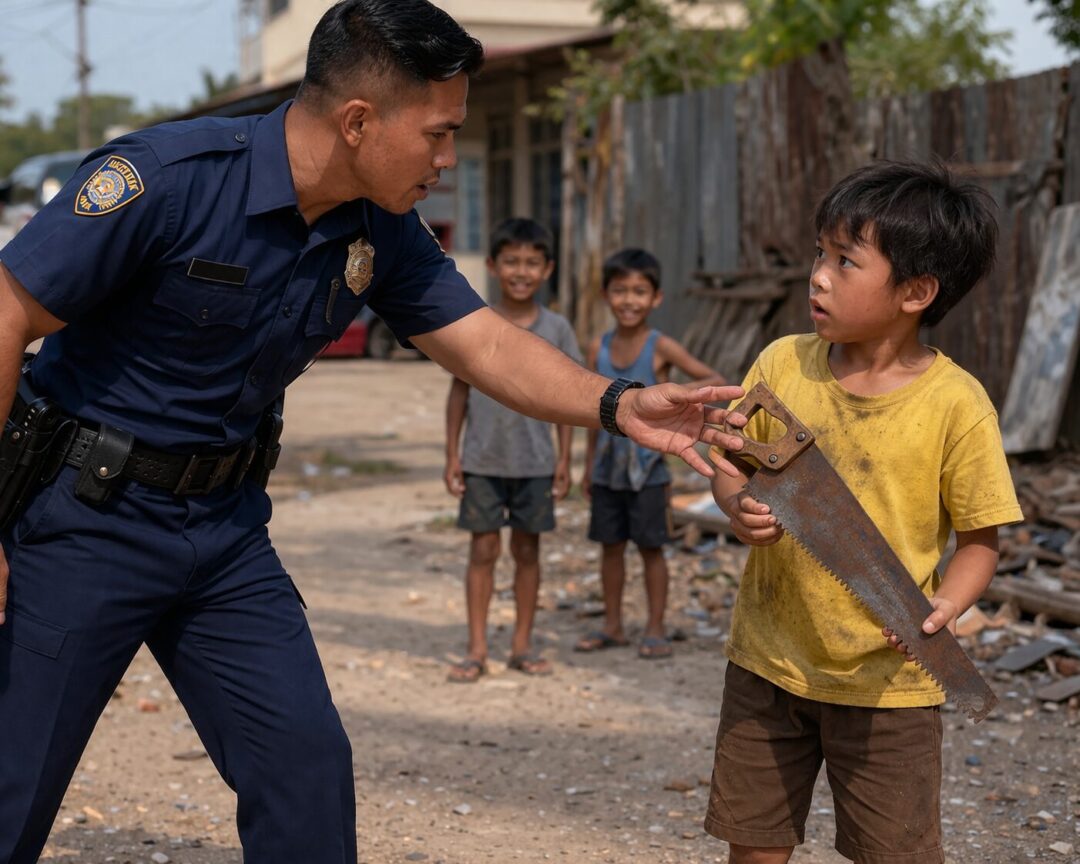
One boy stood in front of the others, thin and dusty, his faded yellow T-shirt darkened with sweat and dirt. He could not have been older than eight. In both hands, he held a rusted hand saw nearly the length of his arm. He swung it once in the air as if he had found treasure instead of danger.
The other boys laughed.
Keegan’s chest tightened so fast it felt like instinct more than thought.
There were moments in the job that happened in levels. First the eyes understood something. Then the body did. Then the mind caught up. This was one of them. By the time his brain had formed the words sharp blade, loose grip, one stumble and blood, his feet were already moving.
He crossed the lot entrance fast.
The boy looked up only when Keegan was near enough to cast a shadow over him. His expression was not guilty. It was proud.
“Look what I found.”
He said it with the open delight children used for frogs in jars, shiny bottle caps, and anything adults were likely to ruin.
Keegan saw the saw’s teeth, brown with rust and dark grime. The handle was cracked. One hard jerk and the blade might slip in the boy’s hand. One playful swing toward another child and the afternoon would become ambulances, screaming, and a mother dropping something in the kitchen when she heard the news.
He did not have time to speak gently first.
“Stop,” he snapped, stepping in. “Give me that.”
The boy’s face changed instantly.
Pride vanished. His fingers loosened around the handle, but not completely. His dark eyes widened with the quick, instinctive fear children reserved for adults in uniform, teachers with crossed arms, fathers coming home already angry.
Behind him, the other boys went still.
Keegan hated that look.
He hated how often urgency sounded like anger to people who had already learned to expect anger first.
The boy swallowed hard. “I didn’t do anything.”
For half a second, the whole lot held its breath.
Keegan saw more in that child’s face than the moment deserved. He saw a nervous reflex that had been practiced before. A defense line ready too quickly. Not brazen. Not manipulative. Just familiar.
I didn’t do anything.
Not, What’s wrong?
Not, Why?
Just the small frightened appeal of someone bracing for blame.
Keegan took the saw from the boy’s hand.
He turned, walked three quick steps to the pile of broken scrap near the far edge of the lot, and hurled the thing as hard as he could into the heap. The blade clanged against twisted metal and disappeared.
The sound echoed.
When he turned back, the boy was still frozen, shoulders tucked in, eyes fixed on him as if waiting for the real punishment to begin.
Keegan let out a slow breath and forced his own shoulders to loosen.
“You’re not bad,” he said, quieter now. “It’s dangerous.”
The words landed harder than he expected.
Something in the boy’s face trembled—not outwardly, not enough for the other children to notice, but enough for Keegan to see the shift. Fear did not vanish. It changed shape. It no longer looked like fear of being punished. It looked like the painful confusion of a child realizing someone had frightened him because they were trying to protect him.
The boy nodded once. Small. Careful.
“Okay.”
That should have been the end of it.
But Keegan stayed where he was a moment longer, staring at the child in the yellow shirt, and could not shake the feeling that he had arrived in the middle of a much older conversation.
Part II — The Boy in the Yellow Shirt
His name was Ellis Mercer.
Keegan learned that later, standing on the narrow porch of a house three doors down from the lot, while Ellis’s grandmother wiped her hands on a dish towel and tried to look less worried than she was.
But before the name, there was the image.
A boy with dusty knees and wary eyes. A child quick to smile at danger and quicker to apologize for himself.
Keegan had seen that combination before.
Not in himself exactly. His mother would have said he had been quieter as a child, too cautious to pick up rusty tools and too stubborn to admit fear when he should have. But he knew the deeper thing when he saw it—the way some children learned to scan an adult’s face before they spoke, trying to determine what version of the world they were standing in. Was this a safe moment? A dangerous one? A forgiving one? A humiliating one?
Children should not have to get good at that.
Grandma Mercer—Darlene, as she introduced herself after a beat—was embarrassed in the particular way decent people got when poverty had made too many decisions for them. She thanked Keegan three times in less than a minute. Then once more after that. She kept glancing toward the lot, then back at Ellis, who stood by the doorframe twisting the hem of his shirt between his fingers.
“I tell them not to go through scrap,” Darlene said. “I do. Lord knows I do. But boys find things.”
Her voice was tired, but not careless. The house behind her was small and clean in the ways that mattered. A box fan rattled in the window. A pot of beans simmered somewhere inside. The sofa had been mended with careful stitches. It was not neglect Keegan smelled in the place. It was strain.
“How long’s he been with you?” Keegan asked, keeping his tone easy.
Darlene paused. Not long enough to be suspicious, but long enough to reveal something.
“Since winter.”
Ellis stared at the porch floor.
Keegan nodded as though the answer explained itself.
“Parents around?”
The question was routine. It still felt invasive.
Darlene pressed her lips together. “His mama sends what she can when she can. She’s out of state.” Then, after a silence that did more talking than her words, “His daddy’s not a person I discuss in front of children.”
Keegan accepted that.
Ellis did not look up once.
Children carried absence in visible ways if you knew where to look. Some became loud enough to fill the gap. Some became silent enough not to add trouble to a house already carrying too much of it. Ellis, Keegan guessed, belonged to the second kind. The ones who tried to make themselves easy to keep.
Darlene touched the back of Ellis’s neck lightly. “Tell the officer thank you.”
Ellis’s shoulders stiffened.
That alone told Keegan more than any report ever would.
Because thank you should have been simple. Instead, the boy looked as though he had been asked to guess the correct answer to a question with consequences.
Keegan crouched a little to bring himself lower, not enough to make it obvious, only enough to cut the height difference.
“You don’t have to say it if you don’t want to,” he told him.
Ellis looked up then, startled.
Keegan saw the child more clearly at close range. Sun-browned skin. A face still soft with babyhood at the edges, though life had already pulled watchfulness into his eyes. A faint streak of dirt across one cheek. One small scar under his chin that had probably come from some earlier adventure no one had enough time to supervise properly.
“I just didn’t want you getting hurt,” Keegan said.
Ellis swallowed. “I know.”
It came out thin, almost soundless, as if he had only just decided to believe it.
That night, long after his shift ended, Keegan found himself thinking about the boy again.
He had gone home to his apartment over the laundromat on Grant Avenue, dropped his keys into the bowl by the door, and stood for too long in the kitchen without turning on the light. The room was blue with evening. Somewhere below, a washing machine thudded out of rhythm.
He had once imagined that the hardest parts of police work would be the obvious things—violence, blood, death notifications delivered at kitchen tables where the food had not yet been cleared.
Those were hard. They never stopped being hard.
But there were other things too. Children who flinched before you touched their shoulder. Teenagers who laughed too loudly because shame had become a performance. Mothers whose relief looked almost identical to exhaustion. Men who confused fear with discipline because it was all they had ever been given.
What stayed with him most were not always the disasters.
Sometimes it was the near-misses.
A rusty saw in a child’s hands.
A sentence spoken too quickly: I didn’t do anything.
A boy who thought protection was the beginning of punishment.
Part III — What Children Learn
Over the next week, Keegan found reasons to pass Mercer Lane more often than he needed to.
He told himself it was ordinary patrol logic. The lot had exposed nails, loose metal, and too many blind corners. Kids drifted there because open spaces were rare and boredom was plentiful. It made sense to keep an eye on it.
That was true.
It was also not the whole truth.
He saw Ellis twice from a distance before the boy finally stopped darting out of sight when the patrol car rolled by.
The first time, Ellis was sitting on the curb with a flattened soda can and a stick, drawing circles in the dirt. He spotted the cruiser and stood up too fast. His body did not run, but it prepared to.
Keegan kept driving.
The second time, Ellis was helping his grandmother carry groceries from a neighbor’s car. He saw Keegan, froze, then looked down. Darlene noticed too and gave Keegan a nod that held gratitude and apology in equal measure. He nodded back and moved on.
The third time, Ellis waved.
It was not enthusiastic. It was cautious, a small lift of the fingers, halfway between habit and experiment.
Keegan smiled before he could stop himself and tapped the horn once in greeting.
By then, he had also learned a little more, not through gossip exactly, but through the slow web of truth that gathered around old neighborhoods. Ellis’s mother worked in another state at a hotel near the interstate, sending money when shifts were steady. His father had come and gone enough times to make permanence feel like a trick. Darlene had raised one daughter already and had not expected to raise a grandson too, especially not this late in life, with arthritis in both hands and blood pressure pills lined up by the sink.
There was no villain in the story in the simple, convenient sense.
No monster visible from the street.
Just the long erosion that poverty, absence, and instability worked on a family, taking a little safety here, a little patience there, until children learned to live among sharp edges and call it normal.
One Friday afternoon, Keegan parked near the corner store and bought two popsicles from the freezer by the register.
He nearly changed his mind halfway back to the cruiser. It was easy for gestures to become performances. Easy for adults in authority to mistake being seen for being helpful. Easy to cross a line without meaning to.
But Ellis was out by the lot again, this time kicking a punctured soccer ball with another boy, and when he saw Keegan walking over, the old fear flickered across his face before he could hide it.
Keegan held up one of the popsicles.
“I figured it’d melt before I got back to the car.”
Ellis blinked.
That was all.
Just blinked, as though he had not been given enough information to understand the shape of the moment.
Keegan crouched again and offered the popsicle handle-first.
Ellis looked toward the porch of his house.
Darlene was there in a rocking chair, shelling peas into a bowl. She lifted her chin once, permission and warning both: be polite, and do not act foolish.
Ellis took the popsicle.
“Thanks,” he said.
This time the word came easier.
Keegan unwrapped his own and sat on the edge of the curb a few feet away, leaving enough space for the boy to keep his dignity. The other child wandered off after a minute, bored by adult proximity.
For a while they said nothing.
Children were better at silence than adults gave them credit for. They only became noisy when silence felt unsafe.
Finally Ellis asked, “Were you mad that day?”
Keegan turned the wooden stick between his fingers.
“At you?”
Ellis nodded.
“No.”
The boy considered that. “You sounded mad.”
“I sounded scared.”
Ellis frowned faintly, trying to fit the idea together. Adults were supposed to be frightened by threats to themselves, not by dangers to children who were not theirs.
Keegan looked out toward the lot. “Sometimes grown-ups talk sharp when something bad could happen fast. Doesn’t always mean they’re angry.”
Ellis licked the red ice from the edge of his popsicle. “My dad talks sharp when he’s angry.”
The sentence came loose and flat, as if he had not intended to say it aloud.
Keegan did not move.
This was one of the hardest disciplines to learn: not filling silence because you were nervous. Not making a child rescue you from your own discomfort.
After a while Ellis added, “Sometimes before he’s angry too.”
Keegan nodded once. “That’s hard.”
Ellis shrugged, but it was the kind of shrug children used when they had long ago stopped expecting adults to understand the size of a thing.
Keegan wanted, suddenly and fiercely, to promise him a cleaner world. One where voices did not turn into storms without warning. One where boys did not sort adult footsteps into categories of danger. One where a rusty saw was just scrap and not an omen.
But promises made to children had to survive contact with reality. Too many adults forgot that.
So he said only what he could keep.
“If I talk sharp to you again, it’ll be because I’m trying to stop something bad. Not because I think you’re bad.”
Ellis looked at him for a long time.
Then he nodded.
It was a small nod, but not the frightened one from the lot. This one had decision in it.
Part IV — The Weight of a Voice
Late in August, the neighborhood held a block cookout in the church parking lot two streets over. Folding tables appeared under shade canopies. Somebody set up a dented speaker that worked only when kicked on one side. Kids ran everywhere, bright with sugar and sweat. Smoke from the grill drifted low over the asphalt.
Keegan stopped by near sunset, still in uniform, not because he was assigned to, but because he had been invited by three separate grandmothers and had learned not to disrespect that kind of authority.
Darlene was there with Ellis beside her, balancing a paper plate piled too high with potato salad and grilled corn. Ellis had grown bolder over the summer. Not transformed. Not suddenly carefree. But less ready to flinch at every unexpected word.
He saw Keegan and gave a shy grin.
Keegan started toward them.
That was when the shouting began.
It came from the far end of the lot, near the alley beside the fellowship hall. A man’s voice. Harsh, loud, and full of the specific fury that wanted an audience.
Every muscle in Keegan’s body sharpened.
He saw Ellis hear it too.
The boy’s posture changed instantly, all openness gone from him. His hands tightened around the paper plate. He did not even need to see who was shouting. His body had recognized the weather before the storm arrived.
A man staggered into view, all furious momentum and stale beer, arguing with a woman Keegan recognized as a cousin of somebody on Mercer Lane. It was not Ellis’s father. Just another man carrying too much anger and too little discipline. But for Ellis, that did not matter. The voice was enough.
Keegan moved before anyone called for him.
He intercepted the man halfway across the lot, turned him aside, lowered his own voice instead of raising it, and kept his hands visible. Two other officers were close enough to help if needed. The man swore, protested, blustered, then finally let himself be steered toward the sidewalk and away from the crowd.
It was handled in minutes.
Nothing dramatic. No fight. No cuffs. Just pressure redirected before it could become harm.
When Keegan returned, Darlene’s face had gone pale with secondhand stress. Ellis stood beside her, silent.
“You all right?” Keegan asked him.
Ellis nodded, but his eyes were still too wide.
Keegan glanced toward the grill, where the older men had already resumed arguing about charcoal like nothing had happened. Life re-formed quickly in neighborhoods used to interruption.
Then Ellis asked, quietly, “How come you didn’t yell?”
Keegan understood the question at once. Not because the man had deserved calm. Not because calm was easier.
Because Ellis was trying to sort adults into categories again. The dangerous kind. The safe kind. The loud kind. The kind who used force because they liked how it felt.
Keegan took a breath.
“Because yelling doesn’t fix everything,” he said.
Ellis looked down at the remains of his melting corn.
“Sometimes,” Keegan added, “people already know they’re doing wrong. Yelling just makes them want to prove they don’t have to listen.”
Darlene watched the exchange with a look so raw it might have been gratitude or grief.
Maybe both.
“And if they don’t listen?” Ellis asked.
“Then you do what keeps people safe.”
The boy thought about that.
Not what wins.
Not what scares.
What keeps people safe.
It was a small difference in language. A vast one in meaning.
Part V — The Thing Left Behind
Summer began to turn at the edges after that.
School supplies appeared in store windows. The mornings lost some of their heat. The lot on Mercer Lane remained what it had always been—dust, weeds, broken lumber, hidden risks. But the children played farther from the scrap pile now. Someone had dragged old tires into a line for jumping. Someone else had nailed a board across a gap in the fence.
Life did not transform. It adjusted.
One afternoon, Keegan found Ellis near the corner, crouched beside a younger child who had fallen off a bike. The little one was crying more from shock than injury, one scraped knee bright with fresh blood.
Ellis did not panic.
He held the bike upright with one hand and kept the other child from rubbing dirt deeper into the scrape.
“It’s okay,” he was saying. “Don’t touch it.”
Keegan stopped a few feet away and watched without interrupting.
The child sniffled. “It hurts.”
“I know.” Ellis glanced up, noticed Keegan, and looked away quickly, embarrassed to have been seen in the middle of something earnest. Then he returned his attention to the crying child. “Stay still.”
There was no imitation of authority in his voice. No swagger. No borrowed harshness.
Just urgency without cruelty.
Keegan felt something ease inside him.
He knelt, checked the scrape, found it superficial, and pulled a small packet of wipes from the cruiser med kit. Ellis held the little boy’s shoulder while Keegan cleaned the knee.
The child winced. Ellis stayed steady.
When it was over, Keegan stood and looked at him. “You did good.”
Ellis shrugged, but there was a glow under it this time, one he could not fully hide.
“You sounded scared,” Keegan said lightly.
A smile twitched at the corner of Ellis’s mouth.
“Yeah,” he admitted.
Keegan nodded toward the smaller child. “Didn’t mean you were mad.”
Ellis looked at him then—really looked, with recognition, memory, and a shy kind of pride.
“No,” he said. “I know.”
That evening, as the sun thinned out over Mercer Lane and the long shadows climbed the fences, Keegan drove past the lot one more time.
The scrap pile was still there, though smaller now.
The children were still children—running, shouting, inventing danger out of boredom and wonder.
Ellis stood among them in his yellow shirt, taller somehow than when summer began, though probably not by much. At one point he bent to pick something from the ground, inspected it, then immediately carried it toward the trash barrel by the corner.
He threw it away without ceremony and jogged back to the others.
Keegan never found out what it had been.
A nail, maybe. A shard of glass. A piece of sharp metal hidden in dust.
Something that could hurt someone if left in a child’s hands.
He kept driving, a faint smile at the edge of his mouth.
Weeks earlier, he had thought the most important thing he took from that lot was a saw.
He understood now that it was not the saw that mattered most.
It was the lesson wrapped around the taking.
That fear did not always mean blame.
That urgency did not always mean anger.
That a sharp voice could carry care inside it.
And that sometimes, in a world full of children learning the wrong things too early, the smallest act of protection could leave behind something stronger than fear.
Something a boy might carry into the next frightened moment of his life and remember at exactly the right time.
Not every danger announced itself with rust and teeth.
Some arrived as voices.
Some as silence.
Some as the old belief that being corrected meant being unloved.
But every now and then, if grace entered fast enough, a child learned a different truth before the lesson hardened.
By the time Keegan reached the end of the lane, the evening light had turned amber across the dirt, and laughter rose once more from the lot behind him—thin, bright, and unbroken.