The HOA Sent Trucks To Tear Down The Ramp He Built Beside His Six-Year Cabin
Chapter 1: The Saw Started Before The Notice Was Read
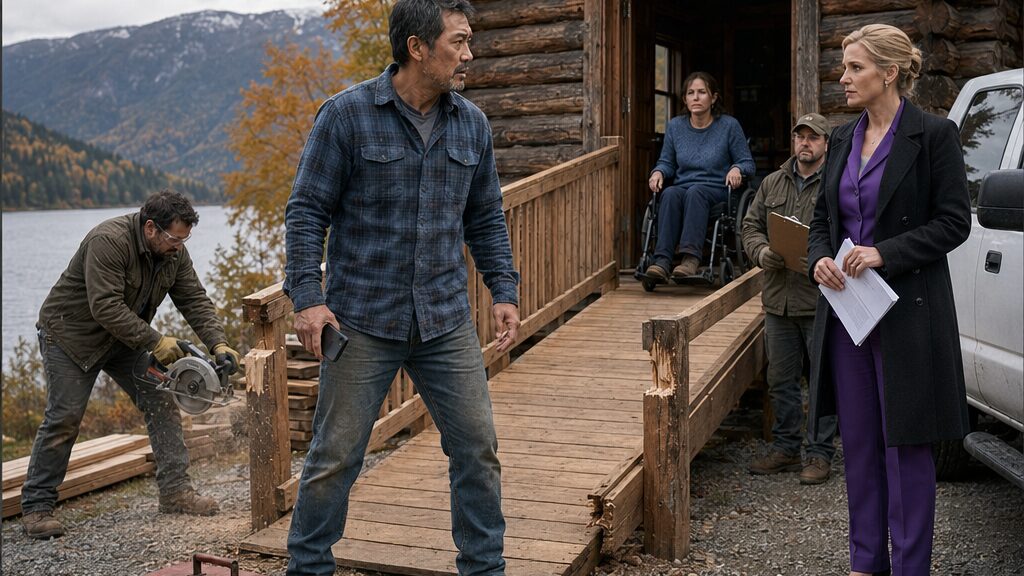
The saw was already biting into the first cedar post when Michael Lee came around the side of the cabin with a coffee cup in one hand and the old red toolbox in the other.
For half a second, he did not understand the sound.
It belonged on a job site, not at his front door. It belonged to a man who had measured twice, checked the grain, marked the cut in pencil, and decided where wood should give way. This sound was rougher. Faster. A blade dropped by someone who did not care what the post held up.
“Stop,” Michael said.
The worker did not stop. He glanced over his shoulder toward the gravel road, where two white trucks sat with amber lights blinking against the yellow autumn trees. The nearest door carried a blue decal: HOA Enforcement. Beside it stood Lisa Clark in a purple suit so bright it seemed to have no business near lake mud, sawdust, or the smell of wet cedar.
Michael set the coffee cup on the top step. The cup rattled once against the boards.
“I said stop.”
The saw whined down, but the blade stayed pressed against the post. A fresh pale wound cut halfway through the cedar. Beneath it, the ramp trembled slightly, as if it had felt the damage.
The crew supervisor stepped from behind the truck with a clipboard tucked against his ribs. “Sir, we have authorization to remove an unapproved exterior structure.”
Michael looked at the ramp. Three weeks ago, he had rubbed oil into those boards with an old rag until the cedar darkened to the same warm brown as the cabin logs. He had built the slope gentle enough for winter ice, wide enough for Anna’s chair, and strong enough that he could push his own truck tire against the rail without budging it. He had left the red toolbox nearby because the handrail still needed one last bracket at the landing.
Unapproved exterior structure.
“It’s an access ramp,” Michael said. “Move your saw.”
Lisa came forward then, heels crunching over gravel. She held a folded paper between two fingers as though she had already decided it was dirty. Her blonde hair was tucked behind one ear, and her mouth had the flat patience of someone who had practiced being interrupted.
“Mr. Lee,” she said. “We notified you that this addition violates Lakeshore Ridge exterior standards.”
“You notified me when?”
“The association has followed procedure.”
“That’s not an answer.”
She extended the paper. “Removal begins today.”
Michael did not take it. He pulled his phone from his shirt pocket and started recording. The screen caught the trucks, the saw, Lisa’s suit, the severed cedar fibers in the post.
“Say your name and what you’re doing on my property,” he said.
Lisa’s eyes narrowed. “There is no need to escalate.”
“The saw is already in the post. You escalated before I walked outside.”
Behind him, from inside the cabin, came a faint thump. Then Anna’s voice, muffled by the door.
“Michael?”
His jaw tightened. He did not turn yet. If he turned, Lisa would see too much too soon, and he hated himself for the instinct. He had spent years making sure Anna never had to be displayed like evidence.
The crew supervisor lowered his clipboard. “Sir, we’re just here to do the removal.”
“Then you can answer a simple question,” Michael said. “Do you have a court order?”
The man looked at Lisa.
Lisa lifted her chin. “We have an HOA enforcement order.”
“That is not the same thing.”
“It is sufficient under the covenants for correction of unauthorized structures.”
Michael stepped between the worker and the ramp post. He kept his hands visible, phone up, toolbox at his boot. The old hatchet was strapped to the side of the toolbox where it always rode, blade covered, handle worn smooth from splitting kindling and shaving cedar stakes. He saw one of the workers notice it. Then he saw Lisa notice the worker noticing it.
Michael moved the toolbox behind his heel.
“Listen carefully,” he said. “That ramp is a medical accommodation. My sister uses it to enter and leave this house. You cut through that post, you have not corrected a violation. You have blocked a door.”
Lisa’s face changed, but not enough. Something flickered there—annoyance first, then calculation.
“There is no approved accommodation on file,” she said.
“I submitted the request four weeks ago.”
“You submitted an incomplete request.”
“You didn’t answer it.”
“We sent a clarification.”
“You asked for a stain sample.”
“Exterior finish is part of compliance.”
Michael almost laughed, and the sound that came out was worse than anger. He turned toward the cabin then.
The front door had opened a few inches. Anna was visible in the gap, one hand braced against the inside wall, her chair behind her. She was still in the blue sweater she wore on colder mornings, hair tied back loosely, face pale with the effort of getting herself to the doorway. She looked first at Michael, then at the cut post, then at the trucks.
“Why are they taking it apart?” she asked.
No one answered quickly enough.
The amber lights kept flashing. Somewhere across the lake, a bird cut low over the water, silent and clean. The whole place Michael had built for quiet now seemed to be holding its breath around the ugly half-cut in the cedar.
Lisa looked past him, toward Anna. “Ma’am, this is an association matter.”
Anna gave a short, dry smile. “That’s my front door.”
Michael felt the words hit harder than anything he had said.
Lisa unfolded the notice and held it toward him again. “Mr. Lee, if you interfere with authorized removal, additional enforcement costs may be assessed to your account.”
“My account,” Michael said. “Not her legs. Not her appointments. Not whether she can get down the steps when the first ice comes.”
The crew supervisor shifted. He looked uncomfortable now, but not enough to put the saw back in the truck.
Michael pointed the phone at the paper. “Read the date.”
Lisa’s fingers tightened on it. “You can read it yourself.”
He took the notice at last. Purple letterhead. Lakeshore Ridge Homeowners Association. Violation: Unauthorized Exterior Ramp / Non-Approved Entry Modification. Removal authorized by board enforcement procedure. Costs billable to owner.
The date sat in the upper right corner.
That morning.
Michael looked from the date to the cut post, then to the amber lights still turning on the trucks.
“You posted this today,” he said.
Lisa did not answer.
The worker behind her glanced down at his boots.
Michael held the notice up so his phone could see it clearly. “You sent a crew before the notice was even read.”
Lisa’s voice lowered. “Mr. Lee, I suggest you step aside before this becomes more difficult.”
“It already is,” Michael said.
Then the damaged post cracked.
Not fully. Just a sharp inward pop where the blade had weakened it. The ramp sagged a fraction of an inch at the landing, and Anna, still in the doorway, drew in a breath she could not hide.
Michael turned fast. “Anna, stay there.”
“I wasn’t planning a parade,” she said, but her voice shook.
Michael faced Lisa again, and for the first time that morning, politeness left him completely. Not his control. Not his restraint. Only the useless softness he had carried into too many meetings, too many unanswered emails, too many requests marked pending.
“No one touches another board,” he said. “Not until I have every name here, the full order in writing, and proof you had the right to start before notice.”
Lisa stared at him, the purple paper bright between them.
Behind her, the saw hung silent.
But the post had already been cut.
Chapter 2: The Cabin Was Approved Before It Had A Door
“Why can’t I get down the front steps?” Anna called from inside the cabin.
Michael had braced a temporary board under the wounded post, but the ramp still dipped when he put weight on it. He stood at the threshold with one hand against the doorframe, blocking the opening without meaning to. He saw Anna notice.
“Don’t do that,” she said.
“Do what?”
“Stand like the door belongs to you.”
He stepped aside.
Anna wheeled closer, stopping where the ramp should have been safe. The front landing sat just beyond her reach, a clean line of cedar interrupted by the pale cut in the post. Outside, the red toolbox rested beside the boards as if it had been abandoned mid-thought. The HOA trucks were gone. Their tire marks remained pressed into the gravel.
Michael had spent six years learning the stubborn language of that land. Where frost lifted stones. Where rain slid down the north side of the roof. Where lake wind found any crack left lazy. The cabin had gone up slowly, paycheck by paycheck, weekend by weekend, with boards stacked under tarps and permits folded into plastic sleeves. He had built the first wall before there was power, the porch before there was paint, and the kitchen cabinets from salvaged maple because Anna once said store-bought cabinets always looked like they were waiting for someone else’s life.
Now she could not get through the front door he had promised her.
“It’s temporary,” he said.
Anna looked at the cut post. “They cut it.”
“Halfway. I stopped them.”
“You stopped half a cut.”
The words landed without cruelty, which somehow made them worse.
Michael picked up the toolbox and carried it to the kitchen table. It left a faint trail of sawdust across the floor. He unlatched it and removed the hatchet first, setting it on the counter far from the window. Then he pulled out a stack of folded papers, envelopes, printed emails, permit copies, sketches with coffee stains in the corners.
Anna wheeled in slowly, watching him sort the past into piles.
“You told me the ramp was handled,” she said.
“I submitted everything.”
“That isn’t what I said.”
He kept his eyes on the papers. There was the original cabin approval from the county. There was the lakeshore setback variance. There was the septic inspection, the roof snow-load letter, the first HOA design approval from before the cabin had even had a door. He found the rough pencil drawing he had made years ago, the cabin nothing but a rectangle and a roofline, the words future accessible entry scribbled near the front.
“I didn’t want you worrying about it,” he said.
“That sentence has done a lot of damage in this family.”
Michael stopped sorting.
Anna was not looking at him now. She was looking through the wide window at the lake. The autumn trees had begun to turn gold around the shore, and their reflection broke whenever wind touched the water. When they were children, she had been the one who ran ahead. He had followed. After the accident, people started speaking to him first whenever they stood together, as if her chair had made her hearing optional. He had hated that. He had promised himself he would never be one of them.
Yet he had hidden the notices.
He opened his laptop and searched the HOA folder. The first email was easy to find: Accommodation Request, Accessible Front Entry, Lot 18. Sent four weeks ago. Attached were Anna’s medical letter, ramp drawings, measurements, stain sample photo, and Samuel Rodriguez’s note on slope and footings.
The reply came three days later.
Received. Pending final exterior review. Please provide physical stain sample and updated railing detail.
Anna read over his shoulder. “Pending.”
“I sent the railing detail.”
“Did you send the stain sample?”
Michael rubbed his thumb against the scar on the table where he had once dropped a chisel. “I had the cedar already treated. Same tone as the cabin.”
“Michael.”
“It matched.”
“That is not the same as sending it.”
He turned in his chair. “They had four weeks. You had an appointment coming. The temporary steps were getting slick. What was I supposed to do, wait until you slipped while they debated wood color?”
Anna’s expression softened, but only a little. “You were supposed to tell me they hadn’t approved it.”
He had no answer that would not sound like fear.
The cabin around them was full of proof of his hands. The uneven stone by the fireplace where he had learned masonry by failing twice. The kitchen shelf Anna had designed low enough to reach from her chair. The narrow desk facing the lake where she planned to work once winter came. The whole place was supposed to say she could live here without asking permission from gravity, strangers, or him.
Instead, a half-cut post outside had told the truth.
Michael found the older HOA approval file next. Six years ago, before the road was paved and before Lisa Clark was president, the board had approved “single-family cabin construction consistent with submitted elevation, natural materials, and accessible entry concept subject to final review.” He remembered the meeting because the room had smelled like burnt coffee and someone had joked that he was building slower than the glaciers.
“They approved the cabin,” he said. “They knew the front entry would be accessible.”
Anna leaned closer. “Subject to final review.”
“Everything is subject to something.”
“That’s how they catch you.”
A sound came from the laptop. New email.
Michael opened it before he could think better of it.
Notice of Continuing Violation and Fine Schedule.
The message was from the HOA office. It said daily fines would begin at sunrise. Removal costs from that morning’s enforcement visit would be assessed to his account. Continued refusal to comply could result in further association remedies, including collection action and lien filing.
Anna read the word lien once. Then again.
“They can take the cabin?” she asked.
“No,” Michael said too quickly.
She looked at him.
He lowered his voice. “Not like that. Not today. It’s a process.”
“A process.” Her hands tightened on the wheels of her chair. “That’s what she called it?”
Michael closed the laptop halfway, then opened it again because hiding the screen now would only prove her right.
“I’ll handle it,” he said.
Anna’s eyes sharpened. “No. You’ll include me.”
The sentence left no room for the old habit. He nodded once.
Outside, the temporary brace creaked under its own weight. Michael looked toward the door, then at the red toolbox open on the table, permits and old promises spilling from it.
At sunrise, the fines would start counting.
Chapter 3: A Purple Suit Turned Safety Into A Photograph
Lisa Clark arrived with a camera before Michael finished clamping the temporary brace.
He saw her reflection first in the cabin window: purple jacket, silver phone, chin lifted against the cold. Behind her, one HOA Enforcement truck idled on the gravel shoulder. The amber lights were off this time, but the decal on the door did enough talking.
Michael tightened the clamp slowly. If he hurried, it would look like guilt. If he ignored her, she would write that down too.
“You’re not authorized to continue work,” Lisa said.
“I’m stabilizing what your crew cut.”
“You were instructed not to alter the structure further.”
“The structure was safe before you sent a saw into it.”
She raised her phone and photographed the post. Then the brace. Then the ramp boards. Each click sounded small and official.
Michael stood. “Are you here to inspect or to collect pictures that leave out the part your crew did?”
Lisa lowered the phone only enough to look at him over it. “I am documenting continuing noncompliance.”
He wiped his hands on his jeans and went to the red toolbox. He had left the hatchet inside this time, under the top tray, where no lens could turn it into something else. From a folder he took Anna’s medical letter, the ramp drawing, the old approval language, and the email showing the request had been received.
“I want these added to the file,” he said.
“You may submit documents through the portal.”
“I did.”
“Then they are in review.”
“No. You sent a removal crew.”
Lisa’s mouth tightened. For the first time, he saw the strain under the polish: faint shadows beneath her eyes, a tremor of irritation in the hand holding the phone. She was not here for a simple victory. She was here because something had to be made tidy before someone else arrived.
“Our insurance renewal inspection is in seventy-two hours,” she said. “The association cannot have undocumented exterior structures on record.”
“It is documented.”
“It is not approved.”
“It is necessary.”
“Necessity does not eliminate process.”
Michael looked at the ramp, at the cut post, at the doorway where Anna had watched too much already. “Process does not replace a door.”
Lisa glanced toward the cabin. “If your sister requires accommodation, the board will review a complete application.”
“She requires a way out of the house today.”
“Then you should not have begun construction without final approval.”
It was the first sentence she had said that landed cleanly.
Michael felt his answer rise—four weeks, no response, ice coming, appointments, common sense—but none of it erased the fact that he had begun. He had told himself the missing stain sample was a technicality because the cedar matched. He had told himself the board would catch up because decent people would see what the ramp was for.
He had built first because waiting felt more dangerous than being wrong.
Lisa saw the pause. Her face settled around it.
“There it is,” she said quietly.
“There what is?”
“You knew.”
Michael stepped closer, not enough to threaten, just enough that she could not pretend the conversation was only a form. “I knew my sister needed access. I knew you had the request. I knew nobody from the HOA answered my calls until a saw showed up.”
Lisa lifted the camera again. “Do not approach me.”
He stopped.
The warning hit the air between them differently than the rest. Not because he had done anything, but because it made a shape around him. A shape someone else could photograph.
From the road, a neighbor slowed in a pickup, looking openly now. Michael felt heat rise at the back of his neck.
He took one step back and held out the papers. “Read the medical letter.”
“I’m not qualified to evaluate medical need at the site.”
“You’re qualified to tear down the ramp without reading why it exists?”
“The board evaluates requests. Not me alone.”
“You ordered the crew.”
“On behalf of the board.”
“Then take responsibility on behalf of the board and read the first page.”
She did not reach for it.
The cabin door opened behind him. Michael turned his head just enough to see Anna in the doorway. She did not come out. She couldn’t, not safely. That was the whole argument, standing there without needing to raise its voice.
Lisa saw her too. Something in her expression moved and was shut away.
“Mrs. Lee—”
“Ms. Lee,” Anna said.
Lisa blinked. “Ms. Lee. I understand this is inconvenient.”
Anna gave a low laugh. “Inconvenient is when the store forgets your order. This is my front door.”
Michael looked down at the papers in his hand. Anna had said the same thing the day before, and it had cut through every technical word in the file.
Lisa adjusted her jacket. “No one is denying access. The rear entrance remains available.”
“The rear entrance is gravel,” Michael said.
“It is an entrance.”
“For whom?”
Lisa did not answer.
Instead she removed a second paper from her folder and clipped it to one of the uncut cedar boards with a metal binder clip. Purple letterhead against raw wood. Stop Work Order. Unauthorized Exterior Modification. Potential Continuing Fines. Potential Lien Action.
Michael stared at the word lien until the rest of the page blurred.
“The association does not want this to escalate,” Lisa said.
“You brought trucks yesterday.”
“And you can stop further action by removing the ramp voluntarily.”
Anna’s voice came from the doorway. “Voluntarily.”
Lisa’s eyes flicked toward her. “By complying with the process.”
Michael folded the medical letter once, carefully, so his hands would not do anything else. “There’s a board meeting?”
“Tomorrow night. Lake lodge. Seven.”
“Put us on the agenda.”
“It is already full.”
“Make room.”
“That is not how—”
“Make room,” he said again, and this time his voice did not rise. It dropped.
Lisa held his gaze. Then she looked past him toward the toolbox, the brace, the ramp, the cabin that had taken six years to become a home. “You will have three minutes during owner comments.”
“Three minutes for a door.”
“Three minutes,” she repeated.
The HOA driver called from the road. “Lisa, you want the north side too?”
She turned away. “Photograph the side elevation.”
Michael exhaled through his nose and bent to gather the papers. The clamp held. The damaged post did not.
Then the driver stepped near the toolbox, angling his phone for a wider shot of the ramp. Michael reached down automatically, lifting the hatchet from inside only because it lay on top of the folder he needed underneath.
“Don’t touch that,” he said.
The driver froze.
So did Lisa.
Michael looked at the hatchet in his hand, then at Lisa’s camera already raised.
The picture clicked before he could put it down.
Chapter 4: The Meeting Where The Ramp Became A Threat
The first picture on the lodge screen was not the ramp.
It was Michael with the hatchet in his hand.
The room made a sound before anyone spoke. A small intake, a chair leg scraping back, a whisper near the coffee urn. The photograph was cropped tight enough to remove the red toolbox, the open folder, the driver reaching toward his papers. It kept Michael’s face, the hatchet, and the HOA truck behind him.
Michael sat in the second row with Anna beside him, her chair angled so she could see the screen without turning her neck. He had told himself to stay quiet until owner comments. He had told himself to let the documents do the work.
Then Benjamin King leaned toward the table microphone.
“This is what our enforcement team encountered yesterday morning.”
Michael’s fingers closed around the folder in his lap.
Anna did not look at him. She looked at the screen. That was worse.
Lisa Clark sat at the front table in the same purple suit, a stack of papers squared before her, a glass of water untouched near her right hand. Michelle Adams sat two seats away with the board binder open, pen held ready. She had the cautious stillness of someone trying not to be pulled into a fight before it had a name.
Benjamin clicked to the next slide. The damaged ramp appeared now, but from an angle that made it look bulky and strange, a cedar arm reaching from the cabin like an afterthought.
“Unauthorized exterior modification,” Benjamin said. “Started without completed approval. Continued after notice. Potential liability exposure. Potential insurance concern. Potential precedent for other owners building first and asking later.”
Michael stood.
Lisa did not raise her voice. “Mr. Lee, public comment is later.”
“You put my picture up first.”
“And you will have an opportunity to respond.”
“That picture is missing what happened.”
Benjamin’s eyes flicked toward the audience. Several neighbors had come, more than Michael expected, their jackets damp from the lake air. “The photo shows what was present.”
“It shows what you wanted it to show.”
Anna touched his wrist.
Not hard. Just enough.
Michael sat down.
Lisa waited until the room settled. “The board understands this is a sensitive matter. But we cannot allow emotional circumstances to override governing documents.”
Anna’s hand left Michael’s wrist.
He felt the loss of it.
The meeting moved through formal lines: call to order, quorum, agenda adjustment. The words had the dull weight of a machine that did not need to hurry because it already knew where the person was standing. When the ramp came back onto the agenda, Lisa summarized the file.
“Owner submitted an incomplete request for exterior modification. Association requested final materials detail. Owner proceeded before approval. A correction notice was issued. Removal began. Owner interfered with enforcement.”
Michael opened his folder and took out the email thread, but Lisa was still speaking.
“The association’s insurer is scheduled for renewal inspection. Unauthorized structures, especially entry modifications with elevation changes, create exposure.”
Benjamin added, “And if we excuse one unapproved build because someone claims special circumstances, we weaken every standard this community depends on.”
Michael looked across the room at the lodge windows. Beyond the glass, the dark lake reflected a row of interior lights. Six years ago, he had stood in this same room with a rolled drawing under his arm while old board members asked about roof pitch and cedar siding. No one had asked then whether a ramp would damage the view. They had smiled at the phrase accessible entry because it sounded harmless before it had boards and rails and a person waiting behind it.
“Owner comments,” Lisa said at last. “Mr. Lee, you have three minutes.”
Michael stood with his folder.
Anna’s chair clicked softly beside him.
He turned. “You don’t have to.”
“Yes,” she said. “I do.”
The room watched her roll into the aisle. Michael followed, carrying the papers because he did not know what else to do with his hands.
At the microphone, he unfolded the medical letter first. His throat felt dry, and the first sentence came out rough.
“My sister lives with me. The ramp is how she enters and leaves the cabin safely.”
Benjamin shifted. “The board has received no completed—”
Lisa lifted a hand to stop him, but not kindly. Procedurally.
Michael looked at the photo still projected behind them. “That hatchet was in my toolbox. The driver reached toward my papers. I picked it up because it was lying on the folder underneath. No one was threatened.”
A neighbor coughed. Someone whispered, “Then why did he have it?”
Michael heard it. Anna did too.
She moved closer to the microphone.
“Because this is a cabin,” she said. “There is kindling. There are cedar stakes. There are things with handles that look scary when someone cuts away everything around them.”
The room went still enough that Michael could hear the lodge heater.
Anna looked at the board, not at the audience. “That ramp is not my brother’s project. It is my front door.”
Michelle’s pen stopped moving.
Lisa’s face remained composed, but her eyes lowered to the binder.
Anna continued, her voice steady but thin at the edges. “The rear entrance has gravel. The side path slopes toward the drainage ditch. If you want to call those access, come sit in my chair and try them in rain.”
Benjamin leaned into his microphone again. “No one is denying you access, Ms. Lee. We are saying there is a process for exterior structures.”
“And I am saying your process left me inside while your crew cut my way out.”
The sentence held.
For one breath, Michael thought it might be enough.
Then Benjamin opened another folder.
“The board cannot govern by sympathy. If the owner had waited for approval, we would not be here. Instead, he built first. Now we are being pressured to accept a noncompliant structure because removal is inconvenient.”
Michael felt Anna flinch at the word.
Inconvenient.
Lisa looked toward Michelle. “Do the March records show final approval?”
Michelle turned pages in the binder. Slowly. Too slowly for Lisa’s comfort. “They show the cabin approved. There’s reference to an accessible entry concept.”
“Final ramp approval?” Lisa asked.
Michelle’s pen hovered. “Not in the written minutes.”
Benjamin seized it. “Then the matter is clear.”
Michael almost spoke, but Anna’s earlier touch stopped him again from inside his own memory. He had been silent too long in the wrong places and too quick in this one. He opened the folder and slid the old approval copy toward Michelle.
“Read the second paragraph,” he said.
Lisa did not reach for it. Michelle did.
Her eyes moved across the page. Something small changed in her face—not agreement, not defiance, but recognition that a line existed where no one had admitted one.
“This should be reviewed with the original recording,” Michelle said.
Benjamin frowned. “We have the minutes.”
“Minutes summarize,” Michelle said. “They don’t always capture conditions discussed.”
Lisa’s voice hardened slightly. “The current issue is final approval.”
“And access,” Anna said.
Benjamin turned to the board. “I move that the owner be given until Monday morning to remove the unauthorized ramp and restore the entry to approved condition. If he fails, the association may complete removal and assess costs, including enforcement and collection fees.”
Michael looked at Lisa. “You’re going to leave her with gravel and steps.”
Lisa’s jaw flexed. “We are offering the rear entrance as temporary access while a compliant proposal is reviewed.”
Anna laughed once, quietly. “Temporary for who?”
Michelle did not second the motion.
For a moment, no one did.
Then another board member, unnamed and stiff-backed near the end of the table, said, “Second.”
The vote moved faster than the discussion had. Lisa voted yes. Benjamin yes. Michelle paused before saying, “I abstain pending review of the March record.”
It did not matter enough.
The motion carried.
Michael gathered the papers because his hands needed an order to obey. Anna backed away from the microphone without looking at him. That frightened him more than Benjamin’s motion.
Outside, the lodge porch light painted her chair silver. The lake wind hit them cold.
“I should have told you,” Michael said.
“Yes,” Anna answered.
“I thought I was keeping it off your shoulders.”
“You put it under my wheels instead.”
He had no defense.
Behind them, through the lodge windows, Benjamin was still at the table, already talking to Lisa over the printed photograph. Michael saw the hatchet image between them like a verdict.
When he opened the truck door for Anna, a board notice arrived on his phone.
Formal Removal Deadline: Monday, 8:00 a.m.
Failure to comply may authorize full removal by association contractor and assessment of all costs to owner account.
Michael read it once.
Then Benjamin’s motion appeared beneath it in bold: lien action may follow continued noncompliance.
Chapter 5: The Picture Made Him Look Dangerous
A neighbor at the mailbox said, “I heard you came at the crew with an axe.”
Michael had stopped the truck only because the mailbox door hung open and one of Anna’s prescriptions was due. He stood with envelopes in his left hand, the lake road empty behind him, and watched the neighbor’s eyes drop toward his belt as if expecting a blade there too.
“It was a hatchet,” Michael said.
The neighbor stepped back half a pace.
Michael heard himself and wished he had said nothing.
He put the envelopes under his arm. “It was in my toolbox. I moved it to reach paperwork.”
“That’s not what they’re saying.”
“Who’s they?”
The neighbor looked toward the bend in the road where the lodge roof showed between pines. “People.”
People. The cleanest hiding place in any neighborhood.
Michael drove home with the envelopes untouched on the passenger seat. The cabin came into view slowly through the trees, its cedar walls warm against the gray sky. The ramp looked worse from the road than it had that morning. The temporary brace made it crooked, guilty. The purple stop-work notice still clipped to one board snapped softly in the wind.
He parked, took the hatchet from the kitchen counter, and placed it deep inside the red toolbox beneath a tray of screws and old drill bits. Then he closed the lid and latched it.
Anna watched from the table.
“Burying it won’t un-take the picture,” she said.
“No. But I’m done letting them make it the first thing anyone sees.”
She had slept badly. He could tell by the way she held her shoulders, by the untouched toast near her elbow, by the careful silence between sentences. Last night, after the meeting, she had gone to her room without asking for help. He had stayed in the kitchen sorting documents until the words blurred.
“The pharmacy envelope came,” he said.
“Thank you.”
He set it beside her. She did not open it.
“What are you doing today?” she asked.
“County records. HOA office if they’ll let me see the file. Samuel’s shop for the ramp drawings.”
“Do I get to know before or after?”
Michael leaned against the counter. “Before.”
That softened something in her face, but it did not erase the hurt.
On the way to town, he saw Benjamin King outside the lodge speaking with two neighbors beside a black SUV. Benjamin held a paper cup and wore a fleece vest with the Lakeshore Ridge logo embroidered over the chest. He was laughing at something until he saw Michael’s truck.
Then he lifted one hand. Not a wave. A pause.
Michael almost pulled over.
He could feel how the scene would unfold: truck door open, boots on gravel, Benjamin’s smooth concern, someone’s phone rising. He could hear himself saying the words he had swallowed in the meeting. You used a cropped picture to make me look dangerous. You called my sister’s front door a precedent. You know exactly what you’re doing.
His foot touched the brake.
Then he saw the lodge window reflect the movement of someone inside. A phone? A face? It did not matter.
He drove on.
At the county records office, the clerk behind the desk pointed him to a public computer and a scanner that hummed like an old refrigerator. Michael searched building approvals, variance letters, and association filings. The county had approved the cabin. The county had signed off on occupancy. The county had no issue with an accessibility ramp if it met slope and footing requirements.
The HOA was the bottleneck. Not the law. Not the county. The association.
He printed what he could and paid in quarters from the truck ashtray.
When he reached the HOA office, the manager behind the counter looked like she had already been warned to expect him. She slid a form through the narrow opening.
“Records requests must be submitted in writing.”
He held up the form. “This is writing.”
“Board packets may take up to ten business days.”
“The removal deadline is Monday.”
“I understand.”
“No,” Michael said. “You process.”
She looked at him sharply.
He exhaled. “Sorry.”
The apology cost him less than the anger would have.
He wrote the request in block letters: March meeting records, audio if available, design review discussion, Lot 18, accessible entry concept. He requested all correspondence related to his ramp, the enforcement order, the insurance inspection, and the decision to send a crew before notice.
When he slid it back, the manager looked down and said, “The minutes are already online.”
“I want the audio.”
She hesitated. “Audio is not usually released unless minutes are disputed.”
“I dispute them.”
A chair creaked behind the interior door. Michael looked up.
Michelle Adams stepped into the office carrying a stack of file folders against her chest. She stopped when she saw him.
The manager said, “Mr. Lee is requesting March audio.”
Michelle’s eyes moved from Michael’s face to the form. “Which March?”
“The meeting when they approved the cabin language.”
Michelle’s grip tightened on the folders. “The written minutes say concept only.”
“I know what the written minutes say.”
For a moment, he thought she would retreat behind process like everyone else.
Instead she said, “Ask for the audio from March. Specifically the design review portion. And ask for the attachment list.”
The manager turned to her. “Michelle—”
“He has the right to request records,” Michelle said. “Whether the board grants it is separate.”
Michael studied her face. “Why?”
Michelle lowered her voice. “Because minutes get cleaned up. Audio doesn’t.”
It was not an apology. It was not even help, exactly. It was a crack in the wall.
He nodded once. “Thank you.”
She looked uncomfortable with the words. “Don’t thank me. I voted to abstain, not to stop it.”
“That was still more than the others.”
Her mouth tightened. “Not enough for your sister to use the front door.”
He left the office with a stamped copy of the request and more questions than paper.
Back at the cabin, he found Anna at the kitchen window, looking at the ramp. He placed the county records on the table. Then he took the hatchet back out of the red toolbox—not to use it, not to hide it—and laid it beside the folder.
“This is what happened,” he said. “The driver reached for the papers. The hatchet was on top. I picked it up to get the folder. Lisa took the picture.”
Anna looked at the hatchet for a long moment.
“Why didn’t you say it like that last night?”
“Because I was angry.”
“No,” she said. “Because you thought if you explained too much, it would sound like begging.”
He looked away.
She was right.
The laptop chimed before he could answer. A message from the HOA office appeared with a scanned packet attached. March minutes, design review summary, file notes.
No audio.
Michael opened the minutes. The paragraph was exactly as Michelle said: accessible entry concept subject to final review. Nothing about the discussion. Nothing about the attachment list. Nothing about the drawing he remembered sliding across the lodge table six years earlier.
At the bottom of the email, one line had been added.
Audio records are archived separately and require board authorization for release.
Five minutes later, his phone buzzed.
Unknown number.
He answered without speaking.
Michelle’s voice came through low and quick. “Ask for the audio from March,” she said. “Not the minutes. Not the summary. The audio. And Michael—ask before Monday.”
Then the line went dead.
Chapter 6: The Record Proved Less Than He Needed
The audio gave Michael the sentence he needed, then took half of it back.
He sat at the county records desk with headphones pressed to his ears, one hand holding the printed transcript request, the other resting on a yellow legal pad. The clerk had found a duplicate archive through the county filing system because Lakeshore Ridge had submitted design approvals with its annual compliance packet that year. The HOA office had not released the recording. The county copy had no reason to protect Lisa Clark.
The old meeting crackled through static and chair noise.
A former board member’s voice said, “Lot 18 cabin elevation appears consistent with natural materials requirement.”
Then Michael’s own voice, younger and rough with nerves: “The front entry will need to be accessible eventually. My sister may live there.”
Paper rustled.
Another voice: “Accessible entry concept is acceptable, subject to final visual review of materials and railing detail.”
Michael wrote the sentence down so hard the pen tore the paper.
Acceptable.
Subject to final visual review.
He removed the headphones and stared at the words. They were proof, but not enough to walk on.
The clerk glanced over. “You okay?”
“Yeah,” he said. “Just found the door and the lock at the same time.”
She did not ask what he meant.
He bought a copy of the audio file on a small drive and printed the archive cover sheet. In the truck, he called Anna.
“They said acceptable,” he told her.
There was a pause. “But?”
“But subject to final review.”
“So Lisa still has a hook.”
“Yes.”
Anna exhaled. “Then find the hinge.”
He almost smiled despite himself.
Samuel Rodriguez’s workshop sat behind a hardware store near the county road, half garage, half lumber cave, with cedar boards stacked by length and a radio playing low near the workbench. Samuel came out wiping sealant from his hands.
“You look like a man carrying a maybe,” he said.
Michael handed him the drawing and the audio note.
Samuel read it, then whistled softly. “Acceptable helps. Subject to review hurts.”
“I need a version they can approve without pretending they were right to cut it.”
Samuel tapped the ramp drawing. “The slope is fine. Width is fine. Footings are fine. The railing detail they’re complaining about, we can change. Cedar face, lower profile, same safety.”
“Can it be done before winter?”
“Sure, if they stop sending people to tear it down.”
Michael folded the paper. “Lisa says insurance inspection.”
“Insurance should like safer access.”
“That’s what I thought.”
Samuel looked toward the back of the shop, where a row of treated posts leaned against the wall. “There’s something else.”
Michael felt his shoulders tighten. “What?”
“When I set those front anchors, the ground under the landing was wetter than it should’ve been.”
“It’s near the lake.”
“Not lake wet. Culvert wet.”
Samuel pulled a pencil from behind his ear and drew the cabin driveway, the ditch, the road curve, the front entry. “Runoff comes down from the association road. That culvert under the shoulder is supposed to carry it past your lot. It’s clogged or crushed. Water is washing under your front approach.”
Michael stared at the sketch. “The ramp covers that.”
“The ramp bridges part of it. Without the ramp, you’ve got gravel washout at the landing and freeze risk at the step.”
“So their fix makes the hazard worse.”
Samuel gave him a look. “Their fix removes the thing keeping your sister off the washout.”
Michael drove home with the audio drive in his shirt pocket and Samuel’s revised sketch on the seat beside him. The road bent along the lake, past cabins with neat woodpiles and approved stain colors, past signs reminding owners about quiet hours and boat storage. By the time he turned into his driveway, the late light had gone flat and gray.
He walked straight to the ramp.
The cut post still held because of the brace. Beneath the landing, where he had not looked closely enough, the gravel had sunk away in a shallow channel. Water had dragged leaves into the hollow. The concrete anchors stood exposed at one edge like teeth.
Michael crouched and pushed two fingers into the wet soil.
Cold mud covered his fingertips.
He had been so focused on the ramp as access that he had missed the ground disappearing under it.
The cabin door opened behind him.
“Bad?” Anna asked.
“Worse than I thought.”
“That’s not your favorite sentence.”
He stood and showed her the mud on his hand. “The association road is draining toward us. Samuel thinks the culvert failed. The ramp wasn’t just helping you over the steps. It was bridging a washout.”
Anna looked at the exposed anchors. “Did they know?”
“I don’t know.”
But he did know one thing: Lisa had photographed every angle except underneath.
He took pictures of the washout, the anchors, the cut post, the road ditch, the culvert mouth half-filled with leaves and gravel. He placed a tape measure across the gap and photographed that too. Then he opened the red toolbox and put the audio drive, printed transcript, county approvals, Samuel’s sketch, and Anna’s medical letter into one folder.
Not scattered anymore. Not hidden in old envelopes. One file. One argument.
Anna watched him from the doorway. “What happens Monday?”
“They come back if I don’t remove it.”
“And if you show them all that?”
“They’ll say it needs review.”
“Then what do we do?”
Michael closed the folder. He almost said, I’ll handle it. The old sentence rose by habit, worn smooth as the hatchet handle.
He stopped it.
“We make them answer in writing,” he said. “And if they send a crew, we make them answer on camera.”
Anna nodded once. Not relieved. Included.
At dusk, engine noise rolled up the gravel road.
Michael looked through the front window.
An HOA truck stopped at the edge of the driveway. The driver stepped out, opened the bed, and began dropping fresh orange cones near the ramp, one after another, bright against the darkening cedar.
Then he left them there, like markers for work already scheduled.
Chapter 7: The Second Crew Came With A Bigger Truck
The bigger truck backed toward the ramp while Anna was still inside the cabin.
Its reverse alarm cut through the morning in short, hard beeps, each one bouncing off the lake and coming back thinner through the trees. Orange cones stood where the driver had left them the night before, bright around the wounded ramp like warning flags at a place already lost. Behind the truck, a flatbed carried pry bars, a portable saw, and two bundles of straps.
Michael stepped onto the gravel without the hatchet.
He had left it inside the red toolbox, closed and latched on the porch. The toolbox itself sat where it had sat the first morning, beside the cedar boards, but this time the top was clear except for a folder, his phone, and a stack of transcript pages held down by a coffee mug.
The crew supervisor climbed out first. He did not look happy to be there.
“Mr. Lee,” he said. “We’re here under the board’s removal authorization.”
“Turn off the truck.”
The supervisor glanced toward the road.
Lisa Clark’s car rolled in behind the flatbed, tires slow over the gravel. She stepped out in a dark coat over the purple suit, hair pulled back tighter than before. Benjamin King followed in his own SUV, not quite part of the crew but near enough to be seen.
“Michael,” Anna called from the doorway.
“Stay inside until I tell you the ramp is safe.”
“I am inside because they made it unsafe.”
The supervisor looked toward the door, then away.
Lisa came forward with a folder against her chest. “Mr. Lee, the deadline passed at eight.”
“It is eight-oh-three.”
“Then you are in continuing violation.”
Michael lifted his phone and started recording. He turned once, slowly, capturing the flatbed, the cones, Lisa, Benjamin, the half-cut post, Anna in the doorway, and the red toolbox.
“This is Michael Lee, Lot 18. The HOA has arrived with a second crew to finish removing an accessible entry ramp while the resident who uses it is inside the cabin.”
Lisa’s expression sharpened. “Do not mischaracterize this action.”
“Then characterize it on camera.”
Benjamin stepped closer. “You were given the weekend to comply.”
“I used the weekend to get the record.”
That stopped Lisa for a fraction of a second.
Michael picked up the first transcript page. His hands were steady, but only because he had spent the hour before sunrise making them so. He had read the words aloud in the kitchen while Anna listened without interrupting. He had practiced not adding anything.
“March design review,” he read. “Lot 18 cabin elevation appears consistent with natural materials requirement. Owner notes future accessible entry. Board response: accessible entry concept is acceptable, subject to final visual review of materials and railing detail.”
Lisa’s eyes moved to the page.
Benjamin frowned. “That does not constitute final approval.”
“No,” Michael said. “It constitutes proof that the ramp was not some surprise structure I invented in the dark.”
“It was still built before final review.”
“I know.”
The admission made the morning shift. Even Benjamin seemed unsure what to do with it.
Michael kept reading. “I should have demanded a written answer before I started. I should have sent the stain sample, even though the cedar matches the cabin. I should not have assumed silence meant common sense would eventually show up.”
Anna was quiet behind him.
He looked at Lisa. “But your crew cut the post before the notice was read. You refused to read the medical letter at the site. You photographed a hatchet without the folder under it. And now you brought a truck to remove the only safe front access before your insurance inspection.”
Lisa’s mouth tightened at the word insurance.
The flatbed engine idled. The sound sat under everything, a mechanical patience.
Benjamin said, “The insurer cannot renew with owner-built structures that have not gone through final review.”
Michael lifted another paper. “That is not what the insurer wrote.”
Lisa’s head turned.
Everyone looked toward the road.
Michelle Adams had parked at the edge of the driveway without anyone hearing her arrive. She wore a rain jacket over office clothes and carried a folder with a blue tab. Her face was pale, but she did not stop walking when Lisa said her name.
“Michelle,” Lisa warned.
Michelle looked at Michael, then at Anna in the doorway, then at the ramp. “The insurer asked for documentation of any exterior entry structure and confirmation that accessible routes were safe and code-consistent.”
Benjamin took one step toward her. “You are not authorized to speak for the board.”
“I am the board secretary,” Michelle said. “And I have the correspondence Lisa forwarded to officers but not the full board packet.”
Lisa’s face changed then. Not collapse. Not guilt. Something smaller and more human: the look of someone whose private shortcut had just been placed in public light.
Michael did not move.
Michelle opened the folder. “The insurer did not request removal. They requested resolution. They specifically noted that lack of safe access could create its own liability concern if the association had notice.”
The crew supervisor muttered, “Wonderful.”
Benjamin’s voice hardened. “The issue remains that the owner proceeded without final approval.”
“And the association proceeded with removal before meaningful notice,” Michelle said.
Lisa turned on her. “We had seventy-two hours before inspection. If that ramp failed, if someone fell, if the insurer walked the property and saw an undocumented structure, the association would be blamed. I would be blamed.”
There it was. Not an apology. Not enough. But a piece of truth with fingerprints on it.
Michael lowered the transcript slightly. “So you made it look simpler than it was.”
Lisa looked at the half-cut post. “I made a decision to protect the association.”
“You protected the file,” Anna said from the doorway.
No one answered her.
Then Anna moved.
Her front wheels reached the threshold before Michael could stop her. The ramp dipped where the cut post had weakened it. The temporary brace groaned. Michael stepped toward her, but she lifted one hand.
“Don’t.”
The word struck him harder than the truck alarm had.
Anna held herself still, halfway between cabin and ramp, her chair angled at a place no one would call accessible if they had to cross it. “I listened all week while everyone talked about my brother’s ramp, my brother’s violation, my brother’s account, his deadline, his compliance. I need to correct the file.”
Lisa looked at her. “Ms. Lee, please do not put yourself at risk.”
“I didn’t.”
Anna’s hand gripped the wheel. “You did.”
The supervisor looked at Lisa. “Are we still removing this?”
Lisa did not answer.
Benjamin did. “The authorization stands until the board rescinds it.”
Michael stepped into the work path then. Not close to the truck. Not dramatic. Just directly between the flatbed and the ramp, transcript in one hand, phone recording in the other.
“No one touches another board while she is on that threshold.”
Benjamin’s lips thinned. “Are you refusing a lawful association action?”
“I am refusing to let you make the hazard worse before you answer the records, the medical request, the insurer’s actual letter, and the drainage washout under that landing.”
Lisa looked sharply at the ramp. “Drainage washout?”
Michael pointed under the landing. “Association road culvert. Samuel Rodriguez documented it. Your runoff is eating out the gravel under the front approach.”
Benjamin shook his head. “That is a separate maintenance issue.”
“It is under the ramp you are removing.”
The first drops of rain touched the transcript page, darkening the paper in small circles. The storm had been sitting over the ridge all morning, waiting.
Michelle moved to Anna’s side, not touching her chair. “The board can call an emergency session.”
Benjamin laughed without humor. “For a ramp?”
Anna’s face turned toward him. She did not raise her voice. “For my front door.”
The rain came harder.
Lisa looked from Anna to the truck, from the truck to the exposed anchors, from the anchors to the folder in Michelle’s hand. The purple suit beneath her coat looked less like armor now and more like a decision she had put on too early.
“Stand down,” she said.
The supervisor’s relief was immediate. “You want us to leave?”
“I said stand down.”
Benjamin stared at her. “Lisa.”
She did not look at him. “Emergency board session at noon.”
Michael lowered his phone, but he did not stop recording.
Anna’s chair remained at the threshold, the damaged ramp waiting beneath her like an argument made of wood.
Lisa turned toward Michael. “Bring your documents.”
Michael looked at Anna.
Anna looked past him, directly at Lisa. “And bring the request with my name on it,” she said. “Not just his.”
Chapter 8: The Cabin Kept Its Door Open
Michael began the emergency meeting by admitting he should have waited for the final written approval.
The lodge room went quiet in a way it had not gone quiet for anger. Rain tapped against the windows. The lake beyond them had turned the color of pewter, and every person at the board table seemed aware of the flatbed truck still parked uselessly near Michael’s cabin.
He stood at the same microphone where the hatchet photo had been used against him. This time, the first image on the screen was not his face.
It was the cut ramp post.
“I started the work after weeks without a final answer,” he said. “That gave the board something to point at. I know that.”
Benjamin leaned back as if the admission proved his whole case.
Michael placed the transcript page on the table before the board. Then Anna’s medical letter. Then the insurer’s correspondence Michelle had brought. Then the photographs of the exposed anchors, the washout under the landing, the clogged culvert beneath the association road. Last, he set down Samuel Rodriguez’s revised ramp drawing with cedar-facing modifications and a lower-profile railing.
“But this is not only about what I did wrong,” Michael said. “It is about what happens when a process sees wood before it sees the person who has to cross it.”
Anna sat beside him, not behind him. Her name had been added to the accommodation request in dark ink at the top of the first page.
Lisa looked at that page longer than the others.
Michelle spoke before Benjamin could. “The March audio confirms that an accessible entry concept was discussed and accepted subject to final review. The owner still needed final approval, but the board record was incomplete.”
Benjamin said, “Incomplete does not equal approved.”
“No,” Michelle said. “And incomplete does not equal justification for cutting first and clarifying later.”
The words landed cleanly because they were not emotional. They were procedural. Michael watched Lisa absorb that. This was the language she had trusted most, turning toward her.
An insurance representative joined by speakerphone, voice thin from the device at the center of the table. “For clarity, our concern is documented risk management. A properly constructed accessible ramp with appropriate maintenance records is preferable to an unsafe or improvised entry path.”
Benjamin pressed both hands flat on the table. “And if every owner builds without final approval?”
“Then the association enforces its process,” Michelle said. “But we are not talking about a gazebo. We are talking about access tied to a medical request, old design approval language, and a maintenance issue under association responsibility.”
Lisa finally looked at Michael. Her face was tired in a way he had not seen before. Not softened. Not forgiven. Just stripped of performance.
“I believed removal was the cleanest way to protect the association before inspection,” she said.
Anna’s voice was quiet. “Clean for the file.”
Lisa looked at her. “Yes.”
No one moved.
It was not an apology, but it was the first honest sentence Lisa had given them.
Michael opened Samuel’s drawing. “This version keeps the slope, adds the cedar facing, lowers the railing profile, and gives access to repair the washout. Samuel can reset the damaged post and reinforce the landing. The association needs to clear the culvert and restore the gravel base before freeze.”
Benjamin started to object. Lisa lifted one hand.
“Motion,” she said, her voice formal again, but not as hard. “Withdraw the removal order for Lot 18. Suspend fines pending completion of revised accessible entry according to submitted drawing. Approve the accommodation request for Anna Lee subject to safety inspection and cedar-facing detail. Assign association maintenance to inspect and clear the road culvert affecting the front approach.”
Michael did not breathe until Michelle seconded.
The vote was not unanimous. Benjamin voted no and made sure the minutes would show it. But the motion passed.
No one clapped.
Michael was grateful for that.
When the meeting ended, Lisa gathered her folders slowly. At the door, she stopped near Anna.
“I should have read the letter at the site,” she said.
Anna looked at her for a long moment. “Yes.”
Lisa nodded once. “I’ll correct the record on the enforcement photo.”
Michael had not expected that. He looked up.
Lisa did not meet his eyes for long. “It did not show context.”
“No,” Michael said. “It didn’t.”
Outside, the rain had thinned. The flatbed truck was gone by the time they reached the cabin. Only the orange cones remained, knocked slightly crooked by wind.
Samuel arrived an hour later with cedar posts in the back of his truck and a thermos balanced beside him. He looked at Michael and Anna, then at the ramp.
“So,” he said, “are we building a front door or arguing with one?”
Anna smiled for the first time that day. “Building.”
The repair took the rest of the afternoon and part of the next morning. The association maintenance crew came too, not with saws this time but shovels, a culvert rod, and gravel. They worked awkwardly around Samuel, embarrassed by the difference between removal and repair. Michael did not make it easier for them, but he did not make it harder either.
He opened the red toolbox and took out screws, brackets, a chalk line, the drill bits he knew by touch. The hatchet stayed inside, under the tray, unnecessary.
When Samuel reset the damaged post, Michael held it steady with both hands. The new cedar met the old ramp with a tight, clean seam. The cut from the saw disappeared behind a reinforcement plate, not erased, but held.
By the following week, the ramp had cedar facing that matched the cabin logs closely enough even Benjamin would have needed a ruler and a grudge to complain. The railing sat lower, stronger, smoother under Anna’s hand. Beneath the landing, fresh gravel covered the repaired drainage path, and the culvert carried water away from the cabin instead of under it.
The final inspection lasted twelve minutes.
The inspector checked slope, handrail height, landing depth, and anchor bolts. Lisa stood at the edge of the driveway with her folder, quiet. Michelle stood beside her. Benjamin did not come.
“Passes,” the inspector said, signing the form against the hood of his truck.
Michael took the copy. He did not feel victorious. He felt tired in places sleep did not reach.
Anna waited at the open door.
“You ready?” he asked.
She looked at the ramp, then at him. “Don’t hover.”
He stepped back.
Her wheels crossed the threshold onto the landing. The boards did not dip. The rail held under her palm. She moved slowly, not because she had to, but because everyone was watching and she refused to hurry for their comfort.
Halfway down, she stopped beside the red toolbox.
Michael’s hand twitched, wanting to help.
Anna saw it and raised an eyebrow.
He let his hand fall.
She rolled the rest of the way to the gravel, turned, and looked back at the cabin. The lake behind it caught a strip of late light between clouds. The ramp looked like it had always belonged there, which was the point and the insult both.
Lisa closed her folder. “The violation is withdrawn. The fine record will be corrected.”
Michael nodded. “Put it in writing.”
“I will.”
Anna turned toward the lake road. “And the photo?”
Lisa’s face tightened, but she answered. “Corrected in the file.”
“Not deleted?”
“No. Corrected. The original remains part of the record.”
Anna considered that. “Good. Let the record show what cropping does.”
Lisa had no reply.
When they were gone, Samuel packed his tools into his truck. Michael gathered the last screws and dropped them into the red toolbox one by one. At the bottom, under the tray, the hatchet lay where he had left it. He closed the lid over it.
Anna waited at the foot of the ramp, facing the water.
“You built too much alone,” she said.
He carried the toolbox to the porch. “I know.”
“You’re going to forget and do it again.”
“Probably.”
She smiled without turning. “Then I’ll remind you.”
Michael set the toolbox beside the door, where it belonged but no longer had to prove anything. The ramp stretched from the cabin to the ground, cedar and bolts and corrected paperwork, but also something less visible: a promise remade in public instead of hidden in a folder.
Anna rolled up the ramp toward him, steady and unassisted.
At the top, Michael opened the door and stepped aside.
The story has ended.