The HOA Said Her Dying Grandfather Forgot Signing Away His Savings—Then Amanda Checked the Date
Chapter 1: The Check That Failed Beside His Hospice Bed
The pharmacy clerk lowered her voice before she said the word declined, as if softness could make the medicine cheaper.
Amanda stood at the kitchen counter with the phone pressed to her ear and looked through the doorway toward the hospital bed in the living room. Frank lay on his back beneath a thin gray blanket, his face turned toward the window. The oxygen concentrator gave its steady mechanical sigh. Beside it, the hospice nurse was checking the line beneath his nose.
“There should be more than enough in that account,” Amanda said.
“I ran it twice.”
The clerk named the amount again. It covered the new pain prescription, anti-nausea medication, and the liquid dose the nurse wanted available before night. Amanda had reviewed the invoice on Friday. She had scheduled the payment herself.
“Can you hold it until this afternoon?”
There was a pause. Paper rustled on the other end.
“I can keep the order open until five.”
“Thank you.”
Amanda ended the call and stayed motionless, one hand gripping the edge of the counter. In front of her lay Frank’s medication schedule, written in the blue ink he had used for as long as she could remember. His letters leaned slightly to the right. The capital F in Friday had a flat top. He had filled out the sheet before his hands became too unsteady.
Next to it, the printer had produced a single page from the hospice billing portal.
PAYMENT FAILED.
The nurse appeared in the doorway.
“Problem?”
“Bank error.” Amanda turned the page facedown. “I’m fixing it.”
The nurse glanced at Frank, then back at her. She had been in the house often enough to recognize the difference between Amanda’s ordinary competence and the tightness now gathering around her mouth.
“The pharmacy can wait a few hours,” the nurse said. “He has enough medication through early evening.”
“Good.”
“But not through the night.”
Amanda nodded.
The nurse did not move. “You don’t have to hide every difficult thing from him.”
“He needs rest.”
“He needs that too.”
Frank stirred in the other room. Amanda lowered her voice.
“The doctor said three weeks. Maybe less. I’m not going to put a banking problem on top of that.”
The nurse’s expression softened without agreeing. She returned to the bed.
Amanda opened the banking app on her laptop.
Frank had kept his savings in two places. His ordinary checking account held household money. The larger reserve sat in a beneficiary trust established years earlier when the subdivision had settled a land-use dispute with its original developer. Several long-term homeowners had received managed accounts. Frank’s was administered through the homeowners association under a written agreement that allowed scheduled distributions for medical care, property taxes, and approved personal needs.
Amanda had hated the arrangement from the first day she learned about it.
Frank had defended it.
“They can’t touch the principal without my signature,” he had said.
The account balance loaded.
Amanda stared at the number.
On Friday, the available amount had been just over eighty-six thousand dollars. Now it showed less than four thousand.
She refreshed the page.
The number did not change.
A transfer appeared beneath it, dated the previous Thursday.
COMMUNITY IMPROVEMENT AUTHORIZATION.
Amanda clicked the transaction. No check image. No electronic copy of the approval. Only a reference number and the initials HOA-TF.
Her first call went to the bank. She passed through an automated menu, a general representative, and finally a trust-services employee who asked Frank’s date of birth, address, and beneficiary code.
Amanda answered everything except the security question.
“What was the name of his first dog?”
She looked toward the living room.
Frank’s eyes were closed.
“Can I put him on the line?”
“If he can confirm the answer.”
Amanda carried the phone to the bed and touched his shoulder.
“Grandpa?”
His eyelids lifted slowly.
“I need one answer for the bank. What was the name of your first dog?”
He blinked.
The nurse paused beside the medication tray.
“Dog?”
“The one you had when you were a boy.”
Frank’s lips moved before sound came. “Rusty.”
Amanda repeated it into the phone.
The employee completed the verification. Keys clicked.
“I see the transfer,” he said.
“Who requested it?”
“The instruction came through the account administrator.”
“The HOA?”
“Yes.”
“For what amount?”
He named a figure that made Amanda sit down on the edge of the chair beside the bed.
Eighty-two thousand five hundred dollars.
“That cannot be right.”
“It was processed under an existing community-improvement authorization.”
“My grandfather is in hospice.”
“I’m sorry to hear that.”
“He did not authorize eighty-two thousand dollars.”
“I can’t determine intent. I can only tell you the documentation was certified by the administrator.”
“Send me the certification.”
“You’ll need to request it from the administrator. We received a verification page, not the underlying board file.”
“Can the transfer be reversed?”
“Not through customer service. You can submit a dispute, but because this is a managed trust, the administrator must respond.”
“How long?”
“Up to ten business days.”
Amanda looked at the pharmacy notice on the counter. “I don’t have ten days.”
The employee gave her the number for the bank’s fiduciary review department and a dispute reference. He could not restore the funds, but he agreed to flag the account against additional nonmedical transfers pending review.
It was not enough. It was something.
After the call, Frank was watching her.
“What did they take?” he asked.
Amanda forced her face to remain neutral. “There’s a transfer I don’t recognize.”
“Who?”
“I’m checking.”
His fingers moved against the blanket. The nails were pale and ridged. “Association?”
The word came too quickly.
Amanda leaned closer. “Why would you ask that?”
Frank looked toward the ceiling.
“Grandpa.”
“I’m tired.”
“Did you sign something for them?”
His jaw tightened. The oxygen machine exhaled between them.
The nurse stepped forward. “He needs a break.”
Amanda wanted to press. She wanted to ask why a man who needed help lifting a glass of water had reacted to the word association as though it carried a memory he had been waiting to avoid.
Instead, she drew the blanket higher over his chest.
“I’ll handle it,” she said.
Frank closed his eyes, but his breathing did not settle.
In the kitchen, Amanda called the hospice billing office. She explained that the trust administrator had made an unauthorized transfer and asked for forty-eight hours. The billing coordinator could grant twenty-four without supervisor approval.
Amanda took it.
By eleven, she had printed the transaction page, the trust agreement, the failed pharmacy notice, and six months of statements. She lined them across the kitchen table.
Frank had taught her to read paperwork that way.
Not in a stack. Side by side.
“Paper lies better when you let it hide behind other paper,” he used to say.
At the bottom of the trust statement was a document-access link she had never noticed. It opened a scanned authorization page submitted by the HOA.
The top half contained formal language about drainage stabilization, retaining-wall repair, emergency disbursement powers, and protection of common property. The lower half held a blue signature.
FRANK LEWIS.
At first glance, it looked convincing.
Then Amanda placed Frank’s medication schedule beside it.
The capital F was rounded instead of flat. The final s in Lewis curled backward. Frank never curled it backward.
She read the certification line.
Submitted by Patricia Mitchell, Board President.
The transfer had not come from a faceless office.
It had come from a woman who lived six streets away, chaired every annual meeting, and had once brought Frank a poinsettia after his first hospital stay.
Amanda printed the page.
As it slid from the machine, she saw the date beneath the signature.
Her hand stopped halfway toward it.
The date was familiar, but she could not yet place why.
She folded the authorization into her folder, picked up her keys, and looked toward the living room.
Frank had turned his face away from her.
Chapter 2: The Signature Dated While Frank Was Hospitalized
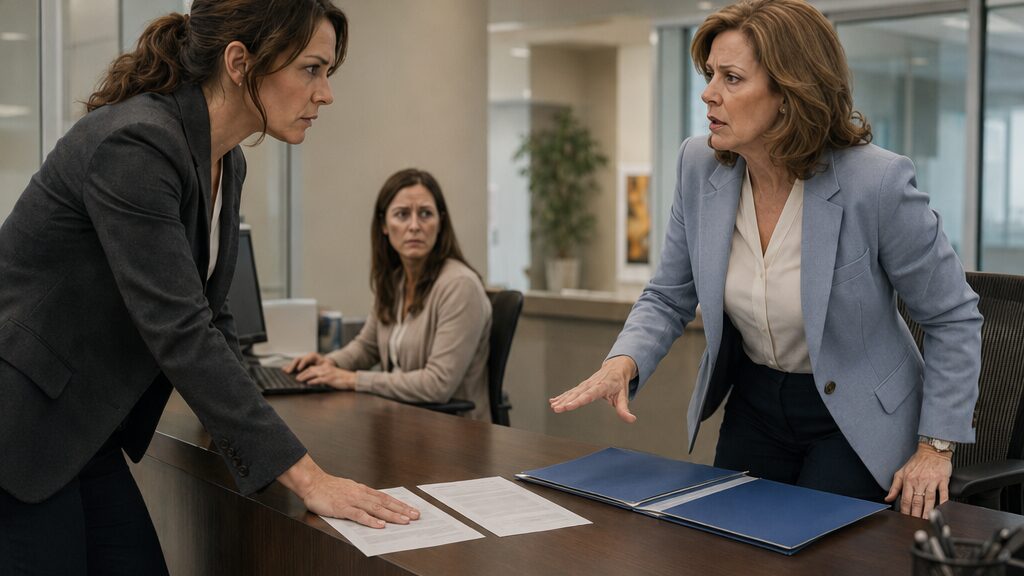
Amanda laid the declined pharmacy statement on Patricia Mitchell’s desk before the receptionist finished saying the board president was busy.
Patricia looked down at the page, then at Amanda.
Her office occupied the back corner of the HOA clubhouse, behind a glass partition etched with the subdivision’s name. The room was bright, cool, and arranged to suggest calm control. Binders stood evenly spaced on a shelf. A framed photograph showed the completed entrance landscaping. Patricia wore a pale blue blazer and a silver watch that caught the light when she folded her hands.
“You should have scheduled an appointment,” she said.
“My grandfather’s medication payment failed this morning.”
“I’m sorry to hear that.”
“Eighty-two thousand five hundred dollars was transferred out of his trust account under your certification.”
The receptionist quietly withdrew and closed the door.
Patricia’s expression changed only enough to become official.
“The board exercised an authorization already granted to the association.”
“Show me the authorization.”
Patricia opened a drawer without hurry. “You already accessed it through the bank.”
“I saw one page.”
“That is the authorization.”
“It is not his signature.”
Patricia leaned back. “That is a serious accusation.”
“It is a direct observation.”
“You are not a handwriting expert.”
“No. I’m the person who has watched him sign birthday cards, checks, repair estimates, school forms, and every note he ever left on our refrigerator.”
Patricia opened a blue folder and removed a copy of the same page Amanda had printed. She set it between them.
“Frank approved emergency access to the trust for community improvements.”
“What improvements?”
“Drainage stabilization and retaining-wall work.”
“Where?”
“The southern easement.”
“What was the board vote?”
Patricia’s gaze sharpened. “Those records are internal.”
“My grandfather’s money is not internal.”
“The trust agreement gives the association administrative authority.”
“Administrative authority is not ownership.”
“No one said it was.”
“You transferred nearly all his remaining balance while he is dying.”
Patricia smoothed one sleeve of her blazer. The gesture was small, almost absent-minded, but Amanda saw what it meant. Patricia was restoring order to the room.
“The project protected the entire subdivision,” she said. “Including Frank’s property.”
“His house is on the north side.”
“Property values are collective.”
“Hospice medication is not.”
Patricia’s mouth tightened. “Amanda, I understand that you are under strain. But your grandfather signed the authorization years ago. If he no longer remembers doing so, that is unfortunate. It does not make the document invalid.”
Amanda felt the words land before she understood their full shape.
“If he no longer remembers?”
Patricia gave a measured sigh. “Memory changes with age. You know that better than most people right now.”
For several seconds Amanda heard only the faint hum of the air-conditioning.
Then Patricia continued.
“The association also maintained Frank’s lawn without charge during his hospitalizations. We sent crews for months. No fines. No maintenance lien. The board has been more than accommodating.”
“You cut his grass.”
“We protected his standing in the community.”
“And that pays for eighty-two thousand dollars?”
“That is not what I said.”
“It is exactly what you meant.”
Patricia pushed the folder toward Amanda.
“What I mean is that this board has acted responsibly under difficult circumstances. You arrived today with incomplete information and an emotional interpretation.”
Amanda looked at the paper sliding across the desk.
The blue signature waited at the bottom.
She had spent the drive to the clubhouse rehearsing arguments. She had imagined raising her voice, demanding access, threatening an attorney. Patricia had expected that version of her. The grieving granddaughter. The exhausted caregiver. A person who could be made to feel unreasonable.
Amanda took the authorization and set it square with the edge of the desk.
Then she opened her own folder.
She removed Frank’s hospital discharge summary.
Patricia’s eyes moved to it.
Amanda placed the two pages side by side.
“What are you doing?”
“This authorization is dated March twelfth.”
“Yes.”
“My grandfather was admitted to the hospital on March ninth.”
Patricia said nothing.
“He remained there until March eighteenth.”
“That does not mean no document could have been signed.”
Amanda drew out the visitor restrictions and treatment schedule attached to the discharge packet.
“He was in intensive care on the twelfth. He was sedated after a respiratory collapse at two fourteen that morning.”
Patricia’s hand moved toward the authorization but stopped.
Amanda placed one finger on the blue signature.
“So either someone carried this page into intensive care while he was sedated, obtained his signature without a witness, and never mentioned it in the medical record—or this date is false.”
“The date may reflect processing.”
“It says date signed.”
“Administrative forms are not always completed in a single sitting.”
“Then show me the original.”
Patricia’s face had lost some of its practiced softness.
“The certified copy is the official record.”
“Show me the board minutes approving the transfer.”
“Internal.”
“The bank instruction.”
“Internal.”
“The contractor invoice.”
“Internal.”
“The permit.”
Patricia’s eyes narrowed. “You do not have standing to conduct an audit from my office.”
“I’m not conducting an audit. I’m asking what you did with my grandfather’s money.”
“I have answered you.”
“You have given me nouns. Improvements. Stabilization. Authority. You have not given me one address, one vote, one invoice, or one lawful reason the signature date falls inside his ICU stay.”
Patricia stood.
The meeting was over because she had decided it was over.
“Submit your questions in writing,” she said. “The board will respond according to policy.”
Amanda remained seated.
“You said he forgot.”
“I said memory changes.”
“You used his age to explain away a signature he could not have made on the date printed beneath it.”
Patricia reached for the folder.
Amanda closed her hand over the authorization.
For the first time, Patricia showed open irritation.
“That is association property.”
“It is a copy provided to the beneficiary.”
“You are disrupting office operations.”
“There are no operations happening in this room except you refusing records.”
Patricia gave a short laugh. It held no humor. “And what exactly do you intend to do?”
“Pull the county permits. Check the property filings. Request the bank’s full transfer chain. File a beneficiary dispute.”
“You think the county maintains our internal project files?”
“No. I think the county knows whether someone had permission to build what you claim was built.”
Patricia walked around the desk and opened the office door.
The receptionist looked up immediately.
Amanda gathered her papers with deliberate care. She tucked Frank’s hospital record behind the disputed authorization so the two dates remained visible through the folder’s clear cover.
At the doorway, Patricia lowered her voice.
“You may want to consider what an investigation will do to this neighborhood. Work was completed. Contractors were paid. Homes were protected. If you create panic because you misunderstand one form, people will remember that.”
Amanda turned.
There it was—not denial, but warning.
“Then the records should calm them,” she said.
Patricia smiled again, though the expression no longer reached her eyes.
“County records,” she said. “Go ahead.”
The laugh followed Amanda into the reception area.
By the time she reached her car, she was no longer shaking.
She photographed every page before starting the engine.
Then she searched the county permit database for the southern easement project.
Chapter 3: The Improvement Project With No City Permit
The county database returned three words beneath the southern easement address.
NO RECORD FOUND.
Amanda entered the parcel number instead.
No record found.
She searched the subdivision name, Patricia Mitchell’s name, the HOA’s legal name, and every variation of “retaining wall,” “storm drainage,” and “slope stabilization” she could think of. Nothing appeared after the previous year’s routine sidewalk repair.
It was nearly midnight. The kitchen table had disappeared beneath printed statements, hospital papers, and the HOA trust agreement. Frank slept in the next room while the oxygen machine kept time with a low mechanical breath.
Amanda opened the authorization again.
A permit number appeared in the upper-right corner, small enough to miss beneath the board’s certification stamp.
She copied it into the county search field.
A result finally appeared.
For one second, relief loosened her shoulders.
Then she read the address.
The permit belonged to a commercial roof replacement twelve miles away.
Amanda checked the digits again. Same number.
She opened the county’s recorded-property index and searched the HOA. Several filings appeared: annual disclosures, liens, easement notices, board certifications. One document listed a temporary construction account connected to the southern drainage corridor.
The account name did not match the HOA’s reserve account.
It belonged to a private limited-liability company.
Amanda searched the company through the state business registry. It had been formed eleven months earlier. The listed mailing address was a rented postal box. The registered agent was not Patricia, William, or any visible board member, but the company appeared on three transfer notices filed as attachments to HOA reserve reports.
The first transfer was forty thousand dollars.
The second was one hundred twenty-five thousand.
The third was two hundred forty thousand.
Nearly four hundred thousand dollars had moved through the private account in stages.
Amanda sat back.
The source video in her mind—the simple version she had believed that morning—had been about Frank’s missing money. One vulnerable man. One unauthorized withdrawal.
Now his transfer looked like the final piece of a much larger structure.
She began building a timeline.
Permit number issued for unrelated roof.
Private company formed.
Emergency authorization language added to board packets.
Transfers initiated.
Frank hospitalized.
Frank’s trust depleted.
At one thirty, she completed an online complaint to the bank’s fiduciary-review department. In the section asking whether the beneficiary had authorized any withdrawal, she selected No.
The answer felt obvious.
She attached the hospital record and disputed signature.
Before submitting, she glanced toward Frank’s medication sheet, the letters in blue ink leaning cleanly across the page.
No, she thought again.
Then she clicked Submit.
At seven the next morning, the hospice nurse found Amanda asleep at the kitchen table with her cheek against a county map.
“The pharmacy called,” the nurse said.
Amanda sat upright.
“They’ll release one day’s medication against the extension. After that, they need payment.”
“I’ll have it.”
The nurse looked over the papers. “Did you sleep at all?”
“Enough.”
“That usually means no.”
Frank coughed from the living room. The nurse went to him while Amanda called the county records office.
By nine, she was standing beneath fluorescent lights at a public counter, waiting while a clerk examined the permit number.
“This isn’t for your subdivision,” the clerk said.
“I know. I need written confirmation.”
The clerk looked at the authorization. “Where did you get this?”
“From the account administrator who used it to remove funds from a beneficiary trust.”
The clerk studied Amanda before turning to a terminal.
“The number is valid,” she said. “But it’s attached to a roof replacement on a retail property. Different applicant, different parcel, different scope.”
“Could the same number be reused internally?”
“Not by the county.”
“What permits exist for retaining-wall or drainage work at this easement?”
The clerk searched.
“Routine maintenance doesn’t always require one. Excavation, structural wall replacement, changes to stormwater flow—those usually do.”
“Do you see any?”
“No.”
“Can you certify that?”
“I can provide a search result and the original permit record. I can’t certify that no unindexed document exists, but I can state what our system shows.”
“That’s enough.”
While the clerk printed the pages, Amanda’s phone vibrated.
An email from the bank confirmed receipt of her complaint. Another came from the HOA’s general address, acknowledging her written records demand and stating that the board would respond within thirty days.
Thirty days.
Frank had been given three weeks.
Amanda forwarded the county result to the bank and began a second complaint through the state’s consumer and financial oversight portal. She described the transfer as unauthorized, attached the hospital dates, and identified the permit mismatch.
At the bottom, a certification warned that knowingly false statements could damage the complaint and expose the filer to liability.
Amanda checked the box.
Outside the records office, she called the number listed for the private company. A recorded voice said the mailbox was full.
She drove to the southern easement.
The road curved behind a row of homes built along a shallow slope. New stonework ran beside the drainage channel. Fresh soil showed where machinery had cut into the bank. The wall was real. The work was not imaginary.
A temporary fence carried no contractor sign.
Amanda parked and walked along the public path. At the far end, one section of earth had been reinforced with concrete and steel mesh. The scale made her pause. Whatever had happened here had cost more than lawn service and routine repairs.
A man watering shrubs watched her from a backyard but did not speak.
She photographed the wall, drainage outlet, and absence of posted permit information.
Then she noticed a metal utility box with an inspection sticker. The company name matched an invoice attached to one of the reserve reports, but the payment recipient on the filing was the private LLC.
Real work. Misdirected money. False permit.
The truth was not becoming simpler.
Back at Frank’s house, she uploaded the photographs and downloaded every publicly available HOA filing. Several included scanned approval pages. Three carried signatures resembling Frank’s—blue, slightly slanted, positioned beneath language allowing emergency assessment waivers.
The signatures were nearly identical.
Too identical.
The same backward curl appeared in Lewis each time.
Amanda enlarged them until the pixels blurred. The starting point of the F sat at precisely the same angle. Even the small break in the second stroke repeated.
Someone had not merely imitated his signature.
Someone appeared to have reused it.
She added the pages to her complaint and sent an inquiry to an independent document examiner whose name appeared on a county court referral list.
At noon, the hospice nurse called from the living room.
“Amanda.”
The urgency in her voice brought Amanda out of the chair.
Frank was awake, breathing harder than before. One hand gripped the blanket. His eyes moved from Amanda to the folder she carried.
“What are you doing?” he asked.
“Fixing the trust transfer.”
His gaze settled on the authorization visible through the clear cover.
Amanda sat beside him. “The permit number is false. The county has no approval for the project, and money went through a private account. I filed a complaint.”
Frank’s fingers loosened.
“You filed what?”
“A beneficiary dispute and a state fraud complaint.”
His eyes closed briefly.
“I told them you authorized nothing,” Amanda said. “The hospital records prove you couldn’t have signed that page.”
Frank turned his head toward her.
For a moment, he looked less ill than wounded.
“Amanda.”
“What?”
He swallowed. The nurse
Chapter 4: What Frank Actually Promised His Neighbors
“Withdraw anything that says I signed nothing.”
Frank’s voice was thin, but the words were clean.
Amanda sat beside the hospital bed with the disputed authorization resting on her knees. The hospice nurse had stepped into the kitchen to prepare medication, leaving the oxygen concentrator to fill the silence between them.
“You were sedated on the date printed here.”
“I know.”
“The signature was reused.”
“Maybe.” Frank looked at the page without reaching for it. “But I signed something before that.”
Amanda felt the complaint forms waiting on her laptop in the next room. The box she had checked. The sentence she had written: The beneficiary did not authorize any transfer or use of principal.
“What did you sign?”
“A temporary advance.”
“How much?”
“Eighteen thousand.”
Amanda stared at him.
“Not eighty-two?”
“No.”
“For the drainage project?”
“For sand, pipe, and temporary bracing. Enough to stop the bank from moving until they could vote properly.”
“You let the HOA use your medical trust for a retaining wall?”
Frank’s eyes shifted toward her. “It wasn’t a retaining wall then.”
He asked the nurse to bring his robe. Amanda objected, but he pushed the blanket aside.
“I want to show you.”
“You can barely walk to the bathroom.”
“I’m not walking.”
Twenty minutes later, Amanda was driving his wheelchair along the paved path behind the southern row of houses. The nurse had allowed ten minutes outside after Frank promised not to leave the chair and Amanda promised to return him immediately if his breathing worsened.
The new stonework ran along the base of the slope. In daylight, Amanda could see where the drainage channel narrowed behind several backyards. Fresh soil had been planted with winter grass, but a long seam in the ground still marked where the hillside had shifted.
Frank pointed toward a house near the bend.
“William’s.”
The rear patio sat several feet above the channel. A hairline crack climbed one corner of the foundation.
“That happened before the work?” Amanda asked.
“Crack was smaller. Ground had started pulling away from the slab.”
He pointed farther down. “Two more houses had water under the crawlspaces. One family moved their kids upstairs every time it rained.”
Amanda looked at the wall again. “Why didn’t the HOA use its reserves?”
“They were short.”
“How short?”
“Patricia said insurance wouldn’t pay until there was structural failure. By then, somebody might lose a house.”
“So she came to you.”
“She came to six of us with old trust accounts. I was the only one who agreed.”
“Why?”
Frank rested both hands on the wheelchair arms. His fingers trembled from the effort of being upright.
“Because I had enough.”
“You needed that money.”
“Not all of it.”
“You’re in hospice.”
“I wasn’t then.”
“You were already sick.”
“I was still allowed to decide what my money was for.”
The rebuke was quiet. That made it harder to resist.
Amanda looked away toward the drainage channel. A maintenance worker had left a length of yellow measuring tape caught beneath a stone. It fluttered against the wall.
“What exactly did the paper say?”
“One paragraph. Emergency advance of eighteen thousand from my principal. Temporary stabilization only. Repayment after insurance or a special assessment.”
“Did it authorize later expenses?”
“No.”
“Did it allow them to take the rest of your account?”
“No.”
“Did you sign at the clubhouse?”
“At my kitchen table.”
“Who was there?”
“Patricia and William.”
Amanda turned back. “William witnessed it?”
“He brought the board folder. Patricia brought the page.”
“Did you receive a copy?”
“I asked for one.”
“And?”
“She said she’d send it after the treasurer recorded the vote.”
“Did she?”
Frank shook his head.
A cough bent him forward. Amanda moved behind the chair, one hand against his shoulder until it passed. His breath returned in shallow pulls.
“We’re going home.”
“Not yet.”
“You’ve shown me.”
“No. You’ve looked.”
He pointed to the concrete outlet at the bottom of the slope.
“The first work was there. Pipe, gravel, bracing. Eighteen thousand could have paid for that. The wall came later.”
Amanda followed the line of his finger. The small outlet was older than the stonework around it. Different concrete. Different weathering.
“The project grew.”
“After the first storm, Patricia said the temporary work proved the whole slope needed replacing.”
“And you refused more money?”
“I told her to call a special meeting.”
“What did she say?”
“That homeowners would panic. That property values would fall before they could collect a dollar.”
“That doesn’t explain your signature appearing on a later document.”
“No.”
“Did you confront her?”
Frank’s mouth tightened. “Twice.”
“And you never told me.”
“You had your job. Your own bills.”
“My mother asked me to look after you.”
“Your mother asked you to love me. That is not the same as managing every choice I make.”
Amanda’s hands tightened around the wheelchair grips.
“I spent all night trying to prove someone stole from a helpless man.”
“I’m not helpless.”
“You can’t stand without assistance.”
“That is not the same thing.”
The distinction struck with more force than if he had raised his voice.
Frank turned toward the houses. “I helped because those people were scared. William’s wife had packed photographs into plastic bins. The family two doors down was sleeping at relatives’ whenever rain came. I would sign the eighteen again.”
“Even now?”
“Yes.”
“And if helping them cost you your medication?”
“That was not the agreement.”
Amanda crouched beside the chair so he would not have to turn.
“I filed a fraud complaint saying you authorized nothing.”
“Then fix it.”
“If I correct it now, the bank may treat the dispute as a contract disagreement. They could release the freeze before anyone reviews the altered page.”
“You want me to lie because the lie makes a stronger complaint?”
“I want time.”
“Call it what it is.”
Amanda stood too quickly.
“What do you want me to do? Wait while Patricia empties what’s left? Let the pharmacy call again? You have maybe three weeks, and every office involved thinks thirty days is reasonable.”
Frank closed his eyes for a moment. When he opened them, the anger had left his face, but not the decision.
“Tell them I signed eighteen. Tell them I did not sign eighty-two. If that makes your case harder, then make a harder case.”
The nurse appeared at the top of the path, signaling that their time was over.
Amanda pushed the chair back toward the house. Neither spoke until they reached the kitchen.
Frank asked for the blue pen beside the telephone.
Amanda handed it to him.
On a blank sheet, he wrote slowly:
Temporary stabilization. $18,000 maximum. Repay after assessment.
His letters shook, but the capital F in the signature had the flat top Amanda knew. The final s in Lewis ended cleanly, without the backward curl.
He stared at the result as though measuring what illness had taken from his hand.
“That is what I agreed to,” he said.
Amanda placed the new page beside the copied authorization.
The signatures did not look like two versions made months apart. One carried hesitation and pressure changes. The other was smooth, almost polished.
“Did the page you signed contain all this language?” she asked, indicating the paragraphs above the disputed signature.
Frank tapped the first block.
“This idea. Not those words.”
“And the rest?”
“There was no rest.”
Amanda looked from his handwritten statement to the authorization certified by Patricia Mitchell.
The page Frank remembered signing had contained one paragraph.
The official version contained four.
Chapter 5: The Treasurer Who Chose His House Over Frank
William Scott opened his front door holding a cardboard records box against his chest.
“I don’t have any board documents here,” he said.
Amanda looked at the handwritten year ranges along the side of the box.
“Then those are unusually organized family photographs.”
William glanced down as though he had forgotten what he was carrying. He was in his late sixties, broad through the shoulders but stooped at the neck. Behind him, the entryway smelled faintly of coffee and damp drywall.
“You shouldn’t be here,” he said.
“You were present when Frank signed the eighteen-thousand-dollar authorization.”
His eyes moved toward the street.
“Come inside.”
Amanda entered without thanking him.
The living room faced the backyard and the repaired slope. A thin crack remained visible above the baseboard near the sliding door. William set the box on the dining table but kept one hand on the lid.
“Frank told you.”
“He told me what he signed.”
William lowered himself into a chair.
“He was trying to help.”
“I know.”
“You filed a fraud complaint.”
“I corrected it this morning. The complaint now states he approved eighteen thousand for temporary stabilization and disputes every amount beyond that.”
William rubbed his thumb over the edge of the box. “That correction may change how the bank handles it.”
“I know that too.”
“Then what do you want from me?”
“The original meeting notes. The version of the authorization Frank signed. The vote record. Every transfer instruction.”
“I don’t have the signed original.”
“Who does?”
“Patricia controlled the files.”
“You were treasurer.”
“On paper.”
Amanda pulled out a chair but did not sit. “You signed the annual disclosures.”
“Because the totals matched the bank statements.”
“The statements showed transfers to a private company.”
“The contractor required a project account.”
“The company was formed eleven months ago and uses a postal box.”
William’s face tightened.
“You searched everything.”
“My grandfather’s medication payment was declined. That made me thorough.”
He opened the box.
Inside were bound meeting packets, loose handwritten notes, and envelopes marked with dates. He removed a yellow legal pad and pushed it across the table.
The page from the emergency meeting contained six lines. Drainage failure. Immediate risk to three homes. Temporary work. Maximum eighteen thousand. Repayment by assessment pending insurance review.
At the bottom, William had written: Frank L. agrees if limited and documented.
“There was no formal vote?” Amanda asked.
“There were only three of us present. Patricia said emergency authority allowed action before ratification.”
“Did you believe her?”
“I wanted to.”
“Why?”
William looked toward the sliding door. Through the glass, his rear foundation sat above the repaired channel.
“The crack doubled in a month. Every storm, water came closer to the slab. An engineer told us the soil beneath this side could shear.”
“So you let Patricia use Frank’s money.”
“For the first work.”
“And after that?”
William removed another packet.
“The contractor opened the slope and found old fill beneath it. Construction debris. Broken concrete. The estimate tripled.”
“Then the board should have stopped.”
“Stopping meant leaving the hillside open during the wettest month of the year.”
“So Patricia kept paying.”
“She said a special assessment would take weeks. She said if we disclosed the full risk before the repair was secure, people would list their homes. Prices would collapse. Insurance carriers might refuse renewals.”
“And you agreed?”
“I signed minutes saying the emergency work continued.”
“Did those minutes say Frank approved the added cost?”
William did not answer.
Amanda opened the packet. The typed minutes described a unanimous decision to use “previously authorized beneficiary funds” for completion of the project.
“Where are the preliminary minutes?”
William lifted the legal pad.
“These.”
“The typed version does not match them.”
“Patricia revised the language.”
“You signed it.”
“She said the intent was the same.”
“Eighteen thousand and eighty-two thousand are not the same intent.”
“I know that now.”
“You knew it then.”
William’s hand closed over the edge of the table.
“My house was moving.”
“And Frank was sick.”
“I didn’t know how sick.”
“You knew he was hospitalized.”
“I knew he had breathing problems.”
“You watched him sign a limited page, then signed minutes that removed the limit.”
William’s voice fell. “Yes.”
The admission did not bring Amanda the satisfaction she had expected. He looked less like a conspirator than a man who had spent months building explanations around one cowardly choice.
“I need these records,” she said.
William pulled the box closer. “If I give them to you, Patricia will say I removed association property.”
“They are copies.”
“Some are originals.”
“Then submit them to the auditor or the state investigator.”
“There is no auditor yet.”
“There will be.”
William shook his head. “You don’t understand. My signature is on those minutes. If this becomes a fiduciary case, I could be personally liable.”
“You were personally responsible when you signed them.”
He flinched.
“I’ll cooperate,” he said, “if your complaint distinguishes my role from Patricia’s.”
“You want me to protect you.”
“I want the record to show I did not alter Frank’s authorization.”
“Did you object when Patricia used it?”
“Not in writing.”
“Did you tell Frank?”
“No.”
“Then I won’t promise you safety from the consequences of your own silence.”
William stood. “You came here because you need what I have.”
“I do.”
“And you’re willing to walk out without it?”
Amanda looked at the box. She thought of the pharmacy deadline, Frank’s labored breathing, and the bank’s warning that her corrected complaint might require further review.
“Yes.”
The word surprised both of them.
“I won’t replace Patricia’s private bargain with yours.”
She gathered copies of the pages he had already placed before her.
William’s hand came down on the legal pad.
“Those stay.”
Amanda released them.
At the door, he said, “Frank knew the houses were in danger. He didn’t hesitate.”
“That is why what you did matters.”
Outside, Amanda photographed the visible crack in William’s foundation from the public walkway. Not because it excused him, but because Frank had insisted the emergency was real.
Her appointment with Nicole Garcia was across town in a narrow office above a printing business. Nicole wore magnifying lenses over her glasses and handled each page with clear sleeves.
“You brought copies,” she said.
“The HOA has the original.”
“Then I can offer a preliminary comparison, not a final conclusion.”
“That’s fine.”
“It usually isn’t fine with clients.”
Nicole scanned Frank’s handwritten statement, the disputed authorization, and three other filings carrying the repeated blue signature.
On a large monitor, she overlaid the signatures.
The curves aligned almost perfectly.
“That degree of repetition is unlikely in natural writing,” Nicole said. “Especially across documents allegedly signed months apart.”
“Copied?”
“Possibly scanned and inserted. Possibly traced from one source. I would need originals to distinguish.”
She enlarged the authorization.
“The signature image has consistent color density. The text above it does not.”
“What does that mean?”
“Different reproduction histories. Look here.”
Nicole pointed to the line separating the first paragraph from the next three.
“The lower paragraphs are slightly darker and sharper. The spacing changes. The page may have been assembled from more than one printing event.”
“Can you prove the language was added after Frank signed?”
“Not from this copy.”
Amanda’s hope tightened into frustration.
Nicole continued, “But I can state that the signature appears mechanically repeated across several documents and that the formatting is inconsistent with a single continuous print process.”
“That is enough to request originals?”
“It should be enough to justify preservation.”
Amanda’s phone rang.
Patricia Mitchell.
She let it ring twice before answering.
“Amanda,” Patricia said. The controlled office voice was gone. “We need to resolve this before it becomes more damaging.”
“What changed?”
“I reviewed the transaction personally. There may have been an accounting mistake.”
Nicole looked up from the monitor.
“What kind of mistake?” Amanda asked.
“The kind we can correct immediately. I can have every dollar needed for Frank’s hospice care restored today.”
Amanda stared at the repeated blue signatures glowing side by side.
“And what do you want in return?”
Chapter 6: The Mistake Patricia Wanted Kept Private
A check for the full hospice balance sat at Amanda’s place in the HOA conference room.
Patricia had positioned it over the copied authorization, covering Frank’s blue signature but leaving the transfer amount visible above it.
“You can deposit that today,” Patricia said.
Amanda remained standing.
Two unnamed board members occupied the far end of the table. Neither met her eyes. William’s chair was empty.
“What are the terms?” Amanda asked.
“This is not a negotiation.”
“Then why is the check here instead of in Frank’s account?”
Patricia folded her hands. “Because the bank has restricted further activity. A direct check is the fastest way to prevent disruption to his care.”
“And after I take it?”
“You notify the bank that the immediate beneficiary issue has been resolved.”
“The beneficiary issue is eighty-two thousand five hundred dollars.”
“This covers all current hospice charges and establishes a reserve for the next thirty days.”
“Frank may not have thirty days.”
One board member shifted in his chair.
Patricia’s gaze held steady. “That is exactly why delay helps no one.”
Amanda sat down at last but did not touch the check.
“What happened to the project?”
Patricia looked toward the closed blinds.
“The original stabilization failed after heavy rain. Once excavation began, the contractor found uncompact fill beneath the slope. The wall could not be safely closed until the unstable material was removed.”
“You had no permit.”
“We filed under emergency maintenance guidance.”
“With a roof permit belonging to another property.”
“That number was entered by the contractor’s office.”
“And transferred into a private company.”
“A dedicated project entity.”
“Owned by whom?”
“The contractor’s project manager.”
“Why not pay the contractor directly?”
“Because subcontractors and material suppliers required separate disbursement.”
Amanda let the silence lengthen.
Patricia finally moved the check closer.
“You saw the slope. You know the threat was real.”
“I do.”
“If we had stopped work, three houses could have become uninhabitable. If we had announced a six-figure special assessment before the engineering report was complete, half the neighborhood would have panicked. People would have withheld dues. Some would have sold at a loss.”
“So you used Frank’s trust.”
“We used available emergency funds to finish necessary work.”
“He authorized eighteen thousand.”
“He authorized the project.”
“He authorized temporary stabilization with a written cap.”
“The scope changed.”
“His consent did not.”
Patricia’s composure slipped. “Do you think I enjoyed this? I had homeowners calling at midnight whenever rain started. Insurance refused to commit. The county told us review would take weeks. The contractor threatened to walk unless invoices were paid. Every option transferred harm to someone.”
“And you chose the man in the hospital.”
“I chose the account that had an existing authorization.”
“You changed the authorization.”
“I relied on the board’s interpretation of its emergency authority.”
“Then why reuse his signature?”
One of the board members looked at Patricia.
Patricia did not answer immediately.
Amanda took out Nicole’s preliminary letter and placed it on the table.
“The signature appears mechanically repeated across multiple documents. The language beneath it was not produced in one continuous print process.”
Patricia read only the first paragraph before pushing the letter away.
“A copy analysis is not proof.”
“No. The original will be.”
The board member nearest the window spoke for the first time. “Patricia, where is the original?”
“In storage.”
“Which storage?”
“The association’s off-site files.”
Amanda watched him realize that he did not know.
Patricia turned back to her. “This is exactly the kind of escalation I am trying to avoid. We can restore Frank’s care funding, conduct an internal review, and correct any document irregularity without damaging every homeowner in the subdivision.”
“Internal review by the people who signed the records?”
“I did not say the current board would conduct it.”
“Who would choose the reviewer?”
“The board.”
Amanda looked at the check.
It was enough to cover the pharmacy, nursing support, and every hospice invoice likely to arrive before Frank died. She could take it home now. She could stop calling billing departments and asking strangers for extensions. She could sit beside him without a folder in her lap.
Her phone vibrated against the table.
The hospice nurse.
Amanda answered.
“His breathing is worse,” the nurse said. “I increased the oxygen, but the current medication isn’t controlling the distress well enough. The pharmacy needs payment before releasing the stronger prescription.”
Amanda looked at the check beneath her hand.
“How long can you keep him comfortable?”
“I’m using what we have. You should come back soon.”
“I will.”
She ended the call.
Patricia had heard enough to understand.
“Take it,” she said, more quietly. “Whatever else you believe about me, take care of him first.”
For a moment, the offer no longer looked like leverage. It looked like money converted into hours without pain.
Amanda picked up the check.
Patricia exhaled.
“I’ll have a short acknowledgment prepared,” she said. “It will state that the association restored the disputed care funds and that you are suspending external complaints pending review.”
Amanda examined the signature line on the check. Patricia’s name was written in black ink, quick and angular.
“Suspending?”
“Temporarily.”
“And the preservation request?”
“You withdraw it while we locate the originals.”
“The state complaint?”
“You advise them the matter is being resolved.”
Amanda folded the check once.
Patricia’s face relaxed by a fraction.
Then Amanda placed it in her own folder.
“I’m depositing this because it belongs to Frank.”
Patricia’s expression changed.
“I am not calling it a settlement. I am not withdrawing anything. I am not agreeing to secrecy.”
“That is not what was offered.”
“Then stop payment.”
The two board members looked at Patricia.
Amanda stood.
“You said this wasn’t a negotiation. Good. Restoring money taken without valid authorization is not consideration for my silence.”
“You are putting every homeowner at risk.”
“No. The project cost did that. Your records made it worse.”
Patricia rose as well. “An external audit will freeze operating funds. Landscaping contracts, utilities, insurance premiums—everything could be affected.”
“Then the board should have considered that before using copied signatures.”
“The signature supported work Frank wanted done.”
“He wanted eighteen thousand dollars of temporary work. He did not give you his name as a blank check.”
Amanda opened the trust agreement to the section she had marked that morning.
Patricia saw the highlighted paragraph and stopped.
“A beneficiary may compel independent review upon a documented dispute involving principal disbursement,” Amanda read. “The cost is charged to the association if material irregularity is found.”
“That provision requires a formal request.”
“I have one.”
She placed the signed request on the table. Frank had not signed it. Amanda had authority under the beneficiary designation to request review while he was medically unable to manage the account.
The board member near the window leaned forward.
“You already filed this?”
“I’m filing it now.”
Patricia’s voice lowered. “Once you do, you cannot control where it goes.”
“I should never have tried to control the whole truth in the first place.”
She thought of the complaint she had corrected, and of Frank telling her to make the harder case.
“The request states that Frank approved eighteen thousand dollars,” Amanda said. “It also states that the board exceeded that approval and submitted a document carrying altered language and a repeated signature. The auditor gets both facts.”
Patricia looked not angry now, but tired.
“The wall saved those houses.”
“Then the audit will say so.”
“And when homeowners receive assessments they cannot afford?”
“They will know what they are paying for.”
“You think truth makes bills easier?”
“No. I think it prevents you from choosing whose account pays them.”
Amanda sent the audit request from her phone before leaving the room.
The confirmation arrived in the parking lot.
INDEPENDENT REVIEW INITIATED. RECORD PRESERVATION REQUIRED IMMEDIATELY.
She drove straight to the pharmacy, deposited the check through the bank’s mobile service, and used her own credit card for the medication while the deposit cleared.
When she reached home, the nurse met her at the door.
Frank’s breathing had worsened. His eyes remained closed while the new medicine was measured.
Amanda sat beside him and took his hand.
“I corrected the complaint,” she said, though she did not know whether he could hear. “All of it. The eighteen thousand too.”
His fingers moved faintly against hers.
“The audit starts tomorrow.”
Frank opened his eyes for only a moment.
“Pen,” he whispered.
“The nurse needs to give you the medicine.”
“Before.”
The nurse looked at Amanda.
On the kitchen table, Frank’s blue pen lay beside the disputed authorization.
By morning, he might no
Chapter 7: The Only Statement Frank Wanted Recorded
Frank asked for the pen before the nurse could increase his medication.
Amanda reached for the blue one on the kitchen table, then stopped.
“Do you understand what you’re signing?” she asked.
His eyes narrowed.
The question sounded clinical the moment it left her mouth. Worse than clinical. It sounded like Patricia’s office, stripped of the polished furniture.
Frank held out his hand.
“I understand you’re stalling.”
Amanda placed the pen between his fingers.
The nurse raised the head of the bed and adjusted the pillows behind him. Frank’s breathing rasped through the oxygen line. The liquid medication waited in a small plastic cup on the tray, clear and measured, promising relief at the cost of alertness.
On the bedside table, Amanda arranged three pages.
The first was her corrected complaint.
The second was a draft declaration summarizing the disputed transfer.
The third was blank.
Frank looked at the draft. “Read it.”
Amanda began.
“I, Frank Lewis, state that I did not authorize the homeowners association to withdraw eighty-two thousand five hundred dollars from my beneficiary trust—”
“Stop.”
“What’s wrong?”
“You skipped the first part.”
“It’s in the next paragraph.”
“Put it first.”
Amanda looked at the nurse. The nurse gave no sign of taking sides.
“The first paragraph should establish what you denied,” Amanda said.
“The first paragraph should establish what I did.”
“Grandpa, the disputed amount is the issue.”
“The truth is the issue.”
His voice was weak enough that each sentence seemed to cost him, but he did not look away.
Amanda sat in the chair beside him.
“All right.”
She opened the document on her laptop.
Frank dictated in short phrases.
“I approved an emergency advance of eighteen thousand dollars.”
Amanda typed.
“For temporary drainage stabilization.”
She added the sentence.
“With repayment expected after insurance or a homeowner assessment.”
His eyes closed while he gathered breath.
“I did it because homes were in danger.”
Amanda’s fingers paused over the keys.
“That isn’t legally necessary.”
“It is necessary to me.”
She typed it.
Frank opened his eyes again. “Now say what I did not approve.”
Amanda read as she wrote.
“I did not authorize any additional withdrawal, expansion of project scope, or use of my signature on later records.”
“Good.”
“Do you want to state that the signature was forged?”
“No.”
Amanda looked up.
“You saw the copies.”
“I saw copies.”
“Nicole says the signature was mechanically repeated.”
“Then let Nicole say that.”
Frank’s hand trembled against the blanket.
“I can say I didn’t sign those pages. Don’t make me say how somebody else made them.”
Amanda deleted the sentence accusing Patricia of forging his signature.
The act felt like loosening her grip on the strongest word she had.
Frank continued.
“I asked Patricia for a full board vote after she told me the cost had increased.”
“When?”
“Before my last hospital stay.”
“Did she respond?”
“She came here.”
“Alone?”
“Yes.”
“What did she say?”
“That stopping work would expose the association to claims. That a vote would frighten people. She wanted me to approve completion.”
“And you refused.”
“I told her no more trust money without an assessment and written repayment terms.”
Amanda typed each word.
“What happened then?”
“She said I had already committed to protecting the neighborhood.”
Frank’s mouth pulled tight at the memory.
“I told her helping once did not make my account hers.”
The nurse checked the oxygen reading and touched Amanda’s shoulder.
“He needs the medication.”
“One more minute,” Frank said.
His voice was barely audible, but the nurse waited.
Amanda finished the declaration and turned the laptop so he could see it.
Frank read slowly. Twice, his gaze lost its place. Amanda guided him back with one finger, careful not to rush.
At the bottom, she had included a sentence stating that he was medically unable to attend an HOA meeting or audit interview.
Frank shook his head.
“Delete unable.”
“You cannot sit through a meeting.”
“Say I will not attend.”
“Why?”
“Because I’m not a display.”
Amanda understood.
The homeowners would gather. Some would be angry about the money. Others would want to see the dying man whose account had paid for their wall. Patricia might present his condition as evidence of confusion. Amanda might present it as evidence of harm.
Either way, Frank would become an argument in a wheelchair.
She changed the sentence.
I will not attend public proceedings. This statement is my account.
Frank nodded.
Amanda printed the page. The printer in the kitchen sounded painfully loud in the quiet house.
When she returned, the nurse had placed a book beneath a clipboard to create a firm writing surface. Frank’s hand looked small around the blue pen.
Amanda pointed to the signature line.
He did not sign immediately.
“What is it?” she asked.
“You.”
“I’m right here.”
“You corrected the complaint?”
“Yes.”
“All of it?”
“I wrote that you approved eighteen thousand dollars. I attached your handwritten note. I removed the statement that you authorized nothing.”
“Even if it hurts the case?”
“Yes.”
Frank looked at her for a long moment.
Then he lowered the pen.
The first stroke of the F wavered. He stopped, lifted the pen, and began again without crossing it out. The flat top formed slowly. The r and a pressed hard enough to leave grooves in the paper. By the time he reached Lewis, the blue line had weakened.
The final s ended cleanly.
No backward curl.
Amanda held the declaration beside the copied authorization. Even weakened by illness, Frank’s writing carried uneven pressure and small human corrections. The disputed signature was smooth, uniform, and identical to the others.
Nicole’s analysis had made the difference technical.
Seeing them together made it personal.
The nurse handed Frank the medication.
He swallowed with difficulty, then let his head sink against the pillow.
Amanda scanned the declaration and sent it to the independent auditor with the corrected complaint, Nicole’s preliminary report, the hospital timeline, the permit mismatch, and photographs of William’s meeting notes. She included William’s contact information but made no promise about how he would be treated.
An hour later, the auditor called.
“The declaration helps,” the auditor said. “Especially because it acknowledges the valid advance.”
“Will you preserve the originals?”
“I issued a records hold this morning. The HOA is required to produce financial files, board packets, electronic document histories, and the original authorization.”
“What if they say the original is lost?”
“That becomes part of the finding.”
“Can you stop more money from moving?”
“I can recommend a temporary freeze. The bank decides whether to honor it.”
Amanda looked at Frank. His eyes were closed now. The medication had eased the strain around his mouth.
“When?”
“I’m sending the notice now.”
The email arrived before the call ended.
TEMPORARY DISBURSEMENT FREEZE APPROVED.
All remaining nonessential project payments from the HOA reserve and beneficiary-administered accounts were suspended pending review.
Amanda read the notice twice.
It did not return the spent money. It did not erase the copied signature. It did not guarantee that Frank would see the final result.
But nothing else could leave the accounts.
She placed the printed freeze notice beneath Frank’s declaration.
His eyes opened slightly.
“They stopped it,” she said.
He gave the smallest nod.
“The auditor accepted the whole statement.”
“Whole,” he murmured.
“Yes.”
The nurse dimmed the lamp.
Amanda remained beside the bed, holding the declaration by its unmarked edge while the blue signature dried.
Chapter 8: The Money Returned Without Erasing the Truth
Patricia Mitchell had to read the sentence twice because the first time her voice failed on the word material.
“The review finds that the discrepancy was not clerical,” she said.
The HOA meeting room was full, but no one interrupted.
Two weeks had passed since the disbursement freeze. The independent auditor sat at the end of the board table with three binders, a laptop, and the disputed authorization sealed inside a clear evidence sleeve.
On the projection screen, two signatures appeared side by side.
The left image came from Frank’s final declaration.
The right came from the authorization used to remove eighty-two thousand five hundred dollars from his trust.
Even from the back row, the difference was visible.
Frank’s signature varied in pressure and spacing. The copied one held the same blue density from beginning to end. Beneath it, the auditor had displayed two additional HOA forms carrying the identical mark.
Amanda sat near the aisle with Frank’s empty chair beside her.
He was alive, but weaker. The nurse had advised against transporting him, and Frank had never changed his decision.
I will not attend public proceedings.
This statement is my account.
Patricia continued reading.
“The beneficiary approved a limited emergency advance of eighteen thousand dollars for temporary stabilization. No reliable evidence establishes consent to additional withdrawals.”
Her fingers tightened around the report.
“The authorization used for subsequent transfers contains formatting changes, language added after the original one-paragraph approval, and a signature image replicated across multiple records.”
A murmur moved through the homeowners.
Patricia stopped until it faded.
The auditor took over.
“The review also found that the drainage emergency was genuine. The initial stabilization work was necessary, and later construction reduced a documented risk to three homes.”
Several people looked toward William.
He sat at the opposite end of the room, shoulders rounded, the original yellow legal pad in front of him.
“The existence of a genuine emergency,” the auditor continued, “does not validate the use of altered records or unrestricted access to beneficiary funds.”
One homeowner raised a hand.
“Are you saying the wall should not have been built?”
“I am saying the board lacked lawful financial authorization for the method it used.”
“So what happens to the money already spent?”
“Some can be recovered from unused project funds and insurance proceeds. Some cannot.”
The room changed at that answer. Accountability had sounded clean until it acquired a price.
The auditor outlined the findings.
The private project company had not been a purely fictitious entity, but its use obscured subcontractor payments and prevented ordinary board oversight. The permit number had been copied from an unrelated file by a project administrator, then repeated in HOA records without verification. Patricia had approved transfers beyond the emergency cap. Two board members had signed minutes they had not independently checked.
No single discovery explained everything.
The harm had been assembled from urgency, fear, bad procedure, and choices made easier because Frank was ill.
William stood when the auditor asked whether any board officer wished to respond.
He carried the legal pad to the microphone.
“I wrote the original notes,” he said. “They show the eighteen-thousand-dollar limit.”
His voice shook, but he did not sit.
“I signed later minutes that did not include that limit. I told myself the work had already gone too far to stop. I told myself Patricia was interpreting the emergency authority, not changing Mr. Lewis’s consent.”
He looked toward Amanda.
“I knew those were not the same thing.”
No one applauded. The silence made the admission heavier.
William placed the notes beside the audit file.
“I chose my house over correcting the record.”
Patricia closed her eyes briefly.
When she spoke again, she did not call it a mistake.
“I believed finishing the work was the least harmful option,” she said. “I still believe stopping it would have endangered homes. But I used an authorization beyond its limit and allowed records to represent consent that had not been given.”
Her words were careful, but they were no longer evasive.
The board accepted the auditor’s corrective plan.
Unused project money would be returned first. Insurance proceeds would restore another portion. The association’s fidelity coverage would review the altered records. A lawful special assessment would cover the remaining verified construction cost, spread across homeowners over time.
Not everyone accepted that quietly.
A man in the second row said he had never approved paying for someone else’s misconduct.
A woman near the window answered that Frank had already paid more than anyone.
Voices rose.
Amanda remained seated.
This was the part Patricia had feared: not exposure alone, but neighbors learning that truth did not remove the bill. The wall remained. The homes had been protected. The money had still come from the wrong place.
The auditor called the room to order.
“The assessment pays for verified work benefiting the subdivision,” she said. “Separate proceedings will determine responsibility for unauthorized transfers and altered records.”
The distinction did not satisfy everyone, but it was honest.
Before the meeting ended, the bank representative confirmed that sixty-four thousand dollars would be restored to Frank’s trust immediately. Additional recovery remained possible, though not guaranteed. His hospice expenses would be paid from a protected subaccount no HOA officer could access.
Amanda had imagined this moment as relief.
Instead, she felt the precise weight of what had not returned.
Eighteen thousand had been Frank’s choice. Some of the remainder was still tied up in legal review. Two weeks of his life had been spent beneath a ceiling while she drove between offices, carrying his name in folders.
Justice arrived in columns, not in restoration.
After the meeting, the auditor gave Amanda a certified copy of the corrected record. Frank’s declaration had been attached as the controlling statement of consent. The altered authorization remained in the file, marked disputed and superseded.
Patricia approached while Amanda placed the copy in her folder.
“I am sorry about what I said in my office,” Patricia said.
Amanda waited.
“About his memory.”
“That was not your largest wrong.”
“No.”
Patricia looked toward the projected signatures, still visible on the screen.
“But it may have been the cruelest.”
Amanda closed the folder.
“You should write that to him.”
“I don’t know whether he wants to hear from me.”
“Then write it without asking for an answer.”
Patricia nodded.
There was no forgiveness between them. Only a sentence that might finally be addressed to the right person.
At home, Frank was awake when Amanda entered.
The hospice bed had been moved slightly closer to the window. Afternoon light fell across the blanket and the small table beside him.
Amanda set down the certified record.
“The audit is finished.”
Frank looked at her face before asking, “Money?”
“Sixty-four thousand restored now. Hospice funds protected. More may come back through insurance and the claim.”
“Wall?”
“Stays.”
“Good.”
“Homeowners will pay an assessment for the verified cost.”
His eyes closed for a moment. “Fairer.”
“Not painless.”
“Fair rarely is.”
Amanda opened the record to the signature comparison.
“The auditor accepted the eighteen thousand as valid. Everything beyond it was unauthorized.”
Frank studied the page.
His authentic declaration appeared above the finding. The blue signature he had struggled to write was now part of the official record.
Not a symbol of confusion.
Not an empty permission.
His choice, with its limit intact.
“William admitted what he did,” Amanda said. “Patricia did too, mostly.”
“Mostly is how people start.”
“She is being removed as president pending the rest of the review.”
Frank showed no satisfaction.
Amanda turned to the final page.
“The altered authorization is preserved, but your declaration controls the record now.”
He touched the paper with one finger.
Amanda had brought the blue pen from the kitchen without realizing it. It rested in her hand, capped, ready for a note, a correction, another form.
Frank noticed.
“Put the pen away,” he said.
“I thought you might want to add something.”
“No more.”
She looked at the folder on her lap. For weeks she had believed that one more document could secure him. One more signature. One more precise sentence.
Frank reached toward her, and she took his hand.
“You did enough,” he said.
The words did not mean she had done everything correctly. They did not erase the complaint she had filed before asking him the whole truth. They did not return the days she had treated him as evidence to be protected rather than a man still capable of choosing.
Amanda capped the pen and placed it in the drawer beside his bed.
Then she removed the folder from her lap.
Outside the window, water moved through the repaired drainage channel behind the houses. It passed beneath the wall Frank had chosen to help begin and had never agreed to finish with all he had.
Amanda sat beside him without paperwork between them.
On the table, his final declaration remained open to the blue signature—uneven, unmistakable, and entirely