Fourteen Neighbors Drove Across His Lawn, but the HOA Knew Who Sent Them
Chapter 1: The Fourteenth Tire Crossed Before Breakfast
The gray SUV left the pavement while Richard Scott was still holding his first cup of coffee.
Its front tire climbed the curb, rolled through the wet strip of grass at the corner, and passed so close to the nearest sprinkler head that Richard heard the plastic crack from the porch. The rear tire followed the same line. A black landscape light bent beneath the undercarriage, disappeared for half a second, then snapped free and spun into the mud.
Richard did not shout.
He set the mug on the porch rail, pulled his phone from his pocket, and opened the camera app before the SUV reached the road again.
The driver never slowed.
Four small feeds appeared on the screen. One camera faced the intersection. One watched the curb. One looked down the side yard. The fourth covered the front walk and the corner bed where Richard had planted low ornamental grass around the lights.
On the curb camera, the SUV’s rear plate filled the frame.
Richard took a screenshot.
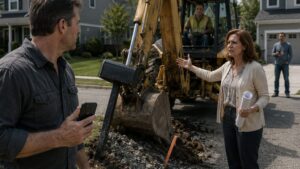
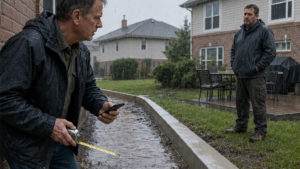
He waited until the vehicle disappeared behind the row of maples, then stepped off the porch. Water from the broken sprinkler pulsed through the grass in short, uneven bursts. The tire had pressed a deep crescent into the lawn, exposing dark soil beneath the turf. One of the landscape lights lay face down three feet from its original position, its black housing cracked through the middle.
He shut off the irrigation valve at the side of the house.
The silence afterward felt worse than the spraying water.
Richard crouched and lifted the light by its wire. Mud filled the lens. He had installed twelve of them himself seven years earlier, measuring the spaces twice so the line would follow the curve of the property without looking forced. They were not expensive individually. That was never the point. The lawn had taken three years to settle into the dense, even surface he wanted. Aeration, soil treatment, overseeding, irrigation adjustments—small things done on schedule until the ground finally held together.
For most people, it was grass.
For Richard, it was the first thing he had ever owned that stayed where he put it.
He carried the broken light toward the garage. On the way, he stopped beside the wooden warning sign he had placed near the corner two weeks earlier.
KEEP VEHICLES ON ROAD.
The sign was flat.
Its two stakes had been pushed into the soil, not snapped. Whoever had knocked it down had done it cleanly enough that the board itself remained intact.
Richard looked toward the road, then back at the house.
The camera facing the corner had captured the SUV. It should have captured the sign falling too.
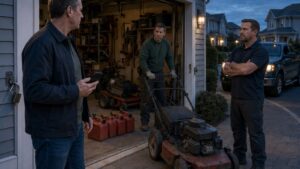
Inside the garage, he placed the light on his workbench beside a yellow legal pad. Thirteen dates already filled the first page.
He wrote the fourteenth.
Saturday, 7:42 a.m. Gray SUV. Sprinkler head. Light.
Beneath that, he copied the license plate number from the screenshot.
He had started the list after the third vehicle crossed the lawn in June. Before that, he had believed the first two drivers had made the same foolish mistake. The corner sat at the edge of the subdivision where the road widened around the clubhouse entrance. During busy weekends, cars sometimes backed up near the stop sign. Cutting across his property saved less than ten seconds.
The third driver had done it while Richard stood beside his mailbox.
The fourth had waved.
After the fifth, Richard installed the signs.
After the seventh, someone flattened them.
After the ninth, he bought the cameras.
He opened the archive on his phone and selected the first incident. A white pickup crossed the lawn at 9:16 on a Saturday morning. The next clip showed a dark sedan at 11:03. Another SUV crossed at 2:21 that afternoon. The dates changed. The angle did not.
Every vehicle entered near the same section of curb and left through the same shallow gap between the last landscape light and the drainage grate.
Richard moved through the recordings one by one, marking each date beside the corresponding line on his legal pad. His anger had become easier to handle once it could be organized.
License plate.
Time.
Entry point.
Exit point.
Visible damage.
He called the landscaping contractor shortly after eight. The contractor had already replaced two sprinkler heads and repaired one section of torn sod that summer. He listened while Richard described the latest damage.
“I can come Monday,” the contractor said. “But you need something there besides signs.”
“I have cameras.”
“I mean something solid.”
Richard looked through the open garage door at the corner.
Large stones would stop the vehicles. So would steel posts. But the HOA covenants restricted permanent objects within the sight triangle of an intersection, and Richard had no interest in giving the board a reason to make the damage his fault.
“I’ll handle it,” he said.
He photographed the sprinkler head from three angles. Then the rut. Then the broken light on the workbench beside a measuring tape. He included the time on his phone screen in the edge of each image, not because he expected anyone to doubt him, but because he had learned that people doubted whatever cost them money.
At nine, he returned to the corner to retrieve the flattened sign.
It was gone.
Only the two narrow holes remained where the stakes had been.
Richard stood over them, certain for a moment that he had approached the wrong place. Then he saw the rectangular patch where the board had pressed the grass flat.
He opened the camera archive again.
The SUV crossed at 7:42.
At 7:49, a pickup stopped near the curb. A person stepped out wearing a bright volunteer vest. The figure walked beyond the camera’s clearest angle, bent near the sign, and returned carrying something long and pale.
The face was not visible.
Richard replayed the clip twice.
The volunteer vest bothered him more than the missing sign.
He returned to the garage and opened the calendar he kept on the wall beside his workbench. He compared the dates of all fourteen incidents.
Each one fell on a Saturday or Sunday.
Then he opened the subdivision website and checked the clubhouse schedule.
Community yard sale.
Youth sports registration.
Pool fundraiser.
Summer craft market.
Each event matched one of his camera dates.
Richard looked from the calendar to the broken black light on the bench.
Fourteen different vehicles had crossed his lawn.
But for the first time, he wondered whether they had all been sent there.
Chapter 2: Four Cameras Watched the Same Corner
The same gray SUV appeared on four screens, but it seemed to enter Richard’s property from four different streets.
On the first camera, it approached the intersection behind two other cars. On the second, its front tire climbed the curb. On the third, the driver turned slightly to avoid the drainage grate. On the fourth, the rear wheel struck the sprinkler head and dragged the broken landscape light through the grass.
Richard froze the final frame.
A person in a volunteer vest stood near the clubhouse entrance in the distance, one arm extended toward the corner.
He enlarged the image until the pixels broke apart.
The face remained impossible to identify.
By Monday morning, Richard had arranged the evidence across his dining table. Fourteen folders. Fourteen license plate screenshots. Fourteen sets of damage photographs. Repair invoices and estimates lay in a separate stack.
The amounts were not equal.
One vehicle had left only a shallow track that recovered after two days. Another had crushed a sprinkler head and cracked the irrigation line below it. Three drivers had damaged landscape lights. Two had driven through the same wet section after heavy rain and left ruts deep enough to require new sod.
Richard knew the difference. He worked for the municipal water department as an irrigation technician. He spent most days locating leaks other people could not see and explaining why a small break underground could become a large bill above it.
Precision was not a personality trait to him. It was how mistakes stopped spreading.
Kathleen Wright studied the folders without speaking when he brought them to her office that afternoon.
Her office sat in a low brick building outside Nashville, between an insurance agency and a tax service. She wore reading glasses only when she examined documents, lifting them whenever she looked directly at Richard.
“You’ve done more documentation than most clients do after a commercial loss,” she said.
“I knew what they’d say.”
“What would they say?”
“That it was just grass.”
Kathleen glanced at the photographs of the broken sprinkler line. “Some of it is grass.”
“And some of it is equipment.”
“Yes.”
“And they crossed private property.”
“That appears clear in several clips.”
“Several?”
She slid one folder away from the others. “This sedan enters the lawn, but your camera loses the rear tire behind the mailbox. The rut photograph was taken seventeen minutes later. That may still be enough to make a claim, but it is not the same as watching a tire break a fixture.”
Richard leaned back.
Kathleen opened another folder. “This one shows no measurable damage.”
“The vehicle crossed.”
“You asked me about restoration costs, not trespass damages.”
“It contributed to the pattern.”
“A pattern is useful. It does not make every driver responsible for every repair.”
Richard looked at the fourteen folders, each one aligned with the edge of her desk.
He had expected questions about legal language, not questions about the structure of his anger.
Kathleen removed her glasses. “What result do you want?”
“The property restored.”
“Then we calculate what can be supported.”
“And I want it stopped.”
“That may involve the HOA.”
He told her about the clubhouse schedule and the person in the volunteer vest. Kathleen asked to see the footage.
Richard opened the clip from Saturday. She watched the volunteer step near the curb and gesture toward the corner. Then she watched the sign disappear seven minutes after the gray SUV crossed.
“Could be directing traffic,” she said.
“That’s what it looks like.”
“Could also be telling the driver to go around the line.”
“Across my lawn?”
“I’m not defending it. I’m telling you what we can prove.”
Richard had heard that sentence in different forms at work. A leak may be under the sidewalk. A valve may have failed. A homeowner may have changed the grading. What mattered was what could be isolated.
He should have respected the distinction.
Instead, he said, “Send demands to all fourteen.”
Kathleen folded her hands. “Not yet.”
“I have plates.”
“You have evidence of fourteen crossings and differing levels of damage. We should identify the registered owners, send preservation notices, ask the HOA for event records, and separate the stronger claims.”
“They’ve had weeks to come speak to me.”
“Did you speak to them?”
Richard’s jaw tightened.
Kathleen waited.
“I put up signs.”
“That is not the same question.”
“They knocked them down.”
“Do you know which driver did that?”
“No.”
“Then you know why I’m asking.”
Richard looked toward the window. A delivery truck idled near the curb while the driver carried packages into the insurance office next door.
“I stayed quiet because I didn’t want a neighborhood scene,” he said.
Kathleen’s voice softened, though not enough to feel like agreement. “Silence can keep a scene from happening. It can also leave you with assumptions.”
He returned to the evidence.
Together they reviewed each folder. The confirmed costs added up: sprinkler heads, wiring, cracked housings, sod removal, soil leveling, labor. Kathleen wrote separate amounts on separate sheets.
When they reached the sixth incident, Richard paused the recording.
A dark crossover waited behind two cars near the clubhouse entrance. A volunteer in a bright vest stepped into view and made a wide sweeping motion with both hands. The driver turned toward the corner, hesitated, then crossed Richard’s lawn.
Kathleen leaned closer.
“That’s more than a random shortcut,” she said.
“So we agree.”
“We agree someone appears to be directing traffic.”
“From the HOA event.”
“Likely.”
Richard felt the first clean edge of vindication.
Kathleen ruined it immediately.
“That may reduce the driver’s responsibility for choosing the route.”
“They still drove over grass.”
“Yes.”
“They could see it wasn’t a road.”
“Yes.”
“Then why should that reduce anything?”
“Because responsibility is not always all or nothing.”
Richard closed the laptop.
Kathleen did not push him. She gathered the repair estimates instead and explained the process. Certified demands could state the known facts, include photographs, request insurance information, and allow thirty days for response. But the language needed to match the evidence in each file.
Richard listened until she proposed sending only nine demands first.
“No,” he said.
“Richard.”
“All fourteen crossed.”
“Two show no confirmed damage.”
“They were part of the same conduct.”
“One may have followed directions from someone the HOA placed there.”
“They still used my property.”
Kathleen looked at him for several seconds. “You understand that if we send a demand too broadly, the recipient may stop listening even where you are right.”
“They weren’t listening when the signs were standing.”
That evening, Richard returned home with the broken landscape light in a clear evidence bag Kathleen had given him. He wrote the incident date on the label and placed it in the garage cabinet.
Then he walked the property line with a tape measure.
The contractor had replaced the sprinkler head but left the sod repair for later, when the soil dried. The black lights formed an uneven line now, with one gap near the corner.
Richard stood in that gap and looked toward the clubhouse.
Cars were already gathering for a weeknight committee meeting. None crossed his lawn.
He wondered whether word had spread.
The next morning, Kathleen called.
“I can send all fourteen,” she said. “But the letters will not claim equal damages. Two will request information and put them on notice. The others will include itemized amounts tied to what we can support.”
Richard was silent.
“That is as far as I will go,” she added.
“When?”
“This afternoon.”
At four-thirty, fourteen certified envelopes left Kathleen’s office in a postal tray.
Each carried a vehicle owner’s address.
Each carried Richard’s name.
By sunset, there was nothing left for him to organize except the waiting.
Chapter 3: The First Neighbor Refused the Story
Thomas Miller arrived with the demand envelope unopened and forty-five dollars folded beneath a rubber band.
Richard saw him through the garage window three days after the letters were mailed. Thomas parked his work van on the street, not in the driveway, and walked toward the house with both hands visible.
The envelope had Richard’s name printed beneath Kathleen’s return address.
Thomas held it up before Richard could speak.
“This came certified,” he said. “My wife signed for it. I haven’t opened it.”
“Then how do you know what it is?”
“Because two other people got the same thing.”
Richard set down the sprinkler fitting he had been cleaning.
Thomas placed the envelope on the workbench. Then he put the money beside it.
“What’s that?”
“The light.”
Richard looked at the folded bills.
Thomas nodded toward the clear evidence bag in the cabinet. “Black housing. Round top. Right side of the corner.”
Richard said nothing.
“I felt it under the tire,” Thomas continued. “I should’ve stopped. I didn’t.”
“You also crossed the lawn.”
“Yes.”
“The letter includes the sod and sprinkler damage connected to your vehicle.”
“That’s the part I’m not accepting.”
Richard opened the cabinet and removed the folder containing the gray SUV screenshots. He placed the clearest image on the bench.
“That’s your plate.”
“I know my own truck.”
“It shows your rear tire over the damaged area.”
“It shows my tire crossing your yard. It doesn’t show me breaking that sprinkler.”
“The contractor found the head cracked after you crossed.”
“After I crossed.”
Richard heard Kathleen’s voice in that distinction and disliked Thomas for making it.
“You came here to argue wording?”
“I came here because you’ve got my daughter named in a property claim.”
Richard looked down at the folder. The registered owner was Thomas. The camera showed a driver with long hair, but the face was obscured by glare.
“The vehicle is registered to you.”
“She was driving.”
“Then she crossed my lawn.”
“Because somebody in a volunteer vest told her to.”
Richard’s hand remained on the folder.
Thomas pushed the money closer. “She called me from the clubhouse entrance. Cars were backed up past the stop sign. A woman with an orange arrow told her to take the grass around the corner and come back in from the side street.”
“There is no side entrance from my property.”
“I know that now.”
“She could see it was a lawn.”
“She is sixteen. An adult in a vest was waving cars through.”
“That doesn’t make grass a road.”
“No. It doesn’t.” Thomas’s voice stayed level. “That’s why I’m paying for the light.”
The quickness of the admission unsettled Richard more than denial would have.
Thomas picked up the unopened envelope but did not leave.
“I’m not asking you to forget what happened,” he said. “I’m asking you to tell the story accurately.”
Richard looked toward the corner. The missing sign had not been returned. The repaired sprinkler head sat lower than the others because the soil around it had softened.
“What story is that?”
“That my daughter followed directions she should’ve questioned. That I told her to keep moving when she called because I was already late getting equipment into the fundraiser. That she felt the light under the tire and I told her we’d deal with it later.”
“You didn’t.”
“No. I didn’t. That part is mine.”
Thomas slid the forty-five dollars forward another inch.
“But I’m not paying for every rut because your camera caught our SUV once.”
Richard opened the folder and laid out three photographs. “This is the rut from that morning.”
Thomas examined them. “You took these at eight-sixteen.”
“Yes.”
“My daughter crossed at seven-forty-two.”
“There were no other vehicles between.”
“How do you know?”
“Four cameras.”
Thomas glanced toward the corners of the house. “Then check the one facing the clubhouse.”
“I did.”
“Did you see the arrow?”
Richard frowned.
Thomas took out his phone and sent a message. A minute later, an image appeared on the screen.
It showed the clubhouse entrance from inside the gray SUV. Cars filled the lane ahead. Near the curb stood a temporary sign: a white board with a thick orange arrow pointing toward Richard’s corner. Behind it, a volunteer in a bright vest gestured in the same direction.
The lower edge of the photograph included the dashboard clock.
7:38.
Four minutes before the SUV crossed Richard’s lawn.
Richard enlarged the image. The sign was homemade. No HOA logo. No printed instructions. Just the arrow.
“Who took this?”
“My daughter. She sent it to me because she didn’t understand where they wanted her to go.”
“Who placed it?”
“That’s what I’d like to know.”
Richard compared the volunteer’s vest in the photograph with the blurred figure from his camera footage. The colors matched.
Thomas watched him without satisfaction.
Two vehicles passed on the road. Both stayed on the pavement.
“You said two other people got letters,” Richard said.
“Three, that I know of. One plans to call your attorney. Another says she’ll report the demands to the board as harassment.”
“They crossed my property.”
“I’m telling you what they’re saying.”
“And what are you saying?”
“That you’re right about the damage.” Thomas tapped the envelope. “You may be wrong about who decided it should happen.”
The rubber-banded money remained between them.
Richard had wanted someone to admit responsibility. Thomas had done it within the first minute. Yet the admission felt smaller than the accusation Richard had prepared for him.
“I’m not taking cash without a receipt,” Richard said.
“Fine.”
“And forty-five covers the fixture, not the wiring.”
“Was the wiring damaged by our truck?”
Richard looked at the bagged light. The wire had pulled loose from the connector, but the buried cable remained intact.
“No.”
“Then write forty-five.”
Richard found a receipt book in the garage drawer. His handwriting pressed hard enough to mark the duplicate sheet beneath it.
Thomas read the receipt before folding it into his wallet.
“You should open the envelope,” Richard said.
“I will. With my insurance agent.”
“That sounds like a threat.”
“It’s not.” Thomas picked it up. “It’s me doing what you did. Keeping records.”
Before leaving, Thomas paused at the driveway.
“The board’s holding an emergency meeting Thursday,” he said. “Your letters are the only item.”
Richard had received no notice.
“Who called it?”
“Amanda Hall.”
Thomas walked back to his van.
That afternoon, two certified responses reached Kathleen’s office. One denied all liability. The other accused Richard of using surveillance to intimidate residents and demanded that he remove the cameras facing the street.
At five-twelve, an HOA email appeared in Richard’s inbox.
EMERGENCY COMMUNITY SAFETY MEETING.
The agenda listed sight-line obstructions, exterior surveillance, and unauthorized claims against residents.
It did not mention vehicles crossing private property.
Richard read it twice.
The meeting was not going to decide who had damaged his lawn.
It was going to decide whether he had become the neighborhood problem.
Chapter 4: Fourteen Envelopes on the Clubhouse Table
“A community safety obstruction.”
Amanda Hall said the phrase before Richard had fully entered the clubhouse.
She stood behind the folding table at the front of the room, one hand resting on a printed agenda. Behind her, a portable screen displayed a photograph of Richard’s corner lawn. The angle made the landscape lights look taller than they were and placed the nearest one directly against the line of sight from the stop sign.
Nearly every chair was occupied.
Thomas sat in the second row with his arms folded. Three other vehicle owners stood along the wall. Amy Brown, the HOA secretary, was arranging papers beside the board treasurer. She looked at Richard once, then lowered her eyes.
Amanda continued as if he had not arrived.
“We are not here to debate anyone’s right to maintain private property. We are here because objects near a residential intersection, exterior surveillance aimed toward public streets, and aggressive financial demands have created legitimate concerns.”
Richard carried a cardboard file box in both hands.
Kathleen had advised him to let her attend. He had refused.
“This is still a neighborhood matter,” he had told her.
Kathleen had looked at him over her glasses. “It stopped being only a neighborhood matter when we mailed certified claims.”
Now the envelopes appeared to be everywhere.
Some residents held them in their laps. Others had set them on empty chairs. Thomas’s remained unopened, its edge creased from being carried.
Amanda motioned toward the front row. “Mr. Scott, there is a seat reserved for you.”
Richard walked past it.
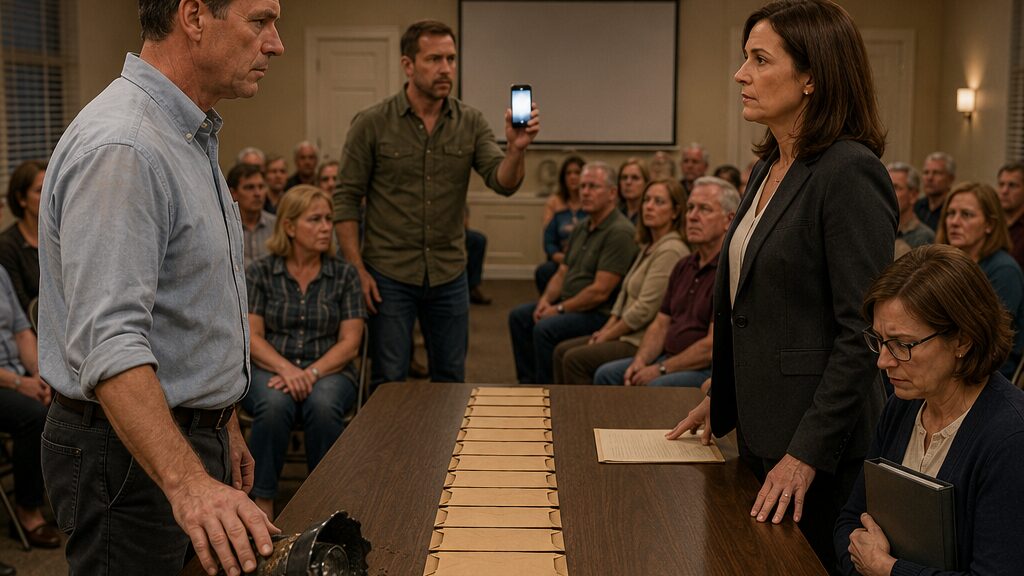
He placed the file box on the table beside Amanda’s agenda. From inside, he removed the mud-stained black landscape light in its clear evidence bag.
Then he removed fourteen copies of the demand packets and arranged them in a straight row.
The room quieted.
Amanda looked at the broken light, then at Richard. “You were asked to submit materials in advance.”
“I submitted the camera dates and repair estimates.”
“You submitted demands through an attorney.”
“Yes.”
A man near the back muttered something about intimidation.
Richard did not turn.
Amanda adjusted the papers before her. “The board has prepared a motion requiring removal of fixed landscape fixtures within the corner visibility zone until a safety review can be completed.”
“They’re twelve inches high,” Richard said.
“The photographs indicate they may affect driver clearance.”
“They affect clearance only when a driver leaves the road.”
A few chairs shifted.
Amanda’s expression stayed composed. “That is exactly the kind of framing that has made this difficult.”
Richard looked at the screen. “Whose photograph is that?”
“The board’s.”
“When was it taken?”
“That is not relevant.”
“The grass is dry. The sprinkler repair is already complete. The photograph was taken after my demand letters arrived.”
Amanda glanced toward Amy. “Please note that Mr. Scott is disputing the board’s documentation.”
Amy wrote something without looking up.
Richard opened the first packet.
“Incident one. White pickup. June eighth, nine-sixteen in the morning. Vehicle crossed from east curb to side road. No confirmed fixture damage. Shallow track recovered without repair.”
The owner of the white pickup looked up sharply.
Richard slid the packet away from the others.
“I am withdrawing the repair demand for incident one.”
A murmur passed through the room.
Amanda’s hand tightened on the agenda.
Richard opened the second packet. “Incident two. Dark sedan. June fifteenth. Camera loses the rear tire behind the mailbox. The damage photograph was taken seventeen minutes later. I cannot connect the rut to that vehicle with enough certainty.”
He moved that packet beside the first.
“I am withdrawing that demand too.”
Thomas leaned forward.
Amanda said, “Then you acknowledge that the letters were excessive.”
“I acknowledge that two claims were not precise enough.”
“You sent them anyway.”
“Yes.”
The word landed harder than a defense would have.
Richard looked at the residents. “That was my mistake.”
No one answered.
He picked up the third packet.
“For the remaining incidents, I have direct footage of tires striking fixtures, irrigation components, or wet turf that required repair. The amounts are tied to specific invoices.”
He opened the folder and read each date, vehicle description, and confirmed loss. He did not name the registered owners. He did not describe intent.
The room’s impatience changed shape.
At first, residents had watched him as though waiting for a performance. By the seventh incident, people began studying their own envelopes. By the ninth, one woman whispered to the driver beside her. By the eleventh, Amanda stopped interrupting.
Richard reached Thomas’s incident.
“Gray SUV. July twentieth, seven-forty-two. One landscape light damaged. No confirmed sprinkler loss.”
Thomas raised his chin slightly.
Richard placed the forty-five-dollar receipt beside the packet.
“Paid voluntarily.”
A woman against the wall said, “He sent us across.”
Every head turned.
She pointed not at Thomas but toward a man wearing a clubhouse volunteer shirt.
“He stood at the entrance and told us to follow the arrow.”
The volunteer’s face reddened. “I was told to keep the line from blocking the main road.”
“By who?” Thomas asked.
Amanda lifted a hand. “We are not going to interrogate volunteers.”
Richard removed his phone and placed it beside the broken light. The screen showed the photograph Thomas’s daughter had taken: the temporary orange arrow, the line of cars, the volunteer vest.
Another driver stood. “That sign was there during the pool fundraiser.”
“So was a woman waving cars around,” someone else said.
“I thought it was overflow parking.”
“You drove across his yard.”
“I followed where they pointed.”
Voices rose, overlapping.
Amanda struck the table once with the flat of her palm. “Enough. Event volunteers were responding to congestion. No one was instructed to damage private property.”
Richard waited until the room settled.
“Who instructed them to use the corner?”
“No one instructed anyone to use private property.”
“Then why did different volunteers give the same directions at different events?”
“They were managing traffic conditions.”
“Using what route?”
Amanda looked at the board treasurer, then at Amy.
Amy’s pen had stopped moving.
Amanda turned toward the portable screen. “The corner contains a recorded drainage easement. The board has always understood that strip to be subject to common access for maintenance and safety needs.”
She clicked to the next image.
A property plat appeared, enlarged until the lot lines blurred. A shaded band crossed the edge of Richard’s corner.
“There,” Amanda said. “The easement.”
Richard stared at the map.
He knew the band. A drainage pipe crossed beneath the lower edge of his property and emptied toward the grate. County crews could enter for repairs. Utility workers could inspect the line.
Cars could not.
“That is a drainage easement,” he said.
“It is a common-access easement.”
“For drainage maintenance.”
Amanda’s voice remained patient. “That is your interpretation.”
“No. That’s what the recorded language says.”
“Do you have the complete recorded instrument with you?”
Richard did not.
The board treasurer leaned toward the microphone. “Until the legal scope is clarified, the board’s position is that no resident should make unilateral accusations based on a disputed boundary condition.”
Richard looked down the row of envelopes.
Two withdrawn. One paid. Eleven still open.
For the first time since the meeting began, he understood the value of Amanda’s map. It did not need to prove that cars could cross his lawn. It only needed to make certainty look unreasonable.
A vote was proposed to suspend all collection demands until the easement could be reviewed. Several hands rose immediately.
Then Amy stood.
She gathered her papers slowly, as if the movement itself had to appear ordinary.
“The secretary needs five minutes to verify the map reference,” she said.
Amanda turned. “The reference is on the slide.”
“I need to verify the version.”
The room quieted again.
Amanda’s expression changed only slightly, but Richard saw it.
Amy carried her binder toward the side door. As she passed Richard, she let one sheet slip to the floor.
He bent to retrieve it.
She reached it first.
“The plat on that screen isn’t the latest one,” she whispered.
Then she straightened and walked out before he could ask what the board had removed from the current record.
Chapter 5: The Map Did Not Grant a Road
The county clerk found the newer plat beneath a document stamped received by the HOA fourteen months earlier.
She placed both pages under the counter light and aligned their corners.
“This is the recorded revision,” she said. “The one you brought is the preliminary survey.”
Richard leaned over the counter.
On Amanda’s version, the shaded easement widened near the corner and ended without written restrictions. On the revision, the same strip was narrower. A note ran beside it in small capital letters:
DRAINAGE AND UTILITY MAINTENANCE ACCESS ONLY. NO VEHICULAR INGRESS OR EGRESS.
The bottom right corner carried a county recording number and a rectangular stamp from the subdivision association.
Richard photographed the page.
“When was this copy issued?”
The clerk pointed to the date. “Last spring.”
“Can I get a certified copy?”
“You can get three if you pay for three.”
He requested four.
Kathleen wanted one. The property surveyor would need another. Richard intended to keep the fourth where no one could claim it had been misplaced.
Outside the records office, he called Amy.
She answered after the fourth ring.
“You shouldn’t be calling me.”
“The HOA received the revision.”
“I know.”
“Did Amanda know?”
Amy was silent.
Richard stood beside his truck while people moved through the county building’s revolving door.
“You told me the map was outdated,” he said. “That means you knew there was another one.”
“I knew one existed.”
“That is not an answer.”
“It is the answer I can give.”
“You’re the secretary.”
“I record motions. I do not make them.”
“You recorded whatever happened with that route.”
Another silence.
When Amy spoke again, her voice was lower. “Narrow your claims.”
“What?”
“Remove the demands where you cannot prove damage. Separate the volunteer-directed drivers from the ones who crossed after your signs were up.”
“Why?”
“Because I will not help you punish people for following instructions.”
“I’m trying to recover what was damaged.”
“Then recover it from the people who caused it.”
“Their vehicles caused it.”
“You know that is not what I mean.”
Richard looked at the certified copies in his hand. He had proof that Amanda’s public map was obsolete. He could take it to the next meeting, force a correction, and leave the fourteen claims exactly where they were.
Amy seemed to hear the calculation in his silence.
“If all you want is leverage,” she said, “use the plat. If you want the truth, decide what you are willing to correct first.”
The call ended.
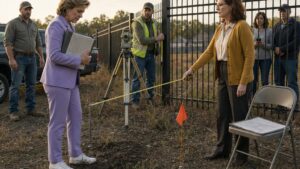
That afternoon, the property surveyor set four orange flags along the corner of Richard’s lawn. One marked the curb. One marked the drainage line. One stood where the broken landscape light had been installed. The final flag sat more than nine feet inside the boundary of the easement.
“No question,” the surveyor said. “Your lights are outside the drainage access strip.”
“What about vehicle passage?”
“Not permitted by the plat language.”
“Could anyone read the old map differently?”
The surveyor studied him. “They could read it carelessly.”
Richard watched the bright flags move in the breeze.
Carelessly was not the same as knowingly.
That distinction followed him to the HOA office the next morning.
Amy had left an unmarked envelope at the front desk. Inside was a copy of an invoice from a traffic-control contractor. The description read:
Estimate requested for temporary overflow exit near clubhouse corner.
The requestor was listed as Amanda Hall.
The date was six months before Richard installed the cameras.
A handwritten note beneath the estimate said permanent work not recommended pending boundary confirmation.
Richard read it twice.
The contractor had quoted a temporary matting system, cones, and a staff-controlled route. The board had never purchased any of it.
Kathleen examined the invoice in her office.
“This shows planning,” she said. “Not necessarily authorization.”
“The route happened exactly where she requested the estimate.”
“Yes.”
“And the contractor warned them about the boundary.”
“He warned them that confirmation was pending.”
“They received the revised plat later.”
Kathleen set the documents side by side. “That sequence matters.”
She called the HOA’s insurer while Richard waited.
The conversation remained professional for the first few minutes. Then Kathleen’s questions became narrower.
When did the board receive the revised plat?
Was the traffic plan disclosed?
Had the association received prior complaints?
Did the policy cover acts taken after a known property restriction?
After the call, Kathleen removed her glasses.
“They may reserve their rights.”
“What does that mean?”
“It means they may investigate before agreeing to pay. If Amanda continued the route after receiving the revised plat, the insurer could argue the board knowingly created the risk.”
“Then the HOA pays.”
“The HOA is the homeowners.”
Richard looked at the repair total on her desk.
It had felt substantial when divided among fourteen drivers. Against the HOA reserve, it might become an assessment charged to every household, including people who had never crossed his lawn.
“What are we talking about?”
“Your restoration claim is not enough to bankrupt anyone. But if the insurer denies defense costs and the board has other deferred obligations, the pressure expands.”
“The clubhouse roof.”
Kathleen nodded. “And the pool pump, from what the treasurer mentioned at the meeting.”
Richard remembered Amanda standing beneath the portable screen, defending the map as if certainty could be created by speaking calmly.
“She could have canceled the events,” he said.
“She could have redirected them properly.”
“She chose my lawn because it was cheaper.”
Kathleen did not answer.
That evening, Richard found Amanda waiting near the orange survey flags.
She wore no board badge and carried no binder. In her hand was a single white envelope.
“I would prefer to discuss this without an audience,” she said.
Richard stayed on the driveway.
“You displayed an obsolete plat.”
“I displayed the map the board had used when the traffic concern began.”
“You had the revision.”
“The board received many documents.”
“It was stamped.”
“I am not disputing receipt.”
“You disputed my boundary in front of the neighborhood.”
Amanda looked toward the clubhouse roofline visible beyond the trees.
“The association reserve is below its recommended level,” she said. “We have known that for two years. The events paid for emergency clubhouse repairs without raising dues.”
“So you sent cars over my property.”
“I approved temporary congestion management based on the easement information available at the time.”
“And after the revised plat?”
Her pause answered before she did.
“The events were already scheduled.”
Richard felt something inside him settle.
Not anger. Accuracy.
Amanda extended the envelope.
“The board is prepared to reimburse your full documented restoration cost privately. Sod, irrigation, lighting, attorney review. Everything.”
“What happens to the eleven demands?”
“They remain matters between you and the vehicle owners.”
“And the board?”
“There would be no admission of liability.”
Richard took the envelope but did not open it.
Amanda’s voice softened. “This protects your property without forcing every homeowner to absorb an assessment.”
“It protects you too.”
“It protects the association.”
“From the decision you made.”
She looked at the orange flag marking the former position of the broken light.
“If you insist on converting an operational mistake into public misconduct, the insurer may walk away. Repairs will be delayed. Legal costs will grow. People who had nothing to do with the route will pay.”
Richard held the envelope at his side.
Amanda turned toward the road.
“The offer expires Friday,” she said. “Full payment, provided you withdraw the board-liability allegation.”
She left him standing beside a boundary that was now officially marked.
For the first time, getting every dollar back required him to preserve a story he knew was false.
Chapter 6: The Settlement Asked Him to Stay Silent
The settlement amount covered every dollar Richard had requested.
Kathleen placed the document on her conference table, then set the damaged black landscape light beside it.
The cracked housing left a faint line of dried mud on the polished wood.
“Payment within ten business days,” she said. “No admission. Mutual release. Confidentiality regarding the board’s traffic decisions and the insurer’s coverage position.”
Richard read the total again.
It included sod replacement, irrigation repairs, three lights, contractor labor, survey costs, and Kathleen’s fees. The number was exact enough to feel less like an offer than a test.
“What about the drivers?”
“The agreement does not release them.”
“So I can take this and continue the individual claims.”
“You can.”
Amanda had built the proposal carefully. Richard could receive complete restoration while the eleven remaining households carried the appearance of primary responsibility. The board would pay privately, not because it had sent them, but because ending the dispute was cheaper.
Kathleen tapped the confidentiality clause.
“This is broader than I like.”
“Can they require silence?”
“They can require it as a condition of settlement. You do not have to accept.”
“What happens if I refuse?”
“We pursue the association, the insurer investigates, and everyone spends more time and money.”
“And if coverage is denied?”
“The HOA may fund defense and restoration through its reserve or an assessment.”
Richard looked at the broken light.
For weeks, it had been evidence of what other people had done to him. Now it sat beside an agreement asking him to let the wrong explanation harden around everyone else.
Kathleen opened a second folder. “Amy sent a partial event timeline.”
Richard looked up.
“She sent it through the association’s counsel. It confirms the route began during a fundraiser after the main entrance backed up. Amanda approved volunteer redirection for that day.”
“One day?”
“The language says temporary.”
“It continued for months.”
“Yes.”
“Why?”
Kathleen turned a page. “Because canceling or relocating the weekend events would have cut off revenue intended for clubhouse repairs.”
Richard remembered the water stain above the meeting-room screen and the buckets stacked in the storage alcove.
Amanda had not sent vehicles across his lawn for amusement. She had chosen the cheapest place to move a problem and then kept choosing it because admitting the first mistake would cost more each week.
That made the decision understandable.
It did not make it acceptable.
A knock sounded at the office door. The receptionist opened it far enough to speak quietly to Kathleen.
“Mr. Miller is here. He says he does not need an appointment.”
Thomas entered carrying a cashier’s check.
Richard stood.
Thomas placed the check on the table beside the broken light. “Forty-five dollars. Made out properly this time.”
“You already paid cash.”
“You gave it back through your attorney.”
Kathleen had returned the money after the legal demand was formally adjusted.
Thomas looked at Richard. “I’m paying it anyway.”
“You followed the arrow.”
“My daughter followed the arrow. I told her to keep moving. We felt the light break and did not come back.”
“The board created the route.”
“And I made my part worse.”
Richard glanced at the settlement.
Thomas followed his eyes. “They offered to pay you?”
Kathleen said, “The terms are confidential unless Mr. Scott rejects them.”
“That sounds like yes.”
Richard expected Thomas to warn him against signing. Instead, Thomas sat in the empty chair.
“If they cover the damage, take the money,” he said.
“And let the demands stand?”
“No.”
Thomas’s answer came without hesitation.
“You sent fourteen letters because fourteen vehicles crossed. Fine. Now you know some of them were directed. Change the letters.”
“That weakens the claim against the HOA.”
“It weakens the wrong claims.”
Richard felt the old resistance rise—the same resistance Kathleen had met before mailing the envelopes.
“I documented what happened.”
“You documented tires,” Thomas said. “You did not document fourteen identical decisions.”
The words held no accusation. That made them harder to reject.
Thomas pushed the cashier’s check across the table.
“I’m not paying because your letter scared me. I’m paying because I know what my family did. That should count for something.”
It did.
More than Richard wanted it to.
After Thomas left, Kathleen separated the papers into three stacks.
“Confirmed intentional crossings after visible warnings,” she said, touching the first.
Three files.
“Volunteer-directed crossings with specific damage.”
Eight files.
“Unsupported or already withdrawn.”
Three files.
Richard counted them twice.
The fourteen envelopes had once made the conflict look clean. Fourteen vehicles. Fourteen owners. Fourteen demands.
The truth required different piles.
“If I withdraw the eight,” he said, “Amanda can say the board corrected everything by paying me privately.”
“Only if you sign confidentiality.”
“And if I reject the agreement after withdrawing them?”
Kathleen looked at him carefully. “Then you surrender some individual leverage while preserving the institutional claim.”
“Would you advise that?”
“I would advise you to decide what you are trying to prove.”
Richard stood and walked to the window.
Across the parking lot, a landscaping crew was replacing shrubs outside the insurance agency. One worker measured each gap before digging. Another carried the discarded plants toward a trailer.
He thought of the rentals his family had moved through when he was young. Every lease had contained language about notice, access, and termination. Boundaries existed on paper, but someone else always possessed a key.
When Richard finally bought his corner lot, he had treated maintenance as a promise. No landlord could decide the yard would become parking. No manager could change the use of a room. No one could move the line without asking him.
Then the HOA had done exactly that.
But Richard had answered by reducing fourteen households to vehicle plates.
He returned to the table.
“Prepare withdrawals for the volunteer-directed drivers,” he said.
Kathleen did not move immediately. “All eight?”
“All eight. State that the crossing occurred, but the evidence no longer supports treating the driver as the primary responsible party.”
“And the three confirmed intentional crossings?”
“They stay.”
“Thomas?”
“Mark his claim satisfied voluntarily.”
Kathleen began arranging the files.
Richard picked up the settlement agreement.
He signed the acknowledgment showing he had received it.
He did not sign the release.
At the bottom of the withdrawal authorization, he wrote his initials beside each of the eight driver files. Then he added the two claims already withdrawn at the meeting and the one unsupported information request.
Eleven cancellations.
Kathleen watched him sign the final page.
“You understand what this does,” she said.
“It tells the truth more accurately.”
“It also removes pressure Amanda expected you to keep.”
Richard placed the pen down.
For months, he had mistaken silence for control. Now he was giving up the easiest form of leverage before knowing whether anyone would reward him for it.
Kathleen gathered the signed withdrawals.
“What do you want me to tell association counsel?”
Richard looked at the broken light beside the unsigned settlement.
“Tell them the neighbors are no longer their shield.”
Chapter 7: The Boundary Was Restored Without Erasing Blame
Richard began the final HOA meeting by canceling eleven demands.
He did not sit at the reserved table. He stood beside it with the cancellation receipts arranged in a neat stack and the replacement landscape light still in its cardboard box.
The clubhouse was fuller than before. Folding chairs extended into the hallway, and residents stood along the back wall beneath the stain in the ceiling. Amanda sat between Amy and the board treasurer. Kathleen occupied a chair near the side door with a closed folder on her lap.
Richard lifted the first receipt.
“This releases the owner of the white pickup from any property-damage claim connected to incident one.”
He placed it face down.
The second followed. Then the third.
He did not rush.
Each cancellation named the incident number, the vehicle, and the reason the demand was withdrawn or redirected. Two claims lacked enough evidence. Eight involved drivers who had followed event instructions. Thomas’s claim had been satisfied voluntarily.
By the time Richard reached the eleventh receipt, the room had gone quiet enough for the paper to sound loud against the table.
Amanda leaned toward her microphone. “The association appreciates that Mr. Scott has reconsidered the scope of his original actions.”
Richard looked at her.
“I corrected the claims,” he said. “I did not reconsider the damage.”
Several residents shifted their attention from him to the board.
Kathleen opened her folder but remained seated.
Richard continued. “Three drivers crossed after the warning signs were standing and without being directed by a volunteer. Those claims remain. The rest belong somewhere else.”
Amanda folded her hands. “The association has already offered full private reimbursement.”
“On the condition that I say nothing about how the route started.”
“That characterization is incomplete.”
“Then complete it.”
The board treasurer cleared his throat. “Before this becomes adversarial, the board has prepared a restoration proposal funded through the reserve.”
A printed sheet appeared on the portable screen. The total matched Richard’s documented costs, minus the three remaining individual claims. Below it was a proposed special assessment spread across all subdivision households.
A low murmur moved through the room.
A resident near the aisle raised her hand. “Why are we paying if drivers damaged his yard?”
Another answered before the board could. “Because volunteers sent them.”
“Volunteers don’t make policy.”
Amanda reached for the microphone.
Amy placed her hand over the switch first.
The gesture was small, but Amanda stopped.
Amy stood with a binder pressed against her chest.
“I need to amend the record from the previous meeting,” she said.
Amanda’s voice lowered. “Amy, we discussed the document review.”
“Yes.”
“Association counsel advised—”
“I am correcting the minutes.”
Amy opened the binder.
She read without looking at Richard.
“Six months before the first documented lawn crossing, the board requested an estimate for a temporary overflow exit near the clubhouse corner. The contractor advised that no vehicle route should be established until the property boundary was confirmed.”
A chair scraped against the floor.
Amy turned one page.
“Fourteen months ago, the association received the revised recorded plat. The revision limited the easement to drainage and utility maintenance and prohibited vehicular ingress and egress.”
Amanda’s face remained still, but the tendons in her neck tightened.
Amy continued.
“At a later planning session, the president stated that volunteers could direct vehicles around the clubhouse backup on event days while the board explored permanent options.”
The board treasurer leaned toward her. “Was that language included in the approved minutes?”
“No.”
“Why not?”
Amy closed the binder halfway. “Because I was asked to describe it as informal congestion management.”
The room changed.
No one applauded. No one shouted. Residents simply stopped looking at Richard as though he were the only person under examination.
Amanda removed her glasses and set them beside the microphone.
“The clubhouse had a roof leak, a failing pool pump, and no room in the operating budget,” she said. “Canceling the events would have removed the only unrestricted revenue we had.”
A man in the back said, “So you used his yard.”
“I believed the original easement allowed temporary access.”
“What about the revised plat?” Thomas asked.
Amanda looked toward him.
Thomas stood beside the wall, one hand resting on the back of an empty chair.
“You had it,” he said.
Amanda’s reply took time.
“Yes.”
The word moved through the room more heavily than any denial.
Richard watched her glance at the ceiling stain, the faded curtains, and the storage-room door that never closed properly. She had spent years trying to keep the clubhouse functioning without asking residents for more money. He could see the logic of each small compromise.
The first route had solved one afternoon.
The second had protected the first decision.
By the time Richard installed cameras, admitting the truth required admitting that every weekend after the revised plat had been a choice.
Amanda spoke into the microphone.
“I knew the revised language did not authorize a vehicle route. I also knew the events were paying bills the association could not otherwise meet. I believed we could manage the traffic without significant damage.”
“You saw my signs,” Richard said.
“Yes.”
“One disappeared.”
“I did not authorize anyone to remove it.”
“But you did not stop the route afterward.”
“No.”
The answer contained no excuse.
The board treasurer proposed a revised motion. The HOA would accept primary responsibility for the volunteer-directed incidents, fund restoration through the reserve, and levy a smaller one-time assessment to replace the portion needed for clubhouse repairs. The traffic route would be formally prohibited. Future events would require written traffic plans and board approval.
Amanda would step down from the presidency pending the next election but remain available during the insurance review.
The vote was not unanimous.
Several residents objected to the assessment. One argued that Richard should absorb part of the lawn cost because the corner was difficult to navigate. Another wanted the three remaining drivers included in the association settlement to avoid further conflict.
Richard refused.
“Those three passed standing signs without volunteer direction,” he said. “Their responsibility is separate.”
“And the others?” a resident asked.
“The others were careless,” Richard said. “So was I when I treated them as if they had all made the same decision.”
Thomas lowered his gaze.
The motion passed.
Not by applause. By raised hands counted twice.
After the meeting, three vehicle owners approached Kathleen separately. Each agreed to cover the specific damage tied to their crossings. One requested a payment schedule. Another asked for photographs before signing. The third said little beyond admitting that he had used the corner because he had seen others do it.
Richard accepted the distinctions.
A month later, the landscaping contractor finished the last section of sod.
The irrigation line ran evenly again. The survey flags were gone, but the recorded boundary remained in Richard’s file cabinet beside the canceled demand receipts.
He opened the replacement light on a Saturday morning.
Thomas arrived carrying a level and a small shovel.
“You sure about this?” he asked.
“It belongs here.”
“I meant me helping.”
Richard handed him the shovel.
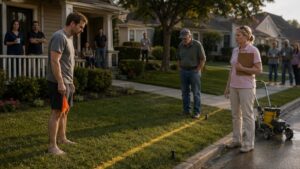
They worked at the corner where the original light had been crushed. Richard measured from the curb and marked the position outside the drainage easement. Thomas dug the narrow hole while Richard connected the wiring.
When the light was upright, Thomas stepped into the road to check its angle.
“It points straight at drivers,” he said.
“It always did.”
“Maybe that was part of the problem.”
“The light did not move into the road.”
“No.” Thomas adjusted the housing slightly. “But it doesn’t need to look like it’s challenging anybody either.”
Richard almost objected.
Then he stood where Thomas had been and looked back toward the lawn.
The beam would still mark the edge. It would still illuminate the grass and the curb. Turned a few degrees, it would no longer shine directly through a windshield approaching the stop sign.
Richard loosened the collar.
“Hold it there,” he said.
Thomas steadied the fixture while Richard tightened it.
At dusk, the replacement light came on with the others. Twelve low circles of light followed the curve of the lawn, stopping exactly where the surveyed boundary ended.
Cars passed on the road.
None crossed.
Thomas stood beside Richard near the driveway, hands in his pockets.
“You keeping the cameras?” he asked.
“Yes.”
Thomas nodded. “Fair enough.”
Richard looked at the corner, at the repaired grass, and at the light they had aimed together.
The boundary was still his.
It simply no longer required everyone beyond it to be his enemy.
The story has ended.