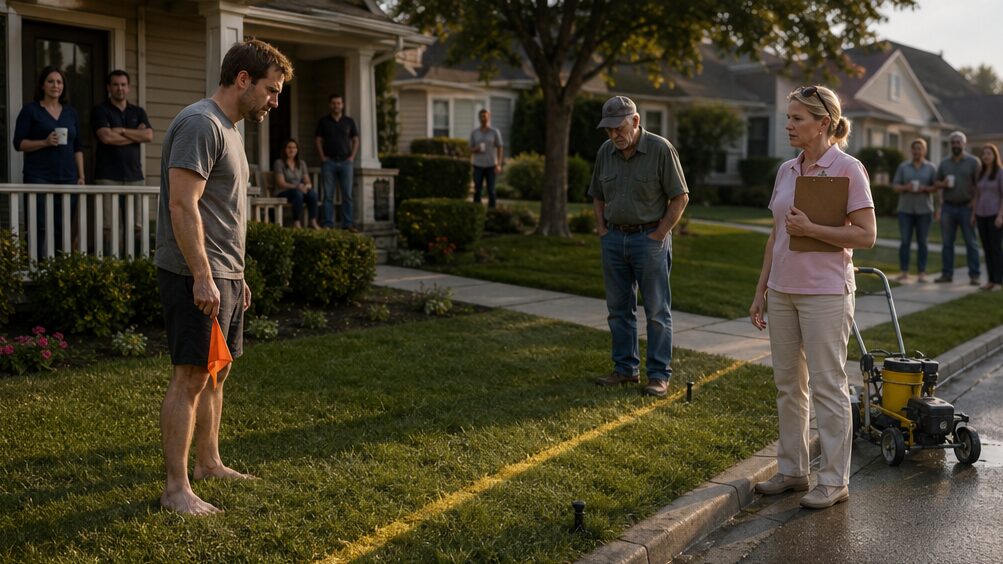
The Yellow Line Across His Lawn Was Meant to Shame Him, Until the Sprinklers Came On
Chapter 1: The Yellow Line Across the Morning Grass
The yellow line began at Jason Mitchell’s driveway, cut straight across his front lawn, and disappeared beneath the low hedge beside the sidewalk like someone had drawn a warning through the grass while he slept.
For a few seconds, he stood barefoot on the porch step with his coffee cooling in his hand.
It was not chalk. It was not a reflection. The stripe was thick, bright, and wet-looking in the early light, a hard artificial yellow against the green he had spent two seasons bringing back from crabgrass and dry patches. It ran just a little crooked where the lawn dipped near the sprinkler head, then straightened again, as if whoever painted it had been following a line only they could see.
Jason set the coffee on the porch rail.
Across the street, a dog barked once and stopped. A garage door hummed open somewhere down the block. Saturday mornings in Brookside Commons usually came in soft: sprinklers ticking, trash bins rolling back from curbs, someone washing a truck before the heat settled in. This morning, every ordinary sound seemed to pause around the stripe.
He stepped onto the grass.
The paint clung to the blades in a powdery coating. It did not smell like road paint. Not exactly. More like the stuff used to mark soccer fields in parks. Still, it had been laid across his property with enough confidence to make his stomach tighten.
He followed it with his eyes toward the hedge. The line clipped past the small patch where he had replaced two sprinkler heads last fall, then kept going into the strip near the maple, as if accusing that part of the yard of belonging somewhere else.
“Unbelievable,” he muttered.
He looked up and down the street. No truck, no crew, no warning cones. Just the tidy repetition of two-story homes, trimmed shrubs, and front doors painted in HOA-approved shades that had been voted on before he moved in.
A memory came with the taste of old frustration: his first month in the house, when he had gotten a notice for leaving empty moving boxes on the porch overnight. Another for a hose reel too visible from the street. Another for edging that “did not meet community standards,” even though he had been working twelve-hour days and still managed to mow before dark.
He had learned to answer politely. Fix what was small. Let the rest pass. After the divorce, after splitting furniture and bank accounts and the version of himself that had wanted a house full of noise, he had bought this place because it was quiet. He had promised himself not to become the guy on the block with a grudge.
But someone had painted his lawn.
Jason walked to the sidewalk, crouched, and touched the edge of the stripe. Yellow dust came off on his fingertips. He rubbed it between thumb and forefinger, then looked toward the corner where the HOA mailbox kiosk stood beside the community bulletin board.
A folded orange flag had been pushed into the ground near the curb.
He had not seen it from the porch. He pulled it free. Printed in block letters across the plastic was: BOUNDARY REVIEW.
No date. No signature. No notice number.
“Jason?”
He turned.
A man in a baseball cap stood two houses down with a leash looped around his wrist. His dog, a brown mutt with white paws, strained toward the grass as if the yellow line were a smell worth investigating.
“You know anything about this?” Jason asked.
The dog-walking neighbor lifted one shoulder. “I saw someone out here early. Thought maybe you hired a crew.”
“At six in the morning?”
“Maybe earlier.” The neighbor glanced at the line and then away. “Looked official.”
That word did more than it should have. Official. As if a person with a clipboard could turn trespass into procedure.
Jason straightened, still holding the flag. “Who was it?”
Before the neighbor could answer, a pale SUV rolled slowly from the direction of the clubhouse and stopped beside Jason’s curb. Heather Clark stepped out in a pink polo tucked into light pants, sunglasses perched on her head though the sun had barely cleared the roofs. She had a clipboard under one arm and the stiff expression of someone arriving not to ask questions but to close a matter.
Behind her, near the rear hatch, was a small wheeled paint-striping machine. A yellow bucket sat in its frame.
Jason stared at it.
Heather followed his gaze, then lifted her chin slightly. “Good morning, Jason.”
He walked toward the curb, the orange flag bent in his hand. “Did you do this?”
“I marked the community boundary,” she said.
“You painted my grass.”
“I marked the boundary,” she repeated, as if the choice of verb mattered enough to erase the act. “There has been confusion about where your maintained yard ends and common area begins.”
“There hasn’t been confusion from me.”
Her mouth tightened. “There has been confusion from the board.”
The dog-walking neighbor took one slow step back. Another garage door opened across the street. Jason saw a curtain move in the front window of the house beside his.
He kept his voice low. “You came onto my property before sunrise and painted a line across my lawn without asking.”
Heather looked toward the houses now waking around them. “The board has authority to inspect visible violations related to common-area encroachment.”
“Inspect. Not paint.”
“It’s washable field paint,” she said, too quickly. “It’s used for marking. It won’t hurt anything.”
The stripe suddenly felt less like damage and more like theater. Jason looked at the line again, at the way it crossed his grass in a place designed for every passing driver to see.
“This wasn’t to help me understand anything,” he said.
Heather’s hand tightened around the clipboard. “Now everyone can see where your yard ends.”
There it was. Not guidance. A public mark.
Two neighbors had emerged onto their porch across the street. Someone else stood at the end of a driveway with a phone held low, not filming openly, but not hiding it either. In Brookside Commons, people rarely gathered around arguments. They paused near them. They listened while pretending to check mail or water a planter.
Jason felt heat move up his neck.
He thought of the closing day, the empty rooms smelling like paint and carpet cleaner, the packet of documents the realtor had slid across the counter. Property survey. HOA guidelines. Irrigation plan. He had kept all of it in a file box under the kitchen counter because he was the kind of person who kept things he hoped never to need.
Heather tapped the clipboard with two fingers. “We have records.”
“Then you should have mailed them.”
“We did.”
“No,” Jason said. “You sent a reminder about edging along the curb. You sent a notice about mulch color last year. You did not send me anything saying you were going to paint a line across my front yard.”
The dog barked again, sharp and uncomfortable.
Heather glanced at the neighbor holding the leash. “This is exactly why the board prefers not to conduct these conversations in the street.”
“You started it in my yard.”
For the first time, Heather’s confidence slipped. Not enough for anyone else to call it fear. Just a small hardening around the eyes.
Then she said, “The HOA already gave you enough chances.”
Jason looked from her face to the stripe, then to the paint machine sitting at the curb like proof she had brought her own verdict with her.
“Enough chances for what?” he asked.
Heather pulled a paper from beneath the clipboard but did not hand it to him.
For a moment, she let the whole street wait.
Chapter 2: The Sprinklers Came On Too Soon
“Everyone can finally see where your yard ends,” Heather said, holding the paper against her clipboard as if it were too important to release into Jason’s hands.
The sentence traveled farther than she probably intended. A woman across the street stopped pretending to sweep her porch. The dog-walking neighbor’s dog sat down in the strip of shade beside the curb. Somewhere behind Jason, a screen door clicked open.
Jason kept looking at Heather.
“That’s not an answer.”
“It is a boundary compliance issue,” she said. “The lawn extension beyond the approved common-area line has been discussed at board level.”
“My lawn hasn’t extended anywhere. Grass grows where grass was when I bought the place.”
“You added irrigation.”
“I repaired irrigation.”
“You increased maintained turf coverage.”
Jason almost laughed, but there was no humor in him. “You mean I fixed dead spots.”
Heather shifted her weight. “You know what the board means.”
“No,” Jason said. “That’s the problem. I don’t.”
A few more neighbors had wandered close enough to hear without officially joining. Brookside Commons had wide sidewalks and narrow courage. People stood with coffee mugs, leashes, gardening gloves. They watched Heather’s clipboard and Jason’s bare feet, the yellow stripe between them doing more speaking than either of them wanted.
Heather turned slightly toward the audience. “For months we’ve had concerns about private residents absorbing common-area landscaping into their own yards. It affects maintenance, insurance, water use, and community appearance.”
“That sounds like something you say in a meeting,” Jason said. “Not something that explains why you painted my grass.”
A flicker crossed her face. Irritation, maybe, or embarrassment at being challenged by someone who usually signed forms and moved on.
“I used temporary marking paint,” she said. “A standard visual aid.”
“Without permission.”
“As compliance chair, I am permitted to identify the issue.”
“You identified it from inside my property line?”
Heather’s lips parted, then closed.
Jason saw then what bothered him most. She did not look like someone who had made a mistake and needed to repair it. She looked like someone who had expected him to stand there ashamed, nodding as neighbors watched, grateful for the chance to correct himself before fines arrived.
He looked at the stripe cutting through the lawn. It passed close to the sprinkler head he had replaced himself, a pop-up rotor he had adjusted to avoid hitting the sidewalk. He could picture the piping beneath the soil, the lateral line running shallow before bending toward the side yard. He had mapped it on graph paper after buying the house because the original contractor had installed the zones like a drunk spider.
Behind the dog-walking neighbor, an older man in a faded work shirt had stopped near the curb. William Brown lived at the end of the block and rarely came to HOA meetings. Jason knew him mostly from short nods and one conversation about a broken park fountain. William’s eyes were on the yellow bucket in the paint machine.
“Mind if I look at that?” William asked.
Heather turned toward him. “This is an HOA matter.”
“Paint bucket’s sitting in the street,” William said mildly.
He stepped closer, not touching the machine, just leaning enough to read the label. His brow creased.
Jason watched him.
William straightened. “That’s field paint.”
Heather’s jaw tightened. “Temporary field-marking paint, yes. I already said that.”
“No,” William said. “I mean washable field paint. Parks department used stuff like that for youth soccer. First decent rinse, most of it’s gone.”
A murmur moved through the small group.
Heather spoke quickly. “It is not meant to be permanent. That was never the point.”
“Then what was the point?” Jason asked.
She looked back at him. “The point was documentation.”
The word hit the morning like a dropped tool.
Documentation.
Jason glanced again at the watching neighbors. He saw the low phone near the driveway across the street, the eyes in the windows, the dog-walking neighbor pretending not to listen too hard. The line had not been painted to last. It had been painted to be seen, photographed, talked about, entered into some file with his name attached to it.
A faint click sounded from behind him.
Jason turned his head.
The sprinkler head near the maple trembled, lifted, and spat a crooked burst of water across the grass.
For one half second, nobody moved.
Then the system pressurized. Three heads popped up in sequence along the front zone. Water fanned outward, catching the low sun, ticking across the lawn and sidewalk with the steady rhythm Jason had programmed for Saturday mornings months ago.
The first spray hit the yellow line.
Heather took a step back. “You need to turn that off.”
Jason did not move.
The water swept across the stripe, darkening the grass, loosening the powdery brightness. Yellow began to bleed downward, thinning at the edges. The clean, accusatory line blurred into streaks.
“Jason,” Heather said sharply.
He kept his voice even. “It’s my irrigation schedule.”
“You’re destroying evidence.”
That made William let out a short sound that was almost a laugh and almost disbelief. “Evidence of what? Your paint?”
Heather turned on him. “Please don’t interfere.”
The sprinklers continued, patient and mechanical. The stripe that had looked so permanent ten minutes ago began to lose its authority. Near the driveway, it dissolved into a faint stain. Along the dip in the lawn, yellow water ran toward the gutter in thin threads.
A neighbor across the street lowered her coffee mug.
Jason looked at Heather, and for the first time that morning, the embarrassment was not his alone.
He should have felt victory. A clean one. The kind that would let him walk back inside, shut the door, and pretend the neighborhood had not just watched a stranger mark his home like a problem to be managed.
Instead, his stomach tightened.
Because Heather was not looking at the disappearing paint. She was looking at him with the focused anger of someone who had just found another rule to use.
“You intentionally activated the sprinklers during a compliance inspection,” she said.
Jason stared at her. “They’re on a timer.”
“You had notice.”
“I had a line across my yard.”
“You had notice,” she repeated, louder now, so the neighbors could hear. “And now the board will have to record that the marked boundary was removed before review could be completed.”
William shook his head. “That’s not what happened.”
Heather did not answer him.
The sprinkler swept back, tapping water against Jason’s ankles. The yellow paint had faded to broken patches, brightest near the sprinkler heads where it had been laid thickest. Jason could see his grass again. Not fully. But enough to know the line had been weaker than its threat.
A silver sedan turned the corner and slowed at the curb behind Heather’s SUV.
Samantha Baker stepped out carrying a folder and a sealed envelope. She wore a navy blouse, her hair pinned back, and the careful expression of someone who had hoped to arrive after the conflict was already over. Her eyes moved from Heather to Jason to the wet grass.
Then she saw the last of the yellow washing toward the gutter.
“Is that the marked area?” she asked.
Heather’s shoulders squared. “It was.”
Samantha hesitated, then walked toward Jason and held out the envelope.
“Mr. Mitchell,” she said, not quite meeting his eyes. “This is your official notice of violation.”
Jason did not take it immediately.
Water ticked across the lawn. Yellow ran in pale trails along the curb.
Finally, he reached for the envelope, and Samantha released it like it weighed more than paper.
Chapter 3: The Notice That Survived the Rain
The envelope was dry when Jason found it again at the mailbox kiosk that afternoon, as if the morning’s sprinklers had washed away everything except the accusation.
It had been delivered twice, apparently. Once by Samantha’s hand, which he had refused to open in front of the neighbors, and once through the formal HOA slot, where another copy waited behind the little metal door with his house number taped inside. The duplication felt intentional. A paper trail thick enough to survive water, embarrassment, and whatever version of the story moved through Brookside Commons before dinner.
Jason stood at the kiosk with the envelope in his hand while a delivery driver sorted packages behind him. The driver glanced once at the HOA letterhead and then looked away with professional disinterest.
Jason wished the whole neighborhood had that skill.
He brought both envelopes inside and laid them on the kitchen table beside his cooling mug from that morning. Yellow dust still faintly marked the side of his thumb no matter how many times he had washed his hands. Through the front window, the lawn looked nearly normal again, but not to him. He could still see the path where the line had been, a ghost stripe crossing the grass because he knew exactly where to look.
He opened the first envelope with a utility knife.
The notice was three pages long.
NOTICE OF BOUNDARY AND COMMON-AREA ENCROACHMENT VIOLATION.
His name. His address. A case number. A photograph taken from the sidewalk while the yellow line was still bright. Another photograph taken after the sprinklers had started, the line blurred, water shining on the blades. Under the second photograph, someone had typed: MARKING REMOVED PRIOR TO FINAL REVIEW.
Jason sat down slowly.
The violation cited Section 8.4 of the Brookside Commons Homeowners Association rules: no resident shall alter, absorb, cultivate, irrigate, edge, decorate, landscape, or otherwise maintain common-area property as private yard space without written board approval.
He read the sentence three times.
Absorb.
As if his lawn were something hungry.
Attached to the notice was a reduced copy of a landscaping diagram. A dark line curved along the front of his property, several feet behind where he believed the property line sat. The yellow stripe from the morning had followed that dark line almost exactly.
Jason went to the cabinet beneath the breakfast counter and pulled out the file box he had not opened in more than a year. It was wedged behind spare batteries, a stack of old appliance manuals, and the blue folder his realtor had given him at closing. He dragged it onto the tile floor and lifted the lid.
The documents smelled faintly of paper dust and moving boxes.
He found the deed first. Then the inspection report. Then the survey with his lot number printed in the corner. He spread it beside the HOA diagram and pressed both flat with his palms.
The lines did not match.
Not by a little.
The survey showed his front property line running close to the sidewalk, with a utility easement noted along the edge. The HOA diagram pulled a maintenance boundary farther back into his lawn, cutting through the area he had repaired last fall. If the HOA map were right, his sprinkler heads sat on common property. If his survey were right, Heather had painted several feet inside his yard.
He pushed back from the table.
The room felt smaller than it had before.
For a while he did nothing. That was the part of himself he disliked most: the pause before action. The careful silence. The calculation of whether the fight would cost more than the insult. He had learned it during the divorce, when every sentence became something to be repeated later with a different tone. He had learned to leave messages unanswered until anger cooled. He had mistaken that for wisdom.
Now the notice sat in front of him with five business days printed in bold.
Failure to respond may result in daily fines and further enforcement action.
Jason stood, took the HOA diagram, and went outside.
The air smelled like wet soil and cut grass. The sprinklers had long since shut off. Near the maple, where the yellow line had crossed thickest, faint residue clung to the base of the blades. Not much. Just enough.
He crouched beside the sprinkler head and brushed the grass aside. The pop-up rotor sat exactly where he remembered installing it, a few inches inside the lateral line he had traced with flags the previous October. He had spent that weekend alone in the yard, hands muddy, knees aching, grateful for work that required no conversation. The old head had been cracked, spraying water in a useless fan across the sidewalk. He had replaced it, adjusted the arc, and drawn the zone on graph paper afterward.
He went back inside and found that drawing too.
It was tucked behind a warranty card, folded twice. Not official, not stamped, but precise enough for him. He had marked valves, pipe runs, head types, coverage arcs. The front zone followed the property survey, not the HOA diagram.
A knock sounded at the door.
Jason froze with both maps in his hands.
Through the side window, he saw William Brown standing on the porch, cap in hand, looking uncomfortable enough that Jason almost pretended not to be home.
Instead, he opened the door.
William glanced toward the table. “I’m not here to get in it.”
“You already are.”
“Fair enough.” William’s mouth twitched, then settled. “I just wanted to say that wasn’t right this morning.”
Jason looked past him at the street. “You say that to Heather?”
“No.”
The honesty surprised him.
William looked down at the porch boards. “Should’ve. Didn’t. I’ve had my own rounds with that board. You start talking and suddenly you’re the difficult one.”
Jason said nothing.
William nodded toward the documents in his hand. “You checking the line?”
“Trying to.”
“Don’t wait too long,” William said. “They’re better with paperwork than they are with apologies.”
After he left, Jason stood in the doorway a moment, listening to the quiet street. The yellow line was gone enough for someone driving by to miss it. The notice was not.
Back at the table, he opened the second envelope. Same violation. Same photos. Same five-day warning.
But tucked into the duplicate packet was one extra sheet, folded smaller than the rest. It looked like it had been copied badly, the lines faint, the corner shadowed by a dark ring like someone had once set a coffee mug on the original.
Jason unfolded it and placed it beside his survey.
A second boundary diagram stared back at him.
Not
Chapter 4: The Map the Board Forgot to Replace
The enlarged photograph of Jason’s lawn was already propped on an easel when he walked into the HOA clubhouse Monday evening, the yellow line glowing under fluorescent lights like a crime scene marker.
Someone had printed it on glossy paper. Someone had cropped out Heather’s paint machine. Someone had left just enough of Jason’s porch in frame to make his house recognizable to everyone in the room.
Jason stopped inside the doorway with his folder under one arm.
Heather stood near the front table in a pale cardigan, her clipboard replaced by a binder thick with tabs. Samantha Baker sat beside her with a laptop open and the careful posture of someone trying not to be part of the display. Three board members sat in folding chairs. A few residents had come too, more than usually attended a Monday meeting. They spoke quietly until they saw Jason.
Then the room changed its breathing.
Heather looked up. “Mr. Mitchell. We’re just about to begin.”
Jason took a seat in the second row instead of the front. He had promised himself on the drive over that he would not start angry. He had packed the closing survey, the duplicate notice, his irrigation sketch, and the two boundary diagrams. He had also packed the stupid orange flag because part of him could not let go of the fact that someone had stuck it in his yard like a warning on public land.
Heather called the meeting to order with a small tap of her pen.
“Item one,” she said, “boundary and common-area encroachment at 1847 Marigold Lane.”
Jason’s address sounded different in her voice. Less like a home. More like a file.
She gestured toward the photograph. “As the board can see, the common-area line was marked Saturday morning for documentation. The homeowner subsequently activated irrigation, removing the marking prior to final review.”
Jason raised his hand.
Heather looked annoyed before she looked at him. “You’ll be given a chance to respond.”
“I’d like the minutes to show that the irrigation was on a programmed schedule.”
Samantha’s fingers paused above the keyboard.
Heather said, “That can be included in your response.”
“No,” Jason said. “It should be included in the statement you just made.”
A board member shifted in his chair. Someone in the back coughed.
Heather’s smile was thin. “Samantha, please note Mr. Mitchell’s claim that the sprinkler activation was scheduled.”
“Not claim,” Jason said.
Heather looked at him fully now.
Jason opened his folder but did not pull anything out yet. He could feel the room waiting for him to become the kind of man it would be easy to dismiss. Loud. Defensive. Personal. He made himself breathe through his nose and keep both feet flat on the floor.
Samantha typed.
Heather continued. “The underlying issue is not the water. It is the maintained turf beyond the approved boundary. The association’s landscaping map has been in effect for years.”
She lifted a photocopy. Jason recognized the curved line from the notice.
“This map shows the common-area maintenance boundary,” she said. “Mr. Mitchell’s irrigation and lawn care extend beyond it.”
Jason stood, carrying his survey.
“May I?”
Heather hesitated. “Briefly.”
He walked to the front table and placed his closing survey beside her map. He did not crowd her. He did not point in her face. He just laid the papers flat where the board could see them.
“This is the survey I received when I bought the house,” he said. “It shows the property line closer to the sidewalk. The sprinkler heads are inside my lot.”
Heather glanced at the survey for less than two seconds. “That is a property survey. We’re discussing common-area maintenance boundaries.”
“Then why did you paint the line across my private yard?”
“The common-area line affects what residents may maintain.”
“The line you painted doesn’t match this survey.”
“It matches the association’s map.”
“And where did that map come from?”
Heather’s eyes moved once toward Samantha.
It was quick. Too quick for most people to notice. Jason noticed because he had been watching the room the way he watched water pressure in a failing zone—small changes told the truth before the break did.
Samantha looked down at her laptop.
Heather said, “The map is part of the association’s records.”
“Which records?”
“Mr. Mitchell, this is not a deposition.”
“No,” Jason said. “It’s a meeting about my lawn.”
A low murmur passed through the residents behind him.
Heather turned a page in her binder. “For the record, the homeowner received a copy of the applicable diagram.”
“I received two,” Jason said.
That landed.
Samantha’s fingers stopped again.
Jason removed the badly copied sheet from his folder and held it up. “This was tucked into the duplicate notice in my mailbox. It has a different line.”
Heather’s face tightened. “That appears to be an old draft.”
“Then why was it included?”
“I can’t speak to every clerical attachment.”
Samantha swallowed, eyes on the screen.
Jason placed the faded sheet beside the others. Three versions of his yard sat on the clubhouse table: his survey, Heather’s landscaping map, and the coffee-ring copy with its faint altered line. They looked similar enough to confuse a person glancing quickly. Different enough to change who was wrong.
One of the board members leaned forward. “Samantha, do we have a record of updated maps?”
Heather answered before Samantha could. “No corrected map has been adopted by this board.”
Jason saw Samantha’s hand move toward a stack of printed minutes beside her laptop. She did not touch them. Her fingers curled back.
The silence lasted only a second, but it had weight.
“Samantha?” the board member asked.
She looked at Heather. Then at Jason. “There was a discussion of a survey update several years ago.”
Heather’s voice cooled. “A discussion. Not an adoption.”
Jason felt his pulse in his throat. “Was it filed?”
Samantha’s eyes flicked to the residents behind him. “I’d have to check the archive.”
Heather closed her binder halfway, a controlled little sound. “The homeowner is attempting to shift this into a records issue. The violation remains visible in the photographs.”
Jason looked at the easel.
The photo showed the yellow stripe bright and clean across his lawn. It did not show the paint machine. It did not show Heather’s hand on the equipment. It did not show that the mark existed because she put it there before any inspection could be made.
“That photograph is not evidence that I crossed a line,” he said. “It’s evidence that Heather painted one.”
The room went still.
Heather’s cheeks colored.
Jason continued before she could cut him off. “The photo was taken after the line was created by the compliance chair. There are no flags, no survey stakes, no licensed marker, no notice posted before Saturday morning. Just paint from her machine.”
A resident in the back whispered, “Is that true?”
Heather said, “The board authorized visual clarification.”
“Show me that authorization.”
She turned a page in her binder, then another. For the first time, her movements looked less like procedure and more like searching.
Jason waited.
Heather stopped turning pages. “The compliance committee has discretion.”
“That isn’t the same thing.”
Her eyes sharpened. “Mr. Mitchell has already interfered with the inspection and removed the marked boundary. I move that the board increase the fine for noncooperation pending final review.”
The word fine moved through the room with more force than the photographs had.
Jason felt the old instinct rise: stop now, take the smaller loss, pay whatever they asked, get your weekends back. He could see the path clearly. Apologize without meaning it. Re-sod a strip if ordered. Let the neighbors forget.
Then he looked at the photo again. His house. His lawn. A line someone else painted so they could say he crossed it.
“No,” he said.
Heather blinked.
Jason picked up the orange flag from his folder and set it on the table. “If the board increases the fine, I want the minutes to state that I asked for the origin of the map, the authority for painting my lawn, and the county filing date of any corrected survey.”
Samantha looked at him sharply.
Heather said, “The minutes will reflect the motion.”
“Samantha,” Jason said, turning to her, “will they reflect my requests?”
For a moment, Samantha looked almost angry with him for making her choose in front of everyone.
Then she said quietly, “Yes.”
Heather’s pen tapped once against the binder. “Motion to increase the fine for noncooperation.”
The motion passed two to one.
Jason gathered his papers slowly, because if he moved quickly his hands might shake. Residents looked away as he passed them. Not all of them. William Brown, seated near the back wall, met his eyes and gave the smallest nod.
Jason was halfway to the door when Samantha stood.
“Mr. Mitchell,” she said.
Heather turned. “Samantha.”
But Samantha had already stepped around the table with a folder pressed to her chest. She did not hand him anything. Not in front of the room.
At the hallway near the restrooms, she leaned close enough that her words stayed between them.
“Check the county filing date,” she said.
Jason looked at her.
Her face was pale, controlled, almost afraid.
“On which document?” he asked.
Samantha glanced back toward the meeting room, where Heather’s voice had resumed, firm and bright.
“The one they said was never adopted,” she whispered.
Chapter 5: The County Stamp Under the Coffee Ring
The county clerk pulled the stamped survey from a flat file drawer and laid it on the counter with the care of someone handling a thing that had outlived everyone’s excuses.
Jason recognized the coffee-ring shadow before he recognized the line.
It marked the upper right corner of the copy, faint but unmistakable, the same dark crescent that had appeared on the folded sheet tucked inside his duplicate notice. The paper in front of him was cleaner, heavier, and full-sized, but the stain was there on the scanned image, preserved by whatever office machine had copied it years ago.
The clerk slid a finger to the lower margin. “Recorded four years ago. Lot 26 and adjacent common area adjustment. Brookside Commons Homeowners Association acknowledgment attached.”
Jason leaned closer.
There was the filing date. There was the county stamp. There was the signature block from a previous HOA officer. And beneath it, in a neat line, initials confirming receipt by the association.
Not Heather’s name. Not Samantha’s. But the HOA’s.
Jason felt no rush of triumph. Only a slow pressure behind his ribs, like a valve opening after being stuck too long.
“Can I get certified copies?”
The clerk nodded. “Survey and acknowledgment?”
“And the attachment list.”
“That’ll take a few minutes.”
While the clerk moved to the copier, Jason stood at the counter looking at the official line. It did what his closing survey had done: placed the front property line closer to the sidewalk, not where Heather had painted. It also showed the common-area maintenance boundary revised after a landscaping easement correction. The old line had been crossed out in a faint dashed pattern.
Someone had known.
Someone had received it.
Someone had kept using the wrong map anyway.
Jason drove from the county office to a strip mall where a survey company occupied a narrow storefront between a tax preparer and a nail salon. Donald Flores met him at a small conference table with a measuring wheel propped in the corner and aerial maps pinned to the wall.
Donald wore work boots and a button-down shirt with the sleeves rolled. He did not smile much, but he listened without interrupting as Jason laid out the documents: the HOA notice, the printed photo, the three diagrams, the certified survey.
When Jason finished, Donald tapped the HOA landscaping map once.
“This one’s old.”
“That’s what I thought.”
“No,” Donald said, eyes narrowing. “Not just old. It’s pre-adjustment. See this curve? That’s the original maintenance boundary before the easement correction.”
Jason leaned in.
Donald placed the certified survey beside it. “The line they painted follows the obsolete maintenance boundary almost exactly. Not the property line. Not the revised boundary. This old one.”
Jason stared at the two papers until the lines seemed to move.
“So they didn’t just eyeball it.”
“No. Whoever painted it was following a document.”
“The wrong document.”
Donald nodded. “The wrong document after a corrected one had been recorded.”
Jason rubbed the back of his neck. “Could they claim they didn’t know?”
Donald’s answer took a moment. “Depends who ‘they’ is.”
The phrase lodged in Jason’s mind.
Depends who.
He had been thinking of the HOA as a single thing, a machine with letterhead and rules. But machines were made of people. People who signed minutes. People who filed maps. People who printed photographs without paint machines in them. People who told themselves procedure was the same as truth.
Donald turned the survey toward Jason. “You mentioned irrigation?”
Jason pulled out his hand-drawn sketch.
For the first time all morning, Donald’s expression warmed with professional interest. “You drew this?”
“After I replaced two heads.”
“Good habit.”
“Not according to the HOA.”
Donald lined the sketch with the survey. “Your heads are inside your lot. Close to the easement, but inside.”
“And the yellow line?”
Donald took a pencil and traced the obsolete boundary lightly through the air. “Here. It would cut right through this front zone.”
Jason pictured the paint crossing the grass, the sprinkler spray hitting it, Heather saying he had destroyed evidence.
He almost laughed. It came out as a breath.
Donald looked up. “What?”
“I thought the sprinkler washing it off was the whole point.”
“It may have helped you.”
“How?”
“Residue near the heads. If someone photographed it while wet, and if it lines up with this obsolete boundary, it helps show the line wasn’t a survey marker. It was copied from an old maintenance map.”
Jason opened the HOA packet again and pulled the second photograph free—the one labeled MARKING REMOVED PRIOR TO FINAL REVIEW. The line was blurred, but the wet yellow remained brightest near the sprinkler head.
Donald studied it. “There.”
He pointed.
The yellow streak bent around the head in a way that made no sense for a true boundary but perfect sense for someone pushing a striping machine over uneven turf.
“She said I destroyed evidence,” Jason said.
Donald handed the photo back. “Looks to me like she made some.”
The small payoff of that sentence should have felt clean. Instead it made the whole thing heavier.
If Jason was right, this was no longer just about his lawn. If the HOA had used an obsolete boundary for years, then the maintenance crew may have skipped areas they were responsible for. Residents may have paid for repairs they should not have paid for. Fines may have been issued under the wrong map. Heather’s yellow line had not created a mistake; it had revealed one.
Donald sat back. “You want a formal boundary walk?”
“How much?”
Donald named a number that made Jason look down at the table.
The fines would start soon. Certified copies had already cost money. Taking a morning off work had cost more. His instinct was to fold the papers, go home, write a careful email, and hope it would be enough.
He hated that instinct.
“Do it,” Jason said.
Donald studied him for a second. “You know this might make your neighbors mad too.”
“They watched her paint my lawn.”
“That’s not what I mean.” Donald tapped the revised survey. “If the association has been using the wrong maintenance boundary, correcting it could mean back charges, new assessments, budget amendments. People like truth until it comes with a bill.”
Jason thought of the residents looking away as he left the meeting. William’s small nod. Samantha’s whisper. Heather’s bright, controlled voice accusing him of noncooperation.
“I’m not trying to bill anyone,” he said.
“Doesn’t matter. The map will.”
By the time Jason returned to his truck, the certified copies lay in a stiff envelope on the passenger seat. He sat with both hands on the wheel but did not start the engine.
His phone buzzed.
An email from the HOA.
SUBJECT: Updated Fine Schedule — Pending Boundary Compliance.
He opened it.
The amount had doubled.
Below Heather’s formal language was a line stating that continued refusal to restore and preserve the marked boundary area could result in additional enforcement.
Jason looked through the windshield at the strip mall parking lot, at a delivery truck backing into a space, at ordinary people going in and out of ordinary doors. For one second, he wanted to throw the phone onto the passenger floor and let the whole thing become what it had always wanted to become: too exhausting to fight.
Instead, he forwarded the email to Donald and attached the certified survey.
Then he sent one more message, shorter than he expected.
Please schedule the boundary walk. I want the corrected line marked in front of the board.
Donald replied before Jason pulled out of the lot.
Understood. But be ready. Someone kept using the wrong map after they knew better.
Jason read the sentence twice.
Then he drove home with the county stamp beside him and the feeling that the yellow line had not washed away at all. It had only moved from his grass into the records.
Chapter 6: The Minutes No One Wanted Read Aloud
Heather offered to waive Jason’s fine before the emergency meeting officially began, which told him the board was more worried than her email had sounded.
She caught him near the clubhouse coffee station, away from the folding chairs where residents were already gathering in uneasy clusters. The air smelled of burnt coffee, printer toner, and the lemon cleaner someone used on the tables after yoga classes.
“Jason,” she said, low enough to sound reasonable. “We can resolve this tonight.”
He held the certified copies in a folder against his side. “Good.”
“I mean without making it larger than it needs to be.”
He looked at her then.
Heather’s face was composed, but the area beneath her eyes looked tired. For the first time since Saturday, she did not seem like someone eager to be watched. She seemed like someone trying to keep a door closed with her shoulder.
“The board is prepared to waive the pending fine,” she said. “You restore the area according to the association’s map, and we’ll treat the sprinkler incident as a misunderstanding.”
“The sprinkler incident.”
“You know what I mean.”
“I know what you’re offering.”
Her fingers tightened around her paper cup. “This neighborhood does not need a records dispute over a strip of grass.”
Jason glanced toward the meeting room. Samantha sat at the front table, arranging papers with too much precision. William stood near the back wall, arms folded. Several residents who had not come Monday were present now, their faces carrying the same question in different forms: How much is this going to cost me?
Jason turned back to Heather. “You painted my lawn with the wrong map.”
Her mouth hardened. “You don’t know that.”
“I have the county filing.”
“That doesn’t mean the board adopted it for maintenance purposes.”
“Then why did Samantha tell me to check it?”
Heather’s eyes cut briefly toward the front table.
There it was again. Not fear exactly. Calculation under pressure.
“She should not have done that,” Heather said.
“She should’ve done it sooner.”
Heather leaned closer. “You think you’re standing up for yourself. I understand that. But you need to understand what happens if you force this into the open. The reserve fund is already tight. Common-area maintenance contracts were priced on the existing map. If that map changes, we may have to reassess costs across multiple lots.”
“If the map was wrong, it was already wrong.”
“And if everyone receives a special assessment because of this, do you think they’ll thank you?”
Jason did not answer.
That was the blade beneath her offer. Not the fine. Not the violation. The neighborhood. The same people who had watched his lawn get marked might decide he was the reason their dues went up.
Heather saw the hesitation and softened her voice. “I’m trying to keep this from becoming ugly.”
Jason looked at the coffee in her hand. It trembled slightly against the paper cup.
For one moment, he could see the person beneath the title: a woman who had built authority out of order because disorder terrified her. Maybe she had inherited bad records. Maybe she had told herself small inaccuracies were harmless if they kept the subdivision looking stable. Maybe she had believed that protecting property values excused a little pressure on one quiet homeowner.
Then he remembered the photograph on the easel with the paint machine cropped out.
“No,” he said. “You’re trying to keep it private.”
He walked past her before she could answer.
The meeting began with more chairs than usual and less small talk. Heather took her seat but did not run the room with her usual crispness. Another board member called the session to order. Samantha’s laptop was open, but beside it lay a stack of printed minutes bound with a binder clip.
Jason placed his certified copies on the table.
“I’m requesting that these be entered into the record,” he said.
Heather said, “The board has not yet determined relevance.”
Samantha spoke without looking up. “They relate to the boundary cited in the violation.”
Heather turned toward her. “Samantha.”
Samantha finally lifted her eyes. “They do.”
The residents noticed. Jason heard the shift: chairs creaking, whispers dying, attention sharpening. The power in the room moved by inches.
The board member accepted the copies. “We’ll review.”
“I’d like the acknowledgment page read aloud,” Jason said.
Heather’s face went still.
The board member frowned. “Is that necessary?”
“Yes,” Jason said.
Heather’s voice cut in. “This is exactly what I warned about. Mr. Mitchell is turning a compliance matter into a public liability discussion.”
William spoke from the back. “Maybe it already was one.”
No one laughed.
The board member adjusted his glasses and began reading the acknowledgment. The language was dry and official: revised boundary, easement correction, attached survey, received by Brookside Commons Homeowners Association. Then he reached the date.
Four years earlier.
A murmur moved through the room.
Jason watched Samantha.
Her hands were folded now, tight enough that her knuckles had paled.
“Were there minutes from that year?” Jason asked.
Samantha closed her eyes briefly.
Heather said, “Old minutes are not automatically relevant to this enforcement action.”
Samantha reached for the clipped stack.
“Yes,” she said. “There are minutes.”
Heather’s chair scraped softly as she shifted toward her. “Samantha, we should discuss archive context before presenting incomplete material.”
Samantha did not stop. She removed the binder clip and turned to a marked page. Her voice was steady at first, then thinned around certain words.
“Special session. Boundary maintenance review. Corrected survey received from county filing. Board discussion regarding cost impact of adjusting common-area landscaping contracts.”
A neighbor near the aisle whispered, “Cost impact?”
Samantha continued. “Motion tabled pending budget review.”
Jason felt the room tilt toward the truth.
“Next meeting,” he said.
Samantha looked at him, not Heather. Something like apology moved across her face, brief and painful.
She turned the page. “Motion to delay homeowner notification until maintenance cost assessment can be completed.”
Heather stood. “That is enough.”
The room erupted—not loudly, not yet, but in sharp fragments. “Delay notification?” “What homeowners?” “Which lots?” “Are we paying for that?”
Heather raised her hand. “Please. Please. These are old procedural discussions. The board at that time was managing a difficult transition.”
“You were on the compliance committee then,” William said.
Heather’s expression tightened.
Jason looked at her. He had not known that.
Heather did not deny it.
Samantha’s voice came softer now. “I signed the minutes as acting secretary for that session. I should have flagged the map archive after the survey was recorded.”
The admission changed her in the room. She was no longer only the woman who handed Jason the envelope. She was part of the mechanism, and she knew it.
Heather seized on it. “Exactly. Multiple people handled these records over years. Singling out one current compliance action is unfair.”
Jason heard the old temptation again: take the win, let the board blame the past, leave before everyone turned on him. But Samantha’s words had opened the deeper wound. The HOA had known enough to wait. Then waited long enough for wrong to become normal.
He stood.
“I’m not asking to single out one person,” he said. “I’m asking the board to retract a violation based on a map it knew was incomplete.”
Heather turned toward the residents. “And if that requires contract revisions? If dues increase? If the association has to reclassify multiple maintained areas? Are we pretending that doesn’t affect every family here?”
A few faces shifted toward Jason.
There it was: the new line, invisible this time, painted between him and the neighborhood.
A resident near the front said, “How much are we talking about?”
The board member did not answer.
Heather did. “Potentially enough to require an assessment.”
The room’s attention settled on Jason with uncomfortable weight. Not all hostile. Not all fair. But changed.
Jason looked at Heather and understood her fear more clearly than he wanted to. She had not painted the line only because she enjoyed control. She had painted it because a visible villain was easier for a neighborhood to handle than a costly mistake.
He felt anger, but under it something steadier.
“The cost doesn’t make the lie true,” he said.
Heather’s face flushed.
“No,” she said, voice rising for the first time. “But your insistence on turning one strip of lawn into a financial crisis may bankrupt the neighborhood’s trust faster than any map ever could.”
The sentence landed hard.
Jason stood with the certified survey in front of him, the residents looking from him to Heather, and for the first time he realized that clearing his name might not make him welcome.
Chapter 7: Where the Real Boundary Was
By nine on Saturday morning, people were standing on the same sidewalk where they had watched Heather’s yellow line wash away, but this time nobody pretended they were just checking the mail.
Jason had expected a few board members and Donald Flores. Instead, the front of Marigold Lane looked like a block meeting without chairs. Residents gathered in loose knots near driveways. A child pointed at the small bundle of yellow survey flags tucked under Donald’s arm until a parent gently lowered the child’s hand. William Brown stood near the maple with his cap pulled low, watching the lawn the way he might watch a field before a storm.
Jason came out carrying a folder, a tape measure, and the orange BOUNDARY REVIEW flag Heather had left in his grass a week earlier.
He had not planned to bring the flag.
He had found it on the kitchen counter that morning beside the certified survey and the HOA notice. For several minutes he had stood over it, telling himself it was petty to carry it outside. Then he had picked it up anyway, not because he wanted to wave it in Heather’s face, but because it reminded him what had started all of this: not a map, not an assessment, not a budget line. A person had marked his home before asking him a single honest question.
Donald parked behind Heather’s SUV and stepped out with a tripod, measuring wheel, and field tablet. He gave Jason a short nod.
“You ready?”
“No,” Jason said. “But start anyway.”
Donald almost smiled. “Best answer I’ve heard all week.”
Heather stood at the curb in a white blouse and pale slacks, her binder hugged to her chest. Samantha was beside her with a clipboard, quieter than usual. The board member who had read the acknowledgment aloud at the emergency meeting had come too, though he kept his distance from Heather. The whole arrangement looked official enough to satisfy procedure and informal enough to make everyone nervous.
Jason walked down to the sidewalk.
“I asked for this boundary walk,” he said, keeping his voice clear but not loud. “Donald Flores is here to mark the corrected line from the recorded survey. I’m not asking anyone to take my word for it.”
Heather’s chin lifted. “The board has not yet voted to adopt any revised maintenance standard.”
Donald looked up from setting his tripod. “I’m not here to discuss maintenance standards. I’m marking the recorded boundary.”
A murmur moved through the residents.
Heather’s eyes narrowed. “That distinction matters.”
“It does,” Jason said. “That’s why we’re here.”
Donald began at the sidewalk edge, locating the first point with the tablet and a metal probe. The work was slower than the neighborhood wanted. People expected truth to arrive in one clean gesture, like a judge’s gavel. Instead, it came through measurements, calibration, a quiet correction to the tripod angle, a pause while Donald checked the survey against his tablet.
Jason found himself grateful for the delay. It gave the morning weight. It made the line harder to dismiss as another argument.
Heather stayed still, but he could see the tension in her hands.
When Donald pushed the first yellow flag into the grass, it landed much closer to the sidewalk than Heather’s painted stripe had been.
A soft sound passed through the crowd.
Donald walked several yards, measured again, checked the tablet, and placed the second flag. Then a third. The flags formed a clean path along the front of Jason’s property, several feet beyond the ghost of the washed paint. They did not cut across the sprinkler head near the maple. They left it on Jason’s side.
Jason looked at the faint yellow residue still visible near the base of the grass where Heather’s line had been thickest. It was almost gone now, but in the right light it remained like an old bruise.
Donald placed another flag, then pointed with the probe. “This is the recorded property boundary. The painted line was inside Mr. Mitchell’s property.”
The sentence did not sound dramatic. That made it land harder.
Someone whispered, “Inside?”
Another resident said, “How far?”
Donald measured the distance between one yellow flag and the faded stripe. “Here, just under four feet. At the maple, closer to five.”
The dog-walking neighbor looked toward Heather. “You painted five feet into his yard?”
Heather’s voice stayed controlled, but it had lost its bright edge. “The marking followed the association map available at the time.”
Samantha looked down.
Jason saw it. So did William.
William stepped forward from near the maple. “That paint wasn’t an inspection marker.”
Heather turned sharply. “William, please.”
“No,” he said. “I worked parks maintenance thirty years. That was field paint from a striping machine. You don’t establish a boundary with that. You make something visible for a game, or for a day. That’s all.”
A few residents glanced toward the place where the paint machine had stood the week before, as if they could still see it there.
Jason had thought William’s statement would satisfy him. It did, partly. But underneath the satisfaction was something uncomfortable. The crowd was shifting now, and crowds could be careless no matter which direction they moved. Last week, their silence had pressed against Jason. Today, their questions pressed against Heather.
“How many lots are wrong?” someone asked.
“Are we paying for common area or not?”
“Who approved those maps?”
“Did the board know?”
Heather looked from face to face. The authority she had worn so naturally seemed too thin for the morning.
Jason glanced at Samantha. She was holding a revised map and the emergency meeting minutes. Her knuckles were white around the clipboard. He could have let her speak. He could have let Heather stand under the questions until she said something that broke her own defense.
Instead, he lifted a hand.
The residents quieted slowly, surprised that he was interrupting questions aimed at someone else.
“This walk is about my violation notice,” Jason said. “And about the boundary that was painted on my lawn. The other issues need a meeting with the full board, records, and numbers. Not a shouting match on the sidewalk.”
Heather looked at him then, really looked, with something like disbelief.
Jason did not soften his face. “But the notice needs to be corrected here. In front of the same people who saw the line.”
The board member shifted. “We can issue written correction after review.”
“No,” Jason said.
The word came out calm, but it surprised him. He had spent years making his objections sound like requests, making his anger into paperwork, trying to leave every room with nobody able to accuse him of being difficult. Now he felt the cost of that habit as clearly as the cost of fighting. His silence had given other people room to narrate him.
He opened his folder and took out the violation notice. The photo of the yellow line faced outward.
“This was public,” he said. “The correction should be public.”
Heather’s eyes moved to the photo. Her mouth tightened, not with fury this time, but with the effort of holding herself together.
Jason picked up the orange flag and held it at his side. “I’m not asking for anyone to be humiliated. I’m asking for the same standard. If a line across my yard can be made in front of the neighborhood, the truth about that line can be said in front of the neighborhood.”
Nobody spoke.
Samantha stepped forward with the revised map. She looked at the board member first, then at Heather.
“The recorded survey places the marked area within Mr. Mitchell’s lot,” she said. “The violation was based on an obsolete maintenance map.”
Heather closed her eyes for half a second.
Jason could have stopped there. Samantha’s statement was enough. The neighbors had heard it. Donald’s flags made it visible. William’s practical explanation had stripped the paint of its official disguise.
But the deeper thing was still standing untouched: Heather had used her position to make the accusation. If Samantha read the correction, it would become a clerical fix. If the board member read it, it would become procedure. Heather had painted the line. Heather had defended it. Heather had told the street he had already been given enough chances.
Jason turned to her.
“Heather,” he said, holding out the violation notice. “Read the correction yourself.”
The air changed so sharply he could hear Donald’s measuring wheel click as it settled against the sidewalk.
Heather stared at the paper as if it were heavier than the binder she carried.
A neighbor whispered something that did not become words. Samantha looked at Jason with alarm, perhaps thinking he had finally chosen revenge.
He had not. At least, he hoped he had not.
His voice stayed low. “You don’t have to apologize right now. But you need to say what the line was.”
Heather’s face flushed. For a moment he thought she would refuse. He thought she would turn to the board member, or to Samantha, or to the rules. Her whole body seemed angled toward escape.
Then William spoke from near the maple.
“He’s not wrong.”
Heather looked at him with an expression Jason could not read.
Donald stood beside the yellow flags, quiet and neutral, the corrected boundary bright at his feet. The old paint residue lay several feet away, weak and fading.
Heather took the notice from Jason.
The paper trembled once in her hand before she steadied it.
Chapter 8: After the Line Was Gone
The corrected notice was posted on the HOA bulletin board where Jason’s violation summary had been, but someone had used the same two pushpins and left the old pinholes showing in the cork.
Jason stood in front of it a week after the boundary walk, reading words he already knew by heart.
Boundary Compliance Notice Retracted.
Recorded survey supersedes obsolete maintenance diagram.
No encroachment found at 1847 Marigold Lane.
The language was dry, careful, and stripped of blame. It did not say Heather had painted the line. It did not say neighbors had watched. It did not say that a man had stood barefoot on his own grass while his home was turned into an example. But the notice was there, in public, where anyone getting mail or checking pool hours could see it.
For a few seconds, Jason let that be enough.
Then he noticed the corner of the paper curling away from the cork and pressed it flat with two fingers.
“You always fix things,” Samantha said behind him.
Jason turned.
She stood beside the mailbox kiosk holding a flat envelope and a rolled map tied with a rubber band. She looked less polished than usual, or maybe just less guarded. The past week had taken something from the entire board. Heather had read the correction in front of the neighbors, voice tight but audible. The board had retracted the violation the next morning. Two days later, a message went out announcing an independent review of common-area maintenance boundaries and billing.
By Friday, another message followed: Heather Clark was stepping down from compliance duties pending completion of the review.
Not resigning from the neighborhood. Not disappearing. Not transformed into someone easy to forgive. Just stepping down.
Jason nodded toward the bulletin board. “It was curling.”
Samantha gave a tired half smile. “Of course it was.”
For a moment they stood with the mailboxes between them. A car passed slowly behind them, the driver glancing over with that new expression Jason had begun to recognize—part apology, part curiosity, part calculation. Since the correction, neighbors had approached him in uneven ways. William had brought over a bag of sprinkler nozzles he no longer needed. The dog-walking neighbor had said, “Glad it worked out,” then hurried on as if “it” had been a delayed package. One resident thanked Jason for forcing the review. Another told him the potential assessment would hurt families who had done nothing wrong.
Both were true. That was the part nobody knew where to put.
Samantha held out the envelope. “This is for your records.”
Jason took it. Inside was a clean copy of the revised map, the retraction notice, and a formal confirmation that all fines had been removed.
The rolled map remained in her other hand.
“What’s that?”
She looked down at it. “The old one.”
He waited.
Samantha slipped off the rubber band and unrolled it enough for him to see the faded line, the obsolete curve cutting through his front lawn. A coffee ring marked one corner. The same ghost circle that had followed the document from archive to copy to county scan.
“I thought you should see the original,” she said. “Not as evidence. Just… because copies make things look accidental.”
Jason studied the stain. “Was it?”
She understood the question.
“No,” she said after a moment. “Not all of it.”
The admission hung between them, quieter than the public correction and heavier in some ways.
Samantha looked toward the clubhouse. “The map should have been replaced when the survey was filed. It wasn’t. At first, I think people were waiting on budget numbers. Then a year passed. Then new board members came in. The wrong map stayed in the binder because using the right one meant explaining why the old one had been wrong.”
“And you signed the minutes.”
“I did.”
Jason watched her hands tighten around the map.
“I told myself minutes weren’t decisions,” she said. “Just records of decisions. That was easier.”
He thought of all the times he had told himself silence was not agreement. Just restraint. Just peacekeeping. Just getting through the day without another fight.
“Easier usually costs somebody,” he said.
Samantha nodded once, accepting it.
Across the street, Heather Clark stepped out of the clubhouse with a box in her arms. It held binders, a travel mug, and a small framed photo Jason had seen once on the clubhouse desk. She paused when she saw them by the bulletin board.
For a second, nobody moved.
Then Heather walked over.
She did not look smaller without the clipboard, exactly. But she looked less armored. Her sunglasses were on top of her head though the sky was overcast. She glanced at the corrected notice, then at Jason.
“I didn’t know the painted line was that far inside your lot,” she said.
It was not an apology. Not fully.
Jason could have said that. He could have made the distinction visible the way Donald had made the boundary visible with flags. Instead, he said nothing.
Heather’s gaze dropped to the old map in Samantha’s hands. “I knew the records were messy. I thought forcing a clear line would make people deal with it.”
“You picked my lawn for that?” Jason asked.
Her face tightened. “Your irrigation made the discrepancy visible.”
“My irrigation fixed dead grass.”
“I know that now.”
“You knew enough then.”
Heather looked away toward the clubhouse windows. When she looked back, the control in her expression had cracked just enough for fatigue to show through.
“I was afraid if the board opened the map issue, everyone would blame compliance. I thought if we corrected one visible case, we could phase in the rest without panic.”
“So you made me the visible case.”
“Yes,” she said.
Samantha looked down.
The plainness of Heather’s answer took some of Jason’s anger and left him with something more complicated. She had not meant to destroy him. That did not make the harm harmless. She had not painted the line because she was bored or cruel or cartoonishly obsessed with lawns. She had painted it because making one homeowner look wrong was easier than admitting the system had been wrong for years.
Jason folded the retraction notice into the envelope.
“You should have asked,” he said.
Heather nodded once. “Yes.”
The word was small, but it cost her something.
She shifted the box against her hip. “The board asked me not to speak to affected homeowners until the review is complete.”
“Then don’t.”
“I wanted to say that I’m stepping back from compliance.”
“I saw the email.”
A weak, embarrassed smile touched her mouth and vanished. “Of course.”
For a moment, Jason thought she might say more. Something cleaner. Something that could be repeated later as closure. She did not. Maybe she could not.
She walked toward her SUV with the box held carefully in both arms.
Samantha exhaled. “That was more than she’s said to anyone.”
“It wasn’t enough.”
“No,” Samantha said. “It wasn’t.”
Jason looked at the corrected notice again. It did not heal the lawn. It did not remove the memory of neighbors watching. It did not answer every fee, every map, every meeting where someone had chosen delay because delay was easier than repair.
But it changed the record.
That afternoon, Jason carried a bag of topsoil and a small sack of seed to the faint place where the yellow line had crossed the grass. The mark was almost invisible now unless he crouched low. He worked the soil loose with a hand rake, picking out dead blades, smoothing the shallow track left by the striping machine’s wheel.
William stopped by without crossing the lawn.
“You want help?”
Jason shook his head. “I’ve got it.”
William leaned on the handle of his walking stick. “Figured you would.”
There was no applause. No gathering crowd. No final neighborhood speech. A few residents passed and lifted hands in awkward greeting. One did not look over at all. Jason found he could live with that.
He spread the seed by hand, careful not to overdo it. Then he uncoiled the hose, thought better of it, and walked to the controller box mounted beside the garage.
The front zone clicked on.
One sprinkler head rose near the maple. Then another near the driveway. Water fanned across the lawn in clean arcs, tapping the new seed into the soil. It crossed the place where the yellow line had been and kept moving, indifferent to old accusations.
Jason stood on the porch step with damp grass under his shoes and watched only water cross his yard.
The story has ended.