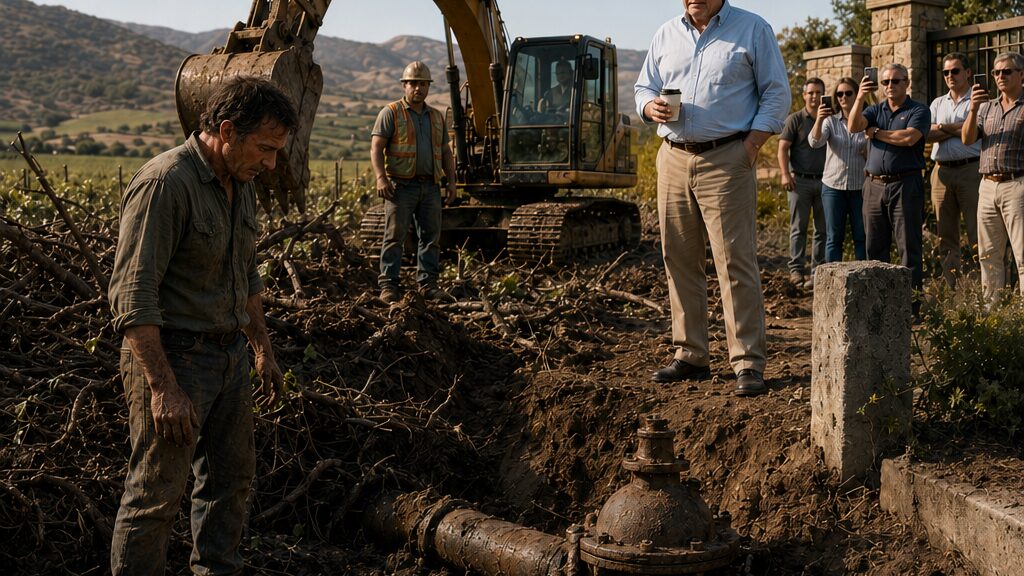
They Bulldozed His Vineyard for an HOA Expansion, Then Learned Their Entire Community Depended on His Water
Chapter 1: The Morning the Excavator Crossed the Old Vineyard Line
The first vine snapped before Benjamin Martin reached the gate.
He heard it from inside his truck: a dry, fibrous crack beneath the diesel growl of an excavator, followed by the grind of steel tracks over soil he had spent eleven years rebuilding.
For half a second he sat with both hands locked around the steering wheel.
Then the excavator bucket dropped again.
It tore through another row.
Benjamin threw the truck into park so hard the cab rocked. He was out before the engine stopped, crossing the frontage in long, uneven strides, one boot catching on the irrigation hose. Dust moved across the vines in a pale sheet.
“Shut it down!”
The operator looked toward him but did not stop.
“Shut the machine down!”
A man in a reflective vest raised one palm as if Benjamin were approaching a road closure. Behind him, orange stakes marked a line through the first six rows of Cabernet vines. The stakes did not follow Benjamin’s fence. They cut inward.
The bucket lowered.
Benjamin stepped directly into its path.
The operator finally killed the hydraulics.
Silence hit hard after the engine noise. Leaves trembled in the dust. A severed vine lay across the trench with its roots exposed, thick as a wrist.
The operator opened the cab door.
“You need to move.”
“You need to get off my land.”
“We’ve got authorization.”
“From who?”
The operator pointed toward the road.
Charles Nelson was walking up from a white SUV with a coffee cup in one hand.
Even from thirty yards away, Benjamin recognized the easy pace. Charles did not hurry because he had already decided the problem belonged to someone else.
He wore a pale blue shirt with the sleeves folded once at the forearms, clean shoes, no hat. Two men from the HOA board stood near the SUV. Farther back, a cluster of residents watched from the new stone entrance to the development. One had a phone held chest-high.
Charles stopped at the trench and looked at the damaged vines.
Then he looked at Benjamin.
“This didn’t need to be difficult.”
Benjamin stared at him.
“You put a machine through my vineyard.”
“We put a machine through the approved access corridor.”
“There is no approved corridor.”
Charles took a sip of coffee.
“The board’s been working on this for months.”
“I refused the easement twice.”
“You refused our purchase offer.”
“I refused the easement.”
“That distinction is going to matter a lot less than you think.”
Benjamin felt something hot move through his chest.
He could see the first letter in his mind because he had written it at the kitchen table in February. The second in April, after the HOA attorney sent a revised proposal with a larger number and a thinner description of what they wanted.
A widened entrance road.
Utility access.
Emergency vehicle clearance.
The language had been polished until the actual request nearly disappeared: a strip of Benjamin’s frontage, wide enough to cut through the old rows and connect the development’s secondary drive to the county road.
He had written no both times.
Not maybe.
Not pending survey.
No.
Benjamin turned toward the man in the reflective vest.
“Who gave you the survey?”
The man glanced at Charles.
That was enough.
Benjamin took his phone from his pocket and called the sheriff’s office. His thumb shook once on the screen, and he hated that Charles saw it.
Charles sighed.
“You’re making a spectacle out of this.”
Benjamin looked at the torn vines.
“You brought an excavator.”
A few people behind Charles laughed.
Not loudly. Not all of them.
Enough.
Benjamin ended the call after giving the address. He walked back toward his truck and opened the passenger door.
Charles called after him.
“You should think about the homeowners for once.”
Benjamin stopped.
He had spent twenty-seven years as a hydrologist, most of them in county service, and had learned that certain sentences were designed to make the person answering them accept a false premise.
He turned.
“What about them?”
Charles gestured toward the development beyond the stone entrance. Red tile roofs climbed the low slope above the vineyard. The golf course lay beyond them, hidden except for the tops of cottonwoods and a bright strip of green fairway.
“You’re holding up an access improvement that benefits more than three hundred households. Insurance costs are rising. Emergency response times matter. Property values matter.”
“And my boundary doesn’t?”
Charles’s mouth tightened.
“You’re sitting on forty acres and acting like six feet of frontage is a moral issue.”
Benjamin almost laughed.
Instead he went to the truck, pulled a document envelope from beneath the seat, and came back.
“This is my April refusal.”
Charles did not take it.
Benjamin held it toward the reflective-vested man.
“This is my February refusal.”
He removed the second copy.
“And this is the certified delivery receipt to your management office.”
Now the worker took them.
He read the first page, then looked at Charles.
“We were told the dispute was resolved.”
No one laughed this time.
Charles lowered his coffee.
“It is resolved.”
“By who?” Benjamin asked.
“The board has relied on the access plan, legal review, and preliminary boundary work.”
“Preliminary?”
Charles’s eyes hardened.
Benjamin saw it then—not guilt, exactly. Irritation at a complication that had been expected to stay small.
A sheriff’s deputy arrived ten minutes later. By then the excavator was silent, the operator standing beside the track while Benjamin photographed every broken vine, every stake, every exposed root.
The deputy listened to both sides, looked at the documents, and said what Benjamin knew he would say.
Civil dispute.
No immediate arrest.
No one was to threaten anyone.
No further work until the contractor clarified authorization.
It was not justice. It was a pause.
Charles used the pause.
He turned toward the residents still gathered by the road.
“This is exactly what we’ve been dealing with,” he said, loud enough for Benjamin to hear. “One holdout willing to cost an entire community money.”
Benjamin kept photographing.
A woman near the stone entrance said, “My insurance went up twenty-eight percent.”
Another voice: “We were told the road was approved.”
Charles nodded as if he had been asked to testify.
“We have acted in the community’s interest at every stage.”
Benjamin stood.
Dust had settled into the sweat along his wrists. One of the oldest vines lay beside his boot, its trunk split lengthwise.
Charles looked at it too.
“You can replant.”
Benjamin crossed the distance between them before he fully decided to move.
The deputy shifted.
Benjamin stopped two feet from Charles.
“You’re standing on my land.”
Charles did not step back.
“And you’re standing in the way of hundreds of people.”
For one dangerous moment Benjamin wanted to hit him.
Not because of the road.
Because Charles had said hundreds of people as if Benjamin were not one person. As if one person became mathematically disposable when enough others wanted something.
Benjamin looked past him instead.
At the trench.
The excavator bucket had peeled away more than roots and soil. Near the third damaged row, something dark curved out of the cut earth.
Pipe.
Old steel, maybe six inches.
Benjamin’s anger thinned into attention.
He moved toward it.
The operator said, “Careful. We don’t know if that’s active.”
Benjamin crouched.
The pipe lay deeper than his vineyard laterals. Wrong diameter for drip supply. Wrong alignment for the old barn service.
Charles came up behind him.
“What now?”
Benjamin ignored him.
He brushed soil from the exposed metal with his bare hand. Rust flaked beneath his thumb.
Near the pipe was a low iron housing almost lost beneath weeds and broken vine leaves. He knew the shape. He had seen it for years without really seeing it, an obsolete piece of farm hardware beside the old boundary marker.
A wheel housing.
Charles gave a short laugh.
“If you’re done inspecting dirt, we can let the professionals sort this out.”
Benjamin’s hand rested on the corroded iron.
A weathered concrete post stood three feet away, tilted by decades of freeze and heat. Someone had once stamped numbers into its face.
Benjamin looked from the marker to the pipe.
Then toward the slope.
The line did not run toward his barn.
It ran northeast.
Toward the HOA.
He wiped more soil away until a faint manufacturer’s stamp appeared beneath the rust.
His breathing stopped.
He knew that marking.
The county had used that pipe series on old shared-well systems and agricultural transmission lines before modern PVC replaced most of them.
Charles was still talking behind him.
Benjamin heard none of it.
He put two fingers against the pipe.
At first, nothing.
Then, deep inside the metal, a faint pulse.
Not memory.
Not imagination.
Movement.
Chapter 2: The Pipe Beneath Their New Entrance Road
The pipe was carrying water.
Benjamin knew before he put his ear near it.
The vibration was too steady for loose metal and too soft for machinery. A pressure pulse moved through the steel at regular intervals, almost delicate beneath the noise of men packing equipment.
He kept his hand on it.
The excavation crew was preparing to leave. The sheriff’s deputy had gone. Charles stood near his SUV speaking into his phone, watching Benjamin with open impatience.
Benjamin lifted his hand from the pipe.
He did not tell anyone what he had felt.
That was his first mistake.
At noon, after the last contractor truck rolled away, he strung survey tape across the damaged rows and walked the exposed line with a fiberglass measuring wheel.
The pipe disappeared beneath the planned entrance corridor, crossed the fence line at an angle, then vanished under hardpan.
Benjamin traced its likely bearing by eye.
Northeast.
The clubhouse sat that way.
So did the upper irrigation pond.
He went to the equipment shed for a shovel.
By three, sweat had soaked through the back of his shirt. He opened two shallow inspection cuts along the suspected line, careful not to strike metal. Both times he found the same pipe.
Active.
Old.
Heading directly toward the development.
A white county envelope had been taped to his gate while he worked.
TEMPORARY WORK STATUS NOTICE.
The contractor had submitted additional documentation. The access project remained paused pending review, but an emergency request for continuation had been filed on grounds of safety and scheduled utility coordination.
Benjamin read the page twice.
Then folded it into his pocket.
Charles had lost half a day and answered by making the pressure official.
Benjamin returned to the pipe.
He should have called an attorney.
He should have called Amanda.
Instead, he took a tape measure and went looking for the old well.
The enclosure sat below the western rise, hidden behind volunteer oak and waist-high weeds. Benjamin had not opened it in years. The small corrugated structure predated his ownership, and as far as he knew, the well had been abandoned before he bought the land.
The padlock was rusted solid.
He cut it.
Inside, dust covered an electrical panel so old the labels had curled. A vertical casing rose through the concrete slab. Beside it sat a wide iron valve wheel, red paint gone brown with age.
Benjamin stared at the wheel.
Then he touched it.
The metal was cool.
He pulled weeds from the base and found a newer conduit running behind the old panel.
Not abandoned.
Modified.
He knelt and followed the conduit to a junction box installed much later than the structure around it.
Someone had kept this system alive.
Benjamin went back for a survey map.
The property line was not difficult to establish. Two known monuments, the 1962 marker, and the south fence corner gave him enough for a field check. He stretched the tape twice because he did not trust the first result.
The well casing stood forty feet inside his property.
He measured again.
Forty feet, four inches.
Benjamin sat back on his heels.
Across the fence, the development’s landscaping climbed toward the golf course in immaculate bands of green. Sprinklers turned in silver arcs over a slope that should have been brown by June.
His phone rang.
Amanda.
He let it ring.
It stopped.
Then rang again.
Benjamin answered.
“What?”
“Nice to hear your voice too.”
“I’m working.”
“I heard you stood in front of an excavator.”
He closed his eyes.
“Who told you?”
“Does it matter?”
“Yes.”
“No, it does not. Did you?”
“The machine was on my land.”
“That isn’t an answer.”
“It stopped.”
There was a pause.
Amanda lowered her voice.
“Dad.”
He hated when she said it that way.
Not angry.
Worried.
“I’m fine.”
“You say that like it’s a legal term.”
“I have to go.”
“I’m already driving.”
Benjamin stood.
“No.”
“Too late.”
“Amanda.”
“I’ll be there in forty minutes.”
She hung up.
Benjamin looked at the valve wheel.
For eleven years, Amanda had told him the vineyard was eating him alive.
Some years she was not wrong.
He had bought the place after leaving county service, when the vines were half-dead and the farmhouse roof leaked in three rooms. He had rebuilt irrigation lines, replaced posts, grafted rows, learned pruning from men who laughed at his first cuts.
Amanda had helped for two summers.
Then she stopped.
He had never asked why.
By the time her car pulled into the yard, Benjamin had mapped the old line from the well enclosure to the excavated frontage and marked three probable branches.
Amanda stepped out wearing work pants and a city office blouse, sleeves already rolled.
She looked at the damaged rows.
Her face changed.
Benjamin looked away.
“That’s worse than I heard.”
“They crossed the line.”
“I can see that.”
“The survey stakes are wrong.”
“I can see that too.”
He handed her the temporary work notice.
She read it.
“You need counsel.”
“I know.”
“You called someone?”
“I’m handling it.”
Amanda looked up.
“That means no.”
He walked toward the well enclosure.
She followed.
“What is this?”
“Maybe nothing.”
“That’s always how you introduce something terrible.”
Inside the enclosure, she saw the casing and stopped.
Benjamin handed her the tape.
“Measure from the west monument.”
She did not argue. That was the part of Amanda he trusted most, even when they could not stand each other.
They checked the line together.
Forty feet.
She crouched beside the newer conduit.
“This upgrade isn’t ancient.”
“No.”
“Who owns the meter?”
“There isn’t one here.”
She turned.
“No meter?”
“Not that I’ve found.”
“That’s not possible if someone is actively drawing.”
“It’s possible.”
“You know what I mean.”
Benjamin did.
He took a wrench from his pocket and loosened a corroded inspection cap on the downstream assembly. It resisted, then shifted.
A fine tremor passed through the fitting.
Amanda touched it.
Her expression sharpened.
“That line is pressurized.”
“Yes.”
“Where does it go?”
Benjamin pointed northeast.
She stepped outside and looked toward the development.
The top of the clubhouse roof was visible between trees.
Beyond it, a fountain threw a white plume above the ornamental lake.
Amanda looked back at him.
“No.”
“I haven’t proved anything.”
“You think their system is tied to this.”
“I think the pipe is.”
“That could be old.”
“It’s carrying.”
“Then call the utility.”
“It may not be a utility line.”
“What does that mean?”
Benjamin did not answer.
He walked to the fence.
From there, the golf course was easier to see. Eighteen holes of irrigated grass spread through the dry valley like an argument against climate.
A maintenance cart moved beside the upper pond.
Then a pump started somewhere beyond the trees.
Three seconds later, the vibration beneath Benjamin’s boot changed.
He looked down.
Amanda saw his face.
“What?”
He crouched and put his fingers to the buried line.
The pressure pulse had strengthened.
He pointed toward the golf course.
“That pump just came on.”
Amanda went still.
Benjamin felt something he had not allowed himself since morning.
Hope.
It frightened him.
Because if he was right, Charles Nelson had bulldozed the land of a man whose well might be feeding the entire development.
And if he was wrong, Benjamin was about to build his case around anger.
He went back inside the enclosure.
Amanda stood at the door while he cleared debris from the base of the casing.
There were scratches beneath the rust.
Old maintenance marks.
Initials, maybe.
Benjamin used a wire brush.
The first letter appeared.
G.
Then M.
He stopped brushing.
Amanda leaned closer.
“What is it?”
Benjamin touched the letters with one thumb.
His grandfather had signed fence posts, pump housings, and tool handles the same way.
G.M.
Always small.
Always hidden where only the person maintaining the thing would see.
Benjamin stared at the casing.
His grandfather had known this well.
More than known it.
He had worked on it.
And somewhere between the old pipe, the active flow, and those two initials was an arrangement Benjamin had never been told about.
Chapter 3: The County File Nobody Had Opened for Decades
“Old water records rarely mean what angry landowners want them to mean.”
George Torres said it before Benjamin had taken off his hat.
The county records office had moved twice since Benjamin worked for the department, but George had somehow remained unchanged except for his hair, which was now mostly white. He sat behind a counter beneath fluorescent lights with a pencil tucked above one ear.
Benjamin placed a folder on the counter.
“I’m not angry.”
George looked at him.
Benjamin took a breath.
“I’m not here to ask you to agree with me.”
“That’s better.”
“I need the deed chain, well log, recorded easements, maintenance access, and any transfer documents tied to my parcel.”
George’s eyes narrowed.
“What happened?”
“Excavator.”
“That answers less than you think.”
“HOA entrance project crossed my frontage.”
George leaned back.
“And now you found something.”
Benjamin said nothing.
George sighed.
“There he is.”
“Who?”
“The man who used to come into meetings with half the answer in his pocket and make everybody earn the other half.”
“I’m trying not to contaminate your search.”
“You’re trying not to be told you’re wrong.”
Benjamin looked toward the reading tables.
George stood.
“Parcel number.”
Benjamin gave it to him.
For the next hour, paper replaced anger.
That was one reason Benjamin had come in person.
Documents demanded patience.
The current deed was straightforward. Forty acres, legal description matching the monuments Benjamin knew. No conveyed strip corresponding to the HOA’s proposed entrance.
George found older plats on microfilm, then a digitized survey from the late 1980s.
The boundary line held.
Benjamin felt the first hard click of satisfaction.
“They crossed it.”
George tapped the page.
“Looks that way from this.”
“Six to nine feet at the deepest point.”
“Maybe.”
“Maybe?”
“I don’t certify field measurements from a scanned plat.”
Benjamin clenched his jaw.
George noticed.
“See? Angry.”
“Keep going.”
The well log took longer.
It was filed under an obsolete agricultural district number, handwritten in 1962, with a pump test added three years later. Depth. Static water level. Yield. Casing diameter.
Benjamin read the numbers twice.
The output capacity was far greater than a vineyard service well.
George looked over his shoulder.
“That catch your attention?”
“Yes.”
“Why?”
Benjamin hesitated.
Then told him about the active pipe.
Not everything.
Enough.
George removed his glasses.
“You think the development is drawing from your parcel?”
“I think a line from this well runs toward them.”
“That’s not the same thing.”
“I know.”
“And use over time matters.”
“I know.”
“Permission matters.”
“I know.”
George put his glasses back on.
“Then stop saying it like you don’t.”
They searched easements.
The first was for electrical maintenance.
The second covered road ingress to service a pump and transmission line.
Benjamin leaned over the page.
“There.”
George read silently.
The language granted access across a defined path for maintenance of “existing water conveyance equipment.”
Benjamin’s pulse quickened.
“It doesn’t grant water.”
George held up one finger.
“It doesn’t clearly grant water.”
“Same difference.”
“No.”
Benjamin stepped away from the table.
George kept reading.
“It references a private arrangement.”
“What arrangement?”
“Not recorded here.”
“Then it doesn’t bind me.”
George looked up.
“You know better than that.”
Benjamin did.
Unrecorded agreements could create years of litigation. Longstanding use could matter. Reliance could matter. State water law could become ugly before breakfast.
But the document did not say what Charles would want it to say.
It did not convey unrestricted water rights to a future HOA.
It did not transfer ownership of the well.
It did not create free perpetual use.
That was something.
By midday they had assembled a stack: deeds, plats, well log, pump inspection, maintenance easement, tax maps.
George brought one final file from archival storage.
The cardboard cover had gone soft at the corners.
“No scan?”
“Apparently nobody cared enough.”
He opened it.
Inside was a black-and-white inspection photograph.
Benjamin recognized the well enclosure immediately.
The roof had been newer. The weeds absent.
And beside the casing stood the same iron valve wheel.
Fresh paint.
Dark, almost certainly red.
Benjamin touched the edge of the photograph.
On the back, in pencil, someone had written a date and a note about shared drought operation.
His throat tightened.
George saw it.
“What?”
“My grandfather’s initials are on the casing.”
George turned the photo over again.
“Then he was involved.”
They kept reading.
A folded page near the back contained a handwritten maintenance notation from years later. Different handwriting.
Benjamin knew it before he finished the first line.
His father.
The note referred to continued summer flow during an extreme drought year.
No contract number.
No rate.
No permanent transfer.
Just a brief statement that service had been maintained by agreement between adjoining landholders.
Benjamin sat down.
George did not speak.
The room seemed suddenly too bright.
His father had never mentioned it.
Or maybe he had, indirectly.
There had been stories about hauling water, wells dropping, families leaving for a season. Benjamin had heard them as a child and filed them under old hardship, the kind adults compressed into two sentences because children could not understand the fear.
George pulled another document closer.
“This helps them.”
Benjamin looked at him.
“It also helps me.”
“Yes.”
“How does it help them?”
“It shows the use wasn’t necessarily secret.”
“It shows my father allowed it.”
“Exactly.”
“Allowed isn’t owned.”
“No.”
“Allowed isn’t forever.”
“No.”
“Then say it.”
George folded his hands.
“You may have a credible basis to challenge current use. You may have a strong one. But if you walk out of here saying every drop is unquestionably yours and they’re thieves, you’ll be lying to yourself before anyone else gets the chance.”
Benjamin stood and went to the window.
Across the street, sprinklers ran on the courthouse lawn.
He thought of the broken rows.
Charles telling him he could replant.
The residents watching.
The laughter.
He had come for a clean weapon and found history instead.
George’s chair moved behind him.
“There’s more.”
Benjamin turned.
George was staring at a computer screen.
“What?”
“I ran the parcel references through recent title correspondence.”
Benjamin came back to the desk.
A PDF had opened on-screen. The letterhead belonged to a title company Benjamin recognized. The date was less than a year old.
Subject: access expansion and water-service exceptions.
George scrolled.
Benjamin read a paragraph once.
Then again.
The preliminary review flagged two unresolved matters: uncertainty in the proposed frontage alignment and absence of a recorded instrument establishing permanent water rights from the Martin parcel.
Benjamin felt the room narrow.
“Who got this?”
George scrolled to the distribution list.
The HOA management company.
The board’s attorney.
The development lender.
And Charles Nelson.
Benjamin stared at the name.
The excavator had not crossed his vineyard because no one knew there was a problem.
Someone had been warned.
George pointed lower on the page.
“There’s a notation.”
A later email summary stated that the issue would be “handled through board resolution and existing-use position” while access work proceeded on schedule.
Benjamin read it in silence.
George looked at him carefully.
“You asked whether they knew.”
Benjamin closed the file folder.
Now he had an answer.
Not the whole answer.
Something worse.
Charles had received the warning before the first vine broke.
And still, on Monday morning, he had stood beside the excavator with coffee in his hand and said the dispute was resolved.
Chapter 4: The Board Meeting Built on a Convenient Lie
By the time Benjamin entered the clubhouse, someone had already printed his name on a sign.
STOP MARTIN FROM HOLDING OUR HOMES HOSTAGE.
The poster leaned against the registration table beside a bowl of wrapped mints and a stack of HOA agendas. A woman he recognized from the lower cul-de-sac saw him reading it and folded her arms.
“You’ve got some nerve coming here.”
Benjamin looked past her.
Every chair was filled.
Residents stood along the walls beneath framed photographs of the golf course in greener years. Through the windows behind the board table, the evening sprinklers turned in slow arcs across the first fairway.
Charles Nelson sat in the center seat.
Melissa Davis was three places to his left, a calculator beside her legal pad. She did not look at Benjamin.
Charles tapped the microphone.
“Let’s keep this civil.”
Benjamin almost smiled.
He took the only empty chair near the back.
The first twenty minutes had nothing to do with him. Reserve funds. Landscape contracts. Insurance renewal estimates. A roof claim involving the clubhouse kitchen.
But his name moved through the room even when no one said it.
Then Charles reached agenda item seven.
“Access improvement update.”
The room changed.
People straightened.
Charles folded his hands.
“As many of you know, work on the secondary entrance has been temporarily interrupted due to a property-boundary objection raised by Mr. Martin.”
“Objection?” Benjamin said.
Charles looked toward him.
“You’ll have time.”
“You sent a machine across my surveyed line.”
Several residents began talking at once.
The microphone squealed.
Charles lifted one hand.
“This is exactly why we need procedure.”
Benjamin stood.
“I brought procedure.”
He carried copies of the title memo to the front.
The HOA attorney, seated at the end of the table, leaned forward before Benjamin had even set them down.
“What is that?”
“A preliminary title review distributed eleven months ago.”
Charles’s expression did not change.
Benjamin placed one copy in front of him.
“Page three.”
The attorney reached for it.
Charles put his palm on the paper first.
A small gesture.
Protective.
Benjamin noticed.
“So you’ve seen it,” he said.
Charles looked up.
“I’ve seen dozens of preliminary documents.”
“This one flags the frontage alignment.”
“It raises a technical question.”
“It says unresolved.”
“Preliminary title work is full of unresolved items.”
“And you told the contractor the dispute was settled.”
A resident near the front called, “Is that true?”
Charles turned toward the room.
“The board acted on advice available to it.”
“That isn’t what I asked,” Benjamin said.
Charles’s voice cooled.
“You are not chairing this meeting.”
“No. I’m just the man whose vines are under your access road.”
The room broke into noise.
Someone shouted that Benjamin had refused every offer.
Another resident asked why the road mattered so much.
A man near the aisle said his homeowners insurance carrier had already warned him about emergency access.
Then Melissa spoke.
Not loudly.
“We cannot afford both.”
The room quieted by degrees.
Charles turned toward her.
“Melissa.”
She looked at her notes.
“We cannot afford a complete redesign of the entrance and a large special assessment in the same fiscal cycle.”
A woman in the second row said, “What special assessment?”
Melissa’s pencil stopped.
Charles answered before she could.
“No assessment has been approved.”
“That’s not what she said.”
More voices.
Melissa closed her eyes briefly, then opened them.
“Our reserves are below target. Everyone here knows that. The insurance renewal is higher than forecast. The road redesign estimate was also higher.”
“How much higher?”
Charles struck the gavel once.
“We are moving away from the agenda.”
Benjamin watched Melissa.
She looked afraid.
Not of him.
Of the numbers.
That mattered.
Charles leaned toward the microphone.
“Mr. Martin has been offered fair compensation for a narrow strip of frontage. He has rejected it repeatedly. Now, after work has begun, he is raising a separate claim involving legacy water infrastructure.”
Heads turned toward Benjamin.
There it was.
He had not mentioned the well publicly.
Charles had.
Benjamin felt Amanda’s warning in the back of his mind: Don’t assume you’re the only one who knows.
A resident stood.
“What water claim?”
Charles spread his hands.
“Exactly. We are dealing with a moving target.”
Benjamin walked to the front again.
“The title memo you received also flags the absence of a recorded instrument granting permanent water rights from my parcel.”
The room went silent enough for him to hear the sprinkler heads outside clicking through their rotation.
Charles stared at him.
The HOA attorney whispered something.
Benjamin continued.
“I have not threatened household water. I have not shut anything off. I have asked what agreement authorizes current use.”
A man near the wall said, “So you are threatening us.”
“No.”
“You just said you control our water.”
“I said I asked for the agreement.”
Charles leaned back.
“Let’s be honest about what this is. Mr. Martin lost a boundary dispute in the field and is now searching for leverage.”
Benjamin’s temper moved before his judgment.
“You knew the boundary was unresolved.”
“We had legal review.”
“You had a warning.”
“We had an exception note.”
“You had my refusals.”
“You had an asking price.”
Benjamin stepped closer to the table.
“I did not have an asking price.”
Charles met his eyes.
“Everyone does.”
The words landed badly.
Even Charles seemed to hear it.
Benjamin thought of the broken vine in the trench.
The years of grafting.
The winter he had slept in the packing shed because the farmhouse roof leaked over the bedroom.
He reached into his folder and removed the black-and-white photograph from the county file.
He held it up.
The old well enclosure.
The iron valve wheel.
“This system predates your development.”
Charles barely glanced at it.
“Obsolete farm hardware.”
“No.”
“You don’t know that.”
“I know it’s active.”
A sharp murmur moved through the room.
Charles’s face changed for the first time.
Not surprise.
Calculation.
Benjamin saw it and understood that the meeting had just become dangerous.
The HOA attorney spoke quickly.
“We should not discuss unverified infrastructure claims in open session.”
“Why not?” someone shouted.
A second board member raised a hand.
“I want to say something.”
Charles turned.
“Not now.”
The board member ignored him.
“We discussed that title memo.”
The room stilled.
Charles’s jaw tightened.
The board member looked toward the residents.
“Not in full session. In executive discussion. We were told the water-rights issue needed clarification before permanent financing.”
Melissa lowered her gaze.
Benjamin felt the satisfaction come.
Clean.
Immediate.
And because he was still angry, he let it show.
Charles saw that too.
“You think this proves what?” Charles asked.
“That you knew.”
“I knew there were questions.”
“And authorized excavation anyway.”
“I authorized work based on counsel and decades of established use.”
The words struck Benjamin harder than denial would have.
Decades of established use.
His grandfather’s initials.
His father’s handwritten drought note.
Charles was not inventing history.
He was standing inside a version of it that benefited him.
Benjamin said nothing.
Charles leaned toward the microphone.
“This community did not wake up one morning and steal water from Mr. Martin. The system has operated openly for generations. The entrance project protects emergency response. The refinancing protects reserves. And yes, property values matter because people have their life savings in these homes.”
A woman near the aisle began to cry quietly.
Benjamin looked at her.
Then at the crowded room.
For the first time, the word homeowners stopped being an abstraction.
He hated Charles for making that matter now.
He hated himself more for wishing it did not.
The meeting deteriorated after that.
Residents demanded documents.
The attorney threatened litigation if Benjamin interfered with any water system.
Charles accused him of retaliation.
Benjamin demanded an immediate stop to all excavation until a certified survey was complete.
No agreement was reached.
At nine thirty, the meeting adjourned into chaos.
Benjamin collected his papers and headed for the side exit.
“Mr. Martin.”
Melissa Davis stood in the hallway.
Up close, she looked older than she had at the table. Tired around the eyes.
Benjamin stopped.
“If this is about the assessment—”
“It isn’t.”
She checked the hallway behind her.
Then lowered her voice.
“The refinancing file.”
“What about it?”
“There’s a disclosure.”
Benjamin waited.
Melissa swallowed.
“Water-source risk.”
His grip tightened on the folder.
“What kind?”
“The kind Charles told us could be cured before closing.”
“Us?”
“The finance committee.”
Benjamin stared at her.
“Do the homeowners know?”
Melissa looked toward the meeting-room doors, where angry voices were still rising.
“No.”
“Does the lender?”
Her silence answered first.
Then she said, “Not everything.”
Benjamin felt the entire conflict shift under his feet.
“What exactly did you hide?”
Melissa stepped back.
“I didn’t say I would give you the file.”
“No. You just told me it exists.”
Her face tightened.
“Because you need to understand something before you decide what kind of man you’re going to be with that valve.”
She walked away before he could answer.
Benjamin stood alone in the hallway, holding proof that Charles had been warned about the boundary.
And now knowing that somewhere inside the HOA’s refinancing records was a second warning—one kept not from him, but from the people whose homes depended on it.
Chapter 5: The Water Agreement That Never Became a Contract
Amanda caught him with both hands on the iron valve wheel before sunrise.
“What are you doing?”
Benjamin froze.
She stood outside the well enclosure in yesterday’s clothes, hair tied back badly, one hand braced on the doorframe.
He had not heard her car.
“I’m testing resistance.”
“You’re turning it.”
“A quarter inch.”
“That is still turning it.”
Benjamin looked down.
The wheel had moved.
Barely.
Enough to break rust from one side of the stem.
He could feel pressure through the assembly.
Alive.
Amanda stepped inside.
“Put it back.”
“I know where it was.”
“Put it back.”
He did.
The wheel squealed as he returned it to the chalk mark he had drawn on the housing.
Amanda watched until his hands came away.
Then she said, “You didn’t tell me Charles knew about the line.”
“I didn’t know he knew.”
“You also didn’t tell me about the board meeting until midnight.”
“I was busy.”
“You were angry.”
Benjamin picked up his wrench.
“They bulldozed my vines.”
“I know.”
“He had the survey warning.”
“I know.”
“They concealed a water-risk disclosure.”
“I know what you told me.”
He stepped toward the door.
Amanda blocked it.
“What happens if you close this?”
“Their irrigation pressure drops.”
“What else?”
“That’s what I’m determining.”
“No. That’s what you should have determined before touching it.”
He looked at her.
She held out a folded site plan.
Benjamin recognized the HOA’s public infrastructure map.
“Where did you get that?”
“County fire planning portal.”
He took it.
Amanda pointed to a storage basin above the golf course.
“This pond supplies landscape irrigation.”
“I know.”
“And this branch?”
Benjamin followed the line.
His stomach tightened.
“Emergency reserve.”
“Partly.”
He looked closer.
The development had municipal household service through a separate system, but two fire-suppression storage points were hydraulically connected to the legacy irrigation network for seasonal replenishment.
Not primary supply.
Not irrelevant either.
Amanda said, “Peak fire season starts in weeks.”
“I’m not shutting it today.”
“You were turning the wheel before dawn.”
“To test it.”
“Alone.”
Benjamin folded the plan too sharply.
“I know water systems.”
Amanda’s expression changed.
There it was.
The old wound.
“You knew the rural project too.”
Benjamin went still.
She immediately looked sorry.
But she did not take it back.
Years earlier, before the vineyard, Benjamin had signed off on a county recommendation for a rural well-support program. The modeling had been defensible. The assumptions had not survived two dry years.
Several families had borrowed against property improvements that became useless when production fell.
No fraud.
No scandal.
Just people losing money after trusting a recommendation with his name beneath it.
Benjamin had left county service the following year.
Amanda said quietly, “I’m not saying it was your fault.”
“Don’t.”
“I’m saying that knowing a system doesn’t make you incapable of hurting people.”
He walked out of the enclosure.
She followed him to the farmhouse.
By eight, the kitchen table was covered with maps.
Benjamin traced the network while Amanda checked engineering documents. The picture became clearer and uglier.
The well on Benjamin’s property fed the golf-course irrigation ponds.
Those ponds supplied greens, fairways, common landscaping, ornamental fountains.
And, under high-risk seasonal protocols, supported replenishment for emergency storage.
A total shutdown would not immediately leave homes dry.
But it could narrow the community’s margin during a bad week.
Benjamin sat back.
Amanda said nothing.
On the table between them lay his father’s handwritten drought note.
Service maintained by agreement between adjoining landholders.
Benjamin picked it up.
“When I was nine,” he said, “there was a fire north of the ridge.”
Amanda waited.
“I remember tankers filling somewhere near the old road. My father disappeared for two days.”
“You think this was why?”
“I don’t know.”
He read the note again.
“He hated the development.”
“There was a development then?”
“Not like now. Houses. A small course. Different ownership.”
“And he kept the water running.”
Benjamin nodded.
“Why?”
He knew before he answered.
“Because people lived there.”
The words felt like a betrayal of his anger.
Amanda leaned back.
“So what did your grandfather agree to?”
“That’s the problem.”
On Friday they returned to archival records.
Not to George’s public counter this time, but to copies Benjamin had ordered and a box of historical district correspondence.
The arrangement emerged in fragments.
A maintenance-access easement.
A pump-sharing note.
Letters between adjoining landowners.
No deeded transfer of the well.
No permanent no-cost entitlement.
No modern usage contract.
And no clean proof that the current HOA could simply take unlimited water forever.
The old system had survived because each generation assumed the next would keep doing what the last had done.
Until Charles tried to take Benjamin’s frontage.
By Saturday afternoon, Benjamin had drafted a notice.
Amanda read it at the kitchen table.
“Too broad.”
“It reserves all rights.”
“It also demands cessation of unauthorized use without defining protected flow.”
“They can negotiate.”
“Then write that.”
He stared at her.
She pushed the page back.
“You keep saying this is about ownership. Fine. Act like an owner.”
“I am.”
“No. You’re acting like a man who found a bigger bulldozer.”
Benjamin stood so fast the chair legs scraped the floor.
Amanda did not move.
For a moment, neither spoke.
Then his phone rang.
Charles.
Benjamin answered.
“You have one minute.”
Charles did not bother with hello.
“I hear you’re preparing a water interference notice.”
“Who told you?”
“You think county requests are invisible?”
“I requested records.”
“You are threatening infrastructure used by hundreds of homes.”
“I offered to discuss a temporary usage agreement last night.”
“You offered extortion.”
“I offered metering, payment, and emergency safeguards.”
“You offered to put a private choke point around a community system because your feelings were hurt.”
Benjamin looked at the broken vines through the kitchen window.
“My feelings did not move your survey stakes.”
“Listen carefully. If you touch that line and anything happens—anything—to a home, a fire reserve, a piece of community property, I will bury you in litigation until your vineyard belongs to somebody who understands cooperation.”
The line went quiet.
Benjamin said, “You had the title warning.”
Charles’s breathing changed.
“You had the water exception too.”
No answer.
“Didn’t you?”
Charles came back colder.
“You have no idea what this community is carrying.”
“Then tell them.”
“You bitter old man.”
Benjamin’s hand tightened around the phone.
Charles continued.
“You think because you found an antique valve you suddenly matter more than three hundred families.”
Benjamin ended the call.
Amanda had heard enough from his side.
“What did he say?”
Benjamin looked at the draft notice.
Then at the emergency-storage map.
For ten seconds he did nothing.
Finally, he sat.
“Get me the minimum seasonal replenishment figures.”
Amanda studied him.
“Why?”
“Because the notice changes.”
They worked until evening.
The final document did not demand a blind shutdown.
It identified disputed use.
Required negotiation of a temporary metered agreement.
Reserved Benjamin’s ownership claims.
Protected defined emergency replenishment and household minimums.
Set a deadline.
Thirty days.
At the post office Monday morning, Benjamin stood at the counter while the clerk stamped the certified envelope.
One copy to the HOA.
One to its attorney.
One to the management company.
He watched the date appear in red.
For the first time since the excavator crossed his line, he felt no satisfaction.
Only weight.
Because the letter gave Charles a way out.
And if Charles refused it, Benjamin would have to decide whether the iron wheel behind his vineyard was truly a right he was prepared to use.
Chapter 6: Thirty Days of Threats, Silence, and Falling Trust
The first protest sign appeared before sunrise.
SAVE OUR WATER.
By six thirty there were seven.
Benjamin found them zip-tied to his fence between the damaged vineyard rows and the county road. One had his last name painted across it.
MARTIN WANTS TO DRY US OUT.
He cut none of them down.
That surprised Amanda.
“You’re leaving those?”
“They’re on the county side.”
“That has never stopped you from complaining about signs.”
“I’m conserving energy.”
She gave him a look.
Benjamin went back to repairing trellis wire.
The thirty-day notice had twelve days left.
Charles had not negotiated.
Instead, the HOA sent letters to residents warning of a “potential unilateral interruption of longstanding community water infrastructure.” The language did not mention the disputed well ownership.
It did not mention the title exception.
It did not mention the emergency safeguards in Benjamin’s proposal.
By afternoon, three more signs appeared.
Then a local insurance adjuster called asking whether Benjamin intended to impair fire readiness.
Then the HOA attorney sent a demand that he withdraw the notice.
Then someone left a dead sprinkler head on his gate.
Benjamin told no one how much the last one bothered him.
He became more precise instead.
He photographed every sign.
Logged every call.
Forwarded every threat to counsel.
And each evening, after Amanda left, he walked alone to the well enclosure and looked at the iron wheel without touching it.
On day twenty-two, Melissa Davis came to the vineyard.
She parked outside the gate and waited.
Benjamin almost made her stay there.
Then he opened it.
She carried no folder.
“No documents?” he asked.
“I’m not stealing board records.”
“You said the file contained a disclosure.”
“It does.”
“You said the lender didn’t have everything.”
Melissa’s mouth tightened.
“I said not everything.”
Benjamin turned away.
“Then we’re done.”
“I pushed Charles to delay it.”
He stopped.
Melissa stood by the gate, arms folded against herself.
“What?”
“The disclosure.”
Benjamin faced her.
She looked toward the development.
“My husband died four years ago. I can carry my house now because the mortgage is low. There are people over there in the same position. Fixed incomes. Medical bills. Some of them could not absorb a twenty-thousand-dollar assessment.”
Benjamin said nothing.
“The refinance was supposed to spread infrastructure costs over time,” she continued. “Road work. reserves. insurance adjustments.”
“And the water risk threatened closing.”
“Yes.”
“So you hid it.”
“We delayed full circulation while counsel reviewed existing-use arguments.”
“You hid it.”
Melissa’s eyes flashed.
“Yes.”
The admission was so plain that Benjamin lost the accusation he had prepared.
She looked tired, not noble.
“I told myself we were buying time,” she said. “Charles told us decades of open use would be enough. He said the missing agreement was paperwork.”
“And you believed him?”
“I needed to.”
Benjamin almost laughed.
Melissa did not.
“That’s the part you won’t understand.”
“I understand numbers.”
“No. You understand being willing to lose everything because you think losing on your own terms is dignity.”
The words landed.
Benjamin looked at the vineyard.
Melissa continued.
“Charles promised the lender a secure long-term source.”
“He couldn’t document it.”
“I know.”
“You knew.”
“Not at first.”
“When?”
She looked at him.
“Before excavation.”
Benjamin felt his anger sharpen.
“And still you said nothing.”
“I thought if the entrance issue was resolved, you would negotiate the water.”
“They tried to force the entrance issue.”
“Yes.”
“By crossing my line.”
“Yes.”
She did not defend it.
That made it worse.
Benjamin stepped closer.
“Why tell me now?”
“Because Charles won’t sign your temporary agreement.”
“He said that?”
“He won’t sign anything that describes the source as disputed.”
“Why?”
Melissa gave him a bleak look.
“Because he certified the opposite.”
The sentence changed the shape of everything.
Benjamin understood.
A temporary agreement would not merely cost the HOA money.
It could expose prior representations to the lender.
Charles was trapped by his own certainty.
Or by his own dishonesty.
Maybe both.
Melissa said, “I’m not asking you to forgive us.”
“Good.”
“I’m asking you not to punish people who never saw the file.”
Benjamin looked toward the well enclosure.
“I already protected emergency replenishment.”
“I know.”
“How?”
“I read your notice.”
“Then tell them that.”
“I tried.”
He looked back at her.
Melissa’s voice dropped.
“Charles says acknowledging your safeguards legitimizes your ownership claim.”
Benjamin let out a slow breath.
There it was.
Not water.
Not safety.
Position.
By day twenty-six, Benjamin revised the proposed agreement again.
Amanda built a schedule preserving household minimums, emergency reserve replenishment, and seasonal fire protection while separating discretionary landscape use.
Benjamin added meter requirements.
Temporary term.
No waiver of title claims.
Payment into escrow.
The HOA rejected it within six hours.
The attorney’s letter called the proposal “coercive and commercially unreasonable.”
Benjamin read the phrase twice.
Then he noticed the attachment.
A declaration from Charles stating that the community could not accept terms inconsistent with its prior representations concerning secure water access.
Amanda read over his shoulder.
“So that’s it.”
Benjamin nodded.
“He can’t sign.”
“He can.”
“No. I mean he can’t without admitting what he did.”
On day twenty-eight, a county inspector arrived at the well.
The inspector checked the casing, line pressure, emergency maps, and Benjamin’s proposed restriction schedule.
For three hours, Benjamin answered questions.
Some he did not like.
What if meter readings failed?
What if the fire district called for additional flow?
What if pressure loss exceeded projections?
What if the HOA sought emergency relief?
Benjamin did not pretend certainty.
That mattered.
At the end, the inspector attached a yellow inspection tag to the valve assembly.
Not permission to destroy.
Not a declaration of absolute ownership.
A controlled procedure.
Observed.
Metered.
Subject to emergency override.
Benjamin stood looking at the tag.
The wheel no longer resembled a weapon.
That frightened him more than when it had.
Because now he could use it.
Thursday afternoon, the call came from the county office.
The inspector would return Friday at eight.
Witnessed restriction.
Charles had until then to execute a temporary agreement or obtain contrary relief.
Benjamin ended the call.
Amanda stood across the packing table.
“Well?”
“Tomorrow.”
She was quiet.
Outside, beyond the fence, protest signs moved in the wind.
Somewhere across the development, sprinklers hissed over green grass.
Benjamin looked at his hands.
For thirty days he had told himself the decision belonged to Charles.
Sign or refuse.
Negotiate or threaten.
Tell the truth or keep hiding it.
But Friday morning, Charles would not be the one standing at the iron wheel.
Benjamin would.
And for the first time, every person watching would know exactly whose hand turned it.
Chapter 7: Friday Morning at the Iron Valve
The county inspector would not let Benjamin touch the wheel until every seal had been photographed.
“Again,” the inspector said.
Benjamin held still.
The yellow tag hung from the valve assembly, bright against the rust. A portable meter had been clamped to the downstream line. Another device sat on a folding table beside printed flow limits, emergency thresholds, and the temporary restriction schedule Amanda had helped calculate.
Across the fence, people were gathering.
Not hundreds.
Enough.
Some stood with arms folded. Some held phones. Two signs from the protest had been carried down from the road.
SAVE OUR WATER.
Benjamin read the words and looked away.
The inspector checked the time.
“Eight oh three.”
He read the authorization aloud in a flat voice. Existing emergency and household minimum flows were to remain available. Discretionary irrigation use could be restricted according to the measured schedule. Fire-related demand took priority over all other conditions.
Benjamin listened to every word.
He had insisted on that language.
Now it sounded like a warning addressed to him.
Amanda stood near the folding table with a clipboard. She had not slept much. Neither had he.
The inspector cut the first county seal.
A car door slammed.
Charles Nelson crossed the dirt track fast enough that dust rose behind his shoes.
“You have got to be kidding me.”
The inspector looked up.
“Mr. Nelson, stay outside the marked work area.”
Charles ignored him.
Behind Charles came the HOA attorney and one of the board members. Melissa was farther back, walking alone.
Benjamin said nothing.
Charles pointed at the valve.
“You touch that and every consequence is yours.”
The old sentence might have worked a month earlier.
Now Benjamin only heard how carefully Charles avoided the words temporary agreement.
The inspector said, “The restriction procedure is authorized under the conditions provided.”
“Authorized by whom?”
“You have the notice.”
“I have a county department exceeding its role in a private property dispute.”
The inspector’s face did not change.
“You can make that argument through counsel.”
Charles looked at Benjamin.
“You enjoying this?”
Benjamin rested one hand on the edge of the well housing.
“No.”
Charles gave a short, humorless laugh.
“Don’t insult me.”
“I’m not.”
“You have residents frightened. Insurance carriers asking questions. Homeowners who think they’re going to wake up without water.”
“They won’t.”
“That’s your promise?”
“It’s in the schedule your attorney rejected.”
Charles’s jaw tightened.
Benjamin continued.
“Household minimums remain. Emergency reserve remains. Fire demand overrides the restriction.”
“You don’t get to set terms for us.”
“Then sign a temporary agreement and set them with me.”
The HOA attorney stepped forward.
“Mr. Martin, you know the proposed language contains admissions our client cannot make.”
There it was.
Clearer than before.
Benjamin looked at Charles.
“Cannot or will not?”
Charles stepped closer to the marked boundary.
“You think this is about my pride?”
“I think you certified secure water access you could not prove.”
The people behind him reacted.
A murmur.
A phone lifted higher.
Charles turned sharply toward the crowd.
“Do not confuse allegations with facts.”
Melissa said, “Then sign the meter agreement.”
Everyone looked at her.
Charles stared.
Melissa did not step back.
“It preserves emergency use.”
“You know why we can’t.”
“Yes,” she said. “I do.”
The silence after that was different.
Benjamin felt it move through the watching residents.
Charles looked suddenly older.
He lowered his voice.
“You are going to blow up the refinance.”
Melissa answered, “You already tied it to something we didn’t own.”
“We have decades of established use.”
“We have risk.”
“We have homes.”
“And we have a man whose land we crossed after a warning.”
Charles’s face flushed.
He turned back to Benjamin.
“This is what you wanted, isn’t it? Not a road. Not vines. Humiliation.”
Benjamin looked at the iron wheel.
For one second he saw it as he had before Amanda arrived that morning weeks ago.
A simple answer.
Close it.
Let the lake drop.
Let the greens burn.
Let everyone who had laughed learn what dependence felt like.
Then he saw his father’s note.
Service maintained.
Not surrendered.
Maintained.
Because people lived there.
Benjamin stepped into the marked area.
The inspector raised one hand.
“Before you proceed, I need verbal confirmation. You understand this is a controlled restriction, not a total closure.”
“Yes.”
“You understand emergency demand overrides the setting.”
“Yes.”
“You understand monitoring remains required.”
“Yes.”
The inspector lowered his hand.
Benjamin gripped the wheel.
The rust pressed into his palm.
Someone behind the fence shouted, “Don’t!”
He stopped.
Not because of the voice.
Because his body had answered it before his mind did.
Amanda looked at him.
She did not nod.
Did not encourage him.
She left the choice where it belonged.
Charles saw the hesitation.
“There,” he said. “You know this is wrong.”
Benjamin looked at him.
“No.”
He turned the wheel.
Metal screamed through the housing.
The sound carried across the dirt.
One quarter turn.
The downstream meter changed.
Amanda called the reading.
The inspector watched the pressure.
Benjamin turned again.
Slowly.
The crowd went quiet.
He could feel resistance in the stem, then release, then resistance again.
Every instinct he had once brought to field work returned—not certainty, but attention.
Pressure.
Flow.
Response.
Amanda read another number.
“Discretionary branch is dropping.”
The inspector checked the emergency line.
“Minimum remains stable.”
Charles stepped toward the boundary.
“What did you do?”
Benjamin did not answer.
He turned until the wheel reached the temporary mark they had calculated.
Then stopped.
The inspector checked the instruments.
“Hold.”
They waited.
Thirty seconds.
A minute.
The household minimum held.
Emergency reserve feed held.
The primary pressure to the golf-course irrigation branch fell.
The golf-course superintendent called someone from across the fence. A radio crackled.
Then the superintendent’s face changed.
Charles saw it.
“What?”
The superintendent hesitated.
“The upper irrigation pumps are starving.”
“How bad?”
“Pressure’s dropping across the ornamental loop.”
Charles looked at Benjamin.
Benjamin stepped away from the wheel.
“That is the discretionary branch.”
“You engineered this.”
“Yes.”
The word landed harder than a denial.
Charles moved toward him.
The inspector stepped between them.
“Stay back.”
“You think you’re some kind of hero?” Charles shouted.
Benjamin’s hands were shaking now that the wheel was still.
He let them.
“No.”
“People are watching you choke a community.”
“I left what keeps them safe.”
“You left what makes you look safe.”
Benjamin almost answered.
Then a sound came from beyond the clubhouse.
A cough of machinery.
A pause.
Another cough.
Everyone turned.
The decorative fountain at the center of the entrance lake had lost height.
Its white plume collapsed to half.
Then lower.
Water sputtered sideways from the nozzle.
A child near the fence said, “Mom?”
The fountain coughed once more and fell silent.
No one cheered.
Benjamin was grateful for that.
Across the crowd, Melissa took out her phone.
Charles stared at the dead fountain.
Melissa looked at him.
“I’m calling an emergency board session.”
Chapter 8: What the Dry Fountain Finally Forced Them to Admit
By Monday, the first fairway had gone from green to gray.
Not dead.
Not yet.
But dry enough that the difference could be seen from the clubhouse windows, which meant denial had become harder than explanation.
Benjamin stood at the back of the emergency meeting room while residents argued over numbers that should have been shown to them months earlier.
The fountain outside remained off.
No protest signs had been brought inside.
Charles sat at the board table with no coffee.
Melissa read from a packet.
“Current reserve deficiency. Revised insurance exposure. Access redesign estimate. Water-source exception. Lender correspondence.”
Each item landed with less drama than the last.
That made them worse.
A resident near the front said, “How long did you know?”
Charles answered, “There were evolving legal questions.”
“Don’t.”
The voice came from an older homeowner Benjamin had seen at the first meeting.
“Just don’t.”
Charles looked at the table.
Melissa continued.
The refinance had been built around assumptions that existing water use would remain secure. The title exception had not been resolved. The board had delayed full disclosure while seeking a legal position based on historical use.
Then came the excavation warning.
Then Benjamin’s refusals.
Then work anyway.
A board member moved for Charles’s removal as president pending financial review.
The room did not erupt.
Hands went up.
Enough of them.
Charles watched the vote finish.
For a moment Benjamin expected anger.
Instead Charles sat very still.
Afterward, while residents crowded around Melissa and the HOA attorney, Charles found Benjamin near the side doors.
“You got what you wanted.”
Benjamin looked through the glass at the dry fountain basin.
“No.”
Charles laughed softly.
“You don’t even know how to enjoy winning.”
“I know what I lost.”
Charles’s expression tightened.
Benjamin expected him to leave.
He did not.
“You think I did this for a road?”
“I think you did it because you believed you could.”
“That too.”
The answer surprised Benjamin.
Charles looked back toward the meeting room.
“When I came onto the board, reserves were already bad. Roofs deferred. drainage work deferred. Then insurance doubled. People wanted lower dues and higher values at the same time.”
“So you promised both.”
“I promised we could stabilize.”
“With property you didn’t own.”
“With an access plan that made sense.”
“To you.”
“To everyone who didn’t want a special assessment.”
Benjamin said nothing.
Charles’s voice dropped.
“One failed expansion would have exposed all of it. The reserves. The refinance assumptions. The water exception. Everything.”
“So you kept pushing.”
“Yes.”
“And crossed my line.”
Charles looked at him.
“Yes.”
No excuse followed.
That was the nearest thing to accountability Benjamin expected from him.
Charles glanced outside.
“I told myself you would take the money eventually.”
Benjamin almost smiled.
“You said everyone had a price.”
“I was wrong.”
“You were wrong about more than that.”
Charles nodded once.
Then walked away.
The final agreement took another week.
Benjamin refused the first draft.
And the second.
The HOA wanted permanent unrestricted access to the well in exchange for compensation.
No.
They wanted an automatic renewal.
No.
They wanted language implying historical ownership.
Benjamin pushed the document back across the table.
“No.”
The HOA attorney sighed.
“What do you want?”
Benjamin looked at Amanda.
She said nothing.
He answered.
“A temporary metered agreement. Defined essential flow. Separate discretionary rate. Emergency override. Annual review. No waiver of my title claims.”
“And the entrance?”
“Restored to the surveyed boundary.”
“The damaged rows?”
“Replanted and compensated.”
The attorney looked at Melissa.
Melissa looked at the numbers.
Then said, “We can do that.”
The agreement was signed without applause.
Benjamin preferred it that way.
A financial review began.
The excavation contractor’s insurer entered negotiations over the vineyard damage. The HOA funded restoration of the torn frontage and accepted a redesigned access route.
Charles remained a resident.
No one drove him from the community.
Benjamin thought that mattered too.
By early autumn, the first replacement posts stood where the excavator had crossed.
Amanda helped him plant the new row.
She worked faster than he expected.
Sloppier too.
“You’re burying that too deep,” he said.
She straightened.
“You have been waiting three hours to criticize me.”
“Twenty minutes.”
“Liar.”
Benjamin adjusted the vine.
Amanda watched him.
“You know I still think you should hire help.”
“I did.”
“You hired two people for harvest.”
“That is help.”
“You know what I mean.”
He did.
This time he did not pretend otherwise.
At the well enclosure, Benjamin had cleaned the iron wheel.
He painted it red again, close to the color in the old inspection photograph.
But he left one section untouched.
The casting.
Rust remained in the recessed numbers.
Amanda saw it when they went to restore the agreed flow.
“You missed a spot.”
“No.”
She looked at him.
Benjamin put his hand on the wheel.
The new meter waited beside the old housing.
On the other side of the fence, the golf course had begun recovering. Not fully. Some sections would need reseeding. The fountain remained off except during limited hours.
The community had chosen to keep it that way.
Too expensive otherwise.
Benjamin thought his father might have approved.
Or argued.
Probably both.
He turned the wheel slowly.
Not open.
Not closed.
To the mark.
The meter climbed.
Essential flow first.
Then the agreed irrigation allotment.
Amanda checked the reading.
“Hold there.”
Benjamin stopped.
For a moment his hand stayed on the iron.
Eleven years earlier, he had bought the vineyard because he believed land could not disappoint him the way institutions had.
Then he had spent eleven years learning that land demanded cooperation too.
With weather.
With neighbors.
With history.
With people you did not trust.
None of that required surrender.
Amanda closed the meter box.
“You coming?”
“In a minute.”
She started toward the new row.
Benjamin looked once more at the exposed 1962 casting.
His grandfather had used the well.
His father had kept water moving through drought.
Benjamin had nearly turned their choices into a weapon because anger had made ownership feel simple.
It was not simple.
That did not make it less his.
He removed his hand from the wheel and followed Amanda back toward the vines.
Behind him, water moved through the old pipe at the exact rate they had agreed upon.
No