The Orange on Richard’s Porch Made the Whole Neighborhood Look at Kindness the Wrong Way
Chapter 1: The Orange Was Waiting Before the Street Woke Up
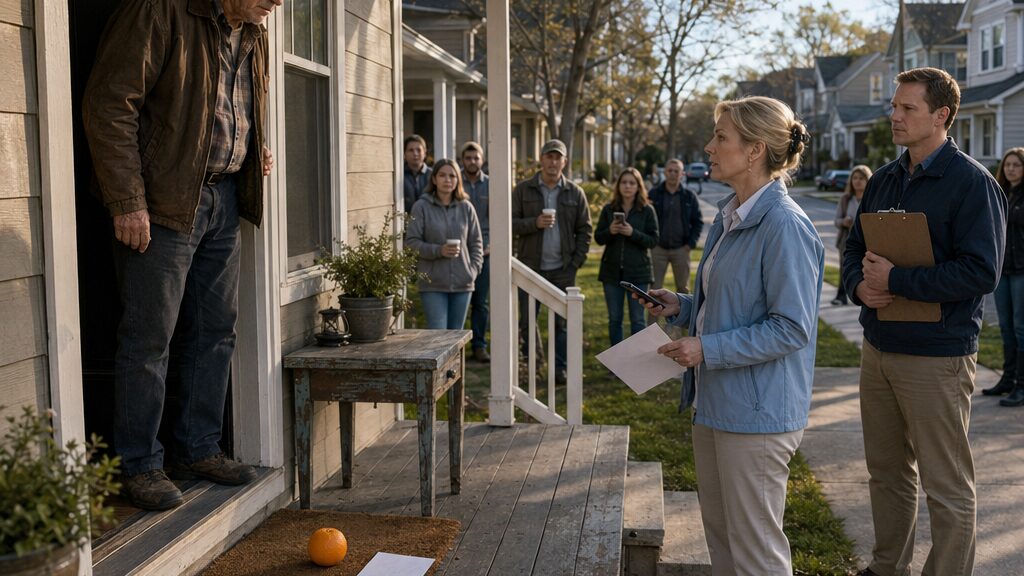
The orange was sitting in the exact center of Richard Moore’s doormat before the porch light clicked off.
He saw it through the narrow glass beside his front door, a small round brightness against the faded mat that still said WELCOME though half the letters had been worn down by years of mail carriers, muddy shoes, and one Labrador that no longer lived next door. The street outside was still blue with early morning. Sprinklers ticked somewhere two houses away. A delivery truck groaned at the stop sign and moved on.
Richard stood still with his hand on the deadbolt.
The microwave clock behind him read 6:58.
He did not open the door right away. That was what bothered him most about himself—not the orange, not the timing, not even the fact that this was the fourth morning in a row. It was the pause. A grown man, seventy in three months, retired after thirty-eight years of fixing industrial equipment and arguing with boilers larger than his kitchen, standing inside his own house as if the fruit might accuse him of something.
He unlocked the door.
Cold morning air came in first. Then the smell of cut grass, damp mulch, and the faint sweetness of citrus. Richard bent carefully, his knees giving their usual dry complaint, and picked up the orange. It was firm, cool, and freshly washed. No sticker. No note. No dent. Whoever left it had set it down gently, stem scar facing upward, like a small offering.
He looked left toward the Clark house, then right toward the corner where the sidewalk curved past the Allen place. No one stood outside. A porch swing moved slightly across the street, but there was no wind.
“Morning, Richard.”
He nearly tightened his hand hard enough to bruise the fruit.
The neighbor from across the street stood at the end of his driveway in running shoes, holding a travel mug and looking more awake than anyone had a right to at that hour. Behind him, the small black eye of his doorbell camera pointed toward the street.
“Morning,” Richard said.
The neighbor’s gaze dropped to the orange. “Another one?”
Richard put the fruit in his jacket pocket. “Looks that way.”
“You report it yet?”
“Report an orange?”
The neighbor gave a short laugh, then stopped when Richard did not join him. “I mean, not to the police. But you know. The board. Heather’s been asking around about porch stuff. Packages, solicitors, that kid selling pest control. People leaving things.”
Richard kept one hand on the doorframe. “It’s fruit.”
“Sure. But four days in a row at the same time? That’s not nothing.” The neighbor took a sip from his mug. “My camera might’ve caught something. I haven’t checked. If you want me to send you the clip—”
“No need.”
“You sure?”
Richard nodded once. He had practiced that kind of nod years ago, in hospital rooms, at service desks, across counters when people wanted a larger explanation than he could give. Short. Civil. Final.
The neighbor looked as if he might say more, but a garage door opened down the block. The sound rolled over the street in sections, metal folding upward, and a small line of morning life began: someone backing out too fast, someone dragging trash bins in, someone coughing behind a hedge.
Richard stepped back. “Have a good one.”
“You too,” the neighbor said, though his eyes were still on Richard’s pocket.
Inside, Richard closed the door softly and leaned against it. He took the orange out and carried it to the kitchen.
Three others sat in a plain white bowl on the counter.
The first had appeared Tuesday, bright and absurd on the mat. He had thought maybe a child had dropped it, or a grocery bag had split, or some delivery driver had made a mistake so strange it would become funny by lunchtime. The second came Wednesday, same place, same time. The third on Thursday. By then Richard had gone to the window at 6:50 and watched the empty street until his coffee cooled.
He had seen nothing.
Or almost nothing.
A shape at the far end of the sidewalk. A shadow moving slowly past the mailboxes. The brief scrape of something wooden against concrete. He had turned away before he could be certain, because certainty sometimes asked for more than a man wanted to give.
Now the fourth orange sat in his palm, its skin slightly pebbled, a leaf still attached to a bit of stem.
His late wife would have laughed at the bowl.
Not loudly. Sandra had never laughed loudly unless she was exhausted or had burned something she insisted was still edible. But she would have stood where Richard stood now, one hip against the counter, arms folded, eyes narrowed with amused suspicion.
“Somebody’s courting you with produce,” she would have said.
“No one courts with oranges.”
“Someone practical does.”
He turned the orange slowly and set it beside the others.
The kitchen was too quiet after that. The refrigerator clicked. The old wall clock marked time in steady little taps. Richard took out a knife, then put it back. He did not want orange for breakfast. He did not want to throw them away. He did not want to explain why he had kept them.
A white envelope lay near the sugar canister, unopened though it had come two days ago. Briar Glen Homeowners Association printed in green at the top corner. Inside, he knew, was the reminder about keeping trash bins out of sight and seasonal plantings “in harmony with community standards.” He had lived in Briar Glen long enough to know that harmony usually meant nobody on the board had received a complaint yet.
He made coffee and took it black, though Sandra had always said it made him look like he was punishing himself.
At 7:11, he heard voices outside.
Richard moved to the front room and stood back from the curtain. Heather Clark was on the sidewalk in a pale blue windbreaker, blonde hair clipped tight at the back of her head. She held her phone low in one hand and a folder under her arm. She was not looking at his house at first. She was speaking to the neighbor with the camera.
Then the neighbor pointed.
Not dramatically. Not accusingly. Just enough.
Heather turned toward Richard’s porch.
Richard let the curtain fall into place, but not before he saw her expression change. It was small, almost professional. Her mouth tightened. Her shoulders squared. She glanced down at her phone, then back at his door, as if the orange had become an item on an agenda.
He stayed behind the curtain until the voices moved away.
In the kitchen, the four oranges looked brighter than anything else in the room. He opened the junk drawer and took out a brown paper lunch bag. One by one, he placed the oranges inside, except for the newest one. That one he held a little longer.
There were things a person did because they were kind.
There were things a person did because they were lonely.
There were things a person did because, once upon a time, someone had stood in a grocery store parking lot in January with one hand braced against a cart and the other hand pretending not to shake.
Richard closed his fingers around the orange.
The doorbell rang.
He did not move at first.
It rang again, followed by a polite knock that somehow sounded less polite than if it had been louder.
Richard put the orange in the bowl and went to the front door. Heather stood on the porch now, smiling in a way that held itself carefully away from warmth. Her folder was open. The neighbor with the camera lingered near the curb, pretending to check his phone.
“Good morning, Richard,” Heather said. “Sorry to bother you so early.”
He kept the storm door closed. “Morning.”
“We’ve had a couple of informal concerns about items being left on porches before dawn.” She glanced down at the doormat, now empty. “Have you noticed anything unusual?”
“No.”
The answer came too quickly. He knew it as soon as he said it.
Heather’s eyes lifted to his. “No?”
“Nothing I can’t handle.”
“That’s not exactly the same thing.”
Richard said nothing.
Heather tapped her folder against her palm. “We’re just trying to get ahead of anything that could become a safety or nuisance issue. Food items can attract pests. And if someone is repeatedly approaching homes without permission, residents have a right to know.”
“It’s my porch.”
“Of course,” Heather said. “But it’s our community.”
The words sat between them, polished smooth by meetings and newsletters.
Richard looked past her to the street. The neighbor had stopped pretending to use his phone. A car slowed at the corner. In the quiet of morning, attention gathered quickly.
“I appreciate the concern,” Richard said. “There isn’t a problem.”
Heather’s smile thinned. “Then you won’t mind if I ask for any relevant camera footage from nearby homes.”
That made his hand tighten on the doorframe.
Heather noticed. He saw that she noticed.
“I’m not accusing anyone,” she said. “I just want clarity.”
Richard thought of the orange in the bowl, the leaf still attached. He thought of a wooden crate scraping lightly over concrete. He thought of how easily kindness could become evidence in the wrong hands.
“Do what you need to do,” he said.
Heather stepped back from the door. “Thank you.”
But she did not leave right away. She looked once more at the empty doormat, as if something missing could still prove something. Then she turned and walked down the steps toward the neighbor with the doorbell camera.
Richard closed the door before he could hear their first words.
In the kitchen, the clock clicked to 7:15. The newest orange sat apart from the others, bright as a warning.
Outside, Heather’s voice carried through the window, clear enough for him to hear.
“Could you send me everything your camera caught this week?”
Chapter 2: The Sidewalk Turned a Gift Into Evidence
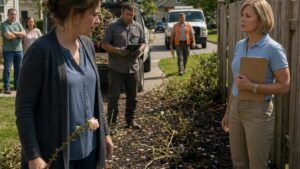
Heather Clark bent down and photographed the orange before Richard could open the door.
He saw the flash of her phone through the front window first, a brief white blink in the gray Friday morning. Then he saw her crouched at the edge of his porch, careful not to touch the doormat, one hand braced against her knee, the other angling the phone as if the orange were not fruit but proof of damage.
Richard had been two steps from the door with his coffee still in his hand.
He stopped.
On the sidewalk behind Heather stood three people in light jackets and walking shoes. The community standards walk. Richard had forgotten it was Friday, or maybe he had remembered and hoped it would pass his house without ceremony. Heather did one every month with whichever board members or residents felt strongly enough about mulch color, mailbox paint, or basketball hoops left out too long.
This morning, Eric Baker stood beside her with a clipboard, looking uncomfortable already. Two neighbors lingered behind him, one whispering into the other’s ear.
Richard set his coffee on the small table by the door and stepped outside.
Heather looked up with the brisk expression of someone pleased to have been interrupted at the right time. “Good morning, Richard.”
He glanced at the orange. This one had a tiny scratch near the stem. Still fresh. Still placed dead center on the mat.
“Heather.”
“I wanted to document the item in place before it was moved.” She rose and tapped the screen of her phone. “For accuracy.”
“It’s an orange.”
“Yes,” she said. “That is what it appears to be.”
Eric shifted his weight. “Morning, Richard.”
Richard nodded to him. Eric was in his forties, neat without seeming polished, the sort of man who apologized before disagreeing and then often did not disagree after all. He held the clipboard against his chest like a shield.
Heather took a white paper from her folder. “We’ve now had multiple reports of produce being left on your porch before dawn.”
“Multiple reports,” Richard repeated.
“Residents are concerned.”
A neighbor behind Eric said, “It’s just strange, that’s all.”
Heather did not look back, but her face accepted the comment. “The concern is not only the item itself. It’s repeated access to a private porch, possible pest attraction, and uncertainty about whether this is invited or unwanted.”
Richard bent, picked up the orange, and felt all eyes follow the movement. He could have laughed then, maybe. A street full of adults watching an old man lift a piece of fruit from his own mat. But there was heat rising under his collar.
“It isn’t what you think,” he said.
Heather’s gaze sharpened. “Then what is it?”
The simple answer waited in his mouth and did not come out.
It is a thank-you.
She is embarrassed.
Leave her alone.
Instead, Richard turned the orange in his hand and said, “It’s my responsibility.”
A whisper passed through the two neighbors like wind moving through dry leaves.
Heather held out the white paper. “This is a written warning, not a fine. Yet.”
Richard did not take it.
She placed it on the small porch table beside his coffee. The top line was printed in clean bold type: NOTICE OF COMMUNITY STANDARD CONCERN.
Underneath, in smaller print, someone had written: Repeated organic material left in exterior entry area. Possible nuisance/pest issue. Unauthorized early-morning drop-offs.
Richard stared at the word organic longer than he should have.
Eric cleared his throat. “This is more of a preliminary step, Richard. Just to open communication.”
“Communication usually starts with a question,” Richard said.
Heather’s face colored faintly, but her voice stayed even. “I did ask you questions Monday. You declined to clarify.”
“You asked for footage.”
“Because you gave no explanation.”
The orange sat heavy in Richard’s palm. Across the street, a curtain shifted. On the porch two houses down, a woman had come outside with a small dog and was now standing still, leash slack in her hand.
Heather lowered her folder slightly. “Do you know who is leaving these?”
Richard looked toward the far end of the sidewalk. The Allen house was quiet behind its trimmed shrubs. Its driveway was empty except for a blue recycling bin that should have been pulled in yesterday. One of the front shutters hung a fraction crooked. No one else would notice. Richard noticed things like that.
“Richard?” Heather said.
He looked back. “No one is being harmed.”
“That isn’t an answer.”
“It’s the answer I’m giving.”
Eric’s eyes dropped to the warning notice.
Heather inhaled through her nose. “I need to be clear. If this continues, the board may classify it as an ongoing nuisance. We also have to consider whether you are permitting non-resident activity that disrupts the neighborhood.”
“Non-resident activity,” Richard said.
“That is the language in the rule.”
“It’s a person walking up to a porch.”
“Before seven in the morning, repeatedly, leaving food.”
The neighbor with the small dog called from the sidewalk, “What if it attracts rats?”
Richard turned his head. “Have you seen rats?”
“No, but—”
“Then don’t invite them into the conversation.”
Eric made a sound that might have been a cough.
Heather’s eyes narrowed. “There’s no need to be dismissive.”
Richard was suddenly aware that his hand had tightened around the orange. A drop of juice showed bright where his thumb pressed into the peel.
He loosened his grip.
Heather saw that too. She seemed to see everything that could be arranged against him and nothing that might explain him.
“I am asking you one more time,” she said. “Is someone leaving these at your request?”
“No.”
“Is someone leaving them with your permission?”
Richard paused.
There it was—the trap not because Heather had made it one, but because truth did not always fit yes or no. He had not requested them. He had not given permission. He had not stopped them. He had not wanted to stop them.
He could still picture the first time: the grocery store parking lot after a freezing rain, Amy Allen pretending she had only paused to adjust her purse while her hand shook on the cart handle. Her oranges had rolled from a torn paper bag and scattered under the cart return. Richard had picked them up one by one while she said, “I’m fine, I’m fine,” in a voice that meant she was not.
“Richard,” Heather said, “with permission?”
He looked at the notice beside his coffee. “My porch is my responsibility.”
“That’s not sufficient.”
“It will have to be.”
Heather turned slightly, not fully toward the others, but enough to let the group into the moment. “This is exactly why the board has procedures.”
Richard felt the porch shrink beneath him.
The two neighbors behind Eric were no longer pretending not to listen. The small dog barked once. A car rolled by slowly, then continued. Someone across the street lifted a phone, perhaps only to check a message, perhaps not.
Heather stepped closer to the table and tapped the warning notice with one manicured finger. “You have seven days to correct the condition.”
“What condition?”
“Unapproved exterior placement of organic material and failure to identify repeated unauthorized access.”
Richard looked at Eric. “You believe that?”
Eric opened his mouth, closed it, then said, “I think we need more information.”
Heather said, “And Richard is choosing not to provide it.”
That was the sentence that did it. Not because it was false. Because it was true in the smallest, ugliest way.
Richard picked up the warning notice. The paper trembled once before he steadied it. “I won’t give you someone’s name so the board can turn a kind gesture into a violation.”
For the first time, Heather blinked without a ready answer.
“A kind gesture from whom?” she asked.
Richard folded the paper once. “Good morning.”
He went inside and closed the door.
For a moment, he stood with his back against it, the orange in one hand and the warning in the other. Through the door, the voices outside lowered, then rose again in pieces.
“Kind gesture?”
“Then he does know.”
“Why not just say?”
“Heather, maybe we should—”
“No, we need consistency.”
Richard carried the orange to the kitchen. The bowl was full now, seven oranges bright against white ceramic. He placed the newest one on top and set the folded warning beside it.
His phone buzzed on the counter.
Emily.
He let it ring.
It stopped, then immediately buzzed again. This time a text appeared.
Dad, why is someone posting about you on the Briar Glen page?
Before he could answer, headlights swept across his front window. A car pulled hard to the curb outside, too fast for that early on a residential street.
Richard looked through the curtain.
Emily Moore was already getting out, phone in hand, her face tight with the expression she wore when worry had turned itself into anger because anger was easier to manage in public.
She looked once toward the cluster of neighbors still near the sidewalk, then at Richard’s house.
On her phone screen, large enough for him to see even from the window, was a photo of his porch.
The orange sat beside the white HOA notice like evidence.
Chapter 3: Emily Came Home With Someone Else’s Version
Emily walked into Richard’s kitchen holding the screenshot like it was something hot enough to burn her fingers.
She did not sit. She did not take off her coat. She came straight through the front room, past the side table where her mother’s old reading glasses still rested in a blue ceramic dish, and stopped at the counter in front of the bowl of oranges.
For a second, she stared at them.
Then she turned the phone toward him.
“Please tell me this is not how I’m finding out something is going on at your house.”
Richard looked at the screen though he had already seen enough through the curtain. Someone had posted the photo to the Briar Glen residents’ page with a caption that tried to sound concerned and failed.
Anyone know what’s going on with the early morning orange deliveries on Maple Ridge? HOA is involved now. Hope everything is okay.
Below it were comments. Some worried. Some amused. Some too eager.
Maybe a secret admirer.
Food left outside attracts pests.
Has anyone checked on him?
This is how scams start.
Richard handed the phone back. “People need hobbies.”
Emily did not smile. “Dad.”
He moved to the sink and rinsed his coffee mug though it was already clean. “It’s being handled.”
“By who? The HOA? Because that picture makes it look like they’re handling you.”
He shut off the water.
Emily was forty-two but in his kitchen she still looked, in certain moments, like the girl who had come home from school furious because a teacher misunderstood her. Same chin lifted, same eyes bright with too much feeling held back too hard. She wore work clothes beneath her coat, black pants and a blouse, and there was a crease between her eyebrows that had not been there when Sandra was alive.
“You drove over for an orange?” he asked.
“I drove over because my phone started buzzing before my staff meeting with people asking whether my father was being harassed, scammed, or cited for fruit.” She placed the phone face down on the counter. “So yes. I drove over for an orange.”
Richard glanced at the bowl.
Seven oranges now. He had not realized until that moment how strange they looked gathered together, not eaten, not shared, not explained.
Emily followed his gaze. “How long?”
“A few days.”
“How many is a few?”
He wiped his hands on a towel. “Since Tuesday.”
“And you didn’t think to mention it?”
“No.”
“Why not?”
Because once he mentioned a thing, people wanted to fix it. Because Emily fixed things with phone calls, forms, firm voices, and follow-up emails. Because Amy Allen’s shame was not a loose cabinet hinge. Because Sandra had once looked at him from a hospital bed and whispered, Don’t let everyone discuss me like I’m not here.
Richard folded the towel and laid it over the oven handle. “It wasn’t worth worrying you.”
Emily laughed once, sharp and humorless. “That sentence has never once made me worry less.”
He leaned back against the sink. “It’s not dangerous.”
“You don’t know that.”
“I know enough.”
She stared at him. “That’s not an answer.”
“Heather said the same thing.”
“For once, Heather may have a point.”
Richard’s mouth tightened.
Emily saw it and softened, but only a little. “I’m not saying I like her. I know how she gets. But someone is coming onto your porch before sunrise. Every day. Leaving food. You’re refusing to explain. Do you understand how that looks?”
“Yes.”
“And?”
“And looking a certain way isn’t the same as being that way.”
Emily rubbed her forehead. “Dad, I deal with this all the time at work. When people won’t answer basic questions, it makes everyone more nervous.”
“Maybe everyone could stand to be nervous without turning it into a committee.”
“This is not about a committee.” Her voice lowered. “Are you lonely?”
The question landed harder than he expected.
Richard looked toward the front window. Outside, the street had gone ordinary again. Cars in driveways. Trash bins waiting. The neighbor with the camera had disappeared inside. The world could look decent very quickly after taking a bite out of someone.
Emily stepped closer. “I’m asking because I love you, not because I’m judging you.”
“I know why you’re asking.”
“Then answer me.”
“I’m fine.”
“You hate when people say that.”
“I learned it from everyone else.”
Her face changed, not with anger now, but with tired hurt. “Are you letting someone come here because it feels good to be needed?”
Richard said nothing.
Emily looked back at the bowl of oranges. “Is someone taking advantage of you?”
“No.”
“Are you sure?”
“Yes.”
“Who is it?”
He picked up one of the oranges, the oldest one, its skin beginning to dull. “It’s a thank-you.”
Emily waited. When he did not continue, she said, “From who?”
“A neighbor.”
“What neighbor?”
He set the orange down. “Someone who doesn’t need the whole street talking.”
“The whole street is already talking.”
“That doesn’t mean I help them.”
Emily’s jaw tightened. “Do you hear yourself? You’re willing to let people think something weird is happening here rather than say one name?”
“Yes.”
The answer came out plain, and maybe that was his mistake. It had the sound of a door closing.
Emily stepped back from the counter. “Dad.”
“She didn’t do anything wrong.”
“She?”
Richard looked down.
There. One careless word. One crack in the wall.
Emily caught it immediately. “Okay. So it’s a woman.”
He did not answer.
“Is she your age?”
“Emily.”
“Is she confused? Is she well? Is this some neighbor who thinks you two have an arrangement? Are you giving her money?”
“No.”
“You say no like that settles things.”
“It should.”
“It doesn’t.” Emily’s voice rose, then she pulled it back. “You don’t get to keep me completely outside your life and then act offended when I’m scared by the parts I can see.”
Richard looked at her then.
The kitchen seemed smaller, crowded by the oranges, the warning notice, the ghost of Sandra’s laugh, and Emily’s accusation, which was not wrong enough to dismiss.
“I helped her carry groceries,” he said.
Emily blinked. “What?”
“Last winter. More than once. That’s all.”
“That’s all?”
“Yes.”
“Then why won’t you say who?”
“Because more than once became often. And often became something she didn’t want people knowing she needed.”
Emily’s expression shifted. The anger did not leave, but concern moved underneath it. “Needed how?”
Richard pressed his lips together.
He saw again the grocery store doors sliding open to January sleet. Amy Allen standing beside her cart, smiling too brightly. A bag split. Cans rolling. Oranges moving across wet pavement like small suns escaping. He saw himself picking them up while she said, “Please don’t make a thing of it.” He saw the tremor in her hand when she tried to lift the case of bottled water.
He had promised without using the word.
Please don’t make a thing of it.
So he had not.
“Dad,” Emily said quietly, “what happened?”
“I carried groceries.”
“You’re doing it again.”
“Doing what?”
“Turning a whole story into three words so nobody can touch it.”
He looked away.
For a moment neither of them spoke. The refrigerator hummed. A car door shut somewhere outside. Emily’s phone buzzed again on the counter, face down, another comment or call or forwarded concern.
She did not pick it up.
“You know what this looks like from the outside?” she said. “It looks like you’re hiding something because you’re embarrassed.”
“I’m not embarrassed.”
“I am.”
That made him look at her.
She closed her eyes briefly. “I don’t mean of you. I mean I’m embarrassed that strangers know there’s a problem before I do. I’m embarrassed that Heather Clark can walk onto your porch with a piece of paper and I’m standing here trying to catch up.”
“There isn’t a problem.”
“There is now.”
The folded HOA notice lay beside the bowl. Emily picked it up and read it. With each line, her mouth tightened.
“Unapproved exterior placement,” she said. “Failure to identify repeated unauthorized access. Dad, they’re building a case because you won’t give them anything else.”
“They can build whatever they want.”
“No, they can fine you. They can drag you into a hearing. They can make this ugly.”
“It’s already ugly.”
“Then stop helping it get worse.”
He took the notice from her more sharply than he meant to. “You think I’m helping?”
“I think you’re being stubborn.”
“I think I’m keeping my word.”
“To someone who leaves oranges on your porch like a riddle?”
“To someone who wanted to say thank you without being put on display.”
Emily’s eyes moved to the bowl. Her voice softened again, and somehow that was worse. “Are the oranges from her yard?”
Richard did not answer.
“That’s why there are no stickers,” Emily said.
He walked to the window and looked out at the street. A small cluster of neighbors stood two houses down, talking too closely together to be casual. One glanced toward his house and looked away too late.
Emily came up beside him. “You can protect her and still protect yourself.”
“You don’t know that.”
“No, I don’t. Because you won’t tell me enough to know anything.”
He heard the hurt then, cleanly. Not accusation. Not embarrassment. Hurt.
For the first time that day, Richard felt tired in a way coffee would not touch.
“I’m sorry,” he said.
Emily waited, perhaps hoping more words would follow.
None did.
Her shoulders lowered. “The HOA meeting is Tuesday?”
He turned. “How did you know that?”
“Heather replied to a comment. Of course she did.” Emily picked up her phone and slipped it into her coat pocket. “If you won’t explain, I’ll go with you.”
“No.”
“Yes.”
“Emily, this is not—”
“I’m not asking.” She moved toward the front room, then stopped near the table with Sandra’s glasses. Her hand hovered there but did not touch them. “You can be private. You can be loyal. You can even be impossible. But I am not letting you sit in a room with Heather Clark and a board full of clipboards while everyone decides what kind of man you are from a picture of an orange.”
Richard’s throat tightened.
Emily opened the front door. The afternoon light came in flat and pale. She looked back once, her face still guarded but her eyes worried.
“If you won’t tell them,” she said, “then I’ll be there to hear what you don’t s
Chapter 4: Behind the Hedge, Heather Saw Only Half the Truth
Heather Clark crouched behind the boxwood hedge at 6:52 Saturday morning and immediately regretted wearing white sneakers.
The mulch beneath her soles was damp. One branch pressed into her sleeve. From the sidewalk, she was almost certain no one could see her, but almost certainty had never been enough for Heather. Almost was how problems slipped past. Almost was how a complaint became a lawsuit, or a loose dog became a bite, or one neighbor’s “private situation” became a community-wide accusation that the board had done nothing.
She shifted, lifted her phone, and checked the time.
6:53.
Across the street, Richard Moore’s porch sat empty except for the mat and a small table. No orange yet. No movement behind his front curtain. The house looked ordinary, which made Heather dislike it more. Ordinary houses were where people hid the things they did not want discussed.
Her phone buzzed with a text from Eric.
You sure this is necessary?
Heather looked at it and did not answer.
He had said the same thing yesterday afternoon after she drafted the formal warning. His voice had been mild, but the meaning was not. He thought she was overreaching. Maybe he even thought she was enjoying it. People always assumed a woman with a clipboard enjoyed being disliked if she kept showing up with rules in her hand.
A year earlier, she had ignored a complaint about a drainage ditch because the resident sounded dramatic. Two weeks later, a child slipped in mud near the common path, and the child’s father had stood in a board meeting asking why no one took reports seriously until someone got hurt. Heather had sat at the table with every eye on her and felt her authority drain out of the room.
She would not be the person who missed the warning sign twice.
At 6:56, she heard the scrape.
It came from the direction of the Allen house, faint but distinct: wood against concrete, pause, wood against concrete again. Heather leaned forward until a leaf brushed her cheek.
An elderly woman came slowly along the sidewalk carrying a shallow wooden crate against her hip.
Amy Allen.
Heather’s first reaction was irritation at being surprised. Amy was not on her list of likely explanations. She was quiet, polite at meetings, particular about her roses, and behind on her lawn edging more often than Heather liked. She was also small enough that the crate looked too large for her, though it held only oranges.
Heather raised her phone but did not record. Not yet.
Amy moved with careful determination. Her gray hair was pinned neatly beneath a faded scarf. She wore a cardigan though the morning was not that cold, and house slippers with hard soles. Every few steps, the crate shifted and she stopped to adjust her grip. The oranges inside rolled softly against one another.
Heather’s anger loosened into confusion.
Amy reached Richard’s walkway and looked around.
Heather sank lower.
For a moment, Amy stood at the foot of the porch steps. She did not look like someone trespassing. She looked like someone approaching a church pew, aware of silence. She took one orange from the crate, turned it in both hands as if choosing the best side, and climbed the two steps.
The front door stayed closed.
Amy placed the orange in the center of the mat.
Not near the edge. Not casually. Precisely in the center.
Heather rose before she planned to.
“Amy.”
The crate jolted. An orange bounced out, hit the porch step, and rolled into the mulch.
Amy turned with a hand pressed flat to her chest. For one sharp second, Heather saw fear in her face—not guilt, not annoyance. Fear.
“Oh,” Amy said. “Heather. You startled me.”
Heather stepped from behind the hedge, brushing leaves from her sleeve. “I apologize. I didn’t mean to scare you.”
Amy looked at the hedge, then at Heather’s phone, then back to Richard’s door. Her mouth tightened. “Were you hiding?”
“I was observing a repeated community concern.”
“At seven in the morning from behind a bush?”
The question had more spine than Heather expected. It made her stand straighter.
“We’ve had multiple reports,” Heather said. “And now I understand you’re the person leaving produce on Richard Moore’s porch.”
Amy bent carefully for the fallen orange. Her hand shook slightly before she got hold of it. “Produce,” she repeated, almost to herself.
“Yes. The oranges.”
“They’re mine.”
“I assumed that much.”
“No, I mean from my tree.” Amy settled the orange back in the crate. “The one in the backyard. It gives too many this time of year. More than I can use.”
Heather glanced toward the Allen property. The backyard tree was not visible from here. “That doesn’t explain why you’re placing them on Richard’s porch before dawn.”
Amy’s fingers curled around the crate handle. “I didn’t want to bother him.”
“You are leaving items at his door every morning.”
“He knows.”
Heather’s pulse quickened. “He knows you’re doing this?”
Amy looked down.
The silence answered before she did.
Heather exhaled, half triumph, half frustration. “Then why wouldn’t he say so?”
“Because I asked him not to make a fuss.”
“Amy, this has already become a fuss.”
Amy’s eyes flicked toward Richard’s window. The curtain did not move, but Heather had the strange sense that the house itself was listening.
“It was just a thank-you,” Amy said.
“For what?”
Amy adjusted the crate again. “He helped me with groceries.”
Heather waited. “Groceries.”
“All winter.”
The words came out small, but they changed the air.
Heather looked at the crate more closely. The wood was old, one corner repaired with two mismatched screws. A folded paper was wedged under the oranges near Amy’s wrist. Heather saw the Briar Glen logo on it before Amy shifted her hand over the corner.
“All winter how?” Heather asked.
Amy’s face closed. “That’s private.”
“Private doesn’t mean exempt from rules.”
“Rules,” Amy said softly. “Yes. I know.”
Heather did not like the way she said it. Not mocking. Worse. Tired.
The front door opened.
Richard stood behind the storm door in a gray sweater, his face unreadable. He looked first at Amy, then at Heather, then at the crate.
“Amy,” he said.
Amy straightened as if caught doing something childish. “I’m sorry. I didn’t mean for all this.”
Richard opened the storm door. “You shouldn’t be carrying that.”
“I can carry a crate.”
“You nearly dropped it.”
Heather stepped closer. “Richard, were you aware Amy has been leaving these?”
Richard held Amy’s eyes for a second longer before turning to Heather. “You scared her.”
“I asked a question.”
“You hid behind a hedge.”
Heather felt heat climb her neck. “Because you refused to answer direct questions, and the board has an obligation to investigate repeated early-morning access.”
Amy gripped the crate. “Please don’t blame him.”
“That’s difficult when he chose not to clarify.”
“He was being kind.”
Heather heard the word and thought of the photo from yesterday: orange, notice, porch, Richard’s hard silence. Kindness was not a policy category. It did not tell her what to write in the incident record.
Richard stepped onto the porch and reached for the crate. “Let me take that.”
Amy pulled it back. “No.”
The refusal was too quick. Richard stopped at once.
Heather noticed.
Noted it.
Amy’s pride stood between them, fragile and sharp as glass.
“Amy,” Heather said carefully, “if you wanted to thank him, there are other ways. A note. A call. Something that doesn’t create concern.”
Amy looked at her, and for the first time that morning, embarrassment hardened into anger. “Concern for who?”
“For the neighborhood.”
“The neighborhood wasn’t carrying my groceries in February.”
Richard’s jaw moved, but he said nothing.
Heather’s answer stalled.
Amy seemed to regret the words as soon as she said them. She lowered her eyes and shifted the crate against her hip. The folded paper under the oranges slipped partly free.
Heather saw more of it this time.
Second Notice: Lawn Maintenance Noncompliance.
Amy followed Heather’s gaze and pushed the paper deeper beneath the fruit.
There it was: not just gratitude. Something else. Another rule. Another failure to keep up appearances. Another small neglected edge that could widen if ignored.
Heather’s professional instinct returned, clean and familiar.
“Amy,” she said, “is there a reason you haven’t responded to the lawn notice?”
Richard’s head turned sharply. “Heather.”
Amy’s face went pale.
“It’s a fair question,” Heather said, though it no longer felt entirely fair even to her.
Amy stepped down from the porch, crate tight against her body. “I should go.”
Richard moved as if to help, then stopped himself.
That restraint bothered Heather more than if he had interfered. It suggested practice. Agreement. Some private rule between them that everyone else had been asked to honor without knowing it existed.
“Amy,” Richard said quietly.
She did not look back. “I said too much already.”
Heather watched her cross the sidewalk toward her house. The crate dragged once against her thigh; she corrected it before Richard could move. At the curb, an orange rolled loose again and settled near the storm drain.
Heather picked it up.
It was warm from Amy’s hand.
Richard came down the porch steps. “Leave her alone.”
“She’s part of this.”
“No,” he said. “You made her part of it.”
Heather held the orange between them. “You did when you refused to answer.”
He took it from her, not roughly, but firmly enough that she felt dismissed. “File whatever you came to file.”
“I intend to.”
“For an orange.”
“For a pattern,” Heather said. “For unanswered questions. For residents who think rules only apply when they feel like explaining themselves.”
Richard looked past her toward Amy’s house. “Sometimes the explanation costs someone more than the rule is worth.”
The sentence landed in a place Heather did not want touched.
For one moment, she almost said, Then help me understand.
Instead, she looked back toward the Allen driveway, where Amy was trying to open her side gate while balancing the crate. The lawn notice flashed white under the oranges.
Heather unlocked her phone.
The official complaint form waited in her drafts.
She added Amy Allen’s name, then paused with her thumb above the screen. At Richard’s door, the latest orange still sat on the mat, perfectly centered, as if the morning had not been disturbed at all.
Heather pressed submit.
Chapter 5: The Groceries Were Not the Whole Story
Amy Allen was loading oranges into the back seat of her car with both hands shaking.
Richard saw her from his driveway Saturday afternoon, the sun high enough to flatten every shadow in the street. He had gone outside to bring in the recycling bin and found her across the way with the garage door half open, a wooden crate balanced on the bumper of her old sedan. Oranges filled the crate nearly to the top. Another box sat on the garage floor behind her. Then another.
Too many.
She lifted one crate, got it three inches off the bumper, and stopped.
Richard crossed the street without thinking.
“Amy.”
She flinched and turned so quickly that two oranges rolled from the crate and thumped onto the driveway.
“I don’t need help,” she said before he asked.
“I didn’t say you did.”
“You were about to.”
He bent and picked up the oranges. One had split slightly near the bottom, showing bright wet pulp.
Amy looked at it as if it had betrayed her.
“I’m taking them to the food pantry,” she said. “That’s allowed, isn’t it? Before someone writes me up for owning a tree.”
Richard set the oranges back gently. “You shouldn’t be lifting these.”
“I said I don’t need help.”
“Your hands say different.”
She turned away, but not before he saw the shine in her eyes. “My hands are old. That’s not a crime.”
“No.”
“And they shake more when someone hides behind shrubs and jumps out at me.”
“I know.”
Amy gripped the edge of the crate. “You should have told them it was me.”
“You asked me not to.”
“I asked you not to make me into a project. There’s a difference.”
The words stung because they were true enough. Richard looked into the garage. It was neat in the way people made things neat when they were afraid of being judged. Shelves labeled in black marker. Garden tools lined by size. Paper grocery bags folded flat and stacked in a bin. Near the back wall, the orange tree’s overflow sat in three boxes, sunlight from the side window catching on the fruit.
A lawn mower stood beside them with the pull cord wrapped around its handle, unused.
Amy followed his gaze and stiffened. “It won’t start.”
“I can look at it.”
“No.”
“Amy.”
“No,” she said again, sharper. “That’s how it starts. You fix one thing, carry one bag, change one bulb, and suddenly people start talking in soft voices. They ask if you’re managing. They ask if you’ve considered options. They call daughters. They call nephews. They call everyone except you.”
Richard looked away first.
A car slowed at the corner, then moved on. In Briar Glen, even kindness felt safer inside garages.
“I didn’t call anyone,” he said.
“I know.” Her voice dropped. “That’s why the oranges.”
He stood beside the open garage with two split oranges at his feet and did not trust himself to answer.
Amy touched the crate again, but she did not lift it. “Last winter, I went three days without going to the store.”
Richard looked at her.
She kept her eyes on the oranges. “There was ice on the driveway. My hip hurt. Then it rained, and I told myself I’d go the next morning. Then I opened the refrigerator and there was mustard, half an onion, and milk I didn’t trust.” She gave a small, embarrassed laugh that hurt to hear. “I had money. That wasn’t the problem. I just couldn’t get myself from the kitchen to the store and back with anyone seeing how hard it had become.”
“You should have told someone.”
“I did.” Her mouth pressed thin. “I told myself.”
Richard said nothing.
“You saw me in the parking lot because I waited until nearly closing. Fewer people. Less chance of conversation. Then the bag split and everything went everywhere.” She looked at him finally. “You picked up every can like it was normal.”
“It was normal.”
“No.” Her eyes sharpened. “It was kind. But you didn’t make me thank you. You didn’t ask who was helping me at home. You didn’t say I shouldn’t be alone. You just put the heavy things in your trunk and followed me here like it was the most ordinary errand in the world.”
Richard remembered the heater blasting in his truck, Amy silent in the passenger seat, a bag of oranges between her feet. He remembered carrying the groceries to her kitchen and pretending not to notice the unpaid utility reminder on the counter, the step stool beside a cabinet she could no longer reach, the chair placed halfway between rooms for resting.
“You said not to make a thing of it,” he said.
“And you didn’t.”
“No.”
“You also kept coming on Thursdays.”
“You had groceries on Thursdays.”
She gave him a look. “You see? That is why I left the oranges. Because you can say a thing like that and act like it doesn’t weigh anything.”
A garage door opened across the street. Both of them turned. No one came out.
Amy lowered her voice. “Heather saw the lawn notice.”
“I know.”
“She’ll use it.”
“Maybe.”
“She’ll say I can’t maintain the property. She’ll say I need assistance. Then someone will decide I need more than assistance.” Amy’s fingers tightened on the crate until her knuckles paled. “My nephew already thinks I should sell. He said this house is too much. He said it kindly, which made it worse.”
Richard thought of Emily in his kitchen, asking if he was lonely, if he was being used. Good intentions could press on a person until they had no shape left.
“You can’t carry all of this alone,” he said.
Amy laughed once. “Listen to us. Two old fools arguing over who gets to disappear first.”
He almost smiled. Almost.
A sound came from behind him.
Richard turned.
Emily stood at the edge of Amy’s driveway.
She had parked at his house without either of them hearing and crossed the street quietly enough to catch more than he wanted her to. Her face was still, but her eyes moved from Amy to the crates, then to the mower, then to Richard.
“How long?” she asked.
Richard felt the old instinct rise: reduce, soften, protect.
“Emily—”
“How long have you been helping her?”
Amy straightened. “Please don’t blame your father.”
“I’m not blaming him.” Emily’s voice was careful, but Richard knew careful meant she was holding a great deal back. “I’m asking him.”
Richard bent and picked up the split orange at his feet. Juice had leaked onto his fingers.
“Since January,” he said.
Emily closed her eyes briefly.
Amy looked stricken. “It wasn’t every week.”
“It was most weeks,” Richard said.
“Richard.”
“It was.”
Amy stared at him, betrayed for half a second by the plainness of it.
Emily stepped into the garage doorway. “Why didn’t you tell me?”
Richard wiped his hand on his jeans. “Because it wasn’t my story to tell.”
“I’m your daughter.”
“That doesn’t make everything mine yours.”
The sentence came out rougher than he meant. Emily’s face changed, and he wished he could pull it back. But there was no clean way through this. Every direction bruised someone.
Amy touched Emily’s sleeve lightly. “He was trying to be decent.”
Emily looked at her hand, then at Amy. “I believe that.”
Richard heard the unsaid part: That does not mean he was right.
Amy turned back to the crate. “I was taking these away so there wouldn’t be any more trouble.”
“You don’t have to do that,” Richard said.
“Yes, I do. Heather won’t stop now.”
“She might if we explain.”
Amy’s face tightened. “Explain what? That I was too proud to ask for help? That I left fruit on a porch because I couldn’t bear writing a thank-you note that sounded like an admission? That my lawn looks bad because the mower won’t start and some mornings the stairs feel longer than they are?”
Silence filled the garage.
Emily looked at the boxes of oranges, and something in her softened. “That doesn’t sound shameful.”
Amy’s smile was small and tired. “Then you’re young enough to think shame listens to reason.”
Richard moved to the crate. “Let me load the boxes.”
Amy inhaled to refuse.
“Not because you can’t,” he said. “Because I’m standing here.”
That stopped her.
Emily picked up the second crate without asking. It was heavier than she expected; Richard saw it in the set of her shoulders. She carried it to the car anyway.
Amy watched them, torn between gratitude and humiliation. Richard knew the look because he had seen it on Sandra’s face when people spoke too brightly near her wheelchair, when they praised her courage for things she had not chosen.
After the crates were loaded, Amy closed the car door and leaned one hand on it.
“I wanted to repay you,” she said to Richard.
“You did.”
“No. I made trouble.”
“You made breakfast complicated.”
That earned the smallest laugh from Emily, then Amy.
For a moment, the street held them gently.
Then Richard saw the white paper taped to his front door.
It had not been there when he crossed to Amy’s driveway.
He left the women beside the car and walked back across the street, already knowing from the green letterhead what it was. The tape had been pressed smooth at all four corners. Whoever delivered it had wanted no chance of wind saving him.
Emily and Amy came up behind him as he pulled it free.
NOTICE OF FORMAL HEARING
Alleged continuing violation: exterior nuisance, unauthorized access, and failure to comply with written warning.
Tuesday. 6:30 PM. Briar Glen Clubhouse.
Richard read it twice.
Beside him, Emily whispered, “Dad.”
Across the street, Amy’s oranges glowed in the back seat of her car, packed for removal like evidence being taken away.
Chapter 6: The Board Wanted a Rule, Not a Reason
Heather set an orange beside the HOA rulebook like it had been sworn in.
Richard watched from the second row of folding chairs in the Briar Glen clubhouse, Emily on his left and Amy on his right. The room smelled faintly of carpet cleaner and coffee left too long on a warming plate. A laminated sign near the door reminded residents to return chairs to the storage rack after events. Someone had arranged the board table beneath a framed watercolor of the neighborhood entrance, the one with the stone pillars and seasonal flowers that always looked better in the painting than in real life.
The orange sat under the fluorescent lights, bright and absurd.
Next to it lay Heather’s folder, a printed copy of the rulebook, and the white warning notice from Richard’s porch. She had placed them carefully, almost ceremonially.
Richard felt Amy’s hand tighten around the strap of her purse.
“You don’t have to stay,” he murmured.
She did not look at him. “Neither do you.”
Emily heard and glanced between them, but said nothing.
At the board table, Eric Baker shifted through papers with the expression of a man hoping order might become mercy if arranged neatly enough. Two other board members sat beside him. Heather stood rather than sat, which made the room feel less like a meeting and more like a presentation.
“Thank you for coming,” she began. “This hearing concerns repeated placement of organic material at the exterior entry of 214 Maple Ridge Lane, unauthorized early-morning access to a residence, and the resident’s failure to provide clarifying information after written notice.”
Richard looked at the orange.
Organic material.
Amy made a small sound under her breath. Not a word. A swallowed protest.
Heather continued. “The board’s goal is not punitive. It is to maintain safety, cleanliness, and consistent community standards.”
A neighbor in the back row whispered something. Richard did not turn.
Heather clicked her pen. “Mr. Moore, you were asked whether you knew the person responsible for leaving the items. You declined to answer. You were asked whether the access was authorized. You gave no clear response. Since then, the behavior has continued, and concern has increased among residents.”
Emily leaned close. “Do you want me to say something?”
“No,” Richard said.
“Dad—”
“Not yet.”
Heather looked directly at him. “Mr. Moore, would you like to make a statement?”
Richard stood.
His knees ached from the folding chair. His mouth was dry. He had spent two days deciding what could be said without taking from Amy what she had fought to keep. Every version sounded either too thin to matter or too revealing to forgive.
He walked to the small table set aside for residents and placed both hands on the back of the chair there.
“The oranges were not a nuisance,” he said. “They were not a prank. They were not meant to attract pests or disturb anyone.”
Heather waited, pen ready.
Richard looked at Eric, then at the board members, then at the few neighbors who had come mostly because ordinary life rarely offered this much theater. “They were a thank-you.”
“For what?” Heather asked.
Richard felt Amy move slightly behind him.
“For help I gave a neighbor.”
“What kind of help?”
He kept his voice even. “The ordinary kind.”
Heather’s pen stopped. “Mr. Moore, the difficulty here is that you keep asking the board to accept vague reassurances while refusing basic facts.”
Eric looked down at his papers.
Richard saw it. A flicker, nothing more.
Heather had been warned. Maybe not strongly. Maybe not enough. But Eric’s discomfort had a history.
“The basic fact,” Richard said, “is that a neighbor left fruit on my porch to express gratitude. I did not complain. I do not complain now. I’m asking the board to withdraw the warning.”
Heather picked up a paper. “The governing documents allow the board to address exterior conditions that may affect the community. Food left outside repeatedly can attract pests.”
“It was there for minutes.”
“We only have your word for that.”
“And doorbell footage, I assume.”
Several heads turned toward the neighbor with the camera, who sat in the back row and suddenly became very interested in his shoes.
Heather’s face tightened. “Footage confirms early-morning placement.”
“And removal?”
Eric cleared his throat. “The clips I reviewed showed the item was usually removed within ten to fifteen minutes.”
Heather shot him a look.
Richard caught it. So did Emily.
“Usually?” Heather said.
Eric adjusted the papers. “In the clips provided.”
“That does not address unauthorized access.”
Amy stood so abruptly her purse slid from her lap and struck the floor.
The room went still.
Richard turned. “Amy.”
She bent for the purse, but Emily was faster and handed it to her. Amy held it against herself with both hands.
“I left them,” Amy said.
Heather’s posture changed. “Mrs. Allen—”
“It’s Miss Allen,” Amy said. Her voice shook, but she did not sit. “And I left them.”
A board member leaned toward the microphone that did not need to be on. “Would you like to come forward?”
“No,” Amy said.
The refusal cracked through the room with more force than if she had shouted.
Richard stayed where he was, halfway between Amy and the board table.
Amy drew a breath. “Richard helped me with groceries during the winter. I have an orange tree. It produced more than I could use. I left him one each morning because I wanted to thank him.”
Heather’s mouth pressed into a line. “Why not simply hand them to him?”
Amy looked at her. “Because then he would tell me to stop.”
A small ripple moved through the room. Not laughter. Recognition, maybe.
Richard lowered his eyes.
Amy continued, quieter now. “And because I was embarrassed.”
Heather softened her voice, which somehow made the question sharper. “Embarrassed about what?”
Richard turned fully. “That’s enough.”
Heather looked at him. “It’s relevant.”
“No,” Richard said. “It’s what you want to make relevant.”
The room sharpened around them.
Heather’s eyes flashed. “Mr. Moore, with respect, you cannot refuse every question and then accuse the board of misunderstanding.”
Richard felt Emily watching him. Amy too. He thought of all the times silence had seemed like shelter. He thought of Sandra’s hand in his, thin and cold, squeezing once when a nurse spoke over her. Don’t let everyone discuss me like I’m not here.
He had kept that promise so fiercely he had almost turned it into a wall no one could pass.
Richard faced the board.
“I helped Amy carry groceries because carrying groceries had become hard,” he said. “That is all I’m going to say about her private life unless she chooses otherwise. She thanked me with oranges because she has a tree and pride and better manners than most of us in this room. If the board wants to fine me for accepting fruit, fine me. But don’t make her prove she deserved help.”
No one spoke.
Amy’s hand came up to her mouth, but she did not cry.
Emily looked down at her lap.
Heather stared at Richard, and for the first time since Monday, he saw something other than certainty in her face. Not remorse yet. Not surrender. A crack.
Then Amy said, “No.”
Richard turned.
She stepped into the aisle. “No, Richard. You don’t have to carry all of it.”
“Amy—”
“I skipped groceries,” she said.
The room became painfully still.
Amy kept her eyes on the board table, not on the neighbors. “Last winter. More than once. Not because I couldn’t pay. Because I was afraid if people saw me struggling, they would decide I couldn’t live alone anymore. Richard saw me in the parking lot when a bag split. He helped. Then he helped again. He never asked for anything. He never told anyone. I left oranges because I could still grow something. I could still give something back.”
Heather looked down.
Amy swallowed. “That’s the whole scandal.”
The words did not invite pity. They ended it.
For several seconds, the only sound was the old refrigerator in the clubhouse kitchenette clicking on.
Then Eric set his papers down.
“I need to say something,” he said.
Heather turned toward him. “Eric—”
“No.” His voice was not loud, but it stopped her. “I reviewed the rule this afternoon. I told Heather I wasn’t convinced the warning applied if the resident did not object and the item was removed promptly.”
Heather’s face flushed. “You said we needed more information.”
“I said we should be careful.” Eric looked at the orange, then at Richard. “I didn’t say it strongly enough.”
One of the other board members shifted. “Are you recommending dismissal?”
“I’m recommending suspension of the warning and no fine pending review.” Eric tapped the folder in front of him. “And I think we should review the complaint procedure that got us here.”
Heather’s chair scraped softly as she finally sat.
Richard looked at her. For a moment, her face was not the face from the sidewalk. It was the face of someone who had built a fence against one old failure and then struck someone with it.
“This board has a responsibility,” she said, but the sentence had lost its edge.
“Yes,” Eric said. “That’s why we should get it right.”
Amy sat slowly. Emily reached for her purse where it had slipped again and set it gently in Amy’s lap.
Richard remained standing.
The orange still sat beside the rulebook, no longer looking like evidence, not yet looking innocent.
Eric turned to the board members. “I move that we suspend any enforcement action against Richard Moore and review both this complaint and prior complaint-handling records before the next meeting.”
Heather’s eyes lifted sharply at the word prior.
Richard saw it then: fear, quick and guarded.
Something more than oranges had followed her into this room.
Eric looked at her, then at the rest of the table. “All of it,” he said. “Not just this one.”
Chapter 7: What Richard Finally Chose to Say
The board offered to erase the fine if Richard agreed to let the matter “resolve quietly.”
Heather did not say it. One of the other board members did, leaning across the clubhouse table with a paper cup of coffee in his hand and the careful tone of a man trying to step around broken glass. The meeting had been called one week after the hearing, and this time there were fewer neighbors in the chairs but more weight in the room.
Richard sat in the front row with Emily beside him. Amy had chosen the chair near the aisle, close enough to be part of it and far enough to leave if she needed to. On the table by the exit sat a bowl of oranges Amy had brought in a brown grocery bag without asking permission. No one had moved it.
Heather sat at the board table with her hands folded over a stack of papers.
She looked tired.
“The board recognizes,” Eric said, “that the original warning should not have been escalated. Based on review, there will be no fine.”
A thin release moved through the room. Someone exhaled behind Richard. Emily’s hand brushed his sleeve, not quite holding on.
Eric continued. “We can remove the notice from Mr. Moore’s file and consider the issue closed.”
Richard looked at the orange bowl.
Closed.
That was how institutions liked their mistakes. Put into a folder, stamped, removed from view. A private correction for a public bruise.
He felt Emily looking at him. A week ago, she would have wanted him to take it. He knew that. He might have taken it himself before the photograph, before the comments, before Amy standing in the clubhouse and saying she had skipped groceries because shame had kept her indoors.
Heather’s eyes were lowered.
Richard stood.
The room quieted in that quick, hungry way people quieted when they sensed conflict returning.
“I appreciate the withdrawal,” he said. “But I don’t agree that it’s closed.”
The board member with the coffee cup frowned. “Mr. Moore, there’s no penalty. Nothing further will be pursued.”
“That helps me,” Richard said. “It doesn’t correct what was done.”
Heather looked up then.
Eric set his pen down slowly. “What are you asking for?”
Richard had practiced this in his kitchen. He had written three sentences on the back of an envelope, crossed out two, and left the envelope beside the sink. Emily had seen it and said nothing.
“A correction posted where the accusation was discussed,” Richard said. “Not details. Not names beyond mine if Amy doesn’t want hers used. Just that the board reviewed the matter and found no violation. And that residents shouldn’t speculate about private situations online.”
A board member shifted. “We don’t control the residents’ page.”
“But board members comment on it,” Richard said.
Heather’s face tightened.
He did not look away from Eric. “The warning notice was photographed. People saw it. People talked. If the correction is private, the mistake stays public.”
In the back row, the neighbor with the camera looked down at his hands.
Emily leaned forward slightly. “He’s right.”
The words were quiet but firm. Richard felt them more than heard them.
Eric nodded once. “I agree a correction is appropriate.”
Heather’s hands moved on the table. The top page in front of her was not the rulebook. Richard could see the heading from where he stood: Complaint Intake Review.
Eric followed his glance. “There’s another matter,” he said.
Heather’s lips parted. “Eric.”
“It needs to be acknowledged.”
“No,” she said, not loudly. “It doesn’t need to be made part of this.”
Richard looked between them.
Eric removed his glasses and set them beside the papers. “Last year there was a complaint about standing water near the common path. It wasn’t escalated in time. A child slipped. The family was angry, and they had reason to be. Heather took most of the blame because she was the compliance chair.”
Heather stared at the table. Her face had gone pale under the clubhouse lights.
“That doesn’t excuse this,” Eric said. “But it explains why she pushed so hard when residents started calling the oranges a safety concern.”
Richard watched Heather then. Not to forgive her. Not yet. But to see her as something other than a clipboard and a warning notice.
Heather spoke without looking up. “I told myself I was being careful.”
No one answered.
Her voice held steady, but barely. “The first time someone complains and you don’t act, they say you’re careless. The next time, you act quickly, and they say you’re controlling.” She looked at Richard at last. “That isn’t your fault. I made it yours.”
The room remained still.
Amy’s hand closed around the strap of her purse.
Richard thought of how many ways fear could dress itself as responsibility. He knew something about that. His silence had looked noble to him until it gave other people room to invent uglier explanations. Heather’s rules had looked protective to her until they became a weapon.
“I don’t need you humiliated,” Richard said.
Heather blinked.
“I need it corrected.”
Emily looked down, and he saw her mouth press together as if holding back tears.
Heather nodded once, small and stiff. “Then I’ll read the correction.”
The board member with the coffee cup started to speak, but Eric raised a hand.
Heather pulled a fresh sheet from her folder. It shook once before she placed it flat.
“This statement will also be posted to the resident page,” Eric said. “If approved.”
Heather read in the polished voice she used for notices, but the words did not sound polished enough to protect her.
“The Briar Glen Homeowners Association has reviewed the warning issued to Richard Moore regarding items left on his porch. The board has determined that no violation occurred. The prior warning is withdrawn. Residents are reminded not to photograph, share, or speculate about private neighbor matters without full information. The board regrets the unnecessary concern caused by premature assumptions.”
She stopped.
The room waited.
Richard looked at Amy. Her eyes were on the bowl of oranges near the door. Not on Heather. Not on him. On the fruit that had started as a thank-you and become something everyone in the room had handled without permission.
“Add one sentence,” Richard said.
Heather’s shoulders tightened. “What sentence?”
He had not planned it. Maybe that made it truer.
“Kindness is not a community standards violation.”
A few people shifted. Someone gave the smallest breath of a laugh, then stopped when no one joined.
Heather looked at Eric.
Eric said, “I support adding it.”
The other board members exchanged looks, then one nodded.
Heather wrote it by hand at the bottom of the page.
Emily reached over and touched Richard’s wrist.
It was not the grasp of someone stopping him. It was the touch of someone arriving.
After the meeting, no one rushed to leave. That made the room awkward in a new way. The neighbor with the camera approached Richard and cleared his throat.
“I took down the post,” he said.
Richard nodded. “Thank you.”
“I should’ve asked you before sending Heather the clips.”
“Yes,” Richard said.
The neighbor’s face reddened, but he accepted it. “Yes. I should have.”
Amy stood near the exit, lifting one orange from the bowl and placing it into a paper napkin. Heather approached her slowly, with no folder in her hand.
“Miss Allen,” she said.
Amy looked wary. “Heather.”
“I was wrong to ask about your lawn notice in front of Richard.”
“You were wrong to ask like it belonged to you.”
Heather took that in. “Yes.”
Amy’s expression did not soften, exactly. It became less guarded by one careful inch. “The mower won’t start.”
“I can remove the notice deadline while you arrange repair.”
Amy’s chin lifted.
Heather corrected herself. “Or while you decide how you want to handle it.”
That seemed to matter. Amy nodded.
Emily walked with Richard to the clubhouse door. Outside, evening lay over Briar Glen in orderly strips: trimmed lawns, glowing porch lights, cars tucked into driveways. It looked like the kind of neighborhood that believed itself peaceful because conflict wore good shoes and spoke in indoor voices.
“I understand now,” Emily said.
Richard put his hands in his jacket pockets. “I’m not sure I did.”
She looked at him.
He watched Amy through the clubhouse window, standing near the orange bowl as Heather kept a respectful distance. “I thought if I stayed quiet, I was protecting her. Maybe I was. At first.”
“And then?”
“Then I was protecting myself from having to choose different.”
Emily’s eyes filled, but she smiled a little. “That sounds like something Mom would have said after letting you figure it out the hard way.”
Richard’s throat tightened. “Your mother had a talent for that.”
Emily slipped her arm through his. He let her.
When he got home, the porch light was already on. The doormat was empty, and for a strange second the emptiness felt louder than the oranges ever had.
Emily drove away after making him promise to call in the morning, a promise he gave and meant. Richard stood on the porch until her taillights turned the corner.
Then he saw it.
One orange sat on the small porch table, not on the mat.
A folded note lay beneath it, weighted by the fruit.
Richard picked up the note and opened it under the porch light.
In Amy’s careful handwriting, it said:
This one is not an apology. It is an invitation.
Chapter 8: At Seven, the Porch Was Not Empty
At 7:00 AM, Richard opened the door before Amy could set the orange down.
She froze at the bottom step with one hand halfway out of her cardigan pocket, the fruit bright in her palm and surprise lifting her eyebrows. For a moment neither of them moved. The morning held itself around them: sprinklers ticking two houses away, a garage door humming open somewhere down the block, a crow complaining from the roofline.
Richard pushed the storm door wide.
“Morning,” he said.
Amy looked at the orange, then at him. “You’re early.”
“So are you.”
“I have been punctual.”
“You have been sneaky.”
Her mouth twitched. “There’s a difference.”
“Not much of one before sunrise.”
She climbed the first step slowly. Richard did not move to help, though his hand wanted to. That had become its own kind of discipline. She reached the porch and placed the orange not on the mat, but in the small ceramic bowl Richard had set on the table the night before.
It was Sandra’s old porch bowl, the one she used to fill with wrapped mints for delivery drivers and neighbor kids. Richard had found it in the hall closet, washed it, and set it outside without explaining to himself why.
Amy noticed. “That’s new.”
“Old,” Richard said. “Just not used lately.”
She stood beside him, looking at the bowl as if it asked a question.
Several weeks had passed since the meeting. The correction had gone up on the resident page. Heather’s sentence—Kindness is not a community standards violation—had been copied into comments more times than Richard was comfortable with, sometimes sincerely, sometimes with the smugness people used when they wanted to show they had been on the right side all along.
The fine had vanished. The warning had been removed. The HOA had added a line to its complaint procedure requiring direct contact and context before public escalation, which sounded dry enough to be real progress.
Amy’s lawn notice had been withdrawn, then replaced by an offer of volunteer assistance residents could request without a violation being opened. Amy had not requested it. Not officially. But one afternoon, a landscaper from two streets over had stopped by to look at her mower, and the next day a grocery store clerk’s son dropped off a part Richard had not asked about.
No one said community project.
No one said poor Amy.
That mattered.
Amy looked toward the sidewalk. “People are pretending not to watch.”
Richard followed her gaze. A curtain across the street moved back into place. The neighbor with the doorbell camera walked to his mailbox with exaggerated casualness and did not look over.
“Let them work at it,” Richard said.
Amy laughed softly.
He picked up the orange from the bowl. “You want half?”
She looked almost offended. “For breakfast?”
“It’s fruit.”
“It’s ceremony.”
“That seems like a yes.”
He took his pocketknife from his jeans, opened it, and cut into the peel over the porch table. The citrus smell rose sharp and clean. Amy watched his hands separate the orange into uneven halves.
“You cut it badly,” she said.
“I repair machines. I don’t perform surgery on produce.”
“You should have let me.”
“You brought it. I ruined it. Fair division of labor.”
This time she laughed fully, and the sound carried just far enough that the neighbor at the mailbox smiled before catching himself and looking away.
Richard handed Amy half.
They sat in the two porch chairs with the bowl between them. For years, one chair had stayed empty. Richard had kept it there because removing it felt dramatic and leaving it felt ordinary. Now Amy sat in it with one slippered foot tucked beneath her, peeling white pith from a segment of orange.
The street woke in pieces.
A delivery driver dropped a package on a porch and waved without stopping. A child waited at the corner with a backpack nearly as large as his body. Somewhere, a dog barked twice and lost interest.
Then Heather Clark came down the sidewalk.
She wore a gray cardigan instead of a board windbreaker. No folder. No phone in her hand. For a moment, Richard felt Amy stiffen beside him.
Heather saw them. Her pace slowed.
Richard did not stand. Amy did not lower the orange.
Heather stopped at the end of the walkway. “Good morning.”
“Morning,” Richard said.
Amy nodded. “Heather.”
Heather’s eyes moved to the bowl on the table, then away. “The revised complaint policy passed last night.”
“I heard,” Richard said.
“Eric insisted on plain language.” A faint, tired smile touched her face. “He said if residents need a law degree to be neighborly, we have failed.”
Amy peeled another segment. “Eric has moments.”
“Yes,” Heather said. “He does.”
An awkward silence settled, but it did not harden. That was new too.
Heather looked at Amy. “I have the number of a mower repair service if you want it. Not through the board. Just a number.”
Amy considered her. “You can leave it in my mailbox.”
“I will.”
Heather looked as if she might say more. An apology again, maybe. Or a defense. Instead, she only nodded and continued down the sidewalk.
Amy watched her go. “That was restraint.”
“From her or you?”
“Yes.”
Richard smiled.
The front door opened behind them before he could take another bite.
Emily stepped onto the porch carrying a small paper bag and wearing the careful expression of someone trying not to make her arrival too meaningful.
“I knocked,” she said.
“No you didn’t,” Richard said.
“I thought about knocking.”
Amy pointed one orange segment at her. “That counts in some families.”
Emily looked at the bowl, then at the orange halves in their hands. “Am I interrupting breakfast or a board-sanctioned produce exchange?”
“Both,” Richard said.
Emily held up the bag. “I brought muffins.”
Richard looked at her more closely. “It’s a workday.”
“I’m going in late.” She said it lightly, but her eyes searched his face. “I thought maybe I could stop by on Thursdays. Not every Thursday. Some Thursdays. Or mornings. Or whenever you pretend you don’t need anything.”
Amy stood with effort. “I should give you two—”
“Stay,” Richard said.
Both women looked at him.
The word had come out fast. Too fast to be polished.
He tried again. “Stay. There are muffins.”
Emily’s expression changed in a way that made him look down at the orange in his hand.
Amy sat back slowly.
Emily placed the bag on the porch table and pulled out three muffins wrapped in wax paper. She set one in front of Amy, one in front of Richard, and kept one for herself. Then she sat on the top porch step because there were only two chairs and did not complain about it.
For a while they ate without making the morning carry more than it could.
Emily asked Amy about the orange tree. Amy explained that it had been planted by the previous owner and had no respect for moderation. Richard mentioned the mower pull cord. Amy told him not to start. Emily said she knew a repair shop near her office. Richard said he could fix it. Amy said that was not the point. Emily said maybe the point could be asking first.
Richard listened to them negotiate help as if it were a language he had once known and forgotten.
At 7:32, the neighbor with the doorbell camera came up the walkway holding a small padded envelope.
“This was delivered to my house by mistake,” he said, offering it to Richard. His eyes flicked to Amy, then Emily. “Morning.”
“Morning,” Richard said.
The neighbor hesitated. “Also, my wife made too much soup yesterday. She wanted me to ask if anyone here wanted some. Not because anyone needs soup,” he added quickly. “Just because there’s too much soup.”
Amy’s eyebrows lifted.
Emily coughed into her napkin.
Richard took the envelope. “Soup can be left on the porch after seven.”
The neighbor smiled, relieved. “Noted.”
After he left, Amy shook her head. “This is how casseroles start.”
“There are worse emergencies,” Emily said.
Richard looked at the small bowl on the table. Orange peels curled inside it now, no longer hidden in his kitchen trash, no longer arranged as proof of anything. Just peel. Just evidence that someone had come by and stayed long enough to share what she brought.
He thought of the first orange, centered on the mat before sunrise. How he had stood behind the door, afraid that opening it would force him to choose between one person’s dignity and his own peace. He had chosen silence then because it was what he knew. He had not understood how silence could leave a person alone even while protecting them.
Amy placed her last bit of peel in the bowl. “Same time tomorrow?”
Emily looked from Amy to Richard. “Is this a standing appointment now?”
Amy lifted her chin. “It is not an appointment. It is a possibility.”
Richard leaned back in his chair. The morning sun had reached the porch boards, warming the place where the orange used to sit alone.
“Possibility is fine,” he said.
Amy smiled at that, small but real.
Emily rested her elbows on her knees and looked out at the street. Heather had reached the corner and was speaking with a landscaper, hands relaxed at her sides. Across the way, the neighbor’s curtain stayed open this time.
Richard picked up the bowl and held it in his lap. The peels inside gave off the last of their bright, sharp scent.
He did not take them to the trash.
Not yet.
The story has ended.