They Sent A Crew To Tear Out The Ramp Before His Mother Could Come Home
Chapter 1: The Crew Was Already Pulling Out The Ramp
The first board came loose with a crack Matthew Young felt in his teeth.
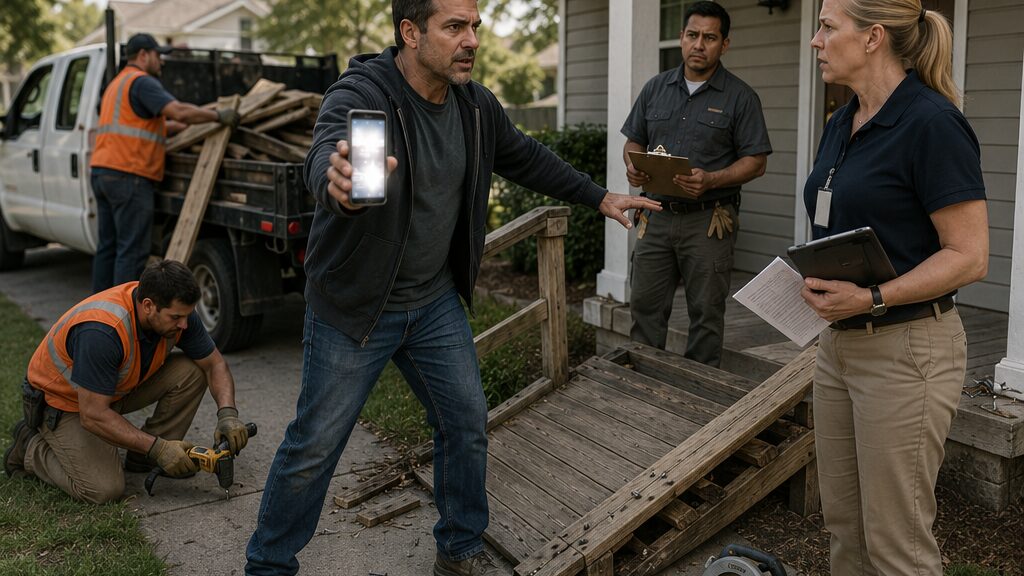
He had not even shut off his truck. The engine coughed behind him at the curb while two workers in orange vests crouched at the foot of his front porch, one holding a drill against the side rail of the temporary ramp, the other stacking loosened boards beside a white work truck. A portable saw sat on the walkway with its cord curled like a black snake across the concrete. The ramp that had taken him three weekends, two borrowed evenings, and every ounce of patience he had left was already half-stripped from the porch.
“Stop,” Matthew said.
The worker with the drill glanced up, then looked past him.
Matthew followed the glance to the woman standing near his front steps. She wore a dark polo, khaki pants, and a plastic ID badge clipped to her belt. Her blonde hair was tied back tight enough to make her face look more certain than it was. In one hand she held a tablet. In the other, a folded notice.
“Stop the work,” Matthew said again, louder this time.
The second worker set a board on the truck bed but did not step away from it. The drill kept whining for half a second too long before the first worker lifted his finger from the trigger.
The woman moved toward him with the practiced pace of someone trained not to look rushed.
“Mr. Young?” she asked.
“You’re standing in front of my house while your crew tears out my mother’s ramp. You know who I am.”
“I’m Christine Roberts, compliance officer for the Lakeside Ridge Homeowners Association.”
“I don’t care what your badge says. Who authorized this?”
Christine’s jaw tightened. “The board issued a removal order for an unapproved exterior structure.”
“It’s a ramp.”
“It was not approved.”
Matthew stepped onto the grass because the walkway was blocked by tools. A loose screw rolled under his shoe. He looked at the half-dismantled rail, at the exposed brackets, at the place where his mother’s right hand had gripped the wood the last time she had practiced coming through the door with her walker.
“It was submitted,” he said. “Four weeks ago.”
Christine raised the tablet slightly. “The association has no record of a complete approval packet. The structure changes the exterior approach and does not meet the community standard for front elevations.”
Matthew let out a small laugh with no humor in it. “Community standard.”
The worker with the drill looked down at the ramp again, waiting for permission from someone else’s face. His vest had a company logo Matthew did not recognize. The other worker shifted his weight near the truck, uncomfortable but not enough to stop.
A man with a clipboard came around from the passenger side. He was broad-shouldered, with work gloves tucked into his belt and sawdust already on one sleeve.
“I’m Anthony Rivera,” he said. “I’m the site supervisor. We were told this was a noncompliant add-on. We’re just here to remove the materials.”
“Those are my materials,” Matthew said.
Anthony looked at Christine, not Matthew. “Ma’am?”
Christine kept her eyes on Matthew. “Mr. Young, if you interfere with authorized enforcement, the association can assess additional costs.”
Matthew felt the heat climb up his neck. He had spent the night at the rehab center, sitting in a vinyl chair beside Susan while she pretended the pain in her hip was only stiffness. The discharge nurse had said tomorrow, maybe late morning, if the home access was ready. Matthew had shown her pictures of the ramp. He had not shown her the email from the HOA threatening fines. He had told himself there was no need. He had the submission receipt. He had the doctor’s note. He had the physical therapist’s measurements. He had done it correctly.
Now a worker had one rail off and another in his hand.
Matthew pulled out his phone.
Christine’s eyes flicked to it. “Recording is permitted in common areas, but this is private association enforcement.”
“This is my front yard.”
“This area includes association-maintained approach standards.”
“My mother broke her hip on that approach.”
The words made the workers still.
Christine blinked once. “I’m sorry to hear that, but the board can only act on what was submitted.”
Matthew opened the folder on his phone with his thumb. His hands were steady, which surprised him. Maybe anger had a place past shaking. Maybe it became something colder when a drill was pointed at the thing that kept your mother from being carried like furniture.
He turned the screen toward Christine.
“Here,” he said. “April 29. Medical accommodation request. Uploaded through your portal. Ramp dimensions. Contractor sketch. Temporary installation note. Doctor’s letter. Physical therapist letter. Confirmation email from Lakeside Ridge at 8:14 p.m.”
Christine did not lean in at first. Her posture stayed official, chin level, shoulders squared. Then her eyes moved across the screen, line by line. Her mouth tightened.
Matthew swiped.
“This is my mother trying the front step after rehab sent her home for an assessment.”
He tapped the video.
On the phone screen, Susan appeared in the doorway, small and furious in a gray cardigan, both hands clenched around a walker. Matthew’s recorded voice, thinner through the phone speaker, said, “Take your time.” Susan tried to lower her right foot to the first step. Her knee trembled. The walker tipped. Matthew’s hand shot into frame, catching her elbow before she pitched forward.
The sound that came from the phone was not dramatic. It was just Susan saying, “I can’t do it, Matthew.”
Christine’s face changed.
Not enough for the workers to notice, maybe. But Matthew saw it because he had been watching for any sign that the words were getting past the badge. Her eyes widened slightly, then sharpened, as if something on the screen had broken through the version of the file she had been given.
He held the phone closer.
“That’s what you’re removing.”
Christine’s gaze jumped from the video to the ramp. The top platform was still attached. The left rail was gone. The bottom board had been lifted and leaned against the truck.
Anthony cleared his throat. “Ms. Roberts, do you want us to pause?”
Christine took half a step back. “The order remains in effect.”
Matthew looked at her. “You just watched her almost fall.”
“I understand this is upsetting.”
“No,” Matthew said. “You understand it’s documented.”
Her cheeks colored.
Anthony shifted his clipboard to his other hand. “I can’t stop the job without instruction from the client.”
“I’m the homeowner.”
“The client listed is the association.”
Matthew nodded once, slowly, because if he let himself answer too quickly, he would shout. He moved around the workers and planted himself between the saw and the section of ramp still attached to the porch.
“You are not touching another board until I get the order in writing, the name of the person who signed it, and confirmation that they reviewed the medical accommodation file.”
Christine’s voice lowered. “Mr. Young, standing in the work area is unsafe.”
“So is removing the ramp.”
The worker with the drill set the tool down. The small sound of plastic against wood was the first decent thing Matthew had heard that morning.
Christine looked toward the street. Two neighbors had slowed on the sidewalk. One pretended to check a mailbox that was not hers. Across the street, Emily Baker stood behind the edge of her front window curtain, then stepped back when Matthew saw her.
The neighborhood looked exactly the way the HOA brochure wanted it to look: trimmed lawns, matching shutters, no trash cans visible after nine, no basketball hoops left overnight, no unauthorized flags, no repairs without architectural review. Matthew had liked that order once. After his father died, and Susan sold the old split-level, Lakeside Ridge had felt safe. Sidewalks. Lighting. Quiet streets. Rules that kept things predictable.
He had not understood that predictability could become a weapon in the hands of people who never had to use the front step.
Christine tapped the tablet. “The record I have says the application was incomplete.”
“Then your record is wrong.”
“It says no medical attachment was received.”
Matthew lifted his phone again. “You saw the confirmation.”
“An automated confirmation only means something was submitted.”
“It means your system received it.”
“It does not mean approval was granted.”
“I never said it did. I said you knew why it was there.”
Christine’s eyes moved again to the phone screen. The video had frozen on Susan’s hand gripping the walker. Matthew suddenly hated that image. He hated that he had recorded it. He hated that the only way to make people believe his mother needed a ramp was to show them a moment she would have never wanted anyone to see.
But he kept the screen up.
“Tell them to stop,” he said.
Christine inhaled through her nose. “I can request clarification.”
“Request it now.”
She glanced at Anthony. “Pause active cutting.”
Anthony nodded to the workers. “Hold up.”
One worker stepped away from the ramp. The other unplugged the saw, but he did it slowly, as if expecting someone to reverse the order before the cord came free.
Matthew lowered the phone but did not put it away.
Christine moved toward the edge of the porch and turned the tablet so her body shielded the screen. Matthew watched her scroll. Her thumb paused once. Then again. She frowned.
“What?” he asked.
“I’m checking the compliance history.”
“Check the accommodation file.”
“I’m checking what I have access to.”
“That’s not the same thing.”
Her lips pressed together, and for the first time she looked less like the face of the HOA and more like a woman whose morning had begun with instructions she had not questioned enough.
Matthew heard the rehab center in his mind: Transport can bring her home tomorrow if the entrance is ready.
Tomorrow. Not when the board met next month. Not when someone found the right attachment. Tomorrow.
Christine tapped something on the tablet. Her eyes moved quickly. Then she stopped.
“What?” Matthew said again.
She did not answer immediately. Behind her, the ramp sat with one side exposed, screws sticking out of the raw wood like broken teeth.
Finally, Christine looked up from the tablet. Her voice dropped so low that Anthony had to lean closer to hear it.
“This file was marked incomplete yesterday.”
Chapter 2: The Notice On The Door Came Too Late
The notice was not on the door.
Matthew found it folded behind the ceramic planter his mother had painted with blue flowers the year before her fall. Fresh clear tape clung to one corner of the paper, but none of it had touched the wood. It was wedged at an angle between the planter and the wall, where a delivery driver might miss it and a homeowner rushing to work would never see it.
He pulled it free with two fingers.
Christine stood two steps away, tablet held against her chest now instead of out like a shield. Anthony waited near the workers, who had gone quiet beside the truck. The saw was unplugged, but the ramp looked worse in silence. Without the drill noise, Matthew could hear the loosened boards settling whenever someone shifted their feet.
“Is this your final notice?” he asked.
Christine’s face tightened. “That appears to be the posted violation notice.”
“Posted when?”
“It should have been posted before removal.”
“That’s not what I asked.”
She looked toward the folded paper. “I arrived this morning with the crew.”
Matthew unfolded it. The page was stiff and clean. No weather marks. No dust. No crease except the one from being folded in half. The date at the top was today.
He turned it toward her. “Today.”
“The board authorized immediate abatement.”
“Before notifying me?”
“Prior correspondence was sent.”
“I got an email saying the ramp was under review.”
Christine looked at the tablet. “The violation notice states the structure was installed without completed approval.”
“The ramp was installed because my mother could not enter her house.”
“That does not eliminate the approval requirement.”
Matthew felt the old argument trying to pull him in circles: requirement, standard, process, review. Words that sounded reasonable until a person stood at the bottom of her own front step with nowhere safe to put her foot.
He held up the notice. “This was hidden behind a planter while your crew was already taking the ramp apart.”
Christine’s eyes flicked toward the sidewalk.
A door across the street opened. Emily Baker stepped out with a watering can in one hand, though the flower bed beside her walkway was already damp. She was in her early fifties, maybe, with careful hair and the wary expression of someone who wanted to know everything without being seen knowing it.
Matthew called across the street, “Emily.”
She froze.
Christine turned.
Emily gave a small, uncomfortable wave, as if the whole scene might become less serious if she treated it like a neighborly interruption.
“Did you see when they came?” Matthew asked.
Emily glanced at the crew truck, then at Christine. “I don’t want to get involved.”
“They’re removing my mother’s ramp.”
“I can see that.”
“Did you see them post this notice?”
Emily set the watering can down. “I saw the truck around eight.”
Christine said, “Ma’am, this is an association enforcement matter.”
Emily’s mouth pinched. “Most things are, lately.”
Matthew crossed halfway down the walkway, stopping where the loose rail blocked his path. “Did you see anyone at my door before the truck arrived?”
Emily hesitated.
Anthony looked at the workers. Christine stared at the tablet as if it might give her a cleaner answer.
“I was taking the trash bins in,” Emily said. “The truck was already there when she walked up to the porch.”
Christine’s shoulders stiffened. “I posted the notice as instructed.”
“After the crew arrived?” Matthew asked.
Christine did not answer.
Emily looked down the street. A few curtains shifted. Somewhere a dog barked once and stopped.
“My doorbell camera might have it,” Emily said, softer. “The angle catches part of your porch.”
Matthew let the words settle. Doorbell camera. Time. Proof not from his phone, not from his anger, not from a system the HOA could call incomplete.
“Can you send it to me?”
Emily folded her arms. “Matthew, I told the board I didn’t like how that ramp looked from the street.”
The admission landed harder than he expected.
He had known people noticed. He had seen a neighbor slow down the first weekend, seen another glance at the raw boards before looking away. He had planned to stain it once Susan was home, to add trim, to make it less like a temporary structure thrown up by a man who had measured three times and still cut one support too short.
But he had not known who complained.
Emily seemed to read his face. “I didn’t know it was for Susan. I thought you were building some kind of deck extension.”
“It has a slope and handrails.”
“People do things without asking,” she said, defensive now. “You know what happened with the Adams patio last year. Insurance mess, contractor liens, everybody paying for it in dues. Donald said the board had to be consistent.”
Christine looked away.
Matthew stared at Emily until the anger found a precise shape. “My mother is due home tomorrow.”
Emily’s face changed. Not as sharply as Christine’s had when she saw the video, but enough. The complaint she had made from across the street had been about appearance. The thing in front of her now had a discharge time.
“Oh,” she said.
A phone rang.
Christine took hers from her pocket, saw the name on the screen, and stepped toward the driveway before answering. “This is Christine.”
Matthew could hear only her side.
“Yes, sir. We’re on site.”
A pause.
“The homeowner is present.”
Another pause. Her eyes moved toward Matthew, then away.
“He has documentation.”
She listened longer this time. The skin around her mouth tightened.
“I understand, but there may be a timing issue with the notice.”
Matthew saw Anthony watching her. Saw the worker by the truck rub one hand over his face. Saw Emily stand very still across the street, her watering can abandoned beside the curb.
Christine turned her back slightly.
“Yes, sir,” she said. “I understand the board’s position.”
Matthew knew before she ended the call.
Christine slipped the phone into her pocket and walked back with her official face restored, though not as cleanly as before.
“The board president has confirmed the removal order remains active,” she said.
Matthew almost laughed again. “Donald Adams.”
Christine did not deny it.
“He knows my mother is coming home tomorrow?”
“I relayed that there are documents you claim support medical necessity.”
“Claim?”
“Mr. Young, I’m using procedural language.”
“Use human language.”
Anthony stepped closer. “Ms. Roberts, are we continuing or not?”
Christine looked at the ramp. The left rail lay on the grass now. The lower section was open. If Susan tried to use it, she would have nothing to hold.
“The crew may continue removing detached materials,” Christine said. “No additional cutting until I receive further instruction.”
Matthew stepped in front of the remaining platform. “No.”
Anthony exhaled. “Sir.”
“Don’t ‘sir’ me while you load my mother’s access into a truck.”
“I’ve got a work order.”
“I’ve got a mother who can’t climb that step.”
That stopped him.
For the first time, Anthony looked not at Christine, not at the paperwork, but at the doorway. The front door was open behind the storm door. Inside, Matthew had already moved the rug so Susan’s walker would not catch. He had placed a small bench along the wall because she got tired after six steps. Her blue sweater was still hanging on the hook where she had left it before the rehab stay, stubborn proof that she expected to come back to the same home.
Anthony’s voice lowered. “When is she coming?”
“Tomorrow.”
Anthony glanced at the ramp, measuring it differently now. Not as materials. As passage.
He turned to the worker nearest the truck. “Leave the rest until we get written confirmation.”
Christine said, “Anthony.”
He lifted his clipboard. “I can’t have my guys working around a homeowner standing in the area. Safety issue.”
It was a thin excuse. Matthew knew it. Christine knew it too. But she did not challenge him immediately.
Matthew let out the breath he had been holding.
Emily crossed the street slowly. She kept looking at the ramp, then at the notice in Matthew’s hand. “I can check the camera,” she said. “It stores clips for twenty-four hours.”
“Thank you.”
“I’m not promising it shows everything.”
“I just need what it shows.”
Her eyes flicked toward Christine. “I don’t like being dragged into board fights.”
“You already were,” Matthew said, more sharply than he meant.
Emily flinched.
He swallowed. The anger had begun spilling onto the wrong person. “I’m sorry.”
Emily nodded once, not quite forgiving him, but not walking away.
Christine’s tablet chimed. She looked down. Her brows drew together.
Matthew’s phone vibrated in his hand.
He looked at the screen and saw the rehab center’s number. For a second he considered not answering, because there were too many people standing around the broken ramp and he could not bear another voice asking him whether the home was ready.
He answered anyway.
“Matthew Young.”
“Mr. Young, this is the discharge coordinator from Valley Glen Rehab. I’m confirming transport for Susan Young.”
He turned away from the crew.
“Tomorrow,” he said. “You told me tomorrow.”
“Yes, transport is scheduled for tomorrow morning. We have a pickup window between ten and eleven-thirty. The therapist just needs to confirm the home entrance remains accessible.”
Matthew closed his eyes.
Behind him, a loose board slid slightly in the truck bed.
“Mr. Young?” the coordinator asked.
“Yes,” he said. “I’m here.”
“Will the front entrance be ready?”
Matthew looked back at the ramp: half-there, half-gone, held together by the stubbornness of screws and one crew supervisor’s reluctance to be the man who made it worse.
Christine watched him.
Emily stood at the curb with her hand pressed against her own phone.
Anthony had one palm resting on the truck bed, his clipboard tucked under his arm, waiting for someone above him to decide what a person could do with his own front door.
Matthew forced his voice steady.
“I’m working on it.”
There was a pause on the line, then the coordinator said, “Mr. Young, if the entrance is not safe, we may have to delay discharge or arrange a different placement review.”
The words hit harder than the drill.
Different placement review.
Susan had made him promise she was coming home. Not “to a place.” Not “when everything was ideal.” Home.
Matthew looked at Christine, then at the notice dated that morning, then at the ramp with its left side missing.
“Don’t delay anything,” he said into the phone. “She’s coming home.”
He ended the call before the coordinator could answer.
Christine’s expression had gone still. Maybe she had heard enough. Maybe not.
Matthew lowered the phone.
“My mother’s transport is scheduled for tomorrow morning,” he said. “So if that ramp is gone, tell me exactly how she gets through that door.”
No one answered.
Then Christine’s phone buzzed again in her pocket, and this time she did not reach for it right away.
Chapter 3: The Application That Disappeared From The File
“The file exists,” the HOA secretary said, “but not in the version the board reviewed.”
Matthew stood at the clubhouse counter with both hands flat on the polished wood, because if he let go, he might point at someone again. Behind the secretary, a printer clicked and hummed as if the building were calmly producing paperwork for a world where paperwork had never hurt anyone.
Christine stood to his left, no longer blocking him from the screen but not quite helping him either. Anthony had stayed at the house with the crew, the ramp paused in a state that looked less like mercy than damage waiting for permission. Emily had gone home to search her doorbell clips. Susan had called twice. Matthew had let both calls go to voicemail.
He told himself he needed answers first.
The secretary turned the monitor slightly, though not enough for him to read everything. “Your architectural modification request was opened April 29.”
“Yes.”
“It shows exterior alteration, temporary access ramp, handrail, front approach.”
“Yes.”
“It also shows missing supporting documentation.”
“No.”
Christine’s eyes moved toward him.
Matthew took out his phone and opened the folder again. He had named it MOM RAMP because at the time he thought blunt labels would make everything easier. Inside were the PDF scans, the therapist’s diagram, the doctor’s letter, the confirmation email, photographs of the porch, measurements, and a video of Susan nearly falling.
He pulled up the confirmation. “Submission received April 29, 8:14 p.m. Reference number LR-4471-A. Six attachments.”
The secretary leaned forward. “The board packet only shows three.”
“Then where did the other three go?”
“I can’t answer that.”
“Who can?”
She glanced toward the hallway behind her. “Mr. Adams is in a call.”
“Of course he is.”
Christine said quietly, “Let’s keep this productive.”
Matthew turned to her. “Productive would have been checking this before you brought a crew to my porch.”
Her face tightened, but she did not answer.
The secretary clicked through several screens. Matthew caught glimpses: dates, status notes, categories in small gray boxes. Incomplete. Pending. Violation generated. Abatement authorized.
There it was, the language that had put a drill against his mother’s ramp.
“Open the attachment log,” he said.
“I’m not authorized to share internal administrative logs.”
“I’m not asking to take it home. I’m asking why my mother’s medical letter vanished.”
The secretary looked toward Christine.
Christine hesitated. That hesitation told Matthew more than refusal would have. She wanted the log opened. Or she wanted to know what was in it.
“Open what you can,” Christine said.
The secretary’s eyebrows rose. “Compliance access?”
“Yes.”
A few more clicks. The screen changed.
Christine stepped closer.
Matthew could not read the tiny lines clearly, but he saw enough: file names, upload times, status fields.
“DoctorLetter_SYoung.pdf,” he said, leaning in. “There. Received.”
The secretary stiffened. “Please don’t come behind the counter.”
“I’m not behind the counter. I’m reading the thing you said wasn’t there.”
Christine stared at the screen. “That line says received.”
The secretary’s hand hovered over the mouse. “Received by portal doesn’t always mean attached to board review.”
Matthew looked at her. “Do you hear yourself?”
She flushed. “I’m explaining how the system works.”
“That is not how anything works. If I submit a medical document and your system receives it, your board doesn’t get to pretend it never existed because it didn’t land in the right tab.”
Christine said, “When was the board packet generated?”
The secretary clicked again. “May 2.”
Matthew checked his phone. “The doctor letter uploaded April 29.”
Christine’s eyes narrowed. “What about the denial notice?”
“May 6,” the secretary said.
“And the violation?”
“May 9.”
Matthew gripped the counter harder. “So you had the letter before the denial.”
The secretary did not answer.
Christine touched the edge of the monitor and angled it a fraction more toward herself. “The upload date doesn’t match the packet note.”
The secretary lowered her voice. “Christine.”
“What packet note?”
Christine’s expression closed. “There’s a notation that the medical documentation was not provided at time of review.”
“But it was.”
“It appears it was received by the portal.”
Matthew stared at her. “Say the whole sentence.”
She looked at him.
“It was received by the portal before the board reviewed the ramp.”
Christine did not say it.
The office door opened at the end of the hallway.
Donald Adams stepped out with a phone in one hand and a leather folder in the other. He was dressed like a man who had never expected to stand in a clubhouse lobby arguing over screws: pressed shirt, polished shoes, silver watch, no sign of the humidity outside touching him. His face carried a controlled impatience Matthew recognized from board emails—the kind that made every sentence sound final.
“Mr. Young,” Donald said. “I understand you’ve brought the morning’s enforcement action here.”
Matthew lifted his phone. “I brought proof.”
Donald gave the phone the briefest glance. “Automated receipts are not approvals.”
“No one is claiming they are.”
“Then we agree.”
Matthew felt Christine shift beside him.
“We don’t agree,” Matthew said. “Your board denied my ramp as incomplete after your system received the medical documents.”
Donald’s eyes moved to the secretary. “The board reviewed the packet provided.”
“Provided by whom?”
“The management system.”
“Systems don’t decide to hide medical letters.”
Donald’s pleasant expression thinned. “Mr. Young, I appreciate that this is personal for you.”
“It’s personal for my mother. It should be procedural for you.”
“The procedure is exactly what we’re following. You installed an exterior structure without final written approval.”
“Because your review deadline passed.”
“The association has thirty business days.”
“The bylaws say fifteen for temporary medical accommodations.”
The secretary looked down.
Donald did not.
Matthew swiped on his phone and opened the document. He had read the rules so many times he could find the section with his thumb. “Page twelve. Temporary access modifications. Fifteen business days for written response. Lack of response does not waive safety requirements, but enforcement must consider documented medical necessity.”
Donald’s face remained still, but something in his eyes cooled. “You’ve done some reading.”
“I’ve done all the reading you hoped I wouldn’t.”
Christine looked at the tablet in her hands.
For a brief second, Matthew felt the old certainty return. This was what proof did. It lined up dates, rules, and signatures until denial had nowhere left to stand. He had the confirmation. He had the bylaws. He had the video. He had the notice dated the same morning as removal. He had enough.
Then Donald said, “Even if every document you reference was submitted, you still did not have approval to build.”
The certainty cracked.
“My mother was discharged for home assessment.”
“That does not authorize unilateral construction.”
“It authorizes me to make the home safe.”
“It authorizes you to request permission to make the home safe.”
The words were calm. That made them worse.
Christine said, “Donald, the timing may need review.”
He looked at her then, not sharply, but with the quiet weight of someone reminding an employee where the floor was. “The timing has been reviewed.”
“By the same packet that missed the doctor’s letter?” Matthew asked.
Donald turned back to him. “Mr. Young, the association cannot permit residents to install structures first and justify them later. We’ve had prior incidents. Unapproved work creates liability for everyone.”
“Liability for everyone,” Matthew repeated. “Except the woman who can’t get in her front door.”
“No one is denying your mother’s condition.”
“You are denying the ramp that lets her come home.”
Donald closed the leather folder under his arm. “The board is willing to consider a compliant alternative once a complete packet is properly reviewed.”
“When?”
“At the next scheduled architectural session.”
“My mother comes home tomorrow.”
“Then I suggest you coordinate temporary rear access, medical transport assistance, or delay discharge until the association can complete its process.”
Matthew stared at him, and for one dangerous second all he saw was the ramp board in the truck and Susan’s hand shaking on the walker.
“You want me to delay my mother’s discharge because your portal lost a PDF.”
Donald’s jaw moved once. “I want you to follow the same process as every other homeowner.”
Christine looked back at the monitor. Her brow creased again.
“What is that?” she asked.
The secretary moved her hand toward the mouse, but Christine leaned closer first.
Matthew turned. “What?”
Christine’s finger hovered near the lower part of the screen without touching it. “There’s a related property note.”
Donald’s voice sharpened. “That is not part of the architectural request.”
Christine did not look at him. “It’s linked to the address.”
The secretary clicked by mistake or by pressure; Matthew could not tell which. A small note opened at the bottom of the file.
He caught only the heading before Christine shifted and the secretary tried to minimize it.
Drainage complaint — hold for review.
Matthew went still.
“What drainage complaint?”
Donald said, “That is a separate maintenance matter.”
“Separate from my front walkway?”
“No determination has been made.”
Matthew remembered Susan standing at the bottom step before the ramp, looking down at a slick patch of concrete after the sprinklers had run too long. He remembered the hairline crack near the edge of the walkway. He remembered saying he would call the HOA again after work. He remembered Susan saying, “Don’t fuss. I can manage one step.”
She had managed it until she hadn’t.
Christine closed the tablet against her side. Not the office computer, not the file, but her own tablet, as if she had seen enough to understand the morning had not started where anyone had told her it started.
Matthew looked from her to Donald.
“What does drainage have to do with my mother’s ramp?” he asked.
Donald’s face settled into something smooth and unreadable.
“Nothing,” he said. “Unless you’re trying to change the subject.”
Chapter 4: The Front Step Was Never Just A Step
Rainwater gathered in the crack at the base of the front step before Matthew found the first old photo.
It had not rained hard. The evening storm had passed quickly, leaving the porch damp and the air smelling of wet mulch. But the water did what it always did near his house. It slid from the narrow strip of association grass beside the walkway, crossed the concrete in a thin sheet, and settled exactly where Susan had planted her foot the morning she fell.
Matthew crouched beside the half-removed ramp with his phone flashlight aimed at the ground.
The left rail was gone. The lower boards sat in the work truck under a tarp because Anthony had refused to take them farther without new written direction. The exposed bolts glistened in the beam of Matthew’s phone. Empty holes marked the places where the ramp posts had been anchored that morning, neat dark circles in the damp wood.
He angled the light toward the walkway.
The crack was wider than he remembered.
It ran from the edge of the common grass toward the porch step, not deep enough to look dramatic, not wide enough to make someone in an office hurry. But a walker wheel could catch there. A cane could slip. A tired foot could land on the wet slope and slide before the body above it knew what had happened.
Matthew opened his photo gallery and searched by date.
The first picture came from three months earlier: Susan standing in the doorway, smiling with one hand on the jamb, the walkway dry but stained along the edge.
He swiped.
Another photo, taken after a sprinkler repair. Mud washed across the path.
Another, two weeks later. A work order confirmation from the HOA landscaper: irrigation grading adjusted along common bed.
Another. Susan’s walker parked inside the doorway, because she had said she could make it to the car without it if Matthew took her arm.
He stopped on the photo from the morning of her fall.
He had not meant to photograph the ground. He had taken a picture for the urgent care intake form after Susan insisted the fall was not worth an ambulance. The image showed her shoe, the porch step, a damp patch of concrete, and one silver walker wheel tilted against the crack.
Matthew enlarged it until the screen blurred.
The ramp had never been just a ramp. It had been a bridge over a problem the HOA already owned.
Across the street, Emily’s front door opened.
Matthew stood as she came over wearing a rain jacket over house clothes, her phone in one hand. She stopped at the edge of his lawn, looked at the exposed ramp supports, then at the water shining along the walkway.
“I found the camera clip,” she said.
“Does it show the notice?”
“It shows Christine walking up with the paper after the truck was already parked.”
Matthew held out his hand.
Emily did not give him the phone yet. “It also shows me standing at the window like a coward.”
He looked at her, too tired to soften his face.
She turned her screen toward him. The footage was grainy but clear enough: the white work truck rolling to the curb at 7:58, Anthony stepping out, two workers opening the back. Christine arriving two minutes later, holding the folded notice. She walked to Matthew’s porch, looked once toward the street, and tucked the paper behind the planter.
Matthew watched it twice without speaking.
“I’ll send it,” Emily said. “But there’s something else.”
“What?”
She looked at the wet concrete. “You remember when the sprinklers kept flooding this side?”
“I called the HOA.”
“So did I. So did the Torres place before they moved. Water was running down from that common bed after the landscapers regraded it. I complained because it was killing my hydrangeas.”
Matthew almost smiled at the absurdity, but the expression never formed.
“When?”
“Last fall. Again in February. Donald said the irrigation contractor said it was within tolerance.”
“Within tolerance,” Matthew repeated.
Emily’s mouth tightened. “I didn’t think it was dangerous. I thought it was annoying.”
Matthew looked back at the step. He could see Susan there: chin up, annoyed by the walker, refusing to let him carry her purse because she could still carry her own purse, thank you very much. He could hear the scrape of the walker, the small gasp, the sound her body made against the porch edge. Not loud. That was what had frightened him most. Something life-changing could happen with almost no sound.
“Do you have those emails?” he asked.
Emily hesitated. “Maybe.”
“Emily.”
“I can look.”
“Please.”
She nodded. The word seemed to cost her less now.
His phone rang before he could say anything else.
Susan.
The name filled the screen with the picture she hated, the one from her birthday at the kitchen table where Matthew had caught her laughing with her eyes closed. He stared at it until Emily lowered her gaze and stepped back toward the street.
He answered.
“Hi, Mom.”
“You sound like you’re outside,” Susan said.
“I am.”
“At the house?”
“Yeah.”
“Is the ramp finished?”
Matthew looked at the missing rail.
He had spent his whole adult life trying not to lie to his mother. When his father’s hospital bills got bad, he had said, “We’ll manage,” because it had been true in the way people make true things by surviving them. When Susan sold the old house, he had said Lakeside Ridge would be easier, and for a while, it had been. When she cried after the fall because rehab staff spoke to her like she was already half gone, he had said, “You’re coming home,” because that was not a hope. It was a promise.
Now the truth sat in front of him in wet wood and empty bolt holes.
“The entrance is being handled,” he said.
There was a pause.
“That is not an answer.”
“It will be ready.”
“Matthew.”
He closed his eyes. “I’m working with the HOA.”
She made a sound between a laugh and a cough. “That bad?”
“No. Just paperwork.”
“Paperwork has a tone when you say it.”
He turned away from the ramp as if she could see through the phone. “How’s your hip?”
“Still attached. Stop changing the subject.”
“I’m not.”
“You always get polite when you’re hiding something.”
He walked toward the driveway, where the work truck had left tire marks in the damp curb strip. “The discharge coordinator called. Transport is still tomorrow.”
“She told me.”
“She did?”
“Yes. And the therapist asked about a rear entrance.”
Matthew stopped.
Behind him, Emily was halfway across the street. Christine’s violation notice lay on the porch rail where he had left it, its clean white paper curling at the edge from the moisture in the air.
“What therapist?” he asked.
“My physical therapist. She said she wanted to confirm whether there was a rear entrance with less obstruction. Why would she ask that?”
Matthew’s grip tightened around the phone.
“Probably just standard questions.”
“Matthew, why would the front entrance have obstruction?”
He watched a drop of water slide from the ramp’s cut rail and fall into the mud below.
“It’s nothing you need to worry about tonight.”
“I will decide what I need to worry about.”
“You need to rest.”
“No, I need to know whether I can get through my own front door tomorrow.”
He did not answer fast enough.
Susan’s voice changed. It lost the dry edge and became smaller, which was worse. “Matthew, what happened?”
He looked at the porch, the planter, the notice, the dark holes where posts had been. He thought of telling her everything. He thought of the shame on her face if she knew the video of her almost falling had been shown to strangers. He thought of her refusing to come home because she did not want to be the reason he was fighting half the neighborhood.
“The HOA is questioning part of the ramp,” he said. “But I have proof. I have the forms. I have the dates. I’m going to fix it.”
“You said that when Dad was sick.”
The words struck so unexpectedly that he had to put one hand on the truck hood.
Susan breathed through the silence. “You said you were going to fix everything. And then you stopped telling me what things cost.”
“This isn’t that.”
“Isn’t it?”
He closed his eyes again. “Mom, I need you to trust me for one more day.”
“I do trust you,” she said. “That’s why I know when you’re leaving me out.”
Across the street, Emily’s porch light came on. Matthew could see her through the window, already bent over a laptop or tablet, searching for old emails she had once written for flowers and now might need for a fall.
Susan’s voice returned, sharper now.
“Matthew, why did the therapist ask if I had a rear entrance?”
Chapter 5: The Compromise Would Trap Her Behind The House
Donald Adams slid the rear-ramp sketch across the clubhouse table as if he were offering Matthew a gift.
“This is the most reasonable path forward,” he said.
The drawing had been printed in color, with clean lines and a small arrow pointing from Matthew’s back patio to the side gate. Someone had measured nothing important. The path curved around the air-conditioning unit, crossed a strip of uneven grass, then squeezed between the fence and the trash enclosure before reaching the driveway. On paper, it looked like access. In real life, it was a trap with landscaping.
Matthew did not touch it.
Christine sat two chairs down with her tablet in front of her. She had not said much since the meeting began. Her hair was tied back again, her badge clipped straight, but there was a shadow beneath her official expression now. Donald stood at the head of the table, refusing to sit, which made the room feel less like a meeting and more like a decision already made.
“The front ramp remains noncompliant,” Donald continued. “However, the association recognizes that your mother may require temporary accommodation. A rear approach avoids altering the front elevation.”
“The rear approach is too narrow.”
“That can be evaluated.”
“It was evaluated this morning.”
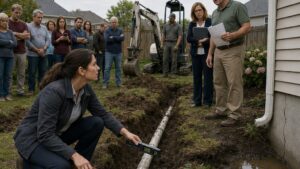
Matthew took out his phone and played the short video he had recorded an hour earlier. The physical therapist’s voice came through clearly while the camera moved along the backyard path.
“This turn is too tight for transport,” the therapist said in the video. “The ground is uneven, and the slope near the gate is not safe for a walker or assisted chair. Emergency transport would not use this as a primary accessible route.”
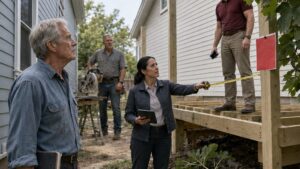
Matthew paused the video on the frame of the measuring tape stretched across the narrowest point: thirty-one inches between the fence post and the trash enclosure.
Christine looked at the number.
Donald did not. “That is one opinion.”
“She is my mother’s therapist.”
“She is not the association’s engineer.”
Matthew looked at him for a long second. “My mother is not an engineering problem.”
Donald’s nostrils flared slightly, the first crack in his calm. “No one said she was.”
“You just offered a ramp to the back of the house because you don’t want to see one in front.”
“I offered a compliant alternative.”
“It would leave her behind the house.”
“Mr. Young—”
“No. Look at the video.”
Donald finally glanced at the phone, but only as a courtesy he resented. The image showed Matthew’s backyard that morning, the grass still damp, the side gate swollen from moisture. The therapist’s hand entered the frame, pointing to the threshold.
“If she comes through here,” the therapist said, “she has to transfer from transport, cross uneven ground, make a tight turn, and enter through a sliding door track. That is not equivalent access.”
Matthew stopped the video.
“Equivalent,” he said. “That’s the word. Not hidden. Not inconvenient. Not whatever makes your front elevation cleaner. Equivalent.”
Christine’s fingers moved on her tablet. She looked like she was typing notes, but her eyes kept returning to the sketch.
Donald folded his hands. “The board must balance individual requests against community standards and liability exposure.”
“There it is again.”
“What?”
“Community.”
Donald’s jaw set. “Lakeside Ridge exists because homeowners agreed to shared standards. If each resident makes exterior changes without approval, the association loses the ability to enforce anything. That affects property values, insurance, and fairness.”
“Fairness to whom?”
“To every homeowner who follows the rules.”
Matthew leaned forward. “I followed the rules.”
“You installed before written approval.”
“You missed your review deadline.”
“That is disputed.”
“No,” Matthew said. “It is inconvenient.”
Christine looked up.
Donald’s voice hardened. “I would be careful with accusations.”
“I am being careful. I have the portal receipt. I have the attachment log. I have Emily Baker’s doorbell video showing your notice went up after the crew arrived. I have photos of the drainage pooling at the step. I have the therapist’s statement that the rear entrance is unsafe.”
Donald’s eyes narrowed at Emily’s name.
There. Matthew saw it. Not fear exactly. Calculation.
“You spoke with Mrs. Baker,” Donald said.
“She sent the footage.”
“Doorbell footage does not establish architectural compliance.”
“It establishes that you started removal before real notice.”
Donald stepped away from the table and looked through the clubhouse window toward the pool deck, empty under a line of closed umbrellas. For a moment he looked less like a board president and more like a man trying to keep too many cracks from showing at once.
When he turned back, the polished calm had returned.
“If you reinstall the front ramp without written approval,” he said, “the association will assess daily fines beginning tomorrow. Costs for removal and legal review may also be charged to your account.”
Christine’s hands stopped moving.
Matthew heard the words but also heard the thing underneath them: If you put back what your mother needs, we will punish you every day for it.
“How much?” he asked.
“Two hundred dollars per day for continuing violation, plus contractor fees.”
Matthew almost laughed. Not because it was funny, but because the number had a strange cleanliness to it. Two hundred dollars a day to climb your own front step. Two hundred dollars a day for a rail to hold. Two hundred dollars a day for Susan not to be routed behind her own house like a delivery.
“Put it in writing,” he said.
Donald tilted his head. “The fine schedule is already in the governing documents.”
“Put this threat in writing. Today. Include that you’re rejecting the front entrance after receiving medical documentation and therapist review.”
Christine’s eyes moved quickly to Donald.
Donald smiled without warmth. “No one is rejecting anything. We are offering review of a compliant alternative.”
“Then put that in writing too.”
“You seem to believe paperwork helps you.”
Matthew stood. “No. I’m starting to believe paperwork helps you until someone reads it back.”
For the first time, Donald’s expression fully changed. It was brief, but Matthew saw irritation sharpen into dislike.
Christine closed her tablet softly. “Donald, if transport is tomorrow, we may need emergency board review.”
Donald did not look at her. “That will be handled at tonight’s session.”
“That’s not on the calendar,” she said.
“It is now.”
Matthew looked between them. “Tonight?”
“A limited discussion,” Donald said. “The board will review temporary accommodation options.”
“Options,” Matthew repeated.
“The rear route among them.”
Matthew picked up the printed sketch and folded it once, then again, carefully enough not to tear it. “My mother is not entering her house through a route medical transport says is unsafe.”
Donald’s voice dropped. “If you block association enforcement again, we will document that too.”
Matthew slipped the folded sketch into his folder. “Good. Document everything.”
He left before Donald could answer.
In the parking lot, he sat behind the wheel without starting the truck. The clubhouse windows reflected the lot back at him: one man in a parked vehicle, holding a folder full of proof that still had not put the ramp back together.
His phone buzzed.
For half a second he expected Christine. Or Emily with another email. Or the discharge coordinator warning him again.
It was a voicemail from Susan.
He pressed play.
Her voice filled the cab, thinner than usual but not weak.
“I spoke to the therapist again,” she said. “She told me there’s a meeting tonight. Do not go to that meeting without me.”
Chapter 6: She Refused To Be The Reason In The File
Susan held out her hand before Matthew had fully entered the rehab room.
“Show me the video,” she said.
She was sitting upright in the armchair by the window, dressed in the dark blue sweater she called her serious sweater. Her walker stood in front of her within reach. A folded blanket lay on the bed untouched. The television was muted on a cooking show neither of them watched. She had been waiting dressed, not resting.
Matthew stopped just inside the doorway with his phone still in his pocket.
“Hi to you too,” he said.
“Do not charm me.”
“I wasn’t going to.”
“You were about to try.”
He set the folder on the small table beside her bed. “I need to explain first.”
“No, you need to show me what happened to my ramp.”
The phrase my ramp made him look away.
“It’s not gone,” he said.
“That is not the same as showing me.”
He took the chair across from her. The vinyl sighed under him. “Mom.”
Her eyes narrowed. “If you say you’re protecting me, I’m going to throw this water cup at you.”
“It’s plastic.”
“I have good aim.”
Despite everything, his mouth twitched. Susan did not smile back.
He took out his phone, opened the video from that morning, then hesitated. The thumbnail showed Christine standing near the porch, Anthony behind her, the first rail already on the grass. Matthew’s own voice had been raw when he recorded it. He hated the sound of it. He hated even more the moment near the middle, when he had played Christine the old video of Susan almost falling.
He dragged the timeline forward, past that part.
Susan’s hand shot out and covered the screen.
“What did you skip?”
“Nothing important.”
“Matthew.”
He stared at her fingers on the phone. The knuckles were swollen from arthritis. The nails were short and unpainted. The hand had taught him how to tie shoes, sign checks, hold a steering wheel at ten and two. Now it trembled slightly from medication or anger or both.
He let the video slide back to the beginning and handed her the phone.
Susan watched without speaking.
On the screen, the workers loosened the rail. Matthew’s voice told them to stop. Christine explained the removal order. Anthony said he had a work order. Then came the moment Matthew had tried to skip: his own thumb opened the older clip, and there Susan was, in the doorway weeks ago, trying to step down while the walker tipped.
The rehab room seemed to shrink around the sound of her own recorded voice.
“I can’t do it, Matthew.”
Susan’s face did not change at first.
Then she paused the video.
“You showed her that?”
“I had to.”
“You showed strangers that?”
“The HOA kept saying there was no medical need.”
“So you gave them my worst moment.”
He swallowed. “I gave them proof.”
She looked at him then, and the hurt in her face was worse than anger. “Proof that I’m helpless?”
“No.”
“That I almost fell?”
“That the step is unsafe.”
“That I can’t get into my house without my son making a case file out of me?”
Matthew sat back as if she had pushed him.
“I didn’t mean it that way.”
“I know what you meant.”
“Then why are you saying it like that?”
“Because meaning well does not make it painless.”
He looked at the muted television. A chef smiled silently over a bowl of lemons.
Susan lowered the phone into her lap. “You should have told me the ramp was being removed.”
“I didn’t know they’d come this morning.”
“After.”
“I was trying to fix it before you had to worry.”
“I am already worried.”
“You’re healing.”
“I am not a vase.”
The words cut through the room cleanly.
Matthew rubbed both hands over his face. “I promised you you were coming home.”
“You promised me I would not disappear into decisions other people made for me.” Her voice shook once, then steadied. “That includes yours.”
He had no answer.
For weeks, he had treated the fight like a wall he had to stand in front of. The HOA on one side, Susan on the other. If he absorbed enough impact, maybe nothing would touch her. But sitting across from her now, he saw the shape of what he had done. He had made her the reason for every form and kept her out of every room where her life was being discussed.
Susan pressed play again and watched the rest. Christine’s face changed when she saw the timestamps. Anthony paused the work. Matthew demanded the order in writing. The ramp sat half-gutted in the morning light.
When the video ended, Susan held the phone out.
“Record me,” she said.
“Mom.”
“Record me.”
“You don’t have to—”
“I am not a problem to be managed.”
The sentence landed in the exact place his fear had been hiding.
He took the phone.
Her eyes stayed on him, not the camera. “If you edit me, I will know.”
“I won’t.”
“You already tried.”
He nodded once. “I did.”
That seemed to matter more to her than an apology would have. She adjusted herself in the chair, wincing before she could hide it. Matthew leaned forward by instinct, and she lifted one finger.
“Don’t hover.”
He stopped.
Susan smoothed the front of her serious sweater. “Is it recording?”
“Yes.”
She looked into the lens.
“My name is Susan Young. I live at 1846 Lake Heron Drive with my son, Matthew. I broke my hip after slipping near my front step. I use a walker. I am coming home tomorrow, and I need to enter through my front door.”
Her voice was even, but Matthew heard the effort under it.
“The ramp at my house is not decoration. It is not a porch addition. It is not a convenience. It is how I get from the driveway into the home I chose. The rear entrance is not safe for me. I do not want to be carried. I do not want to be hidden behind my own house because the front looks better without me.”
Matthew’s throat tightened.
Susan’s eyes flicked briefly to him, then back to the lens.
“My son should have told me everything sooner. I am angry with him for that. But he built that ramp because I asked to come home, and because the front step was not safe before the ramp was there. If the board wants to discuss my access, then the board can hear from me.”
She stopped.
Matthew lowered the phone.
Neither of them spoke for several seconds.
Finally Susan said, “Was that too much?”
“No.”
“Was it enough?”
He looked at the phone in his hand. For the first time all day, it felt less like a weapon and more like something he had been trusted to carry.
“It’s yours,” he said. “That’s what matters.”
Her face softened, but only slightly. “Now tell me the part you still haven’t told me.”
He looked down.
“The drainage,” she said.
He exhaled. “You knew.”
“I knew the walkway was wet too often. I knew you called. I knew you stopped mentioning it after I fell.” She gripped the chair arms. “I did not know there was a file.”
“There’s a note. ‘Drainage complaint — hold for review.’ Donald says it’s separate.”
“Is it?”
“No.”
She nodded slowly. “Then don’t let him make it separate.”
The room door opened, and the physical therapist leaned in. “Transport confirmed for tomorrow, pending safe access.”
Susan answered before Matthew could. “We are working on safe access.”
The therapist looked from Susan to Matthew, sensed the weather in the room, and withdrew with a small nod.
Matthew’s phone buzzed in his hand.
He expected Susan to ask who it was. She did not. She watched him read it.
The text was from Christine.
Bring every timestamp. Tonight.
Chapter 7: The Board Finally Saw What The Ramp Protected
“Before we begin,” Donald Adams said, “the board needs to be clear that the structure in question was unauthorized.”
Matthew had not even sat down.
The clubhouse meeting room smelled faintly of coffee and floor polish. Folding chairs faced the long table where Donald sat with two board members, the HOA secretary, and a stack of printed packets. Christine stood near the wall with her tablet held against her side. Her badge caught the fluorescent light every time she shifted.
Matthew remained in the aisle with his folder under one arm and his phone in his hand.
On the screen, Susan’s recorded statement waited, paused on her face.
Donald looked at the few residents who had come in quietly and taken seats near the back. Emily Baker sat in the second row, both hands wrapped around her own phone. Anthony Rivera stood near the door in his work shirt, cap folded between his hands, looking like a man who had arrived expecting to be blamed for something he had not fully understood until too late.
Donald tapped the packet in front of him.
“The board recognizes that emotions are high,” he said. “However, this remains an architectural compliance matter.”
Matthew walked to the front table and placed the folded rear-ramp sketch on it.
“No,” he said. “It became an access matter the moment you sent a crew to tear out the only safe way my mother could enter her home.”
Donald’s eyes moved toward Christine. “Mr. Young, you will have a chance to speak.”
“I’m speaking now because you started by calling her ramp unauthorized before saying her name.”
A board member shifted in his chair. The HOA secretary looked down at her notes.
Donald’s expression did not change, but his fingers flattened against the packet. “Proceed, then.”
Matthew opened his folder with careful hands. If he moved too quickly, the anger would show in ways Donald could use. He laid out the timeline one page at a time: April 29 portal receipt, six attachments; doctor’s letter; therapist diagram; HOA confirmation; photos of the step; violation notice dated the same morning as removal.
Christine watched every page.
“This is the submission receipt,” Matthew said. “This is the medical letter the HOA file said was missing. This is the physical therapist’s measurement. This is your temporary modification rule requiring review within fifteen business days. This is the notice Christine posted after the crew arrived.”
Donald leaned back. “Again, automated confirmation is not approval.”
Matthew nodded once. “That sentence has done a lot of work for you today.”
A small sound passed through the room. Not laughter. Recognition.
Donald’s jaw tightened. “The issue is whether you installed prior to written authorization.”
“The issue is whether you removed after receiving medical necessity.”
Christine stepped away from the wall.
“Donald,” she said.
He looked at her with warning in his eyes. “Ms. Roberts.”
She set her tablet on the table and turned it so the board could see. “The compliance record needs correction.”
The room went still.
Matthew looked at her, not trusting the words yet.
Christine’s voice stayed professional, but it no longer sounded like a shield. “The portal attachment log shows DoctorLetter_SYoung.pdf received April 29 at 8:14 p.m. The board packet generated May 2 did not include that attachment. I do not know whether that was a system error or administrative omission, but the medical document was present in the portal before denial.”
Donald’s face hardened. “That is an internal technical issue.”
“It affected enforcement.”
“It did not grant approval.”
“No,” Christine said. “But it means the removal order was based on an incomplete review.”
The sentence hung there.
Matthew felt something inside him loosen, but not enough. One corrected record did not rebuild a ramp.
Donald turned to the board members. “The association cannot be held hostage by a homeowner’s unilateral action because of a portal issue.”
Emily stood suddenly enough that her chair legs scraped the floor.
Donald’s eyes moved to her. “Mrs. Baker?”
“I complained about the ramp,” Emily said.
Matthew turned.
Her voice was tight, but she kept going. “I thought it was ugly. I thought he was building without asking. I told the board someone needed to look at it.”
Donald said, “Your concern was properly noted.”
“No,” Emily said. “I mean, yes, I complained. But I didn’t know it was for Susan. And I didn’t know the notice was being posted after the crew was already there.”
She held up her phone. “My doorbell camera shows the truck arrived at 7:58. Christine approached the porch at 8:01 with the notice. The first board came off before 8:06.”
Christine closed her eyes briefly.
Donald said, “Doorbell timestamps are not official association records.”
Anthony raised his hand slightly from the back. “My work log is.”
Everyone turned toward him.
He looked at Matthew, then at Christine, then finally at Donald. “We were instructed to arrive at eight for removal. The work order says pre-notified homeowner, immediate abatement authorized. We started unloading at 7:59. First fasteners came off at 8:04.”
Donald’s voice went flat. “Mr. Rivera, contractor invoices are outside tonight’s review.”
“You sent me,” Anthony said. “I wrote down when.”
The board member nearest Donald reached for the work log Anthony held out. Donald did not stop him quickly enough.
Matthew watched the page travel across the table. It was not dramatic. It was a clipboard sheet with times, signatures, job number, address. Yet the room changed around it. The morning at Matthew’s porch was no longer one man’s anger against an association’s procedure. It had times. It had sequence. It had the shape of a decision made before notice had meaning.
Donald drew in a measured breath. “Even accepting the timeline, Mr. Young installed first.”
Matthew picked up his phone.
“And my mother is still the person whose home you are discussing.”
He tapped play.
Susan’s face filled the small screen. He had offered to project it, but she had said no when he called from the parking lot. “Make them look where you looked,” she had told him. “Not at a wall. At the phone.”
So Matthew held the phone in his hand, the same way he had held it in front of Christine that morning.
“My name is Susan Young,” her recorded voice said. “I live at 1846 Lake Heron Drive with my son, Matthew. I broke my hip after slipping near my front step. I use a walker. I am coming home tomorrow, and I need to enter through my front door.”
The room was silent except for Susan’s voice.
“The ramp at my house is not decoration. It is not a porch addition. It is not a convenience. It is how I get from the driveway into the home I chose.”
Matthew did not look at Donald. He looked at the board members. At Christine. At Emily, who had lowered her eyes. At Anthony, whose cap was twisting in his hands.
“I do not want to be carried,” Susan said. “I do not want to be hidden behind my own house because the front looks better without me.”
Matthew’s throat closed, but he kept the phone steady.
“My son should have told me everything sooner. I am angry with him for that. But he built that ramp because I asked to come home, and because the front step was not safe before the ramp was there. If the board wants to discuss my access, then the board can hear from me.”
The video ended.
No one spoke.
Matthew lowered the phone. It no longer felt like evidence alone. It felt warm from his palm, alive with what Susan had trusted him to carry.
Donald broke the silence first.
“Mrs. Young’s statement is moving,” he said, “but we cannot ignore the broader implications of front-elevation exceptions.”
Matthew looked at him. “You heard that and still said elevation.”
The board member holding Anthony’s work log leaned forward. “Donald, what is the drainage note in the property file?”
Donald’s face changed so slightly most people might have missed it. Matthew did not.
“That is a separate maintenance item.”
Christine said, “It is linked to the same address.”
The board member turned to the secretary. “Pull it up.”
The secretary looked at Donald.
Donald did not move.
“Pull it up,” the board member repeated.
A few keystrokes filled the silence. The printer behind the counter clicked awake, then stopped. The secretary’s face changed as she read from the monitor.
“Drainage complaint logged October 12. Follow-up February 3. Resident reports runoff across walkway near front step. Landscaper notes grading issue after irrigation adjustment. Status: hold for review pending budget allocation.”
Matthew heard Emily inhale behind him.
The board member looked at Donald. “Budget allocation?”
Donald’s voice was controlled, but the control had become visible. “Maintenance priorities are reviewed quarterly. There are dozens of requests.”
“My mother fell in March,” Matthew said.
Donald looked at him. “The association has not determined causation.”
“No,” Matthew said. “You determined removal.”
Christine’s hand rested on the table, near her tablet. “The drainage note was not included in the enforcement packet either.”
“Because it was separate,” Donald said.
“Or because if it was included,” Matthew said, “the board would have to admit the ramp was covering a danger you already knew about.”
Donald stood. “That is a serious accusation.”
Matthew felt the room watching him, waiting for him to swing harder. Instead, he opened Susan’s video again but did not play it. Her paused face looked out from the screen.
“No,” he said. “It’s a serious question. Did you rush the removal because approving the front ramp meant reviewing the step, the drainage, and the walkway you had already put on hold?”
Donald’s silence answered nothing and too much.
The board member set Anthony’s work log beside Matthew’s printed confirmation. “I want the drainage complaint scheduled for review immediately.”
Donald turned. “This meeting is not about drainage.”
“It is now,” the board member said. “Because the ramp, the fall, the notice, and the removal all touch the same front entrance.”
Matthew looked at Christine. She met his eyes for one second, then looked down, not in shame exactly, but in recognition of a line she had helped draw and now could not defend.
The board member turned back to Donald.
“Why was the drainage complaint never scheduled for repair?”
Chapter 8: Her Front Door Opened Without Asking Permission
The same crew came back with new bolts.
Matthew recognized the truck before it reached the curb. For one second his body remembered the sound of the first board cracking loose, and his hand moved toward his phone. Then he saw Anthony step out carrying lumber instead of a clipboard, followed by the two workers who had looked at the ground the last time they stood in his yard.
The ramp was still wounded. Its lower rail leaned against the porch. The platform remained, but the missing section made the entrance look unfinished, embarrassed, as though the house itself had been caught between permission and need.
Anthony walked up the driveway and stopped before touching anything.
“We’re here to rebuild the section we removed,” he said. “Temporary compliant repair. Same footprint for now. Additional side support. Non-slip strips. No charge to you.”
Matthew looked at the truck bed. The boards were not the same ones. Those were stacked separately, his old wood with screw holes and saw marks, the pieces that had been taken away and returned after the board vote. New pressure-treated lumber lay beside them.
“Who authorized it?”
Anthony held out the work order.
Matthew read every line.
Temporary access restoration. Medical accommodation pending final architectural approval. Emergency action approved by board vote. Drainage inspection scheduled.
It was not an apology. It was better than that in some ways. It was written.
“Go ahead,” Matthew said.
Anthony nodded to the workers, then paused. “For what it’s worth, I should’ve stopped sooner.”
Matthew looked at him. “You stopped when you could.”
Anthony’s mouth tightened. “Maybe.”
He went to unload the boards.
Christine arrived twenty minutes later in her own car, not the HOA golf cart, not with a tablet held high in front of her. She wore the same dark polo and badge, but she had a paper envelope in her hand.
Matthew was kneeling near the step, holding a support brace steady while one worker checked the angle. He stood when he saw her.
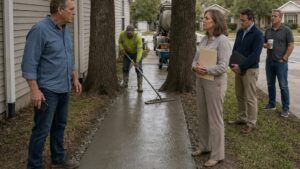
Christine stopped at the bottom of the walkway, careful not to step across the tools. Water no longer pooled there that morning; Anthony had laid a temporary rubber mat over the worst stretch until the drainage crew could come.
“I have the written withdrawal,” she said.
Matthew wiped his hands on his jeans and took the envelope.
Inside was a letter on HOA letterhead. The violation notice had been withdrawn pending accommodation review. Removal fees would not be assessed. Daily fines would not be imposed. The board had approved temporary front access for Susan Young until final repair and drainage remediation were complete.
He read it twice.
Christine waited.
“This should have been checked before yesterday,” she said.
Matthew folded the letter along its crease. “Yes.”
She accepted that without flinching.
“I put the corrected attachment log into the file,” she said. “The board has it now. The drainage complaint too.”
“Donald?”
“Stepped out before the vote ended.”
Matthew looked at the ramp. One worker was fastening the new rail where the old one had been. The sound of the drill made him tense until he realized it was building, not taking apart.
“Will that change anything?” he asked.
Christine watched the workers. “It already did. Not enough. But enough for today.”
He almost thanked her. He did not. Not because she had done nothing, but because the letter in his hand had come after a morning of damage and a night of forcing people to look. Gratitude felt too simple for something that should not have required courage.
Christine seemed to understand. She nodded once and stepped back.
The emergency medical transport van arrived just after eleven.
Matthew stood at the top of the ramp with one hand on the new rail, testing it for the tenth time. The non-slip strips were dark against the pale boards. The bolts were bright and unweathered. At the base, the temporary mat covered the wet concrete, but the crack still showed at one edge, a reminder that approval had not erased what caused the fall.
The driver opened the van door.
Susan appeared slowly, first the walker, then her serious sweater, then her face set in an expression that dared anyone to look sentimental. Matthew started down the ramp before he could stop himself.
She lifted one hand.
“Do not hover.”
He froze two steps from the bottom.
The driver looked between them, unsure.
“She means it,” Matthew said.
Susan smiled faintly. “He learns.”
The therapist stood nearby, watching the angle and the rail. “Take your time.”
Susan placed both hands on the walker. One foot moved onto the bottom of the ramp. Then the other. The boards held. The rail stood firm beside her.
Matthew’s hands flexed uselessly at his sides.
Every part of him wanted to step close enough to catch her if she stumbled. Every lesson from the last two months told him that love meant being ready before she asked. But Susan’s recorded voice from the night before returned to him: I do not want to be carried. I do not want to be hidden.
So he stayed where he was.
Susan moved up the ramp slowly. Not gracefully. Not easily. Her jaw clenched once when her hip protested, and the walker wheels clicked softly over the non-slip strips. Halfway up, she paused, breathing through her nose.
Matthew took one step without meaning to.
Susan looked at his foot.
He stepped back.
She continued.
At the top, she reached the porch and turned toward the front door. Her blue flower planter sat beside it, moved away from the wall now, with no notice hidden behind it. The old sweater still hung inside on the hook. The bench waited in the hallway. The house smelled faintly of fresh lumber and the soup Matthew had started too early that morning because he needed something to do with his hands.
Susan crossed the threshold under her own effort.
No one clapped. No one said anything big enough to ruin it.
Christine stood near her car, watching from a distance. Emily had come to her porch across the street but did not cross over. Anthony loaded unused boards quietly into the truck.
Susan stopped just inside the doorway and looked back.
Matthew stood on the porch, one hand finally resting on the rail, not to hold her up but to feel that it was there.
“You coming in?” she asked.
“In a second.”
She looked past him to the ramp, to the fresh bolts, to the dark strips, to the mat covering the cracked wet concrete below. Her eyes stayed there long enough for him to know she saw both the repair and the delay.
Then she looked at him.
“You did fight for me,” she said.
He swallowed. “I should have fought with you.”
“Yes,” she said. “Next time, start there.”
He nodded.
She turned her walker slightly and faced the doorway again. Sunlight fell across the threshold and onto the first few feet of the hall.
Susan rested one hand on the doorframe, not because she needed support, but because it was hers.
“Now,” she said, “it feels like my door again.”
The story has ended.