They Nailed a Violation Sign to His Fence, Then His Records Request Put Three Homes at Risk
Chapter 1: The Yellow Sign on Richard White’s Fence
The power driver bit into Richard White’s fence before anyone told him what was happening.
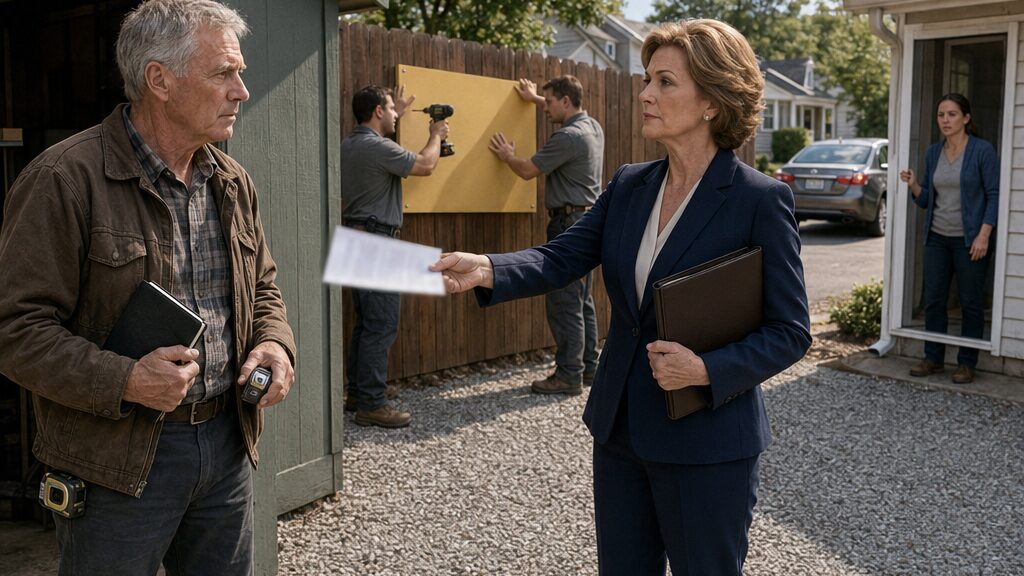
The first screw went through the top corner of a yellow plastic board. The second worker held the bottom steady while the cordless driver whined again, forcing another silver screw into cedar Richard had planed and installed with his own hands seventeen years earlier.
NOTICE OF HOA VIOLATION filled the sign in black block letters.
Richard stood at the open door of his green tool shed with a framing square in one hand. He had been adjusting a shelf when the truck stopped beside his driveway. Now sawdust clung to the knees of his work pants, and the square felt strangely heavy.
“Stop.”
The driver went silent.
Both workers looked toward Barbara Clark.
She stood near the gravel edge in a navy suit and white heels that sank slightly between the stones. A leather folder rested against one hip. She did not look surprised to see Richard. She looked prepared.
“They’re authorized,” she said.
“Not to drill into my fence.”
Barbara opened the folder and removed a sheet of paper. “The fence is part of the visible frontage affected by the violation.”
Richard looked at the yellow board, then at the small shed behind him. The structure was eight feet wide, ten feet long, painted the same muted green as the rear shutters. Its roofline sat below the fence. The gravel pad under it was square, compacted, and edged cleanly.
“What violation?”
Barbara held out the paper.
The amount at the bottom had been printed in bold.
$1,000.
Richard read the heading twice. The complaint described an unapproved accessory structure placed inside a required side setback. It instructed him to remove the shed within five business days.
A car slowed at the corner. The driver glanced toward the sign before continuing down the street.
Richard felt heat climb the back of his neck.
“You could have mailed this.”
“We mailed prior warnings.”
“No, you didn’t.”
Barbara’s mouth tightened, but her tone stayed smooth. “The board has documentation.”
“Then show me.”
“The notice explains the violation.”
“It names one. It doesn’t prove one.”
One of the workers shifted his weight. The driver remained pointed at the half-fastened sign.
Barbara looked past Richard toward the shed. “Accessory structures must maintain a ten-foot side setback.”
Richard set the framing square on his workbench and reached for the metal tape measure clipped to his belt.
Barbara gave a brief sigh. “This isn’t necessary.”
“It’ll take less than a minute.”
He hooked the tape against the concrete survey marker beside the side boundary and walked it toward the nearest corner of the shed. The steel blade clicked over the gravel.
Ten feet, six inches.
He checked the rear corner.
Ten feet, seven inches.
Richard crouched, pressed the blade flat, and measured again. The figures did not change.
He had laid out the pad from the approved site plan kept in the county file. He had checked the property pins himself and paid a surveyor to confirm them before setting the first timber.
Barbara watched without moving.
“Ten feet, six,” Richard said. “At the closest point.”
“The measurement isn’t the only issue.”
“You just said it was.”
“The design standards also require accessory structures to remain outside the landscaped side corridor.”
Richard stood slowly. “Which recorded covenant is that?”
“It’s in the community guidelines.”
“What section?”
Barbara glanced at the workers. “The board has already reviewed it.”
“That wasn’t my question.”
Her voice sharpened. “The community cannot operate if every homeowner decides which rules deserve compliance.”
Richard looked at her white heels, then at the yellow sign hanging crookedly from one screw. “And it can’t operate if the board invents rules on the driveway.”
The second worker lowered his eyes.
Barbara stepped closer, leaving a small indentation in the gravel. “The board is not inventing anything. The landscaped corridor standard was adopted to preserve consistent sightlines and property values.”
“Adopted when?”
“At a properly noticed meeting.”
“Date?”
She did not answer immediately.
Richard reached into the chest pocket of his faded work jacket and removed a small black notebook. The cover had softened at the corners from years of job-site use. He opened to a blank page.
Barbara stared at it. “What are you doing?”
“Writing down what you said.”
“That is unnecessary.”
Richard wrote the date, the time, and her name.
Then he wrote: Landscaped corridor standard adopted at properly noticed meeting.
“What meeting?” he asked again.
Barbara’s expression changed—not much, but enough. Her chin lifted, and the public politeness in her face became effort.
“I’m not conducting a records review in your driveway.”
“No. You’re putting a thousand-dollar sign on my fence.”
“It’s a notice, not a punishment.”
“It has a dollar amount.”
“The amount will be waived when the violation is corrected.”
Richard looked toward the house next door. Laura Johnson stood behind her screen door, one hand holding it open. When she realized he had seen her, she gave an uncertain nod and stepped back inside.
The humiliation was not in the fine alone. It was in the way the sign made the dispute public before Richard had been given a chance to answer it. Anyone driving by would see the word violation before they saw the shed.
Barbara closed the folder.
“You have five business days,” she said. “After that, the fine doubles.”
Richard stopped writing.
“For what?”
“Continued noncompliance.”
“You haven’t identified an enforceable rule.”
“The board has made its determination.”
He wrote that sentence down exactly.
Barbara watched his pen move. “You’ve always been capable of making simple matters unnecessarily adversarial.”
Richard remembered the spring meeting two years earlier when he had questioned a drainage estimate because the contractor’s scope omitted the lower culvert. Barbara had called his comments unproductive. The work had been approved anyway, then postponed.
“I built houses for forty-two years,” he said. “Simple matters usually come with measurements.”
“And communities require judgment.”
“Judgment still needs authority.”
For the first time, anger showed plainly in her eyes.
She turned to the workers. “Finish it.”
The driver whined again.
Richard did not stop them.
He photographed the sign, each screw, the workers, Barbara’s folder, and the tape stretched from the survey marker to the shed. Then he stepped aside and let the yellow board become as permanent as Barbara wanted it to appear.
When they left, four screws held it flat against his fence.
Richard spent the next hour at his kitchen table with the original closing binder open beneath the light. He worked through the declaration, amendments, architectural standards, and enforcement policy. He found rules covering fences, exterior paint, detached garages, satellite dishes, drainage easements, and temporary storage containers.
He found the ten-foot setback.
His shed complied with it.
He found no landscaped side corridor. No sightline restriction. No amendment describing the rule Barbara had named.
Near dusk, the yellow sign caught the last light outside his office window and threw a pale reflection across the glass.
Richard opened his notebook.
Under Barbara’s final statement, he wrote one more line.
No such rule in recorded documents.
Then he turned to the index and found the section explaining how new restrictions were supposed to be adopted.
The procedure required written notice to every homeowner.
Richard had never received one.
Chapter 2: The Fine Doubled Before the Board Answered
The certified envelope arrived three days later with NONCOMPLIANCE printed above a doubled amount.
Richard stood beside the mailbox while the carrier’s truck rolled away. The yellow sign remained visible behind him, bright against the cedar fence, its corners already collecting dust from the road.
Inside the envelope was a second notice.
The original $1,000 fine had become $2,000. An administrative charge had been added beneath it. The letter stated that continued refusal could result in collection costs, attorney fees, and a lien against the property.
Richard read the last paragraph twice.
Then he looked toward the green shed.
Nothing about it had changed.
He carried the notice into his office and placed it beside the covenant binder. For two days, he had expected an answer to the email he sent the management company asking for the date, agenda, and vote adopting Barbara’s landscaped corridor rule.
No one had answered.
He opened his laptop and checked again.
There was a new message, but it was not a response.
It was a courtesy copy of a notice of intent to record a claim against his property.
The document bore three signatures.
Barbara Clark, President.
Gary Hill, Treasurer.
Donna Perez, Secretary.
Richard leaned back in his chair.
Most HOA enforcement letters came from management staff or association counsel. Board members did not usually sign collection notices personally, especially all three officers. He enlarged the page and studied the signatures.
Barbara’s was firm and angular.
Gary’s was almost illegible.
Donna’s was careful, each letter separated.
He printed the document and laid it beside the doubled fine. Through the office window, the yellow sign seemed to float over the page.
His first impulse was to call Barbara and demand an explanation. He picked up the phone, then set it down again.
Calling would give her another conversation to summarize however she pleased.
Richard opened his notebook instead.
He listed the dates: sign installed Monday, first deadline Friday, doubled notice issued Thursday morning—before the original five-business-day period had ended.
He checked the calendar twice.
Then he called the management office.
A representative answered after several transfers.
“I’m calling about account White, Lot Forty-Seven.”
There was a pause while she searched. “Yes, sir. I see an active architectural violation.”
“I need the adoption record for the landscaped side corridor standard.”
“That would be included in the governing documents.”
“It isn’t.”
“Then it may be part of the design guidelines.”
“What date were those guidelines approved?”
Another pause.
“I don’t have that information in front of me.”
“Who does?”
“The board maintains its meeting records.”
“I asked the board.”
“You may want to submit a formal records request.”
Richard wrote the phrase down. “And why was my fine doubled before the cure period expired?”
“I can only see the balance.”
“Can you see the issue date?”
“Yes.”
“And the deadline on the first notice?”
A longer silence followed.
“I can make a note for the community manager.”
“Make one that says the dates don’t work.”
After the call, Richard drove to the management office with copies of both notices. The building sat in a commercial strip beside a dental practice and a tax preparer. Inside, framed photographs of landscaped entrances covered one wall.
The representative accepted his documents through a glass partition.
“I’m not asking you to decide the violation,” Richard said. “I’m asking for the record showing the board had authority to issue it.”
She looked uncomfortable. “The manager will review your concern.”
“When?”
“I can’t promise a timeline.”
“They’re threatening a lien.”
“I understand.”
“No, you understand a file. I understand a lien.”
The words came out harder than he intended. The representative’s shoulders stiffened.
Richard took a breath. “I’m sorry. That wasn’t directed at you.”
She nodded but did not quite relax. “I’ll mark it urgent.”
On his way home, he passed Laura Johnson near the community mailbox kiosk. She was talking with another homeowner. Both women stopped when Richard slowed.
Laura stepped toward his truck.
“Barbara said you’ve ignored three notices.”
Richard kept one hand on the steering wheel. “There weren’t three.”
“She said the board tried to work with you privately.”
“They put a four-foot sign on my fence.”
Laura glanced toward the other homeowner, who pretended to check her mail.
“I’m not taking sides,” Laura said. “I just don’t want this turning into one of those neighborhood wars.”
“Neither do I.”
“Then why not move the shed until it’s sorted out?”
Richard felt the suggestion like a hand pressing between his shoulder blades.
“Because it’s compliant.”
Laura lowered her voice. “Sometimes being right costs more than fixing the problem.”
He almost told her about the doubled fine and the threatened claim. Instead he said, “It’s handled.”
Her expression made clear she did not believe him.
That evening, Richard searched the county recorder’s online index. The formal lien had not yet appeared, but the notice of intent was real enough. He printed the association’s enforcement policy from the management portal and compared it to the amendment log in his closing binder.
The dates did not match.
The enforcement policy had been uploaded eighteen months earlier. No homeowner notice appeared in the association newsletters. No amendment had been recorded with the county. No annual-meeting packet mentioned adopting new design restrictions.
A board could clarify existing covenants. It could not quietly create new property restrictions and treat them as recorded obligations.
Richard felt the first clean edge of vindication.
Then he opened the declaration’s section on collection powers.
The association could recover attorney fees if it prevailed. Even a defective violation could become expensive to fight if he mishandled deadlines.
He thought of his late wife sitting at the kitchen table during their final winter, sorting household papers into labeled folders because she no longer trusted her hands to do it later.
Keep the house simple, she had told him. Don’t risk it trying to prove you’re the smartest man in the room.
Richard closed his eyes.
He had promised her.
Now three board officers had signed a document threatening that house, and he had told no one—not Laura, not the other neighbors, not even the friend who handled his taxes.
His silence had allowed Barbara’s version to travel farther than the truth.
He returned to the covenant binder and kept reading.
Near the back, under Member Rights, he found Section Sixteen.
Any member in good standing could inspect association books, financial statements, contracts, meeting minutes, and supporting records for a proper purpose related to membership.
The request had to be made in writing.
The association had ten business days to respond.
Richard copied the language into his notebook. Then he searched the state statute cited beneath it. The statutory wording was broader than the covenant and included accounting records, bank statements, and documentation supporting board expenditures.
The fine was no longer the only thing he wanted explained.
Why had Barbara cited a rule no one had received?
Why had the board accelerated the penalty before the cure period ended?
Why had all three officers personally signed the threat?
Richard drafted a formal request for five years of meeting minutes, financial statements, reserve-account records, contracts, invoices, enforcement-policy adoption records, and communications concerning his property.
At midnight, he printed two copies.
He signed one and placed it in a certified-mail envelope.
On the other, he wrote the tracking number beside the same three signatures that appeared on the property claim.
Whatever Barbara, Gary, and Donna were protecting, they had now given him a lawful reason to ask for it.
Chapter 3: Section Sixteen and the Abrupt Dial Tone
Barbara called before the postal website finished displaying the delivery confirmation.
Richard’s laptop still showed the spinning symbol beside the tracking number when his phone vibrated across the kitchen table. Her name appeared on the screen.
He let it ring twice before answering.
“Richard,” Barbara said, “I’ve just been informed that you sent an excessive records demand to the management company.”
“Good morning.”
“This is not a reasonable response to an architectural violation.”
“It’s a member records request.”
“You are not entitled to unrestricted access to confidential association files.”
“I didn’t request unrestricted access.”
“You requested five years of financial records.”
“Yes.”
“And board communications.”
“Concerning my property.”
Her breath came through the line, measured and controlled. “This appears retaliatory.”
Richard looked at his notebook beside the certified-mail receipt. He had opened it to the page from the driveway.
Landscaped corridor standard adopted at properly noticed meeting.
The board has made its determination.
“I gave a proper purpose,” he said. “To verify the authority for the restriction and the charges against my account.”
“The board has already provided the relevant information.”
“No. It provided a fine.”
“You are confusing disagreement with lack of authority.”
Richard turned the covenant binder toward him. A yellow tab marked the page.
“I’m reading Section Sixteen, paragraph B. ‘Upon written demand stating a proper purpose, a member may inspect and copy the association’s books, records, and minutes reasonably related to that purpose.’”
Barbara did not respond.
He continued. “The state statute says the same thing. The ten-business-day period started this morning.”
“You are not an attorney.”
“No.”
“Then you should be careful about making legal interpretations.”
“I’m reading a sentence.”
The line went so quiet Richard could hear the refrigerator motor switch off.
Barbara spoke again, but the polish had thinned. “Some documents contain private homeowner information.”
“Redact it.”
“Some records may be protected.”
“List them and identify the basis.”
“This is exactly the adversarial behavior I warned the board about.”
Richard looked through the kitchen window. The yellow sign stood beyond the driveway, facing the street.
“You installed a public accusation on my fence.”
“It was an enforcement notice.”
“You doubled the fine early.”
“That is not my understanding.”
“I sent both dates in the request.”
Another silence.
Then Barbara said, “Remove the shed, and most of this becomes unnecessary.”
The sentence was soft enough to sound reasonable. That made it more troubling.
“If the shed violates a recorded rule,” Richard said, “send me the rule.”
“You have the guidelines.”
“I have a PDF with no adoption date.”
“The board approved it.”
“Then the minutes should show that.”
Barbara’s voice lowered. “You need to consider whether prolonging this is worth the damage it may do to your standing in the community.”
Richard placed his pen on the notebook.
“Is that an official warning?”
The call ended.
Not with a goodbye. Not with an explanation.
Just the abrupt tone of a disconnected line.
Richard stared at the phone. The satisfaction he expected did not come. He had forced Barbara to retreat, but her last words remained in the room.
Damage to your standing.
He wrote the phrase down.
At noon, the management company emailed him a formal acknowledgment. The records request had been received and would be processed within the statutory period. Certain documents might require redaction. Copying charges could apply.
It was a small victory, procedural and bloodless, but it mattered. Barbara could no longer pretend the request did not exist.
Richard printed the acknowledgment and filed it with the photographs of the yellow sign.
When he stepped outside to collect the afternoon mail, Laura was standing near the side boundary between their lots. She wore gardening gloves and held a short section of broken plastic drainpipe.
“Do you have a minute?” she asked.
Richard almost said no.
He had spent the morning measuring every word, and conversation now felt like another risk. But Laura’s shoes were muddy, and the pipe in her hand was split lengthwise.
She led him behind her house.
The ground near the retaining wall had sunk several inches. A hairline crack ran through one concrete block, then widened near the base. The soil beneath it was dark and soft.
“This wasn’t here last month,” she said.
Richard crouched and pressed the handle of his screwdriver into the ground. It sank almost to the shaft.
“Where’s the outlet from the upper swale?”
“That’s what I wanted to ask you.”
He followed the grade with his eyes. Water from the common slope should have entered a buried collection line before reaching Laura’s wall. Instead, runoff marks curved directly toward her yard.
“The inlet’s clogged or collapsed.”
Laura folded her arms. “The HOA said they were replacing that drainage run last fall.”
Richard looked up. “Who told you?”
“Barbara. At the budget meeting.”
“Was it approved?”
“She said the reserve study listed it as a priority.”
Richard remembered the project. Drainage correction along the lower lots, including the culvert estimate he had questioned two years earlier. Barbara had later announced that the work was being rescheduled while the board compared bids.
“How long has the wall been moving?”
“I don’t know. I noticed the crack after the rain.”
“You need temporary shoring if it opens any farther.”
Laura watched him examine the blocks. “Can you do it?”
He hesitated.
Years earlier, he would have brought lumber from the shed and built the braces before dinner. Now the request felt entangled with everything he was trying to keep private.
“I can show you how,” he said.
Her face changed. “Richard, I’m not asking for free work.”
“That’s not what I meant.”
“Then what did you mean?”
He stood and wiped the screwdriver on the grass.
Laura looked toward his fence. From behind the houses, only the top edge of the yellow sign was visible.
“Barbara told people the shed is blocking a drainage easement,” she said.
Richard turned to her. “What?”
“She said that’s why the board had to act quickly.”
“My shed is twenty-three feet from the drainage easement.”
“I didn’t know that.”
“You could have asked.”
“I am asking now.”
The answer stopped him.
Laura held up the broken pipe. “I avoided getting involved because I can’t afford a special assessment, legal fight, or neighborhood feud. I thought this was you and Barbara being stubborn. But if the board canceled drainage work and is blaming your shed for something it can’t affect, I need to know.”
Richard looked again at the shifting wall.
He had treated the dispute as a private attack because the sign was on his fence and the lien threatened his house. Yet the soft earth under Laura’s wall had no interest in whose pride started the fight.
“I requested the records,” he said.
“All of them?”
“Five years.”
Laura exhaled. “Does Barbara know?”
“She called this morning.”
“And?”
“She hung up.”
For the first time since the sign appeared, Laura almost smiled. It vanished quickly.
“What are you expecting to find?”
“The adoption record for the guideline. The enforcement dates. Maybe why three officers signed the claim personally.”
“And the drainage project?”
Richard looked at the broken pipe in her hand. “Now that too.”
He helped her install temporary timber braces against the wall using lumber from his shed. They worked without much conversation. When they finished, Laura touched one of the green boards stacked beside the doorway.
“My son still talks about painting this place.”
Richard remembered the boy at twelve, more paint on his arms than on the siding.
“That was a while ago.”
“Not to him.”
Laura removed her gloves. “You should have told me about the lien.”
Richard’s hands stopped on the clamp.
“I didn’t want the neighborhood involved.”
“The neighborhood was involved the minute they put up that sign.”
She left before he could answer.
The records arrived four days later in a taped cardboard file box delivered by a management employee. Richard signed for it at the door and carried it to his office.
Bank summaries. Vendor contracts. Annual budgets. Reserve studies. Meeting minutes separated by year.
He arranged the folders in order.
One year was missing.
Not a few months. Not a misplaced meeting.
An entire twelve-month section had been removed between two labeled dividers.
Richard checked the transmittal list. The missing year was marked as included.
It was the same year the drainage project had been approved, postponed, and quietly dropped.
He opened his notebook and wrote the dates across a fresh page.
Then he looked at the empty space in the box.
Someone had answered his request by giving him almost everything.
The missing year told him where to begin.
Chapter 4: Eighty-Two Thousand Dollars Without a Recorded Vote
The reserve balance dropped by thirty thousand dollars in a single month, but Richard could not find a contractor invoice, canceled check, or board motion to explain it.
He set the bank statement beside the annual budget and checked the dates again.
The withdrawal appeared in March.
The meeting minutes for March contained three pages about spring landscaping, pool furniture, and a homeowner complaint involving a basketball hoop. No capital project was approved. No emergency expenditure was discussed. The treasurer’s report described the reserve account as “stable.”
Richard wrote the amount in his notebook.
$30,000.
He turned to the next month.
Another withdrawal appeared in April for twenty-seven thousand dollars. This one carried a handwritten notation on the transaction summary.
ADVANCE—G.H.
The vote-reference box beside it was blank.
Richard stopped.
He pulled the May statement from the box.
Twenty-five thousand dollars.
ADVANCE—B.C.
Again, the vote-reference box was blank.
He searched for a third entry, moving backward through the records until he found five thousand dollars transferred to an account identified only by initials.
D.P.
The three amounts totaled eighty-two thousand dollars.
Richard checked the math on paper even though he did not need to.
$82,000.
He circled the total, then sat back as the office darkened around him. The yellow sign outside caught the setting sun and cast a stained reflection through the window. For several minutes, the number seemed to lie beneath that yellow light.
An advance was not automatically theft. Associations sometimes reimbursed officers for emergency purchases or issued temporary payments tied to approved work. The word itself proved very little.
Richard had spent too many years reviewing change orders to mistake suspicion for evidence.
He separated every invoice from the missing year and arranged them by vendor. Roofing repairs. Tree removal. Pool pump replacement. Insurance premium. Legal consultation.
Nothing matched the withdrawals.
He opened the reserve study. The drainage correction along the lower lots had been scheduled for the same year at an estimated cost of seventy-eight thousand dollars. A retaining-wall inspection and culvert replacement had been listed as urgent within twelve months.
Across the next page, someone had written DEFERRED in blue ink.
No explanation followed.
Richard called the management company and asked for supporting documents tied to the three advances.
The representative placed him on hold twice before returning.
“I don’t see attachments associated with those entries.”
“Were they reimbursements?”
“They’re categorized as board-authorized advances.”
“Authorized in which meeting?”
“I would need to refer you to the minutes.”
“The year is missing.”
A silence opened on the line.
“I’ll have to escalate that.”
“Please also send the bank authorization forms.”
“I don’t know whether those are association records.”
“They moved association money.”
“I understand your position.”
Richard almost corrected her, but remembered the last call. “Please send the request to the manager.”
He hung up and continued.
Gary Hill’s initials appeared beside the largest advance. Barbara Clark’s beside the second. Donna Perez’s beside the smallest. The transaction dates fell within nine weeks of one another.
Richard searched the financial summaries homeowners had received that year. The reserve account had been presented as intact. The numbers had been grouped with operating cash in a way that concealed the reduction unless someone compared the bank statements directly.
That required intent or astonishing carelessness.
Neither possibility comforted him.
A hard knock sounded at his side door.
Laura stood outside in rubber boots, her hair pulled back, mud streaked along one sleeve.
“The brace moved.”
Richard followed her across the property line.
The retaining wall had shifted farther outward. One timber brace leaned at an angle, its base driven through softened soil. A thin stream of brown water emerged beneath the lowest block.
Richard crouched and pressed two fingers into the gap.
“This isn’t surface runoff anymore.”
“What does that mean?”
“The collection line behind the wall is probably full or broken. Water’s building pressure where it shouldn’t.”
Laura looked at the wall, then toward her house. “Is it dangerous?”
“Not to the house today. But nobody should stand below it, and your son shouldn’t play back here.”
“He’s with his father this week.”
Richard nodded and began repositioning the brace.
Laura watched him work. “You found something.”
He kept his eyes on the timber. “Why do you say that?”
“You’ve been out here three times. Today you haven’t told me the wall is my responsibility.”
Richard tightened the clamp.
“The reserve paid out eighty-two thousand dollars in three advances.”
Her face went still. “For the drainage project?”
“No invoices.”
“Then what were the advances for?”
“I don’t know yet.”
“To who?”
He hesitated.
Laura stepped closer. “Richard.”
“Gary. Barbara. Donna.”
The names changed the space between them. These were not distant executives. They were people whose cars passed each morning, who ran holiday decorating contests and sent reminders about trash bins.
Laura looked down at the mud on her boots.
“Donna?”
“Yes.”
“She brought food when my mother died.”
“That doesn’t erase a bank entry.”
“I didn’t say it did.”
Richard heard the edge in his own voice. “I’m trying not to accuse anyone until I can prove what happened.”
“And while you’re doing that, the wall is moving.”
The words struck harder because they were true.
He had been treating proof as the finish line. For Laura, proof would not stop the water.
“I’ll call the reserve-study engineer,” he said. “Ask for an emergency inspection.”
“Will the HOA pay for it?”
“They should.”
“And if the money’s gone?”
Richard looked at the cracked block.
“That’s what I’m trying to find out.”
Back in his office, he created a timeline.
The drainage project was approved in principle.
The three advances followed.
The project was deferred.
The board’s financial reports concealed the reserve reduction.
Then Barbara cited a nonexistent corridor rule against Richard’s shed and claimed it interfered with drainage.
He pulled out the site plan and traced the easement. The shed did not touch it, but his recent survey markers made the true drainage corridor visible. One marker sat within six feet of the common swale.
If the board blamed the shed, the markers and measurements would expose the lie.
The conflict had never been solely about appearance.
Richard searched the declaration for provisions governing loans or advances to board members. He found a cross-reference in the financial controls section, then followed it to an older amendment adopted before he bought the house.
Any unauthorized advance to an officer or director became immediately repayable with interest upon demand. Each recipient, by accepting the funds, agreed to secure repayment through personal assets sufficient to protect the association.
A later paragraph was more specific.
Where an officer signed the disbursement authorization, the officer accepted personal guarantor status.
Richard read it three times.
Barbara, Gary, and Donna had all signed the authorization summary attached to the year-end report.
He turned to the property-claim notice they had signed against him.
The same three names.
The same signatures.
The people threatening his home might have placed their own property behind the missing money.
Yet the clause did not answer the question that mattered most.
Had they understood what they were signing—or had someone counted on them not reading the rules they enforced against everyone else?
Chapter 5: Donna Perez Kept the Minutes Barbara Wanted Gone
Donna Perez arrived carrying a grocery bag filled with paper.
Richard saw her through the kitchen window before she reached the door. She moved quickly, holding the bag against her chest with both arms. No car sat in his driveway. She must have parked around the corner.
When he opened the door, she looked past him toward the street.
“Can I come in?”
Richard stepped aside.
Donna entered the kitchen and placed the grocery bag on the table. The bottom sagged beneath the weight of folders and loose pages. A loaf of bread logo stretched across one side.
“You requested the missing minutes,” she said.
“I requested all the minutes.”
“I know.”
Her hands remained on the bag.
Richard did not offer coffee. He did not sit.
“Why are they in your house?”
Donna looked at him. “Because I kept copies.”
“Why weren’t they in the records box?”
“Barbara told management they were drafts.”
“Were they?”
“Some were.”
“And the rest?”
Donna pulled out a blue folder. “Approved, but never uploaded.”
Richard opened it.
The first page was headed Special Board Meeting. The attendance line listed Barbara, Gary, and Donna. Below it, the minutes described an emergency reserve transfer program intended to address “temporary personal liquidity constraints affecting essential board continuity.”
Richard read the phrase again.
“What does that mean?”
“It means Gary said he needed money.”
Donna lowered herself into a chair.
Richard remained standing.
“He had invested in a property renovation with his brother,” she continued. “The financing collapsed. He said if he defaulted, he’d have to sell quickly, and the board would lose its treasurer during the insurance renewal.”
“So the association loaned him thirty thousand dollars.”
“Barbara called it an advance.”
“Without a homeowner vote.”
“She said a vote wasn’t required if it was temporary.”
Richard turned the page.
A second set of draft minutes described Barbara’s advance. It referenced legal expenses and an urgent family obligation but included no amount in the discussion section.
“What was hers for?”
Donna rubbed one thumb over the other. “Her daughter was in a custody dispute. Barbara had already used most of her savings on attorneys. She said the association needed her through the drainage negotiations and that she would repay everything after refinancing.”
“And your five thousand?”
Donna looked down.
“My husband’s medical deductible.”
Richard let the silence sit.
“You accepted association money.”
“Yes.”
“You signed the year-end authorization.”
“Yes.”
“You certified the public minutes as complete.”
Her eyes lifted. “Yes.”
“Then why bring this to me now?”
Donna reached into the grocery bag and removed another folder. These pages bore handwritten corrections, dates, and margin notes.
“Because Barbara wanted the original drafts destroyed after the reserve study was deferred.”
Richard opened to a page marked in red.
Gary moved to approve the advances subject to later ratification.
No second recorded.
No vote taken.
Underneath, in Donna’s handwriting, appeared: Barbara instructed secretary to record unanimous consent.
“You wrote this?”
“I wrote what happened.”
“But the official version says the motion passed.”
Donna’s voice thinned. “Barbara said the board had already agreed informally.”
“Did you?”
“I agreed that Gary needed help. I agreed Barbara was carrying too much. I agreed the money would be repaid before the drainage contract started.”
“That isn’t the same as approving the transactions.”
“I know that now.”
Richard closed the folder.
“You knew it then.”
Donna flinched.
He regretted the sharpness, but not the words.
She looked toward the window, where the yellow sign faced the street. “The sign was Barbara’s idea.”
Richard waited.
“She said private notices weren’t working. She said the board needed to make an example before other people started treating every guideline as optional.”
“My shed complies.”
“I told her the site plan looked compliant.”
“And then you signed the lien notice.”
Donna pressed both palms flat on the table. “She had the false certification.”
Richard said nothing.
“I certified that the minutes were accurate. If I refused to sign, she said she would tell everyone I altered the records after taking association money.”
“You did alter them.”
“Under her instruction.”
“You still did it.”
Donna’s face tightened. “I know.”
There was no defense left in her voice, only exhaustion.
Richard sat across from her.
“What changed?”
“The wall.”
“Laura’s wall?”
Donna nodded. “Barbara told the management company to say your shed obstructed the easement. I knew it didn’t. I saw the survey when you built it.”
“And that was enough?”
“No.” Donna looked at the grocery bag. “The engineer sent another warning last month. The lower drainage line may fail in several places. Barbara told Gary they could cover the repairs with a special assessment before anyone reconciled the reserves.”
Richard felt his jaw set.
“How much?”
“Maybe six thousand per house.”
Laura had told him she could not afford a special assessment.
Donna pushed the folders toward him. “I didn’t take money for a vacation or a car. But I took it. I lied about the vote. Then I signed against your house because I was afraid of losing mine.”
The admission did not make her innocent. It made the harm harder to arrange into clean categories.
Richard studied her careful handwriting. Every correction showed that she had known the record mattered. Every hidden copy showed that some part of her had expected the truth to be needed.
“Does Barbara know you kept these?”
“No.”
“Does Gary?”
“No.”
“Why not go to association counsel?”
“Barbara chooses what counsel sees.”
“That’s not how representation works.”
“It is when everyone believes the president speaks for the board.”
Richard thought of the missing year, the blank vote columns, the polished summaries. The scheme had not required brilliance. It had required neighbors assuming someone else was checking.
A car door slammed outside.
Donna stood so quickly the chair legs scraped the floor.
Richard looked through the window. Gary Hill was crossing the driveway.
He wore a light jacket despite the heat and carried no folder. His eyes went first to Donna’s carless arrival, then to the grocery bag on Richard’s table.
Richard opened the door before he could knock.
Gary stopped on the step.
“We need to settle this,” he said.
Donna appeared behind Richard.
Gary’s face changed. “What did you give him?”
“The records you left out,” Donna said.
Gary closed his eyes briefly, then looked at Richard. “You don’t understand the consequences.”
“Eighty-two thousand dollars.”
“It was temporary.”
“It postponed drainage repairs.”
“We had cash-flow options.”
“You had a blank vote column.”
Gary lowered his voice. “If residents learn the reserve is short before we arrange financing, property values will take a hit and the association will face a special assessment anyway.”
“So your answer was to put a lien threat on me.”
“Your dispute gave Barbara a reason to push enforcement. I didn’t choose the sign.”
“You signed the claim.”
Gary looked toward Donna. “We can still contain this.”
“Contain what?” Richard asked.
“The damage.”
Richard understood that Gary did not mean Laura’s wall.
That evening, Barbara called.
Her voice was calm again, almost gentle.
“We can withdraw every fine, remove the claim, and approve your shed immediately.”
Richard looked at Donna’s copied minutes spread across his table.
“What do you want?”
“Return all copied association records and sign a confidentiality agreement. We’ll treat the matter as resolved.”
Richard glanced through the window at the yellow sign she had ordered nailed to his fence.
Barbara continued. “You wanted your property protected. I’m offering exactly that.”
The offer would save his house.
It would not move one dollar back into the reserve account.
Chapter 6: The Settlement That Would Have Saved Only One House
Stephen Baker slid the release across the conference table with Richard’s lien withdrawal already signed.
The page carried Barbara’s signature and the management company’s acknowledgment. A second document rescinded every fine connected to the shed. A third approved the structure as a permissible accessory building.
Everything Richard had asked for at the beginning sat within reach of his hand.
Barbara sat across from him, her posture straight, a closed leather folder beside her. Gary occupied the chair to her right. Donna had been invited but had not come.
Stephen folded his hands.
“If Mr. White signs the confidentiality and mutual-release provisions, the property matter ends today.”
Richard read the lien withdrawal first.
No conditions appeared in that document itself.
He placed it aside and examined the release.
It required him to return or destroy all copied records, waive claims against the board, refrain from discussing internal association finances, and acknowledge that the enforcement dispute resulted from differing interpretations rather than intentional misconduct.
He looked up.
“That last sentence isn’t true.”
Barbara’s expression barely shifted. “It avoids assigning blame.”
“It assigns confusion.”
Stephen spoke before she could continue. “Settlement language often reflects compromise.”
“Compromise between what and what?”
“Your individual claims and the association’s need to avoid unnecessary litigation.”
Richard opened his evidence folder. A photograph of the yellow violation sign lay on top, the black letters stark against the fence.
“Where does the missing eighty-two thousand fit?”
Gary leaned forward. “Those advances are being addressed separately.”
“By whom?”
“The board.”
“The same board that approved them without a vote?”
Barbara’s hand moved toward her folder, then stopped. “We had an emergency.”
“Three emergencies.”
“You have no understanding of what people were dealing with.”
“I understand the reserve account paid for it.”
Stephen’s gaze moved between them. “The purpose of today’s meeting is to determine whether a comprehensive resolution is possible.”
“Comprehensive for whom?” Richard asked.
No one answered immediately.
Stephen opened another file.
“The association’s current financial position is fragile. If the advances are not repaid, the projected drainage and retaining-wall work cannot proceed without a special assessment.”
“How much?”
“Preliminary estimate is between fifty-five hundred and sixty-five hundred dollars per lot.”
Richard pictured Laura holding the broken drainpipe in muddy gloves.
“And if the advances are repaid?”
“Depending on timing, the association may still need short-term financing, but the assessment could likely be avoided or reduced.”
Gary’s face had gone pale.
Richard turned to Stephen. “The guaranty clause.”
Barbara spoke sharply. “That clause is outdated.”
Stephen did not look at her. “It remains part of the recorded governing documents.”
“Is it enforceable?” Richard asked.
“It is sufficiently clear to support a claim or negotiated security agreement. Litigation would depend on facts, authorization documents, and applicable defenses.”
“So it doesn’t automatically take anyone’s home.”
“No.”
Barbara released a breath.
Stephen continued. “But the signatures create meaningful personal exposure. Particularly if the transfers were unauthorized and the association suffered a loss.”
Gary rubbed one hand over his mouth.
Richard looked at the three authorization copies. Barbara and Gary had signed every one. Donna had signed the year-end certification and one disbursement summary.
The power had shifted, but it did not feel clean.
Barbara met his eyes. “You wanted the board bound by its own rules. Fine. Those rules may force me to sell.”
Her voice was quieter than it had been on his driveway.
“My daughter and granddaughter live with me. The house is refinanced already. If you push for immediate repayment, there may not be another option.”
Richard studied her face.
He believed the fear. That did not erase what she had done.
“You threatened my house to hide yours.”
“I was trying to prevent the association from collapsing.”
“You put a false violation on my fence.”
“You challenged every decision publicly.”
“I asked for a rule.”
“You make people feel incompetent when they don’t know what you know.”
The accusation landed because it contained a piece of truth Richard disliked.
He had spent years correcting measurements, bids, and assumptions. Precision had often been his defense against grief, uncertainty, and other people’s disorder. When he knew he was right, he stopped listening for anything beyond the error.
Barbara continued. “Gary believed he could repay within six months. I believed I could refinance. Donna needed help. We told ourselves it was temporary. Then the drainage estimate rose, and the market changed, and every month made disclosure harder.”
“And your solution was me.”
“Your survey markers drew attention to the easement. Your records requests could expose the timing. I thought if the shed was removed, the issue would quiet down.”
There it was—not apology, but admission.
Richard looked at the signed withdrawal.
He could accept it, take down the yellow sign, and let the board find another way to fill the reserve. His wife’s voice lived somewhere in the careful folders at home.
Don’t risk the house trying to prove you’re the smartest man in the room.
But this was no longer about proving he was smart.
Laura’s wall was moving. Dozens of households could receive bills they had not caused. Donna had lied but finally brought the truth forward. Barbara feared losing her home after using that same fear against him.
Richard turned to Stephen.
“What would a repayment plan require?”
Gary looked up.
Stephen answered carefully. “Independent accounting. Written acknowledgments of the advances. Security sufficient to protect the association. Payment schedules based on verified ability. Board resignations may also be appropriate.”
“And emergency drainage work?”
“Prioritized before nonessential spending.”
“No confidential treatment of the reserve shortage.”
Barbara shook her head. “That will create panic.”
“It will create anger,” Richard said. “Panic comes when people get a six-thousand-dollar bill with no warning.”
“You want to humiliate us.”
Richard pushed the photograph of the yellow sign across the table.
“This is humiliation.”
Barbara looked at the image.
“I don’t want your granddaughter watching workers nail one of these to your fence,” Richard said. “I want the money protected, the repairs started, and the people who signed the advances removed from deciding how they’re handled.”
Gary’s chair creaked as he leaned back.
Stephen made a note.
Richard placed the confidentiality agreement beside the unsigned release.
“I’ll accept the lien withdrawal and the cancellation of the fines. Those correct actions the board had no authority to take.”
Barbara’s eyes narrowed. “And the rest?”
“I won’t waive the records issue. I won’t return Donna’s copies. I won’t agree that this was a misunderstanding.”
Stephen looked at the documents. “Then we do not have a global settlement.”
“No.”
“What are you requesting instead?”
“An open homeowner meeting. Full reserve disclosure. An independent review. Interim safety work on the drainage line. Repayment agreements secured under the clause the board signed.”
Barbara’s composure finally cracked.
“You think residents will listen calmly?”
“No.”
“You think they’ll distinguish between a temporary advance and stealing?”
“Then explain it.”
“They’ll come for our homes.”
Richard closed his evidence folder.
“That decision belongs to more than the four people in this room.”
For years, he had guarded his dignity by keeping problems inside his own walls. The habit had made him useful, dependable, and alone. It had also allowed Barbara to tell the neighborhood what his silence meant.
Stephen gathered the unsigned agreement.
“If an open meeting is called, the association must issue notice.”
“Then issue it,” Richard said.
Gary stared at the table. Barbara stared at Richard.
The signed lien withdrawal remained beside his hand. He took it, along with the fine rescission and shed approval. He left the confidentiality agreement where it lay.
At the door, Stephen spoke.
“Mr. White.”
Richard turned.
“Once this becomes public, you may not control what residents demand.”
Richard thought of the guaranty clause, the moving wall, and the sign still fixed to his fence.
“No,” he said. “But the board won’t control what they’re allowed to know.”
He walked out with his house protected and the conflict wider than it had ever been.
Before he reached the parking lot, his phone vibrated with an association notice.
SPECIAL OPEN HOMEOWNER MEETING—SATURDAY, 6:00 P.M.
The subject line read: Architectural Appeal and Reserve Funding.
Barbara had placed the shed first.
Richard knew she still hoped the neighborhood would see only that.
Chapter 7: The Board’s Own Words in an Open Room
Residents entered the clubhouse expecting a hearing about Richard White’s shed and found copies of the reserve ledger on every chair.
The first page showed the three advances.
The second showed the blank vote-reference column.
The third showed the drainage project marked deferred.
People stopped talking as they picked up the packets. A few remained standing, reading the same figures twice before taking their seats. The room smelled faintly of coffee, printer toner, and damp jackets brought in from the evening air.
At the front table, Barbara Clark sat between Gary Hill and Stephen Baker. Donna Perez occupied a chair at the far end, separated from them by an empty seat.
Richard stood beside a folding easel. On it was an enlarged photograph of the yellow violation sign attached to his fence.
Barbara tapped the microphone.
“This meeting was called to address an architectural appeal and certain concerns regarding reserve funding.”
A homeowner near the back raised his packet. “Certain concerns?”
Another voice called out, “Where did the eighty-two thousand go?”
Stephen leaned toward the microphone. “Everyone will have an opportunity to ask questions. Please allow the presentation to proceed.”
Barbara opened her folder.
“The architectural issue began when Mr. White installed an accessory structure that the board believed conflicted with community design standards.”
“Believed?” Laura said from the second row. “The fine said it violated them.”
Barbara looked at her. “The board acted on the information available at the time.”
Richard felt the old pull to correct every word immediately. He placed one hand on his notebook and waited.
Stephen introduced the documents in order: the shed site plan, the recorded covenants, the design guideline without an adoption record, the doubled fine issued before the cure period ended, and the notice threatening a claim against Richard’s property.
“The association has withdrawn the violation,” Stephen said. “The shed has been approved, and Mr. White’s account has been cleared.”
A murmur moved through the room.
It was the result Richard had wanted two weeks earlier. Now it sounded small.
A woman near the aisle asked, “Then why are we looking at bank records?”
Richard stepped to the microphone.
“Because the records request that cleared my property also showed why the board wanted the request stopped.”
Barbara’s chair shifted.
Richard held up the first ledger page.
“These three advances total eighty-two thousand dollars. They came from the reserve account during the same period the drainage and retaining-wall work was postponed.”
Gary reached for his microphone. “They were temporary advances, not permanent withdrawals.”
“Were they approved by a recorded vote?” Richard asked.
Gary looked toward Stephen.
Donna spoke before either man could answer.
“No.”
The single word quieted the room more completely than the microphone had.
Barbara turned toward her. “Donna, we discussed the circumstances.”
“We discussed them,” Donna said. “We did not vote.”
She opened the blue folder she had brought from Richard’s house.
“I wrote draft minutes showing there was no second to the motion and no formal vote. Barbara instructed me to record unanimous consent afterward. I certified the official minutes anyway.”
A homeowner whispered, “Why?”
Donna’s fingers tightened around the folder.
“Because I accepted five thousand dollars from the same reserve account. My family had a medical expense. I told myself I would repay it before anyone was hurt.”
She looked toward Laura.
“I was wrong.”
Gary took the microphone.
“My advance was larger, and I accept responsibility for it. But the board was trying to maintain continuity during a difficult year. No one intended to deprive the association of repairs.”
Laura stood.
“My retaining wall is moving.”
Gary lowered his eyes.
“The reserve-study engineer says the lower drainage line needs emergency work,” she continued. “That isn’t theoretical. It is behind my house.”
Barbara’s voice came out strained. “The board planned to address the shortage through financing.”
“Without telling us?” someone asked.
“And a special assessment?” another added.
The room broke into overlapping voices.
“How much?”
“Who knew?”
“Can they do this?”
“Put liens on their houses.”
“They were ready to put one on his.”
Barbara struck the table once with her palm.
“We made decisions under pressure. We did not steal from the community.”
Richard turned toward her. “Then explain the shed.”
Barbara stared at the enlarged photograph.
Stephen said quietly, “The question should be answered.”
For several seconds, she did not move.
Then she looked at the residents rather than Richard.
“His survey markers made the drainage easement easier to trace,” she said. “If he challenged the guideline and requested the adoption records, I believed the financial records would follow.”
A man in the front row shook his head. “So you used the violation to scare him.”
Barbara’s gaze dropped to the table.
“Yes.”
No one applauded. No one needed to.
The admission settled across the room with the weight of something that could not be returned to private conversation.
Richard opened his notebook to the first page.
“The board has a rule for unauthorized advances,” he said. “It requires repayment with interest. The officers who signed the disbursement documents accepted personal guarantor responsibility.”
Someone behind Laura said, “Then take their houses.”
Several voices agreed.
Barbara’s face went white. Gary gripped the edge of the table. Donna closed her eyes.
Richard had imagined this moment while the yellow sign hung outside his window. In those private versions, the rule struck cleanly. The same fear they had placed over his home returned to theirs, exact and deserved.
But Barbara’s granddaughter lived in her house. Donna had already brought the records forward. The neighborhood needed money sooner than a lawsuit could provide it.
Richard raised one hand.
“No.”
The room quieted unevenly.
“They threatened your home,” Laura said.
“They did.”
“And you’re protecting them?”
“I’m protecting the association from another bad decision made in anger.”
He faced Stephen.
“Read the proposed terms.”
Stephen opened the document prepared after the conference-room meeting.
“The proposal requires an independent financial review, immediate resignation of Barbara Clark and Gary Hill, public correction of the minutes, and written repayment agreements secured by available personal assets. Donna Perez will cooperate with the review, repay her advance, and remain subject to homeowner censure.”
“What about the drainage?” Laura asked.
“Emergency stabilization begins from current operating funds,” Stephen said. “The repayment schedules will replenish reserves. Nonessential spending is suspended. A credit line may cover the remaining timing gap, subject to homeowner approval.”
“And the special assessment?”
“Not under the current proposal.”
The tension in the room changed. It did not disappear, but it became practical.
A homeowner asked how long repayment would take.
Another asked who would select the auditor.
A third wanted monthly statements posted online.
Richard wrote each request in his notebook.
Barbara watched him.
“You planned all of this,” she said.
“No.”
He looked at the photograph of the yellow sign.
“I planned to prove my shed was legal.”
The sentence drew no laughter. It was too close to the damage.
Donna pushed the blue folder toward Stephen.
“I’ll certify the correction,” she said. “Every missing minute.”
Gary removed his board badge and placed it on the table.
Barbara kept hers pinned to her jacket a few seconds longer. Then she unclipped it.
“I believed if people lost confidence in the board, the community would become impossible to manage,” she said.
Laura answered from her seat. “Confidence isn’t the same as not knowing.”
Barbara nodded once. The movement looked painful.
The homeowners approved the independent review and interim repair plan by written ballot. The repayment agreements would still require signatures and verification. The drainage work would take months. Trust would take longer.
When the meeting ended, residents did not surround Richard. They gathered in small groups around the ledger pages, asking each other what committees were needed and who had accounting experience.
Laura came to the front.
“You could have told me sooner.”
“I know.”
“You still think asking for help means you’ve failed.”
Richard closed the notebook. “I’m working on it.”
“That’s not an apology.”
“No.”
She waited.
“I’m sorry.”
Laura nodded. “Better.”
The next morning, Richard removed the yellow sign from his fence.
The screws resisted at first. Rust dust fell from the lower corners as he backed them out with his driver. The cedar beneath showed four clean holes and a pale rectangle where the sun had not reached.
He carried the sign to the shed, turned it over, and fixed a clear plastic records sleeve to the blank side.
Laura held the ladder while he mounted it beside the community mailbox kiosk with management approval.
Inside the sleeve was the first public notice from the independent review.
FINANCIAL RECORDS AUDIT
Initial document deadline: thirty days.
Emergency drainage inspection: scheduled.
Monthly reserve updates: required.
The black violation lettering remained hidden against the post, but Richard knew it was there.
Barbara walked past while he tightened the final screw. She had no folder, no badge, and no white heels. She stopped several feet away.
“I signed the repayment acknowledgment,” she said.
Richard lowered the driver.
“Stephen told me.”
“I don’t expect you to forgive how I handled this.”
“I haven’t decided what forgiveness has to do with it.”
Her mouth tightened, then eased.
“The shed looks fine,” she said.
“It always did.”
Barbara accepted the correction without argument and continued down the sidewalk.
Richard climbed from the ladder. Laura handed him his notebook.
He opened to the page where he had recorded Barbara’s words on the first morning.
The board has made its determination.
Below it, he wrote the auditor’s first deadline and the date of the drainage inspection.
Then he added one final line.
Records available to every homeowner.
He closed the notebook and placed it in his jacket pocket.
Across the street, the green shed stood exactly where it had before. The house behind it was still his. Barbara’s house was still hers. Donna would repay what she had taken. Gary would face what he had tried to postpone.
Nothing had become simple.
But the yellow sign no longer told the neighborhood who had broken the rules.
It told them where to find the truth.
The story has ended.