They Put a Seizure Sign on Her Tractor, So She Made the Whole State Watch
Chapter 1: The Sign on the Tractor Windshield
The first black luxury vehicle stopped at the end of Samantha Walker’s driveway before the sun had cleared the oak branches.
It did not belong there.
Nothing that polished belonged between those trees, where the gravel ran narrow and pale under roots that had lifted the earth for more than a hundred years. The driveway was barely wide enough for a hay truck on a careful day. On both sides, ancient oaks stood shoulder to shoulder, too thick to cut without permits, too old to ignore, and too close together for any vehicle to swing around the entrance.
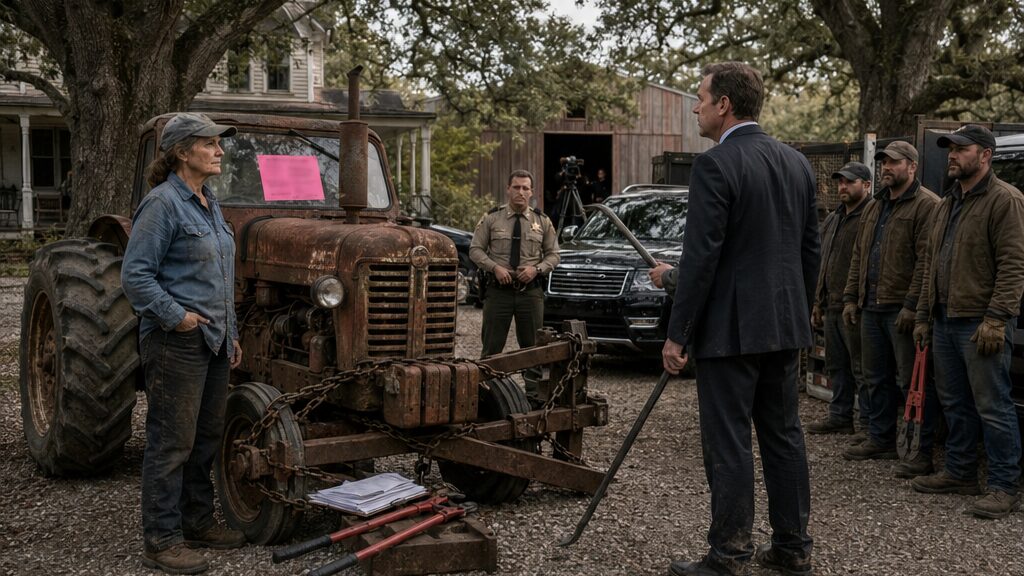
Samantha stood beside the tractor with one gloved hand resting on the rusted hood.
The tractor had not been pretty for decades. Its paint had faded to a hard, dull red beneath sun and weather, its metal patched in places with welded scrap, its tires scarred but solid. It started in cold, mud, heat, and stubbornness. Her father used to say the machine sounded like a bucket of bolts learning scripture.
That morning, Samantha had started it before dawn, driven it twenty yards down the gravel drive, and parked it crosswise between the oaks.
Then she had shut off the engine.
Then she had put the key in her coat pocket.
Now the first vehicle idled just beyond the mouth of the drive, its headlights cutting white lines through the low dust. A second vehicle stopped behind it. Then a truck with a flatbed trailer. Then another dark car.
Samantha did not move.
A door opened. A man stepped out in a dark suit that looked too expensive for gravel. He paused to examine the oaks, the tractor, the farmhouse beyond it, and finally Samantha herself. He carried a leather briefcase in one hand as if it were a judge’s hand on his shoulder.
Behind him, two contractors climbed down from the truck. A local patrol vehicle rolled in last and stopped with its tires just off the road.
The man in the suit smiled like he had already forgiven her for losing.
“Samantha Walker?”
“You know where you are,” Samantha said.
His smile tightened at the edges. “Larry Brown. Counsel representing the acquiring party.” He lifted the briefcase a little. “We’re here to execute a lawful seizure and secure the property.”
Samantha looked past him to the patrol vehicle. Ronald Smith stepped out slowly, hat in hand, his face already uncomfortable. She had known him since he was a boy riding his bicycle too fast past her mailbox. Now his hand rested near his belt as if the uniform might answer for him.
“Morning, Ronald,” she said.
He looked at the tractor before he looked at her. “Morning, Samantha.”
Larry glanced between them, noticing the name, storing it for use later.
“I assume there’s no need for a scene,” he said. “We have the order, the boundary packet, and enforcement support. If you’ll move the equipment, my team can proceed.”
“That tractor is on my land.”
“That is precisely the issue.” Larry set the briefcase on the hood of his lead car and opened it with two bright clicks.
Paper came out in stacks. Thick paper. Stamped paper. Paper with colored tabs and seals printed in dark ink. He laid a survey across the hood, flattening it with his palm.
Samantha did not step closer until he tapped a finger on the drawing.
“Here,” Larry said. “The access lane and frontage easement were reassigned under emergency condemnation. The farmhouse parcel is now subject to immediate control pending final transfer.”
Samantha looked at the page.
The drawing showed her driveway as a neat line, clean and obedient, stripped of every root, dip, fence scar, and bend it had earned over time. The oaks were little circles. The farmhouse sat too far east. The access road had been shaded in corporate blue.
She looked at the blue shape for a long second.
“That line runs through a white oak,” she said.
Larry’s eyes flicked down. “Trees can be removed.”
“Not those.”
“That’s not your decision anymore.”
One of the contractors gave a quiet laugh. Larry did not look pleased by it; he preferred his insults to sound official.
Ronald came forward, stopping near the edge of the gravel. “Samantha, I need you to understand what he’s showing us. There’s paperwork.”
“There’s always paperwork.”
Larry slid another page from the packet. “You were notified.”
“No.”
“The notice was served.”
“No.”
“Then your refusal to open mail is not my client’s concern.”
Samantha looked at his hands. Smooth, pale at the knuckles, one finger pressing hard enough on the page to bend it. Not calm, then. He was pretending at calm.
“I open my mail,” she said.
Larry closed the folder halfway and lowered his voice. “Mrs. Walker—”
“Miss.”
“Miss Walker. This does not have to become humiliating. You can gather personal items under supervision after access is secured.”
The word humiliating sat in the gravel between them like something he had brought on purpose.
Samantha reached into her coat pocket. Larry’s gaze jumped to the movement. Ronald’s did too.
She took out nothing. Her fingers closed around the tractor key, cold and familiar, and stayed there.
Larry noticed the gesture. A flicker crossed his face.
“Is that the key?”
Samantha said nothing.
His jaw moved once. Then he turned to one of the contractors. “Post the property notice.”
The contractor reached into the flatbed and pulled out a neon sign so bright it looked indecent against the gray morning. The words were black and huge.
CONDEMNED & SEIZED.
Ronald shifted. “Mr. Brown—”
“It’s required,” Larry said.
“It can go on the gate.”
“There is no accessible gate because Miss Walker has obstructed it with equipment.”
The contractor walked toward the tractor.
Samantha’s hand left the hood and dropped to her side. She did not block him. She did not raise her voice. She watched him come within arm’s reach of the machine her father had kept running with wire, patience, and spare iron after every shop in the county said it should have died.
The contractor slapped the neon sign onto the windshield.
The paper hit the glass with a flat, hard crack that rang louder than it should have.
For the first time that morning, Samantha felt heat move up her neck. Not anger exactly. Anger was noisy, and she had no use for it yet. This was older. It came from the place in her that remembered her father sitting at the kitchen table with a pen in his hand, staring at a document he did not understand while men in clean shoes told him not to make trouble.
Larry watched her face as if waiting for the break.
There were four men, one officer, two cars, a truck, a briefcase, and a sign announcing to anyone passing that the farm had already been taken.
Samantha turned, climbed one step onto the tractor, and pressed her palm against the sign.
She did not remove it.
Instead, she looked through the paper’s edge at Larry.
“You done marking things?”
Larry’s smile returned, but smaller now. “Not nearly.”
He reached into the back seat of his lead car and pulled out a heavy solid-steel crowbar. It caught the weak morning light along one clean edge. He held it loosely, not like a worker, but like a man demonstrating what other people would be made to do.
Ronald stiffened. “What’s that for?”
Larry looked past the tractor toward the farmhouse porch.
“If she refuses access,” he said, “we open the house ourselves.”
Chapter 2: The Crowbar at the Farmhouse Door
Larry Brown tapped the crowbar once against the bottom step of Samantha’s porch, and the sound carried all the way back to the tractor like a nail being driven into bone.
Ronald moved first. “Hold on.”
Larry turned, eyebrows raised. “There a problem, Officer?”
“There might be if you start forcing doors.”
“This is a seizure action.”
“It’s still a residence.”
“And I am still counsel of record.” Larry’s voice stayed pleasant, but he lifted the crowbar again and rested it on his shoulder. “I suggest everyone remember their role.”
Samantha stood beside the tractor with the neon sign glowing on its windshield. She had not followed Larry to the porch. That would have given him the picture he wanted: old woman dragged away from her own front steps while he performed restraint for the officers.
So she stayed where the driveway narrowed. The tractor blocked everything larger than a person. The oaks blocked the rest.
One contractor waited by the flatbed, watching for Larry’s hand signal. The other had taken out his phone but held it low, uncertain whether to record or pretend not to see.
Larry faced Samantha across thirty yards of gravel. “Last chance. Move the tractor.”
“No.”
“Then you are obstructing a lawful process.”
“No.”
His smile cut away. “You have a limited vocabulary.”
“I save words when men bring crowbars to farmhouses.”
Ronald gave her a look that asked her not to make it worse. Samantha almost answered it. Almost told him that worse had arrived in a suit, carrying a briefcase and a printed lie. But Ronald was already trapped between the page in Larry’s hand and the house he knew she had painted herself three summers back.
Larry strode back down from the porch, the crowbar hanging at his side. He stopped at his briefcase, pulled out the survey packet, and held up a page.
“This property line was certified through the county office. Your refusal to accept that reality does not preserve your ownership.”
“Let me see the whole packet,” Samantha said.
“You’ve had access.”
“No. You showed me the pretty page.”
Larry’s eyes narrowed. Then he slid three pages free and held them out, keeping the rest pinned under his palm.
Samantha walked toward him slowly. Gravel shifted under her boots. Ronald watched her hands. Larry watched her face.
She took the pages.
The first two looked like copies of copies, official enough to frighten someone who had learned to respect seals more than soil. The third was a boundary map. She saw it before she understood it: a small black survey mark drawn beyond the old oak line, just past the root flare of the biggest tree.
Her stomach tightened.
She had seen that mark before.
Not that ink, not that paper, but the same little lie. A corner moved just enough. A line softened just enough. A driveway transformed from family access to disputed frontage by a hand that never lifted a fence rail or pulled a stuck calf from mud.
Larry reached for the pages. “That’s sufficient.”
Samantha let him take the first two. She held the third for one extra second.
He noticed.
His hand snapped forward and pulled it from her fingers. “Careful. These are certified documents.”
“Who placed the new marker?”
“The surveyor.”
“Which surveyor?”
“The one authorized to do so.”
“That’s not a name.”
“That’s not your concern.”
Ronald stepped closer. “Mr. Brown, if she’s asking about the surveyor—”
Larry turned on him with a softer voice, which was worse. “Officer Smith, your department was served the enforcement packet this morning. The judge’s office acknowledged receipt. I have a client representative expecting secured access by nine. If this becomes a failure to assist, the report will reflect that.”
Ronald’s mouth closed.
Samantha saw the shame cross his face before he hid it.
He walked toward her, lowering his voice. “Samantha, these came through fast. Faster than I like. But they came through a channel I’m supposed to respect.”
“And if the channel is dirty?”
“Then I need more than you saying so.”
She looked at him. “You think I don’t know that?”
For a second, he was not Officer Smith. He was Ronald again, twelve years old, returning a wrench he had borrowed from her father and pretending he had not bent it.
“I’m trying to keep this from getting ugly,” he said.
“It got ugly when he touched my house.”
Near the porch, Larry made a show of checking his watch. “Enough. Clear the obstruction.”
The contractor by the flatbed opened a metal box and pulled out a chain. Another lifted a pair of heavy bolt cutters. Their handles were long, painted dull red beneath scratches. The jaws opened and shut once, biting air.
Samantha’s gaze moved from the cutters to Larry’s briefcase.
When Larry turned to give instructions, one page slipped loose from the side pocket of the case. He caught it quickly, too quickly, and tucked it behind the false bottom before anyone else could read it. But Samantha saw the corner: not a map, not an order. A letterhead she did not recognize and a line of numbers printed across the top.
He did not want that page photographed.
Her eyes shifted, barely, toward the barn.
The barn doors stood partly open, as they always did when she worked early. Inside, beyond the hanging dust and stacked feed sacks, something small blinked once and vanished.
Larry pointed at the chain near the tractor’s front axle. “Cut that first. Then we tow it clear.”
“It won’t tow clear,” Samantha said.
One contractor laughed under his breath. “Everything tows.”
“Not through those trees.”
Larry ignored her. “Do it.”
The contractor with the bolt cutters walked toward the tractor and stepped over the shallow ditch beside the driveway. His boot came down near the exposed roots of the big white oak.
Samantha’s body moved before her face did.
“Watch your feet.”
The contractor looked down, annoyed. “It’s dirt.”
“It’s older than your company.”
Larry made a small sound of disgust. “This is exactly the problem. Sentiment pretending to be law.”
Samantha looked at him then, really looked. The suit, the briefcase, the crowbar, the contractors, the vehicles boxed uselessly outside the driveway because he had not understood the land before trying to own it.
“You didn’t come for the whole farm first,” she said.
Larry paused.
“You came for the entrance.”
His eyes gave him away for less than a breath.
Then he smiled. “I came for what the law allows.”
Ronald saw it too. Not the meaning, maybe, but the flicker.
Samantha stepped back to the tractor. Her hand brushed the welded scrap iron along its side, rough under her glove. Her father had put the first plate there after a storm dropped a limb through the shed roof. She had added more later, ugly and practical.
Larry raised his hand. The contractor lifted the bolt cutters.
Samantha did not look at him this time.
She looked toward the barn doors and gave one small nod.
Chapter 3: The Old Survey Line Under the Oaks
The contractor’s boot snapped the old painted boundary stake before the bolt cutters ever touched the chain.
It was a small sound, dry and sharp, nearly lost under the mutter of engines. But Samantha heard it. She had been hearing that particular piece of wood in her mind for thirty-one years.
The stake leaned for half a second against the exposed oak root, then fell into the gravel.
“Stop,” she said.
The contractor looked at the broken stake, then at Larry. “It was rotten.”
Samantha walked to the root line and crouched. Her knees did not like it, but she made them bend. She picked up the broken piece and rubbed her thumb across the faded paint. Blue once. Almost gray now.
Larry came up behind her. “Do not disturb marked evidence.”
She stood with the stake in her hand. “This isn’t your evidence.”
“It is inside the disputed boundary.”
“It’s been here since before you learned to sign your name.”
“Romantic statements won’t help you.”
Samantha turned the stake once in her palm. On the underside, where weather had not taken all the color, a shallow notch remained. Her father had carved it there the summer after Betty Walker made him walk the whole line with a measuring chain and a thermos of coffee because she did not trust the man from the county.
Samantha remembered the day in pieces: her mother’s sun hat hanging down her back, her father’s silence, the kitchen table covered in papers that smelled like dust and ink. She had been young enough to think adults signed documents because they understood them.
Later, she learned better.
She carried the broken stake to the tractor and opened the metal toolbox mounted under the seat. The latch stuck, as it always did. She hit it once with the heel of her hand. It gave.
Larry stepped closer. “What are you doing?”
“Opening a box.”
“Anything you remove may be considered—”
“Old.”
Inside were a coil of wire, two wrenches, a cracked flashlight, and a flat tin wrapped in oilcloth. Samantha took out the tin and set it on the tractor’s footplate.
Ronald came nearer. “Samantha.”
She looked at him. “You wanted more than me saying so.”
Larry’s expression sharpened. “Officer, she is contaminating a boundary dispute with personal material.”
Samantha opened the tin.
The papers inside were folded around a tax receipt so old the creases had gone soft. Betty’s handwriting ran along the margin in pencil, thin but steady.
Entrance is what they wanted then, too. Don’t let them move the line just to make room for men who won’t stay.
Samantha had read it only twice before. Once after her mother died, when grief made every drawer dangerous. Once three weeks ago, after she found the new survey flag beyond the oak.
Reading it now in front of Larry felt like opening a wound in public.
She folded the receipt again before the camera hidden in the barn could see too much.
Larry’s eyes fixed on the tin. “That has no bearing on a certified order.”
“You keep saying certified.”
“Because it is.”
“Then name the surveyor.”
He did not answer.
Ronald noticed the silence. The contractor noticed Ronald noticing. Larry saw both and changed tactics.
“Miss Walker,” Larry said, making her name sound like a problem being handled kindly, “I appreciate that families attach emotion to property. Especially when land has been passed down without modern management. But old receipts, sentimental notes, and hand-carved sticks do not overturn lawful proceedings.”
Samantha put the broken stake beside the tin.
“My father signed a correction once,” she said. “He thought he was fixing a clerical error.”
Larry’s eyes cooled. “I’m not here to discuss your father.”
“No. Men like you never are.”
Ronald lowered his voice. “What happened?”
Samantha kept her eyes on the tractor. “A line moved. Just a little. Enough to make the entrance questionable. My mother fought it after. Quietly. Receipts, tax maps, old photos, every repair invoice for this driveway. She kept it all.”
Larry gave a short laugh. “So this is inherited paranoia.”
The word struck harder than she expected.
Her fingers closed around the broken stake. For one second, she saw herself swinging it—not at him, not truly, but at the smile, at the suit, at the clean ease of a man who had never had to prove his own front door belonged to him.
Ronald saw her hand tighten.
“Samantha,” he said softly.
She opened her fingers.
The stake fell onto the tractor step.
Larry pointed at it immediately. “There. She moved it. She has altered physical evidence in full view of an officer.”
“You watched your contractor break it,” Samantha said.
“I watched you remove and relocate it.”
“That’s not what happened,” Ronald said, but his voice lacked the force it needed.
Larry turned on him. “Then make a note in your report. Make all the notes you like. But until a court tells me otherwise, that tractor is an obstruction, that house is subject to entry, and this property is under seizure.”
The contractor with the bolt cutters shifted impatiently. “You want me to cut it or not?”
Larry’s answer came fast. “Cut it.”
Samantha put the receipt back into the tin, but not before sliding one smaller folded paper into her coat sleeve. Betty’s second note. The one she had not shown anyone, not even Jennifer.
She closed the toolbox and rested her palm on the welded scrap iron along the tractor’s side.
The patch was ugly, thick, and dark. Her father had bolted the first piece on after the old machine cracked near the frame. Samantha had welded the rest herself years later, after she understood that iron could do what signatures could not: refuse pressure without explaining itself.
From the barn came the softest crunch of a boot against straw.
Larry did not hear it. Ronald did. His eyes moved toward the barn doors, then back to Samantha.
Inside, hidden behind stacked feed sacks and a hanging tarp, Jennifer Harris waited with a camera crew and a live pack Samantha had not wanted to use until the last possible moment.
At dawn, when Jennifer arrived, she had whispered, “Are you sure this isn’t just a local property fight?”
Samantha had answered, “Wait until he touches the house.”
Now Larry had touched the house. His crowbar still leaned against the porch rail.
A faint buzz came from inside Samantha’s coat pocket. One short vibration. Then another.
The agreed signal.
Samantha turned away from Larry and walked toward the barn as if fetching another tool. Ronald’s eyes followed her. Larry began arguing with the contractor over the chain.
At the edge of the barn door, Jennifer’s face appeared in the darkness, pale with nerves and focus.
“The line is ready,” Jennifer whispered. “We can go live in seconds.”
Samantha looked past her to the camera lens, black and round and waiting.
For years, she had kept her mother’s notes folded away so no stranger could turn her family’s near-loss into county gossip. For years, she had let people call her difficult because difficult was easier than explaining why her father stopped going to town after signing one bad paper.
Jennifer swallowed. “Samantha, are you sure?”
Behind them, Larry’s voice cracked through the morning.
“Clear that tractor now.”
Samantha looked at the old receipt hidden in her sleeve, then at the neon sign blazing against the tractor windshield.
“No,” she said quietly. “Not yet.”
Chapter 4: The Fake Order Looks Real Enough
Ronald held out his hand in front of everyone.
“Samantha,” he said, “I need the key.”
The gravel seemed to quiet around those words. Larry stood near the tractor hood with his briefcase open, his stamped papers arranged in a neat fan. The neon seizure sign still clung to the windshield. Behind the tractor, the farmhouse waited with its porch shadow dark and still, the crowbar leaning against the rail like a promise that had not been forgotten.
Samantha kept her hand in her coat pocket.
The key was small enough to disappear inside her fist. Brass worn thin at the teeth. Her father had tied a bit of faded twine through its ring so it could be found at the bottom of a work jacket. The twine rubbed against her knuckle now.
Ronald’s hand stayed open.
“I don’t want to do this the hard way,” he said.
“You’re already doing it their way.”
His face tightened, not with anger but with the pain of being watched while someone named the thing he was trying not to see.
Larry placed one page on the tractor hood. The paper fluttered at the corner until he pinned it with two fingers. “Officer Smith has no discretion here. The order authorizes access and removal of obstruction.”
Samantha looked down at the page.
The seal was dark. The language was clean. The margins were wide and official. It had all the features paper used when it wanted to frighten people before they read too closely.
She stepped nearer.
Ronald shifted as if to stop her, then didn’t.
Samantha’s left hand rested on the tractor’s iron casing. It held the night cold beneath the thin warmth of morning. Her right hand remained around the key.
Larry tapped the document. “You recognize the property description?”
“I recognize part of it.”
“Then we’re finished.”
“No.” She leaned down and read the parcel reference again. “This number doesn’t cover the house.”
Larry’s jaw flexed.
Ronald looked at the page. “What does she mean?”
Larry slid another sheet over it so smoothly it almost looked accidental. “She means she is not qualified to interpret legal descriptions.”
Samantha gave a short, dry breath. Not quite a laugh. “I’ve paid taxes on that house since before your shoes knew gravel.”
“That is not a legal argument.”
“It’s a better argument than hiding the number.”
For the first time that morning, one of the contractors stopped pretending boredom. His eyes moved from Samantha to Larry’s hand.
Larry collected the pages and squared them with care. “This is exactly why these actions require enforcement. Laypeople get emotional, misunderstand technical language, and then create danger.”
Ronald turned slightly away from Samantha and lowered his voice to Larry. “Let me call this in again.”
“You already called it in.”
“I called the county office. I want state confirmation.”
Larry closed the briefcase halfway. “No.”
Ronald stared at him. “No?”
“No delay. No fishing expedition. No theater.” Larry stepped closer to Ronald, close enough that Samantha could see the little pulse moving in his neck. “The acquiring party has a certification deadline. If access is not secured today, there are damages. Real damages. Your name goes on the report as the officer who declined to enforce a valid order because a landowner became sentimental over a tractor.”
Ronald’s ears reddened.
Larry softened his voice. “I understand your position. Rural communities are personal. Everybody knows everybody. But that is exactly why outside counsel exists. To prevent favoritism.”
Samantha watched Ronald absorb it. Career. Report. Failure to assist. Favoritism. Words chosen not to convince him of truth, but to make hesitation feel like misconduct.
Ronald glanced toward the barn, toward the farmhouse, toward the tractor blocking the drive.
Then he looked back at Samantha. “I’m asking you one more time. Move the tractor voluntarily.”
“No.”
“If I order you to move it?”
“It won’t change the key.”
His open hand closed.
Larry exhaled through his nose, impatient now. “Enough.”
“Mr. Brown,” Ronald said, “I haven’t ordered removal yet.”
“You are standing beside the obstruction while my client’s lawful access window closes.”
“There is no window in that order,” Samantha said.
Larry turned sharply. “Excuse me?”
She nodded toward the briefcase. “You keep saying today. You keep saying access. You keep looking at your watch. But the paper you’re showing doesn’t say you need my driveway cleared by nine.”
Larry’s eyes went flat.
Ronald heard it too. “Is there a deadline outside the order?”
Larry’s smile returned slowly, rebuilt piece by piece. “There are business realities beyond the four corners of an enforcement document.”
“Business realities don’t give you a crowbar,” Samantha said.
The contractor nearest the truck muttered, “We doing this or not?”
Larry snapped the briefcase shut. The twin clicks sounded like small locks on a cage. “We are.”
He pointed toward the chain looped near the tractor’s front frame. “Cut that. Attach the tow line. If she interferes, Officer Smith can decide whether his badge is decorative.”
Ronald turned on him. “Careful.”
Larry lifted both hands slightly, the picture of innocence. “I’m only asking everyone to do their job.”
Samantha looked through the windshield. The neon sign blocked most of the view from the seat, but she could still see the outline of the farmhouse beyond it, split by black letters announcing condemnation. Paper pretending to be a wall.
Her mother’s second note pressed against her sleeve.
She had wanted, more than she would ever admit, for Ronald to stop this before it reached the next step. For a county clerk to answer a phone. For one seal to fail. For Larry to flinch enough that she could keep Betty’s old words folded away and never tell strangers how close her father had come to giving up.
But Larry did not fear refusal.
He feared delay.
And that meant the truth still needed more time to ripen in his mouth.
The contractor lifted the bolt cutters from the flatbed. Their jaws opened with a dull scrape. Another man dragged chain across the gravel, each link scraping past the last like something being pulled from a well.
Ronald stepped between Samantha and the tractor. “Don’t touch them,” he said softly. “If you put hands on anybody, I can’t help you.”
“I’m not touching anybody.”
“I mean it.”
“So do I.”
His face changed then, just a little. He was still wearing the badge, still standing where Larry needed him to stand, but his eyes had shifted from warning to worry.
Samantha almost told him everything. Jennifer in the barn. The old receipts. The parcel number. The state complaint she had filed before dawn, with scanned copies attached and a message short enough to make a clerk nervous. She almost let Ronald step into the truth beside her.
But almost had ruined her father once.
He had almost asked for a second opinion. Almost refused to sign. Almost told Betty he was scared.
Samantha let the silence stand.
Larry mistook it for defeat. “At last.”
He retrieved the crowbar from the porch rail and walked back down toward the drive. He did not swing it. He did not need to. He wanted the shape of it in everyone’s eyes.
The contractor with the bolt cutters stopped beside the tractor and bent near the chain.
Ronald’s hand moved near his belt, not touching the cuffs but not far from them.
Samantha stepped back once, enough to give Larry the image he wanted: the old farmer yielding space while men with tools took over.
Larry’s shoulders lowered.
There it was. Relief, quick and ugly.
Samantha saw it and understood the morning more clearly than any document had allowed. He had never planned to debate the deed. He had planned to create a fact: access cleared, house opened, seizure sign posted, vehicles on the property before anyone with authority could unwind the lie.
Once iron moved, paper would catch up.
The bolt cutters opened.
The jaws hovered over the chain.
Larry looked at his watch again. “Now.”
The tool came down, metal kissing metal.
Ronald inhaled.
Samantha took the tractor key from her pocket, held it up just long enough for Larry to see it, then dropped it inside the front of her shirt beneath her collar.
Larry’s face darkened.
“You think that’s clever?”
“No,” she said. “I think it’s mine.”
Larry pointed at the flatbed without looking away from her.
“Bring the larger cutters.”
Chapter 5: When the Bolt Cutters Broke
The larger bolt cutters clamped onto the tractor with a metallic bite loud enough to stop even the contractors from talking.
For a second, nobody moved.
The jaws had not found the chain. They had found the scrap iron Samantha had welded to the side of the tractor years ago, a thick dark plate bolted over older repairs and braced beneath the frame. The contractor frowned, adjusted his grip, and tried to angle the cutters lower.
“They’re not on the chain,” Larry snapped.
“I know that,” the contractor said. “There’s plating in the way.”
“Then cut through it.”
The man looked at him over one shoulder. “This isn’t fence wire.”
Larry’s eyes flicked toward Samantha, as if the iron itself were her insolence taking shape.
The neon sign trembled faintly on the windshield in the morning breeze. CONDEMNED & SEIZED. Its paper corners had begun to lift.
Samantha stood five feet from the tractor, close enough to smell old oil warming in the sun. She did not look at the cutters first. She looked at the contractor’s stance, the stress in his wrists, the way the tool jaws could not settle around the plate without catching on the hinge.
Her father had taught her that most men trying to force a machine lost because they wanted the machine to be simpler than it was.
Larry wanted the farm to be a page.
The tractor was not a page.
The contractor squeezed. The handles flexed. Nothing gave.
Larry stepped forward, crowbar in one hand. “Use the tow chain.”
“There’s no angle,” the other contractor said. “Truck can’t get past the first oak, and if we pull sideways, we’ll peel the front end off your car before we move that thing.”
“My car is not the issue.”
“It’s parked in the only pull line.”
Ronald looked down the driveway. The vehicles Larry had brought now boxed him in as much as they boxed Samantha out. There was no shoulder wide enough for turning. No ditch shallow enough to cross. No opening between the oaks that could accept even a small truck without taking bark, root, and mirror with it.
The land had Larry by the tie.
Larry felt it. His voice sharpened. “The access has to be certified today.”
Samantha lifted her head.
Ronald did too.
The contractor holding the cutters paused. “Certified?”
Larry froze for half a beat, then recovered badly. “Cleared. I meant cleared.”
“No,” Samantha said. “You said certified.”
Larry turned on her. “Do not twist my words.”
“I’m repeating them.”
“You’re interfering.”
“With certification?”
His mouth pressed into a white line.
Ronald stepped toward him. “What access certification?”
Larry swung the crowbar down so its tip struck gravel. “A development compliance issue that has nothing to do with this enforcement action.”
“Development,” Samantha said.
He looked at her then with something almost honest. Not guilt. Contempt stripped of polish. “You have no idea how many people are tired of watching land sit useless because one person confuses inheritance with purpose.”
The words did not surprise her. That was the worst of it. They fit him so perfectly they might have been written under every stamped page in his briefcase.
“Useless,” she said.
Larry gestured toward the farmhouse, the barn, the fenced pasture beyond. “Sentimental acreage. Unimproved frontage. A dead-end farm blocking infrastructure.”
Samantha felt Ronald look at her, waiting for fury.
It came, but not outward. It moved through her slowly, packing itself behind her ribs until it became weight instead of flame.
“My mother planted beans past that wash after the flood,” she said.
Larry rolled his eyes. “This is not about beans.”
“My father rebuilt that culvert with a broken wrist.”
“Miss Walker—”
“I pulled calves out of ice in that field. Buried dogs under that walnut. Paid taxes on land your map can’t even draw straight.”
Larry took one step closer. “And none of that changes the order.”
“Then why are you scared of waiting one hour?”
The question struck clean.
Ronald turned fully toward Larry.
Larry’s control slipped enough for his hand to tighten around the crowbar. “Because delays are how people like you steal value from everyone else.”
“People like me?”
“Owners who cannot manage assets but refuse to release them.”
Samantha looked at the contractor with the cutters. “You hear that?”
The man did not answer.
Larry realized too late that she was not arguing for him. She was gathering him.
He pointed toward the farmhouse. “If that machine is not movable, we proceed on foot and secure the residence.”
Ronald stepped in front of him. “No forced entry until I verify the dwelling parcel.”
Larry pushed past his shoulder.
Not hard. Not enough to be called assault. Just enough to show Ronald how little he feared local hesitation.
Samantha saw the movement. Saw Ronald swallow his anger. Saw the contractor still fighting with the bolt cutters, twisting them against the scrap plate as if the right angle might turn iron into permission.
Larry was halfway to the porch.
The crowbar hung at his side.
That was when Samantha moved.
She crossed the gravel without hurry and reached the tractor just as the contractor tried to reset the cutters. Her hand closed around one handle.
“Ma’am—”
“Let go.”
He looked to Larry.
Larry turned back from the porch. “Do not touch that tool.”
Samantha’s other hand closed on the second handle. She looked at the contractor, not Larry.
“You want your fingers clear.”
Something in her voice convinced him. He released it.
Ronald said, “Samantha.”
She lifted the bolt cutters with both hands. They were heavier than they looked, made awkward by the long handles, the jaws still open. She set the jaws deliberately around the thick lip of scrap iron welded to the tractor’s side, not on the chain, not near the axle, but on the reinforced plate where old metal overlapped older metal.
Larry started toward her. “Arrest her.”
Ronald did not move.
Samantha pushed the handles wide until the hinge sat exposed, strained at the wrong angle. She placed one boot against the lower handle, steadying it. Her hand found the tractor hood.
For half a second she felt her age. Knee pain. Shoulder stiffness. The old scar across her palm from a hay hook. Every morning she had woken before light because land did not care how tired grief made a body.
Then she thought of Betty’s handwriting.
Entrance is what they wanted then, too.
Larry lunged two steps closer. “Stop.”
Samantha drove her boot down.
The hinge cracked.
Not broke. Cracked.
The sound snapped through the oaks and came back from the barn wall.
The contractor cursed and jumped away.
Samantha shifted her weight, raised her boot again, and kicked harder.
This time the hinge shattered. One handle twisted loose, the jaws sprang crooked, and a broken pin spat into the gravel beside Larry’s polished shoe.
Silence fell so completely Samantha heard the camera buzz from inside the barn.
The bolt cutters hung dead from the scrap iron for one strange second, opened like a jaw that had forgotten how to bite.
Then they dropped.
Larry stared at them.
Samantha stepped back. Her breathing was steady, but her hands were not. She closed them before anyone noticed.
Larry’s face darkened beyond performance. “You just destroyed private equipment during execution of a lawful order.”
“No,” Samantha said. “I stopped a tool from being used to break into my home.”
“Officer Smith.” Larry’s voice rose. “Cuff her.”
Ronald’s hand went to his belt.
Samantha looked at him and did nothing to help him. No pleading. No explanation. She had chosen this moment and now it belonged to all of them.
Larry saw Ronald hesitate and struck at the hesitation. “She is violent. She is obstructing. She is destroying equipment. How much more do you need?”
Ronald took one step toward Samantha.
Behind them, from the barn, a latch clicked.
Larry did not hear it over his own voice.
“I want her removed from this property now.”
The barn door opened six inches.
Chapter 6: We Are Live, Mr. Brown
“Arrest her,” Larry shouted, while the broken bolt cutters were still rocking in the gravel.
Ronald’s hand touched his cuffs.
Samantha saw the movement and felt the morning narrow to that small piece of metal at his belt. She could still lose. Not the land, not forever, maybe, but the moment. Larry could turn the picture into exactly what he wanted: unstable woman destroys tool, refuses order, forces officer response. By the time the truth caught up, her face would already be the story.
Larry knew it too.
He stepped back, lifting both hands as if suddenly afraid of her. “Everyone saw that. She attacked lawful removal equipment.”
Samantha said nothing.
The barn door opened wider.
Jennifer Harris stepped into the strip of daylight with a camera behind her shoulder and a small red broadcast light glowing above the lens.
Larry turned.
For the first time all morning, he had no expression ready.
Jennifer’s voice shook only at the edge. “We’re live, Mr. Brown.”
The contractor nearest the tractor took his cap off without knowing he had done it. The other looked toward the flatbed as if calculating how quickly he could become someone uninvolved.
Ronald’s hand dropped from his cuffs.
Larry stared at the camera. Then at Samantha. Then at the barn door, where another crew member stood half-hidden among feed sacks and coiled rope.
“You are recording a law enforcement action without authorization,” Larry said.
Jennifer came down the barn ramp carefully, eyes on him, microphone low at her chest. “We are broadcasting from private property with the landowner’s permission.”
“This property is under seizure.”
“Then you won’t mind explaining the order.”
Larry’s mouth opened, closed, then found its old shape. “I will not litigate for entertainment.”
“No one asked you to litigate.” Jennifer turned slightly so the camera caught Larry, the tractor, the neon sign, the crowbar near his leg, the broken cutters in the gravel. “You arrived before sunrise with contractors, a seizure notice, and a crowbar. You threatened to open the farmhouse. You stated the access had to be certified today. Certified for what?”
Larry’s face flushed.
Samantha looked at Jennifer then, really looked. The reporter’s hand was tight around the microphone. This was not easy for her either. She had taken Samantha’s call before dawn with doubt in her voice and sleep still in it. She had come anyway. Now she stood in front of Larry with the red light burning.
Samantha had spent years believing people failed you when paper got complicated.
Sometimes they did.
Sometimes they stood in barn dust and gave your silence somewhere to go.
Larry snapped his briefcase shut and bent to grab it.
Ronald stepped forward. “Leave it open.”
Larry turned slowly. “Excuse me?”
“If this is being questioned, leave the documents visible.”
“You have no authority to seize my work product.”
“I didn’t say seize. I said leave it open.”
Larry laughed, but there was no breath in it. “You’re letting a camera change your understanding of the law?”
Ronald looked at the crowbar in Larry’s hand. “I’m letting what I saw change it.”
A small sound came from one contractor. Not quite approval. Not quite relief.
Larry pointed toward his lead car. “Move the vehicle.”
The driver, who had stayed behind the wheel with the engine running, looked uncertain.
“Now,” Larry barked. “Back it out.”
Samantha turned toward the driveway mouth. The car could not back out cleanly. The flatbed and second luxury vehicle blocked the road behind it. Larry had arrived in a procession, confident he would drive forward into her land. He had never planned an exit.
Jennifer’s camera followed the line of trapped vehicles.
“Mr. Brown,” she said, “why is your driver attempting to leave with documents still in dispute?”
Larry strode toward the car.
Ronald moved faster and blocked him. “Nobody leaves until I get confirmation.”
“From whom?”
“State office.”
Larry’s eyes sharpened. “You called them?”
Ronald did not answer.
He had not. Not yet. But Samantha had.
The buzz in Samantha’s pocket came again. Three short vibrations this time. She did not touch it.
Larry saw the flicker in her eyes and understood enough to be frightened.
“What did you do?” he said.
Samantha walked to the tractor and pulled the folded paper from her sleeve. Not the whole file. Not all Betty’s pain. Just the note and the tax receipt copy beneath it, the one showing the old entrance recorded before the first attempted correction.
She held it against the tractor hood.
“My father signed a boundary correction thirty-one years ago because a man with papers told him it was harmless,” she said.
The camera turned toward her.
Her throat tightened. For a moment, she hated the lens. Hated its hunger. Hated that truth needed an audience before it became heavy enough to stop men like Larry.
But the neon sign was still on the windshield.
The crowbar was still in Larry’s hand.
So she continued.
“My mother knew it wasn’t harmless. She kept receipts, maps, photographs, culvert bills, fence repairs, every tax record that named this driveway as farm access. She died with a drawer full of proof because she was afraid no one would believe a farmer over a stamped page.”
Larry tried to speak. Jennifer cut in.
“Is that why you called us?”
Samantha kept her eyes on Larry. “I called because he was going to do it where no one could see.”
Larry lifted the briefcase. “This is defamatory.”
Ronald’s voice came low and firm. “Set the case down.”
Larry did not.
From beyond the line of trapped vehicles, sirens rose faintly.
Not local sirens. Deeper. More than one.
The driver of the lead car opened his door and stepped out, hands visible. The contractors backed away from the tractor.
Larry looked down the driveway, then at the oaks that gave him no second route, then at Samantha.
For a second, all his polish fell away.
“You don’t understand what you’ve cost people,” he said.
Samantha looked at the broken bolt cutters, the crowbar, the paper on her windshield.
“No,” she said. “I think I finally do.”
The sirens grew louder, pushing through the trees from the road beyond Larry’s cars.
Chapter 7: Coffee While the Luxury Cars Leave
“Do not touch the briefcase again.”
The state trooper’s voice cut through Larry’s next argument before it could become a sentence. He stood between Larry and the lead car, one hand held out, palm down, calm enough to make everyone else still.
Larry stopped with the briefcase halfway lifted.
For the first time since he had stepped out beneath the oaks, his hand looked unsure.
“This contains privileged legal material,” he said.
The trooper did not lower his hand. “Set it on the hood.”
“You have no warrant.”
“I have a live report of a forced property seizure using disputed documents, a local officer requesting verification, and a state complaint with attachments already logged this morning. Set it down.”
Larry looked toward Ronald, as if the local badge might still be useful.
Ronald did not move.
The second trooper was already at the flatbed, speaking quietly to the contractors. One of them pointed toward the broken bolt cutters. The other pointed at the porch, where the crowbar still leaned in plain sight. Jennifer’s camera followed each gesture without rushing.
Samantha stood beside the tractor and felt the key resting warm beneath her collar.
The sirens had stopped. The road had not. It seemed to breathe now, engines idling, radios murmuring, gravel settling under too many boots. The oaks held everything in place. Larry’s cars, his truck, his men, the patrol vehicle, the state cruisers—each one trapped in the narrow order of its own arrival.
Larry set the briefcase on the hood of his car.
The trooper opened it carefully.
“No,” Larry said sharply. “You don’t have authority to review—”
“Then you should not have presented these documents as active enforcement papers in the presence of law enforcement.” The trooper lifted the top sheet by its corner. “Officer Smith, is this the packet provided to your department?”
Ronald stepped forward. His face had gone pale in a way Samantha had never seen before.
“Yes,” he said. “That’s what we were handed.”
“Directly from Mr. Brown?”
“Yes.”
Larry laughed once. “This is absurd. That department received proper notice.”
The trooper looked at him. “Through which office?”
Larry’s answer came a fraction too late. “County civil processing.”
The trooper turned a page. Then another.
Samantha watched his eyes pause where hers had paused earlier.
“The parcel number on this order,” he said, “does not match the farmhouse.”
Larry’s mouth tightened. “It references the affected access.”
“It references a tract two miles east.”
The words struck the driveway with less noise than the bolt cutters, but they did more damage.
Ronald closed his eyes for half a second.
Jennifer stepped closer, careful not to interfere. “Can you repeat that?”
The trooper did not look into the camera. “I’m not making a public statement yet.”
Larry seized on that. “Exactly. This is premature. This entire broadcast is prejudicial, and I will hold every person here accountable.”
Samantha walked to the tractor windshield.
The neon sign was still there, its corners peeling now, the black letters broken by dust. She reached up and took one edge between her fingers.
Larry saw her.
“Leave posted notice in place,” he snapped.
She looked at him. “No.”
The paper resisted for a moment. The adhesive stretched in soft strings from the glass. She pulled slowly, not tearing it, not giving him the anger he wanted to show the camera. When the sign came free, she folded it once, carefully, so CONDEMNED disappeared inside SEIZED.
She carried it to Larry and placed it on the gravel at his feet.
No slap. No throw.
Just placement.
The trooper lifted another sheet from the briefcase, this one with a boundary attachment clipped behind it. “These attachments are not consistent.”
Larry turned from Samantha to the trooper. “They’re updated plats.”
“They’re altered plats,” the trooper said.
The contractor who had held the bolt cutters muttered, “I didn’t know anything about that.”
Larry whipped around. “Do not speak.”
The contractor stepped back, face hardening. “I said I didn’t know.”
That frightened Larry more than Samantha’s silence had.
One of the troopers removed a roll of evidence tape from his cruiser. The sound of it peeling loose was thin and sticky and final. Paper, at last, being used for truth.
Ronald stepped into Jennifer’s camera frame before he seemed to realize it. His hat was in his hand again.
“For the record,” Jennifer said, “were these documents independently verified before local enforcement arrived?”
Ronald looked at Samantha first.
She wished he hadn’t. The old habit in her wanted to rescue him from the question, to wave it away, to say it was Larry who had done this and Ronald who had been boxed in. But that would be another silence. Another soft place where paper could hide.
Ronald swallowed.
“No,” he said. “We were handed a packet that appeared to be processed. I made a county call, but not an independent parcel verification before arrival.”
Larry snapped, “Don’t answer her.”
Ronald’s shoulders straightened. “I’m answering what happened.”
The camera light glowed red against the barn’s darkness.
Samantha felt something inside her loosen and ache at the same time.
Jennifer turned toward her. “Miss Walker, do you want to make a statement?”
There it was—the opening Samantha had feared more than Larry’s crowbar.
A statement. A speech. Her face carried through living rooms, phones, county offices, diner counters. Her mother’s handwriting held up for strangers. Her father’s shame turned into a headline.
She looked toward the farmhouse window. Behind that glass, in the kitchen drawer beside the stove, Betty Walker’s old receipts sat in their tin when they were not needed. Betty had kept proof quietly because quiet had been the only weapon she trusted. Samantha had inherited the proof, and the quiet, and the fear that if the world looked too closely, it would not see dignity. It would see weakness.
The trooper sealed one stack of documents into an evidence bag.
Larry saw her hesitation and moved toward it like a man spotting a gate left open.
“Yes, Miss Walker,” he said, voice smoothing itself again. “Make your statement. Tell everyone how you attacked lawful equipment and interfered with officers because you couldn’t accept change.”
Samantha looked at the broken bolt cutters lying near the tractor. Then at the crowbar on the porch. Then at the folded neon sign at Larry’s feet.
She walked back to the tractor, opened the metal toolbox, and took out Betty’s tin.
No one spoke.
Samantha did not open it for the camera. She simply held it against her chest for a moment and then set it on the tractor seat.
“My mother’s name was Betty Walker,” she said.
The words came out rougher than she expected, and that nearly stopped her. She put one hand on the tractor hood, feeling the iron steady her palm.
“She kept the records for this farm after my father signed something he should not have signed. He wasn’t foolish. He was tired, and men with papers knew it. They moved a line on him and told him it did not matter.”
Larry looked away.
Samantha saw it.
“It mattered,” she said. “It mattered for thirty-one years.”
Jennifer lowered the microphone a little, not interrupting.
“This entrance belongs to the farm,” Samantha said. “The oaks mark it. The tax maps mark it. The culvert bills mark it. My mother’s receipts mark it. My father’s repairs mark it. That tractor has crossed it longer than some offices have kept clean files.”
Her voice steadied.
“I don’t have a speech. I have a driveway. I have a house. I have my mother’s notes. And I have a man here who brought a crowbar before he brought the truth.”
Nobody moved for three seconds.
Then the trooper nearest the flatbed lifted the crowbar with gloved fingers and carried it toward an evidence bag.
Larry’s driver said, “Sir, they’re asking for the keys.”
Larry spun toward him. “Don’t give them anything.”
The first trooper turned. “The vehicles are being held pending documentation review.”
“They’re my vehicles.”
“They were used in the attempted execution of a disputed seizure.”
“This is outrageous.”
“No,” Samantha said quietly.
Larry looked at her.
She bent into the tractor cab and reached behind the seat, where the old green thermos lay wrapped in a rag. Betty had carried coffee in it when she walked fence line, when she sat beside Samantha’s father during long repairs, when she spread tax receipts across the kitchen table and made herself stay awake through fear.
Samantha unscrewed the cap.
Steam lifted into the late morning air.
Larry watched as if the act offended him more than shouting would have.
A tow chain rattled near the road. This time, it was not aimed at Samantha’s tractor.
One of the troopers guided the tow truck into the only angle the oaks allowed. Slow, careful, respectful of roots. The chain hooked beneath Larry’s first luxury vehicle. Its polished front end dipped as tension took hold.
Jennifer’s camera turned, but Samantha did not.
She poured coffee into the thermos cup. Her hand trembled once. She steadied it against the tractor hood until the tremor passed.
Ronald came to stand a few feet away.
“I should have called state verification before I got here,” he said.
“Yes,” Samantha said.
He took that in. No forgiveness offered to spare him. No cruelty either.
“I’m sorry,” he said.
She looked at him for a moment, then back to the driveway. “Put it in your report.”
He nodded.
The tow truck pulled.
Larry’s lead car rolled backward over the gravel, tires crunching down the narrow lane it had entered so confidently. The ancient oaks stood on both sides, too close for escape, their roots lifting the earth like knuckles. The car’s glossy paint caught flashes of leaves, sky, and red emergency lights as it was dragged away from the farmhouse it had come to claim.
Larry stood beside the evidence bags with the folded neon sign at his feet.
Samantha raised the cup of coffee and drank.
It was too hot. Bitter. Perfect.
She did not smile.
She only watched the car disappear past the oaks, down the driveway that still belonged to the farm.
The story has ended.