She Slammed an Eighteen-Thousand-Dollar Repair Bill Down, but the Rust Told a Different Story
Chapter 1: The Rust Inside the Fresh Break
The garage door was halfway open when Richard Young heard the conversation stop.
One second earlier, the old motorcycle garage had been full of ordinary noise: laughter around the wooden table, the clink of bottles, Scott Harris arguing with two club members about a route for the charity ride next month. The next second, every voice disappeared.
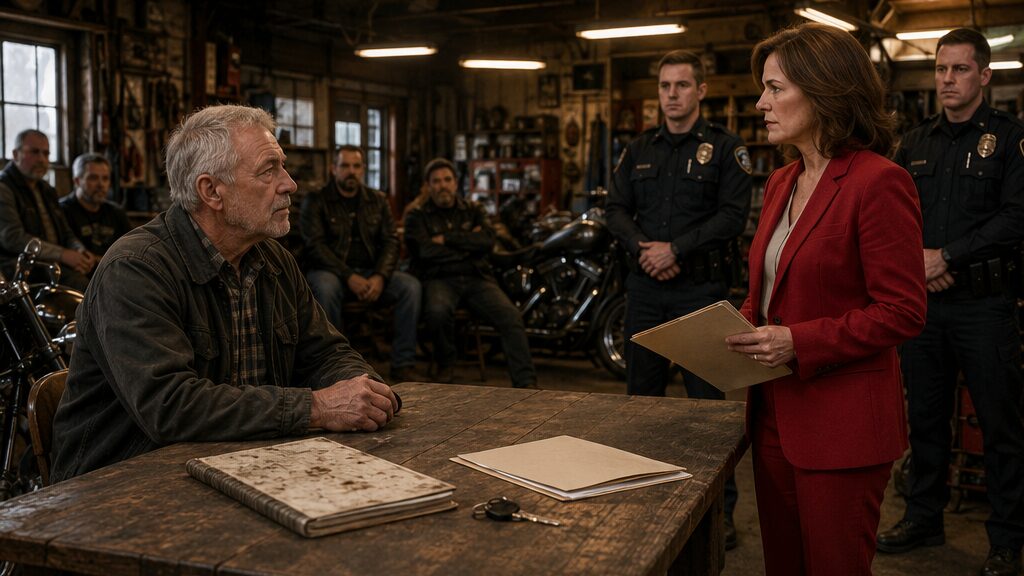
Richard looked up from the bottle in his hand and saw Donna Roberts standing beneath the rising garage door.
She was wearing a bright red suit that looked completely out of place among the oil-stained concrete, hanging tools, and motorcycles lined against the walls. Behind her stood two patrol officers, their expressions neutral but their presence heavy.
Richard did not need anyone to tell him this was not a social visit.
Scott lowered his bottle slowly.
“Richard,” he said quietly, “what’s going on?”
Richard watched Donna step inside.
She did not look at the motorcycles. She did not look at the people sitting around the table. Her eyes went directly to him.
“Richard Young,” she said, “I am here because you need to take responsibility for what happened.”
The room stayed silent.
Richard set his bottle down before he answered.
“What happened?”
Donna’s expression tightened, as if his question offended her.
“My retaining wall collapsed yesterday evening.”
Richard already knew about the collapse. Everyone in the neighborhood did. The wall separated Donna’s elevated backyard from the narrow strip of land beside Richard’s garage. The broken section had fallen toward her property, taking part of the landscaping with it.
But knowing something happened and accepting someone else’s version of why it happened were two different things.
Donna reached into her folder.
“The damage was caused by activity from your property.”
She pulled out several papers and dropped them onto the wooden table.
The top page landed beside Richard’s motorcycle keys.
The sound was louder than it should have been.
An estimate.
A photograph.
A signature page.
Richard looked down.
The number at the top of the estimate was printed in large, clean black letters.
$18,740.
A few of the club members shifted in their seats.
Donna noticed.
“That amount covers the emergency stabilization, removal, replacement materials, labor, and related costs. Your insurance company will receive a copy after you sign the acknowledgment.”
Richard looked at the signature line.
“I’m not signing anything.”
Donna blinked.
“I don’t think you understand the situation.”
“I understand the paper.”
“No,” she said. “You understand a piece of paper. You do not understand what it means.”
She pointed toward the garage entrance.
“Your customers and friends were riding motorcycles beside that wall for years. The vibration weakened it. Yesterday, during your little gathering, someone moved a bike through the loading lane again. The wall finally gave way.”
Richard looked toward the open garage door.
Beyond it was the narrow strip of gravel between the garage and Donna’s property line.
He remembered motorcycles there.
He remembered moving bikes.
He remembered a lot of things.
But he also remembered the wall.
Donna leaned forward.
“You have a business here. You have insurance. This does not need to become complicated.”
The officers remained quiet.
Richard knew why they were there. Donna had requested a civil standby. They were not there to arrest him or declare anyone responsible. But he also knew how it looked.
An older man in a motorcycle garage.
A woman with an expensive repair bill.
Two officers standing behind her.
A story already prepared.
Donna slid the signature page closer.
“Sign that you accept responsibility, and we can move forward.”
Richard reached for the photograph instead.
It showed the damaged section of the wall. The concrete cap had cracked away, exposing the interior. The picture had been taken close enough that the broken anchor inside the structure was clearly visible.
Donna watched his face.
“You see it, don’t you?”
Richard did not answer.
The anchor was supposed to be hidden behind the wall.
Instead, the photograph showed dark orange streaks running through the metal.
Rust.
Not surface rust.
Deep corrosion.
Richard stared at it longer.
Donna mistook his silence for hesitation.
“Richard, I know this is frustrating. But fighting it will only make everyone’s lives harder.”
Richard suddenly laughed.
It was only one short sound.
Not loud.
Not mocking.
Just surprised.
The entire room changed.
Donna straightened.
The officers looked at him.
Scott frowned.
“Richard?”
Donna’s face hardened.
“You think this is funny?”
Richard looked up from the photograph.
“No.”
“Then explain why you’re laughing.”
He tapped the picture with one finger.
“Because you brought me a wall failure that happened Saturday night.”
“Yes.”
“And you brought me a picture showing something that started a lot earlier.”
Donna stared at him.
“What are you talking about?”
Richard turned the photograph slightly toward her.
“This rust.”
She looked down.
“It’s a damaged anchor.”
“It’s a damaged anchor that was already damaged before the wall fell.”
“That is your opinion.”
Richard shook his head.
“No. It’s a question.”
He pointed at the dark streaks.
“Which part of that rust formed Saturday night?”
Nobody spoke.
For the first time since she entered, Donna looked uncertain.
Only for a moment.
Then it disappeared.
“You are not going to distract from the fact that your property caused this.”
Richard pushed the signature page back across the table.
“I’m not accepting responsibility for something I haven’t seen proven.”
Donna gathered the papers.
“You should be careful, Richard. Sometimes refusing to cooperate makes people look like they have something to hide.”
The words stayed in the room.
Richard felt them because part of him knew there was truth buried inside that accusation.
Not the truth Donna wanted.
But a truth.
He had never been good at explaining himself. He had spent decades fixing machines because machines did not care how he felt. A broken engine either had a broken part or it did not.
People were different.
People wanted explanations.
People wanted apologies.
People wanted someone to stand in front of them and admit they were wrong.
Richard had learned a long time ago that silence protected him.
Sometimes it also protected the wrong people.
Donna placed one final document on the table.
“A demand notice. Seventy-two hours.”
Scott picked it up.
“Seventy-two hours for what?”
Donna looked at Richard.
“For payment. If this is not resolved, the next document will name his business.”
Richard watched her leave.
The officers followed.
The garage door began closing again.
Only after the red suit disappeared did anyone speak.
Scott looked at the photograph.
“You really think the wall was already failing?”
Richard did not answer immediately.
He looked at the rust bleeding through the broken metal.
Then he looked at the estimate.
The paper was clean.
The photograph was not.
“I think,” Richard said slowly, “someone decided the answer before they asked the question.”
His phone vibrated on the table.
He looked down.
An unfamiliar number.
He answered.
“Richard Young?”
“Yes.”
“This is Sarah Adams. I’m the insurance adjuster assigned to the claim Donna Roberts submitted.”
Richard looked at the estimate.
“What claim?”
There was a pause.
“The claim stating your business activity caused the retaining wall failure.”
Richard glanced at the closed garage door.
Sarah continued.
“I need to ask you something. Has anyone from your property ever been given permission to access the area beside that wall?”
Richard said nothing.
The silence lasted too long.
Sarah noticed.
“Mr. Young?”
Richard looked again at the photograph.
The rust.
The wall.
The estimate.
A question he thought belonged to Donna suddenly belonged to him.
“Yes,” he finally said.
But before he could explain, Sarah spoke.
“Because Donna’s contractor says you authorized access there.”
Richard’s hand tightened around the phone.
The estimate was no longer just a bill.
It was a story.
And someone had already written the first version.
Chapter 2: The Photograph That Proved Too Little
Richard found the red marking paint before he found the damage.
The bright line crossed the gravel beside his garage, cutting across the edge of his loading strip like someone had already decided where the argument would happen.
A wooden contractor stake stood near the collapsed section of Donna’s retaining wall.
Half of it was on his side of the property line.
Richard stopped walking.
He looked at the stake.
Then at the wall.
Then back at the stake.
Nobody had asked him before putting it there.
He pulled out his phone and took a picture.
Not because he wanted a fight.
Because he was finally learning that memories were not enough.
The previous evening, he had believed the rust was obvious. He had believed anyone looking closely would see what he saw.
Now, standing beside the wall in daylight, he understood the problem.
Nobody was looking closely.
They were looking quickly.
Donna’s backyard was already full of movement. A few neighbors stood near the damaged area, watching workers measure the collapsed section. Donna stood near the center of them wearing a different jacket but carrying the same confidence she had brought into his garage.
When she saw him, she walked over.
“I asked that nobody enter the work area.”
Richard looked at the contractor stake.
“You entered mine.”
Her eyes moved briefly toward it.
“That is for the inspection.”
“On my property?”
“Richard, please.”
Her voice carried enough frustration that the nearby neighbors turned slightly.
“You are making this harder than it needs to be.”
Richard looked at the broken wall.
“I’m trying to understand what happened.”
“You already know what happened.”
“No,” he said. “I know what you believe happened.”
Donna folded her arms.
“Your motorcycles were there.”
Richard did not deny it.
“Yes.”
“And your friends move them around constantly.”
“Yes.”
“And the wall failed.”
Richard looked at the exposed section.
“Yes.”
Donna waited.
She wanted the next word.
The word that would connect everything.
Richard did not give it to her.
She sighed.
“You know, this is why people get frustrated with you.”
Richard looked at her.
“What does that mean?”
“It means you act like staying quiet makes you reasonable.”
The sentence bothered him because it sounded too close to something Scott had said many times.
Donna turned toward the wall.
“Look.”
She pulled out her phone.
A photograph appeared on the screen.
A motorcycle.
Near the loading strip.
Near the wall.
Richard recognized it immediately.
It belonged to one of the club members.
The picture was from the previous week.
Donna held it up.
“This was taken three days before the collapse.”
Richard looked at it carefully.
The motorcycle was parked near the edge of the gravel.
Not against the wall.
Not touching it.
But close.
Close enough.
Donna watched him.
“That is what I have been saying.”
Richard handed the phone back.
“That proves a motorcycle was there.”
“It proves your side was causing stress on the area.”
“No,” Richard said. “It proves a motorcycle was there.”
Donna’s expression hardened.
“You always do this.”
“Do what?”
“Find one small detail and act like it changes everything.”
Richard almost answered.
Then he stopped.
Because she was right about one thing.
He did look for details.
That was how he repaired motorcycles.
That was how he survived.
A machine could look fine from ten feet away and still have a failing part hidden underneath.
He stepped closer to the wall.
“Can I see the anchor?”
Donna immediately moved.
“No.”
“Why?”
“Because the inspection is already being handled.”
“By Thomas?”
She hesitated.
Only slightly.
But Richard noticed.
Thomas Mitchell had done repair work on Donna’s property two years earlier. Drainage improvements. Wall reinforcement. Small jobs that became bigger jobs.
Richard remembered the trucks.
He remembered the equipment.
He remembered Thomas asking if he could use the edge of Richard’s loading strip because it gave easier access to the backyard.
He remembered saying yes.
Just yes.
No paperwork.
No dates.
No agreement.
A handshake.
At the time, it had seemed normal.
Now it felt like a missing piece.
Donna saw the change in his face.
“What?”
Richard shook his head.
“Nothing.”
That answer made her more suspicious.
“Nothing?”
Richard looked back at the wall.
The exposed anchor was visible beneath the broken capstone.
He crouched down.
The metal was darker than he expected.
The rust had spread around the interior.
Not a fresh fracture.
A long problem.
But he also saw something else.
The gravel beside the wall had been disturbed recently.
Tire marks.
Small.
Fresh.
He stood.
Donna noticed.
“You see them.”
Richard looked at the tracks.
“Yes.”
“Your people drove there.”
Richard did not answer.
Because now the situation was more complicated.
The tire marks were real.
The motorcycle photograph was real.
The rust was real.
Three pieces of evidence.
Three different directions.
That afternoon, Richard returned to the garage and found Scott waiting.
“You look like you lost a fight with a toolbox.”
Richard set his keys down.
“I need to check something.”
Scott watched him.
“That usually means you already know something you don’t want to say.”
Richard ignored the comment.
He walked into the office and opened the old maintenance ledger.
The book was stained with years of grease and fingerprints. Most entries were simple repairs.
Brake work.
Engine rebuilds.
Customer notes.
Then he found the page he was looking for.
Two years earlier.
A short handwritten note.
Mitchell crew—south strip.
Richard stared at it.
Scott came closer.
“What is that?”
Richard closed the book halfway.
“Nothing.”
Scott looked at him.
“No.”
Richard looked up.
“No?”
“No. I know you. When you say nothing, it means there is something.”
Richard hated that Scott knew him that well.
He opened the ledger again.
“Thomas used my loading strip when he worked on Donna’s wall.”
Scott read the note.
“How long?”
“About a week.”
“And you didn’t tell Sarah?”
Richard did not answer.
Scott leaned against the desk.
“Richard.”
“I didn’t think it mattered.”
“It matters if they are saying your property caused the damage.”
Richard rubbed his forehead.
“I didn’t want it to look like I was admitting anything.”
Scott was quiet.
Then he said something Richard did not want to hear.
“Maybe you weren’t admitting anything.”
He pointed at the ledger.
“Maybe you were hiding something.”
The words landed harder than Donna’s accusation.
That evening, Richard’s phone rang again.
Sarah.
He answered.
“Mr. Young, I reviewed the photos from both sides.”
Richard waited.
“There is something we need to discuss.”
“What?”
“The contractor who prepared Donna’s estimate says your property had authorized access to the wall area before the collapse.”
Richard looked at the ledger.
The old note stared back at him.
Sarah continued.
“Why wasn’t that included in your first statement?”
Richard closed his eyes.
Because he had spent years believing silence was the safest answer.
Now silence was becoming evidence.
“I should have included it,” he said.
Another pause.
Then Sarah spoke carefully.
“Mr. Young, incomplete information can become a problem.”
Richard looked toward the garage floor.
The motorcycles were lined up exactly where they had always been.
Familiar.
Reliable.
Simple.
People were not.
“What happens now?” he asked.
Sarah answered.
“Now I need to know whether the previous repair failed.”
Richard looked at the photograph of the rusted anchor.
“And if it didn’t?”
“Then we need to know who knew it was failing.”
The call ended.
Richard sat alone in the office.
For the first time since Donna walked through his garage door, he wondered if proving she was wrong would require him to admit where he had been wrong first.
Chapter 3: The Access Agreement Nobody Wrote Down
Sarah placed two documents on Richard’s desk and asked the question he had been avoiding.
“Which one is incomplete?”
Richard looked at the papers.
One was Donna’s photograph showing the motorcycle near the wall.
The other was his own unsigned statement from the insurance company.
Neither one told the entire story.
“I should have mentioned Thomas’s access,” Richard said.
Sarah did not react.
She simply wrote something in her notebook.
“That is not the same as saying you caused the damage.”
“I know.”
“But it changes the timeline.”
Richard looked toward the garage.
Outside the office window, Scott was speaking with club members. Their voices were low. Nobody wanted to be the person who said the accusation had changed the mood.
The garage had always been a place where people came to fix things.
Now everyone was waiting to see if something here was broken beyond repair.
Sarah tapped the old ledger.
“Tell me exactly what happened.”
Richard took a breath.
“Two years ago, Thomas Mitchell needed access to Donna’s backyard. His truck couldn’t reach the work area from her driveway.”
“So he used your property.”
“Yes.”
“Did you charge him?”
“No.”
“Did you sign an agreement?”
“No.”
“Did you set limits?”
Richard looked down.
“No.”
Sarah nodded.
“That matters.”
Richard felt irritation rise.
“I let a contractor cross a gravel strip.”
“You let a contractor cross a gravel strip beside a retaining wall that is now the center of a liability dispute.”
He knew she was right.
That was the part that bothered him.
Donna had built her case around a simple story.
Motorcycles.
Vibration.
Collapse.
But his own silence had created empty spaces in the real story.
Empty spaces were where people inserted assumptions.
Sarah flipped through the papers.
“Thomas claims later motorcycle activity may have accelerated existing weakness.”
Richard looked up.
“Accelerated?”
“That is his wording.”
Richard almost laughed.
Almost.
Instead, he asked, “Does he have proof?”
“Not yet.”
Richard stood.
“He repaired that wall.”
Sarah watched him carefully.
“Did he?”
The question stopped him.
“What do you mean?”
“I mean the documents I received say he performed drainage work and anchor replacement.”
Richard looked at the ledger.
“Then he repaired it.”
Sarah held up another page.
“This invoice says four anchors were replaced.”
Richard read it.
Four anchors.
He pictured the photograph.
The rusted metal.
The failed section.
A cold feeling moved through him.
“Can we get the original work records?”
Sarah nodded.
“That is what I’m trying to do.”
Richard looked at the garage floor.
For years, he had avoided paperwork whenever possible.
The garage was built on trust.
A customer brought in a motorcycle.
Richard fixed it.
A neighbor needed help moving something.
Richard helped.
A contractor needed access.
Richard opened a gate.
It had always seemed like the right way to live.
But now he was discovering the cost of leaving everything unwritten.
Scott entered the office.
“How bad?”
Richard looked at him.
“Bad enough.”
Scott saw the papers.
“Thomas?”
Richard nodded.
Scott frowned.
“He worked on that wall?”
“Yes.”
“And now he is saying bikes damaged it?”
“That is what he claims.”
Scott shook his head.
“That sounds convenient.”
Richard did not answer.
Because convenient did not always mean false.
That was the problem.
A few hours later, Thomas arrived at the garage.
He did not enter confidently like Donna had.
He stood near the doorway, looking at the motorcycles.
“Richard.”
Richard stepped forward.
“Thomas.”
The contractor glanced around.
“Didn’t expect this place to become a courtroom.”
“It isn’t.”
Thomas gave a small smile.
“Feels like one.”
Richard held up the old invoice.
“Did you replace four anchors at Donna’s wall?”
Thomas looked at the paper.
“Yes.”
“And the one that failed?”
Thomas hesitated.
“Richard—”
“Did you replace it?”
The hesitation answered before the words did.
Thomas looked away.
“It’s complicated.”
Richard felt his jaw tighten.
“Complicated how?”
Thomas lowered his voice.
“The wall had issues.”
“What issues?”
“Drainage.”
Richard stared at him.
“Donna said motorcycles caused the failure.”
Thomas did not immediately respond.
Finally he said, “Motorcycles could have contributed.”
“Could have?”
Thomas sighed.
“You know how this works. Small problems become big problems.”
Richard looked at him.
“You charged her for replacing anchors.”
“I did work.”
“That wasn’t my question.”
Thomas looked uncomfortable.
“I replaced what I could.”
The sentence stayed between them.
What I could.
Not what was promised.
Not what was needed.
Richard understood something then.
The estimate Donna brought into his garage was not built from one lie.
It was built from pieces.
Fear.
Assumptions.
Incomplete repairs.
His own silence.
Thomas left without giving a clear answer.
Scott watched him drive away.
“He knows something.”
Richard nodded.
“Yes.”
“Are you going to tell Sarah everything?”
Richard looked at the old ledger.
The answer used to be easy.
Keep quiet.
Wait.
Let the truth appear.
But the truth was not appearing.
It was being buried under paperwork.
“I have to,” Richard said.
Scott studied him.
“You sure?”
Richard looked toward the garage table where Donna had slammed the estimate down.
The paper was still there.
The number still visible.
$18,740.
A demand built on certainty.
Richard picked it up.
“I’m tired of letting other people write the story because I don’t like explaining mine.”
The next morning, Sarah called.
Her voice was more serious than before.
“Mr. Young, I reviewed the additional information.”
Richard waited.
“There is a problem.”
His stomach tightened.
“What problem?”
“Your insurance company is questioning why the access agreement was not disclosed initially.”
Richard closed his eyes.
He already knew.
“My coverage?”
“May be affected.”
Richard looked out at the garage.
The motorcycles.
The table.
The place he had spent decades protecting.
Sarah continued.
“You need to understand something. Even if you did not cause the wall failure, the missing information makes this harder.”
Richard stared at the estimate.
The paper that had arrived as an accusation was now forcing him to face his own mistake.
“What do I do?”
Sarah answered.
“Find out what actually happened.”
After the call, Richard opened the garage door.
The same door Donna had walked through with two officers behind her.
The same door where she had expected him to sign.
He looked toward Donna’s property.
Toward the damaged wall.
Toward the section where the rust had been hidden for years.
For the first time, Richard stopped trying to prove he was innocent.
He started trying to prove what was true.
Chapter 4: The Estimate Written Before the Inspection
The date on the estimate was wrong.
Richard noticed it before he noticed the amount.
He was sitting alone at the garage table, the same table where Donna had dropped the $18,740 demand three days earlier. The paper was spread out beside the motorcycle keys and the old maintenance ledger.
He had spent years looking at documents after the work was finished.
Invoices.
Parts orders.
Repair notes.
Dates mattered.
Machines remembered what people forgot.
He tapped the top corner of the estimate.
Prepared: Monday, 8:15 a.m.
Then he looked at the attached inspection summary.
Site inspection: Monday, 3:30 p.m.
Richard stared at the two lines.
The estimate existed before the inspection.
He picked up his phone and called Sarah.
She answered after two rings.
“Mr. Young?”
“Sarah, when did Thomas inspect the wall?”
There was a pause.
“According to the report, Monday afternoon.”
“And when was the estimate created?”
Another pause.
“Monday morning.”
Richard looked at the paper.
“Before he saw it.”
“That is not necessarily unusual,” Sarah said. “Contractors sometimes prepare preliminary numbers.”
“Preliminary numbers don’t say ‘replacement due to impact damage.’”
Sarah became quiet.
Richard knew he had her attention.
The estimate was not just a number anymore.
It was a conclusion.
A conclusion written before anyone looked closely.
“I’ll request the supporting documents,” Sarah said.
Richard hung up.
For the first time since Donna entered his garage, he felt something other than defense.
Direction.
He was not looking for a way to prove Donna wrong.
He was looking for the moment when the story changed from a question into an accusation.
That afternoon, Richard drove to the municipal records counter.
The clerk behind the window recognized the address immediately.
“Donna Roberts’ property?”
Richard nodded.
“I’m looking for drainage records.”
The clerk glanced at the request form.
“Related to the retaining wall?”
“Yes.”
The clerk hesitated.
“You’re not the first person asking questions about that wall.”
Richard looked up.
“Who else?”
The clerk looked back at the computer.
“Just someone from the property side.”
Richard knew better than to push.
People became careful when neighbors were involved.
A few minutes later, the clerk printed several pages.
Richard expected building permits.
Instead, he found complaints.
Water runoff.
Saturated soil.
Drainage concerns.
The dates caught his attention.
The first complaint was months before the motorcycle gathering.
Months before the collapse.
Richard read the notes again.
“Water collecting behind the wall after heavy rain.”
“Possible pressure buildup.”
“Recommend drainage evaluation.”
He felt something tighten in his chest.
The wall had not suddenly failed.
It had been warning people.
Nobody listened.
Or maybe someone listened and decided the answer was more convenient somewhere else.
When Richard returned to the garage, Scott was waiting.
“You find something?”
Richard placed the records on the table.
Scott read them.
“Those are older than the collapse.”
“Yes.”
“So the wall had problems.”
“Yes.”
Scott looked relieved for half a second.
Then his expression changed.
“Why do you still look worried?”
Richard sat down.
“Because Donna might not know the whole story.”
Scott frowned.
“What does that mean?”
“It means she may actually believe she’s right.”
Scott leaned back.
“You’re worried about defending her now?”
“No.”
Richard looked at the papers.
“I’m worried because people are easier to understand when they are lying.”
Scott said nothing.
Richard continued.
“When someone believes something wrong, they can do more damage because they think they’re protecting the truth.”
Before Scott could answer, Richard’s phone rang.
Donna.
He almost ignored it.
Instead, he answered.
“Hello.”
“You went to municipal records.”
Richard looked at Scott.
“How do you know that?”
“Because now people are asking questions.”
“That tends to happen when someone makes an $18,740 claim.”
Donna’s voice tightened.
“You think this is a game.”
“No.”
“Then stop looking for ways around responsibility.”
Richard glanced at the drainage complaints.
“I found records showing the wall had problems before the motorcycles.”
“That does not mean your motorcycles did not make it worse.”
Richard stayed silent.
Because she was right about that possibility.
A crack could become a collapse.
A small problem could become a failure.
The question was who created the small problem.
Donna continued.
“You know what happens if you drag this out? The neighborhood business association hears about it.”
Richard frowned.
“Why?”
“Because people deserve to know when a business owner refuses to take responsibility.”
The threat was not about the wall.
Not entirely.
It was about reputation.
Richard looked around the garage.
The place had survived because people trusted him.
Customers trusted him with machines worth thousands of dollars.
Friends trusted him with their time.
Donna understood that.
She was not only asking for money.
She was threatening the thing he had built.
“I’ll review everything,” Richard said.
“You have until Friday.”
The call ended.
Scott looked at him.
“She’s going public.”
“Yes.”
“Then you need to fight back.”
Richard looked at the estimate again.
The clean paper.
The confident wording.
The neat conclusion.
Then he remembered something.
A conversation with Donna months earlier.
A joke he had made while moving motorcycles outside.
The sound of engines.
The whole block hearing them.
He had laughed and said the bikes could “shake the block awake.”
At the time, it was nothing.
A joke.
Now he wondered who would hear it and what they would believe.
That evening, Donna sent a message.
A voice recording was attached.
Richard played it.
His own voice came through the phone speaker.
Louder than he remembered.
“Don’t worry, Donna. These bikes could shake the whole block awake and they still wouldn’t break anything.”
Then laughter.
His laughter.
The recording ended.
Scott watched his face.
“That was taken out of context.”
“Yes.”
“But?”
Richard looked at the phone.
“But it sounds exactly like something someone would use if they already wanted to believe me guilty.”
The garage was quiet.
For years, Richard had believed the truth was enough.
Now he was learning something harder.
Truth needed a path.
And someone else had already built a different one.
On Friday, Donna planned to present her version of events to everyone who mattered.
Richard had two days to build his.
Chapter 5: What Donna Could Not Afford to Admit
Richard knew something was wrong when the appraiser left Donna’s property without taking a single photograph.
He was standing beside his motorcycle garage when he saw the man walk down the driveway carrying his equipment.
No camera bag opened.
No measurements taken.
No inspection.
Just a quick conversation with Donna and a disappointed shake of the head.
Richard waited until the man reached the street.
“Excuse me.”
The appraiser stopped.
Richard approached slowly.
“I don’t mean to interfere. I’m trying to understand something.”
The man looked toward Donna’s house.
“About the wall?”
“Yes.”
The appraiser hesitated.
“I can’t discuss the details.”
Richard nodded.
“I understand.”
The man looked at him.
Then sighed.
“Off the record, the property situation is complicated.”
“Because of the damage?”
“Because of the timing.”
Richard waited.
The appraiser adjusted his folder.
“That is all I can say.”
Then he walked away.
Richard stood there watching him leave.
Timing.
That word stayed with him.
Later that afternoon, he found Donna sitting alone in her driveway.
The confidence she carried in the garage was gone.
She looked tired.
Older.
Richard almost turned around.
Almost.
Instead, he stopped.
“Donna.”
She looked up.
“If you’re here to tell me about another document, I’m not interested.”
“I’m not.”
She looked surprised.
Richard glanced at the unstable wall.
“Can we talk?”
For a moment, she seemed ready to refuse.
Then she looked away.
“Fine.”
They stood several feet apart.
Not neighbors.
Not enemies.
Something less clear.
Richard held the drainage records.
“You knew about the runoff problems.”
Donna’s face changed.
“I knew there had been water issues.”
“How long?”
She did not answer.
“Donna.”
She sighed.
“Months.”
Richard nodded.
“Thomas warned you?”
Her eyes moved toward him.
“How do you know that?”
“Because contractors leave trails.”
She looked down.
“I knew the wall needed attention.”
“Then why say it was motorcycles?”
Her expression hardened again.
“Because I felt it.”
“What?”
“The vibration.”
Richard listened.
“The night it failed, I was inside. I heard bikes. I felt movement.”
She pointed toward the wall.
“Then hours later, it collapsed.”
Richard believed she believed it.
That was the problem.
“You connected two things.”
“Because they happened close together.”
“Yes.”
“And because you have motorcycles coming and going every day.”
Richard looked down.
There was no denying that.
Donna continued.
“I am not trying to destroy you.”
Richard looked at her.
“But you are asking me to pay.”
Her face tightened.
“I need the wall repaired.”
“That doesn’t answer the question.”
Donna looked away.
For the first time, Richard saw something beneath the anger.
Fear.
Not fear of him.
Fear of losing control.
“My daughter needs help.”
Richard said nothing.
Donna swallowed.
“The appraisal was supposed to help with refinancing. If the wall issue appears in the report, everything changes.”
There it was.
The hidden pressure.
Not greed.
Not revenge.
Desperation.
But Richard also knew something else.
Someone else’s emergency did not make him responsible for something he did not cause.
“I’m sorry you’re dealing with that,” he said.
Donna looked at him.
“But?”
“But needing someone to blame doesn’t make the blame correct.”
Her expression closed again.
“I thought you were different.”
Richard almost laughed.
“Different how?”
“I thought you were the kind of person who understood doing what was right.”
Richard looked at the wall.
“I do.”
“Then pay for the repair.”
“No.”
The answer was quiet.
That seemed to surprise her more than anger would have.
“No?”
“I’ll pay for what is mine.”
Donna stared.
“And what exactly is that?”
Richard did not answer immediately.
Because he was finally willing to admit the part that belonged to him.
“The access.”
Her expression changed.
“The access?”
“Thomas used my strip. I allowed it without paperwork.”
Donna looked away.
“That has nothing to do with the wall.”
“Maybe not.”
Richard paused.
“But it has something to do with why this became harder to understand.”
For the first time, Donna looked uncertain.
That evening, Richard returned to the garage.
Scott was waiting with a folder.
“You were right.”
Richard looked at him.
“About what?”
“Thomas’s invoice.”
Scott opened the folder.
Inside was the original repair invoice.
Richard read the line.
Anchor replacement: four units.
Drainage adjustment: completed.
He looked closer.
The invoice date.
The work description.
The materials.
Everything was there.
Scott pointed.
“Look at the anchor section.”
Richard did.
Then he noticed the handwriting.
A note in the margin.
Additional reinforcement recommended if seepage continues.
Richard stared.
“Donna had this?”
Scott nodded.
“Probably.”
Richard closed the folder.
The estimate on Donna’s claim said the wall failed because of sudden impact.
The old invoice said something else.
A warning.
A problem waiting.
A repair that may not have fixed what it promised.
Richard looked toward the garage table.
The same place where Donna had slammed the estimate.
“Thomas knew.”
Scott was quiet.
“Maybe.”
Richard looked at him.
Scott corrected himself.
“He knew something.”
The next morning, Sarah called.
“Mr. Young, we received the original contractor invoice.”
Richard stood.
“And?”
Her voice changed.
“There are inconsistencies.”
Richard waited.
“Thomas charged for replacing four anchors.”
Richard already knew.
Sarah continued.
“One of the failed anchors appears to be one of those four.”
Richard looked at the wall outside.
The rust.
The estimate.
The story.
Everything was moving toward the same place.
But he still had one thing left to do.
Tell the entire truth.
Even the part that made him look worse.
Sarah spoke again.
“We need a formal conference on Friday.”
“With Donna?”
“And Thomas.”
Richard looked at the motorcycle keys on the table.
The first day Donna arrived, those keys had been beside the accusation.
Now they would sit beside the evidence.
“Where?”
Sarah answered.
“Your garage.”
Richard looked around.
The place where the accusation began.
The place where the truth would have to stand.
Chapter 6: The Bill Turned Around on the Table
Donna walked into the garage without the officers.
That was the first thing Richard noticed.
The second was the folder in her hand.
The third was that she did not slam it onto the table.
She placed it down carefully.
The difference was small.
But Richard noticed small things.
He had spent forty years noticing the difference between a machine that needed a minor adjustment and one that was about to fail.
Sarah Adams stood beside the table with her notes. Thomas Mitchell was near the garage entrance, looking uncomfortable among the motorcycles and tool cabinets.
Scott stood behind Richard.
Not beside him.
Not in front of him.
Behind him.
Richard appreciated that.
This was his conversation.
Donna looked at the table.
The same table where she had first placed the estimate.
The same table where she had expected a signature.
“I brought a revised demand,” she said.
Richard nodded.
“Before we talk about numbers, we need to talk about what happened.”
Donna looked toward Sarah.
“I already explained what happened.”
Sarah answered calmly.
“You explained your belief about what happened.”
The distinction bothered Donna.
Richard could see it.
Thomas shifted his weight.
Sarah opened her folder.
“We have several documents now. The contractor invoice, municipal drainage records, the original estimate, and photographs from the site.”
She looked at Donna.
“There are conflicting timelines.”
Donna crossed her arms.
“Because everyone is trying to avoid responsibility.”
Richard looked at her.
“No.”
The word was quiet.
But it stopped the room.
“Everyone is trying to decide what responsibility actually belongs to them.”
Donna held his gaze.
For a moment, neither of them moved.
Then Richard reached for the old ledger.
“I need to start with mine.”
Scott looked surprised.
Richard opened the page.
The handwritten note was still there.
Mitchell crew—south strip.
“I allowed Thomas’s crew to use my property.”
Donna looked at Thomas.
“You knew that?”
Thomas looked uncomfortable.
“Yes.”
“And you didn’t tell me?”
Thomas hesitated.
“I thought it was understood.”
Richard almost smiled at the irony.
Everyone had thought something was understood.
That was how they ended up here.
Sarah watched Richard.
“Mr. Young, explain.”
Richard pointed toward the note.
“Thomas needed access to Donna’s backyard. His truck couldn’t reach the work area from her side. I let him cross my loading strip.”
“How long?”
“About a week.”
“Was there an agreement?”
“No.”
“Was there documentation?”
“No.”
Sarah nodded.
“And that was your mistake.”
Richard did not argue.
“Yes.”
The answer surprised Donna.
She had expected resistance.
An excuse.
Instead, he accepted it.
Richard continued.
“The access happened. The gravel was damaged. The surface was disturbed.”
He looked at Donna.
“I am willing to pay for that.”
Donna stared.
“But not the wall?”
“Not without proof.”
Thomas stepped forward.
“You’re acting like the wall failure had nothing to do with the area.”
Richard turned toward him.
“No. I’m saying the area has a history you didn’t include.”
Thomas looked away.
Sarah placed the original invoice on the table.
“Thomas, this document states that four anchors were replaced.”
“Yes.”
“And the failed anchor appears to match one of the locations listed.”
Thomas was silent.
Donna looked at him.
“Is that true?”
Thomas rubbed his hand across his face.
“I did the work.”
“That is not an answer,” Sarah said.
Thomas looked at the invoice.
“The wall had problems beyond the anchors.”
“Did you tell Donna that?”
“Yes.”
“When?”
“After seeing the drainage.”
Donna’s expression changed.
“When did you see the drainage problem?”
Thomas did not answer quickly enough.
Richard saw it.
Donna saw it too.
“You knew before the collapse.”
Thomas sighed.
“I knew there were concerns.”
“Concerns?”
Donna’s voice rose.
“You told me the repairs would hold.”
Thomas looked frustrated.
“I said the repairs addressed the immediate issues.”
“No.”
Donna shook her head.
“You said it was fixed.”
The room became quiet.
Richard looked at the estimate.
A document created from certainty.
A document built from words that were simpler than the truth.
Sarah turned the estimate around.
“The claim states sudden structural failure caused by activity from Richard’s property.”
She tapped the paper.
“But the evidence shows the wall had ongoing drainage issues, previous repair concerns, and a failed anchor system.”
Donna looked at Richard.
“But the motorcycles were there.”
Richard nodded.
“Yes.”
That surprised her.
“You admit that?”
“Yes.”
He pointed toward the photograph.
“Motorcycles were near the area. That is true.”
“Then—”
“But that does not prove they caused the wall to fail.”
Donna stopped.
Richard continued.
“This is the part nobody wanted to say.”
He looked around the table.
“Multiple things can be true at the same time.”
Nobody spoke.
“The wall was already damaged.”
He looked at Thomas.
“The repair history was incomplete.”
He looked at Donna.
“You had reasons to worry.”
Then he looked at himself.
“And I made things harder by refusing to explain the access arrangement.”
The admission sat there.
Not dramatic.
Not heroic.
Just true.
Scott looked down.
Richard knew that mattered more than defending himself.
For years, he had believed admitting mistakes gave people power over him.
Now he understood something else.
Sometimes admitting the smaller truth protected the larger one.
Donna opened her folder.
“I still have expenses.”
Richard nodded.
“I know.”
“The emergency work.”
“Yes.”
“The damaged landscaping.”
“Yes.”
She looked at him.
“So what are you saying?”
Richard reached for the estimate.
The same estimate.
The same $18,740.
He turned it around.
Not toward himself.
Toward Donna.
Then he picked up a pen.
The room watched.
He crossed out several lines.
Not angrily.
Carefully.
“Structural replacement.”
He tapped the line.
“Not proven.”
He moved down.
“Impact damage.”
“Not proven.”
Then he pointed to another section.
“Gravel restoration.”
He circled it.
“That belongs to me.”
Donna looked at the paper.
For the first time, she was not holding the accusation.
She was looking at the details.
Thomas stared at the estimate.
“This is not how liability works.”
Richard looked at him.
“No.”
He placed the pen down.
“This is how responsibility works.”
Sarah watched both sides.
Then she said the sentence everyone had been avoiding.
“If Donna submits the complete record, the insurer will review the claim differently.”
Donna looked at her.
“And if I don’t?”
Sarah did not answer immediately.
She did not need to.
Everyone understood.
Richard leaned back.
He had spent days afraid of this moment.
Now that it was here, it felt quieter than he expected.
Donna picked up the estimate.
Her hand stopped on the paper.
“I need time.”
Richard nodded.
“That’s fair.”
She looked at him.
“You really would pay for the gravel?”
“Yes.”
“Even after all this?”
Richard looked toward the damaged wall.
“I’m responsible for what I did.”
A long silence followed.
Then Donna took the folder.
She walked toward the door.
Before leaving, she stopped.
“You could have told me about Thomas.”
Richard looked at her.
“Yes.”
“And I could have waited for the inspection.”
Richard nodded.
“Yes.”
Neither apology fixed anything.
Neither one erased what happened.
But both were finally standing in the same version of the story.
Donna left.
The garage door closed.
Scott exhaled.
“That was not what I expected.”
Richard looked at the estimate.
“Me neither.”
Sarah gathered her documents.
“Mr. Young, the claim is not finished.”
Richard nodded.
“I know.”
“There may still be questions about coverage because of the missing access information.”
“I know.”
Sarah paused.
“But your position is stronger now because you stopped defending yourself and started explaining.”
Richard looked at the motorcycle keys beside the rusted anchor photograph.
The first day, those things had represented the accusation.
Now they represented something more complicated.
The truth.
Before Sarah left, Donna’s voice message arrived on her phone.
Sarah listened.
Then her expression changed.
“What?”
Sarah looked at Richard.
“Donna wants the formal review.”
Richard nodded slowly.
“Good.”
Scott looked surprised.
“Good?”
Richard looked at the estimate.
“Yes.”
Because the only way out was through everything they had avoided.
And now every piece of the story was finally on the table.
Chapter 7: The Part of the Damage That Was His
The envelope from the insurer arrived without an apology.
Richard noticed that immediately.
The first page did not say they were sorry.
It did not say they had been wrong.
It simply stated the updated review.
Claim determination.
Liability adjustment.
Documentation received.
He stood in the garage doorway holding the envelope while motorcycles sat quietly behind him.
For a moment, he expected to feel victorious.
He did not.
The $18,740 demand was gone.
The structural liability was removed.
But the garage did not feel different.
The same tools hung on the walls.
The same table sat in the middle of the room.
The same motorcycle keys rested beside the ledger.
Winning had not changed anything that mattered.
Scott walked in.
“Well?”
Richard handed him the letter.
Scott read it.
“Structural claim redirected to contractor review.”
He looked up.
“That’s it?”
“That’s it.”
Scott shook his head.
“After all of that?”
Richard folded the letter.
“What did you expect?”
“I don’t know.”
Scott looked around.
“Maybe something bigger.”
Richard understood.
Everyone expected these things to end loudly.
A person was proven right.
Someone else admitted defeat.
The crowd understood.
But real life was quieter.
A document changed.
A number disappeared.
A relationship remained damaged.
Two weeks later, Richard stood beside the repaired gravel strip.
It was not a large repair.
A small section.
A narrow area where Thomas’s equipment had crossed.
Richard paid for it himself.
No argument.
No demand.
No negotiation.
Donna watched from her side of the boundary.
The wall was still there.
Partially repaired.
The investigation into Thomas’s work was ongoing.
They spoke when necessary.
Nothing more.
The old friendship they never had was not replaced by a new one.
Sometimes a conflict ended without creating peace.
It only created distance.
Donna approached the boundary.
“The contractor review starts next week.”
Richard nodded.
“I heard.”
She looked at the gravel.
“You actually paid.”
Richard looked at her.
“I said I would.”
Donna nodded slowly.
“I still think the motorcycles didn’t help.”
Richard considered arguing.
Then he stopped.
“Maybe they didn’t help.”
She looked surprised.
Richard continued.
“But that is different from saying they caused the wall to fail.”
Donna looked toward the damaged section.
“I know.”
The admission was small.
Almost too small to notice.
But Richard noticed.
She looked at him.
“I should have waited.”
Richard did not answer immediately.
“I should have told you about the access.”
Neither one apologized.
Neither one pretended the past week had not happened.
That was enough.
Donna left.
Richard returned to the garage office.
The old estimate sat on his desk.
He had kept it.
Not because he wanted to remember the accusation.
Because he wanted to remember the lesson.
He placed it in a folder.
Then he wrote a label.
Wall claim.
Corrected.
He put it into the cabinet.
Then he pulled out a blank agreement form.
Scott watched from the doorway.
“What’s that?”
Richard looked down.
“Something I should have done two years ago.”
He wrote the date.
Access agreement.
Property use.
Conditions.
Simple words.
Clear words.
Scott smiled slightly.
“Never thought I’d see you become a paperwork guy.”
Richard looked at the form.
“Neither did I.”
He paused.
“But apparently I needed the lesson.”
Outside, a motorcycle engine started.
Richard looked toward the garage door.
One of the club members was waiting near the loading strip.
Richard walked outside.
“Before you move that bike, sign this.”
The rider looked confused.
“What is it?”
Richard handed him the form.
“An agreement.”
The rider laughed.
“Since when do you need those?”
Richard looked back at the garage.
At the table.
At the place where a repair estimate had become a weapon.
“Since I learned that people remember different versions of the same event.”
The rider nodded and signed.
Richard watched the ink dry.
For years, he had believed silence meant he was refusing to participate in other people’s accusations.
But silence had also left empty spaces.
And empty spaces invited other people to fill them.
He closed the folder.
The rust inside the broken wall had told the truth eventually.
Not quickly.
Not dramatically.
It simply waited until someone was willing to look closely.
Richard had learned to do the same.
He did not need everyone in the neighborhood to believe he was right.
He did not need Donna to admit she had been wrong.
He did not need the garage full of people cheering.
He only needed the record to match reality.
And this time, it did.
The story has ended.