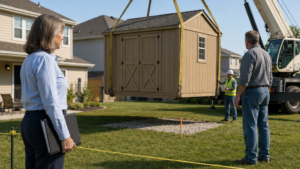
My Neighbor Fastened His Dream Deck to My House, Then the HOA Learned Why I Stayed Silent
Chapter 1: The Hammering Started Before Timothy Opened His Blinds
The first post rose past Timothy Carter’s kitchen window before he had opened the blinds.
It moved upward in short, jerking increments, a square column of pressure-treated wood lifted by unseen hands. For one confused second, Timothy thought a utility crew was working in the side yard. Then a nail gun cracked outside, followed by the heavy knock of a mallet, and the post settled into a hole less than six feet from his breakfast table.
He stood with one hand on the blind cord.
Beyond the glass, two workers crossed the narrow strip between his house and Charles Anderson’s. One carried a level. The other dragged a twelve-foot board through the grass, scraping mud across the concrete pad beneath Timothy’s kitchen window.
The strip had always been awkward. Too narrow for a driveway, too wide to ignore, it held two air-conditioning units, a drainage channel, and the old wooden gate that separated the front yards from the back. Timothy mowed his side. Charles mowed his. Neither had ever needed to discuss the arrangement.
Now six wrapped bundles of lumber lay against Timothy’s foundation.
He opened the back door.
“Morning,” he called.
The worker with the level glanced over. “Morning.”
“What are you building?”
“Deck.”
The man said it as if the answer should have been obvious.
Timothy stepped onto the patio in his slippers. The air smelled of cut pine and damp earth. Four holes had already been dug. Two posts stood upright, braced with diagonal scraps. Chalk lines crossed the ground, disappearing beneath the lumber piles.
“How large?”
The worker pointed toward Charles’s backyard. “From his back steps to about here.”
“Here” was beneath Timothy’s kitchen window.
Timothy looked for the things he expected to see on a job site: a laminated permit card, an approved plan in a plastic sleeve, orange survey flags, even one of the white architectural-review notices the homeowners association required residents to display during exterior work.
There was nothing.
“Did Charles give you a site plan?”
“You’ll have to ask the contractor.”
“Are you the contractor?”
The worker shook his head and lifted the level again, ending the conversation.
Timothy went back inside and put on shoes.
He told himself that Charles had probably submitted everything. Charles liked projects. In five years he had replaced the front landscaping twice, installed permanent landscape lighting, and converted half his garage into a home gym. He spoke about improvements the way other men spoke about weather: constantly, confidently, and without expecting disagreement.
A deck was not surprising.
A deck beneath Timothy’s kitchen window was.
He walked around the front of the houses and knocked on Charles’s door. No one answered. Charles’s SUV was gone, as was his wife’s sedan. Timothy called him and heard the line ring until voicemail picked up.
“Charles, it’s Timothy. There’s a crew working in the side yard. Call me when you can.”
He kept the message neutral. No accusation. No demand.
That was how he handled things now.
Years earlier, when the HOA had approved a row of glaring security lights along the rear fence, Timothy had challenged the decision at three meetings. He had brought diagrams, municipal glare standards, photographs taken from his bedroom, and copies of the association rules. He had been correct, but correctness had not protected him from becoming the man everyone avoided at community gatherings.
His late wife had stopped being invited to two neighborhood lunches during that dispute. She never blamed him. That had made it worse.
After she died, Timothy promised himself that peace mattered more than winning.
Outside, another post rose.
By ten o’clock, the workers had installed a beam running parallel to Timothy’s wall. The lumber no longer looked like the beginning of a small landing. It looked like the spine of a room.
Timothy carried a tape measure into the yard.
He taught technical drafting at the community college and had spent thirty years telling students that drawings existed to keep assumptions from becoming expensive. Measure twice was not merely a workshop slogan. It was an admission that human judgment failed.
He hooked the tape against his foundation and extended it toward the nearest post.
Three feet, nine inches.
He measured again from the center of the drainage channel. Then from the corner of his house to the chalk line. The numbers bothered him, not because he knew the exact boundary, but because he did not.
The original metal survey pin should have been near the gate. He found the depression where he remembered it, but the pin itself was buried or missing. A pale spray-painted mark sat fourteen inches closer to his house.
One of the workers noticed him looking.
“That’s the line,” the man said.
“Who marked it?”
“Charles showed us.”
“Was there a survey?”
The worker shrugged. “Not my department.”
Timothy photographed the mark, the posts, and the tape measure stretched across the grass. He almost called the HOA. Instead, he returned inside and searched his email.
No architectural-review notice.
No neighbor notification.
No request for temporary access.
He opened the HOA portal and found Charles’s property under recent submissions. The page showed nothing, though Timothy knew residents could not always see pending applications.
At eleven, he called Catherine Smith, the community manager. Her voicemail said she was away from her desk. He left a message almost identical to the one he had left Charles.
“There’s construction beside my house. I’m trying to confirm whether the association approved it.”
He avoided the word complaint.
By noon, joists extended from the main beam toward Charles’s house. The workers moved quickly, stepping across the frame as if it had always belonged there. Their boots passed level with the bottom of Timothy’s kitchen window.
Timothy made coffee and stood inside watching them.
A board struck the vinyl siding with a hollow slap. One worker dragged its end along the wall, leaving two shallow gray marks beneath the window. Timothy opened the door again.
“Please keep the lumber off my siding.”
The younger worker looked down at the scuffs. “Sorry.”
He shifted the board away.
It was a small success, and Timothy accepted it too eagerly. He went back inside rather than asking them to stop.
At one thirty, Charles returned.
Timothy saw him cross the front yard carrying a paper bag and speaking into his phone. He did not look toward Timothy’s house. He went through his own front door and emerged five minutes later in work gloves.
Timothy started for the back door, then stopped.
He wanted the plans first. He wanted Catherine to return his call. He wanted the survey pin located and the rule number confirmed. He wanted proof strong enough that Charles could not wave it away as nerves or possessiveness.
Outside, Charles laughed at something the contractor said.
The crew lifted a long ledger board and held it flat against Timothy’s siding.
Timothy moved closer to the window.
The board ran beneath the sill, horizontal and heavy, with evenly spaced holes drilled through it. One worker pressed his shoulder against the wood. Another raised a cordless drill fitted with a long masonry bit.
Timothy’s hand closed around the blind cord.
He told himself they might only be checking the fit.
The drill motor started.
Its high whine cut through the glass, followed by a hard, grinding vibration that traveled through the wall and into the kitchen cabinets.
A cup rattled beside the sink.
Then the bit struck Timothy’s house.
Chapter 2: The Screw Head Beside the Kitchen Window
The wall vibrated beneath Timothy’s palm.
Not the glass. Not the frame. The wall itself.
He crossed the kitchen in three steps and pressed his hand against the drywall beside the window. The vibration came again, deeper this time, followed by the rapid metallic clatter of a driver forcing something tight.
Timothy opened the back door.
“Stop.”
The word came out louder than he intended, but it did what he needed. The drill fell silent.
The younger worker stood on the unfinished frame with the tool still raised. Behind him, the ledger board lay flush against Timothy’s vinyl siding. A bright silver screw head sat in one of the predrilled holes.
Charles turned from the contractor.
“What’s wrong?”
“You’re fastening that to my house.”
Charles looked at the board as though seeing it for the first time. “It’s just a ledger.”
“That ledger is screwed into my wall.”
“It needs support.”
“Then support it from your property.”
The contractor stepped down from the frame. He was broad through the shoulders and wore a pencil behind one ear. “This is how attached decks are built.”
“Attached to the house they serve,” Timothy said. “Not the neighboring house.”
Charles removed one glove with his teeth. “Tim, let’s not make this bigger than it is.”
Timothy looked at the fresh screw. The vinyl around it had puckered inward. Fine white shavings clung to the edge.
“You drilled into my siding without asking.”
“We’ve used this side strip for years.”
“For access.”
“For whatever needed doing.”
“That does not include attaching a structure to my wall.”
Charles let out a breath and glanced toward the street, checking whether anyone was watching. “The old owners treated this as shared space. You know that.”
Timothy did know something about the old arrangement. Before Charles bought the house, the previous owners had occasionally rolled their trash bins through the side strip when their own gate jammed. Timothy had allowed a landscaping crew to cross it during a drainage repair. Once, years ago, he had signed an HOA form allowing access to both exterior walls so the association’s contractor could replace damaged trim.
None of that made Charles’s deck shared.
“Where is the approved plan?” Timothy asked.
“Catherine has the paperwork.”
“Where is the permit?”
“The contractor is handling it.”
The contractor’s face tightened almost imperceptibly.
Timothy noticed.
“Has a permit been issued?”
“We submitted what we needed,” Charles said.
“That isn’t what I asked.”
Charles pulled his glove back on. “The county doesn’t care about every little platform people build.”
“This is already level with my window.”
“It’ll look better once the railing is in.”
Timothy stepped closer to the frame. The gap between the nearest joist and his wall was barely the width of his hand. Beneath the ledger ran the main electrical service conduit toward the meter around the corner. A water shutoff line entered the foundation several feet below.
He pointed. “You don’t know what’s inside this wall.”
The contractor followed his finger.
“There’s electrical service along this section,” Timothy continued. “And the interior water controls are behind that cabinet. Did anyone scan before drilling?”
The contractor looked at Charles. “You said it was a blank exterior run.”
“It is,” Charles replied.
“No,” Timothy said. “It isn’t.”
The younger worker lowered the drill.
“Take the board down,” Timothy said.
Charles’s expression changed. The friendliness left first, then the embarrassment. What remained was a kind of stiff disbelief.
“You’re ordering my crew around?”
“I am withdrawing permission for anyone to enter, attach to, drill into, or use my property.”
“You never objected when we marked it.”
“I didn’t know you intended to build against my house.”
“You watched us all morning.”
Timothy felt the accusation land because part of it was true.
He had watched. He had measured. He had waited for perfect confirmation while the frame rose.
“I should have spoken sooner,” he said. “I am speaking now.”
The younger worker climbed down.
The contractor turned to him. “Hold up.”
Charles pointed at the joists. “We lose the day if you stop.”
“We need to clarify the attachment,” the contractor said.
“There’s nothing to clarify. The HOA arrangement covers this strip.”
Timothy took out his phone and photographed the ledger. He moved close enough to capture the silver screw head, the pucker in the vinyl, and Charles standing behind it.
Charles gave a humorless laugh. “Seriously?”
“Yes.”
“After living next to me for five years, you’re documenting me like I’m some criminal?”
“I’m documenting my wall.”
The distinction seemed to anger Charles more.
The contractor removed his cap and rubbed his forehead. “I’m not putting another fastener in until someone shows me written authorization.”
“Fine,” Charles said. “Take lunch.”
The younger worker set the drill in a tool bag.
For a moment, the side yard became strangely quiet. The unfinished frame cast narrow shadows across the grass. Timothy could hear an air conditioner running two houses away.
Then Charles stepped onto the deck skeleton and crouched beside the ledger.
“You see this?” he said. “If we pull it now, we lose the whole run. The holes are already there. The damage you’re worried about has already happened.”
“That is not permission to continue.”
“It’s permission to solve the problem instead of making it worse.”
“You solve it by removing your board from my house.”
Charles stood. “You always do this.”
Timothy stared at him. “Do what?”
“You wait until everyone has money in the ground, then you appear with rules.”
The old neighborhood dispute flashed through Timothy’s mind: folding chairs in the clubhouse, people lowering their voices when he entered, his wife smiling too brightly as another invitation failed to come.
Charles must have heard some version of it.
“This isn’t about landscape lights,” Timothy said.
“No, it’s about you needing everything measured, stamped, and approved before anyone can breathe.”
The contractor moved between them without quite making it obvious. “Let’s pause and call the HOA.”
Charles shook his head. “No. We are weather-tight by tomorrow or the schedule collapses.”
Timothy looked again at the ledger. “Weather-tight?”
“A storm is coming Wednesday,” the contractor said.
The exposed penetrations would sit behind the board without flashing. Rain could be driven into the wall before anyone resolved the dispute.
Timothy photographed the full length of the ledger.
“Nothing else goes into my house,” he said.
The contractor nodded. “Understood.”
Charles did not.
He walked toward his patio, phone already in hand. Timothy heard him speaking before he reached the door.
“I need another guy this afternoon,” Charles said. “Someone who can finish a ledger.”
Timothy turned back.
The younger worker had heard it too. He looked at the contractor, who closed his eyes briefly.
“You told him to stop,” Timothy said.
“I stopped my crew.”
“That sounded like he was replacing them.”
The contractor lowered his voice. “You need to call code enforcement.”
Timothy studied him.
“Off the record,” the man added, “I was told the property line had been cleared and the HOA had signed off.”
“Did you see the approval?”
“I saw an access document.”
“An access document is not construction consent.”
“I agree with you now.”
Now.
The word followed Timothy inside.
He called Catherine Smith again. This time she answered on the fourth ring.
“Timothy, I got your message. I was about to call.”
“A deck ledger has been screwed into my house.”
There was a pause.
“Into the siding?”
“Through the siding. Possibly into the framing.”
“That shouldn’t have happened before architectural review was complete.”
“So review is not complete.”
“I didn’t say that.”
“Has the HOA approved this deck?”
Catherine exhaled slowly. “Charles submitted materials. There is an older property-access agreement in the file, and the board believed the side-yard issue had been resolved between the homes.”
“Resolved how?”
“I need to pull the full document.”
“Do that now.”
His tone surprised both of them.
Catherine became more formal. “I’ll review the record and contact the board president.”
“Tell Charles to stop construction.”
“The HOA cannot necessarily issue an emergency stop-work order. That may require the municipality.”
“You can tell him the association has not confirmed approval.”
Another pause.
“I’ll call him,” she said.
Outside, a pickup truck stopped at the curb. A man Timothy had not seen before climbed out carrying a drill case.
Charles walked down the driveway to meet him.
“Catherine,” Timothy said, “someone else just arrived.”
“I’m looking at the file now.”
Paper shifted near her phone.
Then she became quiet.
“What?” Timothy asked.
“There’s a signed form attached to the old maintenance record.”
“What form?”
“It has your signature.”
Timothy watched Charles lead the new worker toward the side yard.
Catherine spoke more carefully now.
“According to the file, Timothy, you may already have agreed to shared access along that wall.”
Chapter 3: The Form That Looked Like Permission
Catherine placed Timothy’s signature between them as if it were a tool sharp enough to settle the matter.
The copy lay on the conference table in the HOA management office, slightly crooked beneath the fluorescent lights. At the top, in faded lettering, were the words EXTERIOR MAINTENANCE ACCESS AUTHORIZATION. Timothy recognized the date before he recognized his own handwriting.
Seven years earlier.
His wife had still been alive.
Charles sat at the opposite end of the table with his arms crossed. Catherine occupied the middle seat, positioning herself physically between the homeowners and institutionally outside the conflict.
“The board relied on this when reviewing Charles’s submission,” she said.
Timothy read the first paragraph.
The document authorized association contractors and adjacent owners to enter the narrow side strip for maintenance, drainage correction, exterior inspection, and temporary equipment placement. It had been created when the HOA replaced rotting trim on both houses.
There was no mention of decks.
No structural attachment.
No transfer of property rights.
No permanent construction.
Yet his signature was there, dark and undeniable.
Charles leaned forward. “You see why I thought it was handled.”
“You thought this let you drill into my wall?”
“I thought it confirmed the side area was shared.”
“For access.”
“Shared access.”
“Those are not the same words.”
Catherine raised a hand. “This is exactly why we should avoid making accusations until the documents are interpreted.”
Timothy looked at her. “Was an architectural approval issued?”
“The application is conditionally recorded.”
“That is not an answer.”
“The board believed the access question had already been addressed.”
“Did the board approve attachment to my house?”
Catherine glanced at the form rather than at him. “The construction drawings were not sufficiently detailed on that point.”
Charles shifted. “My contractor submitted a standard deck plan.”
“For your house,” Timothy said.
“It’s beside my house.”
“It is fastened to mine.”
Catherine folded her hands. “We need to lower the temperature.”
Timothy heard the phrase and felt something in him tighten. It was the language institutions used when the facts were becoming inconvenient.
“My wall has holes in it,” he said. “The temperature is not the problem.”
The door opened, and Emily Carter entered carrying a folder and a retractable measuring tape. She had driven across town after Timothy called the night before. She still wore the navy slacks and white blouse she used for client meetings, but her sleeves were rolled above her elbows.
“Sorry,” she said. “Parking.”
Charles looked from her to Timothy. “You brought your daughter?”
“I asked her to read the document.”
Emily sat beside her father without greeting Charles. She pulled the form toward her and read it once, quickly, then again more slowly.
“Where is the deck application?” she asked.
Catherine slid over a second set of pages.
The drawings showed a rectangle behind Charles’s house, with stairs at one end and a railing around three sides. The fourth side was drawn against a blank line marked EXISTING ADJACENT STRUCTURE.
Emily tapped the phrase.
“What structure?”
Catherine said, “The neighboring exterior wall.”
“Then why doesn’t it say Timothy Carter’s residence?”
“The drawing came from the contractor.”
“Who approved it?”
“The committee reviewed the general dimensions.”
“Did anyone notify the owner of the adjacent structure?”
Catherine’s face hardened slightly. “The association does not require neighbor consent for every exterior improvement.”
Emily opened the old form and placed it beside the drawing. Then she took out the measuring tape and laid it across both documents, pinning them flat.
“This form allows temporary entry,” she said. “It does not grant an easement. It does not transfer ownership. It does not permit permanent attachment. It does not authorize structural loading. It does not waive damage claims.”
Charles leaned back. “Are you a lawyer?”
“No.”
“Then this is just your interpretation.”
“It’s the plain language.”
“My interpretation was different.”
Emily looked at him. “Did you ask my father?”
Charles did not answer immediately.
Timothy watched the silence settle.
“I intended to,” Charles said.
“When?”
“Before the finish work.”
Emily gave a short, disbelieving breath. “After the holes?”
“Emily,” Timothy said.
She turned to him. “No. He keeps describing this like paperwork got mixed up. He had someone drill into your house.”
“I know.”
“Then why did you wait all morning?”
The question struck more cleanly because she had not meant to wound him. She was asking what she genuinely could not understand.
Timothy looked down at the measuring tape stretched across the documents.
“I wanted to be certain.”
“You saw the posts.”
“I didn’t know the final design.”
“You saw the line marked in the grass.”
“I couldn’t find the survey pin.”
“You heard the work.”
“I called Charles.”
“After they started.”
Charles’s posture changed. He was listening differently now, not as a defendant but as someone receiving unexpected support.
Catherine noticed it too.
“This delay is relevant,” she said carefully. “The board may consider whether the work proceeded with apparent acquiescence.”
Emily turned on her. “Apparent acquiescence is not permission to penetrate someone’s exterior wall.”
“I am not saying it is.”
“You just suggested it.”
“I said the timeline matters.”
Timothy closed his eyes for a moment.
This was the complication he had created. Not the drill. Not the false boundary mark. But the empty hours in which everyone else had interpreted his silence for him.
“I should have objected when the first post went in,” he said.
Charles nodded once, too quickly.
Timothy looked directly at him. “That does not make the wall yours.”
Charles’s nod stopped.
Catherine gathered the documents into a neater stack. “The HOA’s position is that construction should remain paused while the municipal building department determines whether permits and setbacks are compliant.”
“Remain paused?” Timothy asked. “It resumed yesterday.”
Charles looked at the table.
Emily turned to him. “You kept working?”
“Only bracing.”
“A second worker installed two more fasteners,” Timothy said.
Catherine’s expression sharpened. “After I called you?”
Charles rubbed his jaw. “The ledger was already unstable.”
“Because you put it there,” Emily said.
“I was preventing more damage.”
Timothy almost laughed, but there was nothing humorous in it.
Catherine wrote something on a legal pad. “I’ll issue a written association notice today.”
“A stop-work notice?” Timothy asked.
“A notice of pending compliance review.”
“So not a stop-work notice.”
“The HOA’s enforcement authority is limited until the municipality determines whether a code violation exists.”
“Then call them.”
“You are free to file a complaint.”
The words were politely spoken, but their meaning was plain: the institution would not move first.
Timothy folded the access form and slipped it into his folder.
Charles stood. “Can we at least cover the ledger before the storm?”
“No work on my wall,” Timothy said.
“We need flashing.”
“You should have installed flashing before drilling.”
“If water gets in, you’ll blame me.”
“If your board remains attached, I already will.”
Charles’s face flushed. “You don’t want a solution.”
“I wanted a conversation before construction.”
“You never came over.”
“I called you.”
“One voicemail after the crew was already there.”
Timothy felt Emily shift beside him.
Charles was wrong about the wall, the permit, and the deck. But he was not wrong about Timothy waiting.
That distinction was harder to carry than simple anger.
At home, Emily spread the documents across the dining table. The measuring tape remained between them, its yellow blade extended to fourteen inches because she had been estimating the distance shown on the plan.
“You need to call the city,” she said.
“Municipality.”
“Fine. Municipality.”
“I will.”
“Today.”
“Yes.”
She studied him. “Dad.”
“I said I will.”
“You always wait until you can make the perfect case.”
“That is not unreasonable.”
“It is when the thing you’re documenting is still happening.”
He looked toward the kitchen.
The afternoon had darkened. Rain pressed against the windows in scattered drops, not yet heavy. Beyond the glass, the ledger board remained fixed beneath the sill.
Emily followed his gaze.
“You think Mom wanted you to let people do this?”
He turned sharply. “Don’t use her.”
“I’m not using her.”
“You didn’t live here after the lighting fight.”
“I lived through it with you.”
“You went home at the end of the weekend. She stayed.”
Emily’s expression changed.
Timothy immediately regretted the words, but neither of them withdrew.
His wife had hated conflict, but she had hated humiliation more—the subtle exclusions, the neighbors who stopped waving, the way ordinary errands became social calculations. After her funeral, Timothy had found an invitation to a garden luncheon tucked inside a cookbook, never sent to her because the gathering occurred during the height of the dispute.
He had promised himself he would never again be the cause of that kind of isolation.
Now his daughter stood across from him, waiting.
“I thought staying quiet protected something,” he said.
“What did it protect yesterday?”
Before he could answer, a soft tapping came from the kitchen.
Not the sharp sound of construction. Something irregular.
They found a thin line of water beneath the window trim.
One drop gathered at the corner, trembled, and ran down the painted wall.
Timothy touched it with two fingers. The water was cold.
Outside, rain darkened the ledger board. No metal flashing covered its upper edge. Water slid behind the wood where the screws had pulled the siding inward.
Emily stared at the damp streak.
Timothy took out his phone and called the municipal building department.
As the line rang, another drop appeared.
Then another.
Chapter 4: Six Violations and One Convenient Silence
The building inspector’s first question was not whether the deck had a permit.
He stood in the narrow side yard with one hand resting on his clipboard and looked directly at the ledger beneath Timothy’s kitchen window.
“Who authorized attachment to this wall?”
Charles answered before Timothy could.
“The homeowners association has a shared-access agreement on file.”
The inspector turned his head toward him. “That wasn’t my question.”
By eight thirty Wednesday morning, the storm had passed, leaving the lumber dark and the grass flattened beneath the deck frame. Water still clung to the lower edge of Timothy’s window. Inside, Emily had taped a clear plastic sheet over the damp section of wall so they could tell whether the stain spread.
Timothy held a folder against his chest. It contained the access form, photographs of every visible screw, screenshots of his unanswered calls, and a written timeline beginning with the moment the first post rose past his blinds.
Charles stood beside the contractor. Catherine had arrived in low heels unsuitable for the mud and kept stepping from one dry patch to another. She carried the HOA file in a leather portfolio.
The inspector crouched near the ledger.
“No flashing,” he said.
The contractor cleared his throat. “We hadn’t finished that section.”
“You covered the attachment with the board before installing any.”
“We were going to membrane over the top.”
“That doesn’t protect penetrations already behind the ledger.”
The inspector used a small flashlight to examine the puckered siding. Then he looked through Timothy’s photographs, pausing at the image taken after the first screw and again at the image showing three additional fasteners.
“You objected before these later fasteners were installed?”
“Yes,” Timothy said.
Charles shifted his weight. “The board was unstable.”
The inspector wrote something.
Charles stepped closer. “I’m not trying to interfere, but the sequence matters. He watched the crew for hours. We had every reason to think the side-yard issue had been approved.”
Timothy could feel Emily watching him from the patio.
He had decided before the inspector arrived that he would not hide his delay.
“I saw the posts that morning,” Timothy said. “I measured the distance and tried to contact Charles and the HOA. I did not clearly order the work stopped until the ledger was placed against my house.”
The inspector looked up.
“Why not?”
“I wanted confirmation before accusing anyone.”
Charles gave a soft, frustrated laugh. “Exactly.”
Timothy continued. “That delay was my mistake. It was not consent to drill into my wall.”
The inspector held his gaze for a moment, then wrote again.
Catherine opened her portfolio. “The association’s concern is that the existing access language created understandable confusion.”
“Confusion about entering the strip,” the inspector said. “Not about fastening a load-bearing structure to another residence.”
Catherine’s lips pressed together.
The inspector asked the contractor for the approved plans. The contractor handed him a folded drawing set in a plastic sleeve. The inspector opened it across two joists and held the corners down with his tape measure and clipboard.
The permit box was blank.
“Application number?” he asked.
The contractor looked toward Charles.
Charles said, “It was submitted.”
“To whom?”
“The county portal.”
“This municipality issues its own residential construction permits.”
“I was told county.”
The contractor spoke quietly. “I told you we needed local confirmation.”
“You said the standard plan was enough to start layout.”
“Layout. Not structural attachment.”
The inspector folded the top page back. “There is no permit associated with this address.”
Charles’s face lost color, but only briefly. “Then we can file one today.”
“That depends on whether the design can comply.”
The inspector extended his measuring tape from Timothy’s foundation to the nearest post. He measured once, moved the hook, and measured again. Then he asked where the property line was.
Charles pointed to the pale spray mark in the grass.
“Survey marker?”
“It was based on the old fence position.”
The inspector looked toward Timothy.
“The metal pin should be near the gate,” Timothy said. “I couldn’t locate it.”
“Was a survey performed for this project?”
No one answered.
The inspector walked to the gate and pushed the tape’s steel blade through the wet grass. It clicked against something buried. He scraped mud away with the edge of his boot until a rusted metal pin appeared several inches below grade.
He stretched the tape from the pin toward the house.
The yellow blade crossed beneath the deck frame and stopped beyond Charles’s chalk line.
“Fourteen inches,” he said.
Charles frowned. “Fourteen inches what?”
“Your marked line is fourteen inches onto the adjacent parcel.”
The contractor looked down at the post nearest Timothy’s foundation.
It stood on the wrong side.
For the first time since construction began, Charles did not have an immediate answer.
The inspector photographed the measurement. The tape lay taut across the mud, bright and exact, dividing assumption from ownership.
Catherine stepped closer to the plans. “Could the post be relocated?”
“Possibly,” the inspector said. “But that doesn’t resolve the setback.”
He measured from the confirmed boundary to the deck edge, then consulted a digital code reference on his tablet.
“Required side setback is five feet for an elevated platform of this height unless a variance is approved.”
“How far are we?” Charles asked.
“Less than two feet at the closest point.”
The inspector moved through the structure methodically.
No permit.
Unverified and incorrect boundary placement.
Insufficient setback.
Improper attachment to an adjacent residence.
Missing flashing and water protection.
Missing joist hangers at several connections.
He counted each one without drama, and that made the list feel heavier.
At the stairs, he tapped a joint where a joist rested on screws rather than approved hardware.
“This connection cannot carry the designed load safely.”
The contractor said, “We hadn’t installed all the hangers.”
“Then it should not have been loaded.”
“No one was using it.”
“You and your crew are standing on it.”
The contractor stepped off.
Charles remained on the frame until the inspector looked at him. Then he climbed down as well.
Timothy had expected satisfaction. He had imagined the simple relief of hearing an official confirm that the deck was wrong.
Instead, he saw the wet lumber, the holes in his wall, and the post buried on his property. Validation did not reverse any of it.
The inspector filled out a notice on his clipboard.
“Work is suspended effective immediately. No additional construction, covering, or modification without written authorization.”
He tore off the top sheet and handed it to Charles.
“What about weather protection?” Charles asked.
“A licensed contractor may install temporary protection under direction of the property owner whose wall was penetrated.”
Every face turned toward Timothy.
He felt the shift. For days, other people had treated his house as a surface around which they could negotiate. Now the decision was his, and even that power felt like another burden.
“The original contractor may remove the ledger and install temporary waterproofing,” Timothy said, “if I am present and no new holes are made.”
The contractor nodded. “That’s reasonable.”
Charles stared at the violation notice.
“Can we redesign and salvage the rest?” he asked.
The inspector looked at the frame. “You can submit a detached plan with a certified survey and proper setbacks. Whether any existing components remain will depend on engineering review.”
“So it doesn’t all have to come down.”
“I did not say that.”
“But it might not.”
The contractor studied the joists. “We could potentially shift the platform toward your house and rebuild the outer support line.”
Timothy turned toward him. “Toward Charles’s house.”
“Yes.”
“And remove everything crossing the boundary.”
“Yes.”
Charles seized on the possibility. “There. We can fix it.”
The inspector held up a hand. “Nothing is fixed until plans are approved. The association’s document does not replace municipal consent, and municipal approval does not give you rights over neighboring property.”
Catherine closed her portfolio. “The HOA will cooperate with revised plans.”
Timothy looked at her. “Will it also explain why the original application was allowed to proceed?”
“The application did not authorize this exact construction.”
“Then what did it authorize?”
She did not answer.
The inspector walked around the corner of Timothy’s house to examine the electrical meter. Timothy followed him. A gray conduit ran vertically near the corner, then disappeared behind the siding toward the kitchen.
The inspector measured from the corner to the nearest screw shown in Timothy’s photograph. He returned to the ledger and placed the tape against the wall.
His expression changed.
“Which fastener was installed last?” he asked.
Timothy pointed to the screw nearest the end of the board.
The inspector crouched and marked its position with a pencil on the siding.
“What is it?” Emily asked.
He stood and looked toward the meter again.
“That fastener may be within the service pathway.”
Charles lowered the notice.
The inspector reached for his phone.
“No one touches this board,” he said, “until the electrical location is confirmed.”
Chapter 5: The Reason Charles Refused to Stop
Charles arrived at Timothy’s front door Friday evening without gloves, paperwork, or anger.
He stood beneath the porch light with both hands visible and said, “Give me ten minutes before you decide I’m a complete idiot.”
Timothy considered refusing.
Behind Charles, the unfinished deck sat under orange safety netting. The municipality had allowed the contractor to remove the ledger after an electrician confirmed that the nearest screw had missed the service cable by less than two inches. Temporary membrane now covered the holes, black against the pale siding.
The deck frame remained standing on Charles’s side, but one corner sagged where the encroaching post had been removed.
“Ten minutes,” Timothy said.
They crossed the yard to Charles’s driveway, where the contractor had spread revised sketches across the hood of his truck. A folding wheelchair ramp leaned against the garage wall.
Timothy stopped when he saw it.
Charles followed his gaze.
“My wife’s father had a stroke in March,” he said. “He’s leaving rehabilitation next month.”
The contractor looked away, giving Charles the privacy to continue.
“He can walk a little with support, but stairs are difficult. We wanted somewhere he could sit outside without going through the yard.”
Timothy looked toward the rear of Charles’s house. The back door opened onto three narrow concrete steps. The proposed deck would have raised the outdoor surface nearly level with the kitchen.
“You could have told me,” Timothy said.
“I should have.”
“Before construction.”
“I know.”
The words lacked the resistance Timothy had come to expect.
Charles tapped the revised drawing. “The contractor thinks we can build detached, shift everything inward, and add a ramp along the back fence. Smaller platform. No connection to your wall.”
“Within the setback?”
“We’d need a variance for part of the ramp.”
“That is not approval.”
“No. It isn’t.”
Timothy studied him.
Charles’s face looked older than it had on Monday. There were dark crescents beneath his eyes. A county violation notice was taped inside his front window, visible from the street.
“I paid a deposit based on Monday’s start,” Charles said. “The lumber was ordered. The family visit was scheduled. Every delay costs more.”
“That explains why you wanted speed.”
“It explains more than that.”
Charles pressed his palms against the truck hood.
“My wife told her father we’d have it ready. I told her I had everything handled. Permits, HOA, contractor—all of it.”
“But you didn’t.”
“No.”
The contractor stepped farther down the driveway.
Charles lowered his voice. “When you came outside, I already knew the wall attachment might be a problem.”
Timothy felt the admission settle between them.
“You knew.”
“The contractor asked whether we had written consent. I told him the access form covered it.”
“You knew it might not.”
“I thought if we got the frame up, nobody would make us tear it apart over one board.”
“One board attached to my house.”
“I know what it was.”
“Do you?”
Charles looked at the temporary black membrane beneath Timothy’s window.
“Yes.”
There was no apology yet. Only recognition.
Timothy wanted to hold on to the clean version of the conflict: Charles arrogant, Timothy reasonable, officials correcting the obvious wrong. The wheelchair ramp complicated that picture, but it did not change the screw holes.
“My delay did not give you permission,” Timothy said.
“I know.”
“And your father-in-law’s condition did not make my house available.”
“I know that too.”
The contractor returned and pointed to the revised plan. “Detached footings here, here, and here. The existing outer beam may be reusable if the engineer signs off. Most of the joists will have to be cut or replaced.”
“How much?” Timothy asked.
Charles answered before the contractor could. “More than I have available right now.”
The original deposit, permit review, electrician, survey, and partial demolition had consumed most of the renovation loan. Full removal plus professional siding repair would exceed the remaining balance.
“What are you asking me for?” Timothy said.
Charles took a breath.
“Approve a redesigned attachment. Not to your wall. A freestanding support line six inches away, with maintenance access between. If you sign neighbor consent, the variance process may move faster.”
Timothy looked at the drawing.
The new support posts would not touch his house, but the deck edge would still crowd the wall and restrict access to the siding. Future repairs would require Charles’s cooperation. The same ambiguity would remain, made more respectable by fresh paperwork.
“No.”
Charles’s jaw tightened, then relaxed.
“You didn’t even think about it.”
“I have been thinking about six inches all week.”
“It would let us save most of the frame.”
“And make my access dependent on your deck.”
“We could write protections into the agreement.”
“You had a written access agreement before. Look what you believed it allowed.”
Charles stepped back from the truck.
For a moment Timothy expected the old defensiveness to return. Instead, Charles folded the revised drawing once and handed it to the contractor.
“Then price full detachment,” he said.
The contractor nodded.
Charles looked toward Timothy’s house. “I can’t pay for full removal and your siding repair at the same time.”
“The wall comes first.”
“I figured you’d say that.”
“It is already taking water.”
“I know.”
Charles’s wife appeared briefly in the garage doorway. She looked at the wheelchair ramp, then at the men, and went back inside without speaking.
Timothy understood then that Charles’s urgency had not been invented after the inspection. It had been present from the beginning, hidden beneath his certainty and pride.
Understanding it did not require surrendering to it.
“I’ll allow scheduled access for repair,” Timothy said. “And I won’t object to a compliant detached plan.”
Charles looked at him.
“But I will not sign away access to my own wall, and I will not accept partial repair so you can preserve the deck.”
The contractor closed his plan tube.
Charles nodded once. It was not gratitude, but it was the first answer he had given without trying to reshape Timothy’s boundary.
When Timothy returned to his kitchen, evening light had faded from the room. The temporary membrane outside made the window look bruised. Two screw holes remained visible at its edge where the siding had been removed for inspection.
His phone rang.
Catherine’s name appeared on the screen.
“I spoke with the board president,” she said. “The association may be able to fund immediate exterior repairs.”
“That would be useful.”
“There are conditions.”
Timothy pulled out a chair.
“What conditions?”
“We would resolve your property-damage claim privately. The association would coordinate the contractor, Charles would contribute under a payment schedule, and the HOA would cover the difference.”
“And?”
A pause.
“The agreement would include confidentiality and a mutual release regarding the architectural-review process.”
Timothy looked through the dim kitchen toward the two holes beside the window.
“So the wall gets repaired,” he said, “if I agree not to explain how it was damaged.”
Chapter 6: The Settlement Required Timothy to Stay Quiet
The confidentiality clause occupied less than half a page.
It was paragraph eleven of the settlement agreement, positioned between the payment schedule and the mutual release. Timothy read it twice while the HOA board waited across the conference table.
The association would arrange immediate professional siding repair. Charles would repay part of the cost over twelve months. Timothy would waive claims for punitive damages and future action related to the deck application.
In return, he would agree not to discuss the dispute, the review process, the access form, or any internal HOA communication with other residents.
Catherine sat beside the board president with a yellow legal pad in front of her. Charles occupied a chair near the wall, separate from both sides. Emily sat next to Timothy but had not spoken since the meeting began.
The board president folded his hands.
“This gives everyone certainty.”
Timothy touched the siding sample he had brought in a paper bag. The repair contractor had removed it from beneath the kitchen window that morning. Two round holes punctured the pale vinyl. Around each one, the surface bent inward like damaged skin.
He placed it on the table.
The board president glanced at it, then back at the agreement.
“We understand the situation has been upsetting.”
“It is not an emotion problem,” Timothy said.
“No one suggested that.”
“The agreement pays to repair my house but requires me to conceal why the repair became necessary.”
“It prevents further neighborhood conflict.”
Catherine shifted in her chair.
Timothy noticed.
“Did you write this clause?” he asked her.
“The association’s attorney prepared the document.”
“That wasn’t my question.”
The board president intervened. “Staff communications are not relevant to the settlement.”
“They are if staff warned the board that the access form was unclear.”
Charles looked up.
Catherine’s pen stopped moving.
Emily leaned slightly toward Timothy but remained silent.
The board president’s expression tightened. “There was no formal determination that the form was defective.”
“Was there an informal one?”
Catherine looked at the legal pad. “I raised concerns last year.”
The room changed.
Charles pushed away from the wall. “Last year?”
Catherine’s voice remained professional, but the effort showed now. “During another exterior-maintenance request, I recommended that the association distinguish temporary access from permanent construction rights.”
“And the board didn’t?” Timothy asked.
“The issue was deferred.”
“Why?”
The board president answered. “Because revising historic agreements could create liability and require legal review across multiple properties.”
Timothy looked at the access form in the folder before him. Seven years of ambiguity had been cheaper than seven years of correction—until someone drilled through a wall.
Charles stared at Catherine. “You knew the wording could be misread.”
“I knew it could create questions.”
“You told me it supported shared use.”
“I told you the file showed shared access.”
“You knew what I was building.”
“I did not know your contractor intended to attach the ledger to Timothy’s residence.”
Charles gave a short laugh without humor. “The drawing said adjacent structure.”
“The drawing was incomplete.”
“And you processed it.”
“Conditionally.”
The word sounded smaller each time it was used.
The board president placed one hand over the agreement. “This is precisely why settlement is appropriate. Responsibility is distributed.”
Timothy considered that sentence.
Responsibility was distributed. Charles had chosen speed over consent. The contractor had begun work without confirming local permits. Catherine had relied on ambiguity she already distrusted. The board had postponed clarification to avoid cost.
And Timothy had watched the first post rise while waiting for proof no reasonable person should have needed.
He picked up the pen.
Emily turned toward him.
Charles lowered his eyes.
Timothy crossed out paragraph eleven.
The sound of the pen against paper was faint, but everyone heard it.
“I will accept immediate repair,” he said. “I will waive punitive claims. I will allow Charles a payment schedule, and I will not object to a compliant detached deck.”
The board president’s mouth tightened.
“But I will not agree to confidentiality.”
“That clause is material,” he said.
“So is the wall.”
“Without confidentiality, the association cannot guarantee approval of the funding.”
“Then do not describe it as repair assistance. Describe it as payment for silence.”
Catherine looked at the siding sample.
The board president turned to Charles. “Mr. Anderson, are you prepared to proceed if the association does not contribute?”
Charles rubbed both hands over his face.
“No,” he said. “Not all at once.”
The admission was quiet.
Timothy felt the choice closing around them. If he refused every compromise, repairs might be delayed while claims moved through insurance and legal review. Rain had already entered the wall. The deeper he pushed for punishment, the longer his own house remained exposed.
He did not want revenge.
He wanted the damage stopped and the rule changed.
“What can you pay now?” Timothy asked Charles.
Charles named an amount.
It was not enough for full removal and repair, but it covered the siding contractor’s deposit and the certified survey.
“The association covers temporary waterproofing and the balance of immediate wall repair,” Timothy said. “Charles reimburses the association under the proposed schedule. Removal begins before any redesigned application is considered.”
The board president shook his head. “You are dictating terms outside the document.”
“Yes.”
“You may not have the leverage you believe you do.”
Timothy pushed the siding sample toward the center of the table.
“Then reject them in writing.”
Silence followed.
Catherine turned to the board president. “The insurance deductible alone may exceed the repair balance.”
He looked at her.
“And if the claim expands,” she continued, “the insurer will request the architectural-review history.”
The board president’s expression did not change, but Timothy saw the calculation.
Catherine had not become an ally. She was protecting the association. Yet for the first time, self-protection required truth rather than delay.
Charles stood and walked to the table.
“I’ll sign the payment schedule,” he said. “And I’ll remove the deck.”
The board president looked at him sharply. “You should consult counsel before making that commitment.”
“I’ve consulted enough people who told me what I wanted to hear.”
Charles placed his hand near the damaged siding sample but did not touch it.
“I kept going after Timothy told me to stop,” he said. “That part is mine.”
Timothy studied him.
The statement did not erase the holes. It did not restore trust. It did something smaller and more useful: it removed the last excuse.
The board president requested a recess.
He and Catherine stepped into the hallway. Through the glass wall, Timothy could see them speaking in low voices. Catherine pointed once toward the agreement, then toward the siding sample.
Emily finally spoke.
“You’re giving up the damages claim.”
“I’m giving up punitive damages.”
“You could make them answer for more.”
“They are answering.”
“Not publicly.”
Timothy looked at the crossed-out clause.
“They will.”
Ten minutes later, Catherine returned alone.
“The board will authorize immediate repair funds without confidentiality,” she said. “The mutual release will apply only after the siding contractor confirms completion and the municipality closes the wall-related violations.”
“And the rule?”
“The board will place adjacent-property consent standards on next month’s agenda.”
“No.”
Catherine blinked. “No?”
“Not next month. Before any revised deck application from Charles is reviewed.”
Charles nodded. “That’s fair.”
Catherine looked through the glass toward the board president, then back at Timothy.
“I can include that condition.”
Timothy signed the revised repair agreement.
Charles signed the payment schedule.
Catherine initialed the deletion of paragraph eleven and wrote a new provision requiring removal of every deck component crossing the certified boundary before reconstruction review.
When they finished, Timothy placed the pen beside the siding sample.
The holes remained open and dark.
But they were no longer private.
Outside the meeting room, Charles paused beside him.
“I don’t expect you to forgive me,” he said.
“I’m not deciding that today.”
Charles accepted the answer.
The next morning, a removal permit appeared in the municipal portal. Beneath it was the contractor’s schedule: dismantling would begin Monday, with Timothy’s wall opened for inspection immediately afterward.
Timothy printed the page and set it beside the kitchen window.
For the first time since the post had risen past his blinds, the next sound from the side yard would not be construction.
It would be the deck coming apart.
Chapter 7: The Holes Were Repaired but Not Erased
The first board came away from Timothy’s house with a groan of wet wood and a sudden spray of trapped sawdust.
He stood in the kitchen doorway while the removal crew supervisor eased the ledger outward with a pry bar. The board resisted at one end, bowed in the middle, then released from the temporary fasteners installed during waterproofing.
For three weeks, it had occupied the space beneath the window like an accusation.
Now it lay across two sawhorses in the side yard.
Behind it, the wall looked worse than Timothy had imagined and better than he had feared.
Several pieces of siding had been removed, exposing the pale house wrap beneath. Dark rings surrounded the screw penetrations. One section of sheathing showed a damp stain no wider than Timothy’s hand. The repair contractor pressed a moisture meter against it and waited for the reading.
Emily stood beside Timothy with her arms folded.
“Well?” she asked.
The contractor checked a second spot. “Elevated, but not saturated. We caught it before it spread into the insulation cavity.”
Timothy released a breath he had not realized he was holding.
“If that rain had lasted another day,” the contractor added, “we might be opening the interior wall too.”
Emily looked at her father.
He knew what she was thinking. Another day of waiting. Another morning spent looking for perfect proof.
“I know,” he said.
She did not press him.
Outside, the removal crew worked backward through the project. Joists that had risen in minutes came down one at a time. Screws rattled into a metal bucket. The orange safety netting sagged as each support disappeared.
Charles remained near his garage. He did not supervise the crew or argue about what could be saved. When the surveyor arrived, Charles walked down the driveway to meet him and signed the final invoice on the hood of the truck.
Timothy saw him take out a personal checkbook.
Catherine had offered to have the HOA process the survey cost through the settlement account. Charles had declined.
When the surveyor left, Charles crossed the lawn carrying the receipt.
“This is paid,” he said.
Timothy accepted the paper. “Thank you.”
Charles glanced toward the exposed wall. “How bad?”
“Limited moisture. No interior replacement.”
“That’s good.”
“Yes.”
Neither man said that it could have been much worse.
The crew removed the post that had stood fourteen inches beyond the property line. Mud clung to its buried end. The empty hole remained for several minutes before a worker filled it with compacted soil.
Timothy watched the boundary disappear beneath ordinary grass.
A line could be legally exact and visually invisible. That was why people marked it, measured it, and sometimes convinced themselves it belonged somewhere more convenient.
The HOA’s revised rule arrived by email that afternoon.
Any exterior improvement within ten feet of an adjacent residence now required a certified site plan. Permanent attachment to a neighboring structure required separate written consent identifying the exact construction. Temporary access agreements could not be interpreted as easements, structural permission, or waiver of property rights.
Catherine had also added a mandatory neighbor-notification period before work could begin.
Emily read the policy on Timothy’s tablet.
“You got everything you asked for.”
“Not everything.”
She looked toward the damaged wall.
“No,” she said. “Not everything.”
The siding contractor replaced the wet sheathing section and sealed each penetration. He installed new house wrap, flashing tape, and insulation before fitting replacement vinyl panels beneath the window.
The manufacturer still produced the same pattern, but seven years of sun had softened the color of Timothy’s existing siding. The new pieces were slightly brighter.
From the yard, the difference was difficult to see.
From Timothy’s kitchen, it was obvious.
The repaired section formed a pale rectangle beneath the window, and two faint dimples remained where the deepest screws had compressed the material behind it.
The contractor offered to replace the entire side wall for a uniform match.
“It would be cosmetic,” he said. “The agreement covers localized repair, but we can price the rest.”
Timothy studied the clean new panels.
“No,” he said. “This is enough.”
Emily waited until the contractor left.
“You’re sure?”
“It is sealed. It is structurally sound.”
“That wasn’t what I asked.”
Timothy touched one of the faint depressions.
For years, he had believed peace meant returning things to the way they had looked before conflict. No visible mark. No story anyone could point to. No reason for neighbors to lower their voices when he approached.
But the old version of the wall no longer existed.
Neither did the old version of the relationship next door.
“I don’t need it erased,” he said.
Emily nodded slowly.
A week later, Charles submitted a new plan.
The replacement deck was smaller, fully detached, and shifted toward the center of his backyard. A ramp ran along the rear fence with a landing wide enough for a wheelchair to turn. The certified survey showed every footing inside Charles’s property and every setback measured from the correct line.
Timothy received the notification before the HOA committee reviewed it.
He read every page.
Then he signed the acknowledgment—not consent, not shared access, only confirmation that he had received the plan.
Charles began work the following Monday.
At eight fifteen, Timothy heard the hollow chop of a shovel entering soil. He looked through the kitchen window and saw two workers marking the first footing. Charles stood beside them holding a rolled drawing.
The hole appeared too close to the survey stake.
Perhaps it was only the angle. Perhaps the worker had not yet centered the mark. Perhaps the approved dimension was measured from the footing edge rather than the post center.
Timothy felt the old instinct return.
Wait.
Measure from inside. Check the digital plan. Call Catherine. Make certain before speaking.
The worker raised the shovel again.
Timothy opened the back door.
“Hold on.”
All three men looked toward him.
He crossed the side yard carrying his measuring tape. Charles watched him approach, guarded but not angry.
Timothy hooked the blade over the survey stake and extended it toward the painted footing mark.
The measurement was short by eight inches.
The worker checked the plan. “You’re right. I measured from the wrong reference.”
He moved the mark inward.
No argument. No damaged wall. No money already buried in the ground.
Charles unrolled the drawing across a stack of lumber and held one corner down.
“Do you want to look at the rest before we dig?” he asked.
Timothy considered the question.
Three weeks earlier, Charles would not have asked. Three weeks earlier, Timothy might have refused to answer until refusal no longer mattered.
He stepped beside the plan.
“Yes,” he said. “Show me where the ramp turns.”
Charles pointed to the rear landing. Timothy checked the dimensions, then the setback, then the clearance along the property line.
The numbers held.
When he returned to his kitchen, the new siding beneath the window caught the morning light. The slight color difference remained. So did the two faint depressions.
Timothy raised the blinds all the way.
Outside, the workers moved the first post to its correct position before lowering it into the ground.
The story has ended.