They Tore Down the Fence He Built, Then Learned the Boundary Had Been Recorded for Thirty-One Years
Chapter 1: The Excavator Crossed the Silver Cedar Line
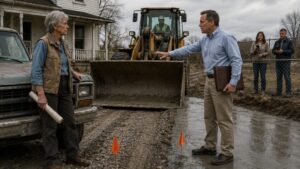
The excavator bucket closed around the first cedar panel before Jack Wilson reached the edge of his yard.
Metal teeth crushed the top rail. Weathered boards bowed, snapped, and vanished beneath the bucket with a sound like dry bones breaking. The operator lifted the wreckage, swung it over the trench, and dropped it onto a muddy heap of roots, form lumber, and torn grass.
Jack stopped halfway down the slope.
For twenty-two years, the fence had run through the pines in a straight silver line. That morning, it ended in midair.
“Shut it down!” he called.
The operator either did not hear him or chose not to. The diesel engine growled, and the bucket reached for the next section.
Jack moved faster. His boots slid in damp soil as he crossed the strip of lawn between his house and the construction site. Men in orange vests looked up from the wooden concrete forms. One of them raised a hand toward the excavator. The engine dropped to an idle.
Gregory Clark came around the rear corner of his house holding a rolled set of plans.
“What’s going on?” Gregory asked.
“You tell me.”
Jack pointed at the broken fence. Three posts had already been pulled from the ground. One lay on its side with a plug of dark soil still clinging to the concrete footing.
Gregory looked from the debris to the orange string stretched between two stakes several feet inside Jack’s grass.
“The fence was in the construction area.”
“That is my fence.”
“The line is marked.”
Jack looked more closely at the orange string. It ran parallel to the old fence line but not on it. At the widest point, it sat nearly four feet into his yard.
“Who marked it?”
“The contractor.” Gregory unrolled the plans against his thigh. “The HOA approved the addition. The county approved it. We’re not guessing out here.”
Jack stepped over a broken rail. Cedar splinters covered the mud like pale straw.
“That fence was built on the surveyed boundary.”
Gregory’s mouth tightened. “Then it shouldn’t be inside the markers.”
For a moment Jack imagined taking the plans from Gregory’s hands and laying them across the wreckage. He imagined forcing him to look at the posts, the holes, the straight path the fence had followed long before Gregory bought the neighboring house.
Instead, he said, “No one notified me.”
“The contractor said he spoke to the adjoining owner.”
“He didn’t speak to me.”
Behind Gregory, the foreman shifted his weight. “We knocked twice Friday.”
“I was home Friday.”
The foreman glanced away.
Jack walked to the nearest surviving panel. The boards had faded from brown to gray, except where the top rail had protected a thin stripe of original color. He placed his palm against the rough grain.
He had bought the cedar in three loads because his old pickup could not carry it all at once. He had measured every post twice. The lumber alone had cost more than eight hundred dollars, money he and his wife had saved through an entire winter.
It had never been decorative. It kept dogs out, marked the western edge, and gave the narrow yard a shape that felt settled.
Gregory tapped the rolled plans against his leg. “We can discuss replacing it after the work is finished.”
“You don’t finish work on my land and discuss it afterward.”
“Jack, I have a concrete crew scheduled. The forms are already set.”
That was when Jack noticed the trench.
Fresh wooden forms extended beyond the corner of Gregory’s house toward the orange line. Muddy reinforcing steel lay inside them. At one point the forms crossed the path where Jack’s fence had stood.
The concrete had not been poured, but the ground was already opened.
Jack crouched beside the debris and lifted a board from beneath a bent rail. One end had split. Near the other, faint pencil lines crossed the grain, each accompanied by a number written in small block figures.
He brushed away cedar dust with his thumb.
The marks were his. At least some of them were. But beside the number sixty-four was a short curved stroke that was not his handwriting.
He knew whose it was.
Jack slid the board away from the mud and carried it under his arm.
Gregory watched him. “What are you doing?”
“Keeping what belongs to me.”
“No one is trying to steal your lumber.”
Jack looked at the orange string. “That’s not the part I’m worried about.”
The foreman cleared his throat. “We need to know whether we’re working.”
“You’re not touching another fence panel,” Jack said.
Gregory’s expression hardened. “The HOA approval is posted in my kitchen. The county permit is in the job box. If you want to challenge the boundary, challenge it. But you don’t get to stop a permitted project because an old fence was in the wrong place.”
Jack felt the familiar pressure behind his ribs—the moment when words crowded together and became more dangerous than silence. He had spent years believing that refusing to argue was a kind of discipline. Most disputes exhausted themselves if he stepped back far enough.
But the excavator was still idling beside the remains of his fence.
“Show me the survey,” he said.
Gregory pointed at the orange stakes. “You’re looking at it.”
“No. Show me the signed survey.”
“The contractor has the documentation.”
“Then ask him for it.”
Gregory exhaled sharply. “I don’t have time for this.”
Jack nearly answered that the fence had stood there for twenty-two years and had not asked Gregory for an hour. Instead, he turned toward the road.
“Where are you going?” Gregory called.
“To find out what your permit actually approves.”
At his truck, Jack placed the salvaged board carefully across the passenger seat. Cedar dust drifted onto the dark upholstery. He drove to the county offices with the windows cracked, carrying the sharp, dry scent of broken wood with him.
The planning department occupied the ground floor of a low brick building beside the courthouse. A clerk entered Gregory’s address into a computer, found the permit, and pulled up a digital site plan.
Jack leaned over the counter.
The drawing showed the Clark house, the proposed rear addition, setback measurements, and a thick line representing the western property boundary.
“Can you enlarge that?” Jack asked.
The clerk zoomed in.
Jack placed one finger beside the approved footing. “That’s the addition?”
“Yes.”
“And that is the property line?”
“According to the submitted plan.”
He pictured the orange string in the grass.
“How far does the foundation stop from that line?”
The clerk used the scale tool, then frowned.
“Eight inches.”
“Inside Gregory’s property?”
“Yes.”
Jack took out his phone and showed her a photograph of the forms and orange string. The clerk studied it, turning the screen slightly to reduce the glare.
“That line outside doesn’t match this footprint,” she said.
“Could the approved plan be wrong?”
“It could be based on bad information. We don’t establish private boundaries here.”
“But that orange line is not where this permit says the foundation should end.”
The clerk looked again at the photograph.
“No,” she said. “It isn’t.”
Chapter 2: The Permit Ended Before the Orange String
On the county plan, Gregory’s addition stopped eight inches before a boundary line that did not exist in Jack’s yard.
Jack stared at the screen until the clerk asked whether he wanted a certified copy.
“I want everything submitted with the permit.”
“That may take a few minutes.”
“I’ll wait.”
She disappeared through a door behind the counter. Jack set the salvaged board across his knees and ran his thumb over the pencil marks. Cedar dust had transferred to the cuff of his shirt and the folder he had brought from his truck.
When the clerk returned, she carried a stapled packet and a larger plat folded into quarters.
“Site plan, building footprint, setback certification, architectural approval, and the county plat referenced by the applicant.”
“Is there a survey?”
“There’s a boundary-verification statement.”
She turned to the last page. The document bore the contractor’s letterhead and a typed declaration that the proposed work had been located according to visible markers and information supplied by the owner.
Jack looked at the signature.
“Who qualifies as a surveyor?”
“The state licenses land surveyors.”
“And this man?”
The clerk checked the name in the permit record. “General contractor.”
“There’s no seal.”
“No.”
“No coordinates either.”
“No.”
Jack folded the packet closed. “Then how was this accepted?”
“For permitting, the applicant certifies that the information is accurate. The county reviews compliance with the submitted boundaries. We don’t independently survey every residential project.”
“So you approved a footprint, not the contractor’s line.”
“That’s correct.”
The distinction was narrow, but it changed the weight of everything. The county had not declared the orange string correct. It had approved construction that was supposed to remain inside a line supplied by Gregory’s side.
Jack paid for certified copies and carried them to his truck.
His next stop was the homeowners association office, a converted sales center near the development entrance. A framed map of the neighborhood hung behind the front desk, every lot outlined in clean green lines that made property seem simple.
Nicole Miller met him in a small conference room. She wore a gray cardigan and had a laptop open before Jack sat down.
“I heard there was an incident this morning,” she said.
“My fence was demolished.”
“Gregory’s contractor reported that an abandoned boundary fence interfered with approved work.”
“It wasn’t abandoned.”
Nicole folded her hands. “I’m using the language from the report.”
Jack placed the certified site plan on the table. “The forms outside don’t match this.”
She examined the page without touching it. “The architectural committee approved the addition based on the submitted packet.”
“The packet says the contractor verified the boundary.”
“Yes.”
“He isn’t a surveyor.”
“He certified the location.”
“That is not the same thing.”
Nicole turned the laptop toward herself and opened a file. “The HOA does not adjudicate property lines. Owners are responsible for verifying them.”
“Then why are you telling me the approval proves Gregory is right?”
“I’m telling you the addition received approval. That is a different statement.”
Jack sat back.
The answer was careful enough to protect the association and broad enough to strengthen Gregory. He recognized the kind of language. It did not lie. It simply left every burden with whoever had less paper.
“My fence stood there before Gregory bought the house.”
“Existing improvements are not always on legal boundaries.”
“This one was.”
“Do you have a current survey?”
“I will.”
Nicole’s eyes moved to the cedar board leaning against his chair. “Mr. Wilson, stopping a construction project can expose multiple parties to costs. If the survey confirms your position, there are procedures. Until then, we have approved documents on file.”
Jack opened the county packet to the contractor’s statement.
“Where is the surveyor’s seal?”
Nicole looked at the page.
For the first time, her expression changed.
She brought the document closer. “This was submitted as verification.”
“That wasn’t my question.”
“The committee does not require a new survey for every exterior project.”
“This addition sits beside a property line.”
“The checklist requires boundary confirmation.”
“From anyone?”
Nicole did not answer immediately. She scrolled through the digital file, then clicked into another document.
“The contractor checked the box.”
Jack almost laughed, but there was nothing funny in it.
“A box let them tear down my fence?”
“The HOA did not authorize destruction of private property.”
“You approved the packet they used to justify it.”
“We approved the design.”
“And now everyone is hiding inside a different sentence.”
Nicole closed the laptop halfway. “What are you asking the association to do?”
“Put the project on hold until the line is verified.”
“I cannot issue a stop-work order on behalf of the county.”
“You can suspend architectural approval.”
“That requires review.”
“The concrete crew comes tomorrow.”
She glanced at the clock. “Submit a written complaint with supporting documentation. I’ll place it before the committee.”
“When?”
“The next scheduled review is Thursday.”
“They pour tomorrow.”
“I understand your concern.”
“No,” Jack said quietly. “You understand the schedule.”
The room went still.
He had not raised his voice, but Nicole leaned back as if he had.
Jack gathered his papers. At the door, she said, “Mr. Wilson, if you interfere physically with the contractor, the association cannot protect you from liability.”
He turned.
“I’m not planning to stand in front of a truck.”
The truth was, he did not yet know what he was planning.
Back home, the excavator had moved onto Gregory’s lot, but the western edge remained exposed. The orange string cut through Jack’s grass with casual certainty. Mud filled the holes where the cedar posts had stood.
He walked the line slowly.
Three days earlier, he had noticed a piece of orange ribbon tied to a low pin near the pines. It had seemed closer to his house than before. He had assumed the crew was marking utilities or equipment clearance. He had thought about asking Gregory.
Then he had gone inside.
It was easier to tell himself he disliked interfering than to admit he disliked being dismissed. Silence prevented arguments, but it also gave other people room to decide what his silence meant.
Jack took out his phone and searched for licensed surveyors. The first two offices could not come for a week. The third answered after four rings.
“Perez Land Surveying.”
“I need a boundary located before concrete is poured tomorrow.”
A pause. “Everyone needs it before concrete.”
Jack explained the demolished fence, the county plan, the contractor’s unsealed verification, and the orange string. He expected another refusal.
Instead, the woman asked, “Do you have the recorded plat?”
“Yes.”
“Any prior survey?”
“Not in hand. The fence was installed from one twenty-two years ago.”
“Corner monuments?”
“I don’t know whether they’re still visible.”
“What time is the pour?”
“Seven-thirty.”
Another pause. He heard keyboard keys.
“My first appointment moved,” she said. “I can be there at six. I’m Laura Perez.”
Jack looked toward the broken line of cedar.
“If you establish it, can you file it the same morning?”
“If the records and monuments agree, I can submit coordinates electronically from the field. But listen carefully: a survey tells you where the line is. It does not make your neighbor reasonable.”
“I’m not asking it to.”
“Most people think they aren’t.”
Jack gave her the address.
Before ending the call, Laura said, “Do not move the orange stakes. Do not move any forms. Photograph everything tonight.”
He spent the next hour taking pictures from measured points: house corner to string, string to post holes, forms to surviving fence. He placed a tape measure across the grass and photographed each reading.
As daylight faded, Gregory appeared beyond the trench.
“I heard you went to the HOA.”
Jack lowered his phone. “I hired a surveyor.”
Gregory’s face hardened. “The pour is scheduled.”
“She’ll be here at six.”
“You could have said something when the contractor marked the line last week.”
Jack felt the accusation land because part of it was true.
“I’m saying it now.”
Gregory looked toward the orange string. “Tomorrow is going to cost me money.”
Jack looked at the empty post holes.
“Today already cost me something.”
At dawn, before the concrete trucks arrived, Laura Perez would decide whether the line Jack had trusted for twenty-two years had ever been his at all.
Chapter 3: Thin Yellow Stakes Stopped the Concrete Trucks
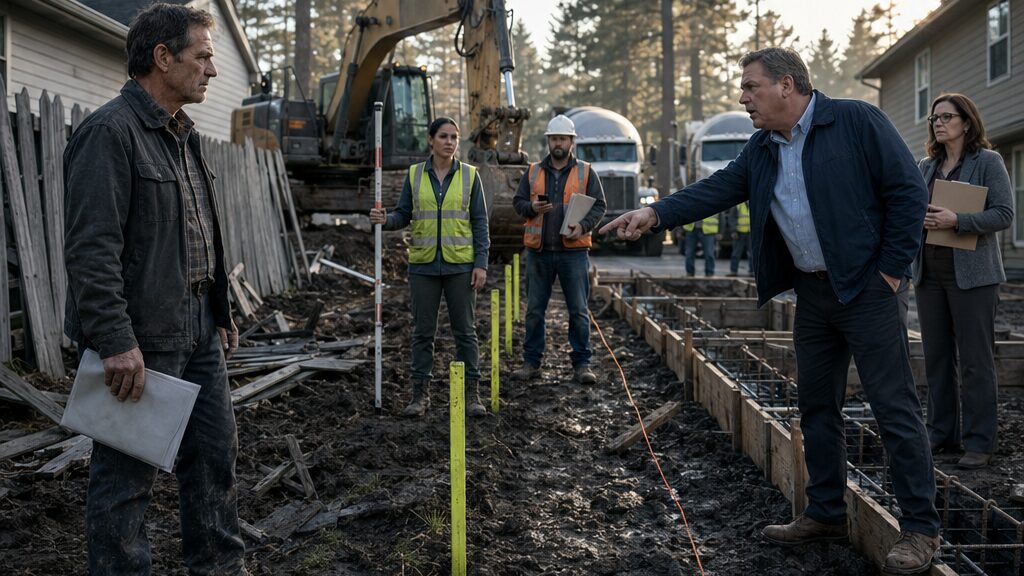
Laura Perez drove the first neon-yellow steel stake through the center of the footer trench at six forty-three the next morning.
The hammer struck three times. Each blow rang against the cold reinforcing steel below, sharp enough to carry through the pines.
Jack stood beside the salvaged cedar board while Laura checked the receiver mounted on her survey pole. A small screen displayed numbers he could not interpret.
“That one is the line?” he asked.
“That one is six hundredths inside your property because I’m not driving through the rebar.” She pointed toward the opposite side of the trench. “The boundary itself passes there.”
Directly through the wooden forms.
Her assistant remained unnamed and mostly silent, moving between the rear corner monument and a tripod near the road. Laura checked two recorded references, measured from the house foundations, and compared the result with the county plat.
Then she looked at the orange string.
“It’s not close,” she said.
“How far off?”
“Three feet seven inches here. Just over four feet near the pines.”
Jack stared at the strip of muddy ground between the string and the old post holes.
The fence had not wandered. The contractor’s line had.
Laura worked steadily down the western edge, placing a yellow stake approximately every twenty feet. Each one stood narrow and bright against the dark soil. At the rear corner, she scraped away pine needles and found the top of an old metal monument beneath two inches of earth.
“There it is,” she said.
Jack crouched beside her. The corroded cap carried faint stamped markings.
“Is that from my old survey?”
“Possibly older. I’ll check the monument record.”
She photographed it, logged the coordinate, and entered notes into her tablet.
At seven fifteen, the first concrete truck turned into Gregory’s driveway.
Its rotating drum sounded louder than the excavator had.
The foreman arrived behind it, followed by two crew pickups. Men climbed out, pulling on gloves. One carried a concrete vibrator. Another dragged a chute extension toward the forms.
Then he saw the stakes.
“What are those?”
Laura stepped out of the trench. “Filed boundary markers.”
The foreman looked toward Jack. “You did this?”
“I hired her.”
The foreman walked to the nearest stake and leaned over it without touching. “This is in our footing.”
“Your footing is across the boundary,” Laura said.
A second truck entered the street and stopped behind the first. Its driver leaned out the window.
Gregory came from his house fastening his jacket.
“What’s happening?”
The foreman pointed. “Survey stakes.”
Gregory walked straight toward Laura. “We already have a verified line.”
“You have an orange string tied to temporary pins,” she said. “I have two recovered monuments, the recorded plat, GPS coordinates, and a filed survey reference.”
“The county approved the addition.”
“The county approved a footprint that stops inside this line.”
Gregory looked at Jack. “You planned this.”
“I told you she was coming.”
“You waited until the trucks were here.”
“She started before they arrived.”
The foreman took out his phone. “I need the filing number.”
Laura read it from her tablet. Jack handed him a printed copy she had produced from the cab of her truck minutes earlier.
The foreman called his supervisor and walked toward the road. The concrete drums continued turning. The excavator sat behind the yellow stakes, its bucket suspended a foot above the ground.
Nicole Miller’s car pulled up at seven thirty-two.
She stepped out holding a leather portfolio. “The board asked me to observe.”
Gregory spread both hands. “Good. Tell them the project is approved.”
Nicole looked at the stakes. “Did the surveyor file these?”
“Yes,” Laura said.
“Today?”
“Six minutes ago. The county system accepted the submission.”
Nicole opened her portfolio, but Gregory moved closer.
“This is insane. We have permits, inspections, financing, labor. One person cannot appear the morning of a pour and erase all of that.”
Jack felt the old instinct to retreat. Let Laura answer. Let Nicole hide behind procedure. Let the foreman make the decision.
But it was his yard.
“The project isn’t being erased,” Jack said. “The part on my land is being stopped.”
Gregory turned on him. “You saw the orange ribbon last week.”
The crew had gone quiet enough to hear him.
Jack said nothing.
“You stood right there,” Gregory continued. “I saw you looking at it. You didn’t ask what it was. You didn’t say the fence was on the line. You waited.”
Nicole looked from Gregory to Jack. Laura lowered her tablet.
Jack remembered the ribbon lifting in the afternoon wind. He had noticed how wrong it looked. He had told himself contractors marked dozens of things with orange tape.
He had also told himself Gregory would not listen.
“I saw it,” Jack said.
Gregory gave a short, bitter laugh. “There. He saw it and said nothing.”
“I didn’t know what it marked.”
“You could have asked.”
“Yes.”
The word surprised everyone, including Jack.
Gregory’s anger faltered for half a second.
Jack continued. “I should have asked. You should have verified the boundary before your crew tore down a fence.”
“That fence looked abandoned.”
“It had posts in concrete.”
“The contractor said it encroached.”
“And did he give you a sealed survey?”
Gregory looked toward the foreman.
The foreman was still on the phone, facing away.
Nicole opened the contractor certification. “There is no surveyor’s seal on the HOA file.”
Gregory stared at her. “You approved it.”
“We approved it based on the owner and contractor certifications.”
“So now this is my fault?”
Laura stepped between the nearest form and stake, not physically blocking anyone but making the line impossible to ignore.
“Fault is not my determination,” she said. “Location is. The footing crosses onto Mr. Wilson’s parcel. These markers have been filed. Removing or disturbing them knowingly can carry penalties under state law.”
The foreman ended his call.
“We’re shutting it down.”
Gregory faced him. “For how long?”
“Until the boundary conflict is resolved and we get revised plans.”
“The concrete is already loaded.”
“I know.”
“I’m paying standby.”
“I know that too.”
Gregory pointed at the forms. “Pour the section inside my side and leave the rest.”
The foreman shook his head. “Not without an engineer revising the footing. It’s continuous.”
The first truck driver switched off his engine. The drum slowed.
In the sudden quiet, water dripped from the excavator bucket into the trench.
Jack looked along the row of yellow stakes. They were thin enough to bend by hand, yet every truck, form, and machine had stopped before them.
For the first time since the fence fell, the boundary existed where everyone could see it.
The satisfaction lasted less than a minute.
Gregory walked toward his house, phone already in hand. At the steps, he turned back.
“You want paperwork? Fine. I’ll get paperwork.”
He called someone and spoke loudly enough for Jack to hear fragments.
“Old access language… utility corridor… maintenance rights… yes, through the HOA documents.”
Nicole’s face changed.
Jack noticed.
“What access language?” he asked.
She closed the portfolio. “There is a recorded maintenance provision along portions of the rear lots.”
“For utilities?”
“Primarily.”
“Does it allow foundations?”
“I need to review the wording.”
Gregory came back down the steps, calmer now.
“My attorney says the association has access rights along that edge. If the easement applies, your stakes don’t give you the power you think they do.”
Laura frowned. “An access easement does not change ownership.”
“No,” Gregory said. “But it may change whether he can stop the work.”
Jack looked at Nicole.
“You knew about this?”
“I knew there were maintenance provisions. I did not know Gregory intended to rely on one.”
Gregory ended the call. “My attorney will send notice today.”
The concrete trucks began backing slowly out of the driveway. Their warning alarms echoed between the houses.
The machinery had stopped, but the argument had moved somewhere harder to see.
By noon, Gregory’s attorney had invoked a clause Jack had never read, claiming the association could enter the very strip of land the survey had just proved was his.
Chapter 4: The Clause Hidden Behind the Approved Addition
The HOA notice arrived taped inside Jack’s storm door before nine the next morning.
NOTICE OF POSSIBLE OBSTRUCTION OF AUTHORIZED MAINTENANCE ACCESS.
He read the title twice, then looked through the glass toward the western edge of his yard. The yellow survey stakes stood where Laura had placed them. Beyond them, Gregory’s forms remained open and empty. No concrete trucks had returned, but the association had found a different way to enter the property.
Jack peeled the notice from the door and carried it to the kitchen.
The document cited a recorded maintenance provision allowing the association and its agents to enter certain side and rear strips for drainage, utilities, and common infrastructure. It warned that obstructing lawful access could result in fines and recovery of legal costs.
Nothing in it mentioned foundations.
Nothing in it mentioned fences.
Nothing in it admitted that Gregory’s construction had crossed a surveyed boundary.
Jack set the notice beside the salvaged cedar board. The board had dried overnight, leaving pale mud in the grain. He filled a bowl with warm water, found an old brush beneath the sink, and began cleaning it carefully.
The first layers came away as brown streaks. Under them, the pencil marks darkened.
Sixty-four.
A small curved line.
Then, lower down, a word appeared in faint handwriting.
Straight.
His wife had written it.
Jack stopped brushing.
He could see her as she had been that summer, standing beneath the pines with one hand against the post while he checked the level. She had laughed when he measured the same span for the third time.
“It is not going to become straighter because you distrust it,” she had said.
He had told her straight was not a matter of trust.
Now the word rested beneath his thumb, preserved where the top rail had protected the wood from rain.
A car door closed outside.
Nicole Miller stood on the front walk holding a folder.
Jack opened the door but did not invite her in.
“The board scheduled an emergency review,” she said. “This afternoon.”
“About Gregory’s foundation?”
“About the access clause and the architectural approval.”
“The notice says I’m obstructing maintenance.”
“It says possible obstruction.”
“There is no maintenance happening.”
Nicole looked past him toward the kitchen table. “The association’s attorney advised us to preserve every available right until the documents are reviewed.”
“Preserve them against whom?”
“Against further delay and liability.”
Jack held up the notice. “This turns me into the problem.”
“It protects the association from waiving a recorded provision.”
“The association approved a contractor’s unchecked box.”
Nicole’s jaw tightened. “I didn’t come here to argue on your porch.”
“Then why did you come?”
“To tell you the meeting starts at three.”
She hesitated.
“And to suggest you bring the survey, the county plan, and anything showing the fence location.”
Jack glanced at the cedar board.
“I’ll bring what matters.”
The HOA meeting room smelled of stale coffee and dry-erase cleaner. Three board members sat behind folding tables. Nicole occupied the end seat with a stack of project files. Gregory sat opposite Jack, his contractor beside him. A woman Jack had not met sat behind Gregory with both hands around a paper cup.
Nicole began by reading the maintenance clause aloud.
It allowed temporary access within ten feet of designated utility and drainage corridors for inspection, repair, replacement, and emergency work. The language was broad in places, but its purpose was narrow.
Jack waited until she finished.
“Where does it authorize a private residential foundation?”
“It does not specifically authorize one,” Nicole said.
Gregory’s contractor leaned forward. “Access was necessary to remove an obstruction and stage the footing.”
“My fence was not obstructing a utility.”
“It was inside the working area.”
“Your working area was inside my property.”
Gregory rubbed his forehead. “We’re going in circles.”
“No,” Jack said. “The property line is fixed. You keep walking around it.”
One board member asked whether Gregory could redesign the footing without temporary access.
The contractor spread the revised sketch across the table. “Not without increasing cost and losing usable width. We may also need access to construct a retaining wall on the lawful side.”
“Temporary access,” Nicole said, “may be negotiable even if the current footing cannot remain.”
Jack heard the shift. The clause would not justify what had happened, but it might still be used to secure what Gregory needed next.
The woman behind Gregory put down her cup.
“This addition is for me,” she said.
Gregory turned. “Heather.”
“I think he should know.”
Heather Clark looked tired rather than embarrassed. She spoke directly to Jack.
“I’m moving back. My separation is almost final, and I can’t keep my current place after the lease ends. The addition was supposed to be a small apartment.”
Jack had assumed a larger kitchen, a sunroom, perhaps an office Gregory could display to visitors. He looked at the plan again and saw a separate entrance, a bedroom, a compact bathroom.
Heather continued. “My father was trying to have it ready before I had to move.”
Gregory stared at the table.
Jack asked, “Did you know the fence was coming down?”
“No. I thought the work stayed on their side.”
The contractor said, “That is what everyone thought.”
Laura’s yellow stakes were not in the room, yet Jack could picture them passing through the center of the contractor’s drawing.
Heather looked at him. “I thought you were trying to stop the project because you didn’t want another house facing your yard.”
“It isn’t another house.”
“I know that now.”
Gregory shifted in his chair. “We do not need to explain family matters to settle a boundary issue.”
“You used my deadline to push the schedule,” Heather said.
“I was helping you.”
“I didn’t ask you to tear down his fence.”
The room quieted.
Jack felt some of his anger change shape. It did not disappear. The boards were still broken. Gregory had still treated uncertainty as permission. But the addition was not only a display of entitlement. It was also a promise Gregory had made and feared he could not keep.
Nicole tapped the maintenance clause. “We need to establish three separate questions. First, whether the demolished fence stood on Mr. Wilson’s parcel. The filed survey indicates that it did. Second, whether the existing foundation plan can proceed. It cannot in its current form. Third, whether limited access can be authorized for revised work.”
Jack looked at Gregory. “Was the boundary survey complete before demolition?”
The contractor answered first. “We verified visible markers.”
“That was not the question.”
Gregory said, “We had the certification.”
“From him.”
“He had measured the lot.”
Laura’s filed survey lay open between them.
Jack waited.
Gregory’s fingers tightened around a pen.
“The formal survey was not complete,” he said.
Heather turned toward him slowly.
Gregory added, “The contractor believed the visible markers were sufficient. The HOA packet was approved. We had no reason to expect a problem.”
“You had no survey,” Jack said.
“We had deadlines.”
“That does not make the line move.”
“No, but it explains why we proceeded.”
The words settled badly. Gregory seemed to realize it as soon as he heard them, but he did not withdraw them.
Nicole closed the access document. “The association will suspend architectural approval for the current footprint. Any revised plan must match the filed survey. Temporary access will require a separate agreement with Mr. Wilson unless the work is strictly within the recorded maintenance purpose.”
The contractor began objecting, but Nicole raised one hand.
“The clause does not authorize demolition of a private boundary structure for residential construction.”
It was the first clear institutional concession Jack had heard.
Small, careful, and late—but clear.
Heather looked at her father.
“You knew the survey wasn’t finished?”
Gregory stared at the revised sketch.
“We knew it was pending.”
“And you let them start anyway?”
“The loan rate was expiring. The crew was booked. Every delay pushed the move date.”
“That isn’t what I asked.”
Gregory looked up at last.
Heather’s voice remained quiet. “Did you know you were gambling with his land?”
Chapter 5: He Chose the Deadline Over the Boundary
Heather brought the email to Jack before Gregory had a chance to explain it away.
She crossed the open strip between the properties just after eight on Friday morning, carrying a folded sheet of paper in one hand. The yellow stakes stood between them. She stopped on Gregory’s side of the line.
“I printed this from my father’s project folder,” she said.
Jack did not reach for it immediately.
“Does he know?”
“No.”
“That matters.”
“So does this.”
She held the page across the boundary.
Jack took it.
The message had been sent by Gregory’s contractor eleven days before the fence came down.
Boundary confirmation remains pending. Visible markers appear inconsistent with prior site sketch. Recommend delaying removal and excavation until licensed verification is received.
Below that was Gregory’s response.
Proceed with site preparation. We cannot lose the scheduled crew or financing deadline. Resolve minor line discrepancy during footing inspection.
Jack read the exchange twice.
Heather watched his face. “He said the contractor made the mistake.”
“The contractor warned him.”
“He’ll say he thought it was minor.”
“Three or four feet is not minor.”
“No.”
Jack folded the page along its existing crease.
Heather looked toward the unfinished addition. Black waterproofing covered one portion of the exposed wall. Rainwater had collected in the trench.
“I need somewhere to live,” she said. “But not like this.”
Jack heard the effort in her voice. Dependence had made honesty expensive.
“You should talk to him before I use this.”
“I tried last night.”
“What did he say?”
“That he was solving a problem no one else was solving.”
Jack knew the kind of sentence. It made urgency sound like virtue and everyone who objected sound ungrateful.
Heather stepped back from the yellow stake.
“I thought you were one of those people who hated any change near their property. My father said you watched everything and never spoke.”
“He wasn’t completely wrong.”
She looked at him.
“I saw the orange ribbon move,” Jack said. “I should have asked.”
“That isn’t the same as authorizing them to destroy the fence.”
“No. But silence gave him something to use.”
Heather nodded once. “He does that. He fills in what people don’t say.”
She returned to Gregory’s house before he came outside.
Jack drove to the county recorder’s office with the email in his folder and the old cedar board wrapped in a moving blanket behind the truck seat. He had not intended to bring the board, but leaving it in the kitchen had begun to feel like hiding it.
The recorder’s office occupied a windowless room behind the public records counter. A clerk searched the lot history by subdivision name, parcel number, and original developer.
“The current plat is easy,” she said. “You’re asking for monument notes from before the association?”
“Anything showing how the western line was established.”
She disappeared among rolling shelves.
Jack waited beneath fluorescent lights while a scanner hummed behind the counter. He could pursue damages now. The email established notice. Laura’s survey established location. The HOA had conceded the clause did not justify demolition.
Still, Gregory’s addition sat open to rain. Heather’s housing need was real. So was the cost of moving the footing.
Jack disliked that the truth had not simplified anything.
The clerk returned carrying a narrow archival sleeve.
“This is the original monument record,” she said. “Thirty-one years old.”
Inside was a surveyor’s field sheet showing the western line, corner references, bearing measurements, and stamped monument descriptions. One recovered monument matched the cap Laura had found beneath the pine needles.
Jack pointed to the handwritten note near the line.
“Existing fence alignment?”
“That appears to have been added during a later verification.”
“What year?”
“Twenty-two years ago.”
The year he built the fence.
The clerk brought up another scanned document. It showed the survey he and his wife had ordered before construction. The proposed fence line sat directly over the recorded boundary, offset slightly inward at two posts to avoid tree roots.
Jack felt something in his chest release.
Not triumph. Something quieter.
For days he had trusted memory, then measurements, then Laura’s work. Now the archive showed that his wife had stood beside him on the correct line. The fence had not merely seemed right because it had been there so long. They had built it where the record told them to.
He ordered certified copies.
Before leaving, he called Laura.
“The monument record is thirty-one years old,” he said.
“That matches what I expected.”
“And my fence survey is in the file.”
“Then your evidence chain is strong.”
“Strong enough to force removal?”
Laura paused. “That is a legal question.”
“You know what I mean.”
“I know what people ask when they want a surveyor to approve a decision the survey does not make.”
Jack looked through the glass wall at the clerk stamping his copies.
“The foundation is on my land.”
“Yes.”
“Gregory knew verification was pending.”
“That changes responsibility. It does not decide your remedy.”
“You said a survey would not make him reasonable.”
“I also said it would not make you reasonable.”
Jack almost ended the call.
Instead, he said, “Fair enough.”
Back at the property, Gregory stood inside the unfinished addition with the contractor. They were examining revised plans spread over a sheet of plywood.
Jack entered through the open framing.
Gregory saw the folder. “Heather gave you the email.”
“She did.”
“She had no right to take private project correspondence.”
“She had enough right to know what was done in her name.”
Gregory dismissed the contractor with a glance. When they were alone, he said, “The warning was cautious language. Contractors write that way to protect themselves.”
“It said delay removal.”
“It also said the discrepancy appeared minor.”
“No. You called it minor in your reply.”
Gregory looked away.
Jack set the certified monument record on the plywood.
“The line was recorded thirty-one years ago. My fence was surveyed when I built it.”
Gregory read the stamp, then pushed the paper back.
“So the contractor pays for the fence.”
“This is not only about lumber.”
“What do you want?”
“I want the encroaching forms removed, the revised design kept inside your property, reimbursement for the survey and fence, and no work within twenty feet of the line without written notice.”
“Twenty feet is absurd.”
“It is a proposal.”
“It would give you control over most of the side yard.”
“It would require notice.”
“It would let you delay Heather’s home whenever you felt like it.”
Jack heard the accusation beneath the words: You already stayed silent once. Now you want the power to make silence official.
“I am not trying to stop her home.”
“You hired a surveyor the morning of the pour.”
“I told you the day before.”
“You watched the ribbon for days.”
Jack placed both palms on the plywood.
“Yes. I did. I should have spoken.”
Gregory blinked.
The admission did not soften him. It removed one of his defenses, and that seemed to anger him more.
“I was trying to keep a promise,” Gregory said. “Her marriage fell apart. She had nowhere stable to go. The rate lock expired at the end of the month. The contractor said the line issue could be resolved during inspection.”
“The contractor told you to delay.”
“He gave me two opinions in one email.”
“He gave you one warning and one description. You chose the description.”
Gregory’s face flushed. “Because delay would have cost tens of thousands of dollars.”
“So you chose the deadline over the boundary.”
“I chose my daughter.”
“No. You chose what you wanted to give her over what you knew belonged to someone else.”
Gregory stepped back as if Jack had struck the plywood between them.
For a moment, neither spoke.
Then Gregory said, “My attorney will handle this.”
By afternoon, Jack sat across from his own attorney in a small office overlooking the courthouse parking lot. The certified survey, historical monument record, permit plan, photographs, HOA notice, and email lay arranged in separate stacks.
The attorney turned the warning email around.
“This is useful.”
“Useful enough?”
“To establish they proceeded with knowledge of uncertainty, yes. Combined with the filed survey and archival record, your position is strong.”
“What can I require?”
“Removal of encroaching work. Restoration. Damages. Survey costs. Potentially attorney’s fees, depending on the claims and any settlement terms.”
“And if I file?”
“The project likely stops completely while the dispute proceeds. Months, perhaps longer. If we seek an injunction and they contest every point, a year is possible.”
Jack looked at the photograph of the yellow stakes.
“What about Heather?”
The attorney studied him. “Legally?”
“No.”
“Then that is not a question I can answer.”
Jack leaned back.
The law could tell him where the line was and what had crossed it. It could not tell him how much consequence was enough.
The attorney placed a legal pad before him.
“I need your instruction. Do you want us to demand removal of the entire affected section and file if they refuse?”
The pen lay beside Jack’s hand.
For the first time, maximum victory was available to him.
Chapter 6: The Invoice Was Paid, but the Line Wasn’t Safe
The reimbursement check arrived while Jack’s yard was still open to Gregory’s construction site.
One thousand three hundred forty dollars.
The contractor’s company name appeared in the upper-left corner. The memo line read FENCE REPLACEMENT—FULL AND FINAL.
Jack stood beside his mailbox and read those last three words twice.
A flatbed had delivered new cedar that morning. The boards lay stacked on spacers near the garage, pale and clean, carrying none of the silver weathering of the old fence. Without posts in the ground, they looked less like a boundary than unused material.
Jack took the check inside and called his attorney.
“Do not deposit it with that memo language,” the attorney said. “We’ll respond that payment applies only to the replacement invoice and does not release any property or access claims.”
“So even the check is an argument.”
“Most checks in disputes are.”
Three weeks had passed since the concrete trucks backed away. Gregory’s contractor had removed the crossing forms and submitted a revised footprint. The new design stayed within the surveyed line, but it required a narrower retaining wall and temporary room for equipment along Jack’s side.
Gregory had not spoken to him directly since the meeting in the unfinished addition.
Nicole had.
She called that afternoon and asked Jack to attend another architectural hearing.
“The board is considering revised access,” she said.
“Under the maintenance clause?”
“Under a private construction agreement, if one can be reached.”
“Then why is the HOA holding a hearing?”
“Because the revised design affects approval, drainage review, and future procedure.”
Jack looked at the check on his table.
“What future procedure?”
Nicole was silent long enough to answer the question before she spoke.
“We reviewed other project files.”
“How many?”
“I would rather explain at the hearing.”
The room was fuller this time. Two board members had brought thick binders. Nicole had marked several pages with red tabs. Gregory sat with his contractor and attorney. Heather occupied a chair against the wall, apart from them.
Jack placed the contractor’s check on the table.
“This does not settle the boundary issue,” he said.
Gregory’s attorney nodded. “The contractor disputes that the memo creates a release beyond the invoiced damage.”
“Then issue a corrected check.”
“We can.”
It was a small concession, almost ordinary. Three weeks earlier, the invoice had seemed like the visible end of the dispute. Now it barely touched the problem.
Nicole opened the hearing.
“The association reviewed twenty-seven recent exterior approvals involving construction within fifteen feet of a recorded lot line.”
A board member shifted uncomfortably.
Nicole continued. “Our checklist required applicants to confirm boundaries, but it did not require sealed survey documentation, recorded coordinates, or verification by a licensed professional.”
Jack looked at her. “The contractor checked a box.”
“Yes.”
“And that was enough.”
“It was treated as enough.”
Gregory’s attorney said, “That review failure does not transfer responsibility for a private boundary representation to my client.”
Nicole kept her eyes on the file. “I did not say it did.”
The contractor leaned forward. “We relied on owner-provided information and visible markers.”
Heather spoke from the wall. “You warned him the markers were inconsistent.”
Gregory turned. “Heather, this is not helping.”
“I’m not here to help you avoid the part you chose.”
The board chair asked Nicole whether similar disputes might exist elsewhere.
“We do not know,” she said. “Most projects may be correctly located. But our process did not distinguish between a contractor’s statement and a licensed survey.”
Jack watched her say it. The admission cost her. He could hear it in the precision of every word.
“What changes are you proposing?” he asked.
“Sealed boundary verification for new structures within a defined distance of lot lines. Written adjoining-owner notice before removal of existing boundary features. Separate acknowledgment that HOA approval does not establish ownership.”
A board member asked, “Would this apply only going forward?”
Nicole looked at Jack’s cedar board, which he had brought and leaned against the wall.
“It should apply to Gregory’s revised submission now.”
For the first time, Jack understood that his fence had exposed more than one bad decision. The HOA had built an entire review practice around assumptions that looked official because they were printed and signed.
His private grievance had found a public weakness.
The contractor slid a revised drawing across the table. “The footing is now eighteen inches inside the surveyed boundary. The wall remains on the Clark parcel. We need six working days of temporary access within five feet of the line for excavation and drainage installation.”
Jack examined the page.
“What equipment?”
“Mini-excavator, compactor, hand tools.”
“No concrete trucks?”
“Not on your side.”
“No storage?”
“Temporary pipe and gravel only during working hours.”
“Who restores the soil?”
“We do.”
“And if a stake is disturbed?”
“We pay Laura Perez to reestablish it.”
Gregory said, “This is what we have been trying to negotiate.”
Jack looked at him. “You rejected my agreement.”
“Because twenty feet and open-ended written approval would let you stop ordinary maintenance.”
“It required notice.”
“It required your consent.”
“After your crew demolished a fence, consent seems relevant.”
Gregory’s attorney placed a proposed agreement before Jack. It allowed access after forty-eight hours’ notice and required restoration, insurance, and survey protection. But a paragraph near the end gave Gregory ongoing access for “construction-related maintenance and adjustment” without a fixed expiration date.
Jack tapped it.
“This stays forever.”
“It follows the improvement,” the attorney said.
“No.”
“It is standard.”
“So was your unchecked boundary form.”
Nicole lowered her eyes.
Jack pushed the agreement back.
Gregory exhaled. “Then what do you want?”
“Access limited to the revised construction. Specific dates. Specific equipment. No expansion. No permanent right. Any later work starts with a new request.”
“That makes every repair dependent on you.”
“Repairs on your property do not. Entry onto mine does.”
“We are talking about inches.”
“We were always talking about inches.”
Gregory’s attorney requested a break.
In the hallway, Heather approached Jack.
“If he refuses, will you file?”
“Yes.”
She nodded, accepting the answer.
“Would you allow access if the agreement was truly limited?”
Jack looked through the glass doors at the stacked binders and revised plans.
“I offered to.”
“My father thinks signing means admitting he intended all of it.”
“He does not have to admit intent. He has to accept responsibility.”
Heather rubbed her thumb along the edge of her sleeve. “He has spent his whole life believing that fixing the result is the same as answering for the choice.”
Jack thought of the orange ribbon he had watched without speaking.
“Some of us believe silence keeps us out of the choice,” he said.
Heather looked toward the hearing room. “Does it?”
“No.”
When the meeting resumed, Gregory rejected Jack’s conditions again.
“Six days can become eight,” he said. “A machine can break. Weather changes. I will not sign something that lets you threaten suit every time the schedule moves.”
“Then include a written extension process.”
“That still puts you in control.”
“Only when you need my land.”
Gregory’s face hardened. “You enjoy this now.”
Jack felt the accusation search for somewhere to attach itself.
He looked at the new cedar stacked outside in his memory, at the corrected line, at the email, and at the old board with his wife’s word under the grain.
“No,” he said. “I am late to it.”
The board declined to restore final architectural approval without a private access agreement or a construction method entirely confined to Gregory’s parcel.
Outside, Jack gave Gregory’s attorney a final draft. It allowed six access days within a fourteen-day window, one possible written extension, restoration by a named deadline, no permanent easement, reimbursement of survey and legal costs, and a requirement that all future work within twenty feet of the line receive advance written notice.
Consent to enter would apply only to the listed work.
Jack placed the document in Gregory’s hands.
“Sign by Monday at five,” he said. “Or redesign without access. If neither happens, I file Tuesday morning.”
Gregory looked at the signature lines, then at Jack.
The deadline no longer belonged to the contractor, the loan, or the HOA.
This time, it belonged to the man whose fence had been torn down.
Chapter 7: His Signature Protected More Than Eight Inches
Jack placed the old pencil-marked cedar board on the mediation table before anyone opened a file.
Its split end faced Gregory. The faded word straight remained visible beneath the grain.
Gregory looked at it, then at the unsigned agreement beside it.
The county mediator sat at the head of the table with Nicole on one side and both attorneys on the other. Heather had taken the chair beside her father, though the distance between them suggested she had made no promise to support him.
Jack kept his hands flat on the table.
His attorney had told him to let the documents speak first. Jack understood the advice. Documents did not lose their temper, become embarrassed, or say more than they could prove.
For once, he did not intend to hide behind them.
The mediator reviewed the unresolved terms.
Gregory accepted the corrected boundary, removal of the encroaching forms, reimbursement of Jack’s survey costs, and replacement of the fence. He accepted the six-day access window and restoration requirements.
He rejected two provisions: advance notice for future work within twenty feet of the property line and the absence of any permanent access right for maintenance of the new retaining wall.
“The wall will be on my parcel,” Gregory said. “But if it requires repair, access from Jack’s side may be the only practical option.”
“Practical for whom?” Jack asked.
“For whoever owns my house after me. For whoever owns yours.”
“Then they can ask.”
Gregory looked toward the mediator. “That is not a durable solution.”
“It is a boundary,” Jack said. “You do not make it durable by giving yourself permanent use of the other side.”
The mediator raised one hand before Gregory could answer.
“What would you accept, Mr. Wilson?”
“A notice requirement for work near the line. A separate request for entry. Proof of insurance. Specific dates and purpose.”
“And emergency drainage failure?”
“If water is actively threatening either house, emergency access with immediate notice.”
Gregory’s attorney wrote something on his pad.
“That is closer,” he said.
Gregory turned toward him. “Closer to what? Asking permission every time a drain clogs?”
“You are not asking permission to repair your property,” Jack said. “You are asking permission to enter mine.”
“There are eight inches between the revised footing and the setback limit.”
“Then use your eight inches.”
“The equipment cannot.”
“That is not my doing.”
Gregory pushed back from the table. The chair legs scraped across the floor.
“No, your part was watching the markers change and saying nothing until the trucks arrived.”
The room tightened around the accusation.
Jack could have answered as he had before. He could have admitted the silence and immediately balanced it against Gregory’s warning email, the demolished fence, and the unfinished survey.
Instead, he looked at the cedar board.
“My wife wrote that word,” he said.
Gregory’s expression shifted, not yet toward sympathy, only uncertainty.
Jack touched the faded pencil mark.
“We built the fence during the last summer she was strong enough to work outside all day. She held the posts while I leveled them. She kept telling me they were straight before I trusted the level.”
No one moved.
Jack had not spoken about that summer at the HOA meetings. He had reduced the fence to replacement cost because money was easier to prove than meaning.
“She died four years later,” he continued. “The fence stayed. I repaired it instead of replacing it because some of her marks were still under the rails.”
Heather lowered her eyes.
Gregory looked at the board again.
“When your crew tore it down,” Jack said, “I acted like the only issue was where the line sat. It wasn’t. But I did not tell you that. I did not tell anyone. I expected a fence, an old survey, and twenty-two years of use to explain everything for me.”
Gregory’s voice lost some of its edge. “I didn’t know.”
“You didn’t ask.”
“You didn’t tell me.”
“No. I didn’t.”
Jack let the admission remain without defending it.
“That was my mistake,” he said. “I saw the orange ribbon move. I decided silence was restraint. It was not. It was fear of an argument I thought I could avoid.”
Nicole closed the file in front of her.
Jack continued, “But my silence did not give you my land. Your deadline did not give you my land. Heather needing a home did not give you my land.”
Gregory’s jaw tightened again, but Heather placed a hand on the agreement.
“Dad,” she said, “I’m not moving into that addition unless this is settled fairly.”
Gregory turned to her. “It is being settled.”
“No. You are still trying to win the part that lets you say you did nothing wrong.”
“That is not what this is about.”
“It has been about that since the survey stopped the trucks.”
“I am protecting the property.”
Heather glanced at Jack’s board. “So is he.”
Gregory’s face reddened. “You think I should sign away access and create a maintenance problem that lasts for decades?”
“I think you should stop calling his permission a problem.”
The mediator waited.
Gregory stared at his daughter. “I took this project on because you needed somewhere stable.”
“I know.”
“I moved money. I changed the loan. I delayed work on my own house.”
“I know that too.”
“And now you are taking his side.”
Heather shook her head.
“There should not be sides to where the line is.”
Gregory looked down at the agreement.
Heather’s voice softened. “I would rather rent another year than begin my home by pretending those four feet did not belong to him.”
The sentence altered the room more than any stamped record had.
Gregory had used Heather’s need as the reason delay was impossible. Now she had removed that reason herself.
Jack watched him absorb it.
For the first time, Gregory did not look angry. He looked tired.
“I thought I could fix it before it became a real problem,” he said.
Jack said nothing.
Gregory rubbed one hand over his forehead. “The contractor said the discrepancy was probably an old landscaping error. The rate lock was ending. Heather’s lease was ending. Every week added another cost.”
“You received the warning,” Jack said.
“Yes.”
“You chose to proceed.”
“Yes.”
The word was barely audible.
The mediator leaned forward. “Can we work from that acknowledgment?”
Gregory looked at Jack.
“I did not intend to take your property.”
“I believe that.”
Gregory seemed surprised.
Jack added, “You intended to take the risk with it.”
After a long pause, Gregory nodded.
“That is fair.”
The attorneys revised the agreement in the room.
The permanent access language was removed. Emergency entry was limited to an immediate threat to drainage, utilities, or structures, with notice as soon as reasonably possible. All other entry required a written request identifying dates, equipment, contractor, insurance, and restoration terms.
The twenty-foot provision remained, but it required advance notice rather than Jack’s approval when work stayed entirely on Gregory’s parcel. Consent was necessary only if people, tools, equipment, or materials crossed the surveyed line.
The construction window allowed six working days within fourteen calendar days, with one extension of up to three days for weather or mechanical failure. Gregory had to request the extension in writing before the original period expired.
Jack agreed to one additional condition.
The contractor could operate a compact excavator from a three-foot strip on his side for drainage installation, provided protective mats covered the soil and Laura verified all stakes before and after the work.
His attorney leaned toward him. “You are not required to offer that.”
“I know.”
Gregory heard.
“Why are you?” he asked.
“Because the revised addition fits on your property. Because Heather needs a place to live. And because protecting a line is not the same as making it impossible to live beside.”
Gregory looked at him for several seconds.
Then he signed.
Nicole signed the HOA acknowledgment next. It suspended the old approval, accepted the revised plan, and required licensed boundary verification for future structures near lot lines. Existing fences could no longer be removed under architectural approval without documented ownership review and written adjoining-owner notice.
Jack signed last.
The pen paused above the page.
For weeks, his signature had represented leverage—the thing Gregory could not build around. Now it represented something more difficult. He was allowing limited entry while making the limit unmistakable.
He wrote his name beneath the recorded boundary conditions.
Construction resumed the following Monday.
Laura arrived before the equipment and photographed every yellow stake. Protective mats formed a temporary path along Jack’s side. The compact excavator moved slowly, its operator keeping the tracks within the agreed strip.
Gregory remained outside during most of the work. He and Jack exchanged only practical sentences.
“The pipe delivery is at ten.”
“The rear stake is visible.”
“They will finish compaction today.”
There was no sudden friendship in them. No easy return to neighborly warmth that had never truly existed.
But there were no assumptions either.
On the sixth day, the contractor removed the final mat and restored the disturbed soil. Laura checked the coordinates. None of the stakes had moved beyond tolerance.
The replacement-fence carpenter arrived in early autumn.
Jack could have hired him to complete everything alone. Instead, he stood beside him at the first post hole, holding the salvaged cedar board.
The new fence would follow the surveyed line, offset inward where roots required it, just as the older record showed. The carpenter suggested replacing the split board with new cedar.
Jack shook his head.
“This one goes first.”
“It won’t weather like the others.”
“It already has.”
They trimmed the damaged end and mounted the board nearest the back corner, where the pines leaned over the line. It was narrower than the new boards and silver against their pale gold surface.
Jack left it unpainted.
Gregory came outside while the final panels were being installed. Heather stood beside him, holding a box marked KITCHEN.
The revised addition was enclosed now. Its separate entrance faced the rear rather than Jack’s yard.
Gregory walked to the fence but did not touch it.
“The drainage inspection passed,” he said.
“Nicole emailed me.”
“She emails everyone now.”
Jack almost smiled. “That may be safer.”
Gregory looked toward the silver board.
“Was that the one from the debris?”
“Yes.”
“The one your wife marked?”
Jack nodded.
Gregory kept his eyes on it. “I should have stopped when the survey was still pending.”
“Yes.”
“I kept thinking if I finished the work, I could solve whatever came afterward.”
“That is what you said.”
“I was wrong.”
Jack did not rescue him from the silence that followed.
After a moment, Gregory said, “Heather moves in Saturday.”
“I saw the boxes.”
“She wants to plant something along the wall. On our side.”
“Good place for it.”
Gregory nodded and returned to the addition.
The carpenter fastened the last board before sunset.
The new fence followed Laura’s yellow stakes in a clean line through the yard. Gregory’s addition stood within its corrected footprint. The old orange string was gone. The reimbursement check had been reissued without release language. Jack’s survey and legal costs had been paid. The access agreement was recorded with the revised approval.
Jack walked the fence alone after the carpenter left.
At the first salvaged board, he stopped.
Straight remained visible beneath the weathered grain.
For years, he had believed the fence protected memory by remaining unchanged. But most of it was new now. The line had survived because he had finally spoken, listened, admitted his own silence, and chosen what could be allowed without surrendering what could not.
On the other side, Heather opened a window in the unfinished apartment. A moment later, he heard Gregory carrying another box inside.
Jack rested his palm against the silver cedar.
The boundary remained firm beneath his hand.
It no longer had to speak for him.
The story has ended.