They Threatened His Pension Before His Bloodied Hands Saved the National Data Center
Chapter 1: The Heat Beneath the Blue Floor Line
The steel floor tile softened the adhesive on Gregory Lewis’s glove before the monitoring system registered a single degree of abnormal heat.
He pulled his hand back and watched a translucent thread of glue stretch from his palm to the metal. The tile looked ordinary beneath the service lights—gray, perforated, numbered C-47 in fading black stencil—but heat shimmered above its edge.
Three meters away, a wall display showed the core room in calm green.
COOLING STATUS: NOMINAL.
Gregory pressed two bare fingers to the neighboring tile. Cold. He moved to the next. Cold again.
C-47 pulsed beneath his fingertips.
Not constant heat. A slow rise, a faint easing, then another rise.
Pressure cycling.
He straightened with a small complaint from his knees and looked through the glass partition into the National Data Center’s core server room. Black cabinets stood in disciplined rows beneath white light. Thousands of blue status lamps blinked through the racks, carrying banking clearances, emergency dispatch traffic, transport routing, and government communications. Behind the cabinets, new red-painted nitrogen lines gleamed like veins too bright for the old building.
A junior technician approached with a driver in one hand and a replacement sensor in the other.
“Dashboard says the floor probe is dead,” the technician said. “I’m opening it.”
“No.”
The technician crouched anyway. “Work order says—”
Gregory caught his wrist before the driver touched the fastener.
The young man stared at Gregory’s hand. The knuckles were broad and scarred, the nails permanently dark at their edges despite the scrubbing station. Gregory loosened his grip but did not release him.
“Put your ear down,” Gregory said.
“What?”
“Not over the seam. Here.”
He guided the technician half a tile away. The young man hesitated, then lowered his head.
At first there was only the steady rush of conditioned air under the raised floor. Then a metallic thud traveled beneath them.
A second followed.
The technician lifted his head. “Water hammer?”
“Nitrogen doesn’t make that sound unless liquid is moving where vapor should be.”
The wall display remained green.
Gregory took the driver from him and set it on a cart. “Nobody opens C-47.”
Donald Roberts’s voice came from the service-corridor entrance.
“Why is my technician standing around?”
Donald wore a white shirt under a spotless dark jacket despite the heat of the mechanical level. A slim tablet rested in one hand. His subcontractor badge hung perfectly centered against his chest. He stopped at the yellow boundary stripe rather than entering the narrow service lane.
Gregory pointed at the floor. “Heat under C-47. Pressure pulse moving west.”
Donald glanced at his tablet. “No anomaly.”
“I touched it.”
“The system has eight thousand sensors.”
“And none of them have fingers.”
The junior technician looked down, suddenly interested in his boots.
Donald tapped the screen. “The floor probe is reporting intermittent failure. Replace it.”
“No one opens that tile until the line is isolated.”
“We are forty-eight minutes from national traffic transfer.”
“Then delay it.”
Donald gave a short laugh, as if Gregory had suggested turning the building upside down. “You don’t delay a nationally coordinated migration because an aging maintenance worker felt a warm panel.”
Gregory bent and pressed his palm flat again. The pulse came harder this time. Heat worked through the softened glove, followed by a vibration fine enough to tremble the tendons in his wrist.
“This line should be dormant,” he said.
Donald’s expression tightened. “The retrofit changed the load-balancing sequence.”
“It didn’t change which direction pressure travels.”
“The hydraulic model accounts for the revised route.”
Gregory looked past him toward the pristine red piping visible through the glass. “A model doesn’t care what somebody welded under the floor.”
Donald signed something on his tablet with one clean sweep of his finger. “Testing continues.”
Gregory stepped toward him. “You have liquid hammering under live racks.”
“And you have a sensor replacement assigned to your team.”
“I supervised this cooling grid before you knew the building existed.”
The junior technician flinched at the words. Donald did not.
“That,” Donald said, “is exactly the attitude that makes modernization difficult.”
He turned the tablet so Gregory could see the approval screen. Every line was green. Engineering review. Safety review. Pressure test. Thermal certification. At the bottom sat Donald’s digital signature, sharp and black against the white field.
Gregory’s gaze stopped at the pressure-test date.
“You tested during reduced load.”
“We tested under the approved conditions.”
“Half the west bank was offline.”
“The result passed.”
“The building isn’t running at half load today.”
Donald lowered the tablet. “The transfer begins on schedule. No unscheduled shutdown, no manual isolation, and no interference with the activation sequence. Is that understood?”
Gregory did not answer.
Donald looked at the technician. “Replace the probe.”
The young man reached toward the cart.
Gregory put his boot on the driver.
“No.”
For a moment the corridor held only the muffled rush beneath the floor.
Donald’s face changed—not into anger at first, but calculation. He looked at Gregory’s old badge, at the word MAINTENANCE printed where SUPERVISOR had once appeared, then toward the camera over the service door.
“Document his refusal,” he told the technician.
“I’m not—”
“Document it.”
The technician pulled out his handheld terminal with an unsteady motion.
Donald walked away without entering the corridor. His polished shoes made no sound on the sealed floor.
Gregory waited until the door closed behind him. Then he removed his boot from the driver.
“Are you going to let me open it now?” the technician asked.
“No. You’re going upstairs.”
“My work order—”
“Will still be there when the pressure is gone.”
Gregory took a narrow inspection mirror from the cart and lay on one shoulder beside the tile. He slid the mirror through the ventilation slot, angling it toward the darkness below.
Condensation filmed the glass.
That should have reassured him. A nitrogen line could frost where pressure dropped. But the moisture trembled in rhythmic rings, and beneath the tile he saw a shadow shift with every pulse.
He rose and followed the faded blue stripe painted along the service floor. Most of it had been covered by gray epoxy during the retrofit, but thin fragments remained beside cabinet feet and under wall brackets. Gregory had painted that line nineteen years earlier. It marked the emergency bypass route, a physical guide for technicians working blind during smoke or power loss.
At cabinet C-51 he knelt again.
The first hammering strike came from behind him.
The second sounded directly beneath his knees.
The pulse was traveling backward.
He moved faster, following the surviving blue marks toward the west junction. The junior technician trailed him despite the order to leave.
“Stay back,” Gregory said.
“What are you looking for?”
“The place where the old line crosses the new manifold.”
“That’s not on the digital plan.”
“I know.”
The answer silenced the technician.
Gregory reached the last access plate before the locked core door. Its fasteners were new, their heads unscarred. Someone had opened it recently and used the wrong grade of sealant when replacing it. A thin amber bead had bubbled along one edge.
He crouched and held the back of his fingers near it.
Heat pressed against his skin.
“Get upstairs,” he said.
The technician did not move.
Gregory looked at him. “Now.”
Something in his voice finally worked. The young man retreated toward the stairs.
Gregory pulled a short wrench from his belt. The first fastener resisted, then broke loose with a metallic snap. The second was overtightened. He leaned his weight into it until his shoulder burned.
As the plate lifted, a breath of hot metallic air escaped from beneath the floor.
The blue bypass pipe lay exactly where he remembered it, old paint scarred but intact. It should have curved away from the core room and rejoined the relief network beyond the west wall.
Instead, twenty centimeters ahead, fresh weld metal shone around a new junction.
The blue pipe had been cut.
A red retrofit line had been welded directly into it.
Gregory stared at the joint while another pressure pulse struck beneath his hand.
The weld was not hidden. It had simply been placed where no one who trusted the digital plan would ever look.
He reached down and touched the edge of the new coupling. Heat bit through his glove.
Above him, the wall display still glowed green.
Chapter 2: The License They Used to Silence Him
Gregory’s access badge flashed red at the door he had opened every morning for nineteen years.
ACCESS DENIED.
He tried it again, slower this time, as though the reader might recognize patience.
The red light returned.
Through the reinforced glass, Donald stood in the operations gallery beside Patricia Miller, the facility’s senior safety inspector. Mark Sanchez was at the central console, shoulders bent over three pressure graphs. None of them looked toward the door until Gregory struck the glass with the flat of his hand.
Mark noticed first. His eyes shifted to Gregory, then quickly back to his screen.
Patricia opened the door only far enough to block the entrance with her body.
“You are not cleared for core operations,” she said.
“The blue bypass is welded into the new pressure loop.”
Her expression did not change. “That line was decommissioned.”
“It’s carrying load.”
“The approved plan shows no active connection.”
“I saw the weld.”
Donald approached behind her. “You removed a sealed access plate without authorization.”
“There was no isolation tag on it.”
“Because it is outside the active system.”
“It was hot enough to bubble the sealant.”
Donald lifted his tablet. “The thermal map is within tolerance.”
Gregory pushed the door. Patricia held it in place.
“Run an isolation test,” he said. “Close the new manifold and watch the west pressure curve.”
“We are thirty-seven minutes from transfer,” Donald replied.
“Then you have thirty-seven minutes to keep the building from catching fire.”
Several operators turned in their chairs.
Patricia stepped into the corridor and let the door close behind her. “Lower your voice.”
“Open the floor.”
“You have already violated access procedure.”
“Patricia, the pipe is physically connected.”
“And your authority to make that determination was revoked.”
The words landed more heavily because she spoke them without heat.
Gregory looked through the glass at Mark. He wanted the younger engineer to stand, to say he had seen the unstable curve, to ask for five minutes. Mark kept both hands on the console.
Donald held out his tablet. “The retrofit passed hydrostatic testing, thermal certification, and safety inspection.”
Gregory took a folded notebook from his shirt pocket. The cover had gone soft with years of grease and sweat. He opened to the morning’s entries: tile temperature by touch probe, pulse interval, direction of hammering, weld location.
Patricia glanced at the pages.
Then Donald placed his tablet beside them.
Clean charts. Numbered approvals. Digital seals. A bright model of the cooling loop rotating on-screen.
Patricia’s attention settled on the tablet.
“You’re comparing a drawing to a pipe,” Gregory said.
“I’m comparing your claim to certified evidence.”
“My notes told you the west shielding was wrong six months ago.”
“Your notes alleged that the shielding was counterfeit. The sample you submitted could not be traced to the installed batch.”
“Because Donald’s crew removed the marked pieces before inspection.”
Donald exhaled through his nose. “Here we go again.”
Gregory faced him. “You changed the material after the delivery check.”
“You made an accusation you could not support.”
“I watched your men strip the labels.”
“And when the independent review found no proof, you refused to accept the result.”
Patricia folded her arms. “That refusal was part of the reason your supervisory license was suspended.”
The corridor seemed to narrow around Gregory.
The official notice had used different language: failure to maintain professional objectivity, repeated obstruction of approved works, unauthorized alteration of operational records. But everyone in the building understood the simpler version. Old Gregory could not accept that the system had moved on without him.
He looked again through the glass.
Mark finally met his eyes.
Gregory lifted the notebook slightly. “Tell them about the west curve.”
Mark’s mouth opened.
Donald turned toward him. “Is there a safety limit violation?”
Mark looked at the three screens. “No formal limit.”
“That wasn’t my question,” Gregory said.
“There’s a variance,” Mark admitted. “A small one.”
“Direction?”
Mark hesitated. “The model treats it as sensor lag.”
“Does pressure rise west before it rises at the manifold?”
Mark’s silence answered.
Donald stepped between Gregory and the glass. “He has already explained it. Sensor lag.”
“No. He repeated what your model calls it.”
“Enough.”
Donald’s voice cracked across the corridor. Operators inside stopped pretending not to listen.
Gregory moved closer. “Isolate the line.”
“You are just a lowly worker about to retire,” Donald said. “Shut your mouth before I fire you and cut your pension.”
For one violent second, Gregory saw nothing but Donald’s collar.
His right hand closed.
Years of lifting housings, breaking seized bolts, and carrying damaged equipment had left strength in it that his stiff gait concealed. He imagined gripping the clean fabric, dragging Donald across the threshold, forcing his face down beside the hot pipe.
Then Gregory saw Mark beyond him.
The younger man had gone pale. Not shocked by Donald’s threat. Afraid of what Gregory might do next—and of being asked to choose.
Gregory opened his hand.
Donald noticed. Satisfaction flickered across his face.
Patricia took a slim stylus from her pocket and wrote on her inspection tablet. “Effective immediately, Gregory Lewis is barred from core controls and mechanical access points pending review.”
“You’re locking out the only person who traced the original network.”
“I am removing an unauthorized disruption during a critical transfer.”
“You know those papers don’t match the floor.”
“I know what was inspected and approved.”
She turned the screen toward him. A formal order filled it. Beneath the restriction notice was a line concerning employment standing and retirement-benefit review.
“One further violation,” she said, “and your pending pension certification may be referred for disciplinary reconsideration.”
Gregory read the sentence twice.
He had counted those weeks. Fourteen shifts. Then the small house would be paid off, the medical deductions would remain manageable, and thirty-eight years inside mechanical rooms would turn into something more secure than memory.
He put the notebook back into his pocket.
“Understood,” he said.
Mark looked away first.
Patricia opened the gallery door. Donald followed her inside. Before entering, he paused.
“Replace the failed probe,” he said. “And do not touch my system again.”
The door sealed.
Gregory remained in the corridor, listening to the faint vibration coming through the floor.
He had chosen the pension.
The knowledge sat badly in him.
A minute later Mark emerged through the side door, carrying a coil of cable as a pretense.
He stopped without looking directly at Gregory. “The west curve is early by one-point-eight seconds.”
“That’s not sensor lag.”
“I know what it looks like.”
“Then say it in there.”
Mark’s jaw tightened. “My name is on the model conversion.”
Gregory studied him.
“I mapped the retrofit data Donald gave me,” Mark continued. “If I challenge the route now and I’m wrong, I’m finished before I’m permanent.”
“And if you’re right?”
Mark looked through the glass toward the core room. “I’m still the one who signed the simulation check.”
Gregory had no gentle answer for him.
“The physical line wins,” he said.
“That’s easy for you to say.”
Gregory touched the notebook in his pocket. “No. It isn’t.”
Mark left with the cable.
Gregory walked to the maintenance station at the end of the hall. His access had been removed from the primary systems, but the older camera grid still ran on a separate console no one had bothered to modernize. He entered a maintenance code from memory.
Sixteen grainy images appeared.
He selected the west cabinet row.
For several seconds the feed showed nothing but black racks and cold white lights. Then cabinet C-54 flickered at its lower seam.
A thin orange flare appeared inside the gap.
It vanished almost at once.
Gregory froze the frame.
The timestamp was current.
C-54 had been certified cool twelve minutes earlier.
Chapter 3: A Blueprint That Proved Too Little
Mark found Gregory’s old authorization number attached to the disputed bypass at 10:18 that morning.
The code sat in the corner of a scanned paper schematic, half-obscured by a fold: GL-17, emergency modification approved.
He enlarged it until the letters broke into pixels.
Across the conference bay, Gregory stood beside the maintenance camera display with the frozen orange flare still visible on-screen. Donald paced behind Mark, speaking into a headset about traffic schedules and executive notifications. Patricia waited near the door with her inspection tablet held against her chest.
Mark opened the current digital plan on a second monitor.
The red retrofit loop crossed the west bank in a clean arc. No blue bypass appeared beneath it. No temporary junction. No alternate return.
He pulled up an older archive.
This drawing showed the faded blue route Gregory had described, turning under cabinet C-51 and rejoining the relief network beyond the west wall.
The two plans could not both be complete.
“Where did this come from?” Donald asked, ending his call.
“Paper archive,” Mark said. “Pre-digitization.”
Donald leaned over his shoulder. “Obsolete.”
“It has Gregory’s authorization code.”
Patricia moved closer.
Gregory did not.
Mark looked at him. “You approved a bypass under the west floor.”
Gregory’s face revealed almost nothing, but his stillness changed.
“When?” Patricia asked.
“Eleven years ago,” Mark said. “Emergency outage.”
Donald gave a quiet, incredulous laugh. “So the man accusing us of undocumented work created an undocumented line himself.”
“It was documented,” Gregory said.
“On paper buried in an archive.”
“The digital conversion was supposed to include it.”
Mark turned from the screen. “Did you verify that?”
Gregory did not answer quickly enough.
The silence shifted the room.
Donald stepped toward the old schematic. “This is what I have been warning everyone about. Field improvisation treated as institutional memory. Uncontrolled changes. Handwritten fixes. Then years later he blames the engineered system because it doesn’t match what exists in his head.”
“The bypass was temporary,” Gregory said.
“How temporary?”
“Until the damaged west return could be replaced.”
“And was it?”
“Yes.”
“Then why was the bypass not physically removed?”
“It was isolated.”
Donald pointed at the frozen camera image. “Apparently not.”
Gregory’s eyes hardened. “Your crew cut into it.”
“Your line should not have been there.”
“It was capped, tagged, and shown on the service drawing.”
“Not on the governing model.”
Mark looked between them. His confidence in Donald had been eroding since the pressure curve shifted early. Now something similar happened to his confidence in Gregory.
“You knew there were two records,” he said.
“I knew the conversion missed details.”
“Did you tell me?”
“I told you to trace the floor.”
“That isn’t the same thing.”
“No.”
Mark waited for more. None came.
Patricia placed her tablet on the table. “This is precisely why formal control exists. Systems cannot depend on one person remembering which undocumented exception remained physically present.”
Gregory’s mouth tightened. “I didn’t say it should.”
“You have behaved for months as though your memory outranks the approved plan.”
“My memory knew that floor was hot before your approved sensors did.”
“And your memory omitted the fact that you authorized the line in question.”
Gregory looked at the old schematic. “I should have checked the conversion.”
The admission was quiet.
Donald seized it. “There. The present discrepancy began under his authority.”
“No,” Gregory said. “The bypass being left in the floor began under mine. Welding your active line into it happened under yours.”
“You have no proof my team made that connection.”
“The weld is fresh.”
“So is half the retrofit.”
Mark zoomed into the archived drawing. Beside the blue route were handwritten pressure limits and a note directing the bypass to remain mechanically isolated except during total west-return failure.
“Why create it?” he asked.
Gregory came closer at last.
“Summer outage. Main return cracked under full load. Replacement assembly was six hours away and emergency traffic had nowhere to move. We used the blue line to bleed pressure around the damaged section.”
“You kept the servers online?”
“We kept the emergency network online. Everything else went dark.”
Donald folded his arms. “Another unauthorized improvisation.”
“Approved by the duty controller and safety lead.”
“Neither signature appears here.”
“They were on the incident packet.”
Patricia searched her tablet. “That packet is not in the current archive.”
Gregory looked at her. “Then your archive is incomplete.”
“Or the packet never existed.”
A pulse of anger crossed Gregory’s face. Mark saw him force it down.
Mark studied the two plans again. “The old bypass rejoins beyond the relief valve.”
“Yes,” Gregory said.
“The new model assumes the red manifold reaches the relief network directly.”
“Yes.”
“If the red line is welded into the blue route before the old junction…”
“The pressure reaches the relief valve backward,” Gregory said. “And full nitrogen activation drives it toward the hot west bank instead of away.”
Donald shook his head. “Only if the old route remains open.”
“It’s carrying a pulse.”
“According to your ear.”
“According to the west curve,” Gregory said, looking at Mark.
Mark turned to the live graph. The early rise remained small but consistent.
Donald leaned over the console. “Thermal expansion can create localized variance. Full activation equalizes the loop.”
Gregory pointed to the core map. “Watch C-57.”
“Why?”
“The pulse interval is shortening. C-54 flared first because the bad shielding is failing near the junction. Heat will move three cabinets west before the next control cycle.”
Donald looked at Patricia. “We are now taking predictions from floor noises.”
“Give it two minutes,” Gregory said.
No one spoke.
The conference bay’s wall clock changed from 10:23 to 10:24.
Mark watched the thermal squares. C-54 glowed amber, then dimmed. C-55 rose by two degrees. C-56 followed more slowly.
At 10:25, C-57 jumped six degrees in four seconds.
An alert box appeared.
LOCAL THERMAL VARIANCE.
Patricia stared at it.
Gregory said, “Isolate the west manifold.”
Donald moved first, closing the alert box. “No. This confirms inadequate circulation. We need full cooling capacity before traffic transfer.”
“It confirms the pulse is traveling exactly where I said.”
“It confirms heat is accumulating.”
“Because your line is feeding the wrong route.”
Donald turned to Mark. “Run the activation simulation.”
Mark’s hands remained above the keyboard.
“Now.”
He entered the command. The model displayed a smooth pressure drop across the west bank. Green arrows flowed through the red loop and returned through an idealized relief path.
Gregory pointed at the screen. “That junction doesn’t exist where the model puts it.”
Donald said, “The model was built from certified retrofit data.”
“Your data.”
“Verified by engineering.”
Mark felt the words settle on him.
His own electronic initials appeared beneath the simulation-validation field.
The prediction at C-57 had proved Gregory understood something the model did not. But Gregory had also hidden the bypass history and failed to verify its removal from the digital record. One man’s authority was compromised by fraud. The other man’s knowledge was compromised by silence.
Patricia looked toward the clock. “Can we delay transfer without triggering continuity penalties?”
Donald answered immediately. “No. The migration window is fixed. A delay risks synchronization failure across regional systems.”
“That’s not the same as a fire,” Gregory said.
“A failed migration can disrupt emergency services nationally.”
Donald faced the room, no longer speaking only to Gregory. “We have an abnormal thermal condition and an approved system designed to correct it. Panic and unauthorized isolation are the greater risk.”
For the first time, Mark understood why people followed him. Donald made uncertainty sound like weakness and action sound like proof.
Patricia nodded once. “Proceed under certified protocol.”
Gregory stepped toward the console. “Patricia.”
Her gaze stayed on the tablet. “Your restriction remains in effect.”
Mark looked at the activation simulation, then at the real west pressure curve. The two lines were beginning to separate.
“How long until the lever goes live?” he asked.
Donald checked the transfer clock.
“Thirty minutes.”
He entered his authorization.
Inside the core room, a protective cover lifted from the liquid-nitrogen activation lever.
A red indicator illuminated beside it.
Chapter 4: The Warning He Buried With His Pride
Samantha Torres found Gregory cutting open the lining of his oldest work glove with a utility blade.
He sat on a bench in the abandoned maintenance locker room, the glove pinned beneath one scarred hand. The medical technician stopped in the doorway, emergency bag hanging from her shoulder.
“What are you doing?”
“Looking for something.”
“You were ordered off the mechanical level.”
Gregory drew the blade through the final stitch. Inside the cuff, between two layers of cracked leather, was a narrow strip of gray insulation wrapped in waxed paper.
Samantha stared at it. “You hid evidence in your glove?”
“I hid a sample.”
“That is evidence.”
“It wasn’t, according to Patricia.”
He unfolded the paper. The insulation had once been dense and pale gray. Now it crumbled at the edges, leaving powder across his palm.
Samantha crossed the room and shut the door behind her. “Security is checking the west corridor.”
“Then don’t stand where they can see you.”
“I came to get you out.”
Gregory placed the sample beneath the locker light. Hairline cracks ran through it like dry earth.
“Six months old,” he said.
“It looks twenty years old.”
“That’s what heat does to cheap filler.”
Samantha set down her bag. “You need to send it outside the facility.”
“I tried to submit one.”
“You submitted an unmarked fragment after the installation crew had replaced the labeled sections.”
“That was the only piece left.”
“And when the review rejected it, you hid another one in your glove?”
Gregory did not answer.
Samantha’s gaze moved to the open locker beside him. A stack of folded papers lay behind an old respirator. Their corners were dark with grease. He pulled them free and spread them across the bench.
Heat-shielding discrepancy. Pressure-route conflict. Inspection access denied. Each warning carried his signature and a date. Some had receipt stamps. Others had only handwritten notes where he had recorded who refused them.
A rust-colored smear crossed one page.
Samantha touched the edge without touching the stain. “Is that yours?”
“No.”
The room’s fluorescent light buzzed overhead.
“Whose?”
Gregory folded the corner back over it. “A technician opened a live panel during the south-bank failure. Management had pushed the restart before we finished tracing the fault.”
“Was he killed?”
“No. Burned through the arm. Couldn’t work electrical again.”
“And you kept his blood on the report.”
“I kept the report they ignored.”
Samantha sat beside him. “Is that why you stayed after they took your license?”
Gregory looked toward the lockers where names had been peeled away as crews retired or transferred. “I told him no junior worker would go into a bad system alone again.”
“That was not a promise to destroy yourself.”
“It was a promise not to leave.”
“There is a difference.”
He gathered the reports. “Not always.”
Samantha took the insulation sample and bent it carefully. It cracked with almost no resistance.
“This should not happen at service temperature,” she said.
“It shouldn’t happen near twice service temperature.”
“Then let me seal it in an evidence bag.”
“Not yet.”
Her eyes sharpened. “You still don’t trust anyone.”
“I trust you.”
“No. You trust me to hold what you have already decided.”
He met her gaze.
She lowered her voice. “You knew the archive was incomplete. You knew the digital plan missed your bypass. You had these warnings. Why didn’t you go beyond Patricia?”
Gregory looked down at his hands.
He had told himself he was protecting Mark and the others. An external complaint would trigger interviews, suspensions, contract reviews. Junior engineers would be asked who had helped him, who had seen what, who had spoken out of turn. Their temporary badges would disappear long before Donald’s legal team finished its first response.
And there had been the pension letter.
One more formal dispute, one more disciplinary note, and thirty-eight years of work could be dragged into review.
“I thought I could stay close enough to stop anything serious,” he said.
Samantha’s expression softened, but not enough to excuse him. “You thought you could carry the whole building in your pocket.”
Gregory slid the sample back into the waxed paper.
A lock clicked somewhere in the corridor.
Then another.
The locker-room display went dark.
Samantha stood. “What was that?”
Gregory tried the maintenance archive terminal. Its screen flashed once.
REMOTE ACCESS SUSPENDED.
The door handle would not move.
Donald’s voice came through the wall speaker.
“Gregory Lewis, remain where you are. Security will escort you from the facility.”
Samantha pressed the emergency release. Nothing happened.
“He locked a medical technician in here,” she said.
“He locked the archive.”
“For what?”
Gregory looked at the reports on the bench. “To keep me away from the service records.”
The speaker crackled again. “Any attempt to bypass the lock will be added to the disciplinary report.”
Samantha opened her medical bag and removed a compact pry tool.
Gregory raised an eyebrow.
“Emergency access,” she said. “Licensed.”
She fitted it beneath the door’s manual release cover.
Before she could pull, Gregory’s phone vibrated.
Mark’s name appeared on the screen.
Gregory answered. “Talk.”
The younger engineer’s breathing was fast. Machinery roared behind him.
“West pressure is climbing. C-57 is above warning level.”
“Did Donald isolate the manifold?”
“No. He says the system needs full circulation.”
“Where are you?”
“Core threshold.”
“Get out.”
“He’s moving the whole engineering team inside. He wants local confirmation before activation.”
A metallic crack sounded through the phone.
Mark cursed.
“What happened?” Gregory asked.
“The cabinet seam. It’s glowing.”
Gregory stood so quickly the bench scraped backward.
“How long until activation?”
“Less than six minutes.”
“Mark, listen to me. Do not let him pull that lever.”
“I can’t override his authorization.”
“You can refuse to validate the pressure sequence.”
“If I do that and you’re wrong—”
“I was wrong not to tell you everything.”
Silence filled the line except for the alarms beginning behind Mark.
Gregory looked at the reports, the crumbling insulation, the stain on the oldest page.
“My bypass should have been removed from service records and physically capped after the outage,” he said. “I signed the temporary order. I never checked the digital conversion. That part is mine.”
Samantha watched him.
“But Donald’s line is feeding it now,” Gregory continued. “If he activates full nitrogen, pressure runs backward through the blue route and into the hot bank.”
Mark swallowed audibly. “What do I do?”
“Find the floor channel. The old blue mark passes beneath C-51. There’s a manual bypass access two panels west.”
The locker door jolted as Samantha forced the release.
“Gregory,” Mark said, “security is coming for you.”
The door opened a hand’s width.
Gregory gathered the reports, then stopped.
He handed all of them to Samantha.
Not one page. All of them.
“Take these outside the control chain,” he said. “Send copies everywhere they should have gone six months ago.”
Samantha sealed the insulation inside an evidence pouch. “And you?”
Another alarm sounded through the phone.
Mark shouted over it. “Pressure just jumped again. Donald is opening the core door.”
Gregory pushed through the gap Samantha had made.
At the far end of the corridor, two security officers entered from the stairwell.
He turned the other way and ran toward the sealed server room.
Chapter 5: Twelve Seconds Before the Wrong Lever
Red alarms flooded the core room as Gregory reached the glass doors.
CASCADE IGNITION RISK.
TWELVE SECONDS TO AUTOMATIC EMERGENCY RESPONSE.
Inside, a relief valve above the west bank glowed orange.
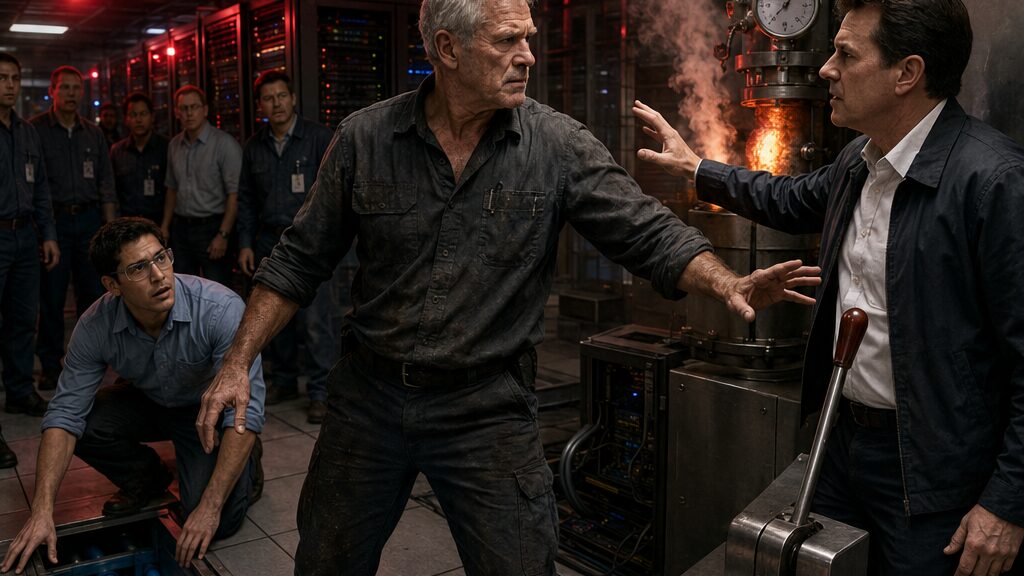
Smoke threaded between the server cabinets. The room’s normal white light strobed beneath rotating red beacons, turning the technicians into broken silhouettes. Donald stood beside the liquid-nitrogen activation lever with one hand on its protective cover.
Mark was on his knees near cabinet C-51, pulling at a floor tile.
Gregory struck the access pad.
Red.
He hit it again.
The door remained sealed.
A security officer caught his shoulder from behind. Gregory twisted free, drove his elbow into the emergency-release glass, and shattered it. He seized the recessed handle and pulled.
The magnetic lock released with a violent snap.
Heat rolled through the opening.
“Everyone out!” Gregory shouted.
Donald turned. “Remove him!”
The countdown voice continued.
TEN SECONDS.
Gregory entered the room. Beneath the alarms he heard the sound he had followed all morning—the hammering pulse, now fast and brutal, traveling west through the floor.
Mark looked up from the loosened panel. “The blue mark is here!”
“Two panels left. Manual wheel under the cross brace.”
Donald stepped between Gregory and the lever. “You have no authority in this room.”
“The relief valve is already overheating.”
“Which is why we activate full cooling.”
“That lever feeds the fire.”
Donald pointed toward the open door. “Get him out.”
One of the security officers entered but slowed when a cabinet seam flashed orange. A spark snapped across the lower rack and vanished into smoke.
NINE SECONDS.
Gregory pointed at the pressure display. “Look at the west curve.”
Mark scrambled to the local monitor. The line rose first at the far end of the bank, exactly as Gregory had predicted, then traveled backward toward the manifold.
Mark’s face changed.
“He’s right,” he said. “The pressure is moving against the model.”
Donald strode to the monitor. “Sensor inversion.”
“It matches the physical heat path.”
“Then correct the input.”
“We don’t have time.”
Donald shoved Gregory in the chest.
“You’re just a lowly worker about to retire,” he said, loud enough for everyone to hear. “Shut your mouth before I fire you and cut your pension!”
The shove drove Gregory back into a cabinet.
For one beat, the room narrowed to Donald’s spotless cuff and Gregory’s own empty hands.
All those years of lowering his voice. All the reports folded into lockers. All the younger workers he had tried to protect by never asking them to stand beside him.
EIGHT SECONDS.
Gregory stepped forward.
Donald raised a hand. “Security—”
A metallic shriek tore through the west bank.
The glowing relief valve shuddered in its housing. Insulation around the pipe darkened and curled away. The air filled with the sharp smell of scorched polymer.
Mark pointed at the display. “Pressure’s entering the blue return.”
Donald turned toward the lever. “Then we need maximum cooling now.”
“No!” Gregory shouted.
Donald flipped up the protective cover.
SEVEN SECONDS.
Mark abandoned the monitor and dropped beside the floor panel. “I found the blue line.”
“Follow it under the brace,” Gregory called. “There’s a wheel with a square stem.”
Donald gripped the activation lever.
Gregory saw the entire chain at once.
The red line Donald’s crew had welded into the old bypass. The reversed junction beneath C-47. The cheap shielding failing in sequence. The liquid nitrogen waiting behind the lever. If Donald pulled it, the pressure would not sweep heat toward the relief network. It would slam into the superheated west route, rupture the compromised line, and spray coolant through live electrical racks.
There was no time left to persuade him.
Gregory charged.
He struck Donald at the waist and drove him sideways into a steel control cabinet. Donald’s head and shoulder hit the door with a hollow crash. Instruments toppled from a shelf. The lever slipped from his fingers before it crossed the activation notch.
Donald folded to the floor.
SIX SECONDS.
The impact tore open a narrow service panel beside the cabinet. Behind it, the relief-valve spindle glowed dull red, its automatic actuator shaking uselessly against rising pressure.
Gregory understood why it was not opening.
The reversed force was driving the valve toward closure while the actuator fought from the other side.
“Mark! Bypass wheel!”
“I can’t see it!”
“Reach past the conduit. Square stem, low left.”
FIVE SECONDS.
Gregory grabbed a steel wrench from the broken cabinet and fitted it over the valve spindle. The tool slipped instantly, its handle too short to hold against the vibration.
The spindle turned another fraction toward failure.
He dropped the wrench.
“Gregory, don’t!” Mark shouted.
Gregory wrapped both bare hands around the exposed relief-valve housing.
Pain arrived as white light.
His skin seized against the metal. The smell hit him a moment later—burned cloth, burned flesh, and hot oil. He clenched harder, using his weight to hold the valve against the backward pressure.
Smoke curled from between his fingers.
FOUR SECONDS.
The roar inside the pipe deepened.
Donald stirred on the floor. Blood marked his temple where it had struck the cabinet. He looked up at Gregory, then toward the security officers.
“He assaulted me,” Donald gasped. “Stop him!”
Neither officer moved.
Mark reached under the raised tile to his shoulder. His fingers searched blindly along the pipe.
“I found the stem!”
“Turn it counterclockwise.”
“It’s locked.”
“Break the seal.”
“I need a tool.”
Gregory’s vision blurred at the edges. Blood began to run from beneath his palms, dark against the orange metal.
“Use the floor brace,” he said.
THREE SECONDS.
Mark tore loose a narrow steel crosspiece and jammed its end against the wheel stem. He pushed. Nothing moved.
“Again,” Gregory said.
The valve bucked beneath his hands. A strip of skin pulled free. He heard Samantha’s voice in memory: surviving to teach the truth matters too.
He held on anyway.
TWO SECONDS.
Mark planted both feet against the cabinet base and drove the brace downward.
The seal cracked.
The manual wheel moved.
A new sound entered the room—a low rush beneath the floor as the blue bypass began to open.
The pressure display dipped.
One line turned from red to amber.
ONE SECOND.
Donald dragged himself upright against the cabinet. “Close it! He’s flooding an obsolete line.”
Mark looked at the graph.
The pressure rose again.
The countdown froze at one.
Gregory’s hands trembled around the valve. “Open it fully.”
“It is open.”
“No. The old wheel has a second stop. Push through it.”
Mark leaned on the brace until his shoulders shook. The wheel turned another quarter.
Cold vapor burst from beneath the floor panels.
For an instant, the pressure gauge fell.
Then it stopped.
The needle hovered above the failure line.
The room remained red.
The relief valve screamed beneath Gregory’s burning hands, and somewhere below them the open bypass struck an obstruction it should not have contained.
Chapter 6: The System Turned Green Too Slowly
The valve tore skin from Gregory’s palms as the open bypass failed to relieve the pressure.
He felt it happen without looking—a wet shift between his hands and the metal, followed by a deeper heat where protection had ceased to exist.
The needle remained above the failure line.
Mark stared at the gauge. “The bypass is open.”
“Something’s choking it,” Gregory said.
Patricia entered through the emergency door with two more officers behind her. Her eyes moved from Donald slumped against the cabinet to Gregory gripping the valve.
“What happened?”
“He attacked me,” Donald said. “He sabotaged the activation sequence.”
Patricia pointed at Gregory. “Release the valve and step away.”
“If he releases it, the west line ruptures,” Mark said.
“You do not know that.”
“I do now.”
The pressure gauge twitched upward.
Gregory tightened his grip and almost blacked out.
“Mark,” he said. “Old drawing. Where does blue narrow before the west return?”
Mark pulled the folded paper schematic from his pocket. Grease from Gregory’s notebook had smeared across one corner when they handled it in the conference bay.
“It doesn’t,” Mark said. “Same diameter all the way.”
“Then Donald reduced it.”
Donald pushed himself higher. “No modification was made outside the approved model.”
Gregory looked toward the floor. “The hammer changed pitch at C-53.”
Mark followed the faded blue stripe with his eyes. “A reducer?”
“Hidden under the coupling.”
Patricia stepped closer. “No one breaks another component. This room is now under incident protocol.”
Gregory stared at her. “Your protocol is holding the pressure inside.”
“We need command authorization.”
“We need the obstruction out.”
The needle rose another fraction.
Mark moved.
He crossed two floor panels, dropped to his knees, and drove the flat end of the brace into the seam.
Donald shouted, “Stop him!”
Patricia caught Mark’s shoulder. “You are not authorized to dismantle a live pressure route.”
Mark looked up at her. Fear was plain in his face, but he did not lower the tool.
“My model validated his line,” he said. “My name is on it. I’m opening the floor.”
He struck the panel latch.
Patricia released him.
The tile lifted into a cloud of cold vapor. Beneath it, the blue pipe passed through a bright new coupling Gregory had never seen. One side was the original wide return. The other narrowed beneath a welded sleeve.
Mark touched the sleeve with the back of his glove.
“Reducer,” he said. “Unlisted.”
Donald shook his head. “Field adjustment. Flow balancing.”
“You hid a diameter mismatch,” Mark said.
“The replacement pipe available during installation required adaptation.”
“You certified uniform pressure capacity.”
Donald’s voice sharpened. “Because delaying the launch would have cost the contract and disrupted national readiness. We corrected the variance.”
Gregory heard the truth beneath the defense. Not an accidental weld. Not a drawing error. A cheap pipe forced into an old route, then concealed inside a coupling so the system would appear to match the model.
The gauge clicked higher.
“Break it,” Gregory said.
Mark raised the brace.
Patricia’s face tightened. “That could destroy the evidence.”
“If he doesn’t,” Gregory said, “there won’t be a room left to inspect.”
Mark drove the brace into the coupling.
The first strike dented the sleeve.
The second split the weld.
A white plume erupted upward, knocking him onto one elbow. The sleeve tore free, exposing a narrow insert jammed inside the wider pipe.
Pressure punched through the opening.
The sound was enormous—then suddenly lower.
The gauge needle dropped past the failure line.
Amber lights flashed across the cabinets.
Gregory held the valve until the vibration faded beneath his hands. One by one, the red alarms extinguished.
The main status display turned green.
NETWORK TRANSFER STABLE.
No one cheered.
The room filled with cold vapor, the ticking of cooling metal, and Gregory’s uneven breathing.
He released the valve.
Pieces of skin remained against it.
His knees folded before he could step back. Samantha reached him from the doorway and caught his shoulder, lowering him rather than letting him fall.
“Hands up,” she said.
He tried.
His fingers would not open.
She cut away the burned remnants of his gloves and wrapped both hands in sterile cooling dressings. Blood soaked through almost immediately.
“You hold them still,” she said. “For once in your life, let someone else carry something.”
Across the room, Donald had regained enough strength to stand.
“He broke protocol,” he shouted. “He assaulted the lead engineer and damaged certified equipment. Detain him.”
One officer looked at Patricia.
Her face had gone gray beneath the server lights. She stared at the exposed reducer lying beside the blue pipe.
“Detain no one yet,” she said.
Donald rounded on her. “You witnessed the attack.”
“I witnessed the system stabilize after the coupling was removed.”
“Because the activation sequence was interrupted. That does not prove his theory.”
Mark stood beside the open floor channel, his shirt wet with condensation.
“Yes, it does.”
Donald glared at him.
Mark carried the old schematic to the main display. He placed it beneath the current digital plan.
“The retrofit model sends pressure from the red manifold directly into the relief network,” he said. “But the physical line joins Gregory’s old blue bypass before the return. Your reducer restricted that path. Full nitrogen activation would have forced pressure backward into the overheated west bank.”
“You validated the model,” Donald said.
“I did.”
Mark’s voice shook, but he did not soften it.
“I converted the data you gave me. I never traced the physical route. That failure is mine.”
Donald pointed toward Gregory. “And his undocumented bypass created the discrepancy.”
Gregory lifted his bandaged hands from Samantha’s lap.
“The bypass should have been removed from the active records and checked during conversion,” he said. “That failure is mine.”
Donald seized the admission. “There. He caused this.”
“No,” Mark said. “His mistake left ambiguity. Your weld created the danger.”
He pointed to the exposed coupling.
“You installed a reducer that appears nowhere in the certified drawings. You used the blue line while declaring it inactive. And your operating sequence would have fed the hot bank.”
Patricia picked up Donald’s tablet. “Show me the field adjustment authorization.”
Donald did not move.
“Open the installation record,” she said.
“The record is on the subcontractor server.”
“Then explain the route.”
He looked at the old paper schematic.
Patricia placed a finger on the blue line. “Where does this bypass rejoin the relief network?”
Donald’s eyes traveled across the drawing.
He chose a junction near the west wall.
Mark shook his head. “That’s the abandoned return.”
Donald pointed elsewhere. “Then here.”
“That is a drainage branch.”
The operators gathered at a distance, silent now.
Patricia turned the paper around and pushed it toward Donald.
“You certified this facility,” she said. “Show us where the bypass rejoins the pressure system.”
Donald stared down at the blue line.
For the first time since Gregory had known him, he had no command to give.
The story has ended.