She Livestreamed Herself Destroying Her Neighbor’s Garage Before Learning What The Machines Protected
Chapter 1: The Woman Filming Across The Driveway
James Anderson stepped into his garage and found a phone pointed directly at his face.
Across the driveway, Rebecca Clark stood on the public sidewalk with one arm extended, her screen angled so he could see himself framed beneath the raised garage door. Comments crawled upward too quickly to read. A red badge in the corner showed that more than three hundred people were watching.
“There he is,” Rebecca said into the phone. “The man who refuses to tell us what those machines are doing.”
Behind James, the garage carried on with its ordinary evening rhythm. The PHEV charger gave a soft cooling whir beside his parked vehicle. Fans drew air through the offline server rack. Along the rear wall, the solar battery bank displayed three steady green indicators. Above it, the environmental station sampled temperature, particulate levels, humidity, and barometric pressure.
Together, the equipment produced a low mechanical hum James had stopped noticing months ago.
Rebecca had not.
“You’re filming into my property,” he said.
“I’m documenting a public hazard.”
“You’re standing outside a private residence.”
“And whatever you’re running in there doesn’t stay private.”
James set down the grocery bag in his hand. He resisted the urge to lower the garage door. Doing so would become evidence of concealment before the metal had touched the floor.
Rebecca turned the phone toward the equipment.
“Listen to that frequency,” she told her audience. “People on this street have had headaches, dropped calls, trouble sleeping. He calls it a charging station. I call it an experiment.”
The hum deepened for several seconds as the PHEV’s thermal system increased airflow.
Rebecca’s eyes widened. “There. It reacted.”
“It’s cooling the vehicle battery.”
“It reacted when I spoke.”
James walked to the charger, disconnected the cable, and pressed the standby control. The louder fan cycle wound down, leaving only the softer server ventilation.
“That was the loudest source,” he said. “It is a certified charging unit. You’ve seen the inspection sticker.”
Rebecca aimed the phone at the silent cable in his hand, then at his face.
“So you admit there are multiple sources.”
A stream of approving comments rose across her screen.
James recognized the pattern. Every answer produced another accusation. Every refusal did the same thing faster.
He put the cable into its wall cradle. “Please stop filming my garage.”
“Why? Because people can finally see it?”
She reached into the canvas bag hanging from her shoulder and pulled out several printed photographs. The first showed the yellow thermal-warning label on the solar battery cabinet. The second was a close crop of a red electrical hazard symbol. The third showed the environmental sensors mounted near the rear window.
The pictures had been taken from different angles and at different times of day.
“How long have you been photographing my house?” James asked.
Rebecca ignored him.
“This says high temperature can cause fire,” she announced, holding the battery photograph near her camera. “And this one warns of lethal voltage. Yet he leaves the whole thing open to the neighborhood.”
“The cabinet is inside my garage. It is locked, grounded, and monitored.”
“So it is dangerous.”
“It contains electricity.”
Rebecca gave the phone a look of vindication. “You heard him.”
James felt irritation tighten behind his ribs, but beneath it came something colder. One photograph showed the left edge of his workbench. Another had been taken from near the side fence. A third revealed a partial view behind the environmental station that could not be seen clearly from the sidewalk.
She had not taken all of them from where she stood now.
Rebecca tapped her screen. A thin, distorted recording began to play. The garage hum had been amplified until it sounded like an approaching aircraft, with a high electronic whine layered over it.
“This is what my bedroom sounds like at two in the morning,” she said.
“No, it isn’t.”
“You calling me a liar?”
“I’m saying that recording has been processed.”
“I increased the volume so people could hear what you’ve trained yourself to ignore.”
James looked across the street. Two neighbors had stepped onto their porches. Neither came closer. One held a cup. The other watched Rebecca’s phone rather than the garage itself.
He could have retrieved the full inspection binder. He could have walked her through grounding resistance, thermal isolation, charge limits, automatic suppression, and noise ratings. He could have shown her that the environmental station measured the very air quality she accused him of poisoning.
But behind those visible systems sat another cabinet disguised among data converters and weather telemetry hardware. Its access details were not his to discuss. Even a careful explanation risked leading her attention toward the one thing she should never examine closely.
“Everything visible here has been inspected,” James said. “You have received copies of the permits.”
“With missing pages.”
“With information withheld under state law.”
Rebecca lowered the photographs.
For the first time, she stopped performing for the audience and looked directly at him.
“State law,” she repeated. “So the government is involved.”
James realized his mistake before the comments erupted.
Rebecca turned sharply and zoomed her camera past him. “Look behind those weather sensors.”
A narrow label was visible on the side of the protected cabinet.
RESTRICTED ACCESS — AUTHORIZED SERVICE PERSONNEL ONLY.
Her voice dropped into a tone more dangerous than shouting.
“That is not a car charger.”
“It is part of a monitored installation.”
“What kind?”
“I cannot discuss protected equipment on a public livestream.”
She smiled without pleasure. “There it is.”
James crossed the garage and positioned himself between her camera and the rear wall.
Rebecca backed farther onto the sidewalk as though he had advanced on her.
“Did everyone see that?” she said. “He blocked the moment we found the restricted unit.”
“You have found a safety label.”
“I found proof.”
“No. You found something you don’t understand.”
The words landed harder than he intended.
Rebecca’s face changed. For one brief moment, the fury fell away and left something bruised beneath it.
“My husband told me I didn’t understand electricity,” she said. “He said the smell in our utility room was nothing. Three days later, the wall caught fire.”
James said nothing.
“He died six months after that,” she continued, her voice sharpening again. “Complications from smoke damage. So forgive me if I don’t bow when another man tells me the machines are perfectly safe.”
The comments slowed. Even the neighbors on their porches seemed to become still.
James could have acknowledged the loss. He could have said fear was not foolish, even when its target was wrong.
Instead, he looked toward the protected cabinet and chose the familiar shelter of procedure.
“You have the right to file a complaint,” he said. “You do not have the right to enter my property or record through my garage.”
Rebecca’s hurt disappeared behind certainty.
“I’ve already filed one.”
She ended the livestream, but she did not leave immediately. She gathered the photographs with deliberate care, slid them back into her bag, and stared past James at the sensors.
“You should close that door,” she said. “Before somebody gets hurt.”
When she finally walked away, James lowered the garage door halfway, then stopped it. The equipment’s hum pressed softly against the silence she left behind.
He went to the wall-mounted security panel and reviewed the exterior cameras. Rebecca had remained on the sidewalk throughout the livestream. Earlier footage told a different story. Two nights before, at 1:13 a.m., a figure had paused near the side fence. The image showed only a shoulder and the pale glow of a phone.
James opened the network log.
An amber notice waited beneath the current system status.
UNAUTHORIZED WIRELESS HANDSHAKE ATTEMPT
SOURCE DISTANCE: ESTIMATED 18–24 METERS
REPEATED REQUESTS: 17
The direction indicator pointed toward Rebecca’s house.
Chapter 2: The Inspection Report With Missing Pages
Carol Wilson placed the petition beside James’s inspection binder and kept one hand on both as though they might slide toward each other and ignite.
“Eleven signatures,” she said.
The number changed the room.
James had expected Rebecca, Carol, and perhaps two curious neighbors. Instead, folding chairs filled Carol’s living room. People stood along the wall beneath framed family photographs, avoiding direct eye contact with him. Rebecca sat near the front with her phone facedown on her knee.
The low hum from her distorted recording played through a portable speaker on the coffee table.
Carol stopped it.
“We are not listening to that again,” she said.
“It’s evidence,” Rebecca replied.
“It’s making my lamp vibrate.”
“That is what it does to my bedroom.”
John Smith, the electrical inspector, leaned forward and unplugged the speaker. “That recording has been boosted beyond any useful level. You can make a refrigerator sound like a turbine if you amplify it enough.”
Rebecca looked around the room. “Notice the tone.”
John frowned. “What tone?”
“The way experts speak when ordinary people ask questions.”
James saw three neighbors shift in their seats.
John did not.
“The equipment either passes or it doesn’t,” he said. “And it passed.”
He opened the inspection binder. Colored tabs divided the sections for the PHEV charger, solar battery installation, offline server power supply, environmental sensors, grounding system, and fire controls.
“These readings are better than required,” John continued. “The battery cabinet has thermal isolation and automatic shutdown. The charger is on a dedicated circuit. The server rack is ventilated within manufacturer limits. The weather station draws less power than a toaster.”
Rebecca lifted a photograph. “Then why does the battery say it can burn?”
“Because every energy-storage device can fail under certain conditions.”
A murmur moved through the room.
John spread his hands. “Your phone battery can burn. That does not make your phone a bomb.”
Rebecca’s expression hardened. “My phone isn’t the size of a refrigerator.”
“No, but the principle—”
“John,” Carol interrupted.
He looked at her, annoyed.
Carol turned the photograph toward the others. “The label says the cabinet must be kept within a listed temperature range. It does not say the cabinet is currently overheating.”
“That is one interpretation,” Rebecca said.
“It is the printed meaning.”
Rebecca picked up James’s binder and flipped to the center. Several pages showed broad black redactions. One section had been replaced by a certification page bearing an official seal and a reference number.
“What about these?” she asked. “Why is the safe equipment covered in black ink?”
James kept his voice level. “Those pages concern a protected communications component. The certification confirms that it was reviewed and lawfully installed.”
“You expect us to accept a page saying other pages exist?”
“I expect you to accept the responsible agency’s certification.”
“Which agency?”
“I am not authorized to identify operational details.”
Rebecca looked at the gathering rather than at him. “He can’t tell us who inspected it. He can’t tell us what it does. He can’t explain why it runs at night.”
“It runs continuously because some systems require continuous operation.”
The answer sounded evasive even to James.
His phone vibrated in his pocket.
A message from Michael Davis appeared on the lock screen.
DO NOT EXPAND ON RELAY FUNCTION. SECURITY REVIEW PENDING.
James closed his hand around the phone.
Carol noticed.
“Is there something we should know?” she asked.
He could have told them the visible equipment was separate from the protected component. He could have explained that the weather sensors provided ordinary environmental data and that the restricted unit had passed every applicable safety review.
Instead, he said, “Nothing relevant to the safety of this neighborhood.”
Rebecca gave a quiet laugh.
“That sentence is the whole problem.”
She stood and placed a second stack of paper beside the petition. These pages contained screenshots of interrupted video calls, dropped wireless connections, and signal measurements from inside her home.
“I started documenting this because nobody believed me,” she said. “Every night around ten, my connection weakens. Sometimes my radio crackles. My phone loses service in the back bedroom closest to his garage.”
John picked up the top page.
“These numbers could come from a dozen sources.”
“But they are real.”
“They appear to be readings.”
“Say it,” Rebecca demanded. “Say I didn’t invent them.”
John hesitated, then nodded. “You did record some kind of interference.”
The room shifted again.
Rebecca’s voice softened, gaining power from restraint. “That is all I have asked anyone to admit.”
James studied the timestamps. The disruptions occurred in clusters, often when his protected unit was operating under minimal load. They did not match his relay cycles, charger use, or server backups.
The readings were real.
Her conclusion was not.
“What device did you use to collect these?” he asked.
Rebecca drew the pages back. “Why?”
“Because the measuring device matters.”
“You want to discredit it.”
“I want to identify the source.”
“The source is thirty feet from my bedroom.”
James almost told her that the restricted equipment did not transmit in the manner she imagined. The words reached the edge of disclosure.
His phone vibrated again.
NO TECHNICAL DETAILS IN OPEN MEETING.
He slipped it back into his pocket.
Rebecca saw the movement. “Someone is coaching you.”
“No.”
“Then show us the message.”
“No.”
Carol pressed her fingers against her forehead. “We need a process, not another argument.”
She produced a printed notice. “The association will conduct an emergency exterior property review on Saturday. No one will enter James’s garage without permission. We will observe from the driveway, verify the visible permits, and document any noise that crosses the property line.”
John leaned back. “That is unnecessary.”
“It may be unnecessary technically,” Carol said, “but socially, we are past that point.”
James looked at the petition. Eleven people had signed not because they understood Rebecca’s claims, but because uncertainty had become less comfortable than accusation.
“Agreed,” he said.
Rebecca picked up her phone.
“I’ll stream the review.”
“No,” James said.
“It will happen in public view.”
“It will happen on private property.”
“Then keep the door closed.”
Carol stepped between them. “No livestreaming inside the property boundary.”
Rebecca’s thumb moved across her screen.
A notification sounded from several phones around the room at once.
James did not need to look. Rebecca had already posted.
She smiled at him.
“Saturday,” she said. “Everyone gets to see what you’ve been hiding.”
Chapter 3: The Warning James Refused To Explain
The device taped to James’s fence was built from a plastic food container, two wires, and a cheap radio-frequency sensor aimed directly at his garage.
He found it before sunrise.
Condensation filmed the clear lid. Inside, a battery pack fed a blinking circuit board. A handwritten label on the side read AIR SAFETY MONITOR.
James photographed it without touching it.
Behind him, the garage maintained its steady layered murmur. The charger was idle. The server fans ran evenly. The environmental station clicked as it sampled the morning air.
Beneath those familiar sounds, James heard a faint oscillation.
The protected cabinet’s cooling fan was cycling three seconds too quickly.
He went inside and opened the diagnostic panel. External noise had raised the relay’s error-correction load overnight. Nothing critical had failed, but the system had spent hours compensating for interference from the direction of Rebecca’s house.
His phone rang.
Michael Davis did not bother with a greeting. “Tell me you did not find that device attached to your boundary.”
“I found it attached to my fence.”
“That distinction will comfort everyone during the review.”
“I haven’t touched it.”
“Good. A security team is coming.”
“No.”
Silence filled the line.
Michael spoke more slowly. “We logged repeated wireless requests against a protected installation. Now there is an improvised sensor pointed at it.”
“It is a consumer detector in a food container.”
“It is unauthorized surveillance.”
“It is also evidence that she has no idea what she is doing.”
“Lack of competence does not reduce intent.”
James watched the abnormal load graph rise and fall.
“If state vehicles arrive at her house,” he said, “she will tell the neighborhood she exposed a government weapon and frightened officials came to silence her.”
“That is not a security argument.”
“It becomes one when twenty people start copying her.”
Michael exhaled. “You should have reported the first confrontation.”
“I documented it.”
“You contained it. That is not the same thing.”
The words struck an old place.
Years earlier, a field relay under James’s supervision had begun dropping packets during a regional emergency exercise. A junior technician had recommended shutting it down immediately. James had judged the error rate manageable and refused to interrupt the network.
The relay failed forty minutes later during a real multi-vehicle incident beyond the exercise zone. Dispatch coordination slowed. Medical units received conflicting routes. No report had blamed one decision alone, but James remembered the technician standing in the operations room afterward, silent because he had already said what needed saying.
James had promised himself he would never dismiss a warning again.
Instead, he had learned to guard every system so tightly that he sometimes guarded information too.
“I can identify the interference source,” James said. “Give me an hour.”
“You already know the direction.”
“I want the device.”
“Do not enter her property.”
“I’m not going to.”
Michael’s voice hardened. “If the load increases, I am deploying the team whether you agree or not.”
The call ended.
James contacted John Smith and showed him the signal graph. Forty minutes later, John arrived carrying a handheld analyzer and an expression that suggested he blamed everyone equally.
They walked the public sidewalk beside Rebecca’s property. The signal peaked near the rear corner of her house.
John studied the analyzer. “Cheap booster.”
“You’re sure?”
“Overpowered, probably failing. It’s hunting for a carrier and spraying noise across adjacent bands.”
“The device she says proves my equipment is attacking her.”
“Could be causing her dropped calls too.”
James looked at Rebecca’s closed curtains. Her own attempt to strengthen a weak signal had created the symptoms she blamed on him.
John knocked on her door.
Rebecca opened it with her phone already recording.
“You’re not coming inside.”
John raised the analyzer. “The interference is originating from this property. You likely have a malfunctioning signal booster.”
“I have a legal right to improve reception.”
“Not with an unapproved amplifier operating above limit.”
Her camera turned toward James. “So now he sends an inspector to confiscate my evidence.”
“No one is confiscating anything,” James said. “Turn the booster off and let John test the change.”
“You want me blind before Saturday.”
“The booster may be disrupting your own devices.”
“That is convenient.”
John stepped closer to the threshold. “Lady, the signal is so dirty I can track it from the street.”
Rebecca’s face flushed. “Do not call me lady like I am an idiot.”
“I did not call you an idiot.”
“You didn’t have to.”
For a second, James saw the same wounded expression that had appeared when she spoke of her husband. Then Rebecca lifted the phone higher and found her audience again.
“They are at my door trying to disable my monitoring equipment,” she said. “This is what happens when ordinary citizens collect proof.”
James kept his hands visible. “Rebecca, nobody is entering your house. We are asking you to shut down one device for five minutes.”
“You first.”
“What?”
“Shut down every machine in your garage.”
“That is not possible.”
She gave the camera a grim smile. “There it is again.”
The door closed.
By noon, a clipped video of the exchange had spread through the neighborhood group. Rebecca removed John’s explanation and left only James saying the shutdown was impossible.
The caption read: HE ADMITS THE MACHINES CANNOT BE TURNED OFF.
James watched it once, then locked his phone.
He could issue a formal notice. Michael could send security personnel. John could report the booster. Every available response would confirm the shape of Rebecca’s story to anyone already inclined to believe it.
Yet doing nothing had shaped the story too.
The garage hum shifted behind him, rising as the protected system compensated for another burst of interference.
For years, James had treated silence as discipline. Now it sounded less like restraint and more like the pause before a failure he had already been warned about.
A motion alert appeared on his security monitor.
Rebecca was in her backyard beside a green garden cart.
She laid a long galvanized steel pipe across it first. Then a heavy red industrial fire extinguisher. A coiled high-pressure hose followed, its brass nozzle catching the sun.
James moved closer to the screen.
Rebecca returned carrying an axe.
She placed it on top of the other tools, tested the cart’s weight, and turned it toward the gate leading to the street.
Edit
Chapter 4: The Livestream Called A Public Rescue
James’s security panel sounded before Rebecca reached the street.
PROPERTY LINE BREACH flashed across the wall display. On the camera feed, she pushed the garden cart through her side gate with one hand and dragged a running hose with the other. Water pulsed from the brass nozzle, striking the pavement in short, violent bursts.
Her phone was mounted upright on the cart.
A red livestream counter climbed beneath the title SAVING OUR NEIGHBORHOOD.
James pressed Michael’s number as he crossed the garage.
“She’s moving toward the property with tools.”
“What tools?”
“Pipe. Extinguisher. Axe. Pressurized hose.”
Michael’s tone changed. “Get inside and close the garage.”
“The relay is exposed if she breaches the door.”
“Your safety comes first.”
“She has already crossed the boundary.”
James ended the call before Michael could argue.
Outside, Rebecca pulled the cart into the road. The extinguisher rolled against the steel pipe with a heavy metallic knock. She faced her phone as she walked.
“For weeks, we have asked for answers,” she announced. “Today we are taking emergency action before one of these batteries explodes.”
Several viewers sent strings of warning symbols. Others urged her to call the fire department.
“I tried,” Rebecca said. “Nobody acts until there are flames.”
James stepped to the edge of his driveway.
“Stop where you are.”
She did not stop.
The hose hissed over the asphalt behind her. The garage’s steady hum remained audible beneath the water and the cart’s rattling wheels, but it no longer sounded harmless. Each fan seemed to mark the distance closing between Rebecca and the energized equipment.
“You are trespassing,” James said. “Turn off the hose and leave the tools in the street.”
Rebecca angled the phone toward him. “He’s threatening me now.”
“I am giving you a clear warning.”
“You gave us warnings on labels. You gave us blacked-out pages. You gave us interference every night.”
“The interference is coming from your signal booster.”
“That is what they told you to say.”
James glanced at the cart. The axe lay beneath the pipe. The extinguisher’s safety seal was still intact, but the pin had been bent outward.
Carol hurried from across the street, carrying the folder prepared for the scheduled property review.
“What are you doing?” she asked.
“What you should have done,” Rebecca replied.
“This is not the review.”
“It became an intervention.”
Carol reached for the phone mount. Rebecca slapped her hand away.
“Don’t touch my evidence.”
Carol stepped back, startled. Her eyes dropped to the extinguisher.
The safety pin was no longer in place.
“Rebecca,” she said, “put that down.”
“It is a fire extinguisher.”
“It’s charged, and you’ve removed the pin.”
“Because we may need it.”
James moved sideways, keeping himself between Rebecca and the open garage.
The relay cabinet sat behind the environmental station, visually unremarkable except for the restricted-access label. The PHEV charger occupied the nearest wall. Beyond it, the solar batteries stood in their insulated enclosure. The offline server rack drew cool air through a bank of exposed vents.
Rebecca pointed at the batteries.
“Those are heat-storage bombs.”
“They are monitored lithium battery modules.”
“Exactly.”
“You do not know what that word means in this system.”
Her face tightened at the old wound inside the sentence.
“My husband knew what words meant,” she said. “He knew enough to tell me not to worry while the wiring burned behind our wall.”
“This is not your old house.”
“No. This one is worse because everyone protects you.”
She lifted the hose.
James raised one hand.
“Rebecca, listen carefully. Water near an energized high-voltage system can injure or kill you. The floor inside that garage contains electrical equipment. Do not spray it.”
Her phone captured every word.
For a moment, the hose remained pointed toward the ground.
Carol spoke softly. “You have your warning on record. That is enough. Let the authorities inspect it.”
Rebecca looked at the livestream counter. More than two thousand people were watching now.
A comment floated across the screen: HE’S SCARED BECAUSE YOU FOUND IT.
Another followed: MAKE HIM SHUT IT DOWN.
Rebecca’s thumb tightened around the nozzle lever.
“You say it is safe,” she told James. “Prove it.”
The water struck the driveway.
The jet swept toward him in a silver arc, hit the concrete at his feet, and broke into spray. James moved backward, but Rebecca lowered the stream and forced it beneath the raised garage door.
Water spread across the floor toward the charger cabinet.
An alarm chirped.
James spun toward the emergency panel and pressed the charger isolation switch. A contactor slammed open inside the wall box. The loudest section of the mechanical hum died.
Rebecca heard the change.
“You see?” she shouted to the phone. “The machine reacted when I exposed it.”
“You triggered a safety shutdown.”
“So it was dangerous.”
“The water is the danger.”
She released the hose and snatched the red extinguisher from the cart.
Carol moved between them. “Rebecca, no.”
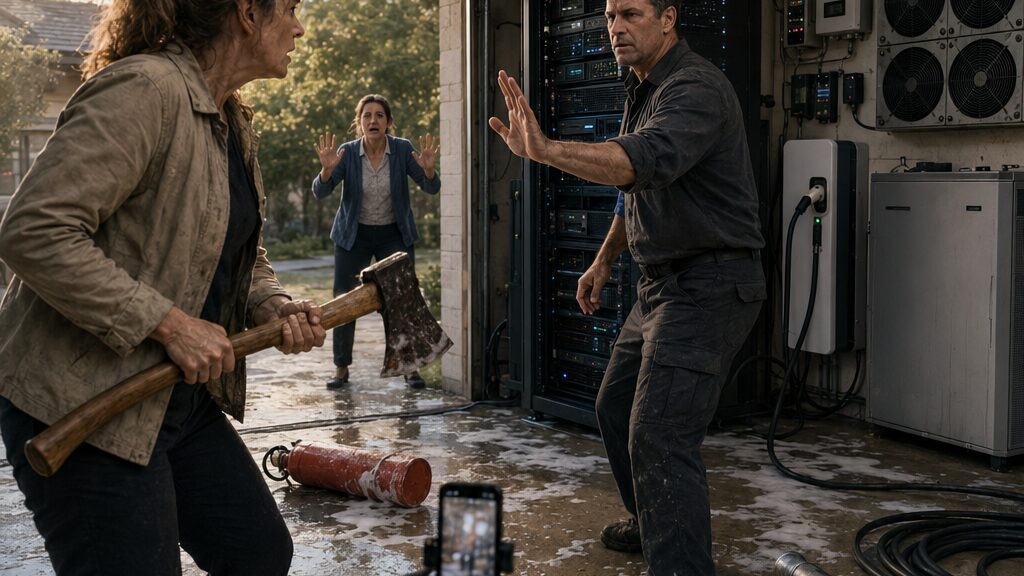
Rebecca shoved past her, aimed the hose at the charger cabinet, and squeezed the handle.
Thick white foam exploded across the open garage.
It struck the charger, coated the cable cradle, and spread over James’s workbench. The chemical cloud swallowed the front of the battery enclosure. Powdery droplets hung in the air and settled over the wet concrete in greasy clumps.
The environmental station sounded a contamination alarm.
Rebecca coughed but kept spraying.
“I am preventing ignition!”
“You are contaminating electrical equipment,” James said.
“Then shut it all off.”
“I cannot shut down the protected system without authorization.”
The livestream erupted with messages.
CANNOT SHUT IT OFF.
GOVERNMENT DEVICE.
CALL THE NEWS.
James saw Rebecca absorb each fragment of certainty. Her fear had become a performance with an audience large enough to punish retreat.
Carol grabbed the extinguisher cylinder from behind. Rebecca twisted, and the discharge swept across the server rack.
The cooling fans inhaled the foam.
Their pitch changed instantly.
One fan began to grind.
James lunged for the suppression handle and forced the extinguisher nozzle upward. Foam struck the ceiling and fell around them like dirty snow.
Rebecca kicked at his shin and tore the cylinder free.
“You assaulted me!”
“Drop it.”
The voice came out harder than he intended.
Rebecca froze.
For an instant, the garage held only the uneven fans, the patter of water, and the thin alarm from the relay cabinet.
Then the phone chimed with another surge of viewers.
Rebecca abandoned the extinguisher and seized the galvanized pipe.
James saw the movement before Carol did.
“Get back,” he told her.
Carol retreated toward the driveway.
Rebecca stepped through the foam, both hands on the pipe. “I am disabling the source.”
“That rack is carrying protected communications.”
“So you admit it transmits.”
“I said communications. Put the pipe down.”
She looked past him at the server cooling fans, where white residue had begun to clog the intake grille.
“You could have told us.”
“I told you it was inspected.”
“You hid behind paper.”
James heard the accusation because part of it was true.
A sharper alarm cut through the garage.
The relay status indicator shifted from green to yellow.
On the diagnostic panel, cooling efficiency dropped below minimum tolerance.
Rebecca lifted the steel pipe over her shoulder.
“Once the fans stop,” she said to her audience, “the frequency stops.”
James stepped onto the flooded floor between her and the rack.
The relay alarm changed from yellow to red.
Chapter 5: The Axe Handle Broke Before The Signal
The galvanized pipe came down as James crossed the last two feet of wet concrete.
He caught it against his forearm rather than let it strike the cooling fans. The impact drove a numb shock from his wrist to his shoulder. Rebecca pulled back for another swing, but he seized the pipe with both hands and twisted.
Her shoes slipped in the foam.
The pipe tore free.
James threw it toward the driveway, where it struck the garden cart and rolled into the grass.
“Stay back,” he said.
Rebecca stared at her empty hands.
Behind James, the relay’s red alarm pulsed in time with the failing fan. The garage hum had broken into uneven layers—one fan grinding, another racing to compensate, the protected cabinet’s internal cooling system surging and falling.
His diagnostic display flashed:
ACTIVE EMERGENCY NETWORK TEST
THERMAL LIMIT APPROACHING
AUTOMATIC FAILOVER: 00:48
Forty-eight seconds before the relay transferred its load. If the local cooling collapsed during failover, the unit could shut down entirely.
Rebecca heard only the change in sound.
“It’s weakening,” she said.
“It is overheating because you filled the fans with foam.”
“So turn it off.”
“Move away from the equipment.”
Carol stood outside the spray line, phone pressed to her ear. “Emergency services are coming.”
Rebecca spun toward her. “Tell them he attacked me.”
“I watched you swing the pipe.”
“He grabbed me.”
“He stopped you from smashing the fans.”
Rebecca looked toward the livestream. The comments no longer moved in one direction. Some demanded that she leave. Others accused James of hiding a weapon. A few urged her to finish before authorities arrived.
James released the manual latch on the secondary cooling duct. Nothing happened.
Foam had sealed the intake.
He pulled a utility knife from the workbench, cut through the contaminated filter, and tore it loose. Air rushed into the rack with a ragged howl. The temperature graph slowed but did not fall.
Rebecca backed toward the cart.
“Do not touch anything else,” James said without turning.
The wood scraped against metal.
He looked over his shoulder.
She had lifted the axe.
Carol lowered her phone. “Rebecca.”
Rebecca held it across her body, not yet raised, her chest moving fast.
“He has a knife,” she told the livestream.
James set the utility knife on the floor and pushed it away with his boot.
“My hands are empty.”
“He is protecting the machine over people.”
“I am protecting the communication system you are trying to destroy.”
“What people?”
“I cannot discuss its users.”
“Because there are none.”
James looked at the countdown.
Thirty-two seconds.
He needed to reach the manual coolant bypass beside the battery enclosure. Rebecca stood between him and it, holding the axe.
“Move to the driveway,” he said.
“You move.”
“If that relay fails, emergency communications may be interrupted.”
“There. He finally says it.” Rebecca’s eyes shone with a frightening mixture of fear and triumph. “The machine controls emergency services.”
“It supports them.”
“You built the thing that decides who gets help.”
“No.”
“My husband waited forty minutes for an ambulance.”
The axe trembled in her hands.
James understood then that she had not merely connected the garage to a fire. She had connected it to every delay, every unanswered warning, every official voice that had told her to wait.
But understanding did not make the blade lighter.
“Rebecca,” he said, “your husband’s death was not caused by this equipment.”
“You do not get to use him.”
“I am not using him.”
“You are telling me again that I misunderstood.”
“I am telling you that grief does not make this safe.”
Her jaw tightened.
James shifted one step toward the bypass.
Rebecca swung.
He moved outside the arc.
The axe head passed close enough for him to feel the air against his cheek. He caught the wooden handle below her leading hand and drove it downward, using her momentum rather than meeting the blade.
Rebecca lost her grip.
James pulled the axe clear, turned the steel head away from both of them, and brought the middle of the handle sharply across his raised thigh.
The wood cracked.
A second pressure snapped it cleanly in two.
He threw the heavy steel head into the soft dirt beside the driveway. It landed blade-down and toppled harmlessly onto its side.
The broken handle struck the concrete.
Rebecca stared at it.
The entire garage seemed to pause around the sound.
James dropped both pieces and turned away from her.
The relay countdown showed nineteen seconds.
He reached the bypass, pulled the protective cover, and forced the stiff valve clockwise. Backup coolant entered the cabinet. The hum surged into a deeper, steadier tone.
Temperature began falling by fractions.
Then the hose moved.
The pressurized line, released when Rebecca abandoned it, had twisted beneath the cart. The nozzle kicked free and whipped across the driveway, spraying a hard uncontrolled jet toward the open garage.
The brass fitting struck the pavement and changed direction.
Water swept toward the battery enclosure.
James lunged, caught the hose behind the nozzle, and tried to close the lever. It had jammed half-open from the impact.
The line bucked in his hands.
He bent it against his knee, but the reinforced hose resisted. Water sprayed across his shirt and face. The jet struck the base of the battery cabinet and spread beneath the foam.
Rebecca scrambled backward.
James gripped the brass nozzle with both hands and forced it sideways against the concrete lip of the driveway. The metal deformed slightly.
The pressure built behind it.
He crimped again.
The hose swelled near the coupling.
“Get back!” he shouted.
Carol pulled Rebecca toward the street.
The line burst.
Water exploded from the split behind the nozzle, spraying outward in a wide harmless fan that drenched the curb and sent the loose hose thrashing into the road.
The direct stream toward the garage stopped.
James dropped the damaged fitting and ran back to the diagnostic panel.
The relay countdown reached zero.
For half a second, the protected cabinet went silent.
The absence of sound struck him harder than any alarm.
Years collapsed into that gap: the junior technician asking for shutdown authority, James refusing, the old field relay falling dark, dispatch voices breaking into static while ambulances waited for corrected routes.
Then the backup cooling engaged.
The hum returned—low, stable, continuous.
STATUS: FAILOVER COMPLETE
NETWORK INTEGRITY MAINTAINED
James placed one hand against the cabinet, feeling the vibration through the metal.
It had held.
Behind him, Rebecca began to cry.
Not quietly. She sat in the wet street beside the garden cart and called emergency services from her livestream phone, speaking between gasps.
“My neighbor attacked me,” she said. “He took my tools. He broke my axe. He has secret government equipment in his garage.”
Carol stood several feet away, soaked with foam and water.
“You swung the axe at him,” she said.
Rebecca covered the microphone. “You were supposed to help.”
“I was supposed to observe a review.”
“You signed the complaint.”
“I signed for a review, not this.”
Rebecca turned away and resumed speaking to the dispatcher.
James checked the recording status on the security system. Two exterior cameras had captured the driveway. The garage camera had captured the pipe and axe swings. But chemical foam obscured several seconds near the server rack.
Rebecca’s livestream might contain the clearest view.
He looked toward her phone.
The moving comments had vanished.
A gray banner covered the screen.
CONTENT LOCKED
FEDERAL SECURITY EVIDENCE PRESERVATION ACTIVE
DO NOT TERMINATE STREAM
Rebecca stopped speaking.
“What did you do?” she asked.
James had done nothing.
In the distance, tires turned hard onto the street.
Chapter 6: Her Own Audience Became The Evidence
The first unmarked vehicle blocked the eastern end of the street before the local patrol car had finished parking.
A second stopped across the western entrance. State troopers stepped out wearing plain tactical vests, followed by communications security personnel carrying sealed equipment cases. Neighbors who had gathered along the sidewalks were ordered back behind their property lines.
Rebecca remained seated beside the cart, holding her locked phone as if it had betrayed her.
James stood inside the garage with his hands visible.
Michael Davis crossed the wet driveway without looking at Rebecca. His gaze moved from the burst hose to the foam-coated charger, the broken axe handle, the server rack, and finally the relay panel.
“Status?”
“Failover completed. Network integrity maintained.”
Michael checked the display himself. “Thermal margin?”
“Recovering. Intake contamination on the primary fans.”
“You crossed live water to reach the rack?”
“Yes.”
Michael’s jaw tightened, but he did not comment.
A trooper approached James while another separated Rebecca from the tools.
“She attacked me,” Rebecca said. “He broke my property and threatened me with a knife.”
“The knife is beside the workbench,” James said. “I used it to remove a blocked filter, then placed it on the floor before she swung the axe.”
Rebecca pointed toward Carol. “She saw him come at me.”
Carol’s face had gone pale beneath streaks of chemical residue.
“I saw Rebecca spray the equipment,” she said. “I saw her swing the pipe. Then the axe.”
“You’re lying because you want to protect the association,” Rebecca said.
Carol looked at her for a long moment. “I wanted this to remain a neighborhood disagreement. That was my mistake.”
The trooper asked everyone to stop talking until statements could be taken separately.
Michael motioned James toward the temporary command vehicle.
Inside, three screens showed synchronized recordings: James’s driveway camera, the garage feed, and Rebecca’s livestream preserved from its public platform. The livestream image shook, but its audio was clear.
James heard his own voice: Water near an energized high-voltage system can injure or kill you. Do not spray it.
Then Rebecca’s response: You say it is safe. Prove it.
Michael paused the footage.
“That warning matters.”
“It should never have reached that point.”
“No.”
James looked toward the relay telemetry. The emergency test had continued without loss, but one graph showed the network within seconds of forced shutdown.
Michael folded his arms. “The system survived. That does not end the review.”
“I know.”
“You received a wireless intrusion alert. You found surveillance equipment. You watched her assemble tools.”
“I believed an official response would intensify the situation.”
“It intensified without us.”
James did not defend himself.
Michael studied him. “You were trying not to use your office against a neighbor.”
“Yes.”
“And in doing so, you treated a security threat like a personal inconvenience.”
James looked at the paused image of Rebecca raising the axe.
Years earlier, he had ignored a technician because the system still appeared stable. This time, he had ignored himself because the neighborhood still appeared manageable.
Different reasons. Same delay.
“I should have reported the escalation,” he said.
“The installation may be removed.”
“I understand.”
“You may face formal discipline.”
“I understand that too.”
Michael’s expression softened only slightly. “You also prevented an outage and avoided injuring her when you had several chances to use more force.”
“That does not erase what came before.”
“No. It doesn’t.”
A security analyst entered carrying a tablet.
“The livestream archive is complete,” the analyst said. “It includes her preparation commentary from inside her house.”
Rebecca had started broadcasting earlier than James knew.
On-screen, she explained each tool to her viewers. The pipe was for “breaking the frequency fans.” The extinguisher was for “neutralizing the battery fire before it started.” The hose was meant to “flush the charge out.” She lifted the axe and said it was insurance in case James physically blocked her.
The analyst advanced to a message thread.
Carol recognized the screenshots when she was brought into the vehicle.
“These came from the neighborhood group,” she said. “She asked people to attend what she called an intervention.”
“Did she describe property damage?”
“Not directly. She said the equipment might need to be disabled before emergency crews would take the danger seriously.”
Rebecca had planned not merely to protest, but to manufacture the emergency she believed authorities required.
Another investigator arrived with John Smith’s signal analyzer sealed in an evidence bag. John stood outside Rebecca’s house while a trooper carried out a consumer signal booster with an oversized aftermarket amplifier attached.
The investigator set it on the command table.
“This unit exceeds permitted output,” she said. “Its carrier search pattern matches the interference recorded by both properties.”
Michael looked at James. “Her own device.”
“Yes.”
The truth produced no satisfaction.
Rebecca had experienced real dropped calls and radio noise. She had not invented the symptoms. She had created them, then treated every refusal to confirm her explanation as proof of conspiracy.
Outside, the relay’s restored hum continued beneath radio chatter and the closing of vehicle doors.
Rebecca was brought to the command vehicle’s open side door.
The trooper explained that she was being detained on suspicion of trespass, reckless endangerment, attempted destruction of protected infrastructure, and assault.
“No,” she said. “I exposed it. Thousands of people saw.”
“Yes,” the trooper replied. “They did.”
Her gaze found James.
“Tell them what that machine is.”
“I cannot.”
She laughed once, sharply. “Even now.”
James stepped closer, stopping beyond her reach.
“I can tell you it was inspected. I can tell you the batteries were within safe temperature. I can tell you the interference came from your booster. I can tell you I should have explained the ordinary systems more clearly before this happened.”
Rebecca stared at him.
“But none of that gave you the right to enter with an axe,” he said.
Her face crumpled, then hardened again.
“You all waited until I forced you to listen.”
Carol answered from behind him.
“We listened. You stopped listening back.”
The trooper turned Rebecca toward the vehicle.
When the first handcuff closed around her wrist, her phone was still held in an evidence sleeve on the command table. The preserved livestream displayed a frozen frame of her standing in James’s driveway with the extinguisher raised.
Rebecca heard the second cuff lock.
The investigator told her that the video she had created would be the primary evidence against her.
For the first time since the dispute began, Rebecca had no audience she could persuade.
Chapter 7: Five Hundred Hours Beneath A Quiet Hum
The judge looked down at Rebecca Clark and asked the question no one in the neighborhood had managed to make her answer.
“Do you still believe the batteries in Mr. Anderson’s garage were bombs?”
Rebecca stood beside her attorney with both hands clasped tightly in front of her. Three months had passed since the attack. Her hair was shorter. Her face looked thinner. She was forbidden from using social media while the case remained active, and without a phone raised between herself and the room, she seemed smaller than James remembered.
“I believed there was a danger,” she said.
“That was not my question.”
The courtroom remained still.
On the table before the judge lay photographs of the foam-coated charger, the burst hose, the broken axe handle, and the server rack with its damaged cooling assembly. A transcript of Rebecca’s livestream rested beneath them.
Her own words occupied dozens of pages.
The judge repeated the question.
Rebecca looked toward James. He sat behind the prosecutor with Carol and Michael several seats away.
“No,” she said at last. “I do not believe they were bombs.”
“Did you have evidence that they were?”
“I had signal failures. Noise. Warning labels.”
“Did any qualified inspector tell you the batteries were unsafe?”
“No.”
“Did Mr. Anderson warn you that spraying water into the garage could cause injury?”
Rebecca’s jaw tightened.
“Yes.”
“And after that warning, did you spray water into the garage?”
“Yes.”
The answers did not sound like surrender. They sounded like objects being set down one by one because she could no longer carry all of them.
The judge turned to James.
“You were offered the opportunity to submit a victim-impact statement requesting the maximum available sentence.”
James rose.
“I submitted a statement.”
“You did. It does not request incarceration beyond what the court finds necessary.”
“No.”
Rebecca glanced at him, suspicious even now.
The judge adjusted her glasses. “You request restitution for the damaged equipment, strict probation, restrictions on internet broadcasting, counseling related to compulsive online behavior, and technical education.”
“Yes.”
“Why?”
James looked at the photographs.
The garage had been repaired, but some marks remained. Chemical foam had etched a pale stain into the concrete. The charger housing had been replaced. One server fan still carried a faint scrape where the pipe had nearly struck.
“Because punishment should reduce the chance of repetition,” he said.
The judge studied him. “And you believe five hundred hours of science and technology instruction will accomplish that?”
“I believe she used words she did not understand as permission to destroy things she had not examined.”
Rebecca’s attorney shifted beside her.
James continued before the room could mistake restraint for mercy without consequence.
“She also entered my property with an axe after being warned to stop. Education does not excuse that. Restitution does not erase it.”
Rebecca lowered her eyes.
The judge imposed a suspended custodial sentence, strict probation, full restitution, limited internet access, counseling, and five hundred hours of approved basic science and technology classes. Any violation involving harassment, trespass, or unauthorized broadcasting would activate the suspended sentence.
The gavel came down once.
No one applauded.
Outside the courtroom, Michael handed James a thin folder.
“Final review decision.”
James opened it.
The relay would remain in place. So would he.
A formal reprimand occupied the first page. The next required immediate reporting of civilian surveillance, attempted access, or credible threats. A third established a communication protocol for nonclassified systems installed near residential boundaries.
“You agree with it?” Michael asked.
“Yes.”
“You could appeal the reprimand.”
“I won’t.”
Michael nodded. “Good.”
James looked at him.
“That sounded almost disappointed.”
“It is easier to argue with you when you pretend silence is always discipline.”
James closed the folder.
Three weeks later, Carol arranged a neighborhood safety briefing in James’s driveway.
There were no cameras.
The garage door stood open, but a temporary screen concealed the protected relay. In front of it, James placed enlarged diagrams of the visible systems: the PHEV charger, battery bank, environmental sensors, emergency disconnects, ventilation paths, and fire controls.
The same neighbors who had watched from porches now gathered in a loose semicircle.
John Smith stood beside the battery diagram and corrected James twice before the first ten minutes had passed.
“You invited me for accuracy,” John said.
“I invited you so they would hear someone who enjoys correcting me.”
A few people smiled, but the mood remained cautious.
James demonstrated the emergency shutoff. He showed the temperature display and explained why warning labels described possible hazards rather than active failures. He pointed to the air-quality sensors and allowed Carol to read the current measurements aloud.
The garage hummed behind him.
No one flinched.
A neighbor asked why he had not explained these things earlier.
James could have said security rules prevented him. That answer would have been partly true and completely insufficient.
“The restricted system could not be discussed,” he said. “The charger, batteries, sensors, and safety controls could have been.”
Carol watched him from beside the folding table.
“I thought saying less would keep the disagreement from growing,” James continued. “It did the opposite.”
Another neighbor asked whether that meant Rebecca had been right to demand answers.
“She was right that people should be able to ask reasonable safety questions,” James said. “She was wrong to decide that any answer she disliked proved danger. She was wrong to trespass. She was wrong to use force.”
The distinction settled over the group without satisfying anyone completely.
That was how James knew it was honest.
After the briefing, Carol helped him collect the diagrams.
“I kept trying to make both sides equal,” she said. “It felt neutral.”
“It felt easier.”
“Yes.”
She folded the battery diagram along the wrong crease, opened it again, and smoothed it flat.
“I should have stopped the meeting when she turned it into a performance.”
“I should have reported the surveillance before the meeting happened.”
Carol looked toward the pale stain on the garage floor.
“We were both late.”
James did not disagree.
Across town, Rebecca began her first court-ordered class in a windowless room at the community technical center.
Her phone had been surrendered at the front desk.
On the whiteboard, the instructor had written:
ENERGY STORAGE, ELECTRICAL RISK, AND SAFE RESPONSE
Rebecca took a seat near the back.
A ventilation fan turned overhead with a low, steady hum.
She looked up at it.
For a moment, her shoulders tightened.
Then the instructor placed a damaged household battery, a warning label, and a fire-response chart on the front table.
“A warning,” the instructor said, “does not mean disaster is happening. It means there are conditions you must understand before you act.”
Rebecca opened the workbook.
On the first page, beneath a diagram of a battery enclosure, was a question asking the difference between a hazard and evidence of immediate danger.
She held the pencil above the blank line for a long time.
Then she began to write.
The story has ended.