The Car Club President Scratched an Old Fender and Exposed the Engineer He Could Never Replace
Chapter 1: The Buckle Against the Aluminum Skin
The scrape was thin, sharp, and wrong.
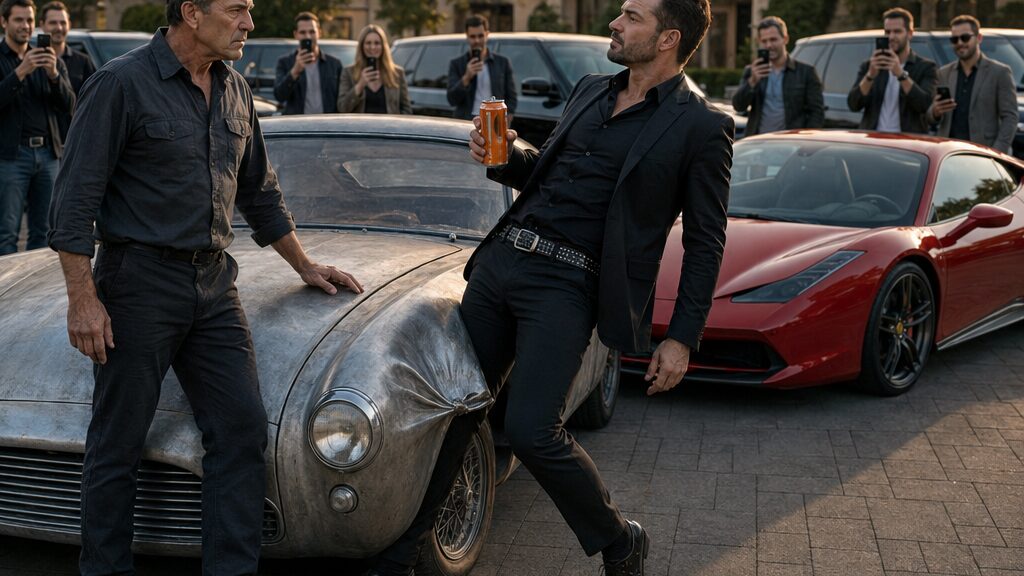
It cut through the parking-lot music so cleanly that Donald Lewis felt it in his teeth before he understood what he was seeing: Brandon Young’s metal-studded belt buckle dragging across the left front fender of the weathered aluminum car.
Donald stopped beside the open trunk of his daily driver.
Twenty yards away, Brandon leaned backward against the sleeper as though it were a bar counter. He had planted his full weight on one hip, forcing the hand-formed panel inward. The aluminum flexed beneath him, caught the late sunlight, then returned almost—but not quite—to its original curve.
Around him stood a loose half-circle of car-club members with phones raised. Their polished vehicles filled the best spaces in the residential parking lot: white, black, and silver luxury SUVs with temporary dealer frames, two German sedans, and Brandon’s red supercar positioned diagonally across a pair of spaces as if ordinary lines did not apply to it.
Donald set down the box of cleaning cloths he had been carrying.
“Move away from the car.”
He did not raise his voice. He did not need to.
Brandon looked toward him and smiled at the nearest phone.
“There he is,” he said. “The owner.”
A few people laughed.
Donald crossed the pavement. He watched the contact point rather than Brandon’s face. The buckle had several raised steel studs arranged in a square pattern. One of them pressed into the faded gray patina just above the wheel arch, directly over a shallow crown Carolyn had worked by hand until the panel held its shape without additional bracing.
It was not rust. Aluminum did not rust that way. The dark streaks came from years of oxidation, heat, road dust, and the oils left by bare hands during fabrication. Beneath the discoloration were hammer marks too subtle for anyone who did not know where to look.
Brandon ground the buckle another fraction of an inch.
The panel creaked.
Donald stopped three feet away. “I said move.”
Brandon’s smile tightened. He was handsome in the maintained way of men who treated themselves as part of their inventory. Perfect beard line. Heavy watch. Club jacket despite the heat.
“This is the showcase row,” he said. “We’ve got sponsors coming through tomorrow. Residents were told to keep project cars in their garages.”
“It isn’t a project car.”
“Then it’s worse than I thought.”
Another ripple of laughter moved through the group, smaller this time.
Donald’s eyes remained on the fender. “Your buckle is pressing into the panel.”
Brandon glanced down as though surprised to discover a car beneath him.
“This?” He knocked his knuckles against the aluminum.
Donald heard the hollow response and felt something close inside his chest.
“Don’t touch it again.”
Brandon straightened slightly, but instead of stepping away, he shifted his weight. The fender dipped under the new pressure. His attention had moved from the car to the phones. Donald recognized the change. Brandon no longer wanted the space cleared. He wanted a reaction he could own.
“I’m trying to help you,” Brandon said. “People pay a lot to live here. We can’t have something that looks abandoned sitting beside real cars.”
Donald looked across the identical shining hoods around them. Several still wore residue from automated car washes along their mirror edges. One SUV had plastic protective film curling beneath its rear emblem. Machines acquired for appearance, used carefully enough to preserve lease terms, then exchanged before any owner had to understand them.
He looked back at the sleeper.
Its hood sat low and plain. Its front grille had no badge. The body shape suggested an old European touring car without copying any single one. Nothing about it announced the liquid-cooled battery modules beneath the rear floor, the twin-motor control system, or the compact combustion unit built to hold peak efficiency while the electrical system handled acceleration.
Nothing on the outside explained why the left fender could never be replaced.
“Step away,” Donald said.
Brandon studied him, then reached to the roof of his supercar and picked up an open energy drink.
Condensation ran down the bright can. The liquid inside was orange and syrupy.
“Relax.” Brandon lifted it over the sleeper’s hood. “Maybe this thing needs a wash.”
Donald crossed the remaining distance before Brandon could tilt his wrist.
His left hand closed around the can.
Brandon held on for an instant. Donald twisted it free.
The phones shifted toward them.
Donald should have set the can on the pavement. He knew that even as his fingers tightened.
The aluminum cylinder collapsed with an explosive crunch. Orange liquid burst through the opening and ran between his knuckles. The sound silenced the nearby laughter.
Donald crushed the can until its sides folded into a dripping knot.
Then he threw it at Brandon’s feet.
It struck the pavement, bounced once, and sprayed sticky droplets across Brandon’s polished shoes.
“Step away from the car.”
Brandon’s face emptied. For one honest second, Donald saw fear.
Then the phones restored him.
“You attacked me.”
“I took a drink out of your hand.”
“You grabbed it while I was holding it.”
“You were holding it over my hood.”
Brandon backed toward his supercar, putting distance between them without seeming to retreat. “Everyone saw that.”
Donald looked around.
Some had seen everything. Others had turned only at the crunch. A young woman near the rear of the group—Ashley Perez, the one who filmed most of the club’s promotional clips—held her phone at chest height. Her expression was not amused. But she did not lower the camera.
Donald turned to the fender.
A wet line of orange liquid had landed on the pavement, not the car. The buckle had left a compressed smear in the patina. He bent until the reflected light ran across the surface.
No cut.
Not yet.
The outer contour had flattened perhaps half a millimeter. Enough to alter how the panel carried light. Enough that he could see where Brandon’s weight had been.
Behind him, Brandon’s voice rose into its practiced public register.
“This is exactly why residents have rules. People get emotionally attached to junk, then become dangerous when anyone questions them.”
Donald ran one finger beside the damaged area without touching it. He could picture Carolyn on the low wooden stool, a sandbag under the raw sheet, tapping the crown outward with a worn forming hammer. She had refused gloves because she said metal lied through leather.
You can polish away evidence, she had once told him. You cannot polish back a hand.
Donald stood.
Brandon had turned his own phone toward himself. The red supercar filled one side of the frame. Donald and the sleeper filled the other.
“You attacked me over a rust bucket,” Brandon said.
“That body is aluminum.”
Brandon laughed. “That’s your defense?”
“It was a correction.”
Donald moved between him and the car.
Brandon glanced past Donald at the unmarked hood. Something in his expression changed—not understanding, but calculation. He had expected shouting. Perhaps a shove. Donald’s restraint had left him without the clean spectacle he wanted.
So Brandon manufactured one.
He faced the camera and pointed toward Donald.
“A resident has just threatened me and destroyed my property because I asked him to move an abandoned vehicle away from tomorrow’s community showcase.”
The crushed can lay between his shoes, leaking orange syrup into the white parking stripe.
Donald saw the red recording symbol on the phone.
Brandon’s eyes met his over the screen.
“And I’ve got the whole thing on video.”
Chapter 2: The Video That Removed the Warning
The notice was taped to Donald’s garage door before seven the next morning.
VEHICLE REMOVAL REQUIRED WITHIN FORTY-EIGHT HOURS.
A second page warned that failure to comply could result in towing at the owner’s expense. Beneath the printed language, someone had handwritten: Pending safety and ownership review.
Donald tore neither page down.
He stood in the quiet lane between garages and read them twice while his phone vibrated in his pocket. He had stopped checking notifications after midnight. The first messages had come from neighbors asking what happened. Later came links to Brandon’s video.
The clip began with the can collapsing in Donald’s fist.
The warning was gone. The buckle against the fender was gone. Brandon lifting the open drink over the hood was gone.
In eleven seconds, Donald appeared from outside the frame, seized the can, crushed it, threw it at Brandon, and ordered him away. The final image froze on Donald’s face while a caption asked whether residents should feel safe.
By dawn, the video had traveled beyond the community group.
Donald unlocked the garage and raised the door.
The sleeper waited beneath white ceiling lights. Away from the rows of polished vehicles, it looked smaller, almost severe. Its oxidized aluminum body absorbed light instead of throwing it back. The compressed mark over the left wheel arch remained visible only from certain angles.
He rolled a narrow inspection lamp across the floor and lowered it until the light skimmed the panel.
There.
The stud had not broken the surface. It had displaced it. A shallow rectangular impression interrupted the surrounding oxidation, brighter at one edge where Brandon’s weight had shifted.
Donald opened a drawer and removed a magnifying lens.
Near the rear seam of the panel were two tiny hand-scribed letters: C.F.
Most people would have mistaken them for scratches.
Donald heard heels outside the garage before Cynthia Adams appeared beneath the raised door. She carried a folder against her chest and wore the tight expression of someone already late for a problem she had not created.
“You received the notice.”
“I’m looking at it.”
“I would have preferred to speak first, but the board wanted written documentation delivered immediately.”
Donald kept the lens over the panel.
Cynthia stepped closer. “Mr. Lewis, I need you to understand the position this puts us in. The club has sponsors arriving. Brandon has filed an incident report. Several residents say they saw you behave aggressively.”
“Several residents saw the last six seconds.”
“The video is concerning.”
“It was edited.”
“That may be true.”
He looked at her. “May be?”
Cynthia exhaled. “I’m not accusing you. I’m saying the community has to respond to what has been submitted.”
Donald pointed to the mark. “Respond to that.”
She bent, though not as far as he had. “I see discoloration.”
“You see compressed aluminum.”
“It looks like an old finish.”
“It is an old finish.”
“That isn’t the same as damage.”
Donald switched off the lamp. “Press here.”
Cynthia hesitated.
“Not on the mark. Two inches behind it. Use one finger.”
She looked as though she suspected a trap, but placed her index finger where he indicated. Donald watched her apply light pressure.
The panel moved.
She withdrew her hand immediately. “That’s very thin.”
“One-point-two millimeters before forming. Less where the crown was stretched.”
“Then why would you park it in a public lot?”
“Because it is a car.”
“A fragile one.”
“A valuable one.”
Cynthia straightened. “Brandon said it had no visible registration tag for the showcase.”
“It wasn’t entered in the showcase.”
“That is part of the dispute. He says it occupied a display space.”
“It occupied the space assigned to my unit.”
Her mouth tightened. Donald knew she was not Brandon’s ally. That almost made her more difficult. She believed rules could remain neutral while people used them as weapons.
He turned the lamp on again and aimed it across the fender.
“These lines aren’t machine stamped,” he said. “The panel was formed over a sandbag and finished on an English wheel. The seams were dressed by hand. That surface is original.”
“Can it be repaired?”
“Anything can be made smooth.”
“That wasn’t my question.”
“It is the answer. Repairing the mark would require blending the surrounding patina or refinishing the whole panel. Then the original surface would be gone.”
Cynthia studied the faint initials.
“Who is C.F.?”
Donald shut off the lamp.
The garage seemed darker afterward.
“The person who made it.”
“You didn’t?”
“I engineered the structure. She formed the final skin.”
Cynthia waited for more. Donald gave her nothing.
His silence had once been useful. In negotiations, the first person to fill silence often surrendered something. Over time, he had begun treating every question like a negotiation.
Cynthia opened her folder. “I need registration, proof of insurance, and evidence that the vehicle meets community safety requirements. If you’re claiming unusual value, I also need ownership documentation before we allow it to remain on the property during the review.”
“The car is insured.”
“Under what declared value?”
“That is between me and the insurer.”
“Not if potential damage occurred during a community event.”
“It wasn’t a community event. Brandon was setting up early.”
“And you physically confronted him.”
Donald looked at the orange stain still caught in the creases of his left thumbnail despite repeated washing.
“I stopped him.”
“You frightened him.”
“He was damaging the car.”
“Both things can be true.”
That landed harder than he expected.
He went to a steel cabinet, unlocked it, and removed a document pouch. The registration was current. The insurance binder carried a specialized agreed-value rider but omitted the full valuation on the summary page.
Cynthia read the first sheet.
Her brow creased.
“This owner name isn’t yours.”
Donald said nothing.
She turned the page toward him. “The registered entity is Advanced Mobility Development Group.”
“That was the original holder.”
“The state database says the company was dissolved eight years ago.”
“I know when it closed.”
“Then why is the vehicle still associated with it?”
“The transfer was handled through the dissolution agreement.”
“Do you have that agreement?”
“Yes.”
“Here?”
“No.”
That was not entirely true. A copy existed somewhere in the locked archive cabinets at the back of the garage, behind test logs, supplier contracts, and the documents he had not opened since the final warehouse was emptied. But finding it meant opening more than a cabinet.
Cynthia glanced toward the sleeper.
“What exactly is this vehicle?”
“A prototype.”
“For what?”
Donald looked at the closed hood.
The easiest answer would have been enough to postpone the tow. He could have named the program, listed the architecture, described the valuation. He could have explained that Brandon’s glossy supercar used control principles derived from work completed years earlier in a windowless laboratory by people whose names never appeared in advertising.
Instead he said, “It is mine.”
Cynthia closed the pouch.
“That may be true, Mr. Lewis. But the paperwork in front of me says a dead company owns a vehicle that you keep in a residential garage.”
“I built it.”
“Building something and owning it are not always the same.”
He knew that better than she did.
She placed the documents on his workbench. “The board has scheduled an inspection for tomorrow afternoon. I’m bringing an independent automotive inspector. Until then, the vehicle stays here.”
“You posted a removal order.”
“The clock is paused until the inspection concludes.”
“And if I refuse?”
“Then the tow authorization becomes active.”
Donald stepped between her and the car without meaning to.
Cynthia noticed.
Her voice softened, but not enough to weaken the question.
“Do you legally own this prototype, Donald?”
He stared at the two faint initials on the fender.
Cynthia continued.
“Or did you take it when the company closed?”
Chapter 3: What the Weathered Hood Concealed
When Donald released the hood latches, the inspection bay went silent.
A moment earlier, Brandon’s club members had been talking over one another beneath the open concrete canopy, their voices bouncing between parked vehicles and the management building. Brandon had positioned his red supercar directly across from the sleeper and was filming an introduction about “accountability” for his followers.
Then Donald raised the weathered hood.
No one laughed.
Beneath the oxidized aluminum body lay an engine compartment so clean and densely organized that it seemed to belong to another machine. Matte housings followed the inner contours with almost no wasted space. Braided high-voltage lines ran beneath shielded channels. A compact combustion unit sat low behind the front axle, while two liquid-cooling circuits traced separate paths through hand-fabricated manifolds. Labels had been etched directly into metal brackets rather than printed on plastic covers.
There was no decorative engine shroud. No polished badge.
Every visible part had a reason to be visible.
Cynthia stood beside a folding table with the documents Donald had provided. Ashley remained near the rear of the small crowd, phone lowered but ready. Brandon stared into the engine bay, then quickly turned his surprise into a dismissive smile.
“A lot of custom wiring,” he said. “That doesn’t make it legal.”
The independent inspector did not answer.
Matthew Brown had arrived ten minutes earlier in a plain work shirt carrying two diagnostic cases. He was leaner than Donald remembered, his dark hair receding, his movements still economical. Donald had recognized him before Cynthia finished the introduction.
Matthew had offered no handshake.
Now he stepped toward the open hood and stopped at the left-side control housing.
His eyes moved across the coolant manifold, the inverter mounting plate, and the narrow service loop beneath the forward cross brace.
He touched nothing.
“Who opened this assembly last?” he asked.
“I did,” Donald said.
“How long ago?”
“Seven months. Contactor inspection.”
Matthew crouched and aimed a small light beneath the housing. “Original gasket?”
“Third revision.”
“The third revision leaked under thermal cycling.”
“Not after the flange relief was cut.”
Matthew’s light paused.
He shifted toward the front, found the thin machined channel in the flange, and stood slowly.
Brandon looked between them. “Do you two know each other?”
Matthew ignored him.
He looked at Donald for the first time without professional distance.
“You kept the split-loop cooling layout.”
“It worked.”
“They said it was too expensive.”
“They were wrong.”
A muscle moved in Matthew’s jaw.
Cynthia stepped closer. “Can you identify the vehicle?”
Matthew walked around the front and examined the unmarked structure where a production serial plate would normally have been mounted. Instead there was a stamped development code.
AMD-P4-01.
He read it twice.
“This is the fourth-platform demonstrator,” he said. “First complete build.”
One of the club members lowered his phone.
Brandon gave a small laugh. “From some company that doesn’t exist.”
Matthew opened one of his cases and removed an insulated meter. “The company existed.”
“What did it make?”
“Systems other companies bought and renamed.”
Donald watched Matthew connect the meter to a service port. The old resentment between them occupied the space more clearly than either man acknowledged.
Cynthia asked, “What kind of system?”
Matthew glanced at Donald, giving him the opportunity to answer.
Donald almost refused it.
Then he looked at the phones, at the faint buckle impression on the fender, and at Brandon’s red supercar reflecting itself in the inspection-bay windows.
“Plug-in hybrid performance architecture,” Donald said. “Independent front and rear electric drive. Compact combustion unit for sustained output and charging support. Segmented battery modules with separate cooling zones. Predictive torque control before that became a brochure phrase.”
Brandon folded his arms. “So it’s an old hybrid.”
Donald reached into the bay and pointed without touching. “The front inverter can isolate a failed phase and continue at reduced output. The battery enclosure can lose one cooling circuit without thermal propagation. The rear drive unit delivers full torque before the combustion engine finishes its first firing sequence.”
“Numbers,” Brandon said. “Give us numbers.”
“This is an inspection, not a sales presentation.”
“Because you don’t have them?”
Matthew looked up from the meter. “He has them.”
The words carried more weight than Donald wanted.
Matthew connected a diagnostic interface. A column of data populated his tablet.
“Cell variance is lower than most new production packs,” he said. “Insulation resistance is stable. Twelve-volt support system is recent.”
“I replaced it last winter,” Donald said.
Matthew scrolled. “Control software build?”
“Seven-point-four-six.”
His thumb stopped.
“That version never went to the supplier archive.”
“No.”
“Only the lead controls group had it.”
Donald met his eyes. “I led the controls group.”
The silence returned, different this time.
Ashley raised her phone, but she was no longer aiming it like a weapon. She framed the engine bay carefully, as if recording evidence she did not yet understand.
Brandon stepped forward. “Hold on. You’re saying he worked for the company?”
Matthew removed the diagnostic connector. “Donald Lewis directed systems integration on this platform.”
“Directed it?” Cynthia asked.
“He designed the energy-management architecture and supervised the prototype build.”
Donald’s shoulders stiffened. Hearing the facts spoken by someone else felt less like vindication than trespass.
Brandon looked at the sleeper again. The contempt in his face had weakened, but his need to control the scene had not.
“What’s it worth?”
Matthew closed the service cap. “That depends on whether you mean as a car, as technology, or as the only intact artifact from the program.”
“Pick one.”
“As a complete development prototype with original body and documented provenance?” Matthew studied the fender. “Several million, potentially more to the right institution.”
A murmur moved through the club members.
Brandon’s eyes flicked toward the buckle mark.
Donald saw him understand at last that the damage had a price. He did not yet understand why price was the least important part.
Cynthia leaned over the fender. “Is the body original?”
Matthew examined the compressed section under Donald’s angled lamp. He followed the reflected line, then found the small initials near the seam.
“Hand formed,” he said. “Final skin, not the earlier buck. These marks match the fabrication method used on the fourth platform.”
Brandon turned toward the crowd. “Fine. It’s valuable. That still doesn’t explain why it’s registered to a dissolved corporation.”
The murmur stopped.
He had found the gap and widened it before anyone else could.
“If Donald designed it,” Brandon continued, “he knew exactly what he was taking. That doesn’t make it his.”
Cynthia looked at Matthew. “Can you verify ownership?”
“I can verify what the machine is.”
“That wasn’t my question.”
Matthew removed his gloves one finger at a time.
“The surviving fixed-asset ledger listed P4-01 as company property during the final operating quarter.”
Brandon’s confidence returned immediately. “There it is.”
Donald felt every eye shift back to him.
Cynthia looked down at the registration documents on the folding table. “Could the ledger have been outdated?”
“Yes,” Matthew said. “Assets can be transferred during dissolution.”
“Was this one transferred?”
“I haven’t seen proof.”
Donald could have ended the uncertainty by retrieving the settlement agreement. At least, he believed he could. The transfer language had been buried among schedules and intellectual-property restrictions written to preserve corporate rights over ideas while disposing of the physical objects that embodied them.
But the agreement carried other language too.
Language about public claims.
Language about authorship.
Language attached to the bargain he had made when the company’s executives threatened to abandon the people who had built everything.
Brandon approached the open hood but stopped beyond Donald’s reach.
“You almost crushed my hand over a car you might not even own.”
“Your hand was never near the can when it collapsed.”
“That isn’t what the video shows.”
“The video starts after you ignored the warning.”
“Then prove it.”
Ashley looked down at her phone.
Donald noticed. So did Brandon.
Before either could speak, Cynthia closed the document folder.
“The vehicle will remain in the garage until ownership is established.”
Brandon pointed at the open engine bay. “You can’t leave experimental technology unsecured with someone who may have taken it.”
Donald lowered the hood halfway, then stopped. “It has been secure for eight years.”
“With you,” Brandon said. “That’s the problem.”
The hood settled shut with a precise metallic click.
Brandon turned to Cynthia, making certain every camera could see his concern.
“You need to secure this vehicle before he makes stolen technology disappea
Chapter 4: The Agreement That Buried Their Names
Matthew stood in the center of the garage exit with one hand raised.
Donald’s sleeper rolled toward him at walking speed, its electric motors making only a faint harmonic whine. The headlights washed over Matthew’s work shirt and the diagnostic case resting beside his shoes.
Donald stopped less than six feet away.
“Move.”
“No.”
Behind Matthew, the garage lane remained empty. Donald had chosen the hour before sunrise because Cynthia’s temporary restriction had not explicitly forbidden moving the car to private storage. By the time anyone noticed, the sleeper could have been inside a secure workshop beyond the community gates.
Matthew looked through the windshield. “You run now, Brandon gets to call it evidence.”
“I’m protecting the vehicle.”
“You’ve been calling it protection for eight years.”
Donald selected park and stepped out. “Cynthia said it had to remain secured.”
“She said it had to remain here.”
“She has no authority over where I store my property.”
“Then prove it’s your property.”
Donald went to lift the diagnostic case out of his path.
Matthew caught the handle first.
For a moment they held it between them.
“You disappeared,” Matthew said.
Donald released the case. “The company closed.”
“The company closed on all of us.”
“I know.”
“No, you knew before we did. You were in the meetings. You signed something, took the prototype, and left the rest of us to learn from a locked email account that our work belonged to people who had never entered the lab.”
Donald glanced toward the open garage. The sleeper’s left fender caught a strip of fluorescent light. Even from several yards away, he could see the break in its patina where Brandon’s buckle had compressed the surface.
“I got your severance released.”
“We didn’t know that.”
“You didn’t need to.”
Matthew gave a bitter laugh. “That sentence is the whole problem with you.”
Donald walked past him into the garage.
At the rear wall stood three gray archive cabinets. The first contained service records. The second held supplier drawings and certification material. The third had not been opened in four years.
He unlocked it.
Paper carried its own stale smell, dry and faintly chemical. Donald removed two storage boxes and set them on the workbench. Inside the second was a thick black binder with no title on its spine.
Matthew came in but stayed several feet away.
Donald opened the binder to a tab marked Dissolution.
The settlement agreement was more than sixty pages long. He remembered every room in which it had been negotiated, but almost none of the sentences. The language had been designed to make memory difficult: retained rights, transferred assets, conditional consideration, non-disparagement, proprietary attribution.
He found Schedule C.
Physical development artifacts assigned in lieu of deferred compensation.
P4-01 appeared halfway down the page.
Matthew leaned over the bench. “There.”
“Read the next column.”
The asset description transferred the complete physical demonstrator to Donald Lewis. The adjacent restriction preserved all underlying patent and licensing rights for the corporation and its successors.
“So the car is yours,” Matthew said.
“The machine is mine.”
“But not the technology inside it.”
“Not the patents.”
“Not the public story either.”
Donald turned several pages.
A clause prohibited him from disputing corporate authorship, disclosing internal development records, or representing himself as the sole creator of any transferred artifact. The restriction had no clear expiration date.
Matthew read it twice. “They gave you the shell and kept your name out of it.”
“They gave me the complete prototype.”
“In exchange for silence.”
“In exchange for more than that.”
Donald opened another section. Attached to the agreement was a list of obligations the investors had agreed to honor once he signed: twelve weeks of severance for the engineering staff, continuation of health coverage, payment of overdue supplier invoices, and a medical assistance fund for employees undergoing treatment.
Matthew found his own surname on one of the schedules.
His face changed.
“My daughter’s surgery,” he said.
Donald closed the binder halfway.
Matthew looked up. “They told us the board approved the coverage.”
“The board refused twice.”
“You signed this to get it released?”
“I signed because they said the company had no reason to spend money on people who no longer produced value.”
The words remained as ugly as they had been in the conference room.
Matthew lowered himself onto the work stool.
“You could have told us.”
“The confidentiality clause applied immediately.”
“You could have told us later.”
“And given them cause to claw the money back?”
“After the treatments were done. After the checks cleared.”
Donald looked toward the sleeper. “Then what? Ask everyone to thank me?”
“That isn’t what I said.”
“It is what people do with sacrifice once they know about it. They turn it into debt.”
Matthew rubbed both hands over his face. “So instead you let us think you saved yourself.”
“I didn’t ask what you thought.”
“No. You never do.”
The accusation struck because it was true.
Donald removed another folder from the box. Hand-drawn forming diagrams lay inside, their edges softened from use. Curved pencil lines mapped the left fender’s crown, flange, and wheel opening. Beside several measurements were the initials C.F.
Matthew touched the corner of one page.
“I remember these.”
“Carolyn changed the rear seam after the first skin buckled under heat.”
“She worked three nights without going home.”
“She slept in the trim room.”
Matthew looked at the car. “She would have hated that mark.”
“She would have hated Brandon.”
“She would have told you not to crush the can.”
Donald’s jaw tightened.
Matthew did not withdraw the statement. “You frightened people.”
“He was about to pour sugar into an unsealed hood vent.”
“And you gave him the exact picture he needed.”
Donald turned away from the workbench.
A phone notification sounded.
Then another.
Matthew checked his screen first.
His mouth flattened as he read.
“What?”
He turned the phone toward Donald.
Brandon had posted a photograph of the old fixed-asset ledger. P4-01 was highlighted in yellow beneath the company-property heading. Above the image, Brandon had written that the community had discovered a resident concealing a multi-million-dollar corporate prototype.
There was no photograph of Schedule C.
No transfer agreement.
No mention of the settlement.
The post had already been shared hundreds of times.
“He got the ledger from somebody,” Matthew said.
“Supplier archives circulated during the liquidation.”
“He knows there are more pages.”
“He doesn’t care.”
Donald’s own phone rang. Cynthia.
He let it ring twice before answering.
“The board has seen Brandon’s post,” she said. “I need the transfer schedule immediately.”
“I have it.”
“Send it before noon. Until I verify it, do not move the vehicle.”
Donald looked at Matthew standing in the exit.
“I wasn’t planning to.”
When the call ended, another figure appeared outside the garage.
Ashley Perez stopped beneath the raised door. She held her phone in both hands, not filming now.
“I saw Brandon’s post,” she said.
Matthew gathered the settlement pages. “If you came for content, leave.”
“I came because the clip he posted isn’t what happened.”
Donald said nothing.
Ashley opened a video file and held the screen toward them.
The frame showed Brandon leaning on the fender. His buckle was clearly pressed against the aluminum. Donald’s first warning could be heard over the music.
Move away from the car.
Brandon looked toward Ashley’s camera, smiled, and shifted more weight onto the panel.
The creak was unmistakable.
Then he raised the open drink.
Ashley stopped the video before Donald entered the frame.
“This is the full recording,” she said.
“Post it,” Matthew told her.
She did not move.
Donald studied her face. “What do you want?”
“I want the truth.”
“You have it.”
“No. I have proof Brandon lied about the first thirty seconds. That doesn’t tell anyone why this car is here, why the company records look wrong, or why you’d rather let everyone call you a thief than explain.”
“That isn’t your concern.”
Ashley’s grip tightened around the phone.
“Brandon gave me access to the club because I could make his events look important. If I release this, I’m out. Sponsors won’t hire someone who embarrasses the person who introduced her to them.”
“Then don’t release it.”
Matthew stared at Donald. “You cannot be serious.”
Ashley lowered the phone. “I’ll release it when you tell the full story.”
“You don’t get to make that condition.”
“I’m not making it for you. I’m making it for me. I’m not burning my place in the club just so you can hide behind another piece of evidence and disappear again.”
Donald felt the old instinct rise: close the binder, lower the garage door, remove the car, refuse the audience.
Ashley looked at the settlement pages.
“Brandon is telling everyone you stole it. I can prove he damaged it on purpose. But only you can explain why the machine belongs to you.”
She backed toward the lane.
“When you decide to do that, call me.”
The garage seemed larger after she left.
On the workbench, the settlement transferred the prototype to Donald in precise legal language while burying every human reason he had accepted it.
Matthew closed the binder.
“You can keep the car,” he said. “Or you can keep the silence.”
Donald looked at Carolyn’s initials on the forming diagram.
For the first time in eight years, the two things no longer appeared to be the same choice.
Chapter 5: The Partner Hidden in the Patina
The damaged surface caught Donald’s fingernail.
He froze beside the left fender, inspection lamp angled beneath his arm. The buckle impression had seemed shallow and featureless the night before, but under stronger magnification, one bright edge contained a line too straight to be accidental.
Donald adjusted the lamp.
A tiny diagonal mark emerged beneath the compressed oxidation.
Then a second.
They formed half of a cross Carolyn had scribed into the raw aluminum before shaping the panel. An alignment reference, hidden when the metal stretched across the buck.
Brandon’s weight had not created it.
He had exposed it.
Donald opened the drawer beneath the workbench and removed Carolyn’s fabrication notebook. Near the final pages, a sketch of the fender carried the same cross beside a handwritten note:
Final crown moved 3 mm forward. Do not dress out reference until road heat cycle.
She had never dressed it out.
Donald sat on the low stool she used to favor, the seat scarred by dropped tools and hot metal.
The notebook fell open to a pocket in the rear cover. Inside was a small memory card.
He knew what it contained.
For years he had told himself he preserved the card because every development record mattered. He had not listened to it since the week after Carolyn died.
Matthew arrived as Donald inserted the card into an old workshop recorder.
“You found something?”
Donald pointed to the revealed mark.
Matthew crouched beside the panel. Recognition softened his expression. “Her alignment cross.”
“She left it under the patina.”
“Or she forgot it.”
“Carolyn didn’t forget marks.”
“No,” Matthew said. “She forgot meals.”
Donald pressed play.
At first there was only workshop noise: ventilation fans, a tool rolling across concrete, Carolyn clearing her throat close to the microphone.
Then her voice filled the garage.
“Build note, final exterior revision. Left front crown advanced three millimeters. Rear flange relieved by one and a half. Surface stays as formed until full thermal cycle.”
A pause followed. Paper shifted.
“This part is not a build note.”
Donald’s hand tightened around the recorder.
“If you’re hearing this, Donald, you’re probably cataloging everything because cataloging is easier than deciding what it means.”
Matthew looked away.
Carolyn continued, her voice tired but edged with amusement.
“They’ll try to polish this car. Someone always wants a smooth surface for photographs. Don’t let them. Every mark tells you what we changed and where our hands corrected the machines.”
The recording clicked softly.
“And don’t hide it forever. Preserving an object while letting other people erase who built it is not protection. It is just a quieter kind of loss.”
The audio ended.
Neither man spoke.
Donald removed the memory card and set it beside the notebook.
Matthew rested one hand on the fender without applying pressure. “She knew you.”
“She knew everyone.”
“She knew you were going to disappear.”
“I didn’t disappear.”
“You stored yourself in a garage.”
Donald almost answered sharply. Instead he looked at the uneven aluminum, the dull patches where Carolyn’s palms had guided it beneath the wheel, the narrow seam she had reshaped after the original buck failed.
“It isn’t worth millions because of the drivetrain,” he said.
Matthew waited.
“The drivetrain can be reproduced. Improved. Licensed around. This can’t.”
He touched the air above the alignment cross.
“She formed the final panels after the company rejected the cosmetic body. Said the polished version looked like every investor’s idea of the future.”
Matthew gave a small smile. “She called it an appliance wearing expensive shoes.”
Donald remembered the exact tone. The laugh that followed. The metal dust along her forearms.
“The car is the last thing we built before they began changing names on the drawings,” he said. “That is why it stayed.”
Not why I kept it.
Why it stayed.
Even now, he caught himself using language that removed his choice.
Matthew did too.
“You kept it,” he said. “Say the whole sentence.”
Donald looked at him.
“I kept it because it was ours.”
The words felt insufficient, but they did not feel false.
A sharp knock sounded against the raised garage door.
Cynthia entered carrying a folder and a roll of red inspection tape.
“The board has reviewed the transfer schedule,” she said. “Their attorney believes it establishes your possession of the physical prototype, but not enough of its compliance status to leave the matter there.”
Donald stood. “What does that mean?”
“One controlled inspection and demonstration tomorrow morning. Closed access road. Matthew supervises all diagnostics and movement.”
“And afterward?”
“If the vehicle passes and the ownership documents withstand review, the removal order is withdrawn.”
“If it fails?”
“We authorize transport to an approved facility.”
Donald looked at the red tape. “You intend to seal my garage?”
“I intend to document that the vehicle remains unchanged between now and the review.”
Matthew stepped forward. “The car was roadworthy yesterday.”
“The board wants proof it can defend.”
“Against Brandon’s followers?”
“Against liability,” Cynthia said, though fatigue weakened the answer.
She unrolled a length of tape between the garage-door frame and the inner wall. “There is another condition. No race.”
“I didn’t request one,” Donald said.
“Brandon has.”
“Denied.”
“I told him that. He says his club members won’t accept a diagnostic crawl as proof of performance.”
Donald glanced toward the sleeper. “Their acceptance is irrelevant.”
“It may be to you. It is not irrelevant to how tomorrow develops.”
Cynthia attached the tape, signed across it, and handed Donald a printed test outline. Acceleration would occur only after electrical isolation, thermal checks, brake verification, and road closure. One driver. No parallel vehicle.
“Brandon agreed to this?” Matthew asked.
“He agreed not to interfere.”
“That wasn’t the question.”
Cynthia met his eyes. “It is the agreement I could obtain.”
After she left, Donald read the test outline twice.
Matthew closed Carolyn’s notebook. “If Brandon brings the supercar, he’ll try to turn it into a race.”
“He can try.”
“And the crowd?”
“They can watch.”
“That is not the same as you speaking.”
Donald picked up his phone.
Ashley had left one message: The full file is ready. Your decision.
He began typing, stopped, then erased the first sentence.
He tried again.
Release nothing until I open the review. After I speak, post the complete recording without edits.
His thumb hovered above the send icon.
For years he had believed silence kept the company from owning more of him. He had never considered how easily the same silence allowed others to take his place in the story.
He sent the message.
Ashley’s reply arrived seconds later.
Understood.
Matthew read Donald’s face. “You’re going to tell them?”
“I’m going to explain what the inspection requires.”
“That isn’t what I asked.”
Donald looked at the alignment cross exposed by Brandon’s buckle.
Tomorrow the mark would be photographed, measured, perhaps priced. People would ask about battery output and acceleration figures because numbers were easier to repeat than names.
He placed Carolyn’s notebook on top of the settlement binder.
“I’ll tell them who built it.”
Outside, someone tested a loud engine in the parking lot. The revs rose, fell, then rose again with impatient force.
Donald did not need to see the red bodywork to know Brandon had arrived early.
Chapter 6: The Test Brandon Could Not Control
Brandon entered the closed access road at twice the posted speed, his supercar’s engine striking the concrete walls with a hard metallic roar.
His phone was mounted to the windshield. A second camera clung to the passenger window. He braked beside the inspection area, revved once more, and addressed the livestream before switching off the engine.
“Today we find out whether the so-called miracle car can perform outside a garage.”
Donald stood beside the sleeper with its hood open.
He had deliberately left the fender uncovered. The oxidized surface, Carolyn’s faint initials, and the fresh buckle compression were all visible beneath the inspection lights.
Cynthia crossed the pavement toward Brandon. “The road is closed for one supervised vehicle demonstration. Yours is not included.”
“I’m not interfering.”
“You’re livestreaming inside a restricted review.”
“I’m documenting community business.”
Club members gathered behind temporary barriers. Ashley stood apart from them with her phone lowered. Matthew had already connected diagnostic leads to the sleeper and arranged printed records across a folding table.
Donald heard the irregularity when Brandon restarted his car to move it.
A slight stumble after ignition. Then a fast idle correction.
He looked toward the red supercar.
Brandon blipped the throttle to conceal it.
Donald said nothing yet.
Cynthia called everyone’s attention to the inspection. “This review concerns ownership, roadworthiness, and damage arising from the parking-lot incident. It is not a contest.”
Brandon leaned against his own roof. “Convenient.”
Donald lifted Carolyn’s forming diagram from the table.
“This vehicle was designated P4-01,” he said. “It was the first complete demonstrator produced under the fourth development platform at Advanced Mobility Development Group.”
The crowd quieted.
Donald disliked the phones. He disliked how their lenses transformed every pause into weakness and every emotion into usable footage. He kept his attention on the machine.
“I designed the energy-management architecture and directed systems integration. Carolyn Flores developed and formed the final aluminum skin after the original cosmetic body failed structural and thermal evaluation.”
He placed the drawing beside a photograph of the unfinished fender.
“The marks on this panel match her forming references. The control revisions in the vehicle match the build records retained with the transferred artifact.”
Brandon raised his voice. “Transferred according to you.”
“According to Schedule C of the dissolution agreement.”
Matthew held up the certified copy. “The physical demonstrator was assigned to Donald as deferred compensation. Patent rights remained with the company and its successors. Possession of the car is lawful.”
A murmur passed through the onlookers.
Brandon stepped away from his supercar. “So he owns the shell but can’t claim the technology.”
Donald faced him. “I can claim the work I performed. I cannot claim exclusive patent rights.”
“That sounds carefully rehearsed.”
“It sounds accurate.”
Donald opened the settlement binder to the employee obligations. He did not lift it for the cameras.
“When the company closed, the investors refused severance and medical coverage for the engineering staff. I accepted restrictions on public attribution in exchange for releasing those obligations and receiving the physical prototype.”
Matthew’s gaze remained on him.
Donald continued. “I believed silence would protect the people involved and preserve the machine. It protected some things. It also allowed others to tell the story without us.”
He looked at Carolyn’s initials.
“This vehicle was built by more hands than mine. But it did not belong to the executives whose names appeared on later advertisements.”
No applause followed. Donald was grateful for that.
Cynthia checked the transfer schedule against the vehicle’s development code. “Ownership of the physical prototype is established for this review.”
Brandon gave a dismissive shrug. “Then let’s see whether it moves.”
Matthew began the safety procedure.
He verified the high-voltage isolation monitor, cooling-system pressure, brake temperature, steering response, and battery-module variance. Donald answered only when needed. The data appeared on a large portable display so no one had to accept his word alone.
Cell variation remained within narrow limits.
Both cooling loops held pressure.
The combustion unit started, reached temperature, and shut down when the battery system assumed the stationary load.
A low mechanical hum replaced the roar Brandon had brought with him.
Ashley’s phone chimed.
Then phones throughout the crowd began sounding in quick succession.
She had released the full video.
On one screen near the barrier, Brandon could be seen smiling toward the camera as Donald warned him away. The replay showed him shifting his hip harder into the fender. It captured the aluminum creak and the open can rising over the hood.
Brandon looked toward Ashley.
“You posted that?”
“You posted an edit.”
“You were filming for the club.”
“I filmed what happened.”
His face reddened. “You just ended every opportunity I gave you.”
Ashley swallowed, but did not lower her phone. “Then they weren’t opportunities. They were payment for making you look right.”
The surprise in Brandon’s face lasted only a moment. Then he turned toward his followers.
“This is still about performance. He called my car obsolete. Put them side by side.”
“I said no race,” Cynthia told him.
Brandon opened his driver’s door. “You can call it a comparison.”
Donald heard the starter engage.
The supercar fired, stumbled, and settled into an uneven idle. A cooling fan accelerated almost immediately.
“Shut it down,” Donald said.
Brandon looked over the roof. “Worried?”
“Your exhaust temperature correction is unstable.”
“You diagnosed that from here?”
“I heard the misfire. Your fan is compensating before the engine is warm.”
Brandon checked his dashboard. A warning icon flashed amber, then disappeared.
“It’s fine.”
“It is clearing the display because you restarted it. The fault remains stored.”
Brandon tapped the accelerator. The engine hesitated, then surged.
Several club members moved closer to film.
Donald saw a faint haze near the rear vent, too thin to be coolant and too sharp-smelling to be ordinary condensation. Residue—likely detailing product or spilled oil—was heating on the exhaust shielding.
“Move everyone back,” he told Cynthia.
Brandon laughed. “Now he’s managing my car too.”
“Shut it off.”
“You don’t give orders here.”
The amber warning returned. Brandon pressed a control on the steering wheel and held it.
Donald recognized the gesture: an override sequence intended for temporary transport after a noncritical fault. Used repeatedly, it forced the system to rerun checks while heat continued to rise.
“If you attempt another launch cycle,” Donald said, “the protection system will lock you out.”
Brandon slid into the seat. “Then watch it not happen.”
For one ugly second, Donald considered letting him continue.
The barriers were up. The cameras were running. Brandon’s own ignorance would do more damage to his authority than anything Donald could say.
Then a club member crouched near the rear quarter panel to capture the exhaust.
Donald crossed the space quickly.
“Back behind the barrier.”
The man hesitated.
Donald seized the lightweight barrier and dragged it several feet away from the supercar. “All of you. Now.”
Something in his voice moved them.
Cynthia joined him, ordering the crowd back. Matthew approached with a fire extinguisher but did not discharge it. The haze remained light, curling from heated residue rather than an active engine fire.
Brandon pressed the ignition.
The starter engaged once.
Stopped.
The dashboard filled with warnings.
He tried again.
Nothing responded except the cooling fans, which rose to full speed.
A red protection message occupied the center display.
Brandon stared at it.
Donald stood outside the open door. “Stop cycling the ignition. Let the system cool.”
Brandon looked up at the phones pointed toward him. “It’s a sensor.”
“It may be. Or an ignition fault, overheating correction, or low support voltage. You will know after diagnosis.”
“You think this proves your car is better?”
“No. It proves yours needs maintenance.”
The answer left Brandon with nothing to strike.
Matthew called from the test line. “Road is clear.”
Donald walked back to the sleeper.
The inspection display showed every system ready. He closed the hood but left the weathered body exposed. No polish. No badge. No attempt to make the machine look more valuable than it had an hour earlier.
He entered the driver’s seat.
Matthew took the passenger position with the portable data recorder. Cynthia confirmed the road closure. The approved course extended along the private access road to a marked braking zone, long enough to demonstrate controlled acceleration without becoming the race Brandon wanted.
Donald pressed the start control.
The sleeper came alive without drama.
A low hum passed through the body. Cooling pumps activated. The dashboard displayed system readiness in plain engineering text.
At Matthew’s signal, Donald released the brake.
The car moved silently.
For the first fifty feet it seemed almost gentle. Then Donald pressed the accelerator to the approved limit.
Torque arrived at once.
The weathered machine surged forward with no gearshift interruption, no exhaust crack, no theatrical roar. The oxidized body remained level as the electric system distributed force across both axles. By the time the combustion unit joined, the sleeper was already deep into the closed course.
Matthew watched the data rather than the road. “Front-rear balance stable. Pack temperature rise minimal.”
Donald reached the marked speed, lifted, and applied the brakes at the first cone.
Regeneration absorbed the initial load. Mechanical braking completed the stop inside the calculated zone.
They turned at the far end.
In the mirror, Donald saw Brandon’s red supercar surrounded by warning lights, raised phones, and a thin ribbon of smoke drifting harmlessly above the rear deck.
He could have accelerated harder on the return.
He did not.
The test had already answered the correct question.
Donald brought the sleeper back into the inspection area and stopped exactly on the painted line. The combustion unit shut itself down. Only the cooling pumps remained, whispering beneath the weathered hood.
Matthew examined the recorder.
“No isolation faults. No thermal excursions. Braking distance within estimate. Vehicle passes the approved demonstration.”
Donald stepped out.
Across the pavement, Brandon stood beside his disabled supercar with one hand on the roof. Sticky orange liquid from the crushed can had dried along the edge of one polished shoe; someone had placed the can beside the tire after collecting it as evidence.
A tow truck’s reverse alarm sounded beyond the community gate.
The crowd turned toward it.
Donald did not.
Chapter 7: The Fender He Refused to Polish
The tow truck backed toward Brandon’s supercar with its reverse alarm cutting through the fading mechanical hum of the sleeper.
No one spoke over it.
The red car sat low and immaculate beneath the inspection lights, its dashboard still glowing through the windshield. Its cooling fans had slowed, but warning symbols remained across the center display. The thin haze near the rear deck had disappeared, leaving behind the sour smell of heated detailing residue.
Donald’s weathered prototype idled several spaces away without visible effort.
Cynthia stood at the folding table signing the final inspection pages. Matthew disconnected the portable recorder and sealed the data file. Ashley remained behind the barrier, reading the comments accumulating beneath the full video she had released.
Brandon watched the tow operator approach his car.
“It doesn’t need a tow,” he said. “It needs the fault cleared.”
The operator stopped. “Can it be driven safely?”
Brandon looked toward Donald.
Donald did not answer for him.
Matthew closed his diagnostic case. “Not until the stored faults are read and the cause is identified.”
“It’s a sensor.”
“Possibly.”
“These cars throw warnings all the time.”
“That does not make ignoring them maintenance.”
Several club members shifted their attention away from Brandon. They did not laugh. Their silence was worse. Men who had stood close to his supercar an hour earlier now examined their phones or drifted toward their own vehicles.
Brandon noticed every movement.
Cynthia carried a document to Donald.
“The removal order is withdrawn,” she said. “The ownership transfer has been verified, and the vehicle passed the supervised roadworthiness review.”
Donald accepted the page.
She held out a second form. “I have also amended the incident record. Brandon is listed as responsible for contact damage to the left front fender, subject to the final repair assessment.”
Donald looked at the phrase repair assessment.
“There will be no conventional repair.”
“You still need a valuation of the damage.”
“I’ll document the deformation and preserve it.”
Cynthia glanced at the compressed mark. “You want to leave it?”
“I want the record to show what happened without removing what was already there.”
She followed his gaze to Carolyn’s exposed alignment cross.
“I thought restoration was the point with valuable cars.”
“For some cars.”
Cynthia nodded, though Donald could not tell whether she understood. She looked toward Brandon, then lowered her voice.
“I should have reviewed the complete video before issuing the notice.”
“You reviewed what was submitted.”
“I treated speed as neutrality.”
Donald folded the removal order once.
“That made his version official before mine existed.”
“Yes.”
She did not defend herself.
“I’m sorry,” she said.
Donald placed the folded notice in his jacket pocket. “Correct the record.”
“I have.”
It was not forgiveness, but it was enough for the moment.
A man in a tailored driving jacket approached the sleeper. Donald had seen him at several community showcases, always beside a different restored vehicle. He kept a respectful distance from the fender.
“I represent a private collection,” he said. “We would be interested in discussing acquisition.”
“The car isn’t for sale.”
“Everything is worth discussing.”
“Not this.”
The man studied the oxidized body. “The engineering significance is obvious now. With a proper cosmetic restoration, it could anchor a major exhibition.”
Donald’s expression changed.
The man mistook it for consideration.
“We would preserve the underlying structure, of course. Strip the oxidation, repair the buckle compression, correct the panel irregularities, then finish it in a period-appropriate color. Presented properly, the value could increase substantially.”
“Panel irregularities,” Donald repeated.
“Tooling marks. Surface inconsistency. Nothing unusual for a hand-built prototype.”
Matthew looked away, hiding the beginning of a smile.
Donald walked to the left fender.
He rested two fingers near Carolyn’s initials, careful not to press against the thin skin.
“The surface is the record.”
“The engineering records can be displayed separately.”
“No.”
The collector’s practiced expression weakened.
Donald pointed toward the faint hammer marks visible beneath the inspection light.
“That line is where the crown was moved forward after the first thermal test. Those shallow flats came from hand finishing around the wheel opening. The uneven oxidation shows where the panel was handled during assembly.”
He indicated the small cross exposed by Brandon’s buckle.
“And that mark was cut before the final forming pass. Polishing the body would not preserve the car. It would make it easier for people who never built it to describe it.”
The collector studied Donald, then the vehicle.
“You may be turning down a considerable offer.”
“I have turned down worse things.”
The man withdrew without arguing further.
Across the inspection area, the tow operator prepared wheel skates beneath Brandon’s supercar. Brandon stood apart from the remaining club members, his livestream ended and his phone hanging loosely at his side.
He approached Donald after the collector left.
“Can we speak privately?”
Donald glanced around. The nearest people were far enough away not to hear without trying.
“This is private enough.”
Brandon looked toward Ashley. “Ask her to remove the video.”
“No.”
“It’s already done what she wanted.”
“What did she want?”
“To embarrass me.”
“She posted what happened.”
“You know how these things work. No one watches context. They see one bad moment and decide that’s the whole person.”
Donald looked at him for several seconds.
“That is how your video worked.”
Brandon’s jaw shifted.
“I built that club,” he said. “Before I started organizing events, nobody here knew each other. Sponsors paid for the charity drives. The holiday collection. The road-safety program.”
“You did useful work.”
The acknowledgment seemed to unsettle Brandon more than an insult would have.
“Then you understand what I could lose.”
“I understand what you chose.”
Brandon glanced down at his shoes. Dried orange syrup marked one polished edge. The crushed can sat near the front tire inside a clear evidence bag Cynthia had left on the table.
“I shouldn’t have leaned on the car,” he said.
“No.”
“I didn’t know what it was.”
“I told you the panel was fragile.”
Brandon’s face tightened. “I thought you were exaggerating.”
“You pressed harder because I warned you.”
He did not deny it.
The tow operator called for the key.
Brandon held it out but did not release it immediately.
“I’ll cover the damage,” he said.
“There is no clean price for it.”
“Then tell me what you want.”
Donald looked at the red car waiting to be lifted.
“I want you to stop treating ignorance as authority.”
Brandon gave a humorless breath. “That sounds like something designed for a camera.”
“No camera is pointed at us.”
Ashley’s phone was lowered. Matthew was packing documents. Cynthia had moved toward the management building.
Brandon looked around and realized Donald was right.
His shoulders dropped slightly.
“If I apologize publicly, it becomes another performance.”
“Yes.”
“If I don’t, everyone says I learned nothing.”
“That is your problem to solve.”
Brandon finally handed the key to the tow operator.
“I am sorry,” he said. “For the fender. And the edit.”
Donald watched him struggle against the instinct to add a condition.
Brandon failed.
“But I still think Ashley should take the video down.”
Donald turned toward the sleeper.
“Then you are not finished understanding it.”
He left Brandon beside the tow truck.
Matthew had placed Carolyn’s notebook and the dissolution binder on the passenger seat. Before closing the door, he held out a small storage drive.
“What is this?”
“Copies of the inspection data, the transfer schedule, and the construction records you authorized.”
Donald accepted it.
“I’m sending the relevant sections to the former team,” Matthew said. “No patent material. No restricted supplier data. Just enough to show who did what.”
Donald looked at the drive in his palm.
“For years they thought I left with the car.”
“Some of them will still be angry.”
“They should be.”
Matthew nodded. “That is different from letting them remain wrong.”
Donald placed the drive beside Carolyn’s notebook.
“The archive title should list both lead contributors.”
Matthew waited.
Donald looked at the initials on the fender.
“Donald Lewis and Carolyn Flores,” he said. “Systems integration and final body development.”
“I’ll use that.”
Matthew closed the passenger door.
The sun had dropped low enough to turn the garage windows gold. The sleeper’s weathered aluminum did not shine like the vehicles around it. Light moved unevenly across its panels, catching every hand-worked change and leaving the oxidized sections dark.
Donald entered the driver’s seat.
Cynthia raised the barrier at the end of the closed road.
Ashley stood nearby. “The full video is staying up.”
Donald fastened his seat belt. “It belongs to you.”
“So does the longer piece I’m making about the prototype.”
He looked at her.
“Only if you approve the technical sections,” she added. “And Carolyn’s name stays in.”
Donald considered refusing. The answer came easily out of habit.
Then he saw Carolyn’s notebook on the passenger seat.
“Send me the draft.”
Ashley nodded once.
Donald pressed the start control.
The sleeper awakened with a soft electrical hum.
Behind him, the tow truck lifted Brandon’s supercar by inches. The reverse alarm continued its patient, mechanical warning. Brandon stood beside the crushed can in the clear bag, watching the red body rise onto the platform.
Donald guided the prototype past the barriers.
At the edge of the parking lot, he slowed and looked once at the left fender. The buckle compression remained visible. So did the tiny alignment cross it had uncovered.
He would measure the damage, stabilize the surface, and leave the mark where it was.
Not because Brandon deserved a place in the car’s history.
Because hiding damage had never undone it.
The access road opened toward the western hills. Donald pressed the accelerator, and the sleeper moved forward without roar or spectacle, its weathered body carrying every hand that had shaped it.
In the mirror, the tow truck’s lights flashed beside Brandon’s polished shoes.
Then the road curved, and the parking lot disappeared.
The story has ended.