When the New HOA Drilled Beneath His Ranch, the Water Stopped for Everyone
Chapter 1: The Drill Mast Beyond the Southern Fence
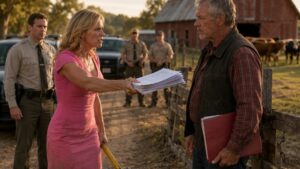
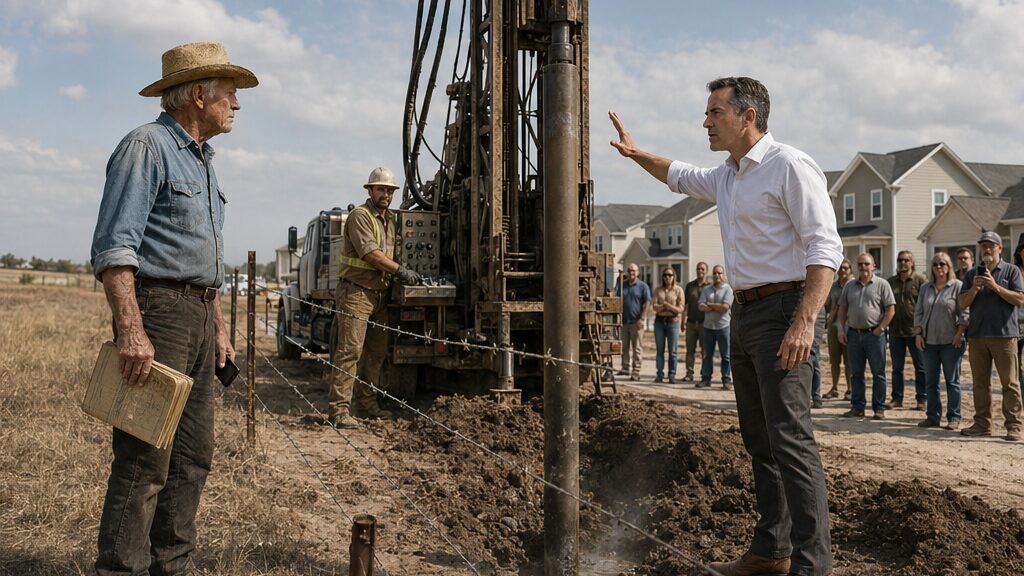
The drill mast stood above George Walker’s southern pasture like a steel needle driven into the wrong piece of earth.
He saw it from the cab of his truck before he heard it. Then the wind shifted, carrying the hammering pulse of the rig across the dry grass. Dust lifted behind a line of service vehicles parked along the new subdivision road, and a length of George’s wire fence sagged where machinery had crossed it.
He stopped fifty yards short of the crew.
Beyond the fence, rows of pale stucco houses rose where open grazing land had been two years earlier. Their tile roofs followed the slope toward the highway, interrupted by unfinished yards and young trees tied to stakes. On George’s side, the pasture remained brown, uneven, and marked by old irrigation cuts.
The drilling rig straddled both worlds.
George stepped out slowly. He wore a faded denim shirt, work boots, and the straw hat Daniel kept telling him to replace. He did not approach the spinning equipment first. He walked to the nearest fence post, crouched, and brushed dust from the iron survey pin beside it.
The pin was still there.
The rig was not where it belonged.
A man in a white shirt detached himself from the group near the control panel. His sleeves were rolled with deliberate neatness, and his boots had never seen livestock mud.
“Mr. Walker,” he called, as if they had arranged to meet. “Michael Roberts.”
“I remember.”
Michael stopped at the broken fence. “We sent notice that utility testing would begin this week.”
“You sent notice to the HOA.”
“The work serves the HOA.”
George looked past him. A thick steel casing disappeared into the ground twelve or fifteen yards inside the pasture. Water-darkened soil had begun to collect around its base.
“This is private property.”
Michael glanced toward two workers, then back at George. “There’s a recorded utility easement along the southern boundary.”
“An easement isn’t a water permit.”
“It authorizes access.”
“To lay utilities. Not to drill into an aquifer.”
The drilling foreman lowered his eyes toward the controls. Michael did not.
“We’re conducting a test bore,” he said. “Nothing more.”
George took out his phone and opened the camera.
Michael’s expression tightened. “You don’t need to record me.”
“I do when a man is standing on my land telling me he has rights he can’t name.”
A pickup had stopped on the subdivision road. Two residents watched from inside. Another woman stood farther back with a phone held upright. The rig’s engine made quiet conversation impossible, forcing every sentence into the open.
Michael raised his voice. “Nine hundred forty homes are scheduled for final occupancy. Those families need a reliable supply. We are not going to suspend lawful work because one adjoining owner objects to development.”
George held the phone steady.
“One adjoining owner,” he repeated.
Michael spread one hand toward the houses. “You know what I mean.”
“I know exactly what you mean.”
George returned to his truck. Behind the seat was a canvas document case he had not opened outside the house in years. He removed a folded survey, its paper softened along the creases and yellowed at the edges.
When he came back, Michael’s patience had thinned.
“If this is about compensation,” he said, “that discussion has already been offered.”
George unfolded only enough of the survey to expose the southern line. He placed it against the vibrating well casing so the workers could see the faded county seal near the corner.
“Show me the state groundwater permit number.”
Michael looked at the paper, then at the phone.
“The county approved the development plan.”
“That wasn’t my question.”
“The easement is recorded.”
“That wasn’t my question either.”
A warning light blinked on the rig. The foreman leaned toward Michael and said something George could not hear.
Michael turned halfway. “Continue.”
The foreman hesitated. “We’ve hit the upper layer.”
“Continue the test.”
George kept recording.
Michael faced him again. “You have been informed of our authority. If you interfere with the crew, you may be liable for delays.”
George folded the survey along its old creases. “And you’ve been warned that you’re drilling without groundwater authorization.”
“You are not the permitting office.”
“No.”
“Then let the permitting office decide.”
George slid the survey into the canvas case.
For a moment, Michael seemed to expect another argument. Perhaps he expected George to stand in front of the rig, threaten the workers, or make the kind of scene that could be summarized later as an unstable rancher obstructing essential infrastructure.
George gave him none of it.
He walked to the iron survey pin, set his boot beside it, and used his phone to photograph the rig, the casing, the fence post, and the digital coordinates displayed on his mapping application. Then he filmed a slow line from the pin to the drill.
Michael followed him with his eyes. “What are you doing?”
“Making sure nobody gets confused later.”
George returned to his truck.
The drilling resumed behind him with a deeper, heavier pulse.
He drove north along the fence until the rig disappeared behind a low ridge. Only then did he stop beneath the old cottonwood and open the survey fully across the hood.
The map had been drawn in 1978, after the drought year. Most of its ink had faded to brown, but the protected recharge boundary remained visible beneath a sheet of handwritten measurements. George traced the southern line with one finger, then compared it with the coordinates on his phone.
He checked twice.
The second result was no kinder than the first.
The casing stood twelve feet inside the protected line.
And beneath that line, according to the survey, the upper rock layer was the last barrier before the aquifer.
Chapter 2: The Offer George Refused Without Explanation
The envelope in George’s safe carried the same parcel number painted in black on the drilling truck.
He noticed it before he removed the papers.
The safe occupied the bottom half of a kitchen cabinet, behind canned goods and an old coffee tin filled with keys. George knelt on the linoleum, worked the stiff dial, and pulled the metal door open. Inside were deeds, tax records, his brother’s death certificate, and the canvas case containing the original groundwater documents.
On top lay the HOA proposal from six weeks earlier.
Parcel 18-South Utility Corridor.
The same number had been stenciled on the truck beside the rig.
George placed the proposal on the kitchen table and opened the 1978 survey beside it. The newer document described a twenty-foot surface corridor for “installation, maintenance, testing, and access related to community utility infrastructure.”
The attached subsurface diagram extended far beyond twenty feet.
The shaded area widened underground toward the aquifer recharge zone.
The back door opened.
Daniel Campbell entered without knocking, carrying the smell of motor oil and sun-warmed dust. He set a toolbox near the wall and saw the papers.
“You found out what they’re doing?”
George flattened the proposal with one hand. “They’re calling it a test bore.”
“That isn’t what I asked.”
“They crossed the protected line.”
Daniel came closer. At forty, he had his father’s broad shoulders and the same habit of pressing his tongue against one cheek when angry.
“Michael called me.”
George looked up. “Why?”
“Because my name is on the ranch operating agreement.”
“Not the deed.”
“No, just the debt.”
George’s hand stopped on the paper.
Daniel pulled out a chair but did not sit. “He said they offered two hundred and eighty thousand dollars for that corridor.”
“They offered for more than a corridor.”
“That would clear the equipment loan and most of the back taxes.”
“It would give them drilling access.”
“It says utility access.”
George pushed the subsurface page toward him.
Daniel studied the shaded wedge. “You could have shown me this.”
“I didn’t need your permission to refuse it.”
“You needed my help paying what refusal costs.”
The drilling vibration was too far away to be heard from the kitchen, but George felt it anyway, a remembered pressure beneath the floor.
Daniel looked at the old survey. “Is this why you told them no?”
“Yes.”
“Then why didn’t you say so?”
“Because they hadn’t applied for the right permit. I wasn’t going to teach them how to take what they wanted.”
Daniel gave a short, humorless laugh. “So you kept quiet, let everybody think you were holding out for more money, and waited for them to make a mistake.”
“I told them the land wasn’t for sale.”
“You tell everyone no and call that an explanation.”
George refolded the proposal, though the crease no longer matched.
His phone rang. The screen showed Sandra Mitchell, HOA Board.
He answered.
“Mr. Walker,” Sandra said, her voice controlled and fast, “we are holding an emergency meeting at six. Residents have seen your video circulating online.”
“I didn’t post it.”
“Someone at the site did. They heard you threaten to stop the community water project.”
“I warned a drilling crew that they lacked a groundwater permit.”
“Michael says the county easement authorizes testing.”
“Michael can say that at the meeting.”
“He will. You have also been named in the notice so residents understand why the work may be delayed.”
George looked at Daniel.
“Named how?”
“As the adjoining property owner disputing access.”
“Not as the owner whose fence they crossed.”
A pause followed. “You are welcome to present your documents.”
The call ended with the strained politeness of people already preparing to blame one another in public.
Daniel reached for the HOA proposal.
George put his hand over it.
“What?” Daniel asked. “You don’t want them seeing their own paperwork?”
“I want the county copy first.”
“Why?”
“Because this drawing has no recording stamp.”
Daniel stared at him. “You think they changed it?”
“I think assumptions are what put that rig in my pasture.”
They drove separately to the county records office. The clerk was preparing to close when George arrived, but she recognized the parcel number and retrieved a digital plat, the recorded easement, and a scanned copy of the 1978 survey.
On the monitor, the newer easement ran along the property edge exactly as Michael had claimed.
The old survey did not.
George leaned closer.
Someone had added a short handwritten correction beside the southern boundary. The notation shifted the protected line east by fourteen feet—just enough to place the drilling casing outside it.
The ink was blue, fresh enough to stand out against the faded scan.
“When was that added?” George asked.
The clerk checked the file history. “This scan was replaced three months ago during the subdivision plat review.”
“Replaced by whom?”
“I can tell you which department submitted it. I can’t tell you who wrote on the paper.”
Daniel read the correction twice. “Could Dad have done that?”
“No.”
“You didn’t even look at the initials.”
“I know his handwriting.”
George asked for a certified copy.
As the printer started, he looked again at the blue line. It was small, almost casual, the sort of mark that could be explained as a clerical correction.
It also moved the legal argument exactly far enough to shelter the drill.
Chapter 3: The Easement That Looked Almost Legal
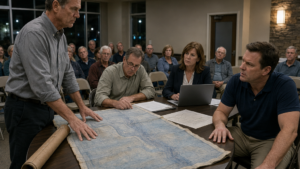
The clerk laid the two maps under a clear plastic overlay, and both could not be right.
On the recorded subdivision plat, the utility easement followed the southern boundary in a clean, straight band. On George’s original 1978 survey, the protected recharge zone curved through that same band and widened beneath the pasture.
The replacement scan shifted the curve.
“Surface access and groundwater authorization are separate,” George said.
The clerk nodded cautiously. “Usually.”
“Not usually. Legally.”
“I’m not an attorney, Mr. Walker.”
Daniel stood beside him with his arms folded. “Who approved the easement?”
“Planning and public works reviewed it. The county commission recorded the final plat.”
“And the drilling?” George asked.
The clerk searched another database. “There is a utility exploration approval.”
“Exploration of what?”
“It doesn’t specify.”
“Does it carry a state well number?”
“No.”
“A groundwater application?”
“I don’t see one attached.”
The answer should have settled something. Instead, the blue correction on the scanned survey kept George from trusting the ground beneath his certainty.
The county had authorized surface exploration. Michael could present that as legal access. If the boundary correction were accepted, he could argue the rig stood outside the protected zone. The missing state permit still mattered—but George no longer knew whether the trespass case was as clean as he had believed.
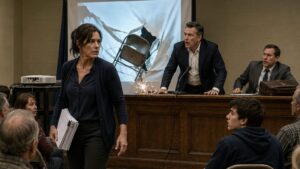
At the subdivision clubhouse, folding chairs filled the polished meeting room. Sandra Mitchell stood near a projector screen while residents talked over one another. Some still wore work clothes. Others had brought children, closing papers, or printouts from the HOA portal.
George entered with Daniel and felt the room register him.
Sandra tapped the microphone. “Mr. Walker has agreed to attend.”
“I agreed to look at your documents,” George said.
Michael sat at the front table beside two board members. He had changed shirts, but dust remained along one cuff.
Sandra projected the county easement.
“This is recorded,” she said. “The HOA was advised that it permits utility access along the southern boundary.”
A man near the back asked, “Then why is he stopping the well?”
“I haven’t stopped anything,” George said.
“You threatened the crew.”
“I asked for a permit number.”
Michael leaned toward his microphone. “The work is an exploratory bore under county authorization. Full production use would require additional state review.”
George watched him carefully. That distinction had not been offered at the rig.
Sandra displayed the exploration approval next. County stamps appeared at the bottom.
A murmur moved through the room.
For several seconds, the paper made George look exactly like what they believed him to be: an adjoining landowner objecting to work that officials had already approved.
Michael let the silence settle before speaking.
“No one is trying to take Mr. Walker’s ranch. The community has a recorded easement and a county-approved testing plan. We have occupancy deadlines, lender requirements, and families who have already moved in.”
“Testing plan for a water source?” George asked.
“For subsurface conditions.”
“With a well casing?”
“With equipment appropriate to the test.”
George took the certified records from his folder. “Where is the state authorization field?”
Michael’s jaw shifted.
George held up the county form. Near the bottom was a blank box labeled Additional State Resource Approval, if applicable.
“This bore entered a mapped recharge zone,” George said. “That makes it applicable.”
One of the board members turned to Michael. “Was a state filing made?”
“Our consultant advised that preliminary testing could proceed.”
“That wasn’t the question,” Sandra said.
It was the first time she had interrupted Michael.
He opened his laptop and brought up an email. The sender was a consulting hydrogeologist. A highlighted sentence described limited exploratory drilling as permissible under the county plan, provided the bore did not access or disturb regulated groundwater.
Michael projected it onto the screen.
“There,” he said. “Permissible testing.”
George read the line above the highlight.
It referred to a location east of the recharge boundary shown on the submitted plat.
The corrected plat.
Daniel saw it too. “That depends on which map is real.”
Voices rose again.
Sandra asked for quiet, but fear had begun replacing anger. A woman in the first row said her family had closed on their house three weeks earlier. Another resident said the municipal backup line had been promised before move-in. Michael answered that the connection was undergoing final inspection.
George turned toward him. “It isn’t operational?”
“It is scheduled.”
“That means no.”
“We have interim capacity.”
“From where?”
Michael did not answer immediately.
Sandra looked between them. “The sales disclosures say municipal redundancy.”
“The connection is substantially complete,” Michael said.
A resident stood. “Can water run through it tonight?”
Michael closed the laptop halfway. “That is not the issue before us.”
It became the issue then.
George understood why Michael had ordered the drilling to continue. The test was not merely exploratory. The development needed proof of a source before someone discovered the promised backup connection could not yet supply occupied homes.
George’s phone vibrated.
The caller identified herself as Rebecca Lee from the state groundwater office. He stepped into the hall and answered.
“Mr. Walker, I reviewed the coordinates and the documents you sent,” she said. “An enforcement team is being dispatched.”
“How long?”
“They are leaving now.”
George looked through the glass doors toward the meeting room. Michael was speaking again, pointing to the county stamps. Sandra stood rigid beside the screen while residents demanded to know whether their water system had any lawful source at all.
“What did the crew reach?” George asked.
Rebecca was silent for half a second.
“The drilling log transmitted by the contractor shows a pressure change at the protected formation.”
George tightened his grip on the phone.
“They reached it?”
“They reached it,” she said. “And if the casing has breached the upper seal, stopping the operation may affect more than the ranch.”
Chapter 4: The Night the State Sealed the Well
The state trucks reached the southern pasture before the drilling crew could pull the casing.
George saw their amber lights moving along the subdivision road as he turned through his gate. Two enforcement vehicles stopped beside the rig, followed by a utility truck carrying steel caps, sample containers, and portable work lamps. Rebecca Lee stepped out before the dust had settled.
“Shut it down,” she called.
The drilling foreman cut the engine. The sudden silence felt larger than the machinery had.
Michael came from behind the service trailer with his phone in one hand. “You cannot close this site without reviewing the county authorization.”
Rebecca held up her identification. “I reviewed it.”
“The bore is exploratory.”
“It registered a pressure change in a regulated formation.”
“According to an automated log that has not been verified.”
“That is why no one is touching the casing until my team verifies it.”
Workers backed away as the enforcement crew placed cones around the wet soil. Under the work lamps, the casing shone with a thin film of mineral water.
George stopped outside the marked area. Rebecca glanced at the canvas document case beneath his arm.
“You brought the original?”
“Yes.”
“Keep it closed until I have gloves.”
Michael stepped between them. “We have occupied homes relying on interim capacity. If you seal that bore tonight, you could interrupt service.”
Rebecca looked at him. “Is this bore connected to the community system?”
“No.”
“Then sealing it should not affect service.”
Michael’s pause was brief, but George heard the answer inside it.
Rebecca heard it too.
“What is feeding the homes now?” she asked.
“Storage and temporary distribution.”
“From the municipal connection?”
“The connection is substantially complete.”
“Operational?”
Michael looked toward the subdivision lights.
George said, “No.”
Michael faced him. “You do not know the system status.”
“I asked you in the clubhouse. You didn’t answer.”
“This is not your system.”
“No. It’s just drilling beneath my land.”
Rebecca cut between them. “Mr. Roberts, I need the active source, storage volume, and redundancy schedule. Now.”
Michael walked toward the service trailer, calling someone before he reached it.
Rebecca pulled on gloves and took the survey from George. Instead of unfolding it on his truck hood, she slid it into a clear evidence sleeve and sealed the top with a numbered strip.
George watched the old paper disappear behind plastic.
“That stays with the file?” he asked.
“Until we confirm the location and chain of custody.”
“It has never left my possession.”
“Tonight it does.”
She spoke without apology. George wanted to object. The survey had spent most of its life in his safe, beyond damp air, careless hands, and people who thought an old map was negotiable. Now it lay under portable lights while a technician photographed every crease.
Rebecca noticed him watching.
“If you want it to carry weight,” she said quietly, “you have to let someone else examine it.”
George looked away.
The crew lowered a camera into the casing. A monitor inside the utility truck showed pale rock, drilling mud, and a narrow fracture where water moved across the image.
Rebecca leaned closer.
“Stop there.”
The technician froze the feed.
A dark seam crossed the upper seal.
“How bad?” George asked.
“We don’t know yet.”
“That isn’t an answer.”
“It’s the only honest one.”
She pointed to the monitor. “The pressure response may be local. It may also mean the bore opened a path between layers. Until we sample and model it, no pumping, no extraction, no movement of the casing.”
Michael returned with a printed system report.
Rebecca scanned it. “Your municipal backup has no final inspection.”
“We were told inspection would occur this week.”
“Your storage reserve?”
“Less than twelve hours at current demand.”
George felt the shape of the next hours before anyone named it.
The subdivision had not been drawing from the test bore. But its storage tanks had been managed on the assumption that a new source or backup connection would be available. The drilling had not created all of their weakness. It had exposed it.
Rebecca read the remaining pages. “Why are the pressure figures already declining?”
Michael rubbed the side of his face. “The development opened another occupancy section yesterday.”
“How many additional homes?”
“Eighty-six.”
“With no operational redundancy?”
“We had every reason to believe the connection would pass.”
Rebecca handed the report to a technician. “That belief is not a supply.”
Michael lowered his voice. “If you issue a full stop, the lenders will be notified. Closings will freeze. Families will lose financing.”
“And if the bore has compromised the seal, continued work could contaminate every legal well connected to this formation.”
“You cannot prove that tonight.”
“I do not need to prove contamination before stopping an unpermitted penetration.”
George’s phone contained the recording from that morning. He opened it and handed it to Rebecca.
Michael’s voice played beneath the work lamps: The county approved the development plan. The easement is recorded.
Then George’s question: Show me the state groundwater permit number.
Then Michael ordering the foreman to continue.
The recording did not settle the boundary discrepancy or explain the altered map. It did something simpler. It established that Michael had been asked directly about state authorization before the drill reached the protected layer.
Rebecca returned the phone.
“That supports immediate enforcement,” she said.
Michael’s expression hardened, but he did not deny the words.
The state crew fitted a steel cap over the casing. Rebecca applied a numbered seal and attached the cease-and-desist notice inside a weatherproof sleeve. The paper snapped in the wind while the crew photographed the locked assembly.
George had expected satisfaction.
Instead, he found himself looking toward the subdivision.
House lights burned across the slope. Through one kitchen window, a woman stood over a sink with a glass beneath the faucet. She turned the handle, waited, and tried again.
Nothing came.
A few minutes later, another house went dark at the windows as someone moved room to room. Then a car entered the street too fast and stopped outside the clubhouse.
Michael’s phone began ringing.
He answered one call, then another. Each time his voice became flatter.
Rebecca received a message from the enforcement truck. “Distribution pressure is dropping across the upper section.”
Michael walked away, speaking urgently to the utility operator.
George remained beside the sealed casing. The notice moved in the wind, bright under the lamps. By law, the drilling had stopped. The boundary was being honored. The evidence had been preserved.
Across the road, porch lights came on one after another as residents tested faucets and called neighbors.
George knew the municipal connection was delayed. A hydrogeologist’s notice had reached him three weeks earlier because his well sat within the review zone. He had kept it in the safe with the other papers.
He had said nothing to Sandra.
Nothing to Daniel.
Nothing at the clubhouse when residents asked whether water could run that night.
His phone rang.
Sandra’s name appeared on the screen.
When he answered, her voice was stripped of its public-meeting control.
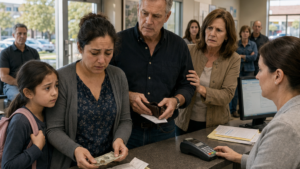
“I’m at a house on Juniper Lane,” she said. “There’s a child here whose medication has to be mixed with clean water. The parents have enough for one dose.”
George looked at the sealed well, then at the dry houses beyond his fence.
Sandra took a breath.
“Tell me what we do now.”
Chapter 5: Nine Hundred Forty Homes Without Water
Sandra turned the clubhouse faucet, and only trapped air came out.
The pipe coughed once, hard enough to shake the metal sink, then went silent. Behind her, residents filled the meeting room and spilled into the corridor carrying pitchers, coolers, stockpots, and empty plastic jugs.
George stood near the doorway with the certified survey copy beneath his arm.
Someone recognized him.
“That’s the man who shut it off.”
The accusation traveled faster than any explanation. Heads turned. A resident near the back raised a phone toward him.
George did not move.
Sandra stepped between him and the room. “The state closed an unpermitted drilling site. Mr. Walker did not operate our water system.”
“He called the state,” another resident said.
“Yes.”
“So this is because of him.”
“No,” George said. “It’s because your system had no working backup.”
The room erupted.
Sandra struck the table with the base of a flashlight. “One at a time.”
A woman held up a baby bottle. “I don’t care whose permit is missing. I need water.”
A man in a construction uniform said he had driven to three stores and found the shelves empty. Someone else demanded that the HOA pay for hotel rooms. Another resident asked whether toilets could be flushed safely.
George listened until the questions became a single sound.
Michael stood near the projector screen with his tie removed and his sleeves rolled unevenly. He had been on the phone for most of the night. The confidence he had worn beside the rig was gone, but he had not left.
“We have requested emergency deliveries,” he said. “The first available tanker can reach the area by late morning.”
“Late morning?” someone shouted.
“We are working on an earlier option.”
Sandra turned toward him. “Tell them about the municipal connection.”
Michael looked at the residents.
“It has not passed final inspection.”
The room went still in pieces.
“You told us there was redundancy,” a board member said.
“The physical line is installed.”
“Can water run through it?”
“Not legally.”
George almost laughed at the word, but nothing about the room allowed it.
A woman near the front looked at Sandra. “Did the board know?”
Sandra’s face tightened. “We were told final approval was imminent.”
“That isn’t what she asked,” George said.
Sandra looked at him sharply, then back at the residents. “No. We did not know it was unavailable for emergency use.”
George opened the survey copy on the table. Several people gathered around, though the faded lines meant little without explanation.
“This curve marks the protected recharge zone,” he said. “The rig crossed it.”
A resident pointed at the newer plat. “The county map says it didn’t.”
“The county map was corrected three months ago.”
“So which one is real?”
“That is being investigated.”
“Then maybe you were wrong.”
“Maybe the surface boundary is disputed,” George said. “The missing groundwater permit is not.”
Michael stepped closer. “The state filing was pending.”
George looked at him. “Pending when you ordered them to continue?”
Michael’s eyes dropped to the survey.
“Yes.”
The admission was quiet, but everyone nearest the table heard it.
Sandra asked, “You knew?”
“I knew the final authorization had not issued. The consultant believed limited testing could proceed under the county approval.”
“The consultant’s email said outside the recharge zone,” Daniel said from the doorway.
George had not seen him enter.
Daniel crossed the room with a folded notice in his hand. “And you used the corrected map to place the rig outside it.”
Michael rubbed both palms over his face. “I used the recorded plat supplied to the project.”
“You also knew the backup line was delayed,” Daniel said.
Michael looked at George instead. “So did he.”
The room shifted again.
Daniel placed the notice on the table. It was the hydrogeologist’s advisory sent to adjoining well owners three weeks earlier. The line about delayed municipal redundancy had been underlined.
George recognized his own pencil mark.
Sandra picked it up. “You had this?”
George said nothing.
“George.”
“Yes.”
The word cost more than he expected.
“You knew we had no functioning backup?”
“I knew the final inspection was delayed.”
“And you never told the board?”
“You never asked me what your manager had disclosed.”
Daniel’s chair scraped backward. “That’s what you’re going with?”
George turned to him. “They were drilling without authorization.”
“That doesn’t answer her.”
“I warned the crew.”
“You warned the people you wanted on record. You didn’t warn the families who would wake up dry.”
A resident said, “He wanted this.”
George faced the voice. “No.”
“Then why keep quiet?”
Because information given too early became leverage. Because developers corrected maps and widened corridors. Because every explanation he had offered in the past had returned as a clause in someone else’s agreement.
He could not say any of that without hearing how thin it sounded beside the empty containers.
Sandra lowered the advisory. “We need a route for the tankers.”
Michael opened a site plan. “The subdivision entrance has a weight-restricted decorative bridge. Full tankers cannot cross until an engineer clears it.”
“Then use the construction road.”
“It is blocked by grading equipment and unfinished drainage cuts.”
The emergency dispatcher spoke through Michael’s phone on speaker. “There is one possible approach from the west, but it requires access through the Walker ranch service road. We can stage distribution at the clubhouse if we can reach the upper gate.”
All eyes returned to George.
The ranch road was narrow but reinforced for cattle trailers and feed trucks. It crossed the dry wash and entered the subdivision behind the maintenance yard. It was also the same route described in the HOA’s rejected corridor proposal.
Michael unfolded a document from his folder.
“We can execute emergency access immediately,” he said. “The form grants temporary ingress, utility support, and continuing access as required for public health.”
George read the first page.
The word temporary appeared once.
The phrase successors and assigns appeared three times.
“This creates a permanent easement,” he said.
“It creates emergency authority.”
“It survives the emergency.”
“We can amend it later.”
“No.”
Sandra came around the table. “People need water.”
“I know.”
“Then sign a limited form.”
“This is not limited.”
Michael’s voice sharpened. “We do not have time for you to redraft legal language.”
“You found time to draft language that keeps my road.”
“That road may be essential to public health.”
“Tonight. Not forever.”
Outside the clubhouse, headlights gathered along the boulevard. Residents had begun driving toward the ranch with empty containers, following messages posted in neighborhood groups.
George could see them through the windows.
He rolled the survey, picked up the advisory, and walked outside.
Daniel followed. “What are you doing?”
“Going home.”
“To write another complaint?”
“To read what they put in front of me.”
“People don’t have until you’re comfortable.”
George stopped beside his truck. “And if I sign that, they’ll use this emergency to claim permanent access across the recharge zone.”
“You can be right and still make this worse.”
“I’m not signing away the road.”
“That isn’t the only choice.”
George looked toward the ranch. A line of vehicles stretched along the county shoulder. At his upper gate, residents stood beside coolers and empty jugs beneath the beam of their headlights.
Michael arrived carrying the easement form.
“Sign it,” he said. “We can have a tanker moving within twenty minutes.”
George took the paper, tore neither it nor marked it, and handed it back.
“No.”
He drove to the ranch with Daniel behind him.
At the upper gate, people moved aside just enough for his truck to pass. A child held an empty cooking pot with both hands. Someone called George’s name, not kindly.
He entered the ranch, stepped out, and pulled the gate closed.
The chain passed through the steel bars with a familiar weight.
He locked it while the first tanker waited miles away for a road no one could use.
Chapter 6: What the 1978 Survey Cost His Family
Daniel found his father’s handwriting beneath George’s on the 1978 survey.
He had spread the original across the kitchen table after following George inside. The evidence sleeve had been opened by Rebecca long enough for certified imaging, then resealed and returned under a temporary receipt. Through the plastic, faded pencil notes crowded the lower margin.
Daniel bent closer.
“That’s his capital R.”
George stopped beside the sink.
A pair of initials sat under the drought measurements: R.C.
Daniel traced them without touching the plastic. “You said this was your survey.”
“It belongs to the ranch.”
“You let everyone call it yours.”
George removed his hat and set it on the counter. Outside, car doors closed near the locked gate. Voices carried across the yard.
Daniel waited.
“In seventy-eight,” George said, “the county wanted voluntary restrictions before it imposed pumping limits. Your father and I agreed to cut the herd.”
“How much?”
“More than half.”
Daniel’s face changed slightly. His father had spoken about that year only in fragments: bad prices, dry wells, cattle sold under weight.
George continued. “The surveyor marked the recharge zone. If we accepted the protected boundary, the county would preserve senior stock-water rights and block high-volume wells along the southern basin.”
“So you chose the water.”
“We chose what would still be here after the drought.”
“My father didn’t describe it as a choice.”
“No.”
George opened the evidence sleeve carefully and unfolded the survey. Near the bottom, two sets of handwriting recorded weekly water depths. George’s numbers were narrow and upright. His brother’s leaned forward.
“He wanted to keep more cattle through winter,” George said. “I voted with the irrigation board to restrict pumping. We sold animals we had raised from calves. Prices were low because everyone else was selling too.”
“And he blamed you.”
“He had reason.”
Daniel looked toward the dark window. “He said you cared more about dirt than people.”
George did not correct him.
The refrigerator motor stopped. In the silence, the voices at the gate became clearer.
“After the herd was gone,” George said, “the aquifer stabilized. The county adopted the protected zone. Your father signed the survey with me.”
“Then why did he hate it?”
“Because a right decision can still cost more than a family knows how to forgive.”
Daniel’s eyes remained on the initials. “And before he died?”
“He made me promise not to let anyone turn that protection into a private supply line.”
“That was the promise?”
“Yes.”
Daniel gave a tired shake of his head. “You built thirty years of silence around one sentence.”
“It wasn’t one sentence.”
“No. It was easier than telling me he signed too.”
George folded one corner of the survey back, revealing another line of pencil: Maintain access for inspection and emergency protection.
Daniel read it aloud.
The words had been written by his father.
For years George had treated the map as a wall. The note made it something else: a boundary with a purpose, not a boundary against every person who might cross it.
His phone vibrated on the table. Rebecca was calling.
“The preliminary samples show drilling fluid in the upper fracture,” she said when he answered. “We cannot confirm migration yet, but we need monitoring access on both sides of the boundary immediately.”
“The state can use the main ranch road.”
“We also need the subdivision-side observation point. Your service road is the only safe route for the equipment.”
George looked at Daniel.
Rebecca continued. “The tanker dispatcher says the same road is required for delivery. I can issue emergency access authority, but that may take hours, and the language will be broader than a private temporary agreement.”
“How broad?”
“Broad enough that you will dislike it.”
“And once issued?”
“It stays in effect until the state terminates it.”
George closed his eyes.
Michael’s form had tried to turn urgency into control. Refusing it had been correct. Locking the gate without offering another instrument had not been.
“I can prepare limited terms,” George said.
“You can, but they must allow state sampling, tanker passage, turnaround, and maintenance access for the duration of the declared emergency.”
“No drilling.”
“No drilling.”
“No subsurface rights.”
“Agreed.”
“No successors, no permanent utility corridor, no precedent for an easement.”
“You will need the HOA’s signature and mine.”
“I’ll get them.”
Rebecca paused. “George, there is another issue. The emergency operator cannot distribute water without a staging area and traffic control. This will require cooperation with the people outside your gate.”
“I understand.”
“Do you?”
He looked at the survey, at his brother’s initials, and at the line about emergency protection.
“Yes,” he said. “I do now.”
After the call, Daniel stood by the table with both hands braced against its edge.
“You knew about the backup delay,” he said.
George nodded.
“You could have warned Sandra before the state sealed the bore.”
“Yes.”
“Why didn’t you?”
George searched for an answer that did not excuse him.
“I thought if I told them, they would use the risk to force access before the permit question was settled. I wanted the drilling stopped first.”
“So you let them walk into the shortage.”
“I let myself believe their manager would handle his own residents.”
Daniel looked toward the gate again. “That sounds like Dad leaving you to handle the ranch because he was too angry to come back.”
The comparison landed cleanly.
George folded the survey along its original crease. For once, he did not place it back in the safe.
He carried it outside.
At the abandoned stock pond beyond the barn, the dry basin held weeds and pale stones. During the drought, cattle had crowded its edges while the remaining water withdrew into mud. George remembered his brother standing there with the sale list, refusing to look at him.
Daniel stopped beside him.
“I don’t know if he forgave you,” George said. “He never told me.”
“He didn’t tell me he signed.”
“He wanted you to remember what was lost.”
“And you wanted me to remember nothing.”
George accepted that.
Headlights shone through the bars of the upper gate. The crowd had thinned, but the empty containers remained lined along the fence. Someone had set a child’s blue water jug on the ground.
George handed Daniel the survey.
“Make three copies when the county office opens. One for you. One for the state. One for the HOA.”
Daniel looked at him. “You’re giving them the map?”
“I’m giving them the conditions.”
A distant diesel engine sounded from the county road. The tanker was approaching the turn but could come no farther while the gate remained locked.
George removed the key from his pocket.
“Bring the socket set,” he said.
Daniel glanced toward the hinges. “You want the chain off?”
“The whole gate.”
“Why?”
“Because a tanker can pass an open gate. A permanent claim can hide in one.”
They walked back across the yard together.
At the steel posts, George unlocked the chain while Daniel set down the tools. The first bolt resisted, rust holding it as stubbornly as memory.
George leaned his weight into the wrench.
“Take the other side,” he said.
Daniel did.
The bolt broke loose.
“Before the tanker gets here,” George said, “we remove the gate.”
Chapter 7: The Gate Opened Under Written Conditions
The first tanker stopped at the open entrance because no one knew whose instructions controlled the road.
George and Daniel had removed the steel gate and laid it beside the fence. The hinges remained fixed to the posts, dark with old grease, while the empty opening exposed the ranch service road all the way to the dry wash.
The tanker driver idled beneath the headlights of three state vehicles.
“I have authorization from the emergency dispatcher,” he said through the open window.
Michael stood on one side of the road holding the easement form George had rejected. Rebecca stood on the other with a state access order ready on her tablet. Sandra waited near the subdivision maintenance entrance with two board members and a line of residents carrying reflective vests.
Everyone had authority.
No one had an agreement.
George stepped into the headlights with four stapled pages in his hand.
“The truck can enter,” he said. “But nobody moves until the terms are signed.”
Michael looked at the pages. “You drafted a contract in the last hour?”
“The water-rights attorney dictated most of it. Rebecca corrected the state language.”
Rebecca nodded. “It satisfies emergency sampling requirements.”
Michael held out his hand. “Let me see it.”
George did not give it to him first. He handed one copy to Sandra, one to Rebecca, and one to Daniel. The fourth remained in his hand.
“This grants temporary passage for potable-water tankers, state testing vehicles, traffic-control crews, and necessary maintenance equipment,” George said. “It ends when the declared water emergency ends or in thirty days, whichever comes first, unless all parties extend it in writing.”
Michael began reading over Sandra’s shoulder.
“No production wells,” George continued. “No test drilling. No trenching. No buried lines. No subsurface rights. No claim that emergency use creates an easement by prescription, necessity, implication, or prior consent.”
The tanker engine vibrated through the road.
A resident near the maintenance entrance called, “Can we do the legal argument after the water gets here?”
George turned toward the voice. “This is how the water gets here without creating the next argument.”
Sandra read the final page. “The HOA pays for road repair and traffic control.”
“Yes.”
“And remediation costs are reserved. This does not decide liability.”
“Yes.”
Michael pointed to a clause. “You require the HOA to acknowledge that the route crosses protected recharge land.”
“It does.”
“That language prejudges the boundary dispute.”
“It identifies the original survey zone. It does not settle title.”
“The corrected county plat places part of this road outside it.”
Rebecca said, “The state requires the stricter boundary until the records are reconciled.”
Michael looked at her. “You helped write this?”
“I prevented you from receiving a broader access order that would have stayed active at my discretion.”
He read that answer for what it was. George’s private agreement protected more of the ranch than the state could promise while still letting emergency vehicles through.
Sandra reached for a pen.
Michael put his hand over the signature line. “The board should have counsel review it.”
“Our counsel is on speaker,” Sandra said, lifting her phone from the table set beside the road.
A voice from the phone confirmed that the document created a revocable emergency license, not a permanent property interest.
Sandra signed.
One board member followed. The other hesitated, then added his name.
Michael did not have a required signature line.
That appeared to trouble him more than the terms.
George signed last. Rebecca recorded the time and countersigned the state-access section.
Daniel moved the traffic cone.
The tanker rolled forward.
Its tires crossed the place where the gate had stood, then descended the ranch road at walking speed. Behind it came a state sampling truck. Residents watched from both sides as the vehicles passed the posted copy of the agreement Daniel had fixed to a plywood board.
The moment should have felt like surrender. Instead, George felt the road become more clearly his because he had said, in writing, exactly why others could use it.
At the clubhouse, the tanker connected to a temporary distribution manifold. Sandra organized residents by street while the emergency crew filled approved containers and supplied the homes with immediate medical needs first.
Michael worked beside them.
He carried hoses, moved barriers, and called two additional tankers. When a delivery driver could not turn through the maintenance yard, Michael walked the route himself and had a stack of decorative fencing removed.
He did not disappear when his authority weakened.
That surprised George.
Near sunset, Rebecca established the testing point beside the sealed casing. George gave her a certified copy of the 1978 survey. He gave another to Sandra and placed the third in Daniel’s hands.
Daniel looked down at it. “You sure?”
“No.”
Daniel waited.
George added, “Take it anyway.”
The survey no longer looked like a private weapon. The copies carried the same curved line, the same drought measurements, and the same two sets of initials. In separate hands, the document could now be questioned without vanishing.
Sandra joined them after the second tanker arrived.
“There will be a board meeting tonight,” she said. “Residents want records.”
“They should get them,” George said.
Michael approached from behind her. His white shirt was marked with dust and a dark stripe of water from a leaking coupling.
“There is something you need to understand,” he said to George. “If the project misses the lender certification, dozens of pending buyers may lose rate locks. Contractors will not be paid. This does not stop with my job.”
George folded his arms. “That made the permit optional?”
“No.”
“Then what are you asking me to understand?”
Michael looked toward the residents filling containers. “Why I kept believing the next approval would arrive before the risk became real.”
Sandra said, “You received a warning.”
He did not answer.
She held up her phone. “The board’s counsel found a reference to a consultant memorandum that was never included in our packet.”
Michael’s face became still.
“What memorandum?” Daniel asked.
Michael looked at George, then at Rebecca.
Rebecca said, “Now would be a poor time to delete anything.”
“I have not deleted it.”
“Then release it,” Sandra said.
Michael walked away from the distribution line and stood beside the temporary command table. For several minutes, he scrolled through his laptop without speaking.
Residents moved around him carrying water. A child dragged a full jug with both hands until Daniel lifted it into the family’s wagon. The second tanker vented pressure with a long mechanical sigh.
Michael turned the laptop toward Sandra.
The memorandum had been sent eleven days earlier. Its first paragraph stated that county exploration approval did not authorize penetration of the regulated aquifer. Its second warned that the corrected survey boundary had not been independently verified. Its final recommendation was unambiguous: suspend drilling until state authorization and archival boundary review were complete.
Sandra read it once.
“You told us the consultant approved testing.”
“He approved testing under conditions.”
“These conditions were not met.”
Michael closed his eyes briefly. “No.”
“Why wasn’t this in the board packet?”
“Because I believed the state permit would issue before drilling reached the formation.”
“That is not an answer.”
Michael’s voice remained low. “Because if the board delayed the test, the lender inspection would fail. I was told the project would be reassigned, the contractors would file claims, and the residents would blame the board for losing the schedule.”
“So you decided for us.”
“Yes.”
Sandra did not raise her voice. “Send it to every homeowner.”
Michael stared at her.
“All of it,” she said. “Not a summary.”
He opened the HOA mailing system.
George watched him attach the memorandum, the consultant’s email chain, and the drilling directive bearing his own approval. Michael added a short message taking responsibility for authorizing continued work while state approval remained unresolved.
His finger hovered over the send button.
“You know what happens after this,” Sandra said.
“Yes.”
He sent it.
Phones began sounding across the clubhouse and distribution line. Residents stopped to read. Conversations broke apart and reformed around the newly released pages.
Michael removed his project identification badge and placed it on the command table.
“I have submitted my resignation to the development company,” he said. “I will remain through the emergency transition if the board allows it.”
Sandra looked at the tankers, the hoses, and the waiting residents.
“You remain tonight,” she said. “Tomorrow is not my decision.”
Michael nodded.
George looked toward the open ranch entrance. Vehicles passed through under written conditions, carrying water in one direction and samples in the other.
The gate was gone, but the boundary had never been clearer.
Chapter 8: The First Clear Water After the Crisis
Clean water returned three weeks later, but every faucet in the subdivision carried a conservation notice.
George saw one taped above the clubhouse sink when Sandra turned the handle for the first public test. The pipe shuddered, released a cloudy burst, then ran clear into a glass sampling jar.
No one applauded.
Rebecca held the jar beneath the light, checked its clarity, and sealed it for confirmation testing. Residents stood behind the marked line, watching the stream as if noise might frighten it away.
“Limited service only,” she said. “No lawn irrigation. No pool filling. No construction use beyond sanitation. The monitoring schedule remains mandatory.”
Sandra repeated the restrictions into the microphone.
Some residents looked relieved. Others looked toward the brown lawns outside and calculated what continued limits would cost. Relief did not erase anger, invoices, delayed closings, or the knowledge that the development had been sold with protections it did not yet possess.
The emergency tankers would continue for another four days.
At the front table lay three proposals.
The first came from the development company. It offered George more money than before for a permanent utility corridor and monitoring access across the ranch.
The second came from several residents who wanted the HOA to sue him for failing to disclose the delayed backup connection.
The third was Sandra’s.
She slid it toward him after the meeting began.
“This is not an easement purchase,” she said.
George read the title: Groundwater Monitoring and Shared Stewardship Agreement.
The proposal funded three observation wells outside the protected core, quarterly public test reports, road maintenance, and an independent archival survey. The HOA, state, and ranch would each receive the data. No party could increase extraction without separate approval.
Daniel sat beside George, reading his own copy.
One board member said, “The development company’s offer would cover remediation and stabilize dues.”
“It would also give them permanent access,” Sandra replied.
“We need infrastructure.”
“We need lawful infrastructure.”
A resident near the aisle raised her hand. “Why should we trust Mr. Walker with monitoring after he withheld information?”
The room quieted.
George could have pointed toward Michael’s empty chair. He could have repeated that drilling had continued without a permit, that the HOA had relied on incomplete packets, and that the residents had bought homes attached to promises no one had verified.
All of that was true.
He stood.
“You should not trust me alone,” he said.
The answer unsettled the room more than a defense would have.
“I had the hydrogeologist’s warning,” he continued. “I knew your backup connection had been delayed. I believed telling the board before the drilling stopped would be used to force access across the ranch.”
“Was that belief wrong?” someone asked.
“Not entirely.”
A few residents shifted.
“But keeping quiet left families unprepared. That part was mine.”
Sandra watched him without rescuing the moment.
George placed the 1978 survey copy on the table. “This land has been treated as if one old paper gives one old man the right to decide everything beneath it. That is not what the survey says.”
He pointed to the two sets of initials at the bottom.
“My brother and I accepted pumping restrictions during the drought. We lost most of our herd. The protected zone was created because people upstream and downstream were drawing from the same formation.”
Daniel looked at the initials but did not lower his eyes.
“The boundary must remain,” George said. “The records must be corrected. But the information should not stay in my safe.”
The resident who had questioned him asked, “Does that mean you support this agreement?”
“It means I support monitoring that cannot become a production claim.”
Sandra said, “The equipment would remain on ranch property.”
George looked through the clubhouse windows toward the southern pasture. The proposed monitoring station would stand near the same road he had guarded for decades. Technicians would cross the ranch on scheduled days. Instruments would remain where only fence posts and cattle had stood.
Allowing it felt different from opening the gate during an emergency.
It felt permanent.
Daniel leaned toward him. “The agreement gives us access to every reading.”
“I saw.”
“And either side can request an audit.”
“I saw that too.”
“You still hate it.”
“Yes.”
Daniel almost smiled. “That doesn’t make it wrong.”
The board voted after another hour of amendments. The development company would fund remediation under reservation of liability. The HOA would pay part of the long-term monitoring costs through its infrastructure account rather than a special emergency assessment. The state would certify equipment and publish test summaries.
The permanent corridor purchase failed.
The stewardship agreement passed by a narrow margin.
Rebecca’s final technical report arrived that afternoon. The drilling fluid had remained concentrated near the bore fracture. Remediation and pressure management had prevented measurable migration into the ranch’s active well. The aquifer could recover, but only if extraction stayed below the revised limit and the upper seal was monitored for several years.
The finding was neither disaster nor absolution.
Michael did not return to the development. His company removed him from the project before formally accepting his resignation. Through Sandra, George learned that he had stayed long enough to help reconcile tanker invoices and contractor logs. He had also surrendered his correspondence to the state review without being compelled by subpoena.
No one called that redemption.
It was simply the first responsible thing he had done without a deadline forcing him.
At the ranch, installation crews placed the monitoring equipment on concrete pads no wider than feed troughs. George stood beside Daniel while Rebecca checked the first instrument.
“The casing remains above the protected formation,” she said. “Sensors only. No extraction.”
George inspected every connection anyway.
Daniel had started working at the ranch four days a week instead of two. They drafted a management plan that gave him authority over equipment purchases, grazing schedules, and the monitoring access calendar. He did not promise never to sell. George did not demand that promise.
“What about the equipment loan?” Daniel asked as they walked back toward the house.
“We restructure it.”
“And the taxes?”
“We pay them slower than either of us likes.”
Daniel nodded. “Sounds like a ranch.”
At the kitchen table, three documents waited: the original 1978 survey, a certified corrected archival copy, and the signed stewardship agreement.
The county investigation had found no proof that anyone deliberately altered the historic map. During digitization, a planning technician had transferred a field annotation from a later surface survey onto the recharge boundary. The mistake had been careless, consequential, and ordinary.
George found that harder to accept than a conspiracy.
No villain had needed to forge the line. A rushed office, an unchecked assumption, and people eager for the convenient version had been enough.
He opened the safe beneath the cabinet.
For years, the original survey had occupied the upper shelf alone. George slid it back into its canvas case, but he did not place the new copy beside it.
He handed that to Daniel.
“Where do you want it?” Daniel asked.
“Your file drawer.”
Daniel studied him. “Not the safe?”
“You will need it when I’m not here.”
Neither of them said more.
Daniel placed the certified copy in the ranch records drawer, beside current tax statements and the monitoring calendar. Then he added the stewardship agreement behind it.
George put the original survey in the safe.
Before closing the door, he saw his brother’s initials through the open edge of the canvas case. The old guilt remained. Shared responsibility had not rewritten the drought, restored the herd, or created a reconciliation that had never happened.
It had only stopped George from using the loss as permission to stand alone forever.
He rose from the floor and left the safe door open.
At the sink, Daniel filled two glasses. The water ran clear and cold from the ranch well, carrying no sound but the ordinary rush through the faucet.
He set one glass beside George.
Outside, beyond the kitchen window, the southern road remained open to the monitoring crew under the terms they had signed. The removed gate rested against the barn, its rusted hinges still attached.
George drank, then reached for the survey file Daniel had placed among the living records of the ranch.
This time, he did not take it back.
The story has ended.