The Neighbor Put a Fence Repair Bill in His Hand Before She Noticed the Old Sheriff Badge
Chapter 1: The Bill She Brought to the Ranch Gate
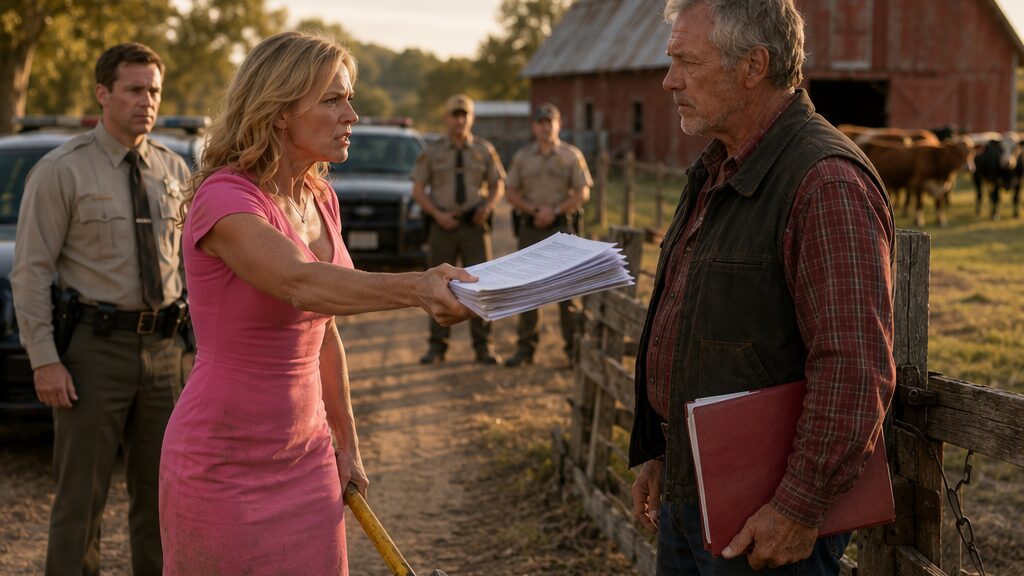
Melissa King slapped the repair estimate against Gregory Thomas’s chest hard enough to make the top page buckle.
“You’re going to sign this before these deputies leave,” she said.
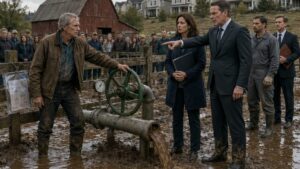
Gregory looked down at the paper, then past it to the two patrol cars parked crookedly on his dirt lane. Their blue lights were off, but the sight of them beside his red barn made the whole place look guilty. His cattle had gathered near the lower fence as if they, too, had been called as witnesses. One heifer pushed her nose through the rails and blew dust into the late afternoon heat.
Melissa stood between Gregory and the broken gate with a yellow-handled post maul gripped in her left hand. It was too heavy for the way she held it, half tool and half accusation. Her pink dress looked strange against the brown lane and splintered cedar posts, but she wore it like armor, clean and bright and angry.
Behind her, one deputy rested his thumbs in his belt. The other kept looking from Gregory to the damaged hinge and back again.
Gregory took the estimate from Melissa before it slid to the ground.
“Twenty-one thousand six hundred dollars,” Melissa said. “Fence repair, pasture gate, emergency livestock containment, contractor assessment, and loss of use. Your cattle came through my side. Your truck tracks are on the lane. Your fence has been neglected for years. I’m not paying for your laziness.”
The word landed harder than the paper.
Gregory adjusted the worn edge of his dark vest, feeling the small weight of the old badge clipped inside it. He had not worn it for authority. He had pinned it there after finding it in the truck console that morning, the way a man carried a key he forgot to put away. Old habits had a way of riding with him.
He did not reach for it.
Instead, he read the top line of the estimate.
Anthony Nelson Fence & Entry Repair
Emergency Assessment
Prepared: May 14
His thumb stopped on the date.
Melissa pointed the post maul toward the broken gate. “Don’t pretend you don’t see what happened.”
The top hinge had torn loose from the cedar post. The gate sagged inward toward Gregory’s pasture, its bottom rail gouged and twisted. Wire had been wrapped in a hurry along the lower gap, bright new staples hammered into old gray wood. On Melissa’s side, tire marks curved near the fresh gravel she had put in after buying the place in the spring.
Gregory lifted his eyes from the estimate. “You said this happened yesterday.”
“It did happen yesterday.”
“This estimate was prepared four days ago.”
Melissa’s mouth tightened. “Don’t start playing word games with me.”
“I’m reading the paper you brought.”
“It’s a preliminary estimate. Anthony already knew that fence was unsafe because of your cattle pushing against it.”
“My cattle were in the north pasture four days ago.”
“You expect everyone to just take your word for that?”
Gregory glanced at the deputies. The younger one looked uncomfortable. The older one had gone still in a way Gregory recognized. It was the posture of a man who had just placed a face and was deciding whether to say so.
Melissa stepped closer and thrust a second page at him. “Initial here. It only acknowledges responsibility. Insurance can handle the rest.”
Gregory did not take the pen she held out.
“No,” he said.
The word was quiet enough that the cattle and the flies seemed louder after it.
Melissa laughed once, not because anything was funny. “No? You think you can just say no?”
“I won’t sign a responsibility statement for damage I didn’t cause.”
“You did cause it.”
“I don’t know that.”
“I know that. Anthony knows that. My insurance company knows that. And now the county knows it because I called them.”
The younger deputy shifted. “Ma’am, we’re here to keep the peace. This is civil unless there’s—”
“He threatened me by refusing to cooperate,” Melissa snapped.
Gregory raised his head.
The deputy stopped speaking.
Melissa seized the pause. “He stood here, looking down at me, acting like I should know who he is. Everybody in this town acts like I should know who he is. Well, I don’t care. He doesn’t get to scare me out of filing a claim.”
Gregory felt the badge under his vest like a hot coin.
“I didn’t threaten you,” he said.
“You didn’t have to.” Her eyes flicked to his chest. “Men like you never have to.”
The older deputy cleared his throat. “Sheriff Thomas—”
Gregory looked at him sharply.
The deputy closed his mouth, but it was too late.
Melissa’s face changed. Not softened. Sharpened.
“Sheriff?” she said.
“Retired,” Gregory said.
She turned toward the deputies with both hands out, the papers in one, the post maul in the other. “There it is. That’s exactly what I’m talking about. You all know him. You’re standing on his land. You called him sheriff before you called me ma’am.”
The older deputy’s jaw flexed. “I served under him years ago. That doesn’t change—”
“It changes everything,” Melissa said. “It means if I don’t make this official now, he walks away and I’m stuck with the bill.”
Gregory folded the estimate once, carefully, along the crease Melissa had already made. He could feel every set of eyes on him: the deputies, Melissa, two ranchers who had slowed their truck on the county road, even Elizabeth’s old mare in the side lot lifting her head over the fence.
He wanted to say the kind of thing he used to say when a scene got loud. Firm, clean, final. He wanted to tell the deputies where to stand, tell Melissa to put the tool down, tell everyone the order in which the facts would be checked.
That was exactly why he did not.
“I won’t sign,” he said again. “And I won’t discuss liability on a dirt lane with a tool in your hand.”
Melissa looked down at the post maul as if she had forgotten it was there. Her grip tightened instead of loosening.
“This tool was found by the damage,” she said. “On your side.”
Gregory looked at the yellow handle. The paint was fresh at the grip but scraped near the head. He did not recognize it.
“That isn’t mine.”
“Of course it isn’t.”
“It isn’t.”
“You know what?” Melissa shoved the pen back into her folder. “Fine. Refuse. I already sent the photographs to insurance.”
Gregory’s hand closed around the estimate. “What photographs?”
“The fence. The gate. The cattle tracks. Your truck ruts. Everything.”
“My cattle tracks in a cattle pasture?”
Her face flushed. “Don’t talk to me like I’m stupid.”
“I’m not.”
“You are. You’re standing here pretending none of this is obvious because you think I don’t know how things work out here.” She turned to the deputies again. “I want it noted that he refused to sign.”
The younger deputy said, “We don’t note civil refusals on scene unless there’s a report attached.”
“There will be.” Melissa reached into the stack and pulled out another document, this one clipped behind a pale blue cover sheet. “Michelle Davis from the carrier is already assigned. She told me to document every interaction.”
Gregory held still.
That name meant the matter had already moved beyond Melissa’s anger. It had a file, a claim number, a person whose job was to follow paper wherever paper pointed.
Melissa pushed the blue sheet toward him. He did not want to take it, but he did.
Across the top, beneath the insurance company name, were the words: Notice of Potential Property Liability. Below that, in small black print, his own name and address sat inside the box labeled responsible party.
Gregory read it once.
Then he read the next line.
Claim initiated by Melissa King. Statement received. Insured reports livestock intrusion and vehicle-related impact from adjoining property.
The lane seemed to narrow around him. The barn, the cows, the deputies, the broken gate, Melissa’s bright dress and raised chin—everything stayed exactly where it was, but the shape of the argument changed.
This was not a neighbor demanding money anymore.
This was a record being built.
Gregory looked past the notice to the broken hinge, then to the yellow-handled post maul still hanging from Melissa’s hand.
He folded the blue sheet behind the estimate and held both papers flat against his palm.
“I’ll respond to Michelle Davis,” he said.
Melissa’s smile was thin. “Good. Then you can explain to her why your fence failed.”
Gregory did not answer.
He watched her walk back toward her side of the gate, papers clutched tight, post maul swinging at her knee. The older deputy lingered as if he wanted to say something, maybe apologize, maybe ask if Gregory was all right.
Gregory gave him nothing to work with.
When the patrol cars finally backed down the lane, dust rolled up behind them and drifted over the red barn. Gregory stood beside the damaged fence until the papers in his hand stopped trembling.
At the bottom of the insurance notice, under Michelle Davis’s typed name, was a sentence Melissa had not mentioned.
Failure to submit a timely response may result in liability review based on currently available claimant documentation.
Chapter 2: The Folder He Almost Left Closed
Elizabeth Allen stopped reading when she reached the word subrogation.
She stood at Gregory’s kitchen table with the insurance notice held in both hands, her mouth partly open, her coat still on though the room was warm from the old stove. The rest of the papers Melissa had brought lay spread across the scarred wood: the estimate, the responsibility statement, printed photographs of the gate, and a copy of the claim summary with Gregory’s name boxed in neat black lines.
“Dad,” she said, “this isn’t just Melissa trying to scare you.”
Gregory sat across from her, his hat on the chair beside him, his hands folded around a mug he had not touched. Through the window above the sink, the red barn was turning dark against the evening, one square of light glowing near the tack room.
“I know what it is,” he said.
“Then why did you let her stand out there and tell everyone her version first?”
He looked at the papers instead of at her. “Because arguing with a woman holding a tool in front of deputies wasn’t going to improve the facts.”
Elizabeth dropped the notice onto the table. “It improved hers. She has a claim number. She has photos. She has a contractor. She has you refusing to sign, which she’ll make sound like guilt.”
“Refusing to sign isn’t guilt.”
“It is if the wrong person writes the summary.”
Gregory’s jaw worked once.
Elizabeth softened, but only a little. She had her mother’s way of pushing when fear was underneath it. “What happens if they decide against you?”
He took a breath. “The insurance company asks my carrier to pay. My rates go up. They might argue negligence on the fence. If it gets ugly, they come after me for the difference.”
“How much difference?”
Gregory slid the estimate toward her.
She already knew the number, but she looked again anyway. “Twenty-one thousand six hundred.”
“That’s what she brought.”
“And if they add more?”
He did not answer quickly enough.
Elizabeth pulled out the chair and sat down. “You can’t just out-still this.”
That almost made him smile. Almost.
“I wasn’t planning to.”
“You were planning to put it in a drawer and wait until someone reasonable called.”
He looked toward the narrow hallway that led to the back room. On the top shelf of the old rolltop desk sat a red-tabbed folder thick enough to bow at the spine. He had nearly left it there after coming in from the lane. The habit was old: keep records, file them, don’t make a show of them. He had spent too many years watching men wave papers as if paper was truth. He had learned to let facts sit until needed.
Elizabeth followed his gaze.
“You still have the fence file?”
Gregory stood.
The floorboard near the pantry gave its familiar groan as he crossed the kitchen. In the back room, dust lay on the rolltop desk in a fine gray skin, except where his fingers had recently pulled open drawers. The red-tabbed folder waited on the top shelf, labeled in his own block writing: East Fence / Shared Line / Gate.
He brought it to the table and set it down.
Elizabeth looked at it as if it might either save them or accuse him.
Inside were photographs in envelopes, receipts from two feed-store trips, handwritten notes about storms and cattle movement, a map of the property line, and three letters Gregory had written but never mailed to Melissa’s previous owner about loose wire near the creek bend. At the back were newer pages: after Melissa bought the place, after she widened her driveway, after Anthony Nelson’s crew began hauling gravel past the gate.
Elizabeth pulled out the first envelope. “You dated these?”
“Always did.”
She turned over a photograph. “April twenty-ninth.”
The image showed the same fence line in late spring light, cattle grazing well back from it. The gate was closed, but the top hinge already sat crooked. One post leaned slightly toward Gregory’s side, its base dark from old rot.
Elizabeth held it beside Melissa’s printed claim photo.
The same lean. The same dark base. The same stretch of wire bowed near the bottom rail.
“This was before yesterday,” she said.
“Before last week.”
“Before her estimate, too.”
Gregory nodded.
“Why didn’t you say that at the gate?”
“Because I didn’t have the photo in my hand.”
“You had the truth.”
“The truth without a date is just another person talking.”
She studied him. “That sounds like sheriff talk.”
He looked down. “Maybe.”
There was the thing he had been trying not to touch all evening. Not the badge. Not the title. The part of him that still sorted the world into statements, evidence, credibility, consequences. He had been good at that once. Too good, his wife used to say when he came home unable to stop hearing both sides of every argument.
Elizabeth found a folded yellow paper. “What’s this?”
“Storm note.”
“In your handwriting?”
“Yes.”
She read aloud. “May tenth. North wind hard after midnight. East line down near King gate. No cattle out. Temporary wire held.”
Gregory remembered writing it. Remembered standing in the mud with a flashlight, checking the line after the storm had shoved branches across the drainage ditch. He had meant to call a fence crew then. He had meant to fix the shared section properly.
But the house had been too quiet that week. His wife’s birthday had passed with nobody sitting across from him at breakfast. He had taken the folder out, written the note, put it away, and told himself he would handle the repair when the ground dried.
Elizabeth picked up on the silence. “Dad.”
He closed the folder halfway. “Part of that fence is mine to maintain.”
“That doesn’t mean you caused her gate damage.”
“No.”
“But you’re thinking about paying because you feel guilty.”
He looked at the old table, at the scratches his wife had once complained about and never let him sand down because they proved the house had been lived in.
“I let that line go longer than I should have.”
Elizabeth’s voice dropped. “That’s not the same as owing Melissa twenty-one thousand dollars.”
“No,” he said again.
But it was not as clean as he wanted it to be. Guilt had a way of reaching for the nearest bill and offering to pay it.
Elizabeth separated the documents into piles with quick hands: photos, notes, receipts, old letters, Melissa’s papers. “We respond with dates. Not feelings. Not your badge. Dates.”
Gregory looked at her.
“What?” she said.
“You sound like your mother.”
“Good. She’d be louder.”
This time he did smile, but it went away when his phone buzzed on the table.
He turned it over.
An email notification filled the screen.
From: Michelle Davis
Subject: Claim Response Required — Five Business Days
Elizabeth read it over his shoulder, her face tightening with every line.
Michelle Davis requested a written statement, any supporting photographs, maintenance records, livestock logs, and prior communication related to the fence or gate. The deadline was Friday at five o’clock. If no response arrived, the review would proceed based on the claimant’s existing documentation.
Elizabeth sat back slowly.
“Five business days,” she said.
Gregory opened the red-tabbed folder again.
The papers inside no longer looked like clutter, and they did not yet look like enough.
Chapter 3: The Inspection That Measured the Wrong Side
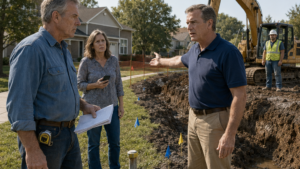
Anthony Nelson hooked the end of his measuring tape over Gregory’s bottom fence rail before Michelle Davis had even finished introducing herself.
“Impact line starts here,” Anthony said, drawing the tape across the dirt toward Melissa’s gate. “You can see how the pressure came from his side.”
Gregory stood with the red-tabbed folder under one arm and watched the metal tape cut a bright, careless line across his pasture grass. Melissa stood near Michelle, arms folded, chin lifted. She was not holding the post maul now. It leaned against the damaged gate within reach, yellow handle bright against gray wood.
Michelle Davis wore field boots with office slacks and carried a tablet in a black case. She had the careful expression of someone trained not to react until the file required it.
“Mr. Nelson,” she said, “I’ll need you to slow down. I haven’t recorded the starting condition yet.”
Anthony gave a friendly little laugh. “Sure. I’m just trying to save everyone time.”
Gregory had heard that sentence from men who meant to spend someone else’s.
He waited while Michelle photographed the gate from the road side, then from Melissa’s gravel entrance, then from Gregory’s pasture side. She asked Melissa when the damage had first been observed. Melissa said last Thursday morning. She asked whether livestock had been loose. Melissa said she saw hoof marks and a place where the wire was pushed down. She asked whether Gregory had been notified before the claim was opened.
Melissa glanced at him. “I tried speaking with him. He refused to take responsibility.”
Gregory kept his mouth closed.
Michelle turned to him. “Mr. Thomas?”
“He gave me papers at the gate,” Gregory said.
Melissa flushed. “I did not give you papers. I presented a repair estimate after you ignored the damage.”
“You brought deputies.”
“Because I didn’t feel safe.”
Michelle looked up from her tablet.
There it was again. Not the fence. Not the hinge. The feeling Melissa wanted written into the record.
Gregory looked at the broken gate. “I didn’t threaten her.”
“No one said you did,” Michelle said, though Melissa had said exactly that in every way except the simplest one. “We’re here to document physical causation.”
Anthony crouched beside the damaged hinge. “Well, physically, this is pretty clear. His cattle pressure weakened the line, then something from his side hit the gate.”
Gregory stepped closer, slow enough that nobody could mistake it for a challenge. “May I point to something?”
Michelle nodded.
He crouched beside the cedar post. Up close, the damage separated into ages. Old gray splitting near the base. Rust around the top hinge screws. Fresh splintering along one side. New gouges where metal had bitten into wood.
He pointed without touching. “This post has been leaning a while. That much is true.”
Melissa made a sharp sound. “Thank you.”
Gregory continued. “But the hinge plate is bent toward my pasture.”
Anthony straightened. “That happens when cattle push through.”
“No.” Gregory moved his finger to the torn screw holes. “If pressure came from my pasture, the gate would pull away from my side and swing toward yours. These screws tore outward from your side and folded back this way.”
Anthony’s smile thinned. “With respect, fence physics isn’t always textbook.”
“With respect,” Gregory said, “a gate still swings on hinges.”
Michelle lowered her tablet and crouched where Gregory had been. She photographed the hinge close, then the ground beneath it.
Melissa shifted. “He’s trying to confuse the issue.”
“I’m documenting,” Michelle said.
For the first time that morning, Melissa looked uncertain.
Anthony stepped in quickly. “The gate may have rebounded after impact. Or been moved after. The bigger issue is his fence condition. You can see the rot. That’s long-term neglect.”
Gregory felt Elizabeth’s warning from the kitchen: Don’t let them make the record for you.
He opened the red-tabbed folder and removed the April twenty-ninth photograph. “The hinge was crooked before the alleged cattle incident. The post was compromised before Melissa’s claim date. I noted storm damage on May tenth.”
Michelle took the photograph. “May I?”
“Yes.”
She compared it to the gate.
Melissa leaned close. “That doesn’t prove his cattle didn’t finish it.”
“No,” Gregory said. “It proves the estimate timeline needs work.”
Anthony’s head turned slightly.
Gregory saw it because he had spent half a life watching for the moment a person reacted before a fact was fully spoken.
Michelle wrote something on her tablet. “Mr. Nelson, when did you first inspect the damage?”
“After Ms. King called me.”
“What date?”
Anthony scratched the side of his neck. “I’d have to check the office copy. Around then.”
“Before or after May fourteenth?”
His eyes flicked to Melissa.
Melissa said, “I had him look at the fence because I was worried about it. That doesn’t mean the damage hadn’t gotten worse.”
Gregory looked at the post maul by the gate.
The yellow paint near the handle was clean, but the head was scuffed with pale wood dust packed into one corner. On the broken hinge strap, below the rust, was a fresh scrape the same yellow as the handle. Not broad. Not proof by itself. Just a thin mark where painted metal had kissed metal under force.
“May I ask about that tool?” Gregory said.
Melissa followed his gaze. “It was lying near the fence after the damage.”
“Where near the fence?”
“On your side.”
“No,” Anthony said quickly. “It was more by the gate. Hard to say.”
Michelle looked from one to the other. “Who owns it?”
Melissa said, “I assumed it was his.”
“It isn’t mine,” Gregory said.
Anthony lifted one shoulder. “A lot of crews use yellow-handled tools. Could be old. Could be anyone’s.”
Gregory watched him say it, then watched him stop looking at the tool.
Michelle photographed the post maul, the hinge scrape, and the lower rail. Her attention had changed. It was still neutral, but no longer moving in the direction Anthony had laid out with his measuring tape.
That should have felt like relief.
Instead, Melissa stepped back, folded her arms tighter, and spoke in a voice meant to sound wounded rather than angry.
“You see what’s happening, right?”
Michelle looked up. “What do you mean?”
Melissa nodded toward Gregory. “He knows exactly how to make people doubt me. He knows what words to use. He knows where to stand. He knows every deputy, every clerk, probably half the people in your office. You all keep acting like he’s just some rancher, but he was sheriff here. Everyone is scared to contradict him.”
The words moved through the group like a change in wind.
Anthony did not argue with her. He let the accusation settle.
Michelle closed her tablet case halfway. “Ms. King, Mr. Thomas’s prior employment is not part of physical causation.”
“It is part of why nobody wants to hold him accountable.”
Gregory felt the old heat rise under his collar. Not anger exactly. The temptation to take command. To say her fear did not make facts. To say he had stood in too many kitchens with real frightened people to let her borrow the language carelessly.
But if he said it like a sheriff, she would use it like proof.
So he slid the photograph back into the folder and said only, “My records are available to you, Ms. Davis.”
Michelle watched him a second longer than necessary. “Please send copies by the deadline.”
“I will.”
The inspection ended without ending anything. Melissa walked back toward her house with her phone already in her hand. Anthony rolled up his tape, slow and casual again, but Gregory saw the set of his shoulders. The contractor was thinking now.
Michelle spoke briefly with the deputies near the road, then drove away.
Gregory stayed by the gate, pretending to examine the lower wire while Anthony loaded his measuring wheel and clipboard into the bed of his truck. The yellow-handled post maul still leaned where it had been, beside the broken hinge.
A gust moved dust along the lane. One of Gregory’s cows bawled from the lower pasture.
Anthony glanced toward Melissa’s house, then toward Gregory.
“Old fences cause new problems,” he said.
Gregory looked at him. “So do quick estimates.”
Anthony smiled without showing teeth. “Good luck with the claim.”
He lifted the post maul from beside the gate and laid it quietly in the back of his truck, under a tarp, as if it had always belonged there.
Chapter 4: The Town Heard Her Version First
“Heard you made the new lady call the deputies.”
Gregory stopped with a fifty-pound salt block balanced against his hip and looked across the feed-store aisle at the neighboring rancher who had said it. The man stood by the mineral tubs with his cap pushed high on his forehead, pretending the question had come loose by accident.
Gregory set the block onto the cart before answering. “That what you heard?”
“I heard there was trouble at the King place.”
“It was at my gate.”
“Same line, ain’t it?”
That was how rumors traveled in a county like theirs. A gate became a place. A place became a side. A side became guilt if nobody corrected it fast enough.
The feed-store clerk, who had been counting bags behind the counter, slowed his hands. Another rancher near the twine hooks turned half an inch toward them, not enough to be rude, enough to hear.
Gregory picked up the second salt block. “There’s an insurance review.”
The rancher nodded as if Gregory had confirmed more than he had said. “She says you wouldn’t even look at the damage.”
Gregory felt the old answer rising. I looked. I measured. I know what a gate does when struck from the other side. Instead he placed the block beside the first.
“She’s mistaken,” he said.
The man’s eyes flicked to Gregory’s vest. “Folks get nervous contradicting you.”
Gregory’s hand stayed on the cart handle.
There it was again, carried from Melissa’s mouth into town already shaped for public use. Not that Gregory was wrong. Not that he had caused damage. That people were afraid of him, and therefore any fact in his favor came with a shadow.
He bought the salt, a roll of smooth wire, and a box of staples. The clerk rang him up too carefully.
At the door, the clerk said, “You need help loading?”
“I’ve got it.”
“Just asking.”
Gregory nodded once. “I know.”
Outside, he loaded the truck under a hard white sun. He could feel people trying not to watch. Years ago, that same silence had followed him for different reasons: a county cruiser pulling in, a uniform stepping out, folks wondering who had called and who was in trouble. He had believed then that quiet meant order. Now it felt like a blank page someone else had started writing on.
He drove from the feed store to the church parking lot because Elizabeth had asked him to pick up a casserole dish left from last week’s community dinner. She was waiting near the side door with the dish wrapped in a towel and worry written plainly across her face.
“Melissa was here this morning,” she said before he turned off the engine.
Gregory sat a second with his hand still on the key. “What did she say?”
“That she’s being forced to fight a man who knows every official in the county.”
He looked toward the church door. A few people moved inside the fellowship hall. Nobody came out.
Elizabeth hugged the dish against her middle. “Dad, you have to answer this. Not just to Michelle. To people.”
“No.”
“Why not?”
“Because town talk isn’t a hearing.”
“It becomes one if you let it.”
He took the casserole dish from her and set it on the truck seat. “I’m going to the county office.”
“For what?”
“Storm records.”
Elizabeth’s expression changed. “You think there’s one?”
“I wrote down May tenth. If the county logged the wind damage, that gives the photo a backbone.”
“And if they didn’t?”
“Then I’ll know.”
At the county records office, the air smelled like toner, dust, and old paper that had been handled by too many worried hands. Gregory signed in at the front window and asked for weather incident logs and road crew notes from May tenth through May twelfth. The records clerk glanced up at him, recognized him, then deliberately looked down at the request form again.
“Fence dispute?” the clerk asked quietly.
“Property claim.”
The clerk nodded in the careful way people did when they knew not to ask the next question. “Give me a minute.”
Gregory waited by a corkboard covered in notices: burn permits, livestock sale dates, a flyer for a missing dog that had been found months ago but never taken down. He kept the red-tabbed folder under his arm. Its edges had begun to soften from use.
When the clerk returned, there were two printed sheets in hand.
“County road crew logged windfall on the east drainage road May tenth,” the clerk said. “Not your exact fence, but same mile marker. Gust damage. One note about debris along the King access.”
Gregory took the papers. There it was in ordinary ink: May 10. High wind debris. Branching down along east drainage near King access. Temporary obstruction cleared.
It did not prove everything.
But it proved Melissa’s timeline had started in the wrong place.
“Can I get certified copies?” he asked.
The clerk stamped them without comment. The sound of the stamp hitting paper carried through the little office like a small verdict.
Back in his truck, Gregory slid the storm report into the red-tabbed folder behind the April photograph. For the first time since Melissa had slapped the estimate against his chest, he felt the shape of a response forming. Not anger. Not defense by title. A line of dated things, each quiet by itself, each less easy to push aside when placed beside the next.
His phone buzzed before he started the engine.
Email from Michelle Davis.
He opened it and read the first paragraph twice.
Melissa had submitted a supplemental claim: lost use of pasture entrance, emergency temporary fencing, contractor standby fee, and additional livestock risk protection. The total had changed. The new requested amount was larger by several thousand dollars.
Gregory sat still until the screen dimmed.
Then a second message appeared from Elizabeth.
Call me. I found something weird on Anthony’s estimate.
At the kitchen table that evening, Elizabeth had the estimate under the lamp with a magnifying glass she had found in the junk drawer.
“Look at this,” she said.
Gregory leaned over her shoulder.
She pointed to the estimate number printed beneath Anthony Nelson’s company name. “These last three digits. They’re lower than the estimate he gave the church for their fence repair two weeks ago. I remembered because I paid that invoice.”
“Lower number could mean anything.”
“I know. But his church estimate was dated after this one. If he numbers them in order, this repair file was opened before Melissa says the damage happened.”
Gregory took the paper and brought it closer to the light. The number sat there, small and stubborn, waiting to become either nothing or the first real crack in Anthony’s story.
Chapter 5: The Estimate Written Before the Damage
“Dad, this invoice existed before she says your cattle got loose.”
Elizabeth did not raise her voice. She did not need to. The estimate lay between them under the kitchen light, circled in pencil at the top right corner, and the three digits she had marked seemed louder than anything Melissa had shouted at the gate.
Gregory stood with one hand on the back of the chair. “We don’t know that.”
“We know enough to ask.”
“Asking the wrong way makes it look like I’m leaning on people.”
Elizabeth looked up at him. “Then ask the right way. But ask.”
The red-tabbed folder was open again. Its contents had begun to sort themselves into a shape that made Gregory uneasy because it was starting to look like a case file. April photograph. May tenth storm report. Melissa’s estimate. Michelle’s notices. Notes from the inspection. A hand-drawn sketch of hinge direction Gregory had made after midnight, then nearly torn up because he hated how much he missed doing work like that.
He took a fresh sheet from the desk drawer and wrote three questions:
When was Anthony’s estimate opened?
Who first reported gate damage?
Where did the yellow-handled post maul come from?
Elizabeth watched his pen. “You forgot one.”
“What?”
“Why did Melissa ask for money before a neutral inspection?”
Gregory did not write it. That question belonged to Melissa, and he was not ready to decide whether fear or dishonesty had answered it.
The feed store opened at seven. Gregory was there at seven fifteen, buying nothing but a fence staple puller he did not need. The same clerk stood behind the counter, turning pages in a delivery book.
“Morning,” the clerk said.
“Morning.”
A pause opened. Gregory set the staple puller on the counter.
The clerk rang it up. “You working that east line?”
“Trying to understand it.”
The clerk’s hand slowed on the receipt. “That so?”
Gregory took out his wallet. “Did Anthony Nelson rent a post maul from you last week? Yellow handle. Heavy head. New paint on the grip.”
The clerk’s eyes moved once toward the window.
Gregory placed a hand flat on the counter, not leaning, not crowding. “I’m not asking you to take a side.”
“Feels like all questions are sides this week.”
“They shouldn’t be.”
“No,” the clerk said. “They shouldn’t.”
The clerk turned to a clipboard hanging by the key rack. Tool rentals were listed in pencil, names and dates in narrow columns. He ran one finger down the page, stopped, then turned the clipboard so Gregory could see without handing it over.
Anthony Nelson. Post maul. Yellow. Rented May 13. Returned May 15.
The clerk tapped the return date. “Came back with paint scraped off near the head. I charged him for damage. He complained.”
Gregory looked at the line until the letters settled in him.
“May I get a copy?”
The clerk shook his head. “Store policy.”
Gregory nodded. “Fair enough.”
“But if an insurance adjuster asks for tool rental confirmation, I can answer.”
“That’s all I need.”
The clerk tore off Gregory’s receipt and folded it around the staple puller. “Gregory.”
He looked up.
“I don’t know what happened out there. But Anthony doesn’t rent tools unless his own are tied up on a job.”
“What job?”
The clerk’s mouth pressed thin. “Ask him.”
Gregory left with the staple puller he did not need and one more fact he could not yet prove on paper.
He drove slowly past Melissa’s property on the county road without turning in. Her driveway entrance had been widened recently with pale gravel that still looked raw against the pasture grass. Two orange cones stood near the culvert. Tire marks cut a shallow arc by the gate where a trailer or small equipment rig had turned too sharply.
Gregory did not stop on her land. He pulled onto the shoulder beside his own lower pasture, stepped out, and took three photographs from the road: the gravel entrance, the arc of tire marks, the angle toward the broken gate. He could hear hammering from somewhere behind Melissa’s house, then Anthony’s voice calling to a crew member.
A truck door slammed.
Gregory got back in before anyone came down the driveway.
He was halfway home when Melissa called.
He almost let it ring out. Then he answered and put the phone on speaker, laying it in the console.
“What do you want, Melissa?”
Her voice came tight and lower than usual. “We need to talk without everyone watching.”
“We’re talking.”
“Not like this. Not with claims people and deputies and your daughter digging through town records.”
“My daughter isn’t the one who filed against me.”
“You think I wanted this?”
Gregory watched the road ahead. “I think you brought a bill to my gate.”
There was a silence on the line, filled by the rough hum of his old truck tires.
“Anthony said if I waited, the carrier might say I failed to mitigate,” she said. “He said if your livestock were involved and I didn’t document it right away, I could end up paying everything.”
“So you named me.”
“Your fence is bad.”
“Some of it.”
“Your cattle lean on it.”
“They lean on every fence.”
“Gregory, stop doing that.”
He slowed near his mailbox. “Doing what?”
“Answering like every sentence is on a witness stand.”
The words hit closer than he liked.
Melissa continued, quieter now. “I can’t afford this repair. I can’t. I put everything into that place. The driveway, the well work, the pasture, everything. Anthony gave me that estimate and told me the shared line was the obvious cause. What was I supposed to do?”
“Get a neutral inspection before naming me responsible.”
“I was scared.”
“That explains why you acted fast. It doesn’t explain why you added charges after Michelle saw the hinge.”
Her breathing changed.
“I added what Anthony told me to add.”
“And what did Anthony tell you about the estimate date?”
No answer.
“Melissa.”
“I’m not splitting hairs over office dates.”
“Then what are you calling for?”
Another silence. When she spoke again, the anger had drained enough to show the fear underneath.
“If we split the bill, I’ll tell Michelle we resolved it privately.”
Gregory pulled into his driveway and parked, but he did not turn off the engine.
“You want me to pay half of a bill you filed against me for all of.”
“I want this over.”
“That isn’t the same thing.”
“I’ll still be paying more than you.”
“I didn’t cause your gate damage.”
“You don’t know that for sure.”
“I know enough not to buy my way out of your fear.”
The line went sharp. “You really are impossible.”
“No,” he said. “I’m not signing.”
Melissa hung up.
Gregory sat with the dead phone on the console and felt no victory at all. He had heard the tremble when she talked about money. He believed it. He also believed she had chosen him because he looked like the kind of man who would carry guilt quietly if the paper looked official enough.
That evening he spread the copies across his table again. Elizabeth stood beside him while he scanned and labeled each page for Michelle: pasture photo, storm note, repair receipt, inspection notes. The estimate went last.
As he lifted it to the scanner bed, the kitchen light caught something near the lower margin. He paused.
“What is it?” Elizabeth asked.
Gregory tilted the page.
A faint line showed under Anthony’s printed description, half-erased or poorly copied beneath the final text. It was not visible straight on. At an angle, the ghost of earlier wording appeared.
Gate damage from equipment contact.
Elizabeth bent closer. “That wasn’t in the final description.”
“No,” Gregory said.
Below it, darker and printed cleanly, Anthony had written: Gate damage consistent with livestock pressure from adjoining property.
Gregory did not move for a long moment.
Then he placed the estimate on the scanner glass, lowered the lid, and made three copies before touching anything else.
Chapter 6: The Statement He Would Not Let the Badge Make
“You expect us to believe nobody in this county is afraid to tell him no?”
Melissa’s voice filled the county meeting room before Michelle Davis had even finished arranging the chairs. She stood at the end of the table with a folder clutched to her ribs, less polished than she had been at the gate but more determined, as if fear had burned away every softer option.
Anthony Nelson sat two seats away from her, cap on the table, hands clasped. He looked tired in a practiced way. Not guilty. Not innocent. Just prepared to be whichever one cost less.
Gregory stood by the doorway with the red-tabbed folder under his arm.
Michelle looked up from her tablet. “Ms. King, we’re here to review documentation. Not county reputation.”
“That is documentation,” Melissa said. “His reputation is why people keep changing their stories.”
Gregory stepped into the room and closed the door behind him.
There were no deputies there. No patrol cars outside. No red barn, no cows, no broken gate in sight. Just a rectangular table, five chairs, a pitcher of water, and the faint smell of floor polish. Still, Gregory felt the ranch lane under his boots as clearly as if dust had followed him in.
Michelle gestured to the chair across from her. “Mr. Thomas.”
Gregory sat. He placed the red-tabbed folder on the table, but kept one hand on it.
Melissa’s eyes dropped to his vest. “Did you bring it today?”
He knew what she meant.
Slowly, Gregory reached inside his vest and unclipped the old badge. Its metal caught the overhead light. For one breath, nobody spoke.
Then he placed it face down beside the folder.
“I won’t use that in here,” he said.
Anthony looked away first.
Michelle’s expression did not change, but her pen stopped moving. “All right. Let’s begin.”
Melissa opened with the same claim, though the edges had shifted. Gregory’s fence was old. His cattle had been seen near the line. The gate failed after pressure from his side. Anthony’s estimate reflected emergency conditions. She had called deputies because she felt outnumbered in a community where Gregory’s name still carried weight.
Michelle let her finish.
Then she turned to Anthony. “When did you first inspect the gate area?”
Anthony folded his hands tighter. “Ms. King asked me to look at the shared fence around May thirteenth or fourteenth.”
“Before the reported livestock incident?”
“She had concerns before the final failure.”
“Did you prepare an estimate before May eighteenth?”
“I opened a preliminary file.”
Gregory did not look at Melissa. He heard her shift in the chair.
Michelle tapped the tablet. “The submitted estimate is dated May fourteenth. The reported incident date is May eighteenth. Your final causation note says livestock pressure from adjoining property. What supported that conclusion on May fourteenth?”
Anthony’s mouth tightened. “The fence condition was poor. Livestock were present on the adjoining property.”
“That describes many fences in this county.”
“It was my professional assessment.”
Gregory opened the red-tabbed folder.
Paper sounded louder in the room than it had in his kitchen. He placed the April photograph on the table first. Then the May tenth storm note. Then the certified county road crew log. Then a simple sketch of the hinge direction, with no dramatic arrows, no underlining. Last, he placed the copied estimate with the faint lower line visible under the final text.
Michelle leaned forward.
Melissa did not.
Gregory spoke before anyone could turn the papers into a fight. “This is not a statement that Melissa has no damage. She does. It is not a statement that my side of the shared fence was perfect. It wasn’t. That east section should have been repaired earlier.”
Elizabeth’s voice was not in the room, but he heard her anyway: Dates, not feelings.
He continued. “The April photo shows the post leaning before the claim date. The county log supports storm damage in the area on May tenth. The estimate was opened before Melissa says my cattle caused the failure. The hinge is bent toward my pasture, which is inconsistent with pressure coming from my side. The tool rental can be confirmed by the feed store if requested.”
Anthony lifted his head. “Tool rental doesn’t prove anything.”
“No,” Gregory said. “It proves you had a yellow-handled post maul during the same window. Michelle has photographs of yellow paint on the hinge scrape.”
Melissa looked at Anthony then. Not long. Just enough.
Anthony saw it. “A paint scrape could come from anything.”
Michelle picked up the copied estimate. “Mr. Nelson, please explain this line.”
Anthony’s face went still.
Michelle turned the paper toward him. “The faint text under your final description. It appears to read, ‘Gate damage from equipment contact.’ Was that an earlier draft?”
Melissa reached for the page. Michelle held it back.
Anthony cleared his throat. “Office software sometimes keeps template language.”
“Is ‘equipment contact’ common template language in fence estimates?”
“No. But preliminary notes can change.”
“Why did this one change?”
“Because additional information came in.”
“From whom?”
Anthony looked at Melissa again, and the room tightened around that glance.
Melissa said, “I told him about the cattle because there were hoof marks.”
Gregory finally turned to her. “There are always hoof marks on my side of a cattle fence.”
“You keep saying that like it makes me stupid.”
“It makes the mark ordinary.”
Her eyes shone, but she did not cry. “You have no idea what it’s like to move somewhere and have everyone decide you don’t belong before you unpack.”
Gregory sat back.
There it was. The thing under the pink dress, under the papers, under the post maul. Not innocence. Not honesty. But pressure.
“No,” he said quietly. “I don’t.”
That answer seemed to disarm her more than denial would have.
Michelle made a note. “Ms. King, did you observe Anthony’s crew working at the driveway entrance before the gate failure?”
Melissa pressed her fingers against the folder in front of her. “They were widening the access.”
“With equipment?”
“Yes.”
“Near the gate?”
“Yes, but—”
“Did any equipment make contact with the gate?”
“I didn’t see that.”
Anthony said, “Nobody reported impact.”
Michelle looked at him. “That wasn’t my question.”
Gregory could feel the meeting turning, but not cleanly. There would be no single moment where the room gasped and truth stepped forward whole. Truth in rooms like this arrived limping, carrying receipts.
Michelle gathered the documents into a stack. “Based on what I have today, I cannot sustain direct liability against Mr. Thomas for the full gate and entrance damage as submitted.”
Melissa’s face drained.
Gregory did not move.
Michelle continued. “However, Mr. Thomas, the shared fence condition may still raise a separate maintenance issue. If your neglected section contributed to exposure or temporary containment needs, there may be a limited responsibility discussion.”
Elizabeth would hate that sentence. Gregory did not like it either.
But he had come there to tell the truth, not only the useful part of it.
“My section needed work,” he said. “I’ll address my lawful portion. I won’t accept responsibility for equipment damage or a claim filed on the wrong timeline.”
Melissa stared at him.
Anthony leaned back, jaw tight. “This is getting beyond the scope of my estimate.”
Michelle looked at him. “It may be exactly within the scope of your estimate.”
She closed the tablet case. The sound was small and final enough for everyone to feel it.
“I am suspending liability review against Mr. Thomas pending amended documentation. Ms. King, you have one opportunity to correct or clarify your claim with complete timeline details, including contractor work at the driveway entrance. Mr. Nelson, I may request your job notes and tool records.”
Melissa’s hand moved to her throat. “And if I don’t amend it?”
Michelle’s voice stayed even. “Then the claim may be reviewed based on inconsistency in submitted documentation.”
Gregory placed the April photograph back in the red-tabbed folder. He picked up the badge last, holding it for half a second before clipping it inside his vest where no one could see it.
Melissa watched the gesture.
For once, she did not say it meant he was threatening her.
Gregory stood. “You have my copies.”
Michelle nodded. “I do.”
He left the room without looking back. Outside, the afternoon sun struck the courthouse steps hard enough to make him squint. His truck sat at the curb, dusty and plain and his. He had taken three steps toward it when the meeting room door opened behind him.
Melissa came out alone.
“Gregory,” she said.
He stopped but did not turn all the way.
Her voice was smaller in the open air. “If I amend it, Anthony can come after me for the unpaid work.”
Gregory looked at her then.
The fear was real. So was the choice.
“You should tell the truth anyway,” he said.
He got in his truck and drove home with the red-tabbed folder on the seat beside him, knowing Michelle had paused the claim but not ended it, and knowing Melissa now had to decide whether fear was worth putting her own name under a lie.
Chapter 7: The Fence Line After the Claim Was Gone
The corrected insurance letter arrived while Gregory was standing at the same gate where Melissa had first put the bill in his hand.
He had walked down with the morning mail tucked under his arm, intending only to check the temporary wire before turning the cattle into the lower pasture. The envelope from Michelle Davis was ordinary white, thin enough that he almost saved it for the kitchen. Then he saw the claim number through the little window and stopped beside the repaired corner post that was not yet repaired well enough to trust.
The red barn stood quiet behind him. The cows waited at the far end of the lane, huffing through the fence, impatient for grass. The gate still sagged, but less than before. Someone had braced it with fresh lumber from Melissa’s side, straight enough for a temporary fix and ugly enough to tell the truth about everything that had happened.
Gregory opened the envelope with his pocketknife.
The letter was only two pages.
Michelle’s language stayed careful, but the meaning did not hide. The carrier was closing the liability review against Gregory Thomas for the submitted gate, entrance, and emergency containment charges. The documentation did not support the timeline or causation originally presented. Any further dispute related to equipment contact, contractor work, or driveway entrance repairs would proceed separately between Melissa King, Anthony Nelson, and the relevant parties.
Gregory read it twice.
He did not smile. His first feeling was not triumph. It was the loosening of a rope he had not admitted was around his chest.
He folded the letter along its original crease and slid it into the red-tabbed folder, which he had carried with him almost without thinking. The folder had grown thick from use, the tab softened at one corner, the cardboard darkened where his thumb kept finding the same place.
A truck slowed on the county road.
Gregory looked up.
Melissa’s pickup turned in carefully, stopping short of the lane as if the dirt itself required permission. She stepped out wearing jeans and a pale work shirt, her hair tied back, no pink dress, no papers held high, no post maul swinging at her knee. Behind her idled a fence crew truck with two workers inside and a load of cedar posts strapped down.
She stayed beside her pickup.
“Morning,” she called.
Gregory closed the folder. “Morning.”
The word traveled between them and found no welcome place to land.
Melissa glanced at the gate, then at the cattle. “The crew needs to get through to replace the entrance brace from my side. Anthony’s not with them.”
Gregory said nothing.
“He won’t be doing the work,” she added. “Not for me.”
That told him something, but not everything.
One of the fence workers leaned out the truck window, pretending not to listen.
Melissa took a folded paper from her back pocket, but she did not thrust it at him. She held it with both hands, low. “I wrote the access terms. Dates, work area, no equipment beyond the marked lane, no storage on your side, any damage repaired by the crew before they leave. I thought you’d want it in writing.”
Gregory walked toward her slowly. He took the paper and read it. The writing was neat but uneven in places, as if she had started over more than once. It was not legal language. It was plain enough to be useful.
“You’ll need to add that the gate stays closed unless someone is passing through,” he said.
Melissa nodded quickly. “I can add that.”
“And no tools left on my side.”
Her face changed at that, but she nodded again. “No tools left on your side.”
Gregory pulled a pen from his vest pocket and gave it to her.
She added the sentence against the hood of her truck. Her hand shook only once.
When she handed it back, he signed beneath her name, then tore the bottom half from the duplicate sheet and kept his copy. He opened the gate himself, then stepped back as the fence crew truck rolled through at a crawl. The workers raised two fingers in thanks. The cedar posts knocked softly against each other in the bed.
Melissa waited until the truck had passed.
“I amended the claim,” she said.
“I heard.”
“Michelle sent you the closure?”
“Yes.”
Melissa looked toward the broken line. “Anthony told me if I didn’t put responsibility somewhere right away, I’d lose coverage. He said everyone would say it was my fault because I was new and didn’t understand rural fences.”
Gregory watched the crew unload the first post. “And you chose my name.”
“Yes.”
The answer was small, but it did not dodge.
He looked at her then. She seemed older than she had at the first confrontation, not in years but in certainty. The confidence she had worn like armor had been replaced by something less useful and more human.
“I was scared,” she said.
“I know.”
“That doesn’t make it right.”
“No.”
Her mouth tightened. “I keep wanting you to say something that makes me less responsible.”
Gregory looked down at the folded access agreement in his hand. “I’m not the person to give you that.”
She nodded as if she had expected the answer and hoped against it anyway.
Behind them, one of the workers pried loose the worst of the damaged board. It cracked free with a dry snap. The sound made both Gregory and Melissa turn.
The old cedar rail came away in two pieces. Beneath it, the post showed dark rot through the core, not new, not anyone’s secret. Time had been eating at that fence before money, fear, or blame ever touched it.
Gregory walked to the line and stood beside the open gap. “That section’s mine.”
Melissa followed but kept distance.
“I should have replaced it after the May storm,” he said. “Maybe before.”
She looked at him cautiously. “Are you saying—”
“I’m saying I’ll pay my portion of the shared line repair. Not your gate. Not the driveway entrance. Not Anthony’s emergency charges. My portion.”
For a moment, she looked almost relieved, then ashamed of the relief.
“I didn’t know how to live next to cattle,” she said. “That sounds ridiculous now.”
“It isn’t ridiculous.”
“I thought if I didn’t come in hard, I’d get ignored.”
Gregory watched a cow press her head over the far rail, testing weakness with the ancient confidence of livestock. “Coming in hard doesn’t make people hear better.”
Melissa gave a short, broken laugh. “No. I guess it makes them keep folders.”
He almost smiled.
The red-tabbed folder rested on the hood of his truck now, weighted with the corrected letter inside. A week ago, Melissa had treated papers as a weapon. Today, paper had become a boundary. Not warm. Not forgiving. Useful.
The crew set a new cedar post into the hole and checked it with a level. One worker asked whether the alignment should follow the old lean or the property string. Gregory and Melissa answered at the same time.
“The string,” Gregory said.
“The string,” Melissa said.
They both stopped.
The worker looked between them, then quietly returned to his job.
Melissa took a breath. “I’m not asking you to trust me.”
“Good.”
The bluntness made her blink.
Gregory softened it only as much as truth allowed. “Trust takes longer than a claim letter.”
“I know.”
“If you need access, ask in writing. If there’s damage, photograph it before blame. If Anthony contacts you about me, copy Michelle.”
Melissa nodded. “And if your cattle get through?”
“I’ll come get them.”
“That’s not what I meant.”
“I know.” He looked at the new post settling into place. “If my cattle cause damage, I’ll own it.”
She looked at him for a long moment. “That must be easy for you.”
“No,” he said. “It just has to be clear.”
The crew worked through the morning. Gregory stayed near enough to see the line and far enough not to hover. Melissa stayed on her side. Now and then the workers asked a question, and one or the other answered. The repaired section began to lose the crooked shape that had caused so much trouble and revealed so much more than wood failure.
By noon, a new board ran clean between the posts. The gate still bore old scars, and the gravel entrance on Melissa’s side still looked too new, too pale, too much like a decision made quickly. But the opening held. The cattle tested it once, then lost interest.
The fence crew packed up. Melissa signed their work sheet, then glanced toward Gregory as if waiting for him to challenge something. He did not.
When the trucks left, dust rose on the lane and drifted over both properties without caring where the line ran.
Gregory picked up the red-tabbed folder from his hood. He opened it one last time at the gate and slid the access agreement behind Michelle’s closure letter. The folder had begun as a place to store things he did not want to argue about. It had become the way he learned that refusing quietly was not enough if someone else was speaking loudly.
Melissa stood by the new board. “Gregory.”
He looked up.
“I’m sorry I put your name on it before I knew.”
He studied her face. It was not the apology people gave when they wanted everything clean. It had no performance in it. It also had limits. Before I knew did not cover everything, and they both knew that.
He nodded once. “Don’t do it again.”
She accepted that without protest.
Gregory latched the gate. The metal caught cleanly this time, a solid sound against the post. He rested his hand there a moment, feeling the difference between a thing closed and a thing hidden.
Then he tucked the folder under his arm and walked back toward the red barn, leaving the new fence board bright between the two properties, honest enough to mark the line and plain enough to remember why it mattered.
The story has ended.