They Called Him a Trespasser at the Lake Cabin His Mother Promised He Would Keep
Chapter 1: The Trespass Warning at the Lake Cabin
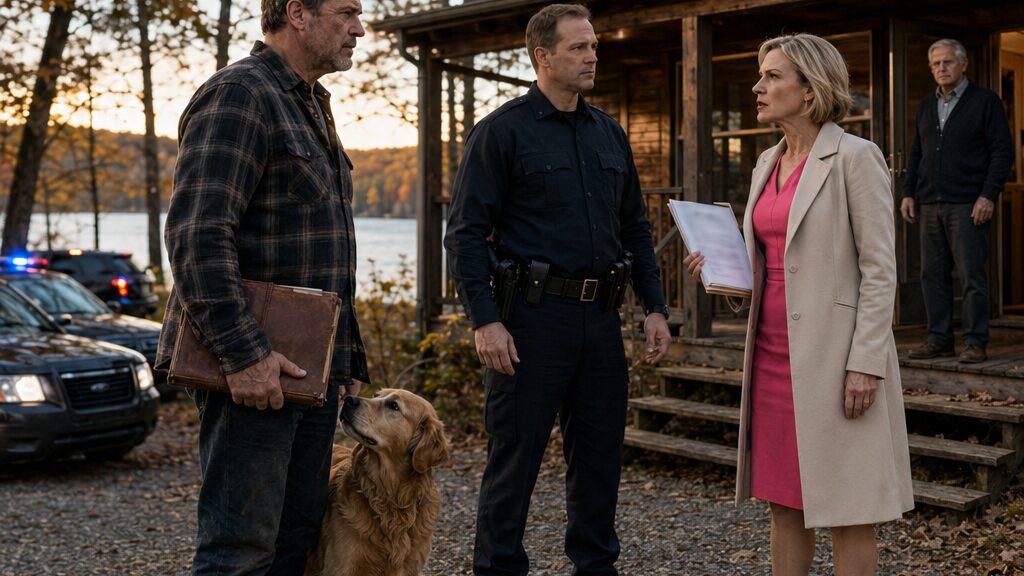
“You have no right to stand on that porch,” Nicole Adams said, pointing so hard at Steven Carter that the uniformed officer turned to see whether Steven had moved.
He had not.
Steven stood at the edge of the gravel drive with Catherine’s old lake-cabin folder tucked under his left arm and the golden retriever pressed against his boot. Behind him, the cabin sat in the slanting autumn light, its cedar siding dark from years of lake wind, its porch rails still uneven from the repair he had promised his mother he would finish before winter. Two police vehicles idled beside Nicole’s SUV. Red and blue light touched the cabin windows, flashing across the room where Catherine used to drink coffee and watch the water.
Nicole’s pink dress looked too bright for the season. Too bright for the day. Too bright for a house that still felt, to Steven, like it had a sickroom hidden behind every wall.
“He came here after I told him not to,” she said. “He has been warned. I want him removed.”
The officer held his hand low near his belt, not threatening, not relaxed either. “Sir, do you have legal permission to be on this property?”
Steven looked past him at the porch. The screen door hung slightly crooked. He had meant to fix that too.
“I came for my mother’s folder,” Steven said. “That’s all.”
Nicole gave a sharp laugh. “Your mother’s folder? You mean documents from my property.”
The retriever shifted closer to Steven’s leg. He could feel the dog trembling through the denim of his jeans, though the animal made no sound.
“Ma’am,” the officer said, “let me ask the questions.”
Nicole held up a stapled packet. Steven recognized the estate attorney’s letterhead even from ten feet away. Jennifer Baker’s name sat at the top in clean black print, the kind of print that made grief look organized.
“This is the estate summary,” Nicole said. “The current one. The legal one. The lake property passes to me. He gets personal effects listed by the executor. That does not include breaking into the house and taking boxes.”
“I used my key,” Steven said.
“You mean the key Mom forgot to take back.”
The words hit harder than he expected. Not because they were clever. Because for three years he had used that key to bring Catherine groceries, clean towels, medication, the dog’s food, and once, in the last week of her life, a bowl of soup she could no longer remember asking for.
The officer looked at him. “Is your name on the current ownership documents?”
Steven’s mouth tightened.
Nicole saw the answer before he gave one. Her shoulders settled, confidence returning to her face. “No. It isn’t. That’s why I called.”
Steven did not reach into the folder. He did not tell the officer about the dock boards in the shed, the unpaid propane receipt, the appointment cards, the handwriting on the calendar, the way Catherine had squeezed his wrist in August and said, Don’t let the place go quiet. None of that had the right shape for this moment. None of it looked like a deed.
“I don’t know what the current filing says,” Steven said. “I know what she told me.”
Nicole stepped forward. “That’s exactly what he keeps doing. Acting like private conversations matter more than documents.”
The officer glanced at the packet in Nicole’s hand. “May I see that?”
Nicole gave it to him quickly, already prepared, pages folded open to the part she wanted him to read. Steven noticed the crease. Not a fresh crease. She had practiced opening it there.
The officer read for several seconds. Gravel popped under one of the idling vehicles. Across the road, a lake neighbor stood beside a mailbox, pretending not to watch.
Steven kept his eyes on the cabin because the cabin was easier to face than Nicole. The porch steps were the same steps where Catherine had once sat wrapped in a blue blanket, telling him Nicole would come around if they gave her time. He had believed that because Catherine needed him to believe it.
The officer lowered the packet. “Mr. Carter, based on what I’m seeing, Ms. Adams is the named beneficiary for the real property.”
“Beneficiary isn’t the same as settled title,” Steven said quietly.
Nicole’s eyes narrowed. “Do not start that.”
The officer held up one palm. “I’m not here to settle probate. I’m here because I received a trespass complaint.”
“There is no complaint if this estate is disputed,” Steven said.
“Disputed by who?” Nicole snapped. “You? Because you don’t like what Mom decided?”
Steven finally looked at her. She had Catherine’s cheekbones, Catherine’s quick eyes, but none of Catherine’s hesitation. Nicole had always been able to say the sentence that cut cleanest and then stand there as if the wound had opened by itself.
“What date does that document say she signed it?” Steven asked.
For the first time since he had arrived, Nicole did not answer immediately.
The officer looked back down. “Six weeks before death.”
Steven nodded once, not as agreement, but as if something inside him had locked into place.
Nicole pointed again. “See? He knows. He was at the reading. He knows exactly what it says.”
Steven kept his voice low. “What date?”
The officer gave him the exact date.
The retriever lifted its head.
Steven looked at the porch again. He had not known what he was looking for until he saw Daniel Hall standing behind the screen door, one hand resting against the frame.
Daniel had aged into stillness. His hair had gone silver, and his shoulders had narrowed, but his eyes had the same careful watchfulness Steven remembered from childhood summers, when adults lowered their voices around him because he had spent his life in courtrooms and heard lies for a living.
Nicole turned and saw him too.
“Daniel,” she said, with a brittle smile, “this is family business.”
Daniel opened the screen door and stepped onto the porch. “Then why are there police cars in Catherine’s driveway?”
The officer straightened slightly. “Sir, do you live here?”
“No,” Daniel said. “I live next door. I also know the family.”
Nicole folded her arms. “He is trespassing. I have documentation.”
Daniel looked at the packet, then at Steven’s folder, then at the retriever standing between them like the dog had chosen a side without understanding the law.
“Documentation can start a question,” Daniel said. “It does not always end one.”
Nicole’s face changed. Just a flicker, but Steven saw it.
The officer asked, “Are you an attorney?”
“Retired,” Daniel said. “Probate judge, before that.”
Nicole’s voice sharpened. “Daniel, don’t.”
Steven felt the folder under his arm grow heavier.
Daniel came down one step, slow enough not to look dramatic, firm enough that even the officer waited. “Nicole, you remember what I did for a living. Then you know this is not finished because you brought an officer.”
Chapter 2: The Reading Where Steven’s Name Vanished
“The lake property passes in full to Nicole Adams,” Jennifer Baker said, and Steven’s hand closed around the old cabin key in his pocket so hard the teeth bit into his palm.
No one else in the room moved.
Jennifer’s office was too warm, too polished, too clean for what it was doing. The walnut table shone under soft lights. A box of tissues sat exactly between Steven and Nicole, as if grief could be placed where everyone could reach it politely. Behind Jennifer, framed certificates hung in a straight line. On the table in front of her lay Catherine Carter’s revised will, clipped and marked with pastel tabs.
Steven heard the sentence again after it ended.
The lake property passes in full to Nicole Adams.
He waited for the correction. For the next clause. For Jennifer to say the dock, the workshop, the little bedroom facing the water, the dog’s care, the life-use arrangement Catherine had talked about. Something.
Jennifer continued reading.
Nicole sat across from Steven with her hands folded around a paper coffee cup she had not touched. Her nails were pale, perfect, and still. She did not look surprised. That was the first thing Steven understood. Not the will. Not the cabin. Nicole’s stillness.
Jennifer turned a page. “Steven Carter is to receive the personal effects specifically designated in Schedule B.”
Steven blinked. “Schedule B?”
Jennifer looked up with professional softness. “A small number of items your mother listed separately.”
“What items?”
Jennifer checked the page. “A tackle box, certain photographs, a cedar chest currently stored in the second bedroom, and the dog’s veterinary records.”
Nicole’s mouth tightened at the last item, as if even that was too generous.
Steven pulled his hand out of his pocket and saw the red marks the key had left across his skin. “That’s it?”
Jennifer paused. “That is what the revised document provides.”
“Revised,” Steven said.
“Yes.”
“Revised from what?”
Nicole exhaled. “Steven.”
He turned to her.
She had worn black, but not the black she wore to Catherine’s funeral. This was sharper. Lawyer black. Meeting black. Her hair was tucked behind one ear, and beside her elbow sat a folder Steven had never seen before.
Jennifer adjusted the will packet. “There was an earlier estate plan. Your mother executed this version six weeks before her passing.”
The room seemed to narrow around that number.
Six weeks.
Six weeks before Catherine died, she had been asking whether the dock boards would hold another winter. Six weeks before Catherine died, she had mistaken the hospice records clerk for a woman from church who had been gone fifteen years. Six weeks before Catherine died, she had gripped Steven’s sleeve and asked if the dog had been fed twice, then asked the same question again before he reached the kitchen.
Nicole said, “Mom changed her mind. That was her right.”
Steven looked at her coffee cup. A lipstick mark curved along the lid. “About everything?”
Nicole met his eyes. “About the cabin.”
Jennifer’s voice stayed careful. “I understand this is difficult. But the document appears facially valid. It has witnesses. It has a notary. It was prepared through this office.”
“Who brought her here?” Steven asked.
Jennifer’s pen stopped moving.
Nicole answered before the attorney could. “I did.”
“You drove her?”
“Yes.”
“Why didn’t anyone tell me?”
“Because not everything had to go through you.”
The sentence landed with old weight. Not everything. That had been Nicole’s complaint for years, though she rarely said it directly. Steven was the one nearby. Steven was the one Catherine called when the smoke alarm chirped, when the pharmacy changed labels, when the lake froze against the dock. Nicole was the one who got updates afterward, and after a while the updates became shorter because Steven was tired and Catherine was embarrassed.
Jennifer placed both hands on the table. “I need to be clear. If either of you anticipates a contest, I recommend separate counsel.”
“A contest?” Nicole said. “He has no grounds.”
Steven looked at the will. “What was the earlier plan?”
Jennifer hesitated. “I cannot disclose privileged drafting history beyond what is appropriate in this meeting.”
“I was her son.”
“And Nicole is the personal representative named in this instrument.”
Nicole’s chin lifted slightly.
There it was again. Instrument. Representative. Valid. Revised. Words that could walk into a family and move the furniture while everyone was still crying.
Steven’s mind went to the dock, because grief often chose the wrong door. Catherine had sat in her chair near the window after the alleged signing date, her socks bunched at the ankles, a blanket over her lap.
You’ll check the far post before next summer, won’t you?
There may not be a next summer, he had thought but not said.
Out loud he had told her, “I’ll fix it.”
She had nodded, satisfied. “Good. This place needs somebody who listens to it.”
Now Jennifer was saying Catherine had already given that place away from him when she said it.
Steven leaned forward. “Did she tell you she wanted me out?”
Jennifer’s expression changed just enough to show she had heard the word beneath the word. Out. Not excluded. Not revised. Out.
“She expressed a desire for Nicole to manage and preserve the lake property.”
“Manage,” Steven repeated.
Nicole set down her coffee. “You lived there for almost three years without paying rent.”
“I cared for Mom.”
“You also lived there.”
Steven looked at her, anger rising so suddenly that he had to put both feet flat on the floor to steady himself. “You think those cancel each other out?”
“I think Mom saw more than you want to admit.”
Jennifer stepped in. “This is not productive.”
“No,” Steven said. “It’s very productive. I’m learning there was a meeting I wasn’t told about, a document I wasn’t shown, and a version of my mother I don’t recognize.”
Nicole’s eyes glistened, but her voice stayed hard. “You don’t own who she was.”
Neither do you, Steven almost said.
He did not say it. He had promised Catherine he would not make her last months ugly. He had promised without knowing someone else might use that promise against him.
Jennifer slid a business card across the table. “If you intend to challenge capacity or allege undue influence, you need to consult counsel. Those are serious claims. They require facts, not impressions.”
“What kind of facts?”
“Medical records. Witness testimony. Evidence of isolation. Evidence that the disposition is inconsistent with longstanding intent. A timeline.”
Nicole laughed once under her breath. “A timeline. Steven, please. Don’t do this to her memory.”
Steven stood before he trusted himself to answer. The cabin key was still in his palm.
At the door, Jennifer said, “Mr. Carter.”
He turned.
She looked briefly at Nicole, then back at him. “For clarity, your mother’s final appointment was private for the execution, but Nicole arranged the date and transportation.”
Nicole’s chair scraped behind him.
Steven looked from Jennifer to Nicole. Six weeks before death. A private appointment. Nicole driving. Nicole arranging. Nicole unsurprised.
He put the cabin key back in his pocket, but for the first time in his life, it felt less like a key than a question.
Chapter 3: The Visits Nicole Said Were Mercy
Steven found the crossed-out Thursdays on a copy of Catherine’s wall calendar while sitting in his truck outside the county records office, the engine off, the lake wind pushing dead leaves against his tires.
Six Thursdays had been circled in Catherine’s shaky blue ink.
Each one had a line through it in darker pen.
Not canceled. Not erased. Crossed over. The kind of mark Nicole made when she corrected something on a list and wanted the correction seen.
Steven held the calendar against the steering wheel and tried to remember those days. The first Thursday, Nicole had called and asked him to pick up a prescription from a pharmacy two towns over because Catherine said the local one “kept mixing things up.” The second, Nicole had sent him to the marina for a replacement heater switch. The third, Catherine had been asleep when he returned, and Nicole had stood in the kitchen washing a mug that was already clean.
“She needed a quiet visit,” Nicole had said then. “You hover.”
He had been too tired to fight her. He had wanted Nicole to visit more. He had wanted Catherine to stop asking, Did your sister call? He had treated every Thursday as mercy.
Now the will date sat inside one of those crossed boxes.
His phone buzzed on the passenger seat.
Nicole’s message filled the screen.
You’re going to tear this family apart over money.
Steven stared at it until the words blurred.
Then he typed, I’m asking what happened.
Her reply came fast.
What happened is Mom finally got a say without you in the room.
He put the phone face down.
Across the street, the county records office was a square brick building with a flag snapping hard above the entrance. Steven took the lake-cabin folder from the seat. The folder’s brown edges had softened from years of Catherine pulling it out whenever taxes, repairs, or insurance came due. She had labeled it in black marker: CABIN / DOCK / HOUSE THINGS. Not estate. Not inheritance. House things.
Inside were receipts, old inspection notes, a copy of the septic map, dock repair estimates, and now the calendar page he had taken before Nicole locked him out. He had not meant to take anything else. He had gone to the cabin that afternoon for the folder because Catherine kept practical truth in it, the kind no attorney would think to ask for.
The clerk behind the counter spoke through a glass partition. “Property records are public. Estate filings are not all here.”
“I need to see anything recorded or requested recently for Catherine Carter’s lake property,” Steven said.
The clerk glanced at his driver’s license, then at the address he wrote on the form. “You family?”
“Son.”
The clerk’s face softened, but only for a second. Rules returned quickly in government buildings. “I can pull recorded documents. If nothing was recorded, I can’t show internal inquiries.”
“Internal inquiries?”
She looked at the form again. “Let me check what’s public.”
Steven waited beside a rack of county maps while a man in work boots argued quietly about a boundary line at another window. He thought about calling Daniel Hall, then stopped. Daniel had already done enough by stepping onto the porch. Steven did not want to become the kind of desperate person who dragged every neighbor into private grief.
But private grief had already turned public. Police lights had flashed across Catherine’s windows. A neighbor had watched Steven stand in the drive like a stranger.
The clerk returned with two printed pages. “No deed transfer recorded yet from the estate. There was a deed-related inquiry noted by staff the same week as this date here.” She tapped the page. “But not a recorded change.”
Steven looked at where her finger rested.
The same Thursday.
“What kind of inquiry?”
“I can’t give details beyond the note.”
“Who made it?”
She shook her head. “Not from what’s public.”
“Was it my mother?”
“I can’t say.”
He heard Nicole’s voice in his head. Mom finally got a say without you in the room.
Steven folded the papers carefully. “If someone was trying to understand whether the cabin could be transferred outside probate, would that create an inquiry?”
The clerk considered him. “Could.”
“And if they decided not to?”
“Could still leave a staff note.”
The pages felt thin in his hand, almost useless, and yet the shape of something had started to appear. Thursday visits. A private will appointment. A deed question the same week. Nicole correcting Catherine’s calendar in darker ink.
Outside, he sat in the truck again and opened the folder across his lap. Wind rocked the cab. A leaf stuck briefly to the windshield, then tore away.
He turned past the receipts. Past the dock estimate Catherine had circled and written Too high beside. Past a vet reminder card for the retriever. At the back, tucked behind an old insurance declaration, was a smaller sheet he did not remember seeing before.
The paper was yellowed at the top, folded twice.
Catherine’s handwriting covered only three lines.
Ask Daniel how to keep Steven here without making Nicole feel punished.
Steven stopped breathing for a moment.
Not give Nicole the cabin.
Not remove Steven.
Not keep Steven from taking over.
Keep Steven here. Without making Nicole feel punished.
He read it again, slower, because the sentence did not solve anything. It made everything worse. It meant Catherine had known there was a problem. It meant she had seen Nicole’s hurt. It meant she had wanted to protect Steven and spare Nicole at the same time, and maybe that was the crack Nicole had found and widened.
His phone buzzed again.
This time it was a photo from Nicole.
The estate summary, folded open to the paragraph naming her beneficiary of the cabin. Beneath the image, she had written:
This is the only paper that matters now.
Steven looked down at Catherine’s note, then at the county page showing the same crossed-over Thursday.
For years he had protected his mother from being seen confused, frightened, diminished. He had told Nicole she was tired. He had told neighbors she was resting. He had told himself dignity mattered more than detail.
Now detail was all he had.
He picked up the phone and found Daniel Hall’s number.
Before he could press call, he noticed something on the back of Catherine’s note. A faint indentation from whatever page had been written above it.
He tilted it toward the window.
Three words had pressed through from another sheet.
Before I forget.
Chapter 4: The Calendar With Missing Thursdays
“The beneficiary was changed before the will was signed,” the bank representative said, and then immediately looked as if she wished she could pull the sentence back.
Steven sat across from her in a low gray chair in the lobby of the small lakeside branch, Catherine’s folder balanced on his knees. A glass wall separated the office from the tellers. Beyond it, ordinary people deposited checks, asked about balances, signed slips, lived inside a world where paperwork did not suddenly turn a son into a trespasser.
“Changed to who?” Steven asked.
The representative folded her hands. “I can’t disclose account details without proper authorization.”
“You just told me it changed.”
“I told you there was a beneficiary change noted before the date you asked about. That is not the same as releasing the full record.”
Steven looked down at the photocopy of Catherine’s crossed-out calendar. The Thursday circled in blue and struck through in dark pen sat between them like a small, ugly door.
“This date,” he said. “That’s the week?”
She glanced at the paper without touching it. “Close to it.”
“Was Nicole Adams listed anywhere on the paperwork?”
The representative’s face tightened. “Mr. Carter, if you intend to challenge estate or beneficiary designations, you’ll need counsel or a formal request through the proper legal process.”
He almost laughed. Proper legal process. Everyone kept saying it like the process had been clean because the papers were clean.
He opened the lake-cabin folder and removed the county printout from the day before. “A deed-related inquiry was made that same week. Now you’re telling me a beneficiary change was made before the will. My sister arranged the will appointment. She also crossed out the same Thursday on my mother’s calendar.”
“I’m not telling you what your sister did.”
“No,” Steven said. “You’re telling me what I’m not allowed to see.”
The representative lowered her voice. “There is a contact designation on some of the account history. That does not mean wrongdoing. Elderly clients often have a trusted family member help coordinate forms.”
“Was that family member Nicole?”
She did not answer. She did not have to.
Steven saw it in the way she reached for the file and then stopped herself. Nicole’s name was there. Maybe as contact. Maybe under power of attorney. Maybe in some small box that looked harmless until it sat beside six crossed-out Thursdays and a will appointment Catherine could not have driven herself to.
The representative slid a brochure across the desk. “This explains the process for estate-related inquiries.”
Steven did not pick it up. “Did my mother come in?”
“I can’t say.”
“Did anyone here see her?”
“I can’t say.”
“Did she sign something in this building?”
The representative’s professional expression faltered for the first time. “Mr. Carter, please understand. If your mother signed valid documents, the bank follows those documents. We don’t determine family intent.”
Steven looked through the glass wall at the teller counter. Catherine used to stand there with a canvas grocery bag hooked over one arm, refusing to use the drive-through because she liked to count the deposit slips herself. She had taught Steven to read bank envelopes when he was twelve, after his father left and every bill became something to be feared quietly.
“She hated signing things she hadn’t read twice,” he said.
The representative’s eyes softened. “Then you should gather what you can and speak to an attorney.”
“I did. Jennifer Baker told me facts, not impressions.”
“That sounds right.”
He finally took the brochure. It felt useless and necessary at the same time.
Outside, his truck smelled faintly of dog hair and the lake mud still dried into the floor mat. The retriever waited in the passenger seat, muzzle resting on the folder as if guarding it. Steven had taken the dog from a neighbor after the police left because Nicole said she had no room for him at her townhouse and “the estate could decide later.” The dog had followed Steven without hesitation, nails clicking on gravel, not understanding that even loyalty could become disputed property.
Steven drove to the lakeside diner because he needed a table larger than his steering wheel. The lunch crowd had thinned. He took the back booth, ordered coffee he did not want, and spread Catherine’s papers beneath the window.
The folder was no longer just “house things.” It had become a map of who had been allowed near Catherine and when.
Six Thursdays.
The will date.
A deed inquiry.
A beneficiary change.
Nicole’s text: This is the only paper that matters now.
Steven took out Catherine’s note again.
Ask Daniel how to keep Steven here without making Nicole feel punished.
On the back, the faint pressed words remained: Before I forget.
He placed a blank napkin over the indentations and rubbed lightly with the side of a pencil he found at the bottom of the folder. The lines appeared unevenly, ghosts of letters from a page no longer there.
Before I forget, tell him dock before summer.
The rest would not show.
Dock before summer.
Steven sat back, the diner noise receding.
Catherine had said it aloud after the will date. He had remembered it as a small moment, one of the hundred practical things she used to repeat when the illness made time slip. But if she had written it before that, if she had been trying to leave herself reminders about Steven and the dock and Daniel, then Nicole’s version had a problem.
Not a solved problem. Not proof. A problem.
The waitress came by with the coffee pot. “You all right, hon?”
Steven covered the note with his hand. “Yes.”
She did not believe him, but she moved on.
His phone buzzed.
Another message from Nicole.
I heard you went to the bank. This needs to stop.
He stared at the screen.
How did you hear that? he typed.
Three dots appeared. Vanished. Appeared again.
Because people are tired of watching you embarrass Mom’s memory.
He set the phone down before anger made him answer badly.
At the motel that evening, the room’s thin curtains glowed orange from the parking lot lights. Steven laid the papers across the bedspread in order: calendar, county record, bank brochure, Catherine’s note, estate summary. The retriever slept beside the door with one ear lifted, still waiting for Catherine’s voice.
Steven called the home health agency number from an old care schedule he had found in the folder. He expected a recording. Instead, after two transfers and a long hold, a hospice records clerk told him the former home health nurse no longer worked there but occasionally picked up messages through the office.
“It’s about Catherine Carter,” Steven said.
A pause. “Family?”
“Her son.”
Another pause, longer. “I can leave a message.”
“Please tell her I’m not asking for records over the phone. I’m asking if she remembers the week of October seventeenth.”
The clerk’s voice changed almost imperceptibly. “That specific?”
“Yes.”
“May I ask why?”
Steven looked at the crossed-out Thursday. “Because that may be the week my mother signed away the house she kept asking me to fix.”
The clerk said nothing for a moment. Then she asked for his number.
He thought the call had failed when no one phoned back that night. He brushed his teeth with motel soap, checked the lock twice, then sat on the edge of the bed and tried to hear Catherine’s voice without remembering the wrong parts.
At 9:43, his phone rang.
A woman’s voice said, “I was told you asked about Catherine.”
Steven stood without meaning to. “Yes.”
“I can’t violate privacy laws.”
“I understand.”
“And I can’t call anything fraud.”
“I’m not asking you to.”
The woman breathed out slowly. “I can tell you what Catherine was like that week.”
Chapter 5: The Attorney Remembered One Quiet Detail
“When exactly did she say she wanted me out?” Steven asked, and Jennifer Baker’s pen stopped halfway across her legal pad.
They were in the same office where Steven’s name had vanished three days before, but the room felt different now. The tissue box was gone. A yellow notepad sat in its place. Jennifer had not offered coffee. Steven had not sat back in the chair. Catherine’s folder lay closed on his lap, one hand resting over it as if it might be taken if he looked away.
Jennifer removed her glasses. “That is not how your mother phrased her wishes.”
Steven leaned forward. “Then how did she phrase them?”
“Mr. Carter—”
“Steven.”
She hesitated. “Steven. I need to be careful.”
“So do I.”
Jennifer’s eyes moved to the folder. “Did you retain counsel?”
“I’m gathering facts before I decide how far I can afford to go.”
“That is not the safest way to proceed.”
“No. The safest way was apparently to arrange a private appointment while my mother was dying and then call it final.”
Jennifer’s mouth tightened, not offended exactly, but struck. “I did not know her medical condition was as serious as you’re implying.”
“Who told you what it was?”
“Nicole provided background when she scheduled the estate update.”
“Nicole provided the background.”
“Yes.”
“And Nicole drove her here.”
“Yes.”
“And Nicole supplied the wording.”
Jennifer looked down.
Steven felt his pulse move into his throat. “Did she?”
“The initial request came through Nicole. She said Catherine wanted to simplify the estate plan and make sure the cabin was protected.”
“From me?”
Jennifer’s eyes came up. “That word was not used in my notes.”
He opened the folder and took out the crossed Thursday calendar, not pushing it toward her yet. “What word was used?”
Jennifer turned one page back in her pad though she was not reading it. “Safe.”
Steven heard the lake in the silence that followed. Safe. It was the kind of word Catherine reached for when she could not bear to choose between people. Keep the dog safe. Keep the dock safe. Keep Nicole from feeling left out. Keep Steven here without making Nicole feel punished.
“She said safe?” he asked.
“Several times.”
“About the cabin?”
“Yes.”
“Did she say Nicole should own it?”
Jennifer replaced her glasses. “The document she executed leaves the property to Nicole.”
“That’s not what I asked.”
For the first time, Jennifer looked tired. Not unprofessional. Tired. “During our meeting, Catherine stated that Nicole knew how to keep the cabin safe.”
Steven sat back slowly.
Nicole knows how to keep the cabin safe.
It could mean Nicole should inherit it. It could mean Nicole knew rules and paperwork. It could mean Catherine had been coached. It could mean Catherine was repeating the last phrase someone had placed in her mind because it sounded responsible.
“Did my mother say my name?” Steven asked.
“Yes.”
His hand tightened on the folder. “How?”
Jennifer’s pen tapped once against the pad, then stilled. “She asked whether you would still be able to use the dock.”
Steven closed his eyes.
Not the cabin. The dock.
Catherine’s mind always went to the dock when she was frightened. The dock was where Steven had fallen through a rotten board at fourteen and laughed until Catherine cried. The dock was where Nicole refused to swim because the lake weeds touched her ankles. The dock was where Catherine scattered her second husband’s ashes in secret because the cemetery felt “too dry.”
Steven opened his eyes. “And what did you say?”
“I told her use rights could be addressed if that was her wish.”
“Were they?”
“No.”
“Why not?”
Jennifer’s expression closed. “Because when I clarified whether she wanted a life estate or formal use provision for you, she said she wanted Nicole to decide what was best.”
“That sounds like my mother to you?”
“I had met your mother twice before that day.”
“And Nicole?”
“More frequently.”
There it was. Not guilt. Not fraud. A hallway left open.
Steven slid the calendar across the desk. “This is her wall calendar. Six Thursdays circled, then crossed out. The will date is one of them. Nicole sent me away on errands on those days.”
Jennifer looked at the page. She did not touch it at first. Then she turned it slightly, reading the shaky blue circles.
“Did your mother make these marks?”
“The blue ones. Nicole made the darker lines.”
“You know that?”
“I know their handwriting.”
“That may matter. It may not.”
Steven almost smiled. “That’s the most honest thing anyone has said to me all week.”
Jennifer looked at him then, really looked. “You understand ambiguity is not enough to undo a signed will.”
“Yes.”
“People make estate decisions their families do not like. They leave property unevenly. They change their minds near death. Illness alone does not mean incapacity.”
“I know.”
“Do you?”
Steven looked at the folder. He thought of all the times Catherine had looked clear when someone visited, then asked him five minutes later whether her own mother had called. He had hidden it because she had asked him to.
Don’t let them look at me like I’m gone before I’m gone.
“I know,” he said again, quieter.
Jennifer set the calendar down. “If you allege undue influence, you need more than suspicion. You need isolation, dependency, pressure, inconsistent intent, medical context, or procedural irregularity.”
“I have some of that.”
“Some is not all.”
“I’m not asking you to overturn it at this desk.”
“What are you asking?”
He took Catherine’s note from the folder and placed it beside the calendar.
Ask Daniel how to keep Steven here without making Nicole feel punished.
Jennifer read it once. Then again.
“Where did you get this?”
“Her cabin folder.”
“When was it written?”
“I don’t know.”
“This is not a will.”
“No. It’s my mother trying to solve a family problem before someone turned it into a legal weapon.”
Jennifer leaned back slightly. The phrase had landed. Not enough to change her obligations. Enough to change the air.
“She seemed lucid during the execution,” Jennifer said.
“For how long?”
“Long enough to answer the required questions.”
“Did you know she was repeating questions at home?”
“No.”
“Did you know she sometimes didn’t know what month it was?”
“No.”
“Did you ask?”
Jennifer’s face tightened again. This time, not in defense. “I asked standard capacity questions.”
“Who was in the waiting room?”
“Nicole.”
“Did my mother arrive with notes?”
Jennifer looked away.
Steven waited.
“She had a small card,” Jennifer said.
“What was on it?”
“I didn’t read it. She held it in her lap. I remember because she kept touching the corner of it.”
“Did Nicole give it to her?”
“I don’t know.”
“But Nicole drove her.”
“Yes.”
“And scheduled.”
“Yes.”
“And gave background.”
“Yes.”
“And supplied the words ‘keep the cabin safe.’”
Jennifer did not correct him.
Steven gathered the calendar and note, but Jennifer lifted one hand. “Wait.”
She opened the file drawer beside her desk and removed a thin appointment log. “I can’t give you privileged notes without proper process. But I can confirm the public-facing appointment time if you are reconstructing a timeline.”
Steven waited while she checked.
“Two-fifteen,” Jennifer said. “Execution completed at approximately two-forty.”
Steven wrote it on the back of the bank brochure.
Two-fifteen.
His hand stopped.
The former home health nurse had not yet told him what Catherine was like that week, but Steven had one record already: a care schedule from the folder, marked in Catherine’s shaky blue. On that same date, beside noon medication, Catherine had written in looping, uneven letters:
Asked what year. Don’t tell S.
He stared at the note until the room blurred at the edges.
Jennifer saw his face. “What is it?”
Steven folded the brochure and put it into the folder with hands that no longer felt steady.
“The appointment was two hours after she wrote down that she didn’t know what year it was.”
Chapter 6: The Nurse Would Not Call It Fraud
“She could sound clear for five minutes,” the former home health nurse said, “and then be lost for the next five.”
Steven stood under the weak light of the clinic parking lot, one hand on the open door of his truck, Catherine’s folder on the seat behind him. The clinic had closed an hour earlier. Its windows were dark except for a vending machine glowing blue in the hall. The nurse had chosen the far side of the lot, away from the entrance camera, not because she was doing anything wrong, she said, but because families turned grief into accusations and accusations into subpoenas.
“I’m not asking you to say she didn’t understand anything,” Steven said.
“Good. Because that wouldn’t be true.”
The nurse wore a quilted jacket and held her car keys threaded between her fingers. She looked like someone who had spent years entering homes at their worst hours and learning how not to flinch. “Catherine had lucid stretches. She knew people. She knew the cabin. She knew the dog. Some days she could tell you the exact year the porch was rebuilt.”
“And other days?”
“Other days she asked if her husband was coming home.”
Steven looked down at the asphalt. “He’d been dead nine years.”
“I know.”
A truck passed on the road beyond the clinic, headlights sliding over them and away.
The nurse continued carefully. “That week you asked about, she was tired. More confused after noon. She was anxious when routines changed.”
“The will appointment was at two-fifteen.”
The nurse’s face changed by only a fraction.
Steven saw it. “What?”
“I had a visit logged that morning.”
“I have the schedule.” He reached into the truck and pulled the copied page from the folder. “Noon medication. There’s a note in my mother’s handwriting. Asked what year. Don’t tell S.”
The nurse looked at the page but did not take it. “She was ashamed of those moments.”
“I know.”
“Do you?”
The question caught him harder than accusation would have.
Steven shut the truck door gently. “She asked me not to tell people. She said she didn’t want Nicole looking at her like she was already gone. She didn’t want Daniel knowing. She didn’t want neighbors bringing casseroles with that face.”
“What face?”
“The one people make when they’re speaking to the illness instead of the person.”
The nurse nodded once.
“So I covered,” Steven said. “When Nicole called, I said Mom was tired. When Jennifer Baker asked later, I didn’t know there had been an appointment, so I said nothing. When neighbors came by, I kept visits short. I thought I was protecting her.”
The nurse’s expression softened, but not enough to let him off. “You protected her privacy. You may also have protected the wrong story.”
He looked toward the clinic windows. He wanted to defend himself. He wanted to say Catherine had begged him. He wanted to say no one who had not sat beside her bed at three in the morning had the right to judge what he hid.
But hiding had consequences. There were documents now with Catherine’s signature on them and no record of the woman who asked what year it was two hours before she signed.
“What do you remember from that day?” he asked.
The nurse looked at the care schedule again. “Morning was uneven. She knew me when I arrived. She knew the dog’s name. She asked twice whether the dock was fixed.”
Steven’s throat tightened.
“She said, ‘Steven has to do the far post before summer,’” the nurse continued. “Then she asked if summer had already happened.”
He turned away for a second.
The retriever lifted his head inside the truck, hearing movement, then settled again.
“Did she mention Nicole?” Steven asked.
“Yes.”
“How?”
“She said Nicole was coming to help with papers. She seemed worried.”
“Worried how?”
“That Nicole would be angry.”
“At me?”
“At both of you, I think.” The nurse rubbed her thumb against her keys. “Catherine said something like, ‘I made it too hard, didn’t I?’ I asked what she meant, and she said, ‘Two children, one house, and only one lake.’”
Steven closed his eyes.
That sounded like Catherine. Not clean enough for court. Too human for a form. Two children, one house, and only one lake.
“Did she understand she was changing her will?” he asked.
The nurse did not answer quickly. “I can’t say what she understood at two-fifteen.”
“But that morning?”
“That morning, I would have wanted a doctor to evaluate her before any major legal signing.”
The words hung between them, plain and devastating.
“Would you put that in writing?”
She looked toward the road. “I can provide a factual statement about my visit if properly requested. Symptoms observed. Questions asked. Notes taken. I will not accuse anyone of anything.”
“I understand.”
“I mean it, Steven. Families hear what they want. If I say Catherine was confused, Nicole will say I’m calling her a thief. If I say Catherine was lucid at moments, you may think I’m abandoning you.”
“I don’t need you to choose a side.”
“Good.” The nurse opened her car door, then paused. “But there’s one more thing.”
Steven waited.
“She had a small card on the table that morning. She kept turning it over.”
“A card?”
“Like an index card. Maybe a note. I remember because she asked me if she was supposed to take it with her. I told her to ask whoever was taking her.”
“Did you read it?”
“No.”
“Did you see any words?”
The nurse looked apologetic. “Only one. Safe.”
Steven let out a breath through his nose. Nicole knows how to keep the cabin safe.
The word was everywhere now, carrying a different meaning depending on who held it.
Back at the motel, he found Nicole’s settlement letter wedged under his door in a white envelope with no stamp. Someone had driven there. Someone had known where he was staying.
He did not open it right away.
He fed the dog from a paper bowl, washed his hands, and sat at the small desk beneath the buzzing wall light. Only then did he tear the envelope.
The letter was short, written through Nicole’s attorney but with Nicole’s fingerprints all over the choices. Steven would receive a modest cash amount, the tackle box, the cedar chest, Catherine’s selected photographs, and “all items related to the care, feeding, and relocation of the dog.” In exchange, he would sign a release, vacate all claims to the lake property, and stop contacting third parties about Catherine’s final estate decisions.
He read it twice, feeling less insulted by the money than by the phrase third parties, as if Daniel and the nurse and Jennifer were strangers circling something that belonged only to Nicole.
Then he saw the final line.
Ms. Adams is also willing to provide the handwritten lake-cabin promise referenced by Catherine Carter, provided Mr. Carter agrees to keep its contents private and make no further claim based upon it.
Steven went still.
The handwritten lake-cabin promise.
He had never told Nicole he knew about it. He had not even found the actual page, only Catherine’s note and the pressed-through words on the back.
The retriever stood and came to his knee, sensing the change in the room.
Steven laid the settlement letter beside Catherine’s folder and stared at the sentence until its meaning became unavoidable.
Nicole was offering him a document he had never told her was missing.
Chapter 7: The Cabin Porch Became the Hearing
“You were never fighting for Mom,” Nicole said. “You were fighting for a house.”
She stood on the cabin porch with both hands flat on Catherine’s old outdoor table, the lake-cabin folder opened between them like something on trial. The police cars were gone now, but Steven could still see the places their tires had pressed into the gravel. The golden retriever lay just inside the screen door, head on his paws, eyes moving between Steven and Nicole as if he understood tone better than words.
Daniel Hall sat near the porch rail, silent so far, a white envelope on his knee. He had agreed to be there only after Steven said he did not want a witness for victory. He wanted one for memory.
Nicole had brought no lawyer. That surprised him. Or maybe it did not. She had always preferred rooms where she could control the first sentence.
Steven looked at the folder. Catherine’s calendar page sat on top. The crossed-out Thursdays looked harsher in daylight.
“I’m fighting because you called the police on me at my mother’s house,” he said.
“My house.”
“Not settled.”
“Named to me.”
“By a document signed after you arranged the appointment, drove her there, supplied the wording, and crossed out every Thursday you visited.”
Nicole’s jaw tightened. “Those visits were mercy. You were smothering her.”
Daniel looked down at the envelope on his knee, but he did not interrupt.
Steven turned one page. “Then tell me why she asked Daniel how to keep me here.”
Nicole’s eyes flicked to Daniel. “You had no right to show him private family notes.”
“She wrote his name.”
“She wrote a lot of things near the end.”
The sentence was meant to weaken Catherine. It hit Steven anyway. A week earlier, he might have defended his mother by denying it. Now he let the truth stand there, painful and useful.
“Yes,” he said. “She did.”
Nicole blinked, as if she had expected anger and gotten a door opened instead.
Steven slid Catherine’s note across the table. “Ask Daniel how to keep Steven here without making Nicole feel punished. That’s what she wrote. Not how to remove me. Not how to give you everything. How to keep me here and not hurt you.”
Nicole did not touch the note. “You don’t know when she wrote that.”
“No. I don’t.”
“So it proves nothing.”
“It proves she was trying to solve both of us before someone told a lawyer that keeping the cabin safe meant cutting me out.”
Nicole’s face flushed. “You think I hypnotized her with one word?”
“No.”
“Then say what you mean.”
Steven looked at the lake beyond the rail. The water was dull silver beneath the clouded sky. Catherine had hated family arguments near the lake. She said sound traveled too well over water.
“I mean you knew what word to use,” Steven said. “Safe.”
Nicole laughed once, but it broke at the edge. “Because the cabin wasn’t safe with you.”
The retriever lifted his head.
Daniel’s eyes came up.
Steven waited.
Nicole pointed toward the porch boards. “Look at this place. You fixed everything halfway. You lived here like time stopped because Mom needed you. Bills stacked on the counter. Tools in the kitchen. That dog sleeping wherever he wanted. Mom was scared you’d never leave because you had nowhere else you wanted to go.”
Steven felt the old shame rise, familiar and hot. There had been tools in the kitchen. There had been weeks he forgot to pay his own bills because Catherine’s appointments ate every morning. There had been nights he slept in the chair beside her bed and woke up angry at the world for continuing without asking him.
“She was scared of losing the cabin,” Nicole said. “She told me that.”
Daniel’s hand tightened on the envelope.
Steven turned to him. “Tell her what she asked you.”
Daniel was quiet long enough that Nicole almost spoke over him. Then he said, “Catherine came to my porch in late September. She had the dog with her. She asked whether there was a way to let Steven keep living here without making Nicole feel like she’d been disowned.”
Nicole looked away.
Daniel continued, “I told her that was a question for an estate attorney. I also told her not to sign anything she didn’t understand.”
“You should have called me,” Nicole said.
Daniel looked at her. “She asked me not to. She said both of you were already hurting.”
“She was confused by then.”
“Yes,” Steven said. “Sometimes she was.”
Nicole turned on him. “So now you admit it.”
“I should have admitted it sooner.”
The porch went still.
Nicole stared at him, thrown off by the confession. Steven kept his hand on the folder, not to protect it from her now, but to keep himself from retreating.
“She asked what year it was the morning she signed the will,” he said. “She wrote it down because she was scared I would find out. The nurse remembered her asking about the dock and then asking whether summer had already happened.”
Nicole’s mouth tightened, but her eyes were wet. “She could be clear. You know she could.”
“Yes.”
“Then don’t pretend she was helpless.”
“I’m not.”
“You are. You’re turning her into someone who couldn’t choose.”
Steven shook his head. “No. I’m saying you chose the moment when her choices were easiest to steer.”
Nicole slapped her hand against the table. The retriever flinched inside the door.
“You don’t get to make me the villain because you were the favorite,” she said.
There it was. Not money. Not paperwork. The thing beneath it.
Steven said nothing.
Nicole’s voice dropped. “Every time I called, she said you had it handled. Every decision, every appointment, every repair. You got the cabin, the dog, the daily calls, the good days. I got updates like I was some cousin in another state.”
“You stopped coming before she got sick.”
“I stopped being invited.”
“That isn’t true.”
“Isn’t it?” Nicole looked toward the kitchen window. “You and Mom had your routines. Your little jokes. Your dock boards and pharmacy runs. I walked in and felt like a guest in my own mother’s last year.”
Steven wanted to deny it cleanly. He could not. There had been days he resented Nicole’s calls because Catherine became agitated after them. There had been updates he shortened because he was tired. There had been a Thanksgiving invitation he forgot to resend after Nicole said maybe. Small omissions. Not cruelty. But omission could still become a room someone was locked out of.
“I should have called more,” he said.
Nicole’s eyes flashed. “Don’t.”
“I should have told you how bad she was.”
“I said don’t.”
“But that doesn’t make this right.”
She looked down at the folder, breathing hard.
Steven pulled out the settlement letter and laid it beside Catherine’s note. “You offered me the handwritten lake-cabin promise.”
Nicole went very still.
“I never told you I knew it existed,” he said. “I only found the indentation from the page that used to be above her note.”
Daniel leaned forward slightly.
Steven looked at Nicole. “Where is it?”
Nicole’s face had lost its color. “She gave it to me.”
“When?”
“She gave me lots of things.”
“When?”
Nicole looked toward the lake. “After the argument.”
Steven felt the porch shift under him though he had not moved.
“What argument?” Daniel asked.
Nicole seized on the question. “The one he keeps leaving out. Mom told me he scared her.”
Steven’s hand closed over the back of a chair.
Daniel looked at him. “Steven?”
He had not wanted this part on the porch. He had not wanted it anywhere.
“We argued,” Steven said.
Nicole’s mouth trembled with something like triumph and grief mixed together. “Finally.”
Steven kept his eyes on Daniel because it was easier than looking at her. “It was in September. She had tried to go down to the dock alone. I found her halfway down the steps without her cane. I got angry. I yelled that if she kept doing that, she was going to fall and I couldn’t watch her every second.”
Nicole whispered, “She cried when she told me.”
“I know.” Steven swallowed. “She cried when she told me too.”
Nicole’s eyes narrowed.
“That night,” Steven said, “she came to the kitchen and apologized for scaring me. Then she said she didn’t want me to leave angry. I told her I wasn’t leaving. She said, ‘Good. Then fix the far post before summer.’”
The retriever pushed the screen door with his nose. It opened an inch, then stuck.
Steven looked at Nicole. “She was afraid of being a burden. Not of me.”
Nicole shook her head, but weakly now. “She told me to keep the cabin safe from you.”
Daniel opened the white envelope on his knee. “No,” he said quietly. “That is not what she asked me.”
Nicole’s gaze snapped to him.
Daniel removed a folded sheet of paper. “She left this in my mailbox two days after she came to my porch. I did not open it until Steven called. That was my mistake.”
Steven stared at the paper.
Daniel unfolded it, but did not hand it over yet. “It says she wanted both of you to have a reason to come back here. It says Steven knew how to keep the place alive, and Nicole knew how to keep it from being lost. It says she was afraid if she chose one of you, the other would never forgive her.”
Nicole’s lips parted.
Steven could barely hear the lake now over his own pulse.
Daniel looked at Nicole, not unkindly. “She did not ask how to keep the cabin safe from Steven. She asked how to keep the family safe from what the cabin would do to you both.”
Nicole looked at Catherine’s folder, at the note, at the settlement letter, at Daniel’s page. Her face hardened again, but not all the way.
“She told me to keep the cabin safe from you,” Nicole said, softer this time, as if repeating it might make it true enough to live with.
Chapter 8: The Document Changed Less Than the Truth
“The document may survive,” the mediator said, “but Ms. Adams’s conduct will not survive scrutiny quietly.”
Nicole sat at the far side of the conference table, hands folded the same way they had been in Jennifer Baker’s office, but there was nothing calm about her now. Her face looked smaller without the porch, without police lights, without the cabin behind her. Steven sat opposite her with Catherine’s folder closed in front of him. Daniel’s written statement lay in the mediator’s file. Jennifer’s appointment-time confirmation lay behind it. The nurse’s factual statement, careful and unsentimental, sat on top.
No single page had saved him. That almost made the pages feel more honest.
The mediator tapped the file. “We have a signing six weeks before death. We have Nicole arranging the appointment and transportation. We have a same-week beneficiary change inquiry. We have medical observations from the morning of execution. We have evidence Catherine expressed a different intent to a third party. We have a settlement letter referencing a handwritten promise not previously disclosed to Steven.”
Nicole’s attorney shifted beside her. Nicole did not.
Steven looked at the folder instead of her. He had learned that looking directly at Nicole made him want to win. Looking at Catherine’s folder reminded him what winning could not fix.
“The will is presumed valid unless challenged successfully,” the mediator continued. “A challenge is expensive, slow, and uncertain. But if it proceeds, the questions raised here will become part of the record.”
Nicole looked at Steven then. “Is that what you want? A record of Mom forgetting things?”
He felt the blow, but it no longer knocked him backward.
“No,” Steven said. “I wanted you not to call me a trespasser.”
Nicole’s mouth tightened.
“I wanted you not to take the word safe and turn it into out.”
Her eyes shone. “You still think you know exactly what she meant.”
“No. That’s the difference between us.”
The room went quiet.
Steven opened the folder and removed Catherine’s note. The paper had been flattened now, sleeved in clear plastic by the attorney Steven had finally hired for one limited purpose. Ask Daniel how to keep Steven here without making Nicole feel punished.
“She was trying not to hurt you,” he said. “I believe that. I think she was clumsy with it. I think she was scared. I think I made it worse by keeping too much quiet. I think you made it worse by deciding her fear gave you permission.”
Nicole looked down.
Her attorney leaned toward her and murmured something. Nicole gave a short shake of her head, impatient, then reached into her own folder.
For a moment Steven thought she might produce the missing handwritten promise. Instead she slid forward a proposal.
“You can have life use,” she said.
The mediator looked at the document. “Meaning?”
Nicole kept her eyes on Steven. “He can live at the cabin. Maintain it. Use it. Keep the dog there. I retain ownership under the will while the estate issues are reviewed. If he stops maintaining it or tries to transfer interest, the agreement ends.”
“That sounds like a leash,” Steven said.
Nicole’s voice sharpened. “It sounds like me not selling it.”
That stopped him.
She looked away, then back. “You think I wanted a quick sale. I didn’t. I wanted control because I thought you would let the place rot around your grief and call it loyalty.”
Steven’s first answer rose hot, but he swallowed it.
The truth was not that Nicole knew nothing. The cabin had frayed under his care in ways he had not wanted to see. He had fixed emergencies. He had not made plans. Catherine’s illness had turned every future task into something he could promise instead of complete.
“I won’t let it rot,” he said.
“Then put it in writing,” Nicole said.
Her voice held challenge, but beneath it was something else. Fear, maybe. Or the last defense of someone whose clean story had cracked and who was trying to keep one piece of herself upright.
The mediator read through the proposal, marked several changes, and began turning ownership language into use language, punishment language into maintenance standards. Steven asked for one addition.
“Catherine’s handwritten promise,” he said. “Whatever Nicole has. It gets attached to the settlement record.”
Nicole’s face closed. “It was private.”
“So was the will appointment.”
Her attorney touched her sleeve. Nicole stared at the table for a long time. Then she opened the side pocket of her folder and removed a folded page.
Steven knew before seeing it.
The paper was soft from handling. Catherine’s handwriting sloped across it in uneven lines.
Before I forget, Steven must fix the dock before summer because he listens when the house complains. Nicole must know I am not choosing against her. If I leave the cabin wrong, they will lose each other over it. I need help making this fair.
Steven read the lines once. Then again. There was no perfect instruction. No legal distribution. No miracle from the dead. Just Catherine, frightened and trying, still believing fairness could be made if someone helped her before time ran out.
Nicole’s voice was low. “She gave it to me after the argument. I thought it meant she was warning me.”
Steven looked at her.
“I wanted it to mean that,” Nicole said.
It was not an apology. It was not enough. But it was the first sentence she had spoken that did not sound like a document defending itself.
The agreement took three more hours. The estate would remain under review. The beneficiary changes would be examined through formal channels. Steven would receive life use of the cabin under maintenance terms. Catherine’s personal lake-cabin keepsakes, including the cedar chest, photos, tackle box, and handwritten promise, would be acknowledged as belonging with him at the cabin. Nicole would not call him a trespasser again.
She refused to include an apology.
Steven almost refused the agreement because of that.
Then he looked at Catherine’s page and understood that there were truths a person could force into the record and truths no signature could make someone ready to say.
Several weeks later, Steven unlocked the cabin door with the same old key.
No police lights flashed against the windows. No officer waited in the drive. No one stood on the porch pointing. The retriever pushed past him into the front room and went straight to Catherine’s chair, sniffed once, then lay down beside it with a sigh that seemed to empty the house.
Steven carried the lake-cabin folder to the kitchen table. It was thicker now. Not because it held victory. Because it held what the revised will had left out: the calendar, the nurse’s statement, Daniel’s letter, Jennifer’s appointment time, the settlement agreement, and Catherine’s handwritten promise.
He slid the promise into the front pocket.
Outside, the dock waited with its far post leaning slightly toward the water.
Steven stood at the window for a long moment, feeling the ache of what had not been restored. Catherine was still gone. Nicole was still his sister and not his ally. The estate was still not clean. The law had not turned backward and made the last six weeks honest.
But the lie had stopped being the only official story.
He took his coat from the chair, picked up the toolbox, and opened the back door. The retriever rose to follow.
At the threshold, Steven looked once more at the folder on the table. For years he had thought protecting Catherine meant hiding the parts of her decline that frightened her. Now her truth sat in plain view, imperfect and preserved.
He stepped outside and walked toward the dock before winter could take another board.
The story has ended.