He Enforced Every Parking Rule Until the HOA Board Parked on the Wrong Curb
Chapter 1: Nine Orange Boots Before the Meeting Ended
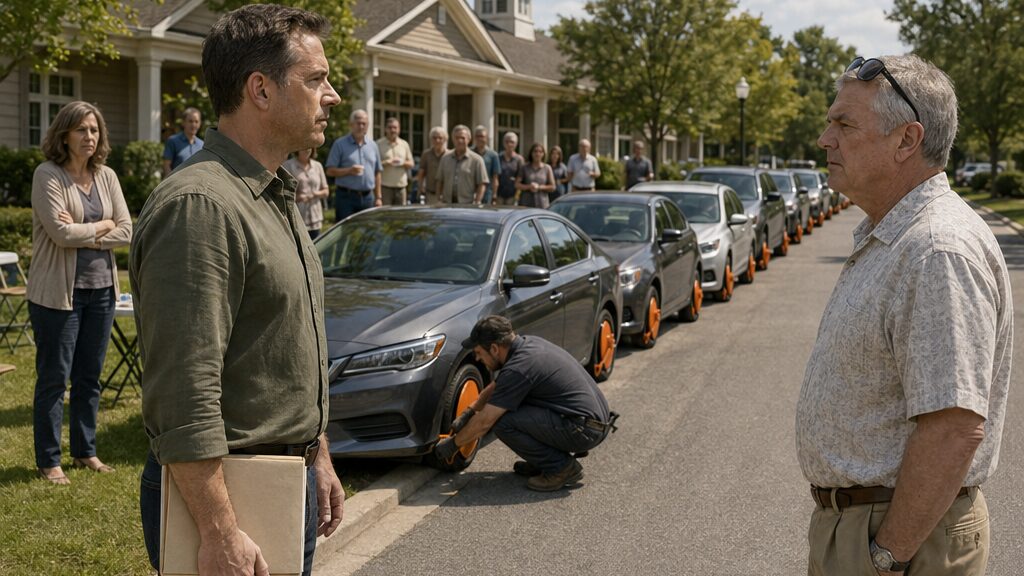
The metal clamp snapped shut around the front wheel with a sound sharp enough to turn three heads across the clubhouse lawn.
James Harris watched the contractor pull once on the bright orange boot, test the lock, then stand.
Across the curb, Raymond Nelson had stopped in the middle of a conversation.
He stared at the wheel. Then at the contractor. Then directly at James.
There were eight more cars lined up behind the first one.
James said nothing.
Ten months earlier, that same stretch of neighborhood pavement had seemed too ordinary to matter.
Patricia Lewis’s minivan was halfway onto a tow truck when James came outside with his coffee.
Patricia stood at the curb in slippers and an old sweatshirt, one hand pressed against the side of her head.
“What happened?”
She pointed toward the van.
“They said I’m outside the parking zone.”
James looked.
The rear tire was inside the painted limit. The bumper extended beyond it by almost nothing.
Raymond stood beside the tow operator with a clipboard tucked against his ribs.
James crossed the street.
“How far over?”
Raymond didn’t need to measure again.
“Four inches.”
James looked at him.
“You’re towing her over four inches?”
“The rule doesn’t say four inches is acceptable.”
Patricia gave a disbelieving laugh.
“I parked there last night because my daughter had the driveway.”
Raymond’s expression barely shifted.
“Then you should have used guest parking.”
“Guest parking was full.”
“That doesn’t change the rule.”
James crouched near the curb. The faded white line had been repainted in sections over the years. He could see where newer paint overlapped older paint by an inch or two.
He had spent enough years looking at curbs to know that lines were rarely as precise as the people enforcing them pretended.
“When was this measured?” he asked.
Raymond looked down at him.
“The board approved the parking plan.”
“That’s not what I asked.”
The tow operator glanced between them and kept working.
Raymond’s jaw tightened.
“The restriction is posted. Patricia received previous notices.”
“Warnings,” Patricia said. “For completely different things.”
“You were informed of the parking policy.”
The winch began pulling the minivan higher.
Patricia stepped forward.
“Can I just move it now?”
Raymond shook his head.
“The tow has already been authorized.”
James looked at the van, then back at Raymond.
There had been a time, years earlier, when James might have admired that answer.
Rules mattered because arguments became endless once exceptions started.
He also knew the danger in pretending judgment had nothing to do with enforcement.
Patricia paid $220 to get the minivan back that afternoon.
Three days later, she filed an appeal with the HOA management company.
James helped her photograph the curb and measure from the painted line to where the bumper had been. Four inches, perhaps slightly less depending on which edge of the uneven stripe counted.
They attached the photographs.
Patricia wrote that guest parking had been full.
She explained that the vehicle had not blocked a driveway, mailbox, hydrant, sidewalk, or traffic lane.
Two weeks later, the answer arrived.
Appeal denied.
The board had determined that the restriction was clear and uniformly applied.
Patricia stood at James’s kitchen counter reading that sentence twice.
“Uniformly,” she said.
James took the paper from her.
That word bothered him more than the denial.
Not because he knew it was false.
Not yet.
But because Raymond had used the same word when James had questioned the tow.
Uniform enforcement.
No discretion.
No exceptions.
James folded the decision and slid it back across the counter.
“Keep it.”
“For what?”
“Because they said something specific.”
Patricia gave him a tired look.
“I’m not starting a war over two hundred and twenty dollars.”
“Neither am I.”
She raised an eyebrow.
James almost smiled.
“Really.”
Winter settled over the neighborhood in the quiet way it always did there. Holiday lights appeared along porch rails. Delivery vans stopped in the street. Families filled driveways on weekends.
The parking notices continued.
The Brennan family two houses down received a $180 fine after a delivery truck remained at their curb while furniture was carried inside. The truck had been there less than forty minutes.
James heard about it because the husband came over asking whether James knew anything about HOA appeals.
James told him what had happened with Patricia.
“Raymond photographed the truck himself,” the man said.
“You’re sure?”
“He was standing across the street with his phone.”
That stuck with James.
A management company could send notices.
A parking contractor could patrol.
But Raymond was personally watching.
On Christmas evening, James’s brother arrived shortly after five with a pie balanced on one hand and a bag of gifts in the other.
James pointed toward the curb.
“You’re fine there. Just stay inside the line.”
His brother laughed.
“You always this nervous about parking?”
“Only since I moved somewhere that requires a committee.”
Dinner ran long.
By seven, the dining table was covered with half-finished plates and opened wrapping paper. James was carrying dishes toward the kitchen when a flash of white light flickered through the front window.
He stopped.
Another flash.
His brother noticed.
“What was that?”
James went to the window.
Raymond stood near the curb with his phone raised toward the parked car.
For a second, neither man moved.
Then Raymond lowered the phone.
James watched him walk away.
His brother came beside him.
“Neighbor?”
“HOA chairman.”
“Did I do something?”
James looked down at the tires.
The car was inside the painted zone.
“I don’t know.”
Twenty minutes later, something slid beneath the front door.
A single sheet of paper stopped against the entry rug.
James crossed the room, picked it up, and read the amount printed near the bottom.
One hundred fifty dollars.
His brother stared at him.
“For what?”
James read the violation again.
Then he looked through the front window toward the empty sidewalk where Raymond had been standing.
“Apparently,” James said, “we’re about to find out how exact this rule really is.”
Chapter 2: The Rule That Reached Christmas Dinner
The violation notice lay beside the Christmas dessert while everyone else tried not to look at it.
James’s brother finally broke the silence.
“I can pay it.”
“No.”
“It’s my car.”
“It’s my house.”
His brother leaned back.
“James, it’s a hundred fifty dollars. I’m not letting you turn Christmas into a court case.”
James folded the notice once.
“This isn’t about the money.”
His brother laughed softly.
“That’s usually what people say right before something becomes very much about the money.”
James put the notice on the counter.
He waited until the following business day before contacting HOA management.
He requested the photograph, the applicable rule, and the exact basis for the citation.
The photograph arrived first.
His brother’s car sat neatly along the curb.
The alleged violation was not that it crossed the painted line.
It was that the car remained in a restricted curb area during designated enforcement hours.
James read the rule twice.
Then a third time.
The language was broad enough to prohibit exactly what Raymond said it prohibited.
That irritated him more than if the notice had been obviously defective.
At the January board meeting, James took a seat near the back.
Raymond sat at the center table beneath the association seal, with Sarah Martin beside him arranging financial reports.
When homeowner questions opened, James raised his hand.
Raymond recognized him immediately.
“Mr. Harris.”
“My brother received a parking citation Christmas night.”
“I remember.”
“I appealed it.”
“I know.”
“You denied it.”
Raymond leaned toward the microphone.
“The board upheld it.”
“Why?”
“The vehicle was parked in a designated restricted area.”
“It wasn’t blocking anything.”
“The rule isn’t based on whether an individual homeowner believes they’re causing an obstruction.”
A few people shifted in their chairs.
James kept his voice level.
“So there is no discretion?”
Raymond paused.
“That’s correct.”
“No temporary guest allowance?”
“Not in that curb area.”
“No holiday exception?”
A few quiet laughs came from the room.
Raymond didn’t smile.
“No.”
James nodded.
“So no parking means no parking.”
“Yes.”
There it was.
Clear enough to remember.
After the meeting, an older homeowner stopped James near the door.
“I know you’re annoyed,” the man said, “but that rule didn’t come from nowhere.”
James waited.
“We used to have cars lined all the way around the bend. Delivery trucks couldn’t get through. One time an ambulance had to slow almost to a stop because somebody parked opposite another vehicle.”
“Was anyone hurt?”
“No. But people were furious.”
Another homeowner joined them.
“Raymond pushed the restrictions after that. A lot of us supported him.”
James glanced back toward the board table.
Raymond was stacking papers.
For the first time, James felt the conflict resist the neat shape he’d been giving it.
A bad rule was easy.
A useful rule badly applied was harder.
He went home and read the association’s parking policy from beginning to end.
The stated purpose was access: emergency vehicles, trash collection, deliveries, visibility near intersections.
None of that was unreasonable.
The fines still felt disproportionate.
The tow still felt unnecessary.
But James could not honestly pretend that Raymond had invented the entire system simply to bother people.
By March, he had nearly decided to let the matter go.
Then the HOA held its spring social.
James noticed the first car while carrying groceries inside.
A sedan was parked along the curb beside the clubhouse.
Another arrived behind it.
Then a pickup.
Then two SUVs.
By two in the afternoon, the same stretch Raymond had described as requiring uncompromising access was lined almost continuously with vehicles.
James stood at the end of his driveway watching.
Patricia came outside with a watering can.
She followed his gaze.
“Apparently emergencies take Sundays off.”
James didn’t answer.
Across the clubhouse lawn, people were eating beneath pop-up canopies. Someone had set folding tables near the entrance. Raymond moved among them, greeting homeowners.
A board member stepped out of one of the curbside cars carrying a covered dish.
Raymond saw her.
He saw the car.
He said nothing.
James waited twenty minutes.
Then forty.
The cars remained.
No warning tags appeared.
No tow truck arrived.
Patricia set down her watering can.
“You seeing what I’m seeing?”
“Yes.”
“Maybe events are exempt.”
“Maybe.”
James’s response surprised her.
“You think they are?”
“I think I want to know before I accuse somebody.”
The following Monday, James emailed HOA management.
He asked for the parking authorization covering the spring social.
The response came the next afternoon.
There was no separate parking authorization on file.
James called.
The management representative checked again.
“No event permit?”
“No.”
“No temporary suspension?”
“Not that I can locate.”
“Board resolution?”
“Nothing in the records we have.”
James looked through his office window toward the curb.
“So what allowed them to park there?”
A pause.
“You would have to ask the board.”
That evening he walked to the mailbox.
Raymond was across the street talking to another homeowner.
James waited until the conversation ended.
“Raymond.”
Raymond turned.
“James.”
“I checked the records for Sunday’s social.”
Something changed in Raymond’s expression. Not fear. Recognition.
“There wasn’t an event parking authorization.”
Raymond placed both hands in his jacket pockets.
“The board manages association events.”
“That isn’t an answer.”
“Parking during organized events has historically been handled differently.”
James stared at him.
“Different how?”
“With reasonable judgment.”
James almost laughed.
“At Christmas you told me there was no discretion.”
“This isn’t Christmas.”
“That’s exactly the problem.”
Raymond’s face hardened.
“You’re comparing one guest vehicle outside a private residence to a supervised community function.”
“I’m comparing parking in the same restricted area.”
“The circumstances aren’t the same.”
“No. The people benefiting are different.”
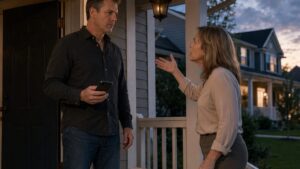
Raymond stepped closer, though his voice stayed low.
“Be careful, James.”
“About what?”
“About deciding that every administrative judgment you dislike is corruption.”
James held his gaze.
Then Raymond walked away.
James stayed by the mailbox.
He was still standing there when Patricia came down the sidewalk.
“What did he say?”
James looked toward the clubhouse curb.
For months, he’d been asking whether Raymond enforced the rule too aggressively.
Now he had a different question.
“That the circumstances were different.”
Patricia snorted.
“They always are when it’s your own car.”
James didn’t answer.
The next morning, he opened a new folder on his computer.
He named it Parking.
Chapter 3: Four Socials and One Quiet Ledger
The silver SUV in James’s photograph had never received a citation.
James knew because six weeks earlier he had seen the same SUV in a violation packet issued to another homeowner—not as the offending vehicle, but parked in the background during a board social.
He enlarged the image on his computer.
Same license plate.
Same bumper sticker.
Same small scrape near the rear wheel.
The SUV belonged to a board member.
During the social, it had remained at the restricted curb for nearly three hours.
A month later, a resident on the opposite side of the neighborhood had been fined after a guest parked in a comparable restricted area for fifty-two minutes.
James entered both records into a spreadsheet.
Date.
Arrival time.
Departure time.
Vehicle.
Enforcement action.
Board event.
Resident violation.
He did not like how quickly the columns became satisfying.
By summer, he had attended or observed four HOA social functions.
He never hid what he was doing. He stood on public sidewalks or his own property and photographed vehicles openly.
He wrote down arrival times.
He saved association notices.
He compared board-event parking to enforcement records homeowners voluntarily showed him.
Patricia called it his ledger.
“It’s a spreadsheet.”
“It’s a ledger when you look that serious while using it.”
James ignored her.
At the third event, she stood beside him as he photographed another row of vehicles.
“You know normal people spend Saturdays doing things they enjoy.”
“I enjoy accurate records.”
“That’s not reassuring.”
He lowered his phone.
“What would you have me do?”
“Nothing. I’m just saying you’ve started smiling every time somebody parks illegally.”
“I don’t smile.”
“You absolutely do.”
James looked toward the clubhouse.
A vehicle door opened. Raymond stepped out.
For a moment, James felt the old reflex from his enforcement years: observe first, document second, argue never.
He had spent eight years working municipal parking enforcement before moving into facilities management.
People remembered parking officers as the person who left the ticket.
James remembered the arguments.
A mother late for daycare pickup.
A contractor who insisted the loading zone should count because he’d only be five minutes.
A shop owner furious that customers were being ticketed.
A wheelchair user unable to reach the curb ramp because someone thought hazard lights transformed a parking space into temporary permission.
The work had taught James something most people disliked hearing.
Almost everyone believed their exception was reasonable.
The difficult part was deciding which ones actually were.
That was why Raymond bothered him.
Not because he enforced rules.
Because he pretended judgment never existed when residents asked for it, then rediscovered judgment when the board wanted it.
By August, James had enough records to establish a pattern.
Four board events.
Dozens of curbside vehicles.
No recorded citations connected to those events.
During the same twelve-month period, ordinary residents had received repeated notices for brief parking in restricted areas.
James did not claim every situation was identical.
Some were not.
But enough were close enough.
He printed a summary.
He did not send it.
That was the part he could not quite defend, even to himself.
If his goal was to correct the policy, he could have brought everything to the board.
Instead, he kept collecting.
Knowledge felt safer while it belonged only to him.
The change came during the August meeting.
Raymond was halfway through a report when one board member leaned over and whispered something.
Raymond stopped.
His eyes moved toward James.
When homeowner comments opened, Raymond spoke before James raised his hand.
“We’ve received concerns regarding residents photographing vehicles and tracking personal movement during association activities.”
Several heads turned.
James felt Patricia stiffen beside him.
Raymond continued.
“Homeowners are entitled to enjoy community events without feeling monitored.”
James stood.
“You mean me.”
“I didn’t name anyone.”
“You didn’t have to.”
Raymond folded his hands.
“Are you photographing license plates?”
“Yes.”
Murmurs moved through the room.
“Why?”
“Because the association claims parking restrictions are uniformly enforced.”
Raymond’s expression flattened.
“And you’ve appointed yourself investigator?”
“No.”
“Then what would you call it?”
James could feel every face turning toward him.
The easy answer would have been righteous outrage.
Instead, he heard Patricia whisper, “Careful.”
James took a breath.
“I call it checking whether what I’m being told is true.”
Raymond leaned back.
“Some residents consider your behavior harassment.”
“Taking photographs from my property isn’t harassment.”
“That isn’t the point.”
“It’s exactly the point if you’re going to accuse me publicly.”
Sarah Martin looked toward Raymond.
“We should probably separate the privacy concern from the parking issue.”
Raymond ignored her.
“If you have a complaint, James, file it.”
“I did.”
“You appealed your citation.”
“I’m talking about selective enforcement.”
“Then submit evidence.”
James almost said, I will.
But he didn’t.
That silence cost him.
Raymond noticed.
“So you don’t have evidence.”
James looked at the folder beside his chair.
He had more than Raymond knew.
Still, something stubborn in him resisted producing it on demand.
“Not tonight.”
Raymond gave a small nod.
“Then I think we’re done.”
Outside, Patricia caught up with him.
“You should’ve shown them.”
“Not yet.”
“What are you waiting for?”
James did not have a good answer.
He told himself he wanted complete records.
He told himself that if he revealed what he had too early, Raymond would simply change behavior long enough to erase the pattern.
Both explanations were partly true.
Neither explained the small pulse of satisfaction he felt from knowing Raymond had underestimated him.
At home, James opened the folder again.
He added the evening’s meeting notes.
Then, almost as an afterthought, he opened the county property-record website.
The parking rule depended on where HOA-controlled roadway ended and private property began.
Raymond had always spoken as though that question had been settled decades ago.
James had never checked.
He entered his address.
The parcel map loaded slowly.
His lot appeared as a pale rectangle bordered by thin digital lines.
James zoomed in.
Once.
Twice.
Then again.
He stopped moving the mouse.
The line along the front of his property did not end where the lawn met the sidewalk.
It continued farther outward.
Across the sidewalk.
Toward the curb.
James leaned closer.
“No.”
He switched layers.
Roadway.
Parcel.
Recorded easements.
The display was too crude to prove anything by itself, but it was clear enough to raise a question he had never thought to ask.
The restricted curb Raymond had been enforcing as association property appeared to sit, at least partly, inside James’s parcel.
He printed the map.
For several seconds he simply looked at the dark boundary line.
Then he reached for his keys.
If the map was right, the argument was no longer only about how Raymond enforced the rule.
It was about whether Raymond had been enforcing it on the wrong property.
Chapter 4: The Curb Line on the Old Survey
The county clerk laid the 1988 subdivision plat beneath a clear plastic sheet and tapped one narrow strip with the capped end of a pen.
“Your parcel doesn’t stop at the grass.”
James leaned closer.
The black survey line ran past the front walk, crossed the sidewalk, and continued toward the curb.
“So this is mine?”
The clerk gave him the kind of look that made the answer feel less satisfying before she even spoke.
“The parcel boundary appears to include it.”
“Appears?”
“This copy tells you where the recorded boundary was established. It doesn’t tell you every right somebody else may have over the land.”
James slid the digital parcel printout beside the old plat.
The shapes matched closely enough.
The curb Raymond had treated as unquestioned association territory sat within James’s recorded parcel.
For several seconds, that was all James saw.
He imagined Raymond at the next board meeting.
No discretion.
No exceptions.
No authority either.
Then the clerk opened another record.
“There’s an access easement here.”
James’s attention shifted.
The language was old and dense, written when the subdivision had been laid out. It reserved portions of the frontage for utilities, maintenance, drainage, and access associated with the roadway.
“Does that give the HOA parking authority?”
“I can’t give you legal advice.”
“Does it make this association property?”
“No.”
That was enough to make his pulse jump again.
“But,” she continued, “owning land subject to an easement isn’t the same thing as having unlimited control over it.”
The sentence stayed with him all the way home.
He took a tape measure outside.
The afternoon was hot enough that the metal blade warmed in his hand.
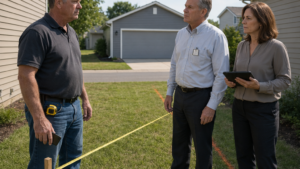
James started at the corner marker noted on the plat and measured toward the street. Then he compared the distance with the visible sidewalk edge and curb.
The legal boundary and the physical street design did not align in the clean way Raymond’s enforcement suggested.
Somewhere over the years, the curb had become an assumed border.
The documents said otherwise.
Patricia found him crouched beside the sidewalk.
“You’ve reached a new stage.”
James looked up.
“What stage?”
“Measuring your own street.”
He handed her the plat copy.
She studied it.
“This means what I think it means?”
“It means Raymond was wrong when he said the whole restricted strip was HOA property.”
Patricia smiled.
“Good.”
“It also means there’s an access easement.”
Her smile faded.
“Bad?”
“Complicated.”
She handed the page back.
“You hate complicated.”
“I don’t hate complicated.”
“You hate it when complicated interrupts you being right.”
James rolled the tape measure shut.
That evening he sent a written request to the HOA management company asking for the recorded basis of its claimed authority over the curb adjoining his parcel.
Two days later, Sarah Martin called.
“I saw your request.”
James stood by his kitchen window, looking at the same curb.
“Then you know why I sent it.”
“I do.”
“Does the association have a deed to that strip?”
“No.”
“Does it own it?”
“Not according to the parcel records I’ve reviewed.”
James closed his eyes briefly.
There it was.
“But before you get too excited,” Sarah said, “the street-access language matters.”
“I’m aware.”
“We should talk.”
They met at the HOA office the next evening.
Sarah had three binders open when James arrived.
Raymond was not there.
James noticed immediately.
“Where’s Raymond?”
“I asked him not to come.”
“Why?”
“Because I want a conversation, not a performance.”
James sat.
Sarah turned one binder toward him.
Inside were old meeting minutes, maintenance notes, and correspondence from before Raymond became chairman.
“There was a real parking problem here.”
“I’ve heard.”
“No, you’ve heard the short version.”
She pulled out a photograph.
Two vehicles were parked opposite each other along a narrow bend. A larger emergency vehicle was visible farther back in the roadway.
“It wasn’t completely blocked,” Sarah said. “But it had to slow, maneuver, back up, reposition. People were furious.”
“How long ago?”
“Years.”
“Before Raymond?”
“Before he became chairman. He was on a committee then.”
James studied the photograph.
The restricted-parking expansion had not begun as Raymond’s personal invention.
Homeowners had demanded it.
Raymond had simply become its most aggressive defender.
Sarah pushed another page toward him.
“The problem is that we kept adding rules after that.”
“Who is we?”
“The board.”
“Under Raymond.”
“Yes.”
“And the social-event exceptions?”
Sarah hesitated.
James noticed.
“Where are they written?”
“They aren’t.”
He leaned back.
“So there are no exceptions.”
“Not formally.”
“But there are in practice.”
Sarah rubbed one thumb along the binder edge.
“Events were treated differently because board members were present, traffic was considered supervised, and the duration was limited.”
James almost laughed.
“That’s discretion.”
“Yes.”
“Raymond told me there was none.”
“I know what Raymond told you.”
“Patricia got towed for four inches.”
“I know.”
“The Brennans got fined for a delivery.”
“I know.”
“My brother got fined during Christmas dinner.”
Sarah’s voice sharpened.
“And I’m not telling you those decisions were good.”
The room went quiet.
James had expected defense.
The admission unsettled him more.
Sarah closed the binder.
“Raymond thinks inconsistency destroys enforcement. So when a resident challenges a violation, he becomes stricter.”
“And when the board wants parking?”
“Then he calls it supervision.”
James looked at her.
“You know how that sounds.”
“I do now.”
“Now?”
Sarah met his eyes.
“Convenience is easy to ignore when you’re one of the people benefiting from it.”
That was not the answer James wanted.
It was too honest.
He stood and gathered his copies.
Sarah spoke before he reached the door.
“What are you going to do with the parcel information?”
James stopped.
“I haven’t decided.”
“That’s not true.”
He turned.
Sarah’s expression was tired rather than accusing.
“You’ve been collecting records for months. You found a boundary Raymond didn’t know existed. You didn’t come here because you want an apology.”
James said nothing.
Sarah continued.
“If you want the policy reviewed, I can push for that.”
“And if Raymond blocks it?”
“He might.”
“He will.”
“Then we deal with that.”
James tucked the plat into his folder.
“What you’re asking me to do is trust the same process that denied Patricia’s appeal.”
“I’m asking you to decide whether your goal is to fix the system or beat Raymond.”
The question followed him home.
He spread the survey across his dining table.
The curb line looked smaller on paper than it did outside.
Just ink.
Just measurements.
Just a boundary somebody had drawn nearly four decades earlier.
But now James knew two things Raymond did not.
The HOA did not own the strip.
And the board’s event exception did not exist anywhere except habit.
By midnight, James had begun researching what a private property owner could legally do about unauthorized parking on land subject to access rights.
Chapter 5: Forty-Five Days to Make It Official
James tightened the final bolt on the parking notice and stepped back.
The sign stood at the edge of his property, positioned where anyone approaching the disputed curb could see it before parking.
He checked the date on his phone.
Forty-five days before the next scheduled HOA social.
Exactly.
The licensed immobilization contractor had been cautious when James first called.
“You understand this can’t interfere with emergency access?”
“Yes.”
“And you need to be certain of the property boundary.”
“I have the recorded plat.”
“Easements?”
“Access and utilities.”
“Then don’t touch anything that blocks the easement itself.”
James had spent nearly two weeks reducing the idea to something narrow enough to withstand scrutiny.
No towing.
No indiscriminate enforcement.
No claim over the roadway.
Only vehicles parked within the documented private frontage under conditions the contractor said could be enforced after proper notice.
The contractor still made him sign an acknowledgment that property disputes remained James’s responsibility.
James signed.
Then he posted the notice.
Raymond arrived less than an hour later.
He walked directly from his car to the sign.
“What is this?”
James remained on his porch.
“You can read it.”
Raymond turned.
“Take it down.”
“No.”
“You cannot post private enforcement notices inside HOA-controlled space.”
James descended the steps.
“This isn’t HOA-owned land.”
Raymond gave a short, dismissive shake of his head.
“We’ve been through this.”
“No, you assumed it.”
James handed him a copy of the parcel map.
Raymond barely looked at it.
“This doesn’t override association access rights.”
“I didn’t say it did.”
“Then you understand you can’t obstruct the curb.”
“I’m not obstructing anything.”
“You’re threatening to immobilize vehicles.”
“Vehicles parked on my property after notice.”
Raymond finally studied the map.
For the first time since the dispute began, James saw uncertainty in his face.
It lasted only a second.
“The HOA will challenge this.”
“Then challenge it.”
“You think because you worked parking enforcement years ago you’re qualified to interpret property law?”
“No.”
“Good.”
“That’s why I checked the records and hired someone licensed to do the enforcement.”
Raymond handed the map back.
“This is retaliation.”
James looked toward the sign.
“It’s notice.”
“You waited months.”
“That makes the notice more valid, not less.”
Raymond stepped closer.
“You want a spectacle.”
James felt the accusation land because some part of it was true.
“I want the rule applied consistently.”
“No. You want me embarrassed.”
James’s jaw tightened.
Raymond pointed toward the curb.
“People supported those restrictions because this street had an access problem. You are turning that history into a personal argument.”
“And you turned a safety rule into a privilege.”
Raymond’s face hardened.
“I’ll have management send you formal notice.”
“Do that.”
Raymond left without another word.
James photographed the sign from three angles, recorded the installation date, and saved the images.
That evening, an HOA email arrived reminding him that owners could not modify common areas without approval.
James responded with the recorded parcel boundary and asked them to identify the document establishing HOA ownership of the sign location.
No answer came.
For the first time in months, James felt ahead.
Not merely correct.
Ahead.
That distinction should have bothered him more than it did.
A week later Patricia came over.
She read the sign from the sidewalk.
Then she looked at James.
“You’re really doing it.”
“If they park there.”
“You could warn them individually.”
“The sign is the warning.”
“You know what I mean.”
James crossed his arms.
“They’ve had years of warning about parking rules.”
“That’s Raymond’s sentence.”
He looked at her.
Patricia nodded toward the sign.
“You’ve been waiting for somebody to say that to him.”
“I’m applying the same standard.”
“Exactly.”
James felt irritation rise.
“After what happened to you, I thought you’d understand.”
“I do understand.”
“You paid two hundred twenty dollars because he wouldn’t let you move your van four inches.”
“I remember. I was there.”
“So what’s the problem?”
“The problem is you’re starting to sound happy about it.”
James looked away.
Across the street, a delivery vehicle slowed near the clubhouse and continued past.
Patricia lowered her voice.
“If the board changes the rule tomorrow, would that be enough?”
“Depends.”
“On what?”
“Whether they admit what they’ve done.”
“That’s not a rule change. That’s an apology.”
“They owe people more than an apology.”
“I agree.”
“Then what are we arguing about?”
Patricia studied him.
“Whether you want them to fix it before the social.”
James didn’t answer.
That was the answer.
She sighed.
“You could send them everything now. The photos. The comparison. The survey. All of it.”
“And give Raymond forty-five days to invent a new explanation?”
“Maybe he’d have to.”
“Or he’d change the event parking just long enough to avoid admitting anything.”
“So you want him to park there.”
James remained silent.
Patricia shook her head.
“There it is.”
“What?”
“You don’t just want proof anymore. You want the moment.”
James felt the same small pulse he’d felt when Raymond underestimated his records at the August meeting.
The imagined moment had become specific.
Raymond walking outside.
Seeing the orange boots.
Understanding that his own phrase—no exceptions—had finally reached the board.
James hated that Patricia could see it.
He turned toward the curb.
“I’ve followed every requirement.”
“I didn’t say you hadn’t.”
“I’ve checked the boundary.”
“I know.”
“I’ve given more notice than anyone Raymond ever fined.”
“I know.”
James faced her.
“Then what’s wrong with letting consequences happen?”
Patricia was quiet for a moment.
“Nothing, maybe.”
That stopped him.
She continued.
“But if you’re hoping for the consequences more than you’re hoping for the problem to be fixed, that’s different.”
She left him beside the sign.
James stood there long after she was gone.
The curb line was still the same strip of concrete it had always been.
But he had begun looking at it as a trap.
Chapter 6: When Revenge Stopped Feeling Clean
“Raymond was right about one thing.”
Sarah Martin’s sentence made James stop halfway into the HOA office.
She had called him that morning and asked him to come before the next social.
Now she stood beside the conference table with an old folder open.
James remained near the door.
“That’s an interesting way to start.”
“The original parking problem was real.”
“I already know that.”
“No. I mean worse than the photograph I showed you.”
Sarah slid several old homeowner complaints toward him.
Cars blocking trash collection.
Vehicles parked too close to the curve.
A delivery truck unable to turn without climbing a curb.
One report described an emergency vehicle losing time because two parked cars narrowed the passage.
No catastrophe.
No dramatic injury.
Just enough delay to frighten people.
“Raymond chaired the committee that fixed it,” Sarah said.
James read one of the complaints.
“He wasn’t chairman yet.”
“No.”
“So people trusted him because the restrictions worked.”
“Yes.”
“And then?”
Sarah sat.
“Then every new complaint made enforcement tighter.”
James looked up.
“That still doesn’t explain the board events.”
“No. It explains why Raymond believes relaxing anything means going backward.”
“And the exceptions?”
Sarah gave a tired half-smile.
“Those started small too.”
A vendor unloading.
A board member bringing supplies.
An elderly volunteer staying longer than expected.
Then full events.
“We told ourselves they were supervised,” Sarah said. “We told ourselves somebody could move a vehicle if necessary.”
“But nobody wrote that into the policy.”
“No.”
“Nobody gave homeowners the same judgment.”
“Not consistently.”
James closed the folder.
“So change it.”
“I’m trying.”
“Before Sunday?”
“Raymond won’t support an emergency change.”
“Of course he won’t.”
“He thinks changing it now validates your accusation.”
“It does.”
Sarah’s eyes sharpened.
“This is the part where you make everything harder.”
James leaned back.
“Me?”
“You have enough evidence to force a review. You know that.”
“And you have enough authority to start one.”
“I’m one vote.”
“So am I supposed to rescue the board from its own choices?”
“No.”
Sarah paused.
“I’m asking whether you really need the boots.”
James stared at her.
There it was again.
Patricia’s question in different words.
“I posted notice.”
“That wasn’t my question.”
“If they don’t park there, nothing happens.”
“And if they do?”
James did not answer.
Sarah folded the old complaints back into the folder.
“Raymond believes you’re bluffing.”
“That’s his mistake.”
“Probably.”
James stood.
Sarah looked up at him.
“Just remember something. Not every person who parks there Sunday will know the entire history.”
“They’ll see the sign.”
“Yes.”
“They can park somewhere else.”
“Yes.”
She wasn’t arguing.
That irritated him more.
“What do you want me to say?”
“Nothing.”
Sarah closed the folder.
“I want you to know what choice you’re making.”
Later that afternoon, Patricia was walking toward her mailbox when James caught up with her.
“Sarah told me how the rule started.”
Patricia stopped.
“And?”
“Raymond wasn’t inventing the access issue.”
“I never thought he was.”
James frowned.
“You didn’t?”
“I thought he liked being right more than he liked being fair.”
That landed too close.
James looked toward his own sign.
Patricia followed his gaze.
“You still doing Sunday?”
“Yes.”
She nodded slowly.
“I figured.”
“I changed one thing.”
“What?”
“I told the contractor not to touch random guest vehicles unless they’re clearly part of the board event and parked within the documented strip.”
Patricia studied him.
“That’s better.”
“Not good enough?”
“I didn’t say that.”
He exhaled.
“I’m not canceling it.”
“I know.”
“You think I should.”
“I think you should stop pretending this is only procedure.”
James looked at her.
Patricia’s voice stayed gentle.
“You want Raymond to feel what it was like when he wouldn’t let me move my van.”
James said nothing.
“You want him standing there with everyone watching while somebody tells him the rule is the rule.”
“Maybe he should.”
“Maybe.”
That answer bothered him more than disagreement.
She continued toward her mailbox.
James called after her.
“You’re not coming to the social?”
She turned.
“I’ll be there.”
“Then what are you going to do when it happens?”
Patricia considered the question.
“Probably feel two things at once.”
On Friday, the HOA sent its final event reminder.
Sunday.
Noon to four.
The message included food, tables, volunteer assignments, and a note that residents should use designated parking areas.
Nothing mentioned James’s notice.
Nothing changed the customary arrangement.
James read the email twice.
Then he forwarded it to the contractor.
Saturday evening, he walked the curb with a flashlight.
The posted notice remained visible.
He checked the boundary measurements again though he no longer needed to.
At one point he stood exactly where Patricia’s minivan had extended beyond the painted limit ten months earlier.
Four inches had started this.
Four inches and a man who insisted judgment had no place in a rule.
Now James had built a rule of his own.
Sunday morning, the contractor confirmed availability.
James placed the survey copy, notice photographs, contractor paperwork, and parking records in a plain folder near his front door.
At 11:56 a.m., he stepped outside.
The clubhouse tables were already arranged.
Raymond stood near the entrance speaking with two board members.
Sarah saw James from across the lawn.
She did not wave.
At 12:07, the first vehicle approached.
James watched it slow beside the posted notice.
The driver paused long enough to read.
Then the car rolled forward and pulled against James’s curb.
Its tires stopped inside the documented boundary.
James looked toward Raymond.
Raymond glanced at the parked car.
Then he looked at James.
Neither man moved.
James took out his phone and recorded the arrival time.
Chapter 7: Nine Cars Inside the Painted Boundary
By 1:06 p.m., the ninth vehicle had parked along James’s curb.
He checked the time, then looked toward the clubhouse lawn.
Raymond stood beneath one of the pop-up canopies talking with two homeowners as though nothing unusual had happened. From where James stood, every vehicle formed a neat line along the disputed frontage.
The posted notice was visible.
No one could honestly say it had been hidden.
Still, James waited.
The contractor had told him to call only after the vehicles had remained long enough to establish that they were actually parked rather than unloading.
At 1:30, all nine remained.
At 1:45, a board member opened one vehicle, retrieved a jacket, and returned to the social.
At 2:00, James made the call.
The contractor arrived twenty-three minutes later in an unmarked work truck.
Patricia stood near the edge of the lawn holding a paper cup. She caught James’s eye but did not come over.
Sarah saw the truck and immediately walked toward him.
“You’re doing this.”
James held the folder against his side.
“They’ve been there almost two hours.”
“Raymond still thinks the notice is unenforceable.”
“He can challenge it.”
Sarah looked toward the cars.
“Once those boots go on, this changes.”
“It already changed.”
The contractor approached.
“You want me to verify each one?”
James handed over his marked copy of the property survey.
“Only the vehicles fully inside this strip.”
The contractor walked the line with a measuring wheel, stopping at each front tire.
James followed.
The first vehicle qualified.
So did the second.
The third sat close enough to the boundary that the contractor paused.
“That one’s marginal.”
“Leave it.”
The contractor nodded.
James felt Sarah glance at him.
Two more vehicles were outside the documented portion entirely. James excluded them too.
By the time the check ended, nine vehicles remained that met the criteria from the larger group parked around the event.
The contractor opened the back of his truck.
Bright orange steel caught the sunlight.
James’s stomach tightened.
He had imagined this moment for weeks.
In his imagination, it had always felt cleaner.
The first clamp closed around a front wheel.
Metal struck metal.
Several people turned.
Raymond stopped talking.
The contractor tested the lock.
Then moved to the next car.
Someone near the food table said, “What is he doing?”
Another person walked toward the curb.
By the third boot, the entire mood of the event had shifted.
Raymond crossed the lawn quickly.
“Stop.”
The contractor did not.
Raymond stepped in front of him.
“I said stop.”
The contractor looked toward James.
James remained where he was.
“You’ll need to speak with him,” the contractor said.
Raymond turned.
His face had gone red around the neck.
“You actually did it.”
James kept his voice level.
“The notice has been posted forty-five days.”
“This is association property.”
“No. It isn’t.”
“We have access rights.”
“And none of these vehicles are being prevented from leaving the roadway. They’re parked on the private strip.”
Raymond looked at the orange boots.
“This is absurd.”
“That was Patricia’s word when her minivan was towed.”
Raymond’s eyes snapped back to him.
“There it is. This isn’t enforcement. It’s revenge.”
James almost answered immediately.
Then he saw Patricia watching from the lawn.
He remembered her saying he wanted the moment.
Maybe he had.
The contractor attached the fifth boot.
One of the vehicle owners hurried over.
“That’s my car.”
Raymond pointed at James.
“He had it immobilized.”
The owner looked confused.
“But Raymond told us this was where board volunteers could park.”
James felt something shift inside him.
“You were told to park here?”
“Yes.”
Another owner spoke from behind her.
“Same.”
A third nodded.
“Raymond said the curb was fine during association events.”
James looked at Raymond.
Raymond’s expression changed, not dramatically, but enough.
He had assumed the board members knew the risk.
Some clearly had not.
The contractor continued.
Six.
Seven.
Eight.
The ninth orange boot locked into place.
Nine bright interruptions lined the curb.
James had pictured Raymond standing before them.
He had pictured satisfaction.
Instead, the sight reminded him of Patricia standing in slippers while her minivan climbed onto a tow truck.
Raymond turned toward the owners.
“We’ll get these removed.”
The contractor shook his head.
“Each vehicle owner handles their own release under the posted terms.”
Raymond looked at James.
“Tell him to remove them.”
“No.”
“You made your point.”
“I don’t control his procedure once enforcement begins.”
Raymond stared at him.
James heard his own old voice in the sentence.
Procedure.
Once initiated.
No exceptions.
The words felt heavier now.
A homeowner approached the notice and read it carefully.
“So we have to pay?”
The contractor answered.
“Removal terms are posted. I’ll process each vehicle separately.”
The owner looked at James.
“You could’ve just told us.”
James opened his mouth.
Nothing useful came out.
Because she was right in one sense and wrong in another, and neither answer erased the embarrassment on her face.
Raymond stepped closer to James.
“You wanted me humiliated.”
James lowered his voice.
“I wanted you to stop pretending the rule applied equally.”
“By doing this?”
“By making the difference impossible to deny.”
Raymond glanced at the line of boots.
“You’ve proven you’re good at punishment.”
The sentence hit harder than James expected.
Sarah arrived beside them.
“Enough.”
Raymond looked at her.
She spoke quietly.
“We’re calling an emergency board meeting.”
“To remove these?”
“To deal with all of it.”
Raymond’s jaw tightened.
“The policy is clear.”
Sarah looked at the boots.
“No. That’s the one thing that isn’t clear anymore.”
The social ended early.
People packed food into containers. Folding chairs disappeared. Conversation broke into tight, irritated clusters.
One by one, vehicle owners dealt with the contractor.
James stayed near the curb but stopped feeling like the person who had won.
Patricia finally joined him after the seventh vehicle was released.
“How does it feel?”
He watched an owner place a receipt into her purse.
“Not like I thought.”
Patricia nodded.
“I figured.”
“Raymond told them to park there.”
“Some of them.”
“I thought they knew.”
“You wanted them to.”
James looked at her.
She did not soften the statement.
By late afternoon, only two boots remained.
Raymond walked past James without speaking.
That evening, an emergency board session was announced for the following night.
James arrived with his folder.
Raymond was already seated.
Sarah sat between them at the long table.
There were no microphones this time.
No audience except several board members and affected homeowners.
Raymond listened while Sarah summarized the property records, the unwritten event exceptions, and the day’s immobilizations.
When she finished, silence settled over the room.
Raymond looked directly at James.
His voice was quieter than it had been at any meeting before.
“All right.”
James waited.
Raymond placed both hands flat on the table.
“You’ve shown everyone what I did wrong.”
He glanced toward the affected homeowners.
“Now tell me something.”
His eyes returned to James.
“What do you actually want?”
Chapter 8: The Boundary Stayed, but the Rule Changed
“I’ll waive your Christmas citation.”
Raymond made the offer before the emergency meeting formally resumed the next evening.
He had caught James in the hallway outside the meeting room.
“And I’ll support reimbursing the immobilization charges from Sunday,” Raymond continued. “For the board members.”
James looked at him.
“In exchange for what?”
Raymond’s mouth tightened.
“You remove your private enforcement notice and stop challenging the parking policy.”
James almost admired the efficiency of it.
“My fine disappears.”
“Yes.”
“The board’s costs disappear.”
“Yes.”
“And Patricia?”
Raymond hesitated.
James had his answer.
“The Brennans?”
“Those are separate cases.”
James nodded once.
“No.”
Raymond stared at him.
“This can end tonight.”
“That’s exactly why I’m saying no.”
James walked into the meeting room.
This time more homeowners had come.
Patricia sat near the front.
Sarah had prepared a packet containing parking citations from the previous year, board-event dates, property maps, and a proposed temporary suspension of discretionary enforcement until the policy could be reviewed.
James recognized his own spreadsheet among the documents.
When homeowner comments began, Sarah asked him to speak first.
James stood with no prepared statement.
He looked at Raymond.
Then at Patricia.
“I need to say something before we talk about the policy.”
The room quieted.
“I was right about the selective enforcement.”
Raymond shifted slightly.
James continued.
“I was also angry enough that being right stopped being enough.”
Patricia looked up.
“I could have brought everything to the board earlier. I didn’t.”
A board member frowned.
“Why not?”
James could have answered with strategy.
Preserving evidence.
Preventing temporary compliance.
Those things were true.
“They would have had time to change behavior without fixing the problem,” he said. “But that’s not the whole reason.”
He paused.
“I wanted Raymond to experience the rule the way residents did.”
No one interrupted.
“I wanted him standing beside a car he couldn’t move while somebody told him procedure had already started.”
James looked down at the folder.
“I got that.”
Then he looked toward the affected vehicle owners.
“Some of you were told where to park. I knew that was possible, and I let the enforcement happen anyway.”
One owner folded her arms but nodded faintly.
James sat.
For several seconds, Raymond said nothing.
Then Sarah turned toward him.
“Your turn.”
Raymond’s expression suggested he disliked the phrasing.
Still, he stood.
“The parking restrictions were created because we had an access problem.”
Several longtime homeowners nodded.
“I still believe the restrictions are necessary.”
James did too.
That was what made the next part matter.
Raymond continued.
“But I allowed event parking because I believed supervised exceptions were reasonable.”
Patricia spoke from her chair.
“Then why wasn’t my van reasonable?”
Raymond looked at her.
He did not answer immediately.
“When residents challenged violations,” he said, “I thought making exceptions would weaken the rule.”
“And board events didn’t?” Patricia asked.
Raymond’s jaw tightened.
“They should have.”
The admission produced no applause.
Only a quiet shifting in the room.
Raymond looked down.
“I treated judgment as something the board was entitled to use and residents were not.”
Sarah closed one of the packets.
“Which is why the proposed policy removes unilateral exemptions.”
The discussion lasted more than two hours.
They did not abolish the parking restrictions.
The access problem was real.
Instead, the board voted to commission a professional boundary review and rewrite the parking policy around clearly mapped zones.
Temporary loading periods would be defined.
Guest parking would receive a limited grace procedure.
Community events would require written parking plans approved in advance.
No chairman, board member, or management representative could create an informal exception.
Previous citations from the review period would be audited against the board’s own enforcement practices.
Where comparable conduct had been permitted at association events, verifiable fines and towing charges would be reimbursed.
Patricia’s case qualified.
So did several others.
Not every complaint did.
Some vehicles had genuinely blocked access. Some fines remained valid.
James found that reassuring.
Fairness did not require pretending every resident had been right.
It required that the same standard survive contact with everyone.
The hardest issue came last.
James’s curb.
The professional survey confirmed the old plat.
The frontage strip remained part of his parcel.
The recorded easement also remained.
James could not treat it as an unrestricted private parking lot.
The HOA could not treat it as association-owned property.
Both sides had been claiming more certainty than the documents supported.
Under the new agreement, the strip would be incorporated into the neighborhood’s mapped access plan with James’s consent, and enforcement would operate under written conditions applying equally to residents, guests, and board events.
In return, James agreed to end his separate immobilization arrangement.
Raymond opposed that compromise at first.
Not because he still claimed ownership.
Because he believed the board was surrendering authority.
James understood the feeling better than he wanted to.
He had begun to feel the same way about giving up his sign.
The private notice represented leverage.
For once, Raymond could not simply overrule him.
Giving it up required trusting a system he had spent months proving was flawed.
Sarah looked between them.
“If both of you need permanent personal power to trust the rule, then we haven’t fixed anything.”
James almost smiled.
Raymond did not.
But after a long silence, Raymond voted yes.
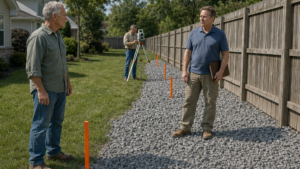
Three weeks later, a survey crew returned to the curb.
James stood on his lawn while they measured from the recorded corner markers.
Raymond watched from near the clubhouse.
Neither man spoke.
Fresh boundary indicators were installed according to the new parking plan.
The physical curb had not moved an inch.
The meaning attached to it had.
Patricia walked over while James loosened the bolts holding his private enforcement notice.
“Need help?”
“I’ve got it.”
The last bolt came free.
James lifted the sign from the post.
Across the street, Raymond looked toward him.
For a moment James thought he might say something.
He didn’t.
James didn’t either.
He carried the sign toward his garage.
Behind him, the curb remained exactly where it had always been—concrete, paint, and an old boundary line beneath all the arguments.
This time, no one standing beside it got to decide alone what the rule meant.
The story has ended.