The Will Was Changed Six Weeks Before Her Mother Died, And Ruth’s Name Was Gone
Chapter 1: The Name Missing From The Brown Folder
“Ruth White is to receive one box of personal effects, to be selected by the executor.”
Daniel Brown read the sentence as if it were no different from the lines before it, as if he had not just lifted Ruth out of her mother’s life with twelve flat words.
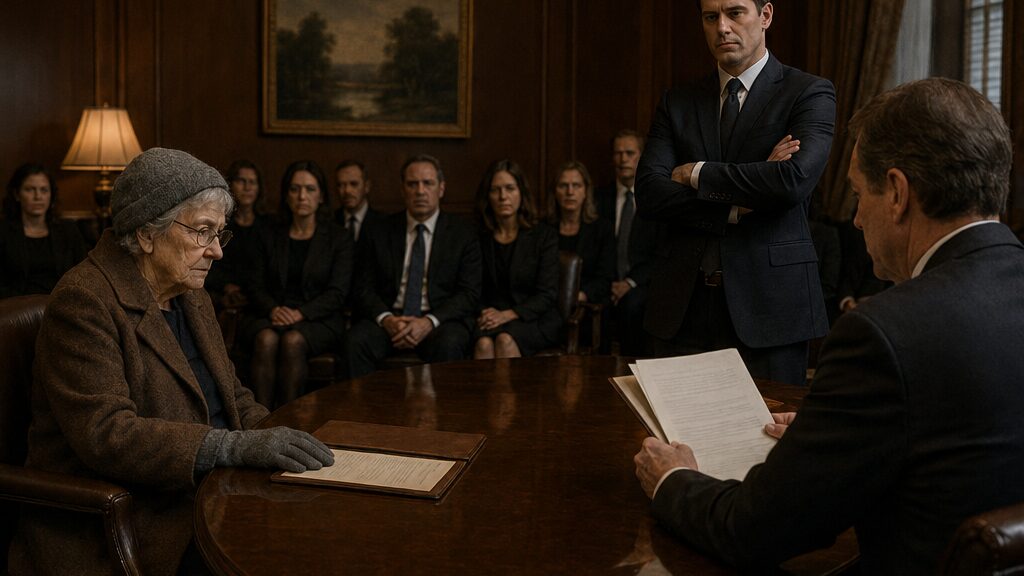
Across the polished table, the brown folder lay open beneath the yellow light. Ruth’s gray-gloved hand rested beside it, close enough to touch the page but not close enough to stop Daniel from turning it. She kept her fingers still. They wanted to curl into her palm.
Ryan Hall stood behind the chair opposite her instead of sitting in it. His dark suit looked pressed too sharply for a family meeting two weeks after a funeral. His arms were folded across his chest, and the silver watch on his wrist caught the light each time he shifted. Behind him, the silent relatives sat in a row along the wall, their black coats and lowered eyes making the conference room feel too much like a second service.
Daniel cleared his throat. “The residence at 418 Willow Lane, all remaining bank accounts, household contents except as otherwise listed, and authority over final estate administration are assigned to Ryan Hall, named here as executor and primary beneficiary.”
Ruth heard the heat click on in the vent above the bookshelves.
No one spoke.
Her mother’s house had never sounded so small before. Not when Nancy Hall had called from the hallway because she could not remember where Ruth kept the towels. Not when Ruth slept in the recliner for three nights because Nancy had started wandering toward the back door after midnight. Not even when the funeral director had asked which dress Nancy should wear and Ruth could not answer for a full minute.
Ryan unfolded his arms and laid one hand on the back of the chair in front of him.
“You understand,” he said softly, though everyone in the room heard him, “Grandma wanted things handled cleanly.”
Ruth looked at him then. Ryan’s mouth had the careful line of a man trying to sound gentle for witnesses. His eyes did not match it.
Daniel adjusted the page. “Mrs. White, I understand this may be unexpected.”
Unexpected.
Ruth had expected the house to feel empty. She had expected forms, signatures, bills, the awkwardness of relatives who had not changed Nancy’s sheets or pureed her soup but still spoke of “what Mom would have wanted.” She had expected grief to come in pieces, like finding Nancy’s lipstick in a drawer or the cardigan still draped over the kitchen chair.
She had not expected her own name to be reduced to a box.
“What box?” Ruth asked.
Daniel paused. “I’m sorry?”
“You said one box of personal effects.” Her voice sounded thinner than she wanted, but it did not break. “What box?”
Daniel looked down again. “The will gives the executor discretion to identify items of sentimental value.”
Ryan leaned forward slightly. “Photos, maybe. Her Bible. Things like that.”
Her Bible.
Ruth’s gloved fingers pressed once into the table. Nancy had stopped being able to read the small print in that Bible almost a year before she died. Ruth had been the one to read the Psalms aloud on the bad evenings, skipping the verses Nancy said sounded too sad.
Daniel continued, “There is also a clause stating that any prior wills, codicils, written statements, or informal promises inconsistent with this document are revoked.”
Ruth’s gaze went to the page.
The words looked official enough to bruise.
She remembered Nancy’s voice in the kitchen, months before the hospital bed came into the front room. Don’t you worry about the house, Ruthie. You kept me in it. It’ll keep you, too.
Ruth had told her not to talk like that. She had put the kettle on and changed the subject.
Now the subject sat in a brown folder under Daniel’s hand.
Ryan moved around the chair and stood beside the table, closer to Ruth than he needed to be. “Aunt Ruth, Mom and Dad are gone. Grandma had to think about the whole family. You lived there with her for years. Nobody’s pretending you didn’t help.”
A small sound came from one of the relatives along the wall, maybe a breath, maybe a swallowed objection.
Ryan kept going. “But she changed her mind. That was her right.”
The words landed harder because he had chosen them carefully.
Ruth turned her head toward him. “Her right?”
“Yes.” He glanced toward Daniel, as if borrowing the law from him. “She was allowed to decide what happened to her own property.”
Daniel said, “That is generally correct, assuming capacity and proper execution.”
Assuming capacity.
Ruth caught the phrase the way she used to catch Nancy by the elbow when her mother stumbled between the bedroom and hall.
“May I see the signature page?” Ruth asked.
Daniel hesitated, then slid a copy toward her, keeping the original inside the folder. His fingertips remained on the top edge for half a second before he let go.
Ruth pulled the page closer. The date sat above the notary block.
March 3.
The conference room narrowed around the numbers.
March 3 was not a date. It was the week Ruth had spent half of Tuesday in the outpatient clinic waiting for her own blood pressure to come down because the doctor would not let her drive home light-headed. It was the week Nancy had called the television “the window radio.” The week Ruth had found her mother standing in the pantry with one shoe on, saying she needed to be ready before her father came for church.
Her father had been dead twenty-two years.
Ruth put one gray-gloved finger beside the date. Not on the ink. Beside it.
Daniel watched the gesture. Ryan watched her hand.
“When exactly,” Ruth said, “did she sign this?”
Daniel’s face changed only a little. It was the expression of a man noticing that a meeting had stepped off its expected path. “The document indicates March 3 at 2:15 p.m.”
“Where?”
“At the office of the drafting attorney.”
“What attorney?”
Daniel turned a page in his notes. “The attorney of record was not our firm. My office is handling probate administration. The drafting attorney was retained before the final document was brought to us.”
Ryan said, “Grandma wanted someone neutral.”
Ruth did not look away from the date. “Who took her there?”
Ryan gave a short laugh without humor. “Aunt Ruth.”
She looked up.
His mouth tightened. “Do we have to do this here?”
“Yes,” Ruth said.
A flicker passed through the relatives. Someone shifted in a chair. The clock above the door clicked once.
Daniel said, “Mrs. White, these questions can be addressed through formal channels if you wish to contest—”
“I’m asking a simple question.” Ruth’s finger remained beside March 3. “Who took my mother to sign this?”
Ryan’s hand flattened on the table. Not hard enough to be called a slap. Hard enough that Daniel stopped speaking.
“I did,” Ryan said. “She asked me to.”
Ruth studied him. She saw the boy who used to track mud into Nancy’s kitchen after Little League games, the teenager who stopped coming by unless someone reminded him, the grown man who had brought flowers after his father died and then disappeared for eight months. She saw all of him, and then she saw the suit again.
“Nancy asked you,” she said.
“My grandmother asked me,” Ryan corrected, too quickly. “And she was clear.”
Ruth’s throat tightened, but she kept her voice level. “On March 3?”
“Yes.”
“She knew what year it was?”
Daniel looked down at the paper.
Ryan’s eyes hardened. “Don’t do that.”
“Do what?”
“Make her sound like she was gone before she was gone.”
The room went still in a different way then. Not embarrassed. Watchful.
Ruth felt the old shame rise in her chest, the shame of remembering how many times she had answered for Nancy at appointments, how many times she had smiled at a neighbor and said, “She’s just tired today,” because saying the other thing aloud felt like betrayal.
“She had good hours,” Ryan said. “You know that.”
“She had moments,” Ruth said.
“And maybe in one of those moments she saw things clearly.”
Ruth heard what sat beneath it. She saw, suddenly, that Ryan was not only defending a will. He was defending a version of Nancy that had chosen him.
Daniel closed the folder halfway. “Mrs. White, if you believe there are capacity concerns, you may consult counsel. For today, my role is to summarize the filed document.”
Filed.
The word made the whole thing sound already buried.
Ruth withdrew her hand from the page and folded both gloves in her lap. She did not cry. Crying would be too easy for them to dismiss. A grieving daughter. An old woman surprised by paperwork. Someone confused by legal terms.
Ryan leaned closer, lowering his voice enough to pretend kindness. “Aunt Ruth, don’t make this harder than it has to be. Grandma signed it. The signatures are verified. The documents are legal.”
Ruth looked at the brown folder. Its corners were worn from being carried, opened, closed, trusted. Inside it, Nancy’s last voice had been turned into pages Ruth had never seen.
Then she looked at Daniel.
“Who was in the room with her that day?”
Daniel did not answer immediately.
Ryan did.
“I was,” he said. “And the attorney. And the notary.”
Ruth kept her eyes on Daniel. “Was anyone there who knew what she was like that week?”
Daniel’s lips pressed together.
Ryan straightened. “That’s enough.”
Ruth turned her head slowly toward him. The room behind him blurred, dark coats and pale faces, but his watch stayed bright under the conference-room light.
“No,” she said. “It isn’t.”
Daniel’s hand returned to the folder, but he did not close it.
Ruth touched the date once more, lighter this time, as if it were a pulse.
“Who,” she asked again, “was in the room with her that day?”
Chapter 2: The Date That Did Not Belong
The front door opened to a house Ryan now controlled.
Ruth stood on the porch for several seconds with the key in her hand, staring at the brass lock Nancy had complained about every winter. It stuck when the air turned cold. Ruth had meant to replace it in January, then Nancy fell in the bathroom, and the lock became one more small problem postponed by a larger one.
Now the key turned too smoothly.
Inside, the house held its breath.
The living room smelled faintly of furniture polish and the lavender lotion Ruth had rubbed into Nancy’s hands after baths. On the table beside the recliner sat the pill organizer, empty except for one pale yellow tablet Ruth must have missed in the last week. Monday through Sunday, morning and night, every little door flipped open like tiny mouths with nothing left to say.
Ruth set the brown folder copy beside it.
The probate meeting had ended without answers. Daniel had given her copies because she asked in front of witnesses, and because refusing would have looked worse than allowing it. Ryan had left first. He had not held the door.
Ruth removed her gloves finger by finger and placed them next to the folder. Her hands looked older without them.
March 3.
She wrote the date on a sheet from Nancy’s grocery pad, the one with faded apples printed along the top. Under it she wrote: Tuesday.
Then she stopped.
Was it Tuesday?
She opened the folder again, found the date, checked it twice, and reached for the wall calendar still hanging beside the refrigerator. Nancy had liked paper calendars. She said phones made days feel slippery. Ruth had kept writing appointments in the little squares long after Nancy stopped looking at them.
March was still there beneath April and May, pressed flat against the wall.
Ruth lifted the pages back.
The square for March 3 contained her own cramped handwriting.
9:30 — Ruth doctor.
Ryan driving Mom — papers?
The question mark felt like a hand on the back of her neck.
She did not remember writing it.
Ruth took the calendar down and carried it to the table. The chair creaked under her, the same sound it had made through years of breakfast toast, medication charts, and Nancy insisting she did not need a walker while gripping the counter with both hands.
Ryan driving Mom — papers?
Ruth closed her eyes.
That morning had smelled like burnt toast. Nancy had wanted tea in the blue mug and then refused it because she said it was not hers. Ruth had been light-headed, her own pulse too fast, her doctor’s office calling twice to say she needed to come in. Ryan had arrived wearing a tan coat, carrying grocery bags and confidence.
I can sit with her a few hours, he had said.
Ruth remembered hesitating at the door.
Nancy had been in the recliner, watching an old game show, smiling at the wrong answers. Ryan had kissed her forehead, called her Grandma, and held up a packet of crackers like proof of harmlessness.
You go, Aunt Ruth. You look like you’re about to drop.
Ruth had gone.
She had gone because she was tired. Because she trusted blood. Because she wanted, for one afternoon, not to be the only person in the world who knew where Nancy kept the spare nightgowns.
When she came back, Nancy was asleep. Ryan had been washing a coffee cup at the sink.
How was she? Ruth had asked.
Fine, he said. She was fine.
Ruth opened her eyes.
On the table, the date sat on the will and the calendar at once.
She took a breath and reached for the pill organizer. March 3 had been during the new medication. The one the doctor later reduced because Nancy slept too deeply and woke confused. Ruth could see the orange bottle in her mind, but the pharmacy bag was gone from the counter now. She had cleaned too much after the funeral. Thrown away too many things because silence made her frantic.
She pulled open the drawer where she kept medical papers.
Receipts. Appointment cards. Hospital discharge instructions. A brochure about fall prevention. A stack of lab results with Nancy’s name in the corner. Ruth searched too quickly and tore the edge of an envelope. She made herself slow down.
The house phone rang.
Ruth flinched.
It rang three times before she answered. “Hello?”
“You home?” Ryan asked.
Ruth looked at the folder. “Yes.”
“I figured. Daniel said he gave you copies.”
“He did.”
Ryan exhaled through his nose. “Aunt Ruth, I know today was hard.”
She said nothing.
“I’m trying to do this respectfully. But the estate has to be inventoried. There are rules. I can’t just pretend the will doesn’t say what it says.”
“The house isn’t even cold yet,” Ruth said.
“That’s not fair.”
“No?”
“You think I wanted this?” His voice sharpened, then lowered again. “Grandma put me in charge. That means I have responsibilities. The inventory starts Friday morning.”
Ruth’s hand tightened around the receiver. “Inventory.”
“Yes. Household contents, condition of property, financial records if they’re in the house. You don’t need to make it uncomfortable.”
A laugh almost escaped her, but it would have come out wrong. “You’re coming to put tags on my mother’s furniture.”
“I’m coming to do what the executor has to do.”
“Executor,” Ruth repeated.
There was a pause. “I’ll be there at ten.”
The line clicked dead.
Ruth held the receiver until the dial tone became a thin, scolding sound. Then she set it down.
Friday.
She looked around the kitchen. The chipped sugar bowl Nancy refused to replace. The towel hanging over the stove handle. The framed photograph on the windowsill of Nancy and Ruth at the county fair, Ruth squinting in the sun, Nancy holding a paper cup of lemonade. What did an inventory tag do to a life? Did it make a note of the dent in the table from the year Ryan dropped a toy truck on it? Did it list the recliner where Nancy forgot Ruth’s name one morning and then remembered it at lunch and cried?
Ruth gathered the medical papers into piles. Doctor visits. Pharmacy. Hospital. Home care. She found a visit summary from late February, the words mild cognitive decline printed in a paragraph too polite for what it had looked like in the kitchen.
Mild.
Nancy had asked Ruth whether her own mother was coming for supper.
Ruth put that paper in the brown folder.
Then she found the outpatient slip from Ruth’s own appointment on March 3. Her name, her blood pressure reading, the time she checked in: 9:42 a.m. She had been across town when Nancy signed away the house.
The guilt came so quickly she gripped the edge of the table.
If she had stayed home, would Nancy still have signed? If she had asked more questions when she came back, would Ryan have told her? If she had not been so proud of managing everything alone, would there have been another witness, another record, another person who could say what Nancy understood?
A car slowed outside.
Ruth looked toward the front window.
For a moment she thought Ryan had come early, but the car passed.
She rose and went down the hall to Nancy’s bedroom. The room remained too neat. Ruth had washed the sheets the day before the funeral because she could not bear the smell of illness becoming permanent. On the dresser sat Nancy’s small cedar box, the one Ruth had assumed would hold jewelry, though Nancy’s good pieces had disappeared into bank boxes and family hands years ago.
Ruth opened it.
Inside lay buttons, two old brooches, a broken watch, and a folded church bulletin from Christmas Eve. No will. No letter. No miracle.
She closed the lid gently.
At six, as the kitchen darkened, Ruth called the clinic and asked how to request a complete copy of Nancy Hall’s medical records.
The clerk on the phone sounded bored. “You’ll need authorization.”
“I’m her daughter.”
“Is there a health care proxy on file?”
“There was.”
“Was it current at the time of death?”
Ruth closed her eyes. “I don’t know.”
“We’ll need proof of authority for records release.”
“What kind?”
“If the estate has an executor, usually documentation from the executor.”
Ruth looked at the brown folder.
Of course.
The executor was Ryan.
She thanked the clerk because manners still clung to her even when they served no purpose. After hanging up, she wrote clinic records — blocked? beneath March 3.
At 7:18 p.m., her phone buzzed with a text.
Ryan: Inventory Friday 10 a.m. Please have any personal items you believe are yours separated. It will be easier for everyone.
Easier for everyone.
Ruth placed the phone face down.
She sat at the table until the kitchen was fully dark, then switched on the lamp and pulled the calendar close again. Her own question mark stared back at her.
Ryan driving Mom — papers?
She traced the words without touching the ink. She had written that because something had bothered her. Even then. Even before the funeral, the folder, the missing name.
A key slid into the front door.
Ruth froze.
The lock turned.
Ryan stepped into the hallway carrying a leather briefcase, and the key in his hand was not the one she had given him years ago for emergencies.
It was new.
Chapter 3: The House That Was Supposed To Keep Her
The first sticker went on Nancy’s sewing cabinet.
Ruth watched Ryan press the white inventory label against the polished wood, smoothing it with two fingers as if he were closing a wound instead of opening one. The little rectangle had a number printed in black. 014.
The cabinet had been Nancy’s mother’s before it was Nancy’s. One drawer stuck unless lifted from the left. Inside were thread spools arranged by color, a tomato-shaped pincushion, and a pair of scissors Ruth had not been allowed to use as a child because they were “for fabric, not foolishness.”
Ryan wrote something on his clipboard.
“Take that off,” Ruth said.
He did not look up. “It has to be listed.”
“It is not a warehouse item.”
“It’s estate property.”
The phrase moved through the living room with the coldness of a draft.
Ruth stood beside the dining table, the brown folder open in front of her, her gray gloves folded to the right of it. She had not put them on this morning. She wanted her hands bare when Ryan came. She did not know why until he started labeling furniture and she felt the urge to cover them again.
Ryan had arrived at ten sharp with his briefcase, a roll of stickers, and a role-only appraiser who stayed mostly silent. The appraiser moved from room to room taking photographs, careful not to meet Ruth’s eyes. Ryan had unlocked the front door himself before Ruth reached it.
Now the house was full of small official sounds. Camera clicks. Pen scratches. Sticker paper peeling.
“You changed the lock,” Ruth said.
Ryan’s pen paused.
“You had another key last night.”
“I had copies made because I’m responsible for the property now.”
“You didn’t ask.”
“I don’t need permission to access estate property.”
Ruth looked toward the hallway, where Nancy’s walker still leaned beside the closet. Ryan had stepped around it twice without moving it. As if it were another object waiting for a number.
“Your grandmother was alive in this house three weeks ago,” Ruth said.
His jaw tightened. “I know when she died.”
The appraiser drifted toward the kitchen.
Ryan lowered his voice. “Can we not perform for strangers?”
“You brought the stranger.”
“I brought an appraiser because if I don’t do this correctly, people can accuse me of mishandling the estate.” He looked at the folder on the table. “People already seem eager.”
Ruth let that settle between them. There it was, almost said.
“You think I’m accusing you because I want the house.”
Ryan gave a short, tired smile. “Don’t you?”
The answer should have been simple. Yes, she wanted the house. She wanted the worn steps, the pantry shelf, the bedroom where Nancy had called for her at 2 a.m. She wanted the right to sit in the kitchen without being inventoried. But desire was not the same as theft, and Ryan had already placed them too close together.
“She told me I could stay here,” Ruth said.
“She told everybody things.”
Ruth stared at him.
Ryan rubbed one hand over his mouth. For the first time that morning, his confidence slipped enough for something younger and meaner to show through. “Grandma told me this house was for family.”
“It is.”
“No, Aunt Ruth. You mean it was for you.”
The appraiser’s camera clicked in the kitchen.
Ryan stepped closer to the table. “You lived here for years. No rent. No bills half the time. You controlled who came in, who called, when Grandma was too tired, when she was sleeping, when it was a bad day.”
Ruth felt each accusation strike something old and tender. “I cared for her.”
“I’m not saying you didn’t.”
“You are.”
“I’m saying maybe she finally understood that one person shouldn’t get everything just because they were closest to the medicine bottles.”
Ruth’s hand moved to the gloves, then stopped. She would not hide them.
“She couldn’t remember what year it was,” Ruth said.
Ryan’s face hardened. “But she remembered you wanted the house.”
The sentence changed the room.
For a moment, Ruth did not hear the appraiser, or the traffic outside, or the ticking clock shaped like a schoolhouse that Nancy had bought at a yard sale. She heard only Ryan’s certainty, and beneath it, hurt sharpened into proof.
“You think I made her promise it,” Ruth said.
“I think,” Ryan answered carefully, “Grandma felt guilty. I think you made sure of that without ever saying the words.”
Ruth almost denied it too quickly.
Instead, memory caught her.
Nancy at the kitchen table with unpaid bills in front of her. Ruth tired, angry, frightened by the cost of roof repairs and prescriptions. Ruth saying, not loudly but with enough bitterness to stain the air, I gave up my apartment for this. I can’t start over at seventy.
Nancy crying afterward. Ruth apologizing. Nancy patting her hand, saying, I know, Ruthie. I know.
Had Ryan heard about that? Had Nancy told him? Had he taken that one ugly moment and built a whole will around it?
Ruth pulled out the chair and sat down before her knees decided for her.
Ryan looked startled, then uncomfortable. “I didn’t come here to fight.”
“You came here with stickers.”
“Because the court requires inventory.”
“The court didn’t tell you to look at me like I stole my own mother.”
A flush rose along his neck. “And you didn’t look at us like we abandoned her?”
Ruth blinked.
Ryan laughed once, quietly. “You did. Every holiday. Every phone call. You had that voice. ‘Your grandmother had a rough night, but don’t trouble yourself.’ ‘Nancy’s sleeping, maybe call later.’ You made it clear nobody could do it right except you.”
Ruth wanted to say he was wrong. Instead, she remembered saying some of those things. Not with cruelty, she told herself. With exhaustion. With the private fury of someone who had been left holding the whole weight and then judged for how she carried it.
But Ryan had heard something else.
“I never kept you from her,” Ruth said.
“You made coming here feel like asking permission.”
His words were not fair. Not entirely. But they were not empty either, and that made them worse.
From the kitchen, the appraiser called, “Do you want appliances listed separately?”
Ryan looked away from Ruth. His expression closed again. “Yes. Separately.”
Ruth watched him move toward the kitchen, clipboard in hand, shoulders squared as if the conversation had been nothing more than another item to record.
She opened the folder. The will copy was on top. Under it lay the calendar page she had removed from March. Ryan driving Mom — papers?
She slid the calendar square out just enough to see it, then tucked it back when Ryan returned.
His eyes flicked to the folder. “What is that?”
“Paper.”
“Aunt Ruth.”
“You seem to trust paper.”
He set the clipboard on the table, not gently. “You have thirty days to vacate unless we work something out.”
Ruth’s mouth went dry. “Thirty days.”
“That’s standard. I’m not trying to be cruel.”
“No. Just correct.”
His face tightened. “I can talk to the lawyer about more time.”
“How generous.”
“Or you can keep making this ugly.”
The appraiser came through the living room carrying the camera at chest level. “I’ll get exterior shots.”
Ryan nodded. The front door opened and closed.
Silence swelled after it.
Ryan reached into his briefcase and removed a small envelope. He did not slide it toward her yet. He held it in both hands, considering.
“There’s a photo,” he said. “Grandma and you at some fair. Lemonade or something.”
Ruth’s eyes moved to the windowsill. The frame was gone. She had not noticed when he took it.
Ryan placed the envelope on the table. “I set it aside. I thought you’d want it.”
Ruth stared at the envelope. Its flap was tucked in but not sealed.
“Why is it in there?”
“Because it’s personal. Like Daniel said. The executor can choose sentimental items.”
“The executor,” Ruth repeated.
Ryan breathed out. “Look, I’m willing to make this easier. You stop challenging the will, I’ll make sure you get the photo, her Bible, some clothes, whatever small things you want. I’ll talk to the lawyer about moving costs. Maybe extra time.”
Ruth lifted her eyes to him.
He looked tired now. Tired and convinced he was being reasonable.
“All I have to do,” she said, “is stop asking what happened on March 3.”
Ryan’s jaw moved.
He did not answer.
Ruth reached for the envelope, opened it, and drew out the photograph. Nancy smiled from the county fair sunlight, younger by twelve years, lemonade in hand. Ruth stood beside her, squinting, one arm half-raised as if she had been trying to shield her mother from the glare.
On the back, in Nancy’s handwriting, were four words Ruth had forgotten.
My Ruth brought me.
Ruth touched the ink with one bare finger.
Ryan looked at the photo, then away.
She slipped it back into the envelope and laid it flat between them.
“You don’t get to give me my own life as a favor,” Ruth said.
Ryan’s face closed completely.
He picked up the roll of inventory stickers and peeled off the next white label.
“Then I’ll list everything,” he said.
Chapter 4: The Visits Nobody Questioned Until Now
“You are not listed as authorized to receive those records.”
The medical records administrator said it through a glass partition with a small round speaker in the middle, so her voice came out flattened and official, stripped of irritation or sympathy. Ruth stood on the other side with Nancy’s death certificate, her own driver’s license, a copy of the old health care proxy, and the brown folder pressed beneath her left arm.
The clerk did not touch any of it.
“I’m her daughter,” Ruth said.
“I understand.”
“I lived with her. I took her to every appointment.”
“I understand, ma’am, but the form requires authorization from the personal representative of the estate.”
“The executor.”
“Yes.”
Ruth looked down at the stack of papers in her hand. She had ironed the old health care proxy between two towels that morning because one corner had curled from years in a kitchen drawer. Nancy had signed that one willingly, at the kitchen table, with Ruth making sure the pen worked before handing it over.
Now it was not enough.
“And if the executor is the reason I need the records?” Ruth asked.
The clerk’s eyes flicked upward, then away. “You may want to speak with an attorney.”
“I’m trying to speak with someone who can tell me whether my mother knew what she signed.”
The clerk lowered her voice. “I can’t discuss the contents of a patient file without authorization.”
Behind Ruth, someone coughed in line. A child kicked the base of a chair. The fluorescent lights hummed above the waiting room, bright enough to make every surface look tired.
Ruth slid the death certificate closer to the opening under the glass. “Can you at least tell me whether records exist for the week of March 3?”
The clerk did not reach for it. “Ma’am.”
Ruth put her hand flat on the counter before it could shake. Her gloves were in her purse today. Bare fingers on cold laminate. “I’m not asking what they say.”
“I can’t confirm or deny—”
A door opened behind the clerk, and a nurse stepped into the records area with a chart tucked against her chest. She glanced through the glass, then stopped.
Ruth knew her. Not her name, not enough to call out, but the shape of her face from all those visits when Nancy had refused the scale or asked three times why they were there. The nurse looked at Ruth for a long second, and recognition softened her mouth.
The clerk turned. “Do you need something?”
The nurse shook her head, but her eyes returned to Ruth. “Mrs. White?”
Ruth straightened.
“I’m sorry about your mother,” the nurse said.
The words slipped through the speaker, quieter than the clerk’s.
“Thank you.”
The nurse hesitated. “I can’t release records.”
“I know.”
“But if you submit the request in writing, and if there’s a dispute involving capacity, sometimes a court order or attorney request can get a limited visit summary.”
The clerk frowned. “We can’t advise—”
“I’m not advising,” the nurse said. She kept her gaze on Ruth. “I’m saying there is a process.”
Ruth heard what she was not saying: do not leave with nothing.
“Was she seen that week?” Ruth asked.
The nurse’s fingers tightened around the chart. “Submit the request.”
“Please.”
The nurse looked toward the hallway, then back. “I remember there were notes before that. Confusion noted. Medication adjustment discussed.” Her voice lowered almost beyond the speaker. “That’s all I can say.”
The clerk’s face closed. “I think we’re done here.”
Ruth nodded once. Not because she agreed, but because she had learned the shape of a door that would not open further.
Outside, in the parking lot, she sat in her car with the folder on the passenger seat and wrote the words on the back of an envelope.
Confusion noted before March 3. Medication adjustment.
The pen made a small tear in the paper.
She drove next to the bank.
The lobby smelled like carpet cleaner and coffee. Ruth took a numbered slip from the stand and waited beneath a framed poster about protecting loved ones from fraud. The smiling people in the poster looked too young to have ever argued over a pill organizer.
When the bank representative called her, Ruth sat across from a desk with a glass bowl of wrapped peppermints. The representative folded her hands and gave the same careful expression Ruth had seen at the clinic.
“I’m sorry for your loss.”
“Thank you.”
“What can I help you with?”
“My mother had an account here. Nancy Hall. I need to know whether the beneficiary designation was changed this year.”
The representative’s hands did not move, but her smile retreated. “Are you the executor of the estate?”
“No.”
“Then I’m very limited in what I can disclose.”
“I’m not asking for balances.”
“I understand.”
Ruth almost laughed. Everyone understood. No one could tell her anything.
“My nephew is the executor,” Ruth said. “He is also the person named in the changed will.”
The representative inhaled softly. “I see.”
“Do you?”
“I can’t discuss account specifics without proper authority. But beneficiary designations generally pass outside the will. If there is a concern about undue influence, you would need legal assistance.”
“Was there a change?”
“I can’t confirm that.”
“Can you confirm whether a form was filed?”
“I can’t confirm details on the account.”
Ruth looked at the peppermints. Nancy had kept those in her coat pocket. Ruth used to find lint stuck to them.
The representative lowered her voice. “You can submit a written notice of dispute. It may not stop disbursement, but it creates a record that concerns were raised.”
A record.
Ruth took the form the representative offered, though every line seemed written for someone with more proof than she had. Outside, she added the bank form to the folder. The folder was heavier now, but not stronger. Not yet.
By Wednesday, the brown folder had become an awkward extension of her body. She carried it to the courthouse clerk, who explained filing fees and contest windows. She carried it to the copy shop, where the calendar page from March came out too dark on the first try and then too pale on the second. She carried it to the pharmacy, where a clerk could print Nancy’s prescription history only if Ruth produced authority she did not have.
At night, she returned to the house and moved carefully around the white inventory stickers Ryan had left behind. They had spread across the rooms like a rash.
014 on the sewing cabinet.
021 on the recliner.
037 on the dining table.
052 on the cedar box.
He had even placed one on the clock shaped like a schoolhouse.
Ruth left them in place because removing them would give Ryan something simple to accuse her of.
On Thursday morning, an envelope arrived from the clinic. She opened it at the kitchen table, heart pounding so hard she had to use scissors because her fingers could not tear the flap cleanly.
The clinic had not sent full records. Only a limited visit summary from late February, stamped “released for continuity verification.” Ruth did not understand why they had given even that much until she saw the handwritten note clipped to the front.
For your attorney if needed.
There was no name.
Ruth touched the note once, then read the summary.
Nancy Hall presented with increased confusion, intermittent disorientation, and difficulty following multi-step discussion. Medication review recommended. Family reports fluctuating clarity.
Family.
Ruth read the word twice.
She had reported that. She remembered sitting beside Nancy while Nancy asked the nurse whether Ruth’s father was waiting in the car. Ruth had smiled and said, “She has good and bad days.” She had made it sound gentle because the truth felt cruel.
Now the gentle version was in the record.
It was not enough to prove Nancy could not sign anything on March 3. But it was enough to make March 3 matter.
Ruth slid the summary into the folder behind the calendar page.
That afternoon she searched Nancy’s old home-care binder. It had been wedged between cookbooks in the pantry, its plastic cover filmed with flour from years of baking days. Nancy had allowed an aide only twice a week near the end, and even then she complained that “strangers fold towels wrong.” Ruth had kept the binder anyway, because the agency required signatures and Ruth feared being billed for days no one came.
The pages smelled faintly of dust and hand soap.
Ruth flipped past January, February, into March.
There it was.
March 3.
No aide scheduled.
March 4.
Visit canceled — family present.
March 5.
Sharon Campbell — 11 a.m. to 2 p.m. Notes: client tired, nephew visited prior day, papers on table, client upset after lunch.
Ruth stopped breathing.
Nephew visited prior day. Papers on table.
She read the line again and again, as if the ink might rearrange itself into something less dangerous.
Sharon Campbell.
Ruth remembered Sharon as a quiet woman with silver-streaked hair and soft-soled shoes who always washed the teacups before leaving. Nancy had liked her but pretended not to. “That Sharon snoops,” Nancy once said, then asked Ruth whether Sharon would be back Thursday.
Ruth pulled her phone closer and searched the old contact list. The agency number had been disconnected. Sharon’s personal number, written once on a sticky note in Ruth’s handwriting, was not in the phone.
She turned the binder page and found a schedule sheet from the agency with emergency contact columns. Sharon’s name appeared in blue ink, beside an address Ruth recognized.
Three streets away.
Ruth tore nothing out. She had learned better. She copied the page, then slipped the original back into its plastic sleeve.
At the bottom of the schedule, Sharon had written one note in the margin, almost too small to notice.
Ask Ruth about promise?
Ruth stared at the words until the kitchen light blurred.
Then she placed the home-care schedule inside the brown folder, on top of the will.
Chapter 5: The Lawyer Remembered One Wrong Word
“The signatures are verified,” Daniel Brown said.
Ruth sat across from him in his smaller office, not the conference room where Ryan had stood over her. There was no row of relatives now, no polished table large enough to make grief look procedural. Just Daniel’s desk, a closed door, and the brown folder resting on Ruth’s lap like something alive.
“When exactly were they signed?” she asked.
Daniel took off his glasses and set them beside a stack of files. “Mrs. White, we discussed the execution date at the reading.”
“We discussed what the paper says.”
“That is what probate relies on.”
“The paper says March 3 at 2:15 p.m. It does not say whether my mother knew why she was there.”
Daniel’s expression tightened. “Capacity is not presumed absent because a person is elderly or ill.”
“I didn’t say elderly. I didn’t say ill.” Ruth opened the folder and removed the limited visit summary. “I said she couldn’t follow a conversation.”
Daniel did not reach for the paper.
Ruth placed it on his desk anyway.
He read enough for his eyes to pause at intermittent disorientation. His face did not change much. Lawyers, Ruth thought, must practice not showing when a word lands.
“This is from February,” he said.
“Yes.”
“The will was executed in March.”
“Six days later.”
“Mrs. White—”
“Ruth,” she said.
Daniel looked up.
“My mother called me Ruthie when she knew me and asked me where Ruth was when she didn’t. If we’re going to discuss whether she was clear enough to sign away my home, you can call me Ruth.”
Something in his posture shifted. Not warmth. Not exactly. But a small lowering of the shield.
“Ruth,” he said, “I am not your attorney. I represent the estate administration.”
“Ryan.”
“The estate.”
“The estate has Ryan’s name on nearly every page.”
Daniel inhaled, then leaned back. “Your concerns may be serious. But you need to understand the difference between unfair and invalid.”
“I do.”
“Do you?”
Ruth felt the sting of it, but she held still.
Daniel tapped the visit summary. “This may show confusion around that time. It does not prove incapacity at the moment of signing. People with cognitive decline can have lucid intervals.”
“Ryan said that too.”
“He is not wrong about that.”
“No. That’s what makes it useful.”
Daniel was silent.
Ruth had not meant to say it like that, but once it was out, she understood it. Ryan did not need Nancy to be well. He needed one hour he could call clear.
She pulled out the March calendar copy next. “I wrote this before I knew what it meant.”
Daniel looked at the square.
Ryan driving Mom — papers?
His brow drew in.
“I was at my own doctor that morning,” Ruth said. “He came to the house. He drove her somewhere. When I came home, he said she was fine. Six weeks later, we buried her. Two weeks after that, I found out she had signed this.”
Daniel studied the calendar for a moment longer than he needed to. “This is not proof of undue influence.”
“No. It’s a question.”
“A court needs more than questions.”
“So do I.”
He glanced toward the window. Outside, the courthouse hallway moved with blurred shapes: clerks, families, men in suits, women clutching envelopes. Ruth had seen enough of them in the last week to understand that the building was full of people whose lives had been turned into file numbers.
Daniel turned back. “What are you asking me for?”
“The drafting attorney’s file.”
“I may not be able to provide that.”
“May not?”
“It depends on what was transferred to this office for administration and what remains privileged or confidential.”
“My mother is dead.”
“Privilege can survive death in certain circumstances.”
“Convenient.”
His mouth tightened. “Careful.”
Ruth almost apologized. The old reflex rose by itself. She swallowed it.
Daniel watched her. Then he opened the file drawer beside his desk.
“I can tell you what is in the estate file we received,” he said. “Not everything. But enough to clarify process.”
He removed a thinner folder, pale blue, not brown. Ruth leaned forward before she could stop herself.
Daniel laid out several pages: a copy of the final will, a self-proving affidavit, a notary certificate, a cover letter from the drafting attorney’s office, and a stapled sheet of notes.
“Most of this you have,” he said.
“What is that?”
“Intake summary. Possibly from the drafting attorney’s assistant. It came attached to the closing letter.”
He turned it toward himself first. Ruth could see only the back of the page and the faint pressure marks of handwriting.
Daniel read silently.
His eyes stopped.
“What?” Ruth asked.
He did not answer.
“Daniel.”
He looked at her, then back at the page. “There is a note here that says, ‘Client wants Ryan to handle estate. Discussed Ruth in home. Life use?’”
Ruth did not move.
The office seemed to shrink around that question mark.
“Life use,” she said.
“It may mean nothing.”
“You don’t believe that.”
“I believe it is ambiguous.”
“It means she wanted me to stay.”
“It may mean the topic was discussed. It does not mean it was included. It does not mean she understood it. It does not mean she rejected it. It only means—”
“That someone wrote it down.”
Daniel stopped.
Ruth’s throat tightened, not with triumph, but with something more painful. Her mother had not forgotten her entirely in that office. Somewhere between Ryan’s driving and the notary’s stamp, Ruth had been spoken of. Not erased from the room. Erased later from the page.
“Why isn’t it in the will?” Ruth asked.
Daniel’s thumb rested beside the note. “I don’t know.”
“Who would?”
“The drafting attorney.”
“Then I want to talk to him.”
“He’s retired.”
“Retired doesn’t mean dead.”
“No,” Daniel said. “But he may not speak without authorization or subpoena.”
“Everything needs authorization from the person who benefited.”
Daniel looked tired then. For the first time, Ruth saw the man beneath the suit: someone who had probably entered law believing documents prevented chaos, only to spend his days watching families bleed through the margins.
“I can make a formal inquiry,” he said.
“Will you?”
“I can ask whether the file contains earlier drafts or clarification notes.”
“Ask.”
“I’m not promising anything.”
“I’m getting used to that.”
A knock came at the door before Daniel could respond.
He stood and opened it halfway. A courthouse clerk handed him an envelope. “This was filed this morning.”
Daniel glanced at the front, and his face hardened in a way Ruth had not seen before.
“What is it?” Ruth asked.
He closed the door slowly.
“It’s from Ryan’s lawyer.”
Ruth’s hand went to the folder.
Daniel read the first page, then set it down. “They’re alleging that you have interfered with estate property, withheld access to documents in the residence, and made unsupported accusations that may delay administration.”
Ruth stared at him. “I didn’t withhold anything.”
“I’m telling you what it says.”
“What do they want?”
“A warning letter first. If the behavior continues, they may seek an order compelling cooperation and possibly reimbursement of estate costs caused by delay.”
Ruth did not understand every term, but she understood enough. Ryan had turned her questions into misconduct.
Daniel looked at the brown folder on her lap. “Have you removed anything from the house that belongs to the estate?”
“No.”
“Documents?”
“I copied a home-care schedule.”
“Copied?”
“Yes. The original is still there.”
“Good.”
His quick answer told her what could have happened if she had done otherwise.
Ruth opened the folder and pulled out the copied schedule. She had not planned to show it yet. Something about the warning letter changed that. Waiting had protected no one.
Daniel read the aide note.
Nephew visited prior day, papers on table, client upset after lunch.
Ask Ruth about promise?
He looked up. “Who is Sharon Campbell?”
“Former aide. Neighbor. I haven’t spoken to her yet.”
“You should.”
“I intend to.”
“Carefully.”
“Everything is carefully now.”
Daniel returned the page. “Ruth, listen to me. The phrase ‘life use’ may not mean what you hope. The schedule note may not mean what you hope. The medical summary may not mean what you hope. If you build this too high in your mind and it collapses—”
“It already collapsed,” Ruth said.
He fell silent.
She gathered the pages and slid them back into the brown folder. The folder no longer felt like Ryan’s weapon. It was not yet hers, but it had begun to hold contradictions.
At the door, Daniel said, “I’ll ask about the retired attorney’s file.”
Ruth turned.
“And Ruth?”
“Yes.”
“If Ryan’s lawyer contacts you directly, do not argue. Say you’ll respond in writing.”
She gave a small nod.
In the hallway, relatives and strangers moved past her with their own envelopes, their own official wounds. Ruth walked slowly, one hand on the folder, one hand on the rail.
Near the elevators, she stopped and reopened the folder just enough to see the copied note Daniel had allowed her to transcribe.
Discussed Ruth in home. Life use?
The question mark looked almost afraid.
Then Daniel’s warning returned: It may not mean what you hope.
Ruth closed the folder carefully, because if those words did not mean what she hoped, she needed to find out why they had disappeared.
Chapter 6: The Offer Meant To Make Her Quiet
“The offer expires when you leave this room.”
Ryan’s lawyer said it with both hands folded on top of a slim envelope, as if silence had been packaged neatly and placed between them.
Ruth sat on one side of the courthouse mediation room with the brown folder in front of her and her gray gloves tucked inside her purse. Ryan sat across from her, no longer standing. That should have made him seem less imposing. It did not. He had chosen the chair beside his lawyer, close enough to lean toward advice, far enough from Ruth to avoid her eyes unless he wanted to use them.
Daniel sat at the end of the table, present as estate counsel but quieter than before. A mediator occupied the chair nearest the door, looking from one face to another with the patient fatigue of someone who had heard many families call money by other names.
Ruth looked at the envelope.
“What’s inside?”
Ryan’s lawyer answered. “A settlement proposal. Moving assistance, an extension of time before the residence is listed for sale, and selected sentimental items, including the photograph your client has requested—”
“I’m not his client,” Ruth said.
The lawyer paused. “Including the photograph you have requested, Mrs. White.”
“I didn’t request it. Ryan took it from the windowsill.”
Ryan leaned back. “I set it aside so it wouldn’t get lost.”
Ruth looked at him. “In my mother’s house.”
His jaw tightened.
The mediator lifted one hand slightly. “Let’s keep this focused.”
Ryan’s lawyer slid the envelope forward. “The estate is willing to be generous to avoid unnecessary litigation. In exchange, Mrs. White agrees not to contest the will, not to interfere with inventory or sale of the property, and not to make further defamatory allegations regarding Mr. Hall’s conduct.”
Ruth did not touch the envelope.
“How much?” she asked.
The lawyer named a figure.
It was not nothing. That was the cruelty of it. It was enough to rent a small apartment for a while, enough to move, enough to make people say Ryan had been fair. Not enough to buy back Nancy’s kitchen. Not enough to make March 3 disappear.
Ryan finally looked at her. “Aunt Ruth, this is better than dragging everyone through court.”
“Everyone,” she said.
“You know what I mean.”
“I know what you keep saying.”
His eyes flashed. “You think I want to sit here? You think I enjoy this?”
“No.”
That seemed to unsettle him more than if she had accused him.
Ruth opened the brown folder. She did not remove anything yet. She only let them see that it had grown.
“I think you want me quiet before I learn enough to ask better questions.”
Ryan’s lawyer leaned in. “Mrs. White, unsupported insinuations are exactly what this offer is meant to end.”
Ruth turned a page in the folder. Calendar. Medical summary. Home-care schedule. Daniel’s note about life use, copied in her own careful hand.
Ryan saw the pages and his expression changed by inches.
“You’ve been digging through Grandma’s private things,” he said.
“I’ve been trying to understand why she signed something you never told me about.”
“She didn’t have to tell you.”
“No,” Ruth said. “You did.”
Ryan’s mouth opened, then closed.
The mediator said, “Perhaps we should separate legal obligations from family expectations.”
Ruth almost smiled. That was what the whole room was trying to do. Separate the law from the family until one could no longer recognize the other.
Ryan leaned forward. “You keep acting like Grandma was helpless. She wasn’t.”
“She was confused.”
“She had good days.”
“She had good hours.”
“And maybe that was enough.”
“For you?”
“For her.” His hand struck the table, not loud, but sudden. “You don’t get to decide that every decision you dislike was because she was sick.”
The words cut because they were not entirely false.
Ruth had spent months deciding for Nancy. What to eat. When to bathe. Which calls she was too tired to take. Which bills could wait. Which truths could be softened. She had told herself each decision was care. Most had been. Some had been convenience dressed as mercy.
But not this.
“She could not remember what year it was that week,” Ruth said.
Ryan’s lawyer started to speak, but Ruth kept her eyes on Ryan.
“She asked me if her father was coming for church. She called the television the window radio. She thought the hallway closet was the pantry.”
Ryan’s face moved. Not guilt exactly. Memory, maybe.
Then he shut it down. “And the next day she knew exactly who I was.”
“That does not mean she understood a will.”
“You’re tearing this family apart over money.”
Ruth’s voice came before anger could. “I’m not doing this over money. I’m doing this because she didn’t sign that alone.”
The room went still.
Daniel’s eyes dropped to the folder.
Ryan stared at Ruth, and for one second she saw fear pass across his face. Not fear of prison or scandal. Fear of being seen in a story he had told himself differently.
“She wanted it simple,” he said.
“Did she?”
“Yes.”
“Then why did the attorney’s note say life use?”
His lawyer shifted. “We are not here to discuss privileged drafting notes.”
Ryan looked at the lawyer. “What note?”
Ruth saw it then. He had not known.
Or he was very good at pretending.
Daniel spoke carefully. “There was an intake reference. It may not have legal significance.”
Ryan turned on him. “You showed her that?”
“I disclosed that it exists in the administrative file.”
Ryan’s lawyer’s voice sharpened. “That should have been handled through counsel.”
Ruth kept watching Ryan. “She talked about me staying in the house.”
Ryan looked back at her. “She talked about a lot of things.”
“But you knew that one mattered.”
His expression hardened again, but the crack had already shown.
“You want to talk about what mattered?” he said. “Fine. It mattered that my dad died and Grandma still acted like your grief was the only grief in the house. It mattered that every time I came over, you hovered. It mattered that when I offered to help, you made me feel like I was visiting a museum where you were the guard.”
Ruth sat very still.
Ryan’s lawyer murmured his name, but Ryan ignored him.
“You say you cared for her for three years. You did. I’m not denying that. But you also made sure everyone knew it. Every tired sigh. Every little comment. Every time you said, ‘Don’t worry, I’ve got it,’ like the rest of us were children.”
Ruth felt heat rise behind her eyes.
She remembered saying it. Don’t worry, I’ve got it. Sometimes brave. Sometimes bitter. Sometimes because if she did not say it, she would have to admit she was drowning.
Ryan continued, quieter now. “Grandma felt guilty about you. She told me. She said she didn’t know how to make it fair.”
Ruth’s fingers rested on the folder edge. “And you helped her make it fair by taking everything?”
“I helped her stop being pressured.”
The sentence lay between them, ugly and revealing.
Ruth looked down.
There it was: his story. Not greed alone. Rescue. Correction. A grandson saving his grandmother from the daughter who had become too necessary.
“You believed that,” Ruth said.
Ryan’s silence answered before he did. “I still think there’s truth in it.”
Ruth nodded once. It hurt more than his anger.
The mediator said softly, “Mrs. White, would you like a private caucus?”
“No.”
Ryan’s lawyer pushed the envelope another inch forward. “Then the proposal stands. Accept it today, and the matter ends without further cost.”
Ruth looked at the envelope for a long moment.
She imagined taking it. Moving into a one-bedroom apartment with beige carpet and a window over a parking lot. Keeping Nancy’s Bible, the fair photo, maybe the cedar box if Ryan felt generous. Letting people say she had been emotional but eventually reasonable.
Her own fault rose beside the offer. She had avoided paperwork. She had waved Nancy away when her mother tried to talk about the house because death was already in the room and Ruth could not bear giving it a chair. She had chosen comfort over clarity, and now clarity had come from Ryan’s lawyer in an envelope.
Ruth pushed it back.
“No.”
Ryan closed his eyes briefly.
His lawyer said, “You understand the estate may proceed with seeking costs.”
“I understand you keep saying estate when you mean Ryan.”
Daniel’s mouth tightened, but he did not correct her.
Ruth gathered her folder. Her hands were steady now, which surprised her.
At the door, Ryan spoke behind her. “What do you want from me?”
She turned.
For once, his face was not arranged for the room. He looked tired. Angry. Younger than thirty-nine.
“The truth,” Ruth said. “And enough of it written down that you can’t take it back.”
She left before he could answer.
That evening, the house felt different. Not safer. Not emptier. Different because Ruth had refused the one clean exit offered to her. The inventory stickers still marked the furniture, and the schoolhouse clock still ticked with a numbered label on its side.
Ruth placed the brown folder on the dining table and, for the first time since Nancy died, took out a blank sheet of paper for herself.
She wrote: What I should have asked Mom.
The list began slowly.
What do you want for the house?
Who should be in the room?
Can we write it down?
By the third line, her hand shook.
She did not hear the phone until the second ring.
“Hello?”
For a moment there was only breathing.
Then a woman’s voice said, “Ruth? It’s Sharon Campbell. I heard you were asking about that week.”
Ruth stood so quickly the chair scraped the floor.
“Yes.”
“I didn’t want to get involved.” Sharon’s voice trembled. “I still don’t.”
Ruth gripped the receiver. “I understand.”
“No, I don’t think you do.” Sharon went quiet, then said, “I remember what Nancy asked him to promise.”
Chapter 7: The Promise Written In The Margin
Sharon Campbell opened her apartment door with an old home-care schedule clutched against her chest.
For one frightened second, Ruth thought the woman might close the door again. Sharon looked thinner than Ruth remembered, her silver-streaked hair pulled back too tightly, her eyes moving past Ruth toward the parking lot as if Ryan might be standing there with his lawyer and a roll of inventory stickers.
“I almost didn’t call,” Sharon said.
Ruth kept both hands visible at her sides. No folder raised like evidence. No demand. “I’m glad you did.”
Sharon glanced down at the schedule. The paper was folded into quarters, softened at the creases. “I don’t want to be dragged into court.”
“I’m not here to drag you anywhere.”
“That’s what people say before they need a statement.”
Ruth could not argue with that. She had the brown folder tucked under her arm, and every page inside it needed someone else to be braver than they wanted to be.
“I need to know what my mother said,” Ruth said. “That’s all I can ask.”
Sharon’s mouth trembled once, then firmed. She stepped back.
The apartment smelled of tea, dish soap, and the faint powdery scent of folded laundry. A small table by the window held two mugs already set out, as if Sharon had prepared for company and accusation at the same time. Ruth sat where Sharon pointed. The chair was low, and her knees protested, but she did not shift.
Sharon remained standing.
“I heard about the will,” she said.
“From who?”
“People talk. And Ryan came by.”
Ruth’s fingers tightened around the folder. “Here?”
“Two days ago.” Sharon looked ashamed, though Ruth did not know for which part. “He asked if I remembered anything from that week. Said you were confused and upset. Said he hoped nobody would make your grief worse by encouraging things.”
Ruth absorbed the words slowly.
Ryan had reached Sharon first.
“What did you tell him?”
“That I didn’t want any part of family business.”
“And now?”
Sharon looked at the schedule in her hands. “Now I keep hearing Nancy’s voice.”
She finally sat. The paper lay between them like a fragile third person.
“I was there March 5,” Sharon said. “Not the signing day. Two days after. I want that clear.”
Ruth nodded.
“Nancy was tired. More tired than usual. She kept picking at the edge of her napkin. You know how she did when she was upset?”
Ruth knew. Nancy would smooth paper until it tore.
“There were papers on the dining table when I came in,” Sharon continued. “Not a big stack. Maybe three or four sheets. I thought they were medical forms. Ryan was leaving as I arrived.”
“Did he see you?”
“Yes. He said his grandmother had had a long morning and not to trouble her.” Sharon’s lips pressed together. “I didn’t like that. I was the aide. It was my job to trouble her a little. Make her eat. Make her walk. Make sure she was clean.”
Despite everything, Ruth almost smiled.
“After he left,” Sharon said, “Nancy asked me whether you were angry.”
Ruth’s smile vanished.
“She said my name?”
“She said, ‘Is Ruthie mad?’ I asked why you’d be mad. She said, ‘Because I made papers.’ That was how she put it. Made papers.”
Ruth opened the folder without taking out a page. She needed somewhere to put her hands.
“I asked what papers,” Sharon said. “She told me Ryan said it would make things simple. That you wouldn’t have to worry.”
Ruth looked up.
Sharon’s eyes filled, but she kept speaking. “Then she said, ‘He knows Ruth stays. I told him. Ruth stays in the house.’”
The apartment blurred at the edges.
Ruth had imagined hearing something dramatic, a sentence strong enough to lift the will off its hinges. Instead, the words were small. Ruth stays. Small enough to be said from a tired chair. Small enough to be missed by anyone who did not need them to survive.
“Did she say anything else?”
“She said Ryan would handle things because he was good with papers. Then she asked if her mother was coming to supper.” Sharon looked down. “That’s why I wrote the note. Ask Ruth about promise. I thought maybe I should tell you, but then your mother had a bad afternoon, and when you got home, you looked so worn down. I told myself it wasn’t my place.”
Ruth heard no accusation in it. That made it harder.
“It was my place,” Ruth said quietly. “I should have asked her.”
Sharon shook her head. “Caregiving does things to people. You start surviving the next hour. You stop asking questions that might break the whole day.”
Ruth looked at her then, really looked. Sharon knew. Not the family version of care, not the funeral version. The kitchen version. The version with wet sheets, misplaced spoons, fear hidden under patience.
“I found something else,” Sharon said.
She rose and went to a small desk by the wall. From the drawer she took a folded photocopy. “I shouldn’t have kept this. It was in a stack Nancy nearly threw away. She told me to put it with coupons. I saw your name and made a copy because something felt off.”
Ruth did not reach for it until Sharon held it out.
It was not a will. Not finished. Not signed. At the top, in formal language, it referred to Nancy Hall’s residence. Several lines were crossed through. In the margin, next to a paragraph about the house, someone had written in blue ink:
Ruth stays — life use?
Ruth stared at the words until they separated from law and became human.
Her mother had tried to put it somewhere. Not perfectly. Not finally. But somewhere.
“This won’t overturn anything, will it?” Sharon asked.
Ruth folded the paper carefully, exactly along its old creases. “I don’t know.”
“I can say what I heard. But I didn’t hear Ryan promise. I only heard Nancy say she told him.”
Ruth closed her eyes for a moment. It would be so easy to turn Sharon’s memory into more than it was. To smooth its edges. To make it sound like proof instead of a person’s recollection from a hard week.
When she opened her eyes, Sharon was watching her, anxious.
“I won’t ask you to say more than you know,” Ruth said.
Sharon’s shoulders lowered, as if that had been the fear under every fear.
Back at Nancy’s house, Ruth spread the folder across the dining table. The final will. The March calendar. The clinic summary. The home-care schedule. Daniel’s note. Sharon’s copy with the margin words. The pages did not form a clean path. They formed something more like a fence with missing boards.
But through it, Ruth could see the shape of what had happened.
Nancy had wanted Ryan to handle things. Nancy had wanted Ruth to stay. Ryan had accepted one part and let the other vanish. Maybe he had convinced himself the second part was pressure. Maybe he had told himself he was simplifying confusion. Maybe debt and resentment had made the simpler version easier to carry.
Ruth touched the margin note.
Ruth stays.
She said the words once, aloud, and the kitchen did not collapse.
Then she took out a blank sheet and began writing a timeline. Not a speech. Not an accusation. Dates. Places. Who was there. What was said. What was not known then but was known now.
When she reached March 5, she wrote Sharon heard Nancy say: “He knows Ruth stays.”
She stopped, then added: Sharon did not hear Ryan promise.
That sentence hurt, but she left it. If she had learned anything, it was that truth weakened when people made it too neat.
At dusk, Ruth called Daniel’s office and left a message asking for one final mediation before any sale or removal of household contents. She said she had additional information, including a witness and a prior draft reference. Her voice did not shake until after she hung up.
Then she put her gray gloves into the drawer instead of beside the folder.
The next morning, Daniel called back.
“Ryan’s lawyer agreed to a short session,” he said. “No promises. No guarantees.”
“I understand.”
“There’s something else. The retired attorney’s office responded. They found a draft packet. It matches the language you described.”
Ruth gripped the phone.
“Is it signed?”
“No.”
Her breath left slowly.
“But the margin note is clearer in that version,” Daniel said. “It says, ‘Ruth to remain in residence for life or until voluntary move.’”
Ruth looked at the brown folder on the table.
For the first time, she did not wait for someone else to tell her what to do with it.
“Schedule the mediation,” she said. “I’ll bring the folder myself.”
Chapter 8: The Truth The Paper Could Not Keep
Ruth set the brown folder down in the same place Ryan had once stood over her.
The polished table reflected its worn corners, the brass clasp, the faint crease where her hand had held it too tightly for too many days. This time her gloves were not on the table. They were not in her purse. Ruth had left them at home in the kitchen drawer.
Her bare hand rested on top of the folder.
Ryan noticed.
His lawyer noticed too, then looked away as if hands could not be entered into the record. Daniel sat with a small stack of papers before him. The mediator had a yellow pad and a face carefully emptied of expectation.
Ryan did not stand. He sat across from Ruth, shoulders stiff, eyes shadowed. He looked less polished than he had at the reading. His tie was slightly crooked. A small thing, but Ruth saw it and wished she had not felt sorry for him.
The mediator began, “We are here to discuss whether there is a path to resolving the dispute before additional filings.”
Ryan’s lawyer said, “The estate maintains the will is valid.”
Ruth opened the folder.
“No one here has heard me say otherwise.”
Ryan looked at her sharply.
She took out the final will and placed it on the table. “This is the document filed with the court.”
Then the March calendar copy. “This is the day Ryan drove my mother to sign it.”
Then the clinic summary. “This is the medical note from six days earlier.”
Then the home-care schedule. “This is the aide note from two days after.”
Then Sharon’s statement, brief and signed, saying only what she had heard and no more.
Then Daniel laid down the draft packet from the retired attorney’s office.
Ruth watched Ryan’s eyes move to it.
His lawyer reached first. “We object to characterizing unsigned drafts as evidence of intent.”
Daniel said, “No one is asking the draft to replace the will. But it is relevant to the discussion.”
Ryan’s lawyer frowned. “Daniel, your role—”
“My role is not to pretend the estate file contains no contradictions.”
Silence entered the room.
Ruth looked at Daniel. He did not look proud of himself. Only tired enough to be honest.
The mediator leaned forward. “Let’s identify the contradiction.”
Daniel adjusted his glasses and read from the draft note. “‘Ruth to remain in residence for life or until voluntary move.’”
Ryan’s jaw tightened. “Grandma wanted it simple.”
Daniel turned to the final will. “The final document gives the residence outright to you and contains no life-use provision.”
“Because she changed her mind.”
Ruth looked at him. “When?”
Ryan’s mouth opened.
The same question from the first day had returned, but it had changed. It no longer stood alone. It had a calendar behind it now, and medical language, and Sharon’s careful memory, and a draft note that had not vanished no matter how much the final will ignored it.
“When did she change her mind about me staying?” Ruth asked.
Ryan looked to his lawyer.
His lawyer answered, “Estate planning discussions are not always linear. A draft may include provisions later removed by the client.”
Ruth kept her eyes on Ryan. “Did she tell you to remove it?”
He looked back at her, and for a moment he seemed almost angry that she had not allowed his lawyer to stand between them.
“She said she didn’t want fighting,” he said.
“That isn’t an answer.”
“She said you’d be taken care of.”
“How?”
Ryan’s face flushed. “I don’t remember every word.”
“You remembered enough to take the house.”
His lawyer said, “Mrs. White—”
“No,” Ryan said.
The word surprised everyone, including him. He looked down at the draft packet, then pushed it away slightly.
“She was confused sometimes,” he said.
Ruth’s breath caught, but she did not move.
Ryan stared at the table. “Not all the time. But sometimes. And yes, I knew it. I told myself the attorney would know if it was too bad. I told myself that wasn’t my job.”
The lawyer put a hand near his arm. “Ryan.”
Ryan pulled his arm away. “She kept saying Ruth stays. Ruth stays. And then she’d say I should handle the papers because Ruth was tired. And then she’d say she didn’t want the house sold.” He looked at Ruth then, with resentment still there, but something broken open under it. “Then she’d say you had given up enough, and I would hear it like a bill coming due to everyone else.”
Ruth felt the words enter her slowly.
Ryan had not invented Nancy’s promise. He had resented it until he could rename it.
“I thought you wanted all of it,” he said. “I thought if I didn’t make it clean, you’d keep the house, the accounts, everything, and the rest of us would just be people who visited wrong.”
Ruth swallowed. “I never wanted the accounts.”
“You never said that.”
The room held still.
It was not a defense. Not enough. But it found the place where Ruth had also failed. She had treated her sacrifice as obvious and her needs as sacred because she had been the one doing the daily work. She had believed that if Nancy knew, then everyone should know. She had let silence carry what only paper could carry safely.
“No,” Ruth said. “I didn’t.”
Ryan looked startled.
Ruth touched the folder. “I didn’t ask her to write it down because I was afraid she’d think I was waiting for her to die. I changed the subject every time she tried. That was my mistake.”
His face changed, but she did not let him soften the moment into forgiveness.
“But you took that silence,” Ruth said, “and used it to remove the one thing she did say.”
Ryan closed his eyes.
Daniel placed another page on the table. “There is also the issue of bank beneficiary changes made shortly before the will.”
Ryan’s lawyer stiffened. “That is outside today’s scope.”
The mediator said, “It may become inside a much larger scope if there is litigation.”
For the first time, Ryan’s lawyer went quiet.
Ruth had not known Daniel would bring that up. She looked at him, and he gave the smallest shake of his head, as if to say not now, not too much.
That was enough.
The discussion that followed did not feel like victory. There were no raised voices, no collapse, no sudden justice. There were terms. Draft revisions. Tax concerns. Estate costs. Language about life tenancy, maintenance obligations, sale restrictions, waiver of certain claims. Ruth listened carefully, asking when she did not understand. She refused the first version because it made her right to stay dependent on Ryan’s discretion. She refused the second because it required her to say Nancy had freely intended the final will as written.
At last, the mediator wrote a framework everyone stopped arguing over.
Ruth would remain in Nancy’s house for life, or until she chose to leave. The estate would transfer Nancy’s personal photograph albums, Bible, cedar box, and the fair photograph to Ruth immediately. Ryan would remain beneficiary of most financial assets, but the bank designation issue would be reviewed before distribution. The settlement would state that prior drafts and witness statements raised unresolved questions about Nancy’s intent regarding the residence.
Unresolved questions.
Not proof of everything. Not punishment. Not full correction.
But no longer silence.
Ryan signed first. His hand moved quickly, as if speed could keep shame from catching up.
Ruth signed last.
Her bare fingers held the pen firmly.
When it was done, Ryan stood by the door while his lawyer gathered papers. For a moment, he looked almost like the boy who had once left muddy shoes on Nancy’s porch.
“Aunt Ruth,” he said.
She waited.
“I thought I was fixing something.”
“I know.”
His eyes flicked up.
“That doesn’t mean you didn’t break it,” she said.
He nodded once, and whatever apology he might have been forming did not come. Ruth was grateful. She did not want a sentence too small for the damage.
That evening, she returned to the house alone.
The inventory stickers were still there. She took them off one by one, slowly, careful not to tear the finish on Nancy’s furniture. 014 came off the sewing cabinet. 021 from the recliner. 037 from the dining table. The schoolhouse clock took a little rubbing, and Ruth worked at the adhesive until her thumb ached.
Then she opened the envelope Ryan had finally handed over.
The fair photograph slid into her palm.
Nancy smiled into the sun, lemonade in hand. Ruth stood beside her, squinting, one arm half-raised to block the glare. On the back, the old handwriting remained.
My Ruth brought me.
Ruth placed the photograph in a clean frame and set it back on the kitchen windowsill where it belonged. The brown folder lay closed on the table, no longer a weapon, not exactly a comfort. A record.
She touched its cover once, then left it there.
Outside, evening gathered softly around the house Nancy had wanted to keep her in.
Ruth stood at the sink, looking at the photograph, and spoke into the quiet kitchen.
“I should have let you write it down, Mom.”
The clock ticked behind her.
Then Ruth took the gray gloves from the drawer, folded them carefully, and placed them on top of the folder—not to hide her hands anymore, but to mark the place where the truth had finally stayed.
The story has ended.