He Kept Calling My Missing Packages a Mistake Until the HOA Saw the Pattern
Chapter 1: The Package He Returned With a Smile
Mark Campbell was standing halfway up his driveway with my cordless drill in his hands.
Not the drill itself. The box.
Still sealed. Brown cardboard, black shipping label, my name printed across the top.
For a second I stayed beside my mailbox, keys in one hand, trying to find an explanation that didn’t make the scene look exactly like what it looked like.
Mark noticed me staring.
“Oh,” he said.
He looked down at the box as if he had only just discovered it there.
“That yours?”
I crossed the street.
“My name’s on it.”
Mark turned the box enough to glance at the label. His eyebrows rose.
“Well, I’ll be damned.”
Then he smiled.
It was the kind of smile that made anger feel socially inappropriate.
“Driver must’ve dropped it at my place. I had two boxes sitting out there when I got home. Just grabbed both.”
He held it toward me.
No defensiveness. No argument. No attempt to keep it.
I took the box.
“Okay.”
“Sorry about that.”
“It’s fine.”
And because I hated neighborhood tension more than I hated almost anything, I meant it—or wanted to.
Our houses sat across from each other on a curved street where the numbers were less logical than they looked. Mine ended in 18. Mark’s ended in 81. A delivery driver in a hurry could transpose them. Two other homes around the bend had nearly identical numbers with different street suffixes. Packages landed on the wrong porches often enough that the HOA occasionally reminded residents to check labels before opening anything.
There were reasonable explanations.
I preferred reasonable explanations.
That night I opened the drill at my workbench in the garage. Nothing was missing. The security seal was intact. The packing slip was mine.
Problem solved.
Four days later, another package disappeared.
This one was a pair of work boots I’d ordered after the sole split on my old pair.
The delivery notification arrived at 2:17 in the afternoon.
Delivered.
No photograph appeared with the alert.
When I got home at five-thirty, the porch was empty.
I checked the side door. The garage. Behind the planter where drivers sometimes tucked smaller boxes out of sight.
Nothing.
Across the street, Mark was rolling his trash bin toward the curb.
I nearly let him pass.
Then I called, “Mark?”
He stopped.
“You happen to get another package of mine?”
For half a second his face didn’t change.
Then he snapped his fingers.
“Actually, yeah.”
He left the trash bin where it was and went through his garage.
A minute later he returned carrying the boot box.
“Same thing again,” he said. “Sorry.”
I looked at the label.
My address.
“Was it on your porch?”
“Pretty sure.”
“You sure?”
His expression shifted—not angry, exactly, but less open than before.
“I didn’t map the crime scene, Jonathan. There was a box. I brought it in.”
“I wasn’t accusing you.”
“I know.”
He gave the box back.
Again, unopened.
Again, no argument.
Again, that smile.
“Maybe call the carrier,” he said. “Somebody’s got your address screwed up.”
That suggestion sounded sensible enough that I used it.
The delivery company confirmed there had been routing complaints in the subdivision during the previous month. A driver had recently been reassigned. Address data had been corrected twice. The representative apologized and told me to report any future misdeliveries through the tracking page.
There it was: an explanation with a reference number.
I felt stupid for having watched Mark’s face so closely.
A week passed without another problem.
Then my daughter’s birthday gift shipped.
She had picked it herself, although she didn’t know I’d ordered it. She’d lingered over it online one Saturday morning, then closed the page when she saw the price.
It wasn’t extravagant. A compact drawing tablet she’d wanted for months.
I ordered it that evening.
The delivery was supposed to arrive Wednesday, two days before her birthday.
At 3:41, my phone buzzed.
Delivered.
This time there was a photograph.
I was at my desk working from home. I could have walked downstairs immediately, but I was in the middle of a call and the package was visible in the photo—squarely against the brick beside my front door.
I remember noticing the blue strip of packing tape across the top.
I remember thinking I should grab it when the call ended.
Twenty-six minutes later, I went downstairs.
The porch was empty.
I stood there long enough for the motion light to switch itself off.
Then I checked the planter.
The side walkway.
The garage.
I walked to the curb and looked both directions, though I had no idea what I expected to see.
Mark’s garage door was closed.
His truck was in the driveway.
I crossed the street and knocked.
No answer.
I knocked again.
Nothing.
I told myself not to turn an inconvenience into an accusation.
The first box had been sealed.
So had the second.
Both had come back.
The carrier had admitted routing problems.
There was still a reasonable explanation.
I went home.
My daughter came into the kitchen that evening and asked why I kept checking through the front blinds.
“Waiting on something?” she asked.
“Nothing important.”
She shrugged and opened the refrigerator.
That lie bothered me more than I expected.
After she went upstairs, I opened the tracking page again.
The delivery photograph filled my phone screen.
There was our brick wall.
Our blue planter.
Our black doormat with one corner folded under.
And sitting beside the door, exactly where the driver had left it, was my daughter’s birthday gift.
It had not been delivered across the street.
It had been delivered to me.
Chapter 2: Eleven Weeks of Being Reasonable
The first piece of evidence that weakened my suspicion of Mark arrived the next morning.
I had filed a delivery complaint before going to bed. By nine-thirty, the company emailed a second image pulled from the route record for my missing work boots.
The photograph showed Mark’s porch.
His gray welcome mat. His white column. The bottom of his house number beside the door.
The boots really had been delivered to him.
I stared at the screen longer than I needed to.
Then I found the original drill tracking information.
No photograph, but the route note showed the package had been scanned at the wrong address.
Two incidents.
Two actual mistakes.
Suddenly the scene in Mark’s driveway looked different.
So did the way I’d questioned him about the boots.
I didn’t like being wrong, but I disliked pretending I wasn’t wrong even more.
That afternoon I walked across the street.
Mark was trimming a hedge near his front steps.
“Got a minute?”
He shut off the trimmer.
I showed him the image on my phone.
“Looks like you were right about the boots.”
He studied it.
“Okay.”
“And probably the drill too. They confirmed a bad scan.”
Mark gave a small nod.
I waited for the tension to leave his face.
It didn’t.
“I shouldn’t have pushed you about it.”
“You didn’t push.”
His voice made it clear that he thought I had.
“I just wanted to say I checked.”
“Good.”
I almost mentioned the birthday package.
Instead I said, “Hopefully they’ve fixed it.”
Mark restarted the trimmer.
Conversation over.
My daughter’s gift never turned up.
I reordered it.
The replacement arrived in time for her birthday, and I let that soften the missing first one into something I could file away.
Then a small package of garage hardware disappeared.
A week later, a replacement filter vanished.
Then a package of printer cartridges.
Not everything disappeared. That was what made the pattern difficult to hold onto.
Some deliveries sat untouched for hours.
Some arrived while Mark was at work.
Some were placed inside my garage after I added delivery instructions.
I started writing my address in larger numbers on the inside of the mailbox post. I put a discreet label near the porch railing. I updated every shopping account I used.
Nothing felt serious enough by itself.
Together, it began to feel absurd.
By the sixth week, I emailed the HOA management office.
I kept the wording deliberately neutral.
Repeated delivery confusion between neighboring properties. Requesting reminder to residents to verify labels before bringing packages inside.
I did not mention Mark by name.
At least, not in the first email.
The HOA sent a general reminder with the next neighborhood notice.
For five days, nothing disappeared.
Then another package did.
I found it at Mark’s house after knocking on his door.
He handed it over immediately.
But this time there was no smile.
“You called the HOA?”
I hadn’t expected the question.
“I asked them to send a general reminder.”
“So yes.”
“It wasn’t about you specifically.”
Mark looked at the package in my hands.
“Come on, Jonathan.”
“I didn’t accuse you of anything.”
“You didn’t have to. Who else is this about?”
“The deliveries have been getting mixed up.”
“Then call the delivery company.”
“I did.”
“Then why is the HOA involved?”
There were answers I could have given him.
Because one package was definitely delivered to my porch and disappeared.
Because my daughter’s name had been on it.
Because I had started feeling stupid every time I walked across the street asking whether he had something that belonged to me.
Instead, I chose the safest answer.
“I just want people checking labels.”
Mark’s jaw tightened.
“You think I don’t know how to read?”
“That isn’t what I said.”
“No. You put it in an email.”
He stepped back from the doorway.
“I’ve handed every box back that ended up here.”
Not every box.
The words reached my mouth and stopped.
I could have told him about the birthday gift then. Could have said why it mattered. Could have asked him directly whether he had seen it.
Instead I looked at the package in my hands.
“Thanks for returning this.”
His laugh was quiet and humorless.
“Yeah. You’re welcome.”
The door closed.
For the next several weeks, I became more careful and less direct.
That combination felt like reasonableness to me.
I saved tracking emails.
I took screenshots.
When something disappeared, I wrote down the date.
I left one polite handwritten note on Mark’s door after a parcel marked delivered failed to appear.
Please check your packages. Another one of mine may have been picked up accidentally.
The note was gone by evening.
The parcel never came back.
By the eleventh week, I had stopped mentioning every incident to my daughter.
I had also stopped pretending they were isolated.
Then another delivery vanished—a box of electrical connectors I needed for a weekend project.
This time the tracking photograph was unmistakable.
My porch.
My front door.
My doormat.
The box sitting beneath the porch light.
When I went across the street, Mark opened the door before I knocked twice.
“What?”
“Did a package get mixed up again?”
His expression hardened.
“You’re doing this every time now?”
“I’m asking.”
“You’re not asking. You’re checking.”
“There’s a photo showing it at my house.”
Mark folded his arms.
“So what do you want me to say?”
“Do you have it?”
“No.”
I waited.
He stared back at me.
Then he said, “You have been treating me like a thief for two months.”
The words landed harder because I knew he wasn’t entirely wrong.
The first two incidents had been legitimate mistakes.
I had contacted the HOA.
I had left notes.
I had kept showing up at his door.
“I don’t think you’re a thief,” I said.
Mark’s mouth tightened.
“You sure act like it.”
He closed the door.
I walked home with nothing in my hands.
That night I sat at my desk and looked through every record I’d saved.
Some boxes had been misdelivered.
Some had definitely reached my porch.
I could no longer prove what happened after that.
And that was the part I had been trying to avoid admitting.
I had suspicion.
Mark had an explanation.
Every argument between us ended in the space between those two things.
The next afternoon, I bought a porch camera.
I installed it above the front door while Mark’s truck was gone.
I ran the wire cleanly along the trim, angled the lens toward the steps, and tested the motion alert twice.
When the little green indicator came on, I stood beneath it and looked across the street at Mark’s house.
For the first time in eleven weeks, I decided not to ask him anything.
Chapter 3: The Four Days the Camera Watched
The motion alert arrived while I was twenty feet from the front door.
My phone vibrated against the desk.
FRONT PORCH — MOTION DETECTED.
I almost ignored it.
The camera had been installed for four days, and so far it had recorded a delivery driver, my daughter leaving for school, a moth large enough to trigger the sensor, and me carrying groceries in from the car.
No missing packages.
No Mark.
Nothing worth proving.
Then the preview loaded.
Two cardboard boxes sat beside the door.
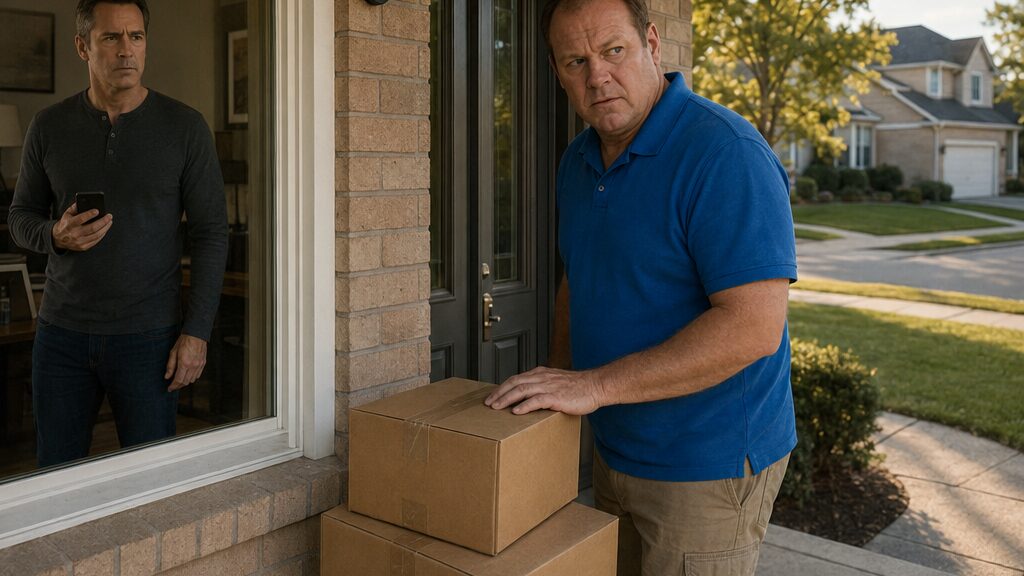
And Mark Campbell was walking up my front steps.
I stopped breathing for a moment.
The live feed was muted. I could hear my air-conditioning vent, the distant hum of my computer, my own chair creak when I leaned closer.
Mark stepped onto the porch.
He did not look surprised.
He did not bend down and study the labels.
He looked toward my front window.
Then over his shoulder at the street.
He picked up the first package.
Paused.
Picked up the second.
And walked away.
The entire thing lasted less than twenty seconds.
I was on my feet before the recording ended.
My first instinct was to go outside.
I could have reached his driveway before he reached his front door.
I imagined calling his name across the street.
I imagined asking what possible explanation he had now.
I imagined the look on his face when I told him there was a camera above my door.
My hand was already on the office doorknob.
Then I stopped.
For eleven weeks, every confrontation had ended the same way.
A question.
An explanation.
A disagreement about what I could prove.
This time I could prove something.
I sat back down.
The camera saved the clip automatically.
I watched it again.
The second viewing felt worse.
The first time, I’d watched the boxes.
The second time, I watched Mark.
He never hesitated over which porch he was standing on.
He didn’t inspect the house number.
He didn’t check the label after picking up either box.
The only thing he checked was whether anyone appeared to be watching him.
I opened the delivery notifications.
Both packages had been delivered nine minutes earlier.
Both tracking records included photographs.
Both photographs showed the boxes on my porch.
I enlarged the first label enough to confirm my surname.
The second showed my street number.
Neither had been misdelivered.
For weeks I’d wanted something definitive.
Now that I had it, the feeling wasn’t relief.
It was dread.
The argument had changed.
So had the consequences.
If I crossed the street now, I wasn’t asking a neighbor to return something accidentally collected.
I was confronting a man I had just watched remove property from my porch.
I thought about calling the police immediately.
Then I heard Mark’s earlier words in my head.
You have been treating me like a thief for two months.
The ugly part was that I had.
At least sometimes.
And during the first incidents, I had been wrong.
That mattered.
It did not excuse what I’d just watched.
But it mattered enough that I didn’t want anger deciding what happened next.
I saved the clip to my computer.
Then I created a folder.
At first I named it Packages.
I stared at the word.
Deleted it.
I renamed the folder with that day’s date.
Inside it I placed the two delivery confirmations, both photographs, and the video.
Then I opened my email and searched backward.
The drill.
The boots.
The birthday tablet.
Garage hardware.
Filter.
Printer cartridges.
Electrical connectors.
Other smaller deliveries I’d almost forgotten because they had eventually come back.
I found screenshots I’d taken without thinking I would ever need them together.
Dates.
Times.
Tracking notices.
Messages to the carrier.
My email to the HOA.
I made a simple spreadsheet.
No accusation column.
No guesses.
Just date, item, delivery status, delivery location if documented, returned or missing.
The list grew longer.
At seven entries, I felt foolish.
At nine, uneasy.
At eleven, I pushed my chair back from the desk.
Eleven incidents.
I checked again because the number seemed too neat.
It stayed eleven.
The first was the drill Mark had returned with a smile.
The second, the boots that had genuinely been delivered to his porch.
Then the birthday package—the first one I could prove had reached my house before disappearing.
After that came a confusing mixture.
Some returned.
Some gone.
Some photographed at my door.
Some without photographs.
The pattern was not clean enough to tell me exactly when accidents stopped and intention began.
But today’s clip was clean.
I clicked it again.
Mark came into frame.
Looked at my window.
Looked down the street.
Two boxes.
No hesitation.
Gone.
My phone rang.
For one sharp second I expected his name.
It was my daughter.
“Are you home?”
“Yeah.”
“Can you check if my package came?”
I looked at the frozen image on my monitor.
Mark’s hands were around one of the boxes.
“What did you order?”
“Phone case. It says delivered.”
I opened the tracking details.
One of the two packages on the video was hers.
The other contained replacement hinges I’d ordered for the garage cabinet.
I closed my eyes.
“Dad?”
“Yeah. I see the delivery.”
“Can you bring it inside?”
I looked across the street through the office window.
Mark’s garage door was down.
“I’ll take care of it.”
She thanked me and hung up.
For several minutes I sat without moving.
Then I printed the spreadsheet.
The printer fed out one page, then a second.
I placed the delivery photos behind them.
Then copies of the emails.
Then the screenshots.
The physical stack looked more serious than the digital folder had.
That bothered me too.
Paper had weight.
It could make uncertainty look like certainty.
So I went through each incident again and marked only what the record actually established.
MISDELIVERED.
RETURNED.
DELIVERED TO MY ADDRESS.
MISSING.
UNKNOWN.
No conclusions.
No words like theft.
No line saying Mark took this.
Except today’s entry.
For that one, I typed:
Video shows Mark removing both packages from front porch.
I read the sentence three times.
It was the first accusation in eleven weeks that did not depend on what either of us believed.
By evening I still had not gone across the street.
I didn’t know whether the boxes were sitting unopened in Mark’s garage or whether he intended to return them tomorrow with another explanation.
That question no longer seemed like the most important one.
I spread all eleven incidents across my desk in chronological order.
Then something about the dates caught my attention.
I moved the HOA email beside them.
The room went very still.
I had spent eleven weeks asking whether Mark’s behavior formed a pattern.
Now, for the first time, I had enough information to ask a different question.
When had the pattern changed?
Chapter 4: The Folder That Changed the Story
The dates split the story in half.
I didn’t see it until I placed the HOA email beside the incident list.
Before the email, the pattern was messy.
The drill had been scanned at Mark’s address. The boots had actually been photographed on his porch. One smaller package had gone missing without any delivery image at all.
After the HOA reminder, the record changed.
Four packages photographed at my house.
Three never returned.
One returned only after I went across the street.
And now two boxes removed from my porch on camera.
I moved the pages around again.
Same result.
The first incidents looked like confusion.
The later ones looked like choices.
I printed the HOA email and slid it into the folder.
That was when I noticed the date.
The first package I could prove had disappeared from my porch—the original birthday gift—had vanished before the HOA complaint.
That complicated everything again.
I sat back.
There was no clean line.
Only a change in frequency and behavior.
By Saturday morning, I had built a timeline that said less than I wanted but more than I had possessed before.
I brought the folder to the HOA management office.
Rachel Williams met me in the small conference room beside the clubhouse. She wore reading glasses on a chain and had the slightly tired expression of someone used to hearing neighbors describe private wars as community emergencies.
She opened the folder.
“Before we start,” she said, “if you’re telling me you believe there’s theft, that’s not really an HOA enforcement matter.”
“I know.”
“Good.”
She turned the first page.
“I don’t want you expecting us to investigate another homeowner.”
“I don’t.”
Rachel looked at me over the glasses.
“Then what do you want?”
It was a fair question.
I had spent eleven weeks collecting answers to questions no one had formally asked.
“I want the record to be accurate,” I said.
She read in silence.
When she reached the camera stills, she slowed down.
One image showed Mark approaching.
One showed him holding both boxes.
One showed the empty porch afterward.
Rachel set the pages down.
“Have you contacted the police?”
“Not yet.”
“Why?”
I almost said I wanted more evidence.
The words sounded ridiculous before I spoke them.
“I wanted to make sure I wasn’t turning mistakes into something they weren’t.”
Rachel glanced back at the first entries.
“These two were misdeliveries?”
“Yes.”
“And you knew that?”
“Eventually.”
“Before you emailed us?”
“About the boots, yes. The drill was confirmed later.”
Rachel closed the folder halfway.
“Jonathan, I’m not saying what happened later is okay.”
“I know.”
“But the board sent a community reminder because you raised the issue. If Mark thought that was directed at him—”
“He did.”
“And after that?”
I pointed to the dates.
“That is what I’m trying to understand.”
Rachel studied them.
Then she said, “Understanding motive and proving conduct are different things.”
“I know.”
“You keep saying that.”
I looked down.
She wasn’t wrong.
The phrase had become another shield.
Rachel reopened the folder.
“The association does have a problem now,” she said. “Not because we can determine whether he took your packages. Because residents are already talking about porch theft. We’ve had two other complaints this month.”
“About Mark?”
“No.”
That surprised me.
“Then why bring them up?”
“Because once people start thinking deliveries aren’t secure, they want the board to solve it.”
She tapped the camera still.
“And boards solve things with rules.”
I left with the folder under my arm and less satisfaction than I’d expected.
Outside the clubhouse, Amy Campbell was coming up the sidewalk carrying an envelope.
She saw me.
Then she saw the folder.
Her pace slowed.
“Jonathan.”
“Hi.”
For a second neither of us moved.
Amy nodded toward the building.
“Board stuff?”
“Just talking to Rachel.”
“About Mark?”
I didn’t answer quickly enough.
She gave a tired little nod.
“Okay.”
“Amy—”
“Did you talk to him before you emailed them?”
The question was quiet.
That made it harder.
“I talked to him about the packages.”
“That’s not what I asked.”
I shifted the folder against my side.
“I didn’t explain everything.”
“Like what?”
“My daughter’s gift.”
Amy’s face changed.
“What gift?”
“The one that disappeared early on.”
She stared at me.
“Mark never told me about that.”
“I didn’t tell him either.”
“Then how was he supposed to know that was the thing that made you stop thinking it was harmless?”
“I wasn’t sure he’d taken it.”
Amy looked toward the parking lot.
“That is kind of the problem, isn’t it?”
I felt irritation rise, then stop.
She wasn’t defending what the camera showed.
She didn’t know about the camera yet.
She was talking about the weeks before it.
“I thought keeping it formal would keep it from getting personal,” I said.
Amy almost smiled.
“You emailed the people who send fines about grass height.”
“That wasn’t what I wanted.”
“No. But you didn’t have to want it.”
She went inside.
I stood there with eleven incidents in my hands and understood, for the first time, that a paper trail could be accurate and still leave out the part where people decided what your actions meant.
Mark confronted me that afternoon.
I was bringing in mail when he crossed the street.
He didn’t step onto my property.
He stopped at the sidewalk.
“You put up a camera.”
“Yes.”
His eyes flicked toward the porch.
“You filming my house now?”
“No. My steps.”
“That lens points straight across.”
“It catches the street.”
“So I’m on it every time I leave home.”
“If you’re in the frame.”
He laughed once.
“There it is.”
“What?”
“Everything’s technically reasonable with you.”
I felt my jaw tighten.
“I watched you take two packages off my porch.”
The change in his face was small.
But it was there.
Not surprise.
Calculation.
He looked at the camera again.
Then back at me.
“You’ve been waiting to say that, haven’t you?”
“I watched the video today.”
“You got audio too?”
“No.”
“Good to know.”
“Mark.”
He stepped backward.
“You want to call somebody, call them.”
“Why did you take them?”
He smiled then, but it wasn’t the smile from the first week.
“You’ve already decided.”
“No. I’m asking you now.”
“Little late for that.”
He turned and crossed the street.
I watched him go.
For once, I had asked directly.
It hadn’t helped.
But the answer he’d refused to give felt almost as important as one he might have.
An hour later, my phone buzzed.
Delivery notification.
One package.
Photographed on my porch.
I opened the camera app immediately.
The box sat beneath the lens.
Across the street, Mark was standing beside his truck.
He wasn’t walking toward my house.
He wasn’t doing anything at all.
He was simply looking at the package.
And this time, he knew I could see him.
Chapter 5: Six Boxes Behind the Garage Door
“Don’t tell me what you think he intended.”
The officer had been sitting at my kitchen table for less than two minutes.
He held a pen over a small notebook and looked at the folder in front of him.
“Tell me what you can show.”
I nodded.
It was strangely relieving.
For weeks I had wanted somebody to confirm my interpretation.
Now the first thing this officer wanted was for me to remove interpretation entirely.
I turned to the first tab.
“This one was misdelivered.”
“Then why is it in here?”
“Because it was part of the pattern I thought I was seeing.”
He made a note.
“And now?”
“Now I know the carrier delivered it to the wrong house.”
He looked up.
“Good. Keep doing that.”
We went through all eleven.
Some entries took seconds.
Some took longer.
When we reached the birthday package, I showed him the delivery photo.
“Do you have footage of anybody removing it?”
“No.”
“So we know it arrived.”
“Yes.”
“And disappeared.”
“Yes.”
“But not who took it.”
“Correct.”
He nodded.
That word—correct—felt better than certainty.
Then we reached the final clip.
The officer watched it once.
Then again without asking me to replay it.
Mark came onto the porch.
Looked toward the window.
Looked toward the street.
Lifted the boxes.
Walked away.
The officer put down the pen.
“How long ago?”
“Two days.”
“You ask for them back?”
“No.”
“Why not?”
“I wanted to stop arguing about what happened.”
He studied me for a moment.
Then he stood.
“Stay here.”
I followed him to the front door anyway.
He crossed the street alone.
Mark answered after the second knock.
From my porch I couldn’t hear the conversation.
I saw Mark look toward my house once.
Then Amy appeared behind him.
The officer spoke for another minute.
Mark stepped outside.
Amy stayed in the doorway.
Then Mark opened the garage.
I stopped leaning against the doorframe.
The officer went inside with him.
For several seconds, nothing happened.
Then the officer reappeared carrying two boxes.
He set them near the driveway.
Mark came behind him with another.
Then another.
Amy did not move.
By the time they were done, six packages sat on the concrete.
I recognized two immediately.
The box from the camera footage.
My daughter’s phone case.
The garage hinges.
A third box was older and dirtier along one corner.
Then I saw the blue strip of packing tape.
I knew that box.
I crossed the street only when the officer waved me over.
“Recognize these?”
I pointed.
“That one. That one. And that.”
My voice caught on the third.
The birthday package was still sealed.
The blue tape ran unbroken across the top.
The shipping label was scuffed but readable.
My daughter’s name.
My address.
The officer photographed each package where it sat.
Three were sealed.
Two had been opened.
One had been retaped.
Mark stood beside the garage with his arms folded.
His face had gone gray.
Amy was still near the door.
She wasn’t crying.
She wasn’t defending him.
She looked as if she were waiting for him to say something that would make the scene smaller.
Nothing he said could.
The officer asked Mark a question I couldn’t hear.
Mark answered.
The officer asked another.
Mark looked at me.
Then he said louder, “The first ones weren’t mine.”
I blinked.
The officer turned slightly.
Mark continued.
“Those first boxes came to my house. Ask him.”
“I already told him that,” I said.
Mark’s mouth tightened.
“Of course you did.”
The officer said, “We’re talking about these.”
Mark looked down at the six packages.
For the first time since I’d known him, he seemed to run out of deflection.
He rubbed one hand over his face.
Then he pointed at me.
“He made it a whole thing.”
Amy closed her eyes.
Mark kept going.
“Notes. Emails. That HOA reminder. People asking me if I was taking his stuff.”
“Nobody told me people asked you,” I said.
“Because I wasn’t going to give you the satisfaction.”
The officer’s voice stayed level.
“So you took packages because you were angry?”
Mark stared at the driveway.
“Some.”
The word landed harder than a denial would have.
“Some?” the officer repeated.
Mark kicked lightly at a crack in the concrete.
“I was going to give them back.”
“You kept six.”
“I said I was going to.”
The officer pointed to the older box.
“How long has that been here?”
Mark didn’t answer.
Amy did.
“Since before the birthday.”
Mark turned toward her.
She stared back.
Something passed between them that had nothing to do with me.
The officer asked, “Why didn’t you return that one?”
Mark looked at the label.
His expression changed.
For the first time, anger drained out of him.
“I saw the kid’s name.”
No one spoke.
“I wasn’t going to open it,” he said.
“That doesn’t explain keeping it,” I said.
“No.”
His voice was quieter.
“It doesn’t.”
The answer unsettled me more than any excuse he’d made.
He hadn’t crossed some final line and opened the gift.
But he’d kept it anyway.
Not because he thought it belonged to him.
Not because he was confused.
Because bringing it back would have required admitting what he’d done.
Pride had become more important than a child’s package.
There was nothing sympathetic about that.
But there was something recognizable in it.
The officer separated the packages by ownership and asked me to verify the tracking numbers.
I did.
One by one.
Only facts.
No motive.
No satisfaction.
When he asked whether I wanted to make a formal complaint regarding the documented removals, I looked at Mark.
He didn’t look back.
“Yes,” I said.
That afternoon, paperwork replaced argument.
The officer explained what would happen next in careful, conditional language. Nothing dramatic. No handcuffs. No crowd.
Just documentation, a complaint, and consequences that would no longer be decided between two front doors.
Amy helped move the recovered boxes to my porch.
At the birthday package, she stopped.
“I didn’t know,” she said.
“I believe you.”
She looked toward Mark’s house.
“I should’ve asked more questions.”
I didn’t tell her I should have too.
The comparison wasn’t equal.
Still, it was true.
That evening my daughter wasn’t home yet, so I placed the birthday box on the dining table.
I didn’t open it.
I wasn’t ready for the story inside that sealed cardboard to become ordinary again.
At six-fifteen, an email arrived from Rachel Williams.
Emergency HOA meeting.
Community package security and street-facing surveillance proposal.
I read the agenda twice.
Attached was a draft rule requiring exterior cameras positioned to capture street and delivery areas.
At the bottom, under the justification section, was a reference to the recent package incident on our street.
My incident.
The thing I had spent eleven weeks trying to prove had just become the reason the HOA wanted every house watching every other one.
Chapter 6: The Rule Written in My Name
My address was on page three.
Not my name.
That somehow made it worse.
The packet described “a documented multi-week package-removal incident involving a residence within the association” and then listed the street number in the background section.
Anyone in the room would know whose house it was.
I sat at the folding table inside the clubhouse with the packet open in front of me while residents filed into metal chairs.
Rachel stood near the board table arranging copies.
When she saw me, she gave a small nod.
“You read it?”
“Yes.”
“We’ll take comments before the vote.”
“Was this already discussed?”
“Informally.”
“Before tonight?”
“People are worried.”
I tapped the proposed rule.
“This isn’t a reminder. You’re requiring cameras.”
“Street-facing coverage of delivery zones.”
“That’s a camera.”
Rachel exhaled.
“Jonathan, your situation is exactly why this came up.”
That was the problem.
By the time the meeting started, nearly every chair was occupied.
A few residents glanced at me.
One neighbor leaned over and said, “Glad they finally caught what was happening.”
I thanked him.
Another said, “We should’ve had cameras years ago.”
I didn’t answer.
Rachel called the meeting to order and summarized the proposal.
Required exterior surveillance.
Minimum field of view.
Retention period.
Maintenance responsibility.
The language was clinical enough to make it sound inevitable.
Then residents started speaking.
A man near the back wanted cameras covering all common sidewalks.
A woman across the aisle said her medication deliveries had been left outside before.
Someone suggested shared access to footage.
That caused the first real argument.
“No way,” another resident said. “You’re not giving the board access to my camera.”
Rachel raised a hand.
“That’s not currently in the proposal.”
“Currently?”
A murmur moved through the room.
I looked at the packet again.
For eleven weeks I had wanted more visibility.
A tracking number.
A photo.
A camera.
A record.
Something that could remove doubt.
Now I was sitting in a room full of people asking for the same thing on a neighborhood scale.
It should have felt validating.
Instead it felt familiar in the wrong way.
A board member asked Rachel about liability.
She explained that the association could not guarantee delivery security, but uniform standards might reduce future disputes and provide evidence.
There was that word.
Evidence.
I looked around the room.
Every person here had become a potential future subject of it.
A neighbor across from me raised his hand.
“What happened to Jonathan proves people lie when there isn’t video.”
Several heads turned toward me.
I felt my shoulders tighten.
He didn’t mean harm.
He was supporting me.
Still, I suddenly understood one small part of what Mark had been angry about.
Not his retaliation.
Not the packages.
The feeling of entering a room after people had already agreed what your name represented.
Rachel moved to the next comment.
A resident objected that a street-facing camera would capture her teenagers coming and going.
Someone else said that was the point.
“Security means seeing what happens.”
“Security for who?”
The room sharpened.
I had seen HOA meetings go bad before. Not spectacularly. Worse than that. They became procedural.
People stopped talking about what they feared and started arguing over subsections.
I looked down at my own address on page three.
I had done the same thing with Mark.
Not the same wrong.
But the same instinct.
Turn discomfort into procedure.
Turn uncertainty into records.
Keep speaking through documents until nobody had to say the difficult sentence directly.
Rachel called a short pause.
She came over to me.
“You’re quiet.”
“I’m listening.”
“You support this, right?”
I looked up.
She seemed genuinely surprised that the answer wasn’t immediate.
“You’re asking me now?”
“You’re the reason most people believe we need it.”
“I thought package theft wasn’t an HOA matter.”
“It isn’t. Security standards are.”
I almost smiled.
Everything could become reasonable if you named it carefully enough.
“Would your camera rule have stopped Mark?”
Rachel hesitated.
“It could deter someone.”
“He knew I had a camera when the last package arrived.”
“That doesn’t mean cameras don’t help.”
“They helped me prove what happened.”
“Exactly.”
“That isn’t the same as preventing it.”
Rachel folded her arms.
“No policy prevents everything.”
I nodded.
Another fair answer.
The meeting resumed.
This time, discussion shifted to enforcement.
What happened if a homeowner refused?
Warning.
Fine.
Possible hearing.
A man who had strongly supported the idea earlier frowned.
“You’re going to fine somebody because they don’t want a camera?”
Rachel said enforcement details could be adjusted.
Someone suggested exemptions.
Someone else objected that exemptions would make the rule useless.
The more they tried to make the policy fair, the more invasive it became.
My phone vibrated.
For one irrational second, I expected another package notification.
Instead it was my daughter.
Are you bringing my old birthday box home from the table or can I open it?
I stared at the message.
The box was still sealed.
Months of suspicion, police paperwork, HOA debate—and inside it was simply the gift I’d bought my daughter.
I typed:
Wait for me.
Then I set the phone down.
Rachel reached the agenda item for homeowner comment.
One resident praised the proposal.
Another asked for stronger language.
A third wanted the board to delay.
Then the woman who had mentioned medication deliveries turned toward me.
“You had the actual problem,” she said. “What do you think?”
The room became quiet.
I hated that kind of silence.
It was the reason I wrote emails instead of knocking on doors.
The reason I saved screenshots instead of saying what I meant.
Rachel looked at me from the board table.
I could have said the policy made sense.
That would have been easy.
It would have sounded grateful.
Safe.
I could have said nothing and let the board decide.
That would have been even easier.
Rachel leaned toward her microphone.
“Jonathan, since this proposal grew directly out of what happened at your address, I think it’s reasonable to ask plainly.”
She paused.
“Do you want the board to pass this rule?”
Every face in the room turned toward me.
Chapter 7: What I Asked the Neighborhood to See
“No.”
The word came out before I could soften it.
Rachel blinked.
A few people shifted in their chairs.
I stood because sitting made it feel like I was answering only her.
“No,” I said again. “I don’t want the board to pass this rule.”
The neighbor who had praised the cameras frowned at me.
“But you’re the one this happened to.”
“I know.”
“Then why wouldn’t you want more protection?”
Because I had wanted exactly that for weeks.
More proof. More coverage. More certainty.
I looked down at the packet, then back at the room.
“The camera helped me prove what one person did. That’s not the same as proving everyone needs to be watched.”
Someone near the back said, “Nobody’s talking about watching people. We’re talking about protecting property.”
I nodded toward the proposal.
“It requires a camera pointed at the street. That means it records people.”
Rachel leaned forward.
“Jonathan, voluntary cameras already exist. The issue is that voluntary coverage leaves gaps.”
“Maybe gaps aren’t always a failure.”
The room went quiet again.
I hated that silence less this time.
I continued.
“Mark took packages from my porch. I have video of that. The police recovered boxes from his garage. Those are facts.”
A woman across the aisle nodded.
“But my next-door neighbor didn’t do that. Neither did the family three houses down. Neither did the teenagers walking home from the bus stop.”
The man in the back folded his arms.
“So we wait until something happens to them?”
“No. We make deliveries harder to take.”
Rachel glanced toward one of the board members.
“How?”
“Parcel lockers at the clubhouse for anyone who wants them. Better carrier instructions. A secured drop area for houses that don’t have garages. Voluntary cameras. Maybe discounted units if enough residents want them.”
Someone said, “That costs money.”
“So does enforcement.”
That drew a few reluctant smiles.
Rachel didn’t smile.
“Those ideas don’t create consistent evidence.”
“No,” I said. “They don’t.”
The answer seemed to surprise her.
I let it sit.
“Evidence mattered in my case. But I think I’ve been confusing evidence with safety.”
That sentence was harder to say than I expected.
I looked at Rachel.
Then at the residents.
“I spent weeks documenting things instead of having one conversation I should’ve had earlier.”
Nobody interrupted.
“The first two package problems were real delivery mistakes. Mark was right about that. Later, he chose to do something wrong. Both things are true.”
A board member asked, “Are you saying the complaint shouldn’t have been filed?”
“No.”
That answer came easily.
“He made choices. He is responsible for them.”
I paused.
“But if we make a rule because one person broke trust, we’re treating every house like we’re waiting for the next Mark.”
The room stayed quiet.
This time it didn’t feel hostile.
It felt undecided.
Rachel took off her glasses.
“You understand that if something similar happens again, people will ask why we didn’t act.”
“Yes.”
“And you’re comfortable with that?”
“No.”
Her eyebrows lifted.
I almost laughed.
“I’m not comfortable with any of it.”
That changed the room more than any confident answer could have.
One resident raised her hand.
“What if cameras are optional, but the association negotiates a group rate?”
Another asked whether parcel lockers could be installed without changing dues.
The woman worried about medication deliveries asked about a secure refrigerated compartment.
The discussion moved.
Not smoothly.
Not quickly.
But away from mandatory surveillance.
The board postponed the original vote.
Two weeks later, a revised package-security plan came through.
Voluntary exterior cameras.
No required street-facing angle.
No HOA access to private footage without owner consent or lawful request.
A small parcel-locker installation near the clubhouse.
Updated delivery instructions for residents who opted in.
A one-year review instead of permanent enforcement language.
The proposal passed.
There was no applause.
People gathered their papers and went home.
That suited me.
Mark did not attend either meeting.
I saw him occasionally after that.
He stopped crossing the street.
If we were both getting mail, one of us waited a few extra seconds.
The police complaint continued through the process the officer had explained. There were interviews, records, and consequences that no longer depended on whether Mark and I could stand at a front door and agree on what had happened.
Amy stayed polite.
Not friendly.
Polite was enough.
One afternoon she caught me near the mailbox.
“He’s angry at me,” she said.
I didn’t ask why.
“For telling the officer about the birthday box.”
I looked toward their house.
“You told the truth.”
“I should’ve done it earlier.”
There were a dozen things I could have said.
Instead I said, “Earlier is easy to see afterward.”
Amy looked at me for a moment.
Then nodded.
That was as close as we ever came to discussing it again.
A month after the HOA meeting, I finally carried the recovered birthday package to my daughter’s room.
It was still sealed.
The blue tape had dulled where dust had settled across it in Mark’s garage.
She looked from the box to me.
“This is the original one?”
“Yeah.”
“The one that disappeared?”
“Yeah.”
She turned it over.
Her own name was still on the label.
“You never opened it?”
“It wasn’t mine to open.”
She smiled.
“You bought it.”
“Still yours.”
She pulled at the blue strip.
For a second, neither of us spoke.
Then the tape tore.
The sound was ordinary.
That surprised me.
After everything attached to that box—tracking numbers, suspicion, anger, police photographs, board packets—it opened like any other package.
Inside was the drawing tablet I’d ordered months earlier.
My daughter lifted it out.
“I already have the replacement.”
“I know.”
“What should I do with this one?”
I leaned against the doorway.
“Your call.”
She thought about it.
“I could give it to the art program at school.”
“That’s a good idea.”
She set the tablet back into the box.
Not as evidence.
Not as proof.
Just something useful again.
Later that evening, I stood on the porch and adjusted the camera.
Not outward.
Down.
I narrowed the angle until it covered the steps, the door, and the delivery area without taking in most of the street.
The image on my phone changed.
Less neighborhood.
More home.
Across the road, Mark’s garage was almost entirely outside the frame.
I saved the setting.
Then I placed the empty shipping box beside the recycling bin.
For eleven weeks, I had thought the hardest part would be proving what happened.
It wasn’t.
The hardest part came after proof—deciding what the truth gave me the right to do.
The story has ended.