The HOA Took Her Two Deeded Parking Spaces—Then One Saturday Forced Everyone to Read the Fine Print
Chapter 1: The Saturday Her Parking Space Vanished
Sarah Lewis slowed so sharply at the entrance to Maplewood Commons that the grocery bags on her passenger seat tipped forward.
Two unfamiliar vehicles sat in spaces 14 and 15.
A silver SUV occupied 14, the spot directly across from her front walkway. A dark sedan filled 15 beside it. Beyond them, the clubhouse doors stood open while people carried foil-covered trays, folding chairs, and balloons inside.
Sarah kept her foot on the brake.
It was not the first time someone had taken one of her spaces. For the past several Saturdays, she had returned from errands to find a visitor parked there. Usually one space remained open. She would use it, tell herself the problem was temporary, and wait for the offending car to leave.
Today both were taken.
She drove past them and found an unmarked space near the far end of the lot.
By the time she carried her groceries back, the handles had cut red lines into her fingers. A family crossed in front of her from the clubhouse, laughing as a child dragged a balloon along the pavement.
Sarah set the bags inside her door, then came back out.
The silver SUV sat directly over the white painted number 14.
Something else bothered her.
She looked at the narrow landscaped strip behind the spaces.
The blue reserved signs were gone.
Sarah walked closer.
When she had bought the unit, each space had a small blue-and-white marker mounted to a metal post. RESERVED UNIT 214, the signs had said. She had never thought much about them. They were simply part of the place, like the mailbox key and the balcony railing.
Now both posts were bare.
She ran a finger over the mounting plate behind space 14.
There were pale scratches around the bolt holes. The exposed metal was brighter than the weathered surface around it.
Fresh.
A woman carrying a casserole dish came out of the clubhouse.
“Excuse me,” Sarah said. “Do you know whose SUV this is?”
The woman glanced toward space 14.
“No idea.”
“These are reserved spaces.”
The woman shifted the dish against her hip. “I thought this whole row was overflow now.”
Sarah looked at her.
“Overflow for what?”
“The clubhouse. That’s what they told us.”
“Who told you?”
The woman hesitated, apparently realizing the conversation had become more serious than she expected.
“The HOA, I guess. There was something about parking being tight on weekends.”
Sarah stared past her at the open clubhouse doors.
Music drifted out faintly. Someone inside applauded at something she could not see.
“When did that start?”
“A month ago? Maybe more.”
Sarah thanked her.
The woman gave an awkward smile and hurried inside.
Sarah stood beside the bare post.
A month.
She had noticed the parking problem for weeks, but she had assumed careless guests were ignoring the signs.
She had never considered that someone might have removed the signs on purpose.
At home, she called the property manager.
The call went to voicemail.
She left a short message, then opened her laptop at the kitchen table. She found the management portal, typed a neutral subject line, deleted it, and typed another.
Parking question.
Too weak.
Reserved parking spaces 14 and 15.
She stared at the words.
At work, Sarah managed scheduling problems for a distribution company. She could tell a vendor in three sentences that a missed delivery window would cost them the contract.
At home, she rewrote the first paragraph four times because she did not want to sound accusatory.
She settled on facts.
The reserved markers were missing. Visitors had been using the spaces. She wanted to know whether maintenance had removed the signs and, if so, why.
Before sending, she attached two photographs.
One showed the silver SUV covering the painted 14.
The other showed the empty mounting plate.
Her phone rang twenty minutes later.
It was the property manager.
“I checked the work orders,” the manager said. “Maintenance didn’t remove those.”
Sarah looked through the blinds at the parking lot.
“So who did?”
“I don’t have that information.”
“Could a board member have ordered it?”
A pause.
“You’d need to ask the board.”
Sarah leaned back in her chair.
“Are spaces 14 and 15 being used as clubhouse overflow?”
Another pause, longer this time.
“I think there was a parking adjustment.”
“What does that mean?”
“I don’t want to give you the wrong answer.”
Sarah almost laughed.
Someone had removed two signs attached to property she had been using for years, but everybody suddenly seemed afraid of giving the wrong answer.
“Who should I contact?”
“Jeffrey Clark. Board president.”
Sarah wrote down the name, though she already knew it. Jeffrey lived three buildings over and had served on the board for years. He was the kind of man who remembered recycling dates and greeted everyone at annual meetings as if he were hosting them personally.
She had never had a problem with him.
That made the empty signposts stranger.
When Sarah went outside again near sunset, the silver SUV was gone.
Space 14 was empty.
She could have moved her car closer to home.
Instead, she stood on the painted number and looked down.
For the first time, the white numerals seemed less like identification than a question.
Inside, she opened the folder she had received at closing in 2021.
She had not looked through it since moving in.
Most of the papers meant little to her now: insurance disclosures, association documents, inspection pages, financing forms. She flipped through them until she found the recorded deed.
Behind it was a stapled exhibit.
Sarah almost skipped over it.
Then she saw two lines near the bottom.
Parking Space No. 14.
Parking Space No. 15.
She read them twice.
The spaces were not mentioned as privileges.
They were listed with the property itself.
Sarah placed the document flat on the table and reached for her phone.
Chapter 2: Eleven Days for One Careful Answer
On the eleventh morning, Sarah opened her inbox before getting out of bed.
Nothing from Jeffrey Clark.
She had sent him the first message the same Saturday she found the closing documents. The next morning, she sent a photograph of the missing signs. Three days later, she forwarded the exchange through the management portal so there would be a second record.
Jeffrey had acknowledged none of it.
Sarah resisted the urge to send another message.
At work she answered shipment delays, corrected invoices, and scheduled a replacement carrier after one failed to arrive. Every problem had a process.
At Maplewood Commons, apparently, silence counted as a process.
The following Saturday, she returned from the pharmacy and found space 15 occupied by a minivan.
Space 14 was open.
She parked there.
As she stepped out, a man crossing toward the clubhouse pointed at her car.
“You can park there?”
Sarah closed the door.
“I own this space.”
He looked confused.
“I thought these were open now.”
“So did somebody tell you that?”
“There was a notice at the clubhouse.”
“What notice?”
He shrugged. “Something about overflow parking.”
Sarah watched him continue toward the entrance.
She walked to the clubhouse instead of going home.
A corkboard beside the lobby held pool rules, committee reminders, landscaping schedules, and a printed sheet about weekend event parking. The wording was careful: residents and guests were encouraged to use designated overflow areas near the clubhouse when primary visitor spaces were full.
No space numbers appeared.
Nothing said 14 or 15.
That ambiguity irritated Sarah more than an outright statement would have.
It allowed everyone to claim something different.
She photographed the board.
That afternoon, Jeffrey finally replied.
Sarah read the email at her kitchen table.
He apologized for the delay. The board had been addressing several community issues. Due to weekend congestion, he explained, selected reserved spaces near the clubhouse had been temporarily incorporated into an overflow arrangement.
Sarah stopped reading.
Selected reserved spaces.
Not accidentally used.
Not misunderstood.
Selected.
She continued.
The adjustment was intended to reduce traffic backups and maintain safer access near the clubhouse entrance. The board believed the affected spaces were not consistently occupied during peak weekend periods. The arrangement would remain in effect while longer-term parking options were reviewed.
Sarah read the message again.
There was no question anywhere in it.
No mention of asking owners.
No reference to deeds.
No end date.
She replied with the closing exhibit attached.
Spaces 14 and 15 are included in my recorded property documents, she wrote. Please confirm the board’s authority to remove the reserved signs and make these spaces available for general use without my consent.
She added one more sentence, deleted it, then restored it.
I am requesting that the signs be replaced.
Jeffrey called the next afternoon.
His tone was friendly enough to make Sarah feel unreasonable before either of them had said much.
“I wanted to avoid a long email chain,” he said.
“I’m fine with talking.”
“We’ve had a real problem on Saturdays.”
“I understand that.”
“Last spring we had cars stacked near the fire lane during a graduation party. People were stopping behind other vehicles. We got complaints from several buildings.”
Sarah looked down at the deed exhibit on her desk.
“So the board opened my spaces?”
“We opened a small number of underused spaces temporarily.”
“Mine.”
“And a few others.”
“Did you ask the owners?”
Jeffrey sighed.
“We were trying to address a community-wide problem quickly.”
“That isn’t an answer.”
His voice tightened slightly.
“No, Sarah, individual permission wasn’t collected first.”
She waited.
There it was.
A simple sentence she had spent almost two weeks trying to obtain.
Jeffrey continued before she could respond.
“The understanding was that this would be a limited accommodation. You live alone, correct?”
Sarah’s fingers went still around the phone.
“Yes.”
“And you generally have one vehicle.”
“I own two spaces.”
“I understand.”
“No. You understand that I use one car. That’s different.”
A silence followed.
Sarah surprised herself with the sentence.
Usually she would have softened it.
Jeffrey changed direction.
“There are fifty-eight units here and only twelve marked visitor spaces near the clubhouse. When residents book events, they expect their guests to have somewhere to park. We’re trying to balance everybody’s needs.”
“Then why not ask me?”
“We should have communicated better.”
Again, careful wording.
Not we should have asked.
Not we should not have done it.
Communicated better.
Sarah looked through the window toward the lot.
A blue sedan pulled into space 15.
“Are you replacing the signs?”
“Not while the temporary parking plan is active.”
“When does it end?”
“We don’t have a fixed date.”
“Then it isn’t temporary.”
“Sarah.”
“I’m asking a reasonable question.”
“And I’m giving you the board’s position.”
She heard something in his voice then—not anger exactly, but impatience with the fact that she had refused the first explanation.
Jeffrey lowered his tone.
“We can revisit this when we review the parking plan next quarter. For now, the board considers the matter settled.”
The words landed harder than if he had shouted.
Sarah thanked him and ended the call.
For several seconds she remained at the desk.
Then she opened the email he had sent and saved a copy outside the HOA portal.
She created a folder.
She added the photographs.
She added the closing exhibit.
She wrote the date of the phone call at the top of a blank document and typed one sentence beneath it:
Board president confirmed permission from owners was not obtained.
Sarah stopped.
Until that moment, she had been trying to persuade the HOA to give her spaces back.
Now she had a different question.
Whether the HOA had ever had the right to take them.
Chapter 3: What the Deed Said Beneath the Staple
The county records clerk turned Sarah’s deed sideways beneath the desk lamp.
“There should be another recorded page behind this.”
Sarah leaned closer.
“What kind of page?”
“Exhibit map, probably.”
The clerk clicked through the property record on the monitor, then smiled faintly.
“There.”
A scanned drawing appeared.
Sarah recognized the shape of her building, but little else. Thin boundary lines divided units, common areas, drive lanes, and parking bays. Along one edge of the drawing were numbered rectangles.
The clerk enlarged the image.
Fourteen.
Fifteen.
Both were connected by notation to Sarah’s unit.
She had seen a smaller copy in her closing packet, but this version contained recording marks and references she had never paid attention to.
“Can I get a certified copy?”
“Sure.”
Sarah paid the fee and waited while the clerk printed the pages.
She felt no triumph.
Mostly she felt embarrassed that she had owned the condo for five years without understanding exactly what she owned.
At the time of purchase, parking had seemed like the easiest part of the transaction. The seller had pointed from the balcony.
Those two are yours.
The reserved signs had been there.
Sarah had believed that was enough.
Christine Allen did not share her assumptions.
The real-estate attorney’s office occupied two rooms above a small insurance agency. Christine placed the county copy beside Sarah’s HOA documents and read for several minutes without speaking.
Sarah filled the silence too quickly.
“I’m not trying to sue anyone.”
Christine looked up.
“I didn’t ask if you were.”
“I just want the spaces restored.”
“That’s a better place to start.”
Christine returned to the documents.
Sarah watched her trace one paragraph with the end of a pen.
Finally Christine pushed the recorded exhibit toward her.
“These are not ordinary assigned spaces.”
“That’s what I thought.”
“Thought and recorded are different.”
Sarah gave a small, uncomfortable laugh.
Christine tapped the page.
“This document treats 14 and 15 as appurtenant to your unit. In plain English, they travel with the property. The association can regulate common areas. It can enforce rules affecting the community. But casually converting specifically deeded parking into general-use parking is a different question.”
“So they can’t do this.”
Christine leaned back.
“I’m saying I would want the association to identify the authority they believe allows them to do it.”
Sarah frowned.
“That sounds less certain than I expected.”
“Property disputes usually do.”
Christine asked to see Jeffrey’s email.
Sarah handed over the printed copy.
The attorney read the paragraph about “selected reserved spaces,” then the sentence describing the measure as temporary.
“Did they send you any notice before removing the signs?”
“No.”
“Board minutes?”
“No.”
“Amendment?”
“No.”
“Compensation?”
Sarah shook her head.
Christine nodded once.
“That helps you.”
For the first time all week, something unclenched in Sarah’s shoulders.
Then Christine continued.
“But I want you to think about something else before you decide what comes next.”
Sarah waited.
“If the association told residents those spaces were open, the people parking there may not know they’re trespassing on anything.”
“They can see the numbers.”
“Numbers don’t tell them what you just spent a morning at the county office confirming.”
Sarah looked down.
Christine was right, and Sarah disliked that immediately.
“The signs were there before.”
“But they aren’t there now.”
“Because the HOA removed them.”
“Exactly.”
Christine slid Jeffrey’s email back.
“You have two problems. One is ownership. The other is notice.”
Sarah folded her hands.
“What would you do?”
“I would document your ownership, demand restoration in writing, and give them a reasonable deadline. If they refuse, then you consider enforcement.”
“Towing?”
“Potentially. If permitted under your documents and local requirements, and if proper notice is posted.”
Sarah pictured a tow truck lifting one of the cars that had occupied her spaces every weekend.
The image produced an unexpected flash of satisfaction.
Then she thought of the man outside the clubhouse saying he had been told the row was open.
Christine seemed to read something in her expression.
“Being legally right doesn’t mean every next step is automatically wise.”
“I know.”
“Do you?”
Sarah looked at her.
Christine’s voice remained neutral.
“I’m not criticizing you. I’m telling you that once you enforce a boundary publicly, people rarely experience the paperwork behind it. They experience the consequence.”
That sentence stayed with Sarah on the drive home.
At Maplewood Commons, space 14 was occupied again.
This time by a white crossover.
Sarah parked in 15.
A paper cup sat near the curb. Someone had left a folded stroller beside the clubhouse entrance.
Everything looked ordinary.
That was part of the problem.
The change had become ordinary.
Sarah took another photograph, then went inside and drafted a formal letter.
She attached the certified property exhibit.
She referenced Jeffrey’s written admission that the board had temporarily opened reserved spaces.
She requested restoration of the signs within seven days.
Then she added a paragraph she almost removed:
If the spaces are not restored and unauthorized parking continues after appropriate notice, I will pursue lawful enforcement of my property rights, including towing where permitted.
Sarah read it twice.
The wording made her uncomfortable.
That was precisely why she kept it.
She emailed the letter to Jeffrey, the property manager, and the HOA’s general board address.
Then she printed a copy and placed it in the folder with the photographs.
Five minutes later, her phone displayed a new email notification.
For an instant she expected Jeffrey.
Instead it was an automatic confirmation from the association portal.
Message received.
Sarah looked through the blinds.
The white crossover still covered number 14.
For years she had assumed the painted number, the reserved sign, and the deed all said the same thing loudly enough that she never needed to.
Now the sign was gone.
The deed was sitting on her table.
And for the first time, Sarah had put in writing what would happen if the board refused to listen.
Chapter 4: The Warning Nobody Thought She Would Use
The tow-warning placard disappeared before Sarah finished her workday.
She had fastened it beside space 14 at seven that morning, following the towing company’s placement instructions and the notice language Christine had reviewed. By six that evening, only two plastic ties remained on the bare post.
Sarah stood in the parking lot with her laptop bag still over one shoulder.
The ties had been cut cleanly.
She photographed them.
Then she photographed the painted 14, the empty post, and the wider row leading toward the clubhouse.
A man loading sports equipment into his trunk glanced over.
“Something wrong?”
“Someone removed a notice.”
He looked at the post. “Parking notice?”
“Yes.”
“For these spaces?”
Sarah nodded.
He gave her the uncertain expression she had started seeing often.
“I thought those were clubhouse overflow.”
“They aren’t.”
He shut his trunk.
“Well, somebody should probably tell people.”
The comment followed Sarah inside.
Somebody should probably tell people.
She had told the property manager. She had told Jeffrey. She had sent the deed. She had sent the certified exhibit. She had given a deadline.
Yet the people actually parking in the spaces still seemed to know none of it.
Sarah replaced the placard the next morning, this time using a weatherproof mounting board the towing company provided.
By lunchtime Jeffrey emailed.
Please remove unauthorized signage from association common-area fixtures.
Sarah read the sentence twice.
She replied with the property exhibit attached again.
The notice is posted adjacent to deeded parking spaces 14 and 15 in preparation for lawful parking enforcement. If the board disputes my ownership or authority, please identify the governing provision you are relying on.
Jeffrey responded twenty minutes later.
We need to discuss this before the weekend.
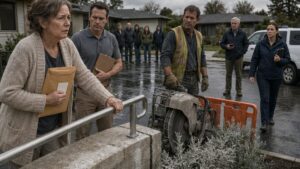
That evening, Sarah attended an informal board work session in the clubhouse meeting room.
Jeffrey sat at the end of a folding table with two board members and Daniel Roberts, the HOA treasurer. Daniel was a quiet man Sarah had seen at annual meetings but never spoken to for more than a greeting.
Jeffrey had printed Sarah’s letter.
“We’re not disputing that your closing documents reference the spaces,” he began.
Sarah set her folder on the table.
“They don’t reference them. They deed them with the unit.”
Jeffrey pressed his lips together.
“We can argue terminology all night.”
“No, we can verify it.”
One board member shifted in her chair.
Jeffrey leaned forward.
“What I’m trying to explain is that we have an operational problem. We had an event last spring where cars blocked emergency access. We had complaints from families, complaints from the fire-safety inspection, complaints from residents whose drive lanes were partially obstructed.”
Sarah had not heard about the inspection before.
Jeffrey continued.
“The board made a temporary decision to open the nearest underused parking. Was every procedural detail handled perfectly? Probably not. But we were trying to prevent another unsafe situation.”
For the first time, Sarah understood why he sounded offended whenever she called the decision careless.
He did not believe it had been careless.
He believed it had been practical.
“That still doesn’t give you my property,” she said.
Jeffrey rubbed one hand across the edge of the table.
“Sarah, you use one car.”
“That is not permission.”
“No one is saying it is.”
“You removed signs from two spaces I own and directed people toward them.”
“We directed people toward overflow areas.”
“Which included mine.”
Daniel moved slightly.
It was a small motion, but Sarah noticed.
Jeffrey did too.
“What?” Jeffrey asked him.
Daniel looked at the tabletop.
“Nothing.”
“Daniel.”
The treasurer exhaled.
“We did discuss whether some of those spaces were individually owned.”
The room went quiet.
Sarah turned toward him.
“When?”
Daniel’s eyes moved to Jeffrey before returning to her.
“Before the signs were removed.”
Sarah felt something cold settle behind her ribs.
Jeffrey interrupted.
“We discussed a lot of things.”
Daniel gave a short nod. “That was one of them.”
“What exactly did you say?” Sarah asked.
Daniel hesitated.
“I said we should verify the property documents before opening that row.”
Jeffrey sat back.
“And we were trying to handle a safety issue before the next event.”
“That isn’t what she asked,” Daniel said.
It was the first time his voice carried any edge.
Sarah looked at Jeffrey.
“You knew there might be an ownership problem.”
“I knew there was a question.”
“And you removed the signs anyway.”
“We believed the parking designations were subject to association control.”
“Did you verify that?”
Jeffrey did not answer immediately.
That was enough.
Sarah closed her folder.
Until that moment she had imagined the board had made a sloppy mistake and then become defensive about correcting it.
Now she understood there had been a warning before the mistake.
Jeffrey’s voice softened.
“I’m asking you not to escalate this during the community event Saturday.”
“The deadline in my letter expires Friday.”
“We can continue talking.”
“We’ve been talking.”
“Towing neighbors’ cars is going to create hostility.”
Sarah thought of her old workplace, years earlier, when she had challenged a scheduling practice that left one team routinely covering another’s missed shifts. She had been right. She had also spent months eating lunch alone after coworkers decided she had made everyone’s life harder.
The memory made her want to compromise.
Jeffrey must have seen it.
“We’ll revisit the policy after the weekend,” he said. “Just give us some time.”
Sarah looked at Daniel.
He stared at his folded hands.
Time was what she had already given them.
Weeks of it.
Time had not restored the signs. It had made the new arrangement feel normal.
“I’m not asking permission anymore,” she said.
Jeffrey’s expression changed.
Not dramatically.
Just enough.
Sarah stood.
“If the board restores both signs and stops directing visitors to my spaces before Saturday, nothing gets towed.”
“And if we don’t?”
“You already have the notice.”
She left before she could soften the sentence.
Friday afternoon, the towing company sent her confirmation that the required posting period had been satisfied.
The operator reminded her that they would still contact her before removing any vehicle from the two spaces.
Sarah stared at the message.
She could cancel the arrangement with one phone call.
At five thirty, she drove past the clubhouse.
The warning placard was still there.
The reserved signs were not.
Jeffrey had made his choice.
Saturday enforcement would begin at noon.
Chapter 5: When Space Fourteen Lifted Off the Ground
Sarah’s phone rang at 12:47 Saturday afternoon.
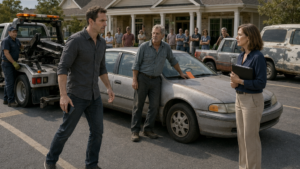
Through her front window, she could already see the yellow tow truck backing toward space 14.
Jeffrey Clark was walking across the lot toward it.
Sarah answered.
“This is Sarah.”
The tow operator’s voice came through over a diesel engine.
“We’ve got three vehicles in the authorized spaces and adjacent restricted area. I need confirmation before we hook the first one.”
Sarah looked down at the folder on her kitchen counter.
Certified exhibit.
Photographs.
Notice dates.
Jeffrey’s emails.
Everything was exactly where it was supposed to be.
Her stomach was not.
“Which one are you starting with?”
“Gray crossover in fourteen.”
Sarah could see it from the window.
A woman and a teenage boy had arrived in it earlier. Sarah had watched them carry a gift bag toward the clubhouse.
She knew because she had noticed every vehicle that entered the row that morning.
Jeffrey reached the tow truck.
Even through the glass, Sarah could tell he was arguing.
The operator spoke again.
“Ma’am?”
For three weeks Sarah had wanted one thing: for people to stop treating her spaces as if they belonged to whoever needed them most.
Now all she had to do was say yes.
She walked outside.
Jeffrey spotted her immediately.
“Sarah.”
The tow operator held his phone at his side.
“You don’t need to do this,” Jeffrey said.
Sarah stopped beside the painted edge of space 15.
“The notice period ended.”
“I’m asking you to hold off.”
“You had a week.”
“This is exactly the kind of escalation I was talking about.”
Behind him, the tow mechanism slid under the gray crossover.
People were beginning to emerge from the clubhouse.
A few stood on the walkway with paper plates in their hands.
Sarah hated that there was an audience.
She hated even more that part of her wanted one.
Not for applause.
For proof that she had finally stopped being ignored.
Jeffrey lowered his voice.
“There are families in there.”
“So?”
“So you’re going to strand somebody over a parking disagreement.”
“It stopped being a parking disagreement when you decided my deed didn’t matter.”
“Sarah, think about how this is going to look.”
There it was.
The question that had controlled her for years.
How will this look?
At work.
In meetings.
With neighbors.
When she objected.
When she refused.
When she stopped smiling.
She looked at the operator.
“You have authorization.”
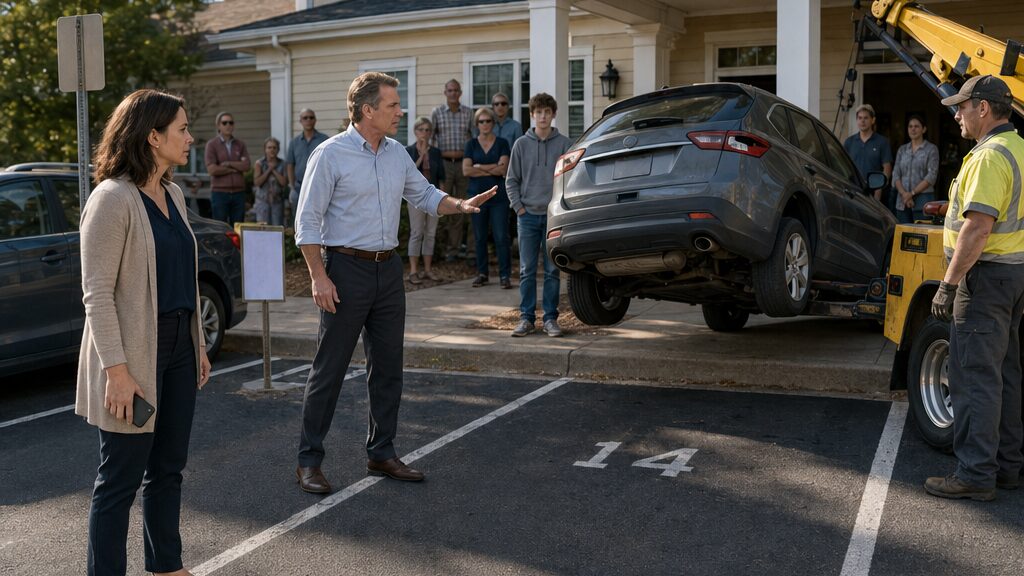
The hydraulic system engaged.
The rear of the crossover rose first.
A murmur moved through the people outside the clubhouse.
Then the front wheels cleared the pavement.
For one clean second, the painted white number 14 was completely visible beneath the suspended car.
Sarah stared at it.
She expected triumph.
Instead she felt something quieter.
Relief, perhaps.
The number had not changed.
The space had not changed.
Only whether anyone was required to respect it.
A woman pushed through the clubhouse doors.
“What are you doing?”
The teenage boy followed her.
The woman hurried toward the tow truck.
“That’s my car.”
The operator stepped back from the controls.
“You’ll need to speak with the property owner.”
The woman turned.
Jeffrey pointed, reluctantly, toward Sarah.
The woman stared at her.
“You’re having my car towed?”
“You’re parked in a private deeded space.”
“No, I’m not.”
“You’re in fourteen.”
“They told us to park here.”
Sarah glanced at Jeffrey.
He shook his head slightly.
“Kimberly,” he said, “let’s keep this calm.”
The woman—Kimberly—looked between them.
“Keep what calm? My car is in the air.”
Her son stood several feet away, red-faced and silent.
Sarah felt the crowd tightening around the scene.
“The space belongs to my unit,” she said. “There’s been a tow warning posted all week.”
Kimberly pointed toward the clubhouse.
“There was nothing about towing when we booked the room.”
“The sign is right there.”
“That sign showed up a few days ago. We were told this row was overflow.”
Jeffrey stepped closer.
“The association has been reviewing the parking arrangement.”
Kimberly stared at him.
“Reviewing what? Your own instructions?”
She opened her purse and pulled out a folded sheet.
Sarah saw the Maplewood Commons header before Kimberly held it out.
“This came with the clubhouse rental packet.”
Jeffrey’s expression changed.
Only slightly.
But Sarah saw it.
Kimberly unfolded the page.
A simple parking diagram occupied the bottom half.
Visitor spaces were shaded.
So was the row containing 14 and 15.
No numbers appeared on the diagram.
No ownership distinction.
Sarah took the sheet.
For weeks she had assumed anyone continuing to park there after the warning was choosing to ignore her.
Kimberly had made a different choice.
She had followed directions.
“When did you get this?” Sarah asked.
“Three weeks ago.”
Before Sarah’s formal tow notice.
Before the deadline.
The tow operator waited.
Kimberly’s voice trembled with anger now.
“I have to pick up my mother after this. My son has work tonight. Where exactly is my car going?”
The operator named the impound lot.
“Six miles?”
“Yes, ma’am.”
“And what does it cost?”
He told her the base recovery amount.
“One hundred eighty-five dollars?”
Sarah looked back at the crossover.
A few minutes earlier, seeing its wheels leave the pavement had felt like the physical proof she had been waiting for.
Now the same image looked different.
Jeffrey spoke quietly beside her.
“Stop the tow.”
Sarah turned toward him.
He looked almost relieved that Kimberly’s document had given him the argument he needed.
“You knew people were being given this?” Sarah asked.
“The rental materials haven’t all been updated.”
“That isn’t what I asked.”
“Sarah, this is not the place.”
“No. This is exactly the place, because her car is hanging over my property because your packet told her she could park here.”
Kimberly looked from one to the other.
“So whose mistake am I paying for?”
Nobody answered.
The question was worse than any accusation.
Sarah could release the vehicle.
But two others still occupied the spaces. The board had refused every earlier opportunity to correct the policy. If she backed down now, Jeffrey could treat the entire enforcement effort as proof that she never intended to follow through.
If she continued, Kimberly would pay for instructions she had reasonably trusted.
Christine’s warning returned to her.
People do not experience the paperwork behind enforcement. They experience the consequence.
Sarah handed Kimberly the parking sheet.
“The tow is already authorized,” she said.
Kimberly’s face hardened.
Sarah forced herself to continue.
“But keep that document.”
“You think that helps me?”
“I think it matters.”
“To who?”
Sarah looked at Jeffrey.
“To the board.”
The crossover began moving toward the truck.
Kimberly stepped back, furious.
“If I have to pay to get that car back, I’m bringing the receipt to you.”
Sarah nodded.
“You should.”
The answer seemed to surprise both of them.
Jeffrey did not speak again until the tow truck pulled away.
Then he faced Sarah.
“We’re calling an emergency board meeting.”
“When?”
“Wednesday.”
Sarah watched Kimberly walk toward the clubhouse with her son, the folded parking sheet clenched in one hand.
For weeks Sarah had believed the first tow would mark the moment the problem became simple.
Her space.
Their car.
Her right to remove it.
Instead, as the truck disappeared beyond the entrance, the conflict became more complicated than it had ever been.
Chapter 6: The Meeting Where Convenience Became a Record
Kimberly Martinez placed the tow receipt in the center of the board table before Jeffrey called the meeting to order.
The paper made almost no sound.
Still, every person in the room looked at it.
Sarah sat two chairs away with her folder closed in front of her.
The amount at the bottom of the receipt was circled.
$185.
Kimberly did not look at Sarah.
Her attention stayed on Jeffrey.
“I want to know who authorized a parking map that sent me into a tow zone.”
The clubhouse meeting room was fuller than Sarah had ever seen it. Folding chairs lined the back wall. Several residents who had attended Saturday’s event sat together. The property manager stood near the door.
Jeffrey adjusted the stack of papers in front of him.
“We’re going to address Saturday’s incident in an orderly way.”
Kimberly leaned back.
“You had four days to get orderly.”
One of the board members cleared her throat.
Jeffrey continued.
“The purpose tonight is to discuss parking enforcement, communication failures, and a path forward.”
Sarah noticed what he had not said.
Ownership.
Jeffrey turned toward her.
“Sarah, I think everyone understands that you have concerns regarding spaces 14 and 15.”
“They aren’t concerns.”
His jaw tightened.
Sarah opened her folder and removed the certified property exhibit.
“They’re deeded spaces.”
Several residents shifted to see the document.
Jeffrey held up a hand.
“No one is trying to relitigate that point tonight.”
Sarah almost smiled.
Three weeks earlier, he had told her they could argue terminology all night.
Now that the room was full, he preferred the issue settled.
Jeffrey continued.
“The immediate problem is that private towing was initiated during a community event, resulting in significant disruption and unexpected expense to residents.”
Kimberly gave a sharp laugh.
“Private towing?”
Sarah looked at her.
Kimberly finally returned the glance.
There was still anger there, but it was no longer aimed in only one direction.
Sarah spoke.
“The towing happened after written notice, after the board received my deed, after the deadline passed, and after someone removed the first warning placard.”
“Which we have no evidence was removed by the board,” Jeffrey said.
“I didn’t say the board removed it.”
“That implication has been made.”
Daniel Roberts shifted at the table.
Sarah saw it and remembered the work session.
She turned toward him.
“Daniel, did the board know before removing the reserved signs that some spaces in that row might be individually deeded?”
Jeffrey’s head snapped toward him.
“Sarah, we’re not conducting cross-examination.”
“No,” Daniel said quietly.
Everyone looked at him.
He swallowed.
“No, she isn’t.”
Jeffrey’s voice hardened.
“Daniel.”
The treasurer kept his eyes on Sarah.
“We discussed it.”
A resident in the back asked, “Discussed what?”
Daniel rubbed his thumb along the edge of his notebook.
“The parking capacity problem started last spring after an event blocked part of the fire lane. We had to find more spaces before the summer reservation calendar filled up.”
“That’s already been explained,” Jeffrey said.
Daniel nodded.
“But when the clubhouse row was proposed, I said we should verify whether all of those spaces were association-controlled.”
Sarah felt the room change.
Not dramatically.
No gasps.
No applause.
Just people becoming still.
“Why?” Kimberly asked.
“Because I remembered older closing documents showing some numbered spaces attached to units.”
Jeffrey interrupted.
“And we believed the governing documents gave us flexibility to manage parking for safety.”
Daniel looked at him.
“We didn’t verify that.”
The sentence landed cleanly.
Jeffrey stared back.
Daniel’s voice remained low.
“I said we should.”
One of the unnamed board members spoke.
“We were facing complaints every weekend. People were double-parking. Residents were threatening to stop renting the clubhouse.”
Daniel nodded again.
“I know.”
“Then don’t make it sound like nobody had a reason.”
“I’m not.”
That answer mattered to Sarah.
Daniel was not rescuing her.
He was admitting that the board had faced a real problem and had still chosen the wrong shortcut.
Jeffrey leaned forward.
“The association was trying to manage limited parking without spending tens of thousands of dollars we do not have. If we closed reservations, residents would complain. If we raised dues for additional parking improvements, residents would complain. We used spaces that appeared underutilized.”
Sarah looked at him.
“You keep saying underutilized.”
“Because they were.”
“That describes how often I used them. It doesn’t describe who owned them.”
Jeffrey fell silent.
Sarah opened the folder and removed a photograph.
It showed the bare post behind space 14.
She slid it across the table.
“That is what made your temporary solution work. You removed the thing that told people there was a boundary.”
Kimberly picked up the photograph.
Then she placed her clubhouse parking sheet beside it.
The two pieces of paper told the story better together than either had alone.
One showed the missing sign.
The other showed a map directing visitors toward the row.
A resident near the wall said, “So Kimberly was told to park there?”
“The packet showed it as overflow,” Kimberly said.
Someone else asked, “Then why is she paying the tow bill?”
Jeffrey rubbed his forehead.
“We’re reviewing reimbursement options.”
Sarah looked at him.
“You emailed me an offer yesterday.”
Jeffrey’s hand stopped.
The room quieted again.
Sarah had not intended to mention it so early.
But the wording still bothered her.
“What offer?” Kimberly asked.
Jeffrey answered before Sarah could.
“A proposed resolution.”
Sarah removed the printed email.
“The association offered to restore my signs, cover my legal consultation, and confirm my exclusive use of spaces 14 and 15.”
Kimberly stared at her.
“That sounds like you won.”
“It would require me to release the association from claims related to the parking arrangement.”
Jeffrey said, “That’s standard settlement language.”
Sarah nodded.
“And it says nothing about the residents who paid towing charges after following HOA parking instructions.”
The room became uncomfortable in a different way.
Sarah could feel the easier version of the ending sitting in front of her.
Take the deal.
Get the signs back.
Recover her money.
Let everyone else argue separately.
It was exactly the kind of quiet solution she would once have preferred.
No public fight.
No more angry neighbors.
No risk of becoming the woman people avoided in the parking lot.
Kimberly looked at her.
“You’d really turn that down?”
Sarah thought about Saturday.
About Kimberly’s car hanging above the painted 14.
About the brief satisfaction she had felt before seeing the parking sheet.
“Yes.”
Jeffrey stared at her.
“Sarah, you came to us because you wanted your spaces restored.”
“I still do.”
“And now we’re offering that.”
“You created one problem for me and another for them.”
“We did not tow their vehicles.”
“I authorized the tow.”
Kimberly’s expression tightened.
Sarah did not look away.
“And I was legally entitled to protect my spaces. But I also know now that at least some of the drivers were told by the association that they could park there.”
Jeffrey leaned back.
“So what exactly are you asking for?”
Sarah had written the answer down before the meeting.
Now she left the paper in her folder.
“Restore the reserved signs for 14 and 15. Put the ownership distinction into the parking policy so this doesn’t happen again. Stop using deeded spaces as overflow without owner consent.”
Jeffrey waited.
“And reimburse documented tow charges for anyone who was directed there through an HOA-issued clubhouse packet.”
One board member whispered something to another.
Jeffrey shook his head.
“That could create a precedent.”
“It should.”
“For what?”
“For paying for mistakes you caused.”
His face flushed.
“You’re asking the entire association to absorb costs created by your decision to tow.”
Sarah felt the old instinct rise.
Soften it.
Explain more.
Make him comfortable enough to agree.
Instead she looked at Kimberly’s receipt.
“My decision enforced the boundary. Your decision erased it.”
Nobody spoke for several seconds.
Then Daniel closed his notebook.
“I think we need to price the reimbursements.”
Jeffrey turned to him.
“You’re supporting this?”
“I’m supporting fixing the whole mistake.”
There was no triumph in Daniel’s voice.
Only fatigue.
Jeffrey looked around the room and seemed to realize that the argument had changed. This was no longer Sarah against the HOA. It was not even residents against Sarah.
The question had become who should pay for a shortcut the board itself had created.
Jeffrey gathered the settlement papers.
“We’ll take the proposal under advisement.”
Sarah stood.
“No.”
He looked up.
“I need something more specific than that.”
“We have to discuss finances.”
“Then discuss them.”
“Sarah—”
She placed the photograph of bare space 14 beside Kimberly’s tow receipt.
“The signs go back. The residents you misdirected get reimbursed. And the parking policy gets corrected.”
Jeffrey’s mouth tightened.
“If the board refuses?”
Sarah met his eyes.
“Then we stop pretending this can be settled privately.”
Chapter 7: The Cost of Being Technically Right
Kimberly knocked on Sarah’s door the following Tuesday evening without a receipt, a parking map, or anyone from the board beside her.
Sarah almost did not recognize her without the anger.
Kimberly stood with both hands tucked into the pockets of a light jacket.
“I’m not here to fight.”
Sarah opened the door wider.
“Okay.”
Kimberly glanced toward the parking lot behind her.
“I wanted to ask you something before the board meets again.”
Sarah waited.
“Why didn’t you tell us?”
The question was so simple that Sarah initially thought she had misunderstood.
“Tell you what?”
“That the spaces were yours.”
Sarah felt herself stiffen.
“I did. I told the HOA.”
“That’s not what I asked.”
Kimberly’s tone was not hostile.
That made the question harder.
Sarah looked past her toward space 14. A temporary laminated marker now stood beside the bare signpost. She had made it herself after the tow incident, large enough that nobody could miss it from a windshield.
PRIVATE DEEDED PARKING.
No ambiguity.
Kimberly followed her eyes.
“That would have helped.”
Sarah folded her arms.
“The reserved signs were already there before the board removed them.”
“I know that now.”
“And I sent written notices.”
“To Jeffrey.”
“And the property manager.”
Kimberly nodded.
“But not to the people actually parking there.”
Sarah disliked the direction of the conversation.
She also knew that was not a reason to end it.
“I thought the board would fix it.”
Kimberly gave a tired half-smile.
“You thought the board that removed the signs would explain to everybody that removing them was a mistake?”
Put that way, it sounded naive.
Sarah stepped outside and closed the door behind her.
“I thought the deed mattered.”
“It does.”
“I thought once they had the documents, the issue was over.”
“But nobody told us.”
Kimberly leaned against the railing.
“My son has a weekend job. My mother can’t drive anymore. That one hundred eighty-five dollars wasn’t nothing to me.”
“I know.”
“No, you know the number.”
Sarah absorbed the distinction.
Kimberly looked at her directly.
“I was mad at you because you were standing there when they took my car. Jeffrey wasn’t. The board wasn’t. You were.”
Sarah remembered the crossover rising over the painted number 14.
She had watched it happen.
She had said yes.
“You had the right to tow me,” Kimberly continued. “I understand that now. I’ve seen the deed copy. I saw what Daniel said at the meeting.”
Sarah said nothing.
“But being right didn’t mean I knew I was wrong.”
The old instinct came quickly.
Defend the timeline.
Explain the warnings.
Explain the legal advice.
Explain that she had given the board multiple chances.
Sarah could have done all of it accurately.
Instead she said, “I should have made the spaces clear myself once I realized the signs weren’t coming back.”
Kimberly’s shoulders loosened slightly.
“That’s all I wanted to hear.”
Sarah looked toward the temporary marker.
“I kept expecting someone else to do the obvious thing.”
“Yeah.”
“I didn’t want to start confronting neighbors.”
“You didn’t have to confront anybody.”
Sarah glanced at her.
Kimberly nodded toward the sign.
“You just had to make it impossible to misunderstand.”
The sentence stayed between them.
That evening, Sarah walked the row.
She noticed details she had ignored before.
A faded directional arrow near the clubhouse entrance still pointed toward the overflow area. A corkboard notice still used the phrase additional parking without listing exact spaces. Volunteers had apparently spent months giving verbal directions based on the old temporary plan.
Sarah understood, finally, how quickly a shortcut could become a shared assumption.
The next afternoon, she stopped while a clubhouse volunteer directed an arriving driver.
“Visitor parking is farther down,” Sarah said.
The volunteer pointed toward the row.
“These used to be overflow.”
“Not anymore.”
The volunteer looked at the temporary sign beside 14.
“Oh.”
That single syllable bothered Sarah more than an argument would have.
There had never been a community-wide announcement.
No correction.
No message saying the earlier instruction had been wrong.
The board had stopped defending its decision publicly, but it had not yet repaired the confusion it created.
At Friday’s work session, Jeffrey placed a revised settlement in front of Sarah.
“The signs will be restored,” he said. “Both spaces explicitly recognized. We’ll also amend the clubhouse parking materials.”
Sarah read the first page.
It was almost everything she had originally wanted.
Two weeks earlier she would have signed before he could change his mind.
She turned to the reimbursement section.
There was none.
“What about the towing charges?”
Jeffrey’s jaw tightened.
“We’ve discussed that.”
“No. You’ve avoided it.”
“The board cannot reimburse every expense created by individual enforcement decisions.”
“Kimberly followed your map.”
“The map was imprecise.”
“It shaded my spaces.”
“It shaded a row.”
“Exactly.”
Daniel sat halfway down the table, silent.
Sarah turned another page.
The release language remained.
If she signed, the association would restore the spaces and close the dispute.
Jeffrey leaned toward her.
“This is a reasonable resolution.”
Sarah studied him.
She could see his exhaustion now.
His defensiveness had not disappeared, but something else had replaced part of it: the strain of trying to protect the board from one more financial obligation.
“How many tow claims are there?” Sarah asked.
Jeffrey hesitated.
“Three documented.”
“At one hundred eighty-five each?”
“Approximately.”
Sarah did the math without writing it down.
This was not a catastrophic expense.
It was uncomfortable.
That was different.
“You were willing to reimburse my attorney consultation.”
“That’s part of resolving your ownership claim.”
“But not the people you sent into the spaces.”
“We didn’t send them intentionally.”
Sarah looked at Daniel.
He finally spoke.
“We sent them through bad instructions.”
Jeffrey turned toward him.
Daniel continued.
“We can call it imprecise, but that doesn’t change what people reasonably understood.”
One board member rubbed her forehead.
“If we reimburse them, we admit fault.”
Sarah closed the settlement.
“No. You admit responsibility.”
Jeffrey exhaled sharply.
“There is a difference only to you.”
“There’s a difference to Kimberly.”
She pushed the papers back.
“And to me.”
Jeffrey stared at them.
“You’re refusing restoration of your own spaces over somebody else’s tow bill?”
Sarah thought about how absurd that would have sounded when the problem began.
She had wanted two signs.
Nothing else.
But the dispute had exposed something larger than two signs.
The board had treated convenience as permission.
Sarah had treated silence as patience.
Both choices had shifted consequences onto people who were easier to ignore.
“I’m refusing a settlement that fixes the visible part and leaves the mistake underneath it.”
Jeffrey looked at her for a long moment.
“Then you may be forcing us into a legal dispute.”
Sarah felt the familiar tightening in her chest.
The fear of becoming difficult.
The fear of losing goodwill.
The fear that firmness always came with isolation.
She let the feeling remain without obeying it.
“If that’s what the board chooses.”
Jeffrey tapped the settlement once.
“The signs can be installed Monday.”
“Then install them.”
“And you still won’t sign?”
“Not without reimbursement language.”
Sarah stood.
For the first time since the conflict began, she did not feel angry walking out of the clubhouse.
She felt precise.
Behind her, Daniel said quietly, “We should vote on the full correction.”
Jeffrey did not answer.
Sarah reached the door.
Then his voice stopped her.
“Give us until Thursday.”
She turned.
Jeffrey was no longer looking at her.
He was looking at Kimberly’s copied receipt lying in the board packet.
Sarah nodded once.
“Thursday.”
Chapter 8: The New Sign Over Number Fourteen
The maintenance worker arrived carrying two blue reserved signs before Sarah had finished her coffee.
She saw him through the front window and set the mug down untouched.
For several seconds she simply watched.
He knelt beside space 14, opened a small tool case, and removed the temporary laminated marker Sarah had made herself.
Then he positioned the new sign against the old mounting plate.
Sarah stepped outside.
The worker glanced up.
“Morning.”
“Morning.”
He tightened the first bolt.
The blue sign straightened.
RESERVED 14.
The number was printed larger than before.
A second sign rested against the curb for space 15.
Sarah had imagined this moment many times.
In some versions, Jeffrey stood nearby apologizing.
In others, neighbors watched as if the restoration proved something about her.
In reality, the worker adjusted the sign, checked it with a level, and asked whether the height looked right.
“It’s fine,” Sarah said.
He moved to space 15.
No applause.
No confrontation.
Just two pieces of metal returning to where they should have been.
Sarah found that she preferred it.
The final board vote took place that evening.
The clubhouse room was quieter than it had been during the emergency meeting. Fewer residents attended. Kimberly sat near the middle, her arms folded. Daniel had a calculator and a thin stack of invoices in front of him.
Jeffrey read the revised proposal without drama.
The HOA would formally recognize spaces 14 and 15 as deeded parking associated with Sarah’s unit.
Clubhouse materials would be revised to identify only designated visitor and overflow areas.
A temporary overflow arrangement would be created farther from the entrance using unassigned association-controlled spaces while the board evaluated a permanent capacity solution.
Then Jeffrey reached the section everyone had been waiting for.
“Documented towing and recovery charges incurred by residents who relied upon association-issued clubhouse parking materials during the disputed period will be reimbursed.”
Kimberly looked down.
Sarah did not.
She watched Jeffrey.
His expression gave away almost nothing.
But he paused before continuing.
“The reimbursement is limited to documented charges arising from association-directed parking during the affected dates.”
Daniel nodded once.
The wording was careful.
So was the responsibility.
When the vote came, it passed.
Not unanimously.
But it passed.
Jeffrey signed the policy correction at the end of the table.
No speech followed.
He capped the pen and pushed the document toward Daniel for the association files.
Sarah felt something settle inside her.
Not victory exactly.
More like the end of an argument she no longer needed to keep rehearsing in her head.
After the meeting, Kimberly caught up with her near the parking lot.
“I got the reimbursement email.”
Sarah nodded.
“Good.”
Kimberly looked toward the clubhouse.
“They’re serious about the new visitor section?”
“They voted for it.”
“That’s not what I asked.”
Sarah smiled despite herself.
Kimberly did too.
“Fair point.”
A week later, Sarah saw Kimberly pull into the newly marked visitor row farther from the clubhouse. She parked, got out, and noticed Sarah standing beside her own car.
Kimberly lifted one hand.
Nothing dramatic.
Just acknowledgment.
Sarah returned it.
By then, the community had largely moved on.
The parking notices had changed.
The old overflow diagram disappeared.
Jeffrey remained board president, though he spoke less casually about “underused” spaces at meetings. Daniel began circulating written property checks whenever common-area changes affected numbered spaces.
The HOA did not become perfect.
Neither did Sarah.
A few residents still thought she had gone too far by authorizing the towing. Others quietly told her they would have done the same thing sooner.
Sarah stopped trying to decide which opinion she preferred.
At the next board work session, one of the members approached her after everyone else had begun packing up.
“We have an open committee seat.”
Sarah looked at her.
“Parking?”
The woman smiled.
“Property and grounds.”
Sarah almost laughed.
“You think I’m qualified?”
“I think you read documents.”
“I do.”
“And you ask uncomfortable questions.”
“That doesn’t sound like a compliment.”
“Sometimes it is.”
Sarah considered the offer.
Months earlier, she might have accepted just to prove she was not hostile to the association.
She might have worried that saying no would make her appear bitter.
Now the answer came easily.
“I appreciate it, but no.”
The woman seemed surprised.
“Can I ask why?”
Sarah glanced toward the window.
From the meeting room, she could see the top of the blue sign over space 14.
“Because I don’t need a seat on the board to expect the board to ask permission.”
The woman studied her for a second, then nodded.
“That’s fair.”
Sarah walked home.
The late afternoon parking lot was mostly empty.
Her car sat in 14 beneath the restored sign.
Space 15 was empty.
For years, people had occasionally asked why she needed two spaces when she owned one vehicle.
Jeffrey had asked it too.
The question had once made her defensive.
Now it seemed irrelevant.
Sarah unlocked her car and placed a grocery bag on the passenger seat.
A couple walked from the clubhouse toward the visitor section. Neither looked at space 15.
They did not need to.
The boundary was clear.
Sarah stood for another moment beside the painted number 14.
She thought about the first Saturday, when the silver SUV had covered it and the empty signpost had made her wonder whether she was overreacting.
She thought about Kimberly’s car rising from the pavement.
About the brief satisfaction she had felt.
About the receipt on the board table.
About the settlement she could have taken.
The strangest part was that the deed itself had never changed.
The ownership had been the same from the beginning.
What changed was whether Sarah expected the paper to defend the boundary for her.
She got into the car.
Before pulling out, she glanced at the empty space beside her.
Fifteen remained unused.
No guest needed it.
No board member had reassigned it.
No neighbor asked her to justify it.
It was simply empty because Sarah had chosen not to use it that afternoon.
For the first time, emptiness did not look like permission.
It looked like ownership.
The story has ended.