They Fined His Porch Repair Until They Learned What That Old Handrail Was Holding Together
Chapter 1: The Red Tag on the Handrail
By the time Jason Carter crossed Gary Bennett’s front yard with a clipboard under one arm and a red violation tag pinched between two fingers, the porch board was already lifted.
Gary heard the shoes first.
Not work boots. Not the worn, heavy step of Joseph Reed moving between the truck and the porch with lumber. These were office shoes, sharp against the concrete walkway, walking too fast for a neighbor and too confidently for a guest.
Gary stayed where he was, one knee on the porch, one hand braced against the half-installed rail. His old cap sat low over his forehead, and sawdust clung to the sweat-darkened collar of his shirt. The morning had started cool, but by nine the sun had slid over the roofline and found the porch directly.
Joseph paused with a drill in his hand.
“You expecting him?” the contractor asked quietly.
Gary looked down at the step where the level rocked instead of settling flat. “No.”
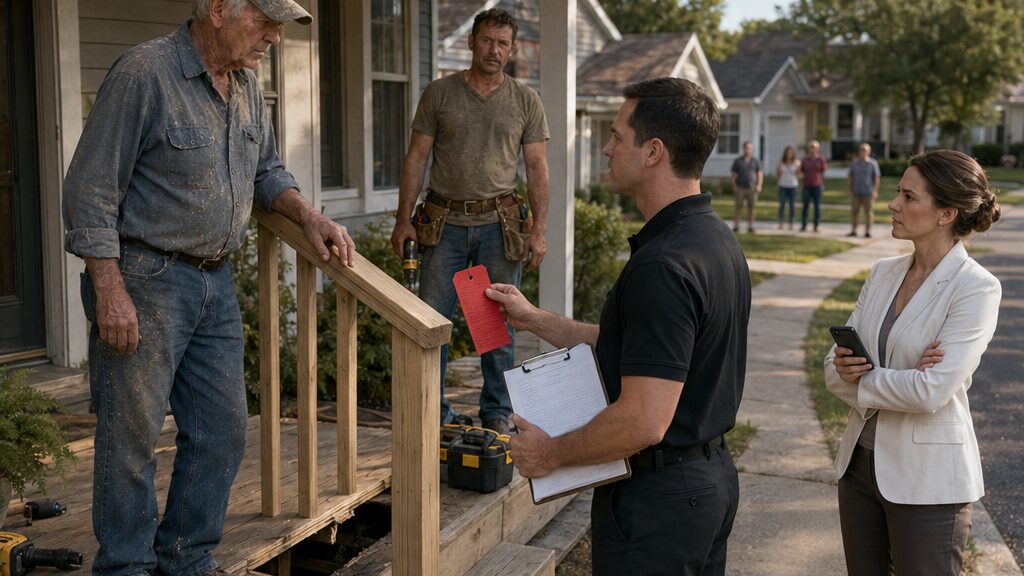
Jason stopped at the foot of the porch as if an invisible line had been painted there for him. He was younger than Gary by more than thirty years, broad through the shoulders, neat in a black polo with the Lakeside Villas emblem stitched over the chest. Behind him, Sarah Miller came up the walkway slower, white blazer bright against the hedges, phone in one hand. She was watching the porch before she watched Gary.
Across the street, a garage door hung half open. A neighbor stood just inside its shade. Another slowed on the sidewalk with a small dog and pretended to check the leash. In Lakeside Villas, people rarely came outside for trouble, but they were always near a window when trouble arrived.
Jason lifted the clipboard. “Mr. Bennett, this work has to stop.”
Joseph lowered the drill fully.
Gary kept his palm on the rail. The rail was plain pressure-treated wood, not painted yet, not pretty yet, but it held firm under his hand. He had set the posts himself yesterday, slowly, measuring twice and resting between each hole.
“Morning to you too,” Gary said.
Jason did not smile. “You were notified that any exterior modification requires board approval before installation.”
“It’s not a modification.”
“It is visible from the street.”
“So is the hole under that step.”
Jason glanced at the lifted board as if it had offended him personally. “That is exactly the issue. You have exposed materials, unfinished lumber, contractor equipment, and what appears to be an unapproved railing attachment.”
Joseph shifted. “I was hired to stabilize the entry. We’re not changing the look. We’re replacing compromised support.”
Jason turned toward him. “You need to stop work until approval is granted.”
“I’ve got a permit inspection scheduled for the support,” Joseph said.
“County permit doesn’t override community standards.”
Gary pushed himself up. It took longer than he wanted. His right knee did its slow, hot complaint, and his fingers tightened around the new rail before he could stop them. He saw Jason notice.
That was the kind of thing people noticed now.
Not the measurements. Not the rot. Not the months of water pooling by the flower bed. They noticed the hand gripping wood, the old man taking too long to stand, and suddenly everything became a conversation about what he could not handle.
Gary picked up his old shop rag from the porch floor and wiped his hands. “I sent in the drainage complaint last winter.”
Jason’s expression barely changed. “This is not about drainage.”
“It is if water got under the step.”
“This is about unapproved work.”
Sarah had reached the bottom of the walkway. She folded her arms, her phone resting against her sleeve. “Mr. Bennett, no one is saying you can’t repair your property. We’re saying there is a process.”
Gary looked at her then. Sarah Miller always looked composed, even when she brought bad news. She had moved into the neighborhood eight years ago and became board president after three. She had a way of speaking that made correction sound like patience.
“The process didn’t come out here when the board was told water was sitting under this porch,” Gary said.
Jason exhaled sharply, already tired of him. “Sir, we can’t have every resident starting construction because they think something might be wrong.”
Joseph stepped forward. “It isn’t a ‘might.’ I saw the underside. There’s movement in the front support.”
Jason raised the clipboard toward him. “And I am telling you, as property manager, that continuing work after notification may result in additional enforcement.”
Then he climbed the first step.
Gary’s body moved before his pride could dress it up. He put one hand out, not touching Jason, but blocking him from stepping on the exposed side.
“Not there.”
Jason looked at the hand, then at Gary. “Excuse me?”
“Step left.”
“I need to photograph the violation.”
“Then step left.”
For a second, nothing happened. A bird clicked from the gutter. The neighbor with the dog had stopped completely now. Joseph watched Gary, then the step.
Sarah’s eyes dropped to the porch board.
Jason stepped left with visible irritation. “This is exactly what I mean. It’s unsafe.”
Gary bent, picked up his level, and set it across the front edge of the step. The bubble slid hard to one side.
“Unsafe is why he’s here,” Gary said.
Jason looked at the level as if Gary had performed a trick at a meeting where tricks were not on the agenda. “That doesn’t change approval requirements.”
“No,” Gary said. “It changes what happens while you wait for approval.”
Jason took out his phone and began photographing. The lifted board. The rail post. Joseph’s toolbox. The strip of contractor tape tied between two porch spindles. He photographed close, never wide enough to include the shallow dip in the walkway where rainwater had carved dirt away from the foundation planting.
Gary watched him crop the truth one picture at a time.
Sarah said, “Jason, get the full condition too.”
Jason paused.
“Please,” she added.
He stepped back and took another photo, though his face said it was unnecessary.
Then he removed a red tag from his folder. It was bright, plastic-coated, official-looking in a way that made even wood seem guilty. He looped its wire around the half-installed handrail and twisted it twice.
Joseph muttered, “You’ve got to be kidding.”
The tag swung once in the morning air.
VIOLATION NOTICE.
Gary stared at it.
Not at Jason. Not at Sarah. Not at the neighbors watching from behind glass and hedges. He stared at that red tag tied to the thing his hand had reached for six times already that morning.
Jason wrote on his clipboard. “Work is to cease immediately. Unapproved exterior alteration. Failure to remove or correct by Monday may result in daily fines.”
Gary’s mouth went dry, but his voice came out level. “That rail is not decoration.”
Jason clicked his pen shut. “Nobody said it was.”
“You’re treating it like a mailbox color.”
Sarah’s face tightened slightly. “Mr. Bennett—”
Gary put his palm back on the rail. He did not lean. He made sure of that.
“It is the only reason I can get through my own front door.”
The sidewalk went still in that peculiar way a neighborhood went still when private things became public.
Jason’s eyes flicked to Gary’s hand again. “If the front entry is unsafe, that’s all the more reason to stop using it until the board can review a proper application.”
“My back steps are worse.”
“Then use assistance.”
Gary’s fingers closed around the shop rag. He could feel the old grease in it, ground so deep no washing ever fully cleared it. Nancy used to threaten to throw it away, then fold it on the washing machine anyway.
“Assistance,” he repeated.
Sarah’s expression shifted, not enough to call sympathy, not yet. More like she had heard a tone she did not expect.
Jason held out a packet. “Here’s the formal notice. You have forty-eight hours to remove the unapproved materials or submit an emergency review request. The board can’t guarantee approval.”
Gary did not take it.
Jason’s arm stayed extended.
Joseph looked as if he might speak, but Gary gave him the smallest shake of the head.
The morning sun caught the red tag again. It flashed against the raw wood.
Gary reached out and took the packet. “You finished?”
“For now,” Jason said.
“No,” Gary said, quietly. “With the porch. Are you finished looking at it?”
Jason frowned.
Gary stepped aside and pointed to the gap where the board had been lifted. “Because if you’re going to write down what’s wrong with my house, you might as well write down what’s actually wrong.”
Jason did not move.
Sarah did.
She came up the steps carefully, choosing the left side where Gary had told Jason to step. Her heels were wrong for the porch, but she listened. She looked down into the exposed space. The shadow under the board made the damage harder to see unless a person knew what rot looked like.
Gary knew.
He knew by color. By smell. By the way wood gave a little before it gave completely.
Sarah looked up. “Jason, did the inspection report mention this?”
Jason’s jaw set. “The report is about visible violation.”
“That isn’t what I asked.”
Gary let the silence sit there. He did not fill it. He had learned, under hoods and under dashboards, that some noises only made themselves known when a man stopped talking.
Jason tucked the phone away. “We’ll review it at the meeting.”
“When?” Gary asked.
“Next scheduled board session is Thursday.”
“Six days.”
“That is the schedule.”
Gary nodded once, as if Jason had confirmed the size of a bolt. “And until then?”
“Until then,” Jason said, “no work.”
The words landed harder than the tag.
Joseph stared at the porch opening. “Leaving it half-open is worse.”
“Then secure it without continuing unauthorized installation.”
Gary almost laughed. It would have come out wrong, so he swallowed it.
Sarah stepped down from the porch. “Mr. Bennett, submit the emergency form today. I’ll make sure it’s on the agenda.”
“Agenda won’t hold my weight.”
She looked back at him, and for the first time that morning, she had no ready answer.
Jason did.
“If the repair remains unapproved after Monday, the fine doubles,” he said.
Gary folded the notice once, slow and exact, and tucked it into his shirt pocket beside the pencil he still carried out of habit.
The red tag kept swinging long after they walked away.
Chapter 2: The Step Nancy Stopped Using
The house sounded different when Gary entered through the back door.
It always had.
The back door opened into the laundry room, where the dryer belt squealed for three seconds before catching and where the floor dipped near the utility sink. The door stuck in damp weather. The light switch sat too far inside, so a person had to step into the dark before finding it.
Nancy used to hate that.
“Front door is for coming home,” she would say, carrying grocery bags through the entry with her purse sliding down her arm. “Back door is for sneaking in.”
After Jason and Sarah left, Gary stood in the laundry room with the HOA packet in his hand and Joseph’s truck still idling outside. The contractor had wanted to cover the porch opening with plywood before leaving, but Jason’s warning had turned even temporary safety into a question of whether someone might call it work.
In the end, Joseph had set a loose board across the gap and weighted it with two bricks.
“Don’t trust it,” he told Gary.
“I don’t.”
“I mean it. You need anything from town, you call me.”
Gary had thanked him and sent him away before gratitude had time to become dependence.
Now the house held the afternoon heat. In the kitchen, the clock above the stove ticked with the stubbornness of a machine too simple to fail. Gary set the packet on the table without opening it. Then he took the kettle from the stove, filled it halfway, and forgot to turn the burner on.
Through the hall, he could see the front door.
Beyond its small glass panes, the red violation tag was a blur of color on the rail.
He looked away first.
The kitchen table still had two chairs, though only one was used now. Nancy’s chair faced the window because she had liked watching the finches bully each other at the feeder. Gary had never moved it. He told himself there was no reason. A chair was a chair. It did no harm staying where it was.
The truth was that the empty chair kept the room from becoming entirely his.
He sat in his own chair and pulled the folded notice from his pocket. The paper had softened from sweat. Unapproved exterior alteration. Visible construction materials. Potential liability. Daily fine schedule. Corrective action required.
Corrective action.
That was what people called it when they had no memory attached to the thing they wanted removed.
He took his glasses from the table and read the packet again, though the words did not improve on second reading. Emergency review requests had to include photographs, contractor scope, proof of insurance, proposed materials, paint color, estimated completion date, and board access permission.
Gary had half of that. The rest was buried in phone menus, county portals, and forms that assumed a person had a printer that didn’t jam every third page.
He got up, slower than he meant to, and went to the drawer beside the refrigerator. It was the drawer Nancy had called “your museum,” because Gary kept everything in it except what belonged there. Allen wrenches. Old spark plugs. Grocery receipts. Batteries that may or may not still have life in them. Two rolls of tape. A hinge wrapped in a napkin.
At the back was a black notebook with the corners worn soft.
Gary carried it to the table.
The first pages were old car notes, written in his square mechanic’s hand. Carburetor rebuild, Miller boy’s truck. Belt noise, Rachel’s mower. Battery drain, unknown, check ground wire. Later pages held house things. Water heater date. Gutter cleaning. Porch paint, Nancy picked blue-gray, too blue in sun. Replace front bulb before Thanksgiving.
He turned pages until he found the section marked PORCH.
The first note was from three years earlier.
Nancy says front step feels soft.
Gary stopped reading.
Outside, a delivery truck passed and rattled the window. He waited until the sound was gone.
He had fixed it then, or thought he had. Added screws. Replaced one board. Checked what he could see without pulling up the whole front edge. Nancy had stood in the doorway with her arms crossed, pretending not to watch him struggle back to his feet.
“You know,” she had said, “there are people younger than you who do this for a living.”
“And most of them charge too much.”
“And most of them can stand up without making that face.”
“What face?”
“The one you’re making right now.”
He had scowled at her, and she had laughed, and the whole thing had felt ordinary enough to waste.
The next note was dated six months after that.
Rain pooling by left flower bed. Check downspout extension.
Then another.
Called HOA office. Drainage at walkway. Left message.
Another.
Jason said landscaping runoff homeowner responsibility. Watch after storms.
Gary rubbed his thumb over the page until the ink blurred slightly under the oil in his skin.
He had watched. He had watched water gather where the walkway met the porch. Watched it settle into the mulch. Watched it disappear by morning, leaving nothing dramatic enough for a photograph unless a man knew what slow damage looked like.
Nancy had stopped using the front step after her fall.
Not all at once. That was the part people never understood about losing ground. It happened by inches. First she said she preferred the back door because the shade was better. Then because the mail could wait. Then because the front step made her nervous when it rained. Then, one morning, she stood inside the front door with her coat on and her purse over her arm and could not make herself cross the threshold.
Gary had been impatient that day.
He remembered that more clearly than he remembered what month it was. He had keys in his hand. They were late for a clinic appointment. Nancy stood with one palm on the door frame, looking at the step as if it might move under her.
“It’s fine,” he had said.
She did not answer.
“Nance, I fixed it.”
“I know.”
“Then what?”
She looked embarrassed. That was what undid him now, sitting at the kitchen table with the HOA notice spread open. Not fear. Not pain. Embarrassment. She had looked ashamed of needing him to understand something he should have understood before she had to ask.
He had softened then, but too late. Helped her through the back. Made a joke in the car. She had patted his knee, forgiving him before he had apologized.
Three months later, she was gone. Not because of the porch. The doctors had names for what happened, names that sounded official and useless. Still, after the funeral, Gary had stood at the front door and stared down at the step she had stopped trusting.
He had promised the empty house he would fix it right.
Then winter came. Then the knee. Then the forms. Then the drainage complaint. Then months of telling himself he still had time.
The kettle sat cold on the stove.
Gary got up and turned the burner on. While it heated, he opened the hallway closet and took down a small metal box where Nancy had kept warranties, appliance manuals, and birthday cards she pretended not to save. Inside, under the furnace receipt, was a folded sheet torn from a notepad.
Gary knew what it said before he opened it.
Front rail before next winter. No excuses. —N
He sat on the edge of the hallway bench with the note in his hand.
Her handwriting leaned slightly to the right. The N at the end had a little slash beneath it, quick and bossy. Nancy used notes like she used her voice: sparingly, but with no wasted motion.
The kettle began to whistle.
Gary did not move until the sound sharpened enough to hurt.
By evening, the porch was washed in orange light. The red tag was still there. Gary stood inside the front door and rested his hand on the knob. Through the glass, the rail waited just beyond reach.
He could remove it. He could pull the posts, stack the lumber, cover the gap with plywood, fill out the form, and wait for people in pressed shirts to decide when he was allowed to be safe.
He could use the back door until then.
He pictured the back steps in rain. The uneven pavers. The long walk around the side of the house with the trash bin and the hose reel and the place where moss grew no matter what he sprayed on it.
The phone rang.
Gary let it ring twice before answering.
“Mr. Bennett?” Sarah Miller’s voice was careful. “I wanted to make sure you received the emergency review form.”
“I received it.”
“If you need assistance submitting—”
“I can read.”
A pause. Then, softer, “I didn’t mean it that way.”
He closed his eyes for a second. “I know.”
“The board needs documentation before Thursday. Photos, contractor notes, anything showing the repair is urgent.”
Gary looked at the notebook on the kitchen table.
“I’ve got notes.”
“Current documentation would be stronger.”
“It was current when I first called.”
Another pause.
“When was that?” Sarah asked.
Gary opened his eyes.
The red tag turned slowly in the evening air, bright as a warning light under a hood.
“Last November,” he said.
Chapter 3: The Photos at the Board Table
Sarah Miller believed in complete files.
It was one of the reasons people trusted her, and one of the reasons others avoided her. A complete file did not care who was charming, who was angry, who had lived in Lakeside Villas the longest, or who brought cookies to the annual budget meeting. A complete file kept the board from making emotional decisions it would later regret.
At least, that was what Sarah had always believed.
On Thursday evening, the clubhouse smelled of lemon cleaner and old coffee. Folding chairs had been set in three rows facing the long board table. The wall screen glowed blue above a rolling cart, waiting for Jason’s presentation. Outside the windows, the community pond reflected the last of the light, smooth except for the fountain spraying water in a neat white fan.
Gary Bennett arrived ten minutes early.
Sarah saw him through the glass door before anyone else noticed. He came up the walkway in his old cap and a clean work shirt, though the collar was frayed and one cuff had been mended with thread darker than the fabric. He carried a black notebook in one hand and a manila folder in the other. He paused at the door longer than necessary, not from confusion, she thought, but from dislike of being watched entering a room that had already judged him on paper.
Jason was connecting his laptop. “He’s here.”
“I can see that.”
“He brought props.”
Sarah gave him a look. “He brought documents.”
Jason smiled without warmth. “We’ll see.”
Gary entered. Several neighbors turned. One whispered to another, not quietly enough. Gary did not look at them. He chose a chair near the aisle, placed the notebook on his lap, and rested both hands over it.
Rachel Cooper slipped in a minute later and sat two rows behind him. Sarah knew Rachel mostly from brief sidewalk greetings and one landscaping complaint about a leaning fence that she had resolved without drama. Tonight Rachel looked uneasy, her purse clutched close, gaze moving between Gary and Jason.
Sarah called the meeting to order at six.
They moved through the first items quickly. Pool access cards. A request to repaint shutters. A dispute over garbage bins left out overnight. Each issue had its folder, its dates, its photographs. Manageable problems. Problems that fit inside procedure.
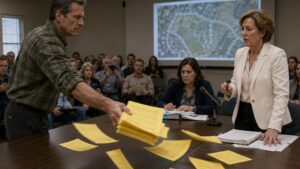
Then Jason dimmed the lights.
“Next item,” he said, “Bennett residence, 1842 Willow Bend. Unapproved exterior alteration and unsafe visible construction condition.”
A photo appeared on the screen.
It showed Gary’s porch from a low angle, the lifted board dark against raw wood, the new handrail post pale and unfinished. The red tag hung at the edge of the frame. Joseph’s toolbox sat open in the background. The image made the porch look chaotic, neglected, almost abandoned.
There was a murmur from the chairs.
Gary did not move.
Jason clicked to the next photo. A close-up of screws on the porch surface.
“These materials were installed without architectural approval,” Jason said. “The work changes the visible exterior and may create liability exposure for the association if left unsecured.”
Another photo. The contractor tape.
Another. Lumber stacked near the walkway.
Another. The half-installed rail, cropped so tightly it looked like a random post bolted into a porch by someone who had guessed at the work.
Sarah glanced at Gary. His jaw had tightened, but his eyes stayed on the screen. Not surprised. That bothered her. A surprised person might be misunderstanding the issue. Gary looked like a man watching something happen exactly as he expected.
Jason continued. “Mr. Bennett was instructed to stop work and submit an emergency review request. As of this afternoon, the work remains visible from the street, and the rail has not been removed.”
Gary lifted one finger from the notebook. Not a raised hand exactly. A marker.
Sarah said, “Mr. Bennett, you’ll have a chance to respond after the report.”
Jason clicked again. “The concern is twofold. First, the modification violates uniform exterior guidelines. Second, if Mr. Bennett’s claim is that the entry is unsafe, then continued use of that entry raises additional safety concerns.”
Gary looked down then, but only for a breath.
A board member near Sarah leaned toward the microphone. “Would the recommendation be removal until proper review?”
“Yes,” Jason said. “Temporary removal of the rail and loose materials, secure the porch surface, and submit a standard application. If the owner believes the front entrance is unsafe, he should use an alternate entrance until approval.”
Rachel shifted in her chair.
Sarah heard it because she was listening for Gary and heard everything around him instead.
She said, “Jason, show the wider photo.”
Jason’s hand stilled on the laptop.
“The full porch condition,” Sarah said.
“It’s in the packet.”
“On the screen, please.”
A moment passed before he clicked backward. The wider photo appeared.
It showed more than the violation. The shallow dip at the side of the walkway was visible now, a darker crescent in the mulch bed. The exposed porch edge showed staining beneath the lifted board. The rail was no longer a random post; it was directly beside the step Gary had warned Jason not to use.
Sarah leaned forward. “Was this staining included in the inspection notes?”
Jason looked at his clipboard. “The inspection was for exterior alteration.”
“Was it included?”
“No. It was not considered relevant to the violation.”
Gary gave the smallest breath through his nose. Not a laugh. Something drier.
Sarah turned toward him. “Mr. Bennett, you may respond.”
Gary rose slowly. He did not bring the notebook at first, then seemed to change his mind and took it with him. The room watched the care with which he stood. Sarah hated that she noticed it too.
He walked to the small table set aside for residents and laid the manila folder flat.
“I didn’t put that rail up because I wanted a different-looking porch,” he said.
His voice was low enough that the microphone had to work for him.
Jason folded his arms.
Gary opened the folder and removed a printed page. “I called about water pooling by the left flower bed in November. I called again after the storm in January. In March, I wrote it down and dropped a note at the office because I don’t trust voicemail.”
Jason said, “We have no open drainage work order for your property.”
Gary turned his head toward him. “That’s my point.”
The room went quiet.
Sarah held out her hand for the page. Gary gave it to her. It was not formal evidence in the way Sarah liked evidence. It was a copy of a handwritten note, dated and plain. Drainage at front walkway holding water after rain. Concern under porch. Please inspect.
“Do you have confirmation this was received?” Jason asked.
Gary looked at him for a long second. “You were standing at the counter when I handed it over.”
A few people turned toward Jason.
Jason’s face hardened. “I receive a lot of resident correspondence.”
“I imagine.”
Sarah looked at the page again. “Mr. Bennett, do you have photographs from that time?”
“No.”
Jason spread one hand, almost gently, as if that settled things. “Then the board has to rely on documented current conditions.”
Gary nodded. “Then document them.”
He opened the black notebook.
Sarah expected a rambling collection of old-man notes. She disliked herself for the phrase as soon as it came. Gary’s pages were not rambling. They were dated, measured, spare. Rain depth. Softness at step edge. Downspout extension checked. Left support damp. Call to office. Recheck after storm.
He did not read them all. He only turned the notebook so Sarah could see the pattern.
“This is not about me wanting to skip your form,” he said. “This is about a step moving while I waited for somebody to look where I asked them to look.”
Jason leaned toward his microphone. “Mr. Bennett, with respect, personal notes are not a substitute for approved inspection.”
Gary closed the notebook halfway. “And a cropped photograph is not a substitute for looking under the board.”
Sarah felt that land in the room.
Not loudly. Worse than loudly.
The board member beside her shifted papers. Someone in the second row whispered, “That’s fair.” Jason’s eyes flicked toward the audience.
Sarah looked back at the projected image. The red tag on the handrail seemed larger than it had on the porch.
“Jason,” she said, “when you inspected, did you look under the lifted board?”
“No. It was not safe to access.”
Gary’s gaze moved to him. “I told you where to step.”
“That doesn’t make it safe.”
“No,” Gary said. “The rail does.”
Sarah watched his hand close over the notebook’s edge. There was strain in it, but also control. He had not raised his voice once. That made the room listen harder.
Jason said, “This is exactly why the association cannot allow residents to improvise structural changes.”
Gary turned to Sarah, not Jason. “Do you want to know what’s wrong with the porch, or do you want to know what rule I broke trying not to fall through it?”
No one spoke.
Sarah looked down at the file in front of her. Jason’s report was complete in all the ways a report could be complete while still missing the thing that mattered.
“Mr. Bennett,” she said carefully, “the board cannot approve work tonight without proper documentation.”
Gary’s face did not change, but something in his eyes withdrew.
“However,” she continued, “I want the condition reviewed before any removal order is enforced.”
Jason turned sharply. “That undermines the process.”
Sarah kept her gaze on Gary. “So does an incomplete file.”
The words surprised even her.
Jason sat back. His mouth formed a line.
Gary gathered his folder and notebook. “Review it soon.”
“We will.”
He looked at the projected photo one last time. “Because that step doesn’t care about Thursday meetings.”
He returned to his chair.
Sarah moved to table the enforcement vote pending a site review. It passed, though not unanimously. Jason recorded the decision with stiff, clipped movements.
When the meeting ended, neighbors stood in clusters, speaking in lowered voices. Gary did not join any of them. He tucked the notebook under his arm and walked toward the exit.
Sarah caught up near the door.
“Mr. Bennett.”
He stopped.
“I’ll come by tomorrow morning.”
He looked tired then. Not weak. Tired in a way that made Sarah understand, suddenly, that every conversation like this cost him something he would never invoice.
“Bring shoes you can stand in,” he said.
Then he pushe
Chapter 4: The Reading Under the Porch
Sarah came the next morning in flat shoes.
Gary noticed that before he noticed the folder tucked under her arm or the way she paused at the foot of the walkway, looking at the porch as if the house might accuse her before he did.
He was already outside.
The red tag still hung from the rail, but the morning had taken some of its brightness. A breeze turned it back and forth with a dry little scratch against the wood. Gary had left it there on purpose. Not because Jason had ordered it kept visible, though the notice had said that too, but because removing it would make the porch look less honest than it was.
Joseph had returned at seven to check the temporary board and then stood by his truck with both hands on his hips, waiting to see whether he was allowed to work or only allowed to witness.
Jason arrived five minutes after Sarah, as if the two of them had agreed not to ride together. He had the clipboard again. Gary wondered if the man slept with it beside the bed.
“Mr. Bennett,” Sarah said. “Thank you for meeting us.”
Gary looked at the open porch edge. “It’s my porch.”
Jason stepped onto the walkway but did not come up the stairs. “For the record, this is a condition review, not work approval.”
Joseph made a low sound in his throat.
Gary picked up the level from beside the rail. “For the record, this is a step.”
Sarah glanced at Jason, then back at Gary. “Can you show us what you wanted documented?”
Gary crouched. His knee objected immediately, hot and sharp, and for one second he had to hold the rail harder than he liked. He felt the three of them watching and hated the room his body made for other people’s opinions. He set the level across the front lip of the step.
The bubble slid left.
“This was closer to center last fall,” he said.
Jason wrote something. “Based on what?”
Gary tapped the black notebook lying open on the porch floor. “Based on that.”
“Personal notes,” Jason said.
“Measurements.”
“Not certified.”
Gary reached for the small moisture meter beside his knee. It was an old yellow device, scuffed at the edges, the kind he had once used checking floor pans on cars that smelled like wet carpet and bad decisions. He had bought it used after Nancy first said the porch felt soft. At the time, he told himself it was cheaper than hiring someone to tell him wood got wet in rain.
He pressed the meter’s pins into the exposed support under the lifted board.
The number blinked. Too high.
Sarah bent closer. “What should it be?”
“Lower than that.”
Jason sighed. “Can you be more specific?”
Gary looked up. “Dry wood doesn’t read like a sponge.”
Joseph stepped forward despite himself. “That’s elevated. I checked it too. The front support’s been taking water. You can see the staining here.”
He pointed beneath the board, careful not to touch anything that could be called work. Sarah crouched awkwardly, one hand on her knee, the other holding her phone so its light shone into the gap.
There it was.
Not dramatic. That was the trouble with slow rot. It did not look like disaster to people who expected disaster to announce itself. The underside of the support was darkened, feathered at the edge where a screwdriver would sink too easily. The soil below showed the path water had been taking after storms, a small channel under the mulch and toward the porch footing.
Sarah’s face changed.
Not enough for Jason to see, maybe. Gary saw.
She took a photo.
Jason said, “Again, nobody disputes there may be maintenance needed. The question is whether Mr. Bennett had authority to begin visible exterior work.”
Gary set the moisture meter down with more care than he felt. “When a fan belt is about to snap, you don’t schedule a committee to decide if the noise is attractive.”
“This isn’t a car.”
“No,” Gary said. “Cars are easier. People admit when they need those to move.”
Sarah looked at him then, and Gary wished he had kept that to himself.
Jason took a photo of the meter reading. “This device isn’t calibrated for structural assessment.”
“It’s calibrated enough to tell me wet wood is wet.”
“Mr. Bennett—”
Gary stood too fast.
He knew it as soon as his weight came up. The temporary board under his left foot shifted against one of the bricks. Not much. Just enough. His balance tipped toward the open edge where the porch board had been lifted.
Joseph reached first.
Gary caught the handrail before Joseph could catch him.
His palm slammed around the raw wood. The red tag snapped against his wrist. For half a breath, his whole weight went into the thing Jason wanted removed.
No one spoke.
Gary straightened slowly, hating the heat that rose into his face. Joseph’s hand hovered near his elbow, then dropped when Gary did not take it.
Rachel Cooper had come out of her house across the way, a bag of trash in one hand. She stopped at the curb. Gary did not look at her, but he felt her seeing him.
Sarah lowered her phone.
Jason recovered first. “That is exactly the kind of unsafe condition we’re trying to prevent.”
Gary looked at him. “That is exactly the kind of unsafe condition I was fixing.”
Jason’s mouth tightened. “You nearly fell because this porch is in active disrepair.”
“I nearly fell because the work was stopped halfway.”
“Because it was unapproved.”
“Because the damage was ignored.”
Sarah stood, brushing dust from one knee. “Enough.”
The word was not loud, but it was the first time Gary had heard command in her voice without polish over it.
Jason turned. “Sarah—”
“I said enough.”
She looked down at the open porch, then at the rail, then at Gary’s hand still wrapped around the raw wood. The red tag lay caught between his knuckles and the post.
Sarah lifted her phone and took one wide photograph. It included Gary, the handrail, the exposed support, the shifted temporary board, Joseph’s stopped tools, Jason’s clipboard, and the red tag twisted around the rail like a warning attached to the wrong thing.
“This needs an independent review,” she said.
Jason’s eyebrows rose. “That isn’t necessary.”
“It is now.”
“The board can’t reward residents for starting work without approval.”
Gary let go of the rail. His palm had left a faint damp mark on the wood. “Nobody’s asking for a reward.”
Jason looked at him. “You’re asking for an exception.”
“I’m asking you not to make the porch worse just so the paperwork looks clean.”
Joseph nodded once, but stayed quiet.
Sarah turned to Jason. “Hold enforcement until I can get another board member to review the file.”
Jason’s face took on that flat look people used when they were angry but wanted credit for not showing it. “The violation clock is already running. If we hold it and something happens, liability shifts.”
“To whom?” Gary asked.
Jason looked at him.
Gary picked up the red tag and let it fall back against the rail. “Because you’ve got your name on that.”
For a moment, Sarah looked as if she had not considered the tag that way. Jason had. Gary could tell by the quickness with which he looked away.
Rachel crossed the street then, still holding the trash bag as if she had forgotten what it was. “Mr. Bennett?”
Gary turned. “Morning, Rachel.”
“I saw—” She stopped, eyes moving to Sarah, then Jason. “I saw the board shift.”
Jason’s pen came up. “Ma’am, this is an association review.”
“I live next door.”
“That doesn’t make you part of the review.”
Gary saw Rachel’s shoulders draw back. She was not a loud person. She took care of her father three afternoons a week and carried groceries in soft-sided bags so the handles would not cut her fingers. She had waved to Nancy every morning for years but had never come farther than the porch unless invited.
She looked at Gary. “Do you need me to stay?”
The question touched something he did not want touched.
“No,” he said.
It came out too quickly.
Rachel nodded, but did not leave.
Sarah watched the exchange. Gary could feel her assembling another kind of file now, one that had less to do with forms.
Jason tucked his pen into the clipboard. “I’m filing this as an unsafe condition. If the front entrance is unstable, the association may require restricted use until proper repairs are approved.”
Joseph stared at him. “You stop the repair, then write him up because it isn’t repaired?”
“I am documenting risk.”
Gary bent and picked up the moisture meter. His hands were steady now. That mattered. He set the meter, the level, and the flashlight into his old canvas tool bag one by one.
“Document this,” he said.
Jason looked impatient. “What?”
Gary pointed to the rail. “At nine-sixteen this morning, the thing you tagged as a violation kept me from going down on my own porch.”
Sarah’s phone remained in her hand.
Jason did not write.
Gary smiled without humor. “No?”
Sarah looked at Jason. “Write it down.”
He hesitated.
“Jason,” she said.
The pen came out.
Gary turned toward the house. He had no wish to watch the sentence form. Behind him, the pen scratched reluctantly across paper.
At the door, he paused with one hand on the knob and one on the new rail.
Rachel was still by the curb. Joseph was standing near his truck. Sarah was looking at the porch, really looking now. Jason was already closing the clipboard as if closure could make the morning behave.
Gary stepped inside and shut the door carefully.
Through the glass, he watched Sarah take one more photo of the red tag.
Chapter 5: The Safe-Looking Compromise
Sarah’s office at the clubhouse had one window, two filing cabinets, and a framed print of the community map showing every street in Lakeside Villas as a clean white curve.
Gary had never cared for that map. From a distance, the neighborhood looked simple. Houses, pond, pool, clubhouse, walking path. No soft steps. No back-door dips. No dark places under porches where water traveled patiently for months. Just tidy lots and names of streets chosen by people who had never expected anyone to grow old on them.
Sarah had asked him to come in on Tuesday.
Gary almost refused. Then he looked at the red tag still hanging from his rail and decided refusing would make it easier for Jason to describe him.
So he came.
He sat across from Sarah with his cap in his hands. Jason was there too, though he stood near the filing cabinet instead of sitting, a position that let him look temporary and in charge at the same time. On Sarah’s desk lay a form clipped to a pale blue folder.
“Thank you for meeting,” Sarah said.
Gary nodded.
“I reviewed the photographs from Friday and your emergency request.”
“I didn’t submit an emergency request.”
Sarah paused. “You submitted supporting notes.”
“I submitted what I had. Your form wants paint colors for a support beam.”
Jason spoke from the cabinet. “Because exterior repairs must be visually consistent.”
Gary turned the cap in his hands once. “Rot doesn’t care what color it is.”
Sarah lifted a hand slightly, not quite stopping him, not quite stopping Jason. “We are trying to find a temporary path that keeps you safe and keeps the association within procedure.”
Gary looked at the blue folder. He had learned to distrust folders that arrived already clipped.
Sarah slid the paper toward him. “This is a temporary compliance agreement. It would pause daily fines for thirty days if you remove the visible rail and construction materials, secure the porch surface with a flat temporary cover, and submit a standard architectural application.”
Gary read the first lines. The words were smooth. Voluntary. Temporary. Safety. Compliance. Review.
He stopped at alternate entry recommended until approval.
“My back door,” he said.
“Yes,” Sarah said. “Only temporarily.”
Gary set the paper down. “Have you seen my back door?”
“I saw the side path from the street.”
“That’s not seeing it.”
Jason shifted. “Many residents use alternate entrances during repairs.”
“Many residents have a flat garage.”
Sarah’s eyes lowered to the form. “Mr. Bennett, we are not saying this is ideal.”
“No,” Gary said. “You’re saying it’s safe because the unsafe part won’t show from the street.”
Jason’s jaw moved.
Sarah leaned forward. “I understand why it sounds that way.”
Gary looked at her. “Do you?”
She did not answer quickly enough.
He picked up the paper again. His reading glasses were in his shirt pocket, but he did not reach for them. The words blurred at the edges. He knew enough of what they said.
Temporary removal. Owner assumes risk. Association review pending. No admission of liability.
He almost laughed at that part.
In the silence, he heard Nancy’s voice as clearly as if she had been standing at the filing cabinet instead of Jason.
Don’t sign what you wouldn’t say out loud.
Sarah folded her hands. “If you sign this, we can prevent the fines from escalating while giving the board time to process the application properly.”
“And if I don’t?”
Jason answered. “Then the violation remains active, and I will recommend escalation based on unsafe maintenance.”
Sarah looked annoyed, but she did not correct him.
Gary placed the form on the desk. “You’re making me choose between a fine and a fall.”
“That is not what this is,” Sarah said.
“Then what is it?”
“It is a temporary solution.”
“For who?”
The question stayed in the office.
Outside the window, a landscaper guided a mower along the edge of the clubhouse lawn. The machine’s hum rose and fell as it turned. Gary watched it for a second, watched the clean stripes appear behind it. Lakeside Villas liked evidence that maintenance had happened. Lines in grass. Fresh mulch. Matching mailboxes. Violations corrected before anyone had to ask twice.
Sarah said, “We have to consider community standards.”
Gary turned back. “I am part of the community.”
“No one said otherwise.”
“You write these things like I’m a problem sitting on a lot.”
Jason’s expression sharpened. “Mr. Bennett, this isn’t personal.”
Gary looked at him then. Really looked.
Jason was not stupid. That made it worse. He was the kind of man who trusted procedure because procedure had always given him a place to stand. He saw Gary’s porch as a case that needed closing. Maybe he even believed that was fairness.
“It’s personal when it’s my door,” Gary said.
Sarah’s face softened and tightened at the same time. “What would you propose?”
“Let Joseph finish stabilizing the step and rail. Inspect it. Tell me what paint to use after. I’ll use your color chart if that makes the wood behave.”
Jason gave a short, humorless breath. “That is not how approvals work.”
Gary kept his eyes on Sarah. “Then approvals don’t work fast enough for rotten wood.”
Sarah tapped the edge of the form. “The board has liability concerns if unapproved structural work continues.”
“Then come watch it. Bring whoever signs things. Take pictures wide enough to tell the truth.”
Jason said, “That’s not practical.”
Gary stood.
The chair legs made a hard sound against the floor. Sarah looked up, startled. He had not meant to stand so quickly. His knee caught, but he kept his face still and put his cap on.
“I came because you asked,” he said. “I listened because you’re trying harder than he is. But I’m not signing that.”
Sarah rose too. “Mr. Bennett—”
“I am not signing away the only door I can still trust.”
The words came out quieter than the heat behind them.
Sarah did not reach for the form.
Jason did. He picked it up and aligned it with the folder, as if neat paper could repair the refusal. “Then the board will have to proceed based on noncompliance.”
Gary nodded. “Write that down too.”
He left before his leg could betray him in front of them.
The walk home took longer than usual. He used the clubhouse ramp instead of the steps, which irritated him more than it should have. The sun was high, the sidewalks too bright. Twice he had to stop and pretend to check something in his pocket while the ache in his knee settled.
At Willow Bend, Rachel was kneeling near her mailbox, pulling weeds from the base. She stood when she saw him.
“Everything okay?”
Gary kept walking. “Fine.”
Rachel fell into step at a careful distance. Not beside him, exactly. Near enough to catch a stumble, far enough not to say that was why.
“My father says fine like that,” she said.
Gary looked at her. “Smart man.”
“He’s impossible.”
“Same thing sometimes.”
She smiled a little, then looked toward his porch. “They still won’t let Joseph finish?”
“They offered to pause the fine if I remove the rail.”
Rachel stopped. “But that’s what you’re using.”
Gary continued another two steps before he realized she had stopped. He turned.
She was looking at the red tag. Wind had twisted it backward so only the blank side showed. From where they stood, it might have been a child’s ribbon or a warning flag left by a utility company. Something temporary. Something that would be gone soon.
“They said use the back,” Gary said.
Rachel glanced toward the side of his house. “That path is uneven.”
“I’ve noticed.”
“My father fell on a path like that.”
Gary did not answer.
“I’m sorry,” she said quickly. “I didn’t mean—”
“I know what you meant.”
She looked down at her hands, still dirty from weeding. “Would it help if I said something?”
He almost said no.
The word was ready. Familiar. Safe.
Instead he looked at the porch, at the rail, at the red tag. He thought of Sarah’s office and the clean map on the wall. He thought of Nancy standing inside the front door, embarrassed to be afraid of a step he had called fine.
“Maybe,” he said.
Rachel looked up.
Gary took his house key from his pocket. It was attached to an old brass tag Nancy had bought at a hardware store twenty years ago, stamped with their last name because she said keys ought to know where they belonged.
He held it for a moment before putting it back.
“Not yet,” he said. “But maybe.”
That evening, he entered through the back door because the temporary board on the porch had shifted again. He carried one grocery bag in each hand. Halfway over the uneven pavers, his right foot caught the raised edge of a stone.
He did not fall.
He did not fall because he dropped one bag, caught the fence post with his elbow, and stood there breathing hard while a jar of peaches rolled into the grass and stopped against the hose reel.
No one saw.
That was the part that frightened him most.
Chapter 6: What the Phone Finally Showed
Rachel Cooper did not sleep well after she saw the peaches in the grass.
She saw them from her kitchen window just before dusk, three bright halves pressed against the glass jar where it had come to rest near Gary’s hose reel. Gary picked it up slowly, turning first to check whether anyone was watching. That small turn bothered her more than the stumble must have bothered him.
A person who checked for witnesses before checking for injury had already been hurt in ways people could not put in a report.
Rachel stood behind her curtain with her phone in one hand and did nothing.
That was what followed her into bed. Not Jason’s voice. Not the red tag. Not even Gary’s hand clamped around the rail the morning the board shifted. It was the fact that she had been close enough to help and had chosen, again, to let privacy stand in for kindness.
Her father would have understood Gary. That was the problem. He would have called the porch fight nonsense, then refused the safest chair in the room because someone had suggested it too gently. He would rather risk pain than become a project.
At six the next morning, Rachel made coffee and opened her phone.
She scrolled back through photos, past pictures of grocery receipts, her father’s medication labels, a cracked birdbath she meant to replace, and a short video of rain running down Willow Bend after the January storm. She had taken it because water had been pooling near her driveway too, and she wanted to show the landscaper where it crossed the curb.
In the corner of the video, across the street, Gary stood near his porch with a hooded jacket over his work shirt. Jason Carter stood with him, one foot on the walkway, a tablet in his hand. Water spread dark across the mulch beside Gary’s front step.
Rachel sat down.
She played it twice.
The audio was mostly rain, but halfway through, Gary’s voice came faintly.
“Under the porch,” he said. “That’s where it’s going.”
Jason’s answer was too blurred by rain to understand, but his gesture was clear. He pointed toward the flower bed, then toward the street, then back at his tablet. The body language said what paperwork later would not: noted, dismissed, moved on.
Rachel trimmed nothing. She sent the whole clip to Sarah Miller with one sentence.
This was January 18. I think it matters.
Then she set the phone on the table and stared at it as if it might accuse her of being late.
Sarah saw the message in her car outside the clubhouse.
She had arrived early to review Gary’s file again before Jason came in. The folder sat on the passenger seat, thicker now but not better. There were photographs from Friday, Jason’s violation notice, Gary’s handwritten copies, the temporary compliance agreement he had refused to sign, and a printed recommendation from Jason titled Continued Unsafe Maintenance and Noncompliant Exterior Alteration.
Sarah did not open the folder first.
She opened Rachel’s video.
Rain filled the screen. For the first two seconds, she could not make sense of the image. Then the camera steadied on Willow Bend, gray and wet, and there was Gary in the corner, smaller than Sarah expected him to look. He wore the same cap. He pointed toward the porch. Jason stood under an umbrella, tablet angled away from the rain.
Gary’s voice came through.
“Under the porch. That’s where it’s going.”
Sarah stopped the video.
She sat with one hand on the steering wheel.
Then she played it again.
Inside the clubhouse office, she pulled up the maintenance logs. Drainage complaints. Landscaping notes. Resident correspondence. The system was simple if the search terms were exact and useless if they were not. Bennett produced the current violation. Willow Bend produced trash-bin notices and one shutter approval. Drainage produced several entries, none at Gary’s address.
She searched Jason’s completed site visits.
January 18 appeared under General Landscape Observation. No owner maintenance issue found. Water dispersal within normal range. No action required.
Sarah stared at the line until the words lost shape.
She printed it.
At eight-thirty, Jason arrived with his coffee and a look of prepared inconvenience. “We need to talk about the Bennett escalation before I send the packet.”
Sarah held up Rachel’s video on her phone. “We do.”
He watched it standing by her desk. His expression did not change much, but she had seen enough meetings to know when a man’s stillness was effort.
“That was a landscape check,” he said.
“Gary is pointing at the porch.”
“He points at a lot of things.”
“He says water is going under the porch.”
“It was raining. Water goes everywhere when it rains.”
Sarah picked up the printed log. “You marked no owner maintenance issue.”
“Based on conditions observed.”
“Did you include his concern in the file?”
“It wasn’t relevant at the time.”
“It is relevant now.”
Jason set his coffee down. “Sarah, be careful. If we start implying the association missed something, we create liability where there may be none.”
“And if we keep pretending we didn’t know?”
“That’s not what I said.”
“It’s what the file says.”
He leaned on the back of the chair across from her. “The board’s job is not to validate every homeowner’s personal theory about drainage. If Bennett thought there was structural damage, he could have hired someone months ago.”
Sarah thought of Gary in her office, cap in hand, saying the back path was not safe. She thought of the way he had refused the form not dramatically, but finally, like a man refusing to step into a hole someone kept calling a walkway.
“He tried to get us to look,” she said.
Jason’s voice cooled. “And then he started unapproved work.”
“Yes.”
“Then we proceed on that fact.”
Sarah placed the printed log into Gary’s folder. “I’m calling a special hearing.”
Jason straightened. “For one porch?”
“For one enforcement action that may be based on an incomplete record.”
“The board won’t appreciate being dragged in for this.”
“The board voted to review.”
“The board voted because you framed it that way.”
Sarah looked at him. “And you framed the photos.”
Color rose slightly in his face. “That’s unfair.”
“So was photographing the rail without the step.”
He picked up his coffee, then set it down again without drinking. “You’re letting him turn this into a story about age.”
“No,” Sarah said. “You are.”
The office went quiet.
Jason gathered his folder. “Fine. Call your hearing. I’ll submit my recommendation.”
“Which is?”
“Continued violation. Unsafe maintenance. Failure to comply with temporary corrective action.”
Sarah looked at him. “He didn’t sign the agreement because it required him to use an unsafe route.”
“He refused a reasonable compromise.”
“He refused a document that protected us more than it protected him.”
Jason’s mouth tightened. “That’s your interpretation.”
“Now it is.”
After he left, Sarah sat alone with the video still open on her phone. Outside her office, the clubhouse printer warmed and clicked. Somewhere down the hall, a chair dragged across tile. Ordinary sounds. Procedure sounds.
She called Rachel first.
“Thank you for sending this,” Sarah said.
Rachel was quiet for a moment. “I should have sent it sooner.”
“You sent it now.”
“Does it help him?”
Sarah looked at the folder. “It helps the truth.”
“That isn’t what I asked.”
Sarah had no easy answer, and for once she did not manufacture one.
“I’m trying to make sure it does,” she said.
Then she called Gary.
He answered after four rings. “Bennett.”
“Mr. Bennett, it’s Sarah Miller.”
“I figured.”
“I received a video from Rachel Cooper. From January.”
Silence.
“It shows you speaking with Jason about water near the porch,” she said.
“I didn’t know she had that.”
“Neither did she, I think. Not in that way.”
Gary breathed out. “What happens now?”
“I’m calling a special hearing for Friday.”
Another silence, longer this time.
“Jason is recommending escalation,” Sarah said. “I want you to know that before you walk in.”
“Escalation.”
“Unsafe maintenance. Continued noncompliance.”
Gary’s answer was so quiet she almost missed it. “He stops the repair, then calls it unrepaired.”
Sarah closed her eyes briefly. “Yes.”
She heard something on his end. A chair creak, maybe. Or the old house shifting around him.
“I can bring the video,” she said. “Rachel can speak if she’s willing. Joseph can provide a contractor statement. Your notes matter too.”
“My notes didn’t matter last time.”
“They mattered enough for me to look again.”
“That’s not the same.”
“No,” she said. “It isn’t.”
Gary did not reply.
Sarah looked at the framed community map on her wall. Willow Bend curved neatly near the pond, Gary’s lot one small rectangle among many. From that distance, every house looked equally easy to enter.
“Mr. Bennett,” she said, “at the hearing, they need to hear from you.”
“They heard me.”
“They heard you answer a violation. They need to understand the repair.”
“I’m not standing in front of that room to perform being old.”
The sentence landed with more force than anger would have.
Sarah lowered her voice. “Then don’t.”
He was silent.
“Bring the measurements,” she said. “Bring the notebook. Bring what you would bring if you were explaining a repair to someone who actually had to fix it.”
For the first time, she heard a faint shift in him. Not trust. Consideration.
“And if they still want the rail gone?” he asked.
Sarah looked at Jason’s recommendation on her desk.
“Then they’ll have to say so after seeing what it holds.”
Gary hung up w
Chapter 7: The Hearing Where He Would Not Perform Weakness
Gary packed the notebook last.
He put the moisture meter in the canvas tool bag first, then the level, the flashlight, Joseph’s contractor statement, the printed January log Sarah had sent him, and the copy of Rachel’s video still that showed Jason standing in the rain. The HOA notice went in too, folded along its original crease. The red tag he carried separately in his shirt pocket, the plastic edge pressing against his chest when he bent.
Nancy’s note stayed on the table until he was ready to leave.
Front rail before next winter. No excuses.
He had considered leaving it home. The note was not evidence, not the sort Sarah could enter into a file or Jason could be forced to answer. It was private. It belonged in the kitchen drawer with the appliance manuals and old birthday cards, not under fluorescent lights in the clubhouse.
But the porch had become public without his permission. So had his balance. So had his front door.
Gary folded the note once and slid it into the notebook.
At the clubhouse, cars filled the lot in a way they did not for ordinary meetings. Word had moved through Lakeside Villas faster than drainage ever had. A porch violation was not enough to draw a crowd, but an old man refusing the board was. So was a property manager accused, gently or not, of missing something.
Gary sat in the truck for a moment after Joseph parked.
“You want me to carry that?” Joseph asked.
Gary looked at the canvas bag between his boots. “No.”
“All right.”
Joseph did not say more. Gary appreciated that. Some men filled silence because they were afraid of what might be inside it. Joseph let it sit.
Rachel was waiting near the entrance, holding her phone and a folder. She wore a blue sweater and looked like she had changed clothes twice before coming. When Gary stepped up onto the curb, her hand lifted slightly, then dropped.
“I can speak if they ask,” she said.
Gary nodded. “Tell what you saw.”
“I will.”
“Not more.”
She looked at him, then gave a small nod. “Not more.”
Inside, the meeting room had been arranged with extra chairs. Sarah sat at the center of the board table with a folder open in front of her. Jason sat to one side, jaw set, his own packet stacked neatly. He had dressed in a sport coat over his polo, as if formality could distance him from the photographs he had taken.
Gary took the same aisle chair as before.
The room settled slowly. Neighbors whispered, shifted, looked at him and away. Gary kept the canvas bag at his feet and the notebook on his lap. His right knee ached from the drive, but he placed both feet flat and waited.
Sarah called the hearing to order.
Her voice was steady, but not as smooth as usual. “This special hearing concerns the Bennett residence, the front porch repair, related violation notice, and the question of emergency safety work under association rules.”
Jason presented first.
He stood beside the screen and moved through his packet with practiced efficiency. Dates. Rule numbers. Photographs. The unapproved rail. The stopped contractor work. The temporary compliance agreement Gary had refused. He did not raise his voice. That was part of what made him effective.
“The association cannot maintain standards if residents begin visible structural modifications without prior review,” Jason said. “The issue is not whether Mr. Bennett may repair his porch. The issue is whether he may disregard the process and then claim urgency after the fact.”
A few people nodded.
Gary looked at the floor.
Jason clicked to a photo of the red tag on the rail.
“Additionally,” he said, “the owner’s own statements confirm the entry was unsafe. Continued use presents risk. My recommendation is that the violation remain active, fines proceed after the original correction period, and the owner be required to remove unapproved rail components pending formal approval.”
Sarah wrote something down. “Thank you.”
Jason sat.
The room waited for Gary to argue.
He did not stand right away. He opened the notebook on his lap and found the clean page where he had written the measurements. Then he took Nancy’s note from between the pages, looked at it once, and set it back inside.
When he stood, the chair legs did not scrape. He had planned that, too.
He carried the canvas bag to the small table and placed each item in a line.
The level.
The moisture meter.
The flashlight.
The red tag.
The folded note stayed in the notebook.
Gary looked at the board, not the room.
“I’m not here to tell you I filled out every form right,” he said. “I didn’t.”
Jason’s pen paused.
Gary continued. “I started the work because the step moved under me. I put in the rail because I needed something solid before the porch was opened. Joseph Reed can tell you what he found. Sarah has the photos. Rachel has the January video.”
Sarah nodded. “Those are entered into the record.”
Gary looked down at the red tag. “This was tied to the rail before anyone here looked under the board.”
The room went still.
He placed the level on the table. “This showed the step had shifted.”
He placed two fingers on the moisture meter. “This showed the support was wet.”
Then he tapped the red tag once. “This showed what the association saw first.”
Jason leaned toward his microphone. “Mr. Bennett, no one disputes there may be repair needs now. The question is whether your response was compliant.”
Gary turned to him. “No. The question is whether your process can tell the difference between a man improving his porch and a man trying not to fall through it.”
A low murmur moved through the chairs.
Sarah said, “Let him finish.”
Gary opened the notebook. “November. Water pooling by left flower bed. Called office. January. Same area after storm. Spoke with Jason.” He looked at Rachel. “Rachel’s video shows that. March. Dropped off written note. Concern under porch. No inspection under the porch was done.”
Jason spoke tightly. “The January visit was logged as a landscape observation.”
Gary looked at him. “That’s because you logged it.”
Sarah’s eyes lowered briefly to the file.
Gary heard his own pulse in his ears. The room had narrowed around the table and the objects on it. He had not wanted to be good at this. He had wanted to be home, on his own porch, with Joseph measuring cuts and sawdust on the steps. But wanting did not change where he stood.
He opened the notebook farther.
“My wife, Nancy, stopped using that step before she died.”
He felt the room shift at the name. He hated that part. The softening. The way grief made people hungry to understand what they had not earned.
He kept his voice level.
“She fell there once. Not bad enough for a hospital. Bad enough that she looked at the step different after. I told her I fixed it. I thought I had.” He paused. “I was wrong.”
Sarah’s face had gone very still.
Gary took Nancy’s folded note from the notebook and placed it beside the red tag.
“This is not for sympathy,” he said. “Don’t vote for me because my wife is gone. Don’t vote for me because I’m old. Vote on the repair.”
No one moved.
He unfolded the note, only enough for the board to see the handwriting, then folded it again.
“She wrote that because she knew I would put off asking for help if I could do half of it myself. She was right. I did. That’s on me.”
The admission cost him more than he expected. Not because the board heard it. Because Nancy would have heard what he did not say: I should have done it sooner.
He looked at Sarah. “But once I opened that board and saw what water had done, leaving it alone stopped being pride and started being stupid.”
Joseph stood when Sarah called him.
He kept his statement short. The support was compromised. The rail was temporary but properly placed for safe access during repair. Removing it before stabilizing the step would increase risk. The final work could be made to match community standards after structural safety was addressed.
Rachel spoke after him.
She played the January video. Rain filled the screen. Gary heard his own voice, thin through the speaker.
“Under the porch. That’s where it’s going.”
He did not look at Jason.
When the video ended, Rachel said, “I didn’t understand what I had recorded until last week. But he told the association before the repair. He wasn’t making it up after.”
Jason requested to respond.
Sarah allowed it.
He stood again, but the room had changed. His facts were still facts, but they had less floor beneath them.
“I sympathize with Mr. Bennett’s situation,” Jason said. “But rules exist partly to prevent unsafe work. If we create an exception every time someone claims urgency, we expose all residents to inconsistent enforcement.”
Gary almost let it pass.
Almost.
Then he heard the word claims.
He stood again.
Sarah said, “Mr. Bennett, briefly.”
Gary nodded. “I don’t want an exception.”
Jason blinked.
Gary picked up the red tag. “If this is only about me, you’ll all feel kind for one night and the next person will get another tag on another thing they need. I don’t want kindness written in pencil.”
Sarah’s hand stilled over her notes.
“I want the rule fixed,” Gary said. “Emergency safety work should be allowed to stabilize a danger first, then reviewed for finish and appearance after. You can inspect it. You can require permits. You can require matching paint. But you shouldn’t be able to stop a brace, a rail, or a step repair long enough to make somebody choose between fines and falling.”
No one spoke.
Gary set the tag down. “And I won’t remove that rail unless someone here is willing to walk me safely through my back door every time I need to leave my house.”
A board member shifted, eyes dropping.
Sarah looked down the table. “We’ll go into deliberation.”
Gary returned to his chair. His hands were cold now. He folded them over the notebook and waited while the board spoke in low voices at the far end of the room.
It did not take long, though it felt long enough for Gary to count every light hum overhead.
When Sarah came back to the microphone, she did not smile.
“The board is withdrawing the daily fine pending completion of approved emergency stabilization. Mr. Reed may resume work limited to structural safety, front-step stabilization, and temporary rail completion. Finish materials and final appearance will be reviewed under standard guidelines within thirty days.”
Gary let out a breath only after he was sure he had not imagined it.
Sarah continued. “We will also draft an emergency safety repair policy for board vote at the next regular meeting. It will allow immediate stabilization of unsafe access points with documentation and prompt inspection.”
Jason stared at the table.
Sarah looked at Gary. “Mr. Bennett, the violation notice will be amended. The tag may be removed after tomorrow’s site inspection.”
Gary stood, slower this time. He picked up the red tag and held it between two fingers.
“No,” he said.
Sarah’s face tightened. “No?”
“Leave it until the rail passes inspection.”
Jason looked up sharply.
Gary tucked the tag back into his pocket. “I want it in the picture when the work is finished. So the file shows what you called it before you knew what it held.”
Sarah nodded once.
Not apology. Not applause. Something better because it cost less and meant more.
Agreement.
Chapter 8: The Door He Chose to Keep
Joseph finished the rail on a Thursday morning under a sky the color of clean tin.
He arrived at seven with two coffees, though Gary had not asked for one. He set the extra on the porch ledge and started unloading tools without comment. That was Joseph’s way of making help easier to accept: he behaved as if the help had no emotional weight at all.
Gary appreciated the courtesy enough not to mention it.
The red tag stayed tied to the rail until Sarah came for the inspection.
It had rained once since the hearing, a short hard storm that left the mulch dark and the air smelling of wet leaves. Joseph had covered the open porch edge before it hit and returned the next morning to check the support. The new board went in tight. The brace beneath was clean and square. The handrail, sanded smooth and set at the right height, ran from the porch post down along the step with no flourish beyond being solid.
Gary had chosen the paint from the HOA color chart.
Warm gray, exterior approved.
Nancy would have called it mud with manners.
Sarah arrived at ten in the same flat shoes she had worn for the review. This time she brought another board member, not Jason. Jason had sent an email saying he was unavailable due to scheduled inspections elsewhere. Gary read the message once on Sarah’s phone and did not ask whether she believed it.
The board member checked Joseph’s permit sheet. Sarah photographed the finished rail from the street, from the walkway, and from the porch. Wide photos, every one.
Gary noticed.
Joseph noticed too, but kept his face turned toward the toolbox.
Sarah ran one hand lightly along the rail, not leaning, just feeling for roughness. “This is good work.”
Joseph said, “Gary laid out the height.”
Sarah looked at him. “Of course he did.”
Gary stood at the doorway with his cap low and said nothing.
The red tag still hung from the lower post. Its wire had left a faint mark in the wood.
Sarah took one last photo of it. Then she looked at Gary.
“May I?”
He nodded.
She untwisted the wire carefully, as if removing something that might still have teeth. The tag came free and rested in her palm, bright and absurd in the morning light.
“I’ll mark the violation withdrawn,” she said.
“Amended,” Gary corrected.
Sarah looked up.
“You said amended at the hearing.”
A small smile touched her face and disappeared. “Amended. With no fine assessed.”
Gary accepted that.
The new emergency repair policy took another week to become official. Sarah sent him a copy in the mail even though she had already told him the vote passed. Gary read it at the kitchen table with his glasses low on his nose. It was not poetry. It had sections, definitions, timelines, documentation requirements, and enough cautious language to keep three committees fed through winter.
But it said what it needed to say.
Immediate stabilization of unsafe access points.
Prompt inspection.
Finish review after safety work.
He folded the paper and placed it in the metal box with the appliance manuals.
Nancy’s note went back into the drawer, but not as deep as before.
The neighborhood adjusted in the strange, quiet way neighborhoods did after witnessing something they did not know how to discuss. The neighbor with the dog waved too broadly for a few days. The man across the street stopped pretending not to look at the porch and finally called, “Rail looks good,” while dragging his trash bin back from the curb.
Gary lifted one hand. “It’ll hold.”
Rachel came over on Saturday with groceries she claimed had been extra from a sale.
Gary looked into the bags. “You buy three cartons of eggs by accident?”
“My father likes eggs.”
“Your father live in my refrigerator?”
She smiled, but she did not step onto the porch until he moved aside.
That mattered.
People had begun approaching his house differently. Not with pity. Not exactly. But with awareness, which was sometimes pity wearing better shoes. Rachel was the only one who waited at the edge and let him decide whether the door opened wider.
“You can leave them there,” Gary said, pointing to the bench beside the front door.
She set the bags down. “I can put them in the kitchen.”
“I know.”
She heard the boundary and nodded. “Bench is good.”
He took one of the bags, lighter than the others, and carried it inside. The front rail was under his left hand as he crossed the threshold. He did not need it every second, but it was there when the step changed height beneath him. That was the point. Not dependence. Readiness.
Rachel waited outside.
When he came back, she was looking at the small repaired section where the new board met the old porch. “My father asked who did the work.”
“Joseph.”
“I told him you measured it.”
Gary leaned one shoulder lightly against the door frame. “Did he approve?”
“He said if the rail doesn’t wiggle, he has no complaint.”
“High praise.”
“For him, yes.”
They stood quietly for a moment. A car moved along Willow Bend, slow enough to observe but not slow enough to admit it. The pond fountain made its distant steady rush.
Rachel looked at the rail. “I’m sorry I didn’t speak sooner.”
Gary rubbed one thumb along the smooth underside of the rail cap. Joseph had rounded the edge exactly right.
“You spoke.”
“Late.”
“Most people do.”
She looked at him, unsure whether that was forgiveness.
Gary was unsure too. Forgiveness sounded larger than what the moment required. Rachel had not caused the rot. She had not tied the tag. She had only hesitated at the edge of another person’s privacy, which was a mistake kind people made when they were afraid of insulting someone by noticing too much.
He said, “Next time you see peaches in the grass, you can knock.”
Her eyes softened. “All right.”
“Doesn’t mean you come in.”
“I’ll wait to be invited.”
“That’s the system.”
Her smile returned, steadier this time. “Understood.”
When she left, Gary brought the second grocery bag inside. He put the eggs away, then stood a while in the kitchen with the refrigerator door open longer than necessary. The house had changed and not changed. The clock still ticked over the stove. Nancy’s chair still faced the window. The laundry room light still forced a person to step into the dark before finding the switch.
But the front door had become the front door again.
That evening, Gary made tea and carried it to the porch.
He did not sit. Sitting outside invited conversation, and he had done enough of that. He stood with one hand around the mug and the other resting on the rail while the light thinned over the lawns.
The repaired board did not shift.
A small thing, that. A board holding steady. A rail taking weight. A door opening the way it was supposed to open.
Small things were only small when a person did not need them.
Gary reached into his shirt pocket and took out the brass key tag stamped BENNETT. He had carried it all day, though there was no reason. The metal had warmed against him. Nancy had bought it from a hardware store display and laughed when he said it was unnecessary.
“Keys wander,” she had told him. “This way they remember where they live.”
He locked the front door from the outside, then unlocked it again.
The key turned cleanly.
Inside, the hallway waited. Beyond it, the kitchen, the ticking clock, the empty chair that did no harm staying where it was. Gary stepped over the threshold, hand sliding once along the rail before he let go.
He shut the door behind him.
For a moment, he stood in the quiet and listened to the house settle around him. Not as a thing he was losing. Not as a thing others had allowed him to keep.
As his.
The story has ended.