The Woman Holding the White Program Knew Why the Young Officer Should Not Thank Her
Chapter 1: The White Program Folded Against Her Chest
Shirley Carter arrived twenty-seven minutes early because late arrivals made doors open at the wrong time.
She knew how a door could interrupt a room. She knew how people turned toward sound before they understood it, how a hinge could cut through prayer, orders, sleep, grief. So she came early, while the ceremonial hall was still swallowing its own echoes and the first rows remained empty under the flags.
A young officer near the entrance offered to take her coat.
“I’ll keep it,” Shirley said.
He hesitated at the worn black wool over her arm, then at the cane in her right hand. The hesitation lasted less than a second, but she had spent too much of her life measuring seconds.
“Yes, ma’am,” he said.
Not nurse. Not Chief. Not Carter. Just ma’am, the soft civilian word for an old woman who should be helped to her seat.
Shirley gave him a nod he could use as permission to stop looking concerned.
The lobby smelled of floor polish, coffee, and flowers. White lilies stood in tall glass vases near the registration table, too many of them for a commissioning ceremony, Shirley thought. They made the morning feel half like a wedding and half like a funeral.
A reception volunteer checked names against a clipboard.
“Carter,” Shirley said. “Shirley Carter.”
The volunteer’s finger traveled down the list, paused, traveled back up. “Here you are. Front section.” She looked over Shirley’s shoulder, searching for someone younger who might be escorting her. “Do you need assistance?”
“No.”
The word came out sharper than Shirley intended. She softened it by placing her left hand on the table.
“No, thank you.”
The volunteer smiled as if forgiveness were part of the job and handed her a white program folded once down the center. The paper was thick, expensive, the kind that held creases like decisions. Embossed blue letters shone across the cover.
COMMISSIONING CEREMONY
UNITED STATES NAVAL OFFICER CANDIDATE PROGRAM
HONORING SERVICE, DUTY, AND FAMILY LEGACY
Below that was a printed anchor, a date, and a list of names in smaller type.
Shirley did not open it there. She stepped out of the line and moved toward the side wall, where a framed photograph of a ship hung beneath a brass light. She balanced the cane against her hip, adjusted the coat over her arm, and opened the program with both hands.
The first page listed the order of events.
Colors. Invocation. Remarks. Commissioning oath. Family recognition. Legacy tribute.
Her thumb stopped at the tribute section.
In Memory of Lieutenant Richard Miller, whose courage and sacrifice continue to inspire future officers.
Shirley read the sentence twice.
It was not wrong.
That was the trouble with certain sentences. They could be polished clean without being true.
Under Richard’s name, there was a paragraph about service, honor, and decisive leadership during an evacuation operation in the Pacific. It mentioned his final mission. It mentioned the lives saved. It mentioned his daughter, Nicole Miller, and his grandson, Joshua Miller, who would receive his commission today.
It did not mention the transport list.
It did not mention the weather report that had arrived six minutes too late.
It did not mention the boy with the burned hands, the pregnant civilian who had stopped crying after the morphine, the engine failure in the second helicopter, or Richard’s voice when he had asked Shirley not to let his daughter grow up owing him to the Navy.
It did not mention Shirley Carter.
Her hand tightened before she noticed. The paper bent softly under her fingers.
A woman laughed near the coffee urn, then lowered her voice as if the flags had reminded her where she was. Two young officers passed Shirley in white dress uniforms, their shoes bright enough to reflect the ceiling lights. One of them glanced at the program in Shirley’s hands, then at her cane, then away.
She folded the program once. Then again, making the edges exact.
The habit steadied her.
Corner to corner. Thumb along the crease. Press, release, breathe.
She had folded casualty blankets that way, sleeves, orders, maps gone soft from sweat. A thing folded properly took up less space. It did not become lighter. Only smaller.
“Shirley.”
She looked up.
Frank Bennett stood ten feet away, one hand lifted as if he had been unsure whether to wave. He had grown thinner since the last veterans’ office luncheon, but his suit still looked pressed by someone who believed wrinkles were a moral failure. His silver hair lay flat against his skull. A small ribbon pin sat on his lapel, modest and official.
“Frank,” Shirley said.
He came toward her with the careful warmth of a man crossing a floor he knew might crack.
“I’m glad you came.”
“You invited me.”
“I did.”
“That usually means you expect a person to appear.”
His mouth moved toward a smile and stopped. He glanced at the folded program. “You’ve seen it.”
“I can still read.”
“Shirley.”
She tucked the program against her chest, under the coat, leaving only one white edge visible. “It’s a fine program.”
Frank looked toward the hall doors. Inside, rows were filling. Families in dark suits and dresses moved with quiet pride, saving seats, pointing at names, arranging children. At the front, a small platform waited under crossed flags. Everything had been measured, centered, polished. A room arranged so memory would not spill.
“I asked them to include your name,” Frank said.
“That must have been difficult for them.”
“It wasn’t that.”
“No?”
His eyes returned to her face. “Nicole objected.”
Shirley had known that before he said it. Still, the words made something old shift in her chest, not pain exactly, but the memory of pain finding its place.
“I didn’t come for my name.”
“I know.”
“Then don’t look so worried.”
“I’m worried because you came.”
That almost made her laugh. A dry little sound rose in her throat and went nowhere. She looked past him into the hall.
Near the front row, Nicole Miller stood speaking to a woman in navy blue. Shirley recognized her from photographs before she recognized her from life. Richard’s daughter had his posture but not his face. She was composed, dark-haired, careful with her hands. A white program rested against her chest, not folded, held flat as if any crease would be disrespectful.
Nicole turned slightly.
For one moment, she and Shirley looked at each other across the wide entrance.
Nicole’s expression did not change in any large way. No anger anyone else would have noticed. No startle. Only a small closing of the mouth, a stillness around the eyes.
Then she turned back to the woman beside her.
Frank saw it. Of course he saw it.
“Your seat is in the front section,” he said. “On the aisle. I thought that would be easiest.”
“Easiest for whom?”
“For you.”
Shirley shifted the cane to her left hand. The right knee had stiffened during the drive. It did that now when rain was coming, or when she had been foolish enough to sit too long, or when she entered rooms where the past had arrived before her.
Frank lowered his voice. “No one expects anything from you today.”
“That’s a comfort.”
“I mean it. Just be present. That’s enough.”
Shirley looked at the stage. A young man in white stood near the steps, speaking with an officer who had a folder tucked beneath one arm. His back was to her. Tall. Straight. Dark hair cut close. One hand resting lightly at his side, fingers still, shoulders squared in the way young officers thought came from confidence and old ones knew came from instruction.
Joshua Miller.
She had last seen him in a photograph taped inside a holiday card Nicole had not sent to her. Frank had shown it to her at the office, pretending there was some administrative reason. In the photo, Joshua had been thirteen, holding a model ship and smiling like a child who had not yet learned which family stories had teeth.
Now he wore white.
Shirley’s fingers found the program edge under her coat. The folded paper pressed into the soft place below her collarbone.
“He looks like Richard from behind,” Frank said.
“No,” Shirley said.
Frank blinked.
“Richard leaned on one hip when he thought no one important was watching.”
After a moment, Frank looked away.
The ceremony announcer stepped to the podium and tapped the microphone. The sound cracked through the hall, then softened into a hum.
“Ladies and gentlemen, we’ll begin seating in just a few minutes.”
People started moving with purpose. Conversations lowered. Programs opened. Chairs whispered against the floor.
Frank offered his arm.
Shirley looked at it until he let it fall.
“I have the cane,” she said.
“Yes. Of course.”
She walked beside him anyway, not because she needed help, but because refusing every kindness had become too close to another kind of pride.
The aisle seemed longer than it had from the doorway. Faces turned politely, then returned to their own families. Shirley kept her pace even. Bad knee first would have been less painful, but she had learned years ago not to show a room where to look.
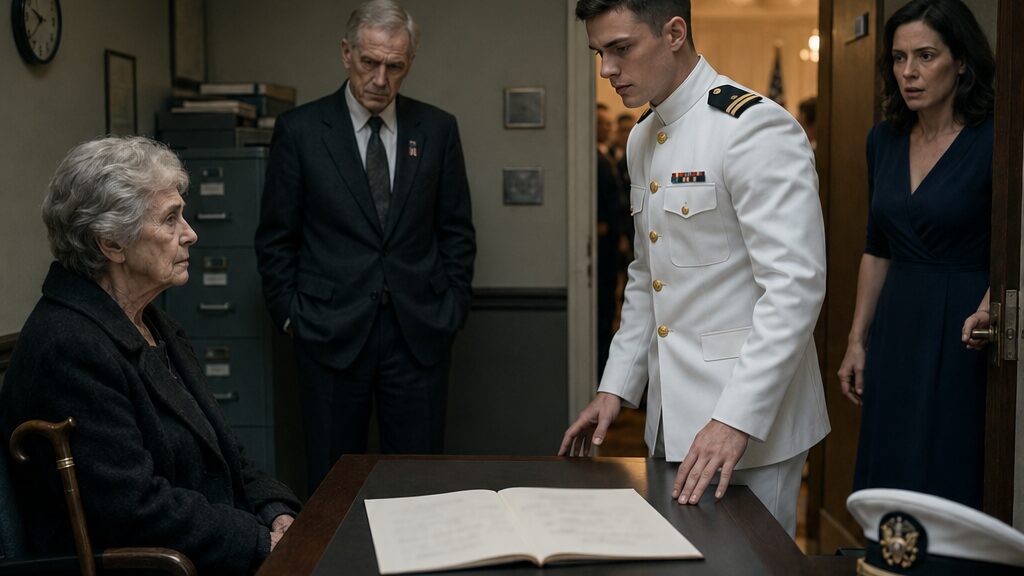
At the front row, Nicole sat two seats in from the aisle. The empty chair beside her had a white reserved card placed on it.
Frank reached for the card.
Nicole’s hand moved first. She removed it, slowly, and set it on her lap.
“Mrs. Carter,” she said.
Not Shirley. Not Miss Carter. Not Chief Carter. Mrs., though Shirley had never married.
“Nicole,” Shirley said.
The air between them held its shape.
Frank cleared his throat. “I’ll be near the podium if either of you need anything.”
Neither woman answered.
Shirley lowered herself into the aisle seat. Her knee objected halfway down, a bright flare she held behind her teeth until it passed. She placed the cane against the chair, coat over her lap, folded program beneath both hands.
Nicole looked at it.
“You folded it,” she said.
“Yes.”
“My father’s name is inside.”
Shirley rested her thumb along the crease. “I know.”
Nicole’s eyes stayed on the paper. “Some people might have kept it open.”
Some people might have written sooner, Shirley thought. Some people might have knocked on a young widow’s door, or answered a daughter’s letter, or explained why the official words were not the last words. Some people might have chosen pain when it was still honest instead of silence until silence hardened into evidence.
But the announcer returned to the microphone before Shirley had to decide whether to answer.
“Please rise for the presentation of colors.”
The room stood.
Shirley put one hand on the chair arm and pushed herself up. Her knee trembled once, then obeyed. Around her, uniforms straightened, civilians adjusted their programs, children were pulled gently upright by their sleeves.
At the front, Joshua Miller turned.
For the first time, Shirley saw his face.
Not Richard’s. Not exactly. The jaw was Nicole’s, the eyes darker, the mouth younger and more guarded. But there was something in the way he held still while waiting for instruction, something in the careful restraint of his breath, that crossed the room and found a place in Shirley she had kept sealed for thirty-one years.
Joshua’s gaze moved over the audience.
It passed Nicole and warmed.
It reached Shirley and paused.
Only for a second.
He did not know her. Not really. Perhaps he knew the outline: an old Navy nurse, someone from the operation, someone his mother disliked. Perhaps he knew less than that.
Still, he looked at the folded program against her chest as if he had seen the white edge of a question.
Beside the podium, Frank turned from the flags and caught Shirley’s eye. His face had lost all ceremony.
He mouthed nothing. He only shook his head once.
Don’t.
The colors advanced. The room fell into silence.
Shirley stood with her bad knee locked, her right hand flat over the folded program, feeling the crease beneath her palm like a scar.
Then Frank stepped near her row under the cover of the movement and bent close enough that only she could hear.
“Don’t correct them today,” he whispered.
Chapter 2: The Seat Reserved Beside a Woman Who Would Not Look
The colors reached the front of the hall with the slow precision of men carrying more than fabric.
Shirley stood with everyone else while the flags passed. Her right knee pulsed in two clean beats, then settled into a lower ache. She did not shift weight. She did not lean on the chair. The body could complain without being given command.
Beside her, Nicole held her program open. She had not folded it. The pages made a small white rectangle between her hands, untouched by thumbprints, unmarked, flat. Shirley could see Richard’s name on the page from the corner of her eye.
The invocation began.
A voice rose from the podium, asking blessing over service, over families, over those who had gone before. Shirley lowered her gaze, not quite closing her eyes. Closed eyes invited memory too easily.
The hall was full now. Shoes lined beneath chairs. Hands clasped in laps. Young officers in white sat in measured rows, their shoulders forming a bright wall across the front. Behind them, civilians watched with the careful faces of people who wanted to be worthy of the occasion.
Shirley had seen rooms like this before. Clean rooms. Rooms where grief had been swept, named, and placed under glass.
When the prayer ended, everyone sat.
Shirley lowered herself with care, one hand on the chair arm, the other still flat over the folded program. Her knee resisted at the last inch. The chair caught her before the pain showed.
Nicole noticed anyway.
Her eyes flicked toward Shirley’s leg, then away.
“You should have asked for a seat farther back,” Nicole said quietly.
Shirley looked toward the podium. “This one had my name on it.”
“It had a reserved card.”
“Yes.”
“That isn’t the same thing.”
The ceremony announcer began welcoming guests, his voice polished by repetition. He spoke of tradition, duty, the honor of commissioning, the families whose sacrifices stood behind every officer. At the word families, Nicole’s fingers tightened almost invisibly on the program’s edges.
Shirley kept her own hands still.
There were skills that stayed after everything else weakened. Listening under noise. Breathing through pain. Knowing when a person wanted an answer and when she wanted a wound to remain open.
“Distinguished guests, veterans, families, and friends,” the announcer said. “Today we gather not only to recognize new officers, but to honor the legacy that brings them to this moment.”
Legacy. The word moved through the room with a shine on it.
Nicole leaned slightly closer, not looking at Shirley. “He was nine when he first asked about you.”
Shirley did not answer.
“I told him you were someone who served with his grandfather.”
“That was true.”
Nicole gave a short breath through her nose. Not quite a laugh. “You always liked true things that left out the rest.”
Shirley felt the program under her palm, the folded bulk of it. Quartered now. Reduced. A white square holding public language in private pressure.
At the podium, the announcer moved through names and offices. Frank stood near the stage steps, hands clasped behind his back, his face turned toward the audience with the grave attentiveness of a man who knew exactly which parts of a ceremony were load-bearing.
Shirley could have looked at him and made him uncomfortable. She did not.
Nicole shifted the program onto her lap. “I didn’t want you here.”
“I know.”
“My mother would not have wanted you here either.”
Shirley received that without movement. Nicole’s mother had been twenty-six when the letter came. Younger than Joshua was now. Shirley remembered the envelope on a metal desk, remembered seeing Richard Miller’s name typed in a line where living men became administrative facts. She remembered signing for transport forms with blood under one fingernail that had not been hers.
She did not remember Nicole’s mother’s face because she had never gone to see her.
That was one of the facts she kept near the front of the drawer.
Onstage, a senior officer spoke next. He had a good voice, not theatrical, and enough gray at the temples to make the young people listen. He described service as “the discipline to act when hesitation is easier.”
Shirley’s thumb pressed into the crease of the program.
Nicole heard the line and lifted her chin.
Of course she did. Families collected phrases the way children collected shells. They kept the ones that sounded like answers.
“Hesitation,” Nicole murmured.
Shirley turned her head slightly.
Nicole’s eyes remained forward. “That’s what they told us. That there was no time. That decisive action saved lives. That my father understood.”
“He did understand.”
For the first time, Nicole looked at her fully.
The anger in her face was not loud. It had been lived with too long for that. It sat in the jaw, in the careful set of her shoulders, in the way she held herself upright as if grief were a uniform no one had permitted her to remove.
“You don’t get to say that.”
Shirley waited.
Nicole’s voice dropped lower. “You came back. He didn’t. You had his last message, or that’s what everyone whispered. You had something from him. Something he said. Something he wanted us to know.”
The officer at the podium paused for light applause. The room filled with soft clapping. Nicole’s words slipped beneath it.
“My mother waited,” Nicole said. “For a letter. For a visit. For anything that sounded like a human being had been with him at the end.”
Shirley watched the stage until the applause stopped.
“I was not good at letters,” she said.
Nicole stared at her. “That’s what you have?”
“No.”
But she did not give the rest.
The ceremony moved on. A row of candidates stood. Joshua was third from the left. The white of his uniform was almost too bright beneath the overhead lights. He kept his eyes forward. His hands rested at his sides. From where Shirley sat, she could see the faint movement of his throat when he swallowed.
Young, she thought. Not as a criticism. As a fact that should have carried more mercy in the world than it did.
The announcer read short biographies. Hometowns. Degrees. Assignments. Family connections. When Joshua’s name came, Nicole straightened so quickly Shirley felt the motion in the air between them.
“Joshua Miller,” the announcer said, “grandson of Lieutenant Richard Miller, whose courage during the Pacific evacuation operation remains an example of selfless naval service.”
The room applauded.
Nicole clapped too, her program tucked now under her arm, both hands free. Her face changed. Not softened exactly, but lit from behind by pride so disciplined it seemed almost painful.
Joshua looked toward his mother.
Then, for the smallest moment, his gaze moved one seat farther.
Shirley did not clap at first.
It was not protest. Her hands had simply failed to obey. The folded program lay on her lap, and her palms rested over it as if holding something down.
Nicole noticed.
“Can’t even do that?” she whispered.
Shirley lifted her hands and clapped.
The sound was small. Dry skin against dry skin. It disappeared under the room’s approval.
Joshua stepped back into line.
The biographies continued, but Shirley heard them from a distance. The words blended into one another, all the clean nouns of a country speaking well of itself: honor, duty, courage, sacrifice, legacy. She had believed in some of those words once with the fierce sincerity of the young. She still believed in parts of them. Smaller parts. Heavier ones.
Nicole sat rigid beside her.
“You know what he used to say?” Nicole asked quietly.
Shirley knew she should not answer. But silence had its own appetite, and she had fed it too long.
“What?”
“That real officers don’t look away when people need them.”
The words entered Shirley without surprise. She could almost hear Richard saying something adjacent to it, younger, cockier, before the fever, before the smoke. Then she could hear his other voice, the one at the end, stripped of performance.
Do not make her carry this like a bill.
Shirley folded her hands over the program.
“Joshua believes that because of him,” Nicole said. “Because of my father.”
“Yes.”
“And because of you.”
Shirley turned enough to see her.
Nicole’s eyes were wet now, but her face had hardened against it. “Because whatever you didn’t say became part of him too.”
At the front, candidates moved into position for the oath. Chairs creaked as the audience leaned forward. Cameras rose discreetly. Frank looked toward Shirley from beside the podium, not warning now, only watching.
Shirley looked at Joshua.
The young man stood tall among the others, one hand raised, his face solemn in the light. He did not know what shape of silence had helped make him. He did not know that the story under his feet had a missing room inside it.
The oath began.
Voices answered together, young and strong.
Shirley felt the words move through the hall, through the folded program, through her hand. She had spoken different oaths, in different years, under ceilings less polished and skies less forgiving. She remembered believing that promises, once made, stayed clean if you held them tightly enough.
Joshua’s voice carried on the final line.
Nicole breathed in sharply beside her.
Shirley looked down at the program in her lap. The crease cut across the page inside, across Richard’s printed name, across a sentence built to be admired.
When the oath ended, applause rose fast and full.
Joshua lowered his hand.
Then the announcer said, “Lieutenant Joshua Miller will now offer a brief legacy reflection in honor of his grandfather, Lieutenant Richard Miller.”
Nicole pressed the program to her chest.
Shirley did not move.
Onstage, Joshua stepped toward the microphone in his white uniform, and the hall quieted to hear what the dead had taught him.
Chapter 3: The Young Officer Wearing Someone Else’s Silence
Joshua Miller adjusted the microphone with two fingers, though it did not need adjusting.
The small gesture caught Shirley harder than his uniform had. Richard used to touch instruments that way before takeoff briefings, not because they were wrong, but because his hands needed a task while his face performed certainty.
Joshua’s sleeve brushed the podium. His cuff was immaculate. Gold buttons caught the light. He unfolded a half sheet of paper, looked at it, then set it down without reading.
“Good morning,” he said.
His voice was lower than Shirley expected. Still young, but trained already to carry across a room.
The audience answered with a quiet murmur.
Joshua looked toward Nicole first. That was proper. That was kind. Nicole’s shoulders changed when his eyes found her, as if she had been bracing against a wall and he had placed a hand there.
Then Joshua looked out at the hall.
“I was asked to speak for two minutes about legacy,” he said. “My grandfather, Lieutenant Richard Miller, died before I was born. So everything I know about him came from other people.”
A small, affectionate sound moved through the room. Families knew this shape of tribute. The absent elder made present. The young officer formed by memory. Safe grief. Useful grief.
Shirley kept both hands on the folded program in her lap.
Joshua glanced down once at the paper, then up again. “I know he was brave. I know he was calm under pressure. I know, during the evacuation operation, he stayed at his post when others needed direction. I know lives were saved because he acted.”
Shirley’s thumb pressed along the crease until the nail paled.
Acted.
Yes. Richard had acted. He had held a slipping doorframe with one burned hand while two children crawled beneath it. He had shouted at a pilot who could not hear him over rotor wash. He had laughed once, absurdly, when Shirley cut away part of his sleeve and told him to stop bleeding on her boots.
He had also begged for water.
He had also been afraid.
Joshua’s face softened in the pause between sentences. Whatever he had practiced, he was feeling some of it now.
“My mother told me that when I was little, I kept asking what made him a hero.”
Nicole sat very still beside Shirley.
“She told me,” Joshua continued, “that real officers don’t look away when people need them.”
A warmth of approval passed through the room. A phrase like that wanted applause, but ceremony held it back. Heads nodded. Someone in the second row touched a handkerchief to one eye.
Shirley looked at the folded program.
The sentence had weight. It had shape. It sounded like something to pass to a child when the truth was too large for a kitchen table. She did not blame Nicole for needing words that could survive bedtime.
But Joshua was not a child now.
He stood in white beneath flags, about to enter a profession that punished simple myths by making them useful.
“Those words stayed with me,” Joshua said. “They’re why I’m here today. My grandfather’s example taught me that hesitation costs lives, and duty means choosing others before yourself.”
Shirley’s breath paused of its own accord.
Hesitation costs lives.
There were rooms where that sentence was true. There were seconds where hesitation did kill. Shirley had seen them. A hand hovering over a clamp. A driver waiting for permission while a road filled with fire. A commander asking for confirmation because certainty felt cleaner than blame.
But sometimes hesitation was the last doorway mercy had.
Sometimes the person who stopped long enough to count saved more than the person who charged ahead wanting history to call it courage.
Joshua had not been taught that part.
Nicole leaned close enough that her sleeve brushed Shirley’s. “He learned it right.”
Shirley did not turn.
Onstage, Joshua looked toward the row of young officers seated behind him. “We inherit more than names. We inherit standards. I hope I can live up to his.”
His jaw tightened on the last words. There it was—the private seam beneath the polished tribute. He was not boasting. He was asking something of a dead man, and of a room that would not answer honestly.
The applause came, formal at first, then fuller.
Joshua stepped back from the microphone. His eyes lowered briefly, as if he regretted some part of having spoken in front of strangers. Then he looked toward his mother.
Nicole clapped with both hands, the program pressed between her wrist and ribs. Her face had pride in it and something more brittle. She had spent years building that sentence for him. Real officers don’t look away. Shirley could see now how carefully Nicole had chosen it, not only to honor Richard, but to accuse the woman seated beside her without saying her name.
Shirley’s hands remained still.
This time she did not remember to clap until Frank, near the podium, looked at her.
She brought her palms together.
Once. Twice. Enough to disappear inside the room.
Joshua returned to his place beside the other officers. A faint smile touched his mouth when the senior officer leaned in to say something to him. It vanished quickly. He resumed his posture, young body trained to stillness, eyes forward, grief tucked where discipline had told him to put it.
Shirley could not stop looking at him.
It was not Richard she saw now. That had been the first blow, the resemblance from behind, the echo in the hands. But what held her was not resemblance. It was the sentence he had taken into himself.
Hesitation costs lives.
At twenty-two, a sentence like that could become a blade. At thirty, it could become a rule. At forty, if the world had not broken it for him, it could become cruelty mistaken for discipline.
Her knee began to ache again. She welcomed it. Pain in the present was useful. It gave the body a place to stand.
The ceremony continued. The senior officer spoke about assignments. Another young officer received recognition for academic achievement. A family in the third row cried softly when a daughter pinned something to a lapel.
Shirley heard it all as if through a door.
Nicole shifted once beside her. “You should leave before the reception.”
The words arrived without anger. Almost practical.
Shirley turned her head a fraction. “Why?”
“Because he’ll ask who you are.”
“Then tell him.”
“I have.”
Shirley waited.
Nicole looked at the stage. “I told him you were there.”
There. The smallest word for a place that had taken years to leave.
“I told him you were the nurse assigned to the evacuation,” Nicole said. “I told him you came home and my father didn’t. I told him my mother wrote twice and received nothing but the official letter.”
Shirley looked at Nicole’s hands. They were clenched around the open program now, wrinkling the lower corner. So she could crease paper after all.
“Did you tell him I was twenty-nine?” Shirley asked.
Nicole’s eyes cut toward her.
Shirley regretted it at once. Not because it was untrue, but because it was too close to defense.
Nicole’s mouth trembled before she controlled it. “My mother was twenty-six.”
“Yes,” Shirley said.
The word landed between them and stayed there.
Onstage, the announcer invited everyone to remain seated for a final presentation before the break. A screen lowered behind the podium with a soft mechanical hum. Photographs appeared: ships, aircraft, training fields, old black-and-white portraits, modern young faces. The audience relaxed into reverence.
Then Richard appeared.
Not the Richard Shirley had last seen. Not gray with ash, not stripped of rank by the animal facts of pain. This Richard was twenty-eight or thirty, standing on a tarmac, one hand raised against sunlight. His smile was angled, impatient, alive. The photograph had been cropped to make him look alone, though Shirley knew from the edge of a shoulder on the left that someone else had stood beside him.
Perhaps her. Perhaps not. She had stopped keeping photographs.
A soft sound came from Nicole.
Shirley did not look at her.
The narration began, recorded in a solemn voice. Lieutenant Richard Miller. Naval pilot. Husband. Father. Officer. His courage during the Pacific evacuation operation helped save dozens of lives.
Dozens. Clean number. No faces.
The image changed to a naval aircraft. Then to a memorial plaque. Then to Joshua as a boy holding a model ship. The audience made a tender sound at that, and Nicole’s breathing caught.
Shirley looked down before the next image could come.
The folded program rested in her lap, but the edge had bent where her fingers had gripped it too hard. The crease no longer aligned perfectly. A small flaw. Visible only if someone knew to look.
She smoothed it with her thumb.
Not enough.
The narration went on. His legacy continues through his grandson, newly commissioned today.
Applause again. A room full of hands turning grief into sound.
Shirley felt something rise in her, not anger, not yet. Fear, maybe. The old kind. Not fear of memory. Fear of what memory could become when polished by people who had never had to choose who got on the last transport.
Joshua stood to be acknowledged. The audience turned toward him.
He looked embarrassed, proud, moved. He looked at his mother and smiled faintly. Then his gaze traveled, perhaps by accident, to Shirley.
This time it did not pass over her.
He saw the program in her lap. Saw that it was folded small. Saw, maybe, that she was not clapping with the others.
His smile faded, not into offense, but into attention.
Shirley held his gaze for one second too long.
Then Nicole’s whisper cut in beside her, low and controlled.
“If you came here to make him doubt his grandfather, I will not let you.”
Shirley’s fingers closed around the program.
“I came because Frank asked.”
“No.” Nicole’s eyes were bright, fixed forward. “You came because rooms like this let people look honorable without having to answer anything.”
The words should have belonged to Shirley. That was what made them hurt.
Onstage, Joshua sat down. The screen lifted. The announcer declared a short break before the reception and final acknowledgments.
Chairs began to move. People exhaled, stood, murmured, reached for purses and phones. The ceremony loosened into human noise.
Shirley remained seated.
Her knee would need a moment. That was one reason.
The other was that Joshua had stepped down from the stage and was walking toward the front row, still in white, still carrying the sentence they had given him like a polished blade.
Nicole rose to meet him.
Shirley stayed where she was, the folded white program bent in her hand, and understood with a slow, cold clarity that silence had not protected him at all.
Chapter 4: The Evacuation List No One Wanted Read Aloud
The break opened the room.
Chairs scraped. Programs closed. Conversations rose in careful layers as people began moving toward the side doors, toward coffee and restrooms and the relief of no longer sitting still under flags.
Joshua reached Nicole first.
Shirley watched the two of them embrace with one arm each, the way people do when uniforms make tenderness difficult. Nicole touched his sleeve, then his cheek, then stepped back as if remembering the room. Joshua smiled at her, but his eyes moved past her once, toward Shirley.
Shirley looked down before he could find her fully.
Her knee did not want to stand. It had been quiet too long and punished her for trusting it. She put one hand on the chair arm, waited until a group of young officers passed, then pushed herself up. The cane came into her palm with familiar weight.
Nicole’s voice floated behind her, soft with pride now. “You did beautifully.”
Joshua answered something Shirley could not hear.
She turned toward the side aisle.
Frank was waiting near the wall beneath a row of framed service plaques. He did not gesture this time. He only stood with his hands behind his back and his mouth set in a line that made him look older than he had in the lobby.
Shirley walked to him because avoiding him would have looked like retreat.
The hallway outside the auditorium was cooler. The air-conditioning hummed above the ceiling tiles. On the walls, photographs of ships and rescue crews marched in chronological order, each captioned with dates, places, names compressed into plaques. Men and women smiled from clean frames, forever uninjured, forever useful to history.
Frank stepped beside her. “You shouldn’t have had to sit through that.”
“No one forced me.”
“I told them the wording was too simple.”
“Ceremonies prefer simple.”
“They’re meant for families.”
“That’s what makes them dangerous.”
Frank looked toward the open auditorium doors. Noise spilled out: laughter too quiet to be careless, children being hushed, coffee cups set on a table. Joshua was still inside, surrounded now by hands on his shoulders and congratulations he had not yet learned how to receive without embarrassment.
“Shirley,” Frank said, “he doesn’t need the whole story today.”
“No one ever needed it on the day I had it.”
“That isn’t fair.”
She turned her head. “No.”
The admission stopped him.
She walked a few steps farther down the hallway, away from the traffic. Her cane tapped once, twice, then found the edge of a carpet runner. There, beneath a photograph of an aircraft carrier at dusk, she stopped.
Frank followed.
“For thirty-one years,” he said, “I’ve watched you refuse to correct people.”
“You say that as if you weren’t grateful.”
His face tightened.
The carpet swallowed the sound of passing shoes. A young officer guided an elderly guest toward the reception room. Two children stared at Shirley’s cane until their parent murmured them onward.
Frank waited until they passed. “I was grateful for peace.”
“Peace for whom?”
“For the families. For the command. For everyone who had to live after.”
Shirley looked at one of the plaques. Names, dates, operation title. Polished brass. Easy to dust.
“Everyone had to live after,” she said.
Frank reached inside his suit jacket.
The motion made her look at him sharply. Old habits. He noticed, paused, then withdrew a folded sheet of paper sealed inside a clear plastic sleeve.
“I didn’t bring this to use,” he said.
“Then why bring it?”
“In case you asked whether I remembered.”
Shirley stared at the paper.
It had been folded long before the plastic protected it. Four creases, worn pale. The corners were rounded with age. Through the sleeve she could see typed columns and dark handwritten marks where someone had corrected a number in a hurry.
Evacuation Priority List
Pacific Civilian-Military Extraction, Final Lift Window
Her throat went dry in a way no water could have helped.
Frank held it out.
She did not take it.
“I know what it says,” she said.
“I know you do.”
“Then put it away.”
“Nicole thinks there was one empty seat.”
“There was.”
Frank’s eyes closed briefly.
Shirley’s hand tightened around the cane. “Don’t clean it up now.”
“I’m not trying to.”
“There was one empty seat after we moved the oxygen unit. Before that, there were none. After that, there was one, and three people close enough to count it.”
Frank lowered the paper a little.
Shirley could hear rotor wash though the hallway was quiet. Not loudly. Not as a hallucination. Only the body remembering what the mind had folded away.
A child on a stretcher, too still except for the eyes. A civilian interpreter with blood in his hair, repeating numbers in two languages because panic made people deaf. Richard Miller sitting with his back against a crate, one boot braced against the floor, burned sleeve cut away, jaw clenched so hard the tendons stood out in his neck.
He had looked at the list in Shirley’s hand.
Not asked. Looked.
She had said, “Don’t.”
He had said, “Carter.”
Only that. Her name as order, plea, and apology.
In the hallway, Frank’s voice was low. “You made the call you were authorized to make.”
“No. I made the call no one wanted to sign.”
“You saved—”
“Don’t count them at me.”
His mouth shut.
The plastic sleeve made a faint crackle as his fingers shifted.
Shirley looked at the list because not looking had become childish. Her own handwriting was there in the margin, cramped and slanted from the vibration of the temporary command table.
Move Ward B child with oxygen. Interpreter second. Miller holds position.
Miller holds position.
A phrase, not a man.
She had written it because forms did not have room for he knows, he asked, he is afraid, he made me promise.
Frank said, “He told you to put the boy on.”
Shirley kept her eyes on the paper. “He told me to put all of them on if I could.”
“And you did.”
“I put all of them on. Then I stood there with one seat and two men looking at me.”
Frank’s face changed. He had known the outline. Not all of it. Men like Frank often knew enough to be burdened and not enough to be guilty.
“Two?”
“The interpreter couldn’t stand by then. Richard could.” Shirley’s voice stayed flat. She made it flat. “Richard told me the interpreter had children in the shelter. He said his own daughter was too young to remember him properly.”
Frank breathed out once.
“He was wrong,” Shirley said.
The reception noise swelled, then faded as the doors partly closed. Somewhere inside, someone laughed. The sound did not belong to the hallway.
“His daughter remembered the empty space around him,” Shirley said. “Children do that better than faces.”
Frank folded the plastic sleeve against his chest. “Why didn’t you tell Nicole that?”
Shirley looked at him.
He had the decency to lower his eyes.
Because she had been twenty-nine. Because she had walked into the communication tent afterward and washed her hands three times before realizing there was no blood left on them. Because the official letter had already been drafted by men with clean sleeves. Because Richard’s wife had written in small blue handwriting asking whether he had suffered, and Shirley had placed the letter in a drawer for one day, then another, then too many. Because Richard had said, Do not make her carry this like a bill.
Because Shirley had been afraid that if she began with the mercy, Nicole would ask about the abandonment, and both were true.
“He asked me not to make his death a debt,” Shirley said.
Frank was quiet.
“He said his wife would spend her life paying it if I let her. He said his little girl would grow up thinking she owed him courage.” Shirley’s fingers ached around the cane. “So I let the Navy give them a cleaner story.”
“A kinder one.”
“No.” She looked toward the auditorium doors. “A smaller one.”
Frank’s face had gone pale in the hallway light. “The program can be changed for the archive copy. Not today, but afterward. We can add language about the medical evacuation team. Your name doesn’t have to be—”
“My name is not the wound.”
“Then what do you want?”
The question was gentle. That made it worse.
Shirley wanted, for one unworthy second, to say she wanted Nicole to stop looking at her as if she had carried Richard home in one pocket and refused to hand him over. She wanted Joshua to unlearn the bright sentence before it found someone else’s life. She wanted Richard to have leaned on one hip in that photograph so the room would know he had not been born noble, only human. She wanted to be twenty-nine again with no list in her hand.
Instead she said, “I want you to put that paper away.”
Frank obeyed slowly.
From the auditorium, footsteps approached. Young, measured, but not yet practiced enough to hide uncertainty.
Shirley looked up.
Joshua stood at the end of the hallway, white uniform bright against the darker wall, his mother not with him. His eyes moved from Frank’s jacket pocket to Shirley’s face.
He had heard enough to know there was something to hear.
Frank started to speak. “Lieutenant Miller—”
Joshua did not look at him.
Shirley’s hand rested over the folded program against her chest.
The words left her before she could fold them smaller.
“I left him there,” she said.
Joshua stopped.
Chapter 5: The Sentence Joshua Was Never Supposed to Hear
Frank moved first.
It was a small movement, only one step forward, but it placed him between Joshua and Shirley as if rank or age could still arrange the room.
“Lieutenant Miller,” he said, “this isn’t the right—”
Joshua’s eyes stayed on Shirley. “Did you know him?”
The hallway seemed to narrow around the question.
People continued passing behind him toward the reception room. A woman balanced two cups of coffee. A child dragged a program along the wall until a parent lifted it away. Somewhere, laughter rose and lowered. None of them knew that the young officer in white had just stepped through a door no ceremony had built for him.
Shirley looked at Joshua’s face and saw, not Richard, but Nicole’s anger before it had hardened. Fresh hurt was easier to harm. Easier to mislead.
“Yes,” she said.
Joshua waited.
Frank said, “Joshua, perhaps after the reception—”
“Did you know him when he died?” Joshua asked.
Frank stopped.
Shirley’s hand found the folded program against her chest. The paper had softened from her grip. Its precise quarters were no longer precise.
“Yes,” she said again.
Joshua’s mouth tightened. Not dramatically. He had training enough not to show everything in public, even when public had followed him into a hallway.
“My mother said you were there,” he said. “She never said you left him there.”
Shirley looked toward the auditorium doors. Nicole was not visible yet. That was a mercy with an expiration.
“There’s a small office,” Frank said quietly. “This way.”
“No,” Joshua said.
The word was not loud, but it had command in it. He heard it too and seemed embarrassed by his own tone. “I mean—if there’s something I should know, I’d rather not have it managed.”
Shirley almost smiled at that. Managed. He had found the right verb.
“You should not learn it in a hallway,” she said.
Joshua looked at her cane, then at the folded program. “Then where?”
Frank opened a door beside the service plaques. The room beyond was narrow, used by volunteers during ceremonies. A desk, three chairs, a filing cabinet, a coat rack with empty hangers. On the wall hung a faded poster about veterans’ benefits and a clock that ticked louder than it needed to.
Shirley entered first. It was habit, not courage: assess the exits, the chairs, the surface where a paper could be laid flat. She took the chair nearest the desk because it had arms.
Joshua remained standing until Frank said, “Sit.”
“I’m fine.”
“No,” Shirley said. “You’re in uniform. Sit before you start using posture as armor.”
Joshua looked at her, surprised enough to obey.
Frank closed the door but did not sit. He stood near the filing cabinet, one hand over the pocket where the plastic-sleeved list had disappeared.
Shirley placed the folded program on the desk. The white square looked almost childish there. She smoothed it once with her palm. The creases remained.
Joshua watched her hand. “Did he suffer?”
Of all the questions, the oldest one.
Shirley had known widows to ask it, mothers, brothers, men who had carried other men away from fire. She had asked it of herself in different forms for most of her adult life. Did he suffer? Did he know? Was he alone? Did he forgive? Which minute counted as the end?
“Yes,” she said.
Frank drew a breath.
Joshua’s face changed. Not crumpled. Closed, then opened in a worse way. “People always say no.”
“People are often trying to be kind.”
“Are you?”
“No.”
He looked down.
The clock ticked above the benefits poster. Outside, reception noise pressed faintly through the wall.
Shirley opened the program. The fold lines resisted, then spread. Richard’s name appeared in the tribute paragraph, split by one of her creases.
“I was a flight nurse assigned to the extraction team,” she said. “By the final lift window, I was doing more list work than nursing. Beds. Seats. Oxygen. Weight. Who could walk. Who could survive the next two hours without transport. Who could not.”
Joshua’s hands rested on his knees, fingers straight.
“Your grandfather was injured helping move people to the landing zone. Burns. Smoke inhalation. He was conscious.”
Joshua looked up quickly. “Then why wasn’t he on the transport?”
Shirley kept her eyes on the page. “Because when we moved the oxygen unit, one seat opened. There were two men left who might live if they got it.”
Joshua’s face sharpened. “Might?”
“That was the word we had by then.”
“And you chose the other man.”
“Yes.”
“Who?”
“An interpreter. Civilian attachment. He had internal bleeding and a worse airway. He also had information about families still in the shelter.”
Joshua absorbed that as if it were an insult to the story he knew.
“My grandfather was an officer.”
“Yes.”
“He was one of yours.”
“Yes.”
“Then why—”
“Because being ours did not make his lungs worth more.”
The room went quiet enough that Shirley heard Frank shift his shoes.
Joshua’s eyes moved from her face to the program and back. Anger had come now, not wild, but clean and young. “Did he ask you to leave him?”
Shirley’s fingers rested beside Richard’s printed name.
“He asked me to put the others on first.”
“That’s not the same thing.”
“No.”
The answer unsettled him more than an argument would have.
Shirley looked at him fully. “Don’t make him braver than he was.”
Joshua flinched.
Frank said softly, “Shirley.”
She did not look away from Joshua. “He was brave. He was also frightened. He wanted water. He wanted his wife. He asked whether the boy with the oxygen had made it on. He made a joke about bleeding on my boots. Then he told me not to make his daughter spend her life repaying a dead man.”
Joshua’s face had gone still.
“She was little,” Shirley said. “Younger than any child should be when adults start turning grief into instruction.”
“My mother,” Joshua said.
“Yes.”
“She waited for you.”
“I know.”
“Did you have a message?”
Shirley looked back at the program.
There it was, the piece that had grown teeth in the dark. She could feel Frank waiting. Could feel Nicole, somewhere beyond the door, proud and wounded and unaware that the story she hated had begun without her.
“Yes,” Shirley said.
Joshua’s voice lowered. “And you didn’t give it to her.”
“No.”
“Why?”
Because I was tired. Because I was ashamed. Because your grandfather asked for mercy and I mistook silence for mercy. Because one unanswered letter becomes easier to leave unanswered than one answered late.
“Because I thought I was keeping his promise,” Shirley said.
Joshua stared at her.
“It was partly true,” she said. “That’s how cowardice survives in disciplined people. It borrows something true and stands behind it.”
Frank’s hand dropped from his pocket.
Joshua looked down at his own hands. They were young hands, unscarred, clean at the nails. “So my mother was right.”
Shirley waited before answering. “About some of it.”
“She said you looked away.”
“No.”
“You just said you left him.”
“I did.”
The words stood there, stripped of defense.
Joshua pushed back from the desk, then stopped himself from rising. The chair legs scraped only an inch. He swallowed. “My whole life, he was the reason. The reason to serve. The reason to be decisive. The reason not to hesitate.”
Shirley folded her hands in her lap to keep them from reaching for the program again. “That is too much weight to put on the dead.”
“You don’t get to tell me what he means.”
“No,” Shirley said. “I don’t.”
His anger faltered. He had expected resistance, perhaps. Denial. An old woman defending her record, a bureaucrat offering sealed pages. Shirley had given him neither. That left him with the harder work of hearing.
She turned the program so Richard’s printed name faced him.
“Do you have a pen?” she asked.
Joshua blinked. “What?”
“A pen.”
Frank took one from inside his jacket and placed it on the desk. Shirley did not thank him. She uncapped it with stiff fingers and held it over the margin beside Richard’s name.
For a moment, she could not make her hand move.
The tremor came from the wrist first, then the thumb. Age, pain, memory; the body did not care which name the room preferred. The pen tip touched the paper and left a dot of blue ink.
Joshua noticed. He looked away quickly, trying to be kind.
That hurt more than if he had stared.
Shirley steadied her hand with the other and wrote slowly in the white space beside the tribute paragraph.
He asked for them first.
The sentence looked too small.
She capped the pen and slid the program toward Joshua.
He did not touch it.
“That is not all he said,” Shirley told him. “It is not all that happened. It does not clear me. It does not condemn him. It is just the part your ceremony left no room for.”
Joshua read the sentence.
His eyes moved over it several times. The anger did not leave him; it changed density. Less flame, more weight.
“He chose that?” he asked.
“He chose as much as anyone can choose when everything has already narrowed.”
Joshua’s fingers reached the program’s edge, then stopped. “And you chose too.”
“Yes.”
“You chose not to tell my mother.”
“Yes.”
He looked at her then, really looked, as if the old woman in the chair had finally become more difficult than the villain he had been handed.
Outside the door, footsteps approached fast, then slowed.
The handle turned.
Nicole stood in the doorway, her reception smile gone before it had fully left her face. Her eyes went first to Joshua, then to Shirley, then to the white program open on the desk between them.
She saw the handwriting.
No one moved.
Nicole stepped into the room and read the sentence beside her father’s name.
He asked for them first.
Her hand rose to her throat, but she did not touch it.
“What did you do?” she asked Shirley.
Chapter 6: The Mother Who Needed a Villain More Than an Answer
Nicole did not step fully into the room at first.
She stood with one hand on the doorframe, the other pressed flat against the front of her dress where the program had been earlier, as if she had reached for it and found nothing there. Behind her, the reception moved on without knowledge of the small office. Glasses chimed. Someone congratulated someone else. A burst of laughter rose, then was hushed.
No one in the office spoke.
Nicole looked again at the handwriting beside her father’s name.
He asked for them first.
“What did you do?” she asked.
Shirley sat with both hands in her lap. The pen lay capped on the desk, parallel to the edge, as though order could still be restored by straight lines.
“I wrote what he said.”
Nicole’s eyes lifted. “No.”
Joshua stood. “Mom.”
“No.” Nicole’s voice sharpened, but she did not look at him. “No, Joshua. She doesn’t get to do this now. Not today. Not after letting us carry nothing for thirty-one years.”
Frank moved toward the door. “Nicole, this conversation should be—”
She turned on him. “You knew?”
Frank stopped.
The question struck him harder than Shirley expected. He opened his mouth, closed it, then looked toward the filing cabinet instead of at her.
“I knew parts,” he said.
“Parts.” Nicole repeated the word with a small, disbelieving laugh. “Everyone always knows parts. Enough to stand at podiums. Enough to print programs. Enough to decide what families can survive hearing.”
Shirley felt the sentence land. Nicole had always been better at finding the blade.
Joshua reached for the program on the desk. Nicole’s hand came down first.
She did not take it. She only held it in place with two fingers.
“Don’t,” she said.
Joshua looked at her. “I already read it.”
“You read what she wanted you to read.”
Shirley remained still.
Nicole’s fingers pressed harder on the program. The white paper buckled slightly beneath them. “My mother wrote to you.”
“Yes.”
“She wrote twice.”
“Yes.”
“She asked whether he had said anything.”
“Yes.”
The answers came too plainly. Nicole’s face changed with each one, not because the facts were new, but because hearing Shirley admit them removed one of the walls she had leaned against for years.
“And you kept it from her,” Nicole said.
“I did.”
Joshua’s gaze moved between them, helpless now in a way his uniform could not conceal.
Nicole looked at him then, and something in her softened for a moment. “This was supposed to be your day.”
“It still is,” Joshua said, though his voice did not make it true.
“No. It isn’t. She made sure of that.”
Shirley accepted the accusation. A person could be wrong in one part and right in another. Nicole had learned to speak from the overlap.
Frank said quietly, “Shirley wasn’t trying to hurt him.”
Nicole turned back. “Then what was she trying to do?”
No one answered quickly enough.
Nicole let go of the program and took one step into the room. The office seemed smaller with her grief inside it.
“I grew up with a father shaped like a blank space,” she said. “Do you understand that? Everyone gave me words. Brave. Honorable. Sacrifice. They said them so often I stopped hearing them. My mother would sit at the kitchen table with those letters she wrote you, and she would say maybe the mail was slow. Maybe you had been reassigned. Maybe the Navy wouldn’t let you answer.”
Her voice did not break. That made it worse.
“She defended you,” Nicole said. “For years.”
Shirley closed her eyes once, then opened them.
“I did not deserve that.”
“No,” Nicole said. “You didn’t.”
Joshua looked at the floor.
Nicole’s hand trembled at her side. “Then after she died, I found the copies. Two letters. Her handwriting. So careful. She didn’t ask for hero stories. She asked if he was alone.”
The clock ticked above them.
Shirley said, “He was not alone.”
Nicole inhaled sharply, as if the answer had arrived decades late and still struck with force.
“Don’t,” she whispered.
“I was with him.”
“Don’t make that sound like comfort.”
“It isn’t.”
Nicole’s eyes filled, but no tears fell. “Then why didn’t you tell her?”
Shirley looked at the program, at her own small sentence in the margin. There was not enough room on the page for what the question required.
“Because he asked me not to make his death a debt,” she said. “Because I was young enough to believe silence could be clean. Because by the time I understood it wasn’t, your mother had turned my silence into one more thing she had to survive.”
Nicole stared at her.
“Because I was afraid,” Shirley said.
The room changed around the words.
Frank looked down. Joshua’s fingers curled once and released.
Nicole gave the smallest shake of her head. “Afraid of what? My mother? Me?”
“Of being asked whether I made the right choice.”
“You were asked that anyway. Just not by us.”
“Yes.”
“And what is the answer?”
Shirley looked up at her.
The honest answer had no ceremony in it. No brass, no flags, no clean sentence for programs. It had a boy’s burned hands, a man’s crushed breathing, a civilian interpreter bleeding under a blanket, Richard’s eyes staying clear longer than they should have because some people met death with discipline and some with denial and most with both.
“I don’t know,” Shirley said.
Nicole’s face went still.
Joshua looked at Shirley as if he had expected guilt, excuse, even confession, but not uncertainty.
“I know what the list required,” Shirley said. “I know what your father asked. I know who survived because of that seat. I know what I signed. I know I did not go to your mother afterward.” She paused. “I don’t know if that makes the choice right. I only know it makes it mine.”
Nicole’s mouth twisted. “How noble.”
“It wasn’t.”
“No, it wasn’t.” Nicole’s voice rose, then she caught it and lowered it again. “Do you know what I needed you to be?”
Shirley did not answer.
“I needed you to be cruel,” Nicole said. “Or cold. Or ashamed. Something simple. Something I could point to when Joshua asked why his grandfather died and all I had were framed words from people who came home.”
Joshua said, “Mom.”
She shook her head. “No. You made him into a lesson because I didn’t have anything else to give you.”
The sentence startled her after she said it. Shirley saw it: Nicole hearing herself, seeing the weapon she had passed into Joshua’s hands and called inheritance.
For one breath, the office held something almost like mercy.
Then the ceremony announcer’s voice came through the wall, muffled but clear enough.
“Ladies and gentlemen, if our guests would begin returning to the hall for the final acknowledgment…”
Frank straightened. Duty returning to fill the space grief had opened.
Nicole reached for the program.
Joshua put his hand over hers, not forcefully. “Please.”
She looked at him.
“I need to keep reading it,” he said.
“It’s one sentence.”
“I know.”
Nicole’s eyes moved to Shirley. “That’s what she does. Gives you one sentence and lets you spend your life trying to survive the rest.”
Shirley did not defend herself.
Frank opened the door a few inches. The reception noise brightened. People were moving back toward the auditorium, smoothing jackets, gathering purses, carrying plates with unfinished cake.
“We need to go,” he said.
Nicole looked at the program once more. Her fingers curled as if she might snatch it, tear it, make the white page unable to hold any version at all.
Instead she let go.
Joshua picked it up carefully, but did not fold it. Not yet.
Shirley pushed herself to stand. Pain rose in her knee, hot and immediate. Her hand missed the cane by an inch.
Nicole saw.
For a moment, her body moved as if to help. Then she stopped herself, angry at the instinct.
Shirley found the cane on her own.
“I won’t say anything from the stage,” she said.
Nicole’s face hardened again. “You think that’s kindness?”
“No,” Shirley said. “I think it’s restraint. I’m no longer certain they are the same.”
Frank held the door open.
Joshua stepped out first, the corrected program held at his side. Nicole followed him. At the threshold, she turned back to Shirley.
“You don’t get to be forgiven because you finally said one true thing.”
“I know.”
Nicole looked as if she had wanted another answer, something she could fight. When it did not come, she left.
Shirley stood alone for a moment with Frank behind her and the ticking clock above the desk.
From the hall, the announcer called Joshua’s name again.
Frank looked at Shirley. “Should I correct the program publicly?”
Shirley tightened her hand around the cane and stepped toward the sound of the room waiting for its clean ending.
Chapter 7: The Correction That Stayed in One Young Officer’s Pocket
The hall had changed while Shirley was gone.
It was the same room, same flags, same polished stage, same rows of chairs, but the air had shifted into the loose expectancy of an ending. People had returned from coffee and private conversations carrying the softness of the reception with them. Programs rested on laps. Children leaned against parents. Young officers sat taller than they had before, as if the break had given them time to feel the weight of their new rank and decide not to show it.
Shirley entered through the side door with Frank one pace behind her.
She did not look for Nicole at first. She looked for the aisle, the chair arm, the path that would let her sit without asking the room for patience. Pain had settled deep in her knee now, no longer sharp enough to command attention, only steady enough to remind her that the body kept its own records.
Joshua was already near the stage.
He had not returned to the row of officers. He stood beside the podium with the corrected program held flat against his thigh. His thumb covered part of Richard’s printed name. From that distance, no one else could see the blue sentence written in the margin.
Nicole sat in the front row, hands empty.
That frightened Shirley more than if she had been holding the program like a weapon.
Frank leaned close as they reached the aisle. “I need an answer.”
Shirley stopped beside the row. The hall lights made his face look colorless.
“No,” she said.
Frank stared at her. “No correction?”
“No public correction.”
“Shirley—”
“You asked what I wanted. That’s not the question.” She shifted her hand on the cane. “What does Joshua need?”
Frank looked toward the stage.
Joshua had turned slightly, as if sensing their attention. His face was composed, but the program in his hand was not. Its edge had bent where he gripped it too hard.
“He needs the truth,” Frank said.
“He has enough of it for today.”
“Enough?”
“Enough to stop worshiping the wrong sentence.”
The announcer returned to the microphone and tapped it once. The sound passed through the room. Conversations faded. The final acknowledgment was beginning whether anyone in the front row was ready or not.
Frank’s jaw worked. “The official copy can still be amended.”
“Later.”
“That’s what we always say.”
Shirley met his eyes. “Then later better mean later this time.”
She sat before he could answer.
Nicole did not look at her. She watched Joshua with a face so controlled it seemed carved. Shirley knew that control. Had used it. Had mistaken it for strength until it became all she had left.
The announcer smiled out at the hall. “Before we conclude, we would like to offer one final acknowledgment to Lieutenant Joshua Miller and to the family legacy represented here today.”
A pleasant murmur moved through the audience.
Joshua stepped closer to the podium. Frank remained standing near the side, caught between ceremony and conscience.
The announcer continued. “Lieutenant Miller’s grandfather, Lieutenant Richard Miller, has been remembered today as an example of courage and sacrifice. We are honored to see that legacy carried forward.”
Applause began.
Joshua did not smile.
He looked down at the program in his hand.
For one suspended second, Shirley thought he might read the correction aloud. Her heart gave one hard beat, not from fear of exposure, but from fear of what public truth would do to him before he understood how little applause could repair.
Joshua lifted his head.
“Thank you,” he said, though the microphone had not yet been adjusted for him. His voice came soft through the speakers after a half-second delay. “I’m grateful.”
The room quieted again, pleased by the unexpected modesty of a young officer.
He looked at Nicole first. Her lips parted slightly.
Then he looked toward Shirley.
Not long enough for the room to follow.
“I was taught that legacy is something you inherit,” Joshua said. “Today I think it may also be something you have to learn how to carry.”
The words were careful. Not a speech. Not a confession. A young man stepping around the edge of a hole in the floor.
Nicole’s hand moved in her lap, closing over nothing.
Joshua looked back at the audience. “I’m honored by my grandfather’s service. I’m honored by everyone who served with him, including those whose names don’t always fit into the printed program.”
Frank lowered his head.
Shirley felt the room receive the sentence without understanding its teeth. Some people nodded. A few glanced at their programs. The words were broad enough to pass as grace, narrow enough to reach the only people who needed to hear them.
Joshua’s fingers shifted over the white paper.
“I hope,” he said, and stopped.
The pause was brief, but Shirley saw him choose inside it.
“I hope I remember that service is not made clean by being honored,” he finished. “Thank you.”
The applause came because applause always came when a young officer said something humble beneath flags. It rose warm and approving. It did not know what it was approving.
Joshua stepped back.
Nicole looked at Shirley then.
There was no forgiveness in her face. No peace. But something had moved. The certainty, perhaps. Or the right to hate without remainder.
Shirley did not nod. It would have been too much.
The announcer closed the ceremony with words about duty and pride. The colors were prepared to depart. Everyone rose.
Shirley’s knee resisted. For a moment she could not stand.
She kept one hand on the chair arm and pushed. Pain flared so bright that the hall thinned around her. The cane slipped against the floor.
Before Frank could reach her, a hand steadied the white program on Nicole’s lap so it would not fall as Nicole turned. Not Shirley’s program. Nicole’s own, still unmarked, still open to Richard’s tribute.
Nicole saw Shirley’s hand shaking on the chair arm.
Her face tightened, almost angrily, and she looked away.
Then she shifted one inch, enough to clear the armrest, enough to give Shirley space to rise without making it help.
It was not kindness. Or it was kindness stripped of softness.
Shirley stood.
The colors moved down the aisle. The room watched them pass. No one saluted except those in uniform. No one looked at Shirley, and for once that felt almost like mercy.
When the flags cleared the doors, the ceremony ended into motion. People stood, gathered coats, embraced. The stage emptied in pieces.
Joshua came down from the front with the program still in his hand.
Nicole rose to meet him, but he did not go to her first. He came to Shirley.
That cost him. Shirley saw it in the way his shoulders stayed square, the way his eyes did not quite know where to rest.
“Mrs. Carter,” he said.
“Carter is fine.”
He swallowed. “Carter.”
Nicole stood close enough to hear. Frank stayed back near the podium, giving them privacy the room did not know it was granting.
Joshua held out the program.
For one foolish instant, Shirley thought he was returning it.
Instead he folded it.
Not the way she had. Not with old precision. His first fold missed the edge by a sliver. He noticed and almost corrected it, then let it remain. He folded it again, smaller, careful around the handwritten sentence.
Then he placed it inside his uniform jacket, against his chest.
Shirley looked at the place where it disappeared.
“You should keep an unmarked one,” she said.
“I have enough unmarked ones.”
The answer was quiet. It did not ask for comfort.
Nicole closed her eyes briefly.
Joshua looked at Shirley. “I don’t know what to do with what you told me.”
“That may be the most honest thing to do with it at first.”
A faint line appeared between his brows. He was young enough still to want instruction, old enough after the last hour to distrust easy instructions.
“Was he angry?” he asked.
Shirley knew he meant Richard. Knew Nicole had stopped breathing beside him.
“No,” she said. “Not at the end.”
Joshua’s eyes brightened, but he held himself still.
“He was afraid,” Shirley said. “And tired. And worried about the people getting out. Those things can live in the same man.”
Joshua looked down.
“Your grandfather was not less brave because he wanted to live.”
Nicole turned her face away.
The room continued around them. A senior officer laughed with someone near the stage. A family posed for a photograph. Chairs snapped back into position under the hands of volunteers. The ceremony was becoming memory already.
Joshua said, “Thank you.”
Shirley’s mouth tightened. “Don’t thank me for leaving him.”
“I’m not.”
His answer came quickly enough to startle all three of them.
He took a breath and tried again. “Thank you for not making it simple.”
Shirley felt the words land somewhere she had not known was still waiting.
Nicole stepped closer to Joshua. “We should go. People are waiting.”
“Yes,” he said, but he kept his eyes on Shirley. “Will you be at the reception?”
“No.”
Frank, from several feet away, looked as if he might object. He did not.
Joshua nodded. “Then may I ask you something before you leave?”
Shirley waited.
“When I said hesitation costs lives.” His voice lowered. “Was that wrong?”
Across the aisle, someone called his name. He ignored it.
Shirley looked at the empty podium, the flowers, the flags now gathered near the doors. So much ceremony for words that had no patience for contradiction.
“Sometimes hesitation costs lives,” she said. “Sometimes refusing to hesitate does. Your work is to learn the difference before other people pay for your certainty.”
Joshua’s face changed, the sentence entering him without polish.
Nicole looked at Shirley then, and this time there was anger, grief, and something more difficult than both.
Joshua touched the front of his jacket, where the folded program rested unseen.
“I’ll try,” he said.
Shirley nodded once. Not blessing. Not absolution. Only acknowledgment.
Nicole put a hand lightly on Joshua’s sleeve. She did not look at Shirley when she spoke.
“Come on.”
Joshua let himself be guided away. After a few steps, he turned back, not fully, only enough for Shirley to see that he was carrying the white square with care.
Frank came to her side.
“You could have let him clear your name,” he said.
Shirley watched Nicole and Joshua move into the crowd waiting to congratulate him.
“No,” she said. “I could have let him use my guilt to avoid his own grief.”
Frank had no answer for that.
The hall began emptying row by row. Shirley stood beside the front chair until the ache in her knee settled into something she could walk with.
On the chair where she had sat, Nicole’s unmarked program lay open, Richard’s name clean and untouched beneath the printed tribute.
Shirley looked at it once, then turned toward the aisle.
Chapter 8: The Empty Chair After the Flags Were Carried Out
By the time Shirley reached the side aisle, half the hall had already begun pretending it had not been changed.
Chairs stood crooked. Programs lay forgotten under seats or folded into purses. A child in dress shoes ran three steps before being caught by the shoulder. Near the stage, a photographer arranged a family beneath the flags and told them to move closer, closer, there, perfect.
Shirley moved slowly.
No one stopped her. That was another kind of grace. The old woman with the cane became part of the room’s furniture again, a figure to step around politely while important people congratulated the newly commissioned.
Her chair waited near the front row.
Nicole’s unmarked program still lay open on the seat beside it, Richard’s printed name exposed. Shirley’s own program was gone. Not gone, she corrected herself. Carried. Folded poorly, held carefully, placed inside Joshua’s jacket where no official archive could smooth it flat.
She stood looking at the empty chair longer than she meant to.
Frank came up beside her, quiet for once.
“I’ll see that the archive copy is amended,” he said.
Shirley did not answer.
“I mean it.”
“Yes,” she said. “You probably do.”
He took the rebuke without protest. His face had settled into fatigue. Not ceremony fatigue. The other kind, when a man realized too late that good intentions had been useful to the wrong silence.
“May I sit?” he asked.
“It isn’t my chair.”
He sat anyway, carefully, as if the front row had become a witness stand. Shirley remained standing with both hands on the cane.
Across the hall, Joshua stood with Nicole near the reception doors. People approached them in turns. Joshua accepted handshakes with discipline. Nicole smiled when she needed to. Once, her hand touched the front of his uniform jacket, just below where the hidden program rested. She withdrew it quickly.
“She may never forgive you,” Frank said.
Shirley looked at Nicole. “She doesn’t owe me that.”
“You gave him something today.”
“I kept it too long.”
“Both can be true.”
Shirley glanced at him. “Careful, Frank. That kind of thinking ruins ceremonies.”
A faint smile crossed his face and disappeared.
The ceremony volunteers began clearing the stage. The lilies were lifted from their stands. A young officer gathered spare programs from the first rows and stacked them against his chest. White paper. Clean edges. All of them saying the same thing.
Frank saw her watching.
“I’ll take care of those,” he said.
“No. Leave most of them alone.”
He frowned. “I thought—”
“People came for what they could carry.” Shirley’s knee ached beneath her, but she did not sit. “Don’t replace one clean story with another.”
Frank looked down at his hands. “Then what do we amend?”
“The copy that claims to remember.”
He nodded slowly.
A volunteer approached their row and paused. “Excuse me, are these yours?”
She held up Nicole’s program from the chair.
Shirley looked at it. So did Frank.
“No,” Shirley said.
The volunteer glanced around, uncertain, then placed it back where she had found it and moved on.
The open page stirred slightly in the air from the closing doors.
Richard’s name remained whole. No crease through it. No correction. No accusation. It was only ink.
Shirley lowered herself into the aisle seat with more effort than she wanted Frank to see. He pretended not to notice. The cane rested between her knees. For the first time all day, her hands were empty.
Empty hands felt unsafe.
She folded them together out of habit, then forced them apart and laid them flat on the chair arms.
The hall continued emptying. Sound changed as bodies left: less murmur, more echo. The flags had been carried out. Without them, the room looked smaller and more expensive. The shine had gone ordinary.
Nicole and Joshua moved toward the exit.
Shirley watched without intending to be seen, but Joshua looked back before he reached the doors. His mother was speaking to him. He heard her, but his eyes found Shirley.
He did not wave.
He touched his jacket once, lightly, where the folded program lay.
Then he left with Nicole.
The doors closed behind them.
Shirley sat very still.
There was no release, not the kind stories liked. No lifted burden. No sudden warmth in the chest. Richard was still dead. Nicole was still wounded. Shirley was still the woman who had left two letters unanswered and one man behind.
But the burden had changed shape.
It no longer fit entirely inside her.
Frank rose after a while. “I’ll walk you out.”
“No.”
He looked at her, then at the cane. “Shirley.”
“I said no.”
This time the sharpness did not need softening.
He accepted it with a small nod. “Then I’ll be in the lobby if you need anything.”
She almost told him she would not. Instead she said, “Put the list where it belongs.”
His hand moved toward the inside of his jacket. “In the archive?”
“In the record. Not a drawer. Not your conscience. The record.”
Frank’s face tightened. “Yes.”
“And Frank?”
He stopped.
“Do not make me kinder in it.”
He held her gaze for a moment, then nodded once and walked away.
Shirley remained in the front row until the last photographer packed his bag, until the reception volunteer carried out the final vase of lilies, until the hall belonged to stacked chairs, abandoned crumbs, and the hum of lights.
Only then did she stand.
Her knee nearly failed at the first step. She caught herself with the cane, breath held between her teeth. No one saw. That was both relief and loneliness.
On the empty chair beside her, Nicole’s program still lay open.
Shirley picked it up.
For a long moment she considered folding it. Once down the center, then again, corner to corner, thumb along the crease. She could make it small. She could make it fit in a pocket. She could carry one more version of Richard Miller out of the room.
Instead she placed it back on the chair, open as it was.
Then she reached into her coat pocket and found the spare program she had taken from the lobby before the ceremony began. She had forgotten it was there. Unopened. Unfolded. Clean.
She looked at it in her hands.
The cover shone with blue letters. Honor, duty, family legacy. A white page ready to tell the room what it wanted to hear.
Shirley opened it to Richard’s name.
There was no pen now. No need.
She set the spare program on her own empty chair, open beside Nicole’s, two official pages facing upward. One untouched by anger. One untouched by correction. Neither complete.
The corrected one was with Joshua.
That would have to be enough for today.
Shirley took her cane and walked toward the side exit.
In the lobby, the lilies had left a faint green smell behind. The registration table was bare except for a roll of tape and a forgotten paper clip. Through the glass doors, afternoon light lay across the steps in pale rectangles.
She paused before going out.
For thirty-one years, she had carried Richard’s last request as if obedience could remain pure if no one else touched it. Today