The Officer Checked His Old Pier Pass, Then Saw the Name the Carrier Never Forgot
Chapter 1: The Old Man at the Carrier Gate
The first thing Joseph Bennett noticed was that the ship looked smaller than it did in his dreams.
Not small, exactly. The carrier still rose above the pier like a wall of gray weather, its island cutting into the morning sky, its flight deck stretched long and blunt over the water. The hull still held the kind of silence that made people lower their voices without knowing why. But in his memory the ship had never ended. It had been steel, noise, oil, shouting, wind, hot coffee, cold hands, and the endless tremor of engines below his boots.
Now it sat still.
A banner hung from a temporary fence near the pier entrance, clean and new against the old ship’s side. FINAL PUBLIC ACCESS WEEK. Visitors moved beneath it in soft jackets and baseball caps, some carrying cameras, some holding children by the hand. Their voices rose and fell in little excited bursts. They pointed at the carrier as though it were a monument, and maybe it was now. Maybe that was what happened to a thing after enough men had given it the best years of their bodies. It stopped being a place and became something people stood in front of.
Joseph shifted his weight on the cane. The wood was smooth under his palm, worn at the handle where his thumb had found the same place for years. His right knee complained each time the line moved forward. He waited anyway.
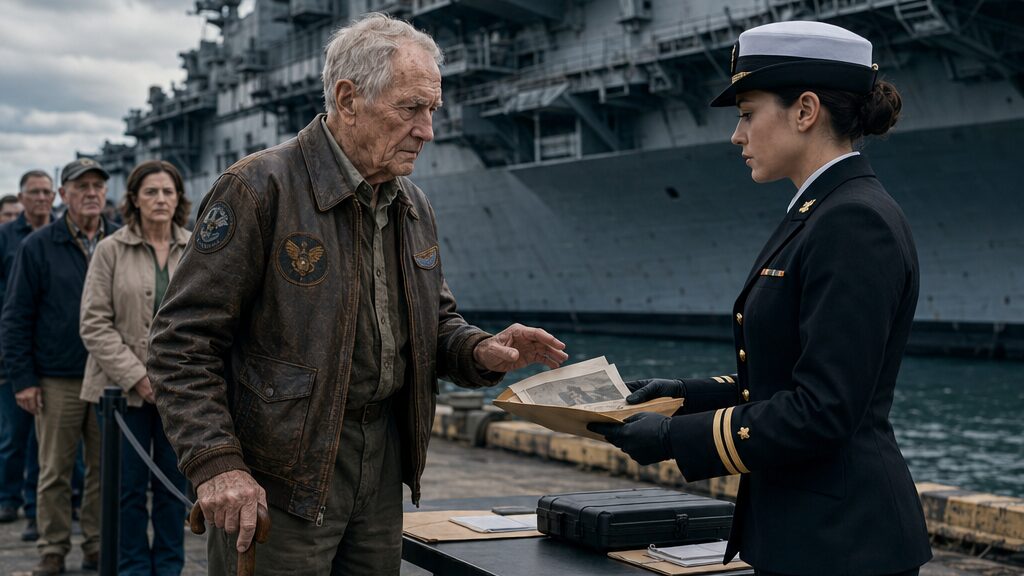
The old brown flight jacket felt heavier than it should have. He had almost left it in the closet that morning, then had stood in his narrow hallway with the jacket in one hand and the document packet in the other, unable to move toward the door until he put it on. The leather had gone stiff in places. The cuffs were faded. On the left chest, the old patch had curled at one corner, thread lifting like a loose memory.
A boy ahead of him turned and stared at it.
“Were you a pilot?” the boy asked.
The woman beside him hushed him quickly. “Don’t bother people.”
Joseph gave the boy a small smile. “No,” he said. “I kept them flying.”
The boy looked as if that answer required more than he had been given, but the line moved and his mother guided him forward.
Joseph’s fingers tightened over the packet tucked beneath his left arm. It was not much to look at. A manila envelope, softened at the corners. A printed visitor approval letter folded around an older sheet. A temporary pass clipped to the front with a plastic sleeve that had been mailed to him two weeks before. Behind that, protected in a cloudy cover, was the photograph.
He did not take the photograph out.
He had not taken it out on the bus, or beside the taxi stand, or while he sat on the bench outside the gate gathering enough strength to stand again. There were some things he could look at only when no one needed anything from him.
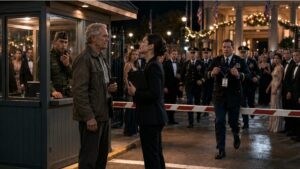
The line shortened. Security sailors checked IDs beneath a canopy. Beyond them, a gangway rose toward the carrier. It had railings now, bright caution strips, museum signage, and volunteers in jackets directing foot traffic. It was not the way Joseph remembered coming aboard. Nothing was. But the wind off the water was the same. Salt, diesel, rope, damp metal. His lungs caught it and for a moment his hands felt younger than the rest of him.
“Sir?”
He looked up.
The young officer at the front table held out one gloved hand. She wore a dark formal uniform, pressed so sharply that the morning light seemed to catch on every seam. Her hair was pinned back. Her expression was calm, professional, not unkind. The name plate read CARTER.
“ID and access pass, please,” she said.
Joseph placed the plastic-sleeved pass on the table, then his driver’s license. His fingers were slow. The officer waited with the patience of someone trained to wait without looking impatient.
“Thank you, Mr. Bennett.”
The sound of his name in her voice was clean and empty. She read it because it was there.
She scanned the pass, frowned slightly, then looked at the printed approval letter. “This is for the public route.”
“Yes, ma’am.”
“You’re listed as requiring mobility assistance.”
“I can walk.”
“That’s not what I asked.” She glanced at his cane, then at the line behind him. “Are you with a group today?”
“No, ma’am.”
“No family?”
“No.”
Her eyes flickered with something that might have been concern, or calculation. “The public route has stairs in two sections. We can arrange a modified path, but you’ll need to remain with a guide.”
Joseph nodded. “I understand.”
She turned the page over. “This says you requested access to a non-public compartment.”
The line behind him pressed forward by inches. Someone coughed. A child complained about being cold. Joseph felt the morning opening around him, too many ears and not enough air.
“That’s right,” he said.
Officer Carter looked up fully then. “That request was not approved.”
Joseph had known that was coming. He had read the letter in his kitchen until the words blurred, had called the number printed at the bottom, had been transferred twice, had spoken to a young man who said he would make a note. Joseph had learned in the Navy that notes could disappear into desks and drawers and systems that outlived the men who made them.
“I was told to bring the supporting page,” he said.
“This is the supporting page?” She lifted the older sheet with two fingers, careful but uncertain. “Sir, this is not an authorization form.”
“No.”
“It appears to be a copied maintenance record.”
“Yes, ma’am.”
“That won’t grant access to a restricted area.”
Joseph held still. The cane tip rested against the concrete. He could feel his pulse in his thumb.
“I’m not asking to wander,” he said. “Just to go where that line says.”
Officer Carter’s face remained composed, but something in her posture closed. “Mr. Bennett, I understand this ship means something to a lot of people. But we have safety restrictions, and we can’t make exceptions based on personal documents.”
The word personal landed wrong. Not harshly. Worse than harshly. Neatly.
Joseph looked past her shoulder to the carrier. A gull swung across the gray of the hull and vanished behind the island. For a moment he was twenty-two again, late for watch, ducking his head as someone shouted his name from a catwalk. Then he was eighty-two, with a cane, holding up a line.
“I’m not asking you to make anything unsafe,” he said.
A man behind him sighed. Not loudly, but enough.
Officer Carter heard it. Joseph saw her hear it. Her chin lifted by the smallest degree.
“Sir,” she said, lowering her voice, “I need you to step to the side while I verify what this actually is.”
The line shifted around him before he moved. A sailor unhooked a small section of rope and gestured toward an area beside the table. Joseph gathered his license, but Officer Carter kept the packet.
His hand hovered over it. He stopped himself from reaching.
“It stays with me,” she said, not sharply. “Just for verification.”
Joseph looked at the packet in her hand. The cloudy corner of the photograph showed beneath the paper clip, only a sliver of a young shoulder, a piece of sky, a shape that used to be a smile.
“All right,” he said.
He stepped aside.
The people behind him moved forward, relieved to become visitors again. Passes beeped. Shoes scuffed. A child laughed as the first portion of the gangway opened above them. Joseph stood outside the moving line, one hand on his cane, the other empty at his side.
Officer Carter bent over the documents. Her gloved finger tracked the printed letter, then the copied maintenance record beneath it. She looked at the pass again, then at the old sheet.
Joseph watched her read.
The ship waited behind her, huge and silent, while the packet that had taken him fifty-eight years to bring back lay open under a stranger’s hand.
Chapter 2: The Name Beneath the Old Photograph
Nicole Carter had been warned about three kinds of visitors during final access week.
The first were the enthusiasts, people who knew more about the ship’s public history than some sailors did and wanted to correct the signage. The second were the sentimental ones, former crew and family members who moved slowly and sometimes cried without warning near ordinary things: a hatch, a ladder, a painted number. The third were the difficult ones, the visitors who believed memory gave them permission to cross ropes, ignore safety rules, or argue until someone gave them a story to tell online.
She had not been warned about Joseph Bennett.
At first he had looked like a combination of the second and third kind. Elderly. Alone. Determined. A cane polished by use. A jacket covered in old aviation patches that might have meant service or might have meant flea market nostalgia. A manila packet full of papers that did not match the system.
Nicole did not like thinking that way, but the gate had to move. The ship was old. The route was controlled for a reason. Final week made people emotional, and emotional people underestimated rust, ladders, and sealed compartments.
She turned the copied page toward the light.
Most of it was hard to read. The copy had been made from something older, typed and marked by hand, then copied again at some point when the ink had already started fading. She saw a date from decades earlier. A compartment number. A line of abbreviations she only half understood. Maintenance crew notation. Then, near the bottom, a roster section.
BENNETT, J.
Her eyes paused there.
She looked up.
Joseph Bennett stood beside the rope, not watching the visitors, not asking for updates, not trying to explain himself to the sailor near him. He faced the ship. His left hand was closed, but not into a fist. The cane kept him upright. The jacket hung on him as if it had once belonged to a broader man.
Nicole looked back down.
SULLIVAN, P.
There was a mark beside that name. Not a neat one. A dark stroke that might have been copied from grease pencil or old ink. Beside both names, someone had written a compartment number and the phrase HAND CREW — FLIGHT SUPPORT.
Nicole turned the packet’s front page back over and checked the visitor request again. The non-public compartment Joseph had requested was the same number.
She felt the first small loosening inside her certainty.
“Mr. Bennett,” she called.
He turned slowly.
“Can you come back to the table, please?”
He did not answer. He simply came, each step careful. The cane clicked once on the concrete, then scraped softly as he adjusted his weight.
Nicole kept her voice even. “This roster line. Is that you?”
Joseph looked at the page but did not lean close enough to read it. “Yes.”
“You served aboard this carrier?”
“Yes, ma’am.”
The answer was so plain that it made her feel worse for having needed to ask.
Nicole glanced at his jacket. The curled patch on his chest bore the old ship’s outline, faded almost into the leather. She had taken it for decoration because she had been looking for valid dates, barcodes, current approvals. She had missed the one thing that was not trying to be current.
“What years?” she asked.
He gave them without hesitation.
A sailor at the second scanner looked over. Nicole lowered her voice.
“And this requested compartment,” she said, touching the page, “was connected to your work area?”
“It was close enough.”
“That’s not an answer I can use.”
“No,” Joseph said. “I suppose it isn’t.”
Something about the way he said it stopped her. He was not being evasive like someone trying to get around a rule. He was holding back like a man trying not to spill something in public.
Nicole slid the cloudy photo sleeve partly free from behind the letter. “May I?”
Joseph’s eyes moved to her hand. For the first time, she saw fear in him. Not fear of her. Fear of the photograph being handled badly, of the past being pulled out too quickly, under a canopy with the line beeping behind them.
“If you need to,” he said.
She drew it out only far enough to see. Two young sailors stood on a sun-whitened deck, one with his arm slung over the other’s shoulder. Their faces were faded, but the grin of the man on the right had survived the years better than anything else in the image. Behind them, a section of carrier deck stretched into light. On the back, visible through the plastic, someone had written two names.
Joseph Bennett. Patrick Sullivan.
Nicole’s fingers stilled.
She looked again at Joseph, then at the young man in the photograph, then at the old man before her. The face was changed almost beyond comparison. Time had hollowed the cheeks, deepened the lines, taken the dark from the hair. But there was something around the eyes that the years had not moved.
Nicole straightened.
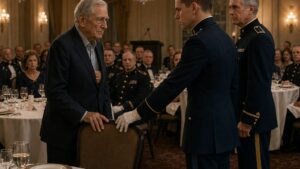
It was not a salute. Not yet. A salute would have made the moment about her, about display, about what everyone around them could see. Instead she removed her hand from the packet and set it flat on the table between them, aligning the edges carefully.
“Mr. Bennett,” she said, quieter now, “I apologize. I should have looked through this more carefully.”
Joseph seemed uncomfortable with the apology. “You were doing your job.”
“I was doing part of it.” She looked toward the line, then back at him. “Were you given a reason this compartment request wasn’t approved?”
“Safety.”
“That’s usually the reason.”
“It’s often a good one.”
“Yes, sir.”
The word came out before she thought about it. Not forced. Not ceremonial. Just correct.
Joseph’s eyes shifted, but he did not smile.
Nicole took the visitor pass and checked the system again. The screen offered nothing helpful. Public route approved. Mobility assistance suggested. Special request denied. No notes visible.
“I can get you on the public tour,” she said. “I can also request a chair for the longer section if you’d like.”
“No, thank you.”
“But that won’t take you to this compartment.”
“No.”
“What is in that compartment?”
Joseph looked past her to the ship. The wind pressed lightly at the edge of his jacket. When he spoke, his voice was low enough that she had to lean closer.
“Not what’s in it,” he said. “What didn’t come out.”
Nicole felt the skin along her arms tighten beneath her sleeves.
Behind them, a visitor asked whether the delay would affect the next group. A sailor answered politely. The world continued with its scanners and clipboards and timed access, but the table between Nicole and Joseph had become something else.
She looked down at the packet again, at the roster line, the photograph, the old pass clipped to the new letter. A few minutes earlier she had seen an elderly visitor with mismatched paperwork. Now she saw a man who had carried proof because he did not expect memory alone to be believed.
“Mr. Bennett,” she said, “I need to call the liaison.”
He nodded once.
“I can’t promise anything.”
“I know.”
“But I’m not going to send you away without asking the right question.”
His hand moved toward the packet, then stopped. “That’s more than I had when I got here.”
Nicole slid the photograph back with care. She did not close the folder over it until Joseph gave the smallest nod.
When she picked up the radio, her grip had changed. The packet was no longer an inconvenience in her hand. It had weight now. Not official weight. Human weight.
“Pier control to liaison desk,” she said. “I need review on a denied compartment request for a former crew member.”
The radio crackled.
Joseph looked at the carrier, not at her.
When the reply came, clipped and busy, Nicole asked for Deborah Miller by name. Then she turned slightly away from the line, shielding the packet from the wind with her body, and waited for someone else to decide whether the old ship still had room for what Joseph had brought back.
Joseph listened until the radio went quiet.
Then he said, almost to the deck beneath them, “The public route won’t take me where I promised to go.”
Chapter 3: A Promise Not Written in Orders
They put Joseph in a folding chair near the gangway while they waited for the liaison.
He disliked the chair at once. It was positioned beside a temporary sign that said ASSISTED ACCESS HOLDING AREA, which made him feel less like a man waiting for a decision and more like luggage that required special handling. Still, his knee was beginning to shake, and pride was a poor brace when bone had its own opinion.
He sat.
Nicole Carter stood a few feet away with the packet held against her clipboard. She had not passed it to anyone else. Joseph noticed that. He tried not to notice, but he did.
The visitors continued moving. Every few minutes, a group climbed the gangway, faces turning upward. Some came down with red eyes and gift-shop bags. Some laughed too loudly, relieved to be back on solid pier. One man in a veterans cap paused near Joseph as if he wanted to ask which years he had served, but Nicole’s presence discouraged conversation.
Good, Joseph thought, then felt unkind.
He was tired of being asked to make his life small enough for polite questions.
Were you on this ship? What did you do? Did you ever see combat? Was it hard? Thank you for your service. The words were usually meant well. That was the trouble. Meaning well could still put a hand on a door a man was trying to keep closed.
Nicole stepped closer. “Can I get you water?”
“No, thank you.”
“You sure?”
He looked up at her. “I’m sure.”
She accepted the answer without fuss, which he appreciated.
The ship’s hull filled the space beyond her. Its paint had been touched up for visitors, but Joseph could see where age had settled beneath the work. Steel remembered. Men did too, though no one trusted men’s memory as much as they trusted paperwork. Maybe that was fair. Paper did not wake at night hearing a sound that had stopped fifty-eight years ago.
Nicole lowered her voice. “The liaison is coming from the exhibit office. Her name is Deborah Miller. She handles access exceptions for the final week.”
“Sounds important.”
“She handles people who think they have reasons.”
Joseph almost smiled. “Everybody has reasons.”
“Yes,” Nicole said. “But not everyone has yours.”
He looked at her then, longer than he meant to. She was young enough to be his granddaughter, though he had none. There was a carefulness in her now that had not been there at the table. He did not know whether to be grateful for it or wary. Carefulness could become pity if a person wasn’t disciplined.
“My reason isn’t in the letter,” he said.
“I figured that.”
“It isn’t in the roster either.”
Nicole waited.
Joseph rested both hands on the cane handle. He could feel the packet nearby like a second pulse. “You looked at the photograph.”
“Only enough to verify the names.”
“That’s him. Patrick Sullivan.”
“The other sailor.”
“Yes.”
She did not ask what happened to him. That made Joseph look away.
A gull landed on a piling near the water and opened its wings for balance. The sound of the pier shifted around them: rope creaking, distant announcements, the thud of shoes on the gangway. Beneath it all, Joseph could almost hear the old ship alive again, a vibration that had once lived in his calves and teeth.
“Patrick’s daughter sent me that picture,” he said. “Long time ago now. She was a little girl when he shipped out. Doesn’t remember his voice. Not really.”
Nicole’s posture changed slightly, not softer, exactly, but less official.
“She asked you to bring it here?”
“No.”
“Then why?”
Joseph’s hands tightened. The answer had seemed simple in his kitchen, with the envelope open and the ship’s final access notice spread beside the sink. It seemed less simple aloud.
“Because I told her mother once that I’d tell her where he was when the time came.” He swallowed. “I didn’t. Not right.”
Nicole said nothing.
“There were reports,” he continued. “There are always reports. Lines typed up by men who weren’t standing there. They said enough for the Navy. Not enough for a wife. Not enough for a child.”
The packet’s edge lifted in the wind. Nicole pressed it back with her palm.
Joseph watched the motion. Gentle. Deliberate.
“I’m not trying to correct the Navy,” he said. “Not after all this time.”
“What are you trying to do?”
He looked at the gangway. Visitors moved up it in a cheerful, uneven stream. None of them knew that a man could spend half a century avoiding a door and still arrive too early to open it.
“There was a place we kept our tools,” Joseph said. “Not a grand place. Not one of the spots they put on signs. Just a bay off a passage most visitors won’t ever see. He was there before the call came. He left his coffee on the bench. Said he’d be back before it went cold.”
The words stopped. He had not meant to say that much.
Nicole waited so quietly that the pause did not embarrass him.
Joseph looked down at his shoes. They were polished, but old. He had worked at the leather the night before until his shoulders ached. A foolish thing. No one inspected an old man’s shoes. But Patrick had once said you could tell whether a sailor was coming back by how he left his boots under the rack. Joseph had not forgotten.
“I brought the photograph,” he said. “And a copy of the line from the log. I thought if I could leave them there—just there—it would be done.”
“Done for who?” Nicole asked.
It was a careful question, but it found the wound anyway.
Joseph breathed out through his nose. “I don’t know anymore.”
A woman in a navy blazer came through the gate with fast steps and a tablet tucked against her side. She was middle-aged, with reading glasses pushed up on her head and the look of someone whose morning had been divided into problems every ten minutes. A security sailor pointed toward Nicole.
“That’s Deborah,” Nicole said.
Joseph started to stand.
“Please,” Nicole said, then caught herself. “You don’t have to.”
Joseph stood anyway. Not quickly, not well, but fully. His knee burned. He set the cane ahead of him and brought his shoulders back as much as they allowed.
Deborah Miller arrived already looking at the tablet. “Officer Carter?”
“Yes, ma’am.”
“This is the denied compartment request?”
“Yes. Mr. Joseph Bennett, former crew member. He served aboard—”
“I read the note you sent.” Deborah looked up at Joseph with professional sympathy. “Mr. Bennett, thank you for coming today.”
Joseph knew that tone. It was the voice people used when they planned to disappoint someone kindly.
“Ma’am,” he said.
Deborah glanced at the packet, then at Nicole. “The public route is available. We can arrange assistance and allow a little extra time at the aviation exhibit.”
Nicole said, “He isn’t asking for the aviation exhibit.”
“I understand that.” Deborah’s voice stayed patient. “The requested compartment is outside the approved visitor path.”
“The record supports that he worked near that area.”
“That may be true, but it doesn’t change the condition of the passage.”
Joseph watched the two women speak around the space he had come to cross. Nicole’s jaw set, then loosened. She was trying not to argue badly. He respected that. Bad arguments wasted everyone’s time.
Deborah turned back to him. “Mr. Bennett, I am sorry. That section has been sealed for safety.”
The carrier rose behind her, patient and unreachable.
Joseph felt the packet leave the center of the world and become paper again. His name. Patrick’s name. A photograph. A line from a log. All of it true. None of it enough.
“I understand,” he said.
Nicole looked at him sharply, as if she expected protest.
But Joseph had learned long ago that some doors did not open because a man wanted them to. Some did not open because he deserved it. Some did not open at all.
Deborah’s face softened with relief. “We can still make sure you have a meaningful visit.”
Joseph nodded once.
Behind Deborah, high above the pier, a small group of visitors stepped onto the carrier’s deck and vanished into the route prepared for them.
Joseph looked at the ship’s gray side and wondered whether a promise could expire simply because the hallway to it had been sealed.
Chapter 4: The Passage They Took Off the Map
Nicole had escorted plenty of people aboard ships.
She knew how to move them along without making them feel rushed, how to point out handrails before a foot slipped, how to answer the same question about the flight deck without letting fatigue enter her voice. She knew how to make rules sound like courtesy. That morning, with Joseph Bennett walking beside her, she discovered that rules sounded different when they stood between a man and the place where he had left part of his life.
Deborah Miller led them through the approved visitor route with her tablet tucked against her ribs. She did not hurry, but everything about her suggested a schedule tightening with every minute. Ahead of them, a volunteer explained the ship’s history to a small group gathered near a display of aircraft models. The visitors leaned in, reading placards and taking pictures through glass.
Joseph did not look at the models.
He paused at sounds. The knock of a loose sign against a stanchion. The hollow ring of shoes over a metal threshold. The low groan of the old hull shifting against the pier. Once, near the first interior passage, his cane stopped in midair before it touched the deck. His eyes moved to a corner where paint had built up in layers around a pipe bracket.
“You all right?” Nicole asked.
“Yes.”
The answer came too quickly.
Deborah turned. “We can stop if you need a chair.”
Joseph lowered the cane. Tap. “No, ma’am.”
Nicole heard the faint strain in his voice and forced herself not to reach for his elbow. He would ask if he wanted help. Or he would not ask and fall. The thought made her uncomfortable because it was not only safety she was worried about now.
The public route had been stripped of surprise. Temporary arrows guided visitors through wide passages. Ropes blocked side hatches. Signs explained what rooms had once been: ready room, briefing space, crew mess, maintenance support. Everything was clean enough for memory to become educational.
Joseph’s packet stayed under Nicole’s arm. Deborah had asked to see it once more before boarding and had returned it with the same professional care one gave a file that might cause trouble later. Nicole had noticed Joseph watching every movement of the envelope. He looked less anxious when it came back to her than when it sat in Deborah’s hand.
They reached a junction where the public route turned right toward a bright exhibit space. Straight ahead, a narrower passage was blocked by a fixed barrier and a sign that read AUTHORIZED PERSONNEL ONLY — NO VISITOR ACCESS.
Joseph stopped.
Nicole knew before she checked the compartment map on Deborah’s tablet.
“This is it?” she asked.
Joseph’s eyes stayed on the blocked passage. “Close.”
Deborah exhaled softly, not in annoyance, but in confirmation of something she already expected. “Mr. Bennett, this section isn’t part of the approved route.”
“The bay is past there,” Joseph said.
“Several spaces are past there. That’s the problem.”
The passage beyond the barrier was dimmer than the visitor area. The overhead lights worked, but not all of them. The deck looked uneven where temporary mats ended. A smell came from there that the public route did not have, old metal and dust with something oily under it.
Nicole looked at Deborah. “Could maintenance escort him?”
“No.”
“Engineering?”
“No.” Deborah’s answer sharpened, then softened when she saw Joseph’s face. “This is not about whether his reason is valid. The route was assessed. That passage has trip hazards, exposed edges, and sections not cleared for visitors. We aren’t opening it during public hours.”
Nicole kept her voice low. “He served here.”
“I understand.”
“I don’t think you do.”
Deborah’s expression changed. Not anger. Warning. “Officer Carter, I am responsible for every person who steps outside that marked route. If Mr. Bennett falls, if a visitor follows, if someone records us ignoring a safety closure, it does not help him, you, or the ship.”
The words were reasonable. Nicole disliked that they were reasonable.
Joseph shifted his grip on the cane. “She’s right.”
Nicole turned to him.
He gave Deborah a small nod. “You can’t open a passage just because an old man asks.”
Deborah looked relieved, but also faintly embarrassed by the relief. “Thank you for understanding.”
“I didn’t say I understood,” Joseph said. “I said you can’t.”
The line was quiet enough that only the three of them heard it. Deborah’s mouth closed.
A group of visitors approached from behind, guided by a volunteer. Nicole moved instinctively to keep Joseph from being pressed against the barrier. One of the visitors, a man with a camera strap, glanced at the blocked passage.
“What’s back there?” he asked the volunteer.
“Non-public maintenance access,” the volunteer said cheerfully. “We’ll continue this way.”
Joseph lowered his head.
The group passed. Their voices faded into the exhibit room, where someone laughed at a recorded pilot’s joke playing from a display speaker.
Nicole looked down at the packet. “The record says flight support.”
Joseph’s jaw tightened.
“That passage,” Nicole said, “doesn’t look like flight deck access.”
“It wasn’t where the planes were.” His voice had become thin, controlled. “It was where things got fixed after the planes reminded us they were stronger than we were.”
Deborah checked her tablet again. “The compartment he requested is listed as former maintenance storage, later converted, then sealed.”
“Converted into what?” Nicole asked.
“Temporary equipment overflow. Then nothing.” Deborah enlarged the map with two fingers. “The old number doesn’t appear on the visitor layer. It’s in the preservation notes only.”
Joseph looked at the tablet. He did not ask to hold it. “They took it off the map.”
“No,” Deborah said. “The public map was simplified.”
“That’s another way of taking it off.”
Nicole expected Deborah to respond, but she didn’t. The liaison’s face had shifted from administrative patience to something more complicated. Perhaps she had heard that kind of sentence before, from other former crew who returned to find their ship explained in plaques and arrows.
Joseph stepped closer to the barrier. Nicole moved with him, but did not stop him. He reached out, not to cross, only to rest two fingers on the top rail. The cane trembled slightly under his other hand.
“I had it wrong,” he said.
Nicole waited.
“I thought if I came back, the ship would remember the way I did.” His fingers withdrew from the rail. “But ships don’t remember. People do. Until they don’t.”
Deborah’s tablet dimmed. She tapped it awake, though she was no longer looking at it.
A voice came from behind them, older and roughened around the edges. “Depends on who you ask.”
They turned.
A retired chief volunteer stood near the exhibit entrance, wearing a navy volunteer jacket over a collared shirt. His hair was white, his back straight in the way of men who had been corrected by time but not bent by it. A badge at his chest read GARY REED.
His eyes were on Joseph, but not in the curious way visitors stared. He was listening with his whole face.
Deborah frowned slightly. “Chief Reed, we’re handling a private access issue.”
Gary Reed did not move closer. “Didn’t mean to intrude.”
Joseph’s expression had become guarded again.
Gary nodded toward the blocked passage. “What compartment number?”
Nicole looked to Joseph before answering. Joseph said nothing.
Deborah spoke instead. “This doesn’t concern—”
“Bay three-two aft support?” Gary asked.
Joseph’s eyes lifted.
The passage seemed to lose its air.
Gary’s voice dropped. “Or the old tool room beside it?”
Joseph stared at him for several seconds. “Where did you hear that?”
Gary did not answer at once. He looked at the packet under Nicole’s arm, then at Joseph’s jacket patch, then at the blocked passage.
“I didn’t hear it,” he said. “I remember the sound it made when the hatch stuck.”
Chapter 5: The Chief Who Remembered the Sound
Joseph did not trust memory when it came too easily from strangers.
People borrowed things. Words, stories, grief. They picked up a detail from a museum sign or an old article and carried it like a key to rooms they had never entered. Joseph had learned to hear the difference between a man remembering and a man performing memory.
Gary Reed did not perform.
He stood with his hands at his sides, not reaching, not smiling, not rushing to claim brotherhood. When Deborah asked him to explain himself, he looked first at Joseph, as if the old man had authority over whether the explanation should exist.
Joseph respected that against his will.
“There used to be a hatch past that bend,” Gary said. “Stuck in wet weather. Had a screech like a chair dragged across concrete.”
Joseph felt the sound before he heard it in his mind. A long metal complaint. Men swearing. Someone kicking the bottom edge because no one had patience at two in the morning.
“You served on her?” Joseph asked.
“Later than you, I’d guess,” Gary said. “Long enough after that they’d painted over half the sins and renamed the other half.”
Joseph’s mouth twitched, not quite a smile.
Nicole noticed. He wished she hadn’t.
Deborah folded her arms around the tablet. “Chief Reed volunteers with us because he knows the ship, but that does not alter the access restriction.”
“No, ma’am,” Gary said. “Didn’t say it did.”
“Then what are you saying?”
Gary looked toward the blocked passage. “I’m saying the compartment number he gave you is real. Or was. And if he says public route won’t take him there, he’s not confused.”
The words settled differently coming from Gary. Not because they were stronger than Joseph’s. Because they came from someone Deborah had already accepted as useful to the institution.
Joseph did not like needing that.
“I don’t need anyone to prove I’m not confused,” he said.
Gary turned to him. “No. You don’t.”
The answer disarmed him more than an argument would have.
Deborah’s radio crackled at her shoulder. She answered, stepped aside, and spoke in a low voice about group timing. Nicole remained near Joseph, still holding the packet. She looked younger in the ship’s interior light, but less certain than she had outside.
“You don’t have to do this here,” she said.
“Do what?”
“Let us ask questions.”
Joseph looked toward the exhibit room. A recording played over speakers: aircraft noise, deck instructions, applause from some ceremony long finished. Visitors stood before a display of helmets and yellowed photographs. They were trying to feel close to something that had been cleaned for them.
“I thought coming here was the hard part,” he said.
Nicole did not answer.
Gary nodded toward a bench outside the volunteer station. “There’s a quieter spot.”
Joseph almost refused. He had refused plenty of help in his life just to remind himself he still could. But his leg had begun to pulse from hip to ankle, and the passage they had taken off the map stood before him like a locked jaw.
“All right,” he said.
They moved to the bench. Deborah stayed within sight, speaking into her radio with one eye on them. Nicole offered Joseph the packet.
He took it, held it against his chest for a moment, then laid it across his knees. The manila paper looked tired. He supposed it had earned that.
Gary sat at the far end of the bench, leaving space between them. “You were flight support?”
“Aviation maintenance. Not glamorous.”
“Glamour gets people hurt if the unglamorous part doesn’t hold.”
Joseph looked at him sidelong. “You always talk like a chief?”
“Only when I’m right.”
This time Joseph did smile, briefly.
Nicole remained standing. “Mr. Bennett, you mentioned Patrick Sullivan.”
The smile left.
Gary’s face changed at the name, though not with recognition of the man. Recognition of the kind of name it was. The kind carried carefully.
Joseph opened the packet. His fingers were clumsy with the paper clip, and Nicole’s hand moved as if to help, then stopped. He appreciated the stopping more than the offer.
He drew out the photograph in its plastic sleeve.
The two young men in the picture looked ridiculous to him now. Too thin, too certain they would remain themselves. Patrick grinning as if he had just won money off somebody. Joseph squinting into sun, annoyed that the picture was being taken, secretly pleased to have been included.
“He was from Ohio,” Joseph said. “Talked about it like it was a country of its own. Had a daughter he’d seen twice because deployments don’t ask permission from babies.”
Nicole lowered herself into a crouch rather than hover above him. “What happened?”
Joseph rubbed one thumb along the edge of the sleeve. “A bad day.”
Gary looked down.
Joseph could have stopped there. He had stopped there for years. A bad day was enough for most people. It invited sympathy but not detail. It closed the door politely.
But the ship had not let him come all this way for politeness.
“There was an incident on deck,” he said. “Equipment failure first. Then fire where fire had no business being. Everyone remembers the big parts of those days. Smoke, alarms, who got written up, who got medals, who got buried. But before the big parts, there are small parts. A tool left on the wrong bench. A warning shouted too late. A man who goes back because somebody else is still inside.”
Nicole’s eyes stayed on the photograph.
“Patrick went back?” she asked.
Joseph nodded. “Not for glory. He was mad. That’s what I remember most. Mad as anything because two young sailors had run the wrong direction and he had to fetch them like children.”
Gary breathed out softly through his nose, a sound almost like a laugh and not one at all.
“He got them out,” Joseph said. “He got one under each arm, near enough. I was at the hatch by then. I had my hands on one of them. Patrick shoved the other toward me. Then something above us came loose.”
His hand closed over the photograph.
Nicole did not ask what. Gary did not ask either. That helped.
“The report said he died during emergency response,” Joseph continued. “That’s true. It also said I assisted in evacuation. That’s true too. Reports are good at being true and still leaving out the part a man hears forever.”
“What part?” Nicole asked.
Joseph looked at her. For a moment he saw not an officer, but a young person trying to understand why an old one had crossed so many years with a folded paper.
“He told me to take them,” Joseph said. “He said, ‘Joe, take them and don’t look back.’”
The ship’s recorded aircraft noise rolled through the exhibit room and faded.
“I looked back anyway.”
No one spoke.
Joseph slid the copied maintenance-log page from the packet and placed it beside the photograph on his knees. “This line was all I could get years later. Names, compartment, time. Patrick’s daughter wrote asking if I could tell her where her father had been. Her mother was gone by then. The official answer had never felt like an answer. I wrote back too little. Then I didn’t write again.”
Nicole’s brow tightened, but she did not judge him with it. “Why not?”
“Because I was ashamed I had more memory than courage.”
Gary folded his hands. “That’s a heavy thing to carry, Bennett.”
Joseph looked at him sharply. “I carried less than Patrick did.”
Gary accepted the correction with a small nod.
Deborah returned before anyone could say more. Her expression had lost some of its hurry. “I spoke with the preservation supervisor. The passage remains closed.”
Nicole stood. “But?”
Deborah looked at her, then at Joseph. “But there may be limited staff access from the lower exhibit corridor to a service-adjacent door. Not the full passage. Not during visitor flow. And not without written approval from me and a safety escort.”
Joseph felt the photograph under his hand.
Deborah continued, “That does not mean yes. It means there is a route worth discussing.”
Nicole looked at Joseph. “Mr. Bennett?”
He stared at the old photograph. Patrick grinned up through the cloudy sleeve, forever young, forever unaware of how long a promise could take.
Joseph’s voice came out rough. “What would you need from me?”
Gary answered quietly before Deborah could.
“The truth,” he said. “Enough of it, anyway.”
Chapter 6: The Truth He Would Not Use as a Key
The side office had once been something else.
Joseph could tell by the way the room held sound. Offices had a deadness to them, carpet or panels swallowing every step. This little compartment still rang faintly when someone moved a chair. The Navy had put a desk in it, a printer, two folding chairs, and a laminated emergency map on the wall, but underneath all that it remained a ship’s room, narrow and practical, built by people who did not waste inches.
Deborah Miller closed the door halfway, not fully. “This is not a hearing,” she said.
Joseph sat with the packet on the desk in front of him. “Feels like one.”
“I’m sorry.”
He believed she was. That did not make it less true.
Nicole stood near the door, hands clasped behind her back. Gary Reed leaned against the wall beneath the emergency map, quiet enough to disappear if Joseph did not look straight at him. Deborah sat across from Joseph with her tablet dark on the desk. For the first time since arriving, she did not have it in her hand.
“We need to understand what you’re asking to do,” Deborah said. “Specifically. If I approve any restricted movement, it has to be narrow, supervised, and safe.”
Joseph looked at the packet.
He had imagined this part differently. In his mind, if he ever reached the ship, the act would be private. He would find the old bay, place the photograph and the copied line where metal met shadow, say Patrick’s name once, and leave before anyone could turn it into something else. He had not imagined three people waiting for him to translate fifty-eight years into a request that fit a form.
Nicole’s voice came gently from the door. “You don’t have to make it larger than it is.”
Joseph looked up.
She added, “Just true enough for us to help.”
That was a dangerous sentence. It made him want to trust her.
He opened the packet and laid the contents out in order. The visitor approval letter. The denied request. The copied maintenance-log line. The photograph. A second folded sheet he had not shown them yet.
Nicole noticed it. Deborah did too, but neither reached for it.
Joseph smoothed the fold with two fingers. “Patrick’s daughter wrote this twelve years ago.”
The paper had been opened and closed so many times that the crease was nearly torn. He did not hand it across. He read only the part that mattered, because the rest belonged to a woman who had trusted him more than he deserved.
“She said, ‘I know you probably told us everything you were allowed to. But if there is a place on that ship where he was still himself before he became a sentence in a report, I would like to know it.’”
Deborah looked down.
Joseph folded the letter again. “I didn’t answer that part.”
“Why?” Deborah asked.
He almost gave the old answer. Because it hurt. Because I was young and then I was not young and somehow not answering became the thing I had done. Because shame grows roots in silence.
Instead he said, “Because the place I remembered was the place I left him.”
Nicole’s face changed, but she did not interrupt.
Joseph placed the photograph on top of the maintenance page. “Patrick was alive when I took the two sailors through the hatch. He was behind me. Close enough that I could hear him cough. Close enough that when he told me not to look back, I thought he meant for the next three seconds.”
His throat tightened. He waited until he had command of it.
“I got them clear. Somebody grabbed the first one. Somebody else took the second. Then the alarm changed pitch. Men who know ships know what that means. You stop thinking in words. You move or you burn or you block someone else from moving.”
Gary’s eyes had lowered.
“I turned back,” Joseph said. “I did. People like to tell me I didn’t, because it makes the story cleaner. But I turned. I saw the hatch. I saw smoke pushing through it. I saw a hand on the frame.”
Nicole’s fingers tightened behind her back.
“I don’t know if it was his hand,” Joseph said. “That’s the truth. I’ve made it his hand in dreams so many times that I don’t trust myself anymore. But I know I heard him. Or I think I did. He said my name.”
Deborah’s eyes glistened, but her voice remained steady. “And the maintenance bay?”
“That was where we’d been before the call. Where he left his coffee, where he kept a picture of his girl tucked behind a parts label because he said lockers were too far from where he spent his life.” Joseph touched the plastic sleeve. “I carried this copy because I thought if I left her picture there, with his name, then the place would answer the question I never did.”
“The picture in the sleeve is yours and Patrick’s,” Nicole said softly.
“Yes.” Joseph drew a breath. “The one of his daughter is behind it.”
He opened the sleeve. With slow care, he slid the first photograph forward. Behind it was a smaller picture, more fragile, of a little girl sitting on porch steps, hair blown across her face, one hand lifted mid-wave. The image had faded at the edges until the porch seemed to be dissolving into light.
No one moved.
“I was supposed to give it back to him after watch,” Joseph said. “He’d dropped it near the bench. I put it in my pocket so it wouldn’t get oil on it.” He looked at the photograph. “Then there wasn’t an after.”
Nicole turned her face slightly toward the door, but not before Joseph saw her blink.
Deborah took off her glasses and set them beside the tablet. “Mr. Bennett, I need to be clear. This cannot become a placement of personal items in a restricted historical area without approval. Preservation rules—”
“I know rules,” Joseph said.
The sharpness surprised even him. Deborah stopped.
He lowered his voice. “I’m not asking you to pretend rules don’t exist. I’m asking whether there is a lawful way to leave a copy where he was. If there isn’t, say so plainly and I’ll go home.”
Nicole stepped forward. “A copy?”
Joseph nodded. “I brought copies for the ship. Originals go back with me or to his daughter if I find the courage I should’ve had years ago.”
Deborah looked at the papers again, and something in her posture eased. Not surrender. Reconsideration.
Gary spoke from the wall. “Preservation archive accepts contextual material during transition week, doesn’t it?”
Deborah glanced at him. “Through formal intake.”
“Could intake occur at the compartment door?”
“That is not standard.”
“No,” Gary said. “But it might be honest.”
Nicole looked at Deborah. “Ma’am, we don’t need to open the whole passage. You said there may be staff access from the lower exhibit corridor.”
“May be,” Deborah said.
“If approved,” Nicole continued, “I can escort. Chief Reed knows the route. We move after visitor traffic clears that section. Mr. Bennett carries nothing loose. We document the material as an archive submission. He gets one minute at the door or inside if the supervisor clears it. No ceremony. No visitors.”
Deborah watched her. “You’re making this sound simple.”
“No, ma’am. I’m making it narrow.”
Joseph looked at Nicole then. Not because she had argued. Because she had not made him larger than he wanted to be. She had not called him hero, had not said he deserved anything the rules could not bear. She had listened to the shape of the request and cut away everything that did not belong.
Deborah leaned back in her chair.
For a while, the only sound was the faint movement of visitors beyond the half-open door.
Finally she said, “I can ask the preservation supervisor to meet us at the lower corridor. I can approve review of the materials for archive intake. I cannot promise entry until the route is inspected.”
Joseph nodded. His hand rested over the photographs. “That’s fair.”
Nicole let out a breath she had been holding.
Deborah reached for her tablet, then paused. “Mr. Bennett.”
“Yes, ma’am?”
“I am sorry that the first answer you received was only about the map.”
Joseph looked at the emergency diagram on the wall. Clean lines. Marked exits. Bright arrows. Necessary things, all of them. Incomplete things.
“Maps are made for people who still know where they’re going,” he said.
Deborah did not answer, but she did not look away.
Nicole moved to the desk. “May I carry the packet?”
Joseph’s instinct was to say no. The packet had lived in his dresser, his coat, his hands. It had crossed years under his keeping. But his fingers were tired, and trust, he was learning, could be smaller than surrender.
He gathered the photographs back into the sleeve, placed the copied pages behind them, and closed the manila cover.
Then he held it out to her.
Nicole took it with both hands. Not like evidence. Not like clutter. Like something that could be damaged if the world moved too quickly.
Joseph stood slowly, leaning on the cane until his knee steadied.
Gary opened the door.
Outside, the ship hummed with visitor voices and old metal. Somewhere below them was a passage not on the public map, and beyond it, a room where a cup of coffee had gone cold before Joseph learned how long a promise could last.
Chapter 7: Permission to Walk Where Memory Stayed
Nicole carried the packet as they descended to the lower exhibit corridor.
She had carried classified material before. She had carried reports that made people nervous and equipment that had to be signed out twice. None of it had ever made her as aware of her hands as the manila packet resting against her forearm.
Joseph walked beside her, one hand on the rail, one on his cane. The route downward was not long, but it asked more of him than he wanted anyone to see. Every step required a small arrangement of breath and balance. His jaw set when the deck angle shifted. Once, near a narrow turn, his boot caught lightly on the edge of a mat and Nicole moved before thinking.
He stopped.
She stopped too, her hand suspended inches from his sleeve.
“Mr. Bennett,” she said quietly, “may I steady you?”
The question seemed to surprise him more than the near stumble. He looked at her hand, then at the rail, then at the passage ahead.
“Yes,” he said.
Only then did she touch his arm.
There was little weight in the contact. He did not lean on her so much as permit her to become part of the space he moved through. His jacket was cold under her fingers. The leather had fine cracks along the sleeve, and near the cuff a line of old stitching had been repaired by hand.
Behind them, Gary Reed walked with the preservation supervisor and Deborah Miller. The supervisor carried a small intake folder and wore a hard hat that looked too clean for the ship. Deborah had the approval note on her tablet, the kind of narrow, carefully worded exception that could survive being questioned later.
No visitors were in this corridor now. The last group had been held in the aviation exhibit above them. The recorded aircraft sounds had gone faint, replaced by the ship’s older quiet: ventilation hum, water against hull, the soft click of Nicole’s shoes, Joseph’s cane marking each step.
Tap.
Pause.
Tap.
The corridor narrowed. Temporary lights had been strung along one side, their cords taped down in bright strips. Arrows for staff access had been added, then crossed out, then replaced. The public route’s clean storytelling ended here. This part of the ship had not been arranged for memory. It had simply survived.
Joseph’s breathing changed when Gary stopped near a service door.
“This is as close as the lower route gets,” Gary said. “Door opens into the side passage. Bay should be beyond the second turn.”
The preservation supervisor checked the frame, the lock, then the note on Deborah’s tablet. “We inspect first. No one proceeds until I clear the first section.”
Joseph nodded.
Nicole gave him the folding chair Deborah had insisted they bring down. He looked at it, then at her.
“It’s not surrender,” she said.
His mouth moved, not quite into a smile. “You’re getting bold, Officer Carter.”
“Yes, sir.”
This time, he did smile. It was small and tired and gone quickly.
He sat. Nicole stood beside him with the packet held in both hands. A security sailor arrived at the far end of the corridor, looked at Joseph, then at Deborah.
“This the visitor?” the sailor asked.
Nicole turned before Deborah could answer. “This is Mr. Bennett.”
The sailor blinked. “Yes, ma’am.”
“And he’ll be addressed that way.”
The correction was not loud. It did not need to be. It moved through the corridor with more force than a shout would have, because it left no room for embarrassment to become cruelty.
Joseph looked down at his cane.
Nicole worried she had gone too far, made him into a lesson when he had asked not to be one. But after a moment he said, “Thank you.”
The preservation supervisor opened the door.
The smell came first. Dust, old grease, paint, trapped metal, the breath of a place sealed from ordinary use. Gary leaned slightly forward as if listening for something.
The supervisor stepped in with a flashlight. The beam moved over the deck, pipes, a low overhead, the edge of a bulkhead where paint had flaked back to older colors beneath. A minute passed. Then two.
Nicole felt the packet edges under her fingers. She had read the copied line again before leaving the office. BENNETT, J. SULLIVAN, P. Hand crew. Time logged. Compartment notation. It still did not tell the story. It only proved that the story had once touched paper.
The supervisor returned. “First section is passable. Slowly. Single file. No one touches exposed surfaces unless necessary. Mr. Bennett, you must use the rail where available. If I say stop, we stop.”
Joseph rose before anyone could help. Then he waited until Nicole asked again.
“May I?”
“Yes.”
She held his left arm. Gary moved ahead with the supervisor. Deborah followed behind Nicole, quiet now.
The passage beyond the door felt like entering the ship under the ship everyone had come to see. Nicole had been aboard enough vessels to know that history did not live evenly. Some rooms carried plaques; others carried stains that had resisted paint. Here, every few steps revealed some unpretty truth of service: a dented corner, a bracket with nothing attached, a label half scraped away, a pipe wrapped and rewrapped.
Joseph moved slower than before.
Not because of his knee, Nicole thought.
Because he knew too much.
At the first turn, he stopped and looked toward a hatch set into the left side. It was not the bay. The supervisor began to speak, but Gary lifted one hand slightly.
Joseph stared at the hatch.
“Wrong one,” he said at last.
They continued.
The second turn came after a stretch of uneven deck. Nicole felt his balance waver and adjusted her stance without tightening her grip. He noticed anyway.
“You’re good at that,” he said.
“At what?”
“Helping without grabbing.”
She looked ahead. “Still learning.”
“So am I.”
The words stayed with her as they reached the bay door.
It was smaller than she expected. No sign announced it. No plaque. No dramatic marking. Just a gray door with an old number beneath newer paint, the shape of it barely visible until the flashlight crossed at an angle. The preservation supervisor wiped dust lightly with a gloved thumb.
“Three-two,” Gary said.
Joseph’s cane stopped.
The sound did not echo. It simply ended.
For several seconds no one moved. Nicole could feel his arm under her hand, not shaking exactly, but holding something back with the last of its strength.
Deborah spoke softly. “Mr. Bennett, the supervisor needs to open and inspect.”
Joseph nodded. “I know.”
But he did not move.
The supervisor waited. Gary looked away down the passage, giving Joseph what privacy could be found in a corridor full of people.
Nicole shifted the packet carefully. “Would you like it now?”
Joseph looked at it as if it had traveled farther than he had. “Not yet.”
The supervisor opened the door.
The hinges complained.
Not the long, terrible screech Gary had described, but a smaller sound, dry and reluctant. Still, Joseph’s eyes closed for half a breath.
The flashlight entered first. Then the supervisor.
“It’s clear enough for one minute,” the supervisor said from inside. “No farther than the marked line. The deck is stable near the entrance.”
Joseph looked at Nicole.
She expected him to reach for the packet, but instead he looked at the others.
“Could I have one minute before I go in?”
Deborah hesitated.
“Just here,” he said. “Door open. I won’t move.”
The request was so small that refusing it would have felt larger than granting it.
Deborah nodded. “One minute.”
Gary stepped back. The supervisor lowered the flashlight beam. Deborah moved behind the bend, taking the security sailor with her.
Nicole began to step away too, but Joseph said, “Officer Carter.”
She stopped.
“Stay, please.”
She stood beside him in the narrow passage, holding the packet with both hands while Joseph Bennett faced the open bay door and prepared himself to enter the place where memory had been waiting longer than permission.
Chapter 8: The Photograph Left Where the Ship Could Keep It
For the first time all day, Joseph Bennett did not hear the visitors.
He knew they were still aboard somewhere above and behind him, moving through clean spaces, reading signs, stepping carefully around ropes. He knew the pier still held lines of people and the wind still worked at the harbor. He knew Officer Carter stood at his side with the packet in her hands.
But at the open bay door, the ship went quiet in the way memory goes quiet before it opens.
The room was smaller than it had grown inside him.
That almost made him laugh. Not because it was funny. Because a man could spend fifty-eight years fearing a place large enough to hold his guilt, then find a storage bay with low overhead, marked deck, old brackets, and a workbench that might not even be the same bench. Paint had changed. Labels had changed. Equipment had been removed. The air had gone stale from being shut away from useful life.
Still, his body knew it.
His right hand found the cane. His left hand reached for nothing, then stopped.
Nicole stepped closer. “May I give it to you?”
“Yes.”
She placed the packet in his hands.
It felt lighter than before, though nothing had been removed. Joseph opened the flap carefully. The paper made a small dry sound in the doorway. He took out the copied maintenance-log page first, then the copy of Patrick’s daughter’s photograph. The original stayed behind the plastic sleeve, protected beneath his thumb.
The preservation supervisor had placed a clean archival envelope on a small folding board just inside the doorway. A practical thing. Proper. Labeled. Not the act Joseph had imagined, but perhaps better. A promise did not become false because someone helped it survive correctly.
He looked at Nicole. “Would you set that there?”
She took the copied log page and the copied photograph. She did not read them again. She stepped only to the marked line, bent, and placed them inside the archival envelope with the care of a person setting down something breakable.
Joseph watched the small picture settle.
A little girl on porch steps. A hand lifted mid-wave. Patrick’s daughter, kept safe in a pocket when the man who loved her had gone back for someone else’s children.
Joseph’s throat tightened.
“I’m sorry,” he said.
The words came out before he knew whether he meant them for Patrick, for the daughter, for the ship, for the young man he had once been, or for the old man who had waited too long. They were not enough for any of them. They were what he had.
Nicole stepped back out of the room and stood beside him again.
Joseph looked into the bay.
“I took them,” he said, voice low. “You told me to take them, and I did. I looked back, but I took them.”
Nicole’s eyes lowered.
Joseph drew in the old metal air.
“I should’ve written her better. I should’ve told her you were mad, not afraid. I should’ve told her you were still yourself. I should’ve told her where you left your coffee.”
His hand trembled on the cane. He let it tremble.
Gary stood farther down the passage, head bowed. Deborah held the tablet against her chest, no longer pretending to review anything. The preservation supervisor remained near the door, respectful and still.
Joseph reached into the packet once more and removed the old photograph of himself and Patrick. Not the copy for the archive. The original. He looked at it without the plastic sleeve between him and the past.
Patrick grinned at the sun.
Joseph squinted beside him, young and irritated and alive.
“You don’t get this one,” Joseph said quietly. “Not yet.”
Nicole glanced at him.
He slid the original back into the sleeve. “I’ve still got one letter to write.”
The words surprised him. They did not feel like courage. They felt like a door opening a little because another had opened first.
Deborah stepped forward. “Mr. Bennett, when the archive processes the material, we can provide a reference number. If you choose to contact Patrick’s daughter, she could request a copy of the intake record.”
Joseph nodded, unable to speak for a moment.
The preservation supervisor sealed the archival envelope, wrote the temporary intake number, and held it toward Joseph for confirmation. Joseph did not take it. He looked at Nicole.
“Would you?”
She accepted the envelope, read the label, and then showed it to him as if his approval mattered more than the form. Joseph nodded.
The supervisor tucked the envelope into the intake folder.
That was all.
No music. No announcement. No crowd. Nothing happened except that two copied pieces of paper entered the ship’s keeping, and a room that had held silence now held Patrick Sullivan’s name in a way that could be found.
Joseph expected to feel emptied.
Instead, he felt tired.
The kind of tired that belonged to the body, not the soul.
Nicole offered her arm. This time he did not wait for the question.
“Yes,” he said.
She helped him turn from the bay. His cane touched the deck.
Tap.
A small sound. A living sound.
The way back seemed shorter. Not easier, but less hostile. At the service door, Deborah paused and looked at Joseph.
“I can’t undo the first answer,” she said.
“No.”
“But I can make sure the intake is handled personally.”
“That would be kind.”
She looked as if the word struck deeper than thanks would have. “I’ll do that.”
Gary walked with them to the lower corridor. Before they joined the public route again, he stopped and faced Joseph.
“Bennett,” he said.
Joseph looked at him.
Gary straightened. Not a parade-ground snap, not a performance. Just one old sailor gathering what remained of formality and offering it without asking anything back.
“Fair winds to Patrick Sullivan,” Gary said.
Joseph swallowed. “And following seas.”
Nicole saw his hand tighten on the cane, but he did not look away.
When they reached the main exhibit level, visitor noise returned all at once. A child asked if the ship had ever been in a movie. Someone laughed near the aircraft display. The world had not changed because Joseph had walked into the old bay.
But Nicole had.
She carried the packet back through the public route, though Joseph had offered to take it twice. At the final passage before the gangway, a sailor moving visitors along glanced at Joseph’s slow pace and said, “Let’s keep the line moving, folks.”
Nicole stopped.
The sailor froze, uncertain what he had done.
Nicole did not raise her voice. “Give Mr. Bennett room.”
The visitors behind them quieted. Not dramatically. Not enough to become a scene. Just enough for space to open around an old man with a cane.
Joseph looked at her from the corner of his eye. “Careful,” he murmured. “You’ll slow the Navy down.”
“The Navy will survive ten seconds,” she said.
This time his smile lasted.
At the top of the gangway, he turned back toward the carrier’s island. The late sun had come through the clouds, laying a pale edge along the flight deck. The ship looked still. It looked old. It looked, for the first time that day, less like a locked place than a place entrusted to other hands.
Nicole returned the packet to him at the pier.
He took it. The manila envelope sagged where the copies had been removed. Lighter now. Not empty.
For a moment neither of them spoke.
Then Nicole stepped back, brought her heels together, and saluted.
It was restrained, private enough that only those nearby might notice, and held just long enough to be understood. Joseph did not straighten into the man from the photograph. Time did not reverse. His knee still hurt. His hand still shook. He was still an old man on a pier at the end of a long day.
But he lifted his chin.
He returned the salute slowly, not because he needed ceremony, but because she had offered respect without taking the moment from him.
When her hand lowered, her voice was quiet. “Thank you for trusting me with the packet, Mr. Bennett.”
Joseph looked down at the envelope, then past her to the line of visitors waiting at the gate. An elderly woman near the front fumbled with her purse while a younger relative spoke too quickly beside her. Nicole saw Joseph notice. She saw him see what she had almost missed that morning.
“Officer Carter,” he said.
“Yes, sir?”
“Read the second page when people bring you one.”
Nicole’s throat tightened. “I will.”
He nodded once and turned toward the pier exit.
His cane tapped the concrete in slow, even beats. The wind lifted the edge of his old jacket. Behind him, the carrier held its place against the sunset.
Nicole watched until he passed beneath the final access banner and joined the ordinary world beyond the gate.
Then she turned back to the table.
The elderly woman had reached the front of the line. Her hands shook as she offered a folded paper and an ID card.
Nicole did not glance past her. She did not hurry her. She lowered her voice, accepted the paper with both hands, and read carefully from the beginning.
Then she turned to the second page.
The story has ended.