They Almost Moved The Old Veteran Away Until One Name On The Program Changed Everything
Chapter 1: The Old Uniform Came Out Before Sunrise
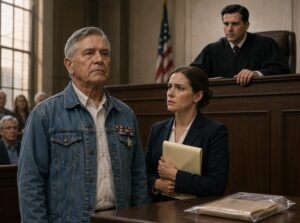
James Bennett woke before the alarm because he had never trusted alarms on important mornings.
For a while he lay still under the thin quilt, listening to the house decide whether it was ready to become a day. The refrigerator clicked in the kitchen. Somewhere inside the wall, an old pipe gave a tired knock. Beyond the curtains, the sky had not yet taken on color. It was the hour when the world still belonged to memory.
His cane stood beside the bed, close enough that he could reach it without turning too far. His daughter had put it there the night before. Catherine always placed things where he would not have to search, as if searching itself had become dangerous.
James turned his head toward the chair by the closet.
The uniform waited there.
He had taken it out after Catherine went home, though it had cost him nearly twenty minutes and one spell of dizziness. Olive green jacket, trousers pressed as well as his hands could manage, cap resting on top like a small folded hill. It was not the uniform of a man expecting attention. It was the uniform of a man keeping an appointment.
He pushed himself upright slowly. The room shifted, then settled. His right hand found the cane. His left went to the edge of the mattress and gripped until his fingers remembered what to do.
The old house was quiet, but not empty. Photographs watched from the dresser. Catherine at twelve with a gap in her smile. His wife, Virginia, under a maple tree in a summer dress, one hand raised against the sun. James in a white shirt, younger than he felt he had ever been, standing beside a pickup with his sleeves rolled to the elbow.
There was no framed photograph of him in uniform.
That had been Virginia’s choice at first, then his. Not from shame. Not exactly. Just because there were some parts of a life that did not sit well behind glass.
He stood, waited for his knees, then moved toward the chair.
The jacket was heavier than he remembered. Or maybe he had become lighter. He slipped one arm in, then the other, and paused with his chin lowered while the cloth settled across his shoulders. It smelled faintly of cedar and old wool. Catherine had offered to have it cleaned, but he had said no too quickly and she had looked hurt. He had not explained that if too much was washed out of it, he was not sure what would remain.
The buttons gave him trouble. His fingers had once tied knots in rain and darkness, had taken apart engines by feel, had folded maps with edges sharper than paper should be. Now they trembled over brass until he had to stop and breathe.
One button.
Then another.
At the third he sat down again.
On the dresser lay the folded program. He had placed it beneath his glasses so he would not forget it, though he had not forgotten it once in six days. The county veterans office had mailed it with a neat cover letter and a printed schedule for the morning’s remembrance ceremony. He had read it at the kitchen table with Catherine standing behind him, one hand on his shoulder.
She had not noticed the mistake until he folded the program closed.
James picked it up now.
The crease had deepened where his thumb kept finding the same line. It was not his own name. That was part of the trouble. If it had been his name, he might have let it go. Men could survive being forgotten themselves. It was harder to survive watching somebody else disappear one letter at a time.
He opened the paper.
County Veterans Recognition Day
Honoring Local Service Across Generations
Below the schedule were names. Some living. Some gone. A few with units printed beside them. One line near the middle had been circled in pencil, then rubbed nearly clean, then circled again with a hand less steady than the first.
Jerry H. Hayes.
James stared at the letter.
H.
It should have been P.
No one at the county office had thought that mattered. Maybe to them it looked like a typo, the kind of thing a volunteer could fix next year, or not fix at all. To James, the wrong initial made the name lean away from the man it belonged to. Jerry Hayes had hated being called by the wrong name. Said it made him feel like a stranger had borrowed his boots.
James turned the program over.
On the back, in old blue ink faded almost gray, was a line he had written years ago on a scrap of church bulletin and later copied onto this program when it arrived.
Jerry P. Hayes. B Company. Tell it right.
He folded the paper carefully, pressed the crease flat with his palm, and slid it into the jacket’s breast pocket.
The front door opened at six-thirty.
“Dad?” Catherine called softly, though she still had a key and did not need to ask permission from the house.
“In here.”
Her footsteps came down the hall with the cautious hurry she used around him now, fast until she reached a doorway, then slow as if speed itself might knock him over. She appeared in the bedroom wearing a navy cardigan and carrying a travel mug.
Then she saw the uniform.
“Oh, Dad.”
James looked down at himself. “Does it look that bad?”
“No.” She shook her head at once. “No, it looks…” Her mouth worked around a word she did not trust. “It looks like a lot for today.”
“That’s why I got up early.”
She set the mug on the dresser and crossed the room. “You should have waited. I told you I’d help.”
“You told me.”
“And you ignored me.”
“I considered it first.”
That almost made her smile, but the worry stayed in her eyes. She reached for the crooked third button. “May I?”
He let her. Her fingers were quicker, though she fumbled once because she was trying not to seem as if she were doing too much. Catherine had inherited her mother’s hands. Capable hands. Hands that could smooth a collar, pay a bill, hold a child, shut a drawer harder than necessary.
“I still think we should call before we go,” she said. “Just to make sure they have a chair close enough. And shade. And—”
“There’ll be a canopy.”
“It’s gravel there, Dad. You know the county park lot. It’s not easy walking.”
“I have the cane.”
“The cane doesn’t make gravel disappear.”
He looked at her then, and she dropped her eyes back to the button.
Catherine had been nine when he first taught her to ride a bicycle in the church parking lot. She had fallen twice, scraped one knee, and shouted at him not to let go. He had let go anyway because letting go was the point. Now she stood in his bedroom trying to hold the whole morning upright with both hands.
“I don’t have to stay long,” he said.
“You say that now.”
“I mean it.”
“You also said the grocery store was just one aisle last week.”
“It was one aisle. The milk was far from it.”
She did smile then, but it faded quickly. “What is this really about?”
James reached for his cap and turned it in his hands. The cloth at the brim had softened with age. He ran his thumb along the seam.
“It’s a recognition ceremony,” he said.
“I know what it is.”
“They sent the program.”
“I know that too.”
He fitted the cap onto his head, buying himself a few seconds. Catherine watched him the way she watched doctors when they entered rooms, searching for what they were not saying.
“Dad,” she said, softer. “If this is about your name not being on the list—”
“It isn’t.”
“Because I can call them. I can ask. Maybe they made a mistake.”
“They did.”
She paused. “With your name?”
“No.”
The house seemed to quiet around the answer.
James took the folded program from his pocket. He did not hand it to her right away. He looked at it once, then held it out.
Catherine unfolded it carefully. Her eyes moved over the schedule, the names, the small print. “Jerry Hayes?”
James said nothing.
“They spelled something wrong?”
“The initial.”
She looked up. “That’s what this is about?”
He heard it before she could soften it. Not disbelief exactly. Fear wearing disbelief’s coat.
“One letter,” she said gently. “Dad, I’m not saying it doesn’t matter, but maybe this isn’t worth you putting yourself through—”
“It’s worth standing for.”
The words came out quieter than he expected, but they stopped her.
Catherine looked back at the paper. “Who was he?”
James turned toward the window. The sky was beginning to pale. In the glass he could see his own reflection: old cap, old jacket, old man held together by habit and buttons. Behind him, Catherine waited with the program open in both hands.
“A man who shouldn’t be introduced wrong,” he said.
“That’s all?”
“That’s enough.”
She folded the program along the old crease, but before she gave it back, her thumb brushed the writing on the back. Jerry P. Hayes. B Company. Tell it right.
“When did you write this?”
“Some years ago.”
“How many?”
He took the program and returned it to his pocket. “Enough.”
Catherine’s face changed. It did not lose its worry, but something else entered it, something like the beginning of respect and the ache of being late to it.
“I’ll get your coat,” she said.
“Don’t need one.”
“It’s damp out.”
“I wore worse.”
She gave him a look.
He let her bring the coat.
At the front door, she bent to check the rubber tip of his cane. He pretended not to notice. The morning air smelled of wet pavement and cut grass. Catherine’s car waited in the driveway, windshield silvered with mist.
James stepped onto the porch. His knee protested, then obeyed. The folded program pressed lightly against his chest.
Behind him, Catherine locked the door.
“Dad,” she said.
He turned.
“If it gets to be too much, we leave. Promise me.”
He looked past her for a moment, toward the house where he had lived most of his life without telling most of it. Then he looked down at the cane in his hand and the polished black shoes he had nearly given away twice.
“I’ll leave,” he said, “after the name is read.”
Catherine opened the car door and did not answer.
As he lowered himself into the passenger seat, the program shifted in his pocket, close enough that he could feel the crease through the wool. For one brief second, he was not in his daughter’s driveway but somewhere much farther away, hearing a younger man laugh in the dark and say, If anybody ever prints my name, Bennett, make sure they don’t mess it up.
James closed his eyes.
“I’m coming,” he whispered, too quietly for Catherine to hear.
Chapter 2: A Chair In The Back Row
The county park looked smaller than James remembered, though the parking lot had somehow grown.
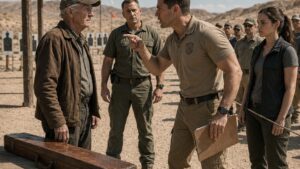
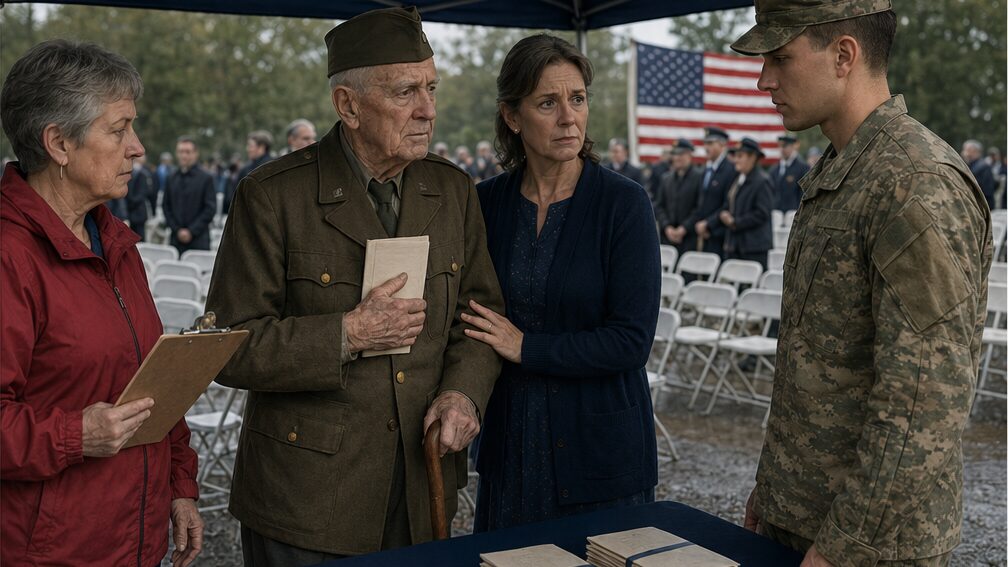
Catherine slowed the car near the entrance where orange cones marked a path across the gravel. Beyond them, a dark blue canopy had been raised at the center of the open space. Folding chairs sat in white rows beneath it, most still empty. A large American flag hung from a pole behind the speaking area, moving only when the damp morning wind bothered to touch it.
A few people in jackets stood near a registration table. Volunteers clipped badges to lanyards. Someone tested a microphone, producing a short squeal that made several heads turn. Two active-duty soldiers in camouflage moved chairs with efficient quiet, their boots dark against the pale gravel.
James watched them without seeming to.
“There’s a spot closer,” Catherine said. “I’ll pull around.”
“No. Here’s fine.”
“It’s not fine. It’s halfway across the lot.”
“I’d rather walk in.”
“Dad.”
He turned his head. “Catherine.”
She exhaled through her nose and pulled into the nearest open space.
By the time she came around to help, James had opened the passenger door and planted his cane on the gravel. The tip pressed between small stones and held. He stood carefully, one hand on the car frame, letting the morning air settle around him. It smelled of wet leaves, coffee from somewhere in paper cups, and the faint plastic scent of new folding chairs.
Catherine hovered close but did not touch his arm.
“Slow,” she said.
“I wasn’t planning to run.”
They made their way toward the canopy. Each step required more thought than James wanted to give it. Gravel had a language of its own, shifting and grinding underfoot, reminding him that ground was never as solid as people liked to believe. His cane tapped, sank, lifted. Tapped, sank, lifted.
Several people glanced at him as he passed. Some smiled with the automatic warmth reserved for old men in military caps. A man near the coffee urn nodded. A woman with a camera lifted it halfway, then lowered it when Catherine stepped closer to James’s side.
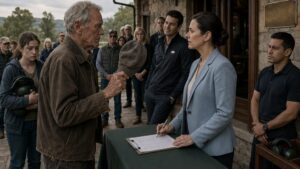
At the registration table, a volunteer in a red windbreaker looked up from a clipboard.
“Good morning,” she said brightly. “Name?”
James removed his cap. “James Bennett.”
The volunteer ran a finger down the page. Her lips moved silently over the alphabet. “Bennett… Bennett…” She flipped to another sheet. “Are you with one of the families?”
“No.”
“Guest of an honoree?”
James looked toward the canopy. “Not exactly.”
Catherine leaned in. “He received the program in the mail.”
The volunteer smiled at Catherine, not James. “We mailed a lot of those. We’re asking general attendees to sit in the back rows until the reserved section fills.”
“I’d like to stand close enough to hear the names,” James said.
The volunteer’s smile held, but it tightened at the edges. “Of course. We do have speakers.”
“The sound cuts in wind,” James said.
She blinked, perhaps uncertain whether he was complaining or simply stating a fact.
Catherine touched the table lightly. “Is there a chair near the front? He can’t stand too long.”
“That front section is for honorees and presenters.” The volunteer looked at James’s uniform, then back at her clipboard. “Were you supposed to be recognized today?”
James did not answer quickly enough.
Catherine did. “He’s a veteran.”
“Yes, ma’am, of course.” The volunteer’s voice softened in a way James had heard before. “We appreciate his service. We just have a check-in system for the ceremony.”
A young soldier approached carrying a stack of folded programs. He was tall, clean-faced, with close-cropped hair beneath his patrol cap. His name tape read Carter. He set the programs on the table, glanced at James, and gave a polite nod.
“Everything all right, ma’am?” he asked the volunteer.
The volunteer lowered her voice, though not enough. “I don’t have Mr. Bennett on the recognition list. He wants to stand near the front.”
Patrick Carter looked at the rows of chairs, then at James’s cane. “Sir, we can get you seated where you’ll be comfortable.”
James held the young soldier’s gaze. “Comfort isn’t why I came.”
A small silence followed.
Catherine moved closer. “Dad, please.”
Patrick’s expression remained respectful, but procedure had already entered it. James could see it in the way his eyes shifted from uniform to cane to clipboard to chairs. The soldier was not unkind. He was measuring a problem.
“We have reserved seating for honorees,” Patrick said. “General seating begins behind that second row. I can personally make sure you have an aisle seat.”
“I need to hear one name.”
“The names will be read over the sound system, sir.”
James reached into his breast pocket and took out the folded program. He did it slowly, partly because his fingers were stiff, partly because something in him resisted opening it in front of strangers.
The volunteer glanced at the paper with the quick impatience of someone expecting confusion.
Patrick noticed.
James unfolded the program to the marked line and held it out, but his thumb stayed on the crease. “This one.”
The volunteer leaned over. “Jerry H. Hayes?”
“Jerry P. Hayes,” James said.
She checked the clipboard again. “Our printed list says H.”
“It’s wrong.”
“Maybe there were two Hayes families?” she offered.
“No.”
Patrick took a half step closer. “You knew him, sir?”
James looked down at the name. The paper trembled slightly, so he steadied it with both hands. “I stood beside him.”
The volunteer’s expression changed, but only into uncertainty. She was not prepared for a sentence like that before the ceremony had even begun.
Catherine stared at her father. “Dad…”
James folded the program again. “I can stand until the name is read.”
Patrick looked at the cane. “Sir, that might be twenty or thirty minutes.”
“I’ve stood longer.”
It was not a boast. He said it like weather.
The volunteer shifted behind the table. “Mr. Bennett, I understand this is meaningful, but we can’t alter the program at check-in. The ceremony is already organized. If there’s a correction, you can write it on the form after—”
“After they say it wrong,” James said.
No one answered.
The wind moved the flag behind the canopy. The fabric lifted once, then fell. A microphone popped as someone at the sound table said, “Testing, one, two.”
Patrick looked from James’s face to the folded program in his hand. “May I see it, sir?”
James did not hand it over immediately. His thumb pressed along the crease until the paper bent around it.
Patrick’s voice changed. Not dramatically. Just enough. “I’ll be careful.”
James studied him. The young soldier stood straight, but his eyes had stopped skimming. He was looking now, not managing.
James passed him the program.
Patrick held it by the edges, the way a person holds something that might tear if treated like ordinary paper. He opened it and read the circled line. Then he turned it over.
The faded handwriting on the back caught him.
Jerry P. Hayes. B Company. Tell it right.
Below that, smaller and almost hidden by the fold, was another line.
J. Bennett. Same unit.
Patrick’s eyes lifted.
“Sir,” he said, quieter now, “you were in B Company?”
James put his cap back on. “A long time ago.”
The volunteer looked between them. “What is it?”
Patrick did not answer her right away. He read the back of the program once more. His shoulders changed before his face did. They settled lower, but his posture sharpened, as if he had stopped bracing against inconvenience and started standing before a person.
“Mr. Bennett,” he said, “would you give me a minute?”
Catherine looked suspicious. “For what?”
Patrick kept his eyes on James. “To check something.”
“The ceremony starts soon,” the volunteer said.
“Yes, ma’am.”
Patrick folded the program along its existing crease and held it back to James with both hands.
The gesture was small. Anyone not watching closely might have missed it.
James did not miss it.
He took the paper and returned it to his pocket.
Patrick turned toward a gray-haired man near the sound table, a retired officer by the look of him, wearing a dark blazer with a small lapel pin. “Sergeant Reed?” he called, though the man was not in uniform. “Do you have the service notes folder?”
Stephen Reed looked up.
James felt Catherine’s fingers brush his sleeve. She did not take his arm. Not yet.
“Dad,” she whispered, “what’s happening?”
James watched Patrick cross the gravel with purpose now, no longer carrying chairs, no longer smoothing ceremony edges.
“I don’t know,” James said.
But that was not quite true.
He knew what it looked like when a young man realized paper could be heavier than a rifle.
Chapter 3: The Name That Did Not Match
Patrick Carter had been told the ceremony would be simple.
Arrive by nine. Help set up chairs. Assist elderly guests. Stand near the flag during the pledge. Hand the presentation items to Sergeant Stephen Reed in the order listed. Stay useful, stay respectful, stay out of the way.
No one had mentioned a folded program with faded handwriting on the back.
He crossed the gravel lot toward Stephen with the unpleasant sense that the morning had tilted. Behind him, he could feel the old man still standing near the registration table, cane planted, daughter close beside him, volunteer uncertain behind the clipboard.
Stephen Reed was crouched near a plastic storage box, sorting envelopes and small presentation cases. He had the deliberate movements of a man who had once done everything by regulation and now did everything by habit. His silver hair was combed neatly. His blazer was buttoned despite the damp air.
“Sir,” Patrick said.
Stephen looked up. “We’re not using sir today, Carter. Makes the county commissioners nervous.”
Patrick did not smile. “Do we have service notes for Jerry Hayes?”
Stephen’s hand paused over the envelopes. “Hayes?”
“Yes, Sergeant.”
The old title came out before Patrick could stop it.
Stephen heard it. His expression sharpened. “Why?”
“There may be a wrong initial in the program.”
Stephen glanced toward the registration table. “A family member complaining?”
“No. A veteran.”
“We have several.”
“This one says he served with him.”
Stephen stood slowly. His knees cracked loud enough for Patrick to hear. “Name?”
“James Bennett.”
For the first time that morning, Stephen Reed looked past the work in front of him. His gaze traveled across the chairs and found James near the edge of the canopy. The old man stood very still, cap low, one hand resting on the cane, the other over his breast pocket.
“Bennett,” Stephen said under his breath.
“You know him?”
“I know the name.”
Patrick waited.
Stephen turned to the storage box and lifted out a blue folder with a white label: Recognition Notes. Inside were printed sheets, photocopies, emails, and handwritten additions clipped in uneven stacks. The ceremony had looked clean from the front. Up close, it was held together by paper clips and hope.
Stephen flipped through the pages. “Hayes, Hayes…”
The microphone squealed again. Someone laughed under the canopy. The first row was beginning to fill with older men and women moving carefully between chairs. A volunteer guided a man with a walker toward the aisle. The flag stirred behind the empty podium.
Patrick glanced back. The volunteer at the table was speaking to Catherine. James was watching the canopy, not them.
Stephen found the sheet.
“Jerry H. Hayes,” he read.
“Is there a source?”
Stephen scanned the page. “County archive index. Donated list from an old veterans association. Looks like it was typed from a handwritten roster.”
“Could H be wrong?”
“Any letter on those old lists could be wrong.”
“Then we should correct it.”
Stephen closed the folder halfway. “Not because a man at check-in says so.”
Patrick felt heat rise under his collar. “He wrote B Company on the back of his program.”
Stephen’s eyes returned to him. “What back?”
Patrick held out his hand, then remembered he had returned the program. “He has it. Faded handwriting. Jerry P. Hayes. B Company. Tell it right. Then J. Bennett, same unit.”
Stephen was quiet.
The county clerk approached with a stack of certificates. “Mr. Reed, they want to start in five.”
“In five,” Stephen said without looking at her.
She hesitated, then moved away.
Patrick lowered his voice. “Sir, he was going to be seated in the back.”
Stephen looked again toward James. “He may prefer it.”
“He said he needs to hear one name.”
“That doesn’t mean he wants attention.”
“I’m not saying attention. I’m saying we may be about to say it wrong in front of him.”
Stephen rubbed his thumb along the folder edge. “There’s an order to these things.”
“Yes, sir.”
“And corrections need confirmation.”
“Yes, sir.”
“And ceremonies cannot become arguments at the microphone.”
“No, sir.”
Stephen gave him a tired look. “You agree too quickly when you’re not agreeing.”
Patrick took that without reply.
The truth was, he had started the morning thinking ceremony respect meant good posture and polished timing. Stand where told. Hand over the case. Keep the aisle clear for the old folks. He had not thought about what happened if the aisle itself became the problem.
“Do you have anything with Bennett’s name?” he asked.
Stephen did not move for a moment. Then he reopened the folder and checked the back pocket. “There was a supplemental note. Came from a local history volunteer, I think. I didn’t use it because it was incomplete.”
He pulled out a photocopy folded in thirds. The top half was a typed paragraph about the county’s surviving service members from older conflicts. The bottom had handwritten notes in the margin.
Patrick leaned closer.
B Co. reunion, 1988. Hayes listed as Jerry P. Hayes. Bennett, James—same town? verify.
Stephen’s jaw tightened.
“There,” Patrick said.
“That’s not official.”
“It’s something.”
“It’s a note telling us to verify.”
“Then let me verify.”
“With whom?”
Patrick turned.
James had not sat down. The daughter was speaking to him now, her face drawn with worry. The volunteer kept looking toward Stephen, as if hoping he would solve the old man away.
“With him,” Patrick said.
Stephen’s eyes hardened, not with anger but with the burden of knowing exactly how public moments could go wrong. “Carter, listen to me. Some memories are clear. Some aren’t. A man that age—”
Patrick felt the sentence strike somewhere deep and unwelcome.
Stephen stopped himself, but not soon enough.
“A man that age,” Patrick repeated carefully, “may be the only living person here who knows the difference.”
Stephen looked away.
The loudspeaker clicked. “Good morning, ladies and gentlemen. We’ll begin in just a few minutes. Please find your seats.”
The rows shifted with movement. Programs opened. Chairs scraped. The ceremony, indifferent to hesitation, was arriving.
Patrick stepped back. “Permission to speak with Mr. Bennett before we start.”
Stephen gave a short breath that was almost a laugh. “You don’t need permission to speak to a man.”
“No,” Patrick said. “But I might need permission to change where he sits.”
Stephen studied him, then the old man, then the folder in his hand.
“Ask him what he wants,” Stephen said at last. “Not his daughter. Not the volunteer. Him.”
Patrick nodded.
“And Carter.”
“Yes?”
“Bring me that program if he’ll allow it.”
Patrick returned across the gravel with the folder copy in his hand. He no longer saw the old veteran as part of the event’s crowd flow. He saw the cane angled against shifting stone. He saw the careful set of the uniform jacket, the cap worn not as costume but as answer. He saw Catherine’s worry and the volunteer’s clipboard and the small triangle of space around James where everyone seemed to be deciding things near him instead of with him.
When Patrick reached them, he removed his cap. It was not regulation for the situation. It simply felt like the right way to make his face fully visible.
“Mr. Bennett,” he said.
James turned.
“I found a note that may support what you said.”
Catherine’s eyes widened. “About the name?”
Patrick nodded. “But Sergeant Reed needs to understand how you know.”
James’s mouth tightened. “I told you.”
“You stood beside him.”
“Yes.”
Patrick waited. The morning wind moved across the gravel. Under the canopy, people were sitting now. The front row had two empty chairs near the aisle.
Catherine said softly, “Dad, you don’t have to do this here.”
James looked at her. Something passed between them, old and private.
“I didn’t come to talk about all of it,” he said.
Patrick kept his voice low. “Then don’t. Tell me only what the name needs.”
James’s eyes came back to him.
For the first time, Patrick saw how tired the old man was. Not sleepy. Not confused. Tired in a way that had nothing to do with the walk from the car. His face carried years like folded maps, each line going somewhere someone else could not follow.
“His middle name was Paul,” James said. “He used to say the P stood for patience, which was a lie. He had none.”
A faint flicker touched his mouth and vanished.
Patrick did not interrupt.
“He wrote his name on everything. Jerry P. Hayes. Boots. Letters. The inside of his cap. Said if he got misplaced, he wanted to be returned properly.”
Catherine covered her mouth with one hand.
James looked down at the gravel. “He was twenty-two.”
Patrick felt the copy in his hand bend slightly under his grip.
The volunteer’s face had changed. Her clipboard lowered to her side.
“May Sergeant Reed look at your program?” Patrick asked.
James’s hand went to his breast pocket.
“I’ll bring it back,” Patrick said.
James drew out the folded paper. He held it for a moment, then placed it in Patrick’s hand.
Patrick did not fold it smaller. He did not tuck it under his arm. He carried it flat against the folder copy and walked back to Stephen.
The ceremony music began from a small speaker, low and tinny. People quieted. The first speaker approached the microphone.
Stephen read the back of the program once. Then again.
His face did not perform surprise. It did something more difficult. It accepted weight.
“Find two chairs in the front row,” he said.
“There are already—”
“Then make space.”
Patrick nodded.
Stephen held the program a little longer before giving it back. “And Carter?”
“Yes?”
“When I get to Hayes, don’t hand me the printed card.”
Patrick looked at the folder in Stephen’s hand.
Stephen slipped the printed sheet behind the corrected note.
“Hand me this.”
Chapter 4: Under The Blue Canopy
By the time Patrick returned, the front rows had begun to fill with people who moved as if every chair had been chosen for them years ago.
James watched them from the edge of the canopy, one hand on his cane, one hand over the program in his breast pocket. Men in ball caps settled beside women in rain jackets. A man with a walker maneuvered carefully around the aisle while a volunteer folded the wheels inward for him once he was seated. Two younger children, dressed too neatly for a Saturday morning, were told to stop kicking the gravel.
The blue canopy made everything beneath it look a little colder.
Catherine stood close enough to catch him if he swayed, but not close enough to admit that was what she meant to do. Every minute or so, her eyes moved from his face to the chairs to the car beyond the orange cones.
Patrick approached with his cap back on and his expression steadier than before.
“Mr. Bennett,” he said, “Sergeant Reed would like you seated in the front row, aisle side, if that’s all right with you.”
Catherine let out a breath. “Thank you.”
James did not move. “Will he say it right?”
Patrick’s eyes flicked toward Stephen Reed, who stood near the podium with the folder tucked under one arm. “He has the corrected note.”
“That wasn’t my question.”
Patrick accepted that. “Yes, sir. I believe he will.”
James looked at the row of chairs waiting beneath the flag. A chair was only a chair until it became a statement. He had spent much of his life avoiding chairs placed too carefully in front of too many people.
“I can stand,” he said.
Catherine turned to him. “Dad.”
“I said I can.”
“You don’t have to prove that to anyone.”
James looked at her, and the sharpness in his chest softened. She thought standing meant stubbornness. Maybe sometimes it did. But some things had to be met upright if the body allowed it, and his body, for this small stretch of morning, still allowed it.
“I’m not proving,” he said. “I’m waiting.”
Patrick glanced toward the podium. “The ceremony is starting.”
“Then I’ll wait here.”
A few people had begun watching them. Not openly. The way people watched an uncertain moment in public, pretending to adjust sleeves or read programs while gathering the shape of trouble.
Stephen stepped to the microphone.
“Good morning,” he said, and the speakers carried his voice in a thin crackle across the gravel. “Thank you for joining us for County Veterans Recognition Day.”
The crowd quieted.
Patrick remained beside James for another moment. “I’ll be near the front if you need anything.”
James nodded once.
Patrick went to stand near the presentation table, where small cases and envelopes had been arranged in the order of the printed program. James saw him move one card behind another, careful not to draw attention.
Catherine leaned close. “Please sit.”
“When it’s time.”
“You said you weren’t going to stay long.”
“I’m not.”
Her mouth tightened. “That is not as reassuring as you think.”
James almost smiled, but Stephen had begun reading the opening remarks.
The words floated around him: service, gratitude, generations, sacrifice, community. They were fine words, all of them. Fine words could be true and still miss the thing. James had heard plenty over the years. On Memorial Days. At school assemblies. In church basements where coffee went cold while men stared at tablecloths rather than answer questions.
He watched Stephen’s hands.
The folder lay open on the podium. The corrected note was inside it now. So was the printed mistake. A man could know the right thing and still read the wrong page. Not from malice. Sometimes habit had more authority than truth.
James shifted his weight. The cane tip pressed into gravel and made a small grinding sound.
Catherine heard it. “Dad?”
“I’m all right.”
“You’re leaning.”
“I’ve leaned before.”
“That doesn’t mean you should.”
He said nothing.
Stephen introduced the first honoree, a woman from a family seated two rows back. She stood with help from her grandson and accepted a certificate for her late husband. People clapped softly. Stephen’s voice stayed even, respectful. Patrick handed him the correct envelope at the correct time.
James watched. The ceremony had a rhythm now. Name. Branch. Brief note. Certificate. Applause. A hand placed over a heart. A nod. A return to the chair.
The rhythm was dangerous because it made mistakes easy to pass through.
A small gust moved under the canopy. Programs fluttered. The American flag lifted behind Stephen’s shoulder and fell back against the pole.
James’s legs began to ache above the knees. He locked them, then unlocked them because locking was worse. His right hand tightened on the cane handle. The wood had darkened where his palm had worn it smooth.
Catherine put her hand under his elbow.
He wanted to pull away. He did not.
The next name was read. Then another.
Patrick looked once in James’s direction. James did not nod. He did not know what he would be promising if he did.
Stephen turned a page.
James felt the program in his pocket as though it had grown warm.
“We also recognize,” Stephen said, “the service of county sons whose names were preserved in older records and local association rolls…”
The words blurred at the edges.
James saw another morning inside this one. Not the whole of it. Never the whole. Just Jerry Hayes sitting on an overturned crate, writing his name inside his cap with a stub of pencil while rain drummed on canvas overhead.
“You lose everything that ain’t tied down,” Jerry had said.
“You planning to tie down your name?” James had asked.
“Somebody’s got to.”
Stephen read two names correctly.
James breathed through his nose.
Then Stephen looked down again.
“Jerry—”
The cane struck gravel once.
Not loud. Not dramatic. But under the canopy, where everyone had grown used to polite stillness, the sound landed clean.
Stephen stopped.
Several heads turned.
Catherine whispered, “Dad.”
James had not meant to make a sound. Or maybe he had. He could not tell anymore where intention ended and memory began.
Stephen looked up from the folder. His eyes found James at the edge of the canopy.
For a long second, no one moved.
Patrick’s hand hovered over the presentation table. He looked at the card, then at Stephen.
Stephen lowered his gaze to the page again. James saw his mouth tighten. He moved the printed sheet aside. The motion was small, but James saw it. Patrick saw it too.
Stephen picked up the corrected note.
“Jerry P. Hayes,” he said, and this time his voice had lost its ceremony polish. It was quieter. More human. “B Company.”
James closed his eyes.
The wind moved through the canopy. A child coughed. A chair creaked. Somewhere behind him, Shirley Miller drew in a breath that sounded almost like an apology but was not one yet.
Stephen continued. “His name appears in county association records with an incorrect middle initial. We correct that today.”
A murmur passed through the rows, gentle but unsettled.
James opened his eyes.
Catherine was looking at him as if a door had opened in a house she thought she knew.
Stephen turned slightly from the microphone. “Mr. Bennett,” he said, “would you be willing to come forward?”
The attention shifted fully then. James felt it touch his cap, his uniform, his cane, the hollows in his face, the hand Catherine still held beneath his elbow.
For one moment he wanted to refuse.
He had not come for the walk to the front. He had not come to become an explanation. He had come to hear the name said right and let it settle somewhere outside his own keeping.
But Patrick had stepped away from the table. He did not hurry. He did not reach for James. He simply stood at the aisle, waiting, making a path without making a show of it.
Catherine’s fingers tightened. “You don’t have to.”
James looked at her.
That was the first time all morning she had said it that way.
Not as warning. Not as fear. As permission.
He nodded.
The gravel shifted under his first step. Patrick moved one chair aside. The people in the front row straightened, some turning their knees to give him room. No one clapped. James was grateful for that.
Step. Cane. Step.
The flag waited behind Stephen. The blue canopy snapped once overhead. James could hear his own breathing now, and beneath it, something older: Jerry laughing as if the world had no right to frighten him.
Halfway down the aisle, James stopped.
Patrick’s hand rose, then paused. “May I help you, sir?”
James looked at the young soldier’s open palm.
Not grabbing. Not guiding. Asking.
James placed two fingers on Patrick’s sleeve just long enough to steady himself.
“Thank you,” he said.
Patrick lowered his voice. “Yes, sir.”
When they reached the front, Stephen stepped back from the microphone. The folder was open in his hands. He looked older than he had moments before.
“Mr. Bennett,” Stephen said, “I owe you a better question than the one I was ready to ask.”
James waited.
Stephen looked down at the corrected note. “Is Jerry P. Hayes the name that should be read into this county record?”
James’s throat tightened so suddenly that he had to look past Stephen, past the flag, toward the gray line of trees beyond the lot.
“Yes,” he said.
Stephen nodded, then turned back to the microphone.
“Then let the record show,” he said, “Jerry P. Hayes, B Company.”
This time the silence after the name did not feel empty.
It felt like a chair finally being pulled out for someone who had been standing too long.
Chapter 5: Permission Before The Pin
Patrick had handled presentation cases all morning without thinking about his hands.
Lift the case. Open it toward Stephen Reed. Step back. Wait for the photograph. Close the case. Return to the table.
The motions had seemed respectful because they were clean.
Now he stood beside the presentation table with James Bennett five feet away, and every motion felt too large.
Stephen had finished correcting the name. The words still hung under the canopy, changed by having been spoken aloud. People were quiet in a different way now. Not bored quiet. Not ceremonial quiet. Listening quiet.
James stood before the flag, cane in his right hand, cap brim shadowing his face. Catherine sat in the front row because Patrick had placed a chair there for her and because she had finally accepted it. Her eyes had not left her father.
Stephen looked at Patrick.
Patrick knew the next step. The county had prepared a small recognition pin for surviving veterans attending the ceremony, a modest item in a blue velvet case. It was not a medal of valor. It was not meant to solve anything. An emblem, a thanks, a public marker. Before that morning, Patrick had thought of it as one more item on the checklist.
He picked up the case now and felt its weight.
Stephen addressed the crowd. “Mr. Bennett did not ask to be added to today’s program. He came to correct the name of a man who served beside him. That correction matters. So does the fact that Mr. Bennett has carried it here himself.”
James’s gaze dropped.
Patrick wished Stephen would stop there.
Stephen seemed to understand. He closed the folder. “Mr. Bennett, the county would be honored to recognize your service as well, if you permit it.”
The last four words changed everything.
If you permit it.
Patrick saw James hear them. The old man’s jaw worked once. Not with pride. With difficulty.
Catherine’s hands tightened around the program in her lap. James had given it to her when he reached the front, perhaps because he needed both balance and courage. The folded crease had begun to split at the edge.
James looked at Stephen. “Say his name first.”
Stephen did not hesitate. “Jerry P. Hayes.”
James breathed in.
“And now,” Stephen said softly, “James Bennett.”
There was a stir in the rows. A few people lowered their programs. Someone in the back whispered, “That’s him?” and was hushed immediately.
Patrick opened the velvet case.
Inside lay the small pin, bright against dark cloth. He had seen a dozen like it that morning. This one looked different because James did not look at it. He looked beyond it, as if deciding whether accepting it would take something away from the name that had finally been returned.
Patrick stepped forward, then stopped.
James noticed.
Patrick held the open case between them. “Mr. Bennett,” he said, keeping his voice low enough that the microphone would not catch all of it, “may I place this on your jacket?”
James looked up.
The old man’s eyes were pale and wet, but steady. Patrick had expected age to make them cloudy. It had not. They were tired, yes, but not lost.
“You ask every man that?” James said.
Patrick answered honestly. “No, sir.”
A small line appeared at the corner of James’s mouth. “You should.”
Patrick felt the words land exactly where they belonged.
“Yes, sir,” he said.
James shifted the cane. His left hand rose slowly to the front of his uniform jacket. For a second Patrick thought he was going to cover the spot, to refuse. Instead James touched the cloth just above the breast pocket and smoothed it once with his palm.
“Here,” he said.
Patrick removed the pin from the case.
The front of James’s jacket was old wool, thicker than the modern dress uniforms Patrick knew. The fabric had softened with time but still resisted the point. Patrick’s fingers slowed. He did not want to pull or snag. The entire canopy seemed to hold its breath over the distance between his hand and the old man’s chest.
Up close, James smelled faintly of cedar and morning air.
Patrick guided the pin through the wool and secured the backing. His thumb brushed the edge of the breast pocket, and he felt paper inside before remembering Catherine held the program now. No, not paper. An old inner fold in the lining, worn from years of carrying things there.
James did not move.
When Patrick finished, he stepped back.
The pin was small. Against the olive jacket, it did not shine much. That seemed right.
Stephen’s voice came from beside them. “Thank you, Mr. Bennett.”
A few people began to clap, softly at first.
James flinched almost imperceptibly.
Patrick saw it and turned slightly, not to silence the crowd but to shield the moment from becoming too wide. The applause faded into something gentler, scattered, then still.
Catherine rose from her chair. She had the folded program in both hands. For once she did not step forward.
James looked at Patrick.
The young soldier straightened by instinct, but he did not salute. Not here. Not over a county pin. Not in a way that would make everyone copy him and turn James into the center of a scene he had not asked for.
Instead Patrick lowered his voice. “Jerry P. Hayes,” he said.
James’s face changed.
The name, said quietly now, did more than the microphone had done. It crossed the small space between two men and arrived whole.
James lifted his left hand from his side.
Patrick thought at first he was reaching for the cane. Then he understood and extended his own hand.
James’s grip was thin, the bones prominent beneath the skin, but it held. Not firmly in the way men described firm handshakes, as if pressure could prove worth. It held with intention.
Patrick bent slightly, not because James demanded it but because the handshake asked him to meet the old man where he stood.
“Thank you,” James said.
Patrick swallowed. “For what, sir?”
“For not carrying it like paper.”
Patrick could not answer.
The local photographer raised her camera. Catherine glanced at her, and something fierce crossed her face. The photographer lowered it.
James released Patrick’s hand and looked toward Catherine. “The program.”
She stepped forward at once, but stopped just short of crowding him. “Here.”
James took it. His fingers brushed hers. Catherine did not close her hand around his. She let him hold it.
Stephen leaned toward the microphone again, but James lifted the program slightly.
“May I?” he asked.
Stephen stepped aside.
Patrick felt unease move through the crowd. Public microphones were dangerous. Old memories were dangerous. Anything unscripted could turn a ceremony into something no one knew how to hold.
James stood before the microphone and did not adjust it. It was too tall, but he did not ask for it to be lowered. His voice, when he spoke, barely needed it.
“His middle name was Paul,” James said.
The speaker carried the words thinly, but they reached.
“He didn’t like being misplaced.”
A small, uncertain ripple of laughter moved through the chairs, then stopped when James looked down at the folded program.
“I came because the paper was wrong,” he said. “Not because paper is everything. Because sometimes paper is all that is left for somebody who wasn’t brought home by enough people.”
Catherine’s face tightened.
James paused long enough that Patrick wondered if he would continue. Then the old man folded the program again, carefully, along the same crease.
“That’s all,” James said.
He stepped back from the microphone.
Stephen looked at him not as a presenter looking at an honoree, but as one man measuring the cost of another man’s restraint.
“Thank you,” Stephen said quietly.
James nodded, but he had grown pale.
Catherine saw it first. “Dad.”
Patrick moved, then stopped himself. “May I?”
James did not answer with words. He touched Patrick’s sleeve again, two fingers only.
Together they turned from the flag.
The ceremony could have resumed then. Stephen could have called the next name. The crowd could have returned to its program. But for several seconds nobody moved. The rows of chairs, the flag, the table, the blue canopy, even the gravel beneath their feet seemed to understand that something had been corrected but not completed.
As James reached the aisle, he leaned close enough for Patrick to hear.
“He hated Paul too,” he whispered.
Patrick looked at him, startled.
James’s mouth moved with the faintest tired smile.
“Said it sounded like a banker.”
Then the smile broke before it could fully arrive, and his eyes filled.
Patrick looked away, not to ignore him, but to give him the privacy of not being watched while standing in front of everyone.
Chapter 6: The Handshake Was Not The End
Catherine had spent years learning the shape of her father’s silence, and that morning proved she had mistaken most of it for emptiness.
After the ceremony, people rose slowly from the folding chairs and gathered in soft clusters under the canopy. Some approached Stephen Reed with questions. Some stopped near the refreshment table. A few looked toward James, then looked away, uncertain whether gratitude would be welcome or whether it would only add weight to shoulders already bent.
Catherine guided her father toward the side of the canopy where the gravel met a strip of damp grass. She did not take his arm until he offered it. That small permission nearly undid her.
“You need to sit,” she said.
“I am sitting.”
“You are leaning against a chair.”
“It’s a kind of sitting.”
“Dad.”
He lowered himself carefully, jaw set against the effort. Patrick remained nearby but not too near. He had carried over a second chair without asking and placed it where Catherine could sit facing her father. Then he stepped back.
The pin on James’s jacket caught a little dull light. The folded program lay across his knee beneath his hand.
Catherine crouched in front of him. “We should go home.”
James looked past her toward the canopy. Stephen was speaking with Shirley Miller near the registration table. Shirley’s red windbreaker made her easy to find. She no longer held the clipboard against her chest like a shield. It hung at her side.
“In a minute,” James said.
“You’re pale.”
“I’ve been pale since eighty.”
“That isn’t funny.”
“It was a little funny.”
She wanted to laugh. Instead she pressed her lips together because crying in front of him felt selfish, and she had already spent too much of the morning making his day about her fear.
“I didn’t know,” she said.
James’s eyes returned to her.
“I didn’t know about Jerry Hayes. Not really. I mean, I knew there were people. I knew you served with men who didn’t come back. But I didn’t know there was a name you were carrying around in your pocket.”
He looked down at the program. “Wasn’t always in my pocket.”
“Where was it?”
“Drawer. Bible. Glove compartment for a while.” His thumb moved along the crease. “Your mother kept finding it.”
“What did she say?”
“Told me paper doesn’t get better from being folded.”
Catherine’s breath caught. “That sounds like her.”
“It was.”
A gust moved through the canopy. The flag shifted behind them. People were leaving now, tires crunching over gravel, doors closing, voices thanking volunteers. The ceremony was becoming ordinary again, which somehow made what had happened feel more fragile.
Patrick approached with Stephen beside him.
Catherine stood automatically, ready to answer whatever question came next.
James noticed. His eyes lifted to hers.
She stopped.
Patrick spoke to James. “Mr. Bennett, Sergeant Reed wanted to return this.”
Stephen held out the corrected note and the original printed card. “I’m keeping a copy for the county file, with your permission. But these belong to you.”
James took the printed card first. Jerry H. Hayes. He looked at it for a moment, then placed it under the folded program on his knee. He took the corrected note next.
“Will the record change?” he asked.
Stephen’s mouth tightened. “The spoken record changed today.”
James waited.
Stephen looked down. “The archive takes longer.”
“How long?”
“I don’t know yet.”
Patrick shifted beside him. Stephen heard the movement and sighed.
“I can start the correction request Monday,” Stephen said. “I should have said that first.”
James nodded. “Monday is a day.”
“It is.”
Catherine almost stepped in. The old habit rose in her throat: ask for a number, a contact, a guarantee, something she could manage. She swallowed it.
James looked at Patrick. “You have to go back?”
“Not immediately, sir.”
“Then don’t stand there like a fence post.”
Patrick blinked, then pulled the spare chair closer and sat. Not beside James exactly, but angled toward him. Stephen remained standing until James glanced at him. Then he, too, took the edge of a folding chair.
Catherine sat last.
For a strange moment the four of them formed a small circle at the edge of a ceremony that had already ended.
James rested both hands on the cane handle. The program stayed on his knee, no longer hidden.
“Jerry was from the south end of the county,” he said.
No one interrupted.
“His mother had a porch with green posts. He talked about those posts like they were famous. Said when we got home, he was going to paint them white just to make her mad.”
Catherine saw Patrick’s face soften. Not pity. Attention.
“He wrote letters all the time,” James continued. “Even when there wasn’t much to say. Some men wrote like they were reporting weather. Jerry wrote like the words could get there ahead of him and keep his chair warm.”
Stephen looked at the corrected note in James’s hand. “The county association had him listed only from the roster.”
“They would.”
“Did his family know about the mistake?”
James did not answer at once. His gaze moved to the gravel, where his cane tip had made a small round mark.
“His mother died before that old association wall went up,” he said. “No brothers. No children. There was a cousin once, maybe. I wrote a letter when I saw the initial wrong the first time.”
“When was that?” Catherine asked.
“Nineteen eighty-eight.”
The year landed hard.
Catherine had been a teenager then. She remembered her father driving alone one Saturday and coming home late with mud on his shoes. She remembered Virginia asking if he had eaten. She remembered him saying yes when the kitchen had no smell of food.
“You never told us,” she said.
James looked at her gently. “You were seventeen. You had enough storms.”
“That wasn’t yours to decide.”
“No,” he said. “It was mine to fail at.”
The answer disarmed her.
Stephen leaned forward. “You tried to correct it then?”
James nodded. “Man at the hall said records came from the county. County said records came from the association. Association said they’d look into it. Then people died. Buildings changed names. Papers moved.”
“And you kept the note,” Patrick said.
James touched the program. “Somebody had to know it was wrong.”
Catherine’s eyes burned. “All these years.”
“All these years go quicker after a while.”
She reached toward his hand, then stopped herself halfway. “May I?”
James looked at her fingers hovering above his.
He turned his hand palm up.
She took it.
His skin felt cold.
“I’m sorry I kept trying to take you home,” she said.
“You were trying to keep me standing.”
“I was trying to keep you safe.”
“That too.”
“I spoke over you.”
James did not deny it.
Catherine nodded as if he had. “I won’t do that now.”
The words were simple, but saying them changed her posture. She was still afraid. James could feel it in her hand. But she was no longer using fear as a leash.
Stephen cleared his throat. “Mr. Bennett, if you’re willing, I’d like to take your statement for the correction request.”
“Today?”
“Monday would be easier.”
James looked at the cars leaving the lot.
Patrick followed his gaze. “Or today, if today matters.”
Stephen gave Patrick a look, but it had no real rebuke left in it.
James folded the corrected note into the program. “There’s one more place first.”
Catherine stiffened. “Dad, you’re exhausted.”
“Yes.”
“Then we should go home.”
“Not yet.”
“Where?”
He looked toward the far side of the park, beyond the canopy, where the county records building sat low and plain beside a line of wet trees. Most people used the front office and never noticed the narrow hallway inside where old plaques and copied rosters hung under glass.
James had noticed. Years ago. More than once.
“The wall,” he said.
Stephen understood before Catherine did. His eyes moved toward the building.
“It may be locked on weekends,” he said.
“You have a key,” James said.
Stephen looked down at his blazer pocket.
Patrick hid the briefest smile.
Catherine saw it and, despite everything, almost smiled too.
She turned back to her father. “Can you make it that far?”
James looked at his cane, then at the program, then at the flag still stirring under the blue canopy.
“No,” he said.
Catherine’s heart dropped.
Then he looked at Patrick and Stephen. “But I can make it with time.”
No one corrected him. No one hurried him. No one said it was too much.
Catherine stood and offered her arm, not as a decision but as an invitation.
James took it.
Patrick picked up the folded chair without being asked and moved it ahead a few yards, setting it down along the path like a promise that rest would be waiting when James chose it.
Stephen walked toward the records building to unlock the door.
And Shirley Miller, still holding the clipboard, quietly stepped aside to clear the way.
Chapter 7: The Name He Carried Home
The county records building had always looked to James like a place that expected no one to need it urgently.
It sat at the edge of the park, low and square, with brick the color of wet clay and narrow windows that reflected the gray sky. There was no flag out front, only a metal sign with the county seal and hours printed in black. Closed Saturday. Closed Sunday. Open Monday through Friday, eight-thirty to four-thirty.
Stephen Reed unlocked the side door anyway.
James waited on the walkway while Catherine stood beside him and Patrick held the folding chair a few steps behind. The journey from the canopy had taken longer than the ceremony itself seemed to have taken. Walk ten paces. Sit. Breathe. Refuse water. Accept water. Walk again. Twice, James had nearly said it was enough. Twice, he had looked at the folded program in his hand and stood.
Now the door opened with a dry metal click.
Stephen held it wide. “There’s a short hallway. Then the display wall.”
James looked at Catherine.
She did not say, Are you sure? She did not say, Maybe Monday. She did not look at Patrick to ask whether this was wise.
She only offered her arm.
James took it.
Inside, the building smelled of paper, floor wax, and old air-conditioning. The lights hummed overhead. Their footsteps changed from gravel crunch to dull tile taps. James’s cane sounded louder in the hallway than it had outside, each touch of the rubber tip making a small hollow note.
The records wall waited past a turn near a row of darkened office windows.
It was not grand. James had remembered that correctly. A glass-covered display stretched along one side of the corridor, filled with copied rosters, old photographs, yellowed clippings, and plaques with dates. Some labels had curled at the edges. One photograph had slipped slightly inside its frame. A small printed notice explained that the display had been assembled by the county historical committee and local veterans association volunteers.
James stopped before the center panel.
Patrick set the folding chair behind him without a word.
James did not sit yet.
For a moment, he let himself look at all of it. Names in columns. Men in uniforms too young for the faces he remembered later. Women in service caps. Ships. Airfields. A grainy parade down Main Street. A photograph of the old veterans hall before the roof was replaced and the windows boarded.
Then he found the roster.
His hand rose, not quite touching the glass.
Hayes, Jerry H.
There it was.
Not shouted. Not fresh. Not cruel. Just wrong, and left wrong long enough to seem official.
Catherine stood very still beside him.
Stephen removed his glasses and put them back on, though nothing about the name changed.
“I’ve walked past this,” he said.
James did not look away from the glass. “Lots of people have.”
“I should have seen it.”
“You didn’t know what you were seeing.”
The words held no accusation. That made them harder.
Patrick stood a little behind them, cap in his hands. Shirley had not come inside. The volunteers were still packing up outside, chairs clattering faintly through the walls. The ceremony was being taken apart piece by piece, but here the mistake remained protected under glass.
Stephen drew a folded paper from inside his blazer. “I made a copy of your program and the note. I can file the correction request Monday.”
James nodded.
“It may need review.”
James nodded again.
“It may take time.”
“All right.”
Stephen looked at him. “That doesn’t bother you?”
James lowered his hand. “It already took time.”
No one answered that.
Catherine touched the edge of the display case, then pulled her hand back as if the glass were something private. “Can it be corrected here today? Not officially, maybe. But can we mark it somehow?”
Stephen hesitated.
Patrick glanced at him. “A temporary notice?”
Stephen looked toward the office doors. “There are archival sleeves in the storage cabinet. I can’t alter the display without the committee, but I can add a dated correction note beside the roster. Temporary, pending review.”
Catherine looked at James. This time she waited.
James turned the folded program in his hands. The crease had gone soft from being opened and closed. For years it had been a private object, carried, hidden, worried, returned to drawers. Under the canopy, it had become proof. Now, in this hallway, he understood it needed to become something else.
He held it out to Stephen.
Catherine made a small sound. She did not mean to.
James heard it and looked at her. “Paper doesn’t get better from being folded.”
Her eyes filled, but she smiled. “No. It doesn’t.”
Stephen accepted the program with both hands.
James kept the printed card with the wrong initial for a moment longer. He looked at it once, then held it out too. “Keep that with it.”
Stephen nodded. “I will.”
Patrick moved toward the display case. “May I help?”
Stephen handed him the temporary correction note he had written outside on the back of a spare ceremony insert. Patrick read it silently.
Correction submitted May 25. Roster line should read: Hayes, Jerry P. B Company. Verified by surviving unit member James Bennett and supporting association note.
Patrick looked up. “It should say Mr. Bennett carried the correction.”
James shook his head. “No.”
Patrick stopped.
James leaned on the cane. “Don’t make it about me carrying it. Make it about him having it.”
Patrick looked down at the note again.
Stephen took it back, removed a pen from his pocket, and crossed out one phrase. He wrote slowly against the wall.
Correction submitted May 25. Roster line should read: Hayes, Jerry P. B Company. Supporting association note and witness statement provided.
He looked to James.
James nodded.
Stephen unlocked the side edge of the display case with a small key from his ring. The glass door opened just enough to release the smell of dust and paper. He slid the note into a clear sleeve, placed it beside the roster, and set James’s folded program behind it, visible but protected.
The program did not look like much there. A creased piece of county paper, softened at the fold, marked by old ink and one stubborn pencil circle.
But it was no longer in James’s pocket.
Stephen closed the glass.
The click of the lock sounded final, though all of them knew it was only the beginning of official correction.
James stared through the glass. Jerry P. Hayes was not printed on the roster yet. Not permanently. Not properly. But the wrong name no longer stood alone.
Catherine slipped her hand into her father’s. “What was he like?”
James let the question settle.
“He talked too much,” he said.
Patrick’s mouth moved into a faint smile.
“He cheated at cards badly. Not well enough to win. Just enough to insult the game.” James’s eyes stayed on the roster. “He sang when he was scared, but only parts of songs because he never knew all the words.”
Catherine squeezed his hand.
“He sounds impossible,” she said softly.
“He was.”
“And you loved him.”
James took a long breath. “He was my friend.”
The hallway held that answer gently.
Stephen cleared his throat. “Mr. Bennett, if you’ll allow it, I’ll call you Monday before I file the formal request. I want the statement to be in your words.”
James glanced at Catherine.
She did not answer for him.
“I’ll be home,” James said.
Patrick shifted his cap from one hand to the other. “Sir.”
James turned.
Patrick stood straight, not stiff. “I owe you an apology for earlier. At the table. I thought I was helping.”
“You were.”
“I was moving you.”
James studied him. The young soldier’s face was open in a way that made excuse impossible.
“You stopped,” James said.
Patrick nodded once. “Not soon enough.”
James looked back at the display. “Soon enough for today.”
Patrick accepted the mercy without trying to improve it.
Catherine brought the folding chair closer. “Dad, now you sit.”
This time James sat.
Not because he had been told. Because the work of standing had reached its end.
The chair creaked under him. He leaned the cane against his knee and looked at the glass case from a lower angle. For most of the morning, people had wanted him seated because standing made them nervous. Now sitting felt chosen, and therefore clean.
Stephen stood beside the display, hands clasped before him. Patrick remained near the door, giving the hallway space. Catherine sat on the edge of the chair beside James, close enough that their shoulders nearly touched.
Outside, a car started. A laugh rose and faded. Someone dragged folded chairs across gravel. The world continued its small dismantlings.
James thought of Jerry’s mother’s porch with green posts. He had never seen it. Not once. But Jerry had described it so often that James could picture the peeling paint, the uneven steps, the way a person might sit there at dusk and look down the road for someone coming home.
He had carried that porch too, without knowing it.
Catherine leaned her head lightly against his shoulder. It had been years since she had done that. He did not move.
“Dad,” she said.
“Hm.”
“Thank you for letting me come.”
He looked at her hand resting near his on the cane handle. “You drove.”
“You know what I mean.”
He did.
For years he had thought silence spared people. Virginia had known better, but she had let him keep certain locked rooms because marriage was not the same as invasion. Catherine had grown up outside those rooms, hearing movement inside and believing the emptiness was meant for her.
“I should’ve told you some of it,” he said.
She turned her face toward him. “You can still tell me some of it.”
He nodded, looking at the roster.
“Not all at once.”
“No,” she said. “Not all at once.”
Stephen checked the display lock once more. “I’ll make a scan of the program Monday. The original can stay here until the committee reviews it, or you can take it back today.”
James looked at the folded paper behind glass.
All morning, its absence from his pocket had seemed impossible. Now he felt the empty space against his chest and found that it did not frighten him as much as he expected.
“Let it stay,” he said.
Catherine looked at him quickly.
James kept his eyes on the program. “If it stays here, somebody else can see it.”
Stephen nodded. “Then it stays.”
Patrick opened the hallway door, letting in a thin line of outdoor light. “Take your time, sir.”
James looked at him. “You keep saying that.”
“Yes, sir.”
“Good.”
Patrick smiled then, small and unguarded.
When James finally stood, Catherine offered her arm again. He took it. Not because he could not manage without her, though perhaps he could not. Because she was offering differently now. Not as someone dragging him from danger, but as someone walking with him out of a room where something had been left in better order than they found it.
At the door, James turned once more.
The roster remained wrong. The correction note stood beside it. The program rested behind glass, crease visible, ink faded, name intact.
It was not enough.
It was something.
Outside, the canopy was coming down. Volunteers had removed the chairs from the front row. The American flag had been lowered from its temporary place and folded by two soldiers near the table. The gravel lot looked ordinary again, damp and pale beneath the afternoon sky.
Patrick walked a few steps behind James and Catherine, carrying the folded chair under one arm. Stephen locked the records building and slipped the key into his blazer pocket.
At the edge of the walkway, James paused.
The air smelled of rain that had not yet decided to fall.
He looked toward the empty space where the ceremony had been, then back toward the records wall hidden inside the brick building. His breast pocket felt strangely light. His hand rose to it once, found only cloth and the small pin Patrick had placed there with permission.
Catherine noticed. “Do you want it back?”
James shook his head.
For a while he said nothing.
Then he looked at the building and spoke so softly that only Catherine heard him.
“Now he can stand without me.”
Catherine closed her hand around his arm, and this time James leaned on her without apology.
Together they crossed the gravel slowly, the cane tapping beside them, no longer counting the distance to a name, but the distance home.
The story has