The Room Where She Stood
Part I — The Hand on the Desk
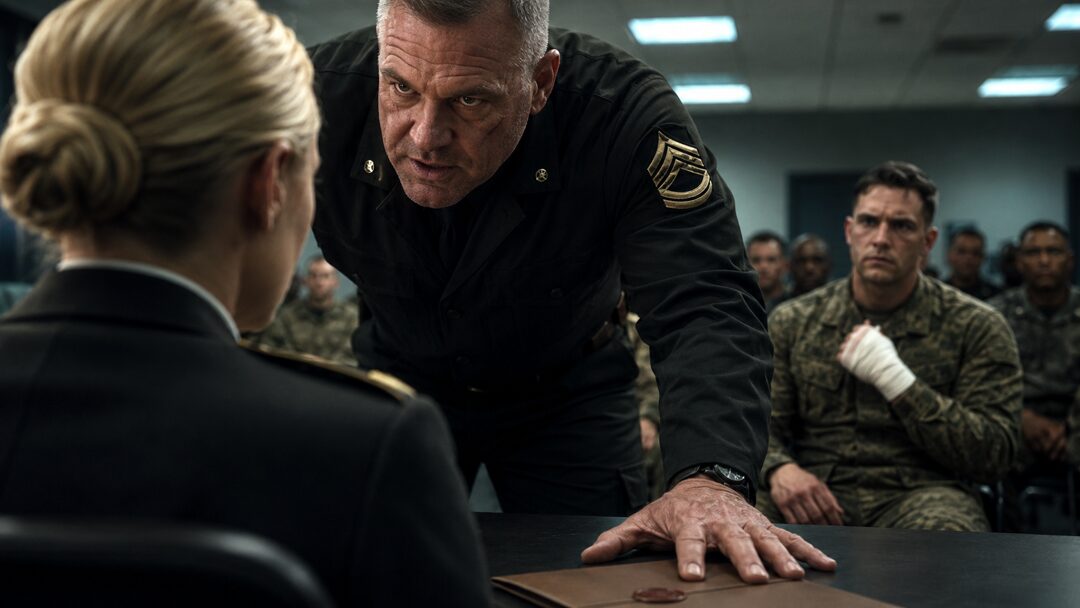
Master Sergeant Robert Hayes planted his hand on Captain Emily Carter’s desk like he owned the wood, the folder, and the silence between them.
“Sign the report,” he said.
He said it quietly enough that no one in the room could accuse him of shouting. That was one of Hayes’s gifts. He could make a whisper feel like an order barked from a tower.
Emily sat still.
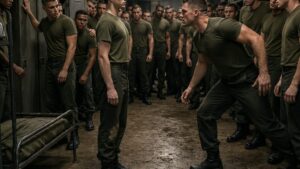
Behind him, twenty soldiers watched from metal chairs arranged in neat rows beneath fluorescent lights. No one coughed. No one shifted. Even the old wall clock seemed to understand it was not welcome to make noise.
The sealed folder sat in front of Emily, cream-colored and official, with a red classification stripe across the top. Her name was printed on the routing sheet. Her signature line waited at the bottom.
Hayes’s hand covered half of it.
Emily looked at his fingers first. Thick knuckles. Old scar across the back of the thumb. A wedding band that had worn a pale groove into his skin. Then she looked past him.
Sergeant Daniel Price sat in the second row, trying not to be seen.
His left hand was wrapped in clean white gauze. His right leg was stretched slightly forward because bending it too long made his jaw tighten. He had come back from Operation Night Glass with a limp, a bandaged hand, and the expression of a man who had learned exactly how much space a person could take up while still trying to disappear.
Emily met his eyes for half a second.
Daniel looked down.
Hayes leaned closer. The scar along his cheek pulled when his mouth moved.
“This unit has been patient with you, Captain.”
Emily did not blink.
“Master Sergeant,” she said, “remove your hand.”
The room breathed in and held it.
Hayes smiled a little, not because anything was funny, but because he had decided the room needed to see what disrespect looked like before he corrected it.
“You hear that?” he said, turning slightly toward the soldiers. “Captain Carter wants courtesy.”
No one laughed.
Hayes straightened just enough to address the room.
“Some people get to watch operations from climate-controlled rooms,” he said. “Some people get to pause feeds. Rewind timestamps. Write notes after the road is quiet.” His eyes cut back to Emily. “And some people bleed before sunrise.”
Daniel’s bandaged hand curled once against his knee.
Emily felt the old room around her: old coffee in a plastic pot, dust on the vents, marker ink from the map board, the faint rubber smell of boots drying under chairs. The room was built for instruction. For discipline. For rows and ranks and corrected behavior.
It was also built for making one person feel very small.
Hayes tapped the folder.
“Closure matters,” he said.
Emily looked at the folder. She had read the report six times. Each version was cleaner than the last. By the final draft, the operation had become almost merciful in its simplicity.
Bad weather.
Interrupted communication.
Hostile deception.
Unavoidable loss.
A sentence could hide a whole road if it was written neatly enough.
“The report is incomplete,” Emily said.
Hayes’s face did not change, but something in him tightened.
“Incomplete,” he repeated.
“Yes.”
“Then complete it. Sign it. Let the people who were actually out there move on.”
That landed exactly where he wanted it to.
A few soldiers shifted. Not much. Just enough.
Emily heard what they were not saying. You were not out there. You were behind glass. You had coffee. You had screens. You had a chair.
She had heard versions of it for nine days.
She had heard it in hallways when conversations stopped as she approached. She had heard it in the careful way officers avoided using the word “mistake.” She had heard it in the silence from Daniel Price, who owed his life to a dead man Emily might have to stain.
Hayes slid the folder two inches closer.
“Sign.”
Emily kept her hands in her lap. Two fingers on her right hand were still marked with black ink from the pen that had leaked in her pocket that morning.
She thought, absurdly, of scrubbing them raw in the restroom before the debrief.
As if clean fingers made a cleaner record.
“No,” she said.
This time, the room heard it.
Part II — The Missing Line
Hayes did not move for three full seconds.
Then he smiled again, wider.
“Captain Carter has concerns,” he said to the room. “Let’s respect that.”
Emily knew that tone. It was what men like Hayes used when they wanted everyone to feel invited to the humiliation.
He walked to the front of the room, slow and heavy, as if he were returning to a lesson plan. Behind him, a map of the border sector still showed the convoy route in faded blue marker. Someone had wiped it poorly. A ghost of the line remained.
Operation Night Glass had been drawn there as a path.
The report described it as a failure.
Emily remembered it as a feed.
Green-black images on a monitor. Heat signatures moving through switchbacks. A convoy crawling along a mountain road under a moonless sky. Static blurring the edges. Her headset pressing a headache behind her left eye.
At 0214, she had seen the first wrong thing.
Three heat blooms on the ridge where there should have been none.
At 0216, another.
At 0217, she sent the warning.
Route compromised. Hold convoy. Confirm alternate passage.
Major William Grant had acknowledged receipt at 0219.
At 0226, the convoy kept moving.
Emily forced herself back into the room before the memory could open further.
Hayes stood beside the map.
“For those who weren’t part of the review,” he said, “the after-action report identifies three contributing factors: weather degradation, signal disruption, and hostile misdirection. That is what happened.”
Emily opened the folder.
Paper whispered louder than it should have.
Hayes watched her fingers.
“If Captain Carter has a professional correction,” he said, “she can make it.”
Emily found the casualty summary. The names sat in a column, black ink on white paper, too orderly for what they represented.
Hayes pointed at the page.
“Read it,” he said.
She looked up.
“You want accuracy. Read the line.”
Daniel’s head lowered further.
The room changed again. It was not just pressure now. It was a dare. Hayes was inviting her to turn the dead into punctuation marks.
Emily looked at the names.
She knew them from the report. Some from personnel files. Some from voice fragments on open comms. One from a laugh caught accidentally over a channel before everything went bad.
She did not read them aloud.
“The report omits the warning sent at 0217,” she said.
Hayes cut in so fast that two soldiers turned toward him.
“There was no actionable warning.”
The speed of it betrayed him.
Emily let the silence stretch around that.
Hayes recovered.
“There was chatter,” he said. “There is always chatter. There were multiple feeds, conflicting reports, degraded visibility—”
“Route compromised,” Emily said. “Hold convoy. Confirm alternate passage.”
She had not meant to quote it.
The sentence came out of her mouth exactly as she had typed it, each word a small, locked door opening.
Hayes stepped away from the map.
“Careful.”
It was the first honest thing he had said.
Emily looked at Daniel again.
He stared at the floor like it might forgive him.
Hayes moved closer to the soldiers, no longer speaking only to her.
“This is what happens after a hard operation,” he said. “People go hunting for one perfect point where pain could have been prevented. One line. One time. One person. It feels better than accepting that sometimes the field does not care how clean your screen looks.”
A few soldiers nodded without meaning to.
Hayes had earned their trust long before this room. He had trained half of them. He had corrected their posture, punished their sloppiness, kept them alive through drills that felt cruel until they worked. He knew where to put his voice so it sounded like experience instead of fear.
Emily knew that too.
That was why it worked.
She had been awake when the convoy turned.
She had watched the thermal feed flicker. She had watched the mountain road fold into itself like a secret.
At 0223, she had called for confirmation.
At 0224, Major Grant had answered, calm as ever.
“Logged, Carter. Stand by.”
His voice had been steady. That was what everyone remembered about Grant. The steady voice. The clean uniform. The wedding ring he turned with his thumb when he was thinking. The way men trusted him because he looked like a man who would never hurry and never hide.
At 0226, the convoy entered the pass.
At 0231, the feed went white.
Emily closed the folder.
Hayes noticed.
“You have something else to say?”
Emily looked at his hand, now hanging loose at his side. She thought of it on the desk. Covering the signature line. Claiming the decision before she had made it.
“Yes,” she said.
Hayes waited.
Emily’s throat tightened once, but her voice stayed level.
“The report says the route compromise was not identified prior to movement through the pass. That is false.”
The word false moved through the room like a dropped tray.
Hayes’s eyes hardened.
“Captain,” he said, “you are crossing from correction into accusation.”
Emily looked at the red stripe on the folder.
“Then maybe the line was crossed before I got here.”
Part III — The Two Words
The first sound came from the second row.
Not loud.
Barely more than breath.
“She sent it.”
Every head turned toward Daniel Price.
He looked almost surprised to find the words had come from him.
Hayes turned slowly.
“What did you say, Sergeant?”
Daniel swallowed. His bandaged hand pressed flat against his thigh.
He looked at Emily once, then away.
“She sent it,” he repeated, softer this time.
The room became smaller.
Emily felt something painful loosen in her chest. Not relief. Relief would have been too clean. It was more like hearing a door open in a building you thought had burned down.
Hayes walked toward Daniel.
Not fast.
Fast would have looked angry. Hayes was too practiced for that.
“You were in the second vehicle,” Hayes said. “Correct?”
Daniel nodded.
“After the signal disruption?”
“Yes.”
“After visibility dropped?”
“Yes.”
“After you sustained injuries?”
Daniel’s jaw tightened.
“Yes.”
Hayes leaned slightly toward him.
“So you are telling this room that your memory, under those conditions, is clearer than the official review?”
Daniel’s mouth opened.
Nothing came out.
Emily almost stood then.
Not because she was ready. Because Daniel looked suddenly young, and because the room had become a place where truth needed protection before it could speak.
But Daniel shook his head once.
Not no.
Not exactly.
More like he was trying to shake loose a sound caught behind his teeth.
“I heard Grant say it,” Daniel said. “Before we moved into the pass.”
Hayes’s expression flickered.
That was the second crack.
Emily saw it. So did others. Not all of them, but enough.
“What exactly did you hear?” Hayes asked.
Daniel looked at the map. At the ghost line. At the place where blue marker faded into erased road.
“He said Carter flagged ridge heat,” Daniel said. “He said it might be old movement. Might be animals. Might be scatter from the slope.” His voice thinned. “Then he said we couldn’t hold the road without exposing the second vehicle.”
Emily remembered Grant’s voice through the headset.
“Convoy maintains movement. We reassess after the bend.”
She had wanted to say, No, you reassess before the bend.
She had said, “Major, recommend hold.”
He had answered, “Logged.”
That word had followed her for nine days.
Logged.
As if a warning became harmless once it entered a record no one read.
Hayes looked at Daniel for a long moment.
Then he said, very quietly, “Major Grant pulled you out.”
Daniel went pale.
Emily felt the blow of it even though it was not aimed at her.
Hayes turned, spreading the weight of Grant’s name across the room.
“Major Grant left cover to retrieve wounded personnel,” he said. “Major Grant did not come home because he went back for men who could not move. Including Sergeant Price.”
No one moved.
Daniel’s eyes were wet now, but he did not wipe them.
Hayes had found the real pressure point. Not career. Not rank. Gratitude.
Emily saw Daniel back in the feed, though she had never seen his face clearly then. She had seen only a heat signature separated from the second vehicle. One body on the road. One figure moving toward him. Another flash. Then static, white and roaring.
Grant had gone back.
Grant had saved him.
Grant had been wrong before he was brave.
That was the part no one wanted room for.
Hayes faced Emily again.
“There are men who made decisions in seconds,” he said. “There are men who paid for them with everything. Be very careful before you sit there and polish your version of courage.”
Emily’s hands tightened in her lap.
There it was.
The thing she had feared most, said out loud.
That the truth would make her look clean and Grant look small.
That a dead man’s last act would be dragged backward through his worst one.
That his widow, who had stood beneath a folded flag with her spine straight and her face emptied of color, would one day hear that her husband had received the warning and moved anyway.
Emily had watched her from the back of the memorial room.
She had not introduced herself.
What would she have said?
I am the one who sent the message he did not obey.
Daniel spoke again.
“Sergeant Major.”
Hayes did not correct the title, though everyone knew it was wrong. Daniel was unraveling.
“Enough,” Hayes said.
Daniel shook his head.
“He saved me,” Daniel said. “I know.”
His voice broke on know, and that was worse than if he had cried.
“But she sent it.”
This time, no one looked away quickly enough.
The room had heard him.
Hayes had too.
Part IV — The Folder Was Not the Only Copy
Hayes returned to the desk.
The folder waited between him and Emily.
He did not touch it at first.
“Captain Carter,” he said, “do you understand what happens when classified logs appear outside their authorized chain?”
Emily held his gaze.
There it was.
Not the defense of Grant.
Not the dignity of the dead.
The threat underneath.
Hayes lowered his voice, but the room was too quiet to protect him.
“You retained a copy.”
Emily said nothing.
His eyes sharpened. He had expected denial. Maybe outrage. Maybe fear he could use.
“You think discipline is optional because your conscience is loud?” he said. “You think a private file makes you righteous?”
Emily felt the first real flinch move through her body.
Small.
A tightening in the shoulders. A breath too shallow.
Hayes saw it.
So did the room.
His hand came down on the folder again.
“There she is,” he said. “There’s the officer behind the performance.”
Emily heard a chair creak. Daniel, maybe. Or someone else.
Hayes leaned in.
“If this continues, the question will not be whether a warning was sent. The question will be why a commissioned officer removed restricted material from protected channels and sat on it for nine days.”
Emily looked at the folder.
For one second, the room tilted backward into the night she had made the copy.
Not stolen. Preserved.
There was a difference, though she knew a board might not care.
She had sat alone at 0412, after the feed ended, after the casualty updates began in broken fragments, after Grant’s channel went silent. The official system had archived the exchange. Then a revised summary appeared without the warning language.
Not removed. Softened.
Potential ridge activity.
No immediate route impact confirmed.
She had stared at the change until her eyes burned.
Then she exported the timestamp trail, attached the evacuation log, and wrote one sentence she deleted three times before sending it through the protected complaint portal.
Operational record discrepancy involving 0217 warning and subsequent movement order.
Her finger had hovered over submit.
She had thought of Grant’s wife.
She had thought of Daniel lying somewhere under white lights.
She had thought of the convoy entering the pass after she had said hold.
Then she pressed send.
Now Hayes thought he had found the place to break her.
He stepped closer.
“You can still correct this,” he said. “Sign the report. File your concern through proper channels. Do not turn a hard day into a public accusation because you need to feel clean.”
Emily looked up.
That line almost did it.
Not because it was true.
Because part of her feared it might be.
She did want to feel clean. Who would not? She wanted one piece of the night to belong to her and not to the road, the feed, the voices, the white screen. She wanted the sentence she had sent at 0217 to matter enough to absolve her.
But truth was not absolution.
Truth was only a weight placed where it belonged.
Emily looked at Daniel.
He was watching her now.
Not begging.
Not asking her to stop.
Just watching like a man who had finally admitted he could not carry the room alone.
Emily turned back to Hayes.
“The copy is not private,” she said.
Hayes went still.
Emily continued, her voice steady enough to frighten her.
“It was submitted twelve hours ago to the Inspector General’s office, with the 0217 warning log, the command acknowledgment, and Sergeant Price’s evacuation timestamp attached.”
The room did not explode.
It emptied.
Every face seemed to lose its first expression and wait for the next.
Hayes’s hand remained on the folder.
Only now it looked different.
Not ownership.
Evidence.
Emily saw the moment he understood.
The folder was never the last copy. The signature line was not the only doorway. The room he had used to corner her had become the room where he had tried, in front of witnesses, to stop a corrected record.
Hayes withdrew his hand slowly.
“Do you understand what you have done?” he asked.
Emily thought of Grant’s steady voice.
Logged.
“Yes,” she said.
Hayes’s eyes moved across the soldiers, searching for the room he had controlled ten minutes earlier.
It was not there.
No one had stood. No one had challenged him. No one had declared allegiance.
But they were looking at him differently now.
Sometimes a room does not need to revolt.
Sometimes it only needs to stop helping.
Part V — When She Stood
Hayes came back to the desk one last time.
He moved carefully now, but that made him more dangerous, not less. Anger had left him. Calculation remained.
He placed his hand beside the folder again.
Not on it.
Beside it.
A small adjustment. A man trying to make a threat look like restraint.
Emily remained seated.
“Soldiers die,” Hayes said, “when officers confuse conscience with command.”
The sentence landed hard because it was almost wise. Hayes had built a career out of almost wise sentences. That was how he made pressure sound like protection.
Emily did not answer.
Daniel shifted in the second row.
His chair scraped the floor.
Emily turned her head just enough and gave him the smallest shake.
Not yet.
Not for her.
He froze halfway forward, then sank back down, ashamed and grateful at once.
Hayes noticed the exchange.
“You see?” he said softly. “Even now, you want witnesses more than truth.”
Emily looked at him.
“No,” she said. “I want the truth to stop needing permission.”
For the first time, Hayes had no immediate answer.
Emily stood.
The sound was small: chair legs against tile, fabric moving, one breath catching somewhere in the room.
But the room changed.
Hayes no longer loomed over her. He was still larger, broader, heavier. His presence still filled space by habit. But the angle was gone. The old picture had broken.
He was not a mountain over a desk anymore.
He was a man standing too close.
Emily picked up the folder.
Her ink-stained fingers were visible against the cream paper.
“I will sign the corrected report,” she said. “It will include the 0217 warning. It will include the route compromise. It will include the command acknowledgment. It will include the movement order that followed.”
Hayes’s jaw worked once.
“And the names?” he said. “You want names in your clean little record?”
Emily swallowed.
There it was again.
Grant.
The dead did not defend themselves. The living did that for them, sometimes badly.
Emily thought of Major William Grant turning his wedding ring with his thumb while comms failed around him. Thought of his voice saying, Logged. Thought of him leaving cover anyway. Thought of Daniel alive because Grant had crossed a road he did not come back from.
Her answer was not loud.
“It will include what happened.”
Hayes leaned closer, but now closeness no longer gave him height.
“I can file formal charges.”
“You can,” Emily said. “After the Inspector General finishes reading the same log.”
The room held.
Then Daniel stood.
It took effort. His left leg resisted the motion, and for a second he gripped the chair in front of him. The white bandage around his hand flashed under the lights.
He did not say anything.
He did not need to.
A soldier in the back row stood next. Young, pale, eyes fixed on the floor.
Then another remained seated but lifted his head.
Then another looked away from Hayes and toward Emily.
No one called it courage. No one made it clean. It was smaller than that and harder to dismiss.
The room had stopped being an audience.
It had become a witness.
Hayes looked at Daniel.
For a moment, Emily saw something in his face that was not anger.
Fear, maybe.
Not fear of punishment. Fear of the record becoming large enough to hold what he had spent nine days making small.
Then it passed.
He stepped back.
“Dismissed,” he said.
No one moved.
The word had no force left in it.
Hayes turned toward the door, and only when he reached it did the rows begin to break. Chairs scraped. Boots shifted. Men left carefully, as if noise might bring the old room back.
Daniel stayed.
Emily stayed.
The folder remained in her hand.
Hayes paused in the doorway without turning around.
“You think this gives them peace?” he said.
Emily looked at Daniel.
Daniel looked at the map.
“No,” Emily said. “But neither did the lie.”
Hayes left.
The door closed softly behind him.
That softness hurt more than a slam would have.
Part VI — What Remained on the Table
Three days later, Master Sergeant Hayes’s name was removed from the training schedule.
No announcement came with it.
No apology appeared in anyone’s inbox. No one gathered the unit to say the room had been used badly. His chair at the front simply stayed empty, and a younger instructor began reading from slides with the nervous care of a man stepping over thin ice.
Emily was temporarily removed from the rotation pending review.
That announcement did come in writing.
She folded the notice once and put it in her pocket.
The report did not become public. Of course it did not. The world outside Fort Keller did not learn the shape of the road, the time of the warning, or the way a sentence had been softened until it almost disappeared.
But the casualty record changed.
One line.
Identified pre-movement route compromise not included in initial summary.
It was not enough.
It was more than nothing.
Major William Grant remained honored for recovering wounded personnel under impossible conditions. His name stayed where his family could bear to see it. But the operation was no longer described as unavoidable.
That word disappeared.
Emily noticed.
She did not celebrate.
On Friday evening, after most of the building had emptied and the hallway lights had switched to their dim after-hours setting, Emily returned to the training room for her notebook.
She had left it in the drawer of the front desk. On purpose, maybe. Or maybe some part of her needed to see the room when it was no longer full of watching faces.
The door was already open.
Daniel Price stood between the second and third row, one hand on the back of a chair, his cane leaning against the wall.
He was practicing without it.
Step.
Pause.
Breath.
Step.
His limp was still there. Less dramatic than the bandage made people expect. More stubborn.
Emily stopped in the doorway.
Daniel looked over, embarrassed.
“Sorry,” he said. “Didn’t think anyone would come back here.”
“Neither did I.”
He almost smiled.
The room without soldiers looked smaller. The map had been wiped clean. The coffee pot was gone. The fluorescent lights still made everyone look more tired than they were.
Emily walked to the front desk and opened the drawer.
Her notebook was there, black cover, corners bent.
Daniel watched her take it.
Then he said, “Thank you.”
Emily closed the drawer.
The words should have been simple.
They were not.
She turned to him.
“You still got left out there.”
Daniel’s face changed.
Not with offense. With recognition.
He looked down at his leg, then at the empty chair where Hayes had stood near him.
“Not all the way,” he said.
The sentence stayed between them.
Emily nodded once.
There were things neither of them would say.
He would not say he had heard Grant’s voice in his sleep.
She would not say she had replayed the feed so many times that the mountain road sometimes appeared when she closed her eyes.
He would not say he was afraid gratitude made him dishonest.
She would not say she was afraid truth made her cruel.
Daniel picked up his cane but did not lean on it right away.
“Do you think his wife will know?” he asked.
Emily knew who he meant.
She looked at the empty map board.
“Maybe not all of it.”
Daniel nodded slowly.
“Maybe that’s mercy.”
Emily thought about that.
Then she thought about the word unavoidable being removed from the record.
“Maybe,” she said. “Maybe mercy still has to leave room for truth.”
Daniel accepted that without agreeing. That was the best either of them could do.
He walked to the door slowly. At the threshold, he paused.
“You standing up,” he said. “That helped.”
Emily looked at the desk.
“I should have done it sooner.”
Daniel shook his head.
“No,” he said. “You did it when the room could see why.”
Then he left.
Emily stood alone in the training room.
For a while, she did not move.
The desk waited under the fluorescent lights. Same scratches. Same dull metal legs. Same surface where Hayes had planted his hand as if pressure could become fact.
Emily took the corrected report from her bag.
It was thinner than it should have been. Still careful. Still official. Still written in the language of people trying not to feel the full weight of what words carried.
But the line was there.
She placed the report on the desk.
No hand covered it.
No voice told her who she had to be to belong in the room.
Emily uncapped her pen.
Her fingers still held the faintest shadow of ink near the nail beds. She had washed them many times. Some marks stayed longer than you thought they would.
She signed her name.
Not fast.
Not dramatically.
Just clearly.
Then Captain Emily Carter closed the folder, picked up her notebook, and walked out of the room standing upright.