The Name at the Table
Part I — The Tray
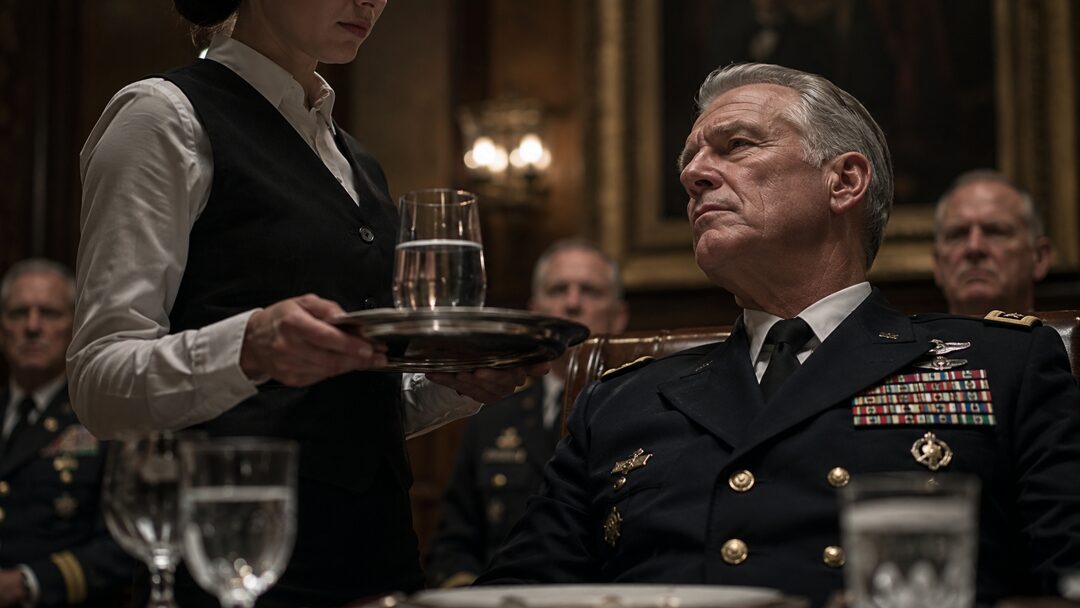
Emily Walker was halfway around the officers’ dining room with a tray of water glasses when she saw the medal on General Robert Hale’s chest and forgot how to breathe.
Only for half a second.
That was all she allowed herself.
The tray stayed level. The glasses did not rattle. Her black vest lay smooth over her white shirt, her tie straight, her hair pinned tight enough to make her scalp ache. No one in the room was supposed to notice the server.
Servers moved around important men the way curtains moved around windows.
Quietly.
Usefully.
Without becoming part of the view.
General Hale stood at the head of the long table beneath a row of framed commanders whose oil-painted eyes followed every meal in that room. His hair was silver, his posture straight, his voice warm from years of being obeyed.
“Before we begin,” he said, raising his glass, “I want to thank all of you for coming tonight.”
Twenty-two officers sat around the table in dress uniforms. Their medals caught the chandelier light. Their name cards were engraved. Their water glasses were full because Emily had filled them.
Hale’s was empty.
She stepped toward him.
The medal was not the largest one on his chest, but it was the one her eyes found. A dark ribbon. A narrow shine. A little piece of metal carrying a story it had never been forced to tell properly.
Emily’s fingers tightened under the tray.
For three years, she had imagined seeing it in a photograph, in a display case, maybe on television if she was unlucky.
She had not imagined standing close enough to see a fingerprint smudge on its edge.
“Miss?”
Hale’s voice reached her gently, which somehow made it worse.
Emily blinked. His glass waited near his right hand. The whole table waited with it.
“Yes, sir.”
She poured.
The water arced cleanly from the pitcher. She watched the level rise. She did not watch his face.
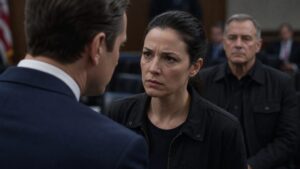
Across the room, Captain Daniel Pierce noticed.
He was not as old as most of the men at the table. Mid-thirties, maybe. Trim, tired-eyed, with fewer ribbons and a mouth that seemed used to stopping words before they escaped. He looked at Emily, then at Hale’s medal, then back at Emily.
She felt his attention like a second hand reaching toward the thing beneath her vest.
The ring.
Michael’s ring.
It hung from a chain against her chest, hidden under cotton and buttons and the rules of the evening.
No jewelry except studs. No personal conversations. No lingering. No reacting.
Especially no reacting.
“Careful,” Hale said suddenly.
Emily realized the pitcher had tipped a breath too far. A drop ran down the outside of his glass and touched the white tablecloth.
It was nothing.
A single drop.
But every face nearby turned.
Hale smiled, and the room relaxed because powerful men could decide whether a mistake was harmless.
“Careful, miss,” he said, louder now, his voice carrying down the table. “Those medals are heavier than that tray.”
A few men chuckled.
Emily kept her hand steady.
Hale’s smile sharpened by a degree.
“They belong to people who know what service costs.”
The room gave another small laugh, not loud enough to be cruel, not soft enough to be innocent. The kind of laugh men gave when rank had already told them what was funny.
Emily lowered the pitcher.
Something in her chest went very still.
Daniel Pierce’s eyes moved to Hale. “Sir,” he said quietly, “let’s not.”
It was almost nothing. A small interruption. A hand placed near a closing door.
Hale heard it anyway.
His smile remained, but the warmth left his face.
“Captain Pierce,” he said, “I spent forty years learning when to let something go.”
The room stilled.
“And when not to.”
Emily could have left then. She should have. She could have bowed her head, carried the tray back through the service door, stood in the hallway until her hands stopped shaking, and told the banquet manager she was sick.
Sarah had told her not to come.
That afternoon, in Emily’s apartment, Sarah had stood by the sink with her arms crossed, watching Emily knot the black tie.
“You don’t have to do this,” Sarah had said.
“It’s a shift.”
“It’s his dinner.”
Emily had looked at her through the mirror. Michael’s sister had his same eyes when she was angry: steady, wounded, impossible to lie to.
“I need the money,” Emily said.
“No, you don’t. Not this badly.”
Emily had tucked Michael’s ring beneath her shirt.
Sarah’s voice softened. “Em, if you go there hoping someone says his name, you’ll come home with nothing.”
Emily had answered before she could stop herself.
“His own words have already been buried once.”
Now, standing beside Hale’s chair, she heard Sarah’s warning return like a hand on her shoulder.
Come home with nothing.
Hale leaned back slightly.
“Unless,” he said, still looking at Emily, “you have something to add.”
The room waited.
Emily’s throat tightened. She could feel every glass on the tray, every fragile circle balanced above her palm.
“No, sir,” she said.
Her voice was quiet.
The men looked away first.
That was the first time that evening Emily understood the room did not need to hate her to erase her.
It only needed her to keep serving.
Part II — The Version They Liked
The dinner resumed as if nothing had happened.
That was the worst part.
Forks lifted. Glasses chimed. The first course went out beneath silver lids. The banquet manager gave Emily one hard look near the service door, a silent warning to disappear better.
Emily did.
She moved behind chairs. She refilled water. She replaced fallen napkins. She nodded when addressed and became furniture when ignored.
But the room had changed.
Or maybe it had finally become honest.
Every laugh landed differently now. Every toast carried weight it had not earned. Every time someone said General Hale’s name with affection, Emily felt the ring beneath her vest press colder against her skin.
At the head table, an older colonel stood to speak.
“Robert Hale,” he said, raising his glass, “is the rare kind of leader who brings people home.”
Murmurs of approval rolled through the room.
Emily stopped behind an empty chair.
Brings people home.
The phrase was printed in the program too. She had seen it when she collected one from a side table before the guests arrived.
GENERAL ROBERT HALE
A LIFETIME OF SERVICE
HONORING THE COMMAND THAT BROUGHT THEM HOME
Inside, there was a paragraph about the campaign in the Kestrel Valley. It mentioned difficult weather, compromised communications, and a civilian evacuation. It mentioned Hale’s “decisive leadership under pressure.”
It did not mention Michael.
Not once.
Emily had read the program twice, standing beside the linen cart, because sometimes disbelief required repetition.
Now the colonel continued.
“There are men who give orders from safety. Robert was never one of them. He knew the terrain. He knew the cost. And during the Kestrel extraction, when confusion could have swallowed the entire valley, he held the line.”
Held the line.
Emily looked down at the tray in her hands.
Michael had written that phrase in his last letter.
Not proudly.
Not cleanly.
The line is a strange thing, Em. Everyone talks about holding it. Nobody tells you what to do when the line is drawn through people.
She had not understood it then.
Three days later, two officers arrived at her door.
Their uniforms were pressed. Their faces were careful. One of them mispronounced her name.
Mrs. Walker.
After that, everything came in containers. A folded flag. A sealed envelope. Boots she could not bring herself to touch. A packet of belongings. A letter with a corner bent where Michael must have folded it fast.
She had read it until the paper softened.
Then she had hidden it in a shoebox because grief became less frightening when it had edges.
“Excuse me.”
Emily turned.
Daniel Pierce stood near the side table, his glass still half full.
“You okay?” he asked quietly.
She gave the answer staff gave when patrons made kindness complicated.
“Yes, sir.”
His eyes flicked toward her collar. She realized her hand had risen without permission. Her fingers were touching the chain beneath the vest.
She dropped it.
Pierce noticed that too.
“I’m sorry about earlier,” he said.
“It wasn’t your remark.”
“No,” he said. “But I laughed too late to stop it.”
Emily looked at him then.
That was not an apology most men in rooms like this made. It was too specific. Too close to guilt.
Before she could answer, Hale’s voice filled the room again.
“Daniel,” the general called. “Don’t hide near the coffee. Come suffer with the rest of us.”
The table chuckled.
Pierce straightened. Something passed over his face—obedience, irritation, habit.
“Yes, sir.”
He returned to his seat.
Emily carried empty plates back through the swinging door.
In the service hall, the noise dulled. The air smelled of coffee, lemon polish, and hot metal from the kitchen trays. She set down the plates and pressed both palms against the stainless-steel counter.
“Five minutes,” the banquet manager snapped from behind her. “Then dessert service.”
Emily nodded.
She did not take five minutes.
She took twelve seconds.
Enough to close her eyes.
Enough to see Michael sitting on their apartment floor, lacing his boots, looking up at her with that half-smile he used when he was trying not to make a promise too large for the room.
I’ll come back if I can.
She had hated him for adding the last four words.
Later, she loved him for not lying.
The kitchen door swung open.
“Emily,” the manager said. “You’re up.”
Emily picked up a clean tray.
Dessert plates this time. Porcelain. Small forks. Coffee cups.
When she stepped back into the dining room, Hale was standing again.
The formal toast had reached the part everyone had come for.
A younger lieutenant had asked him to tell the Kestrel story.
Of course he had.
Men loved asking heroes to narrate themselves.
Hale placed one hand on the back of his chair. His medal caught the light again.
Emily walked toward the table.
She told herself not to stop.
Part III — The First Name
“The truth is,” Hale began, “the Kestrel extraction has grown in the telling.”
The room smiled.
Emily set a dessert plate before a major.
“Some of you have heard versions where I personally carried six people across a ridge in a storm while calling artillery with my teeth.”
Laughter, warmer this time.
Hale smiled with them.
“The real story was messier. Bad weather. Bad roads. Radios cutting in and out. A civilian convoy trapped below Ridge 17. Units stretched thin. Nobody seeing the whole board.”
Emily’s hand paused above a coffee cup.
Ridge 17.
The number entered the room like a door opening.
Daniel Pierce looked up.
Hale continued.
“What we did have was discipline. That was the difference. When communications fail, training remains. Orders remain. You hold your positions so the larger extraction can move.”
Emily felt the tray tilt.
One spoon slid half an inch.
She caught it with her thumb.
“Not everyone understood that,” Hale said.
The room was quieter now. Not tense exactly. Interested.
“There was one squad leader who failed to maintain position. He made a choice. A brave choice, some might say. A costly one, certainly.”
Emily’s breath stopped.
Not everyone understood that.
One squad leader.
Failed to maintain position.
Michael reduced to a cautionary clause.
The coffee cup on Emily’s tray trembled against its saucer. A small sound. Porcelain against porcelain.
Hale heard it.
So did everyone close enough to enjoy discomfort.
His eyes came to rest on her again.
“If the story upsets you,” he said, not unkindly, “you may step outside.”
Emily looked at him.
For a moment, the entire room narrowed to his face and the medal beneath it.
She could have stepped outside.
She could have let him finish.
She could have gone home to Sarah and said, You were right. They didn’t say his name.
Instead, she heard her own voice before she felt herself choose it.
“I’ve heard the story before.”
No one laughed.
The words were too quiet for laughter.
Hale’s expression barely changed, but one finger tapped once against the back of his chair.
“Have you?”
“Yes, sir.”
“And where did you hear it?”
Emily saw Daniel Pierce sit straighter.
She should have stopped. She knew that. There was still a narrow path out. She could say from the program. From the news. From people who talk too much.
But Hale had called Michael one squad leader.
Not even his rank. Not even his name.
Emily set the tray down on the edge of the table.
Every glass on it caught the chandelier light.
“My husband told me part of it.”
The room seemed to lose air.
Hale’s eyes sharpened.
A man near the middle of the table lowered his fork.
Daniel Pierce stared at Emily’s face, then at the chain just visible at her collar, and something like recognition passed through him.
Hale’s voice changed.
Not softer.
More careful.
“Your husband?”
“Sergeant Michael Walker.”
The name did what names do when they have been withheld too long.
It entered the room whole.
A chair creaked.
Somebody whispered, “Walker?”
Daniel Pierce stood.
Not abruptly. Not dramatically. But with enough intention that the movement pulled every eye to him.
“Sir,” he said, looking at Hale, “was Sergeant Walker the squad leader at Ridge 17?”
Hale did not answer immediately.
That silence answered first.
Emily looked at Pierce. He looked almost ashamed of the question, but he did not sit down.
Hale’s jaw tightened.
“Captain,” he said, “that operation remains partially sealed.”
“Respectfully, sir,” Pierce said, “you just described it to the room.”
The words landed cleanly.
Not loud.
Clean.
Hale’s face hardened, and for the first time all evening he looked less like a man being honored and more like a man defending ground.
“Mrs. Walker,” he said, turning back to Emily. “There are things families are not told because pieces of truth can become lies when removed from context.”
Emily nodded once.
“I know.”
That answer seemed to irritate him more than argument would have.
“You know?”
“I know orders matter. I know fear changes how men hear each other. I know my husband did not write me a clean story.”
Her voice almost broke on husband.
Almost.
She let the almost pass.
“He said the radio net was failing. He said the transport below the ridge was burning. He said the children inside were screaming loud enough to make every order sound far away.”
A murmur moved through the table and died quickly.
Hale’s hand closed around the chair back.
“The convoy was not his assignment.”
“No,” Emily said. “It was people.”
That line changed the room.
Not because it was clever.
Because no one could decide whether to punish it.
Hale’s eyes flashed. “You think command is that simple?”
“No.”
“Good. Because it is not. Your husband’s movement exposed the flank. It delayed extraction. It forced decisions that put other lives at risk.”
Emily felt those words strike places she had already bruised herself.
She had read the reports she was allowed to read. She had seen the redacted pages. She had imagined every version in which Michael’s choice saved strangers and endangered friends. Grief had never given her the luxury of a simple hero.
“I know,” she said again.
Hale blinked.
The room shifted.
Emily’s hands were empty now. She did not know what to do with them, so she folded them in front of her apron.
“I’m not here because I think command is easy,” she said. “I’m here because you made it sound clean.”
Hale’s face changed.
For one brief second, the public man left him.
Something older looked out.
Then he returned.
“The official record says what it can say.”
“The official record says less than it should.”
“You are speaking from loss.”
“Yes,” Emily said. “That does not make me wrong.”
Daniel Pierce lowered his eyes.
Hale looked at the officers around the table. Some looked back at him. Some looked at their plates. The room that had laughed for him now waited for him to decide what kind of silence they were allowed to keep.
That was when Emily understood his power.
It was not only that he gave orders.
It was that people let him decide which truths were inconvenient.
Part IV — The Line He Remembered
Hale stepped away from his chair.
He did not raise his voice. He did not need to.
“Mrs. Walker,” he said, “I am sorry for your loss. Truly. But grief can turn one act into the center of everything. The mission did not belong to one man.”
“No,” Emily said. “It belonged to everyone who paid for it.”
His eyes narrowed.
“A medal is not a history book.”
“No,” she said. “But tonight you let them read it like one.”
A few men shifted in their chairs.
Pierce was still standing.
Hale looked at him. “Captain, sit down.”
Pierce hesitated.
It was a small hesitation, but the room saw it.
Then he sat.
Emily did not blame him.
Standing once had cost him enough.
Hale turned back to her. “Your husband was brave. I never denied that.”
“You never said it.”
The words came out before she could polish them.
For the first time, Hale looked tired.
Not old. Not weak.
Tired in the way a locked door must feel after years of holding.
“You want me to say he was right,” he said.
Emily shook her head.
“No. I want you to say his name without making him a mistake.”
The room held still around that.
Somewhere near the service door, the banquet manager hovered pale and useless, trapped between employment rules and history.
Hale looked down at his glass. The water Emily had poured earlier sat clear and untouched.
“You believe I have carried nothing?” he asked.
Emily heard the danger in the question. Not anger. Injury.
She thought of Sarah in the apartment, saying, Do not go there hoping they give you something.
She thought of the shoebox under her bed.
The letter.
The line she had promised herself not to use unless she had to.
Maybe she had come here hoping Hale would make it unnecessary.
Maybe that had been the last foolish mercy in her.
“I believe,” Emily said, “that you carried what let you keep standing.”
Hale looked up sharply.
“And my husband’s name was not part of it.”
His mouth opened, but no answer came.
So she gave him the line.
“He wrote to me before the last movement. The letter came back with his things.”
Hale went very still.
Emily reached beneath her vest. Not for the letter. She had not brought it. She would not let the paper become an exhibit on a table between forks and dessert plates.
She touched the ring instead.
“He wrote, ‘If they call it disobedience, tell them I heard a child crying and knew the order had already failed.’”
The room disappeared from Hale’s face.
Not completely. A man like that did not fall apart in public.
But his eyes widened, and his mouth parted slightly, and Emily knew.
He knew the line.
Daniel Pierce knew it too. Not the words themselves, maybe, but the recognition. He saw Hale hear a voice from somewhere no ceremony could polish.
Hale’s hand found the back of his chair again.
Emily waited.
Nobody moved.
Even the servers by the wall had stopped pretending to work.
Hale swallowed once.
“He said that over the net,” he said.
His voice was so low the men nearest him leaned forward.
Emily’s throat tightened.
It was the first new piece of Michael anyone had given her in three years.
Not a report.
Not a summary.
A sound.
“He said that?” she asked.
Hale did not seem to hear her question as a question. He was somewhere else now, staring at the tablecloth as if the white linen had become a map.
“The transmission broke,” he said. “I heard only pieces.”
Emily’s hand closed around the ring through her shirt.
Pieces.
That was all anyone had left her too.
Hale’s eyes lifted to hers. For the first time that evening, he looked at Emily not as staff, not as disruption, not as a grieving civilian trespassing on a professional matter.
He looked at her as the person who had carried the other half of a sentence.
“Mrs. Walker,” he said, and this time her name held weight.
Emily stepped closer.
She did not know whether the movement was courage or exhaustion.
“You told me medals are heavier than trays,” she said.
No one breathed.
“Maybe they are.”
Her voice stayed level. That was the part that almost broke her.
“But I have carried his folded flag, his boots, his letters, and every version of your story that left him out.”
Hale’s face went pale beneath the chandelier light.
Emily saw the shock move through the officers. Not loud. Not theatrical. Just a dozen men realizing, too late, that they had been sitting comfortably inside a story someone else had been forced to hold from the outside.
She could have said more.
She could have opened every sealed place in herself and let the room drown in it.
Instead, she asked for the only thing she had come close enough to want.
“When you give your final toast,” she said, “say his name.”
Hale did not move.
“Say that Michael Walker saved eleven people below Ridge 17. Say the mission was not carried by one man’s command alone.”
Her eyes stayed on his.
“And say that sometimes obedience is not the same thing as courage.”
That line hurt him. She saw it.
But he did not look away.
For a long moment, the whole room waited on the choice of one man who had spent his life making choices for others.
Then Hale lowered his head.
Not a bow.
Not surrender.
Something smaller.
Something harder.
“Give me a moment,” he said.
Emily nodded.
Then she picked up the tray.
Only then did she realize one glass had never been filled.
Part V — The Name Spoken Aloud
Emily waited by the doorway because leaving too soon would look like retreat, and staying too close would turn her grief into a performance.
The banquet manager whispered her name once.
Emily ignored her.
At the table, no one ate dessert.
General Hale stood where he had stood at the beginning of the night. The same chair. The same portraits. The same medal on his chest.
But the room was not the same.
That was the strange thing about truth. It did not move furniture. It moved where people were allowed to look.
Hale lifted his glass. His hand was steady at first.
Then it was not.
The tremor was slight. Emily would have missed it if she had not spent three years noticing what men tried to hide.
“I had prepared remarks,” Hale said.
A few men gave polite smiles out of habit.
No one laughed.
Hale looked down the length of the table.
“I was going to speak about service. About command. About the privilege of leading men and women who gave more than their country could ever properly repay.”
He stopped.
The expected words were there. Emily could feel them lined up in him, polished and safe.
Then he stepped away from them.
“There is a name that should have been spoken earlier tonight.”
Emily’s hand found the ring.
Beside the table, Daniel Pierce lowered his eyes.
“Sergeant Michael Walker,” Hale said.
The name entered the room differently this time.
Not from Emily’s mouth.
From his.
“He was a squad leader during the Kestrel extraction. He made a choice below Ridge 17 that did not fit neatly into the orders given that day.”
Hale’s jaw tightened.
For one second, Emily feared he would retreat into language again.
Then he looked toward the doorway.
Not at the officers.
At her.
“His choice saved eleven civilians.”
Emily’s vision blurred so suddenly she had to blink hard to keep standing.
Hale continued, each word slower than the last.
“Command decisions have shadows. Some of them follow you longer than the citations. Longer than the applause. Longer than the explanations that make sleep possible.”
No one at the table moved.
“I will not pretend tonight that one man brought everyone home. That was never true.”
The glass in his hand trembled again.
“And I will not let Sergeant Walker’s name remain outside this room.”
Emily pressed the ring so hard through her shirt that the edge bit into her finger.
It was not enough.
Of course it was not enough.
Michael did not walk through the door. Sarah did not get her brother back. The empty side of Emily’s bed did not become warm. A name spoken three years late did not undo the years it had been withheld.
But something shifted.
Not healed.
Shifted.
A weight she had mistaken for her own moved slightly off her chest and entered the room where it belonged.
Hale raised his glass a little higher.
“To Sergeant Michael Walker,” he said.
The officers stood.
Not all at once. Not perfectly. Chairs scraped. One man wiped at his mouth before rising. Daniel Pierce was first, and that mattered to Emily more than it should have.
“To Sergeant Walker,” Pierce said.
The others repeated it.
Softly at first.
Then with more force.
Emily did not wait for applause.
She turned before the room could decide what to do with her. Before someone could thank her. Before someone could apologize badly. Before her grief became part of the evening’s story in a way someone else would retell over coffee.
In the corridor, the air was cooler.
The service door swung shut behind her, cutting off the sound of chairs and voices.
She stood alone beside the linen cart and let her hand fall from the ring.
For the first time all night, her tray was gone.
She looked down and realized she had left it in the dining room.
For a moment she almost went back.
Then the door opened behind her.
Daniel Pierce stepped out carrying the tray in both hands, as if it were something breakable.
One glass stood on it, still full.
Untouched.
He stopped a few feet away.
“I thought you might want this,” he said.
Emily looked at the tray.
Then at him.
“No,” she said softly. “I’m done carrying it.”
Pierce absorbed that. His face tightened, not with offense, but with understanding arriving late.
He nodded.
“I’m sorry,” he said.
This time she believed he knew the size of what he was apologizing for was larger than himself.
Emily gave him nothing easy in return. Not forgiveness. Not comfort. Not a smile he could carry back into the room and call peace.
But she did answer.
“Say his name when they forget again.”
Pierce held her gaze.
“I will.”
The promise was small.
It was not enough either.
But small promises were the only kind Emily trusted now.
She left through the side corridor, past stacked chairs and folded tablecloths, past the framed photographs of ceremonies that had ended before she was born. Outside, the night air touched her face like water.
Sarah was waiting in a parked car near the curb.
Of course she was.
Emily stopped when she saw her.
Sarah got out immediately. She did not ask whether Emily was okay. That was why Emily loved her.
Instead, Sarah looked at her face and said, “Did they say it?”
Emily tried to answer.
The first attempt failed.
She nodded.
Sarah covered her mouth with one hand. Her eyes filled, but she did not step forward until Emily did.
Then they held each other beside the curb, under the soft yellow security lights, while inside the building men in formal jackets finished a ceremony that had changed only because one woman refused to keep pouring water over a missing name.
Later, Captain Pierce would return the tray to the kitchen.
He would stand there longer than necessary, looking at the one glass still full.
Later, General Hale would remove the medal in his hotel room and set it on the dresser instead of back in its case.
Later, Sarah would drive Emily home without turning on the radio.
But for that moment, Emily stood in the night with Michael’s ring beneath her fingers and his name still alive in the air behind her.
She had not brought him back.
She had not made the story clean.
She had only opened the door wide enough for the truth to sit at the table.
And for tonight, that was all she could carry.