The Door She Kept Open
Part I — The Papers on the Porch
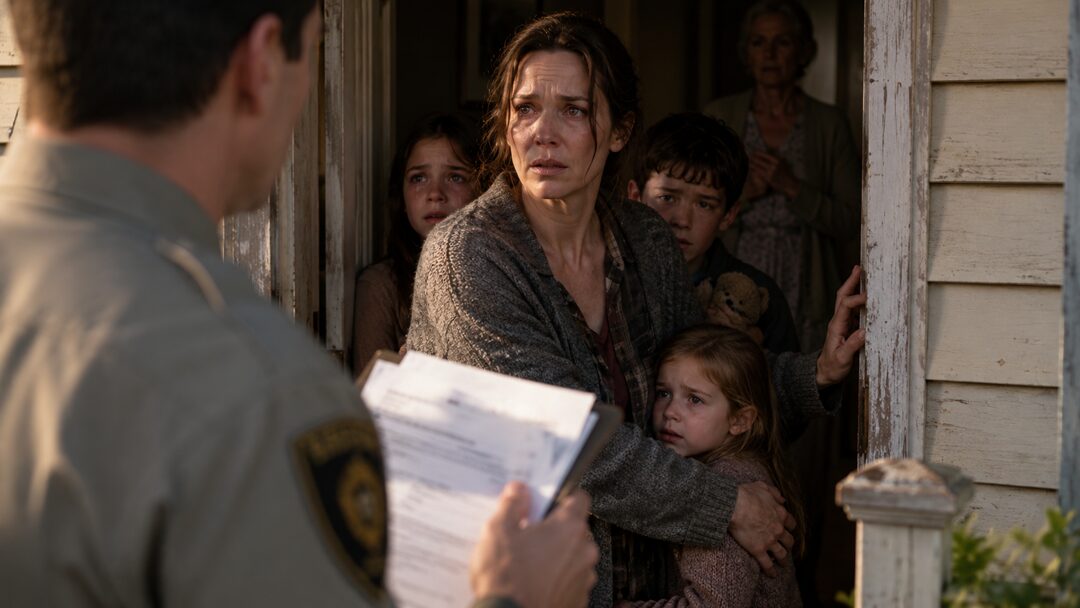
The deputy stood on Sarah Miller’s porch with a folded order in his hand, and her three children were already crying before he finished saying her name.
“Mrs. Miller,” he said, keeping his voice low, like softness could change what the paper meant. “I need you to step aside.”
Sarah did not move.
Her youngest, Ashley, had both fists twisted into the hem of Sarah’s cardigan. Her son, Matthew, stood half behind her leg, breathing in short, panicked bursts. Emily, the oldest, was trying not to cry and failing at it in a way that made her look older and smaller at the same time.
Behind Sarah, in the dim hallway, Linda Carter held one hand over her mouth.
Sarah gripped the doorframe so hard her knuckles had gone pale. She had worked a closing shift the night before and opened at six that morning. Her hair was pinned with a clip that had given up hours ago. Her shoes were still wet from rinsing juice off the diner floor.
But she stood like the whole house depended on the width of her shoulders.
Because it did.
Deputy Thomas Reed looked past her once, then stopped himself. He was a broad man in a clean brown uniform, with tired eyes and a clipboard pressed against his chest. Another officer stood two steps behind him, younger, silent, pretending not to see the neighbors gathering at the edges of their lawns.
Thomas cleared his throat.
“I’m sorry,” he said. “But if you don’t let us in, I’ll have to call child services to the scene.”
Ashley began to wail.
Sarah pulled her closer without looking down.
“You’re not taking my children.”
“I’m not here to argue with you.”
“That’s good,” Sarah said. “Because there’s nothing to argue about.”
Thomas opened the folded order. The paper made a small, dry sound in the quiet street.
Sarah hated that sound.
It sounded final.
Thomas read in pieces, not proudly, not dramatically. “Temporary emergency placement… failure to appear… lack of verified legal guardian contact… notices returned undeliverable…”
“Because you sent them to the wrong address,” Sarah snapped.
Thomas glanced up.
“We moved from base housing nine months ago. I filed the change. Twice. I called the clerk. I called the family office. I called everybody who would let a phone ring long enough to ignore me.”
“Mrs. Miller—”
“My husband is not missing.”
The word seemed to land harder than she intended. Missing. It hung on the porch between the deputy and the children.
Emily wiped her face with the sleeve of her shirt.
“He’s coming home,” she said.
Thomas’s eyes moved to her, then back to the paper.
Sarah felt something break loose in her chest. Not grief. Not yet. Something hotter.
“Michael is alive,” she said. “The Army knows where he is.”
Thomas lowered the paper just enough to show discomfort. “I understand that’s what you’ve been told.”
“No. That’s what I know.”
The neighbors had gone very still. Mrs. Henley across the street stood with a watering can in her hand, water spilling unnoticed into her flower bed. Two houses down, someone had opened a front door but not stepped outside.
Public pity was almost worse than public judgment.
Sarah could feel every eye on her porch. On the chipped paint. On the children’s bare feet. On Linda’s old sedan in the driveway with the missing hubcap. On the laundry basket visible behind Sarah in the hall because she had not had time to fold anything since Tuesday.
Thomas looked like he wished the street would empty itself.
It did not.
“Mrs. Miller,” he said, quieter now, “the order is signed and active. It says the children are to be placed temporarily until the hearing can be reviewed.”
“The hearing I never knew about.”
“I can only act on what’s in front of me.”
Sarah stared at the paper.
“That’s the problem,” she said. “You’re acting like that paper is all that’s here.”
Matthew made a small choking sound.
“Mom,” he whispered, “do we have to pack?”
Sarah turned fast, too fast, and crouched enough to put her hand on his cheek.
“No. Nobody’s packing anything.”
“But he said—”
“I know what he said.”
Ashley sobbed into Sarah’s cardigan. Emily stared at the deputy as if memorizing him for a future she already hated.
Linda stepped forward at last.
“Officer,” she said, her voice trembling around the word, “my daughter has been doing everything. She works doubles. She gets them to school. She calls and calls and calls. Their father is serving this country.”
Thomas’s mouth tightened.
“I respect that, ma’am.”
“Then respect this house.”
The younger officer shifted on the step.
Thomas did not answer right away. His eyes flicked back to the order.
Then he saw the name.
Michael Miller.
Something moved across his face. Not recognition exactly. More like memory catching up with duty.
“You’re Michael Miller’s wife?” he asked.
Sarah’s chin lifted.
“Yes.”
Thomas looked down again. Sarah knew that look. She had seen it in offices, at reception windows, over the phone in people’s voices. The look that said a person had just realized the story was more complicated than the form allowed.
But complication had never saved anyone she loved.
Thomas folded the order halfway.
“I read about him,” he said. “Last year. The evacuation.”
Emily stepped out from behind Sarah’s hip.
“He saved people,” she said fiercely. “And he promised he’d be home before my birthday.”
Sarah shut her eyes for one second.
Emily’s birthday had been three weeks ago.
Michael had not called.
Not that day. Not the next. Not after Sarah left three messages with a liaison who sounded too young to have anyone’s life in her hands.
Thomas looked at Emily as if she had placed something heavy in his palms.
Then his radio cracked.
The spell broke.
He stepped down one stair and turned away, speaking into his shoulder. His words came low, clipped, official. Sarah caught only pieces.
Signed order.
Resistance at doorway.
Three minors present.
Mother claims active service error.
Need instruction.
Sarah stood frozen, the children pressed against her.
Thomas listened. His face changed very little, but Sarah saw the answer before he repeated it.
He came back up the steps.
“I’m giving you five minutes,” he said. “Call whoever you need to call.”
Sarah stared at him.
“I asked for twenty.”
“I was told to proceed. I’m giving you five.”
The world narrowed to the phone in her back pocket.
Five minutes to prove her husband existed.
Five minutes to keep her children from being carried out under a stranger’s authority.
Five minutes for every office that had failed her to suddenly answer.
Sarah pulled out her phone with a hand that would not stop shaking.
“Mom,” Emily whispered, “call Dad.”
Sarah looked at her daughter and felt the cruelest part of hope.
“I’m going to try.”
Part II — Five Minutes
The first number rang seven times and sent her to a recording.
Sarah pressed the phone against her ear so hard it hurt.
“Family support services. Our office hours are Monday through Friday—”
She hung up.
“It’s Friday,” she said, though no one had asked.
Thomas checked his watch.
Sarah called the liaison’s direct line. It rang twice, then clicked into voicemail.
“This is Lieutenant Karen Brooks. I’m away from my desk—”
Sarah made a sound that was almost a laugh.
Away from her desk.
Sarah had been away from sleep, away from certainty, away from any version of herself that did not keep a list of emergency numbers taped inside a kitchen cabinet.
She called the old unit number next.
Disconnected.
She called the base legal office.
Hold music.
Her children watched her the way people watch a door that might open onto safety.
Linda reached for Ashley, but Ashley would not let go of Sarah. Matthew had backed into the hallway and was staring at his backpack on the floor.
“You said nobody’s packing,” he said.
“Nobody is.”
“But if they make us go, can I take the blue dinosaur?”
Sarah could not answer immediately.
That was what almost undid her. Not the order. Not the deputy. Not the neighbors. The blue dinosaur.
A dollar-store toy Michael had bought at a gas station during his last leave because Matthew had cried when they passed the dinosaur museum and did not have time to stop.
Michael had said, “Next time, buddy.”
There had been so many next times.
Sarah forced air into her lungs.
“You can hold it if you want,” she said. “But we’re not packing.”
Matthew disappeared down the hall and came back with the dinosaur clutched against his chest.
Thomas looked away.
Sarah noticed.
Good, she thought. Look away. Be human if you can’t be helpful.
The hold music cut off.
“Base legal assistance, this is Donna.”
Sarah nearly dropped the phone.
“This is Sarah Miller. My husband is Sergeant Michael Miller. I have a court order at my house right now saying my children can be removed because he’s listed as unavailable for contact. That is wrong. I need someone to verify his active status immediately.”
A pause.
“Ma’am, I’m going to need you to slow down.”
“I don’t have slow. I have a deputy on my porch.”
“I understand. Can I get his unit?”
Sarah gave it. Then Michael’s full name. Then the last four digits she had repeated so often they felt burned into her tongue.
Keys clicked.
Thomas shifted his weight.
Ashley’s crying softened into hiccups.
Donna came back. “I’m showing limited access on that record.”
“What does that mean?”
“I’m not authorized to disclose—”
“No,” Sarah said. “No. Do not say authorized to me. I have three children listening to a stranger explain why they might have to leave their home.”
“Ma’am, I’m sorry.”
“Then help me.”
Another pause.
This one was longer.
“I can send a verification request,” Donna said.
“How long?”
“It depends.”
Sarah looked at Thomas.
He did not ask. He already knew.
“I don’t have depends,” Sarah said.
“I understand, but—”
The line clicked.
Sarah pulled the phone from her ear and stared at the screen.
Call failed.
For a second, no one moved.
Then Emily said, “Try again.”
Sarah did.
No signal.
She lifted the phone higher, as if the old house itself might be blocking mercy. One bar appeared, vanished, returned.
Thomas stepped closer to the threshold.
“Mrs. Miller.”
“Don’t.”
“I have to proceed.”
“No, you don’t. You want to because it’s easier to obey a paper than look at them.”
Thomas’s face tightened, but he did not snap back.
“I have a job to do.”
“So do I.”
Her voice broke on the last word.
The younger officer took a step up.
Linda put both hands together under her chin.
“Please,” she said, not loudly. “Just wait.”
Thomas looked past Sarah into the hallway. His gaze moved over the scuffed baseboard, the school art taped crookedly near the kitchen, the small sneakers lined under a bench. Ordinary things. Things no order should have been able to turn fragile.
Then his radio crackled again.
“Reed, status?”
Thomas lifted it slowly.
Sarah’s phone buzzed in her palm.
For one wild second, she thought it was Michael.
It was a voicemail notification from the legal office. A missed callback she had not heard because the signal had dropped.
Sarah pressed play.
Donna’s voice filled the porch, tinny and too calm.
“Mrs. Miller, I’m sorry, but I’m unable to release information. I recommend you contact the assigned caseworker or appear at the scheduled review. Again, I’m sorry for the inconvenience.”
Inconvenience.
Sarah lowered the phone.
Emily began to cry again, silently this time.
Thomas’s eyes closed for half a breath.
Then he stepped over the threshold.
Only one step.
But Sarah felt the house change.
It was no longer only hers.
She backed up instinctively, pushing the children behind her, and Thomas stopped just inside the doorway with the order in his left hand and shame pulling at the corners of his mouth.
“Please don’t make this worse,” he said.
Sarah stared at his boots on her floor.
“You already did.”
Part III — The Messages That Arrived Late
Sixteen miles away, Michael Miller stepped down from the transport with a duffel in one hand and a sealed packet in the other.
The airfield smelled like heat, rubber, and cut grass.
He had imagined this moment differently when he let himself imagine it at all. Sarah at the barrier. Emily pretending not to run and then running anyway. Matthew asking whether he brought anything. Ashley hiding behind Sarah until she remembered his voice.
Instead there was a young lieutenant with a clipboard and an expression too careful to be casual.
“Sergeant Miller?”
Michael stopped.
“Yes.”
“I’m Lieutenant Brooks. Welcome back.”
He looked over her shoulder.
No Sarah.
No children.
His fingers tightened around the duffel strap.
“Where’s my family?”
Lieutenant Brooks blinked once. “Sir, I was told they’d been notified through command.”
“That wasn’t my question.”
She swallowed.
“Your return window changed twice. The last update was restricted until the transport cleared.”
Michael felt a coldness move through him that had nothing to do with the wind.
“Did my wife get the message or not?”
Brooks did not answer quickly enough.
A captain approached from the side, older, broad-shouldered, his face lined with the fatigue of men who had learned to carry bad news without seeming bent by it.
“Michael,” he said.
Captain James Walker had not called him by his first name once during the mission.
That made Michael’s stomach drop.
Walker held out a folder.
“These came in while you were dark.”
Michael took it.
Delayed call logs. Printed voicemails. Civil notices. A copy of a hearing date that had passed. Returned mail labels. A flagged message from legal assistance.
On the top page, Sarah’s name appeared so many times it looked like an accusation.
He flipped faster.
Custody review.
Emergency temporary placement.
Failure to establish contact with legal guardian of record.
His vision tunneled.
“When?” Michael asked.
Walker’s face hardened with controlled anger, though Michael could not tell who it was aimed at.
“Order was issued this morning.”
Michael dropped the duffel.
The sound made Brooks flinch.
“Where are they?”
Walker held out another page.
Michael recognized his address and then did not recognize anything else about his life.
He had spent months moving through places where names were redacted, routes changed by the hour, losses counted in rooms with no windows. He had told himself silence was discipline. He had told himself Sarah understood duty because she had always understood more than anyone gave her credit for.
But her voicemails were in his hand now.
Michael, they’re saying you’re unreachable.
Michael, I need a document, anything.
Michael, Emily keeps asking if you know about her birthday.
Michael, please. I don’t need details. I need one sentence.
The last one was dated four days ago.
He could hear her voice inside the typed words.
Not angry. Not then.
Terrified.
Michael turned toward the parking lot.
Walker caught his arm.
“You need to clear medical and sign the debrief statement.”
Michael looked at the captain’s hand.
Then at his face.
“My children are being removed from my house.”
“I know.”
“Then move.”
Walker did not.
“The report matters. You’re the only surviving medic who can confirm the chain of events from the evacuation.”
Surviving.
The word hit a place Michael had sealed shut.
For a moment, the airfield was gone.
He was back under a sky broken by smoke, counting pulse beats with fingers that shook only after the work was done. Mark Jensen’s hand slipping out of his. Three men breathing because Michael had dragged them out one at a time. One man not breathing because there had not been enough time, enough hands, enough God.
Mark had carried a photo of his newborn son in his vest pocket.
Michael had carried it home in a plastic bag.
He had not told Sarah that. He had not told her anything that mattered. He had let silence become a wall and called it protection.
Walker’s grip softened.
“Michael.”
“My wife left me messages asking me to prove I was alive,” Michael said. “And I was waiting for permission to come home clean.”
Brooks looked down.
Walker’s jaw worked once.
Then he took the sealed packet from Michael’s hand, added two forms from his own folder, and shoved it back against Michael’s chest.
“Get in the truck.”
Michael stared at him.
Walker was already walking.
“Now,” he said.
Michael grabbed his duffel and followed.
Inside the vehicle, Walker drove faster than he should have. Neither man spoke for the first two miles.
Then Walker said, “The packet verifies active status, restricted communication, delayed notification, and legal support failure. It should pause the order.”
“Should,” Michael repeated.
“That’s the word we have.”
Michael looked at his hands.
They were steady. They had always been steady when somebody else was bleeding, when somebody else needed a tourniquet, a pressure dressing, a voice saying stay with me.
Now his hands would not stop opening and closing.
Walker glanced at him.
“You saved lives over there.”
Michael stared out the windshield.
“I may have lost mine here.”
Walker did not answer.
There are sentences men in command learn not to challenge. Not because they are true.
Because they might be.
Part IV — The Line He Crossed
At the house, Thomas stood just inside the doorway, and Sarah looked at his boots as if she could force them backward by hatred alone.
The younger officer remained on the porch. He had the sense not to come in.
“Mrs. Miller,” Thomas said, “I need you to gather essentials for the children.”
“No.”
“It’s temporary.”
“You don’t get to call something temporary when you’re not the one they’re taking it from.”
Emily wrapped both arms around Matthew. Matthew clutched the blue dinosaur so hard one of its plastic legs pressed a red mark into his palm. Ashley had gone quiet, which frightened Sarah more than the crying.
Linda moved beside Sarah, not behind her.
“Thomas,” she said.
Everyone looked at her.
The use of his first name startled him. Maybe she had read it from his badge. Maybe she simply understood that men were harder to hide inside titles when someone said their names.
“Please,” Linda said. “Look at them.”
Thomas looked.
That was the worst part. He did.
His face changed, but his hand still held the order.
“I don’t have authority to cancel this.”
“Then don’t pretend you have no choice,” Sarah said. “You have a body. You have feet. You chose to put them in my house.”
The words hit him. She saw it.
For a moment, the power shifted—not enough to save them, but enough to make the room breathe.
Then the radio hissed.
“Reed, child services ETA twelve minutes.”
Emily made a sound Sarah would remember forever.
Not a scream. Not a sob.
A small, stunned “No,” as if the world had broken a promise she had only just learned adults could make.
Sarah turned and pulled all three children to her. She did not care that Thomas was there. She did not care about the neighbors. She did not care if anyone thought she looked unstable, uncooperative, difficult, hysterical, any of the words people used when a mother refused to be polite while losing her life.
“You listen to me,” she whispered into their hair. “You stay with me until someone makes me let go. Do you hear me? Nobody walks away from this door alone.”
Thomas’s radio crackled again, but another sound cut through it.
Tires at the curb.
Not a siren. Not the smooth pull of a county vehicle.
A heavy engine. Brakes. A door opening before the vehicle had fully settled.
The younger officer turned first.
Then Thomas.
Sarah could not see past them. For one second, all she saw was the shift in their faces. The younger officer’s mouth opened. Thomas went still.
A man’s boots hit the sidewalk.
Sarah knew the rhythm before she saw him.
Her body knew it and betrayed her. Her knees weakened. Her hand flew to the doorframe. Ashley lifted her head.
“Mommy?”
Michael came around the edge of the porch in dusty fatigues, a duffel hanging from one hand, a sealed packet in the other. His face was thinner than when he left. There was a healing cut near his eyebrow. His medals were pinned wrong, slightly crooked, as if someone had dressed him for honor in a hurry and he had carried it like weight instead.
The street went silent.
Even the neighbors seemed to forget how to whisper.
Michael stopped at the bottom step.
His eyes found Sarah first.
The relief on his face was so raw it hurt to look at.
Then he saw the children behind her.
Then Thomas in the doorway.
Something in him went still.
Not calm.
Still.
“Are those my children you’re here to take?” Michael asked.
His voice was controlled, but it shook underneath.
Thomas did not answer.
He stared at Michael’s name tape, then his face, then the ribbons on his chest. Recognition moved through him fully this time.
“Sergeant Miller,” he said.
Michael stepped up onto the porch.
The younger officer moved aside without being told.
Michael did not raise his voice. He did not touch Thomas. He did not threaten anyone.
That made it worse.
“I asked you a question.”
Thomas swallowed.
“I have an active order.”
Michael held out the sealed packet.
“Then you have incomplete information.”
Thomas hesitated.
Michael’s hand did not move.
Finally, Thomas took it.
The porch seemed too small for all of them. Too small for the order, the packet, the children’s breathing, Sarah’s face, Linda’s clasped hands, Walker standing at the curb with his jaw tight and his eyes on the ground.
Thomas opened the packet.
His eyes moved line by line.
The longer he read, the less official he looked.
Sarah watched him, but she could feel Michael watching her.
She did not go to him.
The children tried.
Emily made the first movement, a half-step forward, hope breaking through fear like light under a door.
Sarah caught her gently by the shoulder.
Emily looked up, wounded.
Sarah hated herself for it.
But hope was dangerous when it arrived dressed like rescue and carrying every unanswered question behind it.
Michael saw the movement. Saw Sarah stop it.
His face changed.
Not anger.
Understanding, and something worse than understanding.
Guilt.
Thomas looked up from the packet.
“I need to call this in.”
Michael nodded once.
“Do it.”
Thomas stepped onto the porch, phone already in hand.
Michael remained where he was, just outside the doorway.
Not crossing.
Not yet.
Sarah looked at him then.
Really looked.
“You came home today,” she said.
“Yes.”
Her laugh broke in half before it became sound.
“Today.”
Michael’s mouth opened.
She lifted one hand.
“No. Don’t explain yet.”
He closed it.
For a moment, they stood with a deputy between them, three children trembling behind her, and months of silence stacked higher than the house.
Then Sarah said the thing she had been carrying since the first notice arrived.
“Every office knew more about you than I did.”
Michael flinched.
“I couldn’t tell you where I was.”
“I didn’t need the mission,” Sarah said. “I needed one sentence.”
His eyes lowered.
“I’m alive,” she said. “That’s all.”
The words broke him more cleanly than shouting would have.
Behind him, Captain Walker looked away.
Thomas was speaking fast into his phone now.
“Yes, I have documentation in hand. Active service status. Restricted communication. Delayed notification acknowledgment. Yes, signed command packet. Yes, I understand. No, I have not removed the minors.”
Removed.
Michael’s jaw tightened at the word.
Sarah saw it and nearly hated him for arriving just in time to hear one ugly word, when she had been living with all of them.
Custody.
Failure.
Unavailable.
Temporary.
Inconvenience.
Thomas listened, then said, “Understood.”
He lowered the phone.
Nobody breathed.
“The order is paused pending emergency review,” he said. “No one is leaving tonight.”
Matthew dropped the blue dinosaur.
Ashley began crying again, but this time the sound was different. It was messy, exhausted relief, not terror.
Emily covered her mouth.
Linda’s hands rose to her face, clasped so tightly her fingers shook.
Sarah did not move.
Michael closed his eyes once.
When he opened them, he did not step forward.
He looked at Thomas.
“Thank you.”
Thomas looked down at the order in his hand.
“I didn’t fix this,” he said.
“No,” Sarah said quietly. “You almost finished it.”
Thomas absorbed that without defending himself.
He folded the order.
For the first time since he arrived, he looked as if he wanted to set it down and never touch it again.
Part V — What He Put in Her Hand
The children broke before the adults did.
Matthew ran first. He darted around Sarah’s arm, snatched up the dinosaur without stopping, and crashed into Michael’s legs. Ashley followed with a sob that sounded like his name even though it was mostly air. Emily held back for one second longer, old enough to be angry, young enough to need him more.
Michael dropped to one knee before they reached him.
The movement startled everyone.
He did not gather them like a hero accepting return.
He lowered himself like a man asking not to be too late.
Matthew hit his chest and started crying into the ribbons. Ashley climbed against his side. Emily stood just beyond his reach with her arms crossed tight, tears running down her face.
Michael looked at her first.
“I missed your birthday,” he said.
Emily’s chin trembled.
“I waited.”
“I know.”
“You promised.”
“I know.”
“You always say next time.”
That one went through him.
Michael nodded, once, like accepting a sentence.
“I can’t give that day back.”
Emily wiped her face angrily.
“No.”
“I’m sorry.”
It was not enough. It was the only thing that did not lie.
Emily stepped forward then, not forgiving him, not fully, but letting herself be held because she was still his daughter and the body remembers love before the mind approves it.
Michael put one arm around her and bowed his head over all three children.
Sarah watched from the doorway.
Her hands were empty now.
That felt wrong.
For months they had been full: lunch boxes, bills, laundry, phones, forms, fever medicine, school notices, the steering wheel at midnight, Ashley’s hairbrush, Matthew’s dinosaur, Emily’s broken birthday candle because Sarah had cried in the grocery aisle and bought the wrong number.
Now her hands had nothing to hold, and she did not know what to do with them.
Michael lifted his head.
He looked at Sarah as if she were the hardest part of coming home.
Then he shifted the children gently and reached to his chest.
The medal was pinned crookedly, just as Sarah had noticed. His fingers paused on it. For a second, she thought he might not be able to remove it.
Then he did.
The small metal piece rested in his palm, bright and official and useless against the porch light.
He held it out to her.
Sarah stared at it.
“Michael.”
“It doesn’t mean what people think it means,” he said.
She did not take it.
The children went quiet.
Thomas, halfway down the steps, stopped without turning fully around.
Michael’s voice stayed low.
“It means I was brave somewhere else while you were left to be brave here.”
Sarah’s face changed.
Not softened. Not healed.
Changed.
He held the medal out a little farther.
“I don’t want it on me right now.”
“You earned it.”
“I know.” His eyes burned. “That’s the problem.”
Sarah looked at the medal, then at his face. She saw the cut near his eyebrow. The hollow under his cheekbones. The way his shoulders stayed squared because if they loosened, something in him might collapse in front of the children.
She saw the man she loved.
She saw the man who had left.
She saw the man who had returned with proof in his hand and damage behind his eyes.
She took the medal.
It was heavier than she expected.
Michael exhaled like he had been holding his breath for months.
“I’ll answer everything,” he said. “Not tonight if you don’t want. Not in front of them. But I will.”
Sarah closed her fingers around the medal.
He looked at the threshold.
Then back at her.
“Can I come inside?”
That question did what his arrival had not.
It reached the part of Sarah still standing alone in offices, alone at school pickup, alone at the kitchen table with notices spread out like accusations.
He could have walked in. The order was paused. The children were in his arms. The deputy was leaving. The neighbors had seen enough to carry the story for years.
But he asked.
Sarah looked past him to Thomas.
The deputy stood beside his cruiser now, the folded order in one hand. He looked back at the porch, and whatever he saw there seemed to trouble him more than the call from his supervisor had.
Linda was crying silently in the hallway.
Captain Walker waited near the curb, not intruding, not leaving either.
The street had begun to breathe again. A screen door clicked shut somewhere. A dog barked once. The late sun had slipped lower, no longer cutting the doorway in half.
Sarah stepped aside.
Not far.
Just enough.
Michael understood the measurement of it.
He gathered Ashley with one arm, kept Matthew pressed to his side, let Emily hold his sleeve instead of his hand, and crossed the threshold slowly.
Thomas watched him enter.
Then he looked down at his own boots, as if remembering where they had stood.
Part VI — What Remained on the Table
Inside, the house did not become happy all at once.
That would have been too easy.
Ashley would not let go of Michael’s sleeve, so he sat on the living room floor with his back against the couch while she curled into his side. Matthew placed the blue dinosaur on Michael’s knee like an offering. Emily sat across from him, close enough to be near, far enough to make him feel the distance.
Sarah went to the kitchen because if she stayed in the doorway one more second, she would fall apart where everyone could see.
Linda followed her.
For a while, neither woman spoke.
Sarah set the medal on the kitchen table.
Beside it, Thomas had left a copy of the paused order. Captain Walker had placed the sealed packet next to it before leaving with a quiet nod and no speech.
Three pieces of proof lay under the yellow kitchen light.
One had almost taken the children away.
One had stopped it.
One had brought their father home and still could not explain where he had been inside himself.
Linda stood by the sink, hands clasped, tears running down her face.
Sarah looked at her mother and almost smiled.
“You can breathe now,” she said.
Linda let out a sound that was half laugh, half sob.
“I was trying not to do it too loud.”
That nearly broke Sarah.
She pressed both hands to the edge of the table.
In the living room, Michael murmured something to Matthew. Sarah could not hear the words, only the shape of his voice. Low. Careful. Familiar enough to hurt.
Linda touched Sarah’s shoulder.
“He came back.”
Sarah nodded.
Her throat tightened.
“He did.”
“That matters.”
“I know.”
Linda waited.
Sarah looked at the medal.
“It doesn’t fix it.”
“No,” Linda said. “It doesn’t.”
That was why Sarah loved her mother most in moments like this. Linda did not rush pain out of the room because it made her uncomfortable. She let it stand there until everyone could see its size.
Michael appeared in the kitchen doorway a few minutes later.
The children were asleep or near it in the living room, piled together under the old blue blanket. Emily had refused to lie down at first, then fallen asleep sitting upright, still holding the edge of Michael’s sleeve.
He did not come all the way into the kitchen.
Sarah noticed.
Good.
He was learning the house had borders now.
“I called the legal office,” he said. “Emergency review Monday. Walker is staying on it. Thomas said he’ll file the packet with his report.”
Sarah nodded.
They both looked at the table.
“Don’t,” she said.
Michael stopped.
“I wasn’t going to explain.”
“Yes, you were.”
A tired, painful honesty crossed his face.
“I was.”
Sarah pulled out a chair and sat because her legs had begun to shake.
Michael remained standing.
“Mark died,” he said quietly.
Sarah looked up.
He had not meant to say it then. She could tell. The name escaped before discipline caught it.
“Mark Jensen?” she asked.
Michael nodded.
Sarah remembered Mark. Loud laugh. Bad card tricks. A wife named Rebecca who sent Christmas cards early every year.
Michael’s eyes went to the dark window over the sink.
“I brought three home. Not him.”
Sarah closed her eyes.
There it was. The thing under the silence. Not the whole thing, maybe. But a door inside it.
“I’m sorry,” she said.
Michael nodded again, but the words did not reach him cleanly.
“I thought if I could just finish the report, finish the transfer, finish the debrief, I could come home as the man who left.” His mouth tightened. “That man didn’t make it back.”
Sarah looked toward the living room, where the children slept tangled in the aftermath.
“Neither did we.”
Michael absorbed it.
He did not argue. Did not reach for duty. Did not say classified or orders or you don’t understand.
He said, “I know.”
The quiet after that was not empty.
It was the first honest thing they had shared all day.
Sarah picked up the medal and turned it over in her hand. She did not understand all the symbols on it. She only understood its weight.
“You can have this back,” she said.
Michael looked at it.
“Not tonight.”
She set it down between them.
“Then it stays here.”
“Okay.”
“With the papers.”
His eyes lifted to hers.
Sarah’s voice was steady now, but only because steadiness was the shape she gave pain when the children were asleep.
“I don’t want symbols in this house that pretend to be answers.”
Michael’s face folded, briefly and quietly.
“Yes,” he said.
From the living room, Ashley whimpered in her sleep.
Michael turned instinctively.
Sarah saw it—the immediate pull, the father in him cutting through everything else.
She let him go.
He knelt beside Ashley and smoothed her hair back with the careful hand of a man touching something more fragile than memory.
Sarah stood in the kitchen doorway and watched.
For months, she had imagined his return in pieces. Sometimes she imagined yelling. Sometimes she imagined collapsing into him. Sometimes, on the worst nights, she imagined not opening the door at all.
She had never imagined this.
Him on the floor.
The children asleep against his legs.
Her mother at the sink, wiping her face with a dish towel.
A court order and a command packet on the table.
A medal between them like a question no one could answer tonight.
Thomas’s cruiser lights were gone from the street, but Sarah could still see where his boots had crossed the threshold.
She could still feel where Michael had stopped and asked.
That mattered too.
Not enough.
But enough to begin.
Michael looked up from the floor.
Sarah held his gaze.
Neither of them smiled.
Then Sarah reached back and pushed the front door open wider, letting the cooling evening air move through the house.
It was not forgiveness.
It was not a promise.
It was only space.
For the children to sleep without fear.
For the truth to wait until morning.
For Michael to sit inside the life he had almost come home too late to enter.
And for Sarah, still standing, still wounded, to no longer be the only one holding the door.