What Remained
Part I — The Medal on the Glass
Robert Hayes came into the pawn shop five minutes before closing, soaked from the storm and dressed like a man who had stepped out of another lifetime.
Emily Carter saw him first in the security mirror.
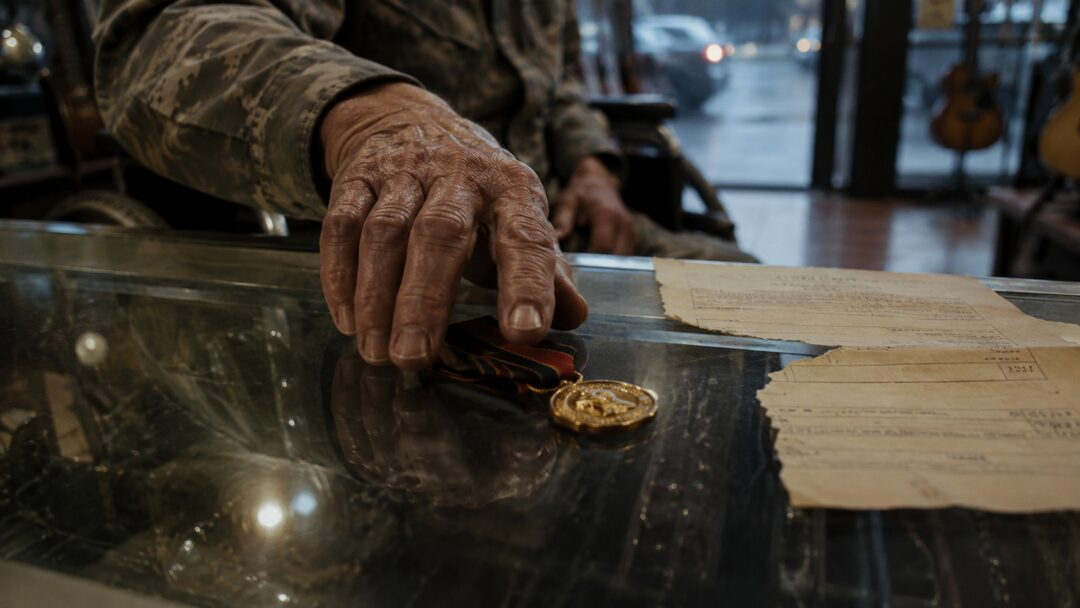
A wheelchair. Faded camouflage. Combat boots fixed over metal prosthetic legs. A thin gray head bent against the rain.
She had already counted the register once. The guitars along the wooden wall were dark shapes under the ceiling lights. The glass cases were locked. Watches, phones, rings, and old cameras sat in neat rows, waiting for people who needed cash more than memories.
The bell over the door gave a tired little jingle.
Emily almost said, “We’re closing.”
Then the man lifted his face.
Something in it stopped her.
He wheeled himself forward with wet hands gripping the rims. Rain dripped from his sleeves onto the tile. His uniform was clean but old, the fabric soft at the elbows, the patches faded almost colorless.
He stopped at the counter.
For a second, neither of them spoke.
Then he reached into his breast pocket and took out a small velvet pouch. His fingers trembled as he opened it.
Inside was a gold medal on a ribbon striped blue, white, and red.
He placed it on the glass as carefully as if the counter might bruise it.
“It’s all I have left,” he said.
Emily looked at the medal, then at him.
The shop hummed around them. Fluorescent lights. Rain on the windows. The low buzz of the neon sign Mark always forgot to fix.
Emily had been trained for this part.
Don’t react too much. Don’t ask personal questions. Don’t make promises. Everything has a resale value, and if it doesn’t, it has a melt value.
But no training told her what to do when an old man in a wheelchair put a medal on the counter like he was surrendering a part of his chest.
“You’re selling this?” she asked.
His eyes stayed on the glass.
“That’s why people come in here, isn’t it?”
Emily swallowed.
“Sometimes they change their minds.”
He gave a faint smile without warmth.
“Sometimes they can afford to.”
She looked down again. The medal was heavier than it appeared. The raised image on the front caught the light, bright and stubborn against the dull gray day outside.
Her hand hovered over it.
“May I?”
He nodded once.
When she picked it up, his fingers twitched, as if his body wanted to take it back before his pride could stop him.
Emily noticed.
So did he.
His hand closed into a fist on his lap.
She turned toward the computer. The pawn system waited on the screen, blue and blank and stupid. Item category. Estimated condition. Notes. Customer identification.
“What amount are you looking for?” she asked.
“Enough.”
She tried to keep her voice gentle. “Enough for what?”
“One last bill.”
The way he said it made the air tighten.
Emily set the medal on a black velvet pad beside the register. She didn’t want it touching the bare counter anymore.
Outside, thunder rolled over the parking lot. Palm trees bent under the rain. The sunny Florida posters taped to the front window looked almost cruel now: beaches, boats, gold light, smiling people holding drinks.
Inside, the old man waited.
Emily typed “gold military medal” into the system.
Nothing useful came up.
She tried “service medal,” then “commemorative medal,” then the letters she could make out around the edge.
The screen kept offering her coins, sports plaques, novelty awards, and one listing for a brass paperweight.
“This may take a second,” she said.
Robert looked toward the door.
“I don’t have much more than that.”
Part II — Store Policy
Emily called Mark from the landline because that was what Mark demanded, even when he was late, even when he ignored the phone, even when he said she should use her judgment and then punished her for having any.
He picked up on the fourth ring.
“Yeah?”
“Customer wants to sell a medal,” Emily said, keeping her voice low.
“What kind?”
She glanced at Robert. He sat upright, hands folded tightly, rainwater pooling beneath his wheels.
“Military. Gold-colored. Older. I can’t find a match in the system.”
Mark sighed into the phone. She could picture him driving with one hand, gold chain at his throat, fast food bag in the passenger seat. “Gold-colored or gold?”
“I don’t know yet.”
“Magnet?”
She checked. “Not magnetic.”
“Weight?”
She gave it.
“Ribbon?”
“Blue, white, red.”
There was a pause.
“Those don’t move unless they come with a story,” Mark said.
Emily stiffened.
Robert’s eyes shifted.
He had heard.
Mark kept talking. “Offer low. If it’s real gold, we’re still taking the risk. If it’s not, we’re stuck with some old display piece nobody buys.”
Emily turned slightly away. “It may be important.”
“Important doesn’t sell. Is he there voluntarily?”
“Yes.”
“Then do the intake. Start at eighty.”
Emily stared at the medal.
“Mark.”
“What?”
“Eighty dollars?”
“If he refuses, let him walk. We’re not a charity.”
The line clicked dead.
Emily stood with the receiver still in her hand.
Robert looked smaller than he had a minute before, though nothing about him had moved.
She hung up.
“My boss says we’d have to start low,” she said.
“How low?”
Emily hated the answer before she gave it.
“Eighty.”
The old man’s face did not change. That was worse than anger. Worse than surprise. He had come ready for insult.
“Eighty,” he repeated.
“I’m sorry.”
“It’s not your price.”
“No, but I’m the one saying it.”
That made him look at her.
For the first time, his eyes fully met hers. They were pale blue and sharp beneath the wet fringe of gray hair. Not helpless. Not soft. Tired, yes. Hurt, yes. But not empty.
“You always apologize for other people?” he asked.
“Only when they leave me standing behind the counter.”
His mouth almost moved toward a smile. Almost.
Emily took the intake form from beneath the register. Her fingers brushed the envelope taped under the drawer.
She checked it every night before closing.
One hundred and forty-two dollars.
Community college application fee. Bus pass. Grocery money if her mother’s hours were cut again. A tiny emergency fund built from skipped lunches, tips, and not buying shoes when her old ones split near the sole.
Kindness was easy in videos. It was harder when it had to come from the same envelope as survival.
Robert watched her pull the form out.
“Name?” she asked.
“Robert Hayes.”
His voice was even.
“Address?”
He gave it: an assisted housing complex four miles away, near the strip mall with the discount pharmacy and the laundromat that smelled like bleach.
“Identification?”
He took a worn wallet from his pocket and handed over his card. The movement was stiff, practiced, humiliating in its neatness.
Emily entered the information.
When she came to the item description, she picked up the medal again and turned it over.
That was when she saw the engraving.
W.H.
Not R.H.
The letters were small, worn at the edges from years of being handled.
Emily looked at the name on the screen.
Robert Hayes.
Then at the medal.
W.H.
Her thumb rested beside the initials.
Robert’s voice came quietly. “Don’t rub it.”
She stopped at once.
“I’m sorry.”
“You say that a lot.”
“Maybe people give me reasons.”
His gaze dropped to the medal.
For a moment, the only sound was rain hitting the front glass.
Emily should have kept typing. She should have entered “engraved initials” and moved to the offer line. She needed the job. Mark watched the camera footage whenever the drawer came up short or his mood came up worse.
But the initials had opened a door in the room.
Emily heard herself ask, “Whose was it?”
Robert’s jaw tightened.
She waited.
He looked toward the guitars on the wall, not at her.
“My son’s.”
Emily’s hand went still around the pen.
The shop seemed to brighten and dim at the same time.
“His name was William,” Robert said.
Was.
A small word. A whole room collapsing.
Emily set the pen down.
Robert’s face stayed controlled, but his fingers betrayed him. They moved once over his knee, searching for something that was not there.
“He earned it?” Emily asked.
Robert looked at her then.
“He didn’t earn anything. He was nineteen. Boys shouldn’t have to earn metal for doing what old men tell them to do.”
The sentence landed hard and stayed there.
Emily had no answer.
For years, she had hated uniforms.
Not loudly. Not in public. Not in ways people could accuse her of. She hated them quietly, in grocery store aisles when someone said “thank you for your service” to a stranger. She hated them during parades. She hated folded flags in movies. She hated speeches about sacrifice delivered by people who went home whole.
Her father, James Carter, had not worn a formal uniform when he came back. He had worn a contractor badge and a shirt dark with sweat. He had carried one duffel bag, a sunburned neck, and hands that shook when a car backfired.
He had kissed Emily’s forehead like he was memorizing it.
Three months later, he was gone.
No note that explained enough. No ceremony. No clean story. Just bills, silence, and her mother crying in the laundry room with the faucet running so Emily’s little brother would not hear.
So when Robert said boys shouldn’t have to earn metal, something in Emily shifted.
Not healed.
Just shifted.
Because he did not sound proud.
He sounded accused by his own memory.
Part III — The Name on the Back
Emily slid the intake form aside.
“I don’t have to process it yet,” she said.
Robert’s eyes narrowed. “You refusing service?”
“No. I’m saying you can take a minute.”
“I took years.”
The words came out flat, not dramatic.
Then he looked ashamed for saying them.
Emily lowered her voice. “What’s the bill?”
He drew back slightly.
“I’m not asking to judge you.”
“You’re asking because you want to decide whether I deserve help.”
That stung because part of it was true.
People did that. Emily knew. They measured need against virtue. They wanted suffering to come with receipts.
She looked down at the medal.
“No,” she said. “I’m asking because eighty dollars is wrong, and I want to know how wrong.”
Robert stared at her.
Thunder cracked close enough to rattle the door.
He reached into the side pocket of his wheelchair and pulled out a folded paper. He did not hand it to her at first. He held it in his lap, thumb pressed against the crease.
“My wife,” he said. “Mary.”
Emily waited.
“She passed in April.”
“I’m sorry.”
This time he did not correct her.
“She wanted simple. No service. No flowers. No preacher pretending he knew her.” His mouth tightened. “She said she’d had enough ceremonies for one life.”
Emily’s throat closed a little.
Robert unfolded the paper.
“I paid most of it. Sold my watch first. Then my tools. Then the ring.” He looked at his bare left hand as if surprised again to find it empty. “Thought I had enough.”
He placed the paper on the counter.
Emily saw the funeral home logo. A remaining balance circled in blue ink.
Two hundred and thirty dollars.
Not thousands. Not an impossible number. That made it worse somehow.
A life, reduced to a remaining balance a grocery trip could almost touch.
“She never forgave me,” Robert said.
Emily looked up.
“For what?”
“For coming home when William didn’t.”
The fluorescent light hummed overhead.
Robert’s hands rested on the arms of his wheelchair, the knuckles pale.
“She didn’t say it like that. Mary wasn’t cruel. Not on purpose.” He looked toward the rain. “But every time she looked at me after the funeral, there was a question in her face. Why you? Why not him?”
Emily heard her own mother’s voice from years ago, not speaking to anyone, just whispering into a kitchen towel.
Why did he come back if he wasn’t going to stay?
Some questions were not meant to be fair. They were only meant to survive the person asking them.
“Did William give it to you?” Emily asked.
Robert nodded.
“Sent it home in a box with a letter. Said it embarrassed him. Said his mother would like it.” His lips pressed together. “She put it on the mantel for three days. Then she turned it around so she didn’t have to see the front.”
“What did you do?”
“I turned it back.”
It was such a small battle. Such a devastating one.
Emily imagined the mantel. The medal facing out. Then away. Then out again. A husband and wife moving grief back and forth without touching each other.
“After she got sick, she asked me to put it in the drawer,” Robert said. “Said she didn’t want to be watched by all the things we lost.”
Emily looked at the medal again.
It had been handled for years. Not displayed safely. Not forgotten. Touched. Turned. Hidden. Retrieved. Punished. Loved.
That was why the ribbon looked soft.
That was why the engraving had worn.
Robert cleared his throat.
“I don’t need a lecture. I don’t need a fundraiser. I just need the balance paid and the receipt mailed.”
His pride rose around him like a wall.
Emily nodded.
“I understand.”
“No,” he said, not unkindly. “You’re twenty-something and standing under bright lights. You don’t understand. But you’re trying not to make it worse. I appreciate that.”
The sentence was so exact it nearly hurt.
Emily looked at the phone.
Mark would tell her to finish the deal. Mark would say the man had named his need and brought in collateral. Mark would say the world was hard and only fools acted surprised.
And maybe Mark was right about the world.
That did not mean he had to be right about her.
She entered the remaining balance into her mind.
Two hundred and thirty dollars.
Eighty from the shop offer. One hundred and forty-two in her envelope. Tips in the jar, maybe twenty-three. She would still be short unless she used her paycheck advance, the one Mark allowed against next week’s hours with a lecture attached.
Her stomach tightened.
Her brother needed new asthma filters.
The power bill was already late.
Her shoes were splitting.
Robert saw something in her face and folded the invoice back up.
“Forget I showed you.”
“No.”
“Girl.”
“Emily.”
He blinked.
“My name is Emily.”
He held the invoice between them.
“Emily, don’t make my problem your inheritance.”
For a second, she could not breathe.
Because that was what her father had done without meaning to. He had left behind a problem and no instructions. A house full of people trying to pay for one man’s broken return.
She almost stepped back.
Instead, she looked at the medal.
“What would William say if he saw you selling it?”
Robert’s face hardened.
“He’d say, ‘Pay Mom’s bill.’”
“And after that?”
The question sat between them.
Robert did not answer.
The bell over the door jingled.
Mark walked in shaking rain from his shoulders.
Part IV — The Offer
Mark Daniels brought the storm in with him.
His polo shirt was damp at the collar. His polished shoes squeaked across the tile. He held a takeout bag in one hand and his phone in the other, already irritated before he understood the room.
“Why are the cases still lit?” he asked.
Emily stepped slightly in front of the medal.
Mark noticed.
Then he noticed Robert.
His expression changed into the customer face Emily hated most: polite, flat, already calculating.
“Evening, sir,” Mark said. “Emily taking care of you?”
Robert nodded once.
“Trying to.”
Mark glanced at the computer screen. “Medal, right?”
Emily said, “I haven’t finalized anything.”
“That’s why I’m asking.”
He came behind the counter, too close. Emily smelled rain and fries and his sharp cologne.
Mark picked up the medal before Emily could stop him.
Robert’s hand moved on the wheel.
Mark turned the medal over, weighed it in his palm, inspected the ribbon.
“Nice piece,” he said.
Emily watched Robert’s face.
Nice piece.
Like a lamp. Like a watch. Like a guitar with a cracked neck.
Mark set it on the counter. “I told Emily eighty.”
Robert looked down.
Emily said, “The balance he needs is two-thirty.”
Mark gave her a slow look.
“That’s not how pricing works.”
“I know.”
“Then why did you say it?”
“Because it matters.”
Mark laughed once, without humor. “To who?”
The question was careless.
The silence after it was not.
Robert’s face went still.
Emily felt heat rise in her throat. “To him.”
Mark lowered his voice. “Back office. Now.”
“No.”
That surprised all three of them.
Mark’s eyes sharpened.
Emily’s pulse jumped, but she stayed where she was.
Robert said, “I can come back.”
“No, sir,” Mark said quickly. “You don’t need to go anywhere.” Then to Emily, quieter and harder: “You need this job?”
The words found their target.
Emily thought of the envelope under the drawer. Her mother’s tired hands. Her brother coughing through the thin wall. The community college email she had not answered because the application fee still felt too big.
“Yes,” she said.
“Then act like it.”
Robert reached for the medal.
Mark moved it back slightly. “We’re not finished.”
“I am,” Robert said.
Mark turned to him. “Sir, I’m not trying to be disrespectful. But you came to a pawn shop. This is what we do.”
Robert’s eyes lifted.
“No,” he said. “This is where I came. What you do is up to you.”
For a moment, even Mark had no answer.
Then his face closed.
“Eighty-five,” he said. “Because of the engraving.”
Emily stared at him.
Robert took the number like a blow he had expected.
“That’ll do,” he said.
“No, it won’t,” Emily said.
Robert looked at her. “Yes, it will.”
“It’s not enough.”
“It’s enough for me to leave with something.”
Mark snapped the intake form off the counter and pushed it toward Robert. “Sign here. Emily, open the drawer.”
She did not move.
Mark leaned closer. “Open. The. Drawer.”
Emily opened it.
The cash tray slid out with a mechanical click.
Under it, taped where no customer could see, was her envelope.
She shut the drawer too quickly.
Mark noticed.
“Problem?”
“No.”
Robert took the pen.
His hand trembled above the signature line.
Emily wanted him to refuse. Wanted him to get angry. Wanted him to say something that would make the choice easy.
He did not.
He signed with slow, careful letters.
Robert Hayes.
Then he placed the pen down like it had exhausted him.
Mark took the form.
“Pleasure doing business.”
Robert flinched.
Not visibly enough for Mark to care.
Enough for Emily to see.
The old man turned his wheelchair toward the door.
The medal stayed on the glass.
For the first time since he entered, his hands were empty.
Emily looked at them.
Empty hands made the whole shop seem suddenly obscene.
Phones behind glass. Rings in trays. Guitars hanging on walls. Things people once touched with hope, now tagged and priced beneath white lights.
Robert wheeled past the display case of watches. Past the rack of used tablets. Past the sunny poster of a beach that had never looked less real.
Mark counted out the bills.
“Emily,” he said.
She did not answer.
He looked up.
She was staring at the medal.
“Put it in the intake drawer.”
Emily picked it up.
The ribbon lay across her fingers. Blue. White. Red. Soft from years of being handled.
W.H.
William Hayes.
A boy whose mother turned his medal away because grief had eyes. A father who turned it back because memory needed a face.
Emily heard her father’s keys on the kitchen table, years ago.
He had come home with shaking hands and no language for where he had been. Emily had hated him for leaving twice: once when he went away, and once when he came back unable to stay.
But maybe some people did not come back whole enough to be forgiven properly.
Maybe some families spent the rest of their lives trying to price what was missing.
Robert reached the door.
Rain flashed silver beyond the glass.
Emily opened the drawer again.
Mark said, “What are you doing?”
She pulled out the envelope.
“Emily.”
She took the tip jar next.
“Don’t be stupid.”
She counted fast. One hundred. Forty. Two. Twenty-three in tips. Eighty-five from Mark’s offer still lying by the register.
Two hundred and fifty.
Enough.
Her hands were shaking now.
Mark’s voice dropped. “That money comes out of you.”
Emily looked at him.
“It already is.”
Then she tore the intake form in half.
Mark stared at her as if she had slapped him.
Robert pushed the door open.
The bell rang.
Emily ran.
Part V — What Could Not Be Priced
“Sir, wait!”
Robert stopped just outside the doorway, half under the awning, half in the rain.
Emily almost slipped on the wet tile as she reached him. The storm blew cold water against her face. Behind her, Mark shouted her name, but the rain swallowed most of it.
Robert turned his chair with effort.
“What are you doing?” he asked.
Emily bent slightly, breathless.
In one hand she held the medal.
In the other, the folded bills.
She placed the medal in his lap first.
His eyes widened.
Then she put the cash beside it.
“You’re not selling this,” she said. “I’m giving it back to you.”
Robert looked at the money.
Then at the medal.
Then at her.
For several seconds, he did not speak at all.
His mouth opened slightly, but no sound came. The rain tapped against the metal frame of his chair. Water ran down the side of his face and caught in the deep lines around his mouth.
Emily expected him to refuse.
Part of her wanted him to, because refusal would make the money hers again. Refusal would mean she had tried. Refusal would let her go back inside and face Mark with less damage.
Robert’s fingers closed around the ribbon.
Not the cash.
The ribbon.
“I didn’t ask you for charity,” he said.
“I know.”
“Then don’t make it charity.”
Emily looked at him.
She understood then. Not fully, but enough.
She took the folded invoice from where he had tucked it under his arm and placed it on top of the bills.
“Then let it be payment,” she said.
“For what?”
“For keeping it safe until someone remembered what it was.”
His face changed.
The words had found something behind his pride.
He looked down at the medal. His thumb moved once over the worn initials.
“I don’t know how to take this,” he said.
“Neither do I.”
That made him look up.
Emily’s throat tightened, but she kept her voice steady.
“My dad came back from overseas wrong. Not from the service exactly. Contract work. Evacuations. Bases. I don’t know all of it. He never told us all of it.” She stopped before the story could become too large. “I spent a long time thinking uniforms took him from us.”
Robert listened without interrupting.
“Maybe they did,” she said. “Maybe not. I don’t know anymore.”
The storm softened for a moment, rain thinning into a hiss.
Robert reached into the side pocket of his chair again and pulled out the folded invoice. He opened it, slower this time, and turned it toward her.
“Read the corner.”
Emily looked.
In blue ink, beside the remaining balance, someone had written:
For William Hayes.
She frowned.
Robert said, “Mary told them to put it there. Said if I was going to pay it, I should remember who I was really paying.”
Emily’s chest ached.
“She sounds honest,” she said.
“She was tired of being kind.”
That line stayed between them.
Then Robert folded the paper again.
“My son wrote us once about an evacuation,” he said. “Place was falling apart. People pushing through a gate. Contractors, clerks, drivers, translators. He said he pulled a young man out when the crowd split. Said the man kept asking for his little girl.”
Emily went very still.
Robert did not seem to notice at first.
“He never wrote names,” Robert said. “Only that the man had a badge clipped to his shirt and blood on his sleeve from someone else. He said the man cried because he thought nobody was coming.”
Emily’s fingers curled against her apron.
Her father had never told that story.
But she remembered one thing.
A scar on his forearm, pale and crooked.
A contractor badge in a drawer.
A night when he drank coffee at three in the morning and whispered, “Some kid got me through,” to no one in particular.
Emily had been twelve. She had pretended not to hear.
Now the rain, the medal, the old man’s voice, and the name William all seemed to lean toward the same impossible place.
“Was his name James?” she asked.
Robert looked up.
“I don’t know.”
The answer did not release her.
It did not trap her either.
It left her standing in a space where certainty could not reach, but meaning still could.
Robert studied her face.
“Could’ve been,” he said quietly.
Emily nodded once.
She did not cry. She felt too full for that.
Behind them, Mark stood inside the doorway, arms crossed, angry and silent. The bright shop lights framed him like another display behind glass.
Robert noticed him.
“You’ll lose your job,” he said.
“Maybe.”
“You need it?”
“Yes.”
“Then take the money back.”
“No.”
“Emily.”
“No,” she said again, softer. “Some things shouldn’t have to be sold just because someone can’t afford to keep them.”
Robert looked away.
His shoulders shifted once, as if he had taken a breath too deep to survive cleanly.
Then he picked up the cash and the invoice. Not quickly. Not greedily. He folded the bills with care and placed them inside the paper.
The medal he kept in his lap.
“I’ll pay you back,” he said.
“You don’t have to.”
“I didn’t ask.”
There he was again. Proud. Difficult. Still himself.
Emily smiled despite everything.
“Okay,” she said. “Then you can pay me back when you can.”
He nodded, satisfied by the shape of a debt he could bear.
For a moment, they stayed there under the awning while the rain fell around them.
Then Robert lifted the medal with both hands.
Not high.
Just enough for the light to touch it.
“My boy hated this thing,” he said. “Said it made people talk like he was braver than he felt.”
“What did you tell him?”
“I told him bravery didn’t care how he felt.”
Emily looked at the ribbon.
Robert’s voice became thinner.
“I was wrong about a lot. But not that.”
He lowered the medal back to his lap.
The shock had not left his face completely. It had softened into something more fragile. Not happiness. Not peace.
Recognition.
As if, after years of being alone with the dead, he had been startled by the living.
Part VI — Back Behind the Counter
Mark did not fire Emily that night.
He wanted to. She could see it in the tight set of his jaw, in the way he snatched the torn intake form from the floor and threw it into the trash.
But firing her would mean explaining why.
And Mark hated looking bad more than he hated losing money.
“You’re paying that back,” he said after Robert left.
Emily stood behind the counter, wet to the knees, apron clinging to her shirt.
“I know.”
“Every dollar.”
“I know.”
“And if you ever tear up store paperwork again—”
“I won’t.”
Mark pointed toward the door. “That man played you.”
Emily looked through the glass.
Robert was halfway across the parking lot, moving slowly beneath the awning’s edge, the medal resting in his lap beneath one protective hand.
“No,” she said. “He didn’t.”
Mark scoffed.
“You think you saved something tonight?”
Emily did not answer right away.
The shop was still full of things people had given up.
A wedding ring in case three. A guitar with a child’s sticker on the back. A camera with someone’s beach vacation still trapped inside the memory card. Watches from wrists that had run out of time, phones filled with old messages, necklaces that had once meant forever.
She had never noticed how loud the silence of objects could be.
Finally, she said, “I think I stopped one thing from becoming another thing.”
Mark stared at her.
“That doesn’t even mean anything.”
Maybe not to him.
Emily closed the register.
When Mark went to the back office, she turned off the case lights one by one. The guitars disappeared first. Then the watches. Then the phones. Last, the empty velvet pad where the medal had rested.
Her envelope was gone.
Her tips were gone.
Next week would be harder now. The bus pass. The application fee. Her brother’s filters. All of it still waited for her outside the warmth of what she had done.
Kindness had not made her life easier.
That was the part people never put in the stories.
She locked the front door and looked through the rain-streaked glass.
Robert had reached the far end of the walkway. A rideshare car waited near the curb, headlights glowing in the storm. Before he got in, he paused and looked back.
Emily raised one hand.
He did not wave.
Instead, he placed his hand over the medal.
Then he nodded.
Small. Formal. Enough.
The car pulled away.
Emily stayed there until its taillights blurred into the rain.
That night, when she got home, her mother was asleep on the couch and her brother’s inhaler sat on the coffee table beside his math homework.
Emily took off her wet shoes at the door.
One sole had finally split all the way open.
She laughed once, quietly, because if she did not laugh, the day might catch up with her.
In the kitchen, she opened the drawer where her mother kept old batteries, tape, coupons, and things nobody knew where else to put.
At the back was a small tin box.
Emily had not opened it in years.
Inside lay her father’s old contractor badge.
James Carter.
The photo showed him younger, sunburned, unsmiling, already halfway haunted. Emily touched the edge of the plastic.
She waited for anger.
It came, but not alone.
That was new.
Under it was something softer. Not forgiveness. Not yet. Maybe not ever.
But room.
Room for the possibility that he had been carried once by a nineteen-year-old boy named William Hayes. Room for the possibility that the story of a family could be larger than the person who broke it.
Emily closed the tin and put it back.
The next morning, there was an envelope taped to the pawn shop door.
No return address.
Inside was a receipt from the funeral home showing the remaining balance paid in full.
Behind it was a smaller note, written in careful, shaking letters.
Emily read it twice before unlocking the door.
It said:
Mary is settled. William is home. I still owe you.
She stood alone in the bright shop while traffic moved beyond the glass and the Florida sun pushed through the last of the storm clouds.
The counter was clean.
The velvet pad was empty.
But for the first time since she had started working there, Emily looked at the empty space and did not see something missing.
She saw something returned.