The Record She Kept
Part I — The Second Signal
The aircraft had seven minutes of fuel when Sarah Mitchell realized someone had erased the proof that Emily Carter was still alive.
Rain hammered the black windows of the operations center so hard the glass looked like it was breathing. Lightning opened the sky in white cracks, flashing across the rows of consoles, the tense backs of men in dark uniforms, the pale glow of maps and numbers reflected on tired faces.
On the main tactical display, Lieutenant Emily Carter was already gone.
Her icon had vanished twenty-three minutes ago.
Her last known location sat inside a gray restricted zone near a disputed island, a place everyone in the room had been told not to name aloud. The official report said her aircraft had gone down. The official report said there had been no confirmed survival beacon. The official report said rescue aircraft Mercy Two was to return to base before the storm swallowed it too.
But Sarah was looking at a smaller screen to the left of the main display.
A raw-data feed.
One most people ignored because it was ugly, unpolished, and difficult to read.
There it was again.
A second ping.
Weak. Unstable. Half-buried under static.
But alive.
Sarah leaned closer.
The screen flickered. Her sharp blue eyes tracked the time stamp, the correction angle, the signal drift. Her hair was pulled back so tightly it made her expression seem carved from focus. Her gray blouse had a dark line of rainwater across one sleeve from when she had crossed the open landing corridor ten minutes earlier. She had not noticed until now.
A broken voice came through the auxiliary channel.
“—cold—repeat—Carter—”
Then static.
Three officers turned toward the speaker.
Captain Mark Reynolds did not.
He stood at the center of the room with his arms folded, silver hair immaculate, uniform untouched by the chaos around him. Even in the storm light, he looked composed enough to be mistaken for calm.
“Mercy Two is to return to base,” he said.
Sarah looked up.
“Sir, we have a live beacon.”
Reynolds did not turn.
“We have an unverified anomaly.”
“It has Carter’s identifier.”
“It has a corrupted identifier.”
“The satellite correction matches her last vector.”
He finally looked at her.
That was worse.
His face held the kind of patience men used when they had already decided a woman was being difficult and were waiting for her to become emotional enough to dismiss.
“Commander Mitchell,” he said, “you are not mission command.”
The words landed quietly.
Everyone heard them anyway.
Sarah felt the room tighten around her. A young systems analyst three stations down, Joshua Hayes, froze with one hand hovering over his keyboard. He was thin, pale, and exhausted, his glasses sliding slightly down his nose. He had been awake too long, and fear had made him careful.
Sarah did not look away from Reynolds.
“No, sir,” she said. “But I am the officer currently looking at evidence we are leaving one of ours in the water.”
Reynolds’s jaw shifted once.
“Protocol exists because emotion gets people killed.”
A flash of lightning filled the room.
For half a second, Sarah saw another room years ago. Another monitor. Another blinking signal. Another officer saying wait while minutes turned into a name carved onto a wall.
Then it was gone.
She turned to Joshua.
“Pull the raw beacon log. Preserve it.”
Joshua did not move.
“Hayes,” she said.
His throat worked. “Ma’am—”
“Now.”
Reynolds’s voice cut across the room.
“Do not touch that record.”
Joshua’s hand stopped.
Sarah looked from Joshua to Reynolds, and something cold moved through her anger.
Not caution.
Not procedure.
Fear.
Reynolds’s fear.
“Why?” she asked.
The room went still enough that the rain seemed louder.
Reynolds stepped closer.
“Because this room is operating under a classified directive you do not have authority to challenge.”
“I’m not challenging the directive.”
“You are.”
“I’m challenging the missing signal.”
His eyes narrowed.
Sarah turned back to the raw feed. The second ping blinked once more.
Then disappeared.
Not faded.
Not lost.
Removed.
Sarah’s breath slowed.
She had learned long ago that panic wasted oxygen. Anger did too, unless it was disciplined into something useful.
She reached for the black coiled-cord handset mounted beside the communications console.
Reynolds saw her hand move.
“Commander.”
Sarah lifted the handset.
“If you won’t act,” she said, “I will.”
Part II — Seven Minutes
The room reacted before anyone spoke.
One officer half rose from his chair. Another looked at Reynolds for permission to stop her. Joshua’s fingers trembled over his keyboard, caught between training and conscience.
Sarah pressed the transmit key.
“Mercy Two, this is Shore Control Actual.”
Reynolds took a step toward her.
“Cut that channel.”
No one moved.
Sarah’s voice stayed level.
“Mercy Two, alter heading to two-one-six. Survivor beacon confirmed. Repeat, survivor beacon confirmed.”
A burst of static answered.
Then a pilot’s voice, strained but clear.
“Shore Control, confirm order. We were directed home.”
Reynolds pointed at the communications officer.
“Cut the channel.”
Joshua moved.
Not fast.
Just enough.
His hand slid over a side panel and tapped two keys in the wrong order. A delay. Barely three seconds.
Sarah heard it.
So did Reynolds.
Her eyes stayed on the storm map.
“Mercy Two,” she said, “redirect that aircraft now.”
The sentence struck the room like a dropped blade.
Nobody breathed.
Then the aircraft answered.
“Copy redirect. Turning two-one-six.”
Reynolds turned on Joshua.
“What did you do?”
Joshua stared at his screen. “System lag, sir.”
It was a bad lie.
It was also the first brave thing Sarah had seen him do.
On the monitor, Mercy Two’s glowing marker curved away from safety and back toward the restricted zone.
The storm swallowed it on the screen, one pulse at a time.
Reynolds stood close enough now that Sarah could smell the coffee on his breath.
“You just put five more people at risk,” he said softly.
Sarah kept the handset in her grip.
“I gave them the location of a living pilot.”
“You gave them an illegal order.”
“I gave them the truth.”
His face hardened.
“No, Commander. You gave them your need to be right.”
That hit closer than she wanted it to.
Because there was a part of her, a small and private part, that feared exactly that.
Mercy Two entered the storm corridor.
The radar return flickered.
“Signal unstable,” one operator said.
“Wind shear increasing,” another added.
Lightning flashed again. The room washed white, then blue, then dark.
Sarah watched the aircraft marker stutter. Every second now had a cost. She imagined the crew inside Mercy Two, hands tight on controls, rain beating the glass, the pilot choosing to trust a voice from shore instead of the order that had sent them home.
She had placed her judgment inside their cockpit.
Reynolds knew it.
He leaned closer.
“If they go down, you own every name.”
Sarah did not answer.
On the auxiliary channel, static burst open.
“—Carter—water—visual negative—”
Then Mercy Two again.
“Shore Control, beacon bearing weak. Confirm coordinates.”
Sarah glanced at the raw feed. The second signal was gone from the main display, but the shadow of it remained in the backup capture she had ordered Joshua to preserve.
“Joshua,” she said quietly.
He did not look at Reynolds this time.
He pulled up a side window. “Corrected coordinates are three miles east of marked debris field.”
Reynolds’s head turned toward him.
Joshua swallowed.
Sarah repeated the coordinates into the handset.
Mercy Two adjusted.
On the far side of the room, someone whispered, “Fuel?”
“Four minutes to bingo,” another said.
Four minutes until return became impossible.
Four minutes until Sarah’s act stopped being defiance and became consequence.
Reynolds’s voice dropped.
“Last chance, Commander. Recall them.”
Sarah looked at the screen.
The aircraft marker flickered again.
For the first time that night, she let herself see Emily Carter not as a file, not as a call sign, not as a symbol of command failure.
A woman in black water.
A broken arm.
A survival vest.
Cold entering the bones.
Trusting someone, somewhere, to believe the signal.
Sarah lifted the handset.
“Mercy Two, continue.”
Reynolds stared at her.
She did not look back.
Part III — The Weight of Being Right
Mercy Two vanished from the main radar for eleven seconds.
In the operations center, eleven seconds became a place no one wanted to stand.
Sarah heard every sound too clearly: rain striking glass, keys clicking, the low hum of machines, someone breathing through their mouth. The handset cord was tight around her wrist because she had twisted it without noticing.
Then the aircraft marker returned.
A voice cracked through the static.
“Shore Control, Mercy Two. We have visual debris.”
Sarah closed her eyes for half a second.
Not relief.
Not yet.
“Any sign of Carter?”
Static.
Then, faintly, from a rescue crew member on an open channel:
“Light. I’ve got a light.”
Joshua’s hand covered his mouth.
Reynolds did not move.
The room tilted toward the speakers.
“Survivor in water. Repeat, survivor in water.”
A sound moved through the room. Not cheering. No one dared. It was something smaller, sharper, almost painful.
Sarah gripped the handset.
“Condition?”
“Alive. Hypothermic. Possible fracture. We’re lowering basket.”
The storm shook the windows.
Mercy Two’s signal dipped hard.
“Wind shift,” an operator said.
Sarah stared at the numbers.
“Mercy Two, abort if unsafe,” Reynolds said suddenly into the command channel.
Sarah looked at him.
For a moment, his composure cracked. Not enough for the room to see clearly. Enough for Sarah.
He was not afraid of losing Mercy Two.
Or not only that.
He was afraid of what Mercy Two was about to bring back.
The rescue channel burst again.
“Basket deployed—hold position—hold—”
Then a shout.
Static swallowed it.
Sarah’s body went cold.
“Mercy Two, report.”
Nothing.
“Mercy Two, report.”
The aircraft marker dipped again.
Joshua whispered, “Come on.”
Reynolds said nothing.
A long scream of static tore through the speakers.
Then:
“We have Carter.”
The room exhaled.
Sarah did not.
“Say again,” she said.
“We have Carter. She’s alive.”
This time, someone did make a sound, a broken laugh quickly covered by a cough.
Sarah lowered the handset a few inches. Her hand shook once. She made it stop.
Reynolds stepped away from her.
Not defeated.
Calculating.
That frightened her more.
Twenty-six minutes later, Emily Carter was aboard Mercy Two, wrapped in thermal blankets, her pulse weak but present. Her left arm was broken. Her lips were blue. She had been in the water nearly an hour.
She had also refused to let go of the small recorder strapped inside her survival vest.
The first report came in from the medic.
“She says it stays with her.”
Sarah frowned.
“What stays with her?”
A pause.
Then the medic answered.
“Flight recorder, ma’am. She keeps saying, ‘Don’t let them wipe it.’”
The words spread through the room slowly.
Don’t let them wipe it.
Joshua looked at Sarah.
Sarah looked at Reynolds.
He was staring at the main display as if he could force the night to rearrange itself.
“Captain,” Sarah said.
Reynolds turned.
His face had gone perfectly still again.
“You are relieved from operational access pending review,” he said.
The room fell silent.
Sarah almost laughed. Not because it was funny. Because it was fast.
“On what grounds?”
“Unauthorized command transmission. Interference with a classified directive. Endangerment of personnel.”
“I saved Lieutenant Carter.”
His eyes held hers.
“You compromised more than you understand.”
Sarah stepped closer, the handset still in her hand.
“No,” she said quietly. “I think I’m starting to understand exactly enough.”
Reynolds’s gaze dropped to the handset.
Then to Joshua’s screen.
“Seal all logs,” he ordered.
Sarah turned to Joshua first.
“Preserve the backups.”
Reynolds snapped, “That is an order from your commanding officer.”
Joshua sat frozen.
There were moments in a life when silence became a signature.
Sarah saw Joshua reach one of them.
His fingers moved under the desk, away from Reynolds’s view.
A small external drive, no larger than his thumb, disappeared into his closed hand.
He did not look at Sarah.
He did not need to.
Part IV — White Rooms
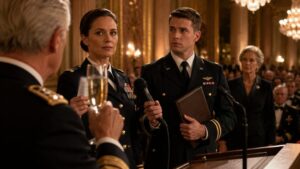
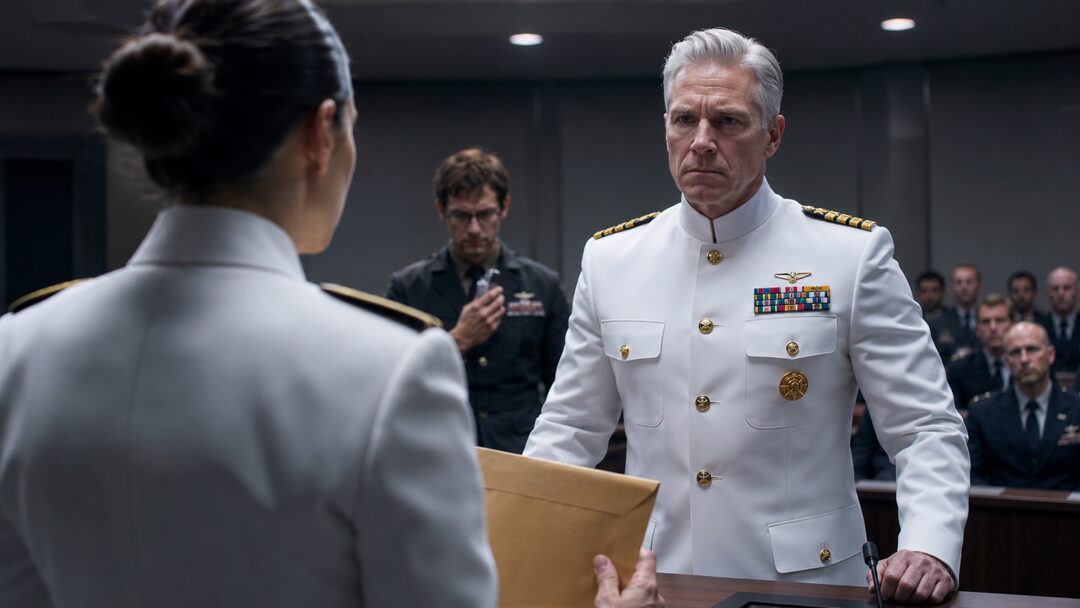
Three months later, Sarah wore dress whites and stood in a room built to make truth feel small.
The ceiling was high. The walls were polished wood. The flag behind the panel hung without motion. Every chair scraped too loudly. Every cough sounded deliberate.
Captain Mark Reynolds sat at the witness table with his silver hair cut close and his uniform perfect. He looked less like a man accused of anything than a man inconvenienced by having to clarify reality for slower people.
Sarah stood alone.
She had been offered counsel. She had accepted counsel. Then she had been advised, very carefully, not to speak unless necessary.
She knew what that meant.
Let the system reduce the event to language it could control.
Unauthorized transmission.
Operational interference.
Unverified data.
Risk to assets.
Sarah looked at the panel of officers and thought of Emily Carter’s blue lips, the way the first rescue photo had shown her hand clenched around the recorder even after sedation.
Some truths survived only because someone held on too hard to let go.
Reynolds testified first.
His voice was calm, almost regretful.
“Commander Mitchell acted outside established authority during a politically sensitive operation. At the time she issued her order, there was no confirmed evidence that Lieutenant Carter remained alive.”
Sarah’s face did not change.
Inside, something sharpened.
Reynolds continued.
“Her decision placed the Mercy Two crew at unnecessary risk, jeopardized a classified mission posture, and could have created consequences far beyond that room.”
A panel member asked, “Did Commander Mitchell attempt proper escalation?”
“She was informed that the data was unreliable.”
“That was not my question.”
Reynolds paused.
Only half a beat.
“She was advised to stand down.”
From the back row, Joshua Hayes shifted in his seat.
Sarah did not turn.
She had seen him when she entered. He looked thinner than before. Tired in a new way. There were dark circles under his eyes, and his uniform still had that slightly imperfect fit, as if he could never quite make himself look like someone safe.
He had not contacted her after that night.
She had not blamed him.
People loved truth in theory.
In practice, truth asked for your name.
The hearing moved through exhibits. Official maps. Weather reports. Fuel calculations. Communication excerpts selected so neatly they looked almost clean.
Almost.
Sarah listened while Reynolds built a version of the night where she was brave in the most dangerous way. Emotional. Impulsive. Unable to distinguish instinct from evidence.
He never called her unstable.
He did not need to.
Men like Reynolds knew how to accuse a woman without using the words that would reveal them.
Finally, one officer turned to Sarah.
“Commander Mitchell, do you dispute Captain Reynolds’s statement that there was no confirmed survival evidence at the time of your transmission?”
Sarah lifted her eyes.
“Yes.”
The room changed.
The smallest way.
Enough.
The officer leaned forward.
“On what basis?”
Sarah opened the folder in front of her.
“On the basis of timestamped raw beacon records, backup screen captures, unedited radio audio, and metadata showing the second survival ping was removed from the primary display after Captain Reynolds received a secure directive.”
Reynolds turned his head toward her.
For the first time all morning, he looked fully awake.
The presiding officer frowned.
“Commander, are those records in evidence?”
“They are now.”
Her counsel went still beside her.
Sarah placed a sealed drive on the table.
A clerk approached.
Reynolds’s hand tightened around his pen.
There it was.
Fear, finally visible.
“Commander Mitchell,” he said, voice controlled, “you are introducing unauthorized material from a classified operation.”
Sarah looked at him.
“No, Captain. I’m introducing the part you left out.”
Part V — What the Room Had Not Seen
The first screen capture appeared on the large display behind the panel.
Time stamp: 21:47.
The main display showed no active beacon.
The raw feed showed one.
Weak. Unstable. Tagged to Emily Carter’s survival system.
The room was silent.
Sarah did not explain too much. She had promised herself that. Explanation could be bent. Evidence had edges.
“This capture was taken before my first request to redirect Mercy Two,” she said.
The next image appeared.
Time stamp: 21:49.
A satellite correction pulled the beacon three miles east of the official debris field.
The next.
Time stamp: 21:51.
A broken audio clip.
Emily’s voice came through the hearing room speakers, thin and torn by static.
“—cold—repeat—Carter—”
Someone in the back row inhaled sharply.
Sarah kept her hands folded.
Reynolds looked straight ahead.
The presiding officer’s expression had changed.
“Captain Reynolds,” she said, “were you aware of this signal?”
Reynolds did not answer quickly.
That was answer enough for Sarah.
“I was aware of an unverified anomaly,” he said.
Sarah turned slightly.
“Then why was it removed?”
Reynolds looked at her with quiet warning.
She had seen that look before. In the operations center. In hallways afterward. In the faces of men who wanted obedience to feel like maturity.
“Commander,” he said, “you are oversimplifying a classified command environment.”
“No,” Sarah said. “You are hiding behind one.”
A murmur moved through the room.
The presiding officer struck the table once.
“Commander Mitchell.”
Sarah lowered her chin.
“Yes, ma’am.”
Reynolds’s voice regained some of its polish.
“The authenticity of these materials is questionable. Commander Mitchell has already admitted she acted outside authority. These files could have been altered after the fact.”
Joshua Hayes stood up.
Not dramatically.
Not like a man who wanted attention.
He stood the way someone stands when sitting has become worse.
Every head turned.
His face was pale.
“I can verify the metadata,” he said.
The presiding officer looked at him. “State your name and position.”
“Joshua Hayes. Systems analyst assigned to the operations center that night.”
Reynolds’s eyes moved to him.
Joshua saw it.
He almost sat down.
Sarah saw that too.
For one awful second, she thought he would disappear back into the safety he had chosen for three months.
Then Joshua reached into his inside pocket and removed a second drive.
“My archived system log shows the second beacon was manually suppressed at 21:52,” he said. His voice shook, but it did not break. “The change occurred after Captain Reynolds received a secure call.”
The room did not breathe.
Reynolds’s face had gone gray under the lights.
“That analyst does not have authorization to interpret command directives,” he said.
Joshua looked at him.
“No, sir,” he said. “But I know when a signal is deleted.”
That line landed harder than anyone expected.
Sarah felt it in her chest.
The presiding officer ordered the drive entered.
More records appeared.
The deleted ping.
The delayed channel lock.
The copied raw data.
The communication Sarah had made from the black coiled-cord handset.
Her own voice filled the room, steady under the storm.
“Mercy Two, alter heading to two-one-six. Survivor beacon confirmed.”
Then Reynolds’s voice.
“Cut that channel.”
Then Sarah again.
“Redirect that aircraft now.”
The words sounded different in the hearing room.
Not louder.
Heavier.
A panel member asked, “Captain Reynolds, why was Mercy Two ordered away from a live signal?”
Reynolds’s mouth opened.
Closed.
For the first time, his stillness did not read as authority.
It read as a man standing at the edge of what he had built.
Sarah knew there was more. Emily’s recorder had already begun to expose the illegal mission alteration, the mid-flight instruction that had placed her in the wrong corridor, the earlier operational mistake someone had wanted buried under weather and distance.
But this hearing did not need every ugly detail today.
It needed one thing.
The truth of the moment they had tried to rewrite.
Sarah turned toward the panel.
“You ignored the truth.”
Reynolds’s eyes snapped to her.
She did not look away.
“You had the beacon. You had the correction. You had her voice. And you chose the version of the screen that made silence easier.”
No one interrupted.
Reynolds spoke through clenched control.
“You have no idea what pressures existed above that room.”
Sarah’s voice softened.
That made it cut deeper.
“I know exactly what pressure feels like, Captain. It does not erase a person.”
The room held the sentence.
Reynolds leaned back, but there was nowhere left to go.
“You cannot prove intent,” he said.
Sarah opened the final tab in her folder.
The clerk projected the last record.
A command audit trail. Raw. Time-stamped. Preserved before the system lock.
Joshua’s metadata tied it to Reynolds’s access code.
The second beacon had not vanished.
It had been hidden.
Reynolds stared at the screen.
Sarah looked at him and said the line he should have feared from the beginning.
“I document everything.”
Part VI — The Quiet Desk
They did not applaud when Sarah was cleared of the worst charges.
That was not how rooms like that worked.
The decision came in clean language, careful language, language that saved as many faces as possible.
Commander Mitchell’s actions were found to be outside normal authorization but materially supported by evidence available at the time.
Further review was recommended regarding Captain Reynolds’s conduct and command-level handling of the Carter incident.
Lieutenant Hayes’s submitted records were accepted.
Lieutenant Carter’s recovered recorder was transferred to a separate investigative panel.
No one said Sarah had been right.
Not directly.
The system disliked sentences that simple.
Afterward, in the corridor, Joshua stood near a window with both hands clasped behind his back. He looked younger now that the hearing was over and older because of what it had cost him.
Sarah approached him.
For a moment, neither spoke.
Then Joshua said, “They reassigned me.”
Sarah nodded.
“I heard.”
“Data compliance. Inland. No operations track.”
He tried to make it sound like a joke.
It failed.
Sarah looked at him carefully.
“You gave them your name.”
Joshua stared out at the gray morning.
“I should have done it sooner.”
She could have comforted him.
She did not.
Some regrets deserved the dignity of not being softened.
“You did it when it mattered,” she said.
His eyes reddened, but he nodded once.
Down the corridor, two officers escorted Reynolds toward a separate room. He did not look at Sarah as he passed.
That surprised her.
Then it didn’t.
Men who mistake control for leadership rarely know what to do when no one is following.
Emily Carter visited Sarah six weeks later.
She came on a cold afternoon, still moving carefully, one arm stiff under her coat. Her short blond hair had grown out unevenly. There was a faint mark near her cheekbone, almost hidden unless the light touched it.
Sarah’s new office was smaller than her old command space.
No panoramic windows.
No storm map.
No rows of personnel waiting for orders.
Just a training building, a metal desk, two chairs, and a view of recruits crossing wet pavement below.
Emily stood in the doorway and took it in.
“They gave you a classroom,” she said.
Sarah smiled faintly.
“They called it a leadership development post.”
Emily’s mouth tightened.
“That sounds worse.”
“It has better coffee.”
Emily stepped inside.
For a few seconds, she did not sit. She looked at Sarah the way people look at someone who has changed the direction of their life and refuses to accept the size of it.
“I read the transcript,” Emily said.
Sarah leaned back. “You were not supposed to.”
Emily lifted one shoulder. “I survived classified water. I can survive paperwork.”
That almost made Sarah laugh.
Almost.
Emily’s eyes moved to the corner of the desk.
There, beside a stack of training folders, lay the black coiled-cord handset from the operations center. Its casing was scratched near the transmit key. The cord was still kinked from Sarah’s grip that night.
Emily stared at it.
“They let you keep that?”
“No.”
A pause.
Emily looked at her.
Sarah said, “It was decommissioned.”
“Convenient.”
“Very.”
Emily moved closer and touched the edge of the handset with two fingers.
Not reverently.
Carefully.
As if it were still carrying sound.
“I don’t remember much,” she said. “The water. The cold. Thinking the light on my vest was too small for anyone to care about.”
Sarah looked down.
Emily continued, quieter.
“I remember hearing the helicopter. I remember someone saying my name. And I remember thinking—someone argued for me.”
Sarah said nothing.
There were things gratitude could not carry without breaking.
Emily pulled her hand back.
“They told me you risked everything because of the recorder.”
Sarah’s eyes lifted.
“No.”
Emily watched her.
Sarah said, “I didn’t know about the recorder.”
The room went still.
Outside, recruits crossed the pavement in uneven lines, young and loud and convinced that rules would always mean what they had been told they meant.
Emily nodded slowly.
“So you came for me.”
Sarah held her gaze.
“Yes.”
It was the smallest answer.
It was also the truest.
Emily’s face changed, not into tears, not into drama, but into something harder to watch. A woman realizing she had not been a file. Not an inconvenience. Not a loose end in someone else’s report.
A person.
Saved as a person.
She sat across from Sarah.
For a long moment, they let silence do what speech would have made smaller.
Then Emily said, “Was it worth it?”
Sarah looked at the handset.
At the scratched transmit key.
At the desk that was not command.
At the window that faced recruits instead of storms.
She thought of Reynolds’s perfect stillness cracking under evidence. Joshua standing when staying seated would have been easier. Emily’s broken voice coming through static. Mercy Two turning into a darkness it had every reason to leave.
She also thought of the life she had built on believing the chain of command would bend toward the truth if truth came documented enough.
That belief had not survived intact.
Maybe it should not have.
Sarah reached for the handset and set it upright, the cord curling beside her hand like a question that refused to go away.
“Yes,” she said.
Then, after a moment, more quietly:
“And it cost more than being right.”
Emily nodded as if she understood that better than most.
When she left, she did not thank Sarah again.
She only paused at the door and gave a small, precise salute.
Sarah returned it.
After Emily was gone, Sarah sat alone in the quiet office.
A group of recruits laughed somewhere below. A bell rang in the hall. Rain began against the window, softer than that night, but close enough to remember.
Sarah looked at the handset on her desk.
She did not keep it as proof that she had won.
She kept it because one night, when silence had been made to look like discipline, her hand had closed around it anyway.
And because somewhere in the sound of rain, she could still hear a weak signal insisting it was not too late.