The Lavender Case She Carried Back After Fifty Silent Years
Part I — The Woman at the Line
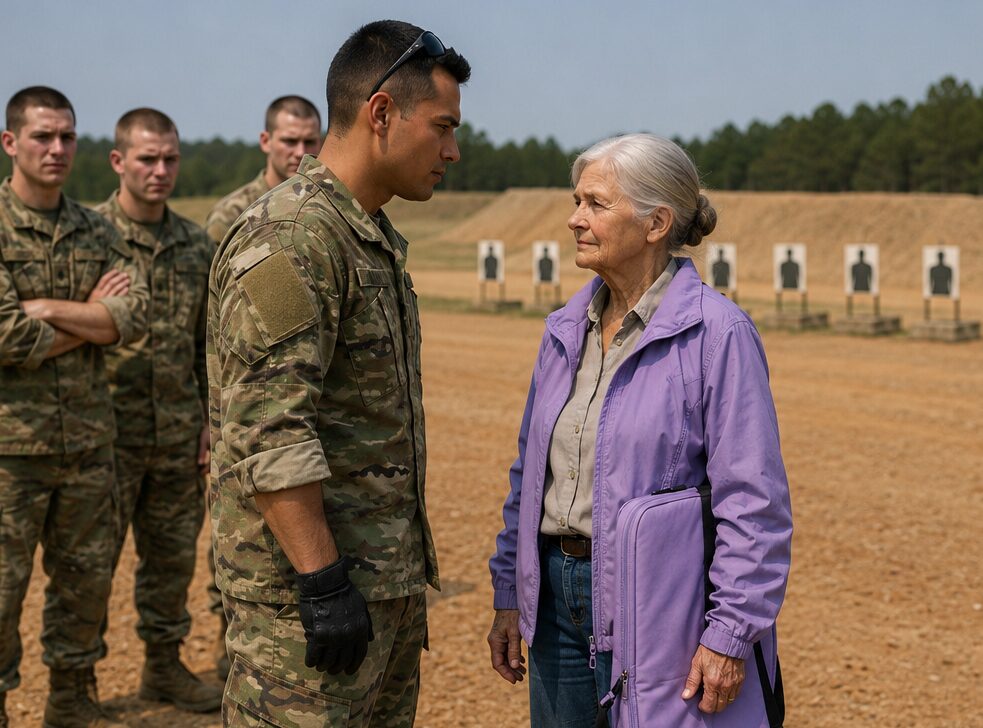
The old woman was halfway across the dusty range before Staff Sergeant Tyler saw the lavender case in her hand and stepped into her path.
It was almost as tall as she was.
That was the first thing the young soldiers noticed. Not her silver hair pinned at the back of her head. Not the pale lavender jacket buttoned over her gray shirt. Not the white sneakers gathering tan dust with every careful step.
The case.
Long. Soft-sided. Lavender.
Wrong for the place.
Wrong against the neat rows of targets, the clipped commands, the sun-baked gravel, the young men in matching uniforms trying not to stare.
Tyler lifted his sunglasses onto his head and gave her the kind of smile men used when they believed they were being gentle.
“Ma’am,” he said, “the veterans’ luncheon is two buildings over.”
A few soldiers laughed.
The woman stopped. She did not look embarrassed. She did not look confused. She shifted the case from one hand to the other, as if the weight had been with her long enough that it no longer surprised her.
“I’m not here for lunch,” she said.
Her voice was quiet. It carried anyway.
Tyler glanced down at the case. “Then I hope that’s not a knitting club trying to sneak past my safety line.”
This time the laugh came quicker.
The woman’s eyes moved over the soldiers behind him. Not angry. Not wounded. Just measuring.
That made Tyler’s smile tighten.
He had seen lost civilians before. Parents looking for ceremonies. Old men wanting to tell stories at the gate. Widows carrying folded letters. He knew how to be kind while keeping them away from places where kindness could get someone hurt.
But this woman was not looking around for directions.
She was looking at the range like she had been there before.
“What’s your name?” Tyler asked.
“Janet Collins.”
He looked down at the clipboard in his hand, more out of habit than interest. Then his thumb stopped.
He looked again.
Janet Collins — civilian consultant.
Authorized by Colonel Samuel.
Tyler read the line twice because the words made no sense together. Civilian consultant. Authorized. Today’s date.
He looked back at her.
“You’re Janet Collins?”
“I was when I left the house.”
Another soldier coughed into his fist.
Tyler ignored him. The smile had left his face now, replaced by irritation. No one had briefed him. No one had told him an elderly civilian would be walking onto his range with a long case and a tone like she had appointments with ghosts.
“What exactly are you consulting on?” he asked.
Janet looked past him, toward the targets trembling faintly in the heat.
“A grouping problem.”
Tyler almost laughed again, but something in her expression stopped him.
Still, his pride needed somewhere to go.
“Ma’am, today is not a county fair.”
Her hand tightened once around the case handle.
“Then stop treating it like one.”
The words landed flat and clean.
The soldiers stopped laughing.
Tyler felt heat climb under his collar. He had been corrected in front of his own line by a woman whose hands looked thin enough for him to worry about the weight of the case she carried.
He pointed toward the gravel strip beside the firing area.
“You’ll wait there until the colonel arrives.”
Janet did not move.
Tyler lowered his voice. “That was not a suggestion.”
For the first time, something almost like a smile appeared at the corner of her mouth.
“No,” she said. “I suppose men here still call those orders.”
Then she stepped to the side and waited exactly where he had told her to wait.
Not because he had won.
Because she was willing to let him believe he had.
Part II — An Old Promise
Colonel Samuel arrived in a white command truck ten minutes later, and the range changed temperature before he even opened the door.
The soldiers straightened.
Tyler stepped forward with the clipboard already in his hand.
“Sir, we have a civilian on the line.”
Samuel looked past him.
His face altered when he saw Janet. Not dramatically. Just enough for Tyler to notice.
“Mrs. Collins,” Samuel said.
“Colonel.”
“You found us all right?”
“I found the dust.”
Samuel gave a polite nod that did not become a smile. “I appreciate you coming.”
Tyler turned his head slightly.
Appreciate.
Not tolerate. Not handle. Appreciate.
“Sir,” Tyler said carefully, “I wasn’t briefed on any civilian participation during qualification.”
“This isn’t qualification,” Samuel replied. “Not for her.”
Janet looked at the target line again. The wind pulled at a strand of silver hair near her cheek. She tucked it behind her ear with two fingers.
Tyler hated how calm she was.
Samuel gestured toward a folding table under the range awning. “Bring the file.”
A corporal ran to the truck and returned with a sealed gray archive box. It looked too official for the heat and dust, too solemn for a morning that had started with jokes about knitting.
Tyler saw the label first.
Red Lantern.
His throat tightened.
Samuel noticed. “You know the reference?”
“My grandfather served under that inquiry.”
The colonel was quiet for half a beat too long.
Janet turned her head.
“Your grandfather’s name?” she asked.
Tyler kept his eyes on Samuel. “John Turner.”
The old woman’s face did not break.
But it changed.
Not enough for anyone else, maybe. Enough for Tyler. Something passed through her eyes and was gone before he could name it.
Samuel opened the archive box.
Inside were yellowing target sheets, a folded map sealed in plastic, typed pages with blacked-out lines, and a photograph so faded the men in it looked like they were dissolving.
Tyler had seen one copy of that photograph in his grandmother’s hallway.
His grandfather had been younger than Tyler was now. Broad-shouldered. Unsure whether to smile. Standing at the edge of the group like he already knew he would one day be left outside it.
“He was blamed,” Tyler said.
No one answered.
Tyler looked at Janet. “You know that, don’t you?”
She said nothing.
“He was blamed for breaking radio silence,” Tyler continued. “He carried that disgrace to his grave.”
Samuel closed the archive box lid halfway, then opened it again as though reconsidering what kind of morning this was allowed to become.
“The record is under review,” the colonel said.
“Why now?”
“A family petition. A congressional archive release. Old papers becoming less old.” Samuel glanced at Janet. “And one surviving witness who was not listed properly.”
Tyler stared at her.
The woman in the lavender jacket did not look like a witness to anything except long grocery lines and church basements. He hated himself for thinking it, and hated her more for making him feel small without lifting her voice.
“What was your role?” he asked.
Janet looked at the box.
“Unofficial.”
“That’s not a role.”
“It was then.”
Samuel cleared his throat. “Mrs. Collins assisted a border training program in a civilian capacity. Range support. Translation. Terrain familiarity.”
Tyler almost laughed. “Terrain familiarity?”
Janet looked at him then.
“Not every uniform was allowed to leave a photograph.”
The line struck him in a place he did not expect.
He looked at the lavender case again.
“What’s in there?” he asked.
Janet’s fingers rested on the zipper pull.
“An old promise.”
She did not open it.
That was worse.
Part III — The Pattern No One Could Explain
The file was laid out on the folding table beneath the awning, and everyone pretended not to watch Janet read.
She did not read like an old woman struggling with small print. She read like someone separating lies from weather.
Her finger moved across the map once, paused, then returned to a ridge marked in faded blue pencil.
“No,” she said.
Samuel leaned closer. “No?”
“That position is wrong.”
Tyler folded his arms. “You’ve looked at it for twelve seconds.”
“I looked at it for fifty years before someone put it in a box.”
No one spoke.
A gust pushed dust across the table. Janet placed one palm over the target sheet before it could lift. Her hand was narrow, veined, age-spotted. Tyler watched it pin down the paper as if it had pinned down worse things.
Samuel slid a second sheet toward her.
“This is the grouping. The question is whether the recorded distance and angle make it possible.”
Janet studied it.
Five marks, tight and slightly low.
Tyler knew enough to respect the pattern. He knew enough to know it was not luck.
“That was my grandfather’s,” he said.
Janet’s eyes stayed on the page.
“The report says that.”
“It was.”
“The report says many things.”
Tyler stepped closer. “Say what you mean.”
Samuel’s voice sharpened. “Staff Sergeant.”
“No, sir. If she’s here to dig up my grandfather’s name, I want to know what she thinks she knows.”
Janet finally looked at him.
For the first time, Tyler saw her age not as weakness, but as distance. She was standing on the far side of decades he had only inherited in fragments: a photograph, a surname, a family silence that came out every Thanksgiving when someone drank too much and said John Turner had deserved better.
Janet reached into the archive box and pulled out the old photograph.
She touched the edge, not the faces.
“Your grandfather was a good man,” she said.
Tyler’s jaw tightened. “Don’t.”
The word came out sharper than he intended.
Janet accepted it. She seemed to accept most blows by making no motion at all.
“He was not a simple one,” she said.
Tyler laughed once, coldly. “That supposed to comfort me?”
“No.”
“Good.”
Samuel shifted, uncomfortable. “Mrs. Collins, can you reproduce the pattern?”
Janet looked toward the target line.
“Not from where the report says it was made.”
Tyler stared at her. “Convenient.”
Her gaze moved back to him. “Set the distance. Set the wind angle. I’ll show you what is convenient.”
The air around the table tightened.
Samuel hesitated, then gave the order.
Two soldiers moved downrange. A target was placed. Adjusted. Replaced. The range officer checked distance and angle. Tyler watched it all with a resentment he could not keep clean.
Part of him wanted her to fail.
Part of him was terrified she would not.
Janet lifted the lavender case and carried it to the firing point.
One of the younger soldiers, the same one who had laughed first, murmured, “No way.”
Janet heard him.
She bent slowly, set the case on the bench, and ran her fingers along the zipper.
The sound was small.
It might as well have split the morning open.
Inside lay a vintage competition rifle, dark wood polished by care, metal dulled by time but spotless. It was wrapped in a faded cloth.
Tyler saw the initials before he understood them.
J.T.
His grandfather’s initials.
The range went still.
Janet lifted the cloth as gently as if she were uncovering a sleeping face.
Tyler moved before he meant to.
“Where did you get that?”
Janet did not answer.
“Where did you get my grandfather’s rifle?”
Samuel said his name, warning.
Tyler ignored him. “Did you take it? Did someone give you access to his effects?”
Janet looked at him with something close to pity, which made him angrier than accusation.
“John gave it to me.”
Tyler shook his head. “No.”
“The night before the inquiry.”
“No.”
“He said, ‘They can bury me. They can’t bury the pattern.’”
Tyler’s hands curled at his sides.
For years his family had owned nothing but a photograph and a discharge no one liked to read. No stories. No medals on the wall. No clean ending. And this woman had walked in carrying his grandfather’s rifle in a lavender case, as if memory were something she could unzip when convenient.
Janet took the rifle to the firing position.
Her knee resisted when she lowered herself. Everyone saw it. Everyone pretended not to.
Tyler almost stepped forward.
She raised one hand without looking at him.
Not asking for help.
Refusing it.
She set her cheek, breathed once, and became very still.
The first report cracked across the range.
Then four more.
No flourish. No drama. No display of pride.
When the target came back, the range officer looked at it, then looked at Samuel.
The five marks sat tight and slightly low.
Just like the sheet on the table.
Tyler stared until the paper blurred.
The old woman did not smile.
That was what unsettled him most.
She had just changed the shape of his family’s shame, and she looked as if the cost had only begun.
Part IV — The Part of the Truth No One Wanted
Tyler found Janet beside the dark truck, drinking water from a paper cup with both hands.
He should have apologized then.
Instead, he said, “Why did you wait?”
She lowered the cup.
The range behind them had fallen into uneasy movement. Soldiers reset equipment too carefully. Samuel spoke with the archive officer who had arrived early and now stood beside the folding table, studying the target sheets like they might accuse him too.
Tyler stepped closer.
“My grandfather died with people thinking he panicked. My grandmother died with that in the house. My father grew up defending a man he barely understood. So why did you wait until everyone was dead or too old to answer?”
Janet looked across the range, not at him.
“Because your grandfather asked me to.”
“That’s cowardice.”
She nodded once.
The acceptance hit him harder than denial would have.
“I know,” she said.
Tyler had wanted a fight. He had wanted her to snap back, to defend herself, to make it easy to stay angry.
She gave him nothing easy.
“Then why come now?”
“Because silence changes as it ages.”
He hated that he understood the sentence.
Janet crushed the paper cup slowly between her fingers.
“Back then, if my name went into that report, it wouldn’t have just been my name. There were families along that border who helped. Men who carried messages. Women who hid maps in flour tins. A boy who watched the road from a church roof. My brother was still there.”
Tyler looked away.
“John knew the inquiry was already looking for one person to hold,” Janet continued. “He had lost his command. He thought he could absorb the rest.”
“So he lied.”
“Yes.”
“And you let him.”
“Yes.”
The second yes was quieter.
Tyler felt the anger in him shift, not disappearing, becoming less useful.
Janet looked down at her hands.
“I was twenty-eight. I thought if the right people survived, that was the same as doing right.”
“And now?”
“Now I’m old enough to know survival can become another kind of debt.”
Behind them, Samuel called her name.
Janet did not move immediately.
“He was not weak,” she said.
Tyler swallowed.
“He was not clean either. Don’t make him clean. Clean men are easier to honor and harder to know.”
Tyler’s voice came out rough. “What do you want from me?”
“For now?” She looked at the range. “Stand where you’re told and don’t interrupt.”
It should have offended him.
Instead, for the first time that morning, Tyler obeyed.
Under the awning, Samuel had arranged the documents in two neat stacks. The archive officer, a small woman with a tablet and careful eyes, waited beside him.
Samuel’s expression was controlled.
Too controlled.
“Mrs. Collins,” he said, “your technical confirmation is extremely helpful. If you sign the statement verifying the pattern’s feasibility, we can amend the internal record before release.”
Janet looked at the paper he offered.
Tyler saw it then.
Not the old paper. Not the file.
The new one.
Clean. Typed. Manageable.
No full witness statement. No names beyond what the institution was prepared to soften. No admission that the map had been altered to erase her position.
Janet did not take the pen.
“My account isn’t attached.”
Samuel clasped his hands behind his back. “That may complicate the review.”
“It was complicated before I arrived.”
“The goal is correction, not escalation.”
Janet’s face did not change, but Tyler felt something in the air go cold.
Correction.
That was what Samuel called it.
Not truth. Not record. Not name.
Correction.
Janet looked at him for a long moment.
“You didn’t invite me here to speak,” she said.
Samuel’s jaw tightened. “I invited you here to help establish facts.”
“You invited me here to make your paper cleaner.”
The archive officer looked down.
Samuel lowered his voice. “Mrs. Collins, if we attach a full account alleging an altered map, unauthorized civilian involvement, and protected local assets, the correction could be delayed indefinitely. It could be rejected.”
Janet reached for the pen.
Tyler thought, for one sharp second, that she was going to sign.
Instead, she turned the paper over and wrote her name on the blank back.
Large.
Slow.
Complete.
Then she pushed it toward Samuel.
“Then let them reject my name in writing.”
No one moved.
Tyler felt the shame of the morning return to him with a different weight.
He had laughed because he thought she did not belong.
Samuel had bowed because he knew she did, and still wanted her quiet.
Tyler did not know which was worse.
Part V — Where the Map Was Wrong
By noon, the range had become a room without walls.
Everyone had a place.
Samuel stood beside the archive officer and the evidence table. The young soldiers lined the rear, no longer pretending not to watch. Tyler stood at Janet’s left as assigned safety supervisor, the same authority he had used to stop her at the entrance.
Now it felt like a burden he had to deserve.
Janet stood at the firing point with the lavender case open at her feet.
She looked smaller in the hard light. Older too. There was no hiding the careful way she bent, the pain that crossed her face when her knee took weight, the brief tremor in her fingers as she lifted one cartridge.
The soldier who had laughed first whispered something.
Tyler turned. “Shut up.”
Janet raised her hand.
Tyler stopped.
She looked back at the young soldier. “Let him watch.”
The young man flushed.
“That’s what he’s here for,” Janet said.
The words were not cruel.
That made them worse.
Tyler leaned closer. “Do you need to sit down?”
Janet looked at the targets.
“I sat down for fifty years.”
After that, even the wind seemed careful.
Samuel cleared his throat. “Mrs. Collins, the target has been placed according to the original record.”
“No,” Janet said. “Place two.”
Samuel frowned. “That’s not necessary.”
“It is if the map is wrong.”
The archive officer looked up from her tablet.
Samuel’s tone hardened. “We are not conducting a full reconstruction.”
Janet turned her head.
“Then you are not asking for the truth.”
Tyler watched Samuel measure the room without walls: the soldiers, the archive officer, the old woman, the open case, the boy he had assigned to supervise her.
Then Samuel nodded.
“Set the second target.”
It took four minutes.
No one spoke through any of them.
The first target stood where the report claimed John Turner had fired from. The second matched the ridge Janet had marked on the map with one blunt fingernail.
Tyler felt his heartbeat in his wrists.
Janet took position at the first line.
She fired five times.
The target returned.
The grouping was close, disciplined, wrong.
Not wildly wrong. Not enough for a fool to notice.
Enough for anyone trained to understand that the old pattern could not have been made from there.
Samuel’s face lost color.
Janet moved to the second line.
Her breath caught when she lowered herself. Tyler moved one inch before he stopped.
She did not look at him.
She did not need to.
The rifle settled.
Five reports cracked through the heat.
When the second target came back, no one reached for it at first.
The range officer carried it like evidence from a place where no one wanted to be first to speak.
Five marks.
Tight.
Slightly low.
The same pattern.
The archive officer stood. “The recorded position is false.”
Samuel said nothing.
Tyler looked at the map. At the targets. At Janet.
The truth arrived in him not as a single blow, but as a series of doors opening too fast.
His grandfather could not have fired from the official position.
Someone had moved the ridge on paper.
Someone had moved Janet out of history.
John Turner had taken the disgrace not because he failed, and not because he was innocent in some easy way, but because the lie had protected people who were never supposed to be there.
Including the woman everyone had laughed at.
The archive officer stepped toward Janet. “Mrs. Collins, I need your statement.”
Samuel moved first. “We can draft a supplemental—”
“No,” Janet said.
He stopped.
Her voice had not risen.
It did not need to.
She stood slowly. Tyler saw the strain in it, the fierce control. She rested one hand on the bench and faced the archive officer.
“My name is Janet Collins,” she said. “I was present during the Red Lantern review area as an unofficial civilian range assistant and local guide. The recorded ridge line is false. The pattern attributed to John Turner was mine.”
Tyler felt the words enter the air and stay there.
Janet continued.
“John Turner did not break under pressure. He did not expose the team. He accepted the report because naming me would have named others. Some were still alive. Some had families. Some had no country left to protect them.”
Samuel’s eyes closed briefly.
Janet looked at Tyler then, only once.
“He told me, ‘They can bury me. They can’t bury the pattern.’ I kept the rifle because he asked me to remember what the paper would not.”
The archive officer’s fingers moved across the tablet.
Janet’s voice thinned, but did not shake.
“I am not asking to be made into anything. I am asking that his grandchildren know he did not break. And that my name not be borrowed without being written.”
Something in Tyler gave way.
Not loudly. Not cleanly.
He removed his cap.
He did not salute. It would have felt too easy. Too much like turning her into a symbol so he would not have to face her as a person.
He simply stood beside her, bareheaded, while the statement was recorded.
One by one, behind him, the soldiers did the same.
No command was given.
For once, no one needed one.
Part VI — What Stayed With Her
When it was over, nobody applauded.
Janet would have hated that.
The range returned to motion in pieces. Papers went back into folders. Targets were marked, photographed, sealed. Samuel spoke quietly with the archive officer, his shoulders lower than they had been that morning.
The young soldier who had laughed first approached Janet once, opened his mouth, failed, and walked away red-eyed.
Tyler carried the lavender case to her truck.
He did not offer to carry the rifle.
She carried that herself.
At the tailgate, Janet laid the rifle inside the case and drew the faded cloth over it. The initials disappeared last.
J.T.
Tyler watched them vanish.
“I’m sorry,” he said.
Janet zipped the case halfway.
He waited for her to say it was all right.
She did not.
Good, he thought. It wasn’t.
“You sounded,” she said, “like men who had been certain of my place before you were born.”
Tyler took that without looking away.
“Yes, ma’am.”
She pulled the zipper another few inches.
Then she stopped.
“But you stopped sounding like them before the day was over.”
He did not know why that hurt more than the first part.
Maybe because it was not forgiveness.
It was a task.
He looked toward the evidence table. “If the correction goes through, they may want to display it.”
“What?”
“The rifle.” He swallowed. “In the museum.”
Janet’s hand rested on the lavender fabric.
For a moment he saw how tired she was. Not frail. Not fragile. Tired in the way a person becomes after carrying one version of the truth for so long that even setting it down has weight.
“No,” she said.
Tyler nodded quickly. “Of course.”
“When I’m finished with it, the rifle goes to your family.”
He looked at her.
Her expression warned him not to make too much of it.
“But the case stays with me,” she added.
His eyes lowered to the lavender fabric.
Soft. Out of place. Ridiculous, maybe, to anyone who did not understand what it had carried.
This morning, he had seen the case as a joke.
Now he understood it had been a door.
“What happens now?” he asked.
Janet looked toward Samuel, then the archive officer, then the long targets shining white in the noon glare.
“Now they decide how much truth they can stand.”
“And you?”
She closed the zipper.
“I already decided.”
A truck passed somewhere beyond the berm, raising dust into the sunlight. The soldiers resumed their work behind them, quieter than before. Commands came again, but they sounded different to Tyler now. Less like control. More like something that could fail if the wrong people were never questioned.
Janet lifted the lavender case.
He wanted to help.
He did not.
She took three steps, then paused and looked back at him.
“Your grandfather wasn’t clean,” she said.
Tyler nodded.
“He was brave,” she added. “Don’t let anyone make those the same thing.”
Then she walked toward the gate.
Slowly.
Carefully.
With the case in her hand and the truth no longer locked inside it.
Tyler stood in the dust long after her truck pulled away. The first mark of her arrival had already begun to fade from the gravel, but the place did not feel the same.
That morning, an old woman had come to the range carrying something everyone thought they understood.
By noon, she had left them with something heavier.
Her name.