What the Room Wouldn’t Hear
Part I — The Line She Couldn’t Ignore
Sarah Mitchell saw the red line before anyone else saw the danger.
It was thin, almost polite, tracking along the underside seam of the F-39 like a thread someone had pulled through the metal. It should not have been there. Nothing in that compartment should have been wet. Nothing should have had color.
Above her, the hangar countdown echoed through the speakers.
“Five minutes to taxi clearance.”
Boots moved around the jet. Cables were being cleared. A crewman shouted for the ladder. Somewhere beyond the open hangar doors, visiting officials waited behind tinted glass to watch Major James Carter take the aircraft into the morning sky.
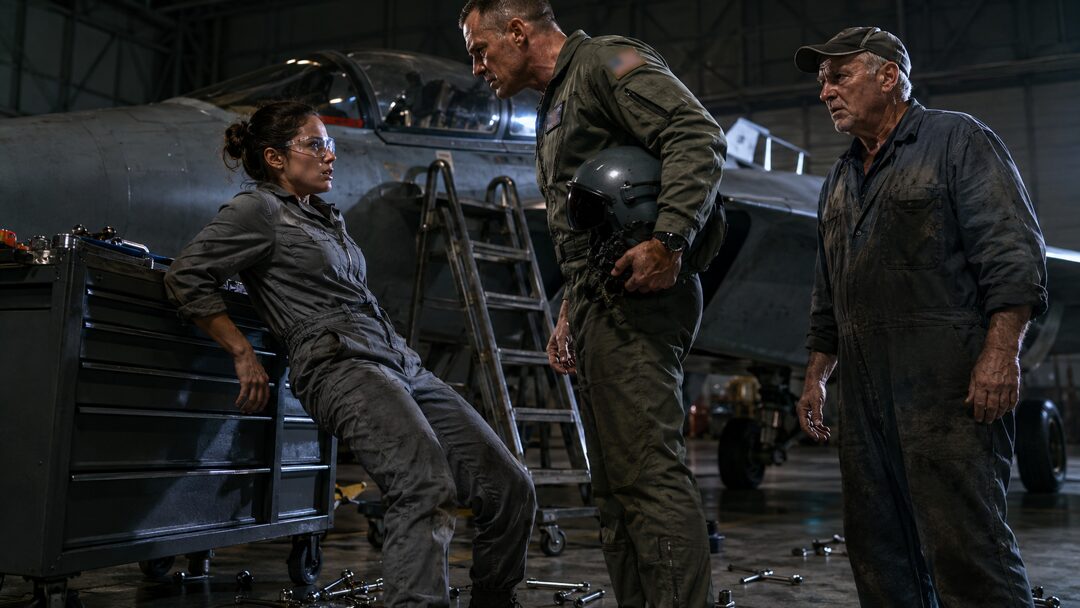
Sarah lay flat on the concrete beneath the wing root, safety glasses fogged at the edges, one gloved hand still pressed against the panel she had just opened.
She stared at the red smear.
Then she heard Carter’s voice.
“Ladder.”
He was already there.
Sarah rolled out from under the aircraft so fast her shoulder clipped the service cart. She came up on one knee, still holding the inspection light.
“Major Carter, wait.”
He didn’t stop. Green flight suit, helmet under his arm, jaw set like he had carved it that way. The squadron patch on his shoulder was faded from years of use, but everything else about him looked ready for a photograph.
Sarah saw his boot hit the first step.
So she grabbed his ankle.
The hangar seemed to inhale.
Carter twisted down at her, disbelief flashing before anger. “Let go.”
“This aircraft can’t fly.”
He jerked his foot free. Sarah’s grip slipped. Her shoulder slammed into the rolling tool chest, and the cart rocked sideways.
Wrenches hit the concrete.
One by one, then all at once.
The sound traveled farther than it should have.
Every mechanic nearby turned. A fuel tech froze with a hose in his hands. Someone near the nose stopped mid-sentence. The ladder crew looked from Carter to Sarah, then down at the scattered tools around her knees.
Carter stepped off the ladder slowly.
“What did you just say?”
Sarah pushed herself upright. Her safety glasses had slipped crooked on her face. She fixed them with the back of one wrist, leaving a dark streak across the clear plastic.
“I said it can’t fly.”
Carter looked at the tools on the floor, then at her. His voice dropped.
“You put your hand on me in front of my crew.”
Sarah could feel the eyes on her. She could feel how it looked. A junior mechanic on the floor. A celebrated pilot standing over her. A stopped clock, a delayed aircraft, a room full of people waiting to decide whether she was brave or unhinged.
But the red line was still under the aircraft.
And if she was right, none of that mattered.
“The emergency cooling line is contaminated,” she said. “There’s seepage at the lower seam.”
Carter’s expression did not change.
“The aircraft passed inspection.”
“The outer panel passed. I signed that. I did not sign the internal line.”
“You are not authorized to ground my jet.”
“I’m not grounding it.” Sarah swallowed. “The jet is grounding itself.”
A few feet away, Robert Hayes moved through the crew with the weary speed of a man who had spent thirty years arriving just before things became impossible. His faded coveralls were zipped halfway. Silver hair showed beneath his cap. He saw the tools first, then Sarah’s face, then Carter’s.
“Sarah,” Robert said quietly. “Stop talking until we check the log.”
Carter turned on him. “The log was checked.”
Robert’s mouth tightened.
That half-second was enough.
Carter saw it. So did Sarah.
The entire hangar saw it.
Carter looked back at her, colder now. “So that’s what this is.”
Sarah’s stomach dropped. “No.”
“You missed something, and now you’re trying to turn it into a flight risk.”
“I didn’t miss this.”
“Then why isn’t it in the record?”
Because the record was clean.
Because the record always looked clean when the problem lived somewhere nobody wanted to open twice.
Sarah looked past him toward the belly of the aircraft. From this angle, the red trace was hidden by shadow.
She had seen it.
No one else had.
And suddenly, that felt like the weakest kind of truth in the world.
Part II — The Clean Record
Carter moved closer, forcing Sarah back toward the tool chest without touching her yet.
“Do you know who’s watching this flight?” he asked.
Sarah did. Everyone did.
The observation gallery beyond the glass held defense officials, budget people, two commanders from the regional office, and men in suits who smiled without ever looking relaxed. The demonstration had been postponed twice already. One more delay, people had whispered, and the squadron might lose the upgrade package entirely.
Carter had heard those whispers too.
Maybe he had heard them louder than anyone.
“This isn’t a training hop,” he said. “This is the flight that keeps this unit alive.”
Sarah’s voice came out sharper than she intended. “A unit isn’t alive if the jet cooks itself in the air.”
His face changed.
Not much. Just enough.
The kind of change that happened when a door opened on a room no one was supposed to see.
“Choose your words,” he said.
“I am.”
“Then choose better.”
Robert stepped between them, but not fully. He kept one hand low, palm down, the way he did when calming a spooked crew.
“Major, give me two minutes with the log.”
“You’ve had months with that log.”
“Then give me two minutes with the aircraft.”
Carter’s eyes stayed on Sarah. “She touched me. She interrupted taxi prep. She accused my crew of clearing a bad aircraft.”
“I accused the aircraft,” Sarah said.
“No,” Carter said. “You accused everyone who signed for it.”
That landed.
She hated that it landed.
Behind Carter, a younger mechanic looked down at his boots. Another crossed his arms and looked away. Not because they thought she was wrong. Because they knew what happened when paperwork was challenged in public.
Mistakes were corrected quietly.
Failures were assigned loudly.
Sarah bent and picked up one wrench, mostly to keep her hands from shaking. The steel was cold through her glove.
Carter saw the movement and mistook it for retreat.
He stepped toward the ladder again.
Sarah moved in front of him.
“No.”
The word was small, but it cut through the hangar.
Carter stared at her.
“Move.”
“Not until that line is inspected.”
“You’re done.”
“I’m not.”
He shoved the tool cart away from the ladder.
It rolled hard into Sarah’s hip, knocking her sideways. Her back struck the edge of the chest, and the drawer she had not closed spilled open.
Sockets scattered across the concrete like coins.
For a second, nobody moved.
Sarah braced one hand on the cart and stayed standing.
Her face burned. Not from pain. From the silence.
Public embarrassment had weight. It pressed on her shoulders harder than Carter’s hand ever could have.
She heard Robert say, “Major.”
Carter did not look at him.
Sarah straightened her glasses again. One lens was scratched now.
“If you want to prove me wrong,” she said, “open the panel.”
Carter leaned close enough that she could smell the faint bite of flight-line coffee on his breath.
“You don’t get to panic and call it courage.”
Sarah looked up at him.
“And you don’t get to call a warning panic just because it comes from someone below you.”
That was when the hangar doors at the far end opened.
Four officers entered in a line, walking quickly, their shoes too polished for the floor they were crossing. At the center was Colonel Thomas Reed, crisp uniform, rigid jaw, eyes already narrowed at the scene.
The room shifted before he spoke.
People stood straighter.
Voices died.
Carter took one step back from Sarah and became Major Carter again.
Sarah remained beside the open tool chest, surrounded by the evidence of how little room she had been given.
Colonel Reed stopped ten feet from them.
He looked at the scattered tools, then at Carter, then at Sarah.
“Someone tell me why my aircraft is still in the hangar.”
Carter answered first.
“Sir, a mechanic interrupted launch prep after an unauthorized inspection. I believe she’s attempting to cover a missed check.”
Sarah felt the sentence strike harder than the cart.
Reed turned to her. “Name.”
“Sarah Mitchell, sir.”
“Position.”
“Aircraft maintenance technician, assigned to this airframe.”
“Problem.”
“The emergency cooling system shows contamination. The ground pressure could read normal, but under full thrust the secondary line may overheat.”
Reed’s face gave nothing away.
“Proof.”
Sarah’s mouth opened.
The red line. The seam. The panel. The smear only she had seen from underneath.
But proof meant something different in rooms like this.
Proof had a signature.
Proof had a timestamp.
Proof had permission to exist.
“The lower seam showed red residue,” she said. “I need the internal line reopened.”
Carter gave a short, humorless breath. “The log says it passed.”
Reed looked at Robert. “Does it?”
Robert’s eyes flicked toward Sarah.
Then toward the aircraft.
Then back to Reed.
“Yes, sir,” he said. “The log shows pass.”
Sarah stared at him.
Robert did not meet her eyes.
The countdown clicked through the speakers again.
“Three minutes to taxi clearance.”
Reed looked at Sarah as if she had become a delay with a name.
“You understand what you are stopping?”
Sarah looked past him, past Carter, past the glass where the officials waited.
“I understand what I’m trying to stop.”
Part III — The Smear on the Glove
Carter was good at being still.
That was part of what made people trust him. He did not fidget. He did not fill silence. He stood with his helmet under one arm and let other people become uncertain around him.
Sarah had seen men like him before. The kind who treated calm as proof and urgency as weakness.
But then he flexed his hand.
Just once.
The glove on his right hand turned slightly under the hangar lights.
Sarah saw red.
Not much. A faint smear across the side of one finger, near the seam in the leather. It had come from his boot when he tore free of her grip. Or from the ladder rail. Or from the outer lip of the cockpit intake where his hand had brushed on the way up.
Her pulse jumped.
“It’s not only below,” she said.
Reed’s eyes sharpened. “What?”
Sarah pointed. “His glove.”
Carter looked down.
For the first time, something like doubt crossed his face.
A mechanic behind Robert whispered, “Damn.”
Carter’s jaw tightened again. He lifted his hand as if the smear were an insult.
“That could be from the floor.”
“No,” Sarah said. “It’s the test compound. It wicked upward through the quick-release valve.”
Robert’s shoulders sank almost invisibly.
Sarah saw it.
Now she understood why he had not looked at her.
“Robert,” she said.
He shook his head once.
Not here.
Not now.
But here and now were all they had.
“Get me the thermal scope,” Sarah said.
Reed looked at Robert. “Do it.”
Robert did not move immediately.
That hesitation changed the air more than any confession could have.
Sarah stared at him. “You knew there was a gap.”
Robert’s face hardened with pain. “I knew we were short two inspectors and running twelve-hour rotations.”
“That’s not what I asked.”
“No,” he said. “It isn’t.”
Carter’s gaze moved between them. “What gap?”
Robert exhaled through his nose. He suddenly looked older than he had two minutes ago.
“The internal line was replaced after the last pressure cycle,” he said.
Reed went very still. “And?”
“And the outer system passed.”
Sarah’s voice was quiet. “But nobody verified the internal line after the replacement.”
Robert’s silence answered.
The hangar no longer felt silent because people were waiting. It felt silent because everyone was calculating blame.
Carter turned on Robert. “You cleared this aircraft.”
“I cleared it based on the inspection packet I had.”
“You signed it.”
“Yes.”
“And now?”
Robert looked at the jet. “Now I want the scope.”
No one thanked him.
No one forgave him.
A crewman ran toward the equipment locker.
Sarah knew Robert was not weak. That was what made it worse. He had kept boys steady under engine fires, talked panicked recruits through midnight repairs, covered for exhausted crew members who had not slept enough to remember their own names.
He protected people.
But sometimes protection became a hand over the alarm.
Carter stepped closer to Sarah, voice low enough for only her and Robert to hear.
“You have any idea what you’re doing?”
“Trying to keep you alive.”
His mouth tightened.
“Don’t.”
The single word carried more than anger.
Sarah looked at him properly then. Past the rank. Past the posture. Past the polished fury.
There were shadows under his eyes. Not sleeplessness from one night. Something older. Something that had learned to stand at attention.
“You think this flight fixes it,” she said.
Carter froze.
Robert looked away.
Sarah should have stopped. She knew she should have stopped. But the hangar had spent six months not saying one name, and silence had already become part of the machine.
“Michael Grant saw a warning light before his last run,” she said.
Carter’s face went flat.
“Don’t use his name.”
“You came back without him because someone called it sensor noise.”
His hand closed around the helmet.
“You weren’t in that cockpit.”
“No,” Sarah said. “I was on the ground reading the maintenance chatter after.”
“That’s not the same.”
“No. It’s worse. I got to watch everyone decide afterward which details were safe enough to remember.”
Carter stepped in so close Robert moved between them again.
Sarah did not move back.
Carter’s voice was low, almost shaking now. “You don’t know what happened up there.”
“I know a warning was easier to doubt than a schedule.”
His eyes changed.
For one second, the anger cracked and something raw looked through.
Then it vanished.
Carter turned to Reed.
“Sir, order the ground spool. We’ll prove it here.”
Sarah’s stomach tightened.
“No.”
Reed looked at her. “You asked to make the problem visible.”
“A controlled spool can still trigger ignition temperature if the contaminant reaches the secondary valve.”
Carter gave her a hard look. “You said it fails under thrust.”
“I said under stress. There’s a difference.”
Reed’s patience was gone. “Enough. We are not launching. We are conducting a controlled engine spool. Everyone behind the safety line.”
Sarah shook her head.
“Not until I see the thermal read.”
Reed’s stare moved over her crooked glasses, the grease on her cheek, the tools at her feet.
“Ms. Mitchell, if you refuse a direct safety order, I will have you removed from this hangar.”
Robert stepped forward.
“Sir.”
Reed did not look away from Sarah. “Choose carefully, Hayes.”
Robert swallowed.
Sarah watched the choice happen in him.
Not all at once. Not beautifully. Not bravely in the way stories liked to pretend. It looked painful. It looked like a man dragging truth out from under years of habit.
“She’s right about one thing,” Robert said. “The line was never independently verified after the replacement.”
Reed turned.
Robert kept going before he could lose the nerve.
“The log is incomplete.”
The words did not echo.
They landed.
Carter looked at Robert as if another aircraft had vanished from formation.
Sarah closed her eyes for half a second.
She was no longer alone.
But that did not mean she was safe.
Part IV — Everyone Watching
The thermal scope arrived in a black case with a cracked handle.
Sarah took it before the crewman could offer it to Robert. Her hands were steady now, which scared her more than shaking would have.
Reed ordered the safety line cleared.
The crew moved back. Slowly at first, then faster when the engine team began final prep. A yellow boundary line stretched across the concrete, bright and absurd under the overhead lights.
Sarah stood just behind it, scope raised.
Carter remained near the cockpit ladder with his helmet under one arm. He had refused to move farther back. Reed allowed it because Reed still needed him in the story as the pilot whose confidence had not broken.
But Sarah saw the smear on Carter’s glove.
He had not removed it.
Maybe he had forgotten.
Maybe he wanted to pretend it was not there.
The engine team called readiness.
Reed gave one sharp nod.
The F-39 woke with a low vibration that moved through the floor before it became sound. Sarah felt it in her knees, in the bones of her wrist, in the teeth she had clenched too hard.
The gauge panel lit green.
Normal.
She lifted the scope to the intake seam.
The screen showed cool blue, steady yellow, clean edges.
Nothing.
Her breath slowed in the wrong way.
Carter looked at her from beside the ladder.
Not triumphant yet. Waiting.
The engine climbed.
The hangar filled with controlled thunder.
Still nothing.
Sarah adjusted the scope angle. Lower seam. Upper valve. Intake lip. Secondary channel.
Nothing.
Behind her, someone shifted.
That small sound was worse than a shout.
It meant people were beginning to believe the room again instead of her.
Reed checked his watch.
Carter came closer, just enough for his voice to reach her beneath the engine note.
“You wanted everyone watching,” he said. “Now they are.”
The words hit exactly where he aimed them.
Sarah saw herself the way they must see her: glasses scratched, hair coming loose, grease across one cheek, surrounded by the tools she had dropped and the accusation she had made.
Maybe she had mistaken residue from the service cart.
Maybe the smear had transferred from the floor.
Maybe urgency had turned a shadow into a pattern.
Maybe the thing she feared most was happening.
Maybe she was wrong in public.
The scope stayed clean.
Reed raised a hand toward the engine lead.
Sarah’s chest tightened.
Then the screen flickered.
Not at the lower seam.
Not where she had expected.
A small bloom appeared near the secondary bleed valve, pale at first, then brightening toward white.
Sarah’s fear snapped into focus.
“It migrated,” she said.
No one heard her.
The engine climbed another notch.
The bloom widened.
Sarah lowered the scope and shouted with everything in her.
“Shutdown!”
Reed turned.
Carter turned.
The engine lead hesitated, waiting for the command from the correct mouth.
Sarah looked at Carter.
For one second, their eyes met across the noise.
She saw him understand enough to be afraid, but not enough to move.
Because moving meant admitting she had been right.
Because stopping meant another mark against his name.
Because six months ago, somewhere above a cold border line, a warning had blinked and someone had called it noise.
Sarah dropped the thermal scope.
It hit the concrete behind the yellow line.
She ran.
“Mitchell!” Reed shouted.
The engine sound grew teeth.
Carter lunged after her.
Sarah crossed the safety line and reached the external service panel just as the first cough ripped through the jet.
It was not an explosion. It was worse in its own way: a wrong sound from a machine built to sound powerful, not sick.
Her gloved hand found the manual cutoff lever.
For half a second, it resisted.
Then she drove her whole weight into it.
The lever slammed down.
The jet shuddered.
A burst of red-pink smoke vented from the intake seam, thick and sudden, followed by a scatter of sparks beneath the wing root. Emergency lights snapped on overhead, washing the hangar crimson.
The smoke rolled low over the concrete.
People shouted from behind the safety line.
Carter stopped inches from Sarah.
He had one hand out as if he meant to grab her.
He did not.
The engine wound down in a long, wounded whine.
Sarah kept her hand on the lever until the sound dropped beneath the pounding of her own heart.
No one spoke.
The aircraft had done what Sarah could not.
It had made the truth visible.
Part V — The Wrench on the Cart
When the last vibration left the floor, the hangar felt too large.
Red smoke thinned around the intake. The emergency lights kept turning, slow and merciless, coloring every face the same.
Carter lowered his hand.
His eyes moved from Sarah to the seam, to the sparks dying under the wing, to the glove he still wore.
The smear was there.
A little darker now.
A little impossible to ignore.
Colonel Reed crossed the safety line himself. Nobody stopped him.
He looked at the vented smoke, then at the service panel, then at Sarah’s hand still locked around the cutoff lever.
“Ground it,” he said.
Two words.
No ceremony.
No apology.
But the whole room changed around them.
The engine lead repeated the order. The crew began moving again, carefully, with the stunned obedience of people stepping around the edge of what almost happened.
Robert came to Sarah’s side.
For a moment, he only looked at the aircraft. Then he removed his cap.
“Sir,” he said to Reed, voice rough but clear. “The incomplete verification is mine.”
Sarah turned to him.
Robert did not look heroic. He looked exhausted. He looked like a man who had finally put down something heavy and discovered it had been holding him up too.
Reed stared at him for a long moment.
“We’ll address that,” he said.
“I understand.”
“No,” Reed said, looking toward the smoke. “I don’t think any of us did.”
That was as close as he came to confession.
It was enough for the room.
Not enough for what nearly happened.
Sarah released the lever. Her fingers ached when she opened them. She became aware of her hip where the cart had struck her, her shoulder where the metal edge had caught, the sweat cooling under her collar.
The tools were still on the floor.
Wrenches. Sockets. A driver bit near Carter’s boot.
All the ordinary things that kept extraordinary machines from becoming coffins.
Carter removed his gloves slowly.
He looked at the red smear on one finger as if it belonged to someone else. As if some version of him had left it there before he knew what it meant.
Sarah waited for him to speak.
Part of her wanted an apology.
Part of her knew she would hate it if he gave one too easily.
He walked past her.
For one bitter second, she thought he was leaving.
Then he bent down.
Carter picked up a wrench from the floor.
It was the first one that had fallen, the one Sarah had grabbed when she needed something cold to hold instead of fear. He turned it once in his bare hand, then placed it gently on top of her tool chest.
The sound was small.
Metal against metal.
It carried.
Carter looked at Sarah then.
Not warmly. Not softly. Nothing in his face asked to be forgiven.
But something had been stripped from him. The hard shell of certainty. The cruel convenience of calling her panic what he did not want to hear.
“Show me where it started,” he said.
Sarah looked at him.
Behind him, the aircraft sat wounded and silent. Robert stood with his cap in his hands. Reed was already speaking into a radio, his polished shoes planted in the dirty place where truth had finally arrived.
Sarah thought of Michael Grant, whose name had been kept out of mouths because grief was easier to manage when it had no sound.
She thought of the warning light no one had wanted to believe.
She thought of how close they had come to making silence official again.
Then she picked up the inspection light from the cart.
Her hand shook once.
Only once.
She stepped toward the lower seam, and Carter followed.
Not beside her.
Not yet.
A little behind.
For now, that was enough.