The Nurse Was Rushing His Discharge Until She Read The Faded Card Beside His Bed
Chapter 1: The Soldier In The Doorway Said Nothing
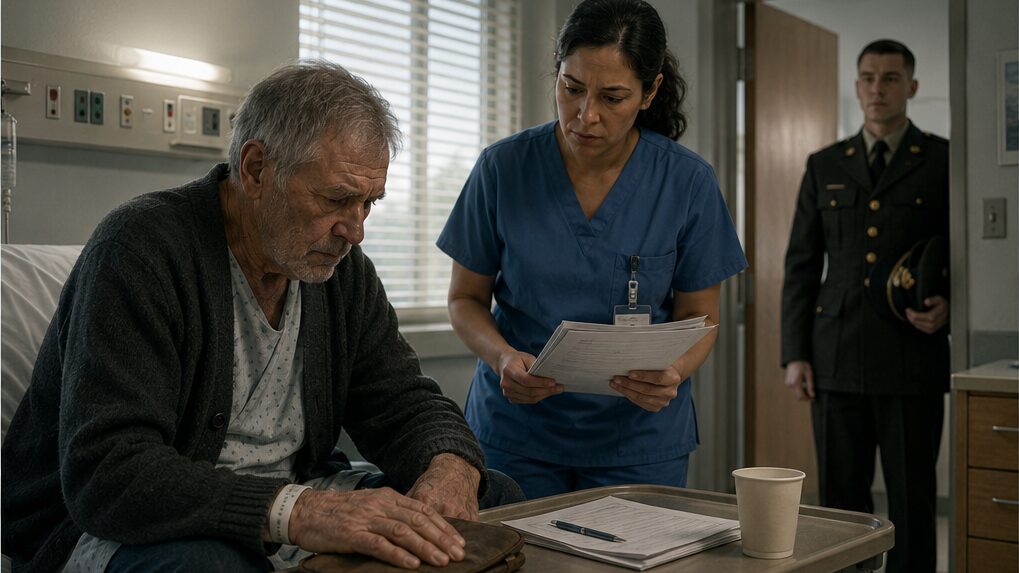
The soldier stood in the doorway and did not blink when Anna Garcia pulled the discharge papers from the printer tray.
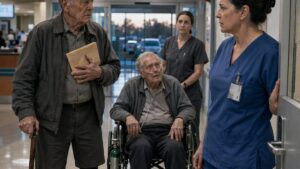
Samuel Mitchell saw him before anyone said a word. Not because the young man moved, or cleared his throat, or stepped into the room, but because hospital rooms taught old men to notice shadows. The soldier’s reflection stood narrow and still in the dark glass of the wall-mounted television, his dress uniform too sharp for a place that smelled of antiseptic wipes, lukewarm broth, and plastic tubing.
Samuel lowered his eyes to his own hands.
The right one was bruised purple where the IV had been removed. The left wore a white hospital wristband that had rubbed a raw line into his skin. His cardigan lay across his shoulders over the thin hospital gown because he had refused the second blanket. The cardigan was dark, old, and pilled at the cuffs, with one button that had been replaced by a mismatched black one years ago. He kept his fingers folded near that button as if holding himself together.
On the bedside tray sat a paper cup of water, two unopened saltine packets, a pen, a stack of forms, and the small brown bag Anna had found in the drawer beneath his clothes.
The bag worried Samuel more than the soldier.
It was a plain thing, soft from age, with a cracked strap and a stain near the bottom corner. A younger nurse had called it a pouch when she moved it from the ambulance belongings bin. Anna had called it “your personal item.” Samuel had not corrected either of them. He had only kept it within reach.
A corner of the faded card showed from beneath the bag’s folded flap.
Anna stepped between him and the tray with the practiced hurry of someone trying not to look hurried. Her badge swung against her blue scrub top. She had kind eyes when she remembered to use them, but right now her attention was split among the forms, the clock, and the tablet tucked under her arm.
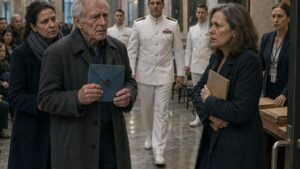
“Mr. Mitchell,” she said, “we just need to finish a few things before transport is requested. Your discharge instructions, medication list, follow-up appointment, and the placement consent.”
Samuel looked at the papers but did not reach for them.
Anna waited. The fluorescent light hummed. Somewhere down the hallway a cart wheel squeaked, stopped, then squeaked again.
“Do you understand what I’m saying?” she asked, not unkindly, but louder than before.
Samuel nodded once.
“All right. Good.” She softened a little, then glanced toward the doorway. “And is he with you?”
Samuel did not turn his head.
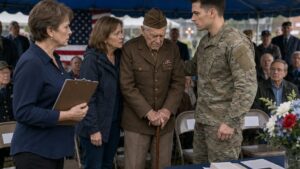
The soldier remained where he was, heels together, cap held against his side. He was young enough that his face still looked surprised by its own seriousness. His jaw tightened when Anna looked at him, but he did not enter.
“I asked him to wait,” Samuel said.
His voice came out dry, more breath than sound.
Anna paused. “So you know him?”
Samuel looked at the brown bag. “No.”
The answer made the room feel smaller.
Anna’s fingers tapped the top page of the discharge packet. “Mr. Mitchell, if there’s a family member or visitor involved, it helps if we know. We’re trying to make sure you leave with the right support.”
“I said he could wait.”
“That isn’t quite the same thing.”
Samuel said nothing.
Anna studied him for another second. He knew what she saw: an old man who had been admitted after dizziness in a grocery-store parking lot, an old man with low blood pressure, stubborn answers, no reliable ride, and a daughter listed as emergency contact but not present. She saw the gray stubble he had not shaved, the skin at his throat loose above the gown, the old cardigan, the cheap socks the hospital had given him. She saw a problem with paperwork.
She did not yet see the card.
“Let’s start with the instructions,” Anna said. “You’ll need to take the new medication once in the morning. Do you have someone at home who can help you organize pills?”
Samuel shook his head.
“Do you live alone?”
He nodded.
“Do you have stairs?”
He looked at the floor.
“Mr. Mitchell.”
“Three.”
“Three stairs, or three flights?”
“Steps. Front door.”
Anna wrote something on the page. “Do you cook for yourself?”
He gave another nod.
“Can you get groceries?”
“I was getting groceries when they brought me here.”
The answer came sharper than he intended. Anna’s pen stopped. The soldier’s reflection did not move, but Samuel felt him listening.
“I understand,” Anna said. “Still, we have to ask these questions.”
Samuel looked past her to the window. The blinds were half closed, slicing the late-morning sun into pale bars across the wall. If he kept his gaze there, he could almost ignore the brown bag. Almost ignore the soldier. Almost ignore the way being questioned in a hospital gown made a man feel twelve years old and guilty of something he could not name.
Anna turned to the tray. “I’m going to organize these so nothing gets lost.”
Samuel’s hand moved before he meant it to.
It landed on the brown bag, fingers spread, not gripping hard enough to seem dramatic but enough to stop her. His knuckles brushed the corner of the faded card and pushed it further under the flap.
Anna looked at his hand. Then at his face.
“I’m not taking anything,” she said.
“I can do it.”
“You’re still on fall precautions.”
“I’m sitting.”
“Mr. Mitchell.”
“I said I can do it.”
The room held still around his words.
Anna drew a slow breath through her nose. Samuel could tell she was measuring him against the morning schedule, the empty beds needed downstairs, the next patient waiting in the emergency department, the case manager who had already called twice. He did not blame her. Hospitals had their own weather, and people moved through them trying not to drown.
But her hand was still near the tray.
He pulled the bag closer until it rested against his hip.
A scrap of the card slid free.
The corner was yellowed, soft at the edge. A line of faded block letters showed, not enough to read unless someone already knew how such records were written. Samuel saw Anna’s eyes catch on it. Only for a moment.
Then a voice from the doorway said, “Ma’am.”
The soldier had spoken quietly, but the word cut through the room.
Anna turned. “Yes?”
The young man swallowed. His gaze flicked to Samuel, then to the brown bag, then back to Anna as if asking permission from both of them and receiving it from neither.
“I don’t want to interrupt,” he said.
“Are you family?” Anna asked.
“No, ma’am.”
“Then I’ll need you to wait outside until we finish.”
“I can do that.”
But he did not move.
Samuel closed his eyes.
He knew that kind of stillness. Young men in uniform learned it when they were afraid to ask the thing that brought them there. They were trained to stand straight even when the question in their chest was anything but straight.
Anna’s voice shifted, not softer, only more controlled. “Sir, I need to finish my patient’s discharge.”
The soldier nodded. “Yes, ma’am.”
Then he looked directly at Samuel.
“Are you Samuel Mitchell?”
The name entered the room like an object dropped onto tile.
Anna turned back to him. Samuel kept one hand on the brown bag and the other on his knee. The television reflection showed the soldier waiting, the nurse watching, the old man sitting very still in a gown that did not close properly at the shoulder.
Samuel had spent decades making his name ordinary.
In that room, with the card half-hidden beneath his palm, it suddenly was not.
Chapter 2: The Faded Card Changed Her Voice
Anna had learned not to stare at patients when a visitor said something strange.
Hospitals collected strange statements the way sinks collected rust around the drain. Sons arrived after three years and called themselves caregivers. Neighbors claimed to be sisters. Patients denied their own birthdays and remembered the name of a dog from 1968. People told the truth badly, lied tenderly, and forgot things that mattered. Anna had learned to keep her face neutral until the room gave her more.
But when the soldier said Samuel Mitchell’s name, the old man’s hand tightened on the brown bag as if he had been struck.
“Mr. Mitchell?” Anna said.
Samuel did not look at her.
The soldier took half a step forward, then stopped himself at the threshold. “I’m sorry. I was told not to push.”
“By whom?” Anna asked.
He hesitated.
Samuel opened his eyes. “Don’t.”
The soldier’s mouth closed.
Anna looked between them. The discharge forms suddenly felt indecent in her hands. Medication schedule. Fall-risk instructions. Skilled placement refusal. Follow-up appointment. All necessary, all correct, all too thin for the weight that had entered the room.
“Mr. Mitchell,” she said, “is there something I need to know before we continue?”
“No.”
The answer was immediate.
“Is he threatening you?”
The soldier’s expression changed fast. “No, ma’am. Never.”
Samuel let out a small breath. It might have been a laugh if it had belonged to another man.
“He isn’t threatening me,” he said.
“Then why is he here?”
Samuel looked at the tray. “Ask him outside.”
“I did,” Anna said. “He stayed.”
The old man’s fingers loosened, and that was when the card slipped out another inch.
Anna saw more of it this time. Not enough to understand, but enough to feel that it did not belong with modern discharge paperwork. It was thick, creased paper, nearly cloth at the fold, with a faded reddish-brown mark near one corner. Not blood, she told herself, because that was absurd. Old ink, old dirt, old whatever paper collected when carried too long.
She reached toward it.
Samuel’s hand covered it again.
“Please don’t throw it away,” he said.
The room changed around that one word. Please.
It was the first thing he had asked instead of resisted.
Anna withdrew her hand at once. “I won’t.”
He watched her as if promises from nurses were part of a language he had forgotten how to trust.
“I mean it,” she said. “I won’t throw it away.”
The soldier lowered his eyes.
Anna set the discharge packet on the bed instead of the tray. She pulled the rolling stool closer and sat, reducing herself by a few inches. It was a small thing, but she saw Samuel notice.
“May I look at it?” she asked.
“No.”
“All right.”
That answer seemed to surprise him more than pressure would have.
Anna folded her hands loosely. “Then can you tell me whether it affects your discharge? Medical instructions? A contact we should call?”
Samuel stared at the card under his palm.
“No.”
“Is there someone listed on it?”
His jaw shifted.
The soldier spoke from the doorway, voice low. “There is.”
Samuel’s eyes cut toward him, not angry exactly. Warning.
Anna turned. “You’ve seen it?”
“Only a copy,” the soldier said. “A bad one. From a photo.”
“Tyler,” Samuel said.
So the old man did know his name.
Anna caught it and let the silence hold the fact.
The soldier stood straighter when Samuel said it, as if hearing his name from that voice had confirmed something private. “Yes, sir.”
“Don’t call me that.”
The young man nodded once. “Yes.”
Not yes, sir. Just yes.
Anna looked at the card again. “Mr. Mitchell, I’m going to ask one more time. May I pick it up?”
He did not answer.
She waited.
Outside the room, an overhead page called for respiratory therapy. A monitor beeped two doors away. The ordinary hospital continued, unaware that in room 314, an old man was fighting a piece of paper.
Finally Samuel lifted his hand.
Anna moved slowly, the way she would near a frightened child or a glass vial of medication. She touched the edge of the card with two fingers, not pinching, not snatching. It was softer than she expected. The fold was worn nearly white.
The handwriting had faded but not disappeared.
FIELD EVACUATION RECORD.
The words were printed across the top in old block type. Below them, in lines filled by hand, were names, numbers, unit markings, dates, blood type, transport notes. Anna’s eyes moved carefully, gathering pieces without yet understanding the whole.
Patient: Brown, Ronald.
Attending medic: Mitchell, S.
Her fingers went cold.
Not because of the military words alone. Her father had kept old service papers in a shoebox in his closet, and she had seen forms with abbreviations and stamped boxes. This was different. This was not decoration. This was not a certificate framed for a wall. This was a working thing. A record meant to move with a wounded man while other hands tried to keep him alive.
Anna looked up.
Samuel’s face had gone blank in a way that was not blank at all. His eyes were fixed just past her shoulder. His body seemed smaller under the cardigan, but his hand on the sheet had curled so tightly that the hospital blanket wrinkled beneath it.
“You were a medic,” Anna said.
Samuel’s mouth moved. No sound came.
The soldier in the doorway bowed his head.
Anna looked back down. She read only one more line before she stopped herself.
Condition on evacuation: critical.
She did not read it aloud.
The discharge papers lay on the bed between them, white, clean, current. The card in her hand seemed to carry dust, heat, noise, and a younger man’s handwriting. Anna felt ashamed of how quickly she had reached for the bag, how easily she had sorted his life into “belongings,” how loud her questions had become when he did not answer fast enough.
She stood.
Samuel looked at her then, wary.
Anna placed the card on her open palm and held it out toward him, not flat on the tray, not dropped on the bed, not handed back like clutter. Held it where he could choose to take it.
“I didn’t know,” she said.
Samuel looked at the card, not at her. “Most people don’t.”
Anna’s throat tightened. She had seen patients cry and families argue. She had watched people receive diagnoses that emptied their faces. But this old man’s restraint made her more careful than tears would have.
She set the card gently on the tray beside his wristband.
Then she did something she had not planned.
She stepped back from the bed. Her shoulders straightened. Her right hand rose, clean and steady, to her brow.
The salute was not grand. It was not for anyone outside the room. It lasted only a few seconds.
Samuel flinched as if it hurt.
The soldier did not move. His eyes shone, but he remained silent.
Anna lowered her hand.
“Mr. Mitchell,” she said, and this time her voice carried no hurry, “I’m sorry for how I handled your things.”
Samuel stared at the card. His lips pressed together, then loosened.
“You handled paper,” he said.
“No,” Anna replied quietly. “I handled something I did not understand.”
That reached him. She saw it in the slight turn of his head, in the way his guarded eyes moved to her face and stayed there long enough to register that she meant it.
The hallway moved behind Tyler Brown. A transport aide passed with an empty wheelchair and glanced in, curious. Anna stepped sideways, blocking the view without thinking.
Samuel noticed.
So did Tyler.
Anna picked up the discharge papers and folded them closed. “We can slow this down.”
“No need.”
“There may be.”
“I don’t need a parade.”
“You’re not getting one.”
The corner of Samuel’s mouth shifted, almost a warning, almost amusement.
Anna placed the packet on the counter instead of the bed. “But I do need to understand what matters before I send you out of here with a packet and a ride you may not have.”
Samuel looked tired again. Not ordinary tired. Old tired. The kind that lived under the skin.
Tyler’s fingers tightened around his cap. “Mr. Mitchell, I didn’t come to make trouble.”
Samuel did not look at him.
Anna touched the edge of the tray, not the card. “Is the name on this card why he’s here?”
Silence.
Then Samuel reached for the faded paper. His hand trembled only once before he controlled it. He slid the card beneath his palm and pulled it toward the brown bag.
When he spoke, the words were so quiet Anna almost missed them.
“It isn’t mine.”
Chapter 3: The Discharge Papers Did Not Slow Down
By early afternoon, the hospital had returned to its pace as if nothing had happened in room 314.
That was what unsettled Samuel most.
The card was sealed inside the brown bag again, tucked beneath a folded undershirt and a pair of socks worn thin at the heel. Anna had found a plastic patient-property envelope and offered it, but Samuel had refused. Plastic was too loud. Plastic made everything look temporary, official, disposable. The brown bag had carried what mattered longer than most people had known him.
Now it rested against his side on the bed, one strap looped around his wrist.
He could still feel the shape of the card through the cloth.
Anna had left after the salute, promising to check something with case management. Samuel had expected her to return with a softer voice and the same paperwork. She did return softer, but the paperwork came with her, and behind it came Mark Davis.
Mark was not unkind. That made him harder to dislike.
He entered with a tablet held against his chest and reading glasses pushed up into his hair. His tie was slightly crooked, his sleeves rolled once. He looked like a man who had skipped lunch and considered that proof of dedication.
“Mr. Mitchell,” he said, “I’m Mark Davis, case management. We spoke briefly yesterday.”
Samuel remembered the voice, not the face. Voices through hospital curtains became part of the machinery.
Mark glanced at Anna, then at the brown bag. “I understand there have been some concerns about your discharge.”
“No concerns,” Samuel said.
Anna stood near the foot of the bed. “There are a few things we need to clarify.”
Mark nodded in the practiced way of someone agreeing before steering the conversation back where he wanted it. “Absolutely. Clarification is good. But medically, he’s cleared. Vitals are stable, labs improved, no acute reason to keep the bed.”
The bed.
Samuel looked at the rails on either side of him.
Not the man. Not Mr. Mitchell. The bed.
Anna’s mouth tightened, but she did not interrupt.
Mark tapped the tablet. “You declined short-term rehab yesterday.”
“I declined a place I don’t know,” Samuel said.
“That’s your right. But if you go home, we need safe transport and confirmation that you can manage medication and follow-up. Your daughter is listed as emergency contact, but we haven’t reached her.”
“Don’t call her again.”
Mark paused. “Is there a reason?”
Samuel looked toward the window. The blinds had been opened now. Sunlight struck the metal arm of the bedside table and flashed against the wall. “She’s busy.”
“Mr. Mitchell, respectfully, everyone is busy. That doesn’t answer the safety question.”
Anna shifted her weight. Samuel could feel her watching him, different from before. Before, she had watched for compliance. Now she watched for the spot where pressure became harm.
Mark continued, “Do you have a neighbor? Friend? Church member? Anyone who can pick you up?”
“No.”
“Can you pay for medical transport?”
Samuel’s hand tightened around the bag strap.
Anna said, “We can look at options.”
“We can,” Mark said, “but options take time, and time is part of the issue. The emergency department is holding three admissions.”
Samuel let his eyes close for one second. In the dark behind them, the words arranged themselves plainly.
Someone else needed the bed. He was in the way.
He had been in the way since the grocery-store parking lot, when his knees bent without permission and strangers leaned over him asking questions. He had been in the way when the ambulance doors closed. In the way when the night nurse helped him stand. In the way when breakfast arrived and he could not open the milk carton with one hand because the IV tape pulled at his skin.
Now he was in the way of three unseen people downstairs.
“Give me my clothes,” he said.
Anna did not move.
Mark looked relieved by the clarity. “That may be the best direction if we can arrange—”
“I said give me my clothes.”
Anna’s voice was careful. “Mr. Mitchell, standing quickly is what we’re worried about.”
“I stood in worse places.”
The room stilled.
The words had come out before he could stop them.
Mark’s eyes flicked toward Anna. He did not know what to do with the sentence. Anna did. Samuel saw it land in her, saw her remember the card, the printed line, the name Brown.
Mark cleared his throat. “I respect that you have life experience, Mr. Mitchell, but this is about current risk.”
Samuel opened his eyes. “Life experience.”
Anna said, “Mark.”
He looked at her.
She lowered her voice. “Let’s not minimize.”
“I’m not minimizing,” Mark said, though his face colored slightly. “I’m trying to make a safe plan within the resources we have.”
Samuel almost preferred the earlier version of the day, when no one knew anything. It had been simpler to be stubborn when they thought stubbornness was all he had.
Now Anna knew just enough to be gentle, and Mark knew not enough to stop being efficient.
The soldier was still outside.
Samuel had seen him through the narrow gap when the door swung open. Tyler Brown sat in the hallway chair, cap on his knee, elbows resting on his thighs. He had not asked to enter again. He had not left either.
That persistence made Samuel uneasy.
Mark followed his gaze. “Is that young man involved in your discharge?”
“No.”
“He’s been here for some time.”
“He can leave when he wants.”
“Is he family?”
“No.”
Anna looked down at the floor.
Mark frowned. “Is he a problem?”
The question was not cruel. It was administrative. A box waiting to be checked: family, friend, threat, nuisance, clergy, unknown.
Samuel looked at the brown bag.
Inside it, the faded card held a name that was not his. Brown, Ronald. A name that had been a body once. A voice. A hand gripping Samuel’s sleeve with impossible strength. A boy who kept asking whether the helicopter was close, though the sound overhead belonged to something else.
“No,” Samuel said. “He’s not a problem.”
“Then what is he?”
Samuel had no answer that would fit a hospital form.
Anna stepped in. “He may be connected to something Mr. Mitchell owns.”
Mark turned to her. “Connected how?”
“That’s not mine to explain.”
Samuel looked at her then.
She had not said veteran. She had not said service. She had not said hero, thank God. She had simply refused to take the story from him.
Mark exhaled, rubbing one hand over his forehead. “All right. We still need a discharge plan. Mr. Mitchell, if your daughter cannot be reached and you decline rehab, we’re looking at either private transport home with documented refusal or a social work delay, which may not be approved.”
“Document refusal,” Samuel said.
Anna moved closer to the bed. “Before you decide that, will you let the veteran liaison speak with you?”
“No.”
“It doesn’t obligate you.”
“No.”
Mark lifted the tablet slightly. “You’ve avoided veterans’ services before?”
Samuel’s eyes hardened. “I avoid waiting rooms.”
Anna heard what Mark did not: not a joke, not quite.
“You served,” Mark said, too late realizing the word had weight in the room.
Samuel’s face closed.
Anna stepped between them just enough to redirect the air. “Mark, can we have ten minutes?”
“We don’t have—”
“Ten minutes.”
He looked at her, then at Samuel, then toward the doorway where Tyler Brown sat visible through the glass panel.
Mark lowered his tablet. “Fine. Ten. But after that we need a decision.”
He left with a controlled nod, the kind that made no promise except to return.
Anna waited until his footsteps faded.
Samuel looked at the brown bag in his lap. “You shouldn’t have done that.”
“Done what?”
“Stood there like I was something fragile.”
“You are in a hospital bed.”
“That isn’t what I mean.”
“I know.”
He looked up, ready to be angry, but her face stopped him. There was no pity in it. That helped. Pity had always felt like someone putting a hand where a wound used to be.
Anna pulled the rolling stool closer but did not sit until he gave the smallest nod.
“The salute earlier,” she said. “I meant it. But I’m starting to understand that meaning it isn’t enough.”
Samuel said nothing.
“If we send you out without a ride, without help, without knowing whether that young man is here for a reason you want handled, then I didn’t respect you. I just reacted to a piece of paper.”
The bag strap creaked under his fingers.
Outside, Tyler Brown leaned forward in the hallway chair, still waiting.
Samuel turned his head toward the doorway.
Anna followed his gaze. “Is he family?”
“No.”
“Is he connected to the name on the card?”
Samuel’s throat moved.
He could say no. He had said no to harder questions from louder people. He could sign refusal, put on his old clothes, take the bag, and disappear into the front loop of the hospital with his discharge packet tucked under one arm.
Then the card would remain what it had been for decades: folded, carried, protected, unanswered.
From the doorway, Mark’s voice cut in before Samuel could speak.
He had returned sooner than ten minutes.
“Anna,” Mark said, standing beside the open door with his tablet in hand. His eyes shifted to the soldier waiting in the chair. “I need to know whether this young man is family or a problem.”
Chapter 4: The Name On The Card Was Brown
Tyler Brown had rehearsed the first sentence for three weeks, but the hospital made him forget it.
He followed Anna Garcia down the hallway with his cap in both hands, careful not to let his steps sound too hard on the polished floor. People looked at him as he passed. A child in a waiting chair stopped swinging one foot. A man at the vending machine straightened without knowing why. Tyler kept his eyes forward. Uniforms did that to rooms. They made strangers expect ceremony, confidence, answers.
He had none of those.
Anna led him into a small family consultation room near the nurses’ station. The room had four chairs, a low table, a box of tissues, and a framed print of a lake that looked like it had never existed anywhere. She set a clean hospital towel on the table before she went back for Samuel. Tyler noticed the towel. He noticed how she smoothed it flat with both palms, as if preparing a place for something breakable.
When Samuel came in, he was in a wheelchair, though he looked offended by it. Anna guided him to the table but did not push him too close. The brown bag rested in his lap. His fingers curled through the strap.
“You don’t have to do this,” Anna said.
Samuel looked at Tyler. “He waited.”
Tyler stood too quickly. “I can leave.”
“Sit down,” Samuel said.
Tyler sat.
Anna remained by the door. “I’ll stay if you want me to stay.”
Samuel did not answer at once. His gaze moved from Anna to the towel, then to Tyler’s hands around the cap.
“He’ll need a witness,” Samuel said.
Tyler did not know whether that meant him or Anna.
Samuel opened the brown bag slowly. The movement took more effort than Tyler expected. It was not weakness exactly. It was care. The old man shifted aside a folded undershirt, a pair of socks, a small paper envelope, and then drew out the faded card.
No one spoke while he placed it on the towel.
Tyler had seen it before only in the photograph his grandmother had kept in a plastic sleeve. The image had been blurred, taken decades ago before the card disappeared into family rumor. His grandmother had called it proof that someone had not left Ronald Brown behind. Tyler’s father had called it a story that got bigger because no one could finish it. When Tyler joined the Army, the story found him again. A veteran liaison had passed along a name. Samuel Mitchell. Possibly alive. Possibly the medic listed on the card.
Now the card lay in front of him, yellowed, creased, real.
Tyler did not touch it.
Samuel watched that restraint and seemed to approve of nothing, which Tyler decided was better than disapproval.
“Read it,” Samuel said.
Tyler leaned forward. The letters swam for a moment before settling.
Brown, Ronald.
His throat tightened.
“That was my grandfather,” Tyler said.
Samuel’s eyes stayed on the card. “I know.”
“You knew?”
“I knew his name.”
“My grandmother looked for the medic,” Tyler said. “For years. She wanted to thank him.”
Samuel’s hand closed on the edge of the wheelchair blanket. “She shouldn’t have.”
Tyler glanced at Anna, who remained still by the door. Her face had gone careful again, not nurse-careful this time, but human-careful.
“My family was told he was evacuated alive,” Tyler said.
“He was.”
“And you were with him?”
Samuel did not answer.
Tyler swallowed. He had imagined this differently. In his mind the old medic had been relieved to be found. Maybe embarrassed, maybe humble, but ready to confirm the story that had sat half-lit in Tyler’s family for years. The brave medic. The evacuation. The last sighting. The missing gratitude finally delivered.
Samuel Mitchell looked like every word was another hand reaching for the bag.
“I’m not here to make you talk about anything you don’t want to,” Tyler said.
Samuel gave him a hard look. “Then why are you here?”
Tyler lowered his eyes to the cap in his lap. The truth sounded selfish when put plainly.
“Because the story stopped with you.”
The old man turned his face toward the blank lake print. His profile was sharp in the overhead light: gray cheek, set jaw, the small tremor at the corner of his mouth that he pressed flat before anyone could name it.
Tyler continued, quieter. “My grandmother died last year. Before she did, she kept asking if anyone ever found Mitchell. She didn’t say your first name. Just Mitchell. The medic. She said Ronald spoke about a man with steady hands in one of his letters before everything changed.”
Samuel’s hand moved once, then stopped.
“Steady hands,” he said.
Tyler heard the bitterness there and did not know what to do with it.
Anna stepped closer but still did not interrupt.
“My father found the photo of the card after she died,” Tyler said. “I sent it through a veteran network. Someone matched the unit, then your name. When the hospital called the wrong number yesterday about a Samuel Mitchell, someone in that office recognized it and contacted me. I was nearby for a training visit. I came because I thought—”
He stopped.
Samuel looked back at him. “You thought what?”
That you would be glad. That I could bring you honor. That I could say my family remembered you and make something old feel complete.
Tyler said none of that.
“I thought you might want to know Ronald Brown’s family still says his name.”
Samuel’s expression changed.
Only a little, but Tyler saw it. The old man’s eyes lowered to the card, and for a second he did not look like someone refusing a story. He looked like someone standing at the edge of one.
“Your grandfather was awake when they put him on the litter,” Samuel said.
Tyler’s grip tightened around the cap.
“He was brave?” Tyler asked, then regretted it at once. It sounded childish. It sounded like he wanted the old man to decorate pain.
Samuel turned toward him slowly.
“Brave,” he said, “is a word people use after. It keeps them from hearing what happened during.”
Tyler nodded, chastened. “I’m sorry.”
“No.” Samuel touched the towel near the card but not the card itself. “He was scared. He knew he was scared. He still asked if the man next to him had water.”
Anna looked down.
Tyler felt something inside him shift. It was not disappointment. It was heavier and better than that. Ronald Brown became less like a photograph and more like a man who might have been cold, thirsty, frightened, kind.
“He was the brave one,” Samuel said.
Tyler’s voice came carefully. “My grandmother would have wanted to hear that.”
Samuel closed his eyes.
The room waited.
When he opened them, he had gone far away, but not completely. One hand rested over the brown bag. The other hovered near the card, the fingers bent as if remembering a different weight.
“He gave me something to say,” Samuel said.
Tyler did not move.
“To his family?” Anna asked softly.
Samuel nodded once.
Tyler’s breath caught. “What was it?”
Samuel drew the card back an inch. Not away from Tyler exactly, but closer to himself.
“I didn’t say it,” he whispered.
Tyler stared at him, the cap forgotten in his lap.
Samuel kept his eyes on Ronald Brown’s name.
“I promised him something,” he said, “and I failed.”
Chapter 5: The Promise He Kept Too Late
After visiting hours, the hospital lights dimmed but did not soften.
Samuel lay half-raised in bed with the brown bag against his ribs, listening to the machinery of other people’s nights. A nurse laughed quietly at the station, then caught herself. A call bell chimed twice. Wheels passed, paused, turned. Behind the privacy curtain of the next room, someone coughed in a deep, wet rhythm that dragged him back and back until the present became a thin sheet over an old place.
He placed the faded card beneath his palm.
For years he had believed that if he pressed hard enough, kept it flat enough, carried it long enough, the card would remain paper. Paper could be folded. Paper could be hidden. Paper could be taken out only when the room was empty and put away before anyone asked why his hands had gone still.
But Tyler Brown had sat across from him with Ronald’s eyes.
Not the exact eyes. That would have been too cruel. Tyler’s were younger, darker, steadier. But when he had asked what the message was, there had been the same open waiting. The same trust that Samuel had not earned and could not return.
The ceiling tile above him had a brown water stain shaped like a country he had never seen on a map.
He closed his eyes.
The first thing was always heat.
Not the story people wanted. Not courage, not flags, not anything clean enough to place in a letter. Heat and the smell of dirt torn open. Men calling for names that belonged to mothers, brothers, God. Samuel on his knees with his aid bag half-empty, one hand pressing gauze where gauze could not do enough, the other reaching for a pulse that kept leaving and returning under his fingers like a frightened animal.
Ronald Brown had been lighter than he looked when they dragged him behind the broken wall.
That detail had stayed. Not the shouting first. Not the sound overhead. The surprise of weight. Samuel had expected a grown man to be harder to move. Instead Ronald’s body had slid too easily across dust and scattered plaster, his boots catching once on debris until Samuel kicked them free.
“Look at me,” Samuel had said.
Ronald had looked.
“You’re going out.”
Ronald had tried to laugh. It came out wrong. “You sound sure.”
“I am sure.”
That had been the first lie.
Samuel opened his eyes in the hospital room.
His old hand trembled on the card. He lifted it and saw the indentation where his palm had warmed the paper.
He had been a medic because he was good with small tasks under pressure. Tape here. Tourniquet there. Airway. Fluids. Names on tags. Time marked. Do the next thing. Do not think about the whole field. Do not think about who had a child, who had a ring, who had been laughing ten minutes before. The world became hands, breath, blood type, pulse, litter, transport.
Ronald Brown had grabbed his sleeve just before the evacuation team came.
“Mitchell.”
“I’m here.”
“My wife,” Ronald said.
“You can tell her.”
“No.” Ronald’s eyes had focused with a force that made Samuel lean closer. “If I don’t.”
“You will.”
“If I don’t.”
Samuel remembered being angry at him for needing language when language was the least useful thing in the world.
“Say it,” Samuel had snapped.
Ronald’s grip tightened. “Tell Ruth I wasn’t alone.”
Samuel had nodded too fast.
“And tell her—” Ronald’s mouth worked around pain and dust. “Tell her I heard her singing. In my head. That old kitchen song. She’ll know.”
The evacuation team came then. Hands, straps, orders, movement. Samuel wrote what he had to write. Brown, Ronald. Critical. Mitchell, S. He tucked the card where it needed to go and kept his hand on Ronald’s shoulder until someone shouted for him to move to the next man.
The next man had no pulse.
Then there was another.
Then no helicopter with Ronald on it came back into Samuel’s sight. No confirmation. No letter from anyone’s wife. No neat ending. Only the card, returned days later through channels that never should have returned it to him, creased and stained and misfiled among salvaged things. Ronald Brown was listed elsewhere, processed elsewhere, mourned elsewhere. Samuel had been shipped home with a box that included socks, two photographs, a cracked watch, and the card that should have traveled on.
He wrote Ruth Brown’s name on an envelope once.
He did not mail it.
At first he told himself he needed the right words. Then he told himself too much time had passed. Then his own life filled with ordinary failures: work he could hold, work he could not; nights Elizabeth found him sitting at the kitchen table with the lights off; mornings he promised to be different and became quiet instead. His wife had stopped asking about the bag before she died. Elizabeth had stopped asking about everything.
Samuel lifted the card and pressed it lightly to his chest, not in drama but in pain.
A soft knock came at the door.
Anna stood in the dim hallway light. “You awake?”
He slipped the card down to the blanket but did not hide it quickly enough.
She noticed. She pretended not to.
“I brought water,” she said.
“There’s water.”
“Fresh water.”
He looked at the paper cup already on the tray. The ice had melted hours ago. “It all gets old.”
Anna came in and replaced the cup anyway. She moved quietly, without the bright efficiency of morning. When she finished, she did not leave.
“Tyler went home for the night,” she said. “He asked if he could come back in the morning.”
Samuel stared at the card. “Did you tell him yes?”
“I told him it was your choice.”
He nodded faintly.
Anna waited. “Mark is still pushing for discharge tomorrow.”
“He would.”
“He’s not wrong about the bed pressure.”
“No.”
“But he’s not right about all of it either.”
Samuel turned the card a fraction of an inch with his thumb. The name Brown shifted under the light.
Anna’s voice lowered. “You don’t have to tell me. But if there is something that affects where you go tomorrow, or who needs to be called, I’ll listen.”
“I carried him,” Samuel said.
Anna went still.
He had not meant to say it. Not to her. Not tonight.
But the room was dim, and the hospital had quieted enough for memory to become louder than pride.
“I carried him to evacuation,” Samuel said. “Ronald Brown. He asked me to tell his wife he wasn’t alone.”
Anna did not step closer.
“Did you?” she asked.
Samuel’s hand closed over the card.
“No.”
The word seemed too small. He had expected it to break something when finally spoken, but it only sat there, thin and ugly.
Anna lowered herself into the chair by the bed. “Why not?”
The question held no accusation. That made it worse.
Samuel looked toward the window, where the glass gave him back a ghost of himself. “Because I was twenty-three and thought a promise needed to be delivered clean. I didn’t know how to write that a man was scared and kind and asking for his wife while everything around us was coming apart. I didn’t know how to tell her he heard a song. I thought I would make it sound wrong.”
He breathed slowly through his nose.
“Then I waited too long.”
Anna looked at the card, then at him. “So you kept it.”
“I punished myself with it.”
She absorbed that in silence.
A phone rang at the nurses’ station. One ring, then another. Anna’s pager vibrated at her waist. She glanced down, then stood.
“I’ll be right back.”
Samuel expected her to leave and not return. People did that after being handed a thing too heavy for their shift.
But she came back within a minute, holding the room phone.
“Mr. Mitchell,” she said carefully, “your daughter is on the line.”
The wall seemed to move farther away.
Samuel stared at the phone.
Anna held it loosely, not offering it too close.
“She called back after the message from case management,” Anna said. “She sounds worried.”
Samuel’s fingers pulled the card toward him until it bent.
“Tell her I’m sleeping.”
Anna did not move.
“Please,” he said.
That word again. It cost him more the second time.
Anna looked as if she wanted to say something, but she only nodded. “All right.”
She turned away with the phone.
Samuel listened as she spoke softly in the hall, protecting him from a daughter’s voice he was not ready to hear. The card lay under his hand, warm now, no longer proof that he had served.
Proof that he had waited.
Chapter 6: No One Gets To Use Him For A Poster
By morning, Anna had slept less than three hours and remembered Samuel’s sentence before she remembered her alarm.
I punished myself with it.
She carried the words into the hospital with her coffee untouched and her hair pinned too tightly. At the nurses’ station, the day had already begun badly. Two call-outs. One bed alarm that would not reset. A family demanding a doctor who had not arrived yet. Mark Davis standing by the printer with a tablet under one arm, telling someone on the phone that yes, transport windows mattered and no, they could not hold a medically cleared patient indefinitely.
Room 314 was still on the board.
Samuel Mitchell: discharge pending.
Anna stared at those words while the printer spat out new pages.
Pending sounded so simple. A person became pending when the system had done what it could and waited for him to cooperate.
She took fresh vitals first. Samuel was awake, sitting upright in his cardigan, the brown bag closed in his lap. He had shaved badly with a disposable razor someone had brought him; a small white square of tissue clung near his jaw. The gesture made him look more exposed, not less.
“Good morning, Mr. Mitchell,” Anna said.
He watched her hands to see what she carried.
“No papers yet,” she said.
His eyes lifted to her face.
She was glad she had said yet. Honesty mattered more now than comfort.
“Tyler Brown is downstairs,” she continued. “He asked me to tell you he’ll wait as long as you need.”
Samuel looked toward the window. “Young men shouldn’t spend days waiting on old ones.”
“Sometimes they choose to.”
He gave no answer.
A staff member passing in the hallway glanced through the open door, slowed, then backed up. She held a phone in one hand and a stack of folders in the other.
“Anna,” she said brightly, “is this the veteran patient?”
Samuel’s hand closed around the brown bag.
Anna turned. “What do you need?”
The staff member looked past her at Samuel, smiling too widely. “Hi, Mr. Mitchell. I heard we had a special service story on the floor. We’re doing a Veterans Appreciation post for the hospital page next week. Nothing big. Maybe a quick photo with staff? If you’re comfortable, of course.”
The last sentence came too late to be consent. It landed like a decoration after the request had already entered the room.
Samuel’s face emptied.
Anna stepped into the doorway. “This isn’t a good time.”
“Oh, no pressure,” the staff member said, while still holding the phone. “We just love honoring our veterans. Especially when there’s a touching story. Someone mentioned a young soldier came to visit?”
Samuel looked down at the bag in his lap. His fingers worked the strap until the cracked leather twisted.
Anna felt heat rise in her chest. Not anger alone. Recognition of the mistake moving through the hospital faster than care. Her salute had been private, but the idea of him had escaped the room.
“Who mentioned it?” Anna asked.
The staff member blinked. “I don’t know. It’s just around. Mark said there might be a veteran services angle.”
Of course Mark had not meant harm. That was becoming the shape of the whole day: harm without malice, pressure without cruelty, exposure without anyone admitting they had opened a door.
Samuel spoke before Anna could.
“No.”
One word. Flat, quiet, final.
The staff member’s smile faltered. “Absolutely. No worries. We can always—”
“No,” Samuel said again.
This time his voice cracked.
Anna saw the staff member understand at last that the room was not available for content, appreciation, or a hallway feel-good moment. The phone lowered.
“I’m sorry,” the staff member said.
Anna did not soften. “Please close the door.”
The staff member stepped back and did.
Silence filled the room after her.
Samuel kept both hands on the bag as though someone might still take it for a photograph.
Anna turned from the door slowly. “I’m sorry.”
“You said that yesterday.”
“I mean it again.”
He gave a thin, tired laugh without amusement. “People like stories better when the person in them stays quiet.”
Anna had no answer that would not sound like agreement.
He looked toward the closed door. “She wanted the card?”
“She didn’t know about the card.”
“They always find the object first,” he said. “The thing they can hold up.”
Anna thought of the towel in the consultation room, the way Tyler had kept his hands folded until invited. “Tyler didn’t.”
“No.”
The admission was small, but it mattered.
Anna moved to the counter and picked up Samuel’s discharge folder. She opened it, then closed it again. The papers inside suddenly seemed too loud for the room.
“I need to tell you what happens next,” she said. “And I need to ask before I do anything.”
Samuel looked at her.
“Mark is going to come in. He’s going to say transport has limited windows. He’s going to say if you refuse rehab and refuse to involve your daughter, we may have to document that you’re leaving against advice or with limited support. He may be technically right about parts of that.”
Samuel watched her steadily.
“But nobody is touching your bag. Nobody is photographing you. Nobody is telling the story behind that card unless you choose to tell it. If someone asks, I’ll say your medical care is private.”
He looked away.
Anna took one step closer, then stopped. “And if Tyler comes up, I will ask you first.”
Samuel’s shoulders lowered a fraction.
“That’s respect?” he asked.
“It’s a start.”
The words sat between them.
He nodded once.
At the nurses’ station, Anna found Mark already waiting with a printed transport form.
“We have a wheelchair van available earlier than expected,” he said. “Twenty minutes, maybe thirty. If we miss it, I can’t promise another today.”
“Transport to where?” Anna asked.
“Home, unless he agrees to the rehab placement.”
“He hasn’t agreed.”
“He hasn’t agreed to anything,” Mark said, more weary than sharp. “Anna, I understand there are sensitivities here, but we still need a safe discharge.”
“Yes,” she said. “Safe. Not just fast.”
Mark removed his glasses and rubbed the bridge of his nose. “I’m not the villain.”
“I know.”
“I’m trying to keep three floors moving.”
“I know that too.”
His expression changed slightly, the first sign that he heard no accusation in her voice.
Anna lowered her own. “But yesterday I saluted him, and then we almost sent him out with no ride, no support, and a family call he wasn’t ready to take. This morning someone tried to turn him into a post. We keep recognizing him in ways that make us feel better, then rushing past what he actually needs.”
Mark looked toward room 314.
For a moment he said nothing.
Then the desk clerk called his name from across the station, holding up another form. The machine pulled at him again. Anna saw it happen: the small tightening of duty around his face.
“I’ll talk to him,” Mark said.
“Ask him,” Anna replied. “Don’t tell him.”
They entered together.
Samuel sat with the bag in his lap, already braced.
Mark stopped just inside the door. His eyes went to the bag, then away from it, deliberately.
“Mr. Mitchell,” he said, slower than before, “transport arrived early.”
Chapter 7: Samuel Finally Chose What The Card Meant
Mark Davis did not say the van was waiting as if it were Samuel’s fault.
That was new.
He stood just inside the room with the transport form lowered at his side, the way a man might hold a tool he had decided not to use yet. Anna stood near the bed, and Tyler Brown waited in the hallway beyond the glass, close enough to be seen but not close enough to claim the room.
Samuel sat upright in the wheelchair with the brown bag in his lap.
The bag felt heavier than it had that morning. He knew that was foolish. The card had weighed almost nothing for decades. It had not grown. It had not changed. Paper did not become heavier because a young soldier had found its name.
Still, his wrist ached from holding the strap.
Mark glanced at Anna, then back to Samuel. “Mr. Mitchell, transport arrived early. If you want to go home today, this is probably the cleanest option.”
Samuel heard the offer beneath the statement. Home. Alone. Three steps. A paper cup of pills he would pretend to sort. A refrigerator with mustard, eggs, and the remaining half of a loaf of bread. A kitchen table where he could put the brown bag back in the drawer and make the day into another thing no one understood.
Anna said nothing.
That helped more than she knew.
Samuel looked toward the hallway. Tyler sat with his cap on his knee, hands folded over it. He was not watching the door. He was watching the floor, giving Samuel the privacy of not being watched.
“He can come in,” Samuel said.
Anna did not move until she was sure.
“Tyler?” she called softly.
The young soldier stood. Before stepping in, he looked at Samuel as if the threshold still belonged to him.
Samuel gave one short nod.
Tyler entered without his cap on. He stopped near the foot of the bed.
Mark shifted aside. “I can come back.”
“No,” Samuel said.
The case manager looked surprised.
Samuel put one hand over the bag. “You wanted a decision.”
Mark’s face closed into professional attention. “Yes.”
“I’ll give you one.”
Anna’s eyes went to the bag.
Samuel opened it.
His fingers were clumsy today. The folded undershirt caught on the strap, and the socks slipped to one side. No one reached to help. He was grateful for that, and angry that gratitude for being allowed to use his own hands was now part of his morning.
At last he drew out the faded card.
For a moment he held it against his palm. The card’s softened edges curled slightly, as if the room’s clean air bothered it. He could see the old lines clearly now. Brown, Ronald. Critical. Mitchell, S.
He had told himself for years that those words accused him. He had carried them like a sentence.
Tyler’s breath changed when he saw it.
Samuel looked at him. “You asked what he said.”
Tyler’s posture went still.
Anna lowered herself onto the stool near the bed. Mark remained standing, but something in him had quieted.
Samuel placed the card on the hospital blanket. Not hidden. Not tucked under his hand. Just there.
“Your grandfather was awake when I got to him,” Samuel said. “He had dust in his teeth. He hated that. Kept trying to spit it out and couldn’t.”
Tyler’s throat moved.
“He asked about the man next to him before he asked about himself. I told you that part.”
“Yes,” Tyler said.
“He wanted water. I couldn’t give him much. Just enough on gauze. He thanked me like I’d brought him a whole river.”
Anna looked down at her hands.
Samuel kept his eyes on Tyler because if he looked at the card, he might stop.
“He knew it was bad. I lied because that was what we did when we needed a man to keep breathing. I said he was going out. I said he’d tell his wife himself.”
His mouth dried. Anna reached for the fresh water on the tray, then stopped and looked at him first.
He nodded.
She handed it to him. Their fingers did not touch.
Samuel drank once.
“His wife’s name was Ruth,” he said.
Tyler closed his eyes for a moment. “Yes.”
“He told me to tell her he wasn’t alone.” Samuel’s voice thinned, but held. “And he told me to say he heard her singing. The kitchen song. He said she would know.”
Tyler bent his head.
Samuel waited for the young man to ask what song, to ask how he sounded, to ask if Ronald suffered. There were always more questions than truth could bear.
Instead Tyler whispered, “She did sing in the kitchen.”
Samuel’s hand tightened on the cup.
“My grandmother,” Tyler said, his eyes still lowered. “When I was little. She hummed while she cooked. My dad said she did it before the war and after. Less after, but she still did.”
Samuel set the cup down carefully.
“I should have told her,” he said.
Tyler looked up. “Yes.”
The word landed clean. Not cruel. Not forgiving. Clean.
Samuel nodded. “Yes.”
No one tried to rescue him from it.
That, too, was new.
“I wrote the envelope,” Samuel said. “I found the address. I sat with it three nights. I kept hearing him say he wasn’t alone, and every way I wrote it made it look small. Then a week passed. Then a month. Then I came home, and people wanted me to be glad I came home. I wasn’t good at glad.”
The room remained still.
“My wife asked about the bag once. I told her it was old paperwork. Elizabeth asked when she was fifteen. I told her to leave it alone. She learned to leave everything alone.”
Anna’s face changed at Elizabeth’s name.
Samuel looked at Mark. “You asked if I had support.”
Mark gave a small nod.
“I don’t know,” Samuel said. “I used to. I made it hard.”
Mark’s gaze dropped briefly to the transport form. “We can still arrange short-term rehab with veteran-supported services if you agree. It would give us time to coordinate follow-up and family contact.”
Samuel almost said no from habit.
The word rose naturally, worn smooth by years of use.
Then he looked at the card.
For decades he had treated it as proof that leaving things unsaid was loyalty to the dead. But Ronald Brown had not asked to be carried as punishment. He had asked to be carried home.
Samuel lifted the faded card in both hands.
Tyler straightened.
“Come here,” Samuel said.
Tyler came to the side of the bed. Not too close. Close enough.
Samuel held the card out.
The young soldier stared at it as if accepting it might break the room.
“It belongs with his family,” Samuel said. “Not with my socks.”
Tyler’s hand rose, then stopped. “Are you sure?”
“No.”
The honesty made Anna look at him.
Samuel swallowed. “But I’m doing it.”
Tyler took the card with both hands.
He did not salute. He did not thank Samuel at once. He looked at Ronald Brown’s name, and the first tear that fell from his face struck the hospital towel Anna had placed on the bedside table earlier, folded now beside the discharge packet.
Samuel was relieved by the absence of ceremony.
Tyler’s voice came rough. “I’ll tell them exactly what you said.”
“No,” Samuel said.
Tyler looked up.
“I will write it,” Samuel said. “You can carry the card. I’ll write what I should have written. Not clean. True.”
Anna exhaled, almost silently.
Mark shifted his weight. “We can delay transport.”
Samuel turned to him. “Not delay. Change it.”
Mark listened.
“I’ll go to the rehab place if I can keep my own bag, make my own calls, and no one puts my face on a poster.”
Mark nodded slowly. “That can be arranged.”
“And Anna calls my daughter first,” Samuel said, then corrected himself. “No. I’ll talk. Anna can dial.”
Anna’s eyes softened, but she did not smile too much. “I can do that.”
Samuel looked at Tyler again. The young soldier held the card as if it were both fragile and strong.
“Your grandmother deserved better,” Samuel said.
Tyler’s answer came after a long breath. “She would have said you brought him as far as you could.”
Samuel closed his eyes.
For once, he did not argue with the mercy offered to him.
When he opened them, the room was still the same room. The rails, the tray, the discharge packet, the cardigan over his gown. Nothing outside had changed. No crowd had gathered. No one clapped. The hospital machines continued their indifferent music.
But the card was no longer under his hand.
That absence hurt.
It also let him breathe.
Samuel turned to Anna. “Call Elizabeth back.”
Chapter 8: Respect Became The Way They Let Him Leave
Anna dialed the number and held the receiver out only after Samuel nodded.
He looked at the phone as if it were a step he might fall from. Then he took it.
The room had been cleared of everyone except Anna. Mark had gone to cancel the early transport and arrange the rehab placement properly. Tyler waited outside again, the faded card sealed in a plain envelope Anna had found and Samuel had signed across the flap, not because anyone required it, but because his hand needed to mark the transfer.
Samuel held the receiver to his ear.
“Elizabeth,” he said.
The name made him sound older than anything else had.
Anna turned toward the window to give him what little privacy a hospital room could offer. She heard only pieces, because Samuel spoke quietly and left long spaces where his daughter’s voice filled the line.
“No. I’m all right.”
A pause.
“I know they called.”
Another.
“I told them not to bother you.”
The answer on the other end must have been sharp, because Samuel closed his eyes.
“You’re right,” he said.
Anna looked down at the discharge folder and pretended not to hear the weight of those two words.
Samuel’s hand tightened around the phone. “There was something I should have told somebody a long time ago.”
He stopped there.
For a moment Anna thought he would retreat. His face had gone pale around the mouth, and his free hand moved toward the place where the brown bag usually rested. But the bag was on the chair now, closed, lighter than before. The card was not inside it.
Samuel looked at that absence.
Then he continued.
“I’m going to a rehab place for a short stay. Not because they’re making me. Because I agreed.”
Elizabeth’s voice became softer through the receiver. Samuel listened with his eyes lowered.
“No,” he said. “You don’t have to fix it today.”
A long pause.
“If you want to come, come there. Not here. I don’t want you seeing me in this gown.”
Anna pressed her lips together.
Samuel heard something on the line that changed his face. Not joy. Not relief. Something more cautious, like a man seeing a light across water and refusing to call it shore too soon.
“All right,” he said. “I’ll tell you when I get there.”
He held the phone a moment after Elizabeth hung up.
Anna stepped closer only when his hand lowered.
“She’ll meet me there,” he said.
“That’s good.”
“She’s angry.”
“That can also be good.”
He gave her a sideways look.
Anna shrugged gently. “It means she didn’t stop caring.”
Samuel looked toward the brown bag. “She learned from me.”
“Maybe she can learn something else too.”
He did not answer, but the words did not seem to offend him.
The afternoon moved differently after that. Not slower exactly; hospitals did not become gentle just because one room needed gentleness. But Anna changed the order of things. She reviewed every form before bringing it to Samuel. She asked before moving his clothes from the cabinet. She wrote “patient keeps personal bag with him” on the transport note in firm block letters. When the social worker assistant arrived with additional placement forms, Anna said, “Mr. Mitchell wants each page explained before signing.”
Not “needs.”
Wants.
Samuel noticed the difference.
Mark returned with revised paperwork and a quieter face. He stood at the foot of the bed and explained the rehab plan without filling the room with urgency. Veteran-supported short-term placement. Medication management. Physical therapy assessment. A call window for Elizabeth. No public release, no photo, no story shared.
Samuel signed where he chose to sign.
When Mark reached for the brown bag to move it off the chair, he stopped himself halfway.
“May I hand you your bag?” he asked.
Samuel looked at his extended hand, then at Mark’s face.
“Yes.”
Mark picked it up by the strap and placed it in Samuel’s lap. He did not comment on its weight.
That was the closest he came to an apology, and Samuel accepted it because it was behavior, not language.
Tyler entered once more before transport arrived. He wore his cap now, but removed it as soon as he crossed the threshold. The envelope containing the card was tucked inside a protective folder against his chest.
Samuel glanced at it. “Don’t lose it.”
“I won’t.”
“Don’t make it pretty.”
Tyler understood. “I won’t.”
Samuel held a sealed hospital envelope toward him. His handwriting across the front was uneven but legible: For Ronald Brown’s family.
Tyler took it with the same care he had given the card. “I’ll carry this with it.”
Samuel leaned back, tired from the effort of the day. “I wrote what he said. I wrote what I didn’t do. Both.”
Tyler’s mouth tightened. “Thank you.”
Samuel shook his head once.
Tyler corrected himself. “I’ll make sure they know.”
That, Samuel allowed.
For a moment the young soldier stood straight, and Anna thought he might salute. He did not. Instead he held the folder against his chest and bowed his head, barely, a gesture small enough to belong only to the room.
Samuel looked away first.
When the transport aide arrived with the wheelchair, Anna stepped in before the aide could lift the bag from Samuel’s lap.
“Mr. Mitchell keeps that with him,” she said.
The aide nodded and adjusted the footrests.
Samuel changed slowly into his own worn trousers and shirt with Anna waiting outside the curtain. The cardigan went back over his shoulders. His hospital wristband remained until the final check, a white strip against his old skin. On the bedside tray lay the discharge folder, a pen, the untouched saltines, and the empty space where the card had been.
Anna returned with the folder.
Inside, behind the medication list, she had placed a careful photocopy of the card. Samuel saw it when she opened the packet.
“I thought you might want a copy,” she said. “But I should have asked first.”
He looked at the copy for a long time.
“You’re asking now?”
“Yes.”
He touched the edge of the page. The copy was flat, clean, harmless in a way the real card had never been. Still, Ronald Brown’s name was there. Mitchell, S. The old burden, changed into record.
“I’ll keep it,” Samuel said.
Anna closed the folder and handed it to him.
At the doorway, Mark stood aside. Tyler waited farther down the hall near the elevators, giving space. A few staff members glanced over as the wheelchair rolled out, but no one gathered. No one asked for a picture. No one said thank you for your service across the hallway like a coin tossed into a fountain.
Anna walked beside Samuel, not behind.
At the elevator, she checked the transport papers one last time. “Mr. Mitchell, may I adjust the bag strap so it doesn’t catch on the wheel?”
He looked down. The strap had slipped near the brake.
A day earlier she would have moved it and thought nothing of it.
Now she waited.
“Yes,” he said.
She adjusted it carefully and placed his hand back over the top.
The elevator doors opened.
Before the aide pushed him in, Samuel turned his head toward Anna. He seemed about to speak, then changed his mind. Instead he gave one small nod.
Not gratitude exactly. Not farewell.
Recognition returned.
Anna did not salute this time.
She stood with both hands at her sides and met his eyes. “Take care, Mr. Mitchell.”
The elevator carried him down.
At the front exit, the afternoon light struck the glass doors hard enough to make him blink. Tyler remained inside the lobby with the envelope and the folder. He would leave a different way. That felt right. Not everything needed to be carried through the same door.
The transport aide pushed Samuel toward the waiting van. Beyond the curb were cars, visitors, a woman arguing gently with a parking machine, someone holding flowers wrapped in cellophane.
The world had not paused.
Samuel held the brown bag in his lap and the discharge folder beneath one arm. The bag was lighter. The folder was heavier. He could feel the copy of the card inside it, feel the absence of the original, feel the space it left behind.
He stepped carefully from the wheelchair to the van seat with the aide’s support.
Three steps at home had frightened everyone. These two steps into the van frightened him more, because they took him somewhere he had agreed to go.
As the door closed, he looked back through the tinted glass.
Anna stood just inside the hospital entrance, small behind the reflection of sky. Mark was beside her, holding another chart. Neither waved. Neither performed anything for him.
They simply waited until the van pulled away.
Samuel settled the brown bag against his side and rested one hand on the discharge folder.
For the first time in years, he was not carrying the card.
He was carrying what came after.
The story has ended.