They Ignored the Old Veteran Holding the Radio Until the Storm Answered Back
Chapter 1: The Old Radio on the Map Table
The radio cracked once in Virginia Taylor’s hand, and every voice in the command room kept talking over it.
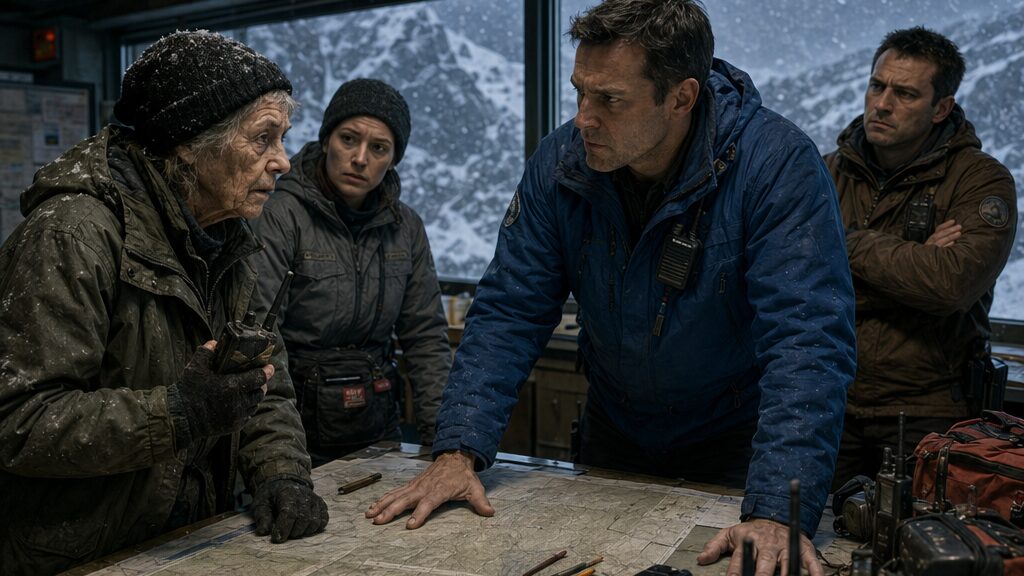
She stood just inside the door with snow melting off the shoulders of her old field jacket, one glove curled around the black handheld set as if it were a small injured animal. Wind shook the windows behind the map table. Beyond the glass, the mountain had already disappeared into a wall of white.
At the center of the room, Andrew Martin leaned over a spread of laminated trail maps with a red grease pencil in his hand. Two volunteers stood behind him, their radios clipped high on their vests. Gregory Lopez, broad-shouldered and damp from the storm, dragged a finger down a printed search grid and shook his head before anyone asked him anything.
“The last GPS ping puts them below the winter trail,” Andrew said. “We send the south team down the marked switchback, cut toward the creek bed, and sweep back up if visibility holds.”
“It won’t hold,” Virginia said.
No one turned fully. A dispatcher glanced toward her and then back at the radio bank. Gregory’s eyes flicked over her knit cap, her wet cuffs, her old boots, and stopped at the radio in her hand with the tired patience people reserved for something outdated and inconvenient.
Andrew lifted his pencil again. “Mrs. Taylor, I know you’re worried.”
Virginia stepped closer to the table. Her right knee did not like the cold, and the walk from the parking lot had made it burn, but she kept her pace even. “I’m not worried. I’m listening.”
That made Gregory exhale through his nose.
The map table was crowded with plastic overlays, cell phones, battery packs, coffee cups, and a newer digital receiver blinking green. Virginia laid her old radio down where there was space, beside the eastern edge of the map. Its casing was scuffed white at the corners. Tape covered a crack near the speaker grille. The antenna leaned a fraction to one side from years of being dropped, repaired, and dropped again.
A young woman near the medical packs looked at it longer than the others did. Christine Johnson, Virginia remembered. New to county rescue. Steady hands. Too soft in the eyes yet, but that could change if she stayed in the mountains long enough.
Andrew straightened. “We’ve got a system, ma’am.”
“You’ve got a signal that died below the ridge,” Virginia said. “That doesn’t mean they’re below it.”
Gregory folded his arms. “That’s exactly what it means when the last ping comes from there.”
“No.” Virginia pointed to the map. Her gloved finger touched the printed trail, then moved past it to a blank-looking section along the ridge line. “Not in this wind. Not with ice on the west face. Jerry Baker wouldn’t take a group downhill if the creek trail glazed over. He’d cut sideways.”
“Jerry was guiding three hikers on the marked route,” Andrew said. “That’s what the permit says.”
“Permits don’t change weather.”
The room quieted just enough for the wind to become louder. Snow hissed against the windows. Somewhere in the radio corner, a field team called in a position update, their words clipped and practical.
Gregory looked at Andrew, then back at Virginia. “When was the last time you were on that cut?”
Virginia kept her eyes on the map. “Long enough to know it’s still there.”
“That’s not what I asked.”
“No,” she said. “It isn’t.”
A few faces shifted toward the table. Not openly mocking. Not cruel. Worse than that. Careful. Protective. The way people looked at a jar on a high shelf before deciding whether the old woman reaching for it might fall.
Andrew softened his voice. “Virginia, Jerry’s a good guide. We know you know him. But we can’t move teams based on a memory of an old route that may not even be passable.”
The name, said gently, landed harder than dismissal. Virginia looked past him to the map edge, where the ink thinned into white paper. That was where the trouble always lived. Not in the bold lines people trusted, but at the edges where somebody once penciled a service road, a drainage path, a maintenance cut, and then forgot why it mattered.
Her radio crackled again.
Just a brief break in the static.
She turned her head.
The dispatcher did not. Gregory did not. Andrew tapped the official grid with his pencil and began assigning volunteers.
Virginia slid the radio closer to herself. “You hear that?”
Andrew stopped only because she had spoken across him. “Hear what?”
The radio answered with ordinary static, dry and shapeless.
Gregory’s mouth tightened. “We’re not going to chase ghosts through the speakers.”
Virginia looked at him then. He was younger than her son would have been, if she had ever had one. Old enough to carry responsibility. Young enough to hate anything that made responsibility feel uncertain.
“It isn’t a ghost,” she said.
“Mrs. Taylor,” Andrew said, “you can wait by the coffee station. Christine can get you a chair.”
The chair. There it was. The final soft weapon.
Virginia felt the room tilt slightly, though it did not move. Her body had been warning her all day: stiff fingers, cold hip, the deep tiredness she never admitted to Mary. She had scraped ice from her windshield with one hand and held the radio in the other because the county dispatch channel had gone busy with Jerry’s call sign, and when Jerry Baker went missing on a mountain he knew better than most roads, it meant the mountain had changed the rules.
She drew one slow breath.
In the Army, years ago, a sergeant had once told her that panic was just information arriving too quickly. Slow it down, Taylor. Sort the pieces. Don’t decorate them.
So she did not raise her voice. She did not say that she had carried radio packs heavier than Andrew’s emergency kit through mud, heat, and blackout drills. She did not say that she had spent twenty years after that listening to mountain static until she could tell clean distance from a bounced signal. She did not say that age had taken some things from her but not that.
Instead, she placed her gloved finger on the map again.
“Send one team to the old cut.”
Andrew’s jaw set. “No.”
“Then hold the south team until you confirm the creek ice.”
“We have confirmation from the model.”
“The model isn’t standing in that wind.”
Gregory gave a short laugh with no humor in it. “And you are?”
Virginia looked toward the window.
White swallowed the far ridge. For a moment she saw only snow, glass, the reflection of fluorescent lights, and her own old face beneath the knit cap. Then the wind shifted and pressed a sheet of powder sideways across the darkening slope.
Sideways.
Her hand tightened around the table edge.
Andrew followed her gaze but saw only weather. “We’re losing daylight.”
“You already lost the ridge,” she said.
No one answered.
The command room resumed around her, but now she heard the separation of it: men calling assignments, paper sliding under palms, boots scraping, radios clipping onto jackets, all of it confident enough to drown out a small ugly note beneath the static.
Christine moved closer, not enough to take sides. “Mrs. Taylor,” she said quietly, “do you want me to get that chair?”
Virginia almost smiled, but it did not reach her mouth. “Not yet.”
The radio crackled under her palm.
Three broken bursts came through, faint and uneven.
Tch. Tch-tch.
Virginia’s eyes lowered to the speaker.
The room kept moving. Andrew circled the official search area in red. Gregory reached for his coat and told two volunteers to gear for the south switchback. Christine looked from the men to Virginia and back again, uncertain now.
Virginia stood very still.
The sound came again, buried deep enough that anyone else would have called it nothing.
Tch. Tch-tch.
Her throat went dry.
It was not a voice. Not yet. Not a message. Not proof.
But it was not nothing.
And it was coming from the wrong side of the mountain.
Chapter 2: The Route No One Wanted Named
Christine Johnson saw the old woman’s hands before she understood the argument.
Everyone else looked at Virginia Taylor’s face—at the creases beside her mouth, the snow caught in her cap, the strain around her eyes that made concern look like confusion if a person had already decided what they were seeing. Christine looked down and saw the fingers instead.
They were not trembling.
Virginia had one gloved hand on the map table and the other on the radio, steady enough to hold silence in place. The radio hissed beneath the room’s noise, a thin unsettled sound that made Christine think of a door left open somewhere cold.
Gregory Lopez was already pulling his parka from the back of a chair. “South team leaves in four minutes.”
“Hold them,” Virginia said.
Andrew Martin did not look up from the clipboard in his hand. “We’re not holding a team because of static.”
Virginia shifted the radio to the eastern edge of the map, beside the blank section where the laminated overlay stopped. “It isn’t static.”
Gregory gave Andrew a look that said they had already spent too much time on this. “She’s using an old handheld with a bent antenna. Of course it’s dirty.”
Christine felt the words land and watched Virginia absorb them without flinching. That was when Christine stepped closer.
“What do you hear?” she asked.
Gregory turned. “Christine.”
“I’m asking.”
Virginia’s eyes moved to Christine’s badge, then to her face. For a second Christine worried she had sounded like she was humoring a patient. She lowered her voice.
“What do you hear that we don’t?”
The room did not stop this time. That made the question feel smaller, safer. Andrew continued scanning the assignment sheet. The dispatcher answered a call. Volunteers checked straps and headlamps.
Virginia tapped the radio speaker once. “Three breaks. Then a drag.”
Christine listened. Static filled the space between them.
“I don’t hear it,” she admitted.
“You’re listening for words.”
“What should I listen for?”
Virginia’s gaze returned to the map. “Interruption.”
The answer made no immediate sense. Christine waited.
Virginia moved her finger from the official winter trail to the lower switchback, then up to the ridge. She did not jab or wave. She touched the map the way someone might touch a bruise, careful and exact.
“Jerry’s last clear check-in was here,” she said.
Andrew finally looked over. “Which matches the ping.”
“No,” Virginia said. “It matches where the signal sounded like it was coming from.”
Gregory pulled his zipper higher. “Signals don’t have feelings.”
“They have behavior.”
The words were quiet, but they cut through more cleanly than if she had raised her voice.
Christine leaned over the map. The official trail showed in blue beneath the plastic. Search zones had been divided into rectangles. Teams had already marked their call signs in dry-erase ink. Beyond the eastern edge of the overlay, the printed topography continued in thin brown curves. No highlighted trail. No bold line. Just ridge, drainage, old forest-service markings, and a faint gray dash that almost vanished beneath the lamination seam.
Virginia touched it.
“What is that?” Christine asked.
“Maintenance cut.”
Gregory came back to the table. “That cut washed out years ago.”
“Part of it did.”
“It’s not on the current map.”
“No.”
“That means we don’t send people there.”
Virginia looked at him then, not angry, not pleading. “That means nobody updates what they don’t use.”
Andrew set down the clipboard. “Virginia, even if Jerry knew that cut, he had hikers with him. He wouldn’t take civilians onto an abandoned route in a storm.”
“He would if the creek trail iced over before they reached the lower bend.”
“Why?”
“Because the creek turns into a chute when the wind comes through the saddle. Ice under powder. No edges. No grip.” She dragged her finger sideways across the map. “But the cut has timber on the north side. Bad footing, but something to hold. Jerry would choose bad footing over a slide.”
Christine pictured it: three hikers, a guide, visibility shrinking, a marked trail turning slick beneath a clean layer of snow. She had trained for maps, splints, exposure, shock. But terrain judgment still felt like a language she was learning from people who had been speaking it long before she arrived.
Andrew’s voice stayed controlled. “That’s an assumption.”
“So is yours.”
Gregory’s face hardened. “Our assumption is backed by data.”
Virginia turned the radio knob a fraction. Static rose, then thinned. She waited. The room seemed to lean away from her patience.
For a moment there was nothing.
Then Christine heard it.
Not a beep. Not a word. Just a break. A tiny gap in the static, followed by two more, close together.
Tch. Tch-tch.
Virginia did not look triumphant. If anything, she looked worse.
“There,” Christine whispered.
Gregory shook his head. “That could be anything.”
“It’s a signal trying to climb out of a hole,” Virginia said.
Andrew rubbed a hand over his mouth. The fluorescent lights made the tiredness under his eyes look gray. “Even if I accept that there’s something, we can’t redirect the main team on that.”
“I didn’t ask for the main team,” Virginia said. “I asked for one team to check the cut.”
“That pulls resources from the likely area.”
“The likely area is where the mountain wants you to look.”
Gregory let out a sharper breath. “That sounds poetic, not operational.”
Virginia lowered her eyes to the map and moved her finger along the edge again. “The ridge blocks clean transmission here. If Jerry were below the trail, your receiver would catch him better from the south repeater. But this—” She tapped the radio. “This is dirty because it’s bouncing off the east face. Wrong side for your plan. Right side for the cut.”
Christine felt the small hairs rise along her arms.
Andrew said nothing for several seconds.
Then Gregory spoke into the silence. “How long since you ran comms on a live rescue, Virginia?”
The first-name familiarity sounded wrong in his mouth.
Virginia picked up the radio. “Long enough to remember when listening came before proving.”
Gregory’s eyes narrowed, but Andrew lifted a hand before the argument could sharpen. “That’s enough.”
From the radio corner, the dispatcher called out that the south team was ready. A volunteer opened the door to the gear bay and wind pushed a cold breath through the room.
Andrew looked at the map, then at the digital receiver, then toward the window where snow battered the glass. For one second Christine thought he might bend. Not fully. Just enough to delay the team.
Instead he drew the red pencil down the lower switchback.
“South team moves now,” he said. “Gregory, you take them to the creek approach. Keep them tight. No one crosses exposed slope without confirmation.”
Gregory nodded once, already turning.
Christine looked at Virginia.
The old woman had gone still again, but this time the stillness was different. Not humiliation. Calculation. She watched Andrew finish the line on the map, watched Gregory call for helmets and ice gear, watched the official plan harden into motion.
Christine wanted to say something that would help. She could not find anything that was not either too little or too late.
Virginia reached past her and took the red pencil Andrew had set down. For a heartbeat, Christine thought Andrew would object.
He didn’t. Perhaps he did not notice.
Virginia made three small marks along the pale gray cut at the edge of the map. Not a route, exactly. More like a warning left for someone who might come back to it after pride had failed.
Then she placed the old radio directly beside those marks.
Andrew saw that.
“Mrs. Taylor,” he said, with strained patience, “please don’t alter the working map.”
Virginia capped the pencil and laid it down.
“Then don’t lose the edge of it,” she said.
Gregory pushed open the gear-bay door. Snow and engine noise rushed in. Two volunteers followed him into the storm.
Andrew watched them go.
Christine stayed beside the table, listening to the old radio hiss against the map.
The three-beat break came once more, faint and stubborn.
This time, she heard the drag after it.
Chapter 3: A Signal Buried Under Static
Virginia had learned long ago that the first task was to separate fear from information.
Fear was loud. It filled a room if allowed. It borrowed other people’s faces and raised their voices. It told the body to grip too hard, move too fast, spend itself in useless motion.
Information was quieter.
It clicked under static. It hid in a pause. It came through broken, late, bent by distance and terrain, and waited for someone disciplined enough not to demand that it arrive clean.
Virginia sat at the radio corner of the command room with her coat still on and her gloves folded beside the receiver. She had refused the chair when Christine offered it at the map table. Ten minutes later, she had accepted this one because her knee had begun to pulse and because stubbornness was not the same as usefulness.
The county equipment hummed around her. New monitors. New chargers. New headsets with soft foam cups. The old radio sat between them like a black stone from another century.
Virginia adjusted the squelch knob with two fingers.
Static rose, broke, rose again.
She closed her eyes.
Not to rest. To remove the room.
In the Army, the radios had been heavier, the nights hotter, the consequences less forgiving in different ways. She remembered canvas straps cutting into her shoulder, rainwater inside her collar, the smell of dust baking on metal casings. Men twice her size had laughed the first week when she carried the set wrong and bruised her hip raw. By the third week, they stopped laughing because she could pull a call sign out of weather while they were still asking each other if they had heard anything at all.
She had not been the strongest. Never pretended to be.
But she could wait.
A burst shivered through the speaker.
Tch. Tch-tch.
Then a faint tail, almost like breath dragged across wire.
Virginia opened her eyes and wrote three small marks on the notepad beside her. Not words. Pattern first. Meaning later.
At the map table, Andrew was on the phone with a county official. He kept his voice low, but parts of it carried.
“Yes, we have teams moving now… visibility poor but workable… no, we don’t have confirmation of injury… Jerry Baker and three hikers… yes, families notified.”
Virginia pressed her thumb against the side of her index finger until the joint complained. Families notified. That phrase made rooms colder.
Christine crouched beside her, careful not to crowd. “Can I sit?”
Virginia nodded.
Christine lowered herself onto a storage crate. Her cheeks were flushed from moving between the command room and gear bay. A strand of hair had escaped beneath her knit cap.
“You don’t have to explain,” Christine said.
“That’s usually what people say before asking for an explanation.”
A brief smile touched Christine’s mouth and vanished. “Maybe.”
Virginia turned the dial a hair to the left. “Ask the useful part.”
“The drag after the three breaks. What makes that different?”
Virginia studied the radio. The speaker crackled, indifferent to being discussed.
“Clean signal drops when distance beats power,” she said. “You get pieces, but the pieces cut sharp. This one smears. Like it’s hitting stone before it reaches us.”
“An echo?”
“Not like shouting into a canyon. More like a flashlight hitting a mirror you didn’t know was there.”
Christine looked toward the window. The mountain was gone now. Only the reflection of the command room stared back at them: Andrew’s rigid shoulders, the dispatcher under headphones, volunteers moving in bursts between tables, Virginia’s own outline small beside the radio gear.
“And that tells you east face?” Christine asked.
“It suggests it.”
“Suggests?”
Virginia glanced at her. “Never trust anyone who says a mountain told them everything.”
Christine absorbed that.
Good, Virginia thought. The girl listened past the first answer.
The radio gave another rough pulse. Virginia adjusted the knob, then stopped herself. Her fingers were slower now. Cold had settled deep in them during the drive over, and age made a thief of small motions before it took large ones. She flexed her hand beneath the table where Christine would not see.
Christine saw anyway. She did not comment.
That restraint earned something.
Virginia picked up the pencil and drew a ridge line on the edge of the notepad. “If Jerry is here, below the marked switchback, the south repeater catches him clean enough for voice fragments.”
She marked another point.
“If he’s here, on the old cut, the east face throws the signal wrong. Weak breaks. Drag after.”
Christine leaned closer. “But why would his radio transmit only breaks?”
“Battery. Cold. Damaged antenna. He may be keying without enough power to carry voice.” Virginia paused. “Or someone else is.”
The words sat between them.
At the table, Gregory’s voice came over the main receiver, thinned by wind. “South team entering creek approach. Visibility twenty yards. Snow over ice. Moving slow.”
Andrew stepped closer to the radio bank. “Copy. Maintain line. Report at the lower bend.”
Virginia did not look up. The lower bend was where the creek trail became a chute if the wind had done what she thought it had done.
Her old radio hissed.
Christine whispered, “You said Jerry would choose the cut.”
“I said he might.”
“But you know him.”
“I know what he respects.”
“What’s that?”
Virginia’s eyes stayed on the notepad. “Bad choices named honestly.”
Christine said nothing for a while.
The old grief moved somewhere behind Virginia’s ribs, not sharp anymore, but heavy. A previous storm. A previous call. Men younger than Andrew waiting for a clean confirmation that never came. Virginia at a radio table, hearing a weak broken signal and letting a supervisor convince her it was bounce, interference, nothing actionable. By morning, the mountain had answered the question for them.
She had kept the radio after that. Not the same radio from the call, but one close enough in weight and ugliness to remind her that equipment did not absolve the person listening.
The command room door opened. Snow blew in around two volunteers carrying extra rope. A local reporter’s voice rose near the entrance and was quickly pushed back by someone from the county. Pressure had arrived with cameras behind it.
Andrew ended his phone call and stood for a moment with his hand over his eyes. When he dropped it, he looked older than he had an hour ago. Not old. Just less certain.
Virginia knew that look too. Command did not make a person cruel. Sometimes it only trapped them inside decisions that would be judged by people warm enough to be confident.
She turned back to the receiver.
The three-beat break came again.
This time, beneath it, she caught something else. A ragged lift at the end. Not voice. Not yet. But a change in angle, maybe. Movement. Someone shifting the radio, raising it, trying again.
Virginia reached for the county headset without asking.
The dispatcher noticed. “Ma’am—”
“Only listening,” Virginia said.
The dispatcher looked to Andrew. Andrew hesitated, then gave a short nod.
Virginia slid the headset over one ear, leaving the other open to the room. The county channel was cleaner but busier. Field updates. Wind checks. Breathing. A clipped report from Gregory.
“Creek approach worsening,” Gregory said. “Surface is glazed under powder. Continuing with caution.”
Virginia’s mouth tightened.
Andrew answered, “Copy. Do not overcommit past the bend.”
Virginia tuned her old radio lower, then higher. Her shoulder began to ache from the stillness. Her left hand cramped around the pencil. She opened her fingers slowly and put the pencil down before it could fall.
Christine saw that too.
“Mrs. Taylor,” she said softly.
“Virginia.”
Christine blinked.
“If you’re going to sit with me,” Virginia said, “use the name.”
“Virginia,” Christine said. “You’re cold.”
“Yes.”
“Do you want coffee?”
“No.”
“A blanket?”
“No.”
“What do you want?”
Virginia looked past the radio, past the map table, past Andrew and the windows and the storm pressing its white hands against the glass.
“I want that boy to answer.”
Jerry Baker was not a boy. He had gray in his beard now and knees nearly as bad as hers. But memory did that. It kept people at the age when you first decided they mattered.
The old radio snapped.
Tch. Tch-tch.
Then, for half a second, a broken shape rode under the static.
Not a word. Almost a word.
Christine straightened. “Was that—”
The digital receiver at the main table chirped sharply.
Everyone turned.
The green dot marking the last GPS ping flickered on the screen, froze, then vanished.
The dispatcher typed fast, then typed again.
Andrew crossed the room in three strides. “What happened?”
The dispatcher’s face had gone pale under the monitor glow. “Lost signal.”
Gregory’s voice came through the county channel, rough with wind. “Command, confirm last ping. Our screen just dropped.”
Andrew stared at the blank space where certainty had been.
Virginia slowly removed the headset.
Her old radio kept hissing in front of her.
At the edge of the static, the three broken beats returned.
Chapter 4: The Daughter Who Wanted Her Home
Mary Robinson arrived with snow packed into the seams of her boots and anger held so tightly behind her teeth that she had to stand in the doorway a moment before speaking.
No one noticed her at first. The command room had swallowed itself whole. Radios scratched and barked. A printer pushed out updated weather sheets. Volunteers moved with ropes over their shoulders and helmets under their arms. A county official stood near the entrance, speaking in a low voice to someone who had no business being there but wore the eager expression of a person hoping to witness grief from a safe distance.
Mary saw none of them clearly at first.
She saw her mother.
Virginia sat in the radio corner with her coat still buttoned and her shoulders drawn inward, one hand near the battered handheld set as if someone might take it. Her face was turned toward the speaker. Not toward the people. Not toward the door. Toward that old radio, that ugly black thing with its taped crack and bent antenna.
Mary had seen it on kitchen tables, nightstands, passenger seats, hospital trays. Even when her mother had stopped volunteering, the radio had remained. It had sat beside pill bottles and unopened mail. It had ridden between them on quiet drives. It had waited through birthdays and holidays like an extra person no one had invited but no one could ask to leave.
“Mom.”
Virginia turned.
For the space of one breath, she looked relieved. Then she saw Mary’s coat, Mary’s wet hair, Mary’s expression, and the relief closed itself away.
“You shouldn’t have driven up,” Virginia said.
Mary laughed once, too softly for humor. “That’s what I came here to tell you.”
Christine Johnson rose from the crate beside Virginia. “I can give you both a minute.”
“No,” Virginia said.
“Yes,” Mary said at the same time.
Christine paused.
Virginia put one hand on the edge of the desk and stood more slowly than Mary liked. Too slowly. Her right knee stiffened before it took her weight. She tried to hide it by reaching for the radio, but Mary had been watching her hide pain for years.
“Mom,” Mary said, lowering her voice, “you need to come home.”
Virginia picked up the radio. “Not yet.”
“You’re soaked through.”
“I’m dry enough.”
“You’re freezing.”
“There’s coffee.”
“You don’t drink their coffee when you’re upset.”
Virginia glanced at Christine, then toward the map table. Andrew Martin was bent over the main screen, one palm on the table, the other holding a phone to his ear. Gregory’s voice came through the county channel in gusts of wind and broken consonants.
Mary took another step into the room. The heat hit her face, but she could not stop shivering. She had spent the drive up imagining her mother in a ditch, in a whiteout, pulled over with that radio in her lap and no signal on her phone. By the time she reached the rescue station, fear had hardened into the clean practical shape of anger.
“They have people for this,” Mary said.
Virginia’s eyes came back to her. “I was one of those people.”
“Was.”
The word left Mary before she could soften it.
Virginia did not move.
Mary heard it then, how cruel it sounded, how much smaller it made everything her mother had ever been. She wanted to take it back, but pride and fear were too close together in her throat.
“I mean,” she said, “you’re not on the roster anymore. You don’t have to carry this.”
“I’m not carrying it.”
Mary looked at the radio in her hand.
Virginia followed her gaze and tightened her fingers around the casing. “That’s not what I meant.”
“Then what are you doing?”
“Listening.”
The same answer she always gave. Listening. As if that explained the nights Mary had found her awake at the kitchen table with the scanner turned low. As if that explained the winter morning years ago when Virginia had stopped going to rescue meetings and never said why. As if listening were not sometimes another word for refusing to come back from whatever had happened before.
Mary stepped closer, enough that she could see the pale fatigue under her mother’s eyes. “You promised me you were done with this.”
“I promised I wouldn’t go into the field.”
“This is still the field for you.”
Virginia looked away.
That struck Mary harder than an argument would have. Her mother rarely looked away unless something was true.
Behind them, Andrew said into the phone, “We’re reassessing the signal loss now.” His voice had tightened since Mary entered. “No, I’m not delaying notification. I’m saying the last data point is no longer active.”
Mary saw the map table then. The red lines. The bodies moving around them. The old radio’s twin sitting on nothing, because Virginia’s own radio had left a dry rectangle on the table edge where it had been.
Someone was lost.
Of course someone was lost. Mary had known it from the call, from the way her mother had said Jerry Baker’s name and gone quiet. But seeing the command room made it real. There were families somewhere waiting for a phone call. There were people outside moving through wind because decisions made in this room told them where to step.
And her mother, seventy-eight years old, with a bad knee and blood pressure she pretended did not matter, was standing in the center of it like the storm had remembered her address.
Mary lowered her voice. “Mom. Please.”
Virginia’s jaw worked once. “Mary.”
“No. You don’t get to use that tone like I’m twelve and asking why you missed dinner.” Mary stepped closer. “You disappeared into this stuff when I was a kid. The mountain called, the radio called, somebody needed you, and you went. Then one day you stopped, and you wouldn’t talk about that either. Now I get a message that you drove yourself through a storm because Jerry Baker went missing and you think the county is wrong.”
Virginia’s face changed at Jerry’s name. Only a little. Enough.
Mary hated herself for using it and kept going because fear was not fair.
“You think you’re the only person who can save everyone.”
“No,” Virginia said.
“Then come home.”
“I can’t.”
“You can.”
Virginia looked down at the radio. Static breathed from the speaker, low and restless. Her thumb rested near the side button but did not press it.
Mary softened despite herself. “You’re tired.”
“Yes.”
“You’re hurting.”
“Yes.”
“You’re scared.”
Virginia looked up then. “Yes.”
The answer stopped Mary cold.
Her mother did not spend fear freely. She rationed it. Hid it in dry jokes, clipped instructions, folded napkins, checked locks. Mary had seen her angry, silent, stern, exhausted. Rarely scared. Never so plainly.
Virginia moved toward the window near the entrance, away from the crowded table. Mary followed. Outside, the parking lot lights showed snow moving sideways across the dark, hard and fast enough to erase tire tracks within minutes. A rescue truck idled near the gear bay, amber lights turning the falling snow gold, then black, then gold again.
Virginia stood with the radio against her chest.
“I heard it before,” she said.
Mary waited.
“Not this exact signal. Not Jerry.” Virginia’s reflection stared back from the glass. “Another storm. Years ago.”
Mary’s hands went cold inside her gloves.
“You never told me.”
“No.”
“Why?”
Virginia’s mouth tightened. For a moment Mary thought she would retreat into silence again, that familiar locked room no daughter could enter.
But the old radio crackled softly, and Virginia closed her eyes.
“There was a weak call,” she said. “Bad transmission. Broken pattern. I thought it was bounce. My supervisor thought it was nothing useful. We waited for confirmation.”
Mary barely breathed.
“It came in the morning,” Virginia said.
The command room noise seemed to fall back. Mary could hear only the window rattling and the radio whispering against her mother’s coat.
“Someone died?” Mary asked.
Virginia did not answer directly. She did not need to.
“I kept thinking,” Virginia said, “if I had pushed harder.”
“You were following orders.”
“I was listening.”
Mary swallowed. “You were one person.”
Virginia’s eyes opened. “That’s what I told myself until I stopped believing it.”
Mary wanted to touch her arm but did not. Not yet. It felt suddenly important not to make the same mistake in a gentler shape.
At the table, Andrew called for a fresh weather update. The dispatcher’s voice shook slightly as she repeated that the GPS signal had not returned. Gregory’s team reported heavy ice near the creek approach. Someone cursed under their breath and apologized immediately.
Mary saw her mother hear all of it. The separate pieces. The ice. The lost ping. The wind at the glass. The radio in her hands.
“Mom,” she said, quieter now, “what if you’re wrong?”
Virginia nodded once. “Then I’ll have to live with that too.”
The answer was not stubborn. It was worse. It was honest.
Mary looked at the old radio. She had spent years hating the way it followed them, how it seemed to get more care than Virginia gave herself. Now she saw it differently for one unwelcome second: not as the thing that took her mother away, but as the thing her mother could not put down because someone might still be calling from inside the static.
“I don’t want to lose you to this,” Mary said.
Virginia’s face softened. “I know.”
“No, I mean it. Not just out there. In here.” Mary touched her own chest, embarrassed by the gesture but unable to stop. “You go somewhere when this starts. Somewhere I can’t reach.”
Virginia looked down.
Christine approached from the side, stopping several feet away. She had given them more time than the room wanted.
“Virginia,” Christine said gently, “Andrew is asking about the old cut again.”
Virginia turned back toward the map table.
Mary caught her sleeve. Not hard. Just enough.
For a moment they stood that way, mother and daughter, the radio between them and the storm at their backs.
“Let me help you walk over,” Mary said.
Virginia looked at the hand on her sleeve, then at Mary.
“I can walk.”
“I know.”
Virginia considered the difference. Then she gave the smallest nod.
Mary walked beside her, not holding her up, not letting go entirely. Halfway back, she noticed Christine watching the radio instead of Virginia’s age.
When Virginia reached the table, Mary stepped aside, still close enough to see how carefully her mother set the radio down.
Christine leaned toward Mary, her voice low enough not to carry.
“What happened in the old storm?”
Mary looked at Virginia’s bent gray head, at the radio waiting on the edge of the map, at the snow pressing hard against every window.
Then she said, “She heard someone no one else believed was there.”
Chapter 5: When the Window Showed the Truth
Christine had been trained to look at patients first, equipment second, and panic last.
That night, the command room made all three difficult to separate.
The patient was not only Virginia Taylor, though Christine kept glancing at the old woman’s face, the pale line around her mouth, the careful way she shifted weight off her right knee. The patient was the whole room. Andrew Martin at the map table with too many people waiting for certainty. The dispatcher leaning into her headset as if volume could pull Jerry Baker’s voice out of the storm. Mary Robinson standing close to her mother but not touching unless invited. Volunteers returning from the gear bay with snow crusted on their shoulders.
And the equipment—screens, radios, maps, weather feeds—was no calmer than the people.
The lost GPS ping had left a blankness worse than a bad location. Bad locations could be argued with. Blankness only stared back.
“South team reports ice from the lower bend to the creek approach,” the dispatcher called.
Andrew braced both hands on the table. “Visibility?”
The dispatcher listened. “Ten to fifteen yards. Wind increasing.”
Gregory’s voice came in ragged behind her. “Command, this chute is bad. We can continue another hundred yards, but if we commit farther, retreat gets harder.”
Christine watched Andrew receive that. He did not dismiss it. He did not panic. His face tightened around the cost of every option.
Virginia stood at the map edge, the old radio in front of her. She had said little since Mary brought her back. Somehow the silence made people more aware of her than her warning had.
Christine moved to the window.
At first, all she saw was reflection. Fluorescent lights. The red smear of grease pencil on the map behind her. Her own face, younger than she felt. Then she cupped both hands beside her eyes and leaned close to the cold glass.
The mountain appeared in pieces. A dark shoulder of pine. A pale slab of snow. The distant amber blink of a truck near the gear bay. Above it all, white sheets crossing the blackness.
Not falling.
Crossing.
Christine frowned.
She had seen snow fall sideways before. Everyone in the county had. But this was different. The snow near the parking lot blew one way; the snow higher up, visible only when the wind thinned, seemed to peel back at another angle entirely. Like two invisible hands were fighting over the ridge.
Behind her, Virginia said, “It turned.”
Christine did not move. “The wind?”
“Yes.”
“When?”
“Before we admitted it.”
The words were not accusation. That made them worse.
Christine kept watching. A gust lifted powder off the roof of the gear shed and drove it toward the tree line. Higher above, along the brief broken outline of the ridge, snow streamed east. Toward the abandoned cut Virginia had marked. Away from the official route Andrew had chosen.
Christine turned from the window. “Andrew.”
He did not look up. “One second.”
“Andrew.”
This time he did.
Christine pointed to the glass. “You need to see this.”
Gregory’s voice broke through the county channel before Andrew could answer. “Command, we’ve got surface cracking near the bend. Not a slide, but the top layer is moving. Request permission to halt.”
Andrew crossed to the window with Christine. He looked out, and for a moment she could see him searching for the wrong thing: a dramatic sign, a visible disaster, something obvious enough to justify changing a plan in front of everyone.
Virginia came slowly behind them.
“Don’t look at the parking lot,” she said. “Look above the black pine.”
Andrew did.
The command room quieted by degrees.
Outside, snow lifted off the unseen slope and streamed hard across the ridge, not down the marked trail but over and around the eastern face.
Christine heard Andrew’s breath change.
Virginia held the radio up, not triumphantly, just high enough for the sound to carry.
Static filled the space.
Then the three breaks.
Tch. Tch-tch.
A faint drag followed.
Virginia lowered the radio to the windowsill. “That ridge is throwing him to us.”
Andrew turned. “You don’t know it’s Jerry.”
“No.”
“You don’t know they’re on the cut.”
“No.”
“You don’t know if that cut is passable.”
“No.”
Gregory’s voice returned, sharper now. “Command, awaiting call. We are holding at the bend. Repeat, holding at the bend.”
Andrew’s jaw flexed. “Then what do you know?”
Virginia looked through the window again. The storm reflected on her face, white moving over old skin.
“I know Jerry wouldn’t take hikers down a chute with ice under powder if he had timber within reach,” she said. “I know the wind has turned across the ridge. I know a weak signal is bouncing from the east face, not rising clean from the creek. I know your south team is already telling you the trail is worse than the model said.”
She paused, and Christine watched her swallow whatever memory tried to climb into her voice.
“And I know waiting for clean proof is how people freeze.”
Mary’s eyes closed briefly.
No one spoke.
The dispatcher looked at Andrew. “South team still holding.”
Andrew returned to the map table. Christine followed him, pulse quickening. Virginia came last, slower but steady. Mary stayed near the window, arms folded tight.
The map looked different now. Not changed. Exposed. The official red line down the switchback seemed too neat, too confident. Virginia’s three small marks on the abandoned cut looked almost accidental, but Christine could not stop seeing them.
Andrew pointed to the old cut. “If we shift, how do we access it?”
Virginia touched the map edge. “Not from the lower trail. From the service spur north of the old ranger shed.”
Gregory’s voice crackled. “Command, repeat? Are you discussing a reroute?”
Andrew pressed the transmit key but did not answer him yet. “That spur isn’t plowed.”
A volunteer near the door said, “Snowplow driver reported the first mile open before sunset.”
“Before sunset,” Andrew said.
Virginia nodded. “After that, snowmobile or foot. Shorter climb than pulling your team out of the chute after they commit.”
Christine watched Andrew’s eyes move over the contours. He was not ignoring her now. He was measuring. Distance, time, risk, responsibility. The difference mattered.
But Gregory was still outside in the storm, and the county official near the door had begun whispering into a phone, and somewhere beyond the room families waited for updates that would sound controlled even when no one felt control anymore.
Andrew keyed the mic. “Gregory, hold position. Do not advance past the bend.”
A burst of wind swallowed Gregory’s first reply. Then: “Copy. Holding. What’s the new plan?”
Andrew did not answer.
Christine looked at him. “Send a check team to the spur.”
His eyes cut to her. Not angry. Warning. “Christine.”
“She’s right about the wind.”
“That doesn’t make the cut safe.”
“No. But Gregory just told you the official route isn’t safe either.”
Andrew’s face closed, not because he had no answer, but because he had too many and none of them were clean.
Christine felt her own fear rise. She was not the commander. She did not have to sign the log. She did not have to answer the county, the families, the review board, the quiet question that would come later if the wrong call cost someone more than pride.
But she could no longer pretend that kindness meant standing beside Virginia while letting the room move around her.
She stepped to the map and placed two fingers beside Virginia’s marks.
“Look at her hand,” Christine said.
Andrew blinked. “What?”
“Look at her hand.” Christine kept her voice level though her heart was beating high in her throat. “She isn’t pointing all over the map. She isn’t changing her story. She’s marked the same edge three times since I started listening.”
Virginia looked at Christine then, startled not by agreement but by being defended carefully.
Christine continued. “I thought she was upset because Jerry is missing. She is upset. But she’s not guessing from fear.”
Gregory’s voice cut in again. “Command, wind shift at our position. Powder moving across the chute. Recommend no further descent until reassessment.”
Andrew shut his eyes for one beat.
The room waited.
The old radio hissed on the table.
Tch. Tch-tch.
Christine heard it now without needing Virginia to name it. A small stubborn interruption beneath the static. Not enough to prove everything. Enough to make ignoring it feel like a choice.
Andrew opened his eyes.
“I need more than belief,” he said.
Virginia leaned both hands on the table. Her shoulders had begun to sag, but her voice stayed even.
“Then ask me for a plan,” she said.
The words settled with the weight of a door unlocking.
Christine turned fully toward Andrew, aware that everyone in the room was watching now—the dispatcher, the volunteers, Mary by the window, even the county official with the phone lowered in his hand.
“Ask her,” Christine said.
Andrew looked from Christine to Virginia, then down at the old radio beside the marked edge of the map.
Outside, the storm struck the glass so hard the window trembled.
Christine did not step back.
Chapter 6: The Choice to Send Them Higher
Andrew Martin had made bad calls before.
Not careless ones. Not reckless ones. The kind every rescue commander eventually made if he stayed long enough: a team sent too early and turned back by lightning; a search grid widened when the subject had doubled behind a drainage; a helicopter requested five minutes too late to beat fog that everyone had hoped would lift. No one died from those calls, but Andrew remembered them anyway. He remembered the reports afterward, the polite language that made fear sound administrative.
Contributing factors.
Visibility limitations.
Reasonable decision based on available information.
He stood over the map table now and hated the word reasonable.
The reasonable route was marked in red down the lower switchback toward the creek bed. It matched the permit, the last GPS ping before it vanished, the official winter trail, and the plan he could defend in a meeting with people who had never felt a ridge wind change against their teeth.
The unreasonable route was three small pencil marks made by an elderly woman on the edge of the map.
Virginia Taylor stood across from him with one hand near her old radio. She had not asked to be right. That unsettled him more than if she had. People who wanted to be right filled silence with certainty. Virginia left silence standing and let it accuse whoever needed accusing.
Andrew looked at Christine. She was still beside the table, face pale but steady. Mary Robinson stood behind her mother, close enough to catch her if she swayed, far enough not to insult her.
Gregory’s voice came through the county channel. “Command, we’re holding but losing heat. Need direction.”
Andrew reached for the mic. “Stand by.”
There was a pause, then Gregory answered, “Copy.”
The pause carried displeasure clearly enough.
Andrew set the mic down. “Virginia. If I even consider this, I need a route that doesn’t strand another team.”
Virginia nodded.
No triumph. No relief. Only work.
“Pull Gregory back from the chute,” she said. “Not all the way. Back to the timber before the lower bend. Keep them warm and ready.”
Andrew pointed to the map. “And the cut?”
“Send a smaller check team to the old ranger shed by vehicle as far as the spur allows. Snowmobile if they can. Foot after that. They don’t take the cut blind. They check for fresh breakage in the timber line here.” She tapped the first pencil mark. “If there’s nothing, they stop. They do not chase my hunch into dark ground.”
Andrew looked up sharply.
Virginia met his eyes.
“I said stop,” she repeated.
That was the first thing that loosened something in him.
Gregory would have argued for his plan until it broke or held. The county official wanted a plan that sounded decisive. The volunteers wanted direction. Christine wanted him to listen. Mary wanted her mother safe. Everyone in the room wanted something from him.
Virginia wanted limits.
“You’d call it off?” Andrew asked.
“If the cut doesn’t speak back, yes.”
“Even with Jerry out there?”
Her hand tightened once on the table edge, then relaxed. “Especially with Jerry out there.”
The answer did not make the decision easier. It made it harder to dismiss.
Andrew rubbed both hands over his face and looked again at the contours. The official trail descended toward the creek, then cut through the chute Gregory had just described as glazed under powder. Virginia’s route climbed toward the abandoned maintenance cut, through timber, over older ground not maintained for winter travel. Neither choice was safe. One carried the authority of current maps. One carried the unease of every new report proving the current maps incomplete.
The old radio crackled.
Andrew almost hated the sound now.
Not because it was loud. Because it was not.
Because if it had been clear, the choice would be simple. If Jerry Baker’s voice came through saying east cut, they would move. If silence held, they would continue with the official plan. Instead, the room had been given something thin and stubborn, just enough to make certainty dishonest.
“Tell me what the three breaks mean,” he said.
Virginia lowered her eyes to the radio. “Maybe nothing.”
Gregory’s voice would have called that useless. Andrew did not.
“And if not nothing?”
“Someone keying without enough power for voice. Or a damaged mic. Or cold battery. The spacing could be deliberate, but I won’t swear to that.”
“Why three?”
“I don’t know.”
Again, that refusal to decorate the facts.
Andrew glanced at Christine. She was listening with the same concentration Virginia had given the static, as if she had learned something from posture alone.
“And the drag?” he asked.
“Signal smear after transmission. Terrain bounce, likely east face.”
“Likely.”
“Yes.”
“What would make you certain?”
“A clear voice from Jerry. A field confirmation from the cut. Or daylight.” Virginia paused. “We don’t have those.”
The dispatcher looked up from the radio bank. “Weather service update. Wind advisory just escalated. Ridge gusts worsening through midnight.”
The county official near the entrance stepped forward. “Commander, the families are asking whether the search is still active.”
Andrew kept his eyes on the map. “It is.”
“They also heard about the GPS loss.”
Of course they had. Information moved faster than rescue teams and with less discipline.
Andrew nodded once without looking at him. “Tell them we are reassessing safely.”
The official hesitated. “They’ll want more than that.”
“So do I.”
The man stepped back.
Andrew picked up the red pencil and drew a small box around the ranger shed. “Access?”
A volunteer at the side table leaned over. “Service road is partly covered, but the snowplow driver said he opened the lower stretch before they pulled him. Could get a truck in maybe half a mile, then snowmobile.”
“Available snowmobile team?”
The dispatcher checked the board. “Two volunteers ready. One medical pack. One rope kit. They were staged for overflow.”
Andrew looked at Christine. “You’re not going.”
“I didn’t ask.”
He gave her a look.
She held it. “But send someone who knows hypothermia signs. If they find them in timber, they may not be walking.”
Andrew turned to Virginia. “Where do they stop?”
Virginia took the pencil, then paused with it above the map.
Her hand was not as steady as before.
Andrew noticed. So did Mary. So did Christine. Virginia noticed them noticing and set the pencil down instead of pretending.
“Christine,” she said, “mark where I tell you.”
Christine picked up the pencil without comment.
Another thing Andrew noticed.
Virginia leaned over the map, breathing through her nose. “Ranger shed. Spur north. They check the first timber break here. If the signal improves, they continue to this bend, but no farther without rope. The old culvert below it may be open under snow.”
Christine marked each point carefully.
Andrew studied the marks. “And if the signal weakens?”
“They stop and report. Don’t force the mountain to fit my memory.”
Mary’s face changed at that. Something between pain and pride.
Andrew keyed the mic. “Gregory, status.”
“Cold and irritated,” Gregory replied, wind chewing at the words. “But holding.”
“Pull back to the timber above the lower bend. Do not descend farther. Repeat, do not descend farther.”
A beat of silence. “Command, say again?”
“Pull back to timber. We’re sending a check team toward the ranger spur.”
This time the silence lasted longer.
Gregory came back clipped. “On what basis?”
Andrew looked at Virginia’s old radio. At the blank GPS screen. At Christine’s pencil marks. At the snow driving sideways against the glass.
“New signal assessment and changing wind conditions,” Andrew said.
Gregory’s reply carried restraint, barely. “That cut isn’t on the active grid.”
“I know.”
“It’s unstable.”
“I know that too.”
“If we split resources and the south route was right—”
“Then that’s on me,” Andrew said.
The room went still around him.
Virginia looked down.
Not with victory. Andrew had expected, maybe even deserved, a look that said finally. Instead she seemed to receive his decision as another weight added to the table.
Gregory’s voice softened by one degree. “Copy. Pulling back to timber.”
Andrew handed the mic to the dispatcher and turned to the volunteers. “Check team to ranger spur. Small team only. No heroics, no improvising. You confirm access, monitor signal, report every five minutes. If conditions turn, you pull back. Understood?”
The volunteers nodded and moved.
The room changed shape around the decision. Not calmer. Never calmer. But directed. Ropes were shifted. A medical pack was opened and repacked. A snowmobile key appeared from a drawer. The dispatcher updated the board. Christine moved between radio corner and map table, copying Virginia’s marks onto a clean overlay.
Andrew stayed where he was.
Virginia reached for her old radio, then stopped, as if asking permission without wanting to.
“Keep it on the table,” Andrew said.
Her eyes met his.
He added, “Please.”
The word felt inadequate. It was also the first one that did not make her smaller.
Virginia left the radio where it was.
Andrew stepped closer, lowering his voice so only she, Christine, and Mary could hear. “If they reach that cut and find nothing, I’ll have to redirect immediately.”
“Yes.”
“And if the signal improves, I’ll need you to guide from here. Not from outside. Not from a truck. From here.”
Virginia’s mouth tightened, perhaps at the command, perhaps at the care hidden inside it.
“Agreed,” she said.
Mary exhaled.
The old radio popped, then hissed. Andrew looked down at it as though it had become a witness.
Tch. Tch-tch.
This time, every person near the table heard it.
The dispatcher called from her station, “Check team ready at the door.”
Andrew looked to the gear bay. Snow rushed in when it opened, white and wild under the amber lights.
He pressed the transmit key.
“Check team, move toward the ranger spur,” he said. “Gregory, hold your team warm at the timber. All stations, update on five-minute intervals.”
He released the key.
The old radio crackled again, faint but present, at the edge of hearing.
Andrew did not know if he had just corrected a mistake or made the one that would define him.
Across the table, Virginia Taylor rested two fingers beside the three pencil marks and closed her eyes for half a second.
Then she opened them and listened.
Chapter 7: The Storm Answered the Old Radio
Virginia Taylor did not pray for the radio to speak clearly.
She had learned too many years ago not to ask storms for mercy or machines for kindness. She asked only for enough. Enough break in the static. Enough discipline in the room. Enough time for people still alive to remain alive until someone reached them.
The check team’s first report came in clipped and breathless.
“Command, we made the lower spur by truck. Snowmobile deploying now. Road closed beyond the bend. Visibility poor.”
Andrew stood at the map table with his sleeves pushed to his elbows, though the room had grown colder from doors opening and closing. “Copy. Five-minute check-ins. No advance without confirmation from command.”
The dispatcher repeated the timing onto the board. Christine marked the clean overlay with a blue grease pencil, tracing the route toward the old ranger shed. Mary stood behind Virginia’s chair with one hand wrapped around a paper cup of coffee she had not touched.
Virginia sat because Andrew had told her to guide from there, and because this time she had not mistaken obedience to sense for surrender. Her knee throbbed under the table. Her fingers ached each time she adjusted the radio, but she kept her touch light. Tight hands made clumsy work.
The old handheld rested beside the county receiver. Its small speaker hissed like snow against glass.
Tch. Tch-tch.
Everyone near the table heard it now.
That had changed the room more than any apology could have. No one said she had been right. No one needed to. The old radio had become part of the command channel, ugly and taped and listened to.
Andrew leaned toward her. “Signal strength?”
“Still weak,” Virginia said. “But less smeared.”
“Meaning?”
“They’re getting closer to the angle, not necessarily to Jerry.”
He nodded and repeated the answer in operational language to the dispatcher.
Virginia appreciated that. He did not make her words prettier, only usable.
Gregory’s south team had pulled back to the timber above the lower bend. His updates came in steadier now, though irritation still threaded his voice. “We can hold here another twenty minutes before we need movement. Wind is cutting hard through the chute.”
Andrew answered, “Hold and conserve heat. You are backup until reassigned.”
“Copy.”
Virginia looked at the map. The red line down to the creek seemed like a wound that had stopped spreading. The blue line toward the old cut was shorter but meaner. Timber, slope, washed-out ground, old culvert. She knew each risk and hated each one.
A burst of static jumped from the old radio.
Not three breaks this time.
A long scrape.
Virginia’s hand lifted. “Wait.”
The room quieted.
The sound came again, ragged and low. Something under it shaped itself into breath.
Christine’s eyes widened. “That’s different.”
Virginia adjusted the volume a fraction and then did nothing. Sometimes the worst thing a person could do was improve equipment while the signal was trying to find them.
A voice cracked through for less than a second.
“—aker—”
The dispatcher straightened. Andrew’s head snapped toward the radio.
Virginia closed her eyes, not from relief. To catch the shape without the room’s reaction getting in the way.
“Again,” she murmured.
Static.
Then three breaks.
Tch. Tch-tch.
Then a broken drag, longer than before.
Andrew spoke softly, as if the radio might shy from louder voices. “Was that Jerry?”
Virginia opened her eyes. “Could be.”
“Could be?”
“Don’t make it more than it is.”
Mary’s fingers tightened on the coffee cup until the lid bent.
The county receiver popped. “Command, check team at ranger shed. We have heavy drift but access to spur. Proceeding on foot. Signal on handhelds still poor.”
Virginia reached for the map. Christine slid it closer before she had to ask.
“Tell them not to drop into the first drainage,” Virginia said. “Stay high until they see the split pine.”
Andrew keyed the mic. “Check team, stay above first drainage. Look for split pine at the timber break.”
A pause.
“Copy. We have a split pine marked by old blaze. Continuing high.”
Christine looked at Virginia.
Virginia kept her face still, but something inside her shifted. Not certainty. Never that. A door opening another inch.
The old radio hissed.
This time the voice came through broken but unmistakably human.
“—cold—three—can’t—”
The room froze.
The dispatcher’s hand flew to her keyboard. “Unknown transmission received. Possible subject contact.”
Andrew leaned over the table. “Jerry Baker, this is county command. If you hear us, key twice.”
Nothing.
Then two weak clicks.
Not voice. Not words.
Two clicks.
Mary covered her mouth.
Virginia’s own breath went shallow. She put one hand flat on the table, grounding herself in the map, the wood beneath the paper, the reality that two clicks were not rescue. Two clicks were only a person trying not to disappear.
Andrew’s voice stayed controlled. “Jerry Baker, this is Andrew Martin with county command. We are sending a team toward the old cut. If you are near the old cut, key twice.”
Static.
A click.
Another.
Christine whispered, “He’s there.”
Virginia shook her head once. “Near enough to hear us. Not enough to know exact position.”
Andrew absorbed the correction. “Check team, command. Possible subject contact near old cut. Report your location.”
The reply came with wind roaring over the channel. “We’re past split pine, approaching bend. Snow deep. Found tracks partly filled, looks like multiple people, heading east along timber.”
Virginia bowed her head.
Only for a second.
The tracks mattered more than the voice. Tracks did not bounce off stone. Tracks did not fool receivers.
Andrew’s face changed. He looked at Virginia then, really looked, and she saw the moment he chose not to say what the whole room already knew. Good. There was work yet.
“Do not rush,” she said.
Andrew repeated at once, “Check team, do not rush. Watch footing. Confirm tracks and proceed with caution.”
Gregory broke in. “Command, do you need south team moving to support?”
Andrew looked to Virginia.
Not for permission. For judgment.
Virginia traced the map with one finger. The old cut curved toward the timber bowl and then narrowed above the culvert. If the hikers had sheltered near the bend, the check team might reach them. If they were beyond it, they would need help carrying anyone out.
“Move Gregory to the ranger shed approach,” she said. “Not the cut. Stage him at the spur. Keep him ready for carry-out.”
Andrew keyed the mic. “Gregory, pull back and reposition to ranger shed approach. Stage for evacuation support. Do not enter cut without command.”
Gregory answered after a short pause. “Copy. Moving.”
No argument this time.
The old radio crackled again.
“—Jerry—Baker—three hikers—shelter—old—”
The voice dissolved into static.
Christine’s eyes filled, but she blinked it back and went to the medical packs. “They’re alive.”
Virginia stared at the radio.
Alive was a moving word. It could change while people were celebrating it. She had learned that too.
Andrew leaned toward the mic. “Jerry, this is command. We have teams near you. Key once if anyone is unable to walk.”
A long silence followed.
Then one click.
Christine stopped with a thermal blanket in her hands.
The dispatcher wrote quickly. “One unable to walk.”
Virginia’s stomach tightened. “Maybe more. Maybe he only heard part of it.”
Andrew nodded. “Check team, possible non-ambulatory subject. Prepare for warming and carry assistance.”
“Copy,” came the reply. “Tracks are fresh under drift. We have a light ahead—stand by.”
The room became all waiting.
Even the storm seemed briefly farther away, though it still battered the windows and shoved snow through every gap in the door when someone entered. Mary moved closer and set the untouched coffee beside Virginia’s elbow.
Virginia did not drink it. But she let it stay.
The check team’s next transmission broke in with a burst of wind and shouting behind it. “Command, we have visual. Four subjects. Repeat, four subjects located near old culvert shelter. One ankle injury, all cold, conscious. Beginning assessment.”
For a moment, no one moved.
Then the room exhaled.
Not cheering. Not applause. Just breath returning to bodies that had been holding too much. Christine pressed the thermal blanket to her chest and closed her eyes. The dispatcher lowered her head over the keyboard. Mary’s hand found the back of Virginia’s chair and rested there.
Andrew shut his eyes for one beat, then opened them. “Copy. Four located. Begin warming. Gregory staging for extraction. Report condition in order.”
The check team answered with details. One injured ankle. One showing moderate hypothermia signs. Jerry Baker alert but exhausted. Two hikers cold but responsive. Shelter improvised under fallen timber near the old culvert. Creek trail impassable below. They had moved to the cut when the lower route iced over.
Every word landed exactly where Virginia had feared it would.
She felt no victory in it.
Only the terrible mercy of being in time.
The old radio popped once more. A stronger voice came through, still broken but recognizable beneath exhaustion.
“Virginia… if that’s you… told ’em the cut was ugly.”
Virginia’s throat closed.
Mary bent slightly beside her.
Andrew picked up the mic, then paused and held it toward Virginia.
She looked at it.
The room waited, but not with the old impatience. This waiting had room in it.
Virginia pressed the transmit key.
“Jerry,” she said, her voice lower than she expected, “you always did mistake ugly for passable.”
A faint crackle came back. It might have been a laugh. It might have been breath.
Andrew took the mic gently when she lowered it. “Jerry, save your battery. Team is with you.”
Virginia leaned back. Her body suddenly felt as old as everyone had assumed it was. Older. Her fingers loosened around the edge of the table.
Andrew turned toward her.
“Virginia,” he began.
She held up one hand, stopping him before the thank-you could become too large, too public, too early.
“How many are accounted for?”
Andrew looked at the dispatcher.
The dispatcher answered, voice unsteady but clear. “Four subjects located. Four listed on permit. All accounted for.”
Only then did Virginia close her eyes.
The old radio hissed softly beside her, no longer fighting to be heard.
Chapter 8: Respect Without Making Her Smaller
By morning, the storm had not ended, but it had lost its authority.
Snow still moved across the parking lot in low restless sheets. The ridge remained hidden. The windows of the command room were rimmed with ice. But the terrible pressure inside the building had thinned into fatigue, damp wool, cooling coffee, and the careful quiet that followed a night when people had come close enough to loss to recognize its shape.
Virginia Taylor sat at the map table with the old radio in front of her and listened to other people talk around the word saved.
They avoided it at first. Professionals often did. The check team had found them. Gregory’s team had helped carry the injured hiker out. Christine had prepared warming stations. Andrew had changed the plan. The snowplow driver had opened enough road before sunset to make the spur reachable. Jerry Baker had made the right ugly choice when the creek trail glazed over.
All of that was true.
And beneath it, in the space no report would quite know how to word, sat Virginia’s radio with its taped crack and bent antenna.
Mary had brought her a dry pair of gloves from the car. They lay beside the map, unused, because Virginia’s hands were wrapped around a mug of coffee Christine had placed there and because warmth had returned slowly enough that she did not fully trust it.
Across the room, Andrew spoke with the county official. His voice was low, clipped by exhaustion.
“No, we’re not doing interviews right now. The located subjects are being evaluated. Families first. Team debrief after.”
The official glanced toward Virginia. So did the local reporter near the door, held back by a volunteer who had grown less polite with every hour of the night.
“She’s the one, right?” the reporter asked, not softly enough.
Virginia kept her eyes on the coffee.
Mary turned sharply. “She has a name.”
The reporter blinked.
Virginia looked up at her daughter.
Mary’s face colored, as if she had surprised herself. She folded her arms and stared at the reporter until he looked away.
A small sound escaped Christine, almost a laugh, but not unkind. She stood at the radio bank with a clipboard hugged against her chest, hair flattened under a cap, eyes red from tiredness.
Andrew left the official and came to the table.
For once, he did not stand over Virginia. He pulled out the chair across from her and sat down.
That single adjustment did more than an apology delivered standing.
“Jerry and the hikers are at the clinic,” he said. “All alive. Injured ankle is stable. Hypothermia cases responding.”
Virginia nodded. “Good.”
“Jerry asked if your radio still sounds like gravel in a coffee can.”
“It does.”
Andrew’s mouth moved slightly, not quite a smile. Then he looked down at the map. The clean overlay showed both routes now: the red line toward the creek, the blue line to the old cut, the final marks near the culvert where the check team had found the shelter.
“I need to say something,” Andrew said.
Virginia braced herself, because praise could become another kind of handling if a person was careless with it.
Andrew seemed to sense that. He took his time.
“I thought you were too close to it,” he said. “Jerry. The mountain. The old route. I thought you were hearing what fear wanted you to hear.”
Virginia held the mug between both hands. “I was afraid.”
“I know that now.”
“No,” she said. “I mean you weren’t wrong about that part.”
He absorbed it quietly.
“I was afraid,” she continued. “I was tired. My hands were stiff. I could have been wrong.”
“But you weren’t.”
“That doesn’t erase the rest.”
Andrew looked at her for a long moment. “No. It doesn’t.”
That was better than the thank-you he had almost given earlier. It left the night whole, not polished.
Gregory came in from the gear bay, snow melting off his jacket. His face was windburned and drawn with exhaustion. He paused when he saw Virginia at the table.
Mary stiffened. Christine looked down at her clipboard.
Gregory removed his gloves finger by finger. “Mrs. Taylor.”
Virginia waited.
He glanced at Andrew, then back at her. The words did not come easily. That counted for something.
“We would’ve been in trouble down that chute,” he said. “You saw it before I did.”
Virginia set her mug down. “You reported it when you saw it.”
His brow creased, as if he had expected either accusation or absolution and received neither.
“You pulled your team back clean,” she said. “That mattered.”
Gregory looked toward the map, then nodded once. “Still should’ve listened sooner.”
“Yes,” Virginia said.
Christine’s eyes flicked up.
Gregory gave a short breath that might have become a laugh if any of them had slept. “Fair enough.”
He left the table quieter than he had approached it.
Mary watched him go. “You didn’t have to make him feel better.”
“I didn’t.”
“You kind of did.”
Virginia picked up the dry gloves Mary had brought and turned them in her hands. “No. I told him which part was true.”
Mary had no answer for that.
The old radio sat silent on the table. Its silence should have felt peaceful. Instead, it felt like a room after someone had finally stopped crying. Necessary, but tender around the edges.
Christine came over with the clipboard. “Andrew wants to update the training log.”
Andrew glanced at her. “Christine wants to update the training log.”
“I do,” Christine said. “Both can be true.”
Virginia raised an eyebrow.
Christine took that as permission to continue. “The old maintenance cut wasn’t on the active overlays. The signal behavior wasn’t something most of us recognized. We should document it.”
“Documenting is sensible,” Virginia said.
“And maybe,” Christine added, more carefully, “you could come in sometime and walk us through what you heard.”
Mary’s head turned toward her mother.
Virginia looked at the radio.
There it was, the edge. Not the map’s edge this time. Her own. The place where being needed became being consumed, where respect could turn into expectation, where a person could be invited back into the same room that had almost hollowed her out years before.
Christine seemed to understand she had stepped near something. “Not today,” she said quickly. “Not this week. And not if you don’t want to.”
Virginia touched the crack in the radio casing with one finger.
“I don’t teach ghosts,” she said.
Christine’s face softened. “Then teach us what kept people alive.”
Mary looked away toward the window.
Outside, a rescue truck rolled slowly through the parking lot, its tires cutting dark tracks through fresh snow. The amber lights were off now. It looked smaller without the storm making it heroic.
Virginia thought of the old call. The one that had ended in morning. The weak signal no one trusted, including her, until there was no one left to answer. She had carried that failure so long it had begun to feel like identity. Last night had not erased it. Nothing would.
But a radio was not only a memorial.
Sometimes it was a tool.
Sometimes, if enough people listened, it was a bridge.
Virginia turned the old radio over in her hands and found the power switch by feel. She had turned it on in panic, carried it through snow, placed it on the map like evidence no one wanted. Now, with the room watching but not pressing, she switched it off.
The sudden silence was complete.
Mary’s eyes filled, though she did not cry.
Virginia slid the radio toward the center of the table, not away from herself, not toward anyone else. Just where it could be seen.
“One session,” she said to Christine. “After Jerry stops telling everyone he chose the ugly route on purpose.”
Christine smiled. “He already started.”
“Of course he did.”
Andrew stood, then stopped himself from turning the moment into something official. “We’ll work around your schedule.”
Virginia looked at him. “And you’ll update the map.”
“Yes.”
“The edge too.”
“Especially the edge.”
That answer settled somewhere in her tired chest.
Mary moved beside her. “Car’s warm when you’re ready.”
Virginia looked up. “You started it already?”
“Yes.”
“You waste gas when you’re worried.”
“I know.”
Virginia reached for the dry gloves. Her hands resisted, stiff and sore, and for once she let Mary help pull the right glove over her fingers. Not because she could not do it. Because Mary had offered without taking anything away.
At the door, the cold met them gently compared to the night before. The sky over the mountains remained low and gray. The ridge was still hidden, but morning had drawn a faint line behind the clouds.
Christine followed them as far as the entrance, clipboard hugged to her coat.
“Virginia,” she said.
Virginia turned.
Christine hesitated, then lowered the clipboard. “When you come back to teach us… can you start with how to hear interruption?”
Virginia looked past her to the command room: the map table, the radios, Andrew speaking quietly to the dispatcher, Gregory hanging wet gear by the door, the old route now marked where no one could pretend it did not exist.
Then she looked at Christine.
“No,” Virginia said.
Christine blinked.
Virginia’s mouth curved, barely. “We start with how to stop talking over it.”
Mary opened the passenger door.
Virginia stepped carefully off the curb, one hand on her daughter’s arm, the other holding nothing at all.
Behind her, inside the command room, the old radio rested silent on the map table, finally heard.
The story has ended.