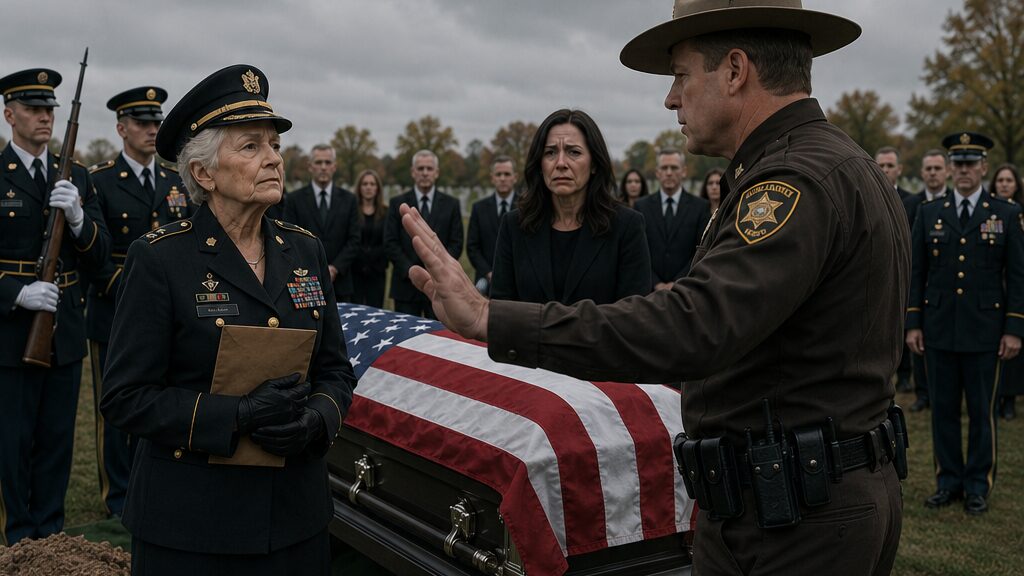
The Sheriff Handcuffed The Old Woman At A Soldier’s Funeral, Then Read Her Name On The Final Orders
Chapter 1: The Woman They Stopped Beside The Flag
The flag was already on the casket when Katherine Wright reached the cemetery gate, and for one sharp second she forgot how to breathe.
It lay smooth across the dark wood, red and white stripes pulled tight against the morning wind, blue field resting where Samuel Martin’s heart would have been. The honor guard stood beyond it in a still line. Black coats gathered under a pale sky. Somewhere behind the mourners, a bugler tested one low note and cut it short, as if even the instrument knew better than to speak too soon.
Katherine stopped with one gloved hand on the open door of her old sedan.
Her knees had stiffened during the drive. Her left wrist ached from the weather. The dark dress uniform she had taken from its garment bag before dawn pulled across her shoulders in a way it had not done twenty years ago. The fabric was brushed, pressed, and correct, but old age had a way of making even formal cloth look borrowed from a stronger life.
She closed the door softly.
In her right hand she carried a sealed brown packet, creased at the corners, with Samuel’s name typed across the front. Not printed by a machine at the cemetery. Not part of the public program. This packet had come to her by registered mail four days earlier with a note from a county clerk who had written only, Mr. Martin left instructions that this be carried by you.
Katherine had not opened it.
Samuel had trusted her once with coordinates, evacuation times, casualty lists, and a silence that lasted nearly thirty years. If he had asked her to carry one more sealed thing to the edge of his grave, she would carry it sealed.
A volunteer in a black raincoat met her beside the stone entrance sign. He was young enough to call her ma’am in the nervous way of someone who had been told to be polite but not given enough information to be useful.
“Family parking is on the far side,” he said, glancing at the older sedan, then at the packet in her hand. “Public parking is back by the chapel.”
“I’m expected at the graveside,” Katherine said.
Her voice was low, not weak. The young man looked past her as a black SUV rolled up behind. Its windows were tinted. A family stepped out, led by a woman with dark hair pinned too tightly and grief held so rigidly in her shoulders it looked painful.
The volunteer checked his clipboard. “Name?”
“Katherine Wright.”
His eyes moved down the page. He started at the top again, slower. The wind lifted one corner of the paper.
“I’m sorry,” he said. “I don’t see you listed with the family.”
“I did not say I was family.”
He looked relieved for half a second, then more confused. “Then I’ll need to know what section you’re with.”
Katherine glanced toward the casket. “Samuel asked me to come.”
The young man’s eyes dropped to her uniform. Not to the ribbons, not exactly. To the age of it. To the careful repairs at the cuff. To the white hair tucked close beneath her service cap. To the way her gloved fingers curled around the brown packet as if it weighed more than paper.
“Ma’am, a lot of people say things at services like this,” he said carefully. “The family gave us a list.”
A black-coated funeral director came over before Katherine could answer. His shoes sank slightly in the damp grass, and he wore an expression polished by years of standing near other people’s losses.
“Is there a problem?”
“She says she’s expected,” the volunteer said. “But she’s not listed.”
The funeral director turned to Katherine. “May I see your invitation?”
Katherine held out the sealed packet. “This was sent to me from the county office. Samuel Martin left instructions.”
The funeral director did not take it at first. His gaze flicked toward the family arriving from the SUV, then back to the packet. “That is not the program.”
“No.”
“Is it a letter?”
“It is sealed.”
“Then I can’t verify from that.”
Katherine’s hand remained steady in the space between them. She had held documents in worse weather, under worse eyes, with engines burning in the distance and men waiting for her to decide whether the road ahead was safe enough to cross. This was only a cemetery. Only a morning. Only Samuel waiting beneath a flag.
But Samuel had waited long enough.
“I need to stand near the casket,” she said. “Not in front. Not with the family. Near enough to fulfill what he asked.”
The funeral director’s face tightened at the word casket, as if she had stepped too close to something that belonged to others. “Mrs. Martin has been very specific. The family section is closed.”
“I understand.”
“I don’t think you do.” He lowered his voice. “This is a difficult day. We cannot have confusion at the graveside.”
Behind him, the dark-haired woman from the SUV had stopped walking. Her eyes were red, but alert. She had heard enough to look directly at Katherine.
Katherine recognized Samuel in the shape of her mouth.
That recognition struck harder than the wind. Katherine had seen Sarah Martin once as a child in a photograph taped inside a footlocker—missing front tooth, hair in uneven braids, one hand gripping Samuel’s sleeve. Samuel had carried that picture through a year of dust and orders and things none of them wrote down afterward. The woman standing by the SUV was no longer a child. She had a daughter’s grief and a daughter’s suspicion, and Katherine had no right to demand that she set either aside.
The funeral director stepped closer. “Ma’am, I can seat you with general guests.”
Katherine lowered the packet. “No.”
The word was not loud, but it changed the young volunteer’s face. The funeral director straightened.
“No?” he repeated.
“I will not sit where I cannot hear his final honors.”
Sarah Martin came forward now. Two mourners moved as if to stop her, then did not. Her black coat was buttoned crookedly, and one side of her collar had folded under.
“Who are you?” Sarah asked.
Katherine met her eyes. “Someone who served with your father.”
Sarah’s face hardened. “A lot of people served with my father.”
“Yes.”
“And they called ahead. They signed the book. They didn’t show up with mystery papers and try to push their way to his casket.”
The brown packet shifted under Katherine’s fingers. She could have said Samuel sent it. She could have said the county had made a mistake. She could have said a title that would have changed the young volunteer’s posture, the funeral director’s tone, perhaps even Sarah’s anger.
But the flag was already on the casket.
This day belonged to the man beneath it.
“I am not here to push,” Katherine said. “I am here because he asked me to carry this.”
Sarah looked at the packet and then at Katherine’s uniform. Her eyes paused on the ribbons, the shoulder boards, the old polished buttons. Something like uncertainty crossed her face, but grief swallowed it quickly.
“My father was sick for a long time,” Sarah said. “People came out of nowhere near the end. People with stories. People who wanted things signed. People who wanted to be remembered by standing close.”
“I want nothing from him.”
“You already got enough from him.”
The words landed with the dull force of something held back for years.
Katherine did not move.
The funeral director touched Sarah’s arm. “Mrs. Martin, let us handle this.”
“I want her away from him,” Sarah said.
The young volunteer looked helplessly toward the road. A county sheriff’s vehicle had pulled up near the chapel, brown and gold against the gray morning. Its door opened, and Sheriff Ryan Brown stepped out, adjusting the front of his uniform jacket as he took in the gathered cluster.
Katherine watched him approach. Mid-forties, controlled stride, jaw set before he knew the problem. A man used to being called when order began to crack, and perhaps too used to thinking order meant obedience.
The funeral director turned with visible relief. “Sheriff.”
Ryan Brown’s eyes moved from Sarah to the volunteer, from the packet to Katherine’s uniform, and then to the casket waiting beyond them.
“What’s going on?” he asked.
“This woman is not on the list,” the funeral director said. “She’s insisting on access to the graveside.”
Ryan looked at Katherine. Not unkindly at first. Efficiently. As if she were one more difficulty to remove before the ceremony could proceed.
“Ma’am,” he said, “I’m going to ask you to step back toward the guest area.”
Katherine held the packet at her side. “I need the cemetery administrator to check the sealed instructions.”
“We’re past that point.”
“No,” Katherine said softly. “You are at exactly that point.”
Ryan’s expression cooled. Sarah stood behind him, trembling with anger or grief. The honor guard waited in silence. The flag did not move.
The sheriff stepped between Katherine and the casket.
“You cannot go any closer,” he said.
Chapter 2: The Sheriff Put Cuffs On Her Hands
Katherine could still see the corner of the flag over Ryan Brown’s shoulder.
That was what she fixed on—not his badge, not the hand resting near his belt, not the mourners turning one by one to watch the interruption widen. Just the flag. The tight fold at the lower edge. The blue field still as a held breath.
“Sheriff,” she said, “there are instructions that must be checked before the service begins.”
Ryan’s voice stayed low, but the shape of his body had changed. He was no longer merely answering a call. He had placed himself as the line. “The family has made their wishes clear.”
“The family may not have all the information.”
Sarah Martin made a small sound behind him, almost a laugh, but there was no humor in it. “My father is in that casket. Don’t stand there and tell me what I have.”
Katherine’s eyes shifted to her. “I would not.”
“Then leave.”
A few mourners lowered their eyes. One older veteran in the second row leaned on his cane and stared at Katherine’s uniform as if trying to pull a memory out of fog. The honor guard commander remained still, but his attention had sharpened.
Ryan noticed the audience. His face tightened with the pressure of being watched.
“Ma’am,” he said, “I’m giving you a lawful instruction. Step away from the restricted area.”
Katherine did not step back. The packet rested against the dark line of her skirt. “This packet was sent under Samuel Martin’s final instructions. If you check it, I will stand wherever the instructions place me.”
“I’m not opening some unknown package at a funeral.”
“I did not ask you to open it. I asked you to verify it.”
“I have verified enough.”
“No,” Katherine said. “You have believed enough.”
The words did not rise above the wind, but several people heard them. Ryan’s eyes narrowed, more from embarrassment than anger. A deputy came up behind him, young and broad-shouldered, stopping when Ryan lifted two fingers.
Sarah’s face had gone pale. “This is exactly what I meant,” she said. “She’s making it about herself.”
Katherine looked down at the packet. Samuel’s typed name blurred for a moment, then cleared. She had crossed an ocean with Samuel Martin when he was young enough to still write letters home every Sunday. She had watched him carry a wounded interpreter through smoke because Katherine had ordered the convoy to move before the second road was secured. She had signed the report that protected names no one could print. Samuel had signed the statement that ended his advancement and preserved the mission.
He had never asked her for anything after that.
Not until now.
“I am making it about a promise,” Katherine said.
Ryan took one step closer. “Set the packet down.”
“No.”
The deputy shifted. The funeral director whispered something about time. The chaplain stood beside the casket with his book closed, waiting for the living to stop failing the dead.
Ryan’s voice hardened. “Ma’am, I don’t know who you are. I don’t know what that uniform means to you. But you are upsetting the family, disrupting a military service, and refusing a direct instruction from law enforcement.”
Katherine’s gaze settled on him. “You do not know who I am because you have not checked.”
“I don’t need to check to see what you’re doing right now.”
For the first time, something moved in Katherine’s face. Not anger. Disappointment so brief that it almost passed for age.
She held the packet out to him again.
Ryan did not take it.
Instead, he reached for her wrist.
A murmur passed through the mourners. Sarah’s mouth parted, but no word came. The deputy looked quickly at Ryan, uncertain now, but Ryan had already committed himself in front of everyone.
Katherine let him turn her gently at first. When he tried to pull her away from the casket, she planted her feet in the wet grass.
“I will not leave his side until the instructions are checked,” she said.
Ryan’s hand closed more firmly. “Then you’re forcing my hand.”
“No,” Katherine said. “You are choosing it.”
He took the cuffs from his belt.
The click of the first bracelet closing around Katherine’s wrist sounded impossibly loud. It cut through the wind, through the low whispering, through the soft shifting of black coats. Her glove bunched under the metal. Ryan drew her other hand behind her, but Katherine turned just enough to keep the packet from dropping into the mud.
“Careful,” she said.
Ryan paused, confused by the word.
“The packet,” she said. “Do not let it fall.”
The second cuff locked.
For one moment the whole graveside seemed arranged around her hands. Old hands. Gloved hands. Cuffed hands holding a brown sealed packet inches from the lower edge of an American flag. The ribbons on her chest caught a thin break of light. The marks on her shoulders were visible now to anyone who knew how to read them, but grief, pride, and procedure had made poor translators of the people standing closest.
The older veteran with the cane removed his cap.
No one else moved.
Ryan seemed to realize the picture he had created only after it existed. His grip loosened, but not enough to undo what he had done. “Escort her back,” he told the deputy.
The deputy did not step forward.
“Sheriff,” the deputy said quietly, “maybe we should call the office.”
Ryan glanced at him. “I said escort her back.”
Katherine lifted her chin. The movement was small, but it carried the old precision of command. “The cemetery administrator has the authority to verify funeral instructions. The county clerk can confirm the packet. The military liaison can confirm the honors request.”
Ryan stared at her. “You seem to know a lot about how this should run.”
“I have buried soldiers before.”
Sarah flinched.
Katherine regretted the sentence as soon as it left her mouth. Not because it was untrue, but because truth could still wound when placed carelessly. Sarah’s grief had no room for the weight Katherine carried. Not yet.
Ryan recovered first. “Then you know better than to interfere with one.”
Katherine looked past him to Samuel’s casket. The flag blurred again. This time she did not fight it.
“I know better than to abandon one,” she said.
The chaplain lowered his eyes. The funeral director swallowed. The honor guard commander’s jaw tightened.
Ryan’s face reddened. “Last chance. Guest area or patrol car.”
Katherine stood with her cuffed wrists held low behind her, the packet pressed between her fingers and the small of her back.
“Check the name again,” she said.
Ryan’s answer came too quickly.
“No.”
The word moved across the graveside like a door closing.
Chapter 3: Sarah Thought The General Abandoned Him
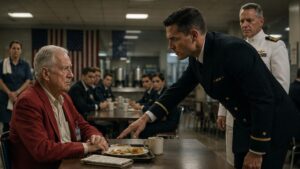
Sarah Martin had spent the last six months imagining every possible way she might lose control at her father’s funeral, but none of those private fears had included an old woman in a decorated uniform standing handcuffed beside his casket.
She had imagined the bugle breaking her. Or the folded flag. Or the chaplain saying Samuel Martin’s name in that careful public voice people used when the dead became cleaner and simpler than they had ever been alive. She had imagined herself crying too hard, or not crying at all, or forgetting how to stand when the rifles sounded.
She had not imagined anger would hold her upright.
The cemetery staff moved the family into the side tent while the service paused. No one called it a pause. The funeral director said they needed “a few minutes to resolve a procedural issue.” The phrase made Sarah want to tear the black ribbon from the guest book.
Her father was in the ground’s waiting place, under a flag, while a stranger with a sealed packet sat on a folding chair near the edge of the tent with handcuffs still on her wrists.
Not a stranger, Sarah corrected herself bitterly. Someone who served with your father.
That could mean anything. Men and women from her father’s past had appeared before. Some came with soft voices and old photographs. Some came with apologies that were really requests to be forgiven by someone who had no authority to forgive them. One had come three years ago asking Samuel to sign a statement about an operation he refused to discuss, and Sarah had found her father afterward sitting in the dark, his hands shaking so hard he could not hold a glass.
Now this woman had come with ribbons, silence, and a packet no one could open.
Sheriff Brown stood near the tent entrance speaking with the funeral director in clipped phrases. The deputy hovered a few steps away, looking increasingly uncomfortable. Mourners waited outside in uneasy clusters. The honor guard remained near the casket, still as carved figures.
Sarah watched Katherine Wright from across the tent.
The old woman sat straight despite the cuffs. She had not asked for water. She had not complained. She had not used whatever authority her uniform was meant to suggest. Her service cap rested on her lap beside the sealed packet, and her white hair, flattened slightly by the cap, made her look older than she had at the gate.
That bothered Sarah most.
A fraud would have protested more.
A confused person would have asked why everyone was upset.
Katherine Wright simply waited, and waiting made her look like someone who had done it under worse conditions.
Sarah crossed the tent before she could talk herself out of it. “Why are you here?”
Katherine looked up. Her eyes were gray, steady, tired in a way Sarah recognized from her father’s last weeks. Not the tiredness of sleep lost, but of things carried too long.
“Because Samuel asked me to be.”
“You keep saying that.”
“Yes.”
“My father didn’t mention you to me.”
Katherine’s face changed only a little. “I know.”
“You know?”
“He told me there were things he never found a way to say.”
Sarah felt heat rise into her throat. “Don’t do that.”
“Do what?”
“Talk like you knew him better than his family.”
Katherine lowered her gaze to the packet on her lap. The cuffs made the movement awkward when she tried to steady it. Metal touched the folding chair with a small sound.
Sarah stared at the cuffs and hated that she noticed the red mark already forming above one glove.
“My father had nightmares for thirty years,” Sarah said. “He missed birthdays. He missed my graduation because he couldn’t walk into a crowded gym. He took jobs below what he was worth because the Army pushed him aside and he wouldn’t explain why. My mother died still angry at people whose names he wouldn’t give her.”
Katherine closed her eyes briefly.
That small act sharpened Sarah’s anger. “So if you’re one of those people, don’t come here with a packet and pretend this is about honoring him.”
“It is about honoring him.”
“Then where were you?”
The question cracked through the tent. Even Ryan looked over.
Katherine did not answer.
Sarah stepped closer. “Where were you when he came home and everyone treated him like he had made some reckless call? Where were you when he had to sell the house? Where were you when he sat at my kitchen table and told me loyalty was sometimes the only thing a man had left, but wouldn’t tell me who deserved it?”
Katherine’s hands tightened around the packet.
“Where were you?” Sarah repeated.
“Exactly where he asked me to be,” Katherine said.
Sarah stared at her. The answer was quiet, but it was not soft. It carried something Sarah could not enter: a locked room, an old order, a promise made between people who had survived something and then never fully returned.
“That’s convenient,” Sarah said.
“No,” Katherine said. “It was costly.”
The word stopped Sarah for half a breath.
Outside the tent, a gust of wind lifted the edge of the flag on the casket. One of the honor guard stepped forward and smoothed it back into place. Sarah watched the white-gloved hand move over the fabric, careful and practiced. Her father had kept a folded flag in a wooden case on his bedroom shelf for as long as she could remember. Not his own. His father’s. He had dusted it every Sunday and never let anyone set anything beside it.
Katherine followed Sarah’s gaze.
“He loved order,” Katherine said.
Sarah gave a short, bitter laugh. “He loved silence more.”
“No. He hated silence.” Katherine’s voice thinned. “He chose it.”
Sarah looked back at her. “Because of you?”
Katherine did not deny it.
The absence of denial did more than an admission would have done. Sarah felt the ground of the morning shift. Her father’s half-sentences, his loyalty, his refusal to blame anyone, his old anger when commentators on television used the word failure too easily—all of it seemed to lean toward the woman in the chair.
“You ruined him,” Sarah said.
The deputy looked away. Ryan’s face tightened, but he did not interrupt.
Katherine accepted the words without flinching. “Your father saved lives.”
“That’s what people say when they don’t want to say what happened.”
“It is also what happened.”
Sarah wanted to slap the packet from her lap. Instead she pointed at it. “What is in there?”
“I do not know.”
“You expect me to believe that?”
“Yes.”
“Why?”
“Because Samuel sealed it.”
For the first time, Sarah saw not pride in the old woman’s face, but obedience. Not to Ryan. Not to the cemetery. To the dead man under the flag.
The sight unsettled her.
“My father wrote one name before he died,” Sarah said. “One name on the pad beside his bed. The nurse thought it was mine at first because his hand was shaking so badly, but it wasn’t.”
Katherine’s breath changed.
Sarah saw it. A small break. A wound opening under the uniform.
“He wrote Wright,” Sarah said. “Over and over. I told myself it had to be a place. Or a street. Or some memory that didn’t matter anymore.”
Katherine looked down at the sealed packet as if it had become heavier than her hands could bear.
Sarah’s voice lowered. “I never believed he meant you.”
Chapter 4: The Missing Page In The Honors Packet
Ryan Brown had handled enough funerals to know that grief could make people unreasonable, but he had never liked the moment when grief made a room look at him.
He stood inside the cemetery administration office with his hat tucked under one arm, listening to the copy machine warm up behind the front desk. Outside the narrow window, the side tent sagged in the wind. He could see the edge of it, the black coats beneath it, the white line of the honor guard still waiting near the casket as if patience itself had been assigned a uniform.
The woman in cuffs was not visible from this angle.
That should have made things easier.
It did not.
The cemetery administrator had pulled three folders from a locked cabinet and spread them across the desk. The funeral director stood to one side, arms folded, face drawn tight with professional panic. The deputy lingered near the door and said nothing, which annoyed Ryan more than any argument would have.
“Here’s the family program,” the administrator said, tapping the first folder. “Here’s the service schedule approved yesterday. Here’s the honors coordination sheet from the military liaison.”
Ryan leaned over the desk. “Does it list Katherine Wright?”
The administrator ran one finger down the page. “Not on the family program.”
“That’s what I said.”
“But the honors sheet has an attachment note.”
Ryan looked at her. “What attachment?”
“That’s what I’m trying to find.”
The copy machine began clicking, too loud in the cramped office. A framed photograph of the cemetery’s dedication ceremony hung crookedly above the filing cabinet. Ryan had stood in this office twice before: once for a Memorial Day security briefing, once when a family dispute over a burial plot had turned ugly. Both times he had left knowing he had done the practical thing.
He liked practical things. Gates. Lists. Procedures. A name was either printed or it was not. A person was either authorized or not. Order came from not letting feelings rewrite rules after a ceremony had begun.
But the sound of the cuffs closing around the old woman’s wrists would not leave him.
“You said she had a packet?” the administrator asked.
“Yes.”
“Did you check the county seal?”
Ryan’s jaw tightened. “It was sealed.”
“That wasn’t my question.”
The deputy looked down.
Ryan gave him a sharp glance, then turned back to the administrator. “She refused to leave a restricted area.”
“She was at a graveside,” the administrator said.
“At the family’s request, that area was restricted.”
The funeral director cleared his throat. “Mrs. Martin was very clear that no unexpected visitors should approach the casket.”
“And the woman knew enough to ask for the administrator,” the administrator said quietly. “Most unexpected visitors don’t.”
Ryan felt the first clean line of the morning bend.
He looked at the paperwork again. Samuel Martin. Army veteran. Full military honors. Family lead: Sarah Martin. Special instructions: see attachment. The place where an extra page should have been clipped showed two small indentations from a staple that had been removed or never properly fastened.
“Where’s the attachment?” Ryan asked.
The administrator’s mouth pressed thin. “That is the problem.”
The funeral director lifted a hand. “We printed from what was sent to us.”
“I’m not accusing anyone,” she said.
No one believed her.
Ryan took the folder and flipped through it himself. Program. Seating note. Chaplain sequence. Flag presentation. Rifle detail. Bugler. Weather backup. A printed guest list with family names, veteran association members, two county officials, and general guests.
No Katherine Wright.
He let himself hold onto that for a moment.
Then he saw it: at the bottom of the honors coordination sheet, in small type half faded by a bad printer, a line reading: Final witness: K.W. packet transfer required.
“K.W. could be anyone,” Ryan said.
The administrator did not answer.
“It could be a clerical mark,” he said.
“It could be,” she said. “But she came with a packet.”
The deputy finally spoke. “And she told us to check the name again.”
Ryan turned. “I remember what she said.”
The deputy’s ears reddened, but he did not look away. “Yes, Sheriff.”
That was worse. Respect without agreement.
Ryan set the page down. His fingers had left a faint crease near the corner. He smoothed it with his thumb, irritated at himself for doing it. “Mrs. Martin asked us to keep this service controlled. You all saw how upset she was.”
The funeral director nodded too quickly. “Exactly.”
The administrator did not. “Controlled is not the same as correct.”
Ryan looked through the window again. He could see Sarah now, pacing just inside the tent. He could not hear her, but he could read the posture. Daughter defending father. Daughter trying to keep strangers from crowding the last few feet of space he had left in the world.
And the old woman.
Ryan had seen a lot of older people in uniforms that no longer fit the body beneath them. Veterans wore old jackets to parades. Widows wore pins. Men with fading memories sometimes appeared at ceremonies believing they were expected. There was no shame in it, but it could turn difficult, especially when families were raw.
He had told himself Katherine Wright was one of those difficulties.
He had needed her to be one.
The administrator opened the third folder. “There’s a county clerk notation here.”
Ryan came around the desk.
She read aloud. “Registered packet delivered to Katherine Wright per decedent instruction. Packet to remain sealed until arrival at cemetery. Secondary sealed copy retained in cemetery archive if primary transfer disputed.”
The office became very still.
“Secondary sealed copy?” Ryan asked.
The administrator was already moving toward the cabinet behind her. She unlocked the lower drawer and pulled out a narrow gray box marked with Samuel Martin’s service number. Inside were envelopes, carbon copies, a folded certificate, and a thick cream-colored packet bound with a red paper band.
She lifted it carefully.
On the front, in typed letters, were the words:
Do not open until General Wright arrives.
The funeral director whispered, “General?”
Ryan stared at the packet.
The word did not explode. It did something worse. It settled into the room with the weight of something that had always been there and had simply been ignored.
The deputy looked at Ryan, then away.
Ryan reached for the packet, but the administrator held it back. “This one is sealed under cemetery witness protocol. We need the military liaison present before opening it.”
“Then call them.”
“They’re already on the grounds, but the assigned officer is still with the honor detail.”
Ryan’s mind moved quickly now, searching for a clean way to restore procedure without admitting the disorder had begun with him. “Fine. Bring them here. Until then, we keep everyone separated.”
The deputy said, “What about the cuffs?”
Ryan did not answer at once.
Through the window, Katherine Wright sat in the side tent, her shoulders straight, her cuffed hands low. She did not appear to be speaking. She did not appear to be pleading. Sarah stood a few feet away from her, face rigid with pain.
The administrator’s voice softened, which somehow made it harder to bear. “Sheriff.”
Ryan exhaled through his nose. “Remove them.”
The deputy went at once, as if grateful for something useful to do.
Ryan stayed in the office. He told himself he needed to secure the paperwork. He told himself the situation was not yet confirmed. He told himself one word on an envelope did not erase the fact that she had refused instruction in a restricted area.
But the word stayed in front of him.
General.
He looked down at his own badge, polished that morning until it caught the office light. He had worn it because people expected certainty from him. Because a county sheriff who looked unsure at a military funeral would become a problem instead of a solution.
The administrator set the sealed copy on the desk between them.
“Sheriff,” she said, “if that packet says what I think it says, this ceremony has been wrong since the first page was printed.”
Ryan said nothing.
Outside, the wind lifted the tent wall, and for a moment he could see the deputy bending beside Katherine Wright’s chair, key in hand, unlocking the cuffs he had put on her.
Chapter 5: The Soldier Who Carried Her Silence
When the cuffs came off, Katherine did not rub her wrists.
The deputy stood in front of her with the open bracelets in his hand, looking younger than he had at the graveside. “Ma’am,” he said, and then stopped, as if any word after that might make the first one worse.
Katherine flexed her fingers once. The gloves had protected the skin from breaking, but a red band marked each wrist where the metal had pressed. She lowered her hands to the brown packet on her lap.
“Thank you,” she said.
The deputy’s face tightened. He wanted to say more. She hoped he would not. Mercy sometimes required allowing a person the dignity of silence before they knew what they were sorry for.
The cemetery administrator sent them to a small chapel room near the main building while the paperwork was checked. It was not a chapel exactly, more a waiting room with wooden chairs, a lectern, and a narrow stained-glass window that turned the gray daylight blue. A heater clicked against the wall. The room smelled faintly of furniture polish and wet wool.
Katherine sat alone for three minutes before Sarah Martin entered.
Sarah stopped just inside the doorway. Her eyes moved to Katherine’s wrists, then to the packet.
“They took them off,” Sarah said.
“Yes.”
“Because of what was on the other envelope?”
“I have not seen the other envelope.”
Sarah looked as if she wanted to challenge that and lacked the strength. She stayed by the door. “They said they need a military officer.”
Katherine nodded.
“My father hated waiting rooms,” Sarah said suddenly. “Hospitals. Offices. Anything with old magazines and people pretending not to listen.”
A memory rose before Katherine could stop it: Samuel Martin at twenty-nine, sitting on an ammunition crate outside a field tent, knees apart, elbows resting on them, writing home with a pencil stub. He had been patient with danger and impatient with paperwork. He could repair a radio with two tools and a curse, but a missing form could undo him.
“He used to tap his left foot,” Katherine said.
Sarah looked up.
“When he was made to wait,” Katherine added. “Always the left.”
Sarah’s mouth trembled before she pressed it flat. “He still did that.”
Katherine looked down at her hands. The red marks above the gloves had deepened. She pulled the gloves off finger by finger, laying them beside her cap. Her hands looked smaller bare. More like an old woman’s hands than a commander’s.
“I did not come to reopen a wound for you,” she said.
“You came with one.”
The words were not cruel. That made them harder to answer.
Katherine rested one palm on the sealed packet. “Your father carried more than he should have.”
“Because of you?”
“Yes.”
Sarah drew in a breath.
Katherine looked toward the blue window. The colored glass softened the cemetery beyond it until the headstones looked submerged. “There was a road outside a village. A convoy. Civilians who were supposed to be moved before dawn. Intelligence that changed too late. If we waited for confirmation, people died. If we moved, our own people might.”
She stopped. She had given testimony in closed rooms with men in suits leaning forward as if truth were a thing they could corner. She had described terrain, timing, order of movement, communications failure. Never the smell. Never Samuel’s face when she gave the order.
“I made the call,” Katherine said. “Samuel executed it.”
Sarah’s voice came quietly. “And something went wrong.”
“Many things went right. That was the problem.”
Sarah stared at her.
“We got the civilians out,” Katherine said. “Not all. Enough that command called it a success in one room and a failure in another. There were questions afterward. About timing. About why a secondary route was used. About whether an officer exceeded what had been authorized.”
“You?”
“Yes.”
“Then why did my father pay for it?”
Katherine closed her hand slowly. “Because the mission that saved those people depended on sources still in the region. If my order became public, names would have followed. Families. Interpreters. People who had trusted us because we promised they would vanish from the paperwork.”
“And my father?”
“Samuel had signed the movement log at the final transfer point. He said the route adjustment was his field judgment.”
Sarah’s face went blank with shock before anger filled it. “He lied?”
“He chose.”
“For you.”
“For them,” Katherine said, and hated how insufficient it sounded.
Sarah turned away. One hand pressed to her mouth. Through the wall, they could hear low voices in the office, a drawer opening, footsteps crossing tile.
Katherine took the packet and turned it once in her hands. The seal held. Samuel’s name looked clean and official, as if paper could make a life orderly.
“I wanted to correct it after the danger passed,” Katherine said. “He would not allow it.”
“Would not allow you?”
“He came to my office in dress uniform. Closed the door. Told me if the record changed, every person we had hidden would be at risk again. Then he said his daughter would rather have an angry father alive than an honored father dead.”
Sarah let out a sound that was almost a sob. “He had no right to decide that for us.”
“No,” Katherine said. “He had no easy right.”
Sarah faced her again. “And you let him.”
“I commanded him once. After that, I owed him the truth of his own choice.”
“You owed his family.”
Katherine nodded. “Yes.”
The answer seemed to disarm Sarah more than any defense. She sank into a chair across the room, leaving the aisle between them empty. “My mother thought he was protecting someone who forgot him.”
Katherine’s throat tightened. “I did not forget him.”
“But you stayed away.”
“He asked that, too.”
Sarah looked at the sealed packet. “And now?”
“Now he has asked me not to.”
Neither woman moved for a while.
Katherine thought of all the times she had told younger officers that restraint was not the same as fear. She had believed it then. She still believed it. But restraint could harden into avoidance if a person wore it too long. It could become a polished surface no one could see beneath, including oneself.
She looked at her wrists. The red marks from the cuffs circled them like accusations.
“I thought silence was the last order I owed him,” she said. “I may have been wrong.”
Sarah wiped under one eye with the side of her finger. “What if that packet makes him look worse?”
“Then I will not read it aloud.”
“What if it makes you look worse?”
Katherine looked up. “Then I will.”
The door opened before Sarah could answer.
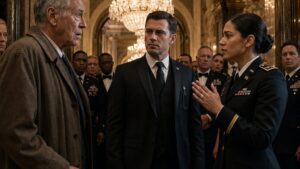
A man in a dark Army dress uniform stood at the threshold. Silver hair at the temples. Colonel’s eagles at his shoulders. He held his cap beneath one arm, and whatever he had meant to say vanished when he saw Katherine.
His posture changed first.
Not dramatically. Not for the room. His shoulders squared. His chin lifted. His eyes widened with recognition that belonged to a different decade.
Katherine knew him only after the movement. Mark Green had once been a captain who wrote too much in the margins of field reports and apologized for none of it. He had aged into authority, but the old earnestness was still there.
He took one step inside.
Then he stopped, heels together.
“General Wright,” Mark Green said.
Sarah went still.
Katherine closed her eyes for the briefest moment.
The title had entered the room at last, and it had not come from her.
Chapter 6: When The Colonel Read Her Name
Mark Green had seen senior officers lose rooms by demanding attention, and he had seen others command silence by refusing it.
Katherine Wright did the second.
She sat in the chapel room with her gloves laid beside her and red marks around both wrists, the sealed packet resting across her knees. Sarah Martin sat several chairs away, pale and motionless. No one spoke for a moment after Mark used the title. Even the heater seemed to pause between clicks.
Katherine opened her eyes. “Colonel Green.”
His name in her voice carried more force than any salute he had received that year.
Mark kept his cap under his arm. “Ma’am.”
“This is Samuel Martin’s funeral,” she said.
“Yes, ma’am.”
“Then stand at ease.”
The corner of his mouth moved, not quite a smile. He obeyed.
Sarah looked between them. “You know her.”
“Yes,” Mark said. “I served under General Wright.”
Katherine’s expression warned him.
He understood it immediately. Not here. Not like this. Not as spectacle.
Ryan Brown appeared behind him in the doorway with the cemetery administrator and funeral director. The sheriff looked from Mark to Katherine, then to Sarah. His face had the guarded look of a man approaching a bridge after hearing wood crack beneath his own feet.
“We have an archived packet,” the administrator said. “It requires military liaison witness.”
Mark nodded. “Bring it to the office.”
Katherine rose carefully. Sarah stood too, as if unwilling to be left with any version of the truth that might happen out of her sight.
“No one opens Samuel’s packet without his daughter present,” Katherine said.
Mark looked to Sarah. “Mrs. Martin?”
Sarah’s voice was rough. “I’m coming.”
The office felt smaller with all of them inside. The sealed archive copy lay on the desk where Ryan had first seen the words. Do not open until General Wright arrives. Beside it sat the incomplete program, the honors sheet, and a copy of the family list that had started the morning wrong.
Ryan stood near the wall. His hat was back in his hand. Without it, he looked less official and more tired.
Mark read the envelope once without touching it. His jaw tightened at the honorific, then at the condition beneath it. “Who authorized the printed program?”
The funeral director lifted a hand slightly. “We printed what was sent.”
The administrator said, “The attachment page was not in the final packet.”
“Was it removed?”
“I don’t know.”
Mark looked at Ryan. Not accusing. Measuring.
Ryan answered the question he had not been asked. “At the time, she was not on the list.”
Katherine said nothing.
That silence did more damage than argument.
The administrator broke the red band with a letter opener. The sound was small but final. She unfolded the first page and placed it on the desk so Mark could read it without removing it from the file.
Mark leaned down.
His eyes moved across the page. Then he straightened, slower than before.
“Read it,” Sarah said.
The administrator hesitated.
Katherine looked at the page. “Only the relevant part.”
Mark picked it up. “Final honors instruction for Samuel Martin. At my graveside, after the flag is presented, the sealed personal statement is to be transferred to my daughter, Sarah Martin, by General Katherine Wright, United States Army, Retired, former commanding officer, Joint Humanitarian Task Force.”
No one moved.
Ryan stared at the paper as if waiting for it to change.
Mark continued, quieter. “General Wright is not to be treated as ceremonial guest of honor. She attends at my request as witness.”
Sarah gripped the back of the chair in front of her.
Katherine’s face did not change, but Mark saw her hand close once at her side.
The administrator took the next page. “There is also a liaison note. It says General Wright’s name was to be included in the honors coordination sheet but withheld from public program at decedent’s request.”
“At my father’s request?” Sarah asked.
Mark looked to Katherine before answering. She gave the smallest nod.
“Yes,” he said. “It appears so.”
“Why?”
Katherine’s voice was low. “Because he did not want the ceremony to become about me.”
Ryan looked down.
There it was, Mark thought. The cruelty of the morning laid bare: the woman had been silent for the same reason she had been misjudged. She had not hidden herself to deceive them. She had hidden herself to obey the dead.
The funeral director whispered, “I am very sorry.”
Katherine turned her head toward him. “Not yet.”
He blinked.
“You do not know what you are sorry for yet,” she said.
The room absorbed that, uneasily.
Mark folded the page once and set it down. He had known Katherine Wright in rooms where decisions arrived without enough time, where her voice could cut panic from a map table without ever rising. He had also seen her sit beside a young radio operator for twenty minutes after casualty notification, saying almost nothing, making sure the man did not confuse survival with failure.
He had never seen handcuff marks on her wrists.
“Sheriff Brown,” Mark said.
Ryan looked up.
“Why was General Wright restrained?”
Ryan’s face tightened at the title. “She refused to leave a restricted area.”
“She asked you to verify her name.”
“She refused an instruction.”
“Both can be true,” Katherine said.
Mark looked at her.
She stood very straight beside the desk, bare hands visible now, red at the wrists. “Sheriff Brown was wrong to refuse verification. I was also unwilling to leave Samuel. Do not simplify the morning just because the paper has become clearer.”
Ryan’s eyes lifted to her then, and for the first time he seemed less defensive than lost.
Mark felt the room shift again. That was why she had commanded men and women who remembered her decades later. Not because she spared them blame. Because she made room for the whole truth and still required them to stand inside it.
Sarah stepped toward the desk. “Where is the personal statement?”
Katherine raised the brown packet she had carried from the gate. “Here.”
The administrator said, “The instruction says transfer after the flag presentation.”
Sarah looked at Katherine. “So we still don’t open it.”
“Not unless you ask me to,” Katherine said.
Sarah stared at the seal. For a moment Mark thought she would reach for it. Instead she folded her arms around herself and looked away.
“Resume the service,” Sarah said. Her voice shook. “If that’s what he wanted, then resume it.”
The funeral director nodded quickly, grateful for motion. The administrator began gathering the corrected pages. Mark took the honors instruction and slid it into a clear folder.
Ryan remained by the wall.
Katherine turned to him. “Sheriff.”
His shoulders stiffened. “Ma’am.”
“Do not call me that because you read a page.”
The color left his face.
Mark nearly stepped in, then stopped. This was not his moment.
Katherine’s voice stayed even. “Call me that if you can mean it for an old woman whose name you have not yet found.”
Ryan swallowed. “Yes, ma’am.”
It was not enough. It was not supposed to be.
Outside, the honor guard commander received the corrected instruction with visible alarm, then moved swiftly toward the graveside. Word traveled not by announcement but by posture: straighter backs, lowered voices, glances toward the chapel office door.
Mark walked beside Katherine as they left the building. Sarah followed a step behind, carrying nothing, as if her hands had forgotten what they were for. Ryan came last.
The casket waited under the same flag. The mourners turned as the group approached, curiosity and shame beginning to mix before anyone had explained why.
Mark stopped near the path. “General,” he said quietly, “do you want the correction made publicly?”
Katherine looked at the casket, then at Sarah, then at the red bands around her wrists.
“Only if it helps Samuel,” she said.
Chapter 7: The Room Went Quiet Before The Salute
When Katherine stepped back toward Samuel Martin’s casket, no one spoke her name.
That was how she preferred it.
The path from the administration building to the graveside was not long, but it had become a public corridor. Mourners who had whispered earlier now stood with their hands folded or caps held low. The honor guard commander had repositioned his soldiers. The chaplain waited with his book open, but his eyes moved once to Katherine’s wrists and then away, as if ashamed of having seen the marks.
The cuffs were gone.
The red circles remained.
Katherine kept her hands bare. She could have put the gloves back on. They were folded in one pocket of her uniform coat, the leather still shaped by her fingers. But Samuel had asked her to carry truth to the edge of his grave, and truth, she had learned too late, rarely arrived clean.
Sarah walked beside her, not close enough to forgive, not far enough to deny what had changed. Mark Green carried the corrected honors instruction in a clear folder. Ryan Brown followed several steps behind them, his face controlled in a way that showed how hard he was working to keep it so.
At the casket, Katherine stopped.
The flag lay exactly as it had before. The world had been interrupted around it, but the flag had remained. That steadied her.
The chaplain looked to Sarah first. Sarah gave a small nod. Only then did he begin again.
His voice did not explain the delay. It did not refer to the office, the packet, the cuffs, or the word that had moved through the cemetery without announcement. He spoke of service and dust, of duty and rest, of the mercy of being remembered by those who remained. Katherine listened with her eyes on the blue field of stars. She had stood at too many graves where the words were correct and insufficient. Still, correct mattered. Insufficient did not mean worthless.
When the rifles fired, Sarah flinched on the first volley and stood firm through the next two.
The bugle followed.
The notes rose thin and bright into the gray air, and something in Katherine that had been held by discipline rather than strength loosened. Samuel had hated bugles when they were young. Said they made every soldier sound like a story already finished. Later, after the road and the inquiry and the silence, he had written her one line on paper torn from a field notebook: If they ever play it for me, don’t let them make me cleaner than I was.
She had kept that note until the ink faded.
The last note dissolved over the rows of stones.
The honor guard commander stepped forward with the practiced gravity of a man who understood that cloth could become a final sentence. He lifted the flag from the casket with two soldiers assisting. Their white-gloved hands made sharp folds, slow and exact. Each movement pulled the morning tighter.
Sarah watched as if afraid to blink.
Katherine stood one pace behind her and to the side, where witness belonged.
When the flag was folded into its triangle, the honor guard commander turned toward Sarah. His hands extended. Sarah reached for it, but the commander hesitated and glanced at Mark Green.
Mark opened the clear folder.
The cemetery seemed to hold itself still.
“Per the final honors instruction of Samuel Martin,” Mark said, his voice carrying without force, “the personal statement is to be transferred to Sarah Martin by General Katherine Wright, United States Army, Retired, former commanding officer and final witness.”
A sound moved through the mourners—not a gasp exactly, but the sudden absence of casual breathing. Heads turned. The older veteran with the cane closed his eyes. The funeral director lowered his chin. Ryan Brown looked at the ground.
Katherine did not look at them.
She looked at Sarah.
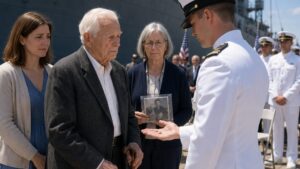
The honor guard commander placed the folded flag in Sarah’s arms. Sarah held it against her chest, and for the first time that morning, her face truly broke. Not loudly. Not for display. Her shoulders shook once, and she pressed her mouth to the sharp folded edge.
Katherine waited.
Mark handed her the brown packet.
It was the same packet she had carried from the gate, the same packet Ryan had refused to verify, the same packet she had protected even while being cuffed. In her bare hands now, it looked smaller. Paper always looked too small after the damage done in its name.
She stepped in front of Sarah.
“Your father asked that I give this to you after the flag,” Katherine said.
Sarah’s eyes were wet and fixed on the seal. “Do you know what it says?”
“No.”
“Do you think I should open it here?”
Katherine looked at the casket, then at the circle of mourners who had become unwilling witnesses to more than a funeral. “Only if you want the room to hear whatever he chose.”
Sarah’s fingers tightened around the flag. “He wanted you to transfer it here.”
“Yes.”
“Maybe he wanted you to read it.”
Katherine felt the old instinct to refuse. Samuel’s privacy had been a mission she had guarded for decades. But the morning had already shown what secrecy could become in the hands of people missing one page.
Sarah held the flag with one arm and broke the packet seal with her free hand.
The sound was soft.
Inside was a folded letter, several copied pages, and a smaller envelope marked Sarah. Sarah looked at the letter first, then held it out to Katherine.
“I can’t,” she whispered.
Katherine did not take it right away. “Sarah—”
“He asked for you,” Sarah said. “Then do it.”
The use of her first name struck Katherine more deeply than the title had.
She accepted the letter.
The paper trembled once in her hands. She steadied it against the folded packet and began to read.
“My daughter,
If this letter is being read at my grave, then I finally ran out of excuses to say this badly in person. I am sorry for that. A father should not leave truth behind like a locked drawer.
You grew up thinking my silence was bitterness. Sometimes it was. But it was also a promise. Years ago, I made a choice to carry blame for an order I did not give, because telling the full truth would have placed living people in danger. General Wright gave the order that saved them. I signed the statement that hid how it happened. I did it knowingly. I did it because the people we moved that night had children, names, and enemies still looking for them.
Do not hate her for what I chose.
I was angry. I was proud. I was afraid that if the record changed, the wrong people would suffer. Katherine wanted to correct it more than once. I forbade it. That was not obedience. That was my decision.”
Katherine had to stop.
The cemetery blurred, but she did not lower the page. Sarah was crying openly now. Mark’s face had gone rigid with the effort of remaining still. Ryan stood behind the mourners, pale and exposed.
Katherine read on.
“I asked her to come because she knows the part of me that did not fit into family stories. I asked her to hand you this because I was not brave enough to do it while I could still hear your answer.
If there is honor in me today, let it not be the kind that requires someone else to stay buried in shame.
And if the people at my service remember anything, let them remember this: rank does not make a person worthy of decency. Neither does age, uniform, grief, or usefulness. Decency is owed before the record is checked.”
Katherine stopped again.
No one asked her to continue. There was no need. The last sentence had landed where the morning had wounded.
Sarah reached for the letter. Katherine gave it to her, along with the copied pages beneath it. Sarah clutched them against the folded flag.
Then the honor guard commander moved.
He stepped toward Katherine, heels together, and saluted.
It was not theatrical. It was not for applause. It was a precise correction inside a silence that understood too late.
Mark Green saluted next.
The older veteran with the cane struggled to stand straighter and lifted his hand to his brow. A few others followed, uncertain but sincere. Katherine did not return it at first. Her right hand felt impossibly heavy.
Then she raised it.
Her fingers touched the edge of her brow, passing over eyes that had seen Samuel young, wounded, angry, loyal, and finally brave enough to leave the truth behind.
When her hand lowered, Ryan Brown stepped forward.
His hat was in both hands now. His voice came low, strained. “General Wright, I owe you—”
Katherine turned to him before he could finish.
“No,” she said.
The single word stopped him more completely than anger would have.
Chapter 8: Do Not Apologize Because I Was A General
After the burial, the cemetery road shone dark under a thin fall of rain.
People left slowly. They passed Katherine without knowing what to say, which was better than saying too much. Some nodded. Some lowered their eyes. The funeral director tried once to approach her and then turned away to help an older mourner into a car. The honor guard departed in quiet formation, their white gloves now hidden, their duty complete.
Samuel Martin’s grave remained behind them under fresh earth, the temporary marker straight, the grass around it torn by shoes and weather.
Sarah stood beside Katherine at the edge of the road, holding the folded flag in one arm and her father’s letter in the other hand. She had read the smaller envelope alone after the service, sitting under the side tent while rain tapped the canvas above her. Katherine had not asked what it said. Some truths belonged first to daughters.
Ryan Brown waited near the administration building.
He had waited through the last prayers, through the lowering, through the first departures. Waiting did not suit him. Katherine could see it in the way he kept shifting his hat from one hand to the other. He was a man built to move toward problems. Now the problem required him to stand still.
Sarah looked at him. “You don’t have to talk to him for me.”
“I know.”
“You don’t have to make it easier for him.”
“I know that too.”
Sarah’s grip tightened around the flag. “I hated you this morning.”
Katherine looked at her.
Sarah gave a broken, humorless breath. “I thought I should say it plainly.”
“You had reasons.”
“I had pieces.”
“We all did.”
Sarah watched rain collect on the edge of the curb. “He protected you.”
“Yes.”
“And you protected what he asked you to protect.”
“Yes.”
“Was it worth it?”
Katherine did not answer quickly. The easy answer would have been cruel. The noble answer would have been dishonest.
“People lived,” she said. “Your father paid. I advanced. That is not a clean equation.”
Sarah looked toward Samuel’s grave. “He didn’t sound angry in the letter.”
“He had more grace than I deserved.”
“He said you tried.”
“Trying is not the same as repairing.”
Sarah turned the letter against the folded flag, shielding the paper from the rain. “Then repair what you can.”
Katherine nodded once.
She walked toward the administration building alone.
Ryan straightened when she approached. The deputy stood near the office door but moved away when Ryan glanced at him. For a moment the sheriff and Katherine faced each other under the shallow overhang while rain ticked against the metal gutter above them.
“Ma’am,” Ryan said.
Katherine waited.
He swallowed. “I owe you an apology.”
“Yes.”
The directness struck him. He had prepared for refusal, perhaps for forgiveness, perhaps for the kind of gracious dismissal that would let him feel smaller but clean. Katherine offered none of those.
Ryan looked at her wrists. The marks had faded slightly but were still visible. “I was wrong to restrain you.”
“Yes.”
“I was wrong not to verify the packet.”
“Yes.”
His face tightened. “I was trying to protect the family.”
“You were also protecting yourself from uncertainty.”
He looked up then.
Katherine’s voice remained even. “Those two things became tangled. That is dangerous when you carry authority.”
Ryan’s mouth opened and closed once. The rain filled the silence.
“I saw an unknown person near a grieving family,” he said. “I saw a sealed packet. I saw a uniform I didn’t understand. I thought if I gave ground, the service would fall apart.”
“And so you made me the disruption.”
His eyes dropped. “Yes.”
Katherine let the word stand between them. Not as punishment. As fact.
Ryan drew a breath. “General Wright, I—”
“No.”
He stopped.
She stepped closer, not enough to threaten, only enough to make sure he had to meet her eyes. “Do not apologize because I was a general.”
His face changed, and in that change she saw the morning return to him: the gate, the list, Sarah’s grief, the packet, his hand closing around an old woman’s wrist.
“If I had been no one,” Katherine said, “if I had been confused, poor, lonely, wrong about why I was invited, you still owed me verification before humiliation. You still owed me patience before metal.”
Ryan’s hands tightened around his hat. “I understand.”
“Not yet,” Katherine said. “But you can.”
The office door opened behind him. The cemetery administrator stood there with a folder held against her chest. She glanced between them, then said, “Sheriff, I pulled the incident form.”
Ryan nodded without looking away from Katherine. “Good.”
The administrator hesitated. “There’s also the procedure review you requested.”
Katherine watched him.
Ryan turned. “Not requested. Required.”
The administrator’s expression shifted slightly.
Ryan looked back at Katherine. “Effective today, no elderly guest, veteran, or unlisted attendee with claimed final instructions gets removed from a service until the cemetery administrator, family representative, and liaison have reviewed the claim. If there’s a sealed packet, it gets logged and verified before anyone touches the person carrying it.”
Katherine studied him. “Write it without the word elderly.”
Ryan blinked.
“Age should not be the condition that earns care,” she said.
He absorbed that, then nodded. “Any guest.”
“And train your deputies that control is not the first form of order.”
The corner of the administrator’s mouth moved, quickly hidden.
Ryan did not defend himself. “I will.”
Katherine believed he meant it in that moment. Whether he would mean it six months from now would be proven by people who never knew her name. That was the only proof that mattered.
He looked again at her wrists. “I can’t undo that.”
“No.”
“I am sorry.”
This time he did not use her title.
Katherine accepted the apology with a small nod. “Then let it make you slower next time.”
Ryan’s eyes shone, though he did not let anything fall. “Yes, ma’am.”
She turned to leave, then paused. “Sheriff Brown.”
He straightened. “Yes?”
“Sarah Martin should not have to request copies of the corrected record twice.”
“I’ll see that she has them before she leaves.”
“Good.”
When Katherine returned to the road, Sarah was waiting beside the old sedan. Rain had softened the careful shape of her hair. The folded flag was protected beneath her coat now, pressed close as if it had a pulse.
“He apologized?” Sarah asked.
“Yes.”
“Did you forgive him?”
Katherine opened the back door and laid her service cap carefully on the seat. “That is not the only useful thing an apology can become.”
Sarah considered that. “My father would have liked that answer.”
“He would have argued with it first.”
For the first time that day, Sarah smiled. It was small and exhausted, but it belonged to life rather than ceremony.
Katherine removed her uniform coat slowly. The damp wool resisted at her shoulders. Beneath it she wore a plain dark blouse, old and neatly pressed. She folded the coat over one arm with the ribbons turned inward, away from the rain and away from view.
Without the coat, she looked smaller.
Sarah noticed.
“My father knew who you were,” she said. “He still asked for Katherine, not the rank.”
Katherine looked toward the grave. “He knew the difference.”
Sarah held out the copied pages from the packet. “Will you help me understand the parts he couldn’t explain?”
Katherine took the pages, then gave them back. “I will sit with you while you read them. I will answer what I can. And when I cannot, I will say so.”
“No more locked drawers?”
Katherine looked at the red marks around her wrists, fading now into the ordinary color of old skin.
“No more than necessary,” she said.
They began walking down the cemetery road together. Behind them, the administrator handed Ryan a folder through the office doorway, and the deputy stood beside him, listening as the sheriff spoke in a lower voice than before.
Ahead, cars moved slowly past the rows of white stones. Rain touched the folded coat over Katherine’s arm, but she did not put it back on. For the first time all morning, she did not need cloth, rank, or witness to keep her standing.
Sarah walked beside her carrying Samuel’s letter.
Not behind her.
Not against her.
Beside her.
The story has ended.