The Brass Compass in Storage Fourteen and the Lesson No One Applauded
Chapter 1: The Key Tag Beneath His Old Cap
The letter had been hiding behind an electricity bill when John Hill found it, and for a moment he thought someone had mailed him a mistake.
Fort Bellamy Military Academy.
The name sat in the upper-left corner beneath a new blue crest he did not recognize. His thumb stopped on the paper. The kitchen was silent except for the old refrigerator clicking on and the faint tick of the cracked watch on his wrist.
He read the first paragraph once.
Then again.
A personal storage crate, mistakenly retained during an archive transfer, had been located in an equipment building on academy grounds. The record attached to it was incomplete. The listed owner was William Reed.
John lowered himself into the kitchen chair carefully, one hand against his right hip.
William had been gone forty-one years.
The letter did not say what was in the crate. It did not need to. John knew what might be there. A notebook with soft black covers. A compass with a scratched face. A folded photograph William had kept tucked inside his field shirt whenever he thought no one was looking.
Or none of those things.
John had learned a long time ago that memory did not always wait where you left it.
He set the letter beside his coffee mug and stared at the wall above the sink, where nothing hung. His wife had liked the walls bare. She used to say people filled them because they were afraid quiet rooms might ask questions.
He had not thought of that sentence in years.
His phone rang before he could decide whether to call the academy.
“John?” Carol Reed’s voice was thinner than he remembered, though she had always sounded careful when speaking about her father. “Did you get it too?”
“I did.”
For a second, neither of them said anything.
“My mother would have wanted to know,” Carol said. “She used to say your friend never came home empty-handed. Even when he came home tired, he had something for somebody.”
John looked toward the field jacket hanging from the back of the pantry door. Dark green, repaired at one elbow with thread that did not quite match.
“He did,” John said.
“Mom can’t travel now.” Carol inhaled through her nose. “But Heather and I can come. We could meet you there.”
John should have said no. It would be easier to collect the crate, bring it to Carol’s house, and leave before anyone had to look at his face while he opened it.
Instead, he heard himself say, “Saturday morning.”
By Saturday, his hip had stiffened enough that getting into the truck took two tries. He did not complain. There was no one in the driveway to hear him.
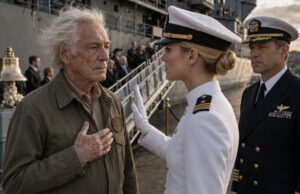
He dressed slowly: plain shirt, old field jacket, dark trousers, scuffed shoes. He lifted the faded cap from its hook and found the dented brass key tag beneath it, still looped onto a thin ring.
STORAGE 14.
The engraving had been worn smooth at the edges.
He placed it in his pocket, then took it out again. For no reason he could name, he held it in his palm until the metal warmed.
The drive to Fort Bellamy took just under an hour. Roads he remembered as narrow strips of patched pavement had widened into lanes with signs and painted arrows. When the academy gate appeared, the old brick guardhouse had been replaced by glass and stone. A banner stretched over the entrance:
ANNUAL INTERGENERATIONAL SAFETY CHALLENGE
Families crowded the grounds. Cadets in pressed uniforms moved between tents. A brass band practiced somewhere near the field, playing the same four measures badly over and over. The air smelled of wet grass, coffee, and oil.
John parked at the far end of the visitor lot, where no one would need to see him climb out slowly.
Carol spotted him near the gate. She was standing beside a teenage girl with dark hair pulled into a loose braid and both hands wrapped around a paper cup.
“John,” Carol said.
She hugged him before he could offer his hand.
Heather watched him with open curiosity. “Mom says you knew Grandpa before she was born.”
“That’s true.”
“Were you close?”
John looked at the academy field beyond her shoulder. The marked range had been set up beside the bleachers, bright cones and barriers in precise rows. Young men and women stood around it laughing too loudly.
“We worked together,” he said.
Heather waited for more.
Carol gave her a small look, and Heather lowered her eyes to the cup.
They walked toward the equipment building, but a staff member stopped them near a white tent. “Storage pickup?” he asked. “The clerk is coming over from the archives. It may be a few minutes.”
John nodded.
A few minutes became twenty.
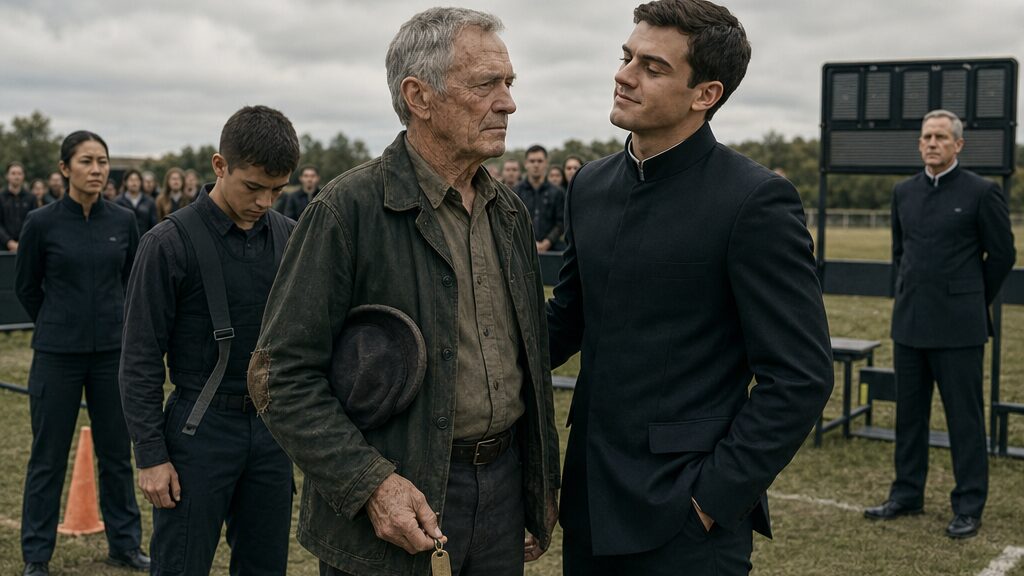
The event around them grew louder. An announcer called names over a speaker. A row of sponsors stood near the field in matching academy jackets. One young man among them did not look like the others. He was broad-shouldered and polished, his jacket fitted too neatly, his posture arranged as if someone had taught him that confidence meant taking up more room than everyone else.
Nicholas Vale noticed John first.
His gaze moved over John’s worn jacket, the cap beneath his arm, the stiffness in his walk. Then it settled on the brass key tag in John’s hand.
Nicholas smiled at two cadets beside him.
“Sir,” he said, loud enough for them to hear, “are you sure you didn’t wander into the wrong part of the base?”
The nearest cadet laughed. It was not a cruel sound at first. More startled than anything.
John folded his fingers over the key tag.
“I’m waiting for a storage clerk.”
Nicholas tilted his head. “This is an academy sports event. Not a museum tour.”
The second laugh came easier.
Carol went still. Heather’s face changed in a way John recognized too well: embarrassment arriving before anger had time to catch it.
John could have told Nicholas that he had once walked these grounds when the barracks were brick and the field had no scoreboard. He could have told him that William Reed’s name had been carried through these gates in silence because men did not always leave a place the same way they entered it.
He did not.
“I only came for a box,” John said.
Nicholas’s smile stayed in place, but it tightened at the edges. Perhaps he had expected an argument. Perhaps he had expected John to retreat.
Instead, John looked past him toward the storage building.
A commandant in dress uniform stood by the sign-in table speaking to an instructor. John recognized neither face. The instructor, a woman with straight dark hair pinned back from her collar, looked briefly in his direction. Her eyes paused on his jacket, then on the way he balanced his weight.
Nicholas followed John’s gaze.
“Mark,” he called. “We have another participant.”
The commandant turned. His expression was distracted, then mildly puzzled.
John felt Carol move closer beside him.
Nicholas grinned at the cadets. “He seems interested in the challenge.”
“I’m not,” John said.
Nicholas stepped nearer. “At your age, what exactly do you think you can prove?”
The words landed in the open space between them.
John looked toward the range. A young recruit near Nicholas had his hands clenched at his sides. His name tag read TYLER ORTIZ. He was watching the ground.
John knew that posture. The body trying to become small before someone else could make it smaller.
The instructor approached. “The challenge is supervised,” she said. “If he wants to participate, there’s room.”
The commandant looked at John. “Only if you wish to, sir.”
John’s hip ached. His hand closed around the key tag in his pocket.
He had come to return a promise, not to stand under bright tape and let strangers measure him. But Tyler still had not looked up. Carol’s mouth was pressed into a hard line. Heather had stopped pretending not to listen.
John adjusted the cracked strap of his watch.
“Would it interfere with your schedule?” he asked.
“No,” the instructor said.
Nicholas’s smile widened.
John nodded once.
“Then I’ll participate.”
Chapter 2: The Range Where Everyone Watched Him
Nicholas laughed softly when John reached for the registration form.
“Careful,” he said. “It has small print.”
John did not look up.
The form rested on a folding table beside a stack of hearing protection and safety vests. He read every line. The instructor stood across from him, waiting without impatience.
“Name?” she asked.
“John Hill.”
She wrote it down, then paused. “Any mobility concerns?”
“My right hip gets stubborn.”
“Do you need accommodation?”
John considered the question. “I need the rules explained clearly.”
Her expression shifted, not quite a smile. “That can be arranged.”
Behind him, Nicholas was telling someone that the challenge was basic. Timed stations, equipment checks, controlled movement, judgment under pressure. Nothing that demanded youth, he said, though he spoke the word as if it meant the opposite.
Tyler stood at the edge of the range, fastening his protective gear. His fingers slipped twice on the strap beneath his shoulder.
John watched him without turning his head.
The commandant, Mark Hayes, stepped toward the microphone. “This portion of the event pairs experience with composure,” he announced. “The purpose is not speed alone. It is awareness, control, and respect for procedure.”
Nicholas bounced lightly on his heels.
John placed his faded cap on the table beside the key tag. The cap looked older under the white tent lights. So did his hands.
Lisa Chen, the instructor, demonstrated the course. Stop line. Equipment check. Verbal confirmation. Controlled task. Final safety inspection.
John listened with his head slightly tilted. He asked where the range officer would stand. He asked whether the final check could be repeated if a participant believed they had missed something. He asked who had authority to pause the course.
Nicholas leaned toward a cadet and whispered something that made the cadet cover his mouth.
Lisa heard it. Her eyes flicked toward him, then away.
John noticed.
Tyler went first after Nicholas.
Nicholas had already completed the course in a quick, polished run. He had moved fast enough to draw applause, though he had nearly missed a final strap check before correcting himself at the last second. His score appeared on the board near the bleachers, high enough to bring more clapping.
Tyler stepped onto the line.
His face had gone pale.
“Don’t freeze now,” Nicholas said under his breath.
The words were quiet, but John heard them.
Tyler’s shoulders stiffened. He moved too quickly through the first check, then stopped when the range officer called him back. His hands shook as he adjusted the equipment. At the controlled task, he hesitated long enough for the timer to chirp.
A murmur moved through the crowd.
Tyler stepped off the lane with his jaw locked.
John saw the loose strap before Tyler did. It hung just beneath the edge of his vest, not enough to cause a problem in this exercise, perhaps, but enough to matter anywhere that mattered more.
“Tyler,” John said.
The recruit looked up, startled.
John pointed without touching him. “That one.”
Tyler followed his finger. His face flushed deeper.
“I checked it.”
“You checked fast.”
Tyler swallowed.
John waited. He did not say anything else until Tyler fixed it.
“There,” John said. “Now it’s checked.”
The range officer called John’s name.
The walk to the line took longer than he wanted. Pain caught sharply in his hip halfway there. He paused, not dramatically, just long enough for it to pass. Some of the crowd shifted. Nicholas folded his arms.
John stepped into position.
The range narrowed around him.
He heard the flags overhead. The speaker crackled somewhere beyond the field. His fingers brushed the face of his watch, a habit older than the crack across the glass.
“Ready?” Lisa asked.
John looked down the lane. “Ready.”
He began.
There was nothing quick about it. He checked every fastening point twice. He waited for the verbal confirmation before moving. When the range officer shifted position, John noticed and adjusted without being told. At the controlled station, he kept his breathing even and his shoulders low.
The crowd grew quiet in a different way.
Not impressed yet.
Watching.
At the final inspection, he paused. The timer ticked. Nicholas looked toward the board as if he had already decided what the numbers would say.
John reached back to one strap near his shoulder. It was secure. He checked again anyway.
Then he raised his hand.
“Complete,” he said.
The results took a few seconds to appear.
John stepped aside and reached for his cap.
The board changed.
A line of numbers rose above Nicholas’s score.
For a moment no one spoke.
Then a cadet near the front let out a surprised breath. Someone began clapping once, then stopped, uncertain whether it was appropriate. The applause returned in scattered pieces, not loud enough to hide the silence underneath it.
Nicholas stared at the board as if it had made a mistake.
Tyler looked from the score to John.
Lisa Chen came closer. “Mr. Hill,” she said, “what unit were you with?”
John slid his cap beneath his arm. “A long time ago.”
Mark Hayes had gone still.
He stepped forward slowly, studying John’s face, the jacket, the repaired elbow. Then he looked at the faded patch sewn inside the collar.
“Hill,” he said.
John met his eyes.
Mark swallowed. “John Hill?”
“Yes.”
Mark reached into his jacket and pulled out his phone. He opened a photograph, then turned the screen toward John.
It showed a framed display inside an academy building. A younger John stood beside a group of soldiers. His hair was dark. His shoulders were straight. One arm rested across the shoulders of another man whose grin had always come a little too quickly when a camera appeared.
William Reed.
Below the photograph were words John had not seen in decades.
DISCIPLINE IS WHAT YOU DO WHEN NOBODY IS APPLAUDING.
Carol made a sound that was almost a breath and almost a sob.
Heather took her hand.
Mark looked at John with something close to reverence. “My father talked about you.”
John’s eyes went to the photograph, then away.
“Your father was a good man,” he said.
Lisa cleared her throat. “Would you say something to the cadets?”
John shook his head.
The applause returned, fuller this time. He let it wash past him without looking at the crowd. Nicholas had not moved.
Instead, John walked to Tyler.
The recruit stood as if he expected a correction.
John stopped beside him. “You rushed because someone made you feel small.”
Tyler’s mouth tightened.
“You don’t need to keep up with anyone to be worthy of respect,” John said. “Slow down. Check what matters. The rest will come.”
Tyler looked at him for a long moment.
Then he straightened.
Behind them, Mark was still holding the phone.
John heard Carol say, very quietly, “Why didn’t you ever tell us?”
He did not answer.
The storage clerk had finally arrived at the edge of the field, holding a ring of keys.
“Mr. Hill?” the clerk called. “Storage Fourteen is ready.”
Chapter 3: The Crate That Should Have Been Empty
“The file says personal effects,” the clerk said, frowning at the papers in his hand. “But there’s no transfer number.”
John stood in the narrow storage corridor with Carol and Heather behind him. The air smelled of dust, old wood, and machine oil. Fluorescent lights hummed above the metal doors.
The clerk tapped the paper again. “There should be a record of where it came from and where it was intended to go. There isn’t one.”
“Can you open it?” Carol asked.
The clerk glanced at John.
John held out the brass key tag.
For a second, the clerk seemed surprised that it fit the lock.
Storage 14 opened with a reluctant scrape.
Inside sat a single wooden crate. It was smaller than John remembered crates being, though perhaps that was because time had made everything from those years feel larger in his mind. Rust darkened the metal corners. A faded inventory label clung to the side, but the ink had bled until only part of William’s last name could be read.
Reed.
Carol stepped forward and stopped.
Heather reached for her mother’s hand. Carol took it without looking away from the crate.
John felt the old pull in his hip, but it was nothing compared with the pressure beneath his ribs.
“I thought it would be gone,” Carol said.
“So did I,” John answered.
The clerk looked uncomfortable. “I can bring it outside, if you prefer.”
“No,” John said. “Here is fine.”
They carried it to a bench against the wall near a high window. Rain had started outside, thin lines against the glass. The sound made the corridor feel farther from the field than it was.
John knelt slowly beside the crate.
Carol crouched across from him. “Do you want me to—”
“No.”
The word came out too quickly.
Carol’s face closed.
John put both hands on the lid. The wood was cold. He remembered William once using a crate like this as a seat while cleaning mud from his boots. He remembered William saying that anything made to carry weight eventually learned the shape of it.
John lifted the lid.
Inside lay a folded unit photograph, a dark notebook, a small canvas pouch, and a sheet of paper with an inventory list typed in faded letters.
Carol reached for the photograph first.
William stood near the center, younger than she had ever known him. His face was narrow, his hair close-cropped, his smile uneven. John stood beside him, looking toward the camera but not quite at it.
Heather bent closer. “He looks like Mom around the eyes.”
Carol pressed her fingertips to the edge of the picture. “He does.”
John picked up the canvas pouch.
The drawstring had stiffened with age. He loosened it carefully and tipped the contents into his palm.
A brass compass slid out.
It was scratched across the lid, dull at the hinge, tied with a short piece of faded thread. John had seen it a hundred times. William used to tap it against his thumb whenever he was thinking.
Carol looked at it and made a sound that she tried to hide.
“He carried that?”
“Everywhere,” John said.
Heather touched the thread with one finger. “Why is it tied like that?”
John looked at the knot.
“I don’t know.”
It was not true, not entirely. He remembered William tying it there after the clasp started coming loose. He remembered offering to fix it. William had told him not to. Said things stayed with you better when you could feel where they had broken.
Heather lifted the notebook.
“Can I?”
Carol looked at John.
He nodded.
The cover was soft black, worn pale at the corners. Heather opened it carefully. The first pages held names, dates, scraps of lists. A reminder about equipment. A note about weather. A sketch of a boot sole with an arrow beside it.
Then Heather stopped.
“John,” she said.
His name sat near the top of a page in William’s careful ink.
John felt Carol looking at him.
Heather read quietly. “John checked the new ones twice. They think he’s slowing them down. He isn’t.”
John reached for the notebook, but Heather turned the page before he could.
Several sheets had been torn out.
Not ripped roughly. Removed cleanly near the binding.
“What was there?” Carol asked.
John looked at the thin uneven edge.
“I don’t know.”
This time Carol did not accept the answer.
“You do,” she said.
The corridor seemed to shrink around them.
John picked up the inventory sheet. There were four listed items: compass, photograph, notebook, personal correspondence.
He read it twice.
The correspondence was not there.
His hand tightened around the paper.
“What is it?” Carol asked.
“There should have been a letter.”
“From my father?”
“I don’t know.”
But he did.
Or he thought he did.
William had begun writing something after the incident. John had seen the first page once, folded on a cot beside a cup of cold coffee. He had not read it. He had told himself he had no right.
Now the letter was missing.
A shadow fell across the corridor entrance.
Nicholas Vale stood there in his sponsor jacket, rain darkening one shoulder. His smile was different from the one he had worn on the field. More careful. Less certain.
“I wanted to apologize,” he said.
Carol stood.
Nicholas looked at John. “What I said earlier was out of line.”
John said nothing.
“The event gets intense,” Nicholas continued. “People are watching. Sponsors are here. I was trying to keep things moving.”
Heather stared at him.
Nicholas noticed the open crate and the compass in John’s hand. “I heard about Mr. Reed,” he said. “I didn’t realize this was personal.”
“It was personal before you realized it,” Carol said.
Nicholas’s jaw shifted.
“I understand,” he said, though he clearly did not. “I just think it would help everyone if we kept the rest of the day positive. The academy has had a good turnout. We don’t need people focusing on one bad moment.”
John looked at him then.
Nicholas met his eyes, trying to hold the gaze.
“You think an apology is a way to make a thing smaller,” John said.
Nicholas blinked.
John placed the compass back in the pouch.
“No,” he said. “It’s a way to decide what you do next.”
Nicholas’s face flushed, but he nodded once and stepped back toward the corridor.
Carol watched him leave. Then she turned to John.
“You knew there was a letter,” she said.
John did not answer.
Heather was still holding the notebook. Her thumb rested at the torn pages.
She turned toward the back cover, where a loose strip of paper had been caught beneath the binding.
“There’s something here,” she said.
She pulled it free.
The handwriting was William’s.
Heather read the line once, silently. Then she looked at John.
“The worst mistake,” she said, “is the one everyone sees and no one stops.”
Chapter 4: The Lesson John Never Defended
Mark Hayes found the report in a drawer that had been painted shut.
The archive room was narrow and overheated, crowded with display cases and filing cabinets that looked as though they had survived three different academies. Rain streaked the high windows. Outside, the public event continued in broken bursts of applause and announcements, but inside the room every sound seemed muffled by dust.
Mark stood beside an open drawer, holding a thin folder with both hands.
“This was filed under the instructor’s name,” he said. “Not William’s.”
Carol remained by the door. The notebook was tucked under her arm. Heather stood beside her, silent now, her eyes moving between John and the folder.
John did not reach for it.
On the wall behind Mark hung the framed academy photograph from the field. The younger John stared out from beneath the old slogan.
DISCIPLINE IS WHAT YOU DO WHEN NOBODY IS APPLAUDING.
It looked different indoors.
Less like praise.
More like a warning.
Lisa Chen entered behind them, closing the door with a quiet click. “The closing program starts in less than two hours,” she said. Her voice was even, but her eyes were not. “Nicholas has been asking whether we can move the archive display out of public view.”
Mark looked up sharply. “He asked that?”
“He said there was no need to stir up old stories on an event day.”
Carol gave a small, humorless laugh.
John finally took the folder.
The paper inside had yellowed at the edges. It described an old training exercise, an equipment inspection, a shortcut taken to meet a timed objective. Names had been reduced to initials in places. The official conclusion was bland: procedural confusion, no lasting damage, corrective instruction provided.
But William’s name appeared once in the margin.
A handwritten note beside it read: Repeated concern raised regarding final check sequence.
John’s thumb stopped over the sentence.
Carol watched him. “What happened?”
He folded the folder shut.
“Nothing worth making a ceremony over.”
“That is not an answer.”
John looked toward the rain-dark window.
Forty years disappeared strangely. Not all at once. First the smell of wet canvas. Then boots scraping gravel. Then William standing beside a supply table, holding a clipboard in one hand and the brass compass in the other.
They had been younger than the cadets outside.
A senior instructor had wanted the exercise completed before lunch. He had called William cautious. Said they were training people to act, not to count straps and wait for permission.
William had said, quietly, “A check only feels slow until something breaks.”
The instructor had laughed.
Several others had laughed too.
John had stood there with his hands at his sides.
He had known William was right.
He had said nothing.
“He warned them,” John said at last.
Carol’s face tightened.
“About what?”
“The order of the checks. They were rushing people through to make the numbers look good.”
Heather looked at the report. “Did somebody get hurt?”
John’s eyes moved to the torn edge of the notebook in Carol’s hands.
“Not badly,” he said.
Carol did not let him hide there. “But badly enough.”
John nodded once.
The exercise had ended with a young recruit stumbling when a fastening came loose. No one had died. No one had even been carried away. The instructor called it a minor incident, an inconvenience caused by nerves.
William had spent the rest of the day rechecking every piece of equipment himself.
That night, he had told John, “They’ll remember the clock, not the reason we stopped it.”
John had answered, “You did what you could.”
William had looked at him for a long time.
“No,” he had said. “I did what I could alone.”
Mark sat heavily in the chair beside the filing cabinet.
“My father trained here after that,” he said. “He told me the academy changed its procedures because of men like you and Reed.”
“Procedures changed,” John said. “People don’t always.”
Lisa crossed her arms. “That’s what happened today.”
Nobody argued.
The sentence sat between them.
Carol stepped closer. Her voice was low. “My father knew you would understand.”
John looked at her.
“You were the one he wrote about,” she said. “The one who checked the new ones twice.”
“I was there,” John said.
“That isn’t the same thing.”
“No.”
It was the first honest answer he had given her.
A knock sounded against the archive door before anyone could speak again. Nicholas stood in the doorway, his jacket damp at the shoulders, his expression carefully composed.
“I heard there was an old incident file,” he said.
Mark’s face hardened. “This is not your business.”
“It becomes my business when people decide to turn it into a public statement.” Nicholas looked toward the photograph on the wall. “My father has guests here. Families. Donors. We are trying to show what this academy does well.”
Carol stepped forward. “And what does it do when someone raises a concern?”
Nicholas’s gaze flicked toward her. “I’m not saying mistakes should be hidden.”
“But you are saying they should be timed better,” Lisa said.
Nicholas exhaled through his nose. For the first time, he looked less polished than tired.
“You don’t understand what this event means,” he said. “People are already asking whether the academy is slipping. Cadets leave. Families complain about pressure. My father keeps hearing that the place has lost its edge.”
John watched him.
Nicholas’s fingers curled once against his palm.
“I’m trying to make sure people see discipline,” he continued. “Not weakness.”
John looked at the report in his hand.
“Those are not opposites,” he said.
Nicholas did not answer.
From the hall came the sharp sound of running footsteps. Tyler appeared in the doorway, breathing hard.
He looked at John first.
“Nicholas said I’m doing the challenge again at the closing ceremony,” he said. “He said it’ll prove I can handle pressure.”
The archive room went still.
John closed the folder.
Tyler’s eyes dropped to the floor.
“And I told him yes.”
Chapter 5: The Boy They Asked to Prove Himself
“Do people ever stop seeing the moment you froze?”
Tyler asked it without looking at John.
They stood beneath the empty bleachers while the field beyond them was rearranged for the closing ceremony. Folding chairs scraped across concrete. The rain had stopped, leaving the grass dark and flattened. Somewhere near the sponsor tent, a microphone squealed and cut out.
John rested one hand on the rail beside him.
Tyler sat two rows down, elbows on his knees. His protective vest lay folded beside him.
“They stop talking about it,” John said.
“That isn’t what I asked.”
John looked at him.
Tyler’s mouth tightened. “I could hear them. When I messed up this morning. They weren’t even trying to be mean. That made it worse.”
John understood that too.
The worst judgments were often the ones people did not think counted.
“You think the second challenge fixes it,” John said.
Tyler shrugged. “Nicholas said it gives me a chance to show I’m not afraid.”
“And are you?”
Tyler’s eyes flashed up. “I didn’t say that.”
“No.”
John reached into his jacket pocket and took out the brass compass. The scratched lid caught the gray light.
Tyler stared at it.
“Was that your friend’s?” he asked.
“William’s.”
John opened the compass. The needle trembled, then steadied.
Tyler leaned closer.
“What does it tell you?” he asked.
“Not much, unless you know where you’re standing.”
Tyler gave a short laugh that held no humor.
John turned the compass in his palm. “Direction is no good if all you want is to arrive before everyone else.”
The recruit was quiet.
John could hear the old answer forming in his own mind. Slow down. Check what matters. The rest will come.
He had already said it once.
It had not been enough.
Tyler picked at a loose thread near his knee. “Nicholas said he froze too once.”
John looked toward the field.
Tyler continued, “He said his father made him go back out in front of people. Said nobody respects excuses.”
“Did he say where?”
“At a scholarship dinner, I think. He was supposed to introduce somebody. He forgot part of it.” Tyler hesitated. “He said he wished somebody had made him do it again sooner.”
John considered that.
It did not make Nicholas right.
But it made him less simple.
“Sometimes people hand you the only lesson they know,” John said.
Tyler looked at the compass again. “So what am I supposed to do?”
“Ask what the lesson is for.”
Before Tyler could answer, Nicholas came down the steps from the equipment tent. He had changed into a dry jacket. His hair was combed back into place, but there was strain beneath the effort.
“Good,” he said when he saw Tyler. “I’ve been looking for you.”
Tyler stood.
Nicholas looked at John, then at the compass in his hand.
“The ceremony starts in forty minutes,” he said. “We’re keeping this clean. Tyler does the course, gets a good score, and everyone moves on.”
“Moves on from what?” John asked.
Nicholas’s smile was thin. “From making a moment bigger than it needs to be.”
Tyler shifted beside John.
Nicholas softened his voice. “You can do it this time. I’ll walk you through the pace. No hesitation. No second-guessing.”
John watched Tyler’s face change. The offer sounded like help. That was why it was dangerous.
“A safety check isn’t an apology,” John said.
Nicholas turned toward him. “No one said it was.”
“It is not a punishment either.”
Nicholas’s jaw tightened. “You think letting him sit in the embarrassment helps him?”
“I think making him perform for your comfort doesn’t.”
The words landed harder than John intended.
Nicholas looked toward the field, where a few staff members moved chairs into neat rows.
“My father is arriving,” he said quietly. “He wants this event to go well. There are people here who decide whether this academy gets what it needs next year.”
“And Tyler is part of your presentation?”
Nicholas did not answer immediately.
Then he said, “Tyler is part of the academy. He should want it to succeed.”
Tyler took a step forward.
“I’ll do it,” he said.
John turned to him.
Tyler’s cheeks were red, but his voice held.
“I said I’d do it.”
Nicholas nodded, relieved too quickly. “Good. That’s good.”
He clapped Tyler once on the shoulder and walked back toward the field.
John watched Tyler pick up the vest.
“You don’t have to prove anything to him,” John said.
Tyler’s hands tightened around the fabric. “Maybe I’m not proving it to him.”
John waited.
Tyler looked away. “Maybe I’m proving it to you.”
The words struck with more force than Nicholas’s insults had.
Before John could answer, Carol appeared at the end of the bleachers. Heather stood behind her, holding the notebook close to her chest.
Carol’s face was pale.
“John,” she said. “We found something.”
She held out a narrow sheet of paper.
It had been folded into quarters and tucked beneath the lining of the compass pouch.
John knew William’s handwriting before he read it.
Only one sentence was written there.
John will know why I stopped asking.
His fingers went cold around the paper.
Carol looked at him with an expression he could not read.
“What did he stop asking you for?” she said.
Chapter 6: The Promise He Could No Longer Keep Quiet
Nicholas announced Tyler’s second attempt before Tyler had even reached the range.
“Today,” he said into the microphone, “we recognize the courage it takes to come back after a difficult start.”
The crowd turned toward the marked lane. Families filled the folding chairs. Cadets gathered behind the barriers. Sponsor banners stirred in the damp breeze.
Tyler stopped halfway to the line.
John stood near the edge of the field with Carol and Heather beside him. The compass lay heavy in his pocket. William’s note was folded against his palm.
John will know why I stopped asking.
Mark stood on the low platform near Nicholas, his expression unreadable. Lisa Chen was beside the range officer, watching Tyler with the same stillness she had worn all day.
Nicholas smiled toward the crowd.
“Pressure is part of every responsibility,” he continued. “What matters is how we respond.”
John heard the applause begin.
Not loud. Polite.
Tyler’s shoulders rose.
John stepped onto the grass.
“Mark,” he said.
The microphone carried his voice farther than he intended.
Nicholas stopped speaking.
Mark looked down from the platform. “John?”
“Stop the event.”
The applause vanished.
A murmur moved through the chairs.
Nicholas’s face changed first to surprise, then anger. “This is not the time.”
John kept walking until he reached the range boundary.
“It is exactly the time.”
Tyler looked at him, uncertain.
Mark descended from the platform. “John, we can discuss this privately.”
“No,” John said. “That is how people make a thing disappear.”
Carol drew in a breath beside him.
Nicholas stepped closer. “You are turning a safety challenge into a personal grievance.”
John looked at him.
“No. You did that when you made a boy’s fear part of your program.”
Nicholas flushed. “Tyler agreed.”
Tyler opened his mouth, then closed it.
Lisa Chen moved to stand beside him.
John reached into his pocket and took out the brass compass.
The crowd watched the small object in his hand.
“William Reed carried this,” John said. His voice was not raised, but it carried. “He was a careful man. People called him slow because he checked things twice.”
Heather held Carol’s hand.
John opened the compass. The needle steadied.
“Years ago, he told people a training exercise was being rushed. They laughed at him. A young recruit got hurt because a check was skipped.”
The field had gone so quiet that John could hear the flags pulling at their ropes.
Nicholas looked toward Mark. “This is not what the closing ceremony is for.”
John turned slightly.
“No,” he said. “It is what the closing ceremony should have been for.”
Mark’s face tightened.
John looked at the cadets. At the families. At Tyler.
“I was there,” he said. “I knew William was right. I did not say enough. I told myself he could handle it. I told myself it wasn’t my place to make trouble.”
The old photograph in the archive room came back to him: the younger version of himself, standing close enough to William that their shoulders touched.
“I was wrong,” John said.
Nobody moved.
Carol’s eyes filled, but she did not look away.
Nicholas’s voice came sharp. “You’re blaming an academy event for something that happened decades ago.”
“I’m saying the same thing can happen anywhere,” John answered. “When people care more about looking strong than keeping someone safe. When a person is made small because they need a moment to think.”
Tyler lowered his eyes.
John walked to him.
The recruit stood stiffly in his vest, one strap hanging just slightly out of line.
John noticed it immediately.
This time he did not reach to fix it.
He held out the compass.
Tyler stared at it.
“What am I supposed to do?” he whispered.
John closed Tyler’s fingers around the brass case.
“You decide whether this begins when they tell you to,” he said, “or when you know everyone is safe.”
Nicholas took a step forward. “This is ridiculous.”
Lisa Chen turned toward him. “No,” she said. “It is procedure.”
The word stopped him.
Mark looked from Tyler to John, then toward the crowd. For a moment John saw the man’s hesitation plainly: the academy, the sponsors, the event schedule, the old report, his father’s memory.
Then Mark stepped to the microphone.
“The challenge is paused,” he said.
Nicholas stared at him. “Mark.”
“Paused,” Mark repeated.
Tyler looked down at the compass in his hand. His breathing was uneven. He glanced at the range officer, then at Lisa. Finally, he reached to his shoulder and corrected the loose strap.
He checked the other one.
Then he looked toward the line.
“There should be a partner,” he said.
No one spoke.
Tyler swallowed. “Nobody should start alone.”
Heather stepped forward before Carol could stop her. She held the notebook against her chest.
“My grandfather wrote something,” she said.
Her voice shook, but it did not break.
Mark handed her the microphone.
Heather looked at the page, then up at the cadets.
“Make sure the young ones remember,” she read, “it is never about being seen.”
The words traveled across the field.
Nicholas’s face had gone pale.
John watched him look toward the sponsor tent, where an older man had arrived beneath an umbrella and was standing very still.
Nicholas looked back at Tyler.
For the first time that day, he did not appear to know what to say.
Mark turned to Lisa. “What would it take to change the opening procedure?”
Lisa did not hesitate. “Pairs. Mandatory mutual checks. No timed start until both participants confirm readiness.”
“And the pledge?” Mark asked.
Lisa looked at Heather.
“Before anyone steps onto the range,” she said, “they name the person who taught them responsibility.”
The crowd did not applaud.
Not yet.
Tyler stood at the line with the compass in his hand, waiting for someone to stand beside him.
Chapter 7: The Tradition That Began Without Applause
Mark Hayes found John beside the storage building before the crowd had fully broken apart.
The closing ceremony had not resumed. People stood in small, uncertain groups across the wet field, speaking softly as though the academy had become a place where volume itself might be judged. Tyler remained near the range with Lisa Chen, his vest unfastened now, the brass compass resting in his closed hand.
Mark approached with his formal jacket open at the collar.
“We should name it after you,” he said.
John did not turn around.
“The new procedure,” Mark continued. “The paired checks. The pledge. We can make it the Hill Standard.”
John looked down at the dented key tag in his palm.
“No.”
Mark seemed prepared for resistance, but not that quickly. “John, people need something to remember.”
“They have something.”
“Your name carries weight here.”
“That is not the same as meaning.”
Behind them, Carol and Heather came out of the storage corridor. Carol held William’s notebook against her chest. The crate had been closed again, its rusted corners catching the pale light.
Mark glanced at them. “Mr. Reed’s name could be included.”
John finally faced him.
“Not included,” he said. “It was his lesson.”
Mark’s expression softened. “Then the Reed Pledge.”
John shook his head again.
“You are still looking for a sign to hang on something.” He slipped the key tag back into his pocket. “Make the cadets say the name of whoever taught them responsibility. Make them check the person beside them before they check themselves. Do that every year. That is enough.”
Mark looked toward the field.
Nicholas stood near the sponsor tent, alone despite the people around him. His father had left without speaking to anyone John could see. Nicholas had taken off his academy jacket and held it over one arm. Without it, he looked younger.
Lisa came across the grass with Tyler beside her.
“He wants to give this back,” she said.
Tyler held out the compass.
John closed his fingers over it but did not take it right away. “What did you decide?”
Tyler looked past him to the range.
“I wasn’t ready when they called my name,” he said. “I was ready when Lisa stood beside me and checked my strap.”
Lisa gave the smallest nod.
“And?” John asked.
Tyler took a breath. “I don’t want to do it again today. Not for them.”
“Good.”
Tyler seemed surprised by the answer.
“But I do want to do it later,” he said. “The right way.”
John took the compass then and placed it back in the canvas pouch.
“That is your decision,” he said. “Keep it that way.”
Carol had been watching them. She stepped closer, her face tired but steadier than it had been in the storage corridor.
“I read the rest of the notebook,” she said.
John looked at the black cover in her hands.
“There wasn’t much about the incident,” Carol continued. “Not directly.” Her thumb moved over the worn edge. “But there were pages about people he worried about. New recruits. Men who pretended they understood instructions when they did not. He wrote down what they needed help with.”
John nodded.
“That was William.”
“He didn’t write like someone waiting to be honored,” Heather said. “He wrote like he was trying not to forget things.”
John looked at her.
Heather held up the loose strip of paper from the back of the notebook. “I want to copy this into the pledge book.”
Carol turned toward her daughter. “Only a copy.”
Heather nodded. “The notebook stays with us.”
John felt something ease in his chest at that. Not relief exactly. Relief would have been too clean. But the sense that an object did not have to become public property to matter.
Carol looked at Mark. “We can provide a copy of the pages that explain the checks. Not the whole notebook.”
Mark nodded. “Whatever you are comfortable with.”
Nicholas crossed the grass toward them before anyone could say more.
He stopped several feet away.
“I heard what you said,” he told John.
John waited.
Nicholas looked at the ground. “About being seen.”
The field noise seemed to fade around him.
“I thought this was what people wanted,” Nicholas said. “A good event. Good scores. Something my father could point to.” He swallowed. “I made Tyler into part of that.”
“Yes,” John said.
Nicholas’s face tightened, but he did not argue.
“I cannot undo it,” he said.
“No.”
Nicholas looked toward Tyler. “I should have stopped.”
Tyler did not answer.
Nicholas nodded once, as if he had expected that.
Then he turned to Mark. “I’ll organize the pair system next year.”
Mark studied him. “That will not be a ceremonial position.”
“I know.”
“It will mean arriving early. Training volunteers. Keeping sponsors out of the procedure.”
Nicholas gave a short, tired breath. “I know.”
John watched him for another moment. Nicholas had not become wiser because he had been embarrassed. That was not how people changed. But he had been given a task that did not let him hide behind applause.
“Make sure no one starts alone,” John said.
Nicholas looked at him.
“I will,” he said.
A year later, the rain held off until after the first challenge.
John stood at the edge of the Fort Bellamy field with his faded cap beneath his arm. His hip hurt before he left the truck, and he had nearly turned around in the parking lot. But Carol had called the week before and said Heather would be reading the pledge. Tyler would be leading the first pair through the checks.
So John had come.
The academy looked different without trying to. The sponsor banners had been moved behind the bleachers. No one stood alone at the start line. Cadets and veterans waited in pairs, speaking quietly, fastening straps for one another, asking questions without being hurried.
A copy of William’s notebook rested inside a glass case near the sign-in table. Beside it lay the brass compass, visible only for the morning.
The original notebook stayed with Carol.
Heather stood near the microphone, older somehow than she had been the year before. She opened the pledge book and read William’s line in a clear voice.
“It is never about being seen.”
No one applauded.
They did not need to.
Tyler stepped onto the range beside a nervous new cadet whose hands shook as he reached for the vest buckle.
“Slow down,” Tyler said.
The cadet glanced up, embarrassed.
Tyler pointed to the strap beneath the shoulder. “Check that one again.”
The cadet did.
“Good,” Tyler said. “Now check mine.”
John touched the compass once through the pocket of his jacket.
Then he turned toward the gate, leaving before anyone noticed he had gone.
The story has ended.