The Day the Old Table Remembered What Everyone Else Had Forgotten
Part I — The Chair Nobody Offered Him
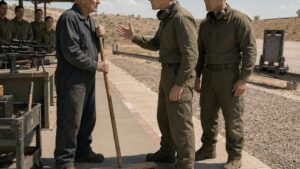
“Sir, step away from the weapon.”
The old man did not move.
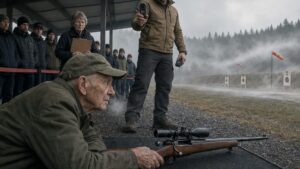
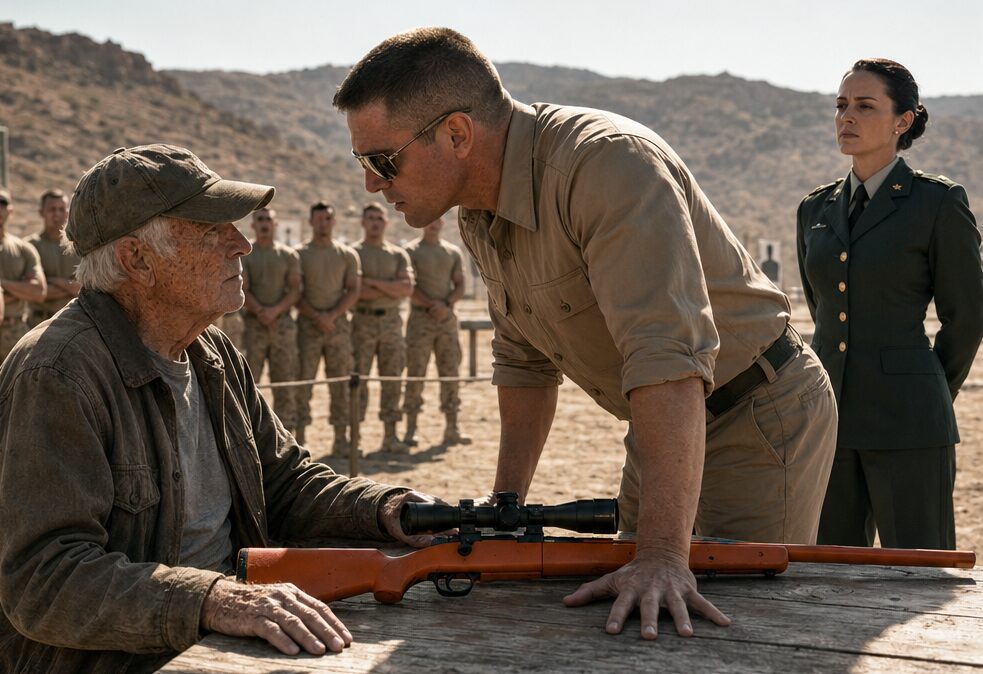
He sat at the sun-bleached range table as if someone had invited him there years ago and forgotten to tell the rest of the world. One thin hand rested near the bright orange training rifle. The other stayed flat on the wood, trembling slightly until his fingers touched the grain.
The desert beyond him shimmered under the late morning heat. Targets stood against the ridge like pale teeth. Young men and women in tan uniforms waited behind the line, pretending not to stare.
Sergeant Jack Miller did not pretend.
He crossed the range with the tight, angry stride of a man whose schedule had been insulted. He was thirty-one, sharp-faced, close-cropped, sunglasses flashing, the kind of instructor whose silence made trainees stand taller.
The old man wore a faded canvas jacket, worn boots, and an old baseball cap pulled low over a weathered face. He looked more like someone’s grandfather who had wandered out of a visitor center than a man who belonged anywhere near the instructor’s table.
Jack planted one hand on the wood and leaned down.
“Sir,” he said again, louder, “I told you to step away.”
The old man looked up at him. His eyes were pale and steady.
“It isn’t loaded.”
A few trainees shifted. Someone swallowed a laugh and strangled it halfway.
Jack’s jaw tightened.
“That’s not the point.” He pointed at the chair, the table, the scoped rifle between them. “The point is you don’t belong at this table.”
The old man absorbed the words without blinking.
That made it worse.
Jack wanted embarrassment. He wanted the old man to mutter an apology, stand too slowly, and let the morning return to order. Instead, the old man stayed seated as if Jack had only commented on the heat.
“I’m waiting for the ridge target,” the old man said.
The small laugh that had been hiding among the trainees finally escaped from someone’s mouth.
Jack turned his head just enough to kill it.
Then he looked back at the old man.
“The ridge target?” he repeated.
“Yes.”
Jack gave him a flat smile. “Sir, this range has been modernized. It’s not whatever training film you crawled out of.”
The trainees looked down. Not because the line was funny. Because it was too sharp.
The old man’s hand tightened once against the table.
Only once.
At the edge of the group, a woman in a dark green uniform stepped into the heat. Major Catherine Grant had arrived without calling attention to herself. Her posture was composed, her face controlled, but when she saw the old man at the table, something moved behind her eyes before she buried it.
Jack noticed her and straightened.
“Major,” he said.
Catherine did not answer right away.
She was looking at the old man.
He looked back at her, and for one brief second the range seemed to lose its noise.
Then Catherine said, “Continue setup, Sergeant.”
Jack hesitated.
The old man’s face did not change.
“Yes, ma’am,” Jack said.
But he did not step away from the table.
He leaned closer to the old man instead, lowering his voice just enough to make it personal and loud enough for everyone to hear.
“You want to sit at the instructor’s table?” he said. “Fine. Tell them what comes after the second marker.”
The old man looked past him, toward the ridge.
“Crosswind shift from the left,” he said. “False marker at eight hundred. The ridge plate sits lower than it looks because the backstop throws the eye high.”
The trainees went still.
Jack’s smile thinned.
“Lucky guess.”
“The final target used to carry a pause.”
Jack removed his sunglasses.
Now his eyes were visible, and they were irritated.
“Modern shooters don’t train hesitation drills.”
The old man looked at him then. Not angrily. Not proudly.
Sadly.
“That target was never about speed.”
The words landed harder than Jack expected.
For the first time, he did not know what to say quickly enough.
Catherine heard it. She was standing ten steps away, hands behind her back, her face as controlled as before.
But her throat moved once.
The old man saw that too.
And still, he said nothing else.
Part II — The Missing Pause
The qualification began late, which Jack hated more than almost anything.
Late meant paperwork. Late meant questions. Late meant command asking why his lane, the cleanest lane on the base, had turned into a retirement home argument in front of twenty-three trainees and a visiting major.
He put his sunglasses back on.
“Listen up,” Jack called. “Today is not about nostalgia. It is not about stories. It is about decisions under pressure. Hesitation costs lives.”
At the table, the old man closed his eyes.
It was not dramatic. It lasted less than a second.
But Catherine saw it.
So did one trainee in the front row, a nervous corporal named nobody would remember after the day except for the way his first miss changed everything.
Jack pointed downrange.
“First shooter.”
The trainee stepped up. The rifle used for qualification was already fixed in position, orange for training, bright enough to keep anyone from mistaking the exercise for field equipment. The trainee did well at first. First marker. Second. A correction at the third. A breath. A clean adjustment.
Jack nodded once.
“Move through it.”
The final target rose against the ridge.
The trainee rushed.
The shot cracked.
The plate stayed still.
A miss.
Jack cursed under his breath.
The trainee lowered his head.
Before Jack could speak, the old man said from the table, “He chased the plate.”
Jack turned.
“What?”
“He saw the plate and forgot the lane.”
Jack walked back slowly. His boots pressed hard into the dust.
“He needs training,” Jack said. “Not stories.”
“He needs the pause.”
Jack laughed once, without humor. “You keep saying that like it means something.”
“It does.”
“Then explain it.”
The old man did not answer Jack. He looked toward Catherine instead, not asking permission, not demanding anything. Just waiting.
Catherine stepped forward.
“Sergeant,” she said, “do you know why the ridge target exists?”
Jack’s mouth tightened again.
“Yes, ma’am. Distance judgment, wind stress, visual misread, delayed correction.”
“That’s the manual answer.”
“It’s the correct answer.”
The old man’s gaze stayed on the ridge.
“No,” he said quietly. “It’s the remaining answer.”
Jack’s eyes flicked to Catherine.
She looked like someone had just opened a door she had hoped would stay shut until after lunch.
“Major?” Jack said.
Catherine did not look at him.
She moved toward the table, stopped in front of the old man, and lowered her voice.
“Colonel,” she said.
The word struck Jack first.
Not loudly. Not officially.
But hard.
The trainees heard it. A few heads lifted.
The old man’s face tightened, almost as if the title had touched a bruise.
Catherine straightened.
Then she saluted him.
The range went quiet in a way Jack had never heard before.
Not disciplined quiet.
Ashamed quiet.
The old man rose slowly. His knees made the movement difficult, but he stood because the salute required an answer. His hand came up. Not fast. Not ceremonial. Exact.
Jack stared at him.
Colonel.
The word rearranged the whole morning.
The chair. The table. The rifle. The old man’s refusal to move.
Jack felt heat climb his neck.
“Sir,” he said, the apology forming badly. “I didn’t know.”
The old man lowered his hand.
“That was the problem,” he said.
No one laughed this time.
Jack looked away first.
Catherine lowered her salute and turned toward the trainees.
“Five-minute hold,” she ordered.
The line broke into silence and murmurs. Nobody went far.
The old man sat back down, not because he wanted to appear above them, but because standing had cost him more than he wanted anyone to see.
Catherine stepped closer.
“I wasn’t told you were coming.”
“I know.”
“We would have arranged—”
“I didn’t come for an arrangement.”
Jack stood near them now, uncertain whether he had permission to leave or responsibility to stay.
The old man looked beyond Catherine, toward the empty spot beside the range shed where a rectangle of cleaner concrete marked something removed.
His expression changed then.
Not much.
Enough.
“Where is Larry’s plaque?”
Catherine did not answer.
That silence did what Jack’s apology had not. It made the old man close his eyes.
“When?” he asked.
“During the modernization.”
“Where?”
“In storage.”
The old man took off his cap and set it on the table.
The top of his head was white with thin hair and sun-spotted skin. Somehow that made him seem less legendary, not more.
“His daughter is coming today,” he said.
Catherine’s composure cracked.
“I know.”
“She asked me if she could see where his name was.”
Jack looked between them.
The old man’s voice stayed calm, but it had lost the dry edge it carried before.
“I told her yes.”
No one spoke for a moment.
The targets on the ridge clicked faintly in the heat.
Then the old man said, “I should have checked.”
Part III — What the Manual Forgot
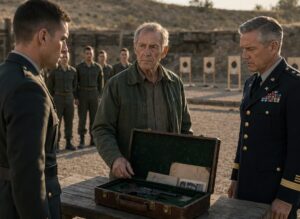
Catherine found the plaque twenty minutes later in a maintenance shed, behind two folded barricades and a box of faded safety cones.
Jack carried it out because she told him to.
He expected it to be light.
It was not.
The bronze had dulled. Dust sat in the engraved letters. One corner was scratched where it had been dragged across concrete instead of lifted. Jack wiped it with his sleeve before he realized what he was doing.
The name came clear first.
LARRY.
Then the rest.
The old man did not touch it.
He looked at it the way some people looked at a closed bedroom door after someone inside had stopped answering.
Catherine stood beside him. Her face was still, but Jack could see color high in her cheeks.
“I signed the modernization order,” she said.
The old man said nothing.
“I read the range history summary,” she continued. “It said the old marker interfered with updated scoring. It said the plaque would be relocated.”
“Relocated,” the old man repeated.
“Yes.”
“Where was it relocated to?”
Catherine looked at the shed.
Jack wished she would defend herself. Not because she deserved it, but because he needed someone else to be wrong loudly enough that his own wrongness felt smaller.
She did not.
“I should have asked,” Catherine said.
The old man looked back to the ridge.
“We all should have.”
Jack shifted his weight. “Sir, the current program does improve results.”
The old man turned to him.
There was no anger in his face.
That somehow made it harder.
“I believe you.”
Jack blinked.
“I’m not against improvement,” the old man said. “I’m against forgetting what the improvement is standing on.”
Jack had no answer.
The old man touched the table with two fingers, as if locating himself through the wood.
“Larry was my spotter,” he said.
Catherine’s shoulders lowered a fraction, like she had been waiting for the story and dreading it.
Jack did not know what a spotter meant beyond the official definition. Partner. Observer. Second pair of eyes. The manual made it clean.
The old man did not.
“There was a convoy,” he said. “Fictional country, real people. Border evacuation. Bad maps. Worse orders. We were on a ridge above a road that curved through a market district.”
His voice did not turn theatrical. It became flatter.
That made the image worse.
“Command wanted a fast solution. We had one. A target moved into the open. I had permission. Everyone below us was screaming over the radio.”
Jack watched the old man’s hands.
They trembled again.
“Larry saw movement behind the target line,” the old man said. “Civilians. Too close. I didn’t see them. He did.”
Catherine whispered, “So you waited.”
The old man nodded.
“They called it hesitation later. Then they called it discipline. Then, when the report got polished enough, they called it precision under pressure.”
Jack’s mouth went dry.
“What was it?” he asked.
The old man looked at him.
“Listening to the man beside me.”
No one spoke.
The desert had a way of making silence feel public.
The old man put his cap back on.
“The convoy got through. Not because I was fast. Because Larry was right.”
Catherine looked at the plaque.
“And Larry?”
The old man did not look away from the ridge.
“Larry stayed on the radio until he couldn’t.”
The words were plain.
They did not ask for pity.
That was why they hurt.
Jack looked down at the plaque in his hands. It seemed heavier now, as if the bronze had filled with everything the manual had left out.
A white SUV rolled onto the range access road.
Catherine turned.
The old man did not need to. He knew.
“She’s early,” Catherine said.
The old man stood too quickly, then caught himself on the table.
Jack stepped forward on instinct, but stopped before touching him.
The old man noticed.
A thin, tired smile appeared and vanished.
“Not yet,” he said.
The SUV stopped near the range office.
A woman stepped out in practical clothes, dark sunglasses, and the guarded posture of someone who had learned not to expect much from official places. She held a small envelope in one hand.
She looked at Catherine first.
Then at the plaque in Jack’s hands.
Then at the old man.
Her face changed.
Not with relief.
With recognition sharpened by years.
“Frank,” she said.
The old man removed his cap again.
“Sarah.”
She walked toward him slowly.
No one greeted her with ceremony. No one knew how.
Her eyes moved once across the table, the orange rifle, the trainees standing too quietly, the plaque not mounted anywhere.
Then she looked at the old man.
“You said his name was still here.”
“It was.”
She laughed once. It broke before it became sound.
“Was?”
Catherine stepped forward. “Ms.—”
Sarah held up one hand without looking at her.
“No.”
Catherine stopped.
Sarah faced Frank fully now.
“My mother wrote you for seven years,” she said. “You never wrote back.”
Frank’s face did not change, but Jack saw his fingers close around the cap.
Sarah’s voice stayed low.
“You never came to the memorials. You never called. You never told me anything except one sentence through other people.”
Frank closed his eyes.
Sarah said it for him.
“He was brave.”
The old man opened his eyes.
“He was.”
“You got the medals,” she said. “My father got a storage room.”
Jack looked down.
The sentence landed harder than anything he had said earlier because it was cleaner. Truer, or close enough to truth to leave bloodless damage.
Frank took it without defense.
“Yes,” he said.
Sarah waited for more.
There was more. Everyone could feel it.
Frank did not give it yet.
That was when Jack understood that silence was not always strength.
Sometimes it was a locked room.
And sometimes the person holding the key was afraid of what would happen when he opened it.
Part IV — The Old Way
Catherine wanted to fix it immediately.
That was what commanders did when the damage could be seen. They issued orders. They restored objects. They made calls. They put people in motion and hoped motion looked like responsibility.
“We’ll have it remounted before the afternoon briefing,” she said. “I’ll bring the trainees in. We can hold a formal—”
“No,” Frank said.
The word was soft.
It stopped her anyway.
Sarah stared at him. “No?”
“The plaque matters,” Frank said. “But not by itself.”
Jack shifted the bronze against his hip.
Frank looked at the ridge.
“Run the old drill.”
Jack’s head snapped up.
“Sir, we’re already behind.”
Catherine looked at him.
He hated how quickly he sounded like the man from an hour ago.
“I mean,” Jack corrected, “command is expecting qualification scores by sixteen hundred. Resetting the old sequence takes time, and half the old mechanics aren’t even active.”
“One is,” Frank said.
Jack frowned. “Which one?”
Frank did not answer.
Catherine did. “The crossing marker.”
Jack turned to her.
“It was disabled.”
“Disconnected,” Frank said. “Not removed.”
The old man’s eyes stayed on the final target lane.
Jack felt the first true unease of the day. Not shame. Not embarrassment.
Unease.
The kind that came when a room you knew by heart had a door you had never opened.
Catherine made her decision.
“Reset the original sequence.”
“Major—”
“Now.”
Jack took one breath, then nodded.
“Yes, ma’am.”
For fifteen minutes, the range changed shape.
Not physically. Not much. Targets stayed where they were. The same table baked in the sun. The same trainees waited. But the mood shifted from evaluation to witness.
Jack moved through the reset with two technicians. He found the old switch box behind a panel he had walked past a hundred times. The label had faded so badly he had mistaken it for rust.
CROSSING ARM.
He stared at it longer than he meant to.
When he returned, Frank was standing beside the table, one hand on the chair, the other near the rifle.
Sarah watched him like she wanted to hate him cleanly and could not.
Catherine stood near the line.
“The range is yours, Colonel,” she said.
Frank shook his head.
“Not mine.”
Catherine understood something in his tone and did not correct him.
Jack brought the rifle forward.
Up close, he could see Frank’s hands clearly. The tremor was worse now. The morning had taken strength from him, and so had Sarah’s words. His fingers hovered over the stock before settling.
Once they touched it, the shaking lessened.
Not gone.
Lessened.
Jack stepped close, lowering his voice so only Frank could hear.
“I can steady it, sir.”
Frank looked at him.
Earlier, that look had made Jack feel accused.
Now it made him feel measured.
“Not yet,” Frank said.
Jack stepped back.
The trainees lined behind the safety boundary. Nobody whispered. Nobody smiled. Even the desert seemed to hold its breath, though that was impossible. Heat still rose. Dust still moved. Far off, something metal clicked in the wind.
Frank sat down.
The chair that had made him look weak in the opening minutes now looked like the only honest place on the range.
Catherine gave the signal.
First target.
Frank took longer than Jack would have allowed a trainee.
He breathed.
The rifle settled.
The target sounded.
Clean.
Second target.
A pause.
Clean.
Third.
A longer pause.
Clean.
Jack watched the old man’s shoulder, then his cheek, then his hand. He had expected legend to look powerful. It looked exhausting.
Fourth marker.
The false one shimmered.
Frank ignored it.
A trainee behind Jack whispered, “How did he—”
Jack raised one hand without turning.
Silence returned.
The ridge target lifted.
This was where the new sequence demanded speed.
Jack knew it in his bones. Acquire. Correct. Decide. Finish.
Frank did not finish.
He stopped.
His finger rested outside the trigger guard.
The pause opened.
One second.
Two.
Jack almost spoke.
Then he saw movement.
Behind the final plate, low and slow, a narrow civilian-shaped marker slid across the back lane. Painted dull gray. Easy to miss if you were locked onto the plate. Easy to hit if speed was the only virtue left in the room.
Jack felt cold under the desert sun.
The marker crossed directly behind the target.
A trainee made a small sound.
Nobody told them to be quiet this time.
They were already learning.
Frank waited.
The gray marker cleared.
The final plate stood alone.
Only then did he fire.
The plate dropped.
The sound came back from the ridge a second later, flat and final.
Frank lowered the rifle.
His face had gone pale.
Jack moved before pride could stop him. This time, when the old man swayed, Jack took the rifle first, not Frank’s arm. He understood the difference now. Help without taking the man away from himself.
Frank let him.
Catherine exhaled.
Sarah had taken off her sunglasses.
Her eyes were wet, but her face remained guarded.
She looked at the final lane, then at Frank.
“That’s what he saw?” she asked.
Frank nodded.
“Yes.”
“My father?”
“Yes.”
Frank’s voice thinned.
“I had the shot. He had the truth.”
Sarah’s mouth tightened.
The line struck her, but she did not soften all at once. Some grief did not move that way.
Frank turned toward her fully.
“The report gave me too much,” he said. “It gave him too little.”
Sarah looked at the plaque.
“Why didn’t you tell us?”
Frank held the cap in both hands.
“Because your mother wanted a hero.”
Sarah’s eyes flashed.
“She deserved the truth.”
“Yes.”
“Then why?”
Frank looked at the table.
“Because I was afraid the truth would sound like I was giving back what I should never have taken.”
No one interrupted.
“I survived,” he said. “I signed the report. I accepted the citation because they told me refusing would dishonor the unit. Then I built this drill into every class they let me teach. The pause. The lane check. The crossing marker. I thought if every shooter learned what Larry saw, then his name was still doing work.”
Sarah’s face broke a little at that.
Not forgiveness.
Recognition.
Frank looked at her.
“But work is not the same as being remembered.”
The wind lifted dust across the table.
Frank swallowed.
“Your father was laughing on the radio,” he said.
Sarah froze.
That was not the answer she expected.
Frank’s eyes were still on the ridge, but his voice had moved somewhere far away.
“Everyone else was shouting. Command was shouting. Men below us were shouting. I was shouting back. Larry laughed once, very softly, and said, ‘Frank, if you miss what matters, it doesn’t matter what you hit.’”
Sarah covered her mouth.
Frank nodded toward the final target.
“That was him. Not me.”
Part V — The Name at the Table
Catherine had the plaque mounted before sunset, but not where it had been before.
Frank noticed.
The old place had been decorative, beside the shed where visitors could pass it on their way to coffee and shade. Catherine ordered it fixed to the instructor’s table instead, on the side facing the trainees.
Not above them.
In front of them.
Jack knelt with the screwdriver. He did not ask a technician to do it.
The bronze caught the evening light differently once the dust was gone. Its scratches remained. Catherine asked whether they should polish them out.
Sarah said no before Frank could.
“Leave something that shows where it’s been,” she said.
Frank looked at her then.
Only briefly.
But it was the first moment between them that did not have a wall in it.
The trainees gathered without being ordered into perfect formation. They stood because no one wanted to sit.
Jack removed the instructor patch from his sleeve and set it on the table beside the mounted plaque.
Catherine glanced at him.
He looked embarrassed, but he did not pick it back up.
“Colonel,” he said to Frank, “before the next qualification, would you teach the first lesson?”
Frank looked at the patch.
Then at Jack.
“You have a lesson already.”
Jack nodded.
“I had half of one.”
That answer stayed in the air.
Frank did not smile, but something in his face eased.
“Then start with the lane,” he said. “Not the target.”
Jack nodded again.
“Yes, sir.”
Sarah stood beside the table, holding the envelope she had brought from the car. She had not opened it yet. Frank had seen it. So had Catherine. Nobody asked.
Frank turned to her.
“Would you read his name?”
Sarah stared at the plaque.
For a moment, she looked younger than thirty-six. Not like a child exactly. Like a person standing beside a door she had waited her whole life to open, terrified that there would be too little inside.
Then she stepped forward.
Her voice caught on the first word and steadied on the second.
“Larry.”
She stopped.
The desert held still around the name.
She tried again.
“Larry. Beloved father. Trusted partner. Steady voice.”
Those last two words had not been on the old plaque.
Catherine looked at Frank.
Frank looked at Sarah.
Sarah’s chin trembled, but she did not look away.
“I asked Major Grant to add them,” she said.
Catherine’s eyes softened.
Jack looked down at the table.
Frank put his cap against his chest.
For a long time, nobody said anything.
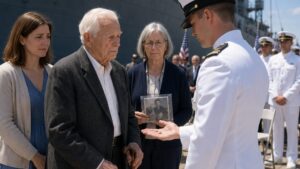
Then Sarah opened the envelope. Inside was a worn photograph, creased at the corners. She placed it beside the plaque.
A younger Frank stood in it, not smiling. Beside him stood Larry, one hand lifted halfway as if the camera had caught him in the middle of saying something funny.
Sarah touched the edge of the picture.
“My mother kept this in a drawer,” she said. “She said she hated looking at it.”
Frank nodded.
“I understand.”
“She also said she couldn’t throw it away.”
“I understand that too.”
Sarah looked at him.
“What did he sound like when he laughed?”
Frank’s face changed.
Not much.
Enough.
“Like he was trying not to wake anybody,” he said. “Even outside. Even under fire. Soft. Like the joke was just for the person closest to him.”
Sarah closed her eyes.
That was the thing she had come for and had not known how to ask.
Not the plaque.
Not the ceremony.
Not even the truth.
A sound.
A living piece.
When she opened her eyes, she did not embrace Frank. She did not forgive him in a sentence. The story was not clean enough for that.
But she placed the photograph on the table between them.
Not on her side.
Not on his.
Between.
Catherine stepped forward.
Her hand rose in salute to Frank.
The trainees followed.
Jack followed last.
Frank looked at them, at the young faces, the straight backs, the shame and respect mingled together. An hour earlier, they had watched him be told he did not belong at this table.
Now nobody seemed certain the table belonged to anyone but the memory fixed into it.
Frank lifted his hand.
For a second, it seemed he would return the salute to Catherine.
Instead, he turned slightly.
His hand moved toward the plaque.
Toward Larry’s name.
Every soldier saw it.
So did Sarah.
Frank held the salute there until his arm began to tremble. Jack took one small step forward, then stopped himself.
Not yet.
Frank lowered his hand when he was ready.
The sun dropped behind the ridge, and the final target lane fell into shadow.
Nobody cheered.
Nobody needed to.
Frank sat again in the same chair where the morning had tried to make him small. The orange rifle rested on the table in front of him, no longer an accusation, no longer a test.
Just an object waiting for the next lesson.
Sarah stood beside him.
Jack stood behind the trainees, silent now for the right reason.
Catherine read the updated range order aloud, her voice steady: from that day forward, no one would run the ridge sequence without first reading the name on the table and explaining the pause.
Frank listened with his eyes on the ridge.
When Catherine finished, Sarah leaned close enough that only he could hear.
“You should have written back,” she said.
Frank nodded.
“Yes.”
“I’m still angry.”
“I know.”
She looked at the photograph.
“But I’m glad I heard him laugh.”
Frank closed his eyes.
The old chair creaked beneath him. The desert cooled. Dust settled into the scratches of the restored bronze.
And for the first time that day, the silence around Frank did not feel like something he was carrying alone.