The Map That Changed The Room Before Morning Could Arrive
Part I — The Room Went Silent
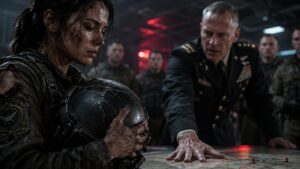
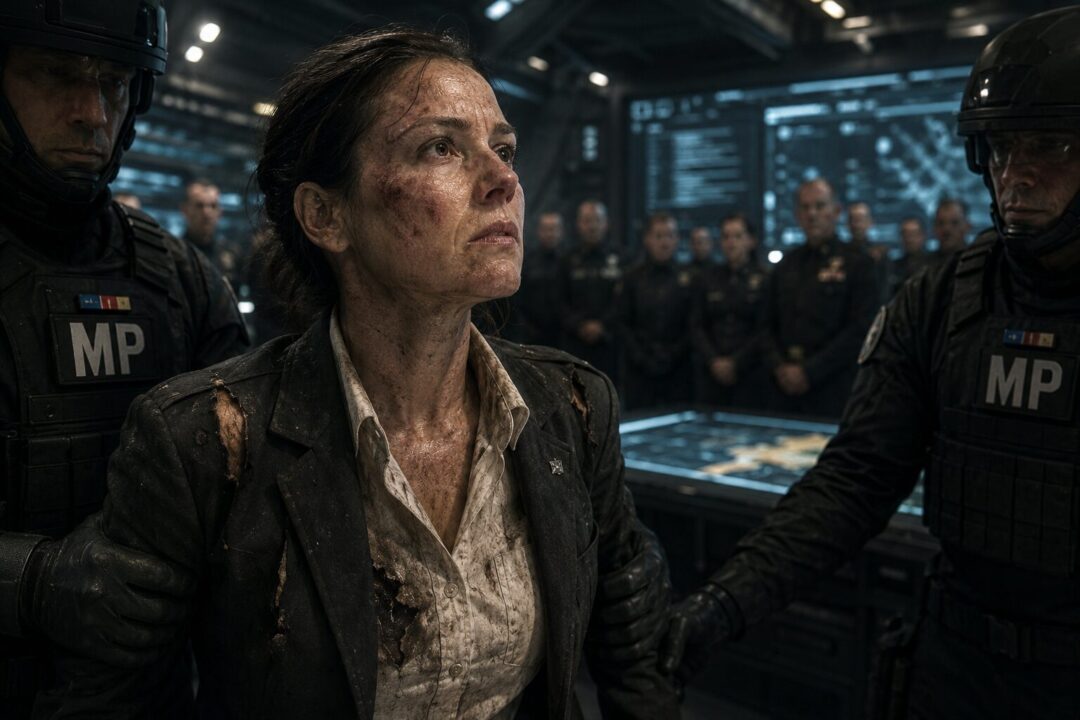
The two military police officers dragged Major Samantha into the command center like she was evidence no one wanted to touch.
Her boots scraped across the polished concrete. One sleeve of her dress jacket hung torn at the seam. Dust clung to her collar. Dried blood had stiffened along the cuff of her left arm, and one eye was swollen badly enough that she had to turn her head to see the room clearly.
No one moved to help her.
That was the first thing she noticed.
Not the screens glowing against the underground walls. Not the tactical table throwing blue light across the faces of senior officers. Not the clock above the main display counting down toward the next rescue launch.
Only the silence.
It came from men and women who had heard explosions through satellite feeds, watched convoys vanish in dust, signed letters to families before dawn. They were trained not to flinch.
But they flinched when they saw her.
The MPs forced her forward until her knees hit the floor.
Across the room, General Ronald stood behind the tactical table in full dress uniform, silver hair neat, ribbons aligned, jaw locked so hard it looked painful. His hands were flat on the glowing map.
Behind him, the canyon spread in clean digital lines.
Too clean.
Samantha stared at it and almost laughed.
If she had laughed, they would have called it shock. If she had cried, they would have called it guilt. If she had screamed, they would have removed her before she could save anyone.
So she swallowed the copper taste in her mouth and said nothing.
Ronald looked down at her as if the room had finally delivered the thing he needed to blame.
“Major,” he said, his voice sharp enough to cut through the hum of the machines. “You were ordered to maintain formation.”
Samantha lifted her head.
One of the MPs tightened his grip on her shoulder.
Ronald continued. “You broke from the approved route. You lost contact with command. You returned without your team. And Captain Brian’s convoy is still inside Arash Canyon.”
At the mention of Brian, something in the room changed.
A few eyes dropped. A radio operator stopped typing. Colonel Christine, at the operations console, looked from Ronald to Samantha with the quiet attention of someone counting seconds instead of emotions.
Ronald stepped around the table.
“Tell me why I shouldn’t have you removed from this room before you do more damage.”
Samantha looked past him, past the officers, past the screens, to the neat blue line that claimed to know the canyon.
It ran straight through a place that no longer existed.
“Show me the terrain model,” she said.
Ronald’s expression hardened.
“That is not an answer.”
“It’s the only answer that matters.”
The MP behind her shoved down slightly, forcing her spine to bend. Pain flashed white behind her left eye.
She did not look at him. She kept her attention on Ronald.
“Show me the map.”
Ronald leaned closer. His face was controlled, but something underneath it was not.
“You lost twelve hours, Major. You disobeyed a direct command. You came back alone.”
Samantha reached into the torn inner pocket of her jacket.
Both MPs reacted at once.
“Hands!” one barked.
She froze, fingers curled around the small object inside the pocket.
“It’s a data chip,” she said. “From Forward Drone Three.”
Christine stood straighter.
“That unit was destroyed,” she said.
Samantha pulled the chip free slowly. It was blackened at one edge, bent slightly, no bigger than a thumbnail. She held it between two fingers until one MP took it from her and placed it on the tactical table as if it might bite.
Ronald did not look at it.
He looked at her.
Samantha’s voice came out lower than she expected.
“Your map failed before I ever gave an order.”
No one spoke.
Then Ronald said, “Remove her.”
Part II — The Broken Chip
The MPs pulled Samantha to her feet.
For one second, the command center resumed breathing. Chairs shifted. A radio crackled. The launch clock ticked down in red digits over the main screen.
Seven minutes, forty-three seconds.
Christine moved before the MPs could turn Samantha toward the exit.
“Sir,” she said.
Ronald did not look away from Samantha. “Colonel, not now.”
“That chip came from a drone unit we wrote off at 0210. If she has it, she reached the forward wash.”
“Or picked it off a dead operator while running from her post.”
Samantha’s throat tightened, but she said nothing.
She had learned years ago that the first person to explain too much looked guilty. She had built a career on precision. Now precision was all she had left.
Christine came around the table, her sleeves rolled to her elbows, blond hair cropped short and flattened on one side from wearing a headset too long. She did not look kind. Samantha trusted that more than kindness.
“Give me sixty seconds,” Christine said. “If it’s empty, she goes.”
Ronald glanced at the launch clock.
Seven minutes, eleven seconds.
The two rescue helicopters were already spooling on the ridge pad above them. Every second held rotor noise, fuel, men waiting with harnesses and stretchers, pilots reading a route that would deliver them into the wrong throat of the canyon.
Ronald pointed at the console.
“Forty seconds.”
Christine took the chip.
The room watched her insert it into a recovery slot.
The main display flickered. Blocks of corrupted data crawled across the screen. Static. Broken telemetry. A partial altitude readout. Three seconds of infrared. Then nothing.
Ronald gave a short, humorless breath.
“There’s your answer.”
“Wait,” Christine said.
The screen jumped again.
This time, red marks appeared in a dry wash west of the official route. Not clean dots. Not standard tags. Faint, irregular heat signatures clustered under a strip of ruined vehicles.
A major at the back whispered, “Patrol group?”
Samantha shook her head once.
“No.”
Ronald turned on her. “You don’t know that.”
“I do.”
Her voice was cold now. Not because she felt calm, but because the alternative was breaking open in front of them.
“Enemy patrols move in pairs along the upper ridges. Those signatures are low. Clustered. Shielded under metal. That’s the convoy.”
Ronald stared at the red marks.
“The convoy was last confirmed on the approved route.”
“The approved route is gone.”
The room shifted again, but not enough.
Ronald heard the words and rejected them before they could enter him.
“The canyon route was verified this morning.”
“By satellite.”
“Yes.”
“From above.”
His eyes narrowed.
Samantha stepped forward. The MP’s grip stopped her.
She turned only her head toward Christine.
“Pull the elevation layer from the western bend. Not the current overlay. The raw return.”
Christine hesitated.
Ronald said, “Colonel.”
But Christine was already typing.
The canyon bloomed on the table, blue and white and elegant. A route line cut through it with insulting confidence.
Samantha stared at the bend in the digital terrain and remembered the real one: smoke pressed low between the walls, the smell of burned diesel, the way sound arrived late because the rock swallowed it first.
“There,” she said.
Christine zoomed in.
Nothing changed.
Ronald’s voice lowered. “You are wasting rescue time.”
“No,” Samantha said. “The map is.”
Christine stripped away the current overlay.
Underneath it, a jagged distortion appeared where the canyon floor should have been smooth.
A crack. A slump. A collapse wide enough to swallow a convoy.
The room stopped pretending it was still only judging her.
Christine looked up slowly.
“That wasn’t in the operational packet.”
Samantha tasted blood again when she answered.
“I know.”
Ronald’s hands curled at his sides.
“Explain.”
The word was not permission.
It was a threat.
Samantha looked at the red marks under the burned-out vehicles.
Then she looked at the launch clock.
Six minutes, two seconds.
“They never reached the bottleneck,” she said. “They doubled back.”
Part III — The Route No One Believed
Samantha did not tell them first about the shouting.
She did not tell them about Brian’s voice over the short-range radio, calm while men cried out behind him. She did not tell them about crawling under a vehicle that was hot enough to blister her palm, or the way the canyon dust turned wet wherever someone had pressed a bandage too hard.
She gave them facts, because facts were the only things the room respected.
“The floor collapsed after the shelling. Brian’s lead vehicle stopped before the west bend. The rear vehicle took damage. They had wounded and limited mobility. The only way out was behind them.”
Ronald stepped closer to the table.
“There is no route behind them.”
“There is if Sparrow Gate is open.”
Christine’s hands paused above the keyboard.
“Sparrow Gate?”
“Old mining maintenance cut,” Samantha said. “North wall. Listed sealed after a rockfall twelve years ago.”
Ronald’s face tightened. “Then it’s sealed.”
“It isn’t.”
He turned on her with sudden force.
“You expect this room to redirect a rescue operation based on your memory of an abandoned cut that official records mark impassable?”
Samantha met his eyes.
“No. I expect this room to stop killing people with records.”
The line landed harder than she meant it to.
Someone inhaled sharply.
Ronald did not blink.
For the first time since she had been dragged in, Samantha saw the human thing behind his anger. Fear. Not of her. Not of failure in the abstract.
Of one name.
Brian.
Captain Brian was not just another marker on the map. Samantha had known that before she left the canyon. Brian had known it too.
“If I don’t come back,” he had said, forcing the chip into her hand, “he’ll hear it better from you.”
Samantha had almost hated him for that.
Now Ronald looked at her with the full weight of a man who had already begun grieving and needed someone to accuse so the grief would not turn inward.
Christine pulled up archived geological data.
The old file opened slowly.
Everyone watched.
A faded survey map appeared beside the live model. Lines from another decade. Maintenance cuts. Service paths. Sealed access notes.
Christine zoomed into the north wall.
There it was.
SPARROW GATE.
Collapsed: historical status.
Unverified: current.
Christine leaned closer.
“Current overlay assumed permanent closure,” she said.
Ronald’s voice was flat. “Assumed by whom?”
No one answered.
Samantha’s legs trembled. The MP gripping her arm felt it and tightened his hold, maybe to restrain her, maybe to keep her upright.
She pointed toward the tactical table.
“Put it on the model.”
Christine did.
A thin red path appeared, running behind the official blue route, bending through a narrow section of rock, then spilling into the dry wash where the red heat signatures clustered.
The room leaned in.
Not all at once. Not dramatically. Just enough.
A captain who had been glaring at Samantha looked at the table instead. A radio operator removed one side of his headset. Another officer stepped closer, lips parted.
Power shifted quietly.
That was how it always happened in rooms like this. Not with apologies. With attention.
Ronald saw it too.
His voice sharpened. “And you found this route how?”
Samantha’s fingers curled.
“I followed their emergency pulse.”
“Alone?”
“Yes.”
“After breaking formation.”
“After the official route collapsed.”
“After losing your team.”
Samantha looked at him.
There were answers she could give. Some would make her sound brave. Some would make her sound innocent. None of them would put time back on the clock.
So she said the only thing that mattered.
“I found Brian.”
The room changed for a third time.
Ronald went still.
Christine’s eyes flicked to Samantha’s face, then back to the map.
The launch clock read four minutes, thirty-eight seconds.
Ronald’s voice had dropped. “You found him?”
“Yes.”
“And left him.”
The words were quiet.
That made them worse.
Samantha’s throat worked once.
“He ordered me to.”
Ronald stepped closer. “Don’t.”
The command in his voice was no longer a general’s command. It was a man begging the world not to rearrange his guilt.
Samantha continued anyway.
“He had six wounded. One vehicle still moving. No clear signal. Enemy patrols above the ridge. He gave me the chip and told me to get the correction back to command.”
Ronald’s face hardened again, but it was late now. Too late for certainty.
“You expect me to believe Brian sent you away?”
Samantha’s voice nearly failed.
“No,” she said. “I expect you to believe he knew someone had to come back with the truth.”
She remembered Brian’s hand closing around hers, gritty with dust, forcing the chip into her palm.
“You don’t get to stay,” he had said.
“I can help carry—”
“You can help by making them stop trusting that map.”
“I’m not leaving you.”
His face had been gray under the dust. Still, he had smiled, just barely.
“Major, that was not a request.”
In the command center, Samantha kept her eyes on Ronald.
“I obeyed his last order,” she said. “Do whatever you want with me after they’re out.”
For the first time, Ronald looked away.
Part IV — Sparrow Gate
The main screen chirped.
Christine turned back to her console so quickly her chair rolled into the station behind her.
“Signal pattern shift,” she said.
Ronald was still staring at the red route.
Christine’s fingers flew across the keyboard. “Multiple hostile units repositioning along north ridge. They’re not reinforcing the official route.”
She enlarged the feed.
Red movement markers crawled toward Sparrow Gate.
Samantha’s stomach dropped.
“They found them,” she said.
Christine’s face went pale under the screen light.
“Or they found the same gap we did.”
The launch clock hit three minutes, twelve seconds.
Ronald straightened. Whatever had cracked in him sealed under command instinct. “Can the helicopters reach the wash through Sparrow Gate?”
A major at aviation control shook his head. “Not on the current flight plan. The canyon ceiling creates a radar shadow through the north wall. Guidance will drop.”
“Then they approach from the east.”
Samantha said, “They die from the east.”
Every eye came back to her.
The MP still held her arm.
She looked at him until he realized the absurdity of restraining the only person speaking clearly. His grip loosened, but did not leave.
Samantha pointed at the red route.
“The east approach funnels into the killing bend. They’ll hear the rotors before the aircraft clears the wall. Brian’s people are west of that, under cover. You need a low approach through the north cut, then drop into the wash before the echo catches up.”
Ronald stared at her. “You flew it?”
“I crawled out under it.”
“That is not the same thing.”
“No. It’s worse. I know every place the canyon lies.”
The room held that sentence.
Christine said softly, “Sir, Chief Warrant Officer Scott is on Lead Bird.”
Samantha turned sharply.
“Scott?”
Christine nodded.
For the first time since arriving, something like relief moved through Samantha’s chest, but it hurt too much to stay.
Scott had flown her team through dust storms, flood smoke, and one night so dark the pilots joked they were navigating by regret. He trusted instruments, but he trusted voices too, if the voice had earned it.
“Put me on with him,” Samantha said.
Ronald answered immediately. “No.”
“She knows the route,” Christine said.
“She is under investigation.”
“She is also standing in the only room with information that matches the enemy movement.”
Ronald’s eyes cut to Christine.
The room felt smaller.
Christine did not look away.
“Procedure already failed them,” she said.
No one breathed.
That was not the kind of sentence people said lightly to a general.
Ronald looked from Christine to Samantha, then to the screen where hostile markers crawled closer to Sparrow Gate.
Two minutes, twenty-seven seconds.
If Samantha was wrong, another crew could vanish into stone and dust.
If she was right and Ronald refused, Brian’s convoy would sit under broken metal while the enemy closed in.
There were choices that allowed a person to remain innocent.
This was not one of them.
Ronald reached for the radio handset.
He held it for one second too long before offering it to Samantha.
When she tried to lift her hand, it shook.
Not slightly.
Enough that the room saw.
She hated that more than the blood on her uniform.
Christine stepped in without a word and steadied the microphone near Samantha’s mouth.
The gesture was small.
It was also the first mercy Samantha had been given.
Ronald pressed the channel open.
“Lead Bird, this is Command. Route update pending. Stand by for live guidance.”
Static answered.
Then a voice, rough and clipped, came through.
“Command, Lead Bird copies. Someone better sound confident down there.”
Samantha closed her eyes for half a second.
“Scott,” she said.
A pause.
Then the pilot’s voice changed.
“Samantha?”
Her name in his mouth did what the accusations had not. It almost broke her.
She opened her eyes.
“Listen carefully.”
“Samantha, where the hell are you?”
“In the room everyone should have been listening to.”
No one laughed.
Scott did not either.
“Give me the route,” he said.
Part V — The Red Line
Samantha stopped looking at Ronald.
She stopped looking at the officers, the MPs, the clock, the torn place in her sleeve where her skin burned every time she breathed.
She looked only at the map.
“Reject the east approach,” she said. “Come north of the ridge line. Stay below the broken shelf until the canyon wall flattens.”
Aviation control murmured, “No guidance in that shadow.”
Scott heard it over the channel. “I didn’t ask the room. I asked her.”
Samantha swallowed.
“After the shelf, you’ll see a split rock that looks like two black teeth.”
Scott’s reply was dry. “Comforting.”
“Do not climb there. The echo will make the canyon feel wider than it is. It isn’t. Stay low.”
“Copy.”
Christine watched the live feed.
The helicopter marker curved away from the official blue route.
A few officers reacted as if they had seen a chair tip backward and could not catch it.
Ronald stood beside Samantha, not touching her, not interrupting.
That restraint cost him. She could see it in his jaw.
The feed stuttered as the helicopter entered the radar shadow.
Static broke across the room.
Christine whispered, “Signal loss.”
Samantha listened.
Not to the radio. To memory.
Rotor echo in a canyon arrived wrong. The sound bounced off stone and returned with lies inside it. A pilot could think he had space where he had none. A driver could think a turn was close when it had already passed.
Samantha counted under her breath.
“One. Two. Three.”
Ronald looked at her.
She kept counting.
At five, the radio cracked.
“Visual split rock,” Scott said. “Dropping.”
“Good,” Samantha said. “You’ll lose the wash for four seconds. Trust the shadow. At the end, there’s a broken mile marker. Half the numbers are gone.”
The room listened to her like she was holding a match in a cave.
Static.
Then Scott: “Marker.”
“Turn west now.”
The aviation major whispered, “That turn isn’t on the map.”
Samantha heard him.
“So fix the map,” she said.
Scott’s feed returned for one bright, unstable second. The screen showed canyon wall rushing close, dust spinning under rotor wash, then nothing.
Someone cursed softly.
Ronald’s hand gripped the edge of the table.
Samantha’s breath went shallow.
She had left Brian under a sheet of warped metal with six wounded and a radio battery dying in the heat. She had told herself, crawling through the north cut with the chip under her tongue so she would not lose it, that returning was enough.
But returning was not enough.
Being believed was the mission.
Scott’s voice burst through.
“Command, Lead Bird has cleared the bend.”
Christine exhaled so hard it sounded like pain.
Samantha kept her eyes on the red route.
“Do you see burned vehicles?” she asked.
“Affirmative. Three vehicles. Heat signatures under the second and third.”
Ronald closed his eyes once.
Scott’s voice tightened. “I have movement. Friendly signal weak but present.”
Christine’s hand covered her mouth.
Samantha did not move.
“Say it clearly,” she said.
A beat.
Then Scott said, “Survivors confirmed.”
The room erupted, but not loudly. Relief in a command center did not sound like cheering. It sounded like chairs moving, orders snapping back into place, radio channels opening, people remembering their bodies after holding them too still.
“Medical extraction team, redirect west wash,” Christine called. “Secondary bird follow Lead. Update all approach lanes to red route.”
The blue line on the map dimmed.
The red line stayed.
Ronald turned to the MPs.
“Release her.”
They stepped away.
The absence of their hands almost dropped Samantha to the floor.
Christine caught her elbow.
Samantha did not thank her. She could not.
The radio crackled again.
Scott’s voice came through lower.
“Command, we have Captain Brian. Alive. Critical, but alive.”
For a moment, Samantha was back in the canyon, Brian pushing the chip into her hand, his voice cutting through dust.
You don’t get to stay.
Her eyes closed.
Not in victory.
In permission.
Ronald said nothing for several seconds.
Then, in a voice the whole room heard, he said, “Major Samantha has the floor.”
The title did not heal anything.
But it changed where everyone was looking.
Part VI — What The Map Remembered
The rescue did not end all at once.
It unfolded in fragments: coordinates repeated, stretchers requested, fuel windows adjusted, medical channels opened, weather checked, enemy movement tracked. The room became motion again, but now that motion passed through the red route Samantha had drawn.
No one asked her to sit.
No one asked her to leave.
That was how command apologized at first: by needing you.
Samantha stood until her legs would not hold steady, then stepped outside the main room into the narrow corridor beyond the blast doors. The air was cooler there. Quieter. It smelled faintly of metal, coffee, and dust baked into uniforms.
She lowered herself onto a bench and finally let her head rest against the wall.
Her hands looked strange without the chip.
Empty hands always did.
Minutes passed. Maybe twenty. Maybe three. Time had stopped behaving normally somewhere between the canyon and the room.
Christine came out carrying something small in her palm.
She sat beside Samantha, leaving a careful space between them.
“They’re still bringing them out,” Christine said.
Samantha looked at the object.
A field tag.
Bent. Blackened at the edge. Brian’s first name stamped into the metal, scuffed but readable.
Christine placed it in Samantha’s hand.
“He made them give that to Scott before they lifted him,” Christine said. “Said you’d be angry if it got lost.”
Samantha’s mouth trembled once.
She closed her fingers around the tag.
For a few seconds, she could not trust herself with words.
Christine leaned back against the wall. Her face looked older out here, away from the screens.
“I should have checked the survey archive earlier,” she said.
Samantha shook her head. “The map looked clean.”
“That’s not an excuse.”
“No,” Samantha said. “It’s a reason. There’s a difference.”
Christine looked at her then, really looked.
Samantha kept her eyes on the tag.
A door opened down the corridor.
Ronald stepped out.
Without the full command room around him, he seemed less like a statue and more like a tired man still carrying the shape of one. His decorations caught the corridor light. His face did not.
Christine stood.
Ronald gave her a small nod, and she returned to the command room, leaving the door open behind her.
For a while, Ronald and Samantha stayed in the corridor with the sounds of the rescue moving behind them.
Finally, he said, “Captain Brian confirmed your account over the medical channel.”
Samantha looked up.
“How much of it?”
“Enough.”
That word had carried her through the canyon. Enough signal. Enough air. Enough time. Enough truth to make someone listen.
It had never sounded smaller.
Ronald’s voice lowered.
“I was wrong.”
She wanted that to feel better.
It did not.
Maybe because being believed after the fact did not rewind the hours when she had not been. Maybe because some of the men under the burned vehicles had not lived long enough to hear the helicopters. Maybe because Brian was alive, but critical was not the same as safe.
Maybe because she had wanted forgiveness and hated herself for wanting it.
Samantha opened her hand and looked at the bent tag.
“How many?” she asked.
Ronald did not pretend not to understand.
His eyes moved once toward the command room.
“Too many.”
The answer settled between them.
No number would have been kinder.
Samantha pushed herself to her feet. Pain flared through her side, sharp enough that the corridor tilted for half a second. Ronald reached out, then stopped before touching her.
She noticed.
So did he.
“Major,” he said, “your record will reflect—”
“Fix the map before you fix my record.”
Ronald went silent.
Samantha held his gaze.
Not angry now. Not even defiant.
Just done carrying the wrong thing.
Behind them, Christine’s voice called from inside the room, firm and clear.
“Second bird entering the north approach.”
Samantha turned back toward the command center.
The officers parted when she entered.
No one announced it. No one saluted. No music rose. No wound became beautiful because it had been useful.
But the tactical table still glowed.
The blue route had been reduced to a faint ghost line. Across the canyon, bright and undeniable, ran the red path Samantha had drawn.
It looked almost violent against the clean model.
It looked necessary.
Ronald entered behind her but did not take his old place at the head of the table. He stood to the side.
Christine looked up from the console. “Major?”
Samantha stepped forward.
Her face ached. Her uniform was ruined. Brian’s field tag was warm in her closed fist.
Outside, somewhere above all that concrete and dust, helicopters moved into the dark.
Samantha placed her free hand on the edge of the table and looked at the red route.
“Again,” she said. “From the split rock.”