The Night She Asked the Room to Remember Every Name
Part I — The Toast
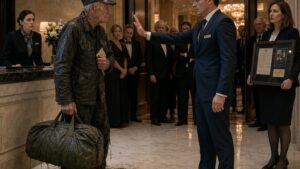
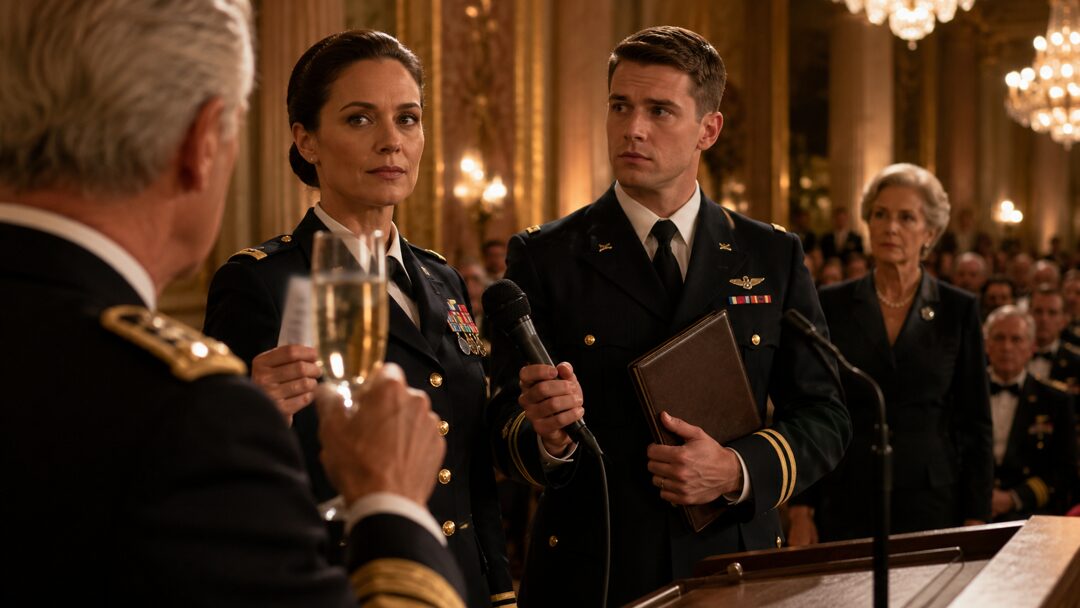
Retired Brigadier General Ronald lifted his champagne glass beneath the chandeliers and told the room, “Courage is obedience under fire.”
The ballroom laughed softly, the way polished rooms laugh when powerful men say polished things. Crystal caught the light. Brass buttons shone. Donors leaned toward officers as if proximity to old decisions made them braver. At the front table, young cadets watched Ronald as if the rest of their lives might be hidden inside his posture.
Then the doors at the far end opened.
The laugh did not stop all at once. It thinned first.
A captain at the registration table looked down at his seating chart, then up again, confused. An older colonel stopped with a glass halfway to his mouth. Two women near the back turned their heads at the same time.
Major Nicole stepped into Patriot Hall in full dress uniform.
She did not look late.
She looked expected by no one and prepared for everyone.
Ronald kept smiling because men like him did not lose rooms easily. His silver hair was combed back, his shoulders squared, his champagne glass balanced lightly between two fingers. He had the relaxed confidence of a man who had been thanked in public so many times that gratitude had become a kind of weather around him.
“To the men and women of Operation Lantern,” he continued, raising his voice just enough to reclaim the air. “To those who followed orders when the map went dark.”
Nicole began walking.
No one told her to stop. That made it worse.
In a room built on rank, seating charts, programs, and rehearsed entrances, her silence was almost rude. She moved down the center aisle between tables dressed in white linen and folded flags, her heels quiet against the polished floor. Her hair was pinned tight. Her face was calm. Her medals were arranged with a precision so severe it seemed less like pride than proof.
Captain Timothy saw her before Ronald truly did.
He stood near the podium with a leather folder tucked under one arm, clean-cut and nervous in the way ambitious young officers learn to hide. He was Ronald’s aide for the evening, which meant he had spent three weeks making sure nothing unpredictable touched the anniversary banquet.
Nicole’s name had not appeared on any invitation list.
Timothy knew because he had checked them twice.
He took one small step away from the podium, then stopped. Protocol had trained his body before conscience had formed a sentence.
Ronald’s eyes flicked to him.
That was all. A glance sharp enough to be an order.
Timothy stepped toward the aisle.
Nicole kept walking.
The room began to recognize her in pieces.
Not by face at first. By uniform. By rank. By the way senior officers became suddenly interested in their napkins. By the medals they could not explain.
A young cadet whispered, “Who is that?”
No one at his table answered.
Ronald turned back to the room and made his smile larger.
“There are nights,” he said, “when the official record cannot hold the whole measure of sacrifice.”
Nicole was close enough now to hear every word without the microphone.
Her mother, Patricia, sat three tables from the back, not with the honored families near the front but near the doors, where late arrivals and spare chairs lived. She wore a plain dark dress and pearl earrings. Her hands were folded so tightly in her lap that her knuckles looked almost white.
She had begged Nicole not to come.
Not because the truth was wrong.
Because the truth had never protected their family before.
Nicole did not look at her yet.
Ronald continued, “Colonel David was a brave man.”
For the first time, Nicole’s pace changed.
Only slightly.
A half beat.
Enough for Patricia to close her eyes.
Ronald let the name settle. He had always known how to use the dead. Slowly. Respectfully. In ways that made contradiction feel indecent.
“A brave man,” Ronald repeated, “who misunderstood the field.”
The room was quiet now.
Nicole walked through that sentence as if it were smoke.
Part II — The Seat That Wasn’t There
Timothy reached her just before the head table.
“Major,” he said quietly, keeping his voice low enough to look like courtesy. “Good evening.”
“Captain.”
“I’m afraid there may have been a mistake with seating.”
“There was.”
He blinked. “Let me see what I can—”
“My seat was removed.”
The line landed gently. That made it more dangerous.
Timothy glanced at the folder under his arm. He did not need to open it. He already knew the chart. The front tables held donors, senior officers, spouses, families of decorated personnel, and one empty chair that had been reassigned that morning after a last-minute call from Ronald’s office.
Nicole had been moved from the room without ever being told she had been invited.
“I can find you a place,” Timothy said.
“I’m not here to sit.”
Behind him, Ronald turned from the podium with the warm disappointment of a host interrupted by someone he meant to forgive in public.
“Major,” Ronald said into the microphone, and the sound carried her title to every corner of the ballroom. “What an unexpected honor.”
Nicole faced him.
There were men in the room who had commanded hundreds and still would not have held that stare.
Ronald lowered the microphone a little. “We are always pleased when members of the Lantern family join us.”
The word family touched Patricia like a hand placed on a bruise.
Nicole did not raise her voice. “Then I’m in time for the final roster.”
A tiny shift moved through the room.
Most people did not understand it. They heard only a formal phrase. A ceremonial request. Something clean enough to belong in a printed program.
But three officers at the front table looked at Ronald.
And Timothy looked down at the folder in his hand.
Ronald’s smile held.
“The program has been carefully arranged,” he said.
“Yes,” Nicole said. “That’s why I came.”
Timothy felt the folder grow heavier.
The anniversary program had been Ronald’s idea. A tribute dinner for the fifteenth year since Operation Lantern. A scholarship announcement. A leadership award. A ceremonial reading from surviving officers. The phrase had sounded noble when Timothy typed it into the final schedule.
All surviving Lantern officers.
He had not thought about who that included.
Ronald had.
“Major,” Ronald said, no longer using the microphone, though everyone close enough still heard him, “this is a night of remembrance, not revision.”
Nicole’s eyes did not move. “Those are not opposites, sir.”
A donor at the front table shifted in his chair.
Someone coughed too loudly.
Ronald turned back to the audience and recovered the rhythm of command. “Before we continue with the roster, it is my distinct pleasure to recognize a young officer who represents the future of the legacy we honor tonight.”
Timothy stiffened.
That was his cue.
He had known it was coming. The leadership award sat inside a velvet case near the podium. His parents were watching from table nine. His promotion packet would not be hurt by photographs beside Ronald. Nothing in the evening was supposed to threaten him.
Until Nicole looked at the ribbon already pinned above his left breast.
Not the award. Not yet.
The ribbon.
Her eyes rested on it for less than a second, but Timothy felt seen in a way that made him want to take it off.
Ronald lifted the velvet case.
“Captain Timothy,” he said, voice full again, “has carried forward the Lantern standard with discipline, intelligence, and loyalty. His citation draws from the same values that guided us on that difficult night.”
Nicole’s jaw tightened.
Only once.
Timothy saw it.
He looked down at his ribbon again.
The citation language came back to him in fragments. Route uncertainty. Field intelligence. Civilian extraction models. Contingency corridor analysis.
He had been praised for expanding a doctrine he had never created.
His instructor once told him some of the original Lantern intelligence had come from an unnamed junior officer whose file remained sealed.
Unnamed.
He looked at Nicole’s medals.
One of them sat slightly apart in meaning, though not in placement. Silver star, dark ribbon, citation sealed. He knew enough to know what he was seeing.
He knew enough to feel afraid.
Ronald opened the velvet case and gestured for him to step forward.
Timothy did.
Because a lifetime of training does not vanish just because your conscience starts making noise.
Part III — The Ribbon
Ronald pinned the award to Timothy’s uniform with ceremony-perfect hands.
The ballroom applauded.
Nicole did not.
Not because Timothy had done anything wrong. That was what hurt. He was young, earnest, and caught inside a story built before he had arrived. He had inherited polished language and called it history.
Ronald clapped him on the shoulder. “Loyalty,” he told the room, “is not a slogan. It is what holds the line when confusion asks men to improvise beyond their station.”
Nicole heard the message beneath the message.
Stay in place.
Stay quiet.
Let rank decide what memory is allowed to become.
The applause faded.
Timothy stood beside Ronald, award bright under the chandeliers, and suddenly felt as if he had been dressed in someone else’s work.
Nicole looked at him, not cruelly.
That made it worse.
“Captain,” she said, “did they give you the original packet?”
Ronald’s hand tightened around the champagne glass.
Timothy swallowed. “Major?”
“The field intelligence packet attached to your citation.”
Ronald laughed once. “Surely we don’t need to turn an awards evening into a records seminar.”
Nicole did not look away from Timothy. “Did they give it to you?”
Timothy hesitated too long.
The room heard it.
“No,” he said.
Ronald’s smile thinned.
Nicole nodded once, as if that answered more than the question.
Timothy hated how quickly his mind began assembling details he had politely ignored. Redacted lines in the training archive. A missing appendix. Ronald’s insistence that certain mission language remain “legacy-approved.” The way older officers said Operation Lantern with reverence but changed the subject when someone asked who had been left behind.
Left behind.
The phrase came into Timothy’s mind uninvited.
Nicole turned to Ronald. “Will you read the final names?”
Ronald set the velvet case down.
“Major,” he said softly, “you are approaching a line.”
“No,” Nicole said. “I’m standing on one.”
Patricia’s hands unclasped in her lap.
The line did not sound rehearsed. It sounded like something Nicole had carried for years until it had hardened enough to survive being spoken.
Ronald moved closer to her. His voice lowered.
“Not here.”
“That was the point of removing my chair.”
His face flickered.
There it was. Not guilt. Not yet. Calculation.
“You were removed,” he said, “because no one wanted this family subjected to another difficult evening.”
Nicole finally glanced toward the back.
Patricia was watching her now.
Fifteen years had not made her grief smaller. It had only taught it to sit upright in public.
Nicole looked back at Ronald. “My family has had difficult evenings before.”
For one second, the banquet hall disappeared.
There was only a radio channel gone cold.
Her father’s voice, flattened by static.
Hold the road until the last truck clears.
A map lit in red. A reroute order that came too late and too clean. Ronald’s voice, younger but already certain, saying the diplomatic passenger took priority. Nicole’s own hand writing the field report at 0300 because if she stopped moving, she would understand that her father was not coming back.
She had been twenty-one then. Too young to know that paper could be buried alive.
Three weeks later, a colonel told her the report had been received.
Six months later, Ronald received his first national commendation.
One year later, her father’s name appeared in a restricted annex with the phrase judgment inconsistent with field realities.
That was how institutions killed a man twice.
They used language the family could not appeal.
Nicole came back to the ballroom with Ronald still in front of her.
His glass had not trembled. She almost respected him for that.
“You know the report remains classified,” he said.
“I do.”
“Then you know what happens if you attempt to disclose it.”
“I’m not here to disclose it.”
His eyes narrowed.
Nicole reached into the inside pocket of her dress jacket and removed a folded banquet program.
Timothy recognized the cream paper. He had approved the embossing himself.
Nicole opened it to the center page.
Ronald’s name sat at the top in gold. Below it, the anniversary ceremony. Below that, the line Timothy had typed without understanding its weight.
Ceremonial reading by all surviving Lantern officers.
Nicole held the program between two fingers.
“You requested this wording,” she said. “Your office confirmed it twice.”
Ronald did not speak.
“I am a surviving Lantern officer.”
The room seemed to lean toward her.
Not physically. Worse.
Morally.
Part IV — The Program
Ronald looked at Timothy.
It was not a glance this time.
It was an order with no words around it.
Timothy felt it enter his body. Shoulders back. Chin steady. Control the disruption. Protect the general. Protect the room. Protect the ceremony.
He stepped half a pace toward Nicole.
Then he looked at her medal again.
The sealed citation.
For years Ronald had described her, when he mentioned her at all, as an analyst attached after the fighting. Someone who helped process data. Someone useful, certainly. Not central. Not present in the hour that mattered.
But that medal did not belong to someone who had arrived after.
Timothy knew that. Everyone who knew enough about citations knew that.
He looked at Ronald’s hand.
The heavy ring. The glass. The perfect stillness.
He looked at Nicole’s hand.
Empty except for the folded program.
Some objects announced power.
Some objects returned it.
“Major,” Timothy said, and his voice sounded too young to him, “the final roster isn’t in the public packet.”
“I know.”
Ronald seized the opening. “Exactly. Because the public packet has been reviewed and approved.”
Nicole said, “The omitted names were never classified.”
A murmur moved through the room.
Ronald’s voice sharpened. “Careful.”
Nicole turned her head slightly toward the microphone. “Names are not tactics.”
That sentence did what accusation could not.
It made the room understand the shape of the omission without being told every hidden thing.
A medic at table seven lowered his eyes.
An older woman near the wall pressed a napkin to her mouth.
Patricia stood halfway, then stopped, as if her body had moved before her courage had permission.
Ronald stepped close enough that only the front tables could hear him clearly.
“You think this restores him?” he said.
Nicole’s face did not change.
“You think dragging his final decisions into a ballroom helps his memory?”
“My father’s memory survived worse than a ballroom.”
“Your father disobeyed operational judgment.”
“My father refused to abandon people who had been promised passage.”
Ronald’s eyes hardened. “He complicated the extraction.”
“No,” Nicole said. “He kept the road open.”
The words struck Patricia first.
Her hand went to her chest, not dramatically, but as if something inside her had shifted and she needed to hold it in place.
Timothy felt the room separating into those who understood and those who sensed understanding was coming.
Ronald leaned in. “If you open this door, Major, you do not control what walks through it.”
Nicole looked at him then with something almost like pity.
“You’ve had fifteen years to close it gently.”
For the first time all night, Ronald had no immediate answer.
The silence widened.
It reached the donors, who did not know where to put their hands.
It reached the cadets, who were learning that ceremony could be more frightening than noise.
It reached Timothy, who looked at the microphone and realized it was no longer an object on a stand.
It was a choice.
Ronald turned to him again. “Captain.”
Timothy’s pulse beat in his throat.
He knew what loyalty had always meant in rooms like this. Loyalty meant protecting the man who had recommended your promotion. Loyalty meant understanding which truth was helpful and which truth was not. Loyalty meant never embarrassing the institution in front of donors.
But Nicole had not embarrassed the institution.
She had asked it to read its own program.
Timothy picked up the microphone.
Ronald’s shoulders relaxed slightly.
Then Timothy turned and held it out to Nicole.
Ronald’s voice cut through the room. “Captain.”
Timothy did not look at him.
His hand shook once, then steadied.
“Sir,” he said quietly, “she’s on the roster.”
Part V — The Names
Nicole took the microphone.
She did not thank him. Not then. Gratitude would have softened the act, and it needed to remain clean.
The ballroom had become so quiet that the ice in one glass near the front table settled with a small crack.
Nicole unfolded a second sheet of paper.
Not the report.
Never the report.
Ronald’s jaw moved, but no words came.
Nicole faced the room.
“For the anniversary record,” she said, “the following names were omitted from tonight’s public reading.”
No one breathed comfortably.
She read the first name.
“Interpreter Susan.”
A man near the side wall covered his face with both hands.
Nicole read Susan’s role, not her whole life. The story did not need embellishment. The role was enough. She had coordinated the families waiting near the road. She had stayed when the first trucks filled. She had sent three children forward without taking a seat for herself.
Nicole read the second name.
“Interpreter Janet.”
Another silence.
Janet had marked the safe crossing points. She had argued into a radio while the channel failed. She had known exactly what staying meant.
Nicole read the third.
“Interpreter Kathleen.”
Patricia lowered her head.
Kathleen had been nineteen. The same age as some of the cadets now watching with open faces and no idea what to do with their hands.
Nicole read the fourth name.
“Medic Dennis.”
At table seven, the medic who had lowered his eyes stood so abruptly his chair scraped the floor.
No one told him to sit.
Nicole did not look at him. If she did, she might lose the thread, and the thread was all she had.
She read the last name.
“Colonel David.”
Her father’s first name filled the room differently.
Not because his life mattered more.
Because it had been used more carefully.
Ronald had praised him in public and diminished him in print. He had called him brave and wrong. He had let the world mourn him in a version small enough to protect Ronald’s own rise.
Nicole’s voice stayed even.
“Final transmitted message,” she said.
Ronald’s eyes closed for half a second.
There were men who would have mistaken that for grief.
Nicole knew better.
It was recognition.
She read the line from memory, though the paper trembled slightly now.
“Hold the road until the last truck clears.”
Patricia made a sound.
Not a sob. Smaller. The sound of a person hearing a voice return through someone else’s mouth.
Nicole lowered the page.
No one applauded.
That would have been easier.
Applause tells people what emotion to have. Silence makes them find it themselves.
Nicole turned to Ronald.
The microphone remained near her chest.
“You began with a toast, General.”
Ronald did not move.
Her medals caught the chandelier light. The sealed citation sat where everyone could see it now. Not a decoration. Not a question.
A witness.
Nicole touched it once.
Not proudly.
Like someone setting down a weight.
“Finish it,” she said.
Ronald’s eyes met hers.
She repeated his own words back to him, not loudly, not cruelly.
“To courage as obedience under fire.”
The room waited.
The cadets waited.
The donors waited.
Timothy waited with his hands at his sides, award newly pinned and already heavier than it had been a minute before.
Patricia waited with both palms pressed against the table.
Ronald lifted his glass an inch.
For one unbearable second, it seemed he might do it. He might fold the names into his legacy the way he had folded everything else. He might speak with that same warm voice and survive again.
But some sentences require too much from the mouth.
His fingers tightened around the stem.
The champagne remained still.
Ronald lowered the glass.
He did not confess. He did not apologize. He did not explain.
His face did something smaller and more complete.
The practiced smile failed.
Not dramatically. Not enough for history books. Just enough for the room to see the man behind the ceremony look, for the first time that night, less powerful than the silence he had created.
That was the confession he could give.
It was not enough.
It was still more than he had ever given before.
Part VI — What the Room Remembered
Patricia stood first.
She did it slowly, one hand on the table, as if age had something to do with it and grief had nothing to do with it at all.
Every head turned toward her.
Nicole saw her mother standing near the back where the seating chart had put her, far from the honored families, far from the photographs, far from the front where Ronald had arranged memory like furniture.
Patricia did not speak.
She did not need to.
The medic at table seven stood next.
Then Timothy.
Then a colonel whose glass had frozen halfway to his mouth when Nicole entered.
Then one of the cadets, uncertain but upright.
Then another.
The room rose unevenly, awkwardly, humanly. Not with the clean timing of ceremony. Not with the confident sweep of a planned tribute. Chairs scraped. Napkins fell. Someone whispered one of the names again, as if testing whether it was allowed to remain in the air.
Ronald stayed seated.
That was when everyone understood the room had moved without him.
Nicole set the microphone back on the stand.
Her hand was steady now, or tired past trembling.
Timothy turned toward her as if he wanted to say something. Apologize, maybe. Promise something. Ask for the packet. Ask for forgiveness he had not earned and she had no duty to provide.
Nicole looked at him once.
It was not warm.
But it was not unkind.
That was more mercy than the night required.
She took the folded banquet program from her pocket again. The page was creased from being carried too long.
At the head table, Ronald’s champagne glass sat untouched beside the place card bearing his title in gold.
Nicole placed the program next to it.
Not on top.
Beside.
Let him choose whether to look.
Patricia had stepped into the aisle now, but she did not come forward. She knew her daughter well enough not to turn the moment into an embrace the room could consume. There would be time later, maybe. Or there would be only a drive home in silence. Both would be honest.
Nicole walked away from the podium.
This time, no one blocked her.
As she passed the tables, no one reached for her sleeve. No one thanked her too loudly. No one asked what really happened. Perhaps they understood, at last, that some truths arrive with borders around them.
Near the back, she stopped beside her mother.
For a moment, they stood shoulder to shoulder, facing the room that had taken fifteen years to hear a list of names.
Patricia’s hand found Nicole’s.
Not clasping.
Just touching.
Enough to say: you did not carry it alone all the way out.
Nicole looked once more toward the front.
Ronald had not moved. His glass still sat full. The program lay beside it, open now to the line his office had requested.
All surviving Lantern officers.
The chandeliers still glowed. The flags still stood. The flowers on the tables had not changed.
But the room had.
That was the strange cruelty of late honor. It could restore a name to the air, but not a person to the chair.
Nicole left before applause could begin.
Outside Patriot Hall, the night was cool and ordinary. Cars passed on the street. Somewhere down the block, people laughed without knowing what had just shifted inside the building behind her.
Patricia came out a few steps later.
For a while, neither of them spoke.
Then Patricia said, “He heard you.”
Nicole looked at the dark glass of the doors.
“No,” she said. “They did.”
Her mother nodded.
That was enough.
Behind them, inside the ballroom, people remained standing for names they had almost been taught to forget.
And at the head table, beside an untouched glass, the program waited like a quiet thing that had finally done its work.