The Old Card on the Checkpoint Table Was Not His Way Back In
Chapter 1: The Old Card Arrives Before the Gate Comes Down
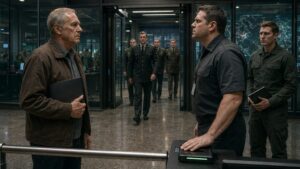
The young soldier at the visitor lane looked at Jonathan Carter’s hands before he looked at his face.
That was the first thing Jonathan noticed.
Not the rifles behind the glass booth, not the orange cones arranged like a temporary maze, not the wide metal mouth of Fort Bellwood’s old gate waiting half-open in the pale morning. He noticed the soldier’s eyes drop to his fingers, bent slightly by age, spotted at the knuckles, one thumb resting against the edge of a faded laminated card.
The card had gone soft at the corners. Its plastic had clouded with time. A brown line ran through one side where heat or sunlight had once bitten into it. Jonathan carried it flat in his left palm, the way a man might carry something too light to matter and too heavy to drop.
“Morning, sir,” the soldier said.
Jonathan nodded.
Behind the checkpoint, a maintenance truck idled with its hazards blinking. Two workers in reflective vests stood near the old guard table, talking over the growl of a power tool. One of them had already removed the little sign that used to tell visitors where to stand. The sign lay facedown beside a stack of orange barriers.
Jonathan had not seen Fort Bellwood in thirty-seven years, but he knew that table.
He had expected the gate to be smaller.
It was not.
It stood at the same angle in his memory: two steel arms, chipped posts, a small roofed station with weather-darkened trim, and that long wooden table where soldiers once emptied pockets, signed forms, traded jokes, checked IDs, and pretended they were not afraid of leaving.
Now the table looked tired enough to be mistaken for junk.
Jonathan stepped forward when the soldier gestured him on.
“ID, please.”
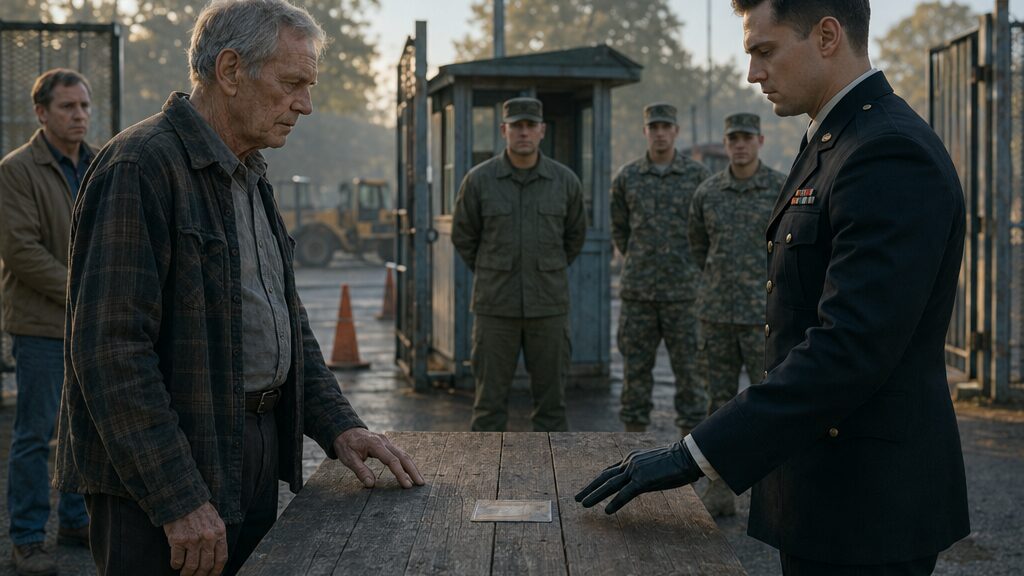
Jonathan placed the laminated card on the table.
He did not slide it. He set it down carefully, thumb and forefinger releasing it at the same time. The edge clicked softly against the old wood.
The soldier leaned over.
For a moment, nothing happened.
Jonathan could hear the flag rope tapping against the pole somewhere behind the booth. The morning had a sharp smell of diesel, cut grass, and wet concrete. There were other people waiting behind him: a delivery driver with a clipboard, a woman in sunglasses tapping at her phone, and a man in a pickup truck whose engine coughed every few seconds.
The soldier looked at the card again, then at Jonathan.
“This isn’t current.”
“No.”
The soldier waited for more. Jonathan offered none.
“Do you have a driver’s license? VA card? Visitor pass confirmation?”
Jonathan reached into the breast pocket of his gray shirt and brought out his license. The soldier took it with a faint look of relief, as if this at least belonged to the present.
“Purpose of visit?”
Jonathan looked past him, through the gap in the gate.
Beyond the checkpoint, the road curved toward low brick buildings he remembered only as open ground. A new visitor center stood where a row of barracks had once been. A clean sign announced the Fort Bellwood Access Modernization Project. Behind it, under a canvas tent, a small crew had gathered around a stack of new metal panels.
“They’re taking the gate down today,” Jonathan said.
The soldier followed his gaze. “Yes, sir. Old entry control point is being retired. New one opens Monday.”
“I need to go through before they finish.”
The soldier straightened. “For what office?”
Jonathan looked down at the old card again.
“Not an office.”
The soldier’s mouth tightened slightly, not in anger, only in the practiced expression of someone trained to keep a line moving. He lifted Jonathan’s license and turned toward the booth.
“Please wait here.”
Jonathan waited.
Waiting had become part of his body with age. He knew how to stand without shifting too much. He knew how to let impatience pass through a room without catching on him. He knew how to listen while people decided whether he was trouble, confused, or merely slow.
A gust of wind moved across the checkpoint and lifted the corner of the old card.
Jonathan placed two fingers on it before it could turn.
The wood beneath his fingertips was rough. Someone had carved initials into the far edge long ago, then scratched them nearly flat. There were dark stains where rain had seeped through the grain, and a dent near the middle that had not been there in Jonathan’s day. Still, when he touched the table, he felt the strange certainty of something that had outlasted uniforms, orders, men, and memory.
He had signed out on this table once with a black pen tied to a string.
Not that day, he told himself.
Not yet.
The soldier returned with another man.
The second man was younger than Jonathan’s grandson would have been if Jonathan had one. Late twenties, perhaps. Tall, clean-cut, face shaved smooth, shoulders squared under a formal dark uniform that made him look prepared for inspection even at an outdoor checkpoint. His black gloves seemed unnecessary in the mild morning, but they gave his gestures a clipped exactness.
“Mr. Carter?” the officer asked.
“Yes.”
“I’m Tyler Scott. I’m supervising access this morning.”
Jonathan nodded once. “Officer Scott.”
Tyler glanced at the driver’s license first, then the card lying beneath Jonathan’s fingers.
“May I see that?”
Jonathan lifted his hand.
Tyler picked up the old card by one corner. He did not handle it roughly, but he handled it like evidence. He tilted it toward the light.
The soldier behind him shifted his weight.
Tyler’s eyes moved across the faded print. “This is an obsolete installation access card.”
“Yes.”
“It predates the current system by decades.”
Jonathan looked at the gate. “I know.”
Tyler turned the card over. “This isn’t valid for entry.”
“No.”
Tyler paused. There was the smallest break in his professional rhythm. “Then I’m not sure why you presented it.”
Jonathan could feel the people behind him listening now. The delivery driver had stopped tapping his clipboard. The woman with the phone had lowered it enough to look. Somewhere near the maintenance truck, a worker laughed at something and then fell quiet when he noticed the stillness at the visitor lane.
“I need it to pass through,” Jonathan said.
Tyler’s brows drew together.
“Sir, a card doesn’t pass through. People do. And this card cannot authorize you.”
Jonathan placed his license back into his pocket. The movement took longer than it once would have. The fabric caught briefly on his knuckle. He did not hurry it.
“I’m not asking it to authorize me.”
Tyler looked at him more carefully then, and Jonathan knew the look. It was the look people gave when they began searching for signs: confusion, impairment, stubbornness, a problem they could solve by speaking louder.
“Mr. Carter,” Tyler said, voice lower, “are you here with someone?”
“No.”
“Did someone from the base request your presence?”
“No.”
“Do you have an appointment?”
“No.”
The soldier behind Tyler glanced toward the waiting cars.
Jonathan heard the pickup truck engine cough again. He smelled warm oil. He saw the corner of the fallen visitor sign twitch in the wind.
Tyler laid the card back on the table.
Jonathan’s eyes went to it before he could stop them.
“Sir,” Tyler said, “I need you to step to the side while we verify what we can. We can’t hold the lane.”
Jonathan did not move.
Not out of defiance. His knees had stiffened during the drive, and the morning air had settled into his bones. But that was not all of it. The table was under his hands. The gate was open. The card was here before the truck hauled the table away. If he stepped aside too soon, the day might close without him.
“Mr. Carter?”
Jonathan looked at Tyler. The officer was waiting with polite firmness. Behind him, two soldiers watched. Not cruelly. Curiously. That was worse in its own small way. Curiosity turned an old man into a delay, a question, a scene.
Jonathan reached toward the card.
Tyler’s gloved hand came down first, not hard, but enough to cover the top edge.
“Please leave that there for now.”
Jonathan stopped.
The glove hid part of the name.
Only the bottom of the old photograph remained visible, blurred under the scratched plastic. Jonathan stared at the covered card, and for one moment he was no longer at the visitor checkpoint. He was nineteen again in a room that smelled of damp canvas and boot polish, listening to a boy from Ohio laugh as if tomorrow had already promised to arrive.
Then the power tool shrieked from the maintenance truck, and morning returned.
Tyler turned the card slightly under his hand.
His eyes narrowed at the printed name.
“This doesn’t belong to you,” he said.
Chapter 2: The Officer’s Glove Covered the Name
Tyler Scott had expected the old man to argue.
Most delays at the gate followed patterns. A contractor forgot a badge and blamed the system. A visitor insisted someone had left their name “at the front.” A retired service member brought paperwork from an era no scanner could read and became angry when the present did not honor the past fast enough.
Tyler had patience for all of it, up to the point where patience became a security risk.
But Jonathan Carter did not argue.
He stood at the table with his shoulders slightly rounded under a dark plaid overshirt, the collar open over a plain gray shirt. His face had the colorless steadiness of stone after rain. Deep lines bracketed his mouth. His eyes were tired but not lost.
That made Tyler more uneasy, not less.
He looked again at the card beneath his glove.
The photograph had faded to a pale oval. The uniform in the image was old enough that Tyler could not identify it at a glance. The lettering remained mostly legible.
Steven White.
Not Jonathan Carter.
Tyler lifted his hand just enough to see the full name, then placed the card flat again on the table.
“Sir,” he said, keeping his voice calm, “this card is issued to Steven White.”
Jonathan’s fingers rested near the table’s edge. “Yes.”
“Are you Steven White?”
“No.”
The delivery driver behind Jonathan let out a quiet breath through his nose. The woman by the lane looked down at her phone, then up again. One of the younger soldiers at the booth had gone still in that way soldiers did when they sensed an officer’s patience being tested.
Tyler glanced toward the maintenance crew. The workers were waiting too. Everything at the gate seemed to have paused around this old card.
“Then you understand the issue,” Tyler said.
Jonathan’s gaze stayed on him. “I understand yours.”
There was no insult in it. That was the strange part. Tyler would have preferred anger. Anger was easier to manage. Anger justified firmness.
“This is not your identification,” Tyler said. “It is expired. It is not in our active system. It predates the current credential format. And you presented it as if it were relevant to entry.”
“It is relevant.”
“To what?”
Jonathan looked past Tyler, toward the old gate.
Tyler followed his gaze and saw only the removal work, the orange cones, the new access road being prepared beyond the visitor center. He had been assigned to supervise the transition because it was supposed to be routine. Keep visitors moving. Keep contractors documented. Keep sentiment from interfering with schedule.
There had been an email about possible older veterans stopping by to take pictures. The base commander wanted them treated courteously, but not allowed past restricted areas without clearance. Tyler had read the email twice. Courtesy mattered. So did procedure.
“Mr. Carter,” Tyler said, “I can’t let you onto the installation because of an old card with another man’s name on it.”
Jonathan nodded slightly, as if Tyler had finally spoken something simple and true.
“I’m not asking you to let me in because of it.”
“Then what are you asking?”
Jonathan’s hand moved toward the card again.
Tyler did not mean to stop him as sharply as he did. His glove came down over the card, palm flat, covering Steven White’s name completely.
The old man’s hand froze an inch away.
The movement drew every eye.
Tyler felt it at once: the soldiers watching from the booth, the driver in line, the woman with the phone, even one of the maintenance workers leaning on a dolly. The moment had become public before Tyler could pull it back.
He softened his voice. “Sir, I need you not to touch the credential while we’re reviewing it.”
Jonathan looked at the black glove.
Not at Tyler’s face. At the glove.
Tyler felt heat rise under his collar. He removed his hand halfway, then stopped, unsure whether moving now would make the gesture seem more or less deliberate.
Jonathan lowered his hand to the table.
“Was there a problem at the gate?” the gate sergeant asked from the booth doorway.
Tyler kept his eyes on Jonathan. “We’re resolving it.”
The sergeant looked at the old man. “Sir, do you need medical assistance?”
Jonathan blinked once.
Tyler wished the sergeant had not said it. Not because the question was unreasonable. It was exactly what protocol asked when an elderly visitor appeared confused or distressed. But something in Jonathan’s face changed—not much, not enough for anyone behind him to notice, but Tyler saw the small settling of the mouth, the quiet taking-in of another assumption.
“No,” Jonathan said. “I do not.”
“You sure?” the sergeant asked.
Jonathan nodded.
The woman behind him whispered something into her phone. Tyler could not make out the words, but he caught the shape of the situation from the outside: an old man holding up a military checkpoint with a card that did not belong to him.
“Let’s step over to the side,” Tyler said. “We’ll get you out of the lane.”
Jonathan did not move.
“Mr. Carter.”
Jonathan’s voice remained low. “They are taking the table after the gate.”
Tyler glanced at the table. “Yes.”
“Today.”
“Yes.”
“Then I cannot come back tomorrow.”
The sentence was plain. It should have sounded stubborn. Instead it landed with a weight Tyler did not know how to place.
“Come back for what?” he asked.
Jonathan looked at the card.
Tyler let his glove slide away from the name.
Steven White emerged again from beneath the black leather.
The old man’s face did not break, but his eyes changed. They became more distant and more exact at the same time, as if he had stopped seeing the checkpoint and was looking through it.
“For him,” Jonathan said.
No one spoke.
A truck horn sounded faintly from somewhere beyond the new access road. The flag rope tapped the pole again. The power tool restarted, then died quickly, as if even the worker had thought better of it.
Tyler stared at the name on the card.
“Is Steven White a relative?”
“No.”
“Someone you served with?”
Jonathan’s fingers closed lightly against the table’s edge. “Yes.”
Tyler waited.
Jonathan gave him nothing more.
The sergeant shifted at the booth. “Sir, we still can’t admit you based on—”
“I heard him,” Jonathan said.
Not loudly. Not angrily. But the words cut through the checkpoint as cleanly as a blade opening an envelope.
The sergeant stopped.
Jonathan turned his eyes back to Tyler. “I heard you too.”
Tyler felt the rebuke more because it was not dressed as one.
He had been spoken to by angry visitors, by superior officers, by drunk civilians outside parade grounds, by parents who believed their children’s graduation passes entitled them to breach procedure. None of them had made him feel as if he had mishandled something fragile.
Still, the facts remained the facts.
“Mr. Carter,” he said, “I need to ask again. What exactly do you want us to do with this card?”
Jonathan took a breath.
His chest rose slowly beneath the gray shirt. The old man looked at the gate, at the table, at the soldiers, at the strangers waiting behind him, and finally at Tyler.
“Let it cross before the gate comes down.”
Tyler almost answered too quickly. He caught himself.
“What does that mean?”
“It means what I said.”
“Sir, I need more than that.”
Jonathan’s eyes rested on him with tired patience.
Tyler heard himself becoming firmer because he did not know how else to be clear. “This is a secured installation. We don’t move unidentified objects through the gate because someone asks us to. We don’t honor expired credentials. We don’t bypass access control because of personal history. If this is a memorial request, there are offices for that.”
The words were correct.
The moment they left his mouth, Tyler wished there had been fewer of them.
Jonathan looked down. His hand settled beside the card, close enough to protect it, not close enough to take it.
“I have never bypassed a gate in my life,” he said.
The delivery driver lowered his eyes.
The young soldier in the booth swallowed.
Tyler kept his posture still. “I’m not accusing you of that.”
“No,” Jonathan said. “You’re only guarding against the possibility that I might.”
Tyler had no answer.
Jonathan lifted his chin toward the old gate. “That card was never meant to open the gate for me.”
Chapter 3: Catherine Thought He Had Gotten Lost Again
Catherine Carter found her father’s truck by the dent in the rear bumper.
It was parked crookedly in the visitor lot near the checkpoint, one tire touching the faded white line, the windshield reflecting a piece of pale sky. She had told him twice last month that the truck needed an alignment. He had said it only pulled to the right when the road wanted him to go left.
At the time, she had laughed.
Now she stood beside it with her phone in one hand and her pulse beating too high in her throat.
The house had been too quiet that morning. His coffee cup was rinsed and turned upside down by the sink. The little hook near the pantry, where he kept his keys, was empty. The locked drawer in his bedroom was open a finger’s width.
That was what had frightened her.
Not the truck gone. Not the early hour. The drawer.
For most of Catherine’s life, that drawer had been treated like a closed door inside the house. It held papers from the Army, two old photographs, a folded handkerchief, and a laminated card she had seen only once when she was a teenager and foolish enough to ask questions with both hands.
Her father had shut the drawer gently that day. Not slammed it. That would have been easier to understand.
“Some things don’t need handling,” he had said.
Now the drawer had been open.
And the card was gone.
Catherine crossed the lot quickly, then slowed when she saw him.
Jonathan stood near the old checkpoint table with one hand on the wood. He looked smaller there than he did at home, not because he was weak, but because the gate behind him was built to shrink people. Uniformed soldiers moved around him with radios and clipped gestures. A young officer in dark formal dress stood across from him, holding himself with polished restraint.
The old card lay between them.
Catherine stopped before she reached the cones.
For one suspended second, she saw the scene the way a stranger would see it: an old man in worn clothes, delaying a line, being questioned by people young enough to assume the world had begun with their own training.
Then she saw her father’s face.
He was calm.
That made her more afraid.
“Dad.”
Jonathan turned at her voice.
Something passed across his face—surprise first, then a tired kind of disappointment he tried to hide before it reached his eyes.
“Catherine,” he said.
She moved past the cone before anyone could stop her. A soldier stepped forward, but Tyler lifted one hand.
“She’s with him?” Tyler asked.
“I’m his daughter,” Catherine said. She heard the sharpness in her own voice and could not soften it fast enough. “What happened?”
Tyler’s gaze moved from her to Jonathan. “We’re trying to understand your father’s request.”
“My father shouldn’t be standing out here.”
Jonathan said, “I drove.”
“That is not the point.”
“It is one point.”
She looked at him then, really looked. His hair had been combed, but the wind had lifted it at the temples. He had put on the plaid overshirt with the missing button at the cuff. His shoes were polished, though one lace had loosened. He had made an effort. That hurt more than if she had found him confused.
“Dad,” she said more quietly, “why didn’t you tell me?”
His eyes went toward the card.
Catherine followed the look. The old plastic sat under morning light, more damaged than she remembered. She could not read the full name from where she stood, but she knew it was not his. That had been the first thing she learned about it, years ago.
Tyler said, “Ma’am, did your father tell you he was coming to Fort Bellwood today?”
“No.”
“Has he been here recently?”
“No.” Catherine looked back at Jonathan. “Not in years. Not since before I was born, I think.”
“Thirty-seven,” Jonathan said.
Catherine stared at him. “Thirty-seven years?”
He nodded.
She wanted to ask why today. She wanted to ask why alone. She wanted to ask whether he had taken his morning medicine, whether he had eaten, whether he had slept. She wanted to ask all the small frightened daughter questions that would make him feel like a child in front of strangers.
So she swallowed them.
The officer noticed. She saw that he noticed. Some of the stiffness in his face changed, though not enough to become warmth.
“There’s an issue with the credential,” Tyler said. “It’s expired and not assigned to him.”
“I know.”
“You know?”
Catherine looked down at the card again.
The name came clear now.
Steven White.
Her chest tightened. She had not spoken that name in decades. In truth, she had barely known it. It existed in her childhood like a room no one entered. Once, when she was eight, she had heard her mother say it at the kitchen table. Her father had gone outside afterward and sat in the truck until dark.
“I know it’s not his,” Catherine said.
Tyler waited for her to explain.
She could not.
Not because she knew too little, though that was true. Because what she knew was made of fragments: a name on a card, a drawer kept closed, her father’s silence during Memorial Day ceremonies, the way he left the room when certain songs came on television, the old table knife he used to pry open stuck windows because he hated sudden banging sounds.
She turned to Jonathan. “Dad, let’s go home.”
“No.”
The word was soft, but she felt it like a door clicking shut.
“You’re tired.”
“Yes.”
“And this is clearly not going the way you thought it would.”
His mouth moved almost into a smile. “Most important things don’t.”
The answer frustrated her because it sounded like him. Not confused. Not wandering. Not lost.
“Please,” she said. “We can call someone. We can write a letter. We can come back when this isn’t—”
“They’re taking the gate down today.”
“I know.”
“And the table.”
She looked at the scarred wood. “It’s a table.”
Jonathan’s hand rested on it.
Catherine regretted the words immediately.
He did not flinch. He did not correct her. He only looked down at the wood as though it had heard her.
Tyler said, “Mr. Carter mentioned that earlier. Is there a reason the table matters?”
Jonathan remained quiet.
Catherine felt everyone waiting again. The officer, the soldiers, the strangers, herself. Waiting for an old man to explain why an obsolete piece of plastic and a beat-up checkpoint table were worth standing in the sun for.
Her worry sharpened into embarrassment, then into shame for feeling embarrassed.
“Dad,” she said, lower now, “people are watching.”
Jonathan looked at her then, and the gentleness in his face almost undid her.
“They watched then too,” he said.
Catherine went still.
Tyler’s expression changed.
“What do you mean?” Catherine asked.
Jonathan took the card from the table before anyone stopped him. Tyler’s hand twitched, but he did not reach this time.
The old man held the card in both hands. Not like ID. Like something returned from water.
“I told him I’d bring it back,” Jonathan said.
“Steven?”
Jonathan nodded once.
Catherine tried to remember the one photograph she had seen: two young men sitting on the tailgate of a truck, sleeves rolled, grinning into sun. One had been her father, so young she had almost not recognized him. The other must have been Steven.
“You never told me that,” she said.
“No.”
“Why not?”
Jonathan rubbed his thumb over the clouded plastic.
“Because you were little,” he said. “Then you were busy. Then I was old. There was always a reason.”
The answer broke something small inside her. Not because it was unfair. Because it was probably true.
Tyler spoke carefully. “Mr. Carter, what exactly did you promise him?”
Jonathan looked through the gate again.
The maintenance crew had begun shifting the old sign and barriers onto a cart. One worker stood near the table now, waiting for permission to take it.
Jonathan saw him. Catherine saw Jonathan see him.
Her father’s fingers tightened around the card.
“He said if he didn’t come through that gate again,” Jonathan said, “I was to bring him through when it stopped guarding anyone.”
Catherine heard the words but did not understand them fully.
Tyler did. Or at least he understood enough to lose the last of his impatience.
Jonathan lifted his eyes from the card to the gate.
“I made that promise before I knew how long a man could take to keep one.”
Chapter 4: The Name the Records Office Could Not Find
Amanda Ramirez had spent eleven years teaching old paper how to become searchable.
She knew the sound of brittle folders before they opened. She knew which ink faded brown, which staples left rust ghosts, which decades preferred typewriters and which preferred signatures that crawled sideways across a line. She knew that institutions liked to say nothing disappeared, but what they meant was that everything still existed somewhere, waiting for the right person to care enough to look.
At Fort Bellwood, that person was usually her.
By noon, the visitor center had warmed under the bright glass of its front wall. The lobby smelled faintly of floor polish and coffee from the machine near the vending alcove. Through the windows, Amanda could see the old checkpoint beyond the cones, its table still standing while the workers waited for clearance to remove it.
The elderly man sat across from her desk with both hands around the old card.
Jonathan Carter. Retired. Late seventies. Driver’s license confirmed. No active base access. No appointment. No obvious reason to be inside the records office except that Tyler Scott had walked him there, Catherine Carter at his side, and asked Amanda if she could “check something historical.”
That phrase usually meant trouble.
Tyler stood near the door, hands behind his back, posture formal even indoors. Catherine sat beside her father, her purse on her lap, watching the card as if it might disappear if no one guarded it.
Amanda held out her hand gently. “May I?”
Jonathan looked at the card before giving it to her.
It was warmer than she expected.
The plastic had softened at the corners. The photograph was faded nearly to a shadow, but the name remained visible.
Steven White.
Amanda read it twice.
“Do you know his middle initial?”
“No,” Jonathan said.
“Date of birth?”
“No.”
“Service number?”
Jonathan’s eyes lowered. “Not anymore.”
Amanda did not say what some people would have said: Then there may not be much I can do. She had watched too many older men and women become embarrassed in offices because their memories did not match the forms.
“That’s all right,” she said. “We’ll start with what we have.”
Tyler glanced at the computer screen as she typed. “Would this be in current personnel records?”
“No. Not if it’s from the period this card appears to be from.” Amanda turned the card carefully under her desk lamp. “This predates the digital access system by a long time.”
“How long?”
She looked at Jonathan. “Late seventies? Early eighties?”
He nodded once. “Seventy-nine.”
Catherine inhaled softly.
Amanda typed Steven White’s name into the archival index. The computer returned three results, all wrong: a contractor in 1998, a civilian employee in 2006, a dependent record with no match. She tried alternate spellings, then narrowed by installation. Nothing.
Tyler’s mouth tightened. “No record?”
“No active searchable record,” Amanda corrected.
Jonathan’s hands were folded now on his knees. The fingertips of one hand tapped once against the other, then stopped.
Amanda opened another database, older, incomplete, assembled from scanned microfilm and handwritten rosters. “What unit?”
Jonathan looked toward the window.
“Transport pool,” he said after a moment. “Gate operations sometimes. We went where they needed bodies.”
“Do you remember his rank?”
Jonathan’s jaw shifted slightly. “He didn’t care for it much.”
Catherine turned to him. “Dad.”
“He said rank was what people used when they forgot names.”
Amanda looked up.
Jonathan’s face remained still, but the sentence had weight. Not a rehearsed line. Something carried too long.
She typed transport pool, Fort Bellwood, White, 1979. The system hesitated, then gave her a spinning circle that lasted long enough for everyone in the office to hear the lobby clock tick.
No results.
Tyler said, “Maybe the card was issued somewhere else.”
“It was here,” Jonathan said.
Tyler did not answer quickly this time.
Amanda saw that too. The officer had entered her office with professional doubt. Now he stood like a man trying not to step on something he could not see.
She turned the card over. A faint rectangular residue marked the back, as if an old sticker had been peeled away. Handwritten near the bottom, nearly rubbed off, were two numbers and what might have been a letter.
“Mr. Carter, did he leave the installation with this card?”
Jonathan’s eyes came to her.
“No.”
The room stilled.
Catherine looked at her father, confused and afraid to ask.
Amanda set the card on a clean sheet of paper beside a modern scanner. The black glass reflected the faded photograph back at itself. She lowered the lid, then stopped before pressing the button.
“This scanner may not read through the laminate clearly,” she said.
“It never liked being read,” Jonathan murmured.
Amanda paused.
Catherine touched his sleeve. “Dad?”
Jonathan looked down, as if surprised he had spoken aloud. “Steven. He used to cover the picture with his thumb when anyone checked him in. Said if the Army wanted his face, it could ask politely.”
For the first time, the corner of his mouth moved.
Not a smile. The memory of one.
Amanda pressed scan.
The image appeared on her screen in washed-out gray. The name stretched, warped by the laminate. The badge number was partly visible. She zoomed in and adjusted contrast. A sequence emerged, but the final digit was uncertain.
She tried it in the badge index.
No match.
She changed the final digit.
No match.
She changed another.
No match.
Tyler shifted. “Could the index be missing that range?”
Amanda looked at him. “The index is missing entire months.”
His expression changed.
“Why?”
“Because old logs were stored in the basement of Building Twelve before renovation. There was a flood in the nineties. Some boxes were salvaged, some scanned, some listed as unreadable.” Amanda looked at Jonathan. “A lot survived. Not everything.”
Jonathan nodded as if he had expected the answer.
Catherine did not. “So that’s it? A flood?”
Amanda disliked how small the word sounded. A flood. A room. A box. A name. Gone because water reached a shelf no one had checked in time.
“Not necessarily,” she said.
She stood and crossed to a locked cabinet behind her desk. Inside were binders used so rarely that dust gathered on the upper edges despite the office being cleaned every night. She took down one marked Gate Logs, Partial, 1978–1980.
Tyler stepped aside as she returned.
The binder opened with a dry crack.
Inside were photocopies of pages that had once been handwritten, then microfilmed, then printed again. Many were crooked. Some names faded into gray smears. Amanda moved carefully, checking dates, entries, initials, vehicle numbers.
“What date?” she asked.
Jonathan did not answer.
“Dad,” Catherine said softly.
His hands tightened together. “June seventeenth.”
Amanda turned pages.
“Year?”
Jonathan’s voice was nearly flat. “Nineteen seventy-nine.”
She found June. The entries were crowded, half legible, names written by different hands. She followed the date column down with one finger.
White appeared once on June fifteenth.
Not Steven. Not full name. Just White, S.
Beside it was a vehicle number and the words temp pass reissued.
Amanda looked across the desk.
Jonathan was not breathing much.
She continued down the page. June sixteenth had water damage across the center, leaving gray blooms where ink had dissolved. June seventeenth was worse. Several lines were unreadable. Near the bottom, two names survived in partial form.
Carter, J.
Below it, almost erased:
White, S.
A mark connected them. Maybe a bracket. Maybe a check-out line. Maybe nothing.
Beside the names was a note, cut off at the edge of the copy.
Released through south gate—
The rest had vanished into water damage.
Amanda lowered her hand from the page.
Catherine leaned forward. “What does that mean?”
Amanda did not answer right away. She could explain records. She could not explain why a man’s eyes would close at the sight of a half-destroyed line.
Tyler moved closer, but not too close.
Jonathan opened his eyes.
“That was us,” he said.
Amanda looked at the page again, at the two names nearly taken by water but not quite.
For the first time that day, the old card seemed less like invalid identification and more like the only part of the record that had refused to vanish.
Chapter 5: The Table Remembered What the System Missed
Jonathan knew the table by the scar underneath.
The maintenance crew had already tipped it onto one side by the time he reached the storage area beside the old checkpoint. Its legs pointed toward the visitor center like stiff, awkward limbs. Two workers had cleared the ashtrays, sign clips, and plastic trays from its top. Someone had slapped a strip of orange tape along one edge with the word REMOVE written in black marker.
Jonathan stood at the doorway of the covered storage bay and felt Catherine stop beside him.
The card was back in his shirt pocket.
Amanda had returned it to him without ceremony, sliding it across the records desk on the clean sheet of paper as if she understood now that some things should not be passed from hand to hand casually. Tyler had walked them out without saying much. He had received a call near the lobby doors and fallen a few steps behind, his voice low, controlled.
Jonathan had not waited for him.
The old table was waiting.
“Sir,” one of the maintenance workers said, straightening. “You can’t come in here without an escort.”
Jonathan stopped just inside the threshold.
Catherine said, “We’re waiting for Officer Scott.”
The worker looked past them, then at Jonathan. He seemed tired more than annoyed. Sawdust clung to one sleeve. “They told us this had to be loaded before two.”
Jonathan looked at the table. “It won’t take long.”
“What won’t?”
Jonathan did not answer.
The table was upside down now, and that was how memory found it.
Most people would have looked at the top, at the scratches from keys and clipboards and elbows. Jonathan looked beneath the left corner, where a cross brace had once split during a winter freeze and been repaired with two mismatched screws. A dark scar ran diagonally across the underside. Near it, barely visible under grime, someone had carved a crooked star.
Steven had done that with the point of a pocketknife while waiting for a transport order that came four hours late.
“Quit marking government property,” Jonathan had said.
Steven had not looked up. “I’m improving it.”
“You’re going to get us both written up.”
“For a star? Carter, if this Army falls because of a star under a table, it was already doomed.”
Jonathan had laughed then.
The memory moved through him with such sharpness that he had to put one hand against the storage bay frame.
Catherine saw. “Dad?”
“I’m fine.”
“No, you’re not.”
He turned his head slightly. “I am where I meant to be.”
The worker cleared his throat. “Sir, really, we’ve got to move this.”
Jonathan stepped toward the table.
The worker shifted as if to block him, then hesitated. Old age did that. It gave strangers a second of uncertainty. They did not want to touch you. They did not want to be seen stopping you. They wanted someone else with authority to arrive.
Jonathan lowered himself slowly to one knee.
The concrete hurt at once.
Catherine moved toward him, but he lifted a hand.
“Please,” he said.
She stopped.
The table’s underside smelled of dust, oil, old rain. He reached beneath the brace and brushed away dirt with the side of his hand. The crooked star appeared more clearly. Beside it were other marks he had forgotten: a short vertical line, another, a third. Waiting marks. Steven had cut one each hour.
Four lines and a star.
Jonathan touched the star.
Not with the card. Not yet.
Just his fingers.
The storage bay fell quiet behind him.
Amanda had followed them out after all. She stood near the doorway holding the copied gate log in a folder against her chest. Tyler arrived a moment later, slowing when he saw Jonathan on one knee beside the overturned table.
“Mr. Carter,” Tyler said, “do you need help?”
Jonathan almost laughed. Not because the question was foolish. Because of how many times in life help arrived after a man had already taught himself not to ask.
“No.”
Catherine knelt despite his earlier gesture. Her knee touched the concrete beside his.
“What is it?” she asked.
He pointed to the carved star.
She leaned closer. “Someone made that?”
“Steven.”
The name settled over them.
Jonathan took the card from his pocket. For a moment he held it against his palm, photograph hidden.
“We were on gate duty before they moved us to transport,” he said. “Not official gate duty. Nothing about us was official when they were short. They put us wherever they needed two men who could stay awake and not complain.”
No one interrupted.
“He hated this table,” Jonathan said. “Said it had more authority than most officers because everyone had to stop in front of it.”
The worker looked down at the table with a different expression now, as if it had become heavier without changing size.
Jonathan’s thumb moved over the cloudy edge of the card.
“He carved that star the week before we left.”
Catherine’s voice was careful. “Left for where?”
Jonathan looked at the card, then at the gate visible beyond the storage bay.
“Not far. Far enough.”
He could feel Tyler listening. Could feel Amanda listening. He did not want to give them a story. Stories rounded corners. They made pain useful to people who had not earned it. But Catherine’s face was beside his, and the confusion in it was no longer embarrassment. It was grief arriving late.
“We signed out through this gate on June seventeenth,” Jonathan said. “I signed the line. Steven forgot his card on the table, then came running back for it, laughing like an idiot because he said the gate wouldn’t let him back into America without his ugly picture.”
Catherine’s eyes shone.
Jonathan stared at the crooked star.
“He made me hold it while he fixed his boot outside the truck. Said if he lost it again, I was responsible. That was the last joke he made before the call came.”
Tyler did not move.
Amanda’s fingers tightened around the folder.
Jonathan did not describe the call. He did not describe the road, or the broken axle, or the wrong turn someone higher up insisted was correct, or the way ordinary light could become impossible to remember afterward. He did not owe that to the storage bay.
“He didn’t come back through,” Jonathan said. “Not the way he meant to.”
Catherine covered her mouth.
Jonathan heard her breath catch and hated that he had put the sound there. This was why he had kept drawers closed. This was why silence became easier as years piled up. People thought silence meant the wound had healed. Sometimes it only meant a man had learned where not to press.
“I brought his card back,” Jonathan said. “Not him. Just this.”
He placed the card beside the carved star.
For the first time all day, it was not on top of a desk, not under a glove, not beside a scanner that could not read it. It was near something Steven had made with his own hand.
Jonathan bowed his head.
The concrete chilled his knee through his trousers. His back ached. His fingers trembled, and he did not try to hide them.
Catherine touched his shoulder, not to steady him, only to be there.
Behind them, Tyler took one step forward and stopped.
Jonathan heard the movement and knew without looking that the young officer had understood enough to be ashamed, but not enough to know what to do with shame.
That was fair.
Jonathan had carried his own for thirty-seven years and had not known what to do with it either.
The maintenance worker spoke into the silence, voice low. “Sir, I can hold the load.”
Jonathan looked up.
“For a while,” the worker added. “I can say we had a bolt issue.”
Jonathan nodded once. “Thank you.”
He took the card back.
Tyler’s shadow fell across the concrete near the doorway, long and straight.
Jonathan rose with Catherine’s help because pride did not require pretending his knees were young. When he turned, Tyler stood just outside the storage bay, face controlled, eyes lowered toward the old table.
The officer had heard enough to know he had been wrong.
Not enough yet to understand that being wrong was only the beginning.
Chapter 6: Jonathan Asked for the Gate, Not the Apology
Tyler Scott had apologized before.
He had apologized for delayed access lists, for parking changes, for a visitor badge printed with the wrong date, for a soldier’s sharp tone at a family day checkpoint. He knew the correct shape of professional regret. Eye contact. Calm voice. Ownership without excess. A sentence that did not make the other person responsible for comforting him.
But as he followed Jonathan Carter away from the storage bay, Tyler understood that his usual apologies belonged to smaller mistakes.
The old man walked slowly, Catherine at his side, the faded card held in his right hand. He did not clutch it. That was what bothered Tyler. If Jonathan had clutched it, Tyler could have told himself grief had made him unreasonable. But Jonathan held the card with care and control, as if he had spent the whole morning preventing other people’s misunderstanding from changing what it meant.
The checkpoint lane had mostly cleared. The delivery driver was gone. The woman with the phone was gone. The soldiers at the booth had returned to work, though one looked over as Jonathan passed. The old gate stood open behind a line of cones. Beyond it, the new visitor center gleamed in glass and brushed metal, efficient and forgetful.
Tyler caught up near the fallen visitor sign.
“Mr. Carter.”
Jonathan stopped.
Catherine looked at Tyler first. There was no anger in her face now. That made it harder.
Tyler removed his cap, then realized the gesture might look too formal, too visible, too much like performance. He held it at his side.
“I owe you an apology.”
Jonathan waited.
Tyler had imagined saying more, but the old man’s silence forced him to choose each word.
“I treated your request as a security inconvenience before I understood what you were carrying.”
Jonathan looked toward the table in the storage bay, then back at him. “You treated it as a card that did not belong to me.”
“Yes.”
“It doesn’t.”
Tyler’s throat tightened. “I also put my hand over it.”
Jonathan’s eyes did not soften, but they did not harden either.
“Yes,” he said.
The single word landed with more force than accusation would have.
Tyler looked down at the cap in his hand. “That was disrespectful.”
“It was careless.”
Tyler lifted his eyes.
Jonathan’s correction held no anger. It was worse than anger. More exact.
“Yes,” Tyler said. “It was careless.”
A radio crackled from the booth. The gate sergeant answered it quietly. Maintenance workers moved in the distance, loading equipment. The day had resumed around them, but Tyler felt as if he stood in a pocket of still air made by one old man’s refusal to hurry pain along.
“I spoke with the base commander,” Tyler said. “We can arrange a brief recognition at the removal site. Nothing large. Just the personnel present. We can acknowledge Mr. White and your service. We can make sure the record reflects—”
“No.”
Tyler stopped.
Catherine glanced at her father, then down.
Jonathan slid the old card into his shirt pocket. “That is not what I came for.”
“I understand you don’t want a spectacle.”
“I don’t want a correction designed to make everyone feel better at once.”
Tyler felt his face warm.
Jonathan saw it and looked away, not to spare him, but because the point had been made.
“I’m not trying to make this about me,” Tyler said.
“Most people aren’t,” Jonathan replied. “That doesn’t keep it from happening.”
Tyler had no answer for that.
Catherine said softly, “Dad, he’s trying.”
“I know.”
Jonathan’s voice held no dismissal. He looked at Tyler again, and for the first time that day Tyler felt seen not as a uniform, not as an obstacle, but as a young man who had reached the edge of his training and found it did not cover everything.
That mercy embarrassed him.
“What do you want?” Tyler asked.
Jonathan looked at the old gate.
The question should have been simple. Tyler had asked versions of it all morning, but only now did he understand that he had been asking for a category. Office. Appointment. Authorization. Purpose of visit.
Jonathan had been answering something else.
“Steven wanted to go home through that gate,” Jonathan said.
Catherine’s hand moved to her father’s arm.
“He said it in a stupid way. He said everything in a stupid way when he didn’t want something to matter.” Jonathan looked past the cones. “We were standing right there when he said it. He’d forgotten his card again. I told him one day the gate would be gone and he’d still be trying to get through it.”
A faint smile touched his mouth and disappeared.
“He said if it ever stopped guarding anyone, I should bring him through. Because then nobody could say he was late.”
Tyler looked at the open gate. Its paint had chipped along the inner hinge. A new chain hung loosely from one side. Workers had already removed the old keypad and a panel of conduit, leaving pale rectangles where equipment had shielded the post from weather.
“That’s why today,” Tyler said.
Jonathan nodded.
“You knew it was being removed?”
“I read it in the local paper.”
Catherine looked startled. “You still get the paper?”
Jonathan looked at her. “You told me the internet had too many opinions.”
Despite everything, Catherine gave a small, broken laugh.
It passed quickly.
Tyler said, “Mr. Carter, I can request permission for you to walk the card through with escort.”
“No.”
Tyler hesitated. “No?”
Jonathan reached into his pocket and removed the card again. He looked at it in the sunlight. The photograph was almost gone.
“If I walk it through under your permission,” he said, “then it becomes about whether I was allowed.”
Tyler was quiet.
Jonathan’s thumb brushed the old laminate. “Steven had enough of being allowed and not allowed. Signed in, signed out, cleared, delayed, transferred, misplaced. He was twenty-one years old and still had to ask permission to stand in the wrong line.”
Catherine bowed her head.
“He did not ask me to make a ceremony,” Jonathan said. “He asked me to bring him through when the gate stopped guarding anyone.”
Tyler looked at the cones blocking the lane. “The gate is still under base control until removal is complete.”
Jonathan nodded. “That is your problem.”
The words should have sounded harsh. Somehow they did not. They sounded like a fact being returned to its proper owner.
Tyler looked toward the booth. The gate sergeant watched from inside, trying not to appear as if he was watching. Beyond him, the base commander stood near the visitor center speaking with Amanda. The maintenance crew waited by the storage bay. Everyone had a task. Everyone had a rule. Everyone had a reason to say later, not today, not this way.
Tyler had begun the morning thinking firmness meant protecting the gate from Jonathan.
Now he wondered whether firmness might mean protecting Jonathan’s request from becoming a performance.
“I can ask them to pause removal,” Tyler said.
Jonathan said nothing.
“I can’t promise more than that.”
“I did not ask you to promise.”
Tyler almost smiled at the quiet precision of it, but did not.
Catherine looked between them. “What happens if they say no?”
Jonathan turned the card over. On the back, the worn residue of an old sticker caught the light.
“Then I take him as close as they let me,” he said.
Catherine’s eyes filled again, but she did not argue.
Tyler looked at her, then at Jonathan. “And if they say yes?”
Jonathan’s hand closed around the card.
“Then the gate stays open for one more person who is not on any list.”
The sentence entered Tyler more slowly than the others.
Not on any list.
He thought of the computer screen in Amanda’s office returning nothing. The missing months. The flooded boxes. The half-line in the copied log. Carter, J. White, S. Released through south gate—
A life reduced to a partial mark because no system had cared enough to keep the rest dry.
Tyler put his cap back on, not as performance, but because he needed both hands free.
“I’ll ask,” he said.
Jonathan nodded.
As Tyler turned toward the visitor center, Catherine’s voice stopped him.
“Officer Scott.”
He looked back.
She seemed unsure whether to thank him or resent that thanks had become necessary.
“He won’t ask twice,” she said.
Tyler looked at Jonathan, standing beside the fallen visitor sign with the old card in his hand and the gate behind him.
“I know,” Tyler said.
And for the first time that day, he did.
Chapter 7: The Card Passed Through Without Opening Anything
By sunset, the old gate no longer looked like something that could stop anyone.
One arm had been unbolted and laid on padded sawhorses. The other remained upright, angled toward the road as if it were still trying to decide whether to open. Wires hung from the post in dull loops. A pale stripe marked the place where the old keypad had been. The booth windows reflected the reddening sky, empty now except for a stack of papers, a radio charger, and a forgotten foam cup.
Jonathan stood on the visitor side of the cones with Steven’s card in his palm.
The day had taken more out of him than he wanted Catherine to know. His back ached from the storage bay. His knee pulsed from kneeling on concrete. The skin between his thumb and forefinger had gone tender from rubbing the edge of the card again and again. He could feel the tiredness gathering behind his eyes, the kind that made the world flatten at the edges.
Still, he was standing.
Catherine stood a few feet behind him, close enough to catch him if she had to, far enough not to make it obvious. She had been learning all day, and he had been learning her learning. It was a strange thing, letting your child discover that you had once been young and frightened and guilty. Stranger still to discover she had the patience to stay after learning it.
Tyler Scott returned from the visitor center with Amanda Ramirez and the base commander walking behind him.
The commander did not come all the way to Jonathan. He stopped near the edge of the work zone, spoke quietly to the maintenance crew, then looked toward Tyler. Whatever authority had been granted was now Tyler’s to carry. Jonathan noticed that. The young officer had asked for permission, but the moment itself had been given back to him.
Tyler approached without hurry.
“They paused the removal,” he said.
Jonathan nodded.
“Only for a few minutes.”
“That’s all he asked for.”
Tyler looked at the card, then at the gate. “The commander approved escort to the old threshold. No public formation. No announcement.”
Jonathan glanced at Catherine.
Her eyes were wet, but she did not speak.
Amanda stepped forward and held a folder against her side. “I made a temporary archival intake sheet,” she said. “Not to take the card from you. Just to create a record that Steven White’s credential was returned to Fort Bellwood on this date, with your statement attached if you choose to give one.”
Jonathan heard the care in the last words.
If you choose.
The whole day had been people asking for proof. Now Amanda was offering him a place to put only what he could bear.
“Later,” he said.
Amanda nodded. “Later is fine.”
Tyler moved one cone aside. The plastic scraped against pavement.
Jonathan looked at the opening.
It was not wide. It was not ceremonial. It was only a gap in a line of orange cones beside a half-removed gate. Beyond it, the old table had been set upright again by the maintenance workers, just inside the post where visitors once stopped. Someone had wiped dust from its surface, but the stains remained. Its legs were uneven, and one corner had been braced with a block of scrap wood to keep it from rocking.
Jonathan almost smiled.
Steven would have said the table had survived on stubbornness and bad carpentry.
“You don’t have to do this alone,” Catherine said.
Jonathan looked back at her.
For thirty-seven years, alone had seemed like part of the promise. He had kept the card alone, hidden the drawer alone, avoided the base alone, remembered the gate alone. He had told himself it spared other people. Maybe it had. Maybe it had also kept Steven trapped in a room only Jonathan entered.
He held out his left hand.
Catherine took it.
Her fingers were warm. Stronger than his. She did not squeeze too hard.
Tyler walked ahead of them, not leading exactly, but clearing the path. Amanda stayed by the visitor center. The maintenance crew stepped back. The commander turned away slightly, giving them the privacy of not being watched too directly.
Jonathan crossed the cone line.
Nothing sounded.
No alarm. No shouted order. No mechanical buzz.
After all the years the gate had spent deciding who belonged and who did not, Steven White’s old card passed under it without opening anything.
Jonathan felt that in his chest.
A gate was only metal until a man gave it a promise. A card was only plastic until a name stayed on it longer than the body that had carried it. He had known these things separately. He had never felt them together until that moment.
At the threshold, he stopped.
The table stood just beyond the remaining gatepost. Its top was scarred with newer marks, but underneath, hidden from view, the crooked star waited. Jonathan knew it was there. That was enough.
Tyler moved to the far side of the table and stood still.
Jonathan placed the card on the wood.
It made the same soft click it had made that morning.
This time, no hand came down over it.
The fading light caught the plastic and turned its cloudy surface gold for a second. The photograph was almost gone. The name remained.
Steven White.
Catherine drew in a slow breath beside him.
Jonathan did not speak at first. He had imagined words during the drive, then forgotten them at the gate. He had imagined apology, report, confession, prayer. None of them fit. Steven had never liked tidy things.
Finally Jonathan said, “You made it back late.”
The sentence was so small the wind almost took it.
Catherine’s hand tightened around his.
Jonathan looked at the card and saw Steven at twenty-one, boot untied, grin crooked, saying the world would wait if it had manners. He saw the morning line through the gate, the truck, the dust, the table with the star underneath. He saw all the years he had treated survival like a debt that could not be paid down.
“I kept it,” Jonathan said. “Not well every day. But I kept it.”
His voice thinned at the end.
He did not apologize for that.
He reached for the card, then stopped. For one terrible second, he did not know whether to leave it there or take it back. Leaving it felt like abandonment. Taking it felt like refusing release.
Tyler looked at him across the table.
The young officer removed his right glove.
Not quickly. Not dramatically. He pulled each finger loose, folded the glove once, and held it in his left hand. Then he laid his bare right hand on the table, palm down, not touching the card.
Jonathan looked at the hand.
Earlier that day, black leather had covered Steven’s name. Now a bare hand rested beside it, careful, waiting.
“I can witness it,” Tyler said.
Jonathan studied him. The officer’s face held no demand to be forgiven. No performance of regret. Only attention.
Jonathan nodded.
Tyler did not touch the card until Jonathan moved his hand away.
Even then, he used two fingers, gentle at the corners, and slid it onto Amanda’s clean intake sheet. He did not pick it up like evidence. He moved it like a thing that belonged to someone.
Catherine wiped her face with the heel of her hand.
Jonathan stood a moment longer at the threshold. The gatepost cast a narrow shadow across his shoes. For thirty-seven years, some part of him had remained on the far side of a line drawn in a June morning. Now the line was only paint, cone marks, fading light.
“I can carry it from here,” Tyler said.
Jonathan looked at Steven’s name one last time.
“No,” he said.
Tyler stilled.
Jonathan lifted the card from the paper, held it once more against his palm, then placed it back on the table himself.
Not because he did not trust Tyler.
Because the promise had been his to finish.
“There,” Jonathan said.
And for the first time all day, he let go before anyone asked him to.
Chapter 8: No One Saluted, and That Was Enough
Catherine drove her father home after dark.
Jonathan sat in the passenger seat with his hands folded over his knees, watching the road as if each passing streetlight had something to say. He had left the card at Fort Bellwood. Not displayed. Not framed. Not held up for anyone’s sympathy. Amanda had placed it in a flat archival sleeve after Jonathan signed a short statement in careful, uneven handwriting.
Returned by Jonathan Carter in fulfillment of a promise made to Steven White.
That was all he wrote.
Catherine had expected more. A date. A story. An explanation. But when Amanda offered another sheet of paper, Jonathan shook his head.
“The rest was his,” he said.
So they left the card in the office, with the intake number written in pencil on a folder that would not go through a scanner until Amanda said it was ready. The old table remained at the gate for the night, covered with a tarp to protect it from dew. The maintenance crew had been told not to load it until morning.
No one saluted.
No one clapped.
The base commander shook Jonathan’s hand once and said, “Thank you for bringing him back.” Jonathan answered, “Thank you for letting him through.” That was the entire ceremony.
Now, in the truck’s dim cabin, Catherine gripped the wheel with both hands.
“You should have told me years ago,” she said.
Jonathan looked out the window. “Yes.”
She had expected him to defend himself. To say she was too young, then too busy, then too burdened with her own life. He had said those things earlier. Now he only accepted the truth.
The simplicity of it made her throat ache.
“I thought sometimes…” She stopped.
He turned slightly. “What?”
“I thought you didn’t trust me with certain parts of you.”
The tires hummed over a seam in the road.
Jonathan looked down at his hands. The right thumb still moved as if the card were there. It rubbed the side of his forefinger, searching for an edge that had been carried too long.
“I didn’t trust myself with them,” he said.
Catherine kept her eyes on the road.
The apology came without the word.
She nodded once because speaking would have made it too large, and the day had already asked enough of him.
At home, Jonathan paused in the hallway outside his bedroom. The drawer remained open as Catherine had found it that morning. Inside were the two photographs, the folded handkerchief, a few old documents, and an empty space where the card had rested for decades.
Catherine stood behind him.
The house was quiet except for the refrigerator motor and the faint sound of traffic beyond the windows.
Jonathan opened the drawer fully.
He took out the photograph Catherine remembered from childhood. Two young men sat on the tailgate of a truck, sleeves rolled, boots dusty, faces bright with a careless confidence neither had earned yet. One was Jonathan, almost unrecognizable except for the eyes. The other leaned toward him with a grin that seemed to pull light into the picture.
Steven White.
Jonathan handed the photograph to Catherine.
“Keep that where it can be seen,” he said.
She looked at him. “Are you sure?”
“No.” His mouth moved slightly. “But do it anyway.”
The next morning, Tyler Scott arrived at the old checkpoint before the maintenance crew.
The sunrise had not yet cleared the visitor center roof. The air smelled of damp grass and metal. Without the usual line of vehicles, the old gate looked less official and more tired, like something that had stood too long at attention.
Tyler carried a clipboard under one arm and a coffee he had forgotten to drink.
The gate sergeant met him near the booth. “Commander wants the table moved to storage after documentation.”
“I know.”
“Not disposal?”
“Not disposal.”
The sergeant looked toward the tarp-covered shape. “Because of yesterday?”
Tyler removed the tarp himself.
The table stood beneath it, stained and ordinary. If a visitor had walked by, they would have seen nothing but old wood waiting for a truck.
“Yes,” Tyler said. “Because of yesterday.”
He crouched and looked underneath until he found the crooked star and four waiting marks. He did not touch them. He only looked.
After a while, he stood and opened the new procedure sheet on his clipboard.
Visitor processing guidance for legacy credentials and historical veteran requests.
The title sounded stiff. Too stiff. Amanda had helped him draft it before leaving the night before. The commander had approved a temporary version with a note that permanent policy would take time. Tyler had learned enough in one day to distrust how easily systems promised later.
So he had printed the temporary guidance himself.
It did not give anyone automatic access. It did not weaken security. It did not turn old paper into a pass. It simply required that older visitors carrying legacy documents be seated, listened to, checked through records before dismissal, and never publicly corrected unless safety demanded it.
Near the bottom, Tyler had added one line Amanda suggested:
Do not assume confusion where purpose has not yet been understood.
The gate sergeant read it twice.
“That from the commander?”
“From yesterday,” Tyler said.
The sergeant said nothing.
A car pulled into the visitor lane just after seven. An older veteran stepped out with a folder tucked under one arm and a faded cap in his hand. He looked toward the half-removed gate with the wary expression of someone prepared to be told he was in the wrong place.
Tyler walked to the table before the soldier in the booth could call out.
“Good morning, sir,” he said. “Take your time.”
The man blinked, surprised by the words more than by the uniform.
Tyler placed a chair beside the table.
Back at Jonathan’s house, Catherine set the photograph on the living room shelf beside a small brass clock that had not kept perfect time in years. She did not ask if the place was right. She let it stand where morning light could reach it.
Jonathan came in slowly with his coffee.
He noticed the photograph at once.
For a moment, he said nothing. Catherine watched his face, ready to move it if she had misunderstood.
He stepped closer.
In the picture, young Jonathan and Steven sat shoulder to shoulder, both of them laughing at something outside the frame. The years had yellowed the paper, but not the foolishness in their faces.
Jonathan touched the shelf, not the photograph.
“He would have hated that spot,” he said.
Catherine almost moved toward it.
Then she saw the corner of his mouth.
“Too respectable?” she asked.
“Far too respectable.”
They stood together in the living room, the old house holding a new kind of quiet.
Later, Jonathan drove himself back toward Fort Bellwood, though Catherine followed in her own car without arguing about it. The old gate was nearly gone by then. One post remained, and the table had been moved to a sheltered corner near the visitor center, not hidden, not displayed, simply kept. Amanda had placed a small temporary tag on it.
Legacy checkpoint table. Fort Bellwood south gate.
No names. No speech. No claim that wood remembered more than people did.
Jonathan stopped before it.
Tyler saw him from the visitor lane and came over, but he did not hurry and did not call attention. He stood beside Jonathan at a respectful distance.
“The card is logged,” Tyler said. “Amanda will keep it with the restored gate records.”
Jonathan nodded.
“And the table?”
“Storage for now. Then maybe the small history room, if they approve it.”
Jonathan ran his eyes over the scarred top.
“That’s more than it expected.”
Tyler looked at him. “Mr. Carter…”
Jonathan waited.
Tyler’s hand tightened once around the clipboard. “I am sorry for how I treated you before I understood.”
Jonathan looked at the young officer for a long moment.
Then he said, “Try not to need understanding first.”
Tyler absorbed it quietly.
“Yes, sir.”
There was no salute. Jonathan was grateful for that.
He turned toward the exit. The new checkpoint stood beyond the visitor center, clean and efficient, its glass booth shining in the morning. Cars moved through it with barcodes, scanners, current badges, approved lists. It would make its own mistakes in time. All gates did.
Catherine waited near the truck.
Jonathan walked toward her without the card in his pocket.
At first, the absence felt like loss. Then, halfway across the pavement, the wind moved through his open hand, and he realized his fingers were not searching anymore.
He had not needed the gate to prove who he was.
He had needed only to stop making Steven wait outside it.
The story has ended.