The Old Man Who Knew Why the Plane Should Wait
Part I — The Hand on the Wheel
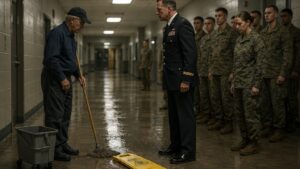
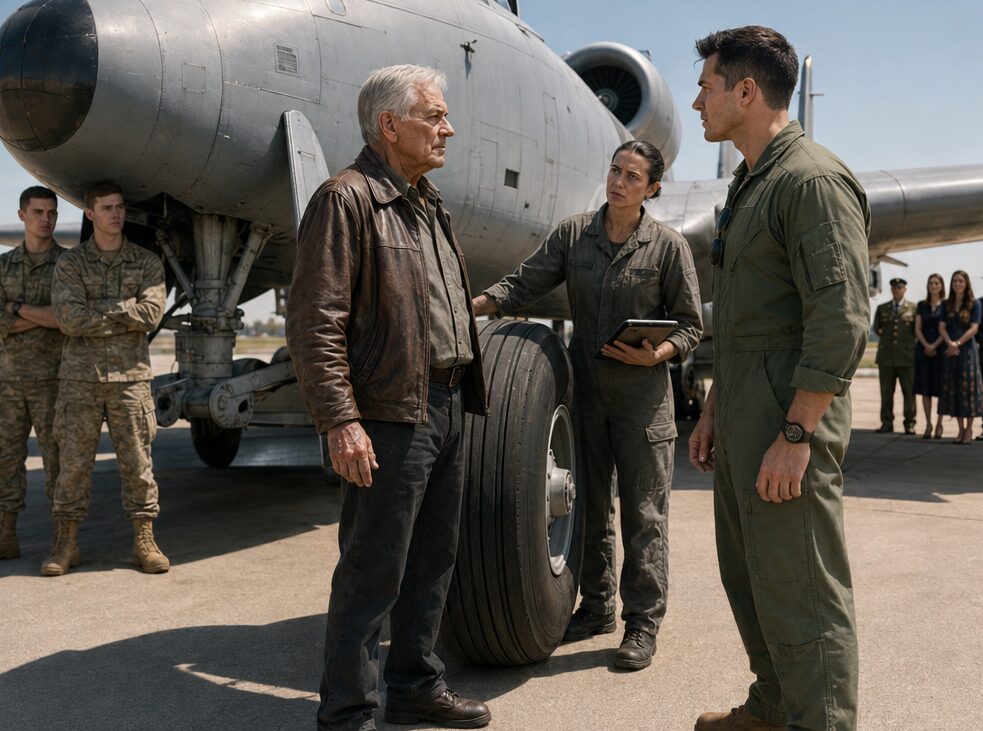
The young pilot stepped close enough for Gregory to smell the mint on his breath and said, “Sir, are you lost?”
Two airmen behind him laughed.
Not loudly. Not cruelly enough to be called cruelty if anyone important asked later. Just enough to make Gregory feel every one of his seventy-eight years standing there in the sun, one hand resting on the great black tire of the old transport plane.
He did not move his hand.
The aircraft towered above them, gray and restored and polished for the afternoon ceremony. Its nose pointed toward the runway like it still had somewhere urgent to be. The left landing gear sat in shadow under the wing, thick struts gleaming, tire dressed clean for cameras and families and speeches.
Gregory’s palm rested against the rubber.
He was not leaning. He was listening.
The pilot’s name patch read MILLER, though his first name was on the program Gregory had been handed at the gate: Captain Joshua Miller. Selected for the memorial flyover. Son of Stephen Miller, one of the men evacuated on this very aircraft decades earlier.
A proud son. A polished son.
A son who was smiling like Gregory was blocking his photograph.
“This is a restricted area,” Joshua said. “Visitors stay behind the ropes.”
Gregory looked at the tire, not the pilot.
“It’s sitting wrong.”
The two airmen stopped laughing for half a second. Then one of them snorted.
Joshua tilted his head. “What was that?”
Gregory slid his fingers along the sidewall, feeling the faint warmth where the sun had reached it and the cooler patch where the shadow held. He had not touched this aircraft in thirty-nine years, but his hand knew the shape of it before his mind finished remembering.
“The left main is sitting wrong,” he said.
Joshua glanced at the tire, then back at Gregory with the patient expression people use on old men in grocery store aisles.
“She passed inspection this morning.”
“Who signed off on the left main assembly?”
That wiped a little shine off Joshua’s smile.
“Sir,” he said, softer now, which somehow made it worse, “I’m going to ask you one more time to step away from the aircraft.”
Gregory finally looked at him.
Joshua was handsome in the way young officers often were when they had not yet learned that uniforms could not hold a man together forever. Clear eyes. Clean jaw. Flight suit crisp. Sunglasses clipped to his chest. Everything about him looked ready to be photographed.
Gregory’s jacket had cracked at the elbows. His boots were old, but polished. His hands were broad, scarred across the knuckles, and ugly in a way only useful hands became.
“Captain,” Gregory said, “that tire is carrying weight it shouldn’t.”
Joshua laughed once, sharp and public.
“You hear that?” he said over his shoulder. “Tire’s got feelings now.”
The airmen smiled because they were young and because the captain had made permission out of his tone.
Gregory said nothing.
That silence bothered Joshua more than an argument would have.
He stepped even closer. “You used to work on planes, sir? Crop dusters? Hobby club? Museum tours?”
Gregory’s palm tightened against the tire.
Behind Joshua, a woman in maintenance coveralls approached fast from the hangar side, tablet in hand, dark hair pulled back hard from her face.
“Captain Miller,” she called. “Problem?”
Joshua did not turn right away.
“Just helping a visitor find the rope line.”
The woman stopped beside them and looked at Gregory’s hand first. Not his jacket, not his age, not the laugh still hanging in the air.
His hand.
Then she looked at the tire.
“What did he say?” she asked.
Joshua smiled. “He says your aircraft is sitting wrong.”
The woman’s eyes narrowed, not in offense.
In calculation.
Gregory watched her take in the angle of the gear door, the slight compression, the way the tire’s outer shoulder carried a fraction too much of the ground. Most people would never see it. Most young mechanics would need an instrument to believe it. Good ones would check because something in their stomach told them to.
She asked Gregory, “What makes you say left main assembly?”
It had been years since anyone asked him a question like that without pity folded under it.
He looked at her sleeve. Sergeant’s stripes. Maintenance badge. Grease near the cuff.
“Because if it was just tire pressure,” Gregory said, “she’d sag cleaner. This is cross-load. Inner bearing’s talking.”
Joshua’s smile thinned.
The sergeant heard it. Not the bearing. The word.
“Talking,” she repeated quietly.
Old shop language. Old flight-line language. The kind that never made it into briefings because it sounded foolish until a machine proved it true.
“What’s your name, sir?” she asked.
Gregory removed his hand from the tire at last.
The rubber kept the shape of his palm only in his imagination.
“Gregory Hayes.”
Something moved behind the sergeant’s face. Not recognition. Not yet.
But the name had struck a shelf somewhere in her memory.
Joshua noticed.
“Sergeant Catherine Carter,” he said, warning in his voice. “We are ninety minutes from ceremony. The aircraft has been cleared.”
Catherine did not look away from Gregory.
“Mr. Hayes,” she said, “did you serve on this airframe?”
The question opened a small door in him. Behind it waited heat, noise, rain on metal, men shouting numbers instead of names, a young pilot with a bandaged arm asking if they could go back for the others.
Gregory shut the door.
“I worked around it,” he said.
Joshua gave a short laugh.
“Around it.”
Gregory nodded once. “Long time ago.”
The airfield loudspeaker crackled in the distance. Families were arriving on the far side of the tarmac. Folding chairs waited in neat rows. A podium stood beside a covered plaque. Small flags snapped in the warm wind.
Everything had been arranged so memory would behave.
Gregory put his hand back on the tire.
Joshua’s jaw tightened.
“Sergeant, escort him out.”
Catherine did not move.
Instead, she looked down at the landing gear again.
And for the first time that morning, Joshua stopped smiling.
Part II — The Names on the Plaque
Catherine did not stop the ceremony preparations. She did something more dangerous.
She asked for ten minutes.
On an airfield running toward a memorial, ten minutes could sound like mutiny.
Joshua followed her toward the maintenance cart, keeping his voice low and controlled. Gregory stayed by the plane because no one had actually told him where to go in a way he cared to obey.
“You’re not seriously entertaining this,” Joshua said.
“I’m checking,” Catherine replied.
“Based on what? An old man touching a tire?”
“Based on what he said before he knew what panel we replaced last month.”
Joshua stopped.
Catherine kept walking.
Gregory watched them from under the wing. The two junior airmen had drifted away, still glancing back. One of them looked embarrassed now. The other looked annoyed that the joke had become work.
Across the tarmac, guests were being guided toward the seating area. Some carried flowers. Some carried photographs. Many wore the expression people wore at ceremonies for events they had inherited: solemn, careful, unsure where to put their hands.
Gregory had not come for the speech.
He had come for the aircraft.
The transport’s designation was stenciled near the nose in fresh black paint, but Gregory knew the old numbers beneath it. He knew where the fuselage panels had been patched after shrapnel tore through the skin. He knew which cargo door latch needed a shoulder, not a shove. He knew the smell of its cabin when it carried wounded men, soaked blankets, field radios, fear.
The plaque near the podium had already been unveiled for photographers.
Gregory walked toward it before he could stop himself.
The metal shone too brightly.
The inscription spoke of the evacuation, of courage under pressure, of pilots and crews who flew through impossible conditions. Beneath it were names. Officers first. Flight crew. The men who never came back.
Gregory read every name.
Then he read the blank space where others should have been.
No ground crew.
No mechanics.
No refuelers who worked by hand after the pumps failed.
No nineteen-year-old who held a flashlight in his teeth for six hours because the generator had coughed itself dead.
No crew chief blamed for the delay.
Gregory’s mouth dried.
He had spent thirty-nine years telling himself that names did not matter. Work mattered. Men breathing mattered. The living did not need credit, and the dead did not need excuses.
But a plaque had a way of making absence look official.
“Sir?”
Catherine stood behind him.
Gregory did not turn.
“My tablet doesn’t go back far enough,” she said. “But the archive room still has paper logs. Your name is in one of them.”
Gregory traced nothing on the plaque with his eyes.
“Paper lasts longer than people think.”
“It says Gregory Hayes. Crew chief. Same airframe.”
Joshua walked up behind her. He was holding an old maintenance folder in one hand. His face had changed, but not softened.
“I found something else,” he said.
Gregory turned then.
Joshua opened the folder like evidence in a trial.
“Removed from duty after unauthorized maintenance action,” he read. “Action delayed second evacuation sortie. Recommendation: permanent reassignment from flight-line command.”
The words crossed the years and found their old places in Gregory’s body.
His back straightened.
Catherine’s expression tightened. She had not wanted Joshua to read that aloud.
Joshua did anyway.
“You were there,” he said. “And you weren’t just forgotten.”
Gregory said nothing.
Joshua stepped closer, but this time he did not smirk. His contempt had found colder clothes.
“My father was on that evacuation,” he said. “He didn’t talk about it much. But he talked about the men who kept flying. Real heroes.”
Gregory’s eyes moved once, toward the aircraft.
Joshua saw it and misread it.
“Is that why you came?” he asked. “To stand around the plane and polish your guilt at their ceremony?”
Catherine said, “Captain.”
“No,” Joshua said. “If he’s going to interfere with my aircraft, I want to know why.”
Gregory folded his hands in front of him. His fingers looked heavy, as if each one had been made from memory and bone.
“Your aircraft,” he repeated.
Joshua heard the challenge in it and flushed.
“I’m flying her today.”
“You’re riding her today,” Gregory said. “There’s a difference.”
The words struck clean.
One of the junior airmen had come close enough to hear. His eyes widened.
Joshua’s voice dropped. “You don’t get to come back after thirty-nine years and talk to me about difference.”
For a moment Gregory’s restraint cracked. Not much. Just enough for something bright and old to show through.
“Real heroes,” he said quietly, “are usually too busy to pose for the picture.”
Catherine looked down.
Joshua looked as if Gregory had put a hand on a bruise he thought was hidden.
The loudspeaker crackled again.
“Final preparations for the memorial flyover will begin in thirty minutes.”
Joshua closed the folder.
“This ceremony isn’t about you.”
Gregory looked at the plaque.
“No,” he said. “That’s the first true thing you’ve said.”
Then he walked back to the aircraft.
Not fast. Not dramatic.
Just back to the wheel.
Part III — The Sound Under the Machine
Catherine ordered a pressure check.
Joshua objected. Command objected through a radio clipped to Catherine’s shoulder. The schedule objected through every announcement, every arriving family, every camera being positioned near the podium.
The tire pressure was within tolerance.
Joshua gave Catherine a look that said he had been generous and patience had now expired.
Gregory listened to the numbers and shook his head once.
Catherine saw it.
“Say it,” she told him.
“Pressure’s not the problem.”
Joshua laughed without humor. “Of course it isn’t.”
Gregory crouched slowly.
His knees objected. His back joined them. Age made every descent a negotiation, and he hated that the young airmen watched him lower himself like something fragile.
But the tire was there.
The wheel was there.
The old aircraft waited above him with its quiet, massive patience.
He placed two fingers near the rim and tapped once. Then again. Not hard enough to make a sound anyone else would notice.
Catherine noticed the rhythm.
“What are you checking?”
“Whether she answers the same on both sides.”
Joshua looked toward the spectators. “This is absurd.”
Catherine’s radio hissed. “Carter, status?”
She pressed the button. “Continuing evaluation.”
“Define evaluation.”
She hesitated.
Joshua reached for his own radio, but Catherine spoke first.
“Possible load irregularity on left main. Requesting permission for short taxi test before clearance.”
There was a pause long enough for everyone to know the answer before it came.
“Negative. Aircraft cleared. Ceremony timeline remains in effect.”
Joshua spread his hands as if the sky itself had ruled in his favor.
Catherine’s jaw tightened.
Gregory stood with effort, but once upright he looked steadier than any of them.
“Taxi her,” he said.
Joshua stared at him. “You don’t give orders here.”
“No,” Gregory said. “Machines do.”
That line silenced even the airmen.
Catherine looked from Gregory to Joshua. She knew the risk. A young officer could survive being arrogant. A maintenance sergeant could be labeled difficult for less than delaying a public ceremony.
Still, she keyed her radio.
“Control, maintenance requests taxi test for final confidence check. My authority.”
Joshua turned on her. “Catherine—”
“Sergeant Carter,” she said.
The correction landed in front of the airmen.
Joshua swallowed the rest.
Permission came back grudgingly. Short taxi. No delay beyond five minutes.
The aircraft began to wake.
Engines turned. The air changed. Heat pushed across the tarmac. Families looked up from the seating area, excited by the movement. Cameras lifted. Someone began clapping too early.
Gregory stood twenty feet from the left gear.
His hand opened and closed once at his side.
The aircraft rolled.
At first there was only the heavy grace of old machinery, the low rumble through concrete, the vibration in the chest. Joshua walked alongside with the others, face tight, posture perfect.
Then it came.
A faint unevenness.
Not a bang. Not a grind. Nothing dramatic enough for a crowd. Just a small broken note inside the rhythm of the left main gear.
Gregory closed his eyes.
For half a second, the airfield vanished.
Rain hammered aluminum. Men shouted over engines. A young pilot with a bandaged arm asked, “Can she make one more?” Someone in the dark prayed without knowing he had started. Gregory’s hand was on this same wheel, younger then, stronger then, already certain and already doomed by that certainty.
The aircraft rolled past.
Gregory opened his eyes.
“Stop her,” he said.
Joshua did not.
“Stop her,” Gregory said again, louder.
Catherine had heard it too. Maybe not the whole thing. Maybe only the part that made the hairs rise on her arms.
She raised her radio. “Halt taxi.”
Joshua spun toward her. “No.”
“Halt taxi,” Catherine repeated.
The aircraft stopped.
The crowd clapped, thinking it was part of the preparation.
Joshua strode toward Gregory, anger now stripped of polish.
“You hear ghosts and expect us to cancel a flyover?”
Gregory looked past him at the wheel.
“Inner bearing,” he said. “Uneven load transfer. She’ll lift. She may even fly clean. But landing will ask the question, and that gear won’t have the answer.”
Catherine stared at him.
That was not guesswork.
Joshua heard it too, and hated that he heard it.
“How would you know that?”
Gregory looked at him for a long moment.
“Because the last time she sounded like that, everyone wanted one more flight.”
The air around them changed.
Even the junior airmen stopped shifting their weight.
Joshua’s face lost color, but pride moved faster than fear.
“This is not the same aircraft in the same condition from some story in your head.”
Gregory stepped closer to him.
For the first time, he used Joshua’s name.
“Your father was sitting on the cargo floor with his arm wrapped in a field sling,” Gregory said. “He kept asking for water and refusing it when I found some. Said the man next to him needed it more.”
Joshua stopped breathing.
Catherine lowered her radio.
Gregory continued, voice still level.
“He had a photograph tucked inside his boot because his shirt pocket was gone. A woman in a blue dress. He asked me if I thought she’d be angry he lost his watch.”
Joshua’s lips parted.
His father’s watch had sat for years in a kitchen drawer, cracked glass and all. His mother had called it the only thing from the evacuation that came home exactly as broken as it left.
Joshua had never told anyone that.
Gregory looked back at the aircraft.
“I remember what machines sound like,” he said. “And I remember men who thought they had one more trip in them.”
No one spoke.
Then the radio barked.
“Proceed with clearance. Ceremony cannot hold.”
The old world returned.
Command. Schedule. Audience. Appearance.
Joshua looked toward the crowd. People were standing now. Children pointed at the plane. Families shaded their eyes. The podium waited. The plaque shone.
Catherine’s radio hissed again. “Carter, confirm clearance.”
Her thumb hovered.
Gregory looked at the tire.
Then at the runway.
Then at the open space in front of the aircraft.
His face settled into something older than fear.
Catherine saw him move first.
“Mr. Hayes,” she said.
He walked past her.
Not toward the rope line.
Toward the plane.
Part IV — The Man in the Path
At first, people thought Gregory was confused.
That was the easiest story to tell about an old man crossing a tarmac alone.
A few spectators murmured. One of the junior airmen jogged two steps forward, then stopped because he did not know whether touching Gregory would make the moment worse. Catherine called his name, but he kept walking.
The aircraft sat idling.
Its nose faced the runway. Its prop wash sent warm air across Gregory’s jacket and flattened his shirt against his chest. He walked directly into its path and stopped there.
Small, from a distance.
Unmovable, up close.
Joshua ran toward him.
“What are you doing?”
Gregory did not turn.
Joshua reached him and grabbed his arm, then let go almost immediately. Gregory had not resisted. That somehow made the contact feel shameful.
“Move,” Joshua said.
Gregory looked at the old transport. “No.”
“This is an order.”
Gregory’s mouth twitched, not quite a smile.
“Not to me.”
“You are making a scene in front of families who came here to honor people you delayed.”
There it was.
The old sentence. Reworded. Reissued.
Gregory looked at him then.
“I know exactly who I delayed.”
Joshua’s anger faltered, but only for a second.
“Then say it,” he snapped. “Say what happened. Stop hiding behind riddles and tires and old-man wisdom.”
Catherine came up behind them, breathing hard. Two officers were crossing from the podium area. The crowd had gone quiet in a way large groups only do when embarrassment becomes public.
Gregory looked at all of them and seemed, for one moment, terribly tired.
Then he spoke.
“Thirty-nine years ago, this aircraft landed with more holes than skin and more men than seats. We patched what we could. Fueled what we could. Loaded wounded until there was no floor left to see.”
Joshua stood rigid.
Gregory kept his eyes on the aircraft, not the people.
“They wanted her turned around for a second run. There were still people waiting. I knew that. Everyone knew that.”
The officers slowed.
Catherine did not move at all.
“I checked the left main and heard that same broken rhythm. Not as bad as today. Worse in some ways, because we had no time and no proper parts and everyone was calling courage whatever got the plane back in the air.”
His hands hung at his sides.
“I pulled the clearance tag.”
Joshua’s face changed.
“That was you.”
Gregory nodded.
“They said I panicked. Said I lost my nerve. Said a real crew chief would have trusted the pilots.”
He looked at Joshua then.
“Your father was one of the pilots.”
Joshua’s throat moved.
Gregory’s voice stayed quiet. That made it harder to listen to.
“He told me to clear her. Not because he was careless. Because there were people still waiting. Because he was young. Because he thought duty meant asking the machine for more than it had left.”
The idling aircraft hummed behind them, patient and terrible.
“I told him no.”
Joshua’s eyes shone, but he did not blink.
Gregory looked past him, toward the families.
“The delay saved the men already aboard. It saved the crew. It saved your father. When they stripped the gear later, the bearing had begun to eat itself. One hard landing and she would have folded.”
He swallowed once.
“But the second run never happened.”
No one moved.
“The weather closed. The field was lost. People who might have come home did not.”
His mouth tightened.
“So command needed a clean version. The kind families can survive. The pilots were brave. The mission was impossible. The old aircraft gave all she had. And one crew chief made an unauthorized maintenance call that delayed the sortie.”
Joshua whispered, “Why didn’t you fight it?”
Gregory looked at him, and for the first time the pain was not hidden.
“Because they were grieving.”
It was not an answer Joshua expected.
Gregory continued, “Because if your son doesn’t come home, you don’t need a mechanic explaining bearings to you. You need somewhere to put the grief. So I let them put some of it on me.”
The line went through Catherine like a blade.
Joshua looked away.
Gregory turned back to the aircraft.
“I didn’t come here to clear my name.”
“Then why?” Joshua asked.
Gregory’s eyes went to the left wheel.
“Because she’s doing it again.”
Catherine moved then.
She lifted her radio.
“This is Sergeant Carter. Aircraft is grounded pending full left main inspection. My authority. Repeat, grounded.”
A voice exploded back through static.
Catherine did not flinch.
Joshua looked at her.
Then at Gregory.
Then at the aircraft that was supposed to carry his father’s memory across the sky.
For a moment, pride fought grief on his face.
Grief won by making him silent.
Part V — What the Gear Remembered
The inspection took forty-two minutes.
The ceremony waited through all of them.
No one called it waiting over the loudspeaker. They called it a “brief technical pause.” Then a “safety confirmation.” Then nothing, because language had run out of tidy places to stand.
Families sat under the sun with programs folded in their laps. Cameras lowered. Officers spoke into phones with their backs turned.
Gregory remained near the aircraft, but not in its path anymore.
He had done what he came to do.
Catherine crawled out from beneath the left gear with grease across her cheek and a look that told the truth before she did.
Joshua stood three paces away from Gregory. Not beside him. Not against him.
Just close enough to hear.
Catherine wiped one hand on a rag.
“Inner bearing stress,” she said. “Uneven load transfer. Early deformation.”
The words struck Joshua one by one.
“Would it have failed?” he asked.
Catherine looked toward the runway.
“Maybe not on takeoff.”
That was not comfort, and everyone knew it.
Joshua shut his eyes.
For the first time all day, he looked young.
The officers who had crossed from the podium arrived in full irritation and left in full silence. Command did not apologize. Institutions rarely did in the moment. They adjusted. They rephrased. They found new ceremonies to make from old errors.
But Catherine did something before anyone could stop her.
She walked to the podium.
The microphone squealed once. The crowd looked up.
Joshua turned toward her.
Gregory did not.
He watched the tire.
Catherine’s voice carried across the tarmac.
“Ladies and gentlemen, the flyover will not take place today. The aircraft has been grounded for safety reasons.”
A murmur moved through the audience.
Catherine waited until it thinned.
“This aircraft was scheduled to fly in honor of the evacuation that brought many home and left many loved ones waiting. Today’s inspection was made possible because a former crew chief recognized a problem others nearly missed.”
Gregory’s hand closed at his side.
Joshua looked at him.
Catherine continued, careful now, each word placed as if it had weight.
“The record of that evacuation has long named the pilots and flight crew. Today, we also recognize the ground crews whose work made each flight possible, including Crew Chief Gregory Hayes.”
Gregory flinched.
Not visibly to the crowd.
But Joshua saw it.
The name did not sound like honor to Gregory. Not at first. It sounded like an old room opening.
Catherine read names from the old logbook. Some she had found in haste. Some she mispronounced and corrected herself. Mechanics. Refuelers. Load hands. A radio technician. Men whose families might not be sitting there, men whose names might not have been spoken on that airfield in decades.
The crowd did not cheer.
That would have been wrong.
They listened.
One woman in the second row covered her mouth. An older man removed his cap. A child leaned against his mother’s side, bored and solemn and not old enough to understand that history was changing shape in front of him.
When Catherine finished, she stepped down from the podium and did not look at the officers.
Joshua walked toward Gregory.
Each step seemed to cost him more than the last.
He stopped where he had stood that morning, close enough to crowd him if he wanted to.
He did not.
Instead, he removed his flight gloves.
Slowly. One finger at a time.
Then he held them in both hands like he did not know what they were for anymore.
“My father,” Joshua said.
Gregory looked at the gloves.
Joshua swallowed.
“What was he like when he was young?”
Gregory’s face changed in a way no one watching from a distance would have noticed. The hard lines did not soften exactly. They shifted, as if making room for something that had been standing in the dark too long.
“He talked too much,” Gregory said.
Joshua let out a breath that almost became a laugh and almost became something else.
Gregory looked at the plane.
“He was scared and pretended not to be. That part you got from him.”
Joshua’s eyes dropped.
Gregory added, “He cared about the men waiting. That part too, I think.”
The words were not forgiveness.
They were not blame.
They were something harder to receive.
A fair accounting.
Joshua nodded once, but still did not look up.
“I’m sorry,” he said.
Gregory heard the apology for the morning. For the folder. For the way Joshua had said guilt like it was a stain a man chose to wear.
He also heard what the apology could not cover.
Thirty-nine years. A record. A plaque. A room full of families who had been given clean words because the truth was too uneven to polish.
Gregory did not make the boy carry all of that.
“You didn’t know,” he said.
Joshua looked up then.
“No,” he said. “I didn’t ask.”
That was closer to the truth.
Part VI — The Same Place, Changed
The ceremony ended without the aircraft leaving the ground.
People still gathered near it afterward.
Not for photographs the way they had planned. Not for the proud sweep of wings overhead. They came close slowly, as if the machine had become less an exhibit than a witness.
Catherine stood near the left gear with her tablet tucked under one arm and the old logbook held against her chest. She looked exhausted. She also looked like someone who had chosen the kind of trouble she could live with.
Gregory knew that look.
He had worn it once.
Joshua spoke with two families near the podium. He did not stand like a man selected for a flyover anymore. He stood like a man learning that inheritance was not a spotlight. It was a debt with names attached.
Gregory began to leave while no one was watching.
That had always been the easiest way.
He made it halfway past the wing before Joshua called after him.
“Mr. Hayes.”
Gregory stopped.
Joshua approached, but this time he left space between them.
“There’s something I’d like to ask.”
Gregory waited.
Joshua looked toward the left main gear.
“Would you—” He stopped, embarrassed by the smallness of the request after everything else. “Would you put your hand on it again?”
Gregory did not answer.
For a moment, the morning returned: Joshua’s smirk, the laughter, the question that had not really been a question.
Are you lost?
Now the same young man stood before him with lowered eyes and empty hands.
Not asking for proof.
Asking for witness.
Gregory walked back to the tire.
The crowd quieted without being told.
He placed his palm against the rubber.
It was warm now from the sun and the aircraft’s brief movement. Beneath his hand, the old machine held its silence. It had carried wounded men, frightened men, brave men, selfish men, young men who wanted to go back, and older men who had to tell them no.
Gregory closed his eyes.
He did not see medals. He did not see plaques. He did not see his name corrected in ink.
He saw Stephen Miller on the cargo floor, trying not to drink the last of the water.
He saw a boy holding a flashlight in his teeth.
He saw empty seats on a second flight that never rose.
He saw the living step off the aircraft into years they did not know had been purchased for them.
When Gregory opened his eyes, Joshua was watching him.
So were the airmen who had laughed.
One of them looked away first.
Not out of boredom.
Out of shame.
Catherine read one final line from the logbook, not into a microphone this time, but close enough for those near the wheel to hear.
“Crew Chief Gregory Hayes. Left main assembly flagged. Clearance withheld.”
She paused.
Then she added, “Aircraft preserved. Crew preserved.”
Gregory looked at her.
“That last part isn’t in the log.”
“No,” Catherine said. “But it should have been.”
The wind moved across the tarmac.
No one applauded.
That was good.
Gregory did not want applause. Applause ended things too quickly. It made people feel finished with what they had only just begun to understand.
Joshua stepped beside him and looked at the tire.
“How did you know?” he asked quietly.
Gregory kept his hand where it was.
“After enough years,” he said, “you learn what weight sounds like.”
Joshua nodded as if the sentence had more than one meaning, because it did.
The old transport remained grounded. The crowd remained subdued. The afternoon ceremony had lost its grandest image and gained a truer one: an old man beside a wheel, a young pilot with his gloves in his hands, and a machine that had waited long enough for someone to listen.
Gregory finally removed his palm from the tire.
This time, no one laughed.