The Morning He Left His Tie on the Table
Part I — The Line Went Silent
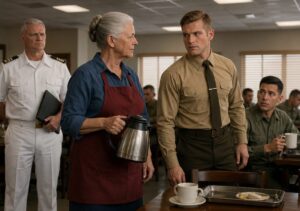
Benjamin’s hand was already wrapped in Ronald’s tie when the tray hit the floor.
Mashed potatoes slid across the gray tile. Gravy spread under the stainless-steel counter. Green beans scattered like loose buttons. Around them, seventy men in training clothes stopped moving at once, their forks halfway to their mouths, their conversations cut clean in half.
Ronald’s back struck the serving line hard enough to rattle the pans.
He did not call for help.
He did not raise his hands.
He only held the long metal spoon at his side and looked at Benjamin like he had been waiting for him to do exactly this.
“Say it again,” Benjamin said.
His voice was low. That made it worse.
Ronald was seventy-two years old, lean as a broom handle, with silver hair cut short and burn scars across the backs of both hands. He wore a white shirt every morning, sleeves pressed, collar buttoned, dark tie pulled tight. No one else in the mess hall dressed that way anymore. He looked like a man trying to keep order by knot alone.
Benjamin’s fist had ruined that order.
The knot was twisted sideways now. The collar had buckled. One of Ronald’s shirt buttons strained under Benjamin’s grip.
A few seconds earlier, Ronald had looked down at Benjamin’s tray and tipped a scoop of potatoes onto it with the careless disgust of a man feeding something under a porch.
Then he had said, loud enough for the line to hear, “Kitchen help in a diving suit.”
Someone behind Benjamin had laughed.
Not loudly. Not bravely.
Just enough.
Benjamin had stood there with the tray in both hands. He was twenty-four, broad-shouldered, close-cropped, and usually still in the way men learned to be still when stillness was the only thing keeping them in the room.
Ronald had dropped green beans on top of the potatoes.
“Careful,” he said. “You spill that, they may put you where you belong.”
That was when the tray fell.
Now Benjamin had the old man pinned against the counter, and every rule in the building seemed to be holding its breath.
“Say it again,” Benjamin repeated.
Ronald’s eyes were pale, dry, and steady. Not frightened. Not even angry in the usual way.
“Take your hand off my tie,” he said.
Benjamin leaned closer.
“You wanted everyone looking.”
Ronald’s jaw worked once.
“They are.”
No one moved.
A young candidate near the milk dispenser lowered his gaze. Another stared openly, waiting for the moment Benjamin’s future ended. A supervisor stepped halfway from the side door, saw Ronald’s lifted finger, and stopped.
That finger was not a plea.
It was an order.
Benjamin noticed it too. His grip tightened.
For the first time, something shifted in Ronald’s face. Not fear. Recognition. A hard little flicker, gone before anyone else could name it.
“You think this makes you a man?” Ronald asked.
Benjamin’s breathing was sharp through his nose.
“No,” he said. “I think you forgot I was one.”
The words landed harder than the tray.
Ronald’s serving spoon scraped the metal pan as his hand lowered. The sound ran through the room like a warning.
Then the side door opened all the way.
Christine stepped in with a folder under one arm and reading glasses pushed up into her hair. She had been a civilian administrator on base long enough to know when a room was quiet because people were listening and when it was quiet because something had already gone too far.
She took in the food on the floor, Benjamin’s fist, Ronald’s ruined collar, and the men watching as if the room had become a trial.
“Let him go,” she said.
Benjamin did not move.
Ronald did not blink.
Christine said it again, softer this time.
“Benjamin.”
That reached him.
He released the tie.
Ronald’s collar stayed crooked. His skin was red where the fabric had pulled. He looked down at the mess on the floor, then at Benjamin’s tray lying upside down near his shoes.
“Get a mop,” Ronald said.
A murmur moved through the room.
Benjamin’s hands curled.
Christine stepped between them before he could answer.
Ronald straightened his tie with two fingers, but the knot would not sit right again.
That was the first thing Christine remembered later.
Not the tray.
Not the insult.
The tie.
No matter how carefully Ronald pulled it back into place, it kept leaning toward the side Benjamin had grabbed.
Part II — Kitchen Duty
By noon, Benjamin was suspended from pool drills.
By three, his file was on Christine’s desk.
By four, everyone had decided what had happened, even the men who had been too far back in line to hear Ronald’s words.
Benjamin had assaulted a seventy-two-year-old mess supervisor.
Ronald had been shoved by a candidate with a temper.
The spilled food had become “disruption.” The tie had become “contact.” The insult had become “an alleged remark.”
Christine hated how fast a report could clean a room.
Ronald sat across from her while she wrote. His shirt was fresh. His tie was replaced. His old one lay folded in his breast pocket, as if he could not bear to throw it away and would not allow anyone else to see it damaged.
“Did you provoke him?” Christine asked.
Ronald looked at the clock.
“That a question for the report?”
“It is.”
“Then write what you saw.”
“I saw the aftermath.”
“Then write that.”
Christine set down her pen.
“I need to know what you said to him.”
Ronald’s mouth tightened.
“Words don’t put a man’s hands on another man.”
“Sometimes words are the match.”
“Sometimes a man who lights fast shouldn’t be near pressure.”
It was the first time his voice changed. Just slightly. The word pressure seemed to come from somewhere older than the room.
Christine heard it and marked nothing down.
Outside her office window, candidates crossed the yard toward evening meal. Benjamin was not among them.
“He says you targeted him,” Christine said.
Ronald’s stare returned to the clock.
“Then he noticed.”
The honesty was ugly enough to stop her.
“You admit that?”
“I admit he was awake.”
Christine leaned back.
“You understand he may be removed from the program.”
“If he quits over a plate of beans,” Ronald said, “he was never going under.”
The sentence should have sounded cruel.
It did sound cruel.
But there was something under it that did not match his face. A heaviness. Not contempt. Not pleasure.
Grief, Christine thought, then rejected the word. Men like Ronald used grief the way they used salt: sparingly, and only after the damage was done.
The decision came down that evening. Benjamin would stay on base until the inquiry ended, but he would not enter the pool. He would report to the mess hall at 0500 and work under Ronald’s supervision.
When Christine told him, Benjamin laughed once.
Not because it was funny.
Because if he did not laugh, something else might come out.
“He does this,” Benjamin said.
“Who?”
“All of you.”
Christine did not defend the room she worked in. She had spent too many years watching polished procedures protect dirty truths.
“I’m still writing the report,” she said.
Benjamin looked toward the mess hall windows. Inside, Ronald was already wiping down the line, one slow pass after another, though the surface had been clean for twenty minutes.
“He called me kitchen help,” Benjamin said. “Now they sent me to the kitchen.”
Christine had no answer clean enough to offer.
The next morning, Ronald handed Benjamin a stack of trays taller than his forearm.
“Rinse, stack, dry. Corners aligned.”
Benjamin took them without a word.
Ronald watched him place the first tray on the drying rack.
“Again.”
Benjamin stopped.
“It’s clean.”
“It’s crooked.”
Benjamin turned his head slowly.
“Are we feeding people or building a church?”
Ronald picked up the tray, set it down with its edges flush against the stack, and tapped the corner twice.
“Order is what keeps small mistakes from becoming last mistakes.”
A candidate at the far table snorted.
Benjamin heard it. Ronald heard it. Neither looked over.
For three hours, Ronald corrected everything.
Sleeves.
Tray angle.
Water left under the coffee urn.
The distance between mop bucket and doorway.
“Somebody trips, you learn,” Ronald said.
Benjamin pushed the mop forward harder.
“You enjoy this?”
Ronald did not look up from the silverware bin.
“Enjoying it would require you to matter to me.”
Benjamin went still.
The mess hall noise shrank.
Ronald kept sorting forks, knives, spoons. Forks, knives, spoons. His scarred hands moved with a precision that seemed too careful for contempt.
Benjamin stepped closer.
“One day your mouth is going to write something your old bones can’t cash.”
Ronald finally looked at him.
“One day your temper is going to give a small man the permission he’s been praying for.”
That landed where Benjamin did not want it to.
He hated Ronald more for being partly right.
At lunch, one of the instructors came through the line with a group from the pool. He tossed a coil knot onto the counter, laughing with another man about a candidate who had tied it wrong.
Ronald glanced at it once.
“Left tail’s short,” he said.
The instructor stopped.
“What?”
Ronald ladled stew into a bowl.
“Left tail’s short. Under load it’ll slip.”
The instructor picked up the knot. His smile thinned.
“You inspecting equipment now?”
“I’m serving stew.”
“Then serve stew.”
Ronald did.
But Benjamin had seen the knot.
He had also seen the instructor quietly take it apart before leaving the room.
That afternoon, a metal oxygen wrench slipped from a trainee’s hand near the side entrance. It hit the floor with a bright, ringing clatter.
Ronald spun so fast he knocked over a stack of cups.
For one second, he was not old.
For one second, his body knew exactly where danger was.
Then the moment passed. He bent to pick up the cups. His breathing had changed.
Benjamin saw his hands trembling.
Ronald saw Benjamin seeing.
“Clean your station,” he said.
Benjamin almost asked.
He didn’t.
Not yet.
Part III — The Sound From the Pool
Christine began with Ronald’s service record because records were supposed to be boring.
His was too boring.
Retired cook. No distinguished citations. No diving certification. No command assignment. No disciplinary action. Long service, clean exit, civilian contractor rehire. A life reduced to meals prepared, shifts completed, forms signed.
It did not explain the knot.
It did not explain the wrench.
It did not explain why the pool instructors spoke to Ronald as if he were furniture but watched him when equipment failed.
Two days later, Christine found Ronald at his locker.
The door was half open.
Inside was a spare shirt, a tin of shoe polish, a folded towel, and an old brass name tag turned face down on the top shelf.
Ronald shut the door before she could read it.
“You need something?” he asked.
“You ever work with dive systems?”
“No.”
“You answered fast.”
“I knew the question.”
“You corrected an instructor’s knot.”
“Knots aren’t classified.”
“You knew decompression timing in yesterday’s report meeting.”
“I listen.”
Christine held his gaze.
Ronald’s eyes moved past her, toward the training pool building across the yard.
“You listen too,” he said. “That’s your trouble.”
Before she could answer, the compressor tone from the pool changed.
It was faint through the walls. A low mechanical pulse most people would have mistaken for air conditioning.
Ronald did not.
His face emptied.
Then he ran.
Christine had never seen him run. His limp vanished for ten yards, then came back hard, but he kept moving across the yard toward the pool building.
“Ronald!” she called.
He did not stop.
Inside, the pool deck was chaos.
A blackout drill was underway. The overhead lights were off, emergency lamps glowing red along the walls. Candidates were supposed to work by touch and signal. In the deep end, Benjamin was under.
The supervising instructor stood near the control station, angry more than afraid.
“He’s fighting the drill,” he snapped. “Let him solve it.”
Ronald shoved past two men.
“He’s not fighting it.”
Everyone turned.
The instructor’s face hardened.
“You don’t belong on this deck.”
Ronald was listening to the compressor.
The sound coughed again.
“Switch his line.”
The instructor stepped toward him.
“Get out.”
“Switch his line now.”
“He missed a signal.”
“He’s breathing dead air.”
That sentence changed the room.
The instructor looked at the gauges. A younger technician froze.
Ronald pointed, his voice sharp enough to cut through the red-lit panic.
“Secondary line. Left manifold. Not the right. The right’s where it’s failing.”
Nobody moved for half a second.
Ronald’s fist struck the metal rail.
“Do it!”
The technician moved.
Underwater, Benjamin’s body jerked once as the new line took. Two men hauled him toward the surface. He came up coughing, furious, alive.
The room flooded with sound.
Orders. Footsteps. Water slapping tile.
Ronald stepped back before anyone could thank him. His face had gone gray. The instructor stared at him with a hatred too focused to be new.
Benjamin sat on the pool edge, breathing through clenched teeth, water running from his chin.
His eyes found Ronald.
For the first time since the mess hall, he looked at the old man without anger leading the way.
Ronald turned and walked out.
Christine followed him.
She found him in the mess hall fifteen minutes later, standing at the sink with both hands under water so hot steam rose around his wrists.
His knuckles were red.
“Ronald,” she said.
He scrubbed harder.
“You knew.”
No answer.
“You knew before anyone in that room.”
The water ran pink where old skin had opened.
Christine reached past him and turned off the tap.
Ronald’s hands stayed under the silent faucet.
“Leave it,” he said.
“Benjamin could have died.”
His eyes closed.
“Men do.”
“Not because a man who knows better stays quiet.”
That got him.
He looked at her, and for once there was no clean line in his face. No discipline. No cold old authority. Only a tiredness that made him seem older than seventy-two.
Then Benjamin’s voice came from the doorway.
“Why?”
Ronald straightened.
Benjamin stood barefoot in pool sandals, a towel around his shoulders, his hair still wet. He looked smaller without the training gear. Or maybe the near miss had pulled something human through the anger.
“You save me if you hate me?” Benjamin asked.
Ronald reached for a towel and dried his hands slowly.
“I don’t hate you.”
Benjamin stepped inside.
“Could’ve fooled me.”
Ronald folded the towel once. Twice.
“I hate what they’ll do to you if you need them to be fair.”
The words hung between them.
Benjamin stared.
Then his face changed.
“That’s what you call it?”
Ronald said nothing.
“You think you’re helping me by treating me like dirt before they do?”
Christine started to speak, but Benjamin lifted a hand without looking at her.
“No. Let him answer.”
Ronald’s jaw tightened.
“Underwater, pride is just another way to drown.”
Benjamin moved closer.
“Living without it is another way to die.”
For a moment, Ronald’s hand rose.
Not high. Not fully.
Just enough that everyone in the room knew what it might have become.
Then he stopped himself.
The hand dropped.
And in that drop, Benjamin saw something he had not wanted to see.
The old man was not calm.
He was contained.
There was a difference.
Ronald turned away first.
“Dry the floor,” he said.
Benjamin looked at the clean tile, then at him.
“You’re scared,” he said.
Ronald’s shoulders went rigid.
Benjamin’s voice lowered.
“Not of me. Of seeing it happen again.”
Ronald did not turn back.
But Christine saw his hand close around the edge of the sink until the scarred skin went white.
Part IV — The Photograph in the Old File
Christine found the photograph in a newsletter archive no one had opened in eleven years.
It was folded into a brittle page about a training class from three decades earlier. Most of the article was routine: names, dates, achievement language polished flat. But the photo was not flat.
Six young men stood by the pool, grinning into hard sun.
One of them was Ronald.
Younger, yes. Dark-haired. Narrower in the face. But unmistakable.
He was not wearing a cook’s apron. He stood in a patched training suit, one hand resting on a helmet beside him. His smile was small, as if someone had caught him before he could hide it.
Beside him stood Andrew.
Christine knew the name from one line in an old incident file: candidate experienced panic response during recovery exercise.
That was all the official record had given him.
A panic response.
Two words to hold a whole life down.
Andrew in the photograph did not look like panic. He looked bright, open, impatient for the world to prove him right. His sleeves were rolled. His grin was too wide. His shoulder leaned slightly toward Ronald, not by accident.
On the back of the photo, in faded pen, someone had written:
He said we would both make it.
Christine took the photo to Ronald after evening meal.
He was alone, resetting chairs that were already straight.
She placed it on the table.
He saw it and went still.
Not surprised.
Caught.
“Where did you get that?” he asked.
“You tell me first.”
Ronald did not touch the photograph.
Christine waited.
The mess hall lights buzzed overhead. Outside, the last candidates crossed the yard, their shadows stretching long against the windows.
Finally Ronald sat.
His hands rested on either side of the photograph, as if it were hot.
“I was assigned to food service,” he said.
“That isn’t what I asked.”
“I know.”
The words came slowly after that, each one pulled from a place that had rusted shut.
He had been a cook on paper. In practice, he had fixed lines, checked valves, cleaned masks, hauled tanks, stayed late. The divers had laughed at first. Then they had started asking him questions. Andrew had asked the most.
Andrew had been fast. Strong. Too hopeful, Ronald said, though his voice changed on that word.
They trained after hours. Quietly. Unofficially.
Ronald learned the systems because no one told him he could not learn what he was already touching every day.
Then came the recovery exercise.
A valve assembly had been wrong. Ronald had warned them. Not loudly enough, he said. Or maybe loudly, but from the wrong mouth. The officers heard “cook” before they heard “failure.”
Andrew went under.
Andrew did not come back the same.
The official line was panic.
Ronald signed a statement that left out the warning, the valve, the argument, the thirty seconds when everyone on deck had known the truth and waited for someone else to say it first.
Christine did not interrupt.
Ronald’s eyes stayed on the photograph.
“They told me I could lose everything,” he said. “Pension. discharge. reputation. They said a cook accusing officers would not save a dead man.”
His mouth twisted at the last two words.
“So you signed,” Christine said.
Ronald nodded once.
“I signed.”
The room seemed to dim around the confession.
Christine looked at the old man’s hands. They were steady now. That was worse than trembling.
“Benjamin deserves to know,” she said.
“He deserves to pass.”
“He deserves both.”
Ronald looked up at her.
“Nobody believes an old cook with a bad memory and a worse temper.”
“I do.”
“You’re not the board.”
“No,” Christine said. “But I can get you in front of them.”
He laughed without sound.
“That what you think this is? A correction?”
Christine slid the photograph closer.
“I think this is the first time you’ve had the chance to say his name where it counts.”
Ronald’s face hardened.
But his eyes betrayed him.
The next day, Benjamin was reinstated for his final qualification drill.
The decision came fast, almost too fast. Christine knew why before she heard it from the hallway: the instructor wanted the problem buried under a clean failure. If Benjamin failed, the pool incident became candidate weakness. Ronald’s interference became an old man’s disturbance. The inquiry could close itself.
Ronald heard enough from the service corridor.
Not all of it.
Enough.
Benjamin arrived at the mess hall before the drill, dressed for the pool, jaw tight enough to ache.
Ronald was polishing the serving line.
“You’ll want your hands quick,” Ronald said.
Benjamin stopped.
“I don’t need anything from you.”
“Yes, you do.”
Benjamin almost kept walking.
Ronald set down the cloth.
“When they try to make you look desperate,” he said, “slow your hands.”
Benjamin stared at him.
The advice was not warm.
It was better than warm.
It was useful.
“You think they’ll try?”
Ronald looked toward the pool building.
“I think men who need a lie will create a room where the truth looks disorderly.”
Benjamin absorbed that.
“Is that what happened to Andrew?”
Ronald did not ask how he knew.
Christine must have told him something. Or maybe the photograph had found its own way through the base. Truth did that sometimes when people stopped sitting on it.
Ronald picked up the cloth again.
“Andrew was better than me.”
Benjamin waited.
Ronald’s voice lowered.
“And I let them make him smaller after he was gone.”
Benjamin’s anger did not leave. It changed shape.
“You don’t get to make me pay for that.”
“No,” Ronald said.
The word was quiet.
“No, I don’t.”
It was the closest thing to an apology Benjamin had heard from him.
It was not enough.
But it was something with weight.
Part V — The Tie on the Table
The final evaluation room was smaller than the mess hall, but the silence felt familiar.
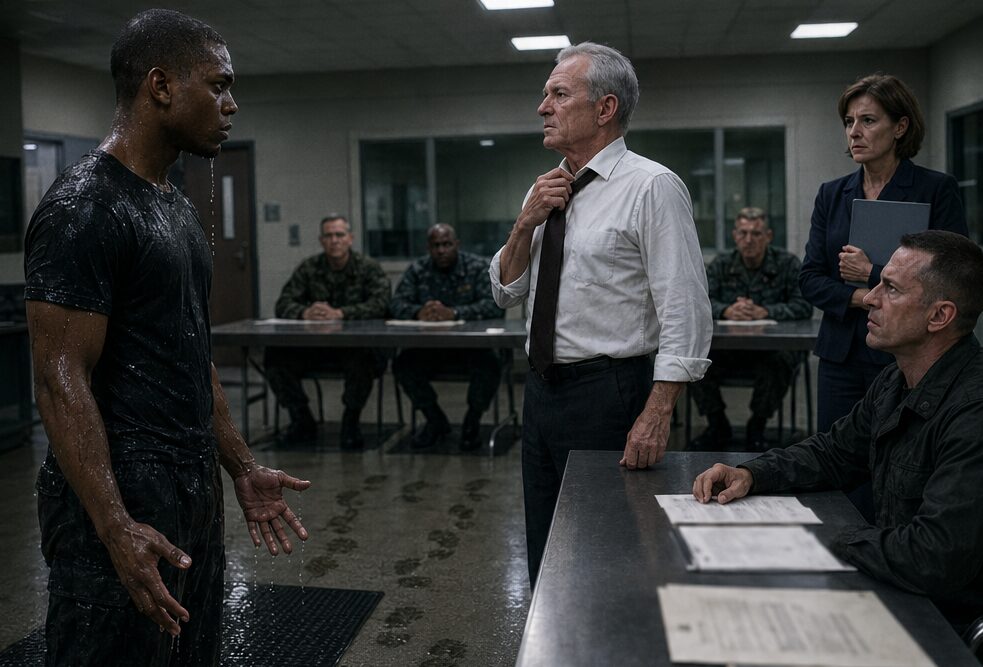
Three board members sat behind a long table. Christine stood near the wall with her folder. Ronald remained by the door because no one had invited him farther in. He wore his white shirt and dark tie. The knot was tight enough to look painful.
Benjamin stood dripping on a rubber mat, breathing hard but controlled.
He had completed the drill.
Everyone in the room knew it.
The instructor who had marked his board did not look at him when he spoke.
“Candidate hesitated during the second-stage exchange.”
Benjamin’s hands twitched at his sides.
Ronald saw it.
Slow your hands.
Benjamin closed his fingers once, then opened them.
The instructor continued.
“Candidate required extended time to regain rhythm after interruption.”
Christine looked down at her copy.
“That is not reflected in the timing log.”
The instructor smiled without warmth.
“Logs don’t capture everything.”
Benjamin’s face sharpened.
There it was.
The room they had built for him.
A room where anger would look like proof.
“Are you failing him?” Christine asked.
“We are noting deficiencies.”
“Are you failing him?”
The instructor leaned back.
“Based on performance and temperament, I recommend removal from the program.”
Benjamin took one step forward.
Not far.
Enough.
Every eye moved to him.
Ronald’s hand went to his tie.
He remembered another room. Another table. Men deciding what a dead man had been. Panic response. Candidate error. Personal weakness.
Two words could bury a life if the right people signed beneath them.
Benjamin’s chest rose and fell.
His hands stayed open.
Ronald stepped away from the door.
“His hands were slow because they were correct,” he said.
The instructor turned.
“You have no standing here.”
Ronald kept walking until he reached the table.
“No,” he said. “I know.”
The board members shifted. One of them frowned as if trying to place him and not liking that he could not.
Ronald reached up.
He loosened his tie.
The room watched him pull the knot down, unthread it from his collar, and lay it flat on the table.
It looked smaller there.
Just cloth.
Just the thing he had hidden behind for years.
“The second-stage exchange was delayed because the signal line was fouled at the left-side junction,” Ronald said. “Candidate corrected without surfacing. He did not hesitate. He diagnosed.”
The instructor’s face darkened.
“You were not on the deck for the full drill.”
“I heard the compressor load change when the reserve kicked wrong.”
One board member looked up.
“You heard that from outside?”
“Yes.”
The room did not laugh.
Ronald continued before anyone could stop him.
“The same failure pattern occurred in an exercise thirty-one years ago. Faulty valve assembly. Wrong maintenance signoff. Candidate Andrew was blamed for panic after he was given bad air and a bad record.”
The instructor stood.
“That incident is closed.”
Ronald looked at him.
“So was my mouth.”
Christine’s fingers tightened around her folder.
Benjamin did not move.
Ronald’s voice remained even. That made it harder to bear.
“I reported the valve before the exercise. I was assigned to food service. They said I was outside my duties. Afterward, they asked me to sign a statement that did not include what I saw. I signed it.”
No one interrupted now.
“I signed it because I was afraid.”
The sentence exposed him more completely than the loosened collar.
“I told myself a dead man would stay dead either way. I told myself a pension mattered to the living. I told myself discipline meant silence.”
He looked at Benjamin then.
Only once.
“I was wrong.”
The words did not clean anything.
They did not bring Andrew back. They did not erase the food on Benjamin’s tray or the old man’s cruelty or the years of a false file sitting in a cabinet with the lights off.
But they entered the room.
And no one could pretend they had not.
The board chair cleared his throat.
“Mr. Ronald, this is a serious allegation.”
“Yes.”
“You understand what you’re admitting?”
Ronald touched the edge of the tie on the table.
“For once.”
Christine stepped forward and placed the photograph beside it.
The younger Ronald. The smiling Andrew. The training suit. The proof that the old cook had once stood closer to the water than anyone wanted remembered.
Benjamin looked at the photograph.
Then at Ronald.
For the first time, he saw the old man’s cruelty and grief standing in the same body.
He still did not forgive him.
But he understood the shape of the wound.
The board did not pass Benjamin that afternoon.
They did not fail him either.
They ordered a repeat evaluation under another instructor.
It was an ugly kind of mercy.
On that base, it was almost a miracle.
Part VI — What Stayed Behind
Benjamin passed two days later.
There was no announcement in the mess hall. No applause. No grand correction. Men found out the way men find out things in places built on silence: a look in the corridor, a file moved from one stack to another, a name not crossed off the board.
Ronald was removed from mess duty pending review.
Some candidates avoided looking at him.
One older chief nodded once as Ronald passed, then seemed embarrassed by his own respect.
Christine came to the empty mess hall near closing with a thin folder in her hand.
Ronald sat alone at the table closest to the serving line. He was not wearing his tie. Without it, his neck looked older. More human.
She placed the folder in front of him.
He did not open it.
“What is it?” he asked.
“Andrew’s file.”
Ronald looked at her.
Christine kept her hand on the folder a moment longer.
“They amended the language.”
His face did not change.
“Amended.”
“It no longer says panic response.”
That was all.
Not justice. Not enough. Not clean.
But the lie had lost two words.
Ronald opened the folder after she left.
The new language was careful, cold, and incomplete. It did not confess everything. It did not accuse the men who had deserved accusation. It did not know Andrew’s laugh or the way he rolled his sleeves or how he once said they would both make it.
But it no longer made him small.
Ronald sat with the page until the evening light faded from the windows.
Then he stood, folded the file closed, and began cleaning the floor.
He started where the tray had fallen.
The tile was already clean. It had been clean for days. Still, he filled a bucket, wrung the mop, and worked the same square slowly.
The side door opened.
Benjamin entered in a plain shirt, hair still damp from the showers, qualification patch not yet sewn anywhere. He stood there for a while, watching the old man drag the mop across a spotless floor.
Ronald did not look up.
“You passed,” he said.
“Yes.”
“Good.”
“That all?”
Ronald wrung the mop.
“What else should there be?”
Benjamin came closer.
An apology waited between them. Maybe two. Neither one reached for it.
Benjamin looked at the serving line, at the trays stacked in perfect order, at the empty pans waiting for morning.
“You still think pride makes a man drown?”
Ronald leaned on the mop handle.
“I think I used the word wrong.”
Benjamin nodded once.
Then he picked up a serving spoon from the counter and set it in its place.
Ronald watched him.
Benjamin adjusted another spoon, lining it up with the first.
“Corners aligned,” he said.
Ronald’s mouth moved almost into a smile.
Almost.
Together, they reset the line for breakfast.
No one saluted. No one watched. No one said Andrew’s name out loud. The amended file sat closed on the table, holding what little the institution had been forced to give back.
When they were done, Ronald reached for the dark tie lying beside the register.
He held it for a moment.
Then he folded it once and left it there.
Benjamin saw.
He did not comment.
Ronald walked toward the door with his collar open.
At the threshold, he stopped and looked back at the empty mess hall: the polished floor, the stainless-steel line, the table where the folder rested in the last of the light.
For thirty-one years, he had thought surviving meant keeping his head down and his knot tight.
That night, he left both undone.
And the room, finally, did not feel silent because men were afraid to speak.
It felt silent because something true had been allowed to remain.