The Sign He Kept Putting Back Where Everyone Could See It
Part I — The Sign on the Floor
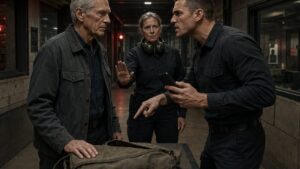
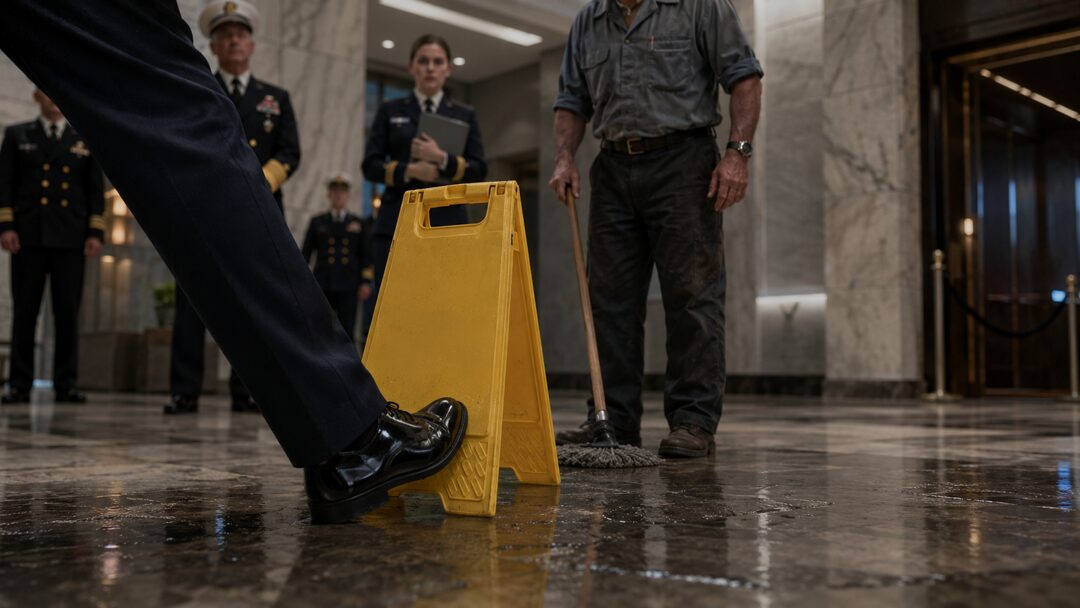
Commander Daniel Price kicked the yellow caution sign before anyone could pretend it was an accident.
It skidded across the polished lobby floor of the Atlantic Readiness Center, spun once near the security desk, and came to rest against the marble wall with its little black stick figure still falling forever.
The old janitor looked at it.
Then he looked at the wet streak his mop had left under Daniel’s polished shoes.
He did not speak.
That silence bothered Daniel more than protest would have.
“Are you serious?” Daniel snapped, loud enough for the junior officers behind him to hear. “Tonight of all nights?”
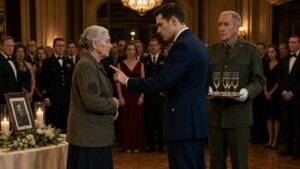
The lobby froze in the way military buildings froze. No one gasped. No one stepped forward. Men and women in pressed uniforms became suddenly busy with folders, phones, badges, invisible lint on sleeves.
The janitor stood with both hands on the mop handle. He was lean and gray-haired, maybe late sixties, wearing a faded work shirt with HAYES stitched above the pocket. His rubber-soled shoes were dull. His hands were steady. His face had the weathered patience of someone who had spent years being looked through.
Daniel pointed at the wet floor.
“We have an admiral coming through this entrance in less than an hour, and you’re turning it into a bus station.”
The janitor bent, picked up the sign, and walked it back to the wet patch.
His movements were slow, not weak. Careful.
Daniel read it as defiance.
“Did you hear me?”
“Yes, Commander,” the janitor said.
His voice was quiet. Flat. Not submissive enough to satisfy Daniel, not challenging enough to punish.
Behind Daniel, Lieutenant Sarah Mitchell shifted her clipboard from one hand to the other. She had been assigned to inspection prep three weeks earlier and had learned quickly that Daniel Price wanted silence before he wanted accuracy.
She looked at the old man’s face, then away.
That was the first thing she would hate herself for later.
Daniel took one step closer to the janitor. His dress blues looked carved onto him. His shoes reflected the ceiling lights. He was forty-two, sharp-jawed, clipped, immaculate, the kind of officer who made people stand straighter before they knew why.
“What’s your name?” he asked, though the patch was visible.
“Robert Hayes.”
“Mr. Hayes,” Daniel said, drawing the “Mr.” out like it was a demotion, “you will finish this floor, remove your equipment from sight, and stay out of the central corridor until the inspection is complete. Is that clear?”
Robert glanced once toward the long hallway past the lobby, where a locked access door bore a red sign: RESTRICTED.
Then he looked back at the wet floor.
“I was told to clean that hallway every Friday night.”
“It’s restricted.”
“Yes.”
“You’re a civilian.”
Robert’s hands tightened almost invisibly around the mop handle.
“Yes,” he said.
Daniel smiled without warmth. “Then behave like one.”
The sentence landed harder than the kick.
Sarah felt it. So did everyone else pretending not to listen.
Robert only lowered the mop back into the bucket. The wheels squeaked when he shifted it aside.
Daniel turned to his staff. “Where are the final inspection packets?”
Sarah held up a folder. “Here, sir.”
“Good. Walk with me.”
He strode toward the command wing, then stopped when he heard the caution sign scrape behind him.
Robert had placed it back exactly where it belonged.
Daniel turned.
Their eyes met.
For one strange second, Sarah saw Daniel’s authority bounce off the old man and fall uselessly to the floor.
Robert did not glare. He did not smirk. He simply stood there, quiet and tired, as if Daniel had arrived late to a conversation that had been happening for years.
Daniel looked away first.
“Keep him out of the corridor,” he told Sarah.
Then he walked on.
Sarah followed, but before the lobby doors swallowed her, she glanced back.
Robert was mopping again.
The yellow sign stood beside him, bright and ugly and honest.
Part II — A Building That Remembered
The Atlantic Readiness Center had been built to impress visitors.
Glass walls. Flag displays. Polished stone. Brass plaques. Wide corridors that made footsteps sound official.
Daniel loved that about it.
He loved buildings that obeyed.
Tonight, the building would not.
The storm came in from the coast just after 2100. Rain struck the glass in hard diagonal lines. Wind pressed low against the doors. Somewhere above the command wing, a power relay clicked, failed, clicked again, and left half the eastern corridor under dim emergency light.
Daniel’s jaw tightened with every small failure.
A printer jammed outside the briefing room.
A junior ensign misplaced the seating chart.
The coffee urn leaked onto a credenza.
Someone from maintenance had left a bucket near a restricted door.
Robert Hayes was always near the problem, and never seemed to be causing it.
That irritated Daniel too.
He saw the janitor wiping fingerprints from the lobby glass. Emptying trash from the conference alcove. Straightening a runner carpet that kept curling near the entrance. Each time Daniel passed, Robert stepped aside with the same maddening calm.
Not slow enough to be insubordinate.
Not quick enough to look afraid.
Sarah noticed other things.
Robert checked the floor drain near the restricted corridor twice.
He paused under a flickering panel as if listening.
He moved the caution sign back into place after a petty officer nudged it with a cart.
When the lights dipped, everyone looked up.
Robert looked down.
At 2135, Daniel found him mopping a narrow stretch outside the restricted corridor.
“I thought I gave an order,” Daniel said.
Robert stopped.
Sarah was beside Daniel with the updated inspection packet tucked under one arm. Two junior officers stood behind them, holding tablets and trying not to exist.
“The hallway was assigned to me,” Robert said.
“By whom?”
“Facilities.”
“Facilities does not outrank me.”
“No, Commander.”
Daniel stepped toward the door. “Do you have access credentials?”
Robert lifted a key ring from his belt. A plain brass key hung among others, worn smooth from use.
Daniel’s eyes narrowed. “Who gave you that?”
Robert looked at the key as if it had become heavier.
“A long time ago.”
“That is not an answer.”
“It’s the only one I have.”
Sarah looked at him then. Really looked.
The old man’s face had changed. Not much. Just enough. His eyes had gone fixed on the red restricted sign, and for a moment he seemed less like a janitor who had wandered somewhere inconvenient and more like someone standing outside a room he had never left.
Daniel held out his hand. “Key.”
Robert did not move.
The air hardened.
Sarah felt it before anyone spoke. There were moments in chain-of-command life when a room decided who had power before anyone issued a formal order. Daniel expected the key to appear in his palm. Everyone expected Robert to give it.
Robert only said, “You don’t want that door opened tonight.”
Daniel’s face flushed.
“Excuse me?”
“There’s water behind it.”
Daniel looked at the dry floor, then at Sarah, as if inviting her to witness stupidity.
“There is no water.”
“Not yet.”
The junior officers exchanged a glance.
Daniel saw it.
That made it worse.
“Mr. Hayes, if I find you in this hallway again, I’ll have security escort you out before the admiral sets foot in this building.”
Robert nodded once.
Then he bent, lifted his bucket, and wheeled it away.
No apology.
No explanation.
Only the soft squeal of wheels crossing polished stone.
Daniel turned to Sarah. “Make a note. Maintenance access review.”
Sarah wrote the words.
Her hand felt wrong doing it.
“Lieutenant,” Daniel said.
“Yes, sir.”
“You looked like you had a question.”
She closed the notebook. “No, sir.”
He studied her a moment too long. “Good. Questions waste time when the answers are obvious.”
Sarah had heard officers say worse things. She had survived them by building a private room inside herself where her opinions could sit quietly until they were safe.
But as Robert disappeared around the corner, she wondered if decency kept in a private room counted for anything at all.
The building groaned under the weather.
Somewhere behind the restricted door, something dripped.
Part III — The Names Behind the Glass
Sarah found Robert ten minutes later in a corridor no one used during tours.
She had not meant to follow him.
That was what she told herself.
She had gone looking for the revised seating chart, then for the petty officer who had taken the wrong binder, then for a quiet place to breathe without Daniel Price’s voice filling the walls.
Instead she found the old janitor standing in front of a memorial plaque half-hidden beside a storage alcove.
It was bronze, but not the kind visitors saw. No spotlight. No fresh flowers. No framed explanation.
Just names.
Eight of them.
Below them: SERVICE INCIDENT — 22 YEARS PRIOR.
One name near the bottom had been rubbed so often that the letters had lost their edges. Not erased. Not preserved either. Damaged by attention.
Robert stood with the mop beside him, both hands folded over the handle.
Sarah should have left.
She did not.
“Mr. Hayes?”
He did not startle.
That unsettled her.
He said, “Lieutenant.”
“You knew they were coming early?”
“No.”
“You just don’t scare easily?”
A faint breath moved through him. Almost a laugh. Almost not.
“I scare fine.”
Sarah stepped closer to the plaque. “I’ve walked this corridor for weeks. I never noticed this.”
“Most people don’t.”
“Did you know them?”
Robert’s gaze stayed on the scratched name.
“I cleaned up after them.”
The words were simple enough. A janitor’s answer. A man’s job.
But Sarah felt the hallway change around them.
“You mean after the incident?”
Robert looked at her then.
His eyes were pale gray, tired at the edges, and sharper than she expected.
“I mean after everyone left.”
Before Sarah could ask what that meant, Daniel’s voice cut down the corridor.
“Lieutenant Mitchell.”
Her spine straightened.
Daniel stood at the far end, inspection binder under one arm. He looked from Sarah to Robert, then to the plaque.
His expression cooled into something harder than anger.
“Is there a reason you’re holding a private conference with maintenance?”
Sarah felt heat rise in her neck. “No, sir. I was checking the corridor.”
“Were you?”
“Yes, sir.”
Daniel walked toward them. Every step clicked.
Robert lowered his eyes, not in fear but in refusal.
Daniel stopped close enough that Sarah could smell rain on his coat.
“You’re assigned to inspection prep,” he told her. “Not nostalgia.”
“Yes, sir.”
“And you.” He turned to Robert. “I’m done being patient.”
Robert said nothing.
That silence again.
Daniel hated it so much his voice dropped.
“Do you think this place owes you something?”
Robert’s fingers shifted on the mop handle.
Sarah saw it. Daniel did not.
“No,” Robert said.
“Good.”
“I think places remember what people ask them to forget.”
The line landed too quietly to be a challenge and too clearly to be ignored.
Daniel stared at him.
For the first time that night, Sarah saw uncertainty touch his face.
Not fear.
Recognition’s younger brother.
Then it was gone.
“You have ten minutes to clear your supplies from every visible corridor,” Daniel said. “If I see that bucket again, you leave.”
Robert nodded.
Daniel turned away, but Sarah did not move fast enough.
He stopped beside her.
“This inspection determines more than whether the floors shine, Lieutenant,” he said under his breath. “There are officers in this building who understand that.”
The meaning was obvious.
His promotion was in the room. Maybe his future command. Maybe the life he believed he had earned one polished surface at a time.
Sarah looked at Robert’s work shirt. HAYES.
Then at Daniel’s ribbons.
Then at the plaque.
Eight names, one worn almost smooth.
“Yes, sir,” she said.
Daniel walked off.
Sarah followed after a second, but the question had already lodged in her.
Why would a janitor have a key to a restricted corridor?
And why had Daniel Price looked at that plaque like it had spoken first?
Part IV — What the Floor Would Not Hide
By 2207, the storm had found the building’s weak places.
Rainwater pushed through some seam above the eastern corridor and gathered behind the restricted door. At first it was a dark line under the threshold. Then a shine. Then a thin spill sliding toward the polished stone.
Robert saw it before the alarms did.
He was wringing out his mop near the service alcove when the first thread of water reached the corridor light. He crossed to the drain, crouched, and removed the grate with a flathead screwdriver from his pocket.
Lint. Wax buildup. A broken plastic corner from some old cleaning cap.
He cleared it with two fingers, wiped them on a rag, and listened.
The drain gurgled once.
Not enough.
Footsteps came fast from the command wing.
Daniel appeared with three inspection folders tucked under his arm, walking while talking into a phone.
“No, Admiral Whitaker is not waiting in the rain because our lobby isn’t ready. Have the west entrance cleared. Now.”
Sarah followed him, half a step behind.
“Sir,” she said, “the eastern corridor—”
Daniel waved her off.
Robert stood. “Commander.”
Daniel kept moving.
“Commander,” Robert said again, sharper.
Daniel turned his head just as his right shoe hit the water.
His foot slid.
The folders flew.
His shoulder tilted toward the glass case beside the corridor, where old navigation instruments rested under museum lights.
Robert moved faster than Sarah thought he could.
He caught Daniel by the upper arm and pulled him back before his shoulder hit the glass.
For one second, Daniel clutched Robert’s sleeve.
Not as an officer.
As a man afraid of falling.
Then his face changed.
He shoved Robert’s hand away.
“Do not touch me.”
The corridor went silent.
Sarah bent to gather the folders. Her own hands were shaking.
Robert looked at Daniel’s wet shoe, then at the spreading water.
“You need to close this corridor.”
“I need,” Daniel said, voice low, “for you to stop appearing in places you were ordered not to be.”
“The drain is blocked.”
“The drain is not your concern.”
“It becomes everyone’s concern when someone falls.”
Daniel stepped closer. “You think saving me from embarrassment buys you authority?”
Robert’s eyes lifted.
“No.”
“Then what do you think it buys you?”
Robert looked toward the memorial plaque, visible down the corridor in the dim emergency light.
“Nothing I haven’t already paid for.”
Sarah stopped gathering papers.
Daniel heard it too.
His anger sharpened into something defensive.
“Security,” he called.
A petty officer near the lobby turned.
Daniel did not take his eyes off Robert. “Escort Mr. Hayes out of the building.”
Sarah stood. “Sir, he identified a hazard.”
Daniel snapped toward her. “Lieutenant.”
The warning in his voice was clear enough to end her career in miniature.
She closed her mouth.
Robert watched her do it.
Not disappointed.
That made it worse.
Two security staff approached.
Robert did not resist. He bent first and picked up the yellow caution sign from where it leaned against the wall. He set it in the center of the wet area.
Daniel laughed once, bitterly.
“Still performing?”
Robert straightened.
Then, in front of Sarah, the junior officers, the security staff, and the leaking corridor, he said, “Daniel Price. Son of Captain William Price.”
Daniel went still.
The sound of the storm filled the space he left behind.
Robert continued, not loudly. “Operation North Lantern.”
Daniel’s face drained so slowly it looked like discipline.
Sarah had never heard the phrase before.
But Daniel had.
His mouth opened, then closed.
Robert did not accuse him. Did not explain. Did not even look triumphant.
He simply knew.
And knowledge, in that moment, outranked Daniel’s uniform.
“Get him out,” Daniel said.
But the order no longer sounded clean.
It sounded scared.
Part V — The Name in the Archive
Sarah broke three rules in eight minutes.
She left her assigned post.
She used an archive terminal without direct authorization.
And she searched a phrase Daniel Price clearly wanted buried.
Operation North Lantern.
The old system was slow. The screen blinked twice before returning a restricted incident summary from twenty-two years earlier.
Most of it was sealed.
Enough was not.
A training vessel. Severe mechanical failure during a coastal readiness exercise. Flooding in a lower compartment. Command decision to seal a hatch to preserve the ship. Casualties. Commendations. Procedural review.
Captain William Price: praised for decisive action under extreme pressure.
Chief Petty Officer Robert Hayes: cited for unauthorized deviation from containment order.
Sarah read the line three times.
Unauthorized deviation.
Then she found a supplemental personnel note buried under an old commendations file.
Chief Petty Officer Robert Hayes credited by surviving crew testimony with extracting three personnel from compromised compartment prior to final seal.
Her mouth went dry.
Three personnel.
Unauthorized deviation.
She clicked another file.
A scanned newspaper clipping loaded crooked on the screen. The headline was bland. The photo was not.
Robert Hayes, twenty-two years younger, stood in dress uniform beside three sailors in hospital robes. His hair was dark then, his face leaner, but the eyes were the same. Tired already. Holding back more than the camera could ask.
Beside the photo, one sentence had been highlighted by someone long ago:
Hayes declined to comment on the inquiry, stating only that “voices carry through steel.”
Sarah sat back.
For a second, she heard the building differently.
Not as stone and glass and authority.
As metal. Doors. Orders. Men knocking.
Her phone buzzed.
DANIEL PRICE: Where are you?
Then another message.
DANIEL PRICE: Admiral arrived early. Lobby. Now.
Sarah looked once more at the screen.
The worn name on the plaque had not been erased.
It had been cleaned too often by a man who could not stop returning to it.
She printed nothing. Took no photo. There was no time. She wrote three lines in her notebook with a hand that no longer shook.
Operation North Lantern.
Chief Petty Officer Robert Hayes.
Three survivors.
When she reached the lobby, Admiral James Whitaker had already entered.
He stood near the main doors with rain darkening the shoulders of his coat. Silver hair. Heavy eyes. The kind of quiet that made louder men sound temporary.
Daniel stood beside him, smiling with controlled force.
“Admiral, we had a minor maintenance issue in the east corridor, but it’s been handled.”
Robert stood near the security desk between two guards, his mop bucket beside him like evidence of a lesser life.
The yellow caution sign remained in the corridor.
Visible from the lobby.
Daniel saw Sarah enter and gave her a look that ordered her back into obedience.
For the first time that night, she did not answer it.
Admiral Whitaker’s gaze moved over the lobby. The polished floor. The officers. The janitor. The sign in the distance.
“Handled?” he asked.
“Yes, Admiral,” Daniel said. “The area will be cleared before the walk-through.”
Robert looked down.
Sarah saw his jaw tighten.
Not in anger.
In exhaustion.
She understood then that silence had a cost even when it looked dignified.
Daniel gestured toward the central hall. “If you’ll follow me, sir, we’ll begin with the operations briefing.”
The admiral nodded.
They moved as a group.
Daniel led.
Whitaker followed.
Sarah walked behind them with her notebook pressed to her side.
Robert remained where security had placed him.
Until the corridor lights flickered.
Once.
Twice.
Then water slid under the restricted door in a fresh sheet, wider now, catching the overhead light like glass.
The yellow sign stood directly in front of it.
Daniel stopped.
Everyone stopped.
For one second, no one spoke.
Then Daniel walked toward the sign.
Sarah knew what he was going to do before he did it.
He was going to move the ugly thing out of the admiral’s sight.
He was going to clear the appearance before he fixed the danger.
His hand reached down.
Robert’s voice came from behind them.
“Leave the warning where people can see it, Commander.”
No one breathed.
Daniel’s hand froze inches from the sign.
The line was not loud.
It did not need to be.
It filled the corridor because it named something larger than water.
Daniel slowly turned. “Mr. Hayes, you are done here.”
“No,” Sarah said.
Her own voice startled her.
Daniel stared at her.
Sarah stepped forward. Every part of her body wanted to retreat, but she opened her notebook.
“The corridor is unsafe, sir. Mr. Hayes identified the drain issue before the leak spread. He should not be removed for reporting a hazard.”
Daniel’s eyes hardened. “Lieutenant, this is not the time.”
“It is exactly the time,” she said.
The admiral turned toward her.
Sarah’s throat tightened, but she kept going.
“There is also an incident record connected to this corridor. Operation North Lantern. Chief Petty Officer Robert Hayes was cited in the report.”
The name changed the air.
Chief Petty Officer.
Robert closed his eyes.
Only for a moment.
Admiral Whitaker looked at him more carefully.
At the work shirt. The gray hair. The old wristwatch. The hands wrapped around nothing now, because the mop stood behind him.
“Hayes,” the admiral said.
It was not a question.
Robert opened his eyes.
“Admiral.”
Whitaker took one step closer. “Robert Hayes?”
Robert gave a small nod.
Daniel looked from the admiral to Robert, and something inside his polished composure cracked.
“Sir,” Daniel said quickly, “with respect, that file is old and not relevant to tonight’s inspection.”
The admiral did not look at him.
“Everything old becomes relevant when it is still shaping the room,” Whitaker said.
Sarah felt the words move through the officers behind her.
Robert stared at the wet floor.
The admiral’s voice softened, but not enough to become kind.
“What happened that night?”
Daniel went rigid.
Robert was silent so long Sarah thought he would refuse.
Then he looked at the caution sign.
“They ordered the hatch sealed,” he said. “I heard them knocking.”
No one moved.
The storm tapped against the glass.
Robert’s voice stayed even. That was what made it unbearable.
“I opened it.”
Daniel whispered, “My father preserved the vessel.”
Robert looked at him then.
Not with hatred.
That would have been easier.
“He preserved the report,” Robert said.
Daniel flinched as if the words had touched skin.
Robert did not continue.
He had said enough.
The admiral turned to Sarah. “Lieutenant, submit your notes to my office before you leave this building.”
“Yes, sir.”
He turned to the security staff. “Mr. Hayes is not to be escorted out.”
Then to Daniel: “Commander Price, close this corridor. Not cosmetically. Actually.”
Daniel’s face had gone pale.
“Yes, Admiral.”
“And send for facilities.”
Robert bent before anyone else moved, picked up the mop, and began pushing water away from the center of the corridor.
Still working.
Still careful.
Only now, no one looked through him.
Part VI — What Remained Visible
By dawn, the storm had thinned to mist.
The admiral’s inspection had not ended so much as changed shape. The briefing still happened. Reports were still reviewed. Officers still spoke in measured voices under fluorescent lights.
But the building no longer felt polished.
It felt opened.
The restricted corridor was closed with temporary barriers. Facilities logged the faulty drain and the compromised seal above the door. Admiral Whitaker requested the North Lantern files before leaving the premises.
No one called it justice.
That would have been too large a word for one wet hallway.
Daniel Price stood in the lobby near the glass wall after the admiral departed, holding his inspection folder against his side.
For the first time that night, his uniform looked like clothing instead of armor.
Sarah passed him on her way to the security desk.
He stopped her with her name.
“Lieutenant Mitchell.”
She turned.
There was anger in his face, but something else underneath it now. A man standing at the edge of a story he had inherited but never questioned.
“You understand what you did tonight,” he said.
Sarah held his gaze.
“Yes, sir.”
His mouth tightened.
For a moment she thought he would threaten her.
Instead he looked toward the corridor where Robert had worked until the water stopped spreading.
“My father never spoke about North Lantern.”
Sarah said nothing.
Daniel’s voice lowered.
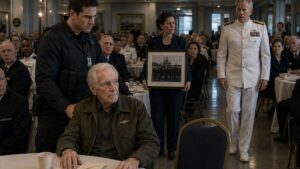
“He kept the commendation in his office. Framed.”
There it was. Not an apology. Not yet. Maybe not ever.
But a crack.
Sarah thought of Robert’s line.
He preserved the report.
Some truths did not arrive as thunder. Some entered as a draft through a door finally opened.
“Maybe you should read what isn’t framed,” she said.
Daniel looked at her sharply.
Then he looked away.
Sarah left him there.
She found Robert in the maintenance closet returning the mop to its rack. His sleeves were rolled to the elbows. His gray hair was damp at the temples. He looked smaller in the cramped room and somehow harder to dismiss.
“You’re leaving?” she asked.
“My shift ended twenty minutes ago.”
She almost smiled. “After all that, you’re worried about overtime?”
“No,” Robert said. “I’m worried someone will ask me to stay and talk.”
Sarah stepped into the doorway but did not block it.
“I filed the statement.”
“I figured.”
“The admiral asked for the full record.”
Robert nodded.
“I don’t know what will happen,” she said.
“That makes two of us.”
There was no bitterness in it. That made the words heavier.
Sarah looked at the name patch on his shirt. HAYES. All night, it had seemed too small for him.
“Why didn’t you tell anyone before?”
Robert took his old wristwatch from the shelf and fastened it slowly.
“People knew enough.”
“That’s not the same.”
“No.”
“Then why stay here?”
His fingers paused on the watch strap.
For a moment she thought he would give her a noble answer. Duty. Memory. Forgiveness.
He gave her something quieter.
“Because somebody had to keep this place from pretending it was clean.”
Sarah’s eyes burned before she could stop them.
Robert saw and looked away, giving her the dignity of not being watched.
Outside, morning light spread across the wet pavement beyond the glass doors. The lobby floor shone again, but not innocently.
Robert picked up his lunch bag.
At the exit, the yellow caution sign stood near the automatic doors where someone from facilities had left it crooked.
Sarah followed him out.
The air smelled like rain and salt.
“Chief Hayes,” she said.
Robert stopped.
The title hung between them.
Not decoration.
Not repayment.
Recognition.
He turned slightly. For the first time all night, a faint smile touched his face. It did not erase the years. It did not forgive the report. It did not bring back the men whose names lived behind glass in a corridor most people passed without seeing.
But it was real.
“Lieutenant,” he said.
Then he stepped toward the door, noticed the caution sign leaning at the wrong angle, and set it upright with one careful hand.
He did not explain it.
He did not look back to see if anyone understood.
He simply left the warning where people could see it, and walked into the morning.