The Song at the Front Gate Changed What the Family Remembered
Part I — The Boy at the White Roses
Samuel Matthews entered through the service gate because no one watched the service gate during a toast.
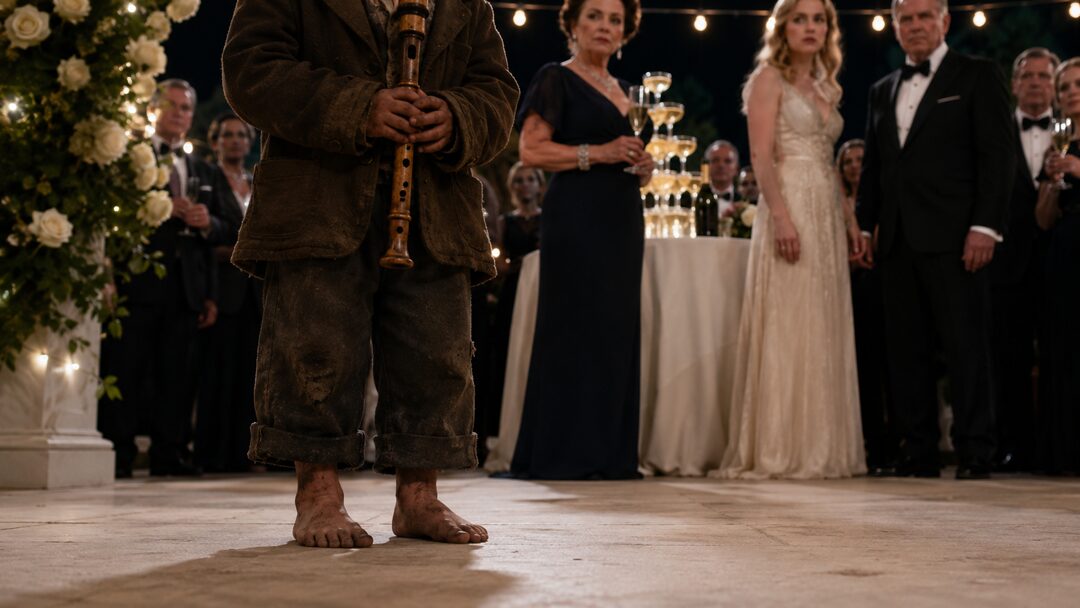
He was eight years old, barefoot, and muddy to the ankle. His brown jacket hung from his shoulders like it belonged to a man who had left in a hurry. In one hand he carried a cracked wooden recorder tied with a piece of blue string. In the other, he held a photograph so worn the corners had gone soft.
At the far end of the garden, Richard Bennett sat beneath a canopy of white roses, receiving congratulations as if he had personally arranged the moon.
His daughter’s engagement party had cost more than most weddings. Champagne towers glittered under hanging lights. Women in silk dresses leaned close to one another and spoke in polished whispers. Men in black tuxedos laughed with their hands in their pockets. A jazz quartet played beside the pool, soft enough not to interrupt the important conversations.
Samuel stepped onto the pale stone path and left brown footprints behind him.
The first guest who noticed him stopped laughing.
Then another.
Then the quiet moved outward in a ring.
Samuel did not look at them. He did not look at the flowers or the silver trays or the waiters who froze with crystal glasses balanced on their palms. He walked straight toward Richard.
A security man shifted first.
Richard saw the movement before he saw the boy. He turned, annoyed for half a second, expecting a drunk donor or a staff problem.
Then Samuel lifted the recorder to his mouth.
The first note came out thin and uneven.
Someone near the fountain whispered, “Is this part of it?”
Patricia Bennett’s smile did not move, but her eyes sharpened.
Richard did not answer anyone. He was looking at the boy’s fingers on the recorder, the way they trembled and still found the tune.
It was not a difficult melody. Four plain notes, then a pause. A little rise. A softer fall.
But Richard had not heard it in thirty years.
He had heard it once through the cracked window of his father’s pool house, when Laura Matthews was nineteen and barefoot on the grass, humming it while she buttoned his shirt with hands that smelled of lemon soap.
He had forgotten her voice on purpose.
The boy played the second line.
Richard’s champagne glass lowered an inch.
Beside him, his daughter Emily touched her fiancé’s sleeve. She was twenty-four, dressed in ivory, with pearls at her ears and a diamond ring bright enough to announce a future before she had chosen how to live it.
“Dad?” she said.
Richard raised one hand, not to welcome the boy, not to comfort him, but to stop security.
The guard stopped.
That was when the party fully understood something was wrong.
Samuel finished the tune. He lowered the recorder and stood close enough for Richard to see the dirt on his cheek and the chapped skin around his mouth.
Then he held out the photograph.
Richard did not take it.
Samuel’s arm stayed in the air.
The silence around them grew ugly.
Patricia came forward with the practiced grace of a woman who had never hurried in public.
“Sweetheart,” she said to Samuel, her voice soft enough to be admired and sharp enough to obey, “who brought you here?”
Samuel did not look at her.
He kept the photograph raised toward Richard.
Richard took it at last.
The picture was of a young girl, maybe six, standing against a gray wall in a sweater too thin for winter. Her hair was dark and uneven at the ends. She looked straight at the camera with the guarded seriousness of someone who had already learned not to expect much.
On the back, in faded pencil, someone had written:
Emily, age six. Don’t let them say I was never here.
Richard’s face emptied.
Not shocked. Not yet.
Emptied, as if someone had opened a door inside him and all the air had gone out.
Emily Bennett stepped closer.
“Dad,” she said again, quieter. “Who is that?”
Richard folded the photograph once, then unfolded it as if he had damaged something alive.
Samuel spoke for the first time.
“My sister kept it under her mattress,” he said. “She said if anything happened to her, I should play the song for the man in the black suit.”
The garden held its breath.
Patricia’s hand closed around the diamond bracelet at her wrist.
“This is not the place,” she said.
And because she said it like a verdict, several guests nodded before they understood what they were agreeing to.
Part II — The Kitchen Door
Richard did not let them throw Samuel out.
That was the first mistake, Patricia would later say.
He also did not defend him.
That was the first truth Emily noticed.
Instead, Richard stood, placed the photograph inside his jacket pocket, and said to the security guard, “Take him to the kitchen. Give him something to eat.”
Samuel’s chin lifted. “I’m not hungry.”
His stomach growled loudly enough for a woman near the roses to look away.
Richard flinched.
Patricia smiled at the guests. “A little misunderstanding,” she said. “Please, enjoy the music.”
The quartet began again too quickly. The notes sounded embarrassed.
Samuel allowed the guard to guide him toward the house, but he looked back once at Richard.
Not pleading.
Waiting.
Richard followed after three steps.
Emily followed after five.
Patricia saw her daughter moving and caught her by the wrist.
“Emily,” she said, still smiling toward the guests, “not now.”
Emily looked down at her mother’s fingers on her skin.
It was a light grip. Elegant. Socially invisible.
It still held her in place.
“Why does he know Dad?” Emily asked.
Patricia’s smile thinned. “Your father has a generous public life. People attach stories to generous men.”
“He didn’t come for generosity.”
“No,” Patricia said. “He came for attention.”
Across the garden, Mark Caldwell appeared beside Emily. He was handsome in the soft, expensive way of men who had been photographed since prep school. His family had money, political friendships, and a Senate announcement planned for the fall.
“Everything okay?” he asked.
Emily looked toward the kitchen entrance.
“No,” she said. “I don’t think it is.”
Inside, the kitchen was all heat and stainless steel. Waiters moved around Samuel with visible discomfort, as if poverty might stain a uniform if brushed against too closely.
Someone set a plate of rolls in front of him.
Samuel did not touch it.
Richard dismissed the staff with one look. They left slowly, taking their curiosity with them.
When the room was nearly empty, Richard crouched, then stopped himself. Crouching felt theatrical. Standing felt cruel. He chose neither well and leaned against the counter.
“What is your name?” Richard asked.
“Samuel Matthews.”
The last name landed with more force than Richard allowed onto his face.
“Where did you get that photograph?”
“My sister.”
“Where is she?”
Samuel’s mouth tightened. He looked suddenly younger.
“She’s gone.”
Richard closed his eyes for one second.
“Gone where?”
“I don’t know.” Samuel’s voice turned hard because it was about to break. “She left the home two nights ago. She said if she didn’t come back, I had to come here.”
“The home?”
“Harbor House.” Samuel swallowed. “We weren’t supposed to leave. But Emily said people with gates don’t answer letters.”
Richard’s hand went to his jacket pocket where the photograph rested against his chest.
Emily Bennett entered before he could speak. She had slipped away from Mark and her mother with the quiet skill of a daughter who had spent years obeying without appearing afraid.
She stopped when she saw Samuel up close.
His feet were dirty and scratched. His toes curled against the tile as if he expected someone to tell him where he could stand.
Emily’s eyes moved to the recorder.
“That song,” she said. “Why that song?”
Samuel looked at Richard. “My mom taught Emily. Emily taught me.”
Richard said nothing.
Emily turned to him. “Dad?”
His face hardened in the way it did during negotiations.
“This is complicated.”
“No,” Samuel said. “It’s not.”
Richard looked at him.
Samuel reached into the pocket of his oversized jacket and pulled out a thin silver bracelet. It was cheap, bent near the clasp, the kind sold at a boardwalk stand or a mall kiosk. He placed it on the metal table.
Inside the bracelet were two small letters.
L.M.
Richard touched it with one finger and became nineteen again so violently he had to grip the counter.
Laura Matthews had worn that bracelet the summer his father told him men like them did not marry girls who cleaned rental houses.
Laura, laughing under the pool house roof during rain.
Laura, pressing his hand against her stomach before there was anything to feel.
Laura, saying, “If you let them decide who I am, Richard, they’ll decide who you are too.”
He had told himself she left.
He had told himself the money meant she chose.
He had told himself many things because his father was dead now and could not correct him.
Emily was still watching.
“Who is Laura Matthews?” she asked.
Richard did not answer fast enough.
That was answer enough.
Part III — The Other Emily
Patricia found them in the kitchen with the precision of a woman who always knew where damage was happening.
Behind her, Mark hovered at the door. He did not enter. That was his habit with unpleasantness. He stayed near enough to witness, far enough to deny involvement.
Patricia looked at the bracelet on the table.
For the first time that evening, her expression changed before she could arrange it.
Samuel saw.
“You know it,” he said.
Patricia’s eyes went to him, then away.
Richard’s voice was low. “You knew?”
Patricia gave a small laugh without humor. “Knew what, exactly? That a woman from your past existed? Yes, Richard. I was not introduced to you as a newborn.”
Emily moved toward the table and picked up the photograph. She turned it over. Read the writing. Turned it back.
The girl in the picture had her eyes.
Not exactly. Not enough for certainty.
Enough for damage.
“Her name is Emily?” Emily Bennett asked.
Samuel nodded. “Emily Matthews.”
Patricia closed her eyes.
Richard stared at his wife.
“You knew she had a daughter.”
Patricia’s silence was clean and terrible.
Emily looked between them. “My name is Emily.”
No one answered her.
That was the second truth she noticed.
Samuel reached for the photograph, but Emily held it gently.
“How old is she now?” Emily asked.
“Fourteen,” Samuel said. “Almost fifteen. She said she was six in the picture because that was when Mom still thought somebody was coming.”
Richard turned away as if struck.
Patricia spoke before grief could make him foolish.
“Laura accepted money,” she said. “Your father’s money, not mine. She signed papers. She left town. Whatever story she told these children—”
“These children?” Emily repeated.
Patricia looked at her daughter. “Emily, lower your voice.”
“No.”
The word surprised the room.
Emily had said no before in small ways. No to a dress. No to another glass. No to a weekend in Palm Beach.
She had never said it like a door closing.
Patricia’s face cooled.
“You are standing in your engagement dress in a kitchen, arguing with your parents in front of a boy none of us know.”
Samuel stared at the floor.
Emily saw it then. The way her mother could make someone disappear while speaking directly about them.
“We know his name,” Emily said.
Patricia’s eyes flashed.
Richard reached for the bracelet again. “What papers?”
Patricia’s mouth tightened. “Your father handled it.”
“And you?”
“I protected what was left.”
“What was left of what?”
“Our life,” Patricia snapped, then lowered her voice because even anger had to wear gloves in that house. “Your father was not going to let you throw away the Bennett name for a girl who had nothing and wanted everything.”
Samuel looked up. “My mom didn’t want everything.”
Patricia turned to him. “You have no idea what your mother wanted.”
Samuel’s face went white with the effort not to cry.
Richard said, “Patricia.”
Just her name. Not enough.
Never enough.
Samuel reached into his jacket again and pulled out a folded sheet of paper. It was old, creased so many times the seams had nearly split.
He handed it to Richard.
Richard opened it.
The handwriting was Laura’s.
Richard,
I tried the office. I tried the house. Your father says you know. I don’t believe him. Her name is Emily. I didn’t choose that to hurt you. I chose it because once, before everyone else got involved, you said it was the name you wanted if life was kind to us.
Richard sat down.
Emily Bennett read over his shoulder.
Her hand rose to her mouth, but she did not cry.
Patricia’s eyes glittered. “That letter never reached you.”
Richard looked at her.
“Did you stop it?”
“No,” Patricia said.
The answer came too quickly.
Richard stood.
“Did you stop it?”
Patricia’s voice dropped. “Your father did. I knew afterward.”
“And you said nothing.”
“I was twenty-three,” Patricia said. “I was engaged to a man who still dreamed about someone else. Do you want me to apologize for being afraid?”
Emily stared at her mother as if seeing a portrait crack.
Patricia looked at her daughter then, and something like pleading passed through her anger.
“I gave you a family,” she said. “I gave you a name people respect.”
Emily’s voice was barely audible.
“No. You gave me someone else’s.”
The words did not shout.
They did not need to.
Part IV — The Gate Before This One
Richard wanted a driver.
Then a lawyer.
Then a private investigator.
He said each thing as if naming professionals could make the room less haunted.
“I’ll find your sister,” he told Samuel. “I’ll put people on it tonight. The best people. You’ll be safe.”
Samuel watched him with tired suspicion.
“Emily said you’d say money first.”
Richard stopped.
“I didn’t say money.”
Samuel looked around the kitchen. At the polished floor. At the silver appliances. At the people in clothes that could pay for a month of heat.
“You said it in rich.”
Emily almost laughed. It came out like pain.
Richard removed his watch and placed it on the counter as if that could make him less of what he was.
Samuel did not look at it.
Patricia did.
“Enough,” she said. “This has become grotesque.”
Richard faced her. “A girl is missing.”
“A girl was missing from your conscience long before tonight.”
The line was cruel because it was true enough to wound everyone.
Emily stepped between them. “When did you first know about her?”
Patricia’s jaw tightened.
Richard answered before she could choose the safest lie. “Tonight.”
Emily looked at her mother.
Patricia held her gaze.
Then Samuel said, “No, she knew.”
The room went still.
Samuel’s hands twisted around the recorder.
“Emily came here,” he said. “Two weeks ago.”
Richard stared at him.
Samuel continued, each word pulled out of him like something sharp.
“She had the picture. She said she was going to make him look at her. I told her rich people don’t open gates. She said, ‘Then I’ll wait until one does.’”
Patricia did not move.
Emily Bennett took one step back.
Samuel looked at Patricia. “You opened it.”
Richard’s voice was almost gone. “What is he talking about?”
Patricia turned toward the door. “This is absurd.”
Samuel’s voice rose. Not loud. Just desperate enough to stop her.
“You gave her cash.”
Patricia froze.
“You said Mr. Bennett was not available. You said if she came again, people would think she was trying to take advantage of a generous family.”
Emily’s face changed in a way Richard had never seen. She did not look angry first.
She looked ashamed.
Not for herself.
For the room she had grown up in.
Patricia said, “She was unstable.”
Samuel shook his head.
“She was scared.”
Patricia’s eyes shone now, though nothing about her softened.
“She came to my home making claims about my husband during my daughter’s engagement week. She had no proof.”
“She had the photograph,” Emily said.
“She had a story.”
“She had a face,” Emily said. “Did you look at it?”
Patricia did not answer.
Richard stepped toward his wife. “Where did she go?”
“I don’t know.”
“You had security remove her?”
“I had security escort her out.”
“Through which gate?”
Patricia looked at him then.
That was how he knew.
The service gate.
The same one Samuel had entered.
Richard put his hand against the counter. For a moment, he looked old in a way money could not protect.
Samuel’s voice became small. “She didn’t come back to the home after that.”
No one spoke.
Outside, the jazz had stopped. A fresh wave of applause floated in from the garden, confused and distant.
Mark appeared again at the door.
“They’re asking for the toast,” he said.
Patricia turned toward him with visible relief, as if ceremony had arrived to save her.
“Yes,” she said. “We’ll do it now.”
Emily stared. “You can’t be serious.”
Patricia adjusted one earring. Her hands were steady again.
“I am very serious. There are two hundred people outside, including Mark’s parents, who did not come here to watch this family unravel in a kitchen.”
Samuel flinched at the word this.
This family.
Not his.
Never his.
Richard said, “Patricia, we’re not going back out there and pretending.”
Patricia looked at him with something deeper than anger.
“That is exactly what families like ours do, Richard. We do not bleed in public just because someone brings a photograph.”
Emily took off one pearl earring. Then the other.
Her hands shook.
Mark stepped closer. “Em, maybe let your parents handle this.”
She looked at him.
For the first time all night, his beauty seemed like another kind of gate.
“My family has already invested a lot in tonight,” he said quietly. “So has yours.”
There it was.
Not a threat.
Worse.
A reminder of purchase.
Emily looked down at her engagement ring.
It was flawless.
That suddenly made it hard to breathe.
Part V — The Toast
Patricia returned to the garden first.
She did not hurry. She never gave a room the satisfaction of seeing her chased.
By the time Richard came out, the guests had gathered near the fountain. The white roses glowed under the lights. The champagne tower stood untouched in the center of the lawn, every glass waiting for a celebration that had already spoiled.
Samuel stood near the edge of the garden beside a security guard who would not meet his eyes.
Emily Bennett stood beside Mark because that was where everyone expected her to stand.
Richard stood beside Patricia because thirty years of habit put him there.
Patricia lifted her glass.
The room settled.
“Thank you all for your patience,” she said warmly. “Families are living things. They require care, loyalty, discretion, and love.”
Emily closed her eyes.
Samuel’s fingers tightened around the recorder.
Patricia continued, “Tonight, we are honored to celebrate not only Emily and Mark, but the joining of two families who understand service, legacy, and responsibility.”
Richard looked at Samuel.
Samuel looked at the ground.
For one terrible moment, Emily understood how it had happened the first time.
Not in a single act of cruelty.
In a hundred polished moments where everyone waited for someone else to be brave.
Patricia turned toward Mark’s parents. “We are grateful to share this next chapter with people who know the value of protecting what matters.”
The recorder sounded.
One note.
Thin. Shaking.
Then the second.
The guests turned.
Patricia stopped speaking.
Samuel stood at the edge of the lawn, recorder lifted, eyes wet but fixed on Richard. The melody trembled through the roses. It was not pretty. It was not entertainment.
It was a knock on a door that had stayed closed too long.
“Remove him,” Patricia said.
No one moved at first.
Then the security guard reached for Samuel’s shoulder.
Emily stepped away from Mark.
His hand caught hers.
“Emily,” he whispered.
She looked down at his fingers and gently pulled free.
The whole garden watched.
She crossed the lawn in her ivory dress and stopped beside Samuel. Her hair had loosened from its pins. One pearl earring was gone. Her ring still shone.
She held out her hand.
Samuel lowered the recorder.
For a second, he did not take her hand. He seemed unsure whether beautiful people could be trusted when everyone was looking.
Then he placed his small muddy hand in hers.
Emily led him to the front of the gathering.
Patricia’s face hardened. “Do not humiliate this family.”
Emily turned to her.
“That’s what you called it when they came here asking to be seen.”
A murmur passed through the guests.
Richard felt it move over him. The cold social current. The withdrawal of admiration. The calculation beginning in every eye.
He had spent his life fearing that current.
He had called the fear responsibility.
He had called cowardice timing.
Samuel held out the photograph again.
This time Richard took it in front of everyone.
His hand shook.
Patricia whispered, “Richard.”
It was not a warning.
It was a plea.
He loved her. That was the worst part. Even then, looking at what she had done, he could feel the long life between them. The dinners. The hospital visits. The way she had held his hand when his father was lowered into the ground. The way she knew exactly when his silence meant pain.
Love did not make her innocent.
It made the truth cost more.
Richard faced the guests.
“This photograph,” he said, and his voice carried badly at first, “is of a girl named Emily Matthews.”
The garden went quiet enough to hear the fountain.
“Her mother was Laura Matthews. I knew Laura when I was young. I loved her.”
Patricia looked down.
Emily Bennett held Samuel’s hand tighter.
“When Laura became pregnant, my family paid to make her disappear from my life. I let myself believe she chose that. I let myself believe not knowing was the same as being innocent.”
His voice steadied.
“It was not.”
No one moved.
“The girl in this photograph may be my daughter. She came here two weeks ago. She was turned away. Now she is missing, and her brother came tonight because private doors had already failed him.”
Samuel’s face crumpled at the word brother. He did not cry loudly. He only leaned slightly toward Emily, as if standing had become difficult.
Richard looked at Patricia then, not to punish her publicly, but because hiding her had been part of the old lie.
“My family has given money to homes, schools, shelters, hospitals,” he said. “But when someone came to our own gate asking to be recognized, we treated her like a threat.”
The sentence landed harder than any confession.
Mark’s father turned away first.
Then two women near the champagne table.
Then a man Richard had played golf with for fifteen years stared into his drink as if his glass had become urgent.
Patricia stood very still.
Her face remained composed, but something inside that composure had broken.
Richard looked at Samuel.
“I’m sorry,” he said.
Samuel did not answer.
That was right.
Some apologies arrive too late to deserve anything back.
Part VI — The Front Gate
The gala did not explode.
That would have been easier.
It emptied politely.
Guests left in clusters, collecting purses and wraps, lowering their voices as if volume were the real indecency. The jazz quartet packed their instruments without being asked. Waiters carried away trays of untouched food. The champagne tower remained standing, absurd and perfect.
Patricia waited until most people were gone before she spoke to Richard.
“You have destroyed her life,” she said.
Richard followed her gaze to Emily, who stood near the roses with Samuel.
“For a girl who may already be gone,” Patricia added.
Richard looked at his wife.
For years, he had mistaken her control for strength. Maybe it was strength. Maybe strength could become cruel when fed only fear.
“No,” he said quietly. “I destroyed it when I let you teach her what silence was worth.”
Patricia’s eyes filled then.
She did not let a tear fall.
That was her final discipline.
Emily walked back to the table where her champagne glass still sat untouched. Mark stood beside it, pale and angry in a way that still tried to look reasonable.
“Emily,” he said. “We can discuss this tomorrow.”
She looked at him with real sadness.
“You mean when fewer people can see me choose.”
His mouth tightened. “That’s not fair.”
“No,” she said. “It’s honest.”
She slid the engagement ring from her finger.
For one second, it resisted at the knuckle.
Then it came free.
She placed it beside the glass.
The sound was small.
Everyone who remained heard it.
Mark looked at the ring, then at her. “You’re making a mistake.”
Emily almost smiled.
“I think I’ve been living inside one.”
She did not wait for his answer.
She returned to Samuel, who stood near the path leading back toward the service gate. He looked exhausted now that no one was actively stopping him. His eyes kept moving toward the dark seam in the hedge where he had entered, as if he knew his place in the world and was ready to return to it.
Emily crouched in front of him.
Not theatrically.
Not for anyone watching.
“Samuel,” she said, “we’re not going out that way.”
He looked at her, confused.
She held out her hand again.
This time he took it faster.
Richard walked behind them, not beside them. He had not earned beside.
Patricia stayed beneath the roses.
Emily led Samuel across the pale stone path, past the fountain, past the empty champagne tower, past the guests who pretended not to stare.
At the front gate, the guard stepped aside.
Samuel looked up at the ironwork, taller than any door he had ever been allowed through.
Emily opened it herself.
Outside, the road was dark and quiet.
Samuel paused on the threshold.
He still had no shoes.
Emily looked down and noticed, truly noticed, as if seeing bare feet for the first time not as pity but as evidence.
She removed nothing. Offered no grand gesture. Some things could not be fixed with a borrowed pair of heels or a sudden act of kindness.
So she simply kept holding his hand.
They walked through the front gate together.
Three days later, the photograph sat inside a clear evidence sleeve on a metal table under fluorescent lights.
The room smelled of burnt coffee and old paper.
Samuel sat with the recorder across his lap. He had not played it since the gala. His feet were in new sneakers Richard had bought, but the laces were still too clean. He kept looking at them like they belonged to someone else.
Emily Bennett sat beside him, her engagement finger bare. Her hair was pulled back without pearls. She held a paper cup of water she had not touched.
Richard stood near the window, speaking quietly to a woman from child services. He looked smaller without a tuxedo. More human. Less useful to himself.
There was still no word from Emily Matthews.
No reunion.
No clean ending.
Only reports filed, names entered, calls returned because Richard Bennett was now saying publicly what others had ignored privately.
Samuel looked at Emily Bennett.
“Do you think she knows?” he asked.
Emily turned the evidence sleeve so the photograph faced him.
In it, the other Emily still stood against the gray wall, six years old forever in that one captured moment, waiting to be more than a problem someone had managed.
“I don’t know,” Emily said.
Samuel’s mouth trembled.
Emily placed her hand over his.
“But people know her name now.”
Across the room, Richard heard her.
He closed his eyes.
It was not enough.
It was the first true thing.