The Last Mercy at Mabel’s
Part I — The Cane
The first mistake Dane Rusk made was taking the old man’s cane in front of everyone.
He did it with a smile, too. Not anger. Not drunken carelessness. A smile.
Caleb Voss sat alone in the front booth at Mabel’s Diner, one hand around a sweating plastic cup of water, the other resting near the brass handle of his cane. The plate of meatloaf in front of him had gone cold. He had ordered it because his wife used to order it every Friday before the cancer made food taste like metal.
He had not come for the meatloaf.
He had come because his daughter was getting engaged in the back room.
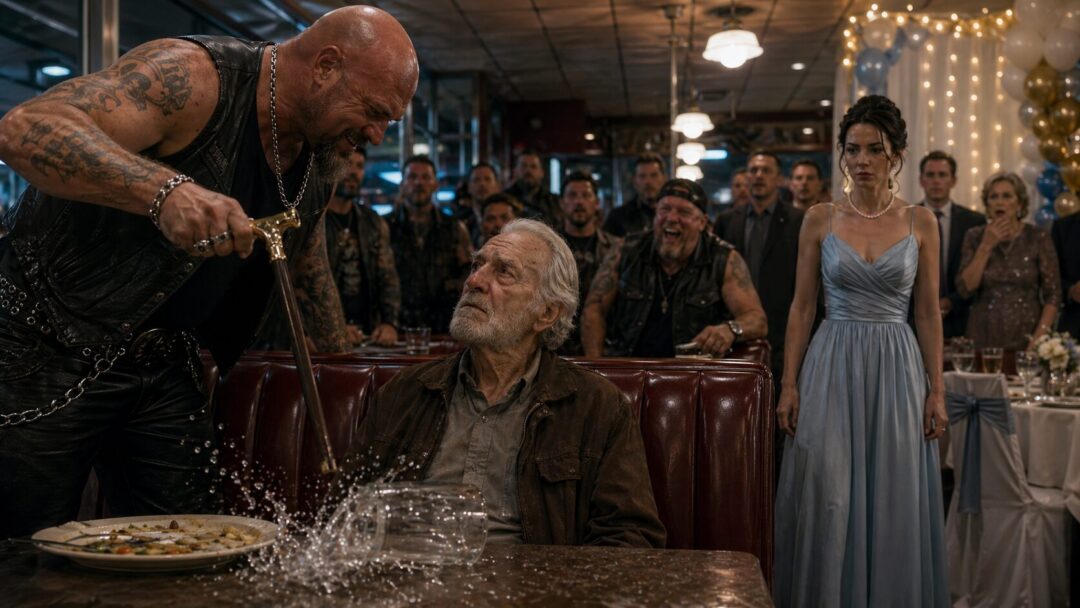
Dane blocked the light from the window when he stepped up to the booth. He was bald, broad-shouldered, and dressed in a sleeveless black leather vest that showed both the tattoos on his arms and the size of them. A silver chain hung from his belt. His boots made the old floorboards complain.
“Well, now,” Dane said, looking at the cane. “Can’t have trip hazards around important guests.”
Caleb looked up at him.
He said nothing.
That seemed to amuse Dane more than any protest would have. He reached down and plucked the cane from where it leaned against the booth, easy as taking a straw from a counter jar.
Caleb’s fingers twitched once.
Not enough for anyone to call it resistance.
Across the diner, near the doorway to the private room, Mira Voss saw it happen.
Caleb watched her face before he watched Dane.
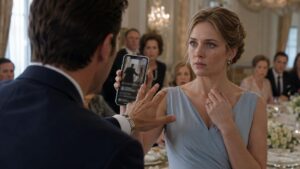
She stood in a pale blue dress that did not look like something she would have chosen for herself. Her hair was pinned carefully. Her earrings were small but expensive. Around her throat was a pearl necklace that made her look less like a bride-to-be than a woman hired to play one for a room that might reject her if she missed a line.
Their eyes met.
For one second, Caleb saw his little girl in the doorway of their old kitchen, barefoot, asking him to make the rain stop because she wanted to ride her bike.
Then Mira lowered her eyes.
Dane turned the cane in his hand, testing its weight.
“Nice stick,” he said.
A few men in leather vests laughed from the long table near the counter. They were Rusk men. Not all by blood, but all by obedience. The town knew the difference and feared both kinds.
Caleb kept his hand on the table.
Dane carried the cane away like a trophy.
At the biker table, one of the men took it and hunched over, pretending to tremble. Another barked, “Careful, Grandpa,” and slapped the table hard enough to make the ketchup bottles jump.
Someone’s elbow caught Caleb’s water glass as Dane passed back by.
The cup tipped.
Water spread across the table in a thin, shining sheet, soaking the edge of Caleb’s napkin and creeping toward his plate.
No one moved to help.
The waitress, Tina, stood behind the counter with a coffee pot in her hand. She opened her mouth. Caleb saw her almost say his name.
Then she glanced toward the private room, toward the white flowers and gold ribbons and the Rusk family gathered beneath them.
She closed her mouth.
That was the way the whole town survived the Rusks.
By swallowing at the right time.
Dane returned with the cane and dropped it on the floor just beyond Caleb’s reach.
The brass handle struck the tile with a crack that made several people flinch.
Dane leaned close.
“You need help with that?” he asked.
Caleb looked at the cane.
Then at the water spreading across his table.
Then at his daughter.
Mira had one hand pressed to her stomach, as if holding herself together from the inside. Her fiancé, Reid Rusk, stood behind her in a dark tailored suit, one hand resting lightly at the small of her back.
Not holding her.
Positioning her.
Reid’s face was calm. Clean-shaven. Handsome in the practiced way of men who had never had to wonder whether a room would make space for them.
He looked at Caleb as if Caleb were not a person.
As if he were a stain that had appeared on an expensive shirt.
Mira took one step forward.
For a moment, Caleb thought she might say it.
That is my father.
She walked to the cane instead.
She bent, picked it up, and placed it carefully against his booth.
Her hand shook.
“Please,” she whispered. “Don’t make this harder.”
Caleb’s eyes did not leave her face.
“Harder for who?” he asked.
Mira flinched like he had raised his voice.
He had not.
That was what made it worse.
Part II — Old History
Mira sat across from him for less than thirty seconds, and every second looked stolen.
Behind her, the private room glowed with soft lights and money. White tablecloths. Champagne flutes. A tiered cake no one had touched. Men in pressed jackets speaking in low, confident voices. Women watching Mira with smiles that did not reach their eyes.
The front half of Mabel’s still looked like itself: turquoise booths, chrome-edged tables, faded menu boards, the smell of coffee and fryer oil.
The back room looked like the diner had dressed up to beg.
“Dad,” Mira said quietly. “You shouldn’t be here.”
Caleb wiped water from the table with the napkin. It tore in his hand.
“You called me.”
Her eyes tightened.
“I texted you two weeks ago. I said maybe we could talk sometime.”
“You said before the wedding.”
“I didn’t mean tonight.”
“You didn’t say not tonight.”
Mira looked back toward Reid.
He was still watching.
Caleb noticed the way Reid smiled when she looked at him. Gentle from a distance. A leash made of approval.
Mira lowered her voice. “His mother invited investors. The county people are here. Everything matters tonight.”
“I can see that.”
“Then please understand.”
“Did you tell him who I am?”
Her mouth parted.
That was answer enough.
Caleb nodded once.
Mira leaned closer, her perfume too delicate for the diner. “Not tonight. That’s all. Not with his mother’s guests here. Not with everyone already looking for a reason to say I don’t belong.”
“You don’t belong where your father has to be hidden.”
Her face went pale.
“That’s not fair.”
“No,” Caleb said. “It isn’t.”
She looked down at the spilled water. At his old jacket. At his hands. Hands that had fixed engines, patched porch steps, lifted her from a fevered bed, signed paperwork he never showed her.
Her voice hardened because soft things were too dangerous. “You don’t know what it’s like to walk into a room and have everyone remember what you drove up in.”
“I drove you to school in that truck.”
“And everyone knew,” she said.
He absorbed that.
She regretted it immediately. He saw that too. But regret was not the same as courage.
Before either of them could speak again, Reid arrived.
“Mira,” he said.
He did not sound angry. That was his gift. He made command sound like concern.
Mira straightened.
Reid’s hand settled on her shoulder. Caleb watched her body become still beneath it.
“Everything all right?” Reid asked.
Mira started to answer, but Caleb spoke first.
“Depends on what everything includes.”
Reid smiled.
Up close, he looked even less like the men at the biker table and more dangerous because of it. Dane used size. Reid used permission. He could make cruelty look like etiquette.
“Mr. Voss,” Reid said.
Mira’s eyes flicked up.
Caleb noticed.
So Reid knew his name.
“Reid,” Mira said softly.
“It’s all right,” Reid said, giving her shoulder one small squeeze. “I believe your father and I can be civil.”
Your father.
He said it easily.
Mira heard it too.
The air left her face.
Reid turned to Caleb. “I’m sorry about my brother. Dane has a poor sense of humor.”
“A man’s humor usually shows what he thinks he can afford.”
Reid’s smile thinned. “And what can Dane afford?”
“In this town?” Caleb looked toward the biker table. “More than most.”
For the first time, something sharpened behind Reid’s eyes.
Then he reached into his jacket, took out a money clip, and placed two hundred-dollar bills beside Caleb’s wet plate.
“Dinner is on me,” Reid said. “And your evening, if you’re willing to continue it somewhere more comfortable.”
Mira whispered, “Reid, don’t.”
He did not look at her.
Caleb looked at the money. The bills drank in water at the edges.
“I’m comfortable enough.”
“You’re sitting in a puddle.”
“I’ve sat in worse.”
“That may be true,” Reid said. “But tonight is not about proving endurance.”
“No?”
“No.” Reid leaned slightly closer. His voice stayed warm enough for witnesses. “Tonight is about Mira’s future. I would hate for old history to drag itself across the floor.”
Mira closed her eyes.
Caleb folded the wet napkin once. Twice.
“Old history,” he said.
Reid’s smile returned. “We all have some.”
Caleb pushed the money back with two fingers.
“Pride is expensive,” Reid said quietly, “when no one else is buying it for you.”
Caleb finally looked him straight in the eye.
“That line work on her?”
Mira stood.
“Dad.”
It was the first time she had called him that in the room.
The word landed. Everyone close enough to hear turned.
Dane laughed from the biker table, but the laugh came late. Like he had missed his cue.
Reid’s face did not change.
Only his hand moved, sliding from Mira’s shoulder to the back of her neck, gentle enough to pass for affection.
Possessive enough that Caleb’s grip tightened around the brass handle of his cane.
“Mira,” Reid said. “Your mother is waiting.”
He meant his mother.
Not hers.
Mira stepped back from the booth.
Reid guided her away.
After two steps, he bent to speak near her ear. Caleb could not hear the words, but he saw their effect. Mira nodded once, fast.
Like a child accepting a punishment she had been told was kindness.
Part III — The Toast
The engagement toast began with laughter polished until it shone.
Caleb stayed in his booth.
Nobody asked him to move again. That was not mercy. That was strategy. A humiliated man who stayed quiet made a better warning than an empty booth.
From where he sat, Caleb could see into the private room if he leaned slightly to the left. He did not lean. He listened.
Reid’s mother, Eleanor Rusk, stood beneath a garland of white roses and lifted her glass. She was silver-haired, elegant, and cold in the way expensive rooms were cold: not empty, just designed to keep certain people out.
“When Reid first told me about Mira,” she said, “I admit I had concerns.”
Soft laughter moved through the guests.
Mira smiled.
Caleb saw the effort in it.
“She came from very little,” Eleanor continued, “but sometimes very little produces a surprising kind of hunger. Discipline. Gratitude. A desire to rise.”
The room murmured approval.
Mira’s fingers tightened around her champagne flute.
Caleb remembered those fingers sticky with cherry popsicle juice. He remembered bandaging them after she tried to carve her name into the porch rail with his pocketknife. M-I-R, then a crooked A, because she had wanted proof the house knew she lived there.
Now she stood in a borrowed glow while strangers applauded her escape from him.
Eleanor turned toward Reid. “My son has always had a generous heart. But generosity must be protected. Love, if it is to survive in families like ours, must also be practical.”
Dane raised his beer. “Hear, hear.”
Reid laughed softly. His hand found Mira’s waist.
Eleanor continued. “That is why Mira has agreed, before the wedding, to sign the Rusk family loyalty agreement.”
The applause was light, automatic.
Mira’s smile froze.
Caleb’s hand went still on the cane.
Eleanor lifted her glass higher. “Not because we doubt her, of course. But because trust is strongest when everyone knows its terms.”
Trust with terms.
Caleb looked at Reid.
Reid was watching Mira, not the room. Watching whether she would keep smiling.
She did.
Barely.
Caleb stood.
Pain moved through his hip, hot and familiar. He took his cane and walked toward the hallway by the restrooms, not fast, not dramatically. Just enough to make Mira’s eyes follow him.
A minute later, she slipped away from the private room.
“What are you doing?” she hissed when she reached him.
“Getting air.”
“You’re standing by the bathrooms.”
“Best air left in here.”
“This isn’t funny.”
“No,” Caleb said. “It stopped being funny when they turned your marriage into a contract and called it love.”
Mira’s face tightened. “You don’t get to judge this.”
“I get to worry.”
“You lost that right when you refused to help me.”
There it was. Not new, but sharper tonight.
Caleb leaned against the wall. “Is that what you think happened?”
“You refused to sell the house. Reid offered more than it was worth. He said it could clear your medical bills, my student loans, everything. He gave us a way out.”
“He gave himself a way in.”
“It was a rotting house.”
“It was your mother’s house.”
“My mother is dead,” Mira said. Her voice broke on the last word, then hardened to hide it. “Poverty is not a shrine.”
Caleb looked away.
That one found the place she meant it to find.
Mira pressed on because stopping would mean feeling. “You kept that house like it mattered more than me. More than my future. More than being able to walk into a room without someone checking whether I knew which fork to use.”
“I kept it because she asked me to.”
“She asked you to keep me safe.”
“I tried.”
“No,” Mira said. “You kept secrets and called it protection.”
Caleb almost told her then.
About the envelope under the loose floorboard in the old laundry room.
About the original deed with Mabel Price’s signature and the boundary markers that proved the Rusks had built their empire across land they had never cleanly owned.
About Reid’s first offer, too generous and too urgent.
About the lawyer who told Caleb, in a tired voice, that title fights against families like that took money, patience, and the willingness to be hated.
About Ellen Price at the county office, who had cried when she saw her grandmother’s name on the old paper.
About the sealed challenge waiting like a match in a dry field.
He almost told Mira everything.
But her cheeks were flushed with shame, and Reid was standing at the end of the hall now, watching them.
If Caleb told her in that moment, it would sound like revenge.
And he had not come to ruin her.
That was the part nobody in the room would believe.
So he said only, “You were right about one thing.”
Mira stared at him.
“I should have told you more.”
For a second, her anger faltered.
Then Reid approached, smooth as a closing door.
“There you are,” he said to Mira. “Everyone is waiting.”
Mira did not move.
Reid looked at Caleb. “I hope Mr. Voss hasn’t been upsetting you.”
Caleb laughed once.
It surprised even him.
Reid’s eyes cooled.
Mira looked between them. “You knew,” she said.
Reid turned to her. “Knew what?”
“You knew he was my father before tonight.”
A pause.
Too small for most people.
Large enough for her.
Reid touched his cufflink. “Of course I knew.”
Mira took a step back.
“But you acted like—”
“I acted with discretion,” Reid said. “Something tonight has lacked.”
Caleb watched Mira understand one piece and then another.
Her voice dropped. “Dane knew too.”
Reid did not answer.
He did not need to.
Mira’s hand went to her throat, fingers brushing the pearls.
“He took the cane because you told him to.”
Reid sighed, almost tenderly. “I asked him to encourage your father not to create a scene.”
“He humiliated him.”
“Your father chose to remain in a room where he was not invited.”
Caleb said, “I was invited by my daughter.”
Reid looked at him then.
There was no smile left.
“No,” Reid said. “You were summoned by guilt. There’s a difference.”
Mira whispered, “Reid.”
He turned back to her, voice softening. “Darling, your Aunt Lisa told me how he gets. The debts. The stubbornness. The way he uses your mother’s memory to keep you tied to that old place. I was trying to protect you from being pulled backward.”
Mira looked sick.
“My aunt spoke to you?”
“She cares about you.”
“She gave you our private business.”
“She gave me context.”
Caleb felt the room tilt, but only inside him.
Lisa. His wife’s sister. The woman who had told Mira, after the funeral, that Caleb’s grief was turning into selfishness. The woman who had said Reid was a blessing because some men came with doors already open.
Mira’s eyes filled, but no tears fell.
The worst betrayals did not always make you cry.
Sometimes they made you very still.
Reid reached for her hand. “This is exactly why the agreement matters. Love needs protection from old damage.”
Mira did not take his hand.
For the first time all night, Reid looked afraid.
Not much.
But enough.
Part IV — The Phone
Caleb returned to the booth slowly.
This time the room followed him with its eyes.
The cane struck the tile once, then again, steady and plain. The sound was not loud. It did not need to be. Everyone in Mabel’s heard it.
Dane stood from the biker table.
“You about done, old man?”
Caleb sat down.
The spilled water had dried at the edges, leaving cloudy rings on the laminate. Reid’s two hundred dollars still lay near the plate, damp and curled.
Caleb looked at the money for a long moment.
Then he reached inside his jacket.
The biker table went quiet.
That was the old animal instinct in men like Dane. They recognized pockets. They recognized slow hands. They recognized the possibility that a quiet man might finally choose the one language they respected.
Dane’s shoulders squared.
Reid stepped into view near the private room, one arm slightly out as if to keep Mira behind him.
But Caleb did not pull out a weapon.
He pulled out his phone.
Dane laughed first, too loudly. “What, you calling the nursing home?”
Caleb put the phone to his ear.
His thumb knew the number.
He had hoped not to use it tonight.
That hope felt foolish now, but he let himself grieve it for one second before the call connected.
“Ellen,” he said.
At the sound of the name, Reid went still.
Caleb looked at him.
There it was.
Not confusion.
Recognition.
“Caleb?” Ellen Price’s voice crackled faintly through the speaker. “Is everything all right?”
“No,” Caleb said. “I need you to release the title challenge.”
Silence moved through the diner faster than speech could.
Reid crossed the room.
“Hang up,” he said.
Caleb did not.
Ellen’s voice sharpened. “You’re sure?”
“Yes.”
Reid reached the booth. “Caleb.”
Not Mr. Voss now.
Caleb kept his eyes on him. “File it public first thing in the morning. Send copies to the county board and the bank.”
Reid’s face lost color.
Mira appeared behind him.
“What title challenge?” she asked.
Reid spoke without looking away from Caleb. “This is a family matter.”
Caleb said into the phone, “And Ellen?”
“Yes?”
“Send one to Mira.”
Reid’s hand shot out.
Dane moved at the same time.
For a second, it seemed the room would become what everyone feared it could become. Dane’s size filled the space beside the booth. Reid reached for Caleb’s wrist. The biker men stood. Chairs scraped. Someone in the private room gasped.
Then Caleb rose.
Slowly.
With the cane in one hand and the phone in the other.
He was not taller than Reid. Not stronger than Dane. Not younger than anyone who wanted him gone.
But he stood like a man who had already lost the thing they were threatening to take.
“Touch me now,” Caleb said, “and everybody here will finally have something honest to talk about.”
Dane stopped.
Not because he had become good.
Because the room had changed.
Phones were out now. Not many. Enough.
The town that could not find courage had found curiosity.
Reid saw it too.
His voice lowered. “You don’t understand what you’re doing.”
“I do.”
“You’ll destroy her.”
Caleb’s hand tightened around the cane.
That was the blade Reid chose. Not money. Not force. Her.
“You’ll drag her name through a legal fight she doesn’t deserve,” Reid said. “You’ll make her the girl from the bad house all over again. Is that what you want?”
Mira’s lips parted.
Caleb did not answer quickly.
Because the question hurt.
Because part of it was true.
Truth did not become harmless just because it was necessary.
Reid saw the pause and moved into it.
“We can settle this privately,” he said. “Tonight. I’ll clear her debts. Yours too. Medical, property taxes, whatever sad little pile has been keeping you awake. You withdraw the filing. Mira signs the agreement. The wedding goes forward. No scandal.”
Mira stared at him.
He still had not understood.
Or maybe he had, and that was worse.
“You’re offering to buy my father?” she asked.
Reid turned to her, softer now. “I’m offering to protect your future.”
“No,” she said. “You’re offering him money so I’ll stay quiet.”
“Mira—”
“You knew who he was.”
Reid’s jaw tightened.
“You knew,” she repeated, louder. “You let Dane take his cane. You let them laugh.”
“I let you choose,” Reid said.
That line ended something.
Caleb saw it happen in her face.
Not the end of love. Love was rarely that obedient.
It was the end of the lie she had needed love to carry.
Reid stepped closer to her. “You wanted a life beyond that house. Beyond his failures. I gave you one.”
Mira looked at Caleb.
There was shame in her eyes.
But not the same kind.
This shame had a door in it.
“You should have told me,” she said to him.
“I know.”
“You let me hate you.”
“I know.”
“Why?”
Caleb looked toward the private room, toward the flowers, the guests, the mother who had toasted Mira’s hunger like it was a useful defect.
Then he looked back at his daughter.
“Because every time I tried, you looked happy.”
The line struck her harder than accusation would have.
Reid exhaled sharply. “This is touching, but sentiment doesn’t change title law.”
Caleb looked at him. “No. Paper does.”
Reid’s face closed.
Caleb put the phone back to his ear. “Ellen, file it.”
“Already started,” Ellen said.
Then the room heard it.
A small sound from the phone. A keyboard. A click. The plain little noise of a locked door opening somewhere else.
Reid stepped back as if the floor had shifted beneath him.
Dane cursed under his breath.
The biker table stopped laughing.
Mira looked down at her left hand.
The ring was enormous. A diamond made to be seen across rooms. A promise designed like a warning.
She twisted it once.
It did not come off easily.
For a terrible second, Caleb thought she would stop. Not because she wanted Reid. Because leaving a cage was still leaving the only roof you had trusted.
Then she pulled harder.
The ring slid free.
The private room watched.
The biker table watched.
Reid watched like a man seeing property walk toward a cliff.
Mira crossed to Caleb’s booth and placed the ring on the table beside the dried water stain.
Not in Reid’s hand.
Not thrown.
Placed.
Like evidence.
Her voice was quiet when she spoke.
“I won’t be protected by people who need me ashamed.”
No one clapped.
No one cheered.
It was better that way.
Some choices deserved silence around them.
Part V — The Damage Left Standing
The Rusks did not storm out.
People like them rarely gave witnesses that kind of satisfaction.
Eleanor gathered her purse with a face so composed it looked painful. Reid spoke briefly to two men from the bank, his voice low and clipped. Dane shoved one of his own men aside when the man asked what was happening.
At the door, Dane looked back at Caleb.
For once, he seemed less angry than confused.
The old man was still old. Still thin in the shoulders. Still leaning on the cane Dane had mocked.
But Dane had the expression of a man who had kicked a door and discovered it was the front of a courthouse.
He did not apologize.
Caleb had not expected him to.
Reid was the last to leave.
He stopped beside Mira.
“You’ll regret this when the sympathy wears off,” he said.
Mira looked tired suddenly. Not triumphant. Not free in the shining way stories liked to pretend. Just tired.
“Maybe,” she said.
That seemed to wound Reid more than refusal.
Because it was honest.
He looked at Caleb. “You think you won?”
Caleb glanced at the wet money still lying by the plate.
“No.”
Reid waited for more.
Caleb gave him nothing.
That was the last mercy he offered him.
When Reid left, the bell above the diner door rang once.
Then Mabel’s became itself again, but damaged. The flowers still hung in the back room. Champagne still waited in glasses. The cake leaned slightly where the frosting had softened under the lights.
Tina came over with a towel.
“I’m sorry, Caleb,” she whispered.
He nodded.
She wiped the table, but when she reached for Reid’s ring, Mira stopped her.
“I’ll take it.”
Mira picked it up with two fingers, as if it had heat left in it, and set it on the empty plate.
Neither she nor Caleb spoke until the last guest had gone.
The diner emptied in stages. First the bankers. Then the Rusk relatives. Then the locals who had seen too much and would pretend tomorrow that they had seen less. The biker engines outside started one by one and rolled away into the dark.
At last, only Caleb and Mira remained in the front booth.
She sat across from him now.
Not in the private room.
Not standing halfway between two families.
Across from him.
The distance was small enough for conversation and large enough for everything they had done to each other.
Mira touched the pearl necklace at her throat, then unclasped it. She laid it beside the ring.
Without it, she looked younger.
Not innocent. Just less arranged.
“Did you come here to ruin my life?” she asked.
Caleb looked out the window.
For a moment, he saw his wife’s reflection there instead of his own memory of her. Mabel’s Diner had been where she told him she was pregnant. Same front booth. Same rain on the glass. She had cried because they had no money and laughed because he had started crying too.
Later, when Mira was nine, she had fallen asleep against him in that booth after a school play, still wearing cardboard butterfly wings.
Before college, she had asked him if leaving meant she was betraying them.
He had told her no.
He had meant it.
“No,” Caleb said. “I came because you asked me once to never let you disappear.”
Mira’s face crumpled, but she did not sob.
Maybe she had no right yet.
Maybe she knew that.
“I let them laugh at you,” she said.
“Yes.”
The word was soft.
It still landed.
“I saw him take the cane.”
“Yes.”
“I wanted to stop him.”
“I know.”
“But I didn’t.”
Caleb looked at her then.
“No,” he said. “You didn’t.”
She nodded as if accepting a sentence.
Outside, the neon sign buzzed red and blue against the wet pavement. OPEN, it said, though the diner had never felt less open in its life.
Mira reached for the cane.
This time, she did not pick it up quickly, embarrassed by it. She wrapped her hand around the brass handle carefully, with respect, and held it out to him.
Caleb looked at it.
Then at her.
He took it.
Their fingers did not touch.
That hurt her. He saw it.
He did not fix it.
Some pain had to be allowed to tell the truth.
“Can I walk you out?” she asked.
Caleb shifted to the edge of the booth and stood. His hip burned. His pride did too, in a different place.
“You can walk beside me.”
Mira swallowed.
“All right.”
They moved toward the door slowly.
Tina watched from behind the counter, her towel clutched in both hands. She did not say goodbye. Maybe she understood that some exits did not need witnesses calling after them.
At the door, Caleb paused.
Mira reached for him automatically, then stopped herself before touching his arm.
He saw that too.
Outside, the night air was cold. The parking lot was almost empty. Where the bikers had been, there were only dark oil spots and the fading smell of exhaust.
Caleb stepped down from the curb on his own.
Mira walked beside him.
Not close enough to pretend.
Not far enough to disappear.
At his truck, he opened the door and set the cane carefully inside before climbing in. Mira stood there with her arms wrapped around herself, the blue dress too thin for the weather.
“Dad,” she said.
He looked at her.
There were a hundred things she could have said. Sorry. Thank you. I didn’t know. Please don’t go. I was scared. I am still scared.
She said none of them.
Maybe one day she would.
Maybe one day he would be ready to hear them.
Instead, she asked, “Where do I go now?”
Caleb’s hand rested on the steering wheel.
The old answer rose in him first.
Home.
But the house was not a shrine.
And poverty was not proof of love.
And daughters were not saved by being pulled backward.
So he gave her the truer answer, the harder one.
“Somewhere you don’t have to hide your name.”
Mira nodded.
The tears came then, silently, without performance.
Caleb started the truck.
Before he pulled away, she stepped back from the curb and stood under the broken glow of the diner sign, no ring on her hand, no pearls at her throat, no family in the doorway claiming her.
For the first time all night, she looked unchosen.
For the first time all night, she also looked like herself.
Caleb drove slowly out of the parking lot.
In the mirror, his daughter grew smaller but did not vanish.
And for now, that was enough.