She Buried Clay Pots Across a Dying Wyoming Field—and Challenged the Deed That Said It Wasn’t Hers
Chapter 1: The Pots Frank Ordered Her to Dig Up
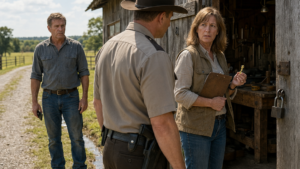
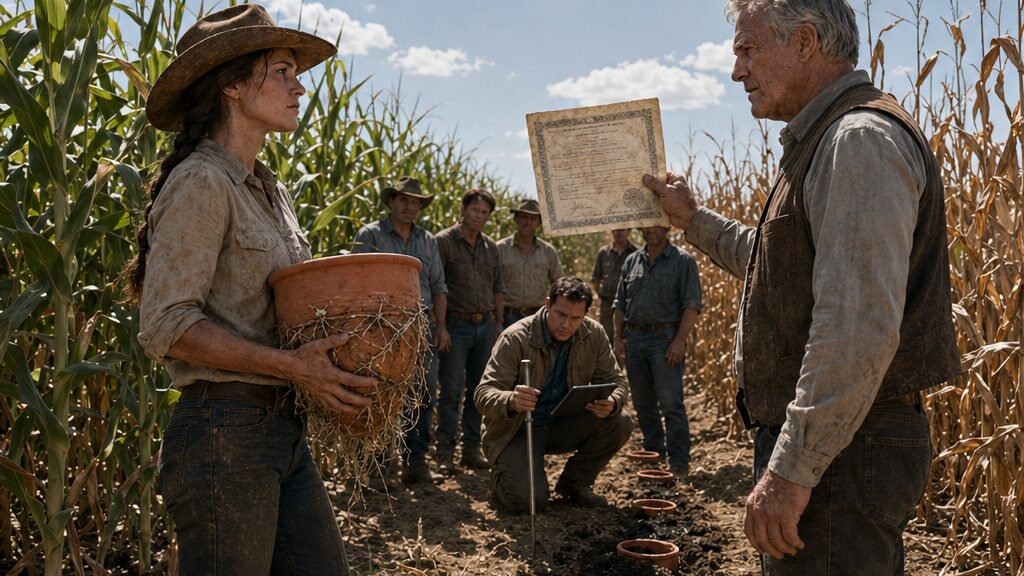
Frank Carter came down the lower field carrying a yellowed county certificate just as Rebecca Walker lowered the forty-eighth clay pot into the ground.
She saw the paper before she saw his face.
It flashed pale against his brown vest while he crossed between the corn rows, careful not to brush the leaves. The field had gone still in the late-morning heat. Even the grasshoppers seemed to pause as Rebecca steadied the terracotta rim with both hands and eased it into the hole.
Frank stopped ten feet away.
“Take it back out.”
Rebecca kept one hand on the pot. “Morning to you too.”
“I said take it out.”
The shovel stood upright beside her, its blade buried in soil hard enough to ring under steel. Behind Rebecca, forty-seven matching pots formed narrow lines between the corn. Only their open mouths showed above ground, each sealed with a flat stone to slow evaporation.
Frank lifted the certificate.
Rebecca recognized it. She had seen it once as a child in the front room of his house, framed beside a photograph of his parents. The paper had looked important then. Now it looked brittle enough to break in the wind.
“Lower field is mine,” he said. “Always has been.”
“You’ve collected rent on it from us for twenty years.”
“That doesn’t make it yours.”
“I never said it did.”
“You dug forty-eight holes without permission.”
Rebecca wiped her palms on her jeans. Dust streaked the fabric. “I told you I was changing the irrigation.”
“You said you were trying something.”
“This is something.”
Frank’s gaze moved across the rows of clay mouths. “Looks like you’re planting cookware.”
“They’re ollas.”
“They’re pots.”
“They seep water below the surface. Roots grow toward them. Less loss to heat, less runoff.”
Frank’s expression did not change. “You altered my land.”
Rebecca crouched beside the pot she had just placed. She packed soil against its sides with the heel of her hand. “Your land has had six tenths of an inch of rain since May.”
“That doesn’t give you authority.”
“No. It gives the corn a problem.”
Frank stepped closer. His boots stopped at the edge of the hole. “Dig them up by sunset.”
Rebecca looked up.
He had known her since she was seven. He had taught her how to sharpen a mower blade and how to back a trailer without jackknifing. When her father died, Frank had stood beside the grave with his hat held against his chest and said nothing because men like him believed silence counted as steadiness.
Now he held the certificate between them like a fence.
“All forty-eight?” she asked.
“All forty-eight.”
“Then the lower rows die.”
“That’s your calculation.”
“It’s not a calculation.”
She rose and walked three rows over. Frank followed, slower than he once would have. Rebecca knelt beside the first pot she had installed two weeks earlier. She removed the flat stone, reached into the opening, and tipped the pot slightly.
The soil around it held together in a dark ring.
Farther out, the ground crumbled into powder.
Rebecca pushed two fingers into the damp earth and lifted a fine corn root into the light.
“This row was folding by noon,” she said. “Now it holds until evening.”
Frank stared at the root.
For one second, his grip softened on the certificate.
Then he folded the paper along an old crease.
“You should have asked.”
“I did.”
“You informed me after you ordered the pots.”
“I asked if I could change the irrigation.”
“You didn’t say you were burying clay across the acreage.”
“You would’ve said no.”
“That’s not asking.”
Rebecca stood. Heat pressed against the back of her neck. “If you wanted every decision in writing, you could’ve given us a written lease sometime in the last two decades.”
Frank’s eyes sharpened.
The words had come too fast. Rebecca felt the mistake as soon as they left her mouth.
Her father had never spoken that way to Frank. Even during bad years, even when rent had been late, he had treated their arrangement as something held together by trust rather than paper.
Frank unfolded the certificate again.
“This is the paper that matters.”
“Why now?”
His gaze shifted toward the western fence, where the Carter acreage rose into dry grazing land. “Because things change.”
“What things?”
“That’s not your concern.”
“It becomes my concern when you kill the crop I’m responsible for.”
“You’re responsible for what you plant on land you have the right to use.”
“We’ve always had the right.”
“You’ve had permission.”
The distinction landed harder than Rebecca expected.
She looked down the rows her father had planted before his hands became too stiff to close around a wrench. The lower field was where he had taught her to read soil by smell, where he had told her that corn showed thirst first at the edges of its leaves.
Rebecca had believed the field belonged to their life, even if it did not belong to their name.
Frank tucked the certificate beneath his arm.
“Sunset,” he said. “After that, I’ll bring someone to remove them.”
“You bring a machine in here, you’ll tear the roots.”
“Then save me the trouble.”
He turned and walked toward his truck.
Rebecca remained beside the open pot until the engine started. She watched dust lift behind him along the service road.
Only when the truck disappeared did she take her phone from her pocket.
There were three missed calls from the farm lender.
She stared at the screen, then pushed the phone away without listening to the messages.
At noon, she covered the final pot and checked every row. At two, she repaired a cracked hose. At four, she walked the boundary and counted the pots again, as if the number might have changed.
She did not dig up a single one.
The sun had dropped behind the equipment shed when she reached the old fence post at the edge of the lower field. Her father had replaced that post twice and refused to replace it a third time, saying some things deserved to lean after enough years of standing.
A white sheet had been nailed to it.
Rebecca tore the paper free.
NOTICE OF TERMINATION OF ACCESS.
The language below was formal, clean, and recent. Frank had filed it that afternoon.
Her right to enter the lower field would end in seven days.
At the bottom, beneath the county stamp, someone had typed the property description.
Rebecca read it twice.
There was no mention of the Walker lease, no record of improvements, no note that her family had worked the field since before she was born.
Only Frank Carter’s name.
Only the land.
Only the order to leave.
Chapter 2: One Cup of Water Beneath Dry Ground
Patrick Davis pulled a living corn root from soil that should have been dead.
He held it between thumb and forefinger while three neighboring farmers leaned closer. The root was white, fine, and damp. Soil clung to it in a dark web.
Rebecca stood beside the exposed clay pot and tried not to look toward the road.
Frank was late.
That worried her more than if he had arrived early.
Patrick rubbed the soil between his fingers. “How much water per vessel?”
“About a gallon every three days,” Rebecca said. “Less once the roots reach the pot.”
“And the control row?”
“Same planting date. Same seed. Surface drip only.”
The agricultural extension technician crouched in the next row and pressed a probe into the earth. The metal sank three inches, then stopped.
“Dry below the crust,” he said.
Patrick nodded toward the pot. “Show me.”
Rebecca had rehearsed the demonstration alone before sunrise.
She removed the stone lid, dipped a measuring cup into a bucket, and poured one cup of water through the narrow opening. No water appeared on the surface. The soil remained pale and dusty.
A feed-store owner who had come to watch gave a doubtful grunt.
Rebecca waited.
Then she pushed a hand trowel into the ground six inches from the pot and lifted a slice of earth. A dark crescent spread through the lower soil. Corn roots curved toward it.
Patrick looked from the moisture to the dry surface.
“So the pot releases through the wall.”
“Slowly,” Rebecca said. “Pressure equalizes as the soil dries.”
“No pump?”
“No.”
“No emitter lines?”
“Nothing to clog.”
One of the farmers folded his arms. “Clay freezes.”
“I pull them after harvest.”
“You’ll break half of them.”
“I made them with a potter outside town. Thicker walls. Narrow necks.”
The farmer looked back at the living row. “Still looks strange.”
“It can look strange and work.”
That drew a brief smile from Patrick.
Then a truck door slammed.
Frank crossed the field carrying the certificate in one hand and Rebecca’s termination notice in the other.
The small group opened around him without anyone being asked. In a county where everybody knew who owned what, paper could change the temperature of a conversation faster than weather.
Frank stopped beside Patrick. “Inspection’s over.”
Patrick straightened. “I’m not finished.”
“You’re evaluating improvements made without the landowner’s consent.”
Rebecca felt every face turn toward her.
Patrick looked at her. “You told me you controlled this parcel.”
“I said my family had farmed it for twenty years.”
“That is not the same thing.”
“No,” Frank said. “It isn’t.”
He held up the certificate.
The document was older than anyone standing there except perhaps the feed-store owner. The top bore the faded words COUNTY CLERK. Beneath them, the legal description of the Carter property had been copied in dark ink.
Frank tapped the lower paragraph.
“This field is part of my deed. She had permission to crop it under our arrangement. She did not have permission to install permanent structures.”
“They’re removable,” Rebecca said.
“They are buried.”
“So are fence posts.”
“You don’t own the fence either.”
A few people looked away.
Rebecca’s face warmed. She wanted to explain the calls from the lender, the grant application, the water allotment she could no longer afford to exceed. Instead she heard her father’s voice telling her never to put private trouble into public hands.
Patrick examined the certificate. “Is there a current lease?”
“No,” Frank said.
“There was never a written lease,” Rebecca said.
“That’s her problem.”
The sentence landed harder in public than it had in the field.
Rebecca crouched before anyone could see it affect her. She gripped the rim of the exposed pot and worked it gently from the soil. Fine roots had gathered around its curved wall, wrapping it in white threads.
She lifted it chest-high.
“This is what you’re calling damage.”
A crack ran near the base, but the vessel remained intact. Damp earth darkened its orange surface. The roots clung to it like veins.
Rebecca looked at Patrick, not Frank.
“The untreated row lost eighteen percent of its plants in twelve days. This row lost two. Water use is down by more than half.”
Patrick studied the roots, then glanced toward the control row.
“That matches the readings.”
Frank’s jaw tightened. “It does not settle ownership.”
“No,” Rebecca said. “It settles whether the work is useless.”
Silence moved across the group.
The farmer who had questioned the clay stepped closer and touched the damp soil. “Could work in my east pasture garden.”
The extension technician photographed the root pattern.
Frank lowered the certificate, but he did not leave.
Patrick took Rebecca aside near the irrigation tank. His voice stayed low.
“The method qualifies for the drought-conservation program.”
Relief rose so quickly that Rebecca almost mistrusted it.
“How much?”
“Potentially enough to cover materials and retrofit the upper field.”
She let out a breath.
“But,” Patrick said, “I can’t recommend funds until land control is verified.”
Her relief vanished.
“Frank can sign owner consent.”
Frank heard his name and looked over.
Rebecca already knew the answer.
Patrick continued. “Without consent, you need a recorded lease, easement, or other legal interest. The county won’t fund an improvement on disputed ground.”
“The pots are already here.”
“That makes the dispute more urgent, not less.”
Frank folded the termination notice. “Seven days.”
Patrick faced him. “If she removes them now, you may lose the only viable stand in this field.”
“That’s my risk.”
“No,” Rebecca said. “You made it mine for twenty years.”
Frank turned toward her. “Your father understood the arrangement.”
The words changed something.
Rebecca stepped closer. “Then say what he understood.”
Frank’s eyes moved to the people listening.
“This isn’t the place.”
“You made it the place when you brought that paper.”
He tucked the certificate beneath his arm. “Remove the pots.”
He walked back toward his truck.
Nobody followed him.
The inspection ended quietly. The neighbors left in separate vehicles, carrying away pieces of the story. Patrick stayed behind to collect soil readings.
Rebecca replaced the exposed pot and packed the roots carefully around it.
When she finished, Patrick was standing beside her with his tablet.
“I pulled the parcel history before I came,” he said.
Rebecca brushed soil from her knees. “And?”
“The legal description matches Frank’s certificate.”
She looked toward the road. “Then there’s nothing else.”
“I didn’t say that.”
Patrick turned the tablet so she could see a scanned index page from the county archive. Three filings were listed under the Carter parcel. The second line referred to an agricultural-use agreement dated twenty-one years earlier.
A notation beside it read: ATTACHMENT A.
The image of the filing ended below the signature block.
No attachment followed.
Patrick enlarged the scan.
“There are page numbers for six pages,” he said. “The county file has five.”
Rebecca stared at the empty space after the final page.
“Could it have been lost?”
“Could have.”
“Could it have been removed?”
Patrick did not answer immediately.
At last he said, “Someone knew there was supposed to be another page.”
Chapter 3: The Promise Her Father Never Explained
The lender’s final notice was hidden beneath two seed invoices and an unopened electric bill.
Rebecca found it because she was looking for the old rent ledger, not because she had decided to face the calls she had ignored.
The envelope had been opened.
Her mother had read it.
Rebecca stood at the kitchen table while the refrigerator motor clicked on behind her. Outside, the last light flattened across the yard and turned the dust on the windows gold.
NOTICE OF INTENT TO ACCELERATE.
Unless the overdue balance was brought current within fourteen days, the lender could demand the full loan and begin foreclosure proceedings against the Walker farmhouse, equipment, and remaining titled acreage.
Fourteen days.
The conservation grant had been the only number in Rebecca’s plan large enough to matter.
Nancy Moore sat near the sink with both hands around a coffee cup.
“How long have you known?” Rebecca asked.
“Three days.”
“And you put it under bills?”
“I put it where you’d stop pretending not to see it.”
Rebecca folded the notice along its original crease. “That’s not why you hid it.”
Nancy looked down into the cup. “No.”
Rebecca set the letter on the table. “Patrick found a missing attachment in the county file.”
Her mother’s fingers tightened.
There it was—not surprise, but recognition.
“You know what it is.”
“I know what it might be.”
“Then tell me.”
Nancy rose and carried the cup to the sink, though it was still full. “Leave the lower field alone.”
Rebecca stared at her back. “Frank is ending our access.”
“Then we plant less next year.”
“There may not be a next year.”
Nancy closed her eyes.
Rebecca pushed the lender’s notice across the table. “Fourteen days.”
Her mother read only the first line before sitting again.
“You said the equipment note was covered.”
“I said I was handling it.”
“That is not the same thing.”
The words were Frank’s, spoken the day before. Rebecca heard the echo and hated it.
Nancy touched the edge of the notice. “How much?”
“More than the corn is worth without the grant.”
“And with it?”
“We make the payment. Retrofit the upper field. Maybe get through winter.”
“Maybe.”
“Yes. Maybe. That’s what farming is.”
Nancy’s gaze went toward the darkening window. “Your father would have pulled those pots.”
“No. He would’ve argued for three days, then claimed they were his idea.”
A small smile almost reached Nancy’s mouth. It disappeared quickly.
Rebecca leaned forward. “Did he own part of the lower field?”
“No.”
The answer came cleanly.
Rebecca waited for something after it. Nothing did.
“He always said Frank and he had an understanding.”
“They did.”
“What understanding?”
“That we could work it.”
“For rent?”
“Yes.”
“For how long?”
Nancy looked toward the hallway, toward the room where Rebecca’s father had died with a blanket over his legs despite the August heat.
“As long as Frank allowed.”
Rebecca sat back.
The kitchen seemed to narrow around the table.
“We built irrigation lines there,” she said. “Dad put in the south fence. I leveled the drainage cut. We paid taxes on improvements.”
“We paid rent.”
“That isn’t an answer.”
“It is the answer.”
Rebecca stood so quickly the chair legs scraped the floor.
She crossed the yard to the equipment shed and switched on the bare bulb. Moths battered themselves against the metal shade. Along the back wall, empty terracotta pots stood stacked beside her father’s tools, their round mouths dark.
She pulled open the steel cabinet beneath the workbench.
Old receipts. Machinery manuals. Vet bills. A coffee tin filled with bolts. At the bottom lay a black ledger swollen by years of grease and damp.
Rebecca carried it to the bench.
The first entries were in her father’s handwriting: seed, fuel, repairs, rent paid to F. Carter. Year after year, the numbers continued. Beside several entries, he had added notes.
Replaced north culvert.
Set posts, lower boundary.
Installed pump line—split cost with Frank.
Rebecca turned pages faster.
The ledger proved what memory could not: two decades of work, payments, and improvements. Not ownership, perhaps, but something substantial enough to carry into a hearing.
Then she reached the years after her father’s back injury.
The rent entries stopped.
One year blank. Then another.
In the margin beside the third, her father had written: Frank covering until harvest.
The next page read: Payment deferred again.
Then: No rent—credit against old amount?
No total followed.
Rebecca heard the shed door open.
Nancy stepped inside.
“You found it,” she said.
“You knew there were years we didn’t pay.”
“Your father couldn’t work.”
“I worked.”
“You were nineteen.”
“I was here.”
“You were also taking classes in town and sleeping four hours a night.”
Rebecca tapped the ledger. “Frank carried us.”
“For a while.”
“And Dad let me believe we were square.”
“He was ashamed.”
“So he solved that by leaving me ignorant?”
Nancy flinched.
Rebecca regretted the sharpness but did not take it back.
Her mother came to the bench and rested a hand on the ledger.
“Frank brought papers once,” she said. “An agreement. Your father was supposed to sign.”
“The missing attachment?”
“Maybe.”
“What was in it?”
“A long-term right to farm the lower field. A share of improvements if the place sold. I never read every line.”
“Why wasn’t it filed?”
Nancy looked at the stacked pots instead of Rebecca.
“Your father thought signing it meant admitting he owed Frank more than he could repay.”
“That makes no sense.”
“Pride rarely does.”
Rebecca turned another page and found a loose receipt. Frank’s name appeared at the bottom beside an amount large enough to cover a season’s rent.
“What happened between them?”
Nancy’s shoulders lowered.
“Your father made me promise I would never accuse Frank of taking the land.”
Rebecca went still.
“Why would he ask that?”
“Because he said Frank had saved us.”
“Then why is Frank using the missing agreement against me?”
Nancy’s eyes filled, though her voice remained steady.
“I don’t know what Frank became afraid of later. I only know what your father demanded at the end.”
Rebecca looked at the ledger, the unpaid rents, the record of work, the spaces where certainty should have been.
“What exactly did I promise him?”
Nancy answered softly.
“That you would never fight Frank for the lower field.”
Chapter 4: The Missing Page in the County File
The county clerk held the old filing against the light and pointed to two rust-colored holes near the top margin.
“Something was stapled here.”
Rebecca leaned over the counter.
The page beneath the clerk’s fingers was numbered six of six. The county file contained only five sheets.
Patrick stood beside her, silent. He had brought the parcel index and the conservation application, but neither mattered now. The blank space beyond the staple marks seemed more important than every page they could actually read.
The clerk turned the document over. “Attachment A is referenced twice. Once in the property description and once in the signature section.”
“What was it?” Rebecca asked.
“Could have been a map. Could have been terms of use.”
“Could it have been removed after filing?”
The clerk glanced toward the records-room door. “It could have failed to scan when the archive was digitized.”
“That isn’t what I asked.”
“No.”
Rebecca waited.
The clerk lowered her voice. “Original files were handled by hand back then. A page could be misfiled, separated, or removed. There’s no chain-of-custody record.”
“Who processed this one?”
The clerk checked the notation at the bottom.
Her expression changed before she answered.
“Frank Carter.”
Patrick looked at Rebecca.
For a moment she heard only the old fluorescent tube buzzing above them.
Frank had not simply known about the document. He had handled it.
Rebecca straightened. “I want a certified copy of everything that remains.”
The clerk stamped each page, including the sheet with the empty staple holes. When she slid them across the counter, Rebecca saw a pencil notation at the bottom of page four.
Deferred filing pending signatures.
“Whose signatures?” she asked.
The clerk shook her head. “The missing attachment probably answered that.”
Outside, Patrick followed her down the courthouse steps.
“You don’t have proof Frank removed it,” he said.
“I have proof he touched it.”
“That is not the same thing.”
Rebecca stopped.
Patrick seemed to recognize the phrase after he said it.
“No,” she replied. “It never is.”
Frank’s workshop stood behind his house, a long metal building with one bay door open. Rebecca found him sharpening a mower blade at a bench. Sparks flashed against his leather apron.
He saw the certified pages in her hand and shut off the grinder.
Neither of them spoke until the blade stopped spinning.
“You handled the filing,” Rebecca said.
Frank removed his safety glasses. “I worked in the clerk’s office.”
“You processed this one.”
“I processed hundreds.”
“This one had your land on it.”
“It had your father’s debt on it too.”
Rebecca placed the papers on the bench. “Where is Attachment A?”
Frank looked at the staple holes.
His face did not show surprise.
“You know what it was,” she said.
“A draft.”
“Of what?”
“An agricultural-use agreement.”
The answer landed with less force than his reluctance to give it.
Rebecca kept her voice level. “Terms?”
“Your father would farm the lower parcel for fifteen years, renewable if both parties agreed. Improvements would be credited against rent. If I sold, he would receive a percentage based on documented labor.”
“That sounds like more than permission.”
“It was never signed.”
“Why not?”
Frank picked up the mower blade, then set it down again.
“Your father owed me.”
“I know about the unpaid rent.”
“It wasn’t only rent.”
He opened a cabinet and took out a dented metal cash box. Inside were copies of checks, loan notices, and handwritten receipts.
Frank laid one receipt on the bench. Rebecca recognized her father’s signature.
Payment advanced for equipment repair.
Another covered seed. Another covered property taxes on the Walker acreage.
“How much?” Rebecca asked.
“Enough.”
“That is not a number.”
“It was enough to keep the lender from taking your place.”
Rebecca’s anger shifted, not away from Frank but into something harder to hold.
“You did that for him?”
“I did it because he was my friend.”
“Then why wasn’t the agreement recorded?”
“He refused to sign the debt acknowledgment attached to it.”
“So you filed the rest?”
“I delayed the foreclosure notice first.”
Rebecca stared at him. “How?”
“I marked the parcel dispute unresolved while we tried to settle it.”
“You altered a county filing.”
“I postponed a collection action.”
“You used your job.”
“Yes.”
The single word carried no pride.
Frank braced both hands against the workbench.
“Your father had broken vertebrae, no crop insurance, and a daughter barely out of school trying to keep machinery running. I bought him time.”
“And then?”
“He healed enough to work. Some years he paid. Some years he didn’t.”
“And the missing attachment?”
“It stayed with me.”
Rebecca felt the room contract.
“You kept it out of the file.”
“It wasn’t signed.”
“You kept it because it protected us.”
“It protected both sides.”
“It protected your ownership.”
Frank looked toward the open bay, where the lower field could be seen beyond the house.
“Yes.”
The honesty unsettled her more than denial would have.
“You showed up with that certificate knowing it was incomplete.”
“The deed is not incomplete.”
“The history is.”
“History does not grant title.”
“No. It only tells people what you had to hide to keep it.”
Frank’s hand closed around the edge of the bench.
“You think I stole that field?”
“I think you let me believe the paper settled everything.”
“It does settle ownership.”
“It does not settle what you owe.”
His face tightened. “And what do you owe?”
Rebecca had no answer ready.
Frank opened the cash box again and removed a folded page protected inside a plastic sleeve.
The paper was a copy, not an original. Across the top were the words AGRICULTURAL USE AND IMPROVEMENT AGREEMENT.
Rebecca saw her father’s name. Frank’s name. A blank signature line.
Attachment A.
“You had it,” she said.
“I had a copy.”
“Why didn’t you tell me?”
“Because your father asked me not to.”
Rebecca looked up.
Frank held her gaze.
“He told me to destroy it.”
The mower blade lay between them, newly sharpened and bright along one edge.
“Why?” Rebecca asked.
Frank returned the page to the sleeve.
“You’ll have to decide whether you want the answer badly enough to hear what it says about him.”
Chapter 5: What Frank Protected and What He Took
Frank placed six receipts across his kitchen table, each bearing Rebecca’s father’s signature.
They formed a timeline neither man had ever shared with her.
Seed money. Diesel. Repairs. Property taxes. A payment to prevent seizure of the Walker tractor. The amounts grew through the first three years after the injury, then became irregular.
Rebecca stood rather than taking the chair Frank offered.
“What happened to the original agreement?”
“Your father tore it in half.”
“You kept a copy.”
“I kept records.”
“You kept leverage.”
Frank’s mouth tightened. “Call it what you like.”
The farmhouse looked smaller than she remembered. His late wife’s blue curtains still hung above the sink, faded almost white along the edges. A stack of unopened envelopes sat beneath a ceramic salt jar.
Rebecca picked up the largest receipt.
“This amount couldn’t have come from rent.”
“It didn’t.”
“Where did it come from?”
“Our operating line.”
“You borrowed against your land to cover us.”
Frank looked toward the envelopes.
Rebecca followed his gaze.
The top one bore the logo of a regional agricultural lender.
“Are they calling your note?” she asked.
He did not answer.
She crossed the kitchen and turned the envelope enough to read the red print visible through the window.
DELINQUENCY REVIEW.
Frank took it from her hand.
“How long?” she asked.
“That is not your concern.”
“You used those exact words in the field.”
“They remain true.”
“No. They explain the field.”
His silence confirmed it.
Rebecca sat at last.
Frank stayed standing near the sink, the lender’s letter in one hand.
“You need the lower parcel unencumbered,” she said. “No tenant claim. No disputed improvement. Nothing a lender might question.”
“I need control of what I own.”
“You need collateral.”
“I need to keep this place.”
“So do I.”
He looked older in the kitchen light than he had outside, the lines around his mouth cut deep.
“My wife spent thirty-two years helping pay for this acreage,” he said. “She sold her mother’s house when cattle prices collapsed. She worked the school cafeteria and came home to mend fence. Before she died, I told her I would not lose it.”
Rebecca’s anger did not disappear. It changed shape.
“You think that promise excuses using an incomplete record?”
“No.”
“Then what does?”
“Nothing.”
The answer stopped her.
Frank set the lender’s envelope beside the receipts.
“I delayed your father’s foreclosure. Later I used the lower parcel, clean and solely titled, to renew my own note. If that agreement had been recorded—even unsigned questions around it might have reduced what the bank would lend.”
“So you benefited.”
“Yes.”
“And you never corrected the file.”
“No.”
Rebecca looked at the receipts again. Frank had protected her family when they had no other option. He had also preserved the advantage that protection gave him.
The two truths occupied the same table.
“What did Dad say when he tore the agreement?” she asked.
Frank pulled out a chair but did not sit.
“He said he would not sign a paper listing everything he owed me.”
“That’s all?”
“He said you already looked at him like he was failing.”
Rebecca’s throat tightened.
“I never—”
“You were nineteen. You worked all day and studied at night. He saw what it cost you.”
“So he chose no protection at all.”
“He chose not to make the debt official.”
“That wasn’t his choice alone. It became mine.”
Frank looked down.
Rebecca gathered the receipts into a stack. Beneath the last one she saw a photocopy of the unsigned agreement.
At the bottom, in her father’s handwriting, were four words:
Do not burden Rebecca.
Her eyes stayed on the line.
Frank said, “He believed I would never remove you.”
“And did you promise?”
“I said I would do what I could.”
“That is not a promise.”
“No.”
The bluntness hurt, but it was cleaner than reassurance.
Rebecca folded her hands to keep from touching the page.
“You covered our debt. I understand that.”
Frank’s shoulders eased slightly.
“But gratitude does not give you the right to erase the rest.”
His expression closed again.
“I didn’t erase your work.”
“You reduced it to permission.”
“That is what it was.”
“It was also the reason the field still produces.”
“I’m not disputing that.”
“You are demanding I destroy the only system keeping it alive.”
“Because every day those pots remain, your claim gets stronger.”
Rebecca looked at him.
There it was.
Not the lender. Not his wife’s promise. Not solely the certificate.
Fear.
“You think I’m trying to take the land.”
“I think lawyers turn labor into arguments.”
“I cannot afford a lawyer.”
“That has never stopped a dispute.”
Rebecca rose and carried the copy of the agreement toward the window. Outside, the lower corn stood uneven but green against the dry hills.
“What if I sign an easement?” she asked. “Fixed term. No ownership claim. Documented improvements. Share of crop proceeds.”
“No.”
“You didn’t even consider it.”
“I have considered every version of this for twenty years.”
“Then why not?”
“Because the bank sees shared control as weakness.”
“And dead corn as strength?”
Frank’s jaw flexed.
Rebecca set the copy down. “Patrick can certify the system. The grant covers the retrofit. With a written agreement, the field produces and both notes have a chance.”
“Remove the pots first.”
“That destroys the proof.”
“It restores the land.”
“To dust.”
Frank walked to the kitchen door and opened it.
The conversation was over.
Rebecca stopped beside him.
“You saved my father,” she said. “That matters.”
Frank looked at her, guarded.
“What you took afterward matters too.”
His face changed, almost imperceptibly.
Rebecca drove to the lower field before going home.
A hairline crack had widened across one of the pots near the boundary. She lifted it carefully, but the base separated in her hands. Damp soil spilled through the break.
For a while she knelt there with both pieces resting on her thighs.
The vessel had still delivered water after it cracked. Not perfectly. Not forever. Enough to keep roots alive.
Rebecca set the halves beside the row.
Then she took out her phone and called the county clerk.
“I need to request an agricultural land-use hearing,” she said.
The clerk asked whether she understood the matter would become public record.
Rebecca looked toward Frank’s house across the field.
“Yes.”
“Do you want mediation first?”
“No.”
The answer came before fear could stop it.
“Put the whole dispute on the calendar.”
Chapter 6: The Hearing Where Rebecca Broke Her Promise
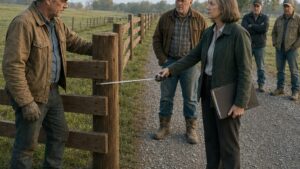
Frank submitted the deed before Rebecca was called to speak.
He placed it on the county hearing table with both hands, flattened the corners, and sat down without looking at her.
Beside the deed stood one terracotta pot.
Rebecca had brought it clean but unrepaired. The crack near its base formed a dark line through the clay. Across from it lay the incomplete county filing, the staple holes visible beneath a clear protective sleeve.
Two hearing members sat at the front of the room. Patrick occupied a side table with soil reports, water-use charts, and the conservation application. The county clerk had brought certified copies of the parcel record.
Nancy sat behind Rebecca.
The room held only eight people, but Rebecca could feel the weight of everyone outside it—the neighbors, the lender, the feed-store owner, the people who would hear by supper which family had lied and which one had lost.
A hearing member reviewed the deed.
“Ownership of the lower parcel is not in dispute based on the documents before us,” she said. “Mr. Carter holds title.”
Rebecca heard Nancy shift behind her.
Frank remained still.
The second member looked toward Rebecca. “Your petition asks the county to recognize an agricultural-use interest and release conservation funds.”
“Yes.”
“Do you claim ownership?”
The question was simple enough to ruin everything if answered carelessly.
Rebecca looked at the clay pot.
“No.”
Frank’s head turned.
“I cannot prove ownership,” she continued. “I can prove twenty years of rent, labor, and improvements. I can prove my family relied on continued access. And I can prove the current crop will fail without the buried irrigation.”
The first member glanced toward Patrick. “Mr. Davis?”
Patrick stood and summarized his findings without embellishment. The treated rows used less than half the water of the surface-irrigated controls. Plant survival was higher. The design met the program’s technical requirements.
“The project is eligible,” he said, “but the applicant is not, unless she establishes lawful control of the parcel for the grant term.”
“So competence is not the issue,” the member said.
“No.”
“Authority is.”
“Yes.”
Frank’s attorney had not come. Neither had Rebecca’s, because there was no attorney to send.
The clerk described the missing attachment. Frank acknowledged handling the filing and retaining a copy of the unsigned agreement.
One hearing member looked at him over her glasses. “Why was the attachment not included?”
“It lacked signatures.”
“That would ordinarily be marked incomplete, not separated.”
Frank’s hands rested flat on the table.
“I exercised judgment I should not have exercised.”
Rebecca had expected him to defend himself longer.
The admission unsettled the room.
The member asked, “Did withholding it benefit you?”
“Eventually.”
“How?”
“It preserved clear title for lending.”
Nancy made a quiet sound behind Rebecca.
Frank did not turn.
The second hearing member addressed Rebecca. “Your father declined to sign?”
“That is what I was told.”
“Do you have firsthand knowledge?”
“No.”
Nancy stood.
Rebecca looked back. Her mother’s face had gone pale, but her posture was steady.
“I do,” Nancy said.
The hearing members allowed her forward.
Nancy took the chair beside Rebecca and folded her hands.
“My husband believed signing the agreement would make every debt he owed Frank permanent,” she said. “He thought Rebecca would inherit the shame of it.”
Rebecca stared at the table.
Nancy continued. “He tore the original. Later, when he was sick, he made me promise we would never accuse Frank of taking the lower field.”
One member asked, “Why?”
“Because Frank had kept our home out of foreclosure.”
“And did your husband understand that refusing the agreement left your family without long-term protection?”
“Yes.”
The word seemed to leave the room without air.
Rebecca turned toward her mother.
“You knew he understood?”
Nancy’s eyes met hers. “Yes.”
“And you let me believe it was only Frank’s doing.”
“I wanted you to remember your father as strong.”
Rebecca felt the old instinct rise—to protect him, to contain the damage, to keep private failure inside the family.
That instinct had shaped every silence that brought them here.
She looked at Frank.
He appeared neither victorious nor relieved. Only tired.
The first hearing member said, “The county cannot create an ownership interest where none was recorded. Nor can we release funds without lawful access.”
Rebecca heard the false ending settle into place.
The method worked.
The field could be saved.
None of it was enough.
She reached into her folder and removed three pages she had written the night before.
“I am not asking the county to give me Frank’s land,” she said.
Frank looked at the papers.
“I am asking him to sign a ten-year agricultural easement. I waive any ownership claim based solely on past labor. Improvements are documented. Grant funds go directly to approved materials. Crop revenue is divided after operating costs.”
The second member took the pages.
Rebecca continued before courage narrowed.
“The easement also requires correction of the parcel history. The missing agreement gets placed in the public file with a statement from both parties.”
Frank’s expression hardened. “That damages my lending position.”
“So does a dead field.”
“You are asking me to admit misconduct.”
“I am asking you to record what happened.”
“And your father?”
Rebecca felt Nancy beside her.
“My father chose silence because he was ashamed. I kept choosing it for him.”
Her voice nearly broke, but she did not stop.
“He was grateful to Frank. He was also wrong to leave me bound by a promise that protected everybody except the person who had to keep farming.”
Nancy lowered her head.
Rebecca turned fully toward Frank.
“I will not call you a thief. You saved our home. Then you used the weakness you helped conceal. Both are true.”
Frank’s gaze moved to the cracked pot.
The room held still.
Rebecca placed the easement beside the deed.
“If you sign, Patrick can release the recommendation. The field stays productive. Your title stays yours. My access becomes lawful.”
“And if I don’t?”
“I lose the grant. Probably the farm.”
Frank looked up.
Rebecca did not hide the truth this time.
“My lender’s deadline is three days.”
Nancy inhaled sharply.
Frank’s eyes narrowed. “You never told me.”
“No.”
“Why?”
“Because I thought needing help made my claim weaker.”
The answer cost her more than the rest.
The first hearing member read the proposed terms.
“This county cannot compel Mr. Carter to sign,” she said. “But we can hold the grant application open until close of business Friday.”
The second member added, “If no access agreement is filed, the application will be denied.”
Frank stood.
For one moment Rebecca thought he might take the easement.
Instead he gathered the deed and the old certificate.
He left the incomplete filing on the table.
At the door, he stopped.
“You want me to correct the record and put my land behind your system.”
Rebecca remained seated.
“I want you to share the risk you have expected me to carry alone.”
Frank looked at the cracked pot once more.
Then he walked out without answering.
Rebecca drew the unsigned easement back toward her.
Friday was three days away.
At the bottom of the final page, two signature lines waited side by side.
Chapter 7: The Field They Could Save Only Together
Frank arrived at sunrise carrying the unsigned easement in one hand and a clay pot in the other.
Rebecca was already in the lower field, checking lids before the day’s heat settled over the corn. She saw his truck stop beside the leaning fence post where he had nailed the termination notice less than two weeks earlier.
He did not wave.
The pot he carried was the broken one she had left near the boundary. A pale band of repair compound circled its base.
Rebecca walked toward him but stopped on her side of the fence.
Frank placed the repaired pot on the hood of his truck. Then he held up the easement.
“I haven’t signed it.”
Her stomach tightened, though she had expected nothing else.
“The deadline is today,” she said.
“I know.”
“Then why are you here?”
“To ask what happens when the grant runs out.”
Rebecca looked past him toward his dry grazing land. “The grant installs the system. It doesn’t operate the farm.”
“And when the crop comes in short?”
“We divide what remains after costs, like the agreement says.”
“That might not cover either note.”
“No.”
He studied her face, perhaps waiting for reassurance she could not honestly give.
Rebecca had spent the three days since the hearing calling the lender, revising projections, and listing equipment that could be sold without ending the operation entirely. The numbers improved with the easement. They did not become kind.
“The first harvest won’t fix everything,” she said. “It gives us time.”
Frank looked at the corn. Several leaves had browned at the tips, but the treated rows still stood upright.
“My wife hated temporary fixes.”
“My father loved them.”
That brought the faintest change to Frank’s mouth.
Rebecca stepped closer to the fence.
“I’m not promising the field saves both farms,” she said. “I’m saying removing the pots guarantees it saves neither.”
Frank unfolded the easement across the truck hood. A new page had been added behind it.
Rebecca read the heading.
Correction and Supplemental Statement of Parcel History.
Her eyes moved down the text. Frank acknowledged processing the incomplete agricultural-use filing, retaining the unsigned attachment, and later using the parcel’s clear title as collateral. He also recorded the Walker family’s long tenancy, rent, labor, and improvements without conceding ownership.
“You filed this?” she asked.
“Yesterday afternoon.”
The county stamp appeared at the bottom.
Before signing the easement, before knowing whether she would accept his terms, Frank had corrected the record.
Rebecca ran her thumb over the raised seal.
“It doesn’t undo it,” he said.
“No.”
“It may make refinancing harder.”
“Yes.”
He looked irritated by her refusal to soften the truth.
Then he reached into the truck and removed another document.
“My lender will extend the note if the conservation plan covers both parcels.”
Rebecca read the proposal. The upper Carter acreage would be added to the water-efficiency project. Frank’s land—not only the disputed lower field—would secure the operating extension.
“You’re adding your place as collateral to the plan.”
“It already is collateral.”
“Not to my system.”
“Our system, if I sign.”
The word remained between them.
Rebecca looked toward the field where the clay mouths formed straight, patient lines through the corn. For weeks she had treated every pot as evidence of what she could accomplish alone. Now their usefulness depended on signatures, shared risk, and the man she had nearly decided was only an obstacle.
“What do you want changed?” she asked.
Frank pointed to a handwritten addition.
“If either lender forces a sale, documented improvement value gets divided before remaining proceeds.”
“That protects me.”
“It protects the work.”
Rebecca read the next paragraph. “You also added annual review.”
“Water changes. Markets change.”
“People change?”
“Sometimes too late.”
She met his eyes.
Frank took a pen from his shirt pocket but did not use it.
“There is one more condition,” he said.
Rebecca waited.
“No more digging on my land without written notice.”
Despite herself, she smiled.
“Seventy-two hours?”
“Seven days.”
“Three.”
“Five.”
“Done.”
Frank signed first.
His hand trembled slightly at the final stroke. Rebecca pretended not to notice.
She signed beneath him.
For several seconds, neither moved.
The easement did not make the field hers. It did not erase the unpaid rent, her father’s shame, Frank’s concealed filing, or the years both families had mistaken silence for trust.
It gave her ten lawful years.
It gave Frank a share in the crop and responsibility for the system.
It gave the county something it could fund.
By noon, the clerk had recorded the easement. Patrick submitted the completed conservation recommendation before the office closed. The lender agreed to suspend foreclosure action while the grant and operating extension were processed.
The money did not arrive like rescue. It came in approved invoices, equipment limits, inspections, and conditions.
Rebecca welcomed every condition.
By early September, repaired and newly fired pots served the lower field and two test rows on Frank’s acreage. The corn harvest was smaller than a good year and larger than the drought had any right to allow.
After costs, the first payment barely dented either debt.
Rebecca sold an old baler. Frank postponed replacing his truck. Nancy took over the farm books and wrote every agreement down, including the small ones.
Nothing became easy.
But nothing had to remain hidden.
On the final installation day, Rebecca carried the repaired pot to the old boundary. Frank followed with a shovel and the written site plan folded in his pocket.
The marked location sat inches from the line.
Frank checked the measurement twice.
“Your side,” he said.
Rebecca looked at the corn roots spreading beneath both parcels.
“Our agreement says the system can serve adjoining rows.”
“It says water may cross below grade.”
“Then the pot belongs here.”
She placed it directly beside the boundary, not beyond it.
Frank lowered the shovel blade into the hard ground. Rebecca worked beside him until the hole was wide enough. Together they set the pot, packed the soil, and covered its mouth with a flat stone.
Rebecca poured in the first gallon.
Nothing changed on the surface.
The soil remained dusty, the boundary line visible, the two properties legally distinct.
Then moisture began moving through the buried clay.
A dark band slowly widened beneath the ground, reaching the roots on Rebecca’s side and Frank’s side alike.
Neither of them spoke.
They stood over the place where the water crossed without taking anything with it.
The story has ended.