They Ordered Him to Remove the Stone Wall on His Farm—Then the First Hard Rain Exposed What It Had Been Protecting
Chapter 1: The Notice Pinned Beside the Lower Pasture
The fluorescent notice was stapled to the cedar post three feet from a wall the county had approved four years earlier.
William Anderson saw it from the tractor before he saw the words.
The paper was too bright for the lower pasture, almost glowing against the gray post and the pale limestone stacked along the edge of the gravel lane. He shut off the tractor, climbed down, and crossed the damp grass with the engine ticking behind him.
The notice carried the name of the agricultural road-and-drainage association at the top.
Below that, in bold type, was an order to remove the retaining structure within thirty days.
William read it twice.
The limestone wall ran about seventy feet along the lower edge of his pasture. At its tallest point it came to his waist. Above it, the ground rose gently toward the hayfield. Below it, a shallow grassed swale carried water toward the roadside ditch.
He had built the wall after a wet spring had taken nearly two feet of soil from the lower bank.
The county had required a grading sketch. He had filed one.
They had required setback measurements. He had given them.
An inspector had stood exactly where William stood now, boots planted in wet clay, and signed off on the finished work.
William folded the notice once and put it in his shirt pocket.
A pickup rolled slowly down the association lane.
Dennis Wilson stopped beside the wall and lowered his window.
“You found it.”
William looked at him. “Hard to miss.”
Dennis got out carrying a narrow folder. He was in his early sixties, broad through the chest, wearing work boots clean enough to show he had not been in a field yet that morning.
“This isn’t personal,” Dennis said.
William almost laughed.
“That sentence usually means something is.”
Dennis ignored that. “The board adopted the new drainage standard in March. Structures inside the roadside drainage corridor have to be removed or brought into compliance.”
“This isn’t in the corridor.”
“It affects the corridor.”
William looked down at the swale.
Water had cut a dark line through the grass from the previous night’s shower, nothing unusual for May. The stone courses sat above it, level and clean except for the green stain along the bottom row.
“What does that wall affect?”
Dennis opened the folder.
“We’ve had three ditch failures in two years. One culvert replacement. Two emergency grading bills. Insurance wants consistent maintenance. We can’t keep working around whatever somebody decided to put beside the lane.”
“Somebody.”
“You know what I mean.”
“I built it.”
“I know.”
“On my land.”
Dennis exhaled through his nose. “That’s not the whole issue.”
William pointed toward the wall. “Then tell me what part of it is wrong.”
Dennis hesitated just long enough for William to notice.
“It narrows the drainage section.”
“Where?”
“The standard requires an open slope.”
“This isn’t an open ditch.”
“It feeds one.”
“That’s different.”
Dennis closed the folder.
“This is exactly why the association hired someone to standardize these things.”
William felt something in him tighten at the word hired. Someone who had walked the road with a clipboard was apparently worth more than four wet seasons of watching where the water actually went.
He stepped closer to the wall.
“County approved it.”
“County approval doesn’t settle association maintenance.”
“It settles whether I built it legally.”
“I didn’t say you built it illegally.”
“Then why am I removing it?”
“Because the association is responsible for the drainage system along this road.”
William looked past Dennis toward the shallow ditch and the culvert farther downhill.
The association had been responsible for it for forty years in the loose rural sense of the word responsible: neighbors paid annual dues, someone arranged gravel when potholes got bad, somebody else rented a backhoe when a culvert washed out. There had never been much ceremony to it until recently.
Dennis had changed that.
He had inherited unpaid maintenance, rising costs, and complaints from newer landowners that some people were getting favored treatment. William knew all of that.
What he did not accept was that cleaning up old bookkeeping gave Dennis a right to redraw the farm.
“I have the permit,” William said.
Dennis nodded. “Bring it to the review meeting Thursday.”
“I don’t need a review meeting.”
“The board voted.”
“On my wall?”
“On the standard.”
“That isn’t the same thing.”
Dennis’s jaw shifted.
“If the wall remains after thirty days, the penalty schedule starts.”
William looked at him.
“What penalty schedule?”
“Fifty dollars the first week. One hundred after that. One-fifty a week once it becomes continuing noncompliance.”
The number changed the shape of the conversation.
Until then, William had treated the notice as paperwork that could be corrected by showing somebody the obvious.
Now Dennis was telling him the association intended to charge him until he surrendered.
William pulled the folded notice out again.
“You put a weekly fine on this?”
“The board did.”
“For a county-approved wall on my parcel.”
“For failure to comply with an association drainage order.”
William stared at the paper until the bright color blurred at the edges.
Then he said, “Come to the house.”
Sarah was at the kitchen table entering fuel receipts when William walked in with Dennis behind him.
She looked from one man to the other and stopped typing.
William went to the filing cabinet beside the pantry and pulled the drawer harder than necessary. He found the folder marked LOWER FIELD and laid it flat on the table.
“Here.”
He opened to the county permit.
Dennis read the first page.
William turned to the inspection approval.
“Final inspection. Signed.”
Dennis looked at the grading sketch.
Sarah leaned back in her chair.
“So what’s the complaint?” she asked.
Dennis kept his eyes on the paper.
“The wall can be legal and still conflict with association drainage.”
Sarah looked at William.
He knew that look. It was not agreement with Dennis. It was the expression she used when she wanted William to hear a sentence he had already decided he disliked.
Dennis closed the folder.
“I’m not disputing your permit.”
“Then we’re done.”
“No. We’re not.”
William took the folder back.
Dennis stood.
“Come walk it with me and the drainage contractor tomorrow afternoon.”
William said nothing.
“We’ll start at the upper ditch,” Dennis continued. “Follow the water down. If there’s something we’re missing, show us.”
William gave a short, humorless smile.
“You already sent the order.”
“That doesn’t mean we can’t inspect it.”
“You voted first and want to understand it second.”
Dennis’s face hardened.
“I’m giving you a chance to put your side on the record.”
“My side is already on the record. County permit. Survey. Inspection.”
Sarah said quietly, “William.”
He did not look at her.
Dennis waited.
“You coming tomorrow or not?”
William shut the folder.
“No.”
Dennis nodded once.
“All right.”
He left through the mudroom.
The screen door closed behind him.
For several seconds Sarah said nothing.
Then she looked toward the window facing the lower pasture.
“You could have walked it with him.”
William returned the folder to the cabinet.
“He could have walked it before he signed the notice.”
“That isn’t what I said.”
“I know what you said.”
Sarah watched him close the drawer.
Outside, the limestone wall caught the morning sun along its upper edge, each course straight and pale above the green swale.
William had spent years refusing to let committees decide where his fences went, where trucks crossed, or how much of his land became convenient simply because somebody else had gotten used to using it.
He had promised his father the farm would never become managed property one small concession at a time.
That promise had always sounded simple.
Now, for the first time, Sarah’s silence made him wonder whether he had just confused refusing a concession with refusing information.
Chapter 2: The Permit Proved Less Than William Expected
“The permit is valid.”
The county clerk slid the folder back across the counter.
William had expected relief.
Instead, he heard the next word before she said it.
“But.”
She tapped the grading sketch.
“This only tells us what was approved when you built the wall.”
“That’s what I came to confirm.”
“And it confirms it.”
She turned the sketch so they were both looking at it.
The drawing showed William’s lower field, the lane, the wall, and a shallow drainage swale in simple black lines. The county stamp crossed the lower corner.
“The wall is on your parcel,” she said. “The setback is fine. Inspection passed.”
William nodded.
“So the association can’t call it an illegal structure.”
“I can’t tell you what authority your association has under its own documents.”
“I’m not asking you to.”
“Good.”
She smiled faintly.
Then her finger moved to the line marking the drainage path.
“I would ask someone about this.”
William leaned closer.
“What about it?”
“This drainage line.”
“What’s wrong with it?”
“Maybe nothing. But you said the association claims the wall interferes with roadside drainage.”
“They claim a lot of things.”
The clerk gave him a look that suggested she had spent years hearing that sentence from property owners.
“If there’s a drainage dispute, the soil-and-water office can compare this with present conditions.”
William almost said he did not need another office involved.
Instead, he folded the sketch and drove across the county complex.
The soil-and-water technician met him near noon and agreed to look at the site after lunch.
He was younger than William expected, quiet, carrying a measuring rod and a tablet. He did not seem impressed by either William’s irritation or the association’s notice.
At the lower pasture, he studied the permit sketch first.
Then he walked fifty yards uphill.
Then he walked back down.
He did it twice.
Finally he stopped near the upper end of the limestone wall.
“Was this swale here when the wall was permitted?”
William looked at the shallow depression in the grass.
“Mostly.”
“Mostly?”
“It was there. I cleaned it up when I did the wall.”
The technician crouched and looked uphill.
“And that ditch along the road?”
“Been there longer than I have.”
“Same alignment?”
William frowned.
“As far as I know.”
The technician stood and walked toward the gravel lane.
At one point he stepped through the grass and disappeared nearly to the ankle in soft ground.
He looked down.
“Water stays here.”
“After rain.”
“This hasn’t dried in a while.”
William said nothing.
The technician checked the sketch again.
“The approved drainage route is farther inside your property.”
“It isn’t.”
“On this plan, it is.”
William took the page.
The difference was not large. Ten feet, perhaps twelve.
But once he saw it, he could not unsee it.
The line on the old sketch curved gently through the pasture.
The present swale hugged the lane and the limestone wall.
“When did that move?” the technician asked.
“It didn’t.”
The technician glanced at him.
William looked uphill again.
At the bend beyond his property line, the association ditch disappeared behind brush before reappearing near the road.
He had driven that lane thousands of times. He knew every pothole, every culvert, every low place that iced first.
But knowing a landscape was not the same as remembering exactly when one narrow trench had shifted ten feet sideways.
“Could’ve been cleaned out differently,” William said.
“Could’ve.”
“Does that change my permit?”
“No.”
“Does it make the wall illegal?”
“No.”
“Then we’re back where we started.”
The technician did not answer immediately.
“No,” he said. “You’re somewhere else.”
William did not like that.
“How?”
“The wall belongs to you. The permit looks fine. But if the active runoff was redirected after this plan was drawn, then your wall may be interacting with drainage that wasn’t part of the original review.”
“Interacting how?”
“I don’t know yet.”
“So Dennis can order it removed?”
“I didn’t say that.”
“Can you say anything useful?”
The technician’s expression remained calm.
“I can say somebody needs to understand where the water comes from before anybody changes what’s holding this bank.”
That sentence stayed with William all the way home.
At the kitchen table, Sarah spread the documents in two rows.
Permit.
Final inspection.
Survey.
Association notice.
William put the grading sketch beside them.
“The technician says the wall is legal.”
Sarah waited.
“And?”
“He says the drainage doesn’t match the old plan.”
She looked at the sketch.
“How much?”
“Ten feet. Maybe more.”
“Toward the road?”
“Toward the wall.”
Sarah traced the printed line with one finger.
“So where did the water run before?”
“Through the field.”
“And now?”
“Along the wall.”
Sarah sat back.
“That seems important.”
“It doesn’t give Dennis ownership.”
“I didn’t say it did.”
William stood and went to the sink for water.
He knew Sarah’s method. She could disassemble an argument simply by refusing to have the argument he wanted.
“The survey settles the property line,” he said.
“Yes.”
“The permit settles the wall.”
“It settles the wall you built.”
He turned.
“What’s that supposed to mean?”
“It means you keep saying the permit proves everything. Maybe it proves one thing.”
William set the glass down.
Sarah pulled a spiral notebook from the shelf beside the filing cabinet.
Its cover had once been blue. Years of dust and damp hands had turned the edges gray.
“What’s that?”
“My field notes.”
“You have field notes?”
“I have your field notes. You just never called them that.”
She opened it.
For years Sarah had written down dates when unusual things affected the farm: calves treated, pumps repaired, fence posts washed loose, diesel delivered, hay cut, culverts blocked. William remembered seeing the notebook around but had never considered it part of anything official.
She flipped through pages.
“2019. Big June storm. You dug sediment from the lower swale.”
“That was after the wall.”
“2017. Culvert plugged.”
“Before the wall.”
“2015…”
She stopped.
William watched her eyes move down the page.
“What?”
Sarah turned the notebook around.
The handwriting was hers, small and compact.
Association crew grading lane. Dug new ditch past Rivera field. Water muddy at lower fence by evening.
William read it again.
The date was eleven years earlier.
Long before his wall.
He looked toward the window.
From the kitchen, only the top course of limestone was visible beyond the pasture fence.
Sarah tapped the notebook.
“That sounds like the ditch changed.”
“Maybe.”
“You said it didn’t.”
“I said I didn’t remember it.”
“That’s different.”
William ignored the correction.
He looked at the grading sketch, then at Sarah’s entry.
The association had rebuilt part of the lane eleven years earlier.
If the roadside ditch had been shifted then, runoff from uphill might have been sent closer to his lower field long before he ever stacked the first limestone block.
His wall might not have interrupted the drainage system at all.
It might have been built because the drainage system had already been changed.
Chapter 3: The First Stone Came Out Clean
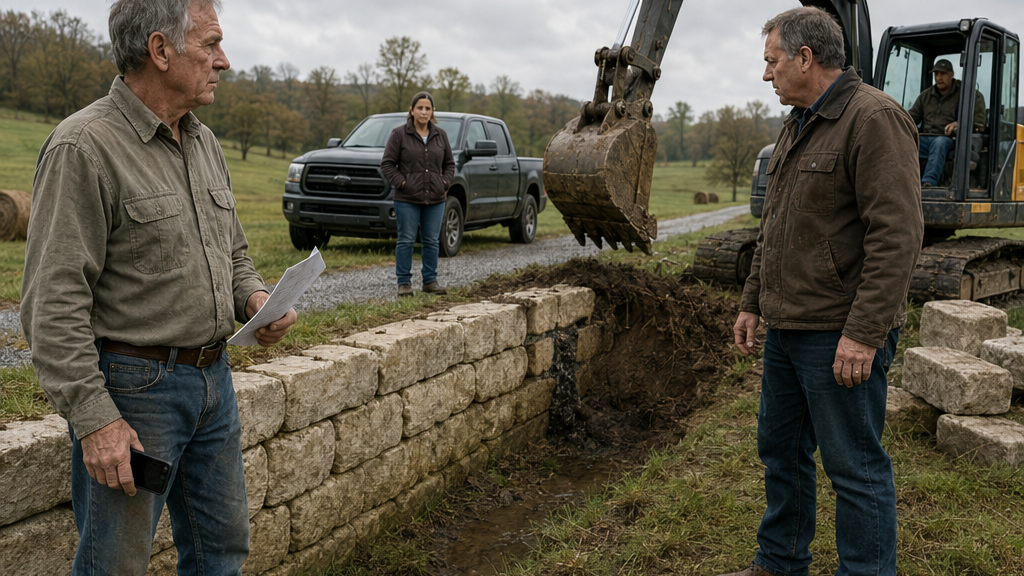
The excavator bucket settled against the first limestone block while William stood ten feet away holding the association’s written removal order.
He had photographed the wall before sunrise.
Every course.
Every corner.
The grass swale.
The lane.
The survey stakes.
The paper Dennis had sent after the board denied William’s appeal.
Now the machine idled in the lower pasture, diesel vibrating through the damp ground.
Dennis stood beside the operator.
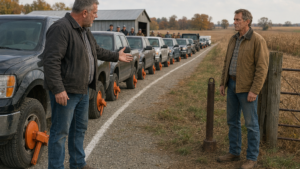
Michelle Rivera had stopped her pickup on the gravel lane. Two other landowners watched from farther uphill.
William walked to Dennis and held out the order.
“This is the final version?”
Dennis glanced at it.
“You know it is.”
“I want you to say it.”
Dennis looked at him.
“Yes.”
“Remove the retaining structure along the drainage corridor.”
“Yes.”
“Entire structure.”
Dennis’s mouth tightened.
“That’s what the order says.”
“And restore the bank to open grade.”
“Yes.”
William folded the paper.
“You still want it done exactly that way?”
Dennis stared at him for a moment.
“We’ve been over this.”
“No. We’ve argued about it. I’m asking once.”
Dennis looked toward the machine.
“Proceed as written.”
William stepped back.
The operator eased the bucket under the upper stone.
The first block came out clean.
It weighed several hundred pounds, pale limestone darkened along the bottom edge. The operator swung it away and set it on the grass.
The second stone followed.
Then the third.
William took photographs without comment.
Dennis watched for several minutes, arms crossed.
The crew had expected the backfill to be dry gravel.
Instead, when the fourth stone came free, a black seam appeared behind it.
Wet.
Not surface dampness.
Saturated.
The operator paused.
A thin trickle ran through the exposed gravel.
Michelle stepped out of her truck.
Dennis walked closer.
“What’s that?”
William lowered his phone.
“Water.”
“I can see that.”
“Then we’re making progress.”
Dennis gave him a sharp look.
The operator scraped lightly at the gravel with the bucket teeth.
More dark material fell away.
Something round appeared inside the bank.
The operator shut the machine down.
Without the engine, the sound of trickling water became clear.
Dennis crouched.
A corrugated pipe, no more than eight inches across, emerged from the earth behind the wall. Its end had been nearly buried in compacted stone.
Michelle came through the fence opening.
“I didn’t know that was there.”
William did not answer.
He had not known either.
Dennis stood.
“You put this in?”
“No.”
“You sure?”
William looked at him.
“I’m sure I didn’t bury a pipe in my bank and forget it.”
The operator brushed more soil away with a shovel.
The pipe angled uphill toward the roadside ditch.
Water dripped steadily from it despite two dry days.
Michelle stared at the opening.
“That’s coming off our side.”
Dennis said, “Maybe.”
“Where else would it come from?”
Dennis looked toward William.
“You knew water ran here.”
“I told you the wall handled runoff.”
“You never mentioned a pipe.”
“I never saw the pipe.”
Dennis rubbed a hand across his mouth.
For the first time since the notice appeared, William saw uncertainty replace irritation.
It lasted less than a minute.
Dennis walked uphill, following the angle with his eyes. Then he came back.
“We can stop and have somebody trace it.”
William waited.
That was the moment he could have said yes.
The county technician had given him a number to call if removal exposed anything unexpected.
The phone was in William’s pocket.
He could feel its weight.
Instead he said, “You already had somebody look at your plan.”
Dennis heard the accusation.
“So did you.”
“My technician said understand the water before changing the bank.”
“And you waited until this morning to tell me there might be something buried here?”
“I told you the wall was carrying water.”
“That’s not the same thing.”
“No.”
William looked at the open seam.
It was not the same thing.
That fact irritated him because Dennis was right.
He had known enough to be concerned. He had not known enough to explain exactly why.
Dennis looked at the machine operator.
“Can you remove the rest without crushing the pipe?”
The operator shrugged.
“Probably.”
Michelle turned toward him.
“You’re continuing?”
Dennis’s expression hardened again, though now it looked less like certainty and more like a man trying to preserve a decision already made.
“The pipe can be inspected once the bank is open.”
William almost said something.
He did not.
Dennis looked at him.
“You object?”
William thought of the review meeting.
The fines.
The fluorescent notice.
Dennis telling the board that William had refused a site inspection.
He thought of his father saying that once a committee decided it could manage one strip of your land, it eventually found reasons to manage the next.
William folded the order again and slipped it into his shirt pocket.
“You’ve got your authorization.”
Dennis held his gaze.
Then he nodded to the operator.
The excavator started.
Stone by stone, the wall disappeared.
As the lower courses came out, the ground behind them grew wetter. The buried pipe was fully exposed, its corrugated surface stained orange from years underground.
The operator stacked the limestone near William’s barn at his request.
By late afternoon, seventy feet of wall had become three neat piles.
The bank looked raw and strangely soft without it.
Dennis walked the length of the exposed grade.
“We’ll have the ditch reshaped tomorrow.”
William looked at the dark seam.
“You may want to trace that pipe first.”
“We will.”
“Before grading.”
Dennis turned.
“I heard you.”
William almost smiled.
Dennis saw it.
“If you think something is going to happen, say it.”
“I’ve been saying it.”
“No. You’ve been saying I don’t have authority.”
“That too.”
Dennis stepped closer.
“You want this to fail.”
William’s first instinct was to deny it.
Instead, he looked at the empty line where the limestone had stood.
“No.”
Dennis waited.
William added, “I want you to understand why it was there.”
“That’s not the same answer.”
Dennis walked back toward his truck.
Michelle remained beside the exposed pipe.
“You really didn’t know?” she asked.
“No.”
“But you knew the water was coming harder than it used to.”
William looked uphill.
“I knew what I saw.”
She followed his gaze toward her hayfield.
“The ditch project Sarah wrote down. That was before I bought my place.”
“I know.”
“My south corner drains into this road ditch.”
“I know that too.”
Michelle looked at the raw bank.
“If that pipe is taking anything from my field, we need to figure it out.”
“We should have figured it out before today.”
She did not argue.
By evening, the association crew had gone.
William stood alone in the lower pasture.
The sky had darkened in the west.
At the house, Sarah had the weather pulled up on her laptop.
When William came in, she turned the screen toward him.
A broad band of rain covered the next three days.
“How much?” he asked.
“Two inches possible. More in spots.”
William looked through the window toward the lower pasture.
The limestone was gone.
The wall that had held four years of runoff now sat in orderly stacks beside the barn.
He still had the county technician’s number in his phone.
Sarah watched him.
“You going to call?”
William did not answer immediately.
If he called, the county might stop the grading and force another inspection.
It might prevent exactly the failure he had warned Dennis about.
It might also give Dennis one more chance to say the problem had never been the order at all, only William’s refusal to cooperate.
William put the phone facedown on the table.
“Dennis said they’re tracing the pipe.”
Sarah looked at the screen, then back at him.
“That wasn’t my question.”
Outside, the first wind bent the grass along the unprotected bank.
Chapter 4: The Water Followed the Forgotten Grade
William heard gravel moving before daylight.
Not rain against the roof. Not wind in the sycamores.
Gravel.
A hard, irregular scraping came from the direction of the lower lane, like someone slowly dragging a shovel across stone.
He was out of bed before Sarah asked what it was.
By the time he reached the mudroom, water was already running beneath the door of the equipment shed in thin brown threads. He pulled on his boots, grabbed a rain jacket, and crossed the yard toward the tractor.
The rain had been falling most of the night, steady rather than violent. That made what he saw at the lower pasture worse.
The bank where the limestone wall had stood was moving.
Not collapsing all at once.
Unraveling.
Brown water poured from the exposed corrugated pipe and struck the loose grade below it. Each surge took another handful of gravel and soil. The shallow swale had filled, then overflowed, cutting a second channel toward the lane.
William stopped at the fence.
For one brief moment, all he felt was vindication.
There.
That was what he had tried to tell them.
The feeling lasted until a section of muddy water jumped the swale and spread across the gravel road.
Then William saw where it was headed.
“Sarah!”
She was already behind him, hood pulled over her hair.
“What?”
“The lower culvert.”
They ran back toward the tractor.
William started the engine and drove downhill while Sarah called Dennis.
The water had crossed half the lane by the time William reached it. Gravel rolled in the current, clicking against one another. The runoff did not come only from the exposed bank. Water was arriving from uphill in pulses, funneled by the association ditch.
At the buried pipe, it emerged fast enough to foam.
William stopped the tractor and stared.
“That pipe’s carrying more than this field,” Sarah said.
“I know.”
“You said you didn’t know where it came from.”
“I didn’t.”
Another surge pushed mud toward the ditch on the opposite side of the lane.
That ditch ran directly toward the shared culvert below Michelle Rivera’s hay access.
William climbed back onto the tractor.
Sarah caught his sleeve.
“What are you doing?”
“Keeping it out of the culvert.”
“With what?”
He looked toward the barn.
“Whatever I’ve got.”
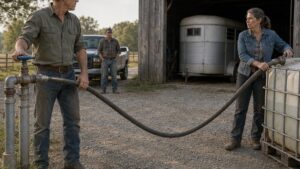
Within ten minutes he had two old round hay bales on the front spear.
They were not designed for erosion control. They were last year’s bottom bales, too weathered to feed, kept mostly because William disliked wasting anything that might still have a use.
He dropped the first beside the lane, then shoved it sideways into the muddy flow.
Water curled around it.
He set the second farther downhill.
The diversion slowed the spread but did not stop it.
Dennis arrived in his pickup, tires slipping slightly where mud had crossed the gravel.
He got out without a jacket.
“What happened?”
William pointed uphill.
“What does it look like?”
Dennis ignored the tone and walked toward the exposed bank.
The soil had cut away another foot since William arrived.
“Where’s the crew?” William asked.
“I called them.”
“You trace the pipe yesterday?”
Dennis did not answer.
William stared at him.
“You said you would.”
“They couldn’t get the camera until this morning.”
“So you left it open.”
“We expected them here before the heavy band came through.”
William looked toward the ditch.
“This isn’t the heavy band.”
Dennis’s face changed.
Sarah stepped closer.
“Then we need to quit arguing about yesterday and keep this off the road.”
Dennis nodded immediately.
That surprised William enough to silence him.
Dennis went to his truck for a shovel.
For the next hour they worked in the rain.
William used the tractor to drag loose gravel into a temporary berm. Dennis cleared debris from the culvert inlet. Sarah moved branches and chunks of sod by hand until Michelle’s pickup appeared at the upper bend.
Michelle stopped abruptly when she saw the water.
“What happened to my entrance?”
The runoff had cut a brown ribbon across the gravel just below the drive into her hayfield.
“Stay on the high side,” William called.
She came down on foot.
Then she saw the exposed pipe.
Her expression tightened.
“That’s still running?”
“It’s running harder,” Sarah said.
Michelle walked uphill along the roadside ditch, rain soaking the shoulders of her coat. She disappeared around the bend.
A few minutes later she called William’s name.
He found her standing beside a shallow junction near her south fence.
Water from her field ditch entered the association ditch there.
So did another channel from farther uphill.
Michelle pointed.
“It’s all feeding the same line.”
William watched the flow.
The present ditch hugged the road, gathering water parcel by parcel.
The old county grading sketch had shown something different.
A broad swale had once spread that runoff through his lower pasture.
Now it was being concentrated.
“Where does the road ditch cross back?” he asked.
Michelle shook her head.
“I thought it stayed open all the way down.”
“It doesn’t.”
The buried pipe had answered that.
Somewhere uphill, the ditch had been gathered, redirected under the shoulder, and discharged directly into William’s bank.
The wall had not merely held back dirt.
It had been slowing the outlet of a drainage system William had never agreed to receive in that form.
A cracking sound came from downhill.
They both turned.
A section of saturated bank slid into the swale.
The current carried it toward the lane.
William ran.
The tractor tires spun once before catching.
He shoved the nearest hay bale deeper into the path of the water, angling it toward a rough depression on his own side of the pasture.
The runoff changed direction.
Not much.
Enough.
The main brown stream moved away from the shared culvert.
Dennis came alongside, breathing hard.
“That’ll hold?”
“No.”
“How long?”
“Longer than nothing.”
Another vehicle approached.
The excavator operator climbed out carrying a length of orange drain hose.
Behind him, the rain intensified.
For the next several hours, nobody spoke about whose fault it was.
They opened a temporary relief channel across William’s pasture. The operator placed gravel around the pipe outlet. Dennis cleared the roadside ditch. Michelle moved her truck before the edge of her entrance softened further.
By afternoon, the worst of the runoff had been diverted.
The damage remained.
A twelve-foot section of bank had washed out where the wall once stood. Mud covered part of the lane. The shoulder near Michelle’s field was scarred. The shared culvert was packed with silt but still open.
William stood beside the stacked limestone near the barn.
Mud streaked the pale stones.
Dennis came up behind him.
“You were right about the wall.”
William looked at him.
He had imagined hearing those words.
In every imagined version, they had felt better.
Instead he looked at the ruts left by the tractor and the muddy road used by everyone on the association.
“I was right that removing it without understanding the water was stupid.”
Dennis accepted that.
William added, “That doesn’t make this good.”
Michelle approached from the lane carrying something in her hand.
It was a broken piece of old black plastic marker ribbon, muddy and faded.
“I found this above the pipe.”
William looked at it.
“So?”
Michelle pointed uphill.
“When I bought my place, the seller showed me where the association rebuilt the road. Said they moved the ditch because the old one kept cutting through the hay ground.”
Dennis turned toward her.
“When?”
“Before I owned it.”
“How long?”
She looked at William.
“About eleven years ago.”
The same year as Sarah’s notebook entry.
William felt the pieces settle into a new shape.
Michelle pointed toward the buried outlet.
“That pipe isn’t some private drain somebody added later.”
Dennis said nothing.
Michelle wiped mud from her fingers.
“It was part of the road project.”
Chapter 5: The Old Ditch Was Never Where They Remembered
Michelle put the association expense ledger on the folding table and opened it to a page marked with a yellow tab.
Sarah laid her old field notebook beside it.
The dates matched.
Eleven years earlier, on the same week Sarah had written Association crew grading lane. Dug new ditch past Rivera field, the association ledger showed payment for gravel, machine rental, culvert pipe, and two days of ditch work.
Nobody in the equipment shed spoke for several seconds.
The rain had stopped three days earlier, but mud still dried in brown fans along the floor where boots had tracked it inside.
Dennis leaned over the ledger.
“That proves we worked on the road.”
Michelle tapped the line below the machine rental.
“What did the pipe go to?”
The entry did not say.
William stood at the far side of the table with his arms folded.
He wanted Dennis to answer.
Dennis did not.
An association board member shifted in his chair.
“Could’ve been the culvert at the north bend.”
Michelle shook her head.
“That one’s concrete.”
“Maybe it replaced something older.”
“Maybe,” she said. “But we have an eight-inch corrugated outlet buried exactly where the ditch project ends.”
Dennis straightened.
“I never said the association didn’t install it.”
William looked at him.
“You said the wall was interfering with drainage.”
“It was.”
“It was holding your drainage up.”
“That’s not the same thing.”
“It’s close.”
Dennis’s eyes hardened.
Sarah touched William’s forearm.
Not enough for anyone else to notice.
Enough.
William stopped.
Michelle turned another page.
“There’s a second invoice.”
She read the description aloud.
“Shoulder fill and ditch realignment.”
The room went still again.
Dennis looked at the entry.
William felt an old, familiar satisfaction beginning to rise.
Here was the thing he had wanted from the beginning: a piece of paper that forced everybody else to stop pretending he was difficult simply because he would not yield.
But the satisfaction did not last.
The field notebook beside the ledger held another truth.
He had built the wall years after the ditch had been moved.
He had watched water strike that bank harder than it used to.
He had known the stone was doing more than holding the grade.
He had simply never told the association.
At the time, he had not seen why he should.
It was his land. His permit. His stone. His problem to solve.
Dennis closed the ledger.
“I knew there’d been a road rebuild.”
William looked up.
“You knew?”
“I knew the association rebuilt the shoulder and changed sections of ditch.”
“And you signed the removal order anyway.”
“I did not know the outlet had been moved onto your parcel.”
“You didn’t check.”
Dennis’s voice sharpened.
“You didn’t tell us.”
William almost answered immediately.
Then stopped.
Dennis pointed toward the window.
“You built that wall four years ago. You filed a county permit. Did you tell the association the wall was receiving runoff from our ditch?”
“No.”
“Did you ask whether that pipe was association infrastructure?”
“I didn’t know the pipe existed.”
“But you knew the water did.”
William said nothing.
Dennis continued, quieter now.
“You keep acting like you were the only one who knew enough to prevent this.”
“I knew enough not to remove the wall.”
“And not enough to tell anyone what it was actually doing.”
Sarah looked at William.
He hated that Dennis had found the exact weak point in his position.
Michelle sat down.
“This is getting us nowhere.”
“No,” Dennis said. “It matters.”
“It matters after we decide what happened.”
“It’s part of what happened.”
William unfolded his arms.
“You want me to say I should’ve reported the drainage when I built the wall?”
Dennis looked at him.
“Yes.”
“All right. I should have.”
Dennis seemed almost disappointed by the answer.
William went on.
“You should have stopped the excavator when the pipe showed up.”
Dennis’s eyes dropped to the ledger.
“Yes.”
It was the first time he had admitted that plainly.
The room changed.
Not into agreement.
Into something harder to dismiss.
Michelle pushed the two records toward the center of the table.
“So this is what we actually know. The association changed the ditch eleven years ago. William built the wall seven years later. The county approved the wall based on an older grading sketch. The association later treated the wall as an obstruction without tracing the drainage it had inherited.”
The board member looked toward Dennis.
“And the wall kept the bank stable.”
William said, “Until you removed it.”
Sarah glanced at him again.
He corrected himself.
“Until it was removed.”
Dennis noticed.
He did not comment.
Later that afternoon, they walked the road with the county soil-and-water technician.
The old drainage route was still visible if a person knew what to look for.
A shallow depression crossed William’s pasture at an angle, softened by years of hay growth. Near the upper fence, an old cut in the ground showed where water had once spread into that swale.
The road project had intercepted it.
The technician traced the present ditch with a measuring rod.
“You concentrated the flow,” he said.
Dennis stood beside him.
“Meaning?”
“Meaning water that once crossed a broader grassy area is now gathered along the road and discharged at one point.”
“Into William’s bank.”
“Yes.”
William looked toward the stacks of limestone.
“So the wall became the outlet protection.”
“Not designed outlet protection,” the technician said. “But functionally? Part of it.”
That distinction mattered.
The wall had worked.
It had not been engineered to work as part of the association system.
Its success had hidden the problem.
For four years, water had reached the limestone, slowed against compacted gravel, and passed through the lower swale without anyone needing to ask why.
The absence of failure had become evidence, in Dennis’s mind, that there was no dependency.
The presence of the wall had become evidence, in William’s mind, that he had solved his own problem.
Both conclusions had been incomplete.
Two days later, the insurance adjuster met them at the damaged bank.
He took photographs of the washout, the pipe, Michelle’s entrance, the shared culvert, and the stacks of stone.
Dennis explained the association’s position first.
William listened.
To his surprise, Dennis did not call the wall unauthorized.
He said the association had ordered removal under its drainage standard.
Then he admitted the buried outlet had not been identified before the work.
The adjuster turned to William.
“Did you know the wall was receiving association runoff?”
“I knew runoff reached it. I didn’t know about the pipe.”
“Did you notify the association when you built the wall?”
“No.”
The adjuster wrote that down.
William watched the pen move.
For weeks he had imagined the dispute as a straight line.
My land.
Their order.
Their mistake.
The notes on the adjuster’s clipboard refused to stay that simple.
At the end of the inspection, Dennis asked the question everyone had avoided.
“So is this association damage or private-property damage?”
The adjuster closed the clipboard.
“I can’t classify it that way.”
Dennis frowned.
“Why not?”
“Because the loss involves an association drainage modification, a privately built retaining structure, an association-directed removal, and a runoff function neither side documented correctly.”
William said, “That sounds convenient.”
“It may be inconvenient. It isn’t simple.”
“Who pays?”
“I’ll submit it. But I would not expect the carrier to treat this as one landowner’s isolated bank failure.”
Dennis looked toward the damaged slope.
“So what do you expect?”
The adjuster opened his truck door.
“That you figure out the permanent drainage responsibility before you rebuild anything.”
He drove away.
William remained beside the lane with Dennis.
The old wall was gone. The temporary diversion cut across William’s pasture. The association’s water still had to go somewhere.
For the first time, neither man could claim the solution belonged entirely to the other.
Chapter 6: Being Right Would Not Rebuild the Bank
The engineer planted two survey flags in the damaged slope and said, “Neither one of you can fix this by yourselves.”
William stood above the washout.
Dennis stood below it.
For a moment, the arrangement seemed too appropriate to be accidental.
The engineer pointed toward the buried pipe.
“You can stabilize the outlet, rebuild the bank, and spread the discharge. But the structure has to sit partly on Anderson’s parcel.”
Then he pointed uphill.
“And the association has to control the approach flow before it reaches this point.”
Dennis asked, “Cost?”
The engineer named a figure.
Michelle, standing with a folder under one arm, let out a slow breath.
William said nothing.
The number was high enough to matter and low enough that nobody could hide behind impossibility.
The design reused most of his limestone. A reinforced gravel core would sit behind the stone. Several visible drainage openings would relieve pressure. The association ditch would be widened uphill at two points so water entered the outlet more gradually.
It was, William had to admit, better than the wall he had built.
That annoyed him less than he expected.
The problem came three nights later at the association meeting.
Dennis slid a draft easement across the table.
William read the first paragraph.
Then the second.
Then he stopped.
“No.”
Dennis leaned back.
“You haven’t finished it.”
“I’ve finished enough.”
Sarah, sitting beside William, took the paper.
Michelle watched both men.
Dennis said, “The association can’t spend that money on private land without permanent access.”
“You can have access to maintain the drainage structure.”
“That’s what this gives us.”
“No. This gives you a twenty-five-foot strip through my lower pasture for drainage, inspection, construction, repair, replacement, modification, and anything reasonably related.”
“That’s standard language.”
“It’s broad language.”
“We need room to work.”
“You need room around the outlet.”
Dennis rubbed his forehead.
“We are not going through another situation where somebody builds something and then tells us we can’t reach our own drainage.”
William felt the old resistance return instantly.
Our own drainage.
On his ground.
Sarah put the draft down.
“What width does the engineer actually need?”
Dennis looked at her.
“That’s not the point.”
“It seems exactly like the point.”
Michelle opened her folder.
“The plan shows twelve feet for maintenance access.”
Dennis turned toward her.
“We discussed flexibility.”
“Yes. We did. We didn’t discuss twenty-five.”
Dennis looked around the table, realizing he no longer had the room aligned behind him.
His voice became quieter.
“Last year we spent almost half our reserve on emergency work. The year before that, another culvert failed because nobody could agree whose responsibility it was until the road was nearly gone. I am not signing an agreement that leaves us unable to maintain what we pay to rebuild.”
William heard something in Dennis’s tone he had missed earlier.
Fear.
Not fear of William.
Fear of being the person holding the association together when the next failure came.
It did not excuse the removal order.
But it explained why Dennis kept reaching for broad authority whenever uncertainty appeared.
William leaned forward.
“You want certainty.”
“Yes.”
“So do I.”
Dennis gave him a tired look.
“Then sign it.”
“No.”
The old answer.
But this time William did not stop there.
He pulled the engineer’s plan toward him.
“Give the association a recorded twelve-foot drainage easement centered on this structure. Inspection rights after major storms. Maintenance access with notice except emergencies. No expansion, relocation, or additional discharge without technical review and written consent from the affected landowner.”
Dennis stared at him.
William continued.
“You pay for the upstream ditch corrections because that’s association infrastructure. I pay the portion of the rebuilt wall that serves my grade above what the drainage design requires.”
Sarah looked at him.
He had not told her he had worked out the cost split.
Dennis said, “And if you sell?”
“The agreement runs with the land.”
Michelle asked, “And if the association changes the ditch again?”
“Then it gets reviewed before anybody moves dirt.”
Dennis looked down at the plan.
The room stayed quiet.
Finally he said, “You’d agree to that?”
William almost answered with irritation.
Instead, he thought of the phone lying facedown on the kitchen table before the storm.
He had known enough to make one more call.
He had chosen not to.
“I should’ve agreed to the site walk the first week,” he said.
Nobody moved.
Dennis looked at him.
William went on.
“I thought if I gave you one inch, you’d treat it as permission to take ten feet.”
Dennis glanced at the rejected easement.
“Apparently I tried for twenty-five.”
Michelle gave a short laugh.
Even William smiled.
Then Dennis’s expression changed.
“I should have stopped the removal when that pipe showed.”
“Yes.”
“I knew we didn’t fully understand the drainage.”
William looked at him.
That was more than Dennis had admitted before.
“You knew?”
“I knew the records were incomplete. I thought opening the bank would make it easier to see what we had.”
“And you kept going because?”
Dennis looked at the folded papers in front of him.
“Because I’d spent six months telling everyone we were done making exceptions. I thought if I stopped when it was your wall, every person who’d been ordered to move a culvert, clean a ditch, or replace a crossing would say the rules only mattered when the board felt like enforcing them.”
William understood the logic.
That made it worse, not better.
“You chose consistency over knowing whether the order was safe.”
“Yes.”
Dennis said it without qualification.
Michelle closed her folder.
“Then that needs to be in the minutes.”
Dennis looked at her.
She held his gaze.
“If we’re asking William to record an easement against his land, the association can record what it did too.”
The board member at the end of the table shifted uneasily.
Dennis was silent for a long time.
Then he nodded.
“Put it in.”
Sarah picked up her pen.
Dennis looked at William.
“Twelve feet?”
“Twelve.”
“Emergency access without notice?”
“For an actual emergency.”
“Technical review before changing discharge?”
“Yes.”
“And affected-landowner consent.”
“Yes.”
Dennis looked toward Michelle.
“We’ll need a policy for that.”
“Then write one,” she said.
The meeting ended without a handshake.
William did not need one.
Outside, Dennis caught up with him beside the gravel parking area.
“You know this won’t make everybody happy.”
“Nothing involving drainage ever does.”
Dennis looked toward the dark line of the road.
“I meant the admission.”
William understood.
Some board members would see it as weakness. Some landowners would use it to reopen old complaints. Dennis had spent a year trying to make the association predictable.
Now predictability required admitting where procedure had failed.
William opened his truck door.
“You wanted things on the record.”
Dennis gave a tired smile.
“So did you.”
“Yes.”
“Still do?”
William thought about the fluorescent notice, the excavator, the black seam of wet gravel behind the first limestone block.
Then he thought about the washout and the hay bales shoved into muddy water.
“Yes,” he said. “Especially the parts that make both of us uncomfortable.”
The revised minutes arrived three days later.
William read them at the kitchen table with Sarah beside him.
The language was plain.
The association acknowledged that the removal order had been executed despite unresolved uncertainty concerning the buried drainage outlet and that earlier association road work had contributed to the current runoff alignment.
Below that, the minutes recorded William’s agreement to negotiate a limited drainage easement and share the portion of reconstruction serving his private grade.
Sarah read the paragraph twice.
“You okay with that?”
William looked through the window toward the stacks of salvaged limestone.
For most of his life, a boundary had meant a line that told other people where to stop.
Now the permanent solution would require a line that also told them exactly where they were allowed to enter, what they were responsible for, and when they had to ask before changing anything.
It was not surrender.
But it was not the solitary version of ownership he had spent years defending either.
He signed the draft agreement and slid it across the table to Sarah.
“Send it.”
For the first time since the fluorescent notice appeared, the next change to the lower pasture would begin with both sides agreeing where the line was.
Chapter 7: The New Wall Marked More Than a Boundary
The first limestone block went back into the ground in September, but not where William remembered it.
He stood beside the lower pasture with the engineer’s plan folded under one arm while the excavator operator lowered the stone onto a compacted gravel base.
“Six inches farther uphill,” the engineer said.
The operator adjusted it.
William watched the block settle.
It was one of the same stones the association had ordered removed in May. He could still see the faint brown stain across one face where runoff had sat behind it for years.
Dennis stood on the gravel lane with Michelle.
No fluorescent notice.
No folder held like a shield.
Just boots, measuring tape, and the recorded drainage agreement Sarah had filed with the rest of the farm papers.
The rebuilt structure looked familiar only from a distance.
Behind the limestone, the crew had installed graded stone and reinforced fabric. Three drainage openings passed visibly through the lower courses. Farther uphill, the association had widened two sections of roadside ditch so runoff would spread before reaching the buried outlet.
Nothing was hidden this time.
That had become the point.
The engineer checked the twelve-foot maintenance easement against the survey stakes.
“The centerline is right here.”
Dennis stepped over the mark and stopped.
He looked toward William.
“Still feels narrow.”
William glanced at him.
“It’s twelve feet.”
“I know.”
“You asked for twenty-five.”
“I remember.”
“Then twelve ought to feel generous.”
Dennis almost smiled.
“Depends which side of the line you’re standing on.”
William looked at the stakes.
Months earlier, that sentence would have started another argument.
Now he said, “That’s why we wrote it down.”
Dennis nodded.
The new agreement had been recorded with more precision than anything the association had used before. Emergency access was defined. Routine inspections required notice. The association could maintain the drainage structure but could not relocate the outlet, increase discharge, or widen the easement without technical review and written consent.
William could not block necessary maintenance simply because he disliked the timing.
Dennis could not call uncertainty an emergency simply because he wanted a quicker answer.
Neither of them had received everything he wanted.
That was probably why the agreement worked.
By noon, half the wall was back in place.
Sarah arrived carrying sandwiches and the old blue field notebook.
William saw it under her arm.
“You bringing evidence to lunch?”
“Habit.”
She handed him a sandwich.
Michelle sat on the tailgate of her pickup.
The association had adopted its new drainage policy the previous week. Any change affecting runoff across more than one parcel now required a site review, a written technical finding, and notice to affected landowners before machinery moved.
Dennis had objected to one part of the language.
Not because he opposed the review.
Because he thought the word consent might let one difficult landowner hold up emergency work.
William had objected to the emergency exception for the opposite reason.
They had spent forty minutes defining both.
Sarah had watched from the end of the table.
Afterward she had said, “You two finally learned to argue about the same thing.”
William had not appreciated the remark at the time.
Now, watching Dennis measure a drainage opening with the engineer, he understood it.
The old arguments had never really been about the same thing.
Dennis had been defending the association from uncertainty.
William had been defending the farm from authority.
Both had treated the other concern as an excuse.
The wall had paid for that misunderstanding.
So had the bank.
The crew finished the last course two days later.
The engineer scheduled a controlled water test before signing off.
A tanker truck supplied the first flow uphill, releasing water into the association ditch in measured stages.
William stood beside the wall with Dennis.
At low flow, water reached the buried outlet and spread through the gravel core.
A thin stream emerged from the first opening.
Then the second.
The grassed swale below remained intact.
The engineer increased the flow.
William watched the water closely.
For years, he had judged runoff by signs few people noticed: where grass flattened, where gravel shone wet, where silt gathered behind a weed stem.
Now the same knowledge had gauges, measurements, and a drawing attached to it.
Water passed through all three openings.
None crossed the lane.
Michelle walked downhill to check the culvert.
When she returned, she raised one hand.
“Clear.”
Dennis exhaled.
William looked at him.
“You worried?”
“Yes.”
“I thought standardized systems solved that.”
Dennis gave him a sideways look.
“Apparently they still need water to cooperate.”
William laughed.
It surprised both of them.
The engineer reduced the flow.
Dennis walked to the lower opening and crouched.
“No pressure behind the face?”
“Not enough to matter,” the engineer said. “That’s what the openings are for.”
Dennis nodded slowly.
William remembered Dennis crouching beside the first exposed pipe in May, staring at water neither of them had expected to see.
Same man.
Same ground.
Different question.
Dennis stood.
“I should’ve stopped the machine that morning.”
William did not answer immediately.
The admission had already gone into the official minutes. It had already been discussed at meetings and with the insurer.
But here, beside the rebuilt wall, it sounded different.
Not procedural.
Personal.
William looked at the drainage openings.
“I should’ve made the call.”
Dennis understood which call he meant.
“The county?”
“Yes.”
“You think they could’ve stopped it?”
“Maybe.”
“That why you didn’t?”
William shook his head.
“No.”
Dennis waited.
William rubbed mud from the edge of one limestone block with his boot.
“I wanted you to learn.”
Dennis looked toward the lane.
“I did.”
“Cost everybody more than it should have.”
“Yes.”
Neither man tried to soften that.
The insurance settlement eventually covered part of the emergency work but not the entire reconstruction. The association paid for the upstream drainage corrections and its share of the engineered outlet. William paid for the portion of wall that supported his private grade.
There was no grand victory hidden in the numbers.
William wrote a check.
So did the association.
The lower pasture lost several weeks of usable ground.
Michelle had to repair the edge of her hay entrance.
Dennis endured two meetings where landowners questioned his judgment.
William endured one where a downstream neighbor asked why he had let the removal proceed when he suspected the bank would fail.
He had answered truthfully.
“I was angry.”
Nobody applauded.
He was grateful for that.
By early October, grass had taken hold along the repaired swale.
The first hard autumn storm arrived overnight.
William woke before dawn and listened.
Rain struck the roof.
For a moment he heard the old scraping sound in memory.
Gravel moving.
He dressed and went outside.
Sarah came with him carrying a flashlight and the blue notebook under her coat.
At the lower pasture, water ran steadily through the roadside ditch.
The buried outlet took the flow.
The new openings released it in three controlled streams.
No mud crossed the lane.
No section of bank shifted.
Dennis’s pickup appeared at the upper bend.
He stopped on the road and walked down.
Nobody had called him.
William noticed that.
Dennis checked the ditch.
William checked the wall.
Sarah stood near the survey stake with the notebook protected beneath her jacket.
After ten minutes, Dennis said, “Looks right.”
William nodded.
“It does.”
Dennis glanced toward the farmhouse.
“I’ll leave you to it.”
He started uphill.
William called after him.
“Dennis.”
Dennis turned.
William pointed to the nearest drainage opening.
“Small branch caught there.”
Dennis walked back.
Together they pulled it free.
That was all.
No meeting.
No argument about access.
No question about whose responsibility the obstruction was.
The recorded agreement already answered it.
When they reached the house, Sarah opened the notebook at the kitchen table.
Most of its pages carried ordinary farm history.
Storm dates.
Fence repairs.
Calving notes.
Fuel deliveries.
The entry from eleven years earlier remained there, the one that had helped uncover how the ditch had moved.
Sarah turned to a clean page.
William looked over her shoulder.
She wrote the date.
First autumn storm after drainage rebuild.
Then she handed him the pen.
William hesitated.
“What am I writing?”
“You tell me.”
He looked through the window toward the lower pasture.
The limestone wall was barely visible in the gray morning, but he could see the pale top course running above the swale.
Once, he had thought its purpose was obvious.
Stone held dirt.
A boundary kept people out.
A permit proved permission.
A rule proved authority.
None of those things had turned out to be complete.
William bent over the notebook.
Below Sarah’s storm entry, he wrote:
Joint inspection completed. Drainage functioning as agreed.
He paused, then added the maintenance date they had signed with the association.
Sarah read it.
“That all?”
William closed the notebook.
“That’s enough.”
Outside, the water kept moving downhill through the openings they had finally designed to acknowledge it.
The wall still marked where William’s land began.
But now it also marked where responsibility did not end.
The story has ended.