The Farm Association Fined Everyone Who Blocked His Lane—Until Their Own Trucks Needed Somewhere to Park
Chapter 1: Nine Orange Clamps Beside the Harvest Field
The first orange clamp was bright enough to see from halfway across Andrew Davis’s hayfield.
By the time Brandon Clark reached the gravel shoulder, there were nine of them.
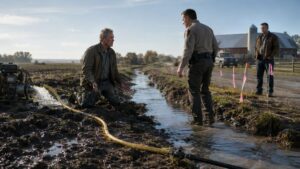
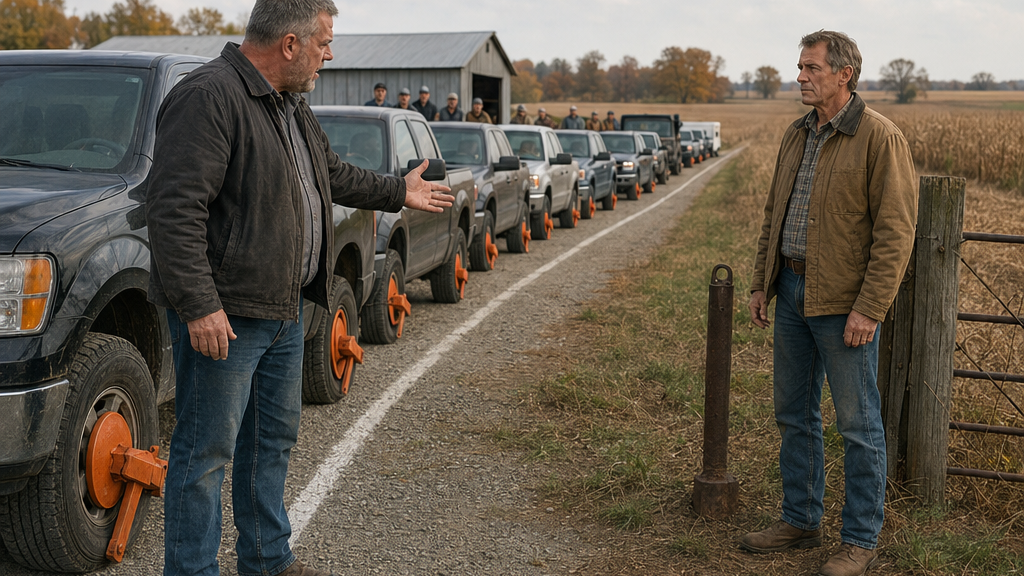
Nine pickups and utility vehicles stood nose to tail beside Andrew’s entrance, their right-side tires resting beyond the painted edge line that ran along the shared farm lane. Each front wheel carried the same heavy orange immobilizer. Beyond them, families who had come for the farm association’s autumn gathering were drifting out from the equipment shed, paper cups still in their hands.
Nobody was leaving.
Brandon stopped beside his black pickup and stared at the clamp around the wheel.
“What is this?”
Andrew stood near the gatepost with his hands in the pockets of his work jacket.
He had expected shouting. Brandon’s quiet voice bothered him more.
One of the board members crouched beside another truck and pulled uselessly at the clamp. “They’re all locked.”
“I can see that,” Brandon said.
Then he looked at Andrew.
The crowd seemed to understand at the same moment he did.
“You did this.”
Andrew glanced toward the contractor standing beside a plain service truck farther down the lane.
“I authorized it.”
A few people began talking at once.
Someone wanted to know whether the vehicles could be damaged. Someone else said the association had permission to park there. A woman demanded the contractor remove hers immediately because she needed to pick up her grandchildren.
Brandon ignored them.
“You authorized somebody to immobilize association vehicles?”
“They aren’t association vehicles,” Andrew said. “They’re privately owned vehicles parked on private ground.”
Brandon gave a short laugh that contained no humor.
“This is an association access lane.”
“The lane is.”
Andrew pointed down.
“The shoulder isn’t.”
For six years, Brandon had used that painted line as if it had been drawn into the earth by something larger than either of them.
Stay inside it.
Keep trailers clear of it.
Don’t let tires cross it.
Four inches counted.
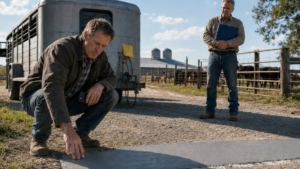
Andrew had watched Brandon kneel with a tape measure beside other people’s trucks. He had seen notices tucked under windshield wipers and invoices mailed before anyone had a chance to argue.
Now Brandon’s front tire sat almost a foot beyond the same line.
He followed Andrew’s gaze.
“That paint is our clearance marker.”
“Exactly.”
“Then you know why we park here during events. We keep the travel lane open.”
Andrew nodded toward the two pickups opposite Brandon’s.
“They’re narrowing the turn for anything longer than a half-ton.”
“That’s not the point.”
Andrew almost smiled.
He stopped himself.
For months he had imagined this moment differently. In those private versions, Brandon would finally have nothing to say. Andrew would stand there calm while everyone understood the hypocrisy without explanation.
Instead, looking at the families scattered beside the road, he felt the first thin edge of discomfort.
The orange clamps looked less clever in person.
They looked severe.
Brandon stepped closer.
“Take them off.”
“The contractor handles removal.”
“You hired him.”
“I followed the procedure.”
“Andrew.”
Brandon lowered his voice.
“This is a farm gathering. Half these people were invited here because the association asked them to come.”
“And?”
“And you know perfectly well this is different from somebody abandoning a truck in the lane.”
A man near the equipment shed called out that he had been parked less than two hours.
Andrew looked toward him.
Rebecca Garcia’s vehicle had once been gone in less time than that.
He said nothing.
Brandon seemed to recognize where his mind had gone.
“That situation was not the same.”
Andrew finally met his eyes.
“Why?”
Brandon’s jaw tightened.
The contractor walked over carrying a clipboard.
“If anybody needs the release procedure, I can start processing them one at a time.”
“What release procedure?” one of the attendees asked.
The contractor explained it plainly. Identification. Vehicle information. Posted release fee. Removal only after the paperwork was completed.
The reaction came immediately.
“How much?”
The contractor named the amount.
Several voices rose again.
Brandon stared at Andrew.
“You charged them?”
“I don’t collect it.”
“You arranged this.”
“I arranged enforcement.”
“That’s a cute distinction.”
Andrew felt something hot move through him, but his voice stayed even.
“It’s the distinction you’ve used for years.”
That silenced Brandon for half a second.
Long enough.
Several people heard it.
One of the board members looked down at his own clamped truck, then at the painted line.
Brandon turned toward the contractor.
“Remove all nine. The association will deal with the billing later.”
The contractor shook his head.
“I need authorization from the property owner or individual releases.”
Brandon pointed at Andrew without looking at him.
“There’s your property owner.”
Andrew said, “Individual releases.”
Brandon turned back.
“You really want to do this?”
That was the question Andrew had been waiting for.
Not because it was difficult.
Because it was so familiar.
Months earlier Rebecca had asked almost the same thing when Brandon told her there could be no informal exception for a few inches of tire.
Andrew could still see her standing beside the empty place where her vehicle had been.
Rules were rules, Brandon had said.
Andrew looked past him to the line of orange clamps.
“I want the posted procedure followed.”
Brandon’s face changed.
The anger stayed, but something else appeared beneath it—calculation.
“All right,” he said. “Then tomorrow morning I’ll call an emergency board meeting. We’ll review your use of the access area, every gate clearance, every equipment setback, every association covenant that touches this property.”
Someone behind him muttered that this was getting ridiculous.
Brandon kept his eyes on Andrew.
“You want technical enforcement? We can do technical enforcement.”
There it was.
The threat Andrew had known would come.
Months of records had taught him that Brandon rarely shouted when he believed paperwork could do more damage.
Andrew had spent eight years in county code enforcement. He knew exactly what administrative pressure could look like when someone decided to use every available rule.
He also knew how quickly a legitimate rule could become personal.
That knowledge had once been the reason he left the job.
Now he had used it to build this afternoon.
For the first time since the contractor arrived, Andrew wondered whether he had crossed some line that did not appear on any survey.
Brandon stepped toward his pickup.
The clamp prevented him from going farther.
He looked down at it, then back toward Andrew.
“You embarrassed nine people to make a point.”
“No,” Andrew said.
“What would you call it?”
Andrew glanced toward the wooden post at the entrance.
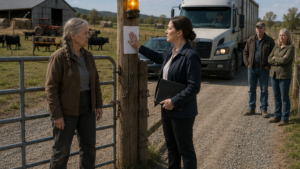
A rectangular warning sign was bolted there beneath the association’s old lane marker. From where Brandon stood, it was partially hidden behind two parked trucks.
Andrew pointed to it.
“I’d call it forty-five days of notice.”
Brandon frowned.
Andrew said, “You drove past that sign for forty-five days.”
Chapter 2: Four Inches Became an Expensive Farm Rule
Rebecca Garcia’s minivan was gone before she finished the morning feed.
Andrew found her standing beside the lane with one glove tucked under her arm and her phone in her hand, staring at the empty patch of gravel as though the vehicle might reappear if she waited.
“Thought your daughter borrowed it,” Andrew said.
Rebecca held out the phone.
A photograph filled the screen.
Her minivan sat exactly where Andrew remembered seeing it the night before, close to the livestock gate. A strip of pale paint ran beside the tires. A measuring tape stretched from the line to the outer edge of the rear wheel.
Four inches.
Andrew looked toward the road.
“Brandon?”
“Who else?”
She gave a dry laugh.
“I called the number. Towed at six-ten this morning.”
“For four inches?”
“That’s what the notice says.”
The minivan had been there because Rebecca’s usual parking area was blocked by stacked feed pallets. She had moved it late after unloading supplies and planned to move it again after morning chores.
Instead, she paid for a ride into town, then paid the tow yard before noon.
Andrew learned the amount that evening when she stopped at his machine shed.
“Two hundred twenty dollars.”
She laid the receipt on the workbench.
Andrew stared at it.
“You going to challenge it?”
“With who?”
“The board.”
Rebecca shook her head.
“And next month they start checking my trailer every time I turn around.”
“You don’t know that.”
“No. I know I’ve got calves to vaccinate and fencing to finish.”
She folded the receipt twice.
“I can’t afford to make irritation into a hobby.”
Andrew understood that more than he liked.
For years he had told himself the farm-access association was useful. The lane served several properties. Large trailers needed room to turn. Combines, hay wagons, cattle trucks, emergency vehicles—none benefited from cars scattered wherever somebody found gravel.
Brandon’s manner could be irritating, but the principle was sound.
That was what Andrew believed.
At first.
Then came the delivery truck.
A driver bringing fencing supplies to another property stopped beside the lane for less than forty minutes because the unloading area was blocked. The truck never prevented Andrew from getting his tractor through.
The family receiving the delivery still got a penalty notice.
Andrew saw Brandon two days later painting over a faded section of the edge line.
“You really cited them for that?” Andrew asked.
Brandon kept rolling white paint along the gravel margin.
“Commercial vehicle exceeded the permitted unloading window.”
“By how much?”
“Doesn’t matter.”
“It does if you’re charging them.”
Brandon stood.
“You want every person deciding which part of the rule matters?”
“No.”
“Then the rule has to mean something.”
Andrew watched him set the roller into the tray.
That answer bothered him because it was not entirely wrong.
A rule nobody followed was merely a suggestion.
So Andrew let it go.
He let other things go too.
The notices under windshield wipers.
The warnings about trailers left too close to the turn.
The photographs Brandon took with his phone whenever he believed a tire crossed the clearance stripe.
Andrew told Daniel about it before Christmas.
“Park by the barn,” he said. “Not the lane.”
Daniel arrived after dark carrying two grocery sacks and a pie balanced on one hand.
The barn area was muddy from a thaw. Rather than risk burying the truck, he stopped along the entrance for what he said would be ten minutes.
Ten became thirty.
Then dinner started.
Andrew remembered hearing the knock while Rebecca was passing potatoes.
Brandon stood outside holding a folded notice.
“Your brother’s truck is beyond the clearance marker.”
Andrew looked past him.
Daniel’s right rear tire rested across the white paint.
“How far?”
“Far enough.”
“It’s Christmas dinner.”
Brandon’s expression did not change.
“The rule isn’t suspended for holidays.”
Daniel came up behind Andrew.
“You serious?”
Brandon handed him the notice.
“One hundred fifty dollars.”
Daniel stared at it.
“For parking at my brother’s place?”
“For obstructing an association-controlled access zone.”
“I’m not obstructing anything.”
Brandon looked toward Andrew.
“You know why the clearance exists.”
That was what ended the conversation.
Because Andrew did know.
At least he thought he did.
He paid Daniel’s fine himself two days later rather than let his brother turn it into a family argument.
The payment stayed with him longer than he expected.
Not because of the money.
Because Brandon had photographed the truck before knocking.
He had already decided what the situation was before asking anybody a question.
By spring Andrew began noticing the line even when Brandon was nowhere nearby.
It appeared in every trip down the lane.
A thin pale stripe dividing permissible from punishable.
Then the association held its first quarterly gathering.
Andrew was repairing a gate hinge that afternoon when the traffic began arriving.
Pickups first.
Then two utility vehicles.
Then a truck towing a small display trailer.
The gathering took place near the association equipment shed beyond Andrew’s south field, where members reviewed maintenance schedules and spent more time eating than discussing culverts.
By two o’clock the regular parking area was full.
Vehicles spread along the lane.
Andrew stopped tightening the hinge.
Three tires were over the painted line.
Then five.
One pickup sat so far onto the shoulder that its passenger-side doors faced the ditch.
Nobody received a notice.
Andrew waited.
Brandon walked past them twice.
Once carrying a folding table.
Once with a cardboard tray of coffee.
He did not photograph a single plate.
At the summer gathering, it happened again.
Andrew said nothing.
That silence became easier to justify once he started calling it observation.
Maybe Brandon had issued warnings privately.
Maybe the gatherings had some exception Andrew had never read.
Maybe association events operated under a different clause.
He wanted there to be an explanation because the alternative would force him to admit how long he had accepted a standard that was only strict in one direction.
Late that summer, Andrew drove past the equipment shed during another gathering and saw Brandon’s pickup parked among the others.
The left side of the travel lane remained clear.
The right tires sat beyond the painted edge.
Andrew stopped.
He got out without thinking.
For years he had carried his phone mostly for weather alerts, auction listings, and photographs of broken equipment.
Now he opened the camera.
He framed the pickup so the plate, the tire, and the painted line all appeared together.
Then he took the picture.
Brandon emerged from the shed before Andrew reached his truck.
Their eyes met across the lane.
Brandon looked down at the phone in Andrew’s hand.
Then at his own tire.
Neither man said anything.
Andrew got back into his truck with the photograph still open on the screen.
For the first time, he was no longer wondering whether the exceptions were real.
He was wondering how many there had been.
Chapter 3: Andrew Logged Every Truck They Excused
By August, Andrew had four rows of photographs spread across his kitchen table.
Spring gathering.
Early-summer meeting.
Equipment demonstration.
Late-summer supper.
He had arranged the images by date, then by arrival time, then by vehicle.
The same painted edge line appeared in nearly every frame.
So did many of the same trucks.
Brandon’s black pickup showed up three times beyond the stripe.
One board member’s utility vehicle appeared at all four gatherings.
Andrew had written arrival and departure times in a legal pad beside each photograph.
He disliked how familiar the process felt.
Eight years earlier, in a county office twenty-three miles away, he had done almost the same thing for work.
Different violations.
Different people.
Same habit.
Observe first.
Record exactly.
Never depend on memory when a photograph can settle a measurement.
Andrew had left code enforcement after eight years because he grew tired of becoming the face people associated with their worst letter of the month. He had been good at the job, which somehow made it worse.
Good enforcement required distance.
Good judgment required knowing when distance had become indifference.
He had not always known.
The old notebooks were still boxed in a cabinet in the spare room.
He found them while searching for a ruler.
Andrew sat on the floor and opened one.
Dates.
Parcel numbers.
Photograph references.
Contact attempts.
Warnings.
Deadlines.
The handwriting looked almost identical to the notes on his kitchen table.
He closed the book.
For a long minute he remained sitting there.
It would have been easy to tell himself he was simply being careful.
But careful people did not attend four association gatherings mainly to photograph tires.
He carried the notebook back to the kitchen anyway.
The next morning he began comparing the association’s own citations against his event photographs.
Rebecca’s four-inch violation.
The delivery truck.
Daniel’s Christmas fine.
Two trailer-clearance notices.
A hay wagon warning issued to another neighbor.
In each case, Brandon had described the painted edge as mandatory safety clearance.
At association gatherings, violations equal to or greater than those examples went untouched.
Andrew built a simple chart.
Date.
Vehicle.
Approximate encroachment.
Duration.
Enforcement action.
The residents’ column filled with notices, fines, and one towing charge.
The association-event column remained empty.
He was studying it when someone knocked on the screen door.
Heather Torres stood outside holding a folder against her chest.
“I heard you’ve been requesting enforcement records.”
Andrew opened the door.
“They’re association records.”
“I didn’t say you couldn’t request them.”
Heather came in but did not sit.
Her eyes went directly to the table.
“You’ve been busy.”
“I’ve been comparing.”
“That’s what worries me.”
Andrew leaned against the counter.
“Why?”
“Because this looks less like a question and more like a case.”
“Maybe it is.”
Heather set the folder down.
“You used to work enforcement.”
Andrew looked at her.
“Who told you?”
“Nobody had to. You ask for records like someone who knows exactly which record creates the next question.”
She picked up one of the photographs.
Brandon’s pickup. Tire beyond the line.
“You take these yourself?”
“Yes.”
“At the gatherings?”
“Yes.”
“All four?”
“Yes.”
Heather put the photograph back.
“You ever ask Brandon about it?”
“He saw me take one.”
“That isn’t what I asked.”
Andrew did not answer.
Heather folded her arms.
“You think the board is going to see this and say, ‘Good catch, Andrew’?”
“I don’t care what they say.”
“That’s not true.”
He almost objected.
She continued before he could.
“You care enough to spend months documenting them.”
“They fined people for less.”
“I know.”
“Then why are we arguing?”
“Because if you walk into a meeting with secret photos and a chart you built for four months, Brandon won’t hear selective enforcement. He’ll hear ambush.”
Andrew looked at the rows of pictures.
“Maybe he should.”
Heather’s expression hardened.
“That’s exactly what I mean.”
The comment followed him the rest of the day.
He repaired fence after lunch, checked cattle before supper, then returned to the kitchen and looked again at his chart.
The evidence had not changed.
His satisfaction in building it had.
That bothered him.
Still, Heather had given him the enforcement records he requested.
He spent two evenings reviewing them.
The pattern became worse.
Association gatherings did not merely lack fines.
There were no written exemptions.
No temporary parking authorizations.
No recorded waivers.
Nothing showing the rule had been suspended.
Brandon simply did not enforce it.
Andrew could have confronted him then.
Instead, he asked a different question.
Who actually controlled the shoulder?
The association documents repeatedly called it an “access margin.” The phrase sounded official without saying much.
Andrew had learned long ago that vague institutional language often survived because nobody compared it against the underlying property record.
He drove to the county records office the following Tuesday.
The clerk helped him pull the current parcel information.
Andrew studied the map.
His farm boundary ran alongside the shared lane.
Nothing surprising there.
Then he noticed the line at the entrance.
He leaned closer.
“Can you enlarge this section?”
The clerk adjusted the display.
The parcel boundary extended farther toward the lane than Andrew expected.
Past the ditch edge.
Past the gravel shoulder.
Nearly to the traveled surface itself.
Andrew pointed at the screen.
“What is this line?”
“Parcel boundary.”
“And this?”
“Recorded access easement.”
They were not the same.
Andrew felt the old professional part of his mind come awake.
“Do you have the subdivision plat this came from?”
The clerk searched.
A scanned document appeared.
Older.
Less precise.
Useful enough to make his pulse quicken.
The association’s access easement crossed a narrow portion of the lane, but the broader gravel shoulder—where Brandon had repeatedly treated the painted line as association-controlled ground—appeared to remain inside Andrew’s parcel.
Andrew sat back.
The clerk glanced at him.
“Something wrong?”
“I don’t know yet.”
That answer was true.
A parcel map was not a court ruling. Old surveys could conflict with later instruments. Easements could contain rights not obvious from a screen.
Andrew knew better than to treat the first document that favored him as final proof.
That was another lesson from his county years.
The fact you wanted most was the fact you checked hardest.
“Is there an older survey tied to this subdivision?”
The clerk searched again.
“Yes.”
“What year?”
She read the entry.
“1988.”
Andrew looked through the office window toward the parking lot.
For months he had been asking whether Brandon enforced the same rule against everyone.
Now a more dangerous question had opened beneath it.
What if the association had been enforcing part of that rule on land it had never controlled at all?
Chapter 4: The Old Survey Changed Who Controlled the Shoulder
The 1988 survey put the painted line in the wrong place.
Andrew knew that before he finished tracing the dimensions with his finger.
The county clerk had rotated the scanned sheet so the north arrow matched the modern parcel map. What looked like a harmless difference on the computer screen became several feet when Andrew compared the old measurements with the current lane.
He leaned toward the monitor.
“Can you print that?”
The clerk nodded. “Full size or reduced?”
“Full.”
The printer started somewhere behind the counter.
Andrew kept studying the screen.
The shared access easement followed the traveled portion of the lane. Its western edge stopped short of the gravel shoulder where Brandon had spent years treating the white paint as if it were an official property boundary.
It wasn’t.
At least not according to this document.
The clerk brought the pages over.
Andrew laid the modern parcel map beside the 1988 survey.
The lines matched closely enough to make his stomach tighten.
He had learned in code enforcement never to fall in love with the first document that agreed with him. Old surveys could be superseded. Recorded easements could be amended. Somebody might have granted broader access later.
“What came after this?”
The clerk searched the index.
“There are maintenance agreements. A drainage amendment. One utility easement.”
“No access expansion?”
“Not that I’m seeing.”
Andrew spent another hour checking.
Nothing widened the association’s right beyond the recorded lane.
By noon he had copies of the survey, parcel record, easement language, and every amendment tied to the tract.
He did not feel triumphant.
He felt careful.
That surprised him.
For months he had imagined discovering something that would finally put Brandon in his place. Now that he had it, or something close to it, Andrew could already hear the questions he would have asked if the evidence belonged to somebody else.
Who surveyed it?
Was it recorded?
Was there a later instrument?
Were the physical markers still present?
Did ownership automatically mean the association had no enforcement rights?
He drove home without calling anyone.
At the farm entrance, he stopped beside the painted line.
Brandon’s stripe followed the gravel shoulder in a clean white arc. Andrew walked it with the old survey folded beneath his arm.
He measured from the fence corner.
Then from the drainage marker.
Then again from the centerline of the traveled lane.
The same result kept appearing.
The white paint was not marking the association’s boundary.
It was sitting inside Andrew’s property.
By several feet in places.
Andrew stood there holding the tape.
A truck approached from the south.
He stepped off the lane.
It was Brandon.
The black pickup slowed as it passed.
Brandon looked at Andrew, then at the measuring tape, then at the papers under his arm.
He did not stop.
Andrew watched the truck disappear around the bend.
That evening he opened Rebecca’s towing notice.
The violation description said her minivan had occupied the “association-controlled access margin.”
Andrew found the same phrase on Daniel’s fine.
Then on the delivery penalty.
He placed the notices beside the survey.
The words looked less official now.
Not meaningless.
But questionable.
The distinction mattered.
The association might still have authority to protect access to the traveled lane. It might still regulate obstruction affecting the easement.
But that was different from claiming control of every inch of Andrew’s shoulder.
The next day Andrew called the county office responsible for private-property vehicle enforcement.
He asked questions without giving names.
Ownership.
Notice requirements.
Posting period.
Authorization.
Contractor licensing.
Liability.
The answer he cared about most came with a warning.
“Being the property owner doesn’t mean you can just immobilize something whenever you feel like it.”
“I know.”
“There are signage requirements.”
“I know.”
“Advance notice.”
“How long?”
The employee told him.
Andrew wrote it down.
“And if the vehicle is partly within an easement?”
“Then you’d better be certain you aren’t interfering with whatever rights that easement grants.”
Andrew thanked her.
He called a surveyor next.
The surveyor would not promise anything from scanned records.
“I’ll locate the old monuments if they’re still there,” he said. “Then I’ll tell you what I can support.”
That was the answer Andrew wanted.
Three days later they found one iron pin beneath grass near the ditch.
Another marker appeared beside an old fence corner.
The field measurements supported the 1988 survey.
The gravel shoulder belonged to Andrew.
The association easement was narrower.
The painted line Brandon had treated as law was not the legal edge at all.
Andrew stood beside the newly flagged pin while the surveyor packed his equipment.
“You’ve got a disagreement between usage and title,” the surveyor said.
“Meaning?”
“Meaning people have acted like one thing was true for a long time.”
“That doesn’t make it true.”
“No.”
The surveyor closed the truck bed.
“But long habits make people angry when somebody finally measures them.”
That proved accurate sooner than Andrew expected.
Heather arrived the next afternoon.
She stepped out of her SUV and looked immediately at the survey flags.
“You had it surveyed.”
“Yes.”
“You could have told the board.”
“I wanted to know what was true first.”
Heather looked toward the painted stripe.
“And?”
Andrew handed her a copy.
She read silently.
Her face changed at the easement dimensions.
“This is going to cause trouble.”
“It already caused trouble.”
“That’s not what I mean.”
“I know.”
Heather folded the pages.
“What are you planning?”
Andrew looked toward the shoulder.
“I haven’t decided.”
She studied him long enough to make him uncomfortable.
“You’ve decided something.”
He didn’t answer.
That silence irritated her.
“You keep doing that.”
“Doing what?”
“Acting like saying nothing makes you neutral.”
Andrew frowned.
“I’m checking facts.”
“You’re building something.”
She handed the survey back.
“If you want the rule corrected, bring it to the board.”
“And let Brandon explain why the documents don’t matter?”
“You don’t know that he will.”
Andrew gave her a look.
Heather sighed.
“No. I suppose you don’t.”
After she left, Andrew sat at his kitchen table.
He had enough information to confront Brandon.
Enough to demand a meeting.
Enough to embarrass him.
Instead, Andrew opened the private-enforcement requirements again.
He read every line.
Then he called a licensed sign company.
When they asked what wording he needed, Andrew read directly from his notes.
He gave them the measurements twice.
He gave them the posting location.
He gave them the effective date.
Before hanging up, the woman asked, “You want one sign?”
Andrew looked through the window toward the farm entrance.
“One should meet the requirement.”
He paused.
“Make it two.”
Chapter 5: Forty-Five Days Gave Everyone Fair Warning
Andrew bolted the first warning sign to the gatepost on a Tuesday morning.
He mounted the second farther down the gravel shoulder where nobody approaching from the association shed could honestly claim not to see it.
The signs were plain.
Private property.
Restricted parking.
Vehicle immobilization possible after the effective date.
Contact information.
Nothing about Brandon.
Nothing about the association.
Nothing clever.
Andrew preferred it that way.
Daniel did not.
When he stopped by that afternoon, he read the nearest sign twice.
“You’re serious.”
“Yes.”
“You’re going to boot people?”
“If they park there after the effective date.”
Daniel glanced toward the lane.
“Association people?”
“Anybody.”
Daniel smiled.
“That ought to be interesting.”
Andrew did not return the smile.
The required notice period made the whole thing less satisfying than revenge was supposed to be.
Forty-five days meant forty-five opportunities to change his mind.
It also meant forty-five days for everyone else to notice.
Within a week, most of them had.
Rebecca stopped at the gate one evening and read the sign from her vehicle.
When Andrew approached, she lowered the window.
“This because of Brandon?”
“This is because it’s my property.”
“That wasn’t my question.”
Andrew rested a hand on the window frame.
“I’m not hiding it.”
Rebecca looked toward the second sign.
“No, you sure aren’t.”
She hesitated.
“I don’t want my two-twenty back bad enough to watch the whole neighborhood tear itself apart.”
“I didn’t say anything about your money.”
“You don’t have to.”
She drove away before he could answer.
That stayed with him.
He had begun this because Rebecca had been treated unfairly.
Now Rebecca herself was warning him what unfairness could become when anger was given paperwork.
Two weeks later Brandon finally stopped.
Andrew was repairing a hinge near the entrance when the black pickup pulled onto the shoulder.
Not beyond the line.
Exactly beside it.
Brandon climbed out and walked to the sign.
He read the entire thing.
Then he laughed.
Andrew kept working.
“You put this up?”
“Yes.”
“Vehicle immobilization.”
“That’s what it says.”
“On the association lane.”
“On my shoulder.”
Brandon turned.
“You’re still on that.”
“I never stopped.”
Brandon walked closer.
“Andrew, people have parked along here during association functions for years.”
“They’ve also been fined for parking along here.”
“Not during association functions.”
“That’s the point.”
Brandon’s expression tightened.
“Association events serve the whole membership.”
“So?”
“So there are practical differences.”
Andrew set down his wrench.
“That’s a useful phrase.”
“What is?”
“Practical differences.”
Brandon stared at him.
“When Rebecca was four inches over, was that a practical difference?”
“That was a clearance violation.”
“What about Daniel?”
“Same thing.”
“And your truck at the summer supper?”
Brandon’s eyes narrowed.
Andrew realized, too late, how much he enjoyed finally saying it.
Heather had been right.
He had turned months of silence into ammunition.
Brandon looked toward the sign again.
“You’ve been keeping score.”
Andrew said nothing.
There it was again.
His refuge.
Brandon laughed once.
“This is what you want? Fine. Put up your signs.”
He tapped the gatepost with two fingers.
“You won’t do anything during an association gathering.”
“How do you know?”
“Because you’re angry, Andrew. You’re not stupid.”
Brandon walked back to his pickup.
Before getting in, he looked toward the painted line.
“You know why we keep that lane clear.”
“Yes.”
“Then quit pretending this is about access.”
The truck left.
Andrew stood beside the sign long after the dust settled.
The accusation bothered him because part of it was true.
He had researched the property because of selective enforcement.
He had followed the permit procedure because he wanted Brandon to experience the same certainty he had imposed on everyone else.
That was not identical to protecting access.
Andrew knew the difference.
He hated that Brandon did too.
Three weeks before the autumn gathering, Andrew contracted with the immobilization company.
The contractor reviewed the property documents and posting dates before agreeing.
“No surprises,” he told Andrew.
“That’s the idea.”
“Once we’re called, we follow the posted procedure.”
“Same for everyone.”
“Owner included?”
Andrew looked at him.
“If I park illegally, yes.”
The contractor shrugged.
“You’d be surprised how often people say that before it’s their truck.”
The following Monday Heather asked Andrew to meet her at the association office.
The room smelled of old coffee and machine oil from the attached equipment shed.
She had three folders on the table.
“Brandon thinks you’re setting him up.”
“He saw the signs.”
“He thinks you won’t enforce.”
“That’s his decision.”
Heather rubbed her forehead.
“You two are impossible.”
Andrew sat across from her.
“You asked me to come here.”
“Yes.”
She opened the first folder.
Inside were older minutes from association meetings.
“This started before I was treasurer.”
“What did?”
“The hard enforcement.”
Andrew looked at her.
Heather pulled out a photograph.
It showed the shared lane years earlier.
Vehicles lined both sides.
A large piece of emergency equipment sat crooked behind them, unable to turn.
Andrew picked up the photograph.
“What happened?”
Heather did not answer immediately.
She opened another folder.
There were repair invoices.
A handwritten incident summary.
Meeting notes.
Then a photograph of a damaged barn wall.
Andrew’s irritation cooled.
“When was this?”
“Eight years ago.”
“Brandon’s place?”
Heather nodded.
“There was an electrical fire in one of his barns. Somebody had a family gathering farther down the lane. Cars were parked everywhere.”
Andrew looked again at the emergency vehicle.
“It couldn’t get through?”
“It got through eventually.”
“That’s not what I asked.”
“No.”
Heather folded her hands.
“The first truck lost time because it couldn’t make the turn. They had to get people outside moving vehicles.”
Andrew looked toward the office window.
The lane was visible beyond the equipment shed.
The same lane.
The same clearance problem.
“Was anybody hurt?”
“No.”
“Livestock?”
“Some smoke exposure. Most got out.”
“So Brandon tightened the rule.”
“Yes.”
That explained the beginning.
It did not explain Rebecca.
Or Daniel.
Or the gatherings.
Andrew pushed the photograph back toward Heather.
“Then why does he ignore it when the board parks there?”
Heather’s expression changed.
“That’s the part I wanted you to understand before Sunday.”
Andrew waited.
She touched the old photograph.
“Brandon didn’t invent that rule because he likes collecting fines.”
“I never said he did.”
“You thought it.”
Andrew did not deny it.
Heather looked down.
“He built the whole enforcement system after emergency crews lost those minutes at his barn.”
She paused.
“And at some point, protecting the lane stopped being the only thing he was protecting.”
Chapter 6: Brandon Had Once Needed the Rule
The emergency photograph was still on the association table when Brandon walked in.
He stopped in the doorway.
For one second, nobody spoke.
Then Brandon looked at Heather.
“You showed him.”
Heather did not apologize.
“He needed to see it.”
Brandon closed the door behind him.
Andrew remained seated.
The photograph lay between them: emergency equipment boxed in by parked vehicles, people standing in the lane, the front of the truck angled uselessly toward a turn it could not make.
Brandon sat across from Andrew.
“You think that changes anything?”
Andrew looked at him.
“I’m trying to decide.”
“That’s generous.”
Heather stood.
“I’m going back to the office.”
Neither man stopped her.
After she left, the attached shed seemed unusually quiet.
Andrew touched the edge of the photograph.
“How much time did they lose?”
Brandon’s mouth tightened.
“Seven minutes.”
Andrew had expected less.
Seven minutes was long enough to matter.
“Anybody tell you the outcome would have been different without the delay?”
“No.”
“Then why—”
“Because I watched a fire truck sit fifty yards from my barn while people hunted for car keys.”
The words came hard but not loud.
Brandon leaned back.
“You ever watched something you built fill with smoke while somebody tells you they can’t get the equipment through?”
“No.”
“Then don’t ask why seven minutes stayed with me.”
Andrew said nothing.
This silence was different.
Not avoidance.
Listening.
Brandon looked at the photograph.
“Afterward everybody agreed the lane had to stay clear. Every person in this association nodded their head.”
“So you started enforcement.”
“We started warnings.”
Andrew waited.
Brandon corrected himself.
“I started warnings.”
“What changed?”
“Warnings became arguments.”
Brandon counted them almost absently.
One person was only unloading.
One was only staying ten minutes.
One truck had been there for years without trouble.
One trailer technically left enough room.
“Every obstruction had a reason,” he said. “Every owner thought his reason was special.”
Andrew knew that pattern.
He had heard the same thing across county desks.
“So you stopped allowing discretion.”
“Yes.”
“And then started allowing it again.”
Brandon looked at him.
“For association events.”
“Why?”
“Because those events are scheduled. People know they’re happening.”
“Fire trucks care about schedules?”
“No.”
“Then why?”
Brandon’s irritation returned.
“You already know what you think.”
“I’m asking.”
“Now you’re asking.”
That landed.
Andrew let it.
Brandon stood and walked to the window.
“Three years ago, two board members wanted me replaced.”
“Over parking?”
“Over enforcement. They said I was making the association hostile.”
“They weren’t entirely wrong.”
Brandon turned.
“People wanted the rule until it cost them money.”
“So you exempted the people who could vote you out.”
“I made event accommodations.”
Andrew almost laughed.
“Practical differences.”
Brandon’s face hardened.
“Yes.”
“At Rebecca’s expense.”
“She blocked the clearance zone.”
“Your truck blocked more.”
“That gathering had traffic control.”
“There was no traffic control.”
Brandon looked away.
That mattered more than an argument would have.
Andrew saw it clearly then.
Brandon was not confused.
He knew.
The original reason was real. The fear was real. The need for clear access was real.
So was the hypocrisy.
One did not cancel the other.
“You could have changed the rule,” Andrew said.
“I tried.”
“How?”
“We proposed designated event parking.”
“What happened?”
“People complained it was too far from the shed.”
Andrew stared at him.
“That’s it?”
“You think people need noble reasons to resist inconvenience?”
“No.”
“Neither do I.”
“Then enforce it.”
Brandon gave him a tired look.
“You think leadership is choosing the technically clean answer every time?”
“No.”
“That’s exactly what you think.”
Andrew felt the words before he understood why.
Brandon pointed toward the survey documents visible in Andrew’s folder.
“You spent months photographing tires. Then you dug through county records. Then you hired a surveyor. Then you posted signs.”
“All legally.”
“I didn’t say otherwise.”
“Then what are you saying?”
“I’m saying you don’t talk to people until you’ve already built the box you want them standing in.”
The room went still.
Andrew’s first instinct was to defend himself.
Evidence prevented pointless arguments.
Documents prevented memory from shifting.
Rules were easier to discuss when facts were fixed.
All of that was true.
None of it answered Brandon.
Andrew looked at the emergency photograph again.
Heather had told him almost the same thing in gentler words.
“Maybe,” Andrew said.
Brandon seemed surprised.
Andrew continued.
“That doesn’t make the exemptions right.”
“No.”
It was the first time Brandon had said it plainly.
Andrew looked up.
Brandon returned to the chair.
“No,” he repeated. “It doesn’t.”
The admission changed the room.
Not enough.
But something.
Brandon rubbed his palms together.
“I told myself the events were different because we knew when they were happening. Then because somebody was always nearby to move a truck. Then because people complained. Then because I got tired of having every meeting turn into a fight.”
“And ordinary farmers kept paying.”
“Yes.”
“Rebecca paid two hundred twenty dollars.”
“I know.”
“Daniel paid one-fifty.”
“I know.”
“You photographed his truck during Christmas dinner.”
Brandon looked uncomfortable.
“It was across the line.”
Andrew almost answered immediately.
Instead, he heard how perfectly that sentence captured the problem.
Across the line.
A fact used without context when context belonged to somebody else.
Andrew closed the folder.
“The autumn gathering is Sunday.”
“I know.”
“My signs take effect that morning.”
“I know.”
Brandon looked toward the window.
“There’ll be more vehicles than the parking lot holds.”
“Then tell them not to use my shoulder.”
“They will.”
“Then move them.”
Brandon was silent.
Andrew understood.
“You already told people they could park there.”
Brandon did not answer.
“When?”
“Before your signs went up.”
“But you never corrected it.”
“No.”
“Why not?”
Brandon’s mouth tightened.
“Because I thought you wouldn’t enforce.”
There it was.
Not ignorance.
Assumption.
Andrew stood.
“Then correct it now.”
“It’s Thursday.”
“That gives you three days.”
“You know what that will do.”
“What?”
“Half the board will say I let you dictate association operations.”
Andrew picked up his folder.
“So this is still about keeping your chair.”
Brandon stood too.
“You think I like this?”
“I think you chose it.”
Brandon moved closer.
“Give me Sunday.”
Andrew stopped.
“One event. We relocate the parking afterward. I’ll put the issue on the next agenda.”
Andrew looked at him.
It was the exact exception that had been granted again and again.
One delivery.
One family visit.
One afternoon.
One understandable reason.
Just this once.
The irony was almost too clean.
Andrew thought of Rebecca’s empty parking spot.
Daniel’s folded notice.
The photograph of the blocked fire truck.
Then the warning signs standing in full view for more than a month.
“No,” he said.
Brandon exhaled slowly.
“You’re really going to do it.”
“If they park there.”
“You know what people will call this.”
“Yes.”
“Revenge.”
Andrew looked toward the emergency photograph.
“Maybe some of it was.”
Brandon frowned.
Andrew surprised himself by continuing.
“That’s something I have to answer for.”
The anger in Brandon’s face eased by a fraction.
“But I’m not giving you an exception,” Andrew said. “Because if I do, nothing changes.”
He started toward the door.
“Then what do you want?”
Andrew stopped with his hand on the knob.
Until that moment, the answer had been simple.
He wanted Brandon caught by his own rule.
He wanted the photographs, the survey, the signs, and the clamps to force an admission.
Now that seemed too small.
Andrew looked back.
“After Sunday?”
“Yes.”
“I want every disputed fine reviewed.”
Brandon stared at him.
“I want the actual easement mapped. I want event parking moved. I want the same clearance rule written so it applies to me, you, Rebecca, the board, and anybody visiting.”
“You expect the board to agree?”
“No.”
“Then what?”
Andrew opened the door.
“Then they can explain why they need exceptions nobody else gets.”
He stepped outside.
Brandon called after him.
“And Sunday?”
Andrew turned once.
“The notice stands.”
But when Andrew drove home, he made one change to the plan.
He called the immobilization contractor and told him not to arrive early.
No hidden setup.
No trapping vehicles before anyone could reconsider.
The contractor would come only after the posted restriction took effect and only if vehicles were still there.
Andrew hung up and looked toward the painted line beside his farm.
On Sunday, Brandon would either move the trucks—or finally have to live inside the rule he had built.
Chapter 7: No Exception Means Andrew Gets None Either
Brandon Clark was the first person to complete the release paperwork.
He stood at the contractor’s folding table beside Andrew’s farm entrance, reading every line before signing his name.
Around him, the autumn gathering had stopped being a gathering. Families clustered near the equipment shed. Two board members were making calls. Someone had begun carrying food back inside because nobody seemed interested in eating anymore.
Brandon handed over his identification.
The contractor checked it against the form.
“Release fee is the posted amount.”
“I know.”
Brandon paid.
The contractor walked toward the black pickup carrying the removal key.
Andrew remained beside the gatepost.
He had expected Brandon to look at him.
Brandon did not.
The orange clamp came free with a metallic snap.
The contractor lifted it away from the tire and carried it back toward the service truck.
One down.
Eight remained.
Rebecca had arrived twenty minutes earlier after hearing what happened. She stood near Andrew now, arms folded beneath her jacket.
“Does it feel as good as you thought?” she asked.
Andrew watched another attendee begin filling out a release form.
“No.”
Rebecca nodded as if that answer suited her.
“Good.”
Andrew looked at her.
She shrugged.
“If you’d said yes, I’d have worried.”
Across the lane, Brandon moved his pickup away from the shoulder.
He parked it in the field area beyond the equipment shed and walked back.
This time he came directly toward Andrew.
“You proved it.”
Andrew said nothing.
Brandon glanced at the remaining clamps.
“Is that what you needed to hear?”
“No.”
“Then what?”
Andrew looked at the painted line beneath the vehicles.
The old stripe was still visible in places, but the corrected survey markers now showed something clearer. The legal boundary and the safety clearance were not the same thing. For years Brandon had treated them as one convenient line.
Andrew had nearly done the same in reverse.
“I want a meeting,” he said.
Brandon gave a humorless laugh.
“You already threatened one.”
“I’m not threatening.”
“What do you want on the agenda?”
“Every access penalty from the last two years.”
Brandon’s expression changed.
“Andrew—”
“Every one.”
“You know how much work that is?”
“Heather has the records.”
“That doesn’t mean every penalty was wrong.”
“I didn’t say it was.”
Brandon studied him.
Andrew continued.
“If somebody actually obstructed the easement, the fine stands. If somebody was penalized for being on land the association didn’t control, we review it. If exceptions were given to association members for the same thing, we review that too.”
Brandon looked toward Rebecca.
She did not look away.
“And after that?” he asked.
“Surveyed access map.”
“We already have maps.”
“You have diagrams.”
Brandon’s mouth tightened, but he did not argue.
“Permanent markers where they’re needed,” Andrew said. “Separate the actual property boundary from the safety clearance. Designated event parking away from the lane.”
“And enforcement?”
“Same written rule for everyone.”
Brandon looked back at the orange clamps.
“You really think people will agree to that after today?”
“No.”
“At least you’re realistic.”
“They don’t have to like it.”
“That sounds familiar.”
Andrew absorbed the remark.
“Yes,” he said. “It does.”
For the first time that afternoon, Brandon almost smiled.
Almost.
Three days later, the association meeting filled every chair in the small office.
Heather had placed copies of the old survey, current parcel map, enforcement records, and proposed access diagram on the table.
Andrew expected anger.
He got it.
One board member wanted the immobilization charges reimbursed by Andrew personally.
Another wanted Brandon removed as chairman before anything else was discussed.
A neighboring farmer demanded repayment for a trailer fine from the previous spring.
Rebecca sat near the back without speaking.
Brandon sat at the head of the table.
For the first half hour he defended almost nothing.
That unsettled people more than an argument would have.
Finally, one member slapped a hand against the survey.
“If he was enforcing on property the association doesn’t own, why is he still sitting there?”
Brandon looked at the paper.
“Because I was enforcing what I believed was the established clearance.”
“You gave yourself exceptions.”
“Yes.”
The room quieted.
Brandon continued.
“That part was wrong.”
Andrew watched several people shift in their chairs.
No applause.
No satisfaction.
Just the discomfort of hearing a man say plainly what everyone had spent months arguing around.
Heather opened the enforcement ledger.
“We can separate three categories,” she said. “Actual obstruction of the recorded easement. Violations based only on the old painted margin. And cases where comparable association-event parking was permitted.”
The work took hours.
Some fines remained valid.
A trailer had genuinely blocked the lane.
A delivery vehicle had stayed in a turning area long enough to force equipment onto soft ground.
But others did not survive the comparison.
Rebecca’s towing charge was one of them.
Heather slid the record toward her.
“The rear tire was outside the easement.”
Rebecca looked at Brandon.
“So I was towed from Andrew’s property.”
Brandon exhaled.
“Yes.”
“And nobody checked.”
“No.”
Rebecca folded her hands.
“I want my two hundred twenty dollars.”
Heather nodded.
“You should get it.”
Daniel’s Christmas fine went into the reimbursement group too.
When the first meeting ended, nobody had solved everything.
But the association had agreed to suspend enforcement based on the old painted line until the new map was adopted.
Two weeks later, permanent markers went in.
The corrected clearance route followed the actual needs of large farm equipment rather than pretending one painted stripe could represent every legal and safety question.
Event parking moved to a mowed section of field beyond the equipment shed.
It was farther away.
People complained.
They parked there anyway.
Brandon remained chairman through the review.
Some members hated that.
Andrew refused to join the effort to remove him.
Rebecca cornered him afterward beside the entrance.
“You protected him?”
“No.”
“Looked like it.”
“I voted on the rule changes.”
“You didn’t vote to remove him.”
Andrew looked toward Brandon, who was helping reposition a marker farther down the lane.
“Removing him doesn’t fix the map.”
Rebecca considered that.
“You getting soft?”
“No.”
“Shame.”
She smiled slightly and walked away.
The real test came a month later.
Daniel arrived with a load of fence posts in the bed of his truck.
The new field parking area was muddy after two days of rain, so he stopped near Andrew’s gate.
Andrew was carrying feed sacks into the barn when he heard the truck door slam.
“I’m here ten minutes,” Daniel called.
Andrew looked toward the lane.
Daniel’s rear tire rested just beyond the corrected clearance marker.
Not on association-controlled property.
On Andrew’s.
But inside the space they had agreed to keep clear for turning equipment.
Andrew set down the sack.
“Move it.”
Daniel laughed.
“I’m unloading.”
“Move it first.”
“It’s your land.”
“Doesn’t matter.”
Daniel stared at him.
“You’re serious?”
Andrew walked closer.
The tire sat perhaps six inches beyond the marker.
Months earlier, that measurement would have filled him with anger.
Four inches.
Six inches.
Numbers used like weapons.
Now the measurement meant something simpler.
A boundary they had all agreed to honor.
“You told them the same rule applies to everybody,” Daniel said.
“Yes.”
“I’m your brother.”
“I know.”
Daniel looked at the muddy field.
Then back at Andrew.
“You could make one exception.”
Andrew glanced down the lane.
He remembered Brandon asking for Sunday.
One gathering.
One exception.
One reason that felt harmless to the person receiving it.
Andrew shook his head.
“No.”
Daniel studied him for another second, then climbed back into the truck.
He reversed carefully.
The tire rolled away from the marker.
Then he turned into the field and parked where everyone else did.
Andrew picked up the feed sack again.
A vehicle approached from the far end of the lane.
Brandon’s pickup.
He slowed near Andrew’s entrance.
For a moment, both men looked at the corrected line.
Brandon’s tires stayed cleanly inside it.
Andrew raised one hand.
Brandon returned the gesture and drove on.
Nothing had been erased.
Rebecca had still paid money she should never have owed. Andrew had still spent months building a case instead of having a conversation. Brandon had still protected his position by giving the people around him privileges he denied others.
But the old painted stripe was fading beneath the gravel now.
The permanent marker beside it did not belong to Brandon.
It did not belong to Andrew either.
It simply showed where the shared rule began.
Daniel returned from the field carrying the first bundle of posts.
“You happy now?”
Andrew took half the load from him.
“No.”
Daniel grinned.
“Good.”
They walked toward the barn together.
Behind them, the truck remained on the correct side of the line.
The story has ended.